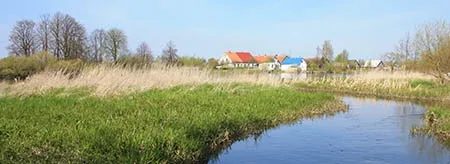
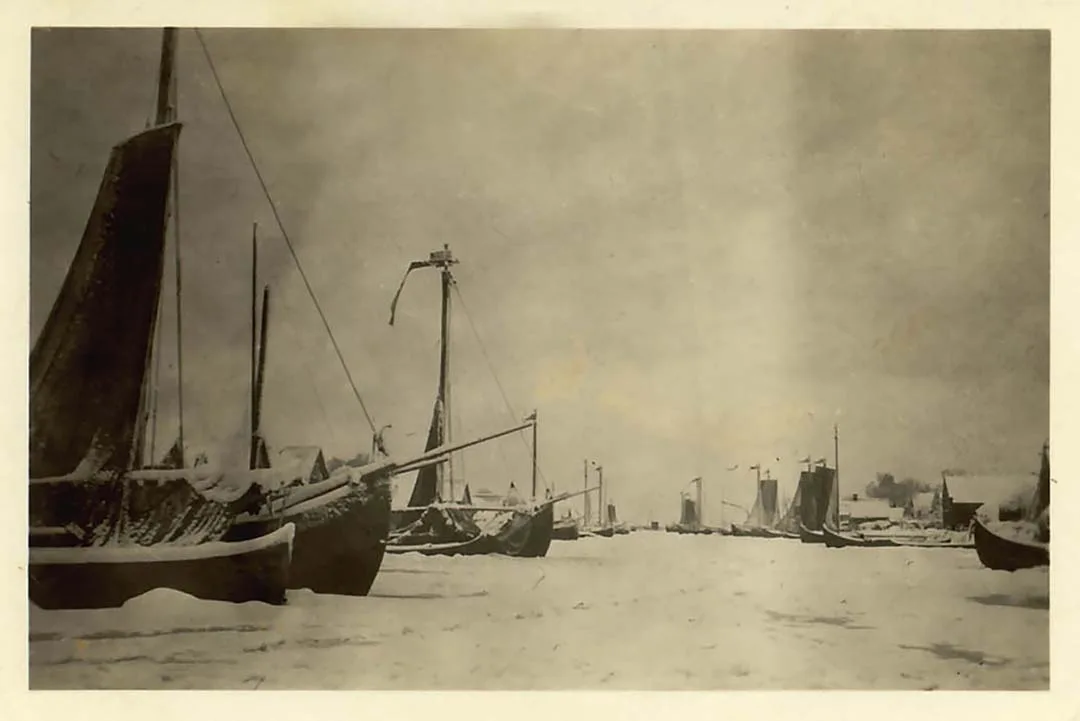
Tawe (German: Tawe) has been known since 1520 as a fishing village on the shore of the Curonian Lagoon belonging to the parish of Kuntzen, which lay on the Curonian Spit. Because the journey across the Curonian Lagoon to the church in Kuntzen was so inconvenient, a parish was established in 1570 in the neighbouring village of Inse / Inse (Prichaly), to which Tawe then belonged. In 16th-century documents Tawe also appears under the names Thabelle (c. 1525), Tawlen (c. 1540) and Thabe (from 1542).
In 1785 Tawe was classified as a royal fishing village (königlich Fischerdorf) with 71 households. The village belonged to the Amt of Labiau / Labiau (Polessk) in the Kreis of Tapiau / Tapiau (Gvardeysk). In 1790 Tawe is recorded as having a "Kulm" inn with brewing rights and a Lithuanian school.
From 1818 Tawe was a village forming a rural municipality in the Kreis of Niederung (from 1938 the Kreis of Elchniederung). Until 1874 Tawe belonged to the Amt of Labiau (Polessk). In 1818 the village had 70 households. But by 1871 the number of families in Tawe had grown to 186, living in 67 houses. On 26.03.1874 the rural municipality of Tawe was incorporated into the newly established Amtsbezirk of Inse (Prichaly).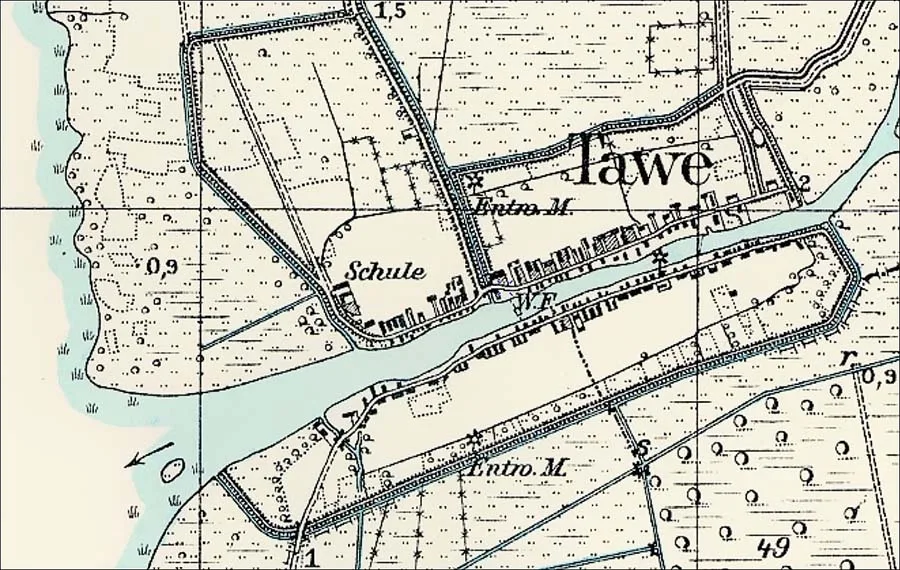 Tawe on a 1938 topographic map of East Prussia.
In 1885 the municipality of Tawe owned 499 ha of land, of which 38 ha were arable and 330 ha meadows. The village had 75 residential houses with 209 households and a rural fish-oil factory.
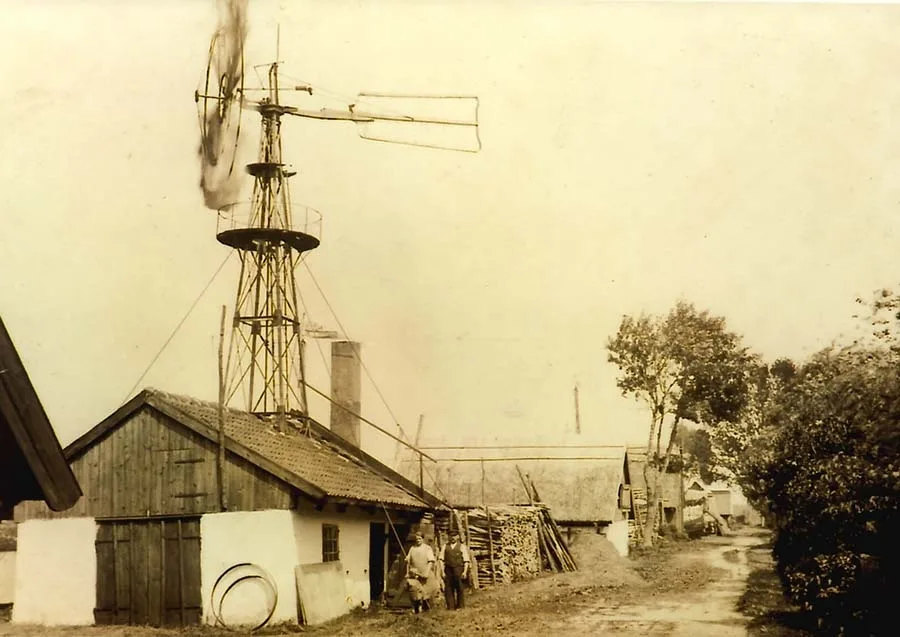 A wind pump for draining floodwater next to the local smithy.
A school in Tawe is mentioned in 1895; by then the number of residential houses had fallen to 73, and the population consisted of 200 families. There was also some kind of institution for communal living (a hostel).
In 1905 the village of Tawe had 494.4 ha of land. Property tax receipts per hectare amounted to 20.76 marks, almost 34% above the average for the rural municipalities of the Kreis of Niederung. Such a tax rate was high even by the standards of East Prussia as a whole. It was evidently due to the substantial investment in land reclamation in the coastal areas of the Kreis of Niederung. The village had 74 residential houses, home to 171 families.
On 1 April 1924 the Tawe forester's lodge / Forsthaus Tawe (55°06'41'' N 21°19'29'' E) was transferred to the municipality of Tawe from the forest Gutsbezirk of Tawellningken / Forsthaus Tawellningken. Including the lodge, in 1925 the municipality of Tawe had 78 residential houses and 170 households.
Another forester's lodge from the Tawellningken Gutsbezirk, Siberien / Forsthaus Siberien (Shlyuzovoye, in part), passed to the municipality of Tawe on 30.09.1929. However, on 01.12.1934 both lodges returned to the forest Gutsbezirk of Tawellningken. In the pre-war years Tawe had a working school. Three wind pumps were installed in the village to drain floodwater. A car ferry crossed the Tawener River (Tovarnaya). The villagers lived by fishing, stock-raising and market gardening. The fishing boats that went out to fish in the Curonian Lagoon / Kurisches Haff were all built to one design and were called kurenas. A special weathervane pennant in the village's colours was fixed to the masts of the kurenas. For Tawe this was a white rectangle on a red background. From 1854 the use of the pennant on fishing boats became compulsory. The pennants became the hallmark of the fishing villages of the Curonian Lagoon. Craftsmen made them for sale to tourists as souvenirs. In the pre-war years the share of fishing in the village's economy declined.
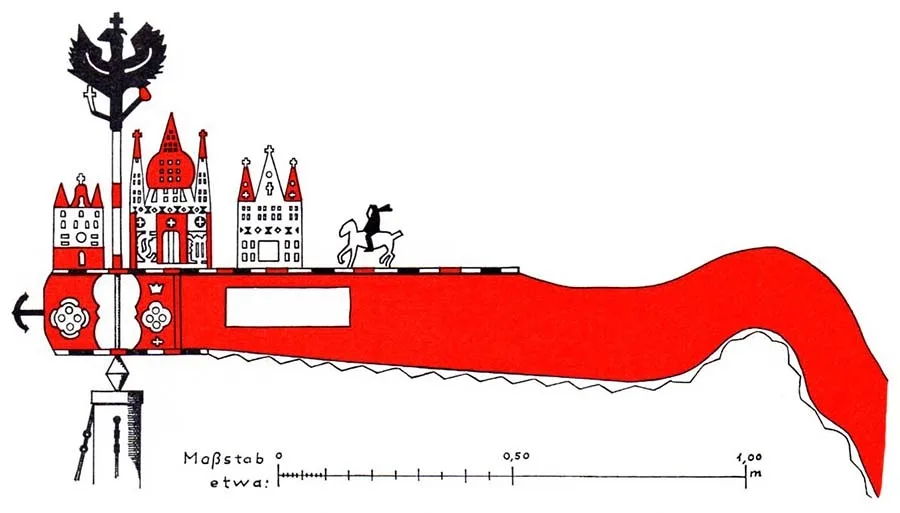 The fishing pennant of Tawe.
After the war, in October–November 1946, the district authorities proposed giving Tawe the status of a workers' settlement and renaming it Kozhedub, but the regional administration did not approve the proposal.
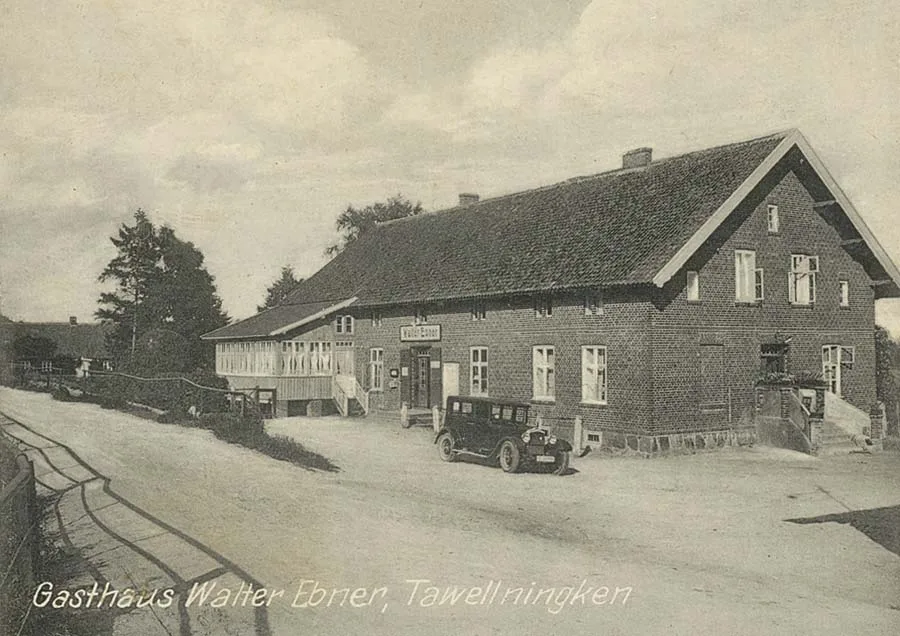 Walter Ebner's guesthouse in neighbouring Tawellningken.
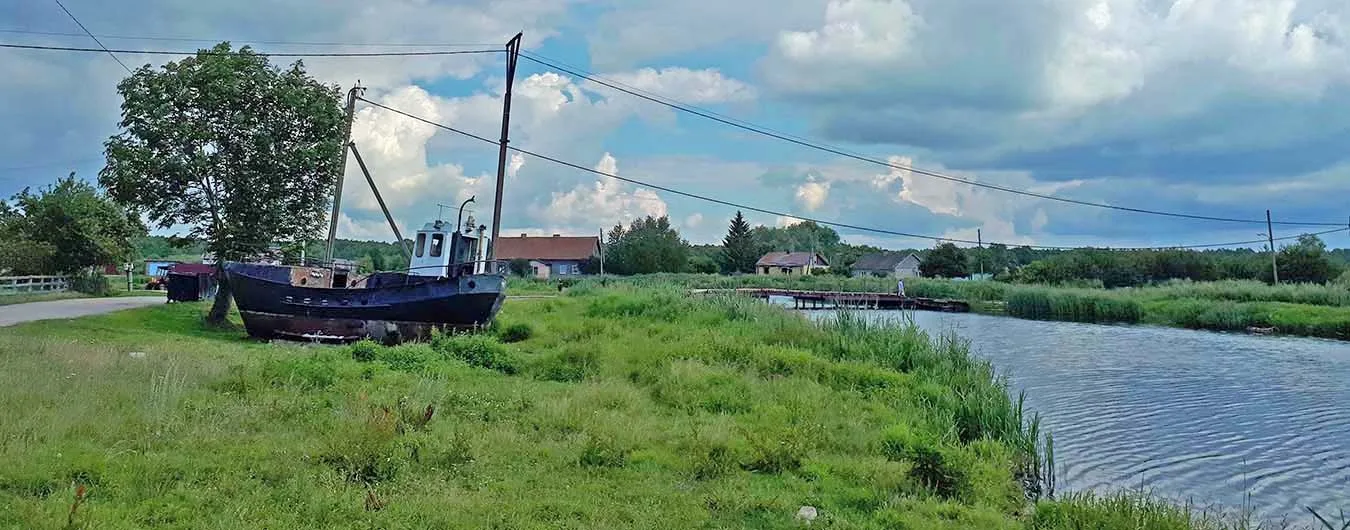
Even before the settlements of Tawe and Inse were renamed in 1947, the A.I. Mikoyan fishing artel was set up on their basis. On 25.07.1947 Tawe was renamed the settlement of Zalivino. The Zalivino village council was established at the same time. In the mid-1950s the Mikoyan artel was converted into a fishing collective farm of the same name. However, the policy of merging collective farms led to the fishermen of Zalivino, together with their boats and gear, being absorbed into the "Rybak Baltiki" fishing collective farm in the settlement of Mysovka. From 12.01.1965, after the Zalivino village council was dissolved, the settlement of Zalivino came under the Prokhladnoye village council. By that time, however, Zalivino had been abandoned because its overland links were constantly flooded. Another contributing factor was that collective farms cared above all about improving their central settlements and found remote villages a burden. Collective farmers therefore tried to move to the central settlement. In addition, in the 1960s there were known cases of settlers returning to the places they had come from. In 1972 Zalivino is marked as an abandoned site with ruined buildings; the settlement was never restored. No later than 1975 the settlement of Zalivino was officially struck off the register.
Coordinates of the settlement: 55°03'16'' N 21°13'37'' E
Population trend of the municipality of Tawe: 1818 – 475, 1852 – 641, 1867 – 771, 1871 – 792, 1885 – 924, 1895 – 931, 1905 – 811, 1910 – 782, 1925 – 677, 1933 – 584, 1936 – 589, 1939 – 840, 1946 – 1221 inhabitants.
Composition of the population of Tawe in 1871: Protestants – 765, Catholics – 19, Jews – 8, children under 10 – 174, literate – 223 (of 601 surveyed, 37%), blind – 1, insane – 1.
For reference
Population of the Tawe forester's lodge: 1905 – 4 inhabitants.
Population trend of the Siberien forester's lodge: 1885 – 10, 1895 – 7, 1905 – 6 inhabitants.
1 — including 102 German residents.
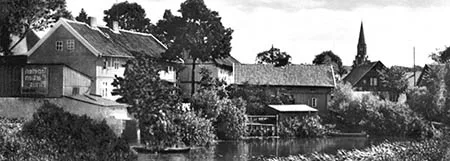
Photo: Bildarchiv Ostpreußen
Translated from Russian with the help of AI (Claude, Anthropic), October 2026.