LEGENDS OF PRUSSIA in the blog of Tatyana Kolivay.
[ 1814 ]
Tilsit. — Trade. — Different peoples. — Their mutual dislike. — Napoleon in Tilsit. — His conduct towards the Queen of Prussia. — His gift. — Beautiful horses. — Return to Memel. — A few more remarks on that town. — The maritime police. — Different routes to Königsberg.
We doubled our skipper's fee and offered to feed him and his mate at our expense, for we had been delayed on the way from Russ to Tilsit, reaching our destination only at noon on the seventh day, although the journey usually takes one day. In return, we had crossed the Niederung in every direction and in that time had got to know both the country and its inhabitants well.
Tilsit is a large town on the left bank of the Neman with a population of 12,000 to 17,000.
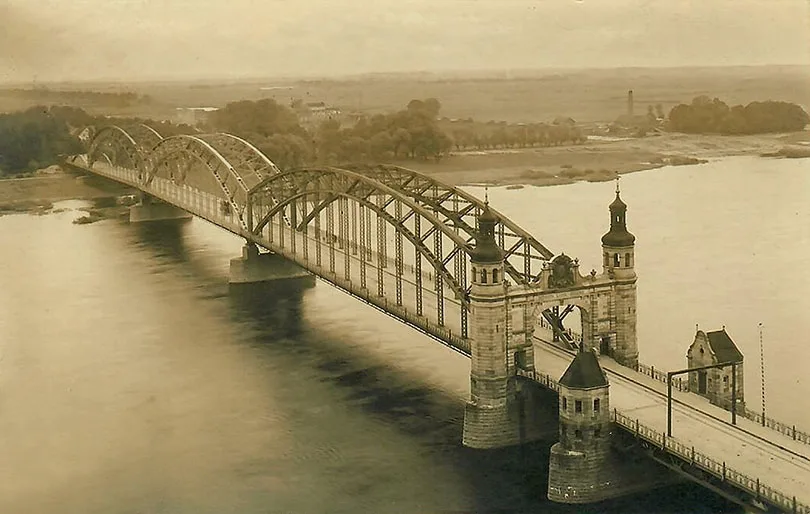
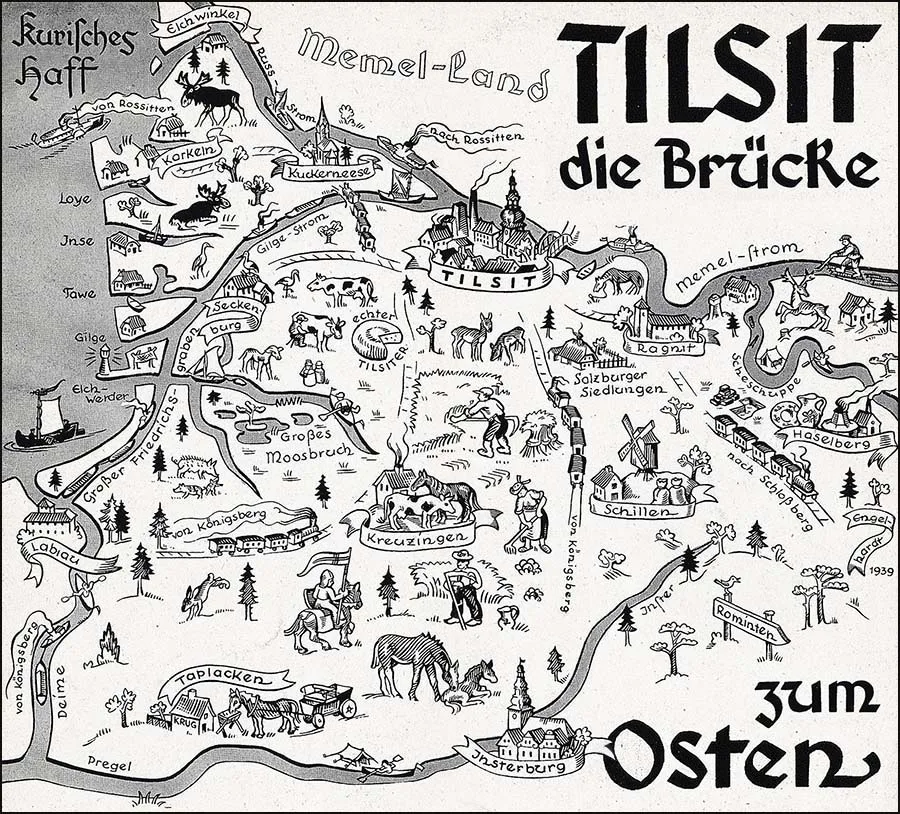 Tilsit – a bridge to the East.
The intermediary trade in grain, timber, hemp and flax carried on by the local merchants contributes considerably to its prosperity and makes this town a very lively place, but there are no large trading houses here. Its inhabitants are very diverse in origin, and their ways of life are just as diverse, for here, as everywhere, they remain faithful to the customs of their fathers.
Prussians, Salzburgers, Mennonites1, Lithuanians and Jews live peacefully side by side in one place, but their customs differ so sharply from one another that the aloofness of these social groups is noticeable at first glance even to an outsider.
The Prussians deal exclusively in timber and grain; the Jews trade in colonial and manufactured goods, and here, as everywhere, they also engage in petty speculation and moneylending; the Salzburgers, Mennonites and Lithuanians are occupied both in retail trade, especially distilling, and in all other branches of industry. Distilling is in general an important branch of the food industry here. The Lithuanians form a small stratum of the town's population.
The Salzburgers, as indeed the Mennonites and Lithuanians, are marked by two unworthy traits: greed and envy. And here, where they live in close proximity, this often turns into dislike and hostility towards one another.
For example, as already mentioned, all three of these social groups engage in distilling and keep distilleries.
And in order to attract as many buyers as possible, each of them makes its alcohol as strong as possible. But since they all go about this business in almost the same way, each tribe accuses the other of all kinds of sabotage and even of witchcraft, by means of which a competitor supposedly tries to give strength to his spirits.
They also give each other offensive nicknames behind their backs. Thus the Lithuanians are called horse thieves and smooth-talkers (Pferdediebe, die Glattmaeuler), and the Salzburgers ox drivers (Ochsentreiber).
Here, at the town's weekly market, one can hear a unique medley of voices. The sing-song speech of the Lithuanians, in which every vowel is drawn out endlessly, the barking jargon of the Salzburgers, the flat speech of the Mennonites, resembling Dutch, and, finally, the Yiddish that everyone loves – all these tongues together make up a noisy, many-voiced cacophony, a concert without equal.
There are no important cloth shops or manufactories in this town, but there is a horse market here that is very well known and is visited by many foreigners.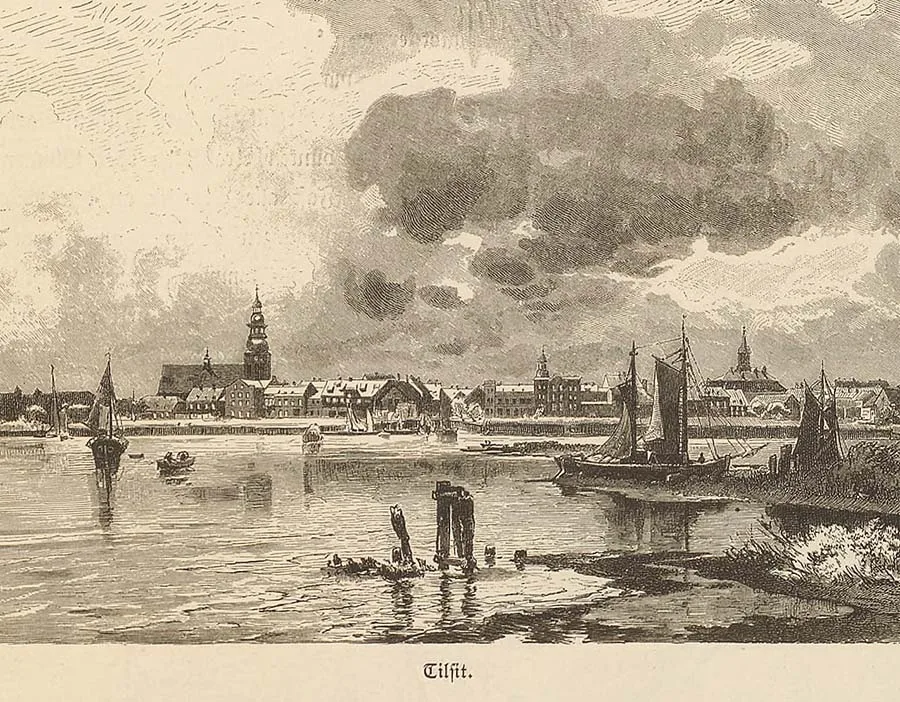 View of Tilsit from the right bank of the Neman.
All food here is of excellent quality and so cheap that Tilsit is considered the most prosperous town in Prussia.
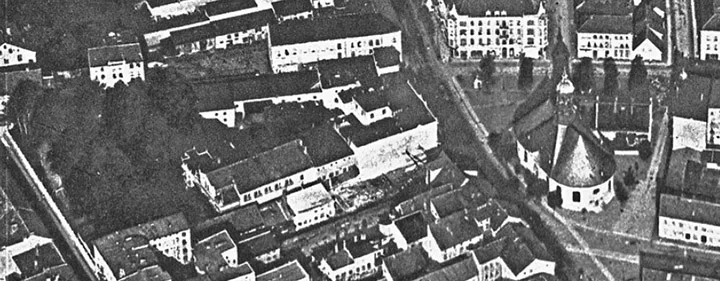
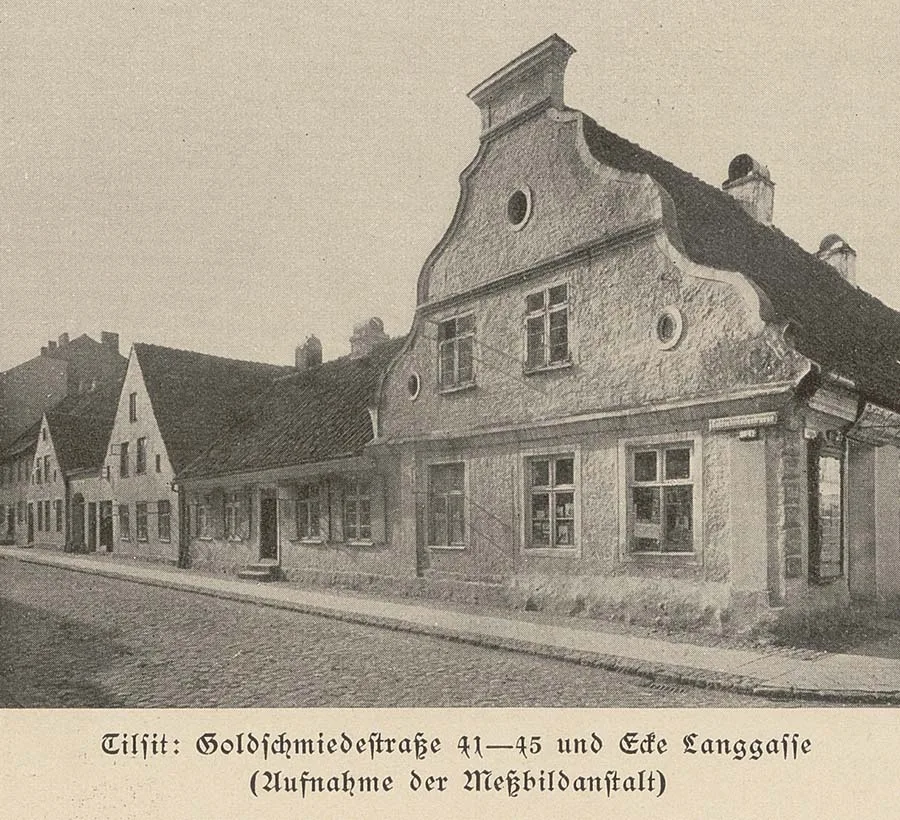 These old Baroque houses our traveller must certainly have seen.
The inhabitants are far more sociable than in Memel, and among the German merchants one meets well-educated people. In winter balls and concerts are held here, as the town has many young people who love to dance, as well as several quite capable musicians. Thus in Herr Zander I met an excellent violinist whose playing would not have disgraced even a duke's orchestra. He keeps a shop of musical instruments and is himself the inventor of several of them.
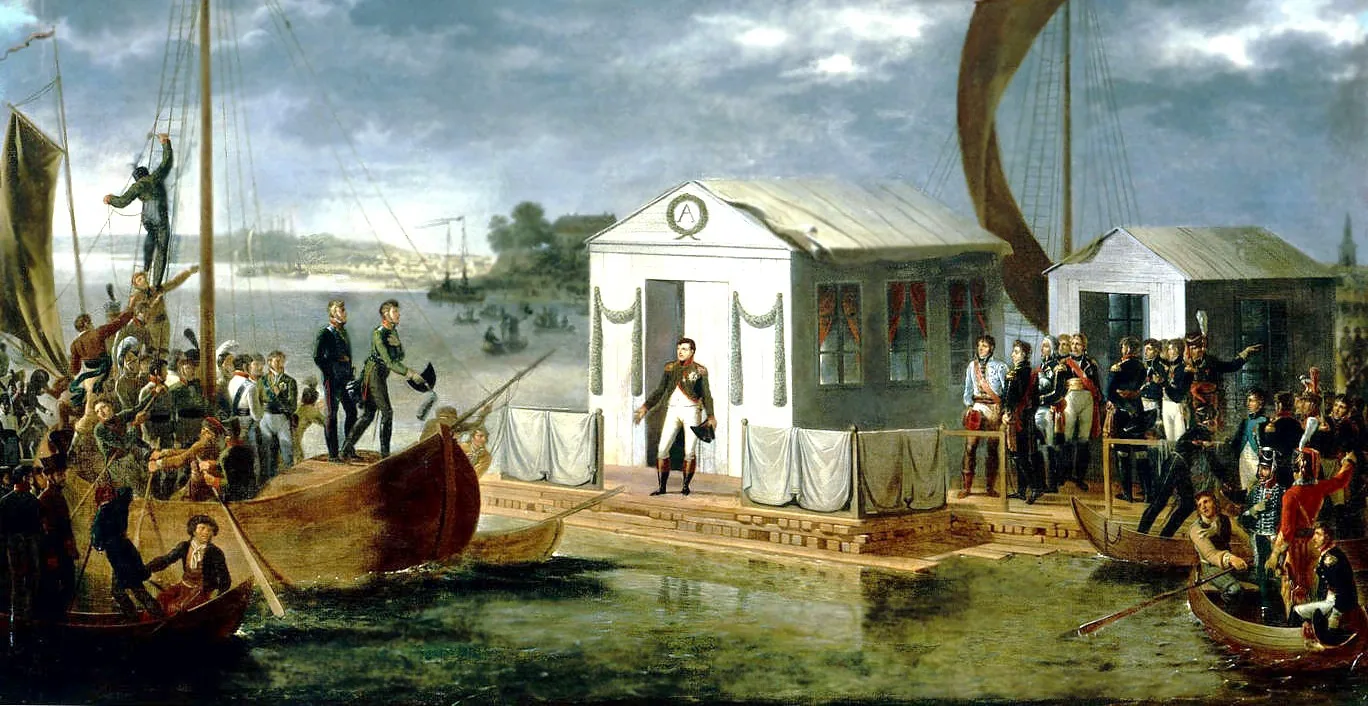
This town has no special sights, but the Treaty of Tilsit concluded here and the meeting of two noble monarchs with the Corsican who imagined himself the arbiter of the world's destinies will remain forever in human memory2.
The inhabitants of Tilsit still recall with bitterness that dark time, which took from them a good half of their prosperity. The town, which the Russians had abandoned, was by no means taken by storm, and yet it was so thoroughly plundered by the French that there was a shortage of the most essential things for accommodating the monarchs – they had to be brought from Königsberg.
Napoleon celebrated his triumph here. He dictated peace terms that could not have been more inhuman and revelled in the torment of the unfortunate Prussian royal couple.
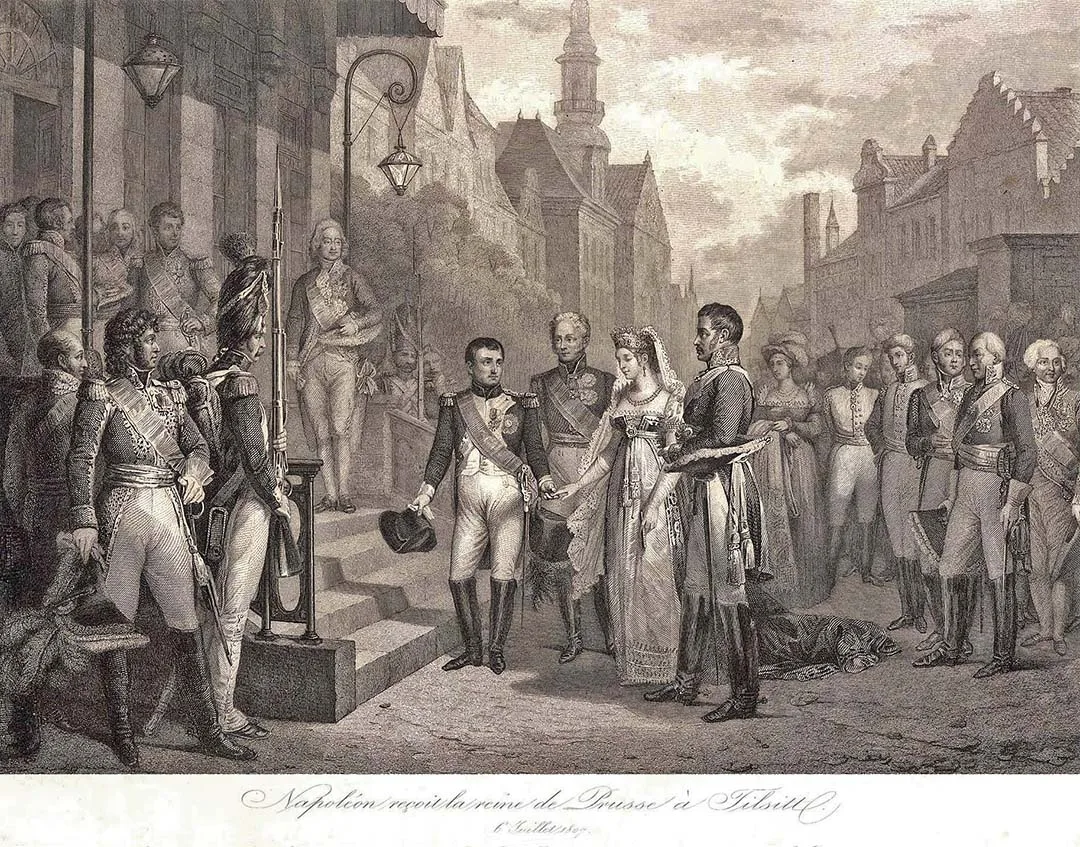
He never gave away more than he was forced to, and yet poor Queen Louise had to humble herself and visit her mortal enemy, because he had given her to understand that in that case he would agree to milder peace terms. On seeing the Queen, Napoleon was so moved by her beauty and nobility that he became embarrassed and, by way of flattery, clumsily invited her to ask him for something. The answer she gave was worthy of a monarch's consort. "As a queen," said the august lady, "I have nothing to ask of you. As the mother of my people, I ask for Magdeburg"3.
The tyrant gave some vague reply, but, in order to show himself a benefactor, the next day he sent the Queen a map on which Silesia was encircled by a gold chain with a little gold heart. Silesia, however, did not belong to Napoleon in any case: had he wished to annex it, our Emperor would never have made peace with him. So Napoleon was "giving away" what he had not conquered, for Cosel4, Glatz5 and Silberberg6 were still in the hands of the Prussian army. Many stories are told about this meeting, most of them so contradictory that I have my doubts about their reliability.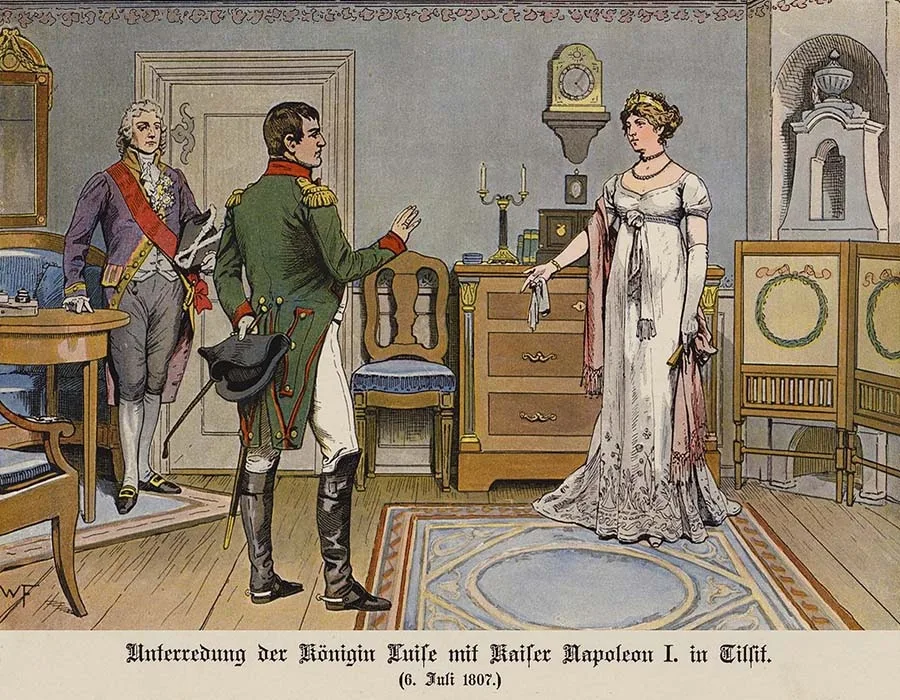 Napoleon and Queen Louise, July 1807, in Tilsit.
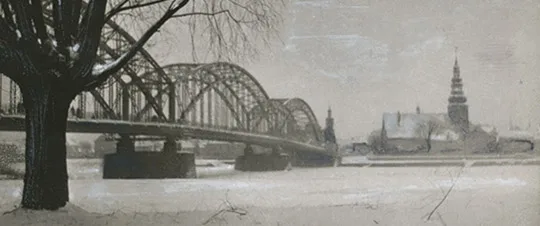
At this point the Neman is a broad river that flows in an almost straight line along the edge of Tilsit and can be seen from afar.
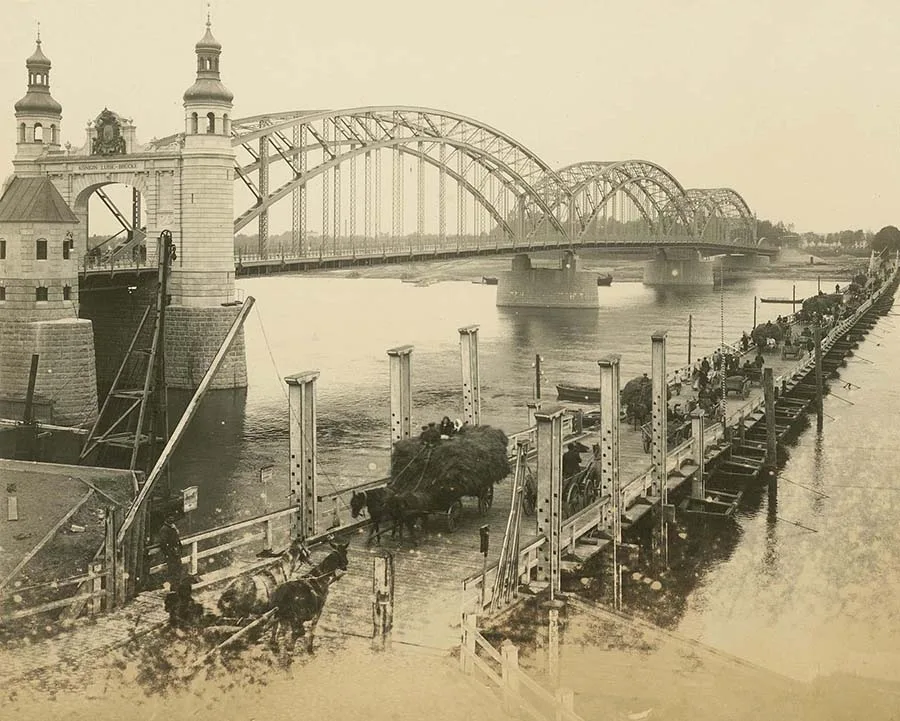 The newly built Queen Louise Bridge and the pontoon crossing still in operation.
This great stream of water presents a magnificent spectacle thanks to the many ships and rafts floating along it.
During my short excursions from Tilsit into the surrounding country I had an excellent opportunity to admire the beauty of the horses of this province. I saw several peasants with horses worth no less than a hundred ducats each, and they were truly worthy of adorning a prince's stable! This gave me occasion to understand the inestimable importance of the lowland (die Niederung) for the uplands of East Prussia and Lithuania.
There is never a shortage of grass here, and in dry years, when there is not enough fodder on the higher ground, the hay harvest is doubly abundant. Thus the lowland (die Niederung), with its abundance, makes life easier for the local inhabitants, who thanks to it solve the problem of feeding their livestock without having to slaughter it, as often happens in other countries. The Curonians7 have yet another source of income, which they owe to the richness of their land, namely taking in horses for fattening. If someone has lean horses that the owner would like to fatten quickly and without great expense, he can, for a very moderate fee, put them out to pasture in the Niederung.
Two months later he will get his horses back as well-fed as if he had been fattening them on choice grain for a whole year.
After eight days in Tilsit I left it, parting from my companion, who was heading via Insterburg to Königsberg. It would have been hard for me to part from this modest, well-educated man had I not been certain that we would meet again in his home town, of which he informed me in great detail. I look forward eagerly to our meeting soon, all the more so as my stay there, I suspect, will be quite long.
I made the return journey to Memel in two days without any adventures, and when I arrived I found your wonderful letter waiting for me, together with the recommendations I needed for the journey to Königsberg. I am now preparing to leave, and since I may never see Memel again, I want to write down what seems to me remarkable about this town.
Memel has about 9,000 inhabitants, among whom there are no beggars and very few poor people. Although the town is in Lithuania, almost everyone here speaks German, while in the genteel houses English is spoken too. Lithuanian is generally spoken by servants and by sellers in the retail stalls at the market.
All geographers describe the town as a fortress, but it is far too open on the side facing Russia, and on the opposite side there are only a few weak fortifications, which is strange enough in itself!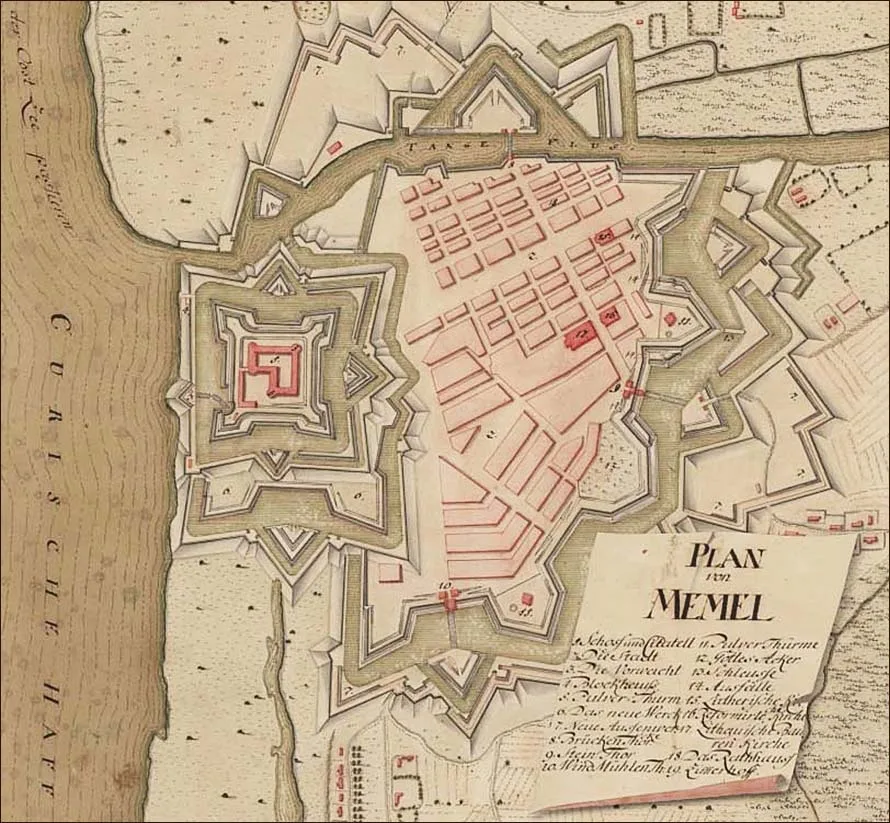 Plan of the Memel fortifications.
What was once called the citadel is nothing but an old walled castle which, apart from one ancient tower, is practically in ruins.
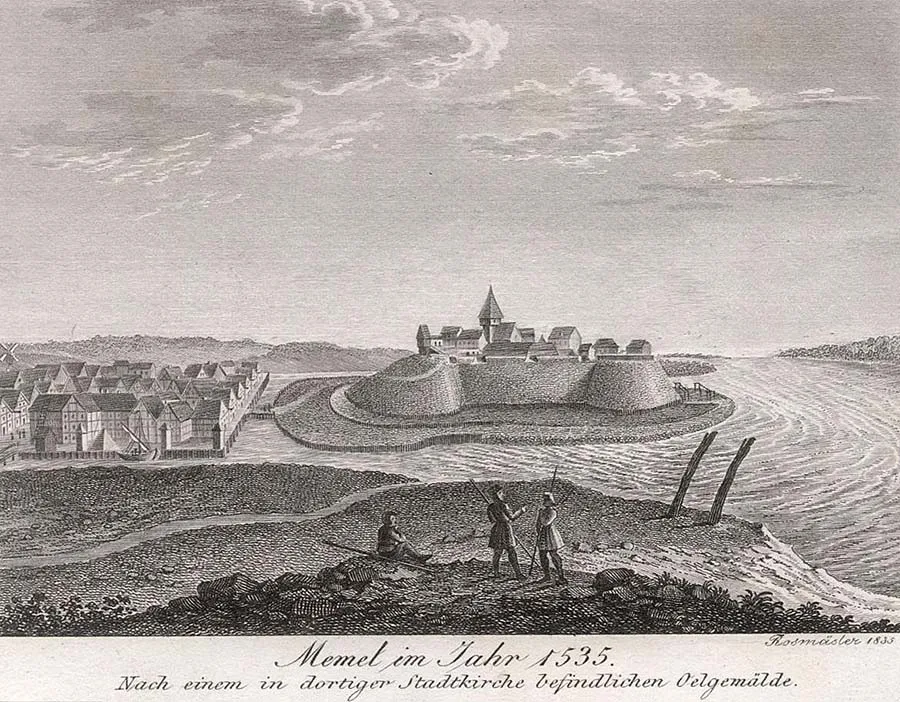 Memel Castle in a 19th-century engraving.
There used to be several iron cannons on the fortress wall, but they were removed long ago because they could not protect the harbour, since the town lies in the line of fire in front of the harbour. Incidentally, it must be said that the harbour here is protected by nature itself: in front of the roadstead there is a sandbank, which causes heavy surf and makes it impossible for seagoing vessels to enter without a pilot. The shore near Memel is very flat and strewn with the wreckage of many ships that once ran aground here, for the sea in this area is extremely shallow and therefore dangerous.
I cannot help telling you something about the local maritime police. It is proof of the cruel means to which, unfortunately, one sometimes has to resort, even in so mildly governed a state as Prussia, in order to keep a degenerate breed of humanity under control.
It is well known that sailors are a wild and unruly lot, which is explained by the way of life they lead. And in this respect the English stand out above all, and they make up the majority of Memel's visitors.
After a ship enters the harbour here, its crew is entitled to go ashore for a few days. And this free time the seamen spend almost without exception in the Memel suburb of Witte, which, just as the Judengasse8 lanes in Amsterdam and Frankfurt am Main are inhabited entirely by Jews, is crowded with lustful harlots who satisfy the various sensual desires of their clients.
But sailors are usually so insatiable in their pleasures that they often fail to return from their short leave on time, and no exhortations or orders from the captain can bring the revellers back to their duties.
Recently the following solution to this problem was found: in order to drive the disobedient back to their ship, an unusually strong man of gigantic stature, a real virtuoso at administering beatings, was hired. He was given the nickname of the Forbidder (der Verboter). As soon as he is informed of another runaway, the giant sets off for the disreputable quarter and searches there for the missing sailor until he finds him.
He then begins to beat the sailor very cruelly with a huge whip that he always carries with him. As a rule the executioner does not stop until he is exhausted or the recalcitrant loses consciousness. No complaints against the giant are accepted unless he beats the culprit to death. And even in that case the executioner will go unpunished if he proves that the sailor resisted.
Moreover, the slightest disobedience to the Forbidder is punishable by years of imprisonment, with an overly obstinate offender being put in chains9. Why does degenerate humanity tolerate such barbarity?
They say that the local postmaster holds the most lucrative post in the whole country. His net income is between 12,000 and 17,000 thalers, because there is a border post office here and the director earns a great deal from sending journals to Russia.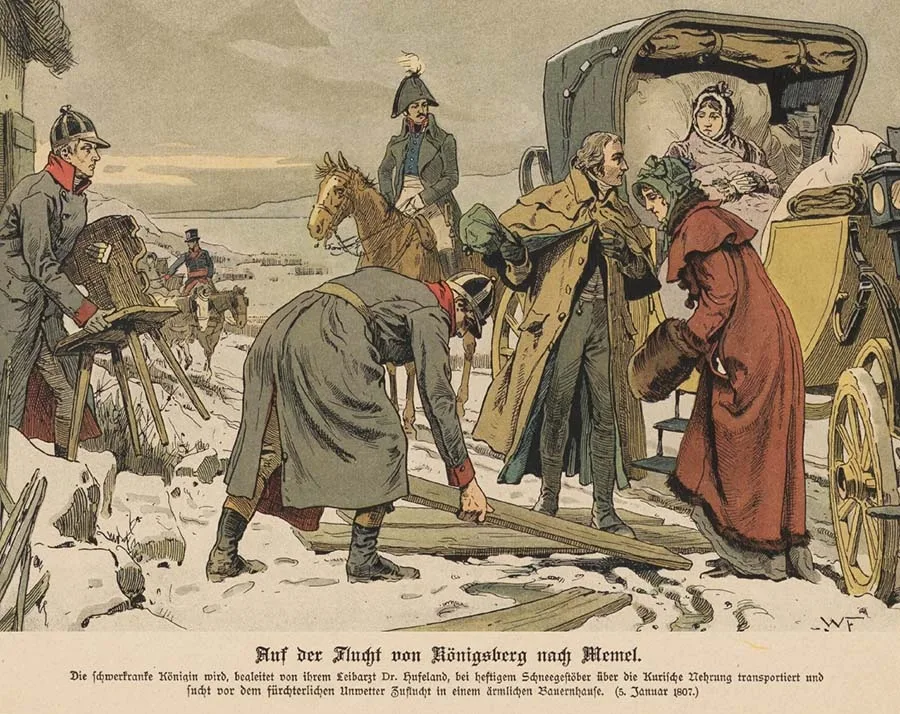 Queen Louise on the Curonian Spit on the way from Königsberg to Memel.
There are three ways of getting from Memel to Königsberg. One route runs through Tilsit. It is the most pleasant, but also the longest, being six miles longer than the others.
Since I had already been to Tilsit, I gave it up. The second route is by water, across the lagoon, where you board a ship together with your carriages and horses and, with a good wind, go ashore after 12 hours only four miles from Königsberg. However, if the wind is not favourable, let alone if it is contrary, you can sometimes be stuck on the water for a whole eight days. I therefore decided to travel to Königsberg by the third route, along the Curonian Spit, all the more so as I had already heard so much about it that I felt a desire to see it with my own eyes.
LEGENDS OF PRUSSIA in the blog of Tatyana Kolivay.
TRANSLATOR'S NOTES
1. Mennonites are members of a Protestant denomination named after its founder, Menno Simons (1496–1561), a Dutchman by origin. Mennonitism is distinguished by its "peaceful and moderate" character. It never calls for violence. It invites reflection on the meaning of life as a whole, on self-improvement and the development of one's soul. The Mennonites were one of the first religious groups to make pacifism part of their doctrine.
2. The Peace of Tilsit was a peace treaty concluded between 13 (25) June and 25 June (7 July) 1807 in Tilsit (today the town of Sovetsk in the Kaliningrad Region) between Alexander I and Napoleon after the War of the Fourth Coalition of 1806–1807, in which Russia fought on the side of Prussia.
3. "Als Königin habe ich nichts zu bitten; als Mutter meines Volks bitte ich um Magdeburg."
4. Kędzierzyn-Koźle (German: Cosel), Poland, is a town located at the confluence of the rivers Kłodnica and Oder, about 50 km south-east of Opole. It was a border fortress of the Polish Piast dynasty. It is first mentioned in 1104, when it was besieged by the Přemyslid prince Svatopluk of Olomouc. From 1138 it was part of the Polish Duchy of Silesia, and from 1173 of the Upper Silesian Duchy of Racibórz under the rule of the Silesian Piasts.
5. Kłodzko (Kładzko, Latin: Glacium, Glacensis urbs, Glocium, German: Glatz) is a town in the Lower Silesian Voivodeship, Poland.
6. Many Silesians welcomed the annexation of Silesia by the Prussian King Frederick II in 1740. By the end of the War of the Austrian Succession (1740–1748) almost the entire region had become part of Prussia, with the exception of the south-eastern duchies of Teschen and Opava, which remained with the Habsburgs. The Seven Years' War (1756–1763) only strengthened Prussian control over this territory, and the Province of Silesia was considered one of the most loyal to the King within Prussia. The Silberberg fortress was built in Silesia by order of Frederick II the Great.
Silberberg (German: Festung Silberberg, Polish: Twierdza Srebrnogórska) is the only full-scale fortress in Polish Silesia. It is located near the village of Srebrna Góra in the Lower Silesian Voivodeship. The complex is one of the largest fortifications in Europe, with the highest bastion citadel. Throughout its existence the fortifications were never captured.
7. The Curonian tribe inhabited the Curonian Spit, the shores of the Curonian Lagoon and the lands north of the Spit (Courland). The other local tribes were settled as follows: the Sambians lived on the Sambian Peninsula, the Natangians south of the Pregel, and the Scalovians in the Memel valley.
8. Judengasse (German: Judengasse – "Jews' Lane").
9. The so-called "chain punishment" (Kettenstrafe) was a form of imprisonment for serious crimes, widespread in the 17th, 18th and even 19th centuries. The convict was chained to the prison wall with an iron chain or had his freedom of movement restricted by a heavy chain placed on his legs.
Translated from Russian with the help of AI (Claude, Anthropic), October 2026.