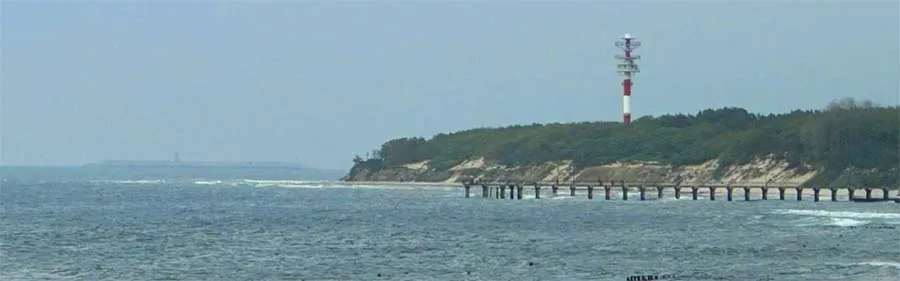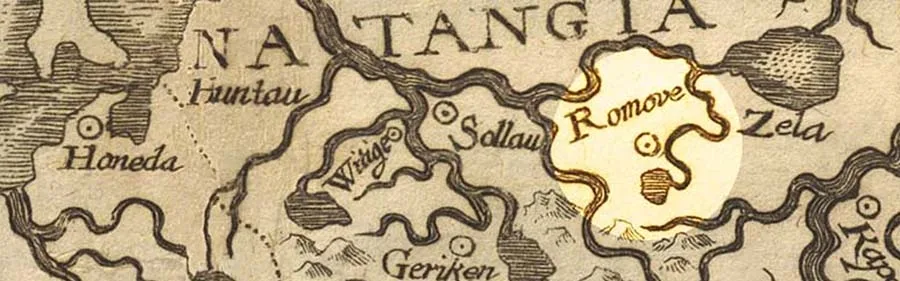
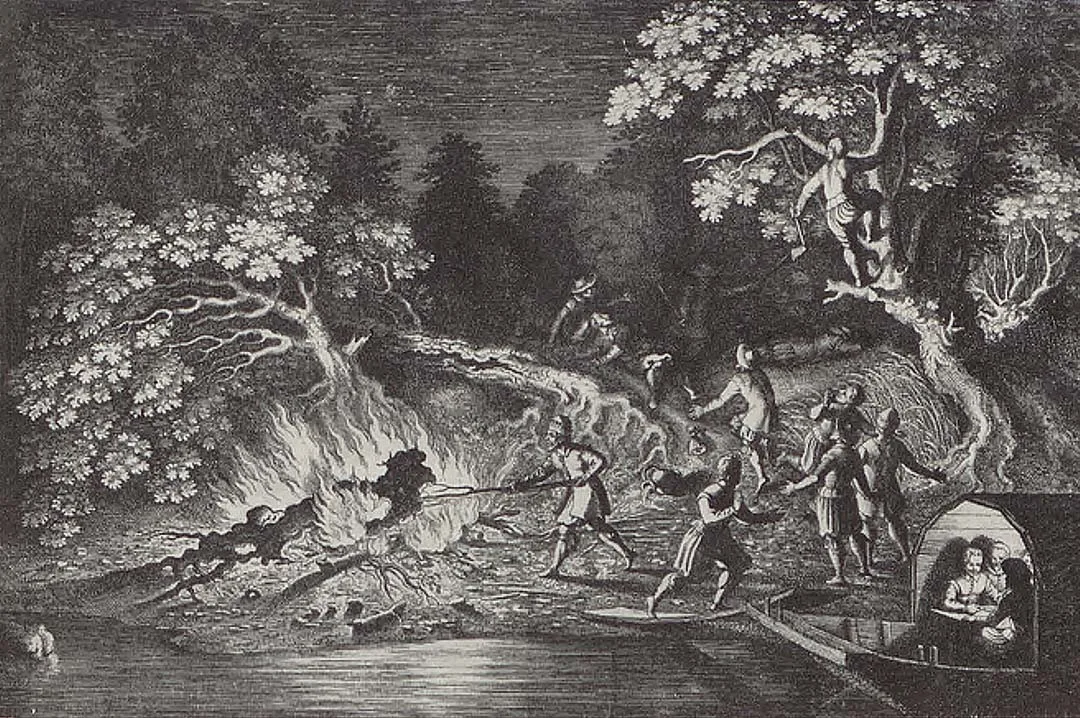
The people of Samland awaited the coming of the invaders with dread. Every day, and especially at night, they lit huge bonfires along the coast so as to see the enemy ships approaching well in advance. They also knew that their lord the Grand Master, the most honourable Margrave Albrecht, was in no position to protect them. And since there was nowhere for them to look for help, they were sorely troubled and took counsel with one another on how to withstand so great a calamity. Day after day went by, and at last the Polish ships appeared on the open sea and in the lagoon near the shores of Samland, which now faced the direct threat of an enemy invasion from the sea.
At that time there lived on the coast a free peasant named Valtin Supplit. He was greatly respected among the common folk, for he came of an ancient line of Prussian pagan priests and was secretly himself the supreme waidelot1. He announced for all to hear that he knew how to keep the enemy out of the land, but that he needed the consent of the rulers to do so. Only once he had it would he be able, with the help of the common people, his countrymen, to make sure that not a single enemy ship would land and that all of Samland, Königsberg included, would be saved.
These words were passed on to Margrave Albrecht of Brandenburg, and he, given the dire straits he was in, agreed to everything. Let the peasant do his best, they said, while it was not yet too late. Any help at all would be welcome now.
On hearing this, Valtin Supplit gathered the peasants from the surrounding villages and told them that only with the help of the Prussian gods could they all be saved. And what he needed was a bull as black as pitch — an old one or a young bullock, it made no difference. This bull was to be sacrificed according to ancient custom and the faith of their forefathers.
He would also need two large barrels of beer. The meat of the bull would have to be eaten and the beer drunk to the very last drop.
It is well known that peasants have always been inclined to idolatry and drunkenness, and so they listened to Valtin's words with pleasure and delight. They did not dally long, but promptly brought him a bull and rolled up two barrels of excellent beer.
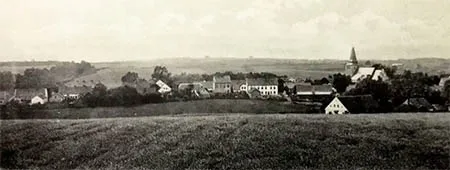
Then the whole crowd, led by the priest, set off for the seashore near Rantau. Women were not allowed to take part in the rite. But the boys, the peasants' sons, ran after the procession as fast as their legs would carry them, to watch what was happening from a distance.
When everyone had reached the shore, Valtin slaughtered the bull with his own hands, flayed it and then carefully butchered it. He took out the bull's entrails and burned them together with the bones, and he put the meat to boil in a huge cauldron, salting it well to make it go down with drink. All the while, like the jesters at a market fair, he waved his arms about a great deal and jerked his legs oddly, reciting a great many special prayers to the ancient Prussian gods. Once the meat in the cauldron was thoroughly cooked, the waidelot held a great feast on the shore. Everyone ate the sacrificial meat, washing it down with plenty of beer, until all of it had been eaten and drunk to the last. And at the end of the meal many strange praises were spoken once again. What sort of rite this waidelot performed and what prayers he recited — no one knows.
A few days passed, and the Danzig ships2 appeared on the horizon once more. Drawing near, the enemy tried to land, but simply could not do it. The Poles also took to small boats, but failed again and again, even though the weather was fine and no one stood in their way. The people watching them from the shore could not understand what was going on or why the enemy sailed off back home. Nor could the margrave and his warriors understand it.
Later, when the war was over, many of those who had been on those ships found themselves in Samland. They explained that a strange delusion had blinded them at the time. Wherever they tried to put in to the coast, they failed. Now the shores rose before them as a sheer wall of sand that no ordinary man could ever climb, now dense impenetrable forests met them on the coast. In the end the ships turned back, having achieved nothing. When the Samlanders heard these explanations, they remembered their waidelot priest. Everything pointed to its having been his art that had clouded the eyes of the Polish invaders, and so Valtin Supplit came to be revered even more than before.
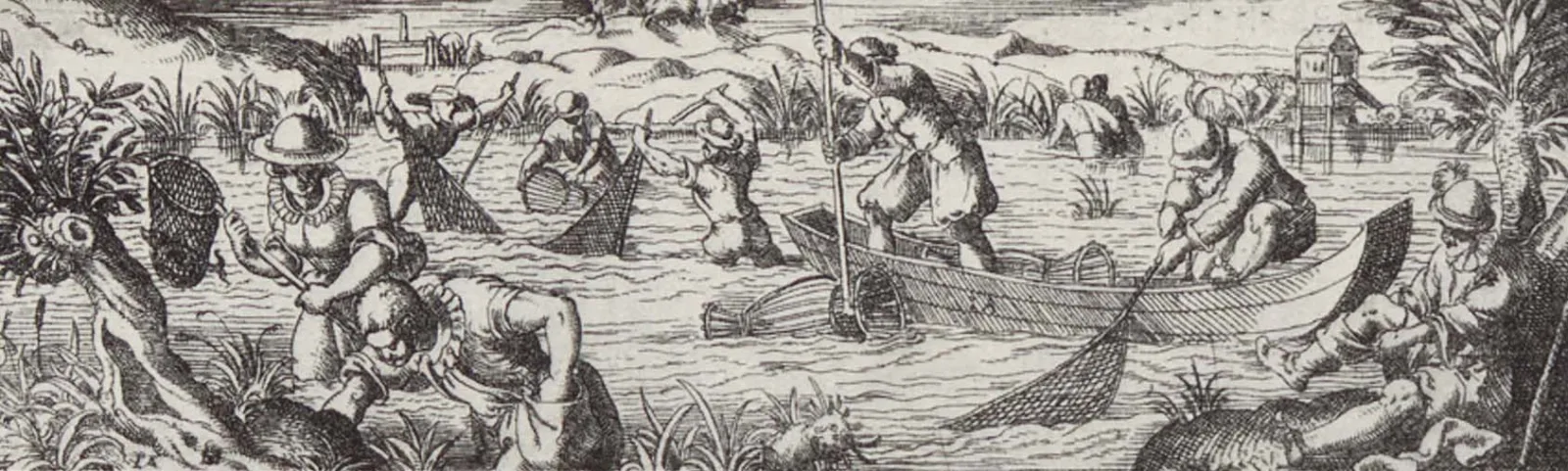
But then another misfortune suddenly befell the local fishermen: the fish vanished from the sea. However hard they tried, their nets stayed empty. In search of fish they went far out to sea in their little boats, putting themselves in danger, sometimes five or six miles out. But even there the catch was very meagre.
Seven long years went by, and all that time the people of the Samland coast lived half-starved. People complained to one another about this new calamity and could not understand why the gods were so angry with them as to deprive them of their livelihood. And little by little they began to whisper that it was Valtin Supplit who was to blame for the fish leaving their shores. He, for his part, admitted that it might indeed be his fault, for when he performed the sacrificial rite he had driven away from the shores of Samland everything that approached them. And that meant that together with the enemy ships he had also driven away all the fish, having forgotten to make an exception for them.
So the waidelot once again asked the villagers for help. He, in turn, would try to bring the fish back to the coast. For this, Valtin had them buy him a black sow and fatten her up properly. Having heard him out, the fishermen and peasants eagerly collected money and bought a sow and two barrels of beer. Once the sow had grown good and fat, the priest had her brought, together with the beer, to the same shore near Rantau again. And so the rite began once more. Valtin slaughtered the sow, accompanying everything with strange gestures, and cleaned out the entrails. After that he cut off the sow's teats, whispered incomprehensible words over them and then threw them into the sea. And before putting the meat into the cauldron he recited incantations for a long time, then salted the meat well to make it go down with drink and boiled it in a huge cauldron over a great fire. After that everyone present ate and drank, so that soon nothing was left.
And no one forced anyone, for the gods love willing helpers. And the sacrifice and service of the peasants consisted in this: that, as everyone knows, meat and blood make them merry. And it is plain to see that as the gods are, so is their service. They must be excellent gods indeed, since they are served by eating and drinking a great deal, even if much sinning goes with it.
News of the pagan sacrifice reached the priest Michael Wille of Pobethen. Having found out all the details, he in turn reported everything to the Bishop of Samland, Georg von Polentz3. On hearing of this idolatry, the bishop was greatly angered. And since the report reached him at the end of March, he came to Pobethen himself in the first days of Easter to investigate the matter on the spot. On arrival he ordered the said Valtin to be summoned to him at the castle together with the local peasants, his comrades in the pagan faith. And so seventy-three people from eight villages appeared before him, all of whom had eaten meat and drunk beer with the waidelot or had helped him in one way or another.
After those who had appeared confessed everything and repented, the bishop took counsel with the priests as to how and in what manner the apostates should be punished. And it was decided to subject them to a harsh punishment and to set a particular day for it.
The lord Bishop of Samland also ordered the priest from Legitten, who knew the Prussian language well, to preach a sermon against idolatry in Prussian from the pulpit of the Pobethen church on the following Sunday. And at the end of the sermon he was to turn to the people and call on everyone to beseech our Lord Jesus Christ to have mercy on the poor apostates, so that they might repent, turn to the faith of Christ and save their lost souls. And so it was done.
Meanwhile, word of the trial and punishment of the sinners spread throughout Samland, and on the appointed day huge crowds — some with concern in their hearts for the lost souls, but more of them idle onlookers — made their way to Pobethen. People came from seven or eight church parishes of Samland and even from Königsberg itself. There were so many of them that the Pobethen church could not hold everyone who wished to attend. So the bishop ordered the local priests to preach in the churchyard as well and in the large meadow next to the church, where temporary pulpits were put up for the purpose, so that the common folk could hear the word of God properly and learn all of Christ's commandments, and especially the first and the second4. They were also ordered to forget the pagan custom of venerating creeping creatures, in particular grass snakes and slow-worms.
The bishop had a paper crown made in advance, in the fashion of a bishop's mitre, with pigs' heads daubed on it, as well as the horned head of the devil. When the sermon was over, all the offenders took off their outer clothing and stood naked to the waist. They were ordered to cross their arms over their chests, and each took in his hands a supple, well-plaited switch. And the false bishop, the waidelot, had the paper bishop's mitre placed on his head.
Then all the apostates were ordered to go into the church. At the head of the procession walked the aforesaid Valtin Supplit with the paper mitre on his head. In each of his hands, which he held crossed over his chest, he carried a long plaited switch. Having come up to the altar, all the guilty men addressed those present with words of repentance.
Finally, the Bishop of Samland decreed that the waidelot, the ringleader, be punished by being made to stand at the pillory. His accomplices were to walk past him, each stopping briefly at the post. And the waidelot was to strike each of them twice with a switch, so that they would never again be tempted to listen to him.
Then the guilty peasants walked past the pillory once more, and each, as he stopped, had to strike his false teacher with a switch two or more times. This was done so that he would not dare to lead people astray with his pagan rites and to serve false gods. And so it came about. Each man stopped and struck the waidelot with a switch in gratitude for his false teaching. And among the guilty there was one peasant by the name of Peter Wenike, who thanked the false priest with his blows so zealously that the crown flew off his head. In all, the waidelot received 150 strokes of the switch.
And when the punishment was over, the Bishop of Samland ordered all the apostates to stand at the altar every Sunday for a whole year, to listen attentively to the priest's sermon and to repent. And after a year each of them was to make confession to his parish priest, ask for absolution of his sins and receive the sacraments of Christ. This they did in deep humility and contrition — the fish had come back to the shores — now one could give some thought to the soul as well.
TRANSLATOR'S NOTES
1. Waidelots (Prussian Waidelotte, Lithuanian vaidilos, Latvian vaideloši) — the general term for pagan priests among the Baltic peoples (the Prussians, Lithuanians and Latvians). The word "waidelot" derives from the combination vaid-lo-to-jis and the root waist, meaning "to know", "to be versed in".
2. Danzig (Polish: Gdańsk) is first mentioned in a chronicle in 997 in connection with the mission of Saint Adalbert (Wojciech) to Prussia. However, according to archaeological excavations, a settlement already existed on the site of Gdańsk in the 5th century AD. From 997 to 1308 Gdańsk was part of Poland. In November 1308 it was captured by the knights of the Teutonic (German) Order, annexed to Prussia and renamed Danzig. In 1466, after the end of the Thirteen Years' War between the Teutonic Order and Poland, in which the Order was defeated, Gdańsk became part of Poland and its original name was restored. In 1793, as a result of the partition of Poland, Gdańsk passed to Prussia and became Danzig once again. Thus in 1520 Danzig was Gdańsk and belonged to the Poles.
3. Georg von Polentz (1478–1550). The last Catholic Bishop of Samland, 1518–1525.
4. The first commandment: "I am the Lord thy God, which have brought thee out of the land of Egypt, out of the house of bondage. Thou shalt have no other gods before me."
The second commandment: "Thou shalt not make unto thee any graven image, or any likeness of any thing that is in heaven above, or that is in the earth beneath, or that is in the water under the earth. Thou shalt not bow down thyself to them, nor serve them: for I the Lord thy God am a jealous God, visiting the iniquity of the fathers upon the children unto the third and fourth generation of them that hate me; and shewing mercy unto thousands of them that love me, and keep my commandments."
SOURCES
M. Lucas David, "Prussian Chronicle", 1812 (Preussische Chronik von M. Lucas David. Königsberg).
Tettau/Temme, "Folk Legends of East Prussia, Lithuania and West Prussia", 1837 (Tettau/Temme. 1837, Die Volkssagen Ostpreussens, Litauens und Westpreussens).
● Editor's note: Read on VisitPrussia.com an interview with the translator of German, and in particular Prussian, fairy tales, our regular contributor Tatyana Kolivay, who runs her own blog, where countless other parables, legends and fairy tales in her translation have been published.
Translated from Russian with the help of AI (Claude, Anthropic), October 2026.