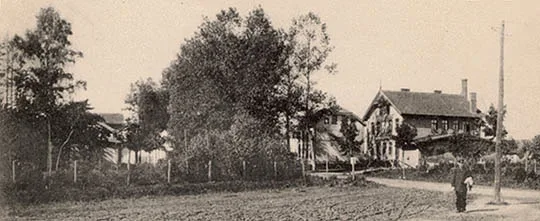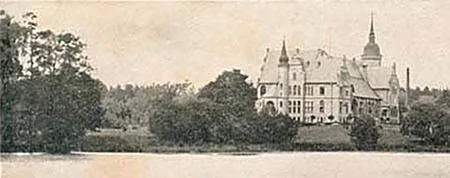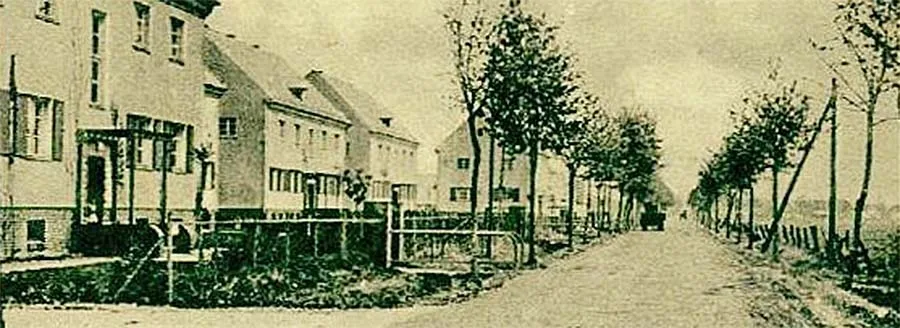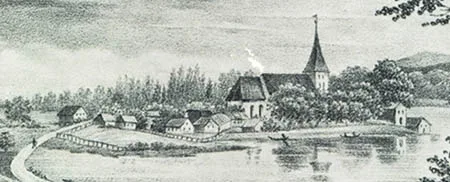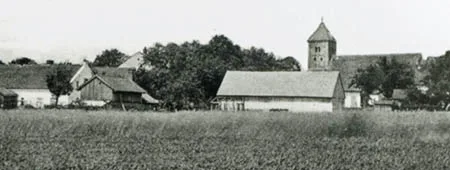
Willgaiten is first mentioned in 1540 as Wilgaiten. In 1785 the name Wilgaiten referred to three different places in the Schaken district (Schakenschen): 1) the Kulm-law free village (cölmisch Freydorf) of Wilgaiten with two households, which belonged to the Amt of Kaporn (Spasskoye); 2) the noble estate (adelich Gut) of Wilgaiten with three households, which in 1800 belonged to a certain Rausching and was valued at 10,000 thalers; 3) the noble inn of Wilgaiten (Wilgaitscher adelich Krug), belonging to the knight's estate (Rittergut) of Mednicken (Druzhnoye).
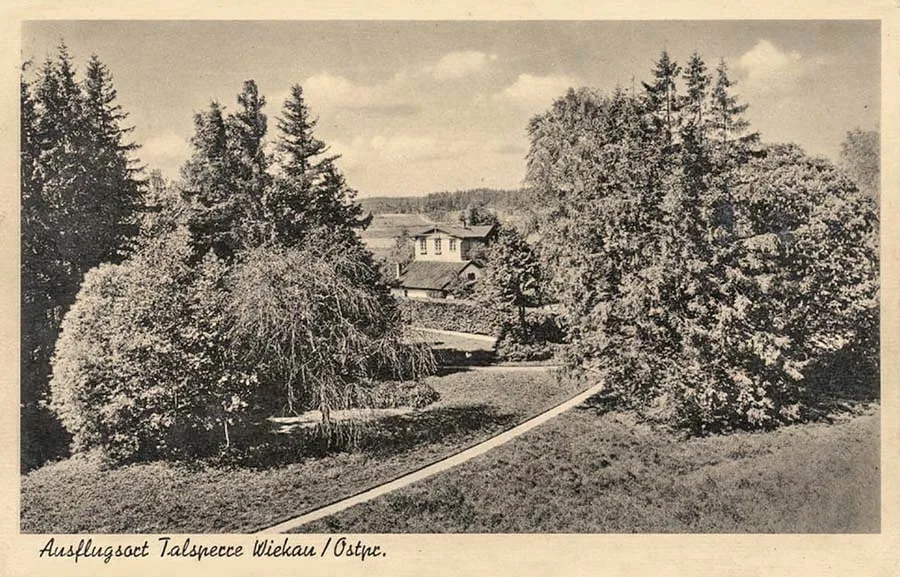
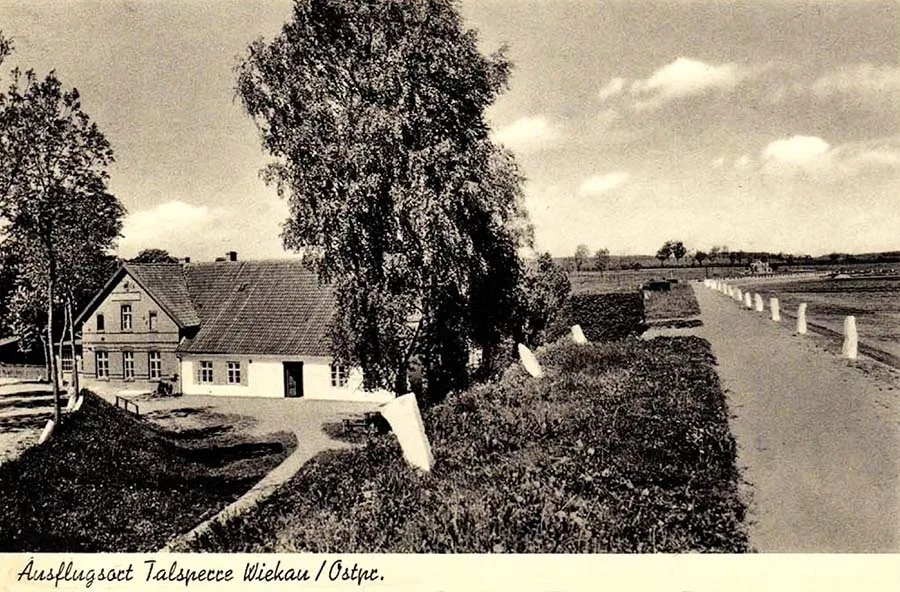
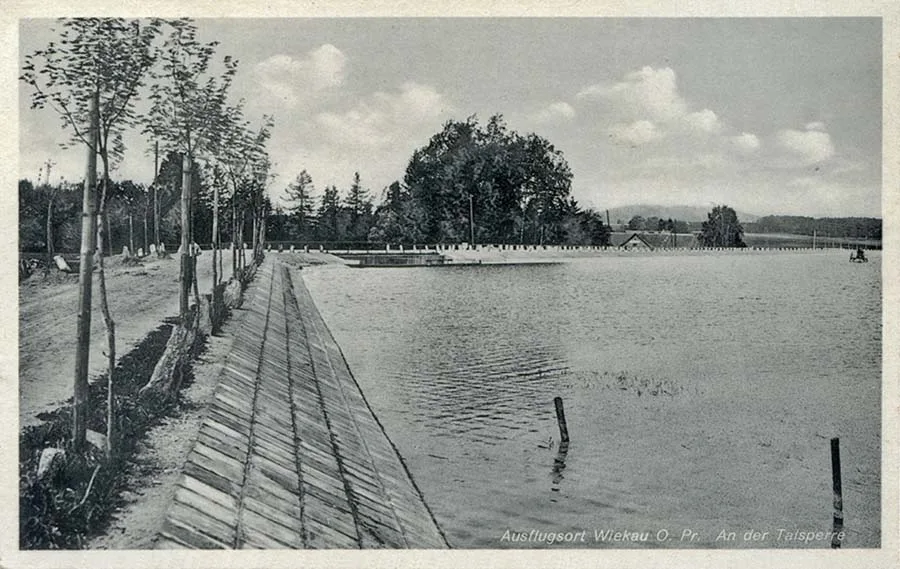
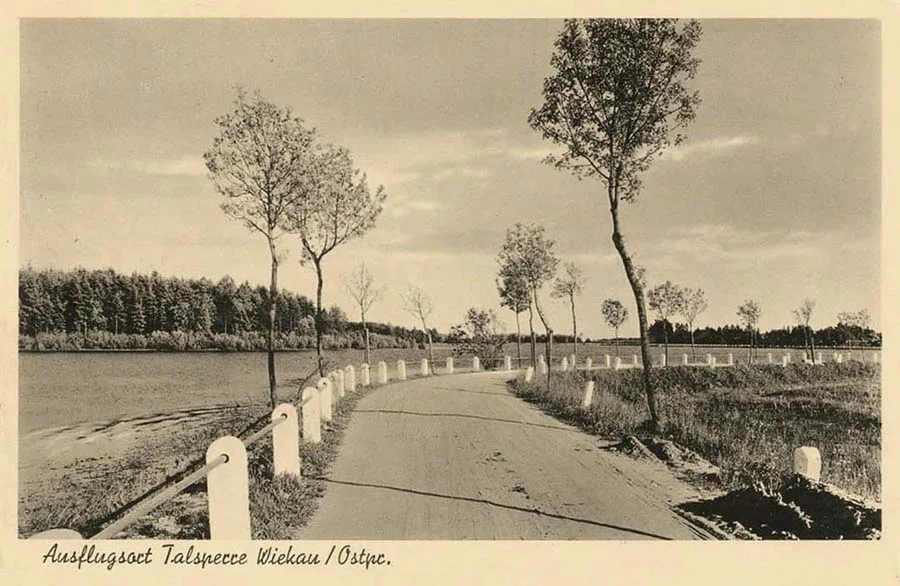 Wiekau. The dam across the floodplain, a favourite excursion spot for the people of Königsberg.
By 1818 Wilgaiten consisted of the royal village (königlich Dorf) of Wilgaiten (five households), the Wilgaiten farmstead (Hof) and the Wilgaiten inn (Krug).
Later the village of Wilgaiten came to be called Köllmisch Willgaiten, while the farmstead and the inn became Adlig Willgaiten.
In the second half of the 19th century Adlig Willgaiten was a knight's estate (Rittergut) which from 1867 formed a Gutsbezirk (estate district) in the Kreis of Fischhausen (merged into the Landkreis of Samland in 1939). The estate belonged to the parish of Wargen (Kotelnikovo). In 1871 Adlig Willgaiten had three residential houses, home to 10 families.
On 13.06.1874 the Gutsbezirk of Adlig Willgaiten was incorporated into the newly established Amtsbezirk of Willgaiten.
In 1885 the Adlig Willgaiten estate owned 186 ha of land, including 129 ha of arable land, 16 ha of meadows and 11 ha of forest. The estate had three houses and nine households.
By 1895 the number of houses on the estate remained the same — three — and the population consisted of 10 families. The situation was unchanged in 1905. In 1905 property tax revenue per hectare of land amounted to 12.47 marks, 26% above the average for the Gutsbezirke of the Kreis of Fischhausen.
On 14.07.1900 traffic opened on the Samland Railway (Samlandbahn), which ran through Willgaiten. A passenger platform was built on it in the village.
Köllmisch Willgaiten was a village which from 1818 formed a rural community in the Kreis of Fischhausen. The village belonged to the parish of Wargen. In 1871 Köllmisch Willgaiten consisted of four residential houses, home to seven families. In the course of the administrative reform of 1874, Köllmisch Willgaiten was converted into an estate, which formed a Gutsbezirk in the Kreis of Fischhausen (Primorsk). On 13.06.1874 the Gutsbezirk of Köllmisch Willgaiten was incorporated into the newly established Amtsbezirk of Willgaiten.
In 1885 the landholdings of the Köllmisch Willgaiten estate amounted to 118 ha, including 61 ha of arable land, 11 ha of meadows and 26 ha of forest. In 1885–95 Köllmisch Willgaiten had four residential houses and six households.
On 14.07.1900 traffic opened on the Samland Railway (Samlandbahn), which ran through Willgaiten. A passenger platform was built on it in the village.
By 1905 the Gutsbezirk of Köllmisch Willgaiten had been converted back into a rural community. In 1905 the rural community of Köllmisch Willgaiten had two residential houses and one public building. The population consisted of six families.
Tax revenue per hectare of land amounted to 12.83 marks, almost 14% above the average for the communities of the Kreis of Fischhausen.
On 30.09.1928 the rural community of Köllmisch Willgaiten (Kolosovka) and the Gutsbezirke of Adlig Willgaiten (Kolosovka), Barrücken (54°47'31'' N 20°18'33'' E), Barsenicken (54°46'29'' N 20°17'42'' E), Dommelkeim (Pavlinino) and Taukitten (54°46'37'' N 20°18'41'' E) were merged into the rural community of Dommelkeim (Pavlinino). In 1935–37 a barracks complex was built in Willgaiten. During the war it housed a Luftwaffe hospital.
The Amtsbezirk of Willgaiten
On 13.06.1874 Amtsbezirk No. 18 Willgaiten was established in the Kreis of Fischhausen, comprising seven Gutsbezirke: Adlig Willgaiten (Kolosovka), Köllmisch Willgaiten (Kolosovka), Barrücken (54°47'31'' N 20°18'33'' E), Barsenicken (54°46'29'' N 20°17'42'' E), Dommelkeim (Pavlinino), Quanditten (Sinyavino) and Taukitten (54°46'37'' N 20°18'41'' E). In 1908 the Gutsbezirk of Köllmisch Willgaiten was converted into a rural community.
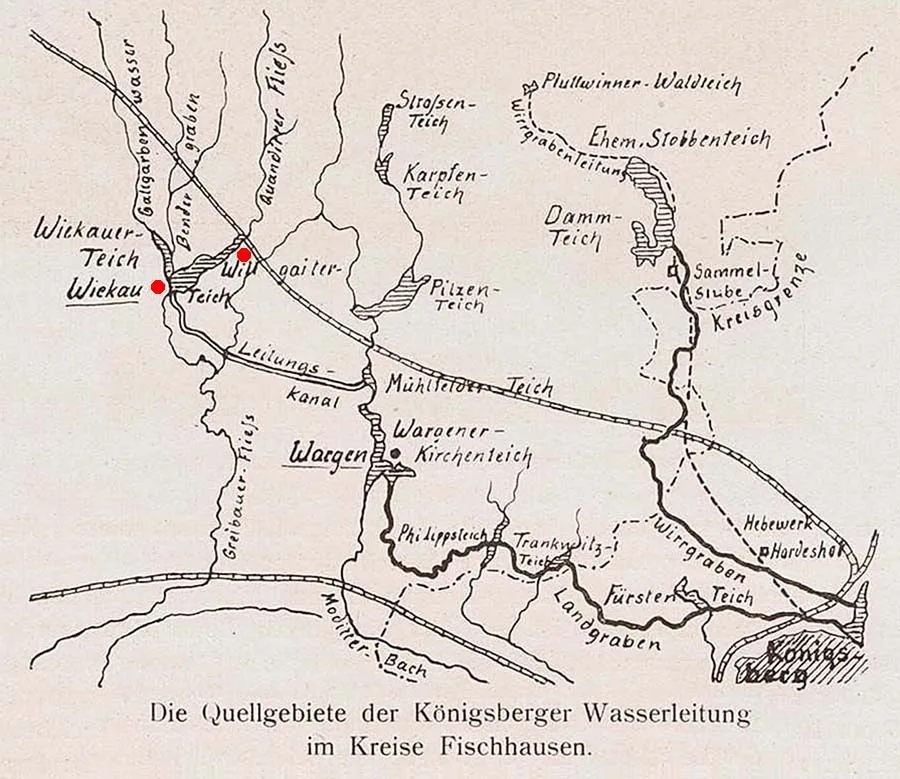 The source areas of the Königsberg water supply in the Kreis of Fischhausen.
On 30.09.1928 the rural community of Köllmisch Willgaiten (Kolosovka) and the Gutsbezirke of Adlig Willgaiten (Kolosovka), Dommelkeim (Pavlinino), Barrücken, Barsenicken and Taukitten were merged into the rural community of Dommelkeim (Pavlinino).
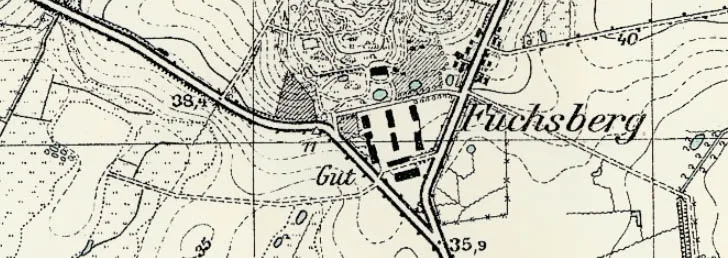
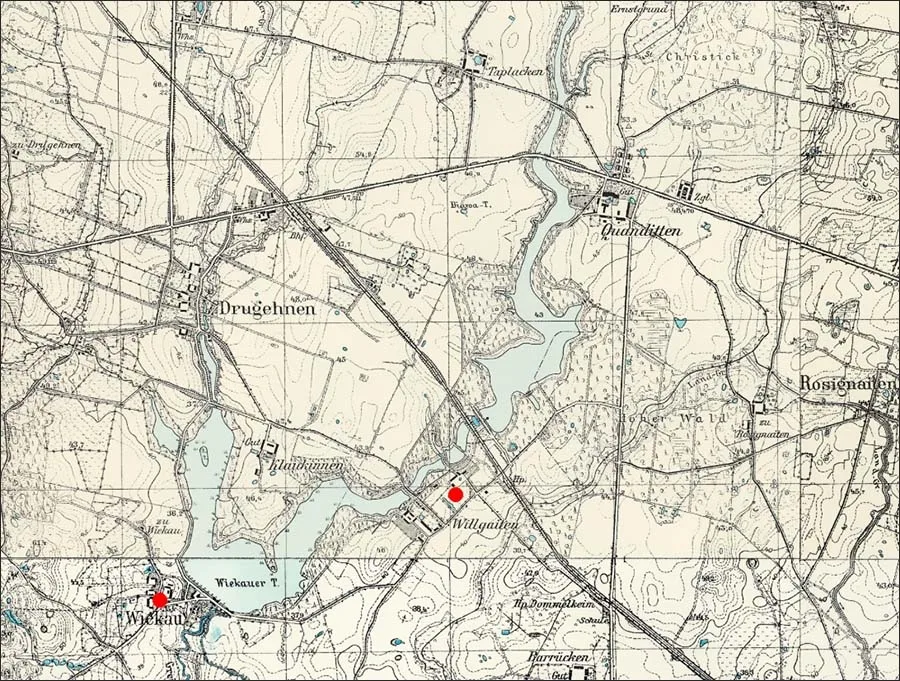 Willgaiten and Wiekau on a topographic map of 1933.
The Gutsbezirk of Quanditten became part of the rural community of Drugehnen (Pereslavskoye) in the Amtsbezirk of Seefeld (Prostornoye). This left the Amtsbezirk of Willgaiten with a single rural community, Dommelkeim (Pavlinino). On 23.04.1930 the community of Dommelkeim was transferred to the Amtsbezirk of Seefeld (Prostornoye), which was renamed the Amtsbezirk of Drugehnen (Pereslavskoye) on 18.05.1930. The Amtsbezirk of Willgaiten was thereby abolished.
Wiekau was founded in 1283 as Wikus. By 1785 the settlement was called Wiekau. In the meantime its name changed several times: Wyckau (c. 1540), Wickaw (c. 1542), Wickau (c. 1563), Wyckaw (1565), after which the spelling Wykau became established for a long time.
In 1785 Wiekau was classified as a royal village (königlich Dorf) with ten households.
The village belonged to the Amt of Kragau (Prokhladnoye) in the Schaken district (Schakenschen). By 1818 the number of households had grown to 12, and the village was now classed as a peasant village (bauer Dorf).
In the 19th century Wiekau was a village which from 1818 formed a rural community in the Kreis of Fischhausen. The village belonged to the parish of Kumehnen (Kumachyovo) and until 1874 was part of the Amt of Kragau (Prokhladnoye). In 1871 Wiekau had 14 residential houses, home to 23 families. On 13.06.1874 the rural community of Wiekau was incorporated into the newly established Amtsbezirk of Seefeld.
In 1885 the community of Wiekau owned 343 ha of land, of which 210 ha were arable land, 25 ha meadows and 22 ha forest. The village had 12 residential houses and 23 households.
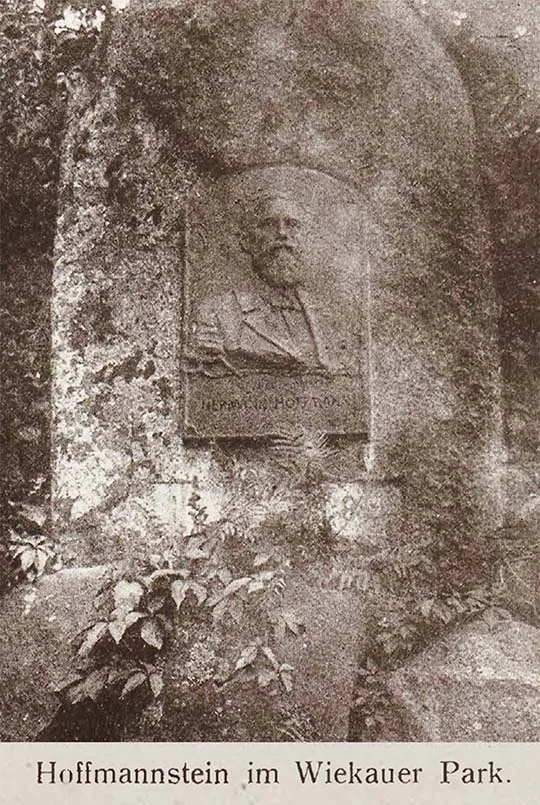
Detail of the monument to Hermann Theodor Hoffmann with his portrait.
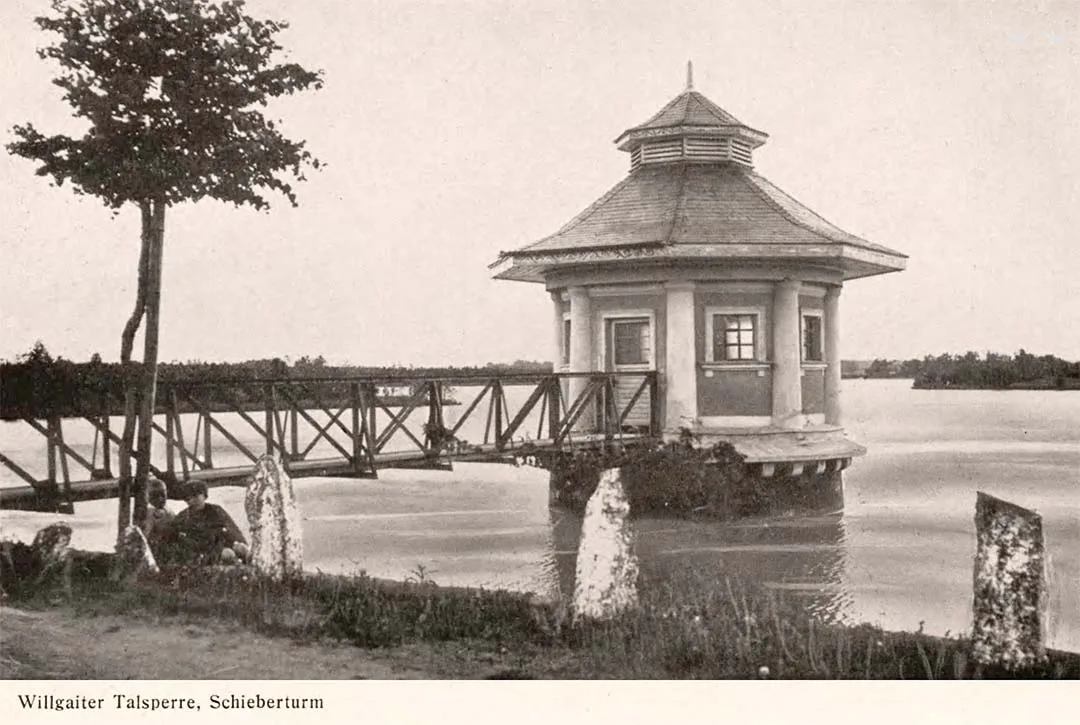
In 1887–89 large-scale hydraulic engineering works were carried out near Wiekau. A dam was built here, creating the Wiekauer Teich pond (the Veliky reservoir), which supplied Königsberg with water.
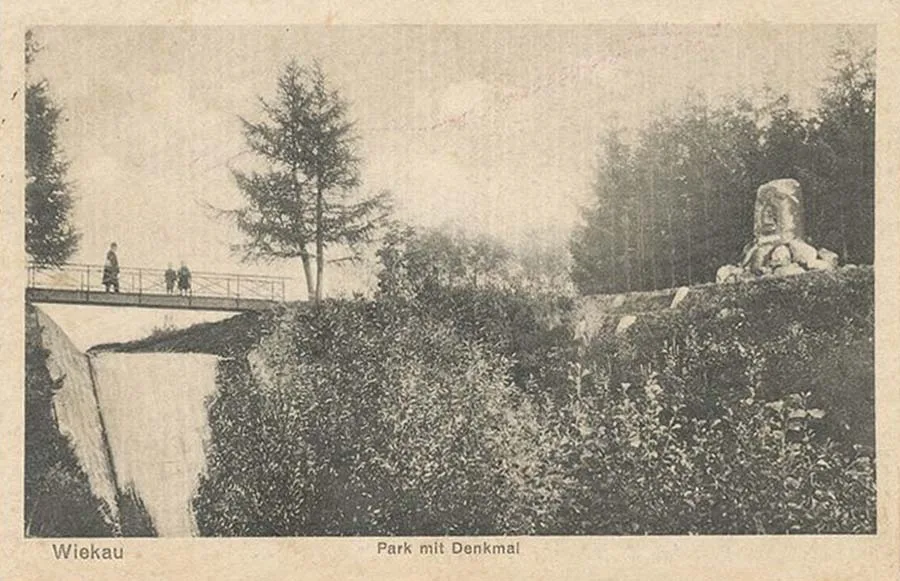 The monument to Hermann Theodor Hoffmann in the Wiekau park.
Water from the pond flowed through the Wiekau-Mühlenfeld canal (Mostovoy) into the Wargener Kirchen-Teich pond (Shkolny) and then along the Landgraben canal (Pityevoy) to Königsberg.
In 1905 Wiekau had 13 residential houses and one public building. The population consisted of 21 families. Property tax revenue per hectare of land was 9.99 marks, 11.5% below the average for the communities of the Kreis of Fischhausen.
On 16.09.1905 a monument was unveiled by the dam to the Königsberg mayor Hermann Theodor Hoffmann (1836–1902), during whose term of office the city's water supply problem had been solved.
On 30.09.1928 the community of Wiekau was merged with the rural community of Pentekinnen (54°47'11'' N 20°16'18'' E) and the Gutsbezirke of Prilacken (Bratskoye), Klaukinnen (54°48'16'' N 20°16'49'' E) and Reessen (formerly Rössen, 54°46'56'' N 20°16'14'' E) into the new rural community of Wiekau.
On 30.01.1945 Willgaiten was taken by soldiers of the 17th Guards Rifle Division of the 39th Army.
On 19–24.02.1945 the 54th Rifle Corps of the 43rd Army fought west of the settlement. On 13.04.1945, after the capture of Königsberg, the 45th Rifle Corps of the 5th Army launched its offensive on Samland from here. In April 1945 an auxiliary observation post of the 3rd Belorussian Front was located in Willgaiten.
On 17.11.1947 Willgaiten was renamed Kolosovka, and Wiekau became Khrustalnoye. In 1955 Kolosovka had 34 houses and Khrustalnoye four. No later than 1975 Khrustalnoye was removed from the register and incorporated into Kolosovka. In 2000–01 Kolosovka briefly became the centre of the Kolosovka rural district, but this was soon dissolved. As of 2018 the settlement had a children's music school and a post office.
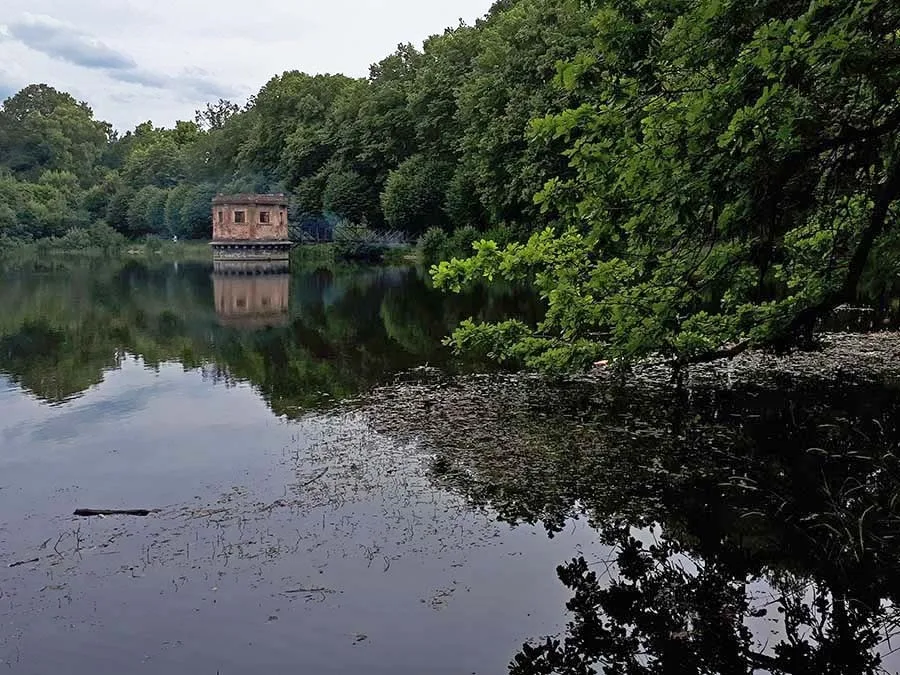 The Veliky reservoir (German: Wikauer Teich. 2025).
As of 2025 the settlement has 97 residential houses and public buildings (excluding the penal colony and the allotment associations). Two of these houses stand on the territory of the former settlement of Khrustalnoye (Wiekau).
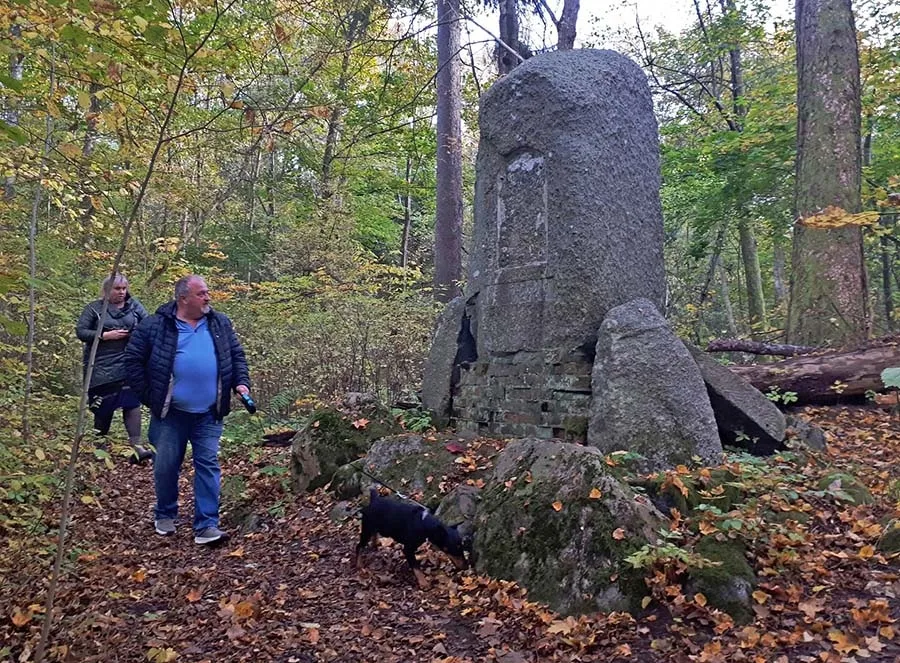 At the monument to Hermann Theodor Hoffmann today (2024).
The two allotment associations "Kolosovka" and "Malaya Kolosovka", on opposite sides of the settlement, have another 200 registered houses. The settlement has a kindergarten and shops. Nearby, on artificial ponds, there is a fishing club.
Sights: the dam of Lake Veliky with its culvert (1887–89), the remains of the monument to Mayor H.T. Hoffmann (1905), a mass grave of Soviet soldiers (203 people, memorial 1956) on the grounds of the penal colony.
Population: 1988 – 920, 2002 – 1,459, 2010 – 1,358, 2012 – 1,554.
Population of Adlig Willgaiten: 1818 – 471, 1867 – 73, 1871 – 52, 1885 – 50, 1895 – 53, 1905 – 60, 1910 – 19.
Population of Köllmisch Willgaiten: 1818 – 25, 1867 – 38, 1871 – 37, 1885 – 39, 1895 – 32, 1905 – 38, 1910 – 59
Population of the Wiekau community: 1818 – 96, 1867 – 131, 1871 – 139, 1885 – 125, 1895 – 121, 1905 – 128, 1910 – 133, 1925 – 323, 1933 – 275, 1939 – 273.
Composition of the population of Adlig Willgaiten in 1871: all 52 Protestant Christians, children under 10 – 15, literate – 30 (81%).
Composition of the population of Köllmisch Willgaiten in 1871: all 37 Protestant Christians, children under 10 – 7, literate – 30 (100%).
Composition of the population of Wiekau: all 139 Protestant Christians, children under 10 – 33, literate – 85 (80%).
For reference
Population of Pentekinnen: 1818 – 24, 1867 – 27, 1871 – 22, 1885 – 34, 1895 – 28, 1905 – 24, 1910 – 33.
Population of Klaukinnen: 1818 – 30, 1867 – 28, 1871 – 22, 1885 – 47, 1895 – 52, 1905 – 49, 1910 – 32.
Population of Reessen: 1867 – 56, 1871 – 56, 1885 – 64, 1895 – 62, 1905 – 54, 1910 – 72.
Composition of the population of Klaukinnen in 1871: all 22 Protestant Christians, children under 10 – 1, literate – 21 (100%).
Composition of the population of Pentekinnen in 1871: all 22 Protestant Christians, children under 10 – 4, literate – 15 (83%).
Composition of the population of Reessen in 1871: all 56 Protestant Christians, children under 10 – 20, literate – 21 (60%).
1 – including 44 inhabitants at the Wilgaiten farmstead and 3 at the Wilgaiten inn.
Photos: Bildarchiv Ostpreußen | bildarchiv-ostpreussen.de, Mikhail Ogorodnikov.
Translated from Russian with the help of AI (Claude, Anthropic), October 2026.