LEGENDS OF PRUSSIA in the blog of Tatyana Kolivay.
From the series "Leafing through Old Pages".
The weekly "Gartenlaube" (The Garden Arbour).
Leipzig, 1859, Heft 31, S. 445-447.
Amber / Der Bernstein.
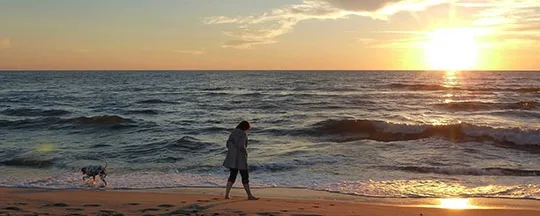
The high-bosomed maidens of Troy, and the wives of the Hellenic warriors who sailed to Troy on "winged, black-sided1 ships" to destroy it, adorned themselves with amber. Both Trojans and Greeks bought amber from the Phoenicians — the Britons of the ancient world — who brought it from the seashore. Which seashore? Why, the very one where it is still found most often today — the seacoast of Prussia.
According to the ancient Greek myth told in the "Metamorphoses" of the Roman poet Ovid, amber is the petrified tears shed by the sisters of Phaethon when the illegitimate son of Helios met his end in a reckless attempt to drive his father's chariot. As a punishment the weeping Heliades were turned into poplars. They stood on the bank of the Eridanus, and their tears fell into the icy water and hardened, turning into amber — a beautiful farewell gift to the son of the Sun.
"The unhappy maidens weep, mourning their brother,
Tear upon tear flows into the waters of the sacred river…"
In Homer's time the Hellenes called the river Padus, now known as the Po, the Eridanus; their descendants gave the name to a river flowing into the North Sea (the Maas, the Scheldt or the Rhine itself); and only by the time of the birth of Christ — that is, at a time when Sidon and Tyre, the former metropolises of Phoenicia, already lay in ruins and the Phoenicians lived on only in history — was the true place where amber was found established: the sandy seacoast of Prussia, bearing the poetic name of Nerung. And the name Eridanus is alive here too. Only now it sounds like Radaune2. That is the name of a small river about 15 kilometres long, a tributary of the Motława, which in turn flows into the Vistula.
For a long time amber was considered a mineral — not for nothing was it called a stone. Recent research, however, has shown that it is undoubtedly of plant origin and belongs to the plant resins, although it lacks some of their properties.
It is probably a fossilised, petrified resin of coniferous trees of the gymnosperm subclass Coniferae, which died out as a species in one of the many natural cataclysms that periodically befall our planet. Professor Göppert of Breslau3 believes that amber was formed during the penultimate or the last ice age [known as the Valdai glaciation, which lasted about 100,000 years and ended roughly 11,700 years ago — ed.]. This is confirmed, in particular, by the fact that the small insects frequently found in amber are identical to those that exist today.
Amber, despite its acquaintance with the ancient Phoenicians, is not very old from the point of view of geology, which, as is well known, operates not in decades and centuries but in millennia. To explain the frequent occurrence of amber in northern latitudes, it is supposed that it is a tree resin that oozed abundantly from the trunks of conifers and, on falling into water, quickly hardened.
In those days the latitudes in which present-day Prussia lies enjoyed a benign, mild climate. Over a large part of what is now the bed of the Baltic Sea grew boundless forests, which perished under masses of water when gigantic floods came here from the far north together with the ice, and this is what led to the change from a mild, warm climate to a harsh, cold one.
۞ ۞ ۞
Depending on where it is found, amber is either sea amber or fossil (mined) amber. The former is obtained mainly from the sea bed. [And after storms — near the shore and even on it — ed.]
Amber can be taken from the sea bed at any time of year. It can be found on the beaches when a storm tears brown seaweed, with amber caught in it, from the deep sea bed and carries it to the shore. Here it becomes the prey of the amber fishers. These are mostly strong men dressed in coarse woollen skirts and leather cuirass-like aprons, with special large nets on long poles.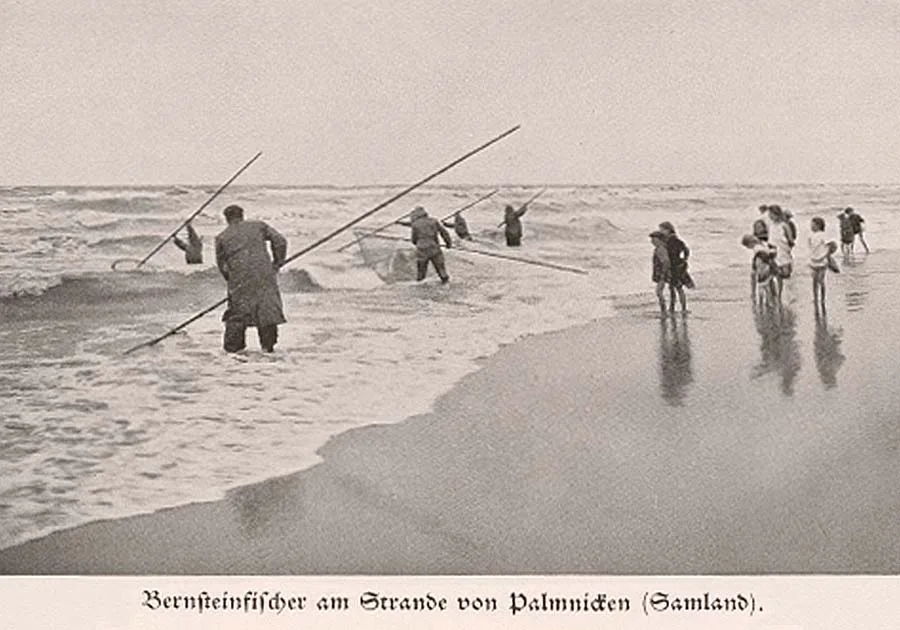 Amber fishers at work on the beach at Palmnicken (Yantarny).
They wade into the seething sea up to the waist, sometimes even up to the chest, spot the seaweed being driven towards the shore by the waves, scoop it up and gather the largest pieces of amber into their bags.
Back on shore, the fishers dump the seaweed — an annoying but unavoidable addition — onto the sand, where women and children carefully pick the smaller pieces of amber out of the brown mass to carry the precious finds home. And the men, after a successful "amber hunt", usually go to the nearest tavern and there indulge in libations of potato schnapps to the glory of Bacchus. Depending on the catch Neptune has granted them, their drinking bouts are more or less lavish.
This is the most common way in which the sea is deprived of its amber riches. Considerably smaller is the quantity of amber that Neptune gives up of his own accord to the inhabitants of dry land, these creatures of his brother Jupiter. Or, to put it less loftily, the quantity of amber that the Baltic Sea throws up on the eastern and western coasts of Prussia when the north and west winds blow.
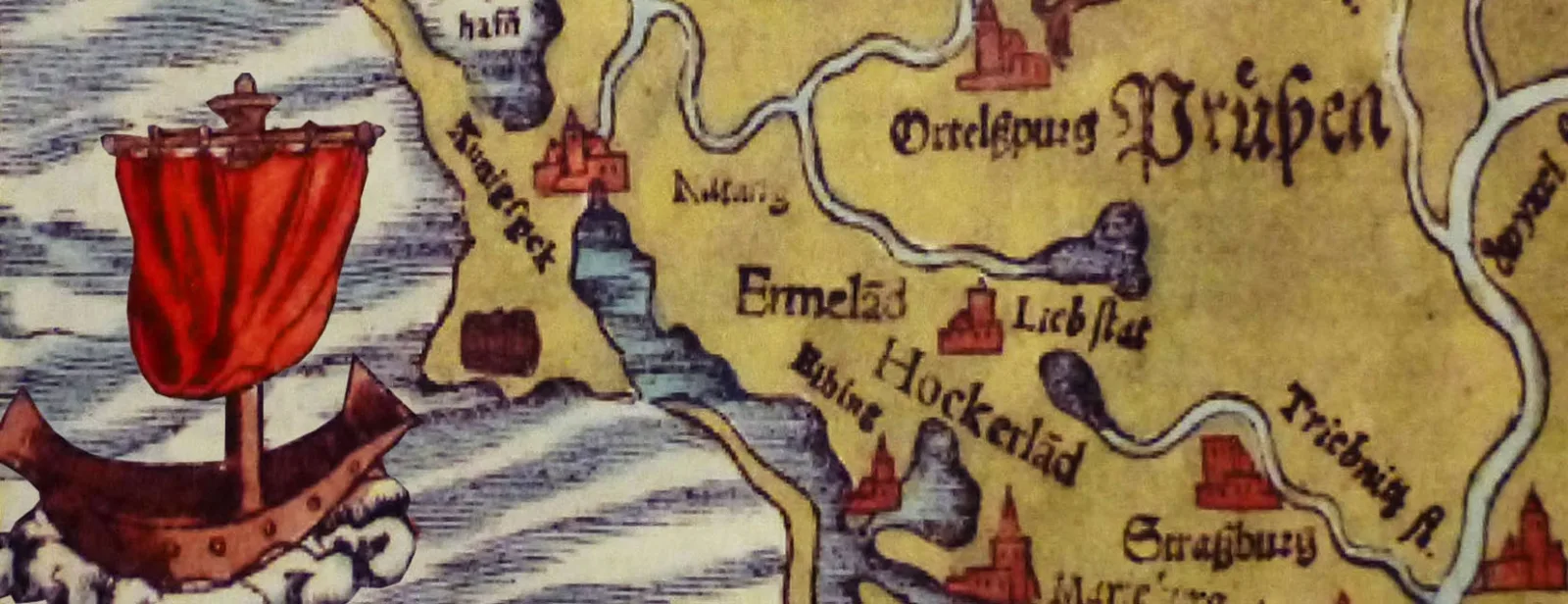
Be that as it may, the western coast of Samland [the Sambian Peninsula, Sambia — ed.] is Prussia's precious "amber coast", the one most generously endowed by the sea. Less rich are the beaches of Danzig [now Gdańsk], the Vistula Spit / Frische Nehrung and the northern coast of Samland. Poorer still are the Curonian Spit and Pomerania, and the poorest of all are the shores of Courland [Latvia] and Sweden. On all other stretches of seacoast where amber occurs, it has been found only very rarely.
۞ ۞ ۞
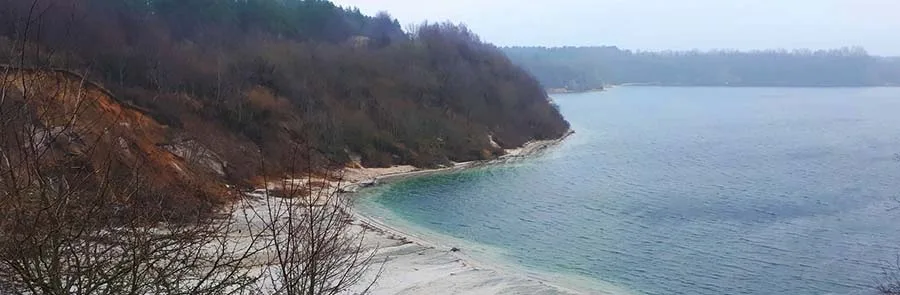
Fossil amber is extracted from pits. [In the mid-19th century there were still no open-cast mines or shafts on the shores of the Baltic Sea. — ed.] To dig them, one looks along the seacoast for places where the shore has collapsed through undermining, so that the layers of earth have become clearly visible in the surviving steep face. Where brown stripes indicate deposits of lignite, or where there are layers of blue clay, amber may also be expected.
When amber is to be mined from pits, a suitable spot is found, its base is cleared of scree and rock debris, and then the foot of the cliff is carefully undercut so that a section of the bank collapses. From the fallen mass of earth a rampart is built to separate the shore from the sea. The rampart is usually semicircular with sloping sides so that the earth does not slide down. Then some of the workers begin digging a large pit by the cliff. It is cleaned out, deepened and levelled. Since groundwater is often present above the amber deposits, it has to be drained off, after which the remaining water is directed into basin-like hollows, and the pit is enclosed around its perimeter with piles, which are interwoven with brushwood, every crack being carefully stopped with grass and moss.
Once the painstaking preparatory work is finished and the pit is ready, the diggers (Stecher) stand in a row and carefully drive tools resembling large chisels some three feet into the ground, neatly separating one thin layer of earth after another.
In front of the diggers in the pit stands the receiver (Abnehmer), who watches closely to see whether any amber has appeared out of the earth. The largest pieces are immediately and carefully removed and wrapped in wet rags so that they do not crack on exposure to the air after thousands of years spent underground, as sometimes used to happen.
The diggers cut away the earth layer by layer for as long as possible without letting the overhanging edge of the pit collapse. They are constantly watched by overseers (Aufseher, Ausgucker). Only when these are satisfied that there is no more amber in the pit is it abandoned, so as to try one's luck elsewhere. The gold diggers of California and Australia work in much the same way.
As for the profit, it is usually divided as follows: one third goes to the owner of the land on which amber is sought, the second third goes to the entrepreneur who organised the digging, and the last third is given to the workers, who share it among themselves. The workers also receive a small fixed weekly wage out of the pocket of the "pit owner", i.e. the entrepreneur, and he too, when visiting the diggings, treats the workers to tobacco and beer — schnapps is usually scorned by the miners of fossil amber, unlike their colleagues, the fishers of sea amber.
The amber found is most often sold as follows: the entrepreneur takes all the amber found for himself and pays the other participants their shares in cash, on the basis of a value agreed in advance by all parties. The price the entrepreneur obtains from buyers, dealers and amber carvers over and above the price he has paid himself forms the second part of his profit.
۞ ۞ ۞
The value of amber is determined above all by size, colour and shape, and by greater or lesser transparency. Fully transparent amber is usually prized most of all. Semi-transparent "bastard amber" / Bastardbernstein is the most common, and opaque amber the least valuable. In the West milky white is preferred, in the East pale yellow.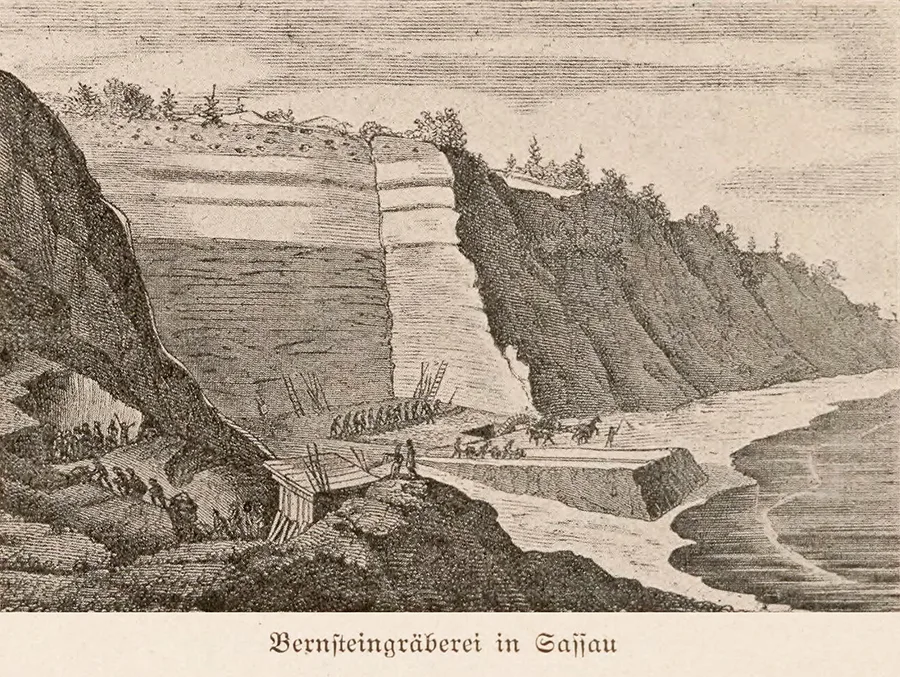 Mining amber from a pit on the seashore.
Depending on size, which is the best measure of value, amber is divided into Große Ware (large goods) and Kleine Ware (small goods).
Large goods are also called Sortiment (assortment) and are subdivided into:
1). Großbernstein (large amber), i.e. amber weighing 1/3 of a pound4 or more, worth 40–60 thalers a pound depending on shape and colour. Exquisitely beautiful pieces in shape and colour weighing more than 1 pound cost 100 thalers and upwards;
2). Zehner (tens) — amber weighing from five to nine Lot5, at a price of 25 to 30 thalers a pound;
3). Dreißiger (thirties) — amber weighing two Lot and more, i.e. 15 to 16 pieces to the pound. This grade usually costs half as much as the previous one, i.e. 14–18 thalers a pound;
4). Czacken (trinkets) — pieces of amber weighing one Lot or less; the price depends on the proportion of large and small pieces and amounts to 7 to 10 thalers a pound.
These four grades of amber in varying quantities make up the Sortiment, which is usually dispatched in wholesale lots for sale in the East.
۞ ۞ ۞
Small goods are subdivided into:
1). Grundsteine, i.e. pieces that do not reach the size of a hazelnut but are as large as a bean. They cost from 1.15 to 1.5 thalers a pound.
2). Knibbel — amber the size of a pea. It costs from 2/3 to 3/4 of a thaler a pound.
All the prices given here, however, apply only to transparent amber. Semi-transparent amber costs half as much, and opaque amber barely a third of the price of transparent amber.
۞ ۞ ۞
Despite its small size, Knibbel is nevertheless used to make amber beads. Thus it too belongs to the so-called working stones. Everything smaller than Knibbel is no longer fit for working and is sold as waste at a few groschen a pound. It is used to prepare amber varnish, amber oil and succinic acid, while low-grade amber crumbs are used to make incense.
Succinic acid and amber oil are considered to strengthen the nerves and to act as antispasmodics, sudorifics and diuretics. The fumes of amber incense were often used as a remedy for gout, sprains and rheumatism. Amber varnish gives wooden articles a beautiful, glossy, water- and airtight coating.
۞ ۞ ۞
Amber is an important export of the Prussian coast, especially to the East, and was so even more in former times than now. Turkish, Armenian and Greek merchants once came to Prussia to buy amber here, both worked and unworked. It was taken to Turkey and to the countries of the East and South, where it was used in women's jewellery and also to make incense, for the Persians, the Chinese and other Orientals prefer the scent of amber to all the aromatic substances in which the East is so rich, and gladly use amber incense at religious festivals and feasts.
Nowadays the inhabitants of the Levant [the eastern Mediterranean — ed.] no longer come to Prussia. The amber trade has been taken over by Prussian and especially Danzig Jews. For centuries Danzig was, and remains, the largest centre of the amber trade.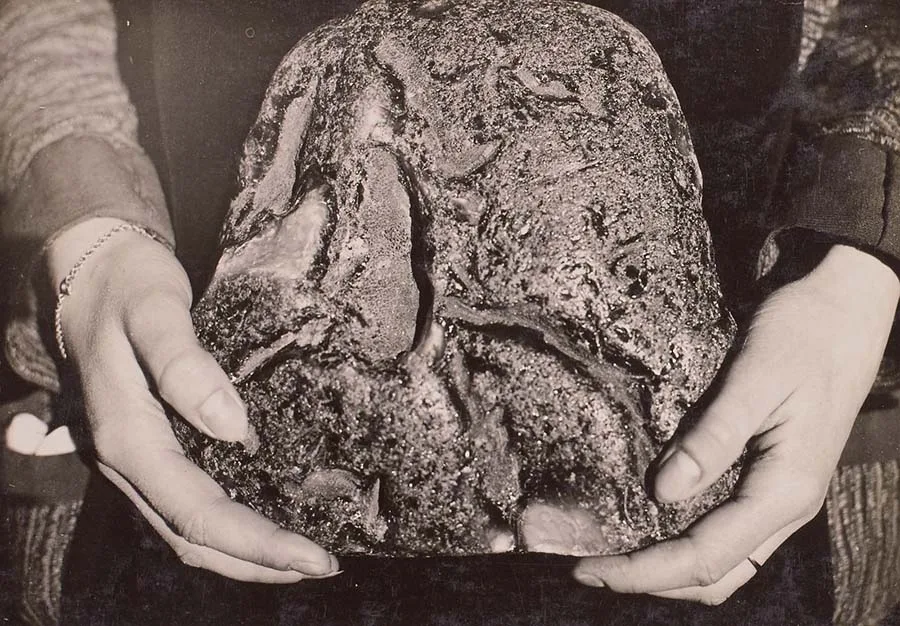 The largest amber nugget known before the Second World War was found in 1803 in a roadside ditch between Insterburg (Chernyakhovsk) and Gumbinnen (Gusev). It weighed more than seven kilograms.
Last year, 1858, according to the official "List of Ship Accounts", ships left Danzig for sea carrying 1,028 hundredweight of raw and worked amber and of amber chemicals (including 14 hundredweight of amber oil).
Most of the cargo went to Holland, which supplies the interior of India, the Indian islands, China and Japan with amber jewellery and amber articles, which are in great demand there. However great the value of the amber shipped to Holland, this is far from the whole of the amber export: at least as much again is sent from Danzig inland — to Poland, Russia, Romania and Turkey.
Most of the amber is also worked in Danzig. At present, however, Paris is beginning to overtake it in this respect. A great deal of "sun stone" is now polished there, and part of it then returns to Germany at unjustifiably inflated prices.
Since amber is considerably harder than other resins, there are many ways of working it. A huge quantity of stones for necklaces is sent to Turkey, the Danubian countries and Egypt. And from Egypt further on to the Sudan, Nubia and Abyssinia, where slave traders often barter amber for slaves for household and field work for lazy Muslims and for concubines for their harems. Large, flat, shapeless stones are specially selected for India. They go into necklaces for statues of Brahma, Vishnu, Shiva and Buddha, which stand in the temples there. Amber pipe mouthpieces are also made for export to the East, since Muslims are permitted to smoke only through these, for the Koran does not allow believers to touch "dead animals" with their lips (all kinds of horn, tortoiseshell and so on are forbidden).
۞ ۞ ۞
Given the high value amber has always had, it attracted the attention of the rulers of various lands from ancient times. But probably, until the arrival of the German knight-brothers of the Order in Prussia, anyone — local or foreigner — was free to gather amber, as the chroniclers Grunau and Leo expressly testify:
Antiquitus legebat quisque succinum in Prussia gratis.
(In olden times everyone gathered amber free of charge)
Histor. Prussiae
The knights of the Teutonic Order, having extended their power over the whole coast of Samland in the last quarter of the 13th century, proclaimed the introduction of the so-called amber regale, or amber privilege / Bernsteinregal, i.e. the monopoly right to extract and sell amber. Unauthorised gathering of amber was punishable at that time by death.
The 14th-century "Amber Ordinance" entrusted general supervision of the observance of the amber regale to the Marshal of the Order / Ordensmarschall in Königsberg. All amber found had to be handed over to amber collectors (the so-called Order stewards / Ordensschäffer, who were appointed by the Marshal. Local inhabitants had no right either to keep amber or to sell it.
The Order held a monopoly on the amber trade and even banned the craft of amber carver in its lands. The Order sent all the amber collected, unworked, to its commanders in Lübeck and Bruges.
In Bruges an amber guild was founded around 1300. Its members made various religious articles, especially amber rosaries. A good hundred years later the guild numbered some 70 masters and about 300 apprentices.
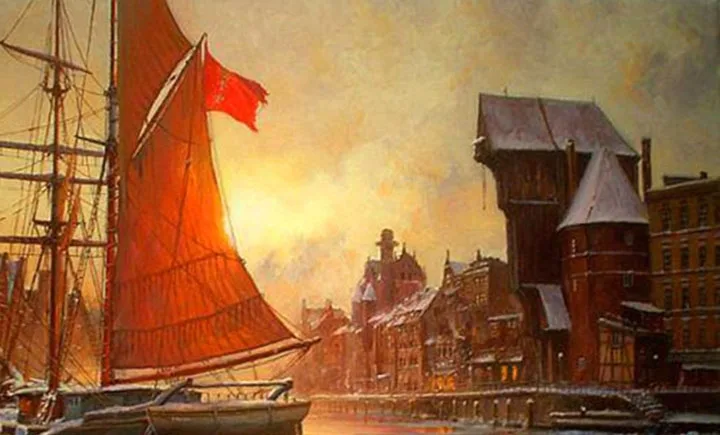
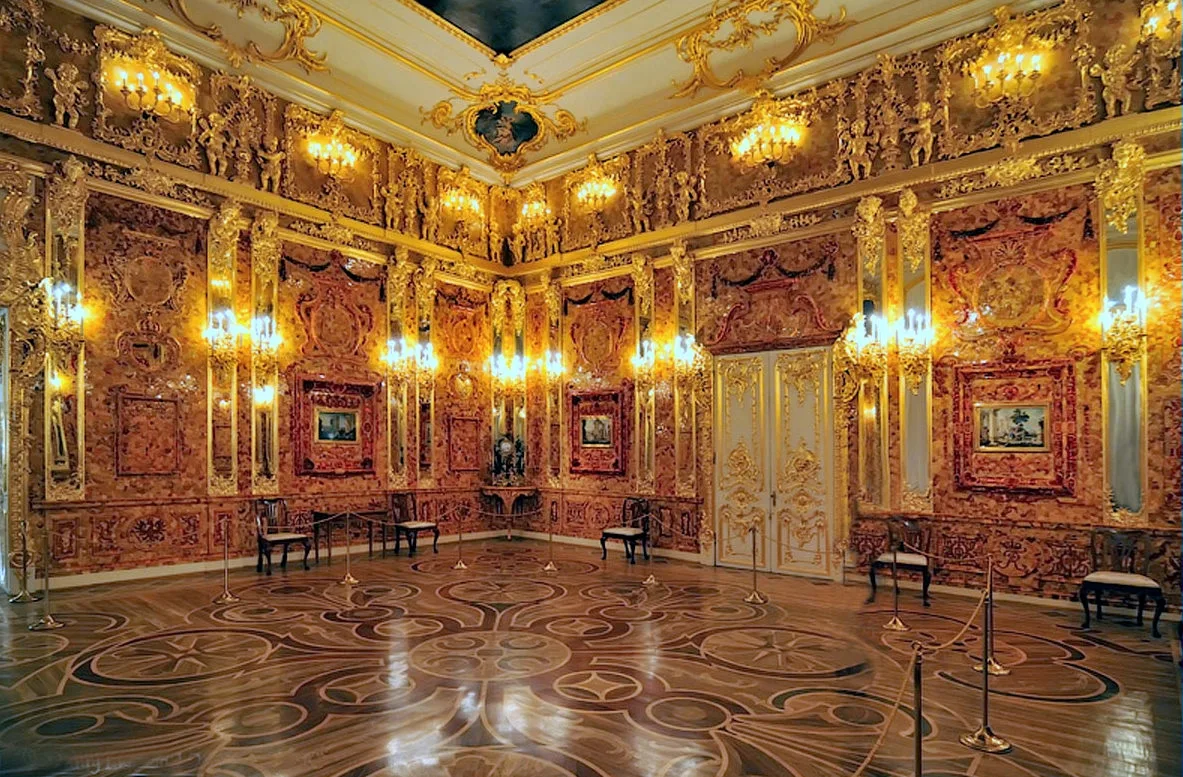
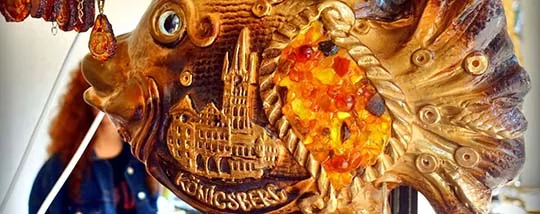
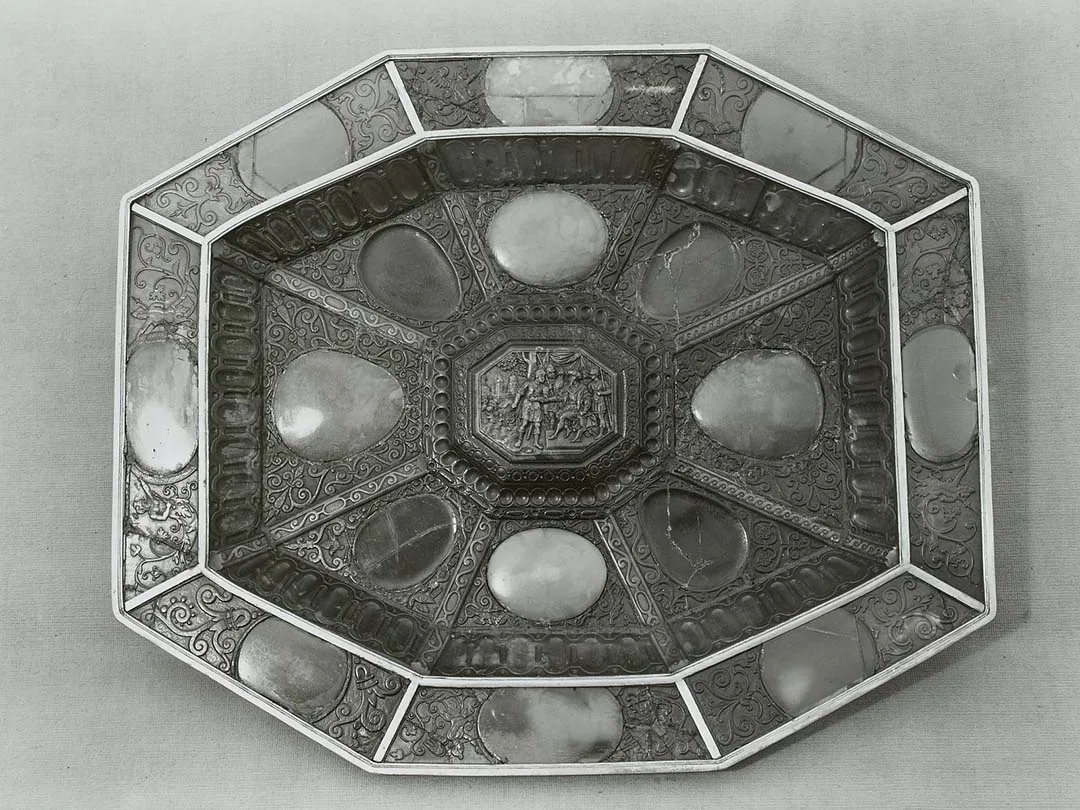
The most important centres of the amber craft in Prussia were Danzig and Königsberg. While Catholic Danzig specialised in religious articles, Protestant Königsberg mainly produced articles for everyday use. Thus large pieces of amber were made into crosses, hearts, caskets, goblets, rings, statuettes, various trinkets, chess sets and so on.
۞ ۞ ۞
The Order's monopoly was dealt a serious blow when, under the Treaty of Toruń of 1466, the whole of West Prussia passed out of its rule, and the Vistula Spit — a third of the Amber Coast — went to the newly formed Free City-State of Danzig6.
The young, ambitious republic took a more liberal view of the amber regale and soon became a successful competitor to the Order's monopoly on the amber trade, since Danzig had no shortage of skilled master carvers or of other resources for working amber.
This prompted the first Duke of Prussia, Albrecht of Brandenburg7, who in 1525 exchanged his Grand Master's mantle for ducal ermine, to permit amber working in his territory as well. He also allowed the mining of fossil amber, which had been permitted in Danzig a little earlier. The first amber pits appeared in Prussia in the 1550s.
The amber miners, however, had to pay a tax to the duke, and the gathering of amber on the coast was still regulated by the amber regale. Offenders were punished with severe fines. Supplements to the Amber Ordinance of 1582 forbade anyone, whatever his estate, to appear on the seashore without proof of identity.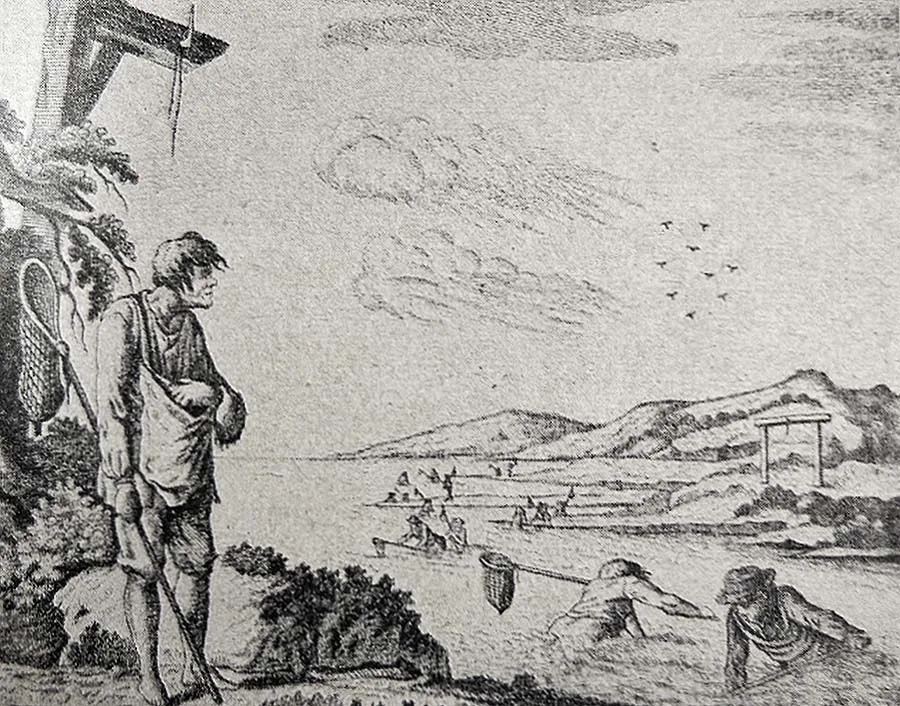 Gallows for those who violated the amber regale.
Gallows were set up on the seashore, and those caught gathering amber illegally were hanged on the spot. Confessions were beaten out of those suspected of embezzling amber, and out of receivers, with whips and torture.
The Great Elector Frederick William of Brandenburg8 at first seemed to pursue a milder policy and did much to develop the amber trade in his Prussian duchy. But it was he who later decreed that all inhabitants of the Baltic shores, as well as those who visited the coast on business, had to swear an official oath not to embezzle amber. This so-called beach oath / Strandeid had to be sworn by all males over eighteen. Not even clergymen were exempt. The oath contained the following passage:

"And if I see and perceive that my father, mother, brothers, sisters or other persons wish to abuse the trust placed in them in dealing with amber, I swear not to allow it and not to yield to temptation.."
The penalties for offenders were laid down as follows: for stealing one pound of amber — a fine of 90 Prussian gulden; two pounds — double the fine; three pounds — a fine of 270 gulden, flogging and banishment from the coastal area for 10 years; four pounds — the same fine, but in addition to the lashes also the pillory and lifelong banishment from the country; five pounds or more — the gallows, with the offender's family compensating double the amount stolen.
In the case of a particularly large theft (25 pounds of amber or more) the culprit could even be sentenced to death by breaking on the wheel!9 Merely going onto the beach without permission was punished by a fine of 12 to 18 gulden, and a repeat offence led to banishment from the coastal area for one to three years.
To put these laws into effect more quickly and to begin punishing violators of the amber regale as soon as possible, an Amber Court / Bernsteingericht, consisting of a fiscal and six assessors, was established in Fischhausen on 21 November 1644 by order of the Great Elector.
The barbaric methods used against violators of the amber regale, and the intimidation and coercion to which the coastal inhabitants were subjected, had a very negative effect. In keeping with the old Latin saying Nitimur in vetitum! (Human souls are drawn to what is forbidden!), they led to the opposite result, prompting bold spirits to secret theft and breeding a bitterness in return, the victims of which were many of the guards who patrolled the coast.
The numerous gallows on the crests of the coastal dunes and the oaths (not to steal amber) were a weak incentive to keep the rules.
Most of the local people did not regard stealing amber as a crime: "The waves throw the stone onto the shore. Amber is the blessing of the sea, so it belongs to us, the people of the coast, and therefore taking it is not theft."
At the beginning of the 18th century the punishments were somewhat relaxed. From then on a sentence of hanging was passed only if about a quarter of a ton of amber had been stolen and, moreover, "the thief was of base estate". Inspections, too, came to be regulated more precisely. Every three years the coastal inhabitants from the boundaries of Danzig to Memel had to appear "with their sons and servants", swear the beach oath, allow their nets to be inspected, and, if their household showed any increase in prosperity, had to prove convincingly that it did not come from selling illegally appropriated amber.
In 1717, during inspections of the property of local peasants, they were punished even if only a single piece of amber was found in a chest or a cupboard.
۞ ۞ ۞
From 1762, after the end of the Russian occupation of East Prussia, punishments became more humane. The death penalty and banishment from the country were abolished, and flogging was imposed only if the offender, caught in the act, attacked a mounted guard10. But the penalty was always prison on bread and water, and in more serious cases the house of correction with a "welcome and farewell", administered on arrival and again on the prisoner's release. These were 25 strokes of the cane, counted out under the strict supervision of the prison physician.
A foreigner, however, who ventured onto the seashore without a legitimation card11 in his pocket faced the "Spanish cloak" and prison.
Wooden barrels of shame, also called "Spanish cloaks", were an instrument of punishment in Europe from the 13th century onwards.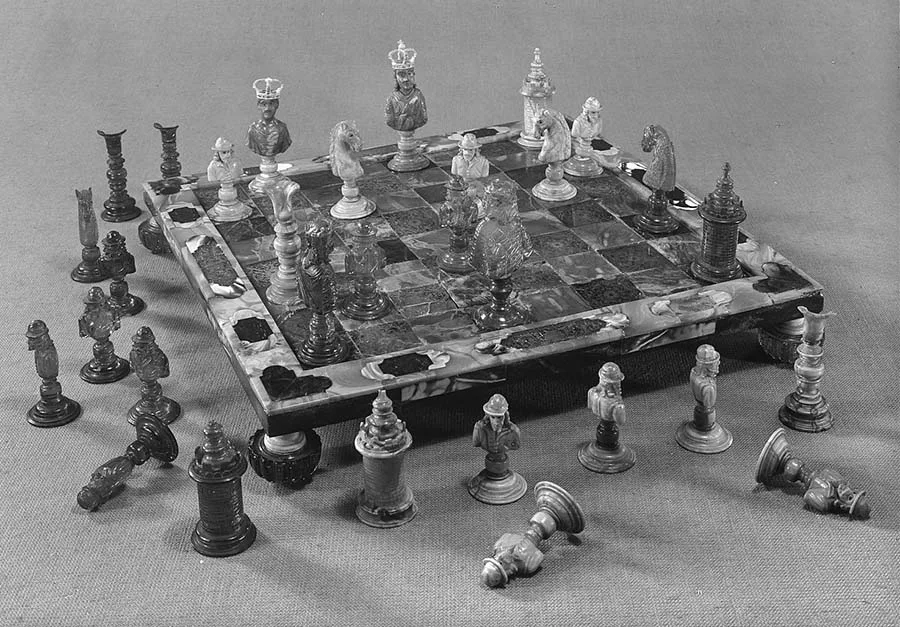 An antique amber chess set.
The person placed in a barrel of shame lined inside with sheet metal could be insulted, slapped and pelted with rubbish. To increase the torment of the condemned, weights were hung from the lower rim of the barrel.
The beach oath was also reinforced by an addition requiring children to denounce their parents! This state of affairs continued until quite recently. It should be mentioned that when the amber regale was leased to merchants in 1807, the hated inspections and the local peasants' obligation to gather and deliver amber came to an end, but access to the seashore still remained under strict control. The situation changed only in 1837, when the inhabitants of the coastal zone themselves obtained the lease of the privilege of the amber regale.
This meant that the former restrictions on access to the seashore ceased, and only from that moment did the numerous visits to Cranz, Neukuhren and the other seaside resorts of the Samland coast begin, together with their vigorous development.
The state, of course, now received less profit from the amber regale, but these losses were amply compensated not only by the income that the resorts of the Prussian coast brought in all year round, but also by the improvement of the moral atmosphere among the local population.
۞ ۞ ۞
In conclusion I would like to mention the attempt made a few years ago in Breslau by Professor Göppert to produce amber artificially. The scientist kept spruce resin and spruce branches in warm water (65–80 degrees C) for three months. The resin began to smell no longer of turpentine but rather of a pleasant balsamic fragrance, which brought its properties closer to those of amber, but, unlike amber, it still dissolved in alcohol. Another resin, Venetian turpentine12, was kept together with larch branches in warm water for a whole year. As a result it too lost part of its solubility, but still could not fully attain the characteristics of amber. These experiments, now begun, will probably encourage physicists to further experiments and attempts to reproduce this wonderful gift of nature.
NOTES
1. Homer describes the ships of the Achaeans (one of the main ancient Greek tribes) as black-sided, that is, with tarred hulls.
2. Radaune (German Radaune, Polish Radunia). A small river in Kashubia (Pomerania) in northern Poland, which flows out of a lake and into the Motława not far from Gdańsk.
3. Johann Heinrich Robert Göppert (1800, Sprottau – 1884, Breslau, now Wrocław, Poland). German botanist, palaeontologist, physician and university professor.
4. Pound (from Latin pondus — weight) — a unit of mass.
In the Anglo-Saxon countries (unlike Russia) the pound was equal to 0.45359237 kg. The most widespread today is the international avoirdupois pound (from English avoirdupois, from French avoir de pois — goods sold by weight), legally defined as 0.45359237 kg.
5. Lot — a pre-metric unit of mass (used in the second half of the 18th to the early 20th century), equal to 1⁄32 of a pound, or 12.79725 grams.
6. Thus in the original:

7. This refers to Albrecht of Brandenburg-Ansbach (German Albrecht von Brandenburg-Ansbach; 1490, Ansbach, Franconian Imperial Circle – Tapiau Castle, Gvardeysk), Grand Master of the Teutonic Order and first Duke of Prussia.
8. Frederick William I of Brandenburg (German Friedrich Wilhelm von Brandenburg; 1620, Cölln an der Spree – 1688, Potsdam), Elector of Brandenburg (1640–1688), known as the "Great Elector", and Duke of Prussia of the Hohenzollern dynasty.
9. Breaking on the wheel — a form of capital punishment widespread in antiquity and the Middle Ages, also known as the "Catherine wheel" or simply "the wheel". It was already used in ancient Rome. In the Middle Ages and the early modern period it was widespread in Europe, especially in Germany and France, where it was considered the most agonising (after quartering) and most shameful execution. The condemned had all the major bones of the body broken with an iron bar or a wheel, was then tied to a large wheel, and the wheel was set up on a pole. The condemned lay face upwards and died of shock and dehydration, often quite slowly. The sufferings of the dying were aggravated by birds pecking at him.
10. Mounted guard (German Strandreiter) — a mounted soldier of the beach patrol, who inspected the coast on horseback every day and had to make sure that no one picked up amber without authorisation.
11. Legitimation card (German Legitimationskarte) — (hist.) a permit to stay in a given territory.
12. Venetian turpentine is a traditional, old, highly refined solvent obtained from the buds of coniferous trees, usually larch. It is an oleoresin exudate of Larix Europaea or Larix deciduas.
The following materials were also used in the article:
Beiträge zur Kunde Preußens. Bd. 6. Königsberg. (1824)
Fragmente zur Naturgeschichte des Bernsteins. Danzig. (1835)
LEGENDS OF PRUSSIA in the blog of Tatyana Kolivay.
Translated from Russian with the help of AI (Claude, Anthropic), October 2026.