The Teutonic Order
Religious (monastic) orders, understood as communities of monks bound by a common rule and common vows (of poverty, celibacy and obedience), appeared in Europe long before the first Crusades. Monastic rules, however, forbade members of these orders from taking any part in warfare. Pilgrimage to Palestine created a need for a different kind of community, one whose members combined monastic vows with skill at arms. The original purpose of the military-religious orders was to help the pilgrims who flocked in great numbers to the holy sites of Palestine, which had been won back from the “infidels”. In this early period the orders were extremely poor and few in number, and they lived on contributions from donors. Their military strength bore no comparison to the feudal armies that set out for Palestine under European monarchs. Yet the potential inherent in the very idea of a military-religious order soon made itself felt.
First, the orders grew rapidly in number. The rule of primogeniture, which had become the foundation of European civil law, produced a vast number of knights who needed to find a spiritual “haven” and some means of financial security.
Under the rule of primogeniture, the eldest son of a feudal family inherited everything. The title and the parents’ property passed to him. All the other sons inherited nothing but their noble birth, which set them apart from commoners.
They received no income from a fief and, at best, entered the service of their elder brother or of some other overlord in exchange for lodging and a livelihood. Marriage was also highly problematic for them, since a feudal marriage was always a union of estates, and when you have nothing to unite, your prospects as a bridegroom are slim. Moreover, children born of such a marriage repeated their parents’ fate, becoming landless knights in their turn and searching for someone to serve. It is hardly surprising, then, that some of these knights readily took vows and joined the military-religious orders. An order always provided lodging and food, and it offered prospects of advancement all the way up to its highest leadership, but religion also played a significant part in this choice. In a society where science, education (other than religious education) and art were practically absent, faith formed the foundation of a person’s inner world. Piety, service to the cause of Christ, and the defence of the interests of Christianity in general and of the Christian Church in particular were deeds held in high esteem. Finally, a sincere belief in resurrection after death and in the inevitability of the coming Last Judgement also shaped the mentality of medieval Europeans. The very social structure of society thus ensured a steady influx of new brethren into the orders. Besides the brethren, who were full members of the order and could rise to its highest posts, the “family of the order” also included half-brothers: men of noble birth who served the order but had not taken monastic vows. In most orders the half-brothers had the right to vote, could hold administrative offices and were obliged to serve in the order’s army, but they could not aspire to the order’s highest offices.
The prospects of the orders in the light of the military and economic order of the day were mentioned above. Very soon the military-religious orders proved to have a number of advantages over the ordinary feudal host of a monarch or a great lord. Above all, an order had a standing military force, kept in full readiness to march whenever necessary. The order’s army had the unity of command and the discipline characteristic of later armies. Offices within the order were distributed, at least to some extent, according to merit rather than birth, since formally all the brethren of the order had equal rights.
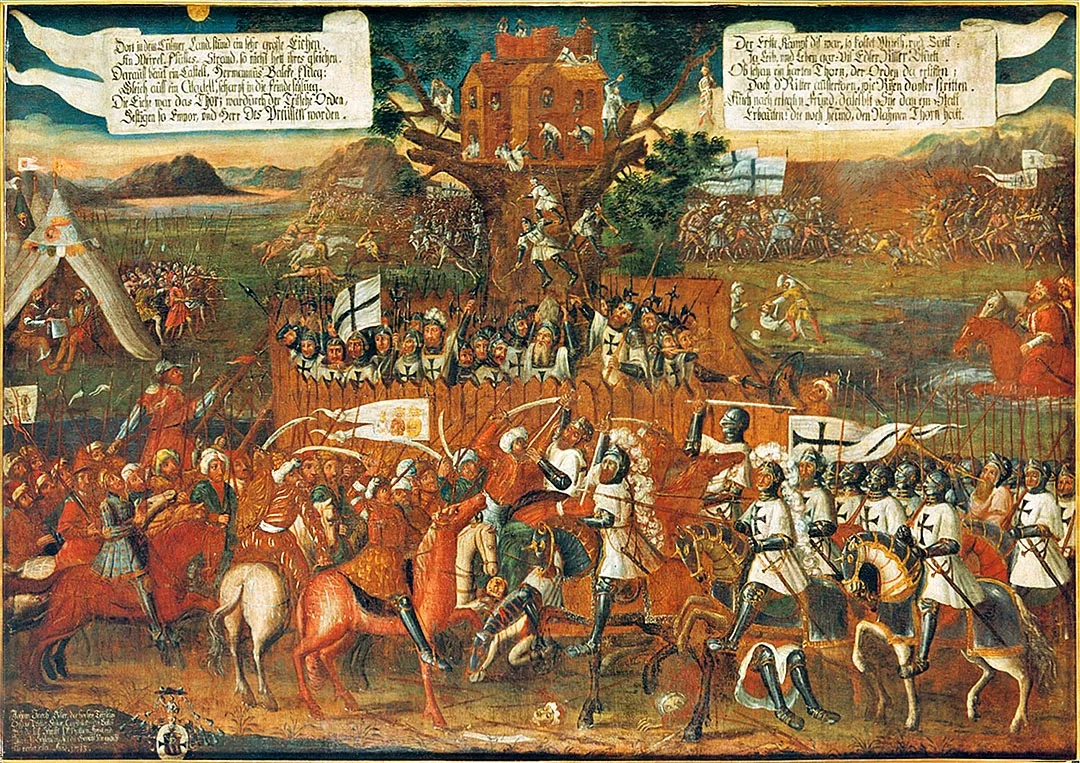
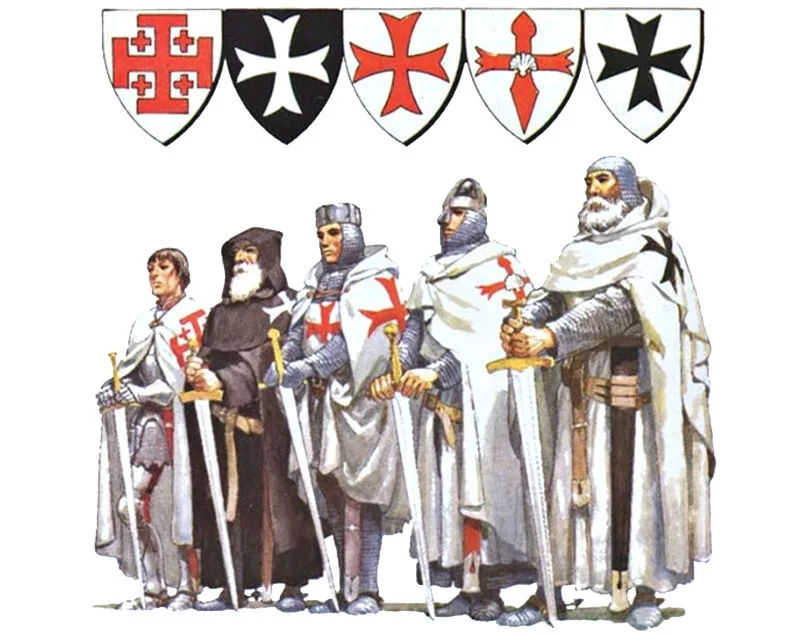 Five knightly orders
that influenced the history of Europe (from left to right):
The Order of the Holy Sepulchre of Jerusalem;
The Order of Malta;
The Order of the Poor Knights of Christ (the Knights Templar);
The Great Military Order of the Sword of Saint James of Compostela (the Order of Santiago);
The Teutonic Order.
Finally, as what was in essence a corporation and a collective feudal lord, the order and its members acted in concert, with the growth of the order’s own power as their chief aim. A typical secular feudal host, by contrast, was a gathering of pronounced individualists, each with his own sovereignty, who placed their personal honour and valour above the common task.
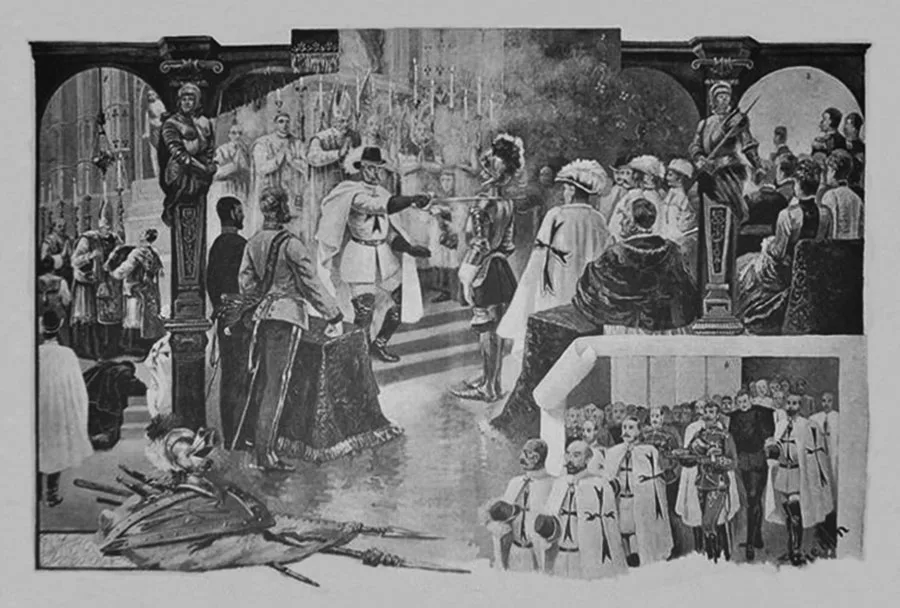
The Teutonic Order traces its history to Palestine in 1190, when German pilgrims opened a hospital for their fellow travellers on the road to the holy places. The hospital was at first attached to the Order of Saint John (the Hospitallers), but from the outset it took steps towards autonomy. As early as 5 March 1198 a papal bull transformed the hospital into a military-religious order, and a year later it gained full independence and its own rule. Its official name, translated from Latin, was “Brothers of the German (Teutonic) Church of Saint Mary of Jerusalem”, while the shortened German form was simply “the German Order”. There were several other versions of the order’s name, but the word “German” appeared in all of them in one form or another. Among its peers, the other military-religious orders, the Teutonic Order was regarded as something of an “upstart”, since its transformation from hospital into order had taken only eight years. The Hospitallers and the Templars undoubtedly saw the Teutonic Order as a direct rival: donations were the orders’ main source of income, the number of donors was limited, and now part of those donations was flowing to the Teutonic Knights. That same fact, however, led the leaders of the orders to realise that an organisation such as an order needed a different, more stable source of income than donations if it was to thrive. The search for that source eventually led to the creation of the monastic states. In the Middle Ages the most reliable income came from the land, or more precisely from the labour of the peasants who worked it, as well as from taxes levied on towns. The road to financial independence therefore lay through large-scale landholding and full sovereignty over one’s own territory and its inhabitants, in other words through the creation of a typical feudal state in which the order itself would play the role of a corporate feudal lord.
An important caveat must be made here: there was no hypocrisy and no breach of the monastic vow of poverty in this pursuit of stable and substantial income. It was the order itself that was meant to grow rich, not its members, including those who held the highest offices.
In the 13th century the rule of the Teutonic Order was observed very strictly. The driving force behind its pursuit of land and wealth was faith in God, in the triumph of Christ’s teaching and in the order’s own historical mission on earth, a mission greatly furthered by having a state and money of its own. In truth, we have nothing to reproach the order’s rulers with: none of them siphoned the Order’s funds into some secret private property. On the contrary, the resources of the order’s state really were devoted to the struggle against the pagans, to supporting the spread of Christianity and to expanding the Catholic world. And when, at the beginning of the 15th century, the tasks for which the Teutonic Order had been founded were exhausted and no pagan lands remained near its borders, the Order itself swiftly fell into decline.
Why the Baltic?
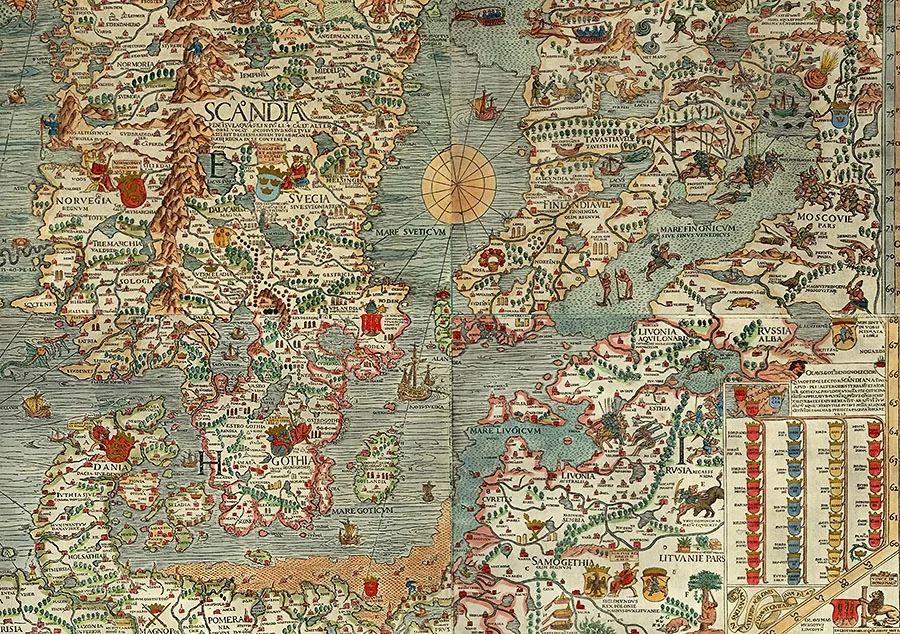
The answer is fairly short and paradoxical: a chance that was bound to happen. That sooner or later some alliance would have been formed against the Prussians was inevitable. Indeed, an attempt to create one was made just before the Teutonic Order invaded the Prussian lands. This was an “order of local significance”, the Order of Dobrzyń, raised from the local nobility on the initiative of Konrad I of Masovia, the duke who suffered more than anyone from the regular Prussian raids. This order, however, was small, insufficiently battle-worthy and very poor. In those days poverty bore directly on fighting strength, since strength depended on each warrior's individual equipment, and a full suit of armour and good weapons were very expensive.
At almost the same time as Konrad I of Masovia and the brethren of the Order of Dobrzyń were vainly resisting the Prussians, the Teutonic Order suffered a galling political defeat in Hungary. Summoned by the Hungarian king Andrew II to fight the Cumans, who threatened the eastern fringes of the Kingdom of Hungary, the Teutonic Order successfully occupied the border territories and built five castles there (two of which, Marienburg and Kreuzburg, would later lend their names to castles in Prussia). After this, the Hungarian nobility and King Andrew II himself began to be tormented by suspicions that the Teutonic Order's excessive entrenchment within the kingdom and on its borders would one day cause Hungary serious problems. And so, despite papal protection, the Order was ordered by ultimatum to “pack up” and leave the Hungarian king's domains.
This was a serious blow to the Order's then Grand Master, Hermann von Salza, and to his attempts to gain a foothold in Eastern Europe. The point is that at the time there were two factions within the Teutonic Order. One, led by the Grand Master, pursued a policy of creating a state of the Order's own in Europe. The other believed that all of the Order's tasks lay in Palestine.
The failure in Hungary undoubtedly handed every trump card to the supporters of the Palestinian course. So when he received Konrad's invitation to take part in a crusade against the pagan Prussians, Hermann von Salza was in no hurry, since another failure could have cost him the office of Grand Master. This time he acted with more than due thoroughness, obtaining documentary confirmation from all the interested parties: Pope Gregory IX, Holy Roman Emperor Frederick II and Konrad of Masovia himself. Under the bulls of the pope and the emperor, as well as a charter from Duke Konrad, the Order received the Kulmerland as a gift, together with all the pagan territories it might conquer in Prussia. This opened the way not only to the conquest of the Prussian lands but also to securing the Teutonic Order's sovereignty over them. In 1230 the first Teutonic detachment, under Konrad von Landsberg, arrived in the Kulmerland. According to the chronicles, it consisted of seven knights and up to a hundred squires. The same chronicles tell us that, with Duke Konrad's help, they built the Order's first castle in the Kulmerland, Vogelsang (“Birdsong”). This legendary castle marked the beginning of the Teutonic conquest of Prussia, which was accompanied by the construction of a great many similar structures. Many of them have survived to this day in one form or another.
Why so many castles?
A medieval castle is, first and foremost, a fortress, and in most cases the fortified residence of a feudal lord. Since the Russian word for “fortress” has a very broad meaning and is applied to a wide variety of fortifications from different eras, we will agree to refer to medieval strongholds specifically as castles, even though at times they may look somewhat unlike the “castle” familiar to us from fairy tales. In Russian, the word for “castle” is often used for a palace, especially one built in the style of a castle. In fact, the direct German equivalent of “castle”, das Schloß, can denote a brick, a timber or even an earthen structure that served precisely as the residence of a person or persons governing a subject territory. Any other fortification of the medieval period that was not intended for permanent residence, but only for repelling enemy attacks or for temporary shelter, was called a Feste or a Schanze. In what follows, we will refer to it simply as a “fortification”.
To say that there were many castles in thirteenth-century Europe is a vast understatement. They numbered in the tens of thousands, and the territories of present-day England, France and Italy were especially rich in them. Castles came in different shapes and sizes and were built of different materials, depending on what was available locally. Yet they undoubtedly shared certain common features.
First, there was the enclosure, the castle wall. Originally of timber or timber and earth, and later of natural stone or brick, this wall was the main defensive barrier and the principal line of defence against a besieging enemy. A warrior standing on the wall had an advantage that mattered greatly in that era: he stood higher above the ground than his opponent. He could hurl stones down on the enemy and pour boiling water or boiling pitch. His arrow also struck the enemy at a greater distance than an attacker below could shoot with the same bow or crossbow. Finally, a defender on the wall could kill and throw down a dozen climbing enemy soldiers one after another without suffering any harm himself.
Second, there was an obstacle in front of the wall, the best of which was a water-filled moat. Such a moat prevented the enemy from moving quickly up to the castle walls. There, under a sturdy shelter of logs (the so-called “cat”), he could have begun to breach the castle wall.
Third, there was at least one gate with a drawbridge in front of it.
All the other elements of a castle were most often present but not strictly obligatory. These included towers, overhanging loopholes (machicolations), parchams, hoardings, defensive galleries, citadels, and keeps (or Bergfriede).
On the whole, the castles of the Teutonic Order closely resembled typical feudal castles, but there were also a number of differences peculiar to the Teutonic school of castle building. These stemmed above all from the fact that the castle was corporate rather than private property and formed part of the Order's overall infrastructure. The Order's castles usually had imposing rooms for administrative business: chambers for receptions and audiences, halls for meetings of the Order's governing bodies, and dining halls (Remter). There was also an infirmary (firmaria) and rooms where the Order's guests could stay. Among the service buildings, extensive granaries stood out. A distinctive feature of the Order's castles was the fortified latrine tower, the Dansker, set outside the defensive walls, which served a defensive function during a siege. Most of the Order's castles also had an extensive Vorburg, or “outer castle”. The Vorburg was at once an additional line of defence and a possible refuge for peasants, horses and livestock, and in peacetime it was used for economic activity. What sets the Order's castles apart from French or Italian feudal castles is the simplicity of their forms and their minimal auxiliary defences, with fewer lines of defence. This was probably due to a rational approach to using the resources available and to keeping construction costs down. Unlike the armies of Western Europe, the Order's enemies, the Prussians and the Lithuanians, lacked advanced skills in storming castles. They preferred either sieges in the hope of starving the defenders out or, most often, confined themselves to ravaging the territory beyond the castle.
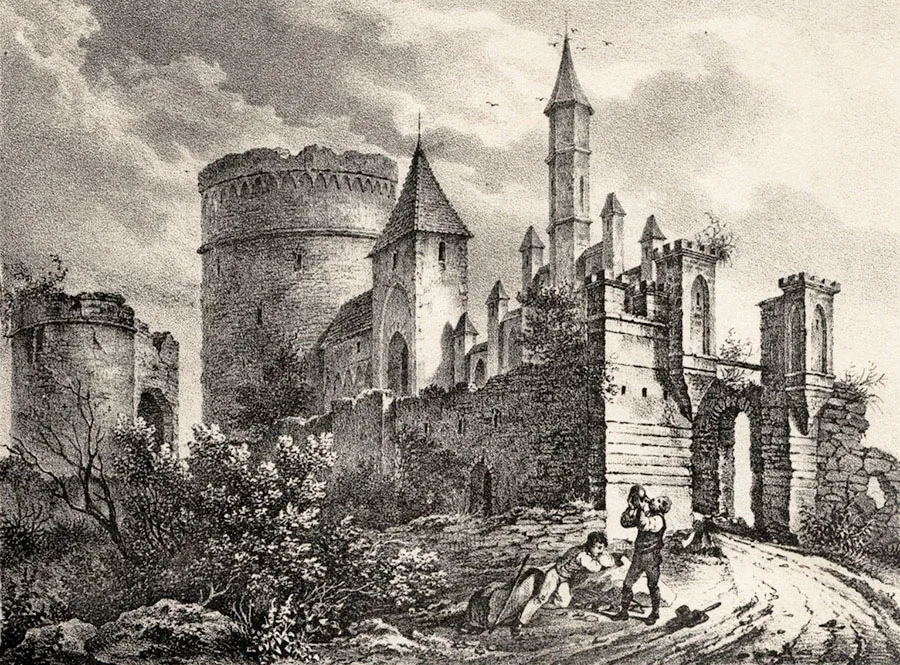 Rößel Castle (Reszel, Poland).
The main task of the garrison of an Order castle was to withstand the enemy's first onslaught and hold out until reinforcements arrived. If the garrison was strong enough to repel an attack on its own, the Teutonic Knights preferred to give battle outside the castle walls, where the Order's heavy cavalry had overwhelming superiority over the Prussians or Lithuanians. The castle kept the knights from being caught off guard and gave the baptized local population a refuge from the pagans.
It is widely believed that the Order's castles were built a day's march apart, roughly 25–30 km. This may have been taken into account, but it was not decisive. In many parts of Prussia the castles stood closer together. By contrast, the castles of Ragnit (Neman) and Tilsit (Sovetsk) lay more than 50 km from the nearest castles, Georgenburg (Mayovka) and Laukischken (Saranskoye). So the rule was, at the very least, not binding. Incidentally, the brethren of the Order were allowed to spend the night outside a castle only in exceptional cases. Chapter 28 of the Order's Rule stated: “Should night overtake them on the road, they may, after Compline or before Matins, speak of necessary and honest matters, but not in an inn after Compline, save in the cases described above. They shall avoid inns and places of ill repute; they shall also keep a light burning in their chamber all night, lest any harm befall their reputation or their property.” A dense network of castles therefore spared the brethren temptation and kept their reputation unblemished. Still, three factors were decisive in choosing where to build a castle:
1. The creation of continuous chains of strongholds (for example, the line of castles in Samland that guarded against Lithuanian raids, or the row of castles along the banks of the Pregel).
2. The need for the Order's authorities to be present in a given area, whose inhabitants found the local administration, court and tax office housed in the castle.
3. The presence of a Prussian earthwork fortification, which considerably reduced the cost of building a castle.
The crusaders' castles in Prussia can be broadly classified as follows. By ownership, they were either Order castles or episcopal castles. By rank, they were Komtur, Vogt or Pfleger castles, and there were also small refuge castles. Episcopal castles were the property of the bishops and stood on the territories the bishops received when the Prussian lands were divided. They housed no Order authorities, yet the Order itself made extensive use of them for military purposes.
How Hard Can It Be to Build a Schloss?
Books on the history of the conquest of Prussia usually put it like this: “in such-and-such a year the Order built a castle,” or “a castle was built by the knights of the Order.” The reader immediately pictures a knight climbing down from his warhorse, swapping his armor for work clothes and starting to lay bricks for the tower of the future castle. On the whole, there is nothing true to life in this picture. Men of noble birth who joined a military religious order knew, of course, that their lives would be full of toil, sweat, hardship and blood, but not to the point of retraining as bricklayers for several years. Besides, the overwhelming majority of castles were not built in stone from the outset, except in the very latest period of the Order. And the towers were built at the final stage, or not at all.
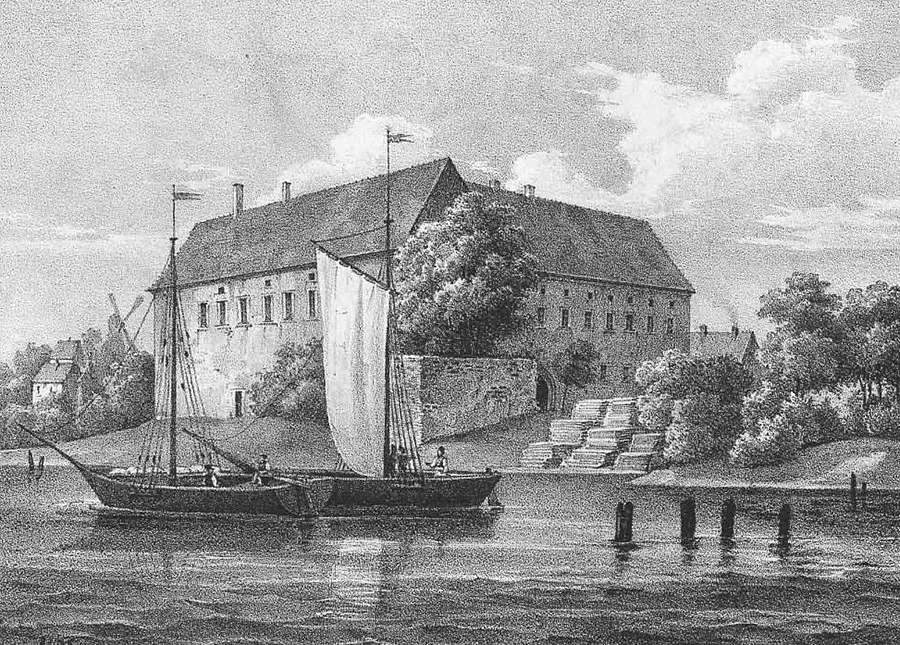 Tilsit Castle (Sovetsk).
In the Middle Ages a castle was the costliest of a feudal lord's luxuries. A horse was expensive, and armor and weapons were very expensive, but neither could compare in cost with a castle. A castle was just as expensive for the Order. Its only advantage was that it could pour all available resources into building a particular, badly needed castle, redirecting them from one territory to another. Nevertheless, thrift and sensible necessity guided the Order's building activity throughout its history.
At first, sensible necessity told the Order that the worst-case scenario for its detachment was a surprise attack by a numerically superior enemy, one so sudden that the knights had no time to put on their armor, mount their horses and form up for battle. Yet even the simplest earthwork with a log palisade, a watchtower and posted sentries made such an attack very difficult. Thrift, for its part, dictated that such fortifications be built on the ramparts of captured Prussian strongholds and hillforts. Experiments have shown that 200 people can build an earthwork fifty meters in diameter in about ten days of backbreaking labor. The same 200 people can put up a palisade on a finished rampart in just a day. We can therefore say with confidence that the Order's first fortifications went up very quickly. The knights and their squires built them themselves, using the labor of prisoners if any were at hand. Physical labor, including construction, was regarded as a form of monastic obedience. It is easy to imagine an Order detachment that has just taken a Prussian hillfort digging holes for the palisade logs, felling trees and building a lookout tower.
The next stage, however, turned the simple palisaded refuge into a fairly powerful timber-and-earth fortification, and it undoubtedly relied heavily on recruited labor. One often reads that the Order used the labor of Prussian peasants and captured Prussian warriors. Yet as soon as you picture such a building project, you realize that it is simple only on paper. Imagine that you are in charge. You have armed backing in the form of well-equipped warriors, a couple of villages nearby, a couple of hundred prisoners and even an interpreter, since you do not know Prussian and they do not understand a word of your language. Yes, you can explain what you want through the interpreter and the village elders. You can drive the village men to the building site and put the prisoners to work. But then it turns out that the whole village has only five iron axes. Everyone else uses primitive stone ones or borrows an iron axe from a neighbor. Things are no better with shovels. There are no nails at all. The prisoners sent into the forest for logs keep trying to slip away, or their comrades hiding in the woods are plotting to attack the guards and free them. To top it all off, this whole horde of peasants and prisoners needs to be well fed, because hungry people simply cannot work. And these unskilled, inefficient “builders” eat exactly as much as the skilled craftsmen of the building guilds and crews back in Germany. Those craftsmen, of course, have to be paid and somehow brought to Prussia, but without them building castles became a near-impossible task. That said, the knights sometimes built small wooden castles with the help of the local nobility who had accepted baptism. The Order let the Prussian chieftains who went over to the Christians keep their authority, granted them new privileges and entrusted them with strongholds, which they were required to fortify with their own resources.
The Order often took the heirs of these chieftains as hostages. They were kept in the Order's castles and brought up in the spirit of European Christian culture. This was how the Prussian nobility was born, and it would largely consist of ethnic Prussians and their Germanized descendants.
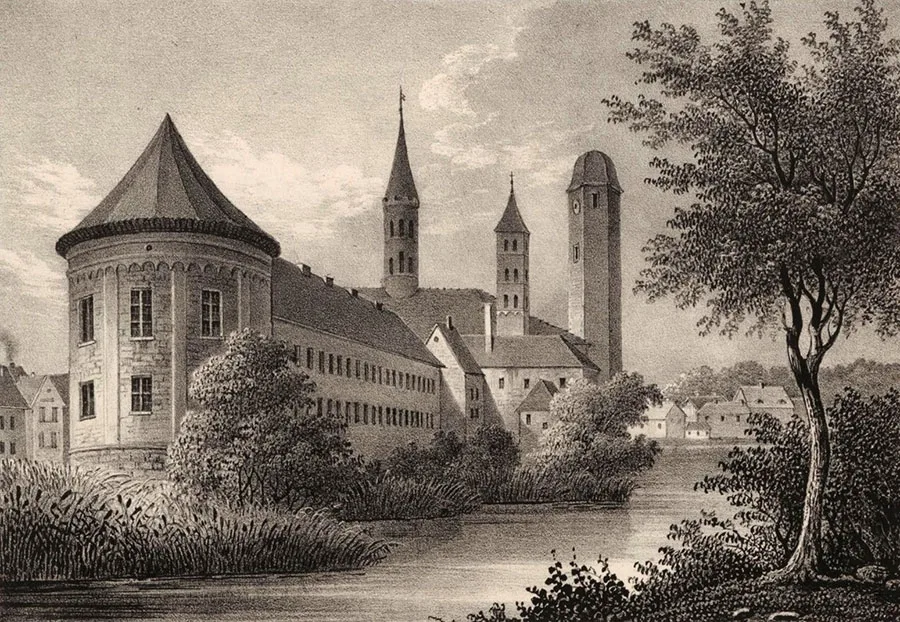 Heilsberg Castle (Lidzbark Warmiński, Poland).
Meanwhile, the second Prussian uprising, which began in 1260 and is called the "second Prussian apostasy" in the chronicles because many Prussians who had been baptised and had sworn allegiance to the Order took part in it, showed that wooden castles offered no serious protection against rebels. All the more so because the brethren of the Order had themselves taught the Prussians, by their own example, how to take such fortresses. The chronicles mention the Prussians using siege engines during this uprising. For the most part, however, the main way of destroying wooden fortifications was to set them on fire. During the second Prussian uprising, every castle of the Order on the territory of today's Kaliningrad Region (in Natangia and Sambia) was taken and destroyed, except Balga and Königsberg, which survived because the Prussians failed to cut off their supplies by water.
Once the uprising had been crushed, the question naturally arose of rebuilding the main castles in stone. And here the help of building crews from Germany became absolutely indispensable. These crews of masons travelled across Europe, hiring themselves out to build or repair feudal castles. Their work was in such demand that clients sometimes had to wait their turn until the previous project was finished. The crews deliberately avoided competing with one another: they all charged very similar prices and delivered work of comparable quality. At that time competition between guilds and crews was not merely frowned upon but actually forbidden by guild statutes and municipal laws. As a rule, a building contract provided not only for payment in money to the master builders and masons but also for payment in kind: the workers' board, the amount of beer the client was to supply, living conditions on site, protection of the workers from robbers and so on were all carefully stipulated.
As already noted above, building a castle in those days was a very costly undertaking. Remarkably, in comparable prices the cost of the work was close to what it would be today if skilled specialists were hired to build a replica of a castle using identical techniques, machinery and materials. That is precisely why, in the very period when stone construction began, the Order took a number of steps to strengthen its economy and, above all, to increase its sources of income. First of all, the entire Prussian peasantry and the larger landowners were made subject to taxes (tribute), which were substantial but not ruinous. At the same time the sale of patents (privileges) began, for instance for opening taverns or breweries.
Kulm law became a special source of income. Under this law a subject (a private individual or an entire settlement) received hereditary rights to land, a certain degree of sovereignty, and rights and some freedoms on its territory. In return they undertook to pay dues in money and in kind and to provide an armed levy, whose size and minimum armament requirements were determined by the size of the landholding.
It should be stressed that Kulm law was granted not only to settlements (towns) but also to free (not necessarily noble) individuals, who came to be called "Köllmer" in German, a word derived from the place name Kulm. As a rule, a Köllmer received several dozen Hufen of land. One Hufe was roughly 17 hectares and was considered an allotment that could feed one peasant family. In addition, a Köllmer was granted the right to open a tavern, a brewery, a mill or some other profitable enterprise; he was also obliged to bring tenants onto the land he had received, collect rent from the resulting settlement and pay the Order the dues owed under Kulm law. This system encouraged the rapid settlement of the land and increased the revenues flowing into the Order's treasury. Incidentally, even after Kulm law was officially abolished in 1620, municipalities, villages and private individuals went on living by the laws that had developed on its basis. The Köllmer as an estate survived in Prussia right up to the fall of the German Empire in 1918.
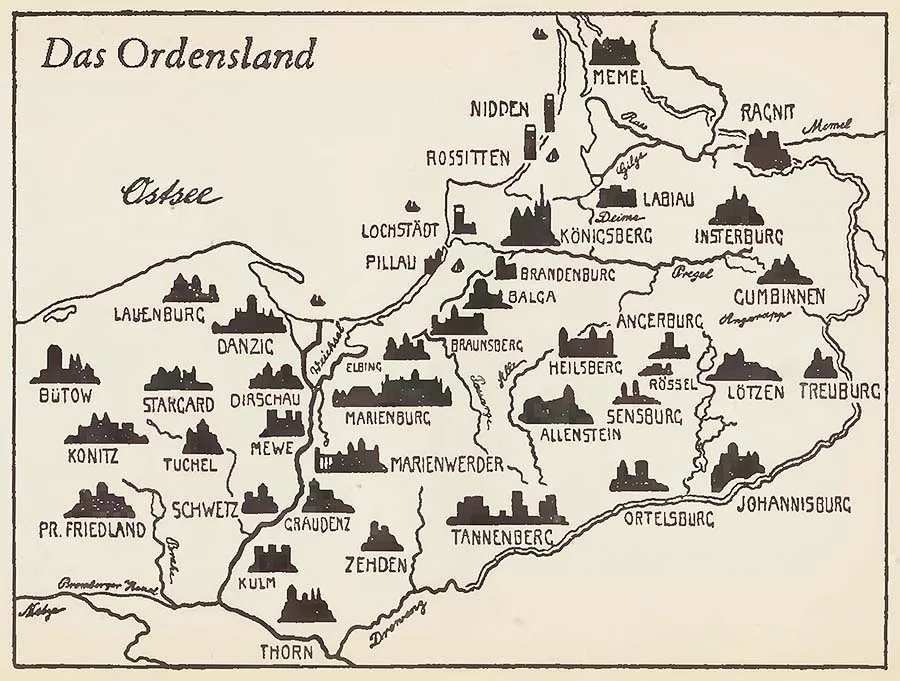
CASTLES OF THE TEUTONIC ORDER IN PRUSSIA
KÖNIGSBERG
The history of Königsberg Castle has already been published on our website, and we decided not to repeat it here; instead, we invite anyone interested to read it by following this link.
Local architect Arthur Sarnitz, a passionate advocate of restoring Kaliningrad's historic centre, hopes that one day Königsberg Castle will once again adorn the city. He has gathered all his ideas in a single video, which we also invite you to watch by briefly heading over to YouTube, where it has been published.
BALGA
► Russian Federation, Kaliningrad Region, Bagrationovsky District
Coordinates: 54.552526, 19.968113
Condition of the site (2020): Majestic protected ruins on the shore of the lagoon.
An important turning point in the conquest of Prussia was the capture of the Prussian stronghold of Honeda by the knights of the Order and the construction of Balga Castle on its site. Balga's position on the shore of the Frisches Haff (the Vistula Lagoon) made it, on the one hand, a bridgehead in Natangia, from which the subjugation of this Prussian land was to begin, and on the other hand allowed the castle to avoid a complete blockade and receive supplies by water. The Prussians had no serious means of waging war at sea, so even the rather modest Teutonic fleet was master of the situation here. On the landward side the area was protected by a marsh crossed by a single road laid on a corduroy causeway. There was no stream near the castle on which a mill could be built, and a mill was an indispensable feature of Teutonic fortifications. The Order solved the problem by building a fortified mill with a small garrison a few kilometres from Balga.
Three years after the capture of Honeda, a Prussian uprising broke out. The Order's position was made worse by the fact that the Pomeranian (that is, essentially Polish) duke Swantopolk joined the rebels.
In the northern part of the territory conquered by the Order, the rebels took all the castles and temporary fortifications. Only Balga and Elbing held out against the Prussians.
To blockade Balga, the Prussians built two temporary strongholds, Partegal and Scrandin. The Teutonic Knights responded in kind, using the former Prussian stronghold of Schneckenberg as a forward fortification. In effect, the battle for Natangia was fought here at Balga. At first fortune favoured the Prussians: they managed to take Schneckenberg and the fortified mill, and their garrisons were wiped out. In response, reinforcements reached the crusaders across the lagoon in the form of a force led by Duke Otto von Braunschweig. The knights then made use of Pomande, a Prussian who had gone over to their side, and lured the Prussian army into a trap where, according to the chronicler Peter of Dusburg, they destroyed it in battle. Both Prussian strongholds were burned and razed. Once again, Balga held out.
In 1246 the Order's forces ravaged the Pomeranian lands, and Swantopolk was forced to admit defeat and, by 1248, to withdraw from his alliance with the Prussians. Left without an ally, the Prussians faced the Order's forces as they advanced from Balga deep into Natangia. The first invasion attempt, however, ended in defeat: the Order's army was ambushed and destroyed. But the campaigns that followed forced the Prussians to conclude the Treaty of Christburg in 1249 on the Order's terms.
During the truce Balga was rebuilt, its moats were deepened and a gate with a drawbridge was constructed. In 1250 the fortress became the seat of a Komtur. The first Komtur of Balga (1250–51) was Brother Maingot of the Order. In 1254 Balga served as the base for the famous campaign of the Bohemian king Ottokar II against the Prussians, which resulted in the conquest of Sambia and the founding of Königsberg.
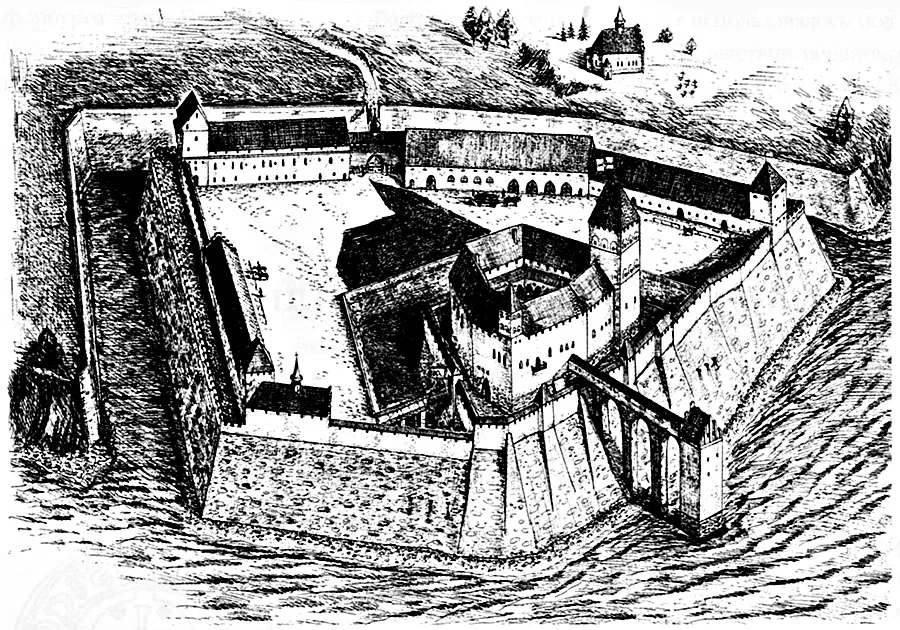 Balga Castle in the early 14th century. Reconstruction by A.P. Bakhtin, drawing by A.M. Osipov.
A new Prussian uprising, the most powerful yet, broke out in 1260. Once again the Order's castles in Sambia and Natangia fell one after another, and now it was Königsberg and Balga that held the line. Both castles withstood the siege. Once reinforcements from the German principalities had lifted it and the uprising itself had been crushed, work began on rebuilding Balga Castle in stone, which was largely completed by 1290.
The castle became one of the Order's most important structures. The ruined building that can be seen today is merely a small fragment of the Vorburg (outer bailey). In reality the castle occupied the entire plateau and consisted of the Vorburg and the castle proper, separated from it by inner walls and moats, remains of which can still be seen today. The main castle building was pentagonal or hexagonal and comprised three wings with vaulted cellars and two or three storeys above them. It housed the chapter house, the refectory, the castle chapel and living quarters. The whole structure was crowned by a defensive walkway at third-floor level. The main tower stood to the south-west. The Vorburg contained an infirmary for elderly and sick brethren of the Order, a hospital, defensive and signal towers, service rooms, storehouses, guest quarters, a smithy, a stable, a cattle shed and more.
Although the Order's military interests shifted north-east of Balga, towards the border with Lithuania, the castle continued to play an important role in the Order's state. The post of commander of Balga was considered an honour and promised further advancement in the Order's hierarchy. Suffice it to say that such Grand Masters of the Order as Dietrich von Altenburg, Heinrich Reuß von Plauen, Winrich von Kniprode and Ulrich von Jungingen all served as commanders at Balga.
During the Great War (1409–1411), after the Order's crushing defeat by the Polish-Lithuanian army at Grunwald, the commander of Balga, Friedrich von Zollern, refused to surrender the castle to the enemy army that had arrived beneath its walls. The might of the castle and the resolve of its garrison forced the Poles to abandon the idea of a siege. Subsequently, the very fact that the Order still held such powerful strongholds as Balga, Königsberg and Marienburg had a very favourable effect on the final text of the First Peace of Thorn.
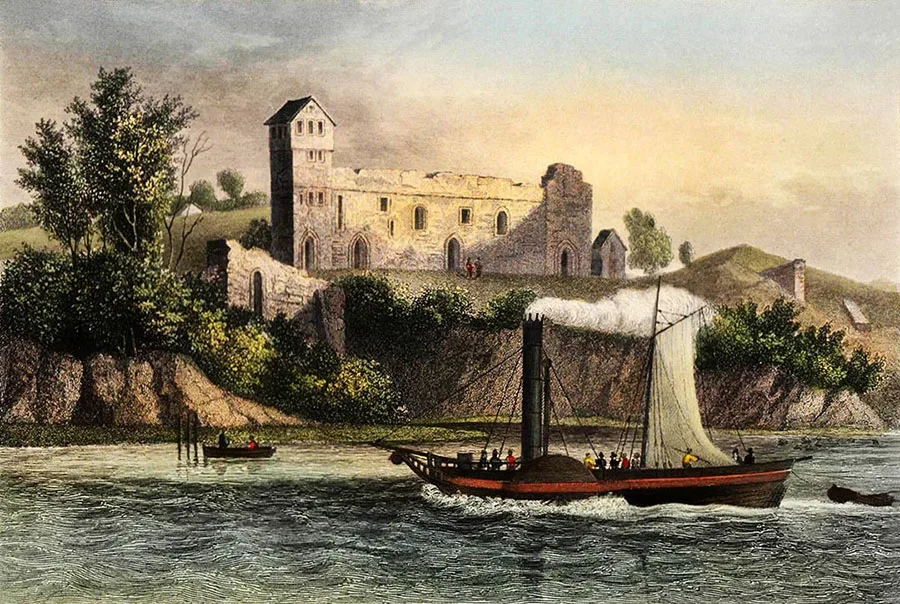 Balga Castle in an old engraving.
During the Thirteen Years' War (1454–1466), Balga was attacked several times by supporters of the Prussian Confederation. In July 1457, the castle was stormed by detachments from Danzig and Elbing. Then Balga was besieged by mercenaries from Bohemia. The last and most powerful assault came in 1466, when a combined force of townsmen from Thorn, Marienburg, Danzig and Elbing tried to take the castle. The castle was never once captured, although its garrison suffered heavy losses and the entire surrounding area was devastated. After the Thirteen Years' War, the commandery of Balga fell into decline.
This was due both to the devastation suffered during the fighting and, more generally, to the castle's rather unfortunate location by shallow waters with no river nearby. The commandery was first downgraded to a Vogtei, and later a castle commandery was established — that is, the castle itself without any subordinate territories, which was more of an honorary status. Balga steadily lost its military and administrative importance. The settlement by the castle remained a village and never grew into a town, as happened near other castles, large and small. Balga Castle demonstrated its military might for the last time in 1520, during the Horsemen's War. By then its walls had already been banked with earth as protection against siege artillery.
In 1525, on the orders of Duke Albrecht, the last commander of Balga, Hans von der Gablenz, handed the castle over to the administration of the duke's ally, Georg von Polenz, the first Protestant bishop. This was a kind of token of the duke's gratitude for his support in his endeavours. The castle's premises housed the administrative bodies governing the surrounding territory (the Amt), including the police and the judiciary. But if the upheavals of war had kept the castle alive, peaceful life finished it off for good. Maintaining a huge building that no longer had any military significance was too costly for the not particularly wealthy Duchy of Prussia. Without repair or upkeep, the castle continued to crumble. In 1584, the dansker and the walls of several buildings collapsed.
From the late 17th century, the castle was systematically dismantled for building materials, and in 1701 King Frederick I signed its final sentence: the castle buildings were to be pulled down and the rubble used to reinforce the banks of moats and canals in the surrounding area.
By 1790, all the buildings had been demolished except for one structure of the Vorburg, which was used for utilitarian purposes and as a navigational landmark.
Eventually it too would have been demolished, but by the first quarter of the 19th century Europeans had begun to realise that, besides material, artistic and religious values, there are also historical ones. Only from this period did the deliberate preservation of old structures begin, and it extended to Balga as well. In 1834, with the support of the well-known Prussian politician Rudolf von Auerswald, then Landrat of the Heiligenbeil district, the remains of the castle were placed under state protection, and were later studied and restored. The castle and its surroundings became a destination for historical tourism and remained so until the outbreak of the Second World War. During the East Prussian Offensive, the castle found itself at the epicentre of the fighting to destroy the German forces pinned against the lagoon, and it suffered fatal damage from artillery fire.
After the war, the peninsula on which Balga stood became popular with tourists, and the ruins of the Vorburg were used as a practice wall by rock climbers. People also searched the area around the castle for hidden cultural treasures, including the Amber Room, but found only large quantities of ammunition and rusty weapons from the last war. Later the castle ruins were granted the status of a cultural heritage site, but in practice they were not protected and continued to deteriorate. Only recently has work begun on creating a protected nature park around the castle. The Mamonovo City Museum has a hall dedicated to Balga Castle, where, among other things, a model of the castle is on display.
KREUZBURG
► Russian Federation, Kaliningrad Region, Bagrationovsky District, Slavskoye settlement
Coordinates: 54.494571, 20.440133
Condition of the site (2020): Two small fragments of wall survive.
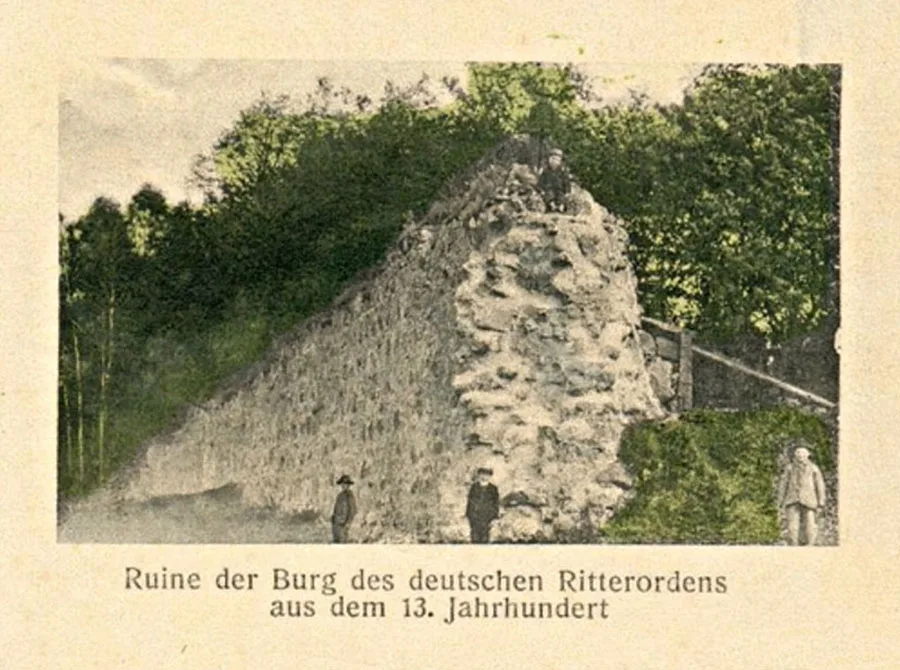
The second castle to be founded on the territory of today's Kaliningrad Region was Kreuzburg (Slavskoye settlement, Bagrationovsk urban district). Kreuzburg Castle was founded in 1241 by Otto von Braunschweig on the site of the Prussian fortress of Witige. In 1243 it was burned by rebellious Prussians, but it had been rebuilt by 1253. In 1260–1263, during the Second Prussian Uprising, the castle was besieged. When the besieged ran out of provisions, they tried to abandon the castle, but since the horses had been eaten too, the Prussians caught up with the fugitives and killed them all except two knights, who managed to reach Balga. In 1273 the castle was rebuilt once more, and in 1309 it was reconstructed in stone. During this period, for a short time (1275–1277), Kreuzburg served as a commander's seat and as the castle of the Vogt of Natangia, but the seat was soon moved to Brandenburg (Ushakovo).
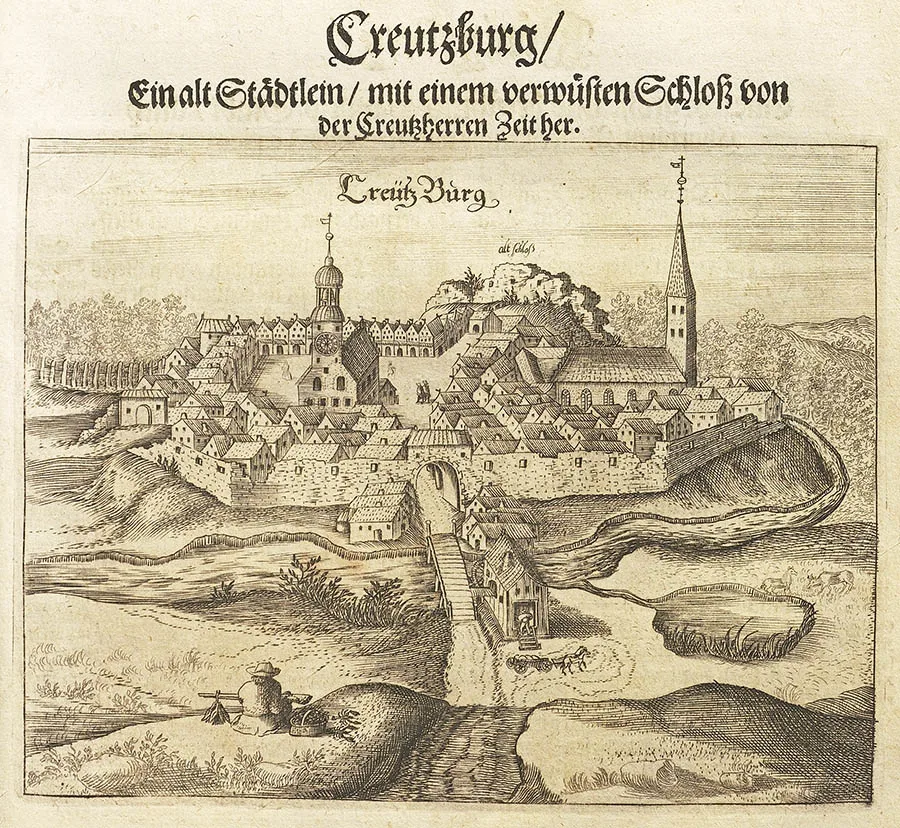 Kreuzburg Castle in an engraving by Christoph Hartknoch, 16th century.
On 31 January 1315, the settlement by Kreuzburg Castle was granted Kulm town rights by the Marshal of the Order, Heinrich Plotzke. In that same year, 1315, a church was built in Kreuzburg.
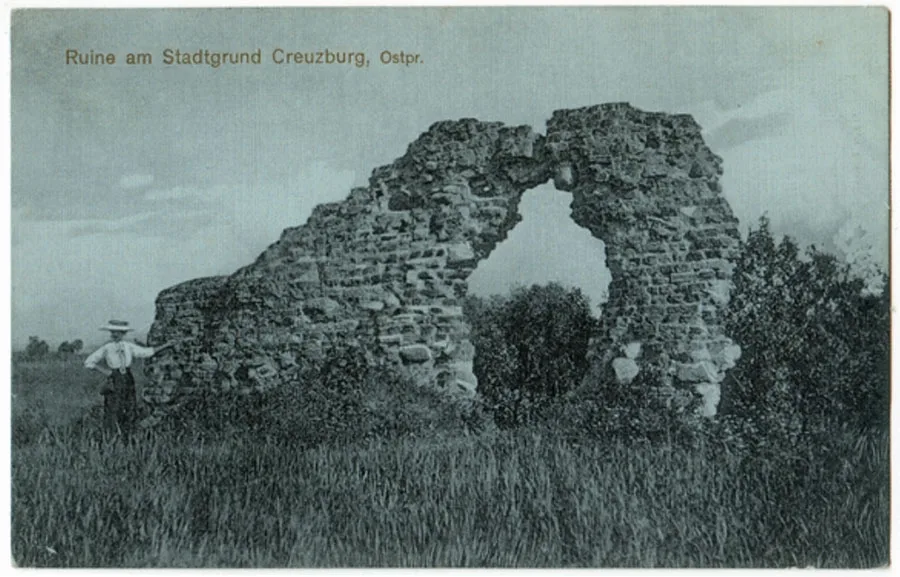 All that remains of Kreuzburg Castle.
In the first year of the Thirteen Years' War (1454–1466), the castle was captured by forces of the Prussian Confederation. As early as 1455, however, the Order won it back. Kreuzburg came under attack several times after that, and the town was repeatedly plundered and burned, but the Poles and the supporters of the Prussian Confederation never managed to take the castle itself. The Second Peace of Thorn lists Kreuzburg Castle among the possessions that remained with the Teutonic Order. The debts the Order was left with after the Second Peace of Thorn forced Grand Master Ludwig von Erlichshausen to pledge Kreuzburg for 2,383 marks to the mercenary captains Anselm Tettau and Michael Greusing. In 1497 it was bought back by Bishop Johannes of Riesenburg, and in 1505 it passed to his successor, Hiob von Dobeneck.
In 1520, during the Horsemen's War (1519–1521), Kreuzburg was attacked by the Poles but held out. After the secularization of the Order, Kreuzburg Castle changed hands several times until, in 1565, Duke Albrecht gave it to his favourite, the adventurer Paul Skalich. After Skalich fled in 1566, the castle was left without proper care and began to fall into ruin. Several Prussian noblemen owned it in turn, but none of them stayed long. In 1585 the state bought Kreuzburg back. In the 17th and 18th centuries Kreuzburg finally settled into the life of a provincial town. The castle was steadily taken apart for building material. By the end of the 18th century only small remnants of walls and the foundations were left. In 1881 the owner of the local mill, a man named Reichermann, organized archaeological excavations at the castle. Today all that remains of Kreuzburg Castle is a small fragment of wall and the hill on which it once stood. Like Balga Castle, it is recommended to visitors armed with old plans of the castle and a vivid imagination. Alas, standing on the castle hill, you can imagine far more than you can actually see.
KAYMEN
► Russia, Kaliningrad Region, Guryevsk District, Zarechye settlement
Coordinates: 54.784507, 20.887089
Condition (2020): Fragments of the walls survive up to the level of the second floor.
The official founding date of Kaymen Castle is 1261. A Prussian stronghold had stood on the site even before the Teutonic invasion. It was captured in January 1255 during the campaign of King Ottokar II and then handed over to Prussians who had gone over to the Order's side and who later proved their loyalty during the Prussian uprising. When the Prussian lands were first divided between the Teutonic Order and the bishop, the area known as Caym or Caymis remained with the Order. In 1261 the Prussian stronghold was rebuilt as an Order castle, and a settlement began to grow up at its walls at about the same time. In 1299 Kaymen was granted to a Prussian nobleman for his loyalty to the Teutonic Order. In 1308 the fortress was taken by the Lithuanians and burned. After this it was decided to rebuild Kaymen in stone, which was done between 1330 and 1352. Once completed, Kaymen Castle was probably a two-wing building with an extensive outer bailey (Vorburg). After the rebuilding, the castle withstood several Lithuanian raids, and each time the garrison succeeded in beating off the assault. From 1424 Kaymen was the seat of a Kammeramt belonging to the Komturei of Königsberg. After the Thirteen Years' War (1454–1466), Kaymen Castle was handed over to a mercenary commander in settlement of a debt. On 3 September 1525 the castle was seized by rebellious peasants, who took the administrator of the Amt, Andreas Rippe, prisoner. Duke Albrecht threatened the rebels with harsh reprisals, after which the uprising died down. Rippe was removed from his post and the ringleaders were executed (such was the compromise that was reached). In 1668, on the orders of Elector Frederick William, the inner part of the castle was rebuilt.
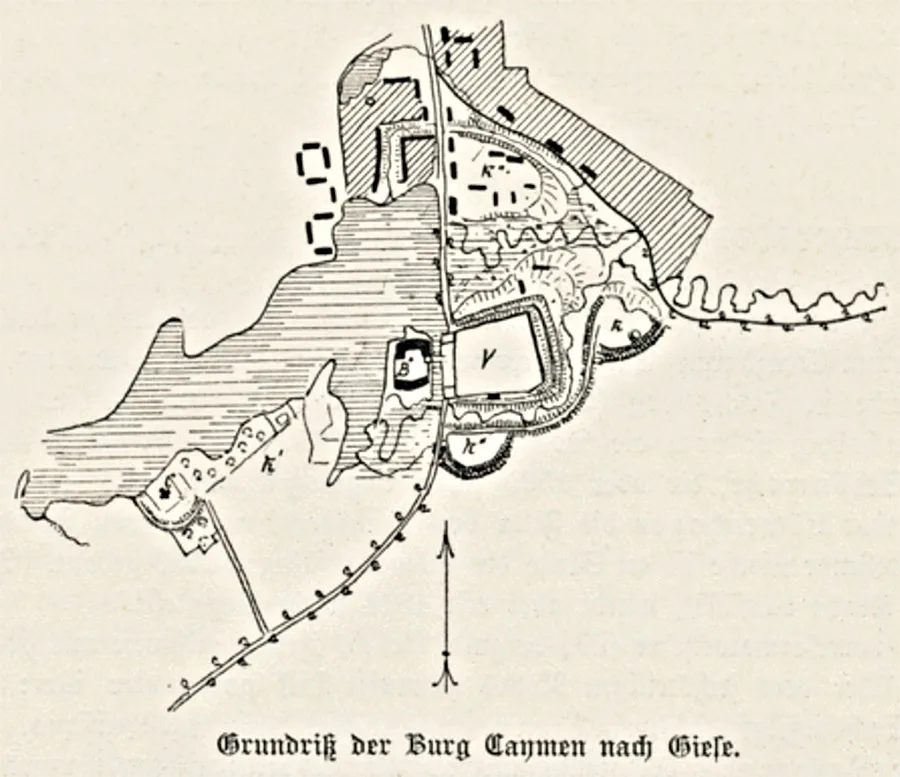
On 21 January 1758 the capitulation of East Prussia was signed at Kaymen, after which “the keys to the gates of Königsberg and Fort Friedrichsburg” were handed over to the Russian command.
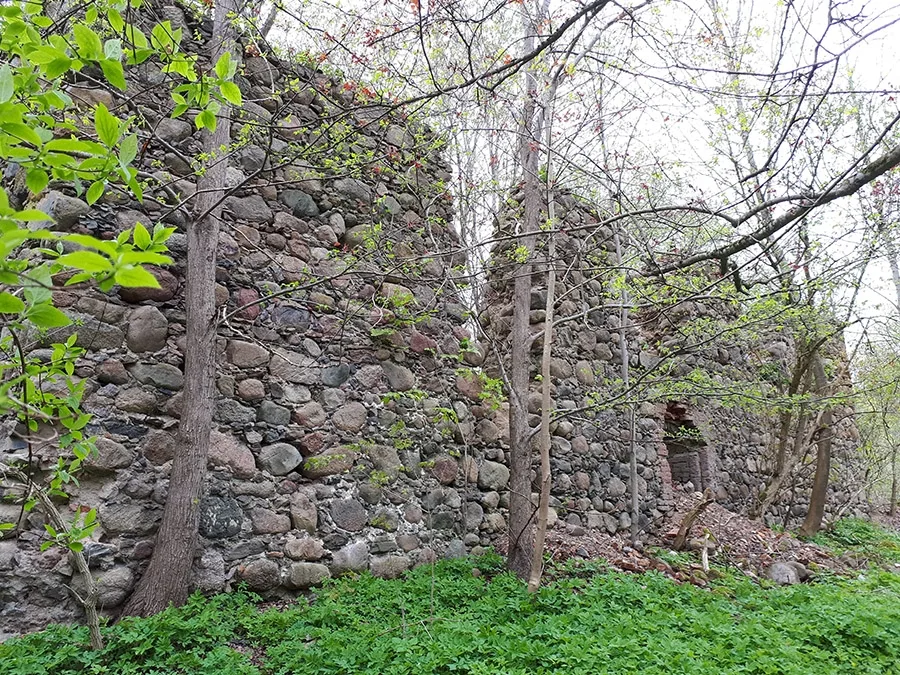 Kaymen Castle is unique in being built entirely of natural stone.
In 1782–1783 the castle was enlarged and remodelled by the architect Glasius Berwart. Some of the walls and towers were demolished, and the castle was adapted for administrative rather than military use. In the first half of the 20th century the castle was leased out.
The Soviet settlers inherited the castle in tolerable condition, though it needed care and repair. The local collective farm, however, used it for purely practical purposes, as storehouses and a pigsty. The castle became popular when, in the 1990s, it somehow found its way into a guidebook to the region's sights; this did not, however, stop the local residents from turning it into a source of building material. As a result, by the turn of the millennium all that was left were fragments of walls overgrown with shrubs and half-buried cellars.
PREUSSISCH EYLAU
► Russia, Kaliningrad Region, Bagrationovsk District, town of Bagrationovsk
Coordinates: 54.386637, 20.632771
Condition (2020): The surviving outer bailey (Vorburg) was conserved after a fire.
Preußisch Eylau Castle was founded in 1325. Historians assign it to the so-called fourth generation of Teutonic castles. The construction was initiated by Grand Master Werner von Orseln, who entrusted the task to Dietrich von Altenburg, Komtur of Balga. The castle's main purpose was to serve as an intermediate stronghold between the castles of Kreuzburg (Slavskoye settlement, Bagrationovsk District) and Bartenstein (Bartoszyce, Poland).
In its early days the castle was called Ile or Ilaw. The name later evolved into Eylau.
Unlike many other castles, Eylau was built of stone and brick from the very beginning. History has even preserved the name of the man who directed the building work: the master builder Arnolf von Eulenstein. The castle itself was a four-wing structure, a quadrangle measuring 43 x 41 m in plan. An extensive outer bailey adjoined it on the east. The south wing housed the castle chapel, an indispensable feature of any Order castle.
Until 1347 Preußisch Eylau Castle served as the residence of an Order Pfleger; from 1347 it housed the administration of a Kammeramt. One of the Pfleger of Preußisch Eylau was Konrad von Wallenrode, a future Grand Master of the Order. By 1348 there was already a settlement called Neuhof by the castle, with twelve taverns; it later took the castle's name and grew into a town.
Preußisch Eylau played an active part in the Thirteen Years' War (1454–1466). At first fortune favoured the Prussian Confederation, whose forces took Preußisch Eylau without much difficulty, along with other castles in Natangia. Then it was the Order's turn, and the castle was recaptured from the insurgents. The Order's garrison of up to twenty knights, together with 60 militiamen fighting for the Teutonic Order, repaired the damage to the fortifications and prepared to repel enemy attacks. At that time a 2,000-strong force of the Prussian Confederation under Remschel von Krixen was marching on Königsberg. Learning that Preußisch Eylau was held by such a small garrison, von Krixen decided to take the castle in passing. The assault began on 24 May 1455. Every attempt by the insurgents to storm the castle met with stubborn resistance.
The events that followed are the stuff of legend, and their reliability is doubtful. Seeing that the garrison was clearly too small to hold the castle, the Teutonic Knights sent a messenger towards Königsberg, using an old underground passage that came out far behind the attackers' lines.
Heinrich Reuß von Plauen, the Order's Grand Hospitaller, gave the messenger the troops of Count Ludwig von Helfenstein and Captain von Blankenstein. On 26 May 1455, under cover of the morning fog, the Order's reinforcements launched a surprise attack on the enemy army. The outcome: 600 supporters of the Prussian Confederation of towns killed, 300 taken prisoner, and the siege of Preußisch Eylau lifted.
Preußisch Eylau came under serious attack twice more during the war. In October 1455 the enemy burned the outer bailey but failed to take the castle, and in March of the following year a sudden and powerful counterattack by the garrison thwarted an attempt to besiege it.
After the war ended and the Polish Crown's feudal overlordship of the Prussian lands was formalised, in 1492 Preußisch Eylau Castle was granted to Heinrich Reuß von Plauen. At about the same time the castle received a coat of arms featuring a lion, the same as the one on the arms of the von Plauen family.
Preußisch Eylau saw military action for the last time in the age of the Order in 1520, during the Riders' War (1519–1521), the open conflict between Master Albrecht and the Polish King Sigismund. Once again the Poles burned the settlement, but the castle held out.
Immediately after the Reformation in Prussia, Preußisch Eylau Castle became the residence and estate of a Hauptmann. On 30 November 1585 the settlement at Preußisch Eylau was granted town rights by Regent George Frederick.
After the Napoleonic Wars, in 1814, the Preußisch Eylau estate (the castle and the surrounding land) changed hands once more, bought by one Heinrich Valentini, who built a manor house on the site of the outer bailey and named it Henriettenhof after his wife, while the castle itself slowly fell into ruin without care or repair. The Valentini family owned the estate until 1945.
In 1961 the grounds of the castle and the outer bailey were formally transferred to the Bagrationovsk office of the district consumer cooperative union. In 1964 an expedition from the Central Scientific Restoration Workshops of the USSR Ministry of Culture worked on the site and recorded an extreme state of neglect and destruction. For some time afterwards a shooting range operated in the west wing. In 1990 the surviving building of the outer bailey burned down. In the mid-1990s there was a project to convert the outer bailey into a hotel, and work began on it, but it did the building more harm than good. Today, visitors to Bagrationovsk with an interest in the past can see the surviving outer bailey building of Preußisch Eylau, its roof disfigured by the incongruous dormer windows of the hotel that never was.
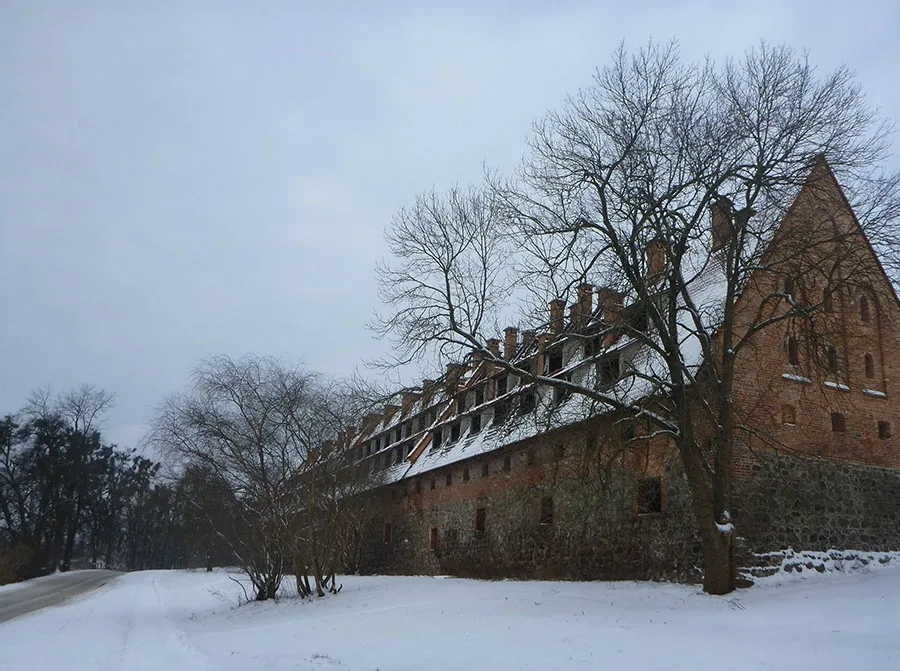 The outer bailey is all that remains of Preußisch Eylau Castle. Winter 2017.
Along the coast of the Baltic Sea and the Curonian Lagoon ran the northern chain of castles: Germau (Russkoye), Pobethen (Romanovo), Rudau (Melnikovo), Laptau (Muromskoye), Powunden (Khrabrovo) and Schaaken (Nekrasovo). The castle of Kaymen (Zarechye), described earlier, can also be counted among them, as can Labiau (Polessk). They were originally built for the usual purposes: to control the surrounding territory and to counter Prussian armed uprisings. But after the conquest of Prussia was completed in 1283, these castles took on other tasks.
From the 14th century onwards, the castles in the north of Prussia served as a barrier against Lithuanian raids on the Königsberg area and as a refuge for the local population during such raids. In the relatively short intervals between hostilities they performed an administrative function. These castles stood on the sites of old Prussian strongholds or very close to them. This location, and the reuse of the former Prussian ramparts, accounts for their characteristic rounded shape.
When the territory of Sambia was divided, the castles of Laptau and Powunden ended up on land belonging to the Bishop of Samland, and Laptau soon passed into the possession of the cathedral chapter.
Around the 1320s–1370s these castles were rebuilt in stone, which made them reliable defences against the Lithuanians, who were not particularly skilled at taking fortresses. In 1370, near Rudau Castle, a famous battle was fought between a large Lithuanian army led by the princes Algirdas and Kęstutis, together with allied Russian and Tatar detachments, on one side, and the Order's army, reinforced by the Königsberg militia and by crusaders from Danish Livonia and the German lands, on the other. The garrison of Laptau Castle also took part in the events: like Rudau, it withstood a siege and pinned down the Lithuanian army until the Order's troops arrived.
As already mentioned, the castles also served an administrative function: they housed the Order's local administrators (chamberlains) or the bishop's officials, depending on who owned the castle. However, after the Great War (1409–1411), when the Order began paying huge indemnities to Poland, maintaining its numerous castles became too costly. Those of the Order's buildings that had not been sold off to pay its debts to mercenaries were repaired only selectively and incompletely. And once the Order had been secularised and the castles were rapidly losing their military importance, their complete destruction became only a matter of time.
Rudau was partly dismantled, and one of its wings was converted into a church, whose ruins survive to this day. Germau met a similar fate. At first it found a use in the duchy: in 1581 the amber administration was moved here from Lochstädt, and in 1586 the castle was even repaired for the purpose. From 1644 to 1693 Germau housed the Amber Court, which sent illegal amber gatherers to the gallows. But the castle was never repaired again and gradually fell into decay; the amber administration and the court were moved to Palmnicken (Yantarny), and by the 18th century Germau had been partly dismantled for road-building fill and for the construction of farm buildings. Around 1760, however, one of its buildings was converted into a church. Sadly, only a small part of its tower remains. Laptau was dismantled at the beginning of the 18th century to provide fill for the Königsberg–Kranz road. Even earlier, in the 16th century, Powunden Castle was taken apart for building material, and its bricks were used to repair Laptau Castle, which outlived Powunden by some 150 years. Pobethen, too, was abandoned and dismantled for its bricks in the 17th century.
SCHAAKEN
► Russian Federation, Kaliningrad Oblast, Guryevsk District, settlement of Nekrasovo
Coordinates: 54.906050, 20.668604
Condition (2020): One of the walls and the cellars survive. A museum complex operates on the site, knightly tournament re-enactments are held, and there is a tavern and a cheese dairy nearby.
For a long time Schaaken housed the local administration (the Kammeramt). Peter I, the Russian tsar, visited the castle twice, in 1711 and in 1716. In the 19th century the castle, as state property, was leased out and survived safely, if somewhat rebuilt, until 1945. After the end of the Second World War, Schaaken Castle housed an orphanage for German children, which was closed in 1948. The castle itself was then used for housing, while the outer bailey and outbuildings served agricultural needs. In the 1990s the castle found its way into tourist guidebooks, and many Kaliningraders were surprised to learn that a surviving 14th-century castle stood just half an hour's drive away (the guidebook gave the date as 1270, but at that time there was no stone castle yet). By then the castle had been badly worn down by time and by a purely utilitarian attitude towards it. The local authorities, for their part, housed resettlers from CIS countries there. Only in 2002, after several more walls and sections of the roof had collapsed, was the castle bought by a private individual to create a museum and history complex on its grounds, which still operates there today. Unfortunately, a genuine restoration never took place: only a section of the fieldstone wall was rebuilt, and conservation work was carried out to prevent further deterioration of the structure.
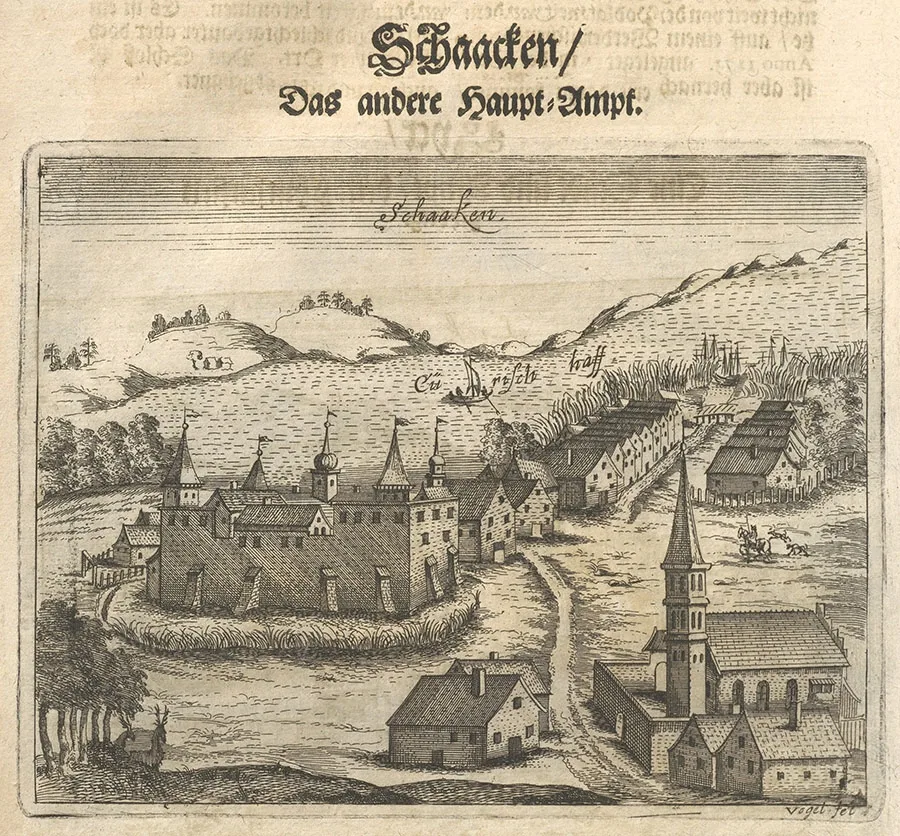 Schaaken Castle in an engraving by Christoph Hartknoch, 16th century.
At Schaaken, the Order's cellars and part of the walls from the Order period have survived. Anyone who has not yet been there is encouraged to visit the castle. It is one of the most interesting buildings of the Order period in the Kaliningrad Region.
Schaaken Castle online:
VK — shaaken
It is no accident that rivers are compared to arteries: in the Middle Ages the lifeblood of the age flowed along them — trade. A town on a river had considerable advantages over one lying at a distance from it. Whoever controlled the river could control the trade routes and, indeed, the life of the entire surrounding area. A river could take you where there were no roads — by water in summer, by sledge track in winter. That is precisely why the Order built its castles near rivers and, to be sure, built them in pairs, one on each bank. These castles not only sealed off the river securely but, standing close to each other, could also support one another effectively if one of them came under siege. In the Kaliningrad Region, such paired castles were Gross Wohnsdorf (Kurortnoye) and Allenburg (Druzhba) on the Alle (Lava); Labiau (Polessk) and Laukischken (Saranskoye) on the Deime; and Norkitten (Mezhdurechye) and Saalau (Kamenskoye), Wehlau (Znamensk) and Taplacken (Talpaki), Insterburg (Chernyakhovsk) and Georgenburg (Mayovka) on the Pregel (Pregolya).
GROSS WOHNSDORF
► Russian Federation, Kaliningrad Region, Pravdinsk District, Kurortnoye
Coordinates: 54.469749, 21.122480
Condition (2020): The gate tower and foundations survive.
Gross Wohnsdorf arose on the site of the Prussian stronghold of Capostete, which the Teutonic Knights burned as early as 1256 during a campaign led by the Komtur of Königsberg, Burchard von Hornhausen. The Order's troops were guided to the fortress by Tirsko, a Prussian who had converted to Christianity. The stronghold occupied an exceptionally favourable position — a plateau overhanging the Alle (Lava), with a stream nearby on which a mill could be built. It is hardly surprising, then, that in that same year, 1256, the Order founded a timber-and-earth castle here. Until the mid-14th century the castle buildings remained wooden, and so in 1319 and 1347 the castle was burned twice by the Lithuanians during raids on the Order's lands. After this second failed defence, and given that in 1348 the castle had become the seat of a local administrator, the Kammerer, it was decided to rebuild Gross Wohnsdorf in stone. This happened in 1356 — or at least so the foundation documents that have been found state.
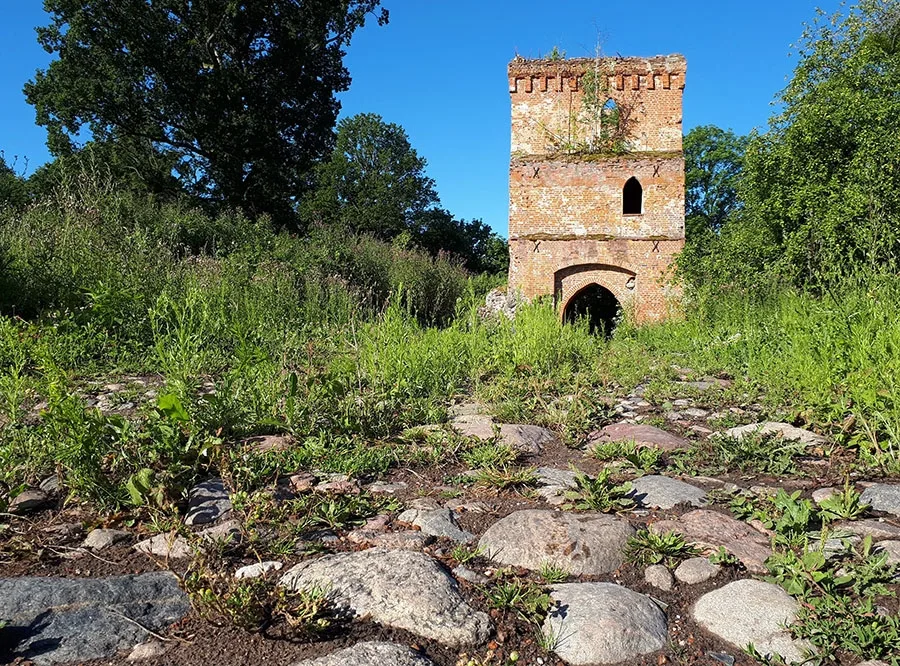 The picturesque ruins of Gross Wohnsdorf Castle in the village of Kurortnoye near Pravdinsk (Friedland).
The new castle was a quadrangle with a gate and a gate tower (pictured above). Adjoining it was an extensive outer bailey, roughly three times the size of the castle proper. At about the same time a settlement grew up next to the castle; today it is the village of Kurortnoye in the Pravdinsk Urban District.
After the Thirteen Years' War (1454–1466), the castle was handed over to the mercenary commander Hans von Weyr in settlement of debts. Gross Wohnsdorf subsequently changed hands a couple more times until, in 1702, it became the property of the von Schrötter family. The outer bailey was demolished and an estate was built in its place, whose buildings have survived to this day. After a fire in 1790 the castle was restored and given elements of the classical style. Immanuel Kant was a frequent visitor here, coming to see the von Schrötter family, including Friedrich Leopold, the future Oberpräsident of East Prussia, whose rooms were located in the gate tower itself. In 1830 the castle suffered a devastating fire, after which it was never rebuilt. Only the gate tower was repaired; the remaining buildings were dismantled for building materials. The tower survived the war and passed to the Soviet settlers in quite tolerable condition, but complete neglect meant that over time first the tiled roof and then the floors between storeys collapsed. Fishermen and tourists who came to the Lava lit campfires inside the tower. In 2007 the tower of Gross Wohnsdorf Castle was granted the status of a cultural heritage site. And not long ago an enthusiast settled next to the site; he guards Gross Wohnsdorf and restores it as far as his means allow.
ALLENBURG
► Russian Federation, Kaliningrad Region, Pravdinsk District, Druzhba
Coordinates: 54.493263, 21.189794
Allenburg was founded almost at the same time as Gross Wohnsdorf and under similar circumstances. During the Prussian uprising in 1260 the castle was burned by the Prussians, but it was soon rebuilt. Like Gross Wohnsdorf, it was probably also ravaged by the Lithuanians. By the mid-14th century at the latest, Allenburg too had been rebuilt in stone, though the castle was considerably smaller than Gross Wohnsdorf. In 1384, for instance, its arsenal is recorded as holding five crossbows and 720 bolts (arrows) for them, which clearly points to a rather modest garrison. At the start of the Thirteen Years' War (1454–1466), in 1455, Allenburg was captured by the Poles and burned. After the war, given the Order's dire financial situation and the presence of Gross Wohnsdorf Castle nearby, Allenburg was not rebuilt, and its remains were taken apart for bricks.
WEHLAU
► Russian Federation, Kaliningrad Region, Gvardeysk District, urban-type settlement of Znamensk
Coordinates: 54.615643, 21.228208
Wehlau Castle is also linked to the name of the Prussian noble Tirsko. He defended the Prussian stronghold of Wetalo, or Wilow, against the knights of the Order. After the crusaders took this stronghold, Tirsko converted to Christianity and began helping the Order fight his own kinsmen. On the site of the Prussian stronghold, the Order built Wehlau Castle, initially of earth and timber. The Prussians besieged the castle in 1262 but, despite several attempts to storm it, failed to take it. Nevertheless, in 1280 the rebellious Prussian tribe of the Sudovians did burn Wehlau Castle. At the beginning of the 14th century the castle was rebuilt in stone, and a settlement soon grew up at its walls, receiving Kulm town rights in 1339. In 1347 Lithuanian warriors led by Duke Kęstutis burned both the town and the castle. While the town was rebuilt, it was decided to erect a Franciscan friary on the foundations of the castle. In 1517 the friary moved to Königsberg. And although no monks remained in Wehlau, in 1525, as the Duchy of Prussia converted to Lutheranism, the townspeople of Wehlau, in a fit of religious fervour, destroyed the Catholic friary. This was, however, practically the only episode of religious intolerance during the establishment of Protestantism in Prussia. The townspeople built houses on the land freed by the friary.
TAPLACKEN
► Russia, Kaliningrad Region, Gvardeysky District, settlement of Talpaki
Coordinates: 54.651017, 21.343068
Condition (2020): The castle is used as a residential building.
A different fate awaited Taplacken Castle, Wehlau's twin. The exact date of its founding is unknown, but by the mid-14th century the wooden castle of Taplacken was already the seat of a chamberlain. In 1376 Duke Kęstutis, then already 79 years old, approached Taplacken with his army and burned it, taking prisoner the castle's Pfleger and part of the garrison. That same year, however, the crusaders began rebuilding the castle in stone. After the secularisation of the Order in 1530, Taplacken was remodelled and thereafter used for administrative purposes. Its advantageous location on the road leading to Lithuania and Russia meant that it housed not only the local administration but also the postal service. Couriers usually changed horses at Taplacken for the last time before entering Königsberg. In the 19th century Taplacken was let to tenants, who altered the building somewhat and put up brick structures in the courtyard. On the whole, however, the castle had survived fairly well into the 20th century. But in 1945 it lay in the path of the main Soviet thrust and was badly damaged during the war. Further destruction was caused by a fire in 1946, started by soldiers quartered in the castle. From 1948 the remains of the castle served as housing for collective farm workers. The building was not protected in any way and no repairs were carried out, as a result of which several parts of the structure were lost. In 2007 the remains of the castle were granted the status of a historical and architectural monument, yet in 2019 the building was still being used as a residence, a fact that even became the subject of a documentary film.
INSTERBURG
► Russia, Kaliningrad Region, town of Chernyakhovsk
Coordinates: 54.639656, 21.806388
Condition (2020): The utility buildings of the Vorburg survive together with the defensive wall. Of the citadel, the shell of the outer walls remains, except for the west wing, which was dismantled after the war. The castle houses a historical and cultural centre.
The history of Insterburg Castle (Chernyakhovsk) begins in 1336, when a commandery castle was founded not far from the point where the rivers Inster (Instruch) and Angerapp (Angrapa) merge to form the Pregel. From it the Order intended to administer Nadrovia, a sparsely populated but densely forested region of Prussia. Once the main phase of construction was complete, the castle formed a quadrangular, almost square (45 x 44 m) complex of four buildings. The height and thickness of the walls, as well as the width of the castle buildings themselves, indicate that they were not built at the same time but over a fairly long period. Adjoining the castle was a Vorburg roughly two and a half times its size. By founding a new commandery and building a fairly large castle as the commander's residence, the Order probably hoped to settle the lands of Nadrovia with colonists and Prussian peasants. But constant Lithuanian raids and the availability of vacant land in other parts of Prussia prevented these plans from being realised. It soon became clear that the sparse peasantry of the subject territories could not adequately support an entire commandery, and so in 1347, after a powerful and devastating Lithuanian attack, it was abolished. The castle became the seat of a Pfleger, that is, one rank lower in status, and was now subordinate to the commandery in Königsberg. Even so, Insterburg played an important role in the life of the Order in the 14th century. On the one hand, it was a staging post for the knights of the Order and its "guests" – crusading knights from Europe who came to Prussia to take part in campaigns against Lithuania – on their way to the Lithuanian border near Ragnit (Neman). There is evidence that the future King Henry IV of England stayed at Insterburg before one such campaign. On the other hand, Insterburg was a forward stronghold of the Order that bore the brunt of Lithuanian invasions. And while the first role brought the Pfleger's district some income, the second threatened it with ruin.
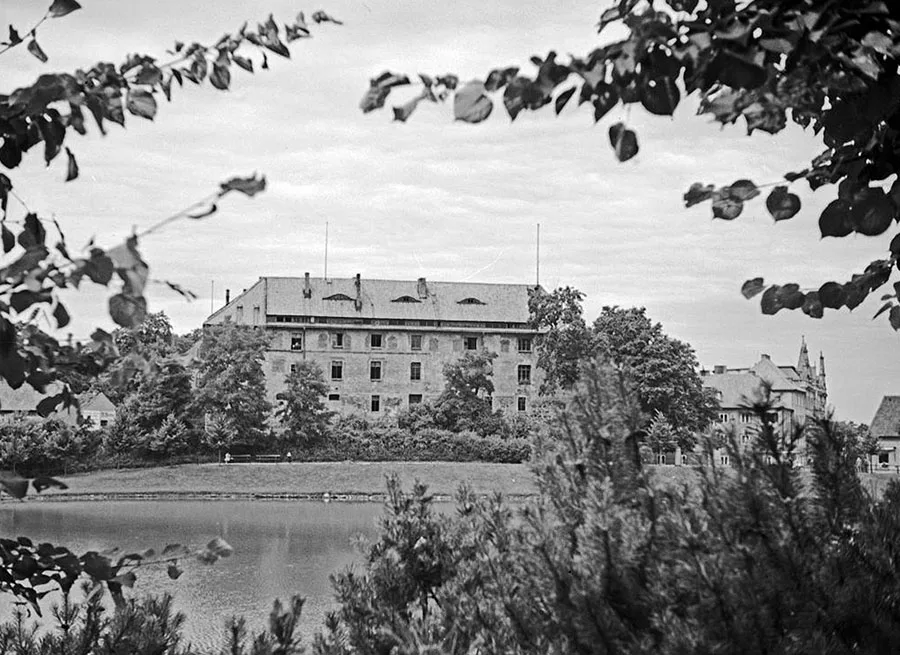
View of Insterburg Castle from the opposite bank of the Castle Pond, which has become the Lower Lake.
For a long time Insterburg remained a very dangerous posting. Suffice it to say that the castle was attacked by the Lithuanians in 1347, 1366, 1367, 1376 and 1403, and on at least two occasions, in 1367 and 1376, it was captured and burned. The castle was once again besieged and destroyed in 1457, during the Thirteen Years' War (1454–1466) between the Order and the Prussian towns.
After the secularisation of the Teutonic Order, Insterburg lost its military importance but gained an administrative one. The settlement near the castle grew and received town rights in 1583. At the end of the 16th century the castle itself became the centre of a Kammeramt, which administered 13 districts known as Schulzenämter. The castle housed administrative bodies, including a court, with a prison in the tower of the Vorburg. The need to accommodate officials here led to repeated alterations of the castle buildings. During the Napoleonic Wars the castle was converted into barracks for the French corps of Marshal Ney, and in 1812 Napoleon ordered the premises to be turned into a hospital. From the late 19th century Insterburg Castle housed the barracks of an uhlan regiment and judicial bodies, while some of the rooms were given over to a museum.
When the Red Army took Insterburg in 1945, the castle came under fire and partly burned down. After the war the surviving rooms were used for utility purposes; they were never repaired and continued to deteriorate. In the mid-1960s extensive demolition of the dilapidated buildings was carried out at the castle, and part of the castle walls and the tower of the Vorburg were pulled down. This state of affairs lasted until the 1990s, by which time the north wing of the castle had collapsed completely, while of the others only parts of the load-bearing walls remained. The buildings of the Vorburg fared better and have survived to the present day. Today the castle is home to the non-profit Dom-Zamok (House-Castle) Foundation. The organisation develops and runs educational, cultural and academic projects, and also experiments with new forms of activity in tourism and leisure.
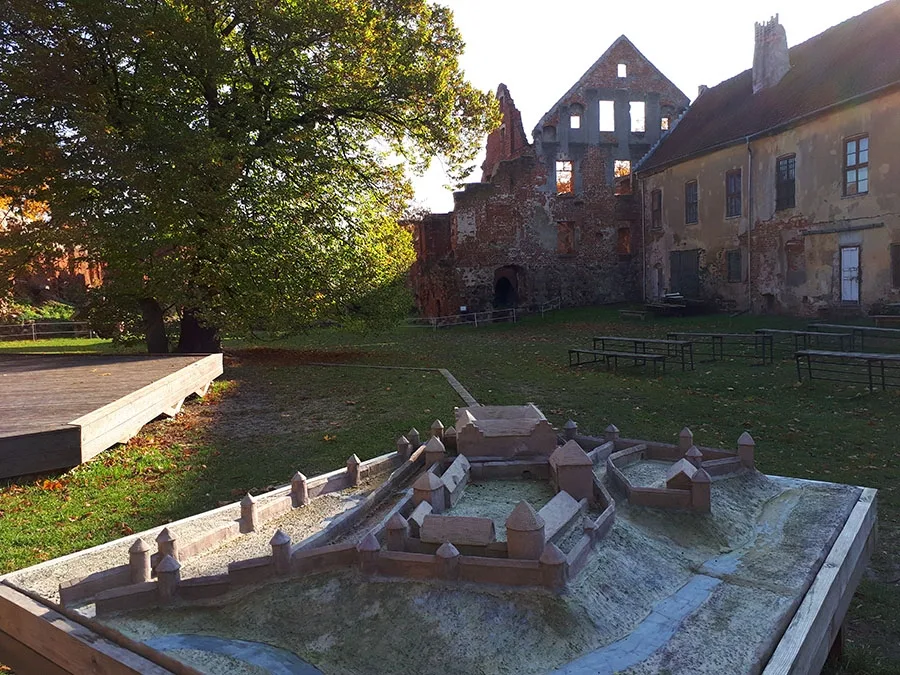 In the courtyard of Insterburg Castle stands a scale model of it.
The castle hosts a number of permanent institutions: a history laboratory, a centre for applied cultural studies, a centre for international cooperation, an art gallery and a history and arts club. The museum exhibition presenting the history of the town includes a diorama of the Battle of Gross-Jägersdorf.
Insterburg Castle online:
Facebook — InsterburgZamok
Instagram — @zamokinsterburg
VK — club2028790
GEORGENBURG
► Russian Federation, Kaliningrad Region, Chernyakhovsk
Coordinates: 54.660880, 21.806911
Condition (2020): The citadel has survived and some of its rooms have been repaired; a museum is being set up, which already hosts a historical reenactment club.
Georgenburg Castle (Mayovka), Insterburg's twin, was founded a year after Insterburg — in 1337, on the site of a Prussian hillfort, as a small fortified estate, the Ordenshaus Georgenburg. It was probably burned to the ground during a Lithuanian raid in 1347, but as early as 1350 a timber-and-earth castle was built in its place on the orders of Master Winrich von Kniprode. In 1352 the land on which Georgenburg stood passed to the Bishop of Samland. The wooden castle was burned by the Lithuanians in 1376, after which, in 1385, construction in stone began, this time at the bishop's expense. The bishopric was evidently not short of money, for the castle turned out even larger than Insterburg Castle — 58x56 m. Adjoining the castle was a Vorburg roughly one and a half times its size. Yet while Insterburg held out against the army of the Lithuanian Grand Duke Vytautas in 1403, Georgenburg was taken. The castle fell not because it lacked strength, but because its garrison was too small.
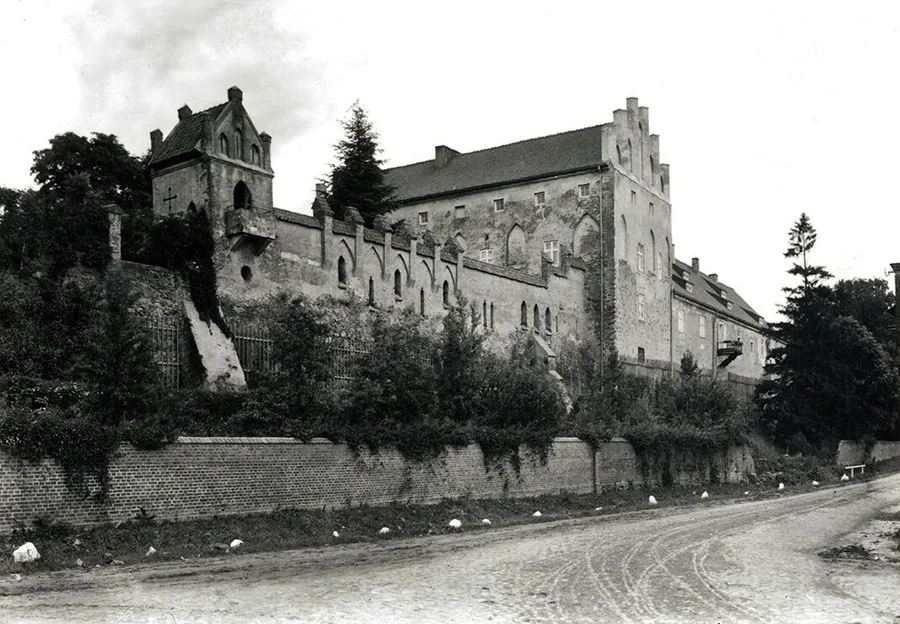 Georgenburg Castle.
After the secularization of the Order, Georgenburg became ducal property. As in Insterburg, a Kammeramt was set up here to administer the surrounding territory. During the Polish–Swedish wars of the 17th century the castle was occupied first by the Tatars in 1656 and later by the Swedes in 1679. If we add that the commander of the Russian army, Apraksin, stayed at Georgenburg in 1757, and the headquarters of the French Marshal Davout in 1807, Georgenburg becomes something of a record-holder in this category.
After the Napoleonic Wars the castle was sold into private hands. In 1828 it was bought by the Scottish Simpson family, who established a horse-breeding estate at Georgenburg; at the turn of the 20th century the state bought it from them.
After the Second World War the castle passed to the Soviet settlers in fairly decent condition. First a military hospital was set up there, and later a civilian hospital. The castle buildings were then used as housing, and the Vorburg partly for administrative purposes as well. Like the other castles, Georgenburg was never repaired while in use, which led to the collapse and demolition of the north wing and the tower. Even so, in the early 2000s Georgenburg, together with Waldau, still impressed with how well it had survived compared with the region's other castles of the Order. In 2010 the castle was handed over to the Russian Orthodox Church, after which — just before the last residents were moved out — a fire broke out that virtually destroyed one of the two surviving wings. The "reconstruction" work being carried out here raises serious fears that we will soon lose this castle too, receiving in its place a replica made of foam concrete blocks and topped with metal roof tiles.
NORKITTEN AND SAALAU
► Russian Federation, Kaliningrad Region, Chernyakhovsk District, villages of Mezhdurechye and Kamenskoye
Coordinates: 54.625022, 21.524484 and 54.655818, 21.550479
Condition of Norkitten Castle (2020): Remains of the Order's foundations may have survived. Archaeological excavation is needed.
Condition of Saalau Castle (2020): The surviving fragments of the walls are provided with an information board.
The next pair is the castles of Norkitten (Mezhdurechye) and Saalau (Kamenskoye). Both castles near the Pregel trace their origins to the Order's first wooden fortifications, built around 1276 on the ramparts of Prussian strongholds. When the lands were divided in 1325, Norkitten remained in the Order's territory, while Saalau came to belong to the bishop, who handed it over to the cathedral chapter. In 1352 Saalau began to be rebuilt in stone, but in 1376, during a Lithuanian raid, it was besieged, taken and burned. The castle was soon restored. At roughly the same time, in 1381–1382, Norkitten too was rebuilt in stone. Lying far from the main events of the wars of 1409–1411 and 1454–1466, both castles came through the decline of the Order and the creation of the secular Duchy of Prussia fairly peacefully. Having lost their military importance, they were leased out. In the early 19th century Norkitten was demolished and a manor house was built in its place, which has not survived to our day either. Saalau, meanwhile, was used in the 19th century as the seat of the local administration and for farming purposes. It survived the Second World War and passed to the Soviet settlers intact on the whole, though battered and in need of repair. But no repairs were ever made: the castle building was used until it was run into the ground and began to collapse.
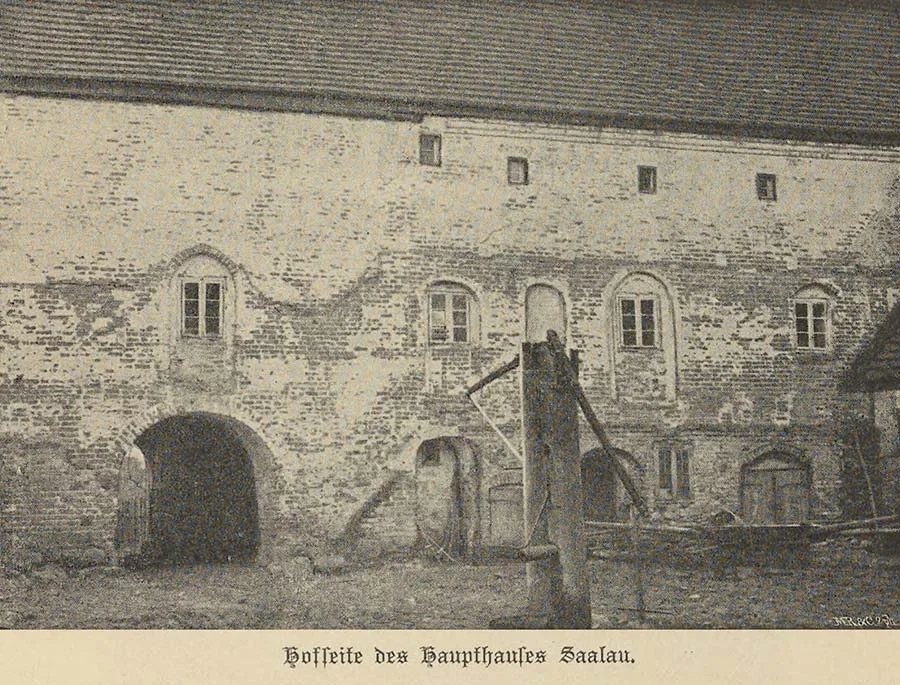 Courtyard of Saalau Castle.
By the 1990s, what remained was the gate tower, stripped of its roof and floors, and a partly ruined circuit of walls. There were reports that a private individual had bought the castle with a view to restoring it, but so far nothing there has changed.
WALDAU
► Russian Federation, Kaliningrad Region, Guryevsk District, village of Nizovye
Coordinates: 54.700504, 20.742975
Condition (2020): The castle houses a museum; restoration work is under way.
Waldau Castle is one of the best-preserved Teutonic castles in the Kaliningrad Region. Its construction began fairly late — around 1309. Before that, a Prussian stronghold had stood on or near the site, but the Order did not use it. The decision to build the castle pursued three main aims: to establish an administrative centre for governing the territory, to protect the near eastern approaches to Königsberg from Lithuanian raids, and to create the first staging post where the Order's troops could halt on campaigns against Lithuania.
The structure was a rectangle in which only the southern and western sides were formed by wings with rooms, while on the east and north it was closed off by a defensive wall. The result was, so to speak, ½ of a standard four-wing building. In addition, the castle itself was surrounded by the outer wall of a Parcham. The castle's Pfleger was subordinate to the Komtur in Königsberg.
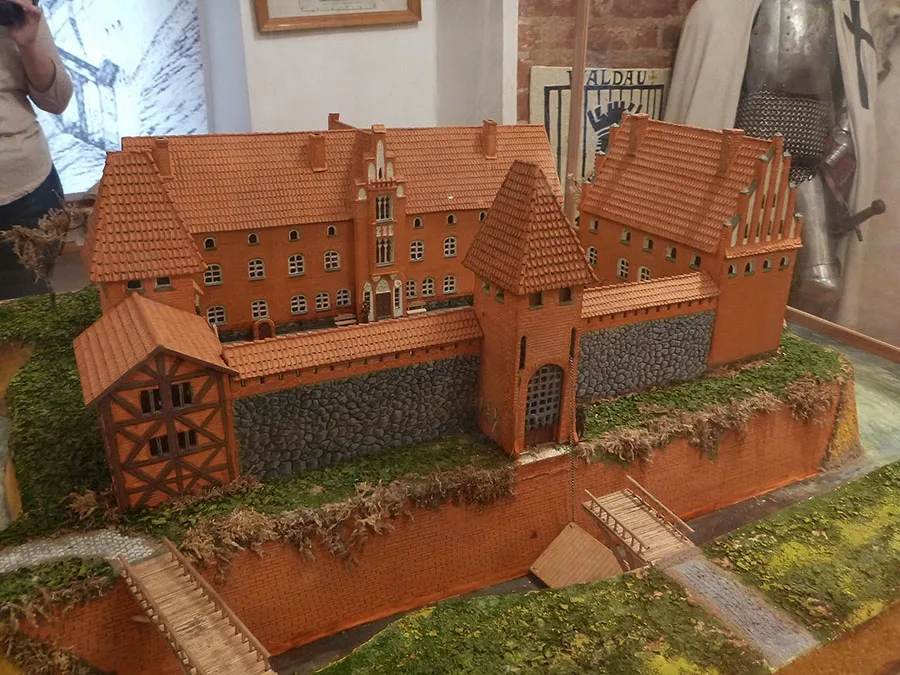 A model of Waldau Castle shows how strongly it was defended.
Throughout the entire period of the Order, the castle successfully fulfilled the tasks assigned to it; there is no record of it ever being taken by the Lithuanians.
After the secularization of the Order, the castle passed into the possession of Duke Albrecht, and after his second marriage it was given to Duchess Anna Maria. Albrecht's relationship with Anna Maria was difficult: in effect there were two parallel courts, the Duke's and the Duchess's, and much of their property was likewise kept separate. In 1550, Waldau Castle underwent its first major rebuilding to meet the Duchess's needs, overseen by the architect Christoph Römer. Later, in 1630, the castle became the property of the Dönhoff family, but only 20 years after that it was bought back by the state.
The next rebuilding of the castle took place in 1700 under Elector Frederick III, who shortly afterwards became King Frederick I. The parcham walls were demolished and the inner walls were stripped of their defensive features. In their place, farm buildings and service quarters were added, as required for the castle's administrative functions. From 1720 the castle was leased out together with the surrounding lands. By 1858, however, Waldau had once again been turned over to state use: an agricultural academy opened in the castle, followed in 1870 by a seminary training teachers for rural schools. In the course of this use, the remains of the defensive towers were destroyed, and by the early 20th century the castle had taken on the appearance it has to this day, with only the south and west wings surviving, linked by a short stretch of defensive wall.
After the war, from 1947, Waldau, renamed Nizovye, became home to a rural vocational school (SPTU) that trained skilled workers for agriculture. The castle itself housed a dormitory for the students and a number of the school's administrative offices. The castle remained in this state until 2009, when the SPTU (which had later taken to calling itself by the fashionable name of "college") was closed. In 2010, Waldau Castle was handed over to the Russian Orthodox Church (Moscow Patriarchate) on the far-fetched pretext that it had supposedly once been church property. In 2013, the family of Andrey Ivanovich Barinov, a former teacher at the SPTU, restored the cellars of the castle's west wing, and a local history museum was later established in that wing. Yet until 2014, the family of the school's caretaker, including an underage grandson, was still living in the castle without basic amenities; the author of this article was among those who worked to have them rehoused in proper accommodation. In 2016, the Sorokin family took on the restoration of the other wing of Waldau Castle, having received a presidential grant for a programme to revive the castle. As a result, the castle is now being looked after, and both wings house museums that are popular with tourists.
TAPIAU
► Russian Federation, Kaliningrad Region, town of Gvardeysk
Coordinates: 54.644920, 21.073958
Condition of the site (2020): The castle is used by the Federal Penitentiary Service (FSIN).
The knights of the Teutonic Order first appeared in the vicinity of Tapiau in 1265, while suppressing the Second Prussian Uprising. It was then that the brethren of the Order founded a wooden fortress on the site of the Prussian settlement of Tapiom. There is reason to believe that the fortress was built on the site of an old earthwork stronghold of the native inhabitants. The location itself lent itself to the construction of a castle: it was to serve as a kind of outpost on the route from Nadruvia to Königsberg. In addition, the new fortification controlled two vital waterways, the Pregel and the Deime. After the Prussian uprising was finally crushed in 1272, colonists founded a settlement beneath the castle walls.
In 1275 the fortress was besieged and stormed by the Lithuanians. Despite some successes, they were unable to take it. Naturally, the surrounding countryside was laid waste and the settlement by the castle burned down. This siege evidently revealed that the site chosen for the castle was a poor one. And so in 1280 the castle was moved to a peninsula surrounded by water on three sides.
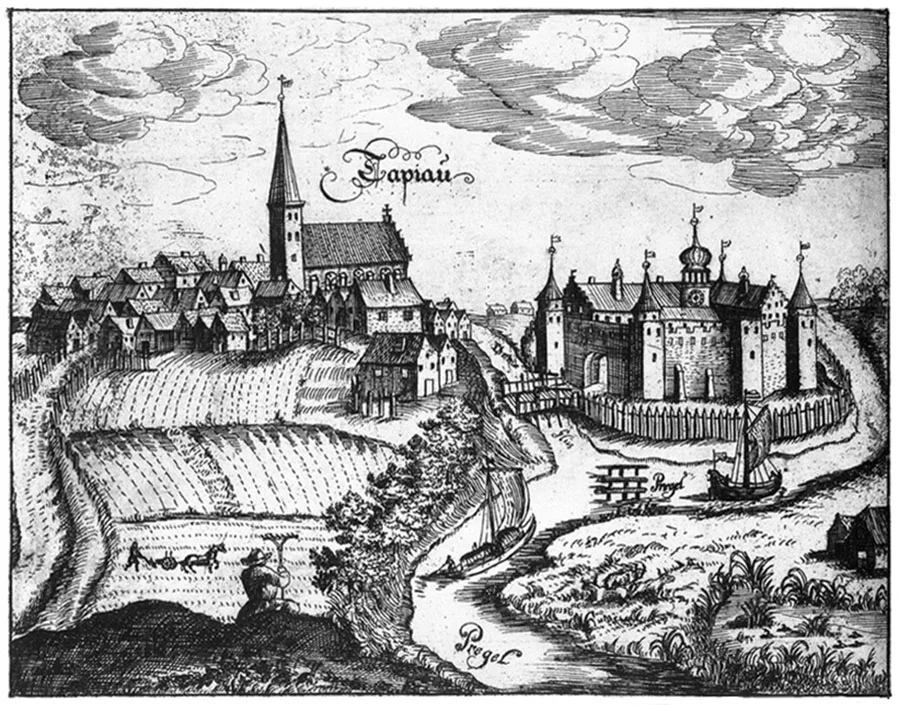
Once the moat had been dug, the fortress was connected to the mainland only by a drawbridge. In that same year, 1280, Tapiow became the seat of a commandery and remained so until 1301. The name of Tapiow's first komtur is known: Ulrich Bavarus. A year later, in 1281, he was killed in battle against the Sudovians. When the Order's campaigns against Lithuania began and its theatre of military operations shifted far to the east, the Tapiau commandery was moved first to Insterburg (Chernyakhovsk) and then even closer to the notional front line, to Ragnit (Neman). The Teutonic Knights considered keeping a commandery at Tapiau an unjustifiable luxury, and Tapiau Castle was assigned to the Königsberg commandery.
After the Order moved its capital to Marienburg (Malbork, Poland) in 1309, the State of the Teutonic Order took its final shape in the Prussian lands. This, together with constant raids by Lithuanian tribes, spurred the building of new castles in stone and the rebuilding of old ones in stone. After 1340 this rebuilding reached Tapiow Castle as well. At the same time, the Tapiow–Labiow (Polessk) canal with its locks was built to provide water transport within the Order's state. Construction of the castle, directed by the Order's Marshal Siegfried von Dahenfeld, was finally completed in the 1350s. The result was a classic four-winged structure forming a closed rectangle measuring 48x46 m. The castle was distinctive in having no towers as part of the main building. Instead, to strengthen its defences, the gable end of each wing, fitted with embrasures, projected slightly beyond the perimeter of the quadrangle, forming a kind of semi-caponier. The castle also had an extensive outer bailey (Vorburg) in the shape of an elongated rectangle. A new settlement grew up on the opposite bank of the river from the castle, though it received town rights much later.
In 1382, in the castle chapel at Tapiow, Grand Duke Vytautas of Lithuania was baptized into the Catholic faith. He was hoping for the Teutonic Order's help in his struggle for power in Lithuania and was therefore willing to go along with such formalities. Incidentally, Vytautas was baptized three times in all, once according to the Orthodox rite.
From around 1450, Tapiom-Tapiow came to be called Tapiau. During the Thirteen Years' War (1454–1466) between the Order and the Prussian Confederation of towns, the castle was taken by the Confederation's forces, but was recaptured the following year by supporters of the Teutonic Order. After the Order's defeat in that war and the loss of its former capital, the archive of the Teutonic Order was brought from Marienburg to Tapiau Castle, where it remained until 1722. In 1474, Dietrich von Cuba, Bishop of Samland, who had spoken unflatteringly of Grand Master Heinrich von Richtenberg, was imprisoned in the castle dungeon and left to starve to death. From then on, the castle acquired an enduring ill repute.
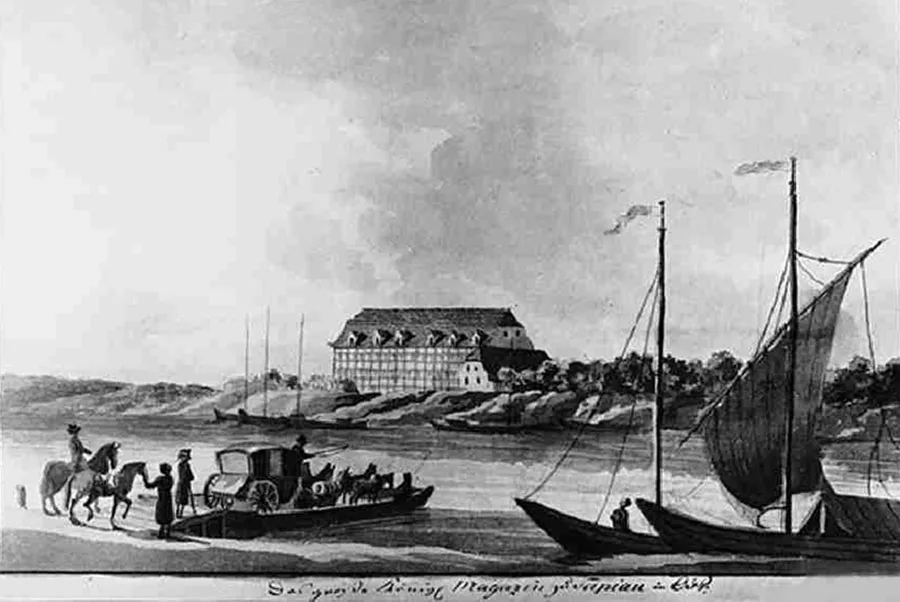 Watercolour "The Royal Carriage Crossing the Pregel at Tapiau".
The status of Tapiau Castle rose considerably under Duke Albrecht of Brandenburg. He made it his residence, and the castle also housed the administration of the Hauptamt ("main office") of Tapiau.
To this end, Albrecht carried out an extensive reconstruction of the castle, as befitted the status of a secular ruler. Albrecht often stayed at Tapiau in his final years. He died here in 1568 and was buried in the castle, but his remains were later moved to a crypt in Königsberg Cathedral.
After Albrecht's death the castle, gradually falling into disrepair and decay, served as an administrative centre housing various local authorities. In 1786 it was converted into an almshouse. From 1793 Tapiau Castle took in paupers, beggars and the sick poor. During the reconstruction, three of the castle's four wings were demolished, and a further building was erected on the grounds in their place to serve as the almshouse.
In 1879, during its conversion into a prison, two storeys were added to the castle, the upper one housing a church. In 1902, a Gothic-style red-brick building with gables and a small tower was built on the site of the former outer bailey. This is the very building that some guides today pass off as the Order's castle itself.
After Tapiau was taken by units of the Red Army in 1945, the new authorities decided not to change the building's purpose, and the castle once again housed a prison, this time a Soviet one. The castle has remained in this form to the present day. The status of the correctional institution changed several times, but its essence stayed the same.
Over the past 10 years, the question of turning the prison into a local tourist attraction has been raised regularly. The few researchers who have managed to visit the high-security facility note that one of the wings of the Teutonic castle has survived, along with the ancient cellars of another. There is no doubt that the castle, so long inaccessible, would be of interest to history enthusiasts and tourists alike, yet the relocation of the correctional facility is, with enviable regularity, postponed indefinitely for one reason or another.
FISCHHAUSEN
► Russian Federation, Kaliningrad Oblast, Baltiysk District, Primorsk
Coordinates: 54.727758, 20.009164
Condition: Remains of the walls survive; there may be cellars buried under the earth.
Fischhausen Castle was founded in 1264 as the residence of the Bishop of Samland (Sambia), since the land around present-day Primorsk had passed into the bishop's possession under a partition treaty and subsequent exchanges of territory. The wooden castle, named Schonewik, was not yet finished when the rebellious Prussians appeared beneath its walls. According to legend, there was only one knight and his servant in the castle, and the gates could be opened from the outside, but some unknown force struck the Prussians blind, and they abandoned their attempt to seize Schonewik. That, however, was where Fischhausen's run of good fortune came to an end.
After the Prussian uprising was crushed, the area was handed over to the Order for its use, on the understanding that the Order would build a stone fortification here. The exact date of construction of the brick castle is unknown, but in all likelihood work began between 1280 and 1285. The result was a “complete” four-winged castle with an extensive outer bailey and water-filled moats. Through the efforts of the Bishop of Samland, a settlement called Bischofshausen (literally “the bishop's houses”) was founded at the castle walls, and on 19 August 1305 it received town rights. By the 15th century, the name Bischofshausen had gradually evolved into Fischhausen.
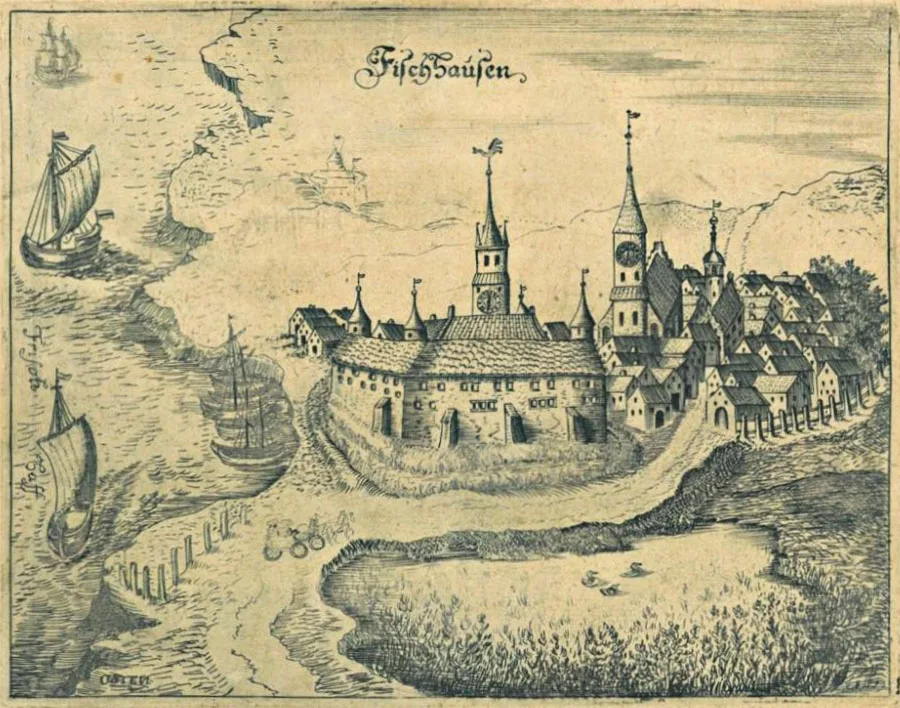
Originally the castle occupied a highly advantageous position, since at that time the strait between the mainland and today's Baltic Spit lay directly opposite it, which meant that merchant ships passed right by. The castle's status as an episcopal residence also had a favourable effect on the development of the town and the surrounding area. Moreover, the castle was never attacked by the Lithuanians, as it lay deep in the rear, shielded by Königsberg.
Later, however, the old strait silted up with sand, and a new one opened where it is today, and Fischhausen immediately lost its strategic importance. After the Great War of 1409–1411 and the defeat at the Battle of Grunwald, the townspeople of Fischhausen, like other burghers, were burdened with heavy taxes to pay off debts and indemnities. On top of that, in 1416 the plague swept through the town, claiming the lives of many residents, including Bishop Heinrich IV von Schauenburg himself. The Thirteen Years' War (1454–1466) brought new misfortunes to the castle. Bishop Nikolaus II von Schöneck decided that the Bishopric of Samland would fare better under the Polish crown and so joined the Prussian Confederation, but a detachment of the Order under Hans von Gleichen, sent to the walls of Fischhausen, forced Bishop Nikolaus to swear allegiance to the Order, which then assigned a small garrison to defend the castle. A hundred years earlier Fischhausen had been deep in the rear, but now it found itself on the very front line, since the Teutonic Order's most active opponents were based in Elbing and Danzig. In 1456 a Danzig force landed from ships near Fischhausen, attacked the town, plundered it and burned it. The force was too small to take the castle by storm, but quite large enough to blockade the garrison inside and lay waste to the surrounding countryside. And although the attackers were soon defeated near Lochstädt, they had already managed to get their booty onto the ships. Four years later, in 1462, while the main forces of the Order were besieging Frauenburg (Frombork), a combined force of Poles and townsmen from Elbing and Danzig, to the complete surprise of the Teutonic Knights, landed near Fischhausen once again, captured the town, plundered it and burned it to the ground. Once again the castle held out, but by the end of the war the surrounding lands had been utterly devastated.
After the secularisation of the Order, the Bishop of Samland, Georg von Polentz, resigned his office and handed over the church's property to the duke. The episcopal residence, Fischhausen Castle, was adapted for administrative purposes and became home to the administration of the Hauptamt (district) as well as the amber court and the coastal court. The castle left its mark on history at least three more times: in 1526 Duke Albrecht married Dorothea of Denmark in the castle chapel, and from 1567 Albrecht's mentally ill son and heir to the Prussian throne, Albrecht Friedrich, lived here. He remained in the castle until his death in 1618. Finally, in 1629, Fischhausen Castle hosted negotiations between King Gustavus II Adolphus of Sweden and Elector George William. To the satisfaction of both sides, the talks ended with the signing of a treaty under which Prussia maintained armed neutrality in the Thirty Years' War (1618–1648).
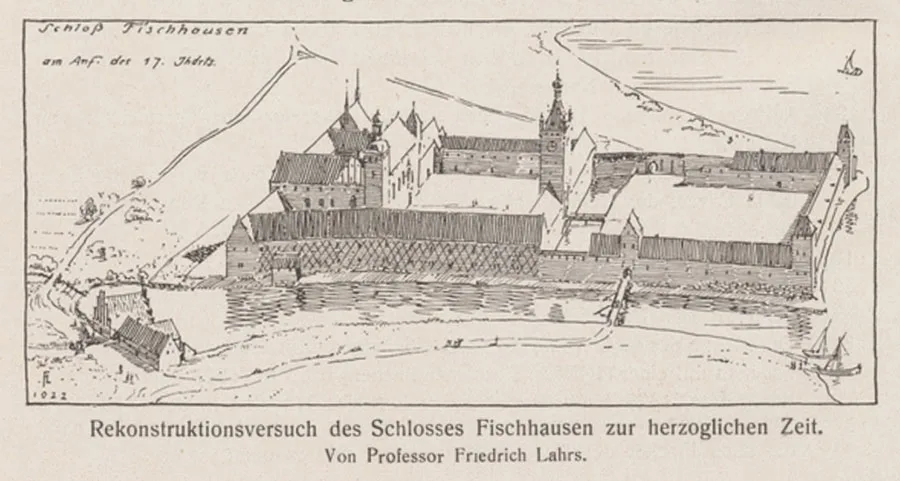
At around the same time, bastioned earthen ramparts were built around Fischhausen Castle, which had by then lost its military significance, turning it into a small fort in which the old building of the Order served as the citadel.
Yet by that very time the castle itself had begun to deteriorate rapidly. Some building work was carried out, such as replacing parts of the roof, all the more so since members of the ruling Hohenzollern dynasty often stayed at the castle while hunting. Nevertheless, from the beginning of the 18th century, by order of King Frederick I, the castle buildings began to be dismantled, and the salvaged masonry was used to strengthen the fortress of Pillau and the banks of the moats around it. Thus Fischhausen shared the fate of Balga Castle. All that remained of the castle was the clock tower and the south wing, or only part of it. Moreover, in 1776 the tower burned down after being struck by lightning and then collapsed. In the 19th century new buildings were erected on the castle grounds to house the leaseholder, while the surviving south wing was used for farm purposes and as living quarters for workers. From the late 19th century these structures were protected as historical monuments. The Second World War brought the history of Fischhausen Castle to a close. The castle lay in the path of the main thrust of the 3rd Belorussian Front during the offensive on Samland in April 1945. The castle buildings came under heavy fire, after which only shapeless ruins were left of the south wing. After 1945 the castle was “picked at” a little more by people quarrying bricks and searching for mythical treasure. Today it survives as the ruin of a single wall of the wing, up to a storey and a half high. It is quite possible that intact cellars lie beneath the heaps of construction and household rubbish.
THREE COMMANDERY CITADELS
RAGNIT
► Russian Federation, Kaliningrad Oblast, Neman
Coordinates: 55.039007, 22.029886
Condition (2020): The citadel and its cellars have survived. The castle is being restored by a local entrepreneur, and guided tours are offered.
Whenever Ragnit Castle comes up, especially in the context of the historical events that unfolded around it, one should always specify which castle is actually meant. There were, in essence, two of them, and both fulfilled their purpose with honour. And unlike other castles, which spent a short time as wooden structures before being rebuilt in stone, here we really are dealing with different castles in different places.
The first of them arose when the Order had only just finished subjugating the Prussian tribes. In 1277, a detachment led by Vogt Dietrich von Liedlau, after whom the oldest of the towers of Königsberg Castle to survive into the 20th century was named, advanced into Samogitian (Lithuanian) territory across the lagoon and along the Memel (Neman) River. On the river bank it attacked the Prussian stronghold of Raganita, which was besieged, stormed and burned. In 1289, a timber-and-earth fortification called Landeshut was built on the site of Raganita. Later, in honour of the Prussian stronghold, it came to be called Ragnit. Brick buildings most likely appeared there a little later.
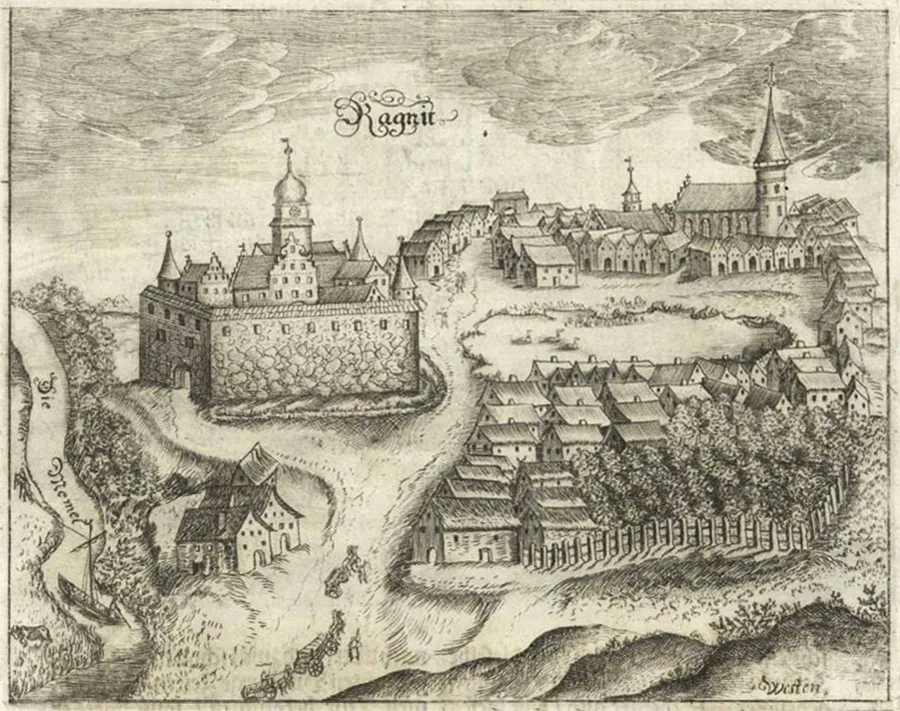
The fortress was originally intended to administer the surrounding region of Scalovia. But since the conquest of Prussia was followed by a push against Lithuania, its role changed somewhat: Ragnit now became a frontier outpost and a mustering point for the knightly detachments setting out on campaigns into Lithuania.
Ragnit Castle itself became the centre of an entire system of fortifications that the Teutonic Knights energetically built to protect the banks of the Neman, for the Lithuanian response was not long in coming, and their raids on Prussian lands became a regular occurrence. Seen from today's perspective, the situation was a stalemate. The Order clearly lacked the strength to defeat the Lithuanians in open military confrontation. Nor could it successfully pursue a policy of dividing the Lithuanian people, as it had done in Prussia, because Lithuania had already entered the stage of early feudal relations, and its tribes were therefore united under princely rule. Yet the Lithuanian raids, too, succeeded only when they could rely on surprise. An encounter with the Order's organised army on its own territory boded them no good, as the Battle of Rudau in 1370 demonstrated. Even so, such Lithuanian incursions were extremely ruinous for the Order's economy. For this reason, the Order kept a strong permanent garrison of 40 knights and some one hundred knechts at its forward position in Ragnit. This garrison was regularly reinforced by combined detachments of Teutonic Knights and guests of the Order who arrived in Ragnit to launch attacks on Lithuanian territory. Three times – in 1290, 1295 and 1315 – the castle came under major attack, but it was never taken, although the surrounding area was plundered with the utmost brutality.
Later, however, the growing strength of Lithuania and its union with Poland under the Union of Krewo of 1385 forced the Order to substantially reinforce its outpost on the Memel. All the more so because the small castles built in Scalovia were regularly captured and burned by the Lithuanians, which meant that only a very powerful fortress could hold out against them – and that is precisely what the new Ragnit Castle was designed to be. On the old site, however, it was impossible to enlarge and strengthen it significantly. It was therefore decided to build a new castle further downstream on the Memel, two kilometres from the old one. This construction is recorded in detail in the Order's documents, which specify how much money, materials and food for the workers was spent, how many people were employed on the works, and so on. We thus know that no fewer than 30 master masons (with their assistants and journeymen) worked on building Ragnit Castle, while 1,200 local inhabitants were employed as labourers. The castle walls took five years to build, from 1397 to 1402, after which came the roofing and finishing work. Two and a half tonnes of clear and coloured glass were used to glaze the castle's windows. The castle itself, consisting of four wings arranged in a square measuring 59x59 metres, could be rivalled in size only by Marienburg Castle before its rebuilding. The walls were three metres thick, and the castle was surrounded by a moat up to four metres deep and 12 metres wide. In keeping with new trends in warfare, Ragnit was well equipped with firearms: in 1407 the castle had 11 guns of various calibres and 18 grapeshot guns. Before the Great War of 1409–1411, a forburg was built on the western side of the castle, with a large round tower and a tall, narrow “watch” tower. The latter was probably intended for observing the area around the castle.
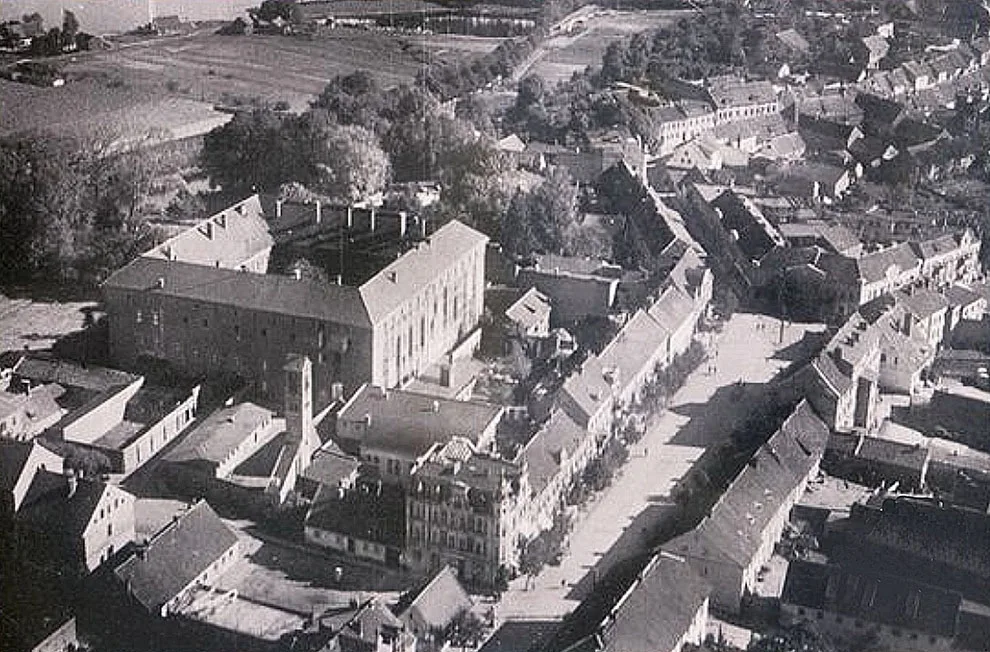 Ragnit Castle from a bird's-eye view in the first half of the 20th century.
The main events of the Great War swept past far from Ragnit, but the Thirteen Years' War (1454–1466) touched it slightly: at the outbreak of hostilities, the castle was seized by supporters of the Prussian Confederation, but the Teutonic Knights soon managed to recover it.
After the secularisation of the Order, Ragnit became, under the ducal administrative reform, the centre of a large Amt that covered practically the entire northeast of today's Kaliningrad Oblast. A settlement grew up around the castle and received town rights by 1722. At the beginning of the 19th century, it was decided to use the huge castle building as a prison and courthouse, which entailed considerable rebuilding. The vaulted ceilings of the first floor were lost and replaced with flat ones; new doorways were cut through the walls, windows were altered, internal partitions were demolished and staircases were installed. In 1828 a major fire broke out in the castle, after which it was restored with even greater alterations. The forburg was demolished and built over, and only the “watch” tower survived of it. In this form the castle building lasted until the beginning of the Second World War.
After 1945, Ragnit Castle passed to the USSR intact, but it needed care and repair. The castle courtyard was used as a market and the ground-floor rooms as warehouses. No one had any intention of repairing anything, and the trophy was exploited mercilessly. By 1955 the castle was already in a dangerous state of disrepair: the roof was missing almost everywhere and the upper floors had begun to collapse. By the time filming of “Twenty Days Without War” (1976) began at Ragnit Castle, the ancient citadel was already badly ruined, as can be seen in the footage. The blowing-up of the castle's inner wall during filming added considerably to the destruction and can hardly be justified by the director's creative vision. After that, Ragnit Castle, while remaining in effect the main sight of the town of Neman, simultaneously served as a supporting structure for a heating main, a source of building materials, an illegal rubbish dump and a hangout for teenagers. Timid attempts were made to clear and conserve the ruins. Later, bars and doors were fitted to the windows and gates, but this restricted access to the castle only for the most civilised part of the population. Finally, in 2020, an entrepreneur who had leased Ragnit Castle from its current owner, the Russian Orthodox Church (Moscow Patriarchate), carried out with the help of volunteers the most extensive works in the entire post-war history of the castle to turn it into a tourist site open to the public. To date, the castle courtyard has been paved with cobblestones, clearing of the cellars is continuing and new gates have been installed. Volunteer clean-up days are held every week, attended by enthusiasts from among the local residents, who are often joined by volunteers from other towns of the region, Kaliningrad included. Completion of the work is still a long way off, but its brisk pace gives cause for hope. Yet even in its present state, the castle is certainly worth a visit for lovers of historical tourism, especially since guided tours are already being held there. If there is anything “genuinely Teutonic” in our region, it is, of course, the ruins of Ragnit Castle.
Ragnit Castle online:
Facebook — BurgRagnit
Instagram — @burg.ragnit
VK — burgragnit
Excerpts from films shot at the castle are collected on a YouTube channel.
BRANDENBURG
► Russian Federation, Kaliningrad Oblast, Guryevsky District, Ushakovo settlement
Coordinates: 54.613867, 20.248551
Condition (2020): The castle is being restored under the patronage of the Russian Orthodox Church; historical re-enactments are held here.
Brandenburg Castle was founded in 1266, during the Second Prussian Uprising, by Otto III, Margrave of Brandenburg, who had come to the Order's aid, and it was named in his honour. Although it was initially built of earth and timber, it was conceived from the outset as the seat of a Komtur. It stood on the shore of what is now the Kaliningrad Lagoon, at the mouth of the Frisching (Prokhladnaya) River, and, lying between the existing Komtur castles of Königsberg and Balga, was meant to strengthen the link between them. The first Komtur of Brandenburg was the serving Marshal of the Order, Friedrich von Holdenstete. During the Prussian uprising he left the castle with a detachment and set off towards Kreuzburg (Slavskoye), a castle the Prussians had burned. At the same time a Prussian captive escaped from Brandenburg and told Glappo, leader of the rebel Natangians, that only a small garrison remained in the castle. The Prussians attacked the wooden castle and slaughtered almost the entire garrison; only a few managed to take refuge in the tower. Holdenstete learned of the attack, picked up reinforcements in Königsberg on his way back to Brandenburg and, with the combined forces, routed the Prussians and freed those besieged in the tower. Nevertheless, the castle was soon attacked by the Prussians again and burned down, most likely in 1267 or 1269. Immediately afterwards Margrave Otto III of Brandenburg landed in Prussia once more and rebuilt the castle. Once the Prussian uprising was over, work began on rebuilding the castle in stone. The new castle was a “full-scale” four-winged structure forming a 65 x 52 m rectangle around a spacious courtyard. Adjoining it to the south-west was an extensive outer bailey (Vorburg), separated from the castle by a moat. The outer bailey consisted of two large buildings standing right next to each other and a defensive wall that closed off the quadrangle on the other two sides. It had several towers of various sizes. The castle itself contained all the rooms typical of a Komtur's castle: the Remter (refectory), the infirmary, where elderly brethren of the Order spent their last days, the chapter hall, the castle chapel and the Danzker (latrine). The ground floors housed the service and storage rooms.
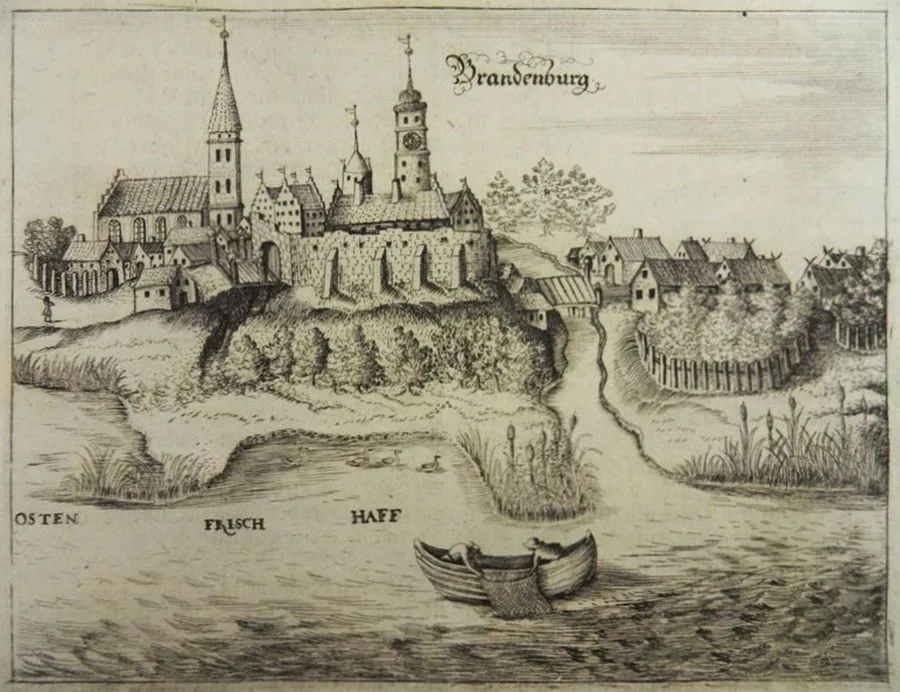
As befitted a Komtur's castle, Brandenburg played an important military, economic and political role in the Order's state. Günther von Hohenstein, its Komtur in the 1370s and 1380s, distinguished himself as a diplomat, while another Komtur of Brandenburg, Markward von Salzbach, was taken prisoner at the Battle of Grunwald and executed by Prince Vytautas.
Komturs of Brandenburg repeatedly went on to hold high office in the Order. Meinhard von Querfurt (Komtur in 1284–88) and Ludwig von Schippen (Komtur in 1290–91) became Landmeisters of Prussia, while Heinrich Dusemer von Arfberg (Komtur in 1334–35) and Johann von Tiefen (Komtur in 1480–89) rose to the office of Grand Master.
During the Thirteen Years' War (1454–66), Brandenburg was seized at the very outset of hostilities by the town militia of Kneiphof, which had joined the Prussian Confederation of towns. The rebels took advantage of the temporary absence of the Komtur and a strong garrison. As early as 1455, however, Brandenburg was retaken without a fight by a detachment led by the Komtur of Elbing, Heinrich Reuss von Plauen. At the very end of the war the castle came under artillery fire from the sea, from ships of the city of Danzig. A fire broke out in the outer bailey, but the enemy did not dare to storm the castle itself. The war-ravaged surroundings left the Brandenburg commandery in dire financial straits. And no sooner had life in the commandery begun to recover than a new war broke out in 1520–21, known as the Horsemen's War. It was caused by the Grand Master Albrecht of Brandenburg's attempt to avoid swearing an oath of fealty to the Polish king. Fierce fighting took place around Brandenburg. In 1520 the castle was taken by the Poles twice. The first time, following all the rules of the military art of the day, they bombarded the castle with artillery and breached the wall where the two buildings of the outer bailey met, whereupon the garrison capitulated on honourable terms and marched out with its weapons and banners unfurled. During the second capture a major fire broke out in the castle.
After the war the castle was restored, though not completely. In the Duchy of Prussia it served (like many other castles) as the administrative centre of an Amt for more than 200 years. Over time the buildings deteriorated as necessary repairs were neglected. Even so, in 1629, when the court of Elector George William moved here to escape a plague epidemic, Brandenburg was still in good condition, and in the 1650s the wife of the Great Elector Frederick William lived here. But by the 1750s demolition of the castle's main building had begun, and by the early 19th century only its foundations remained. The buildings of the outer bailey survived and were turned into a leased state domain. On 5 January 1813 Macdonald's retreating French X Army Corps halted at the castle, pursued by a detachment under Ivan Ivanovich Diebitsch-Zabalkansky, who waited for reinforcements and then drove the French out of Brandenburg.
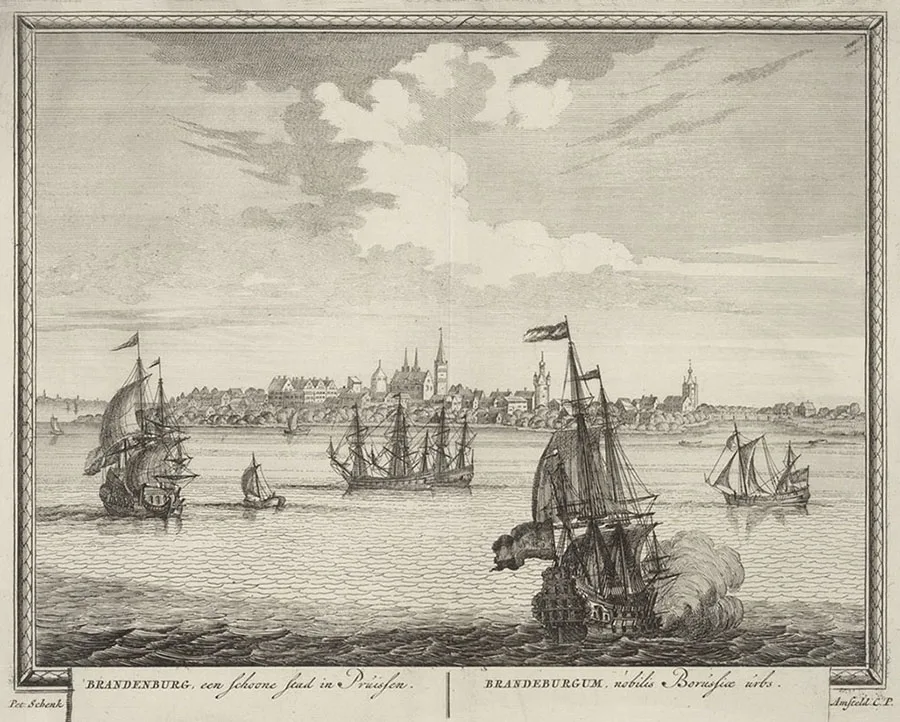
The two buildings of Brandenburg Castle's outer bailey survived intact until the Second World War, but in March 1945 they found themselves in the midst of heavy fighting and were badly damaged. Nevertheless, from 1946 Soviet settlers lived in the southern wing of the outer bailey.
This building was used as housing until around the early 1980s, when, for lack of repairs, it became uninhabitable. In the 1990s a project emerged to convert the outer bailey into a hotel complex, but it all ended in even greater destruction: the roof was now gone entirely, and some of the walls were dismantled for their bricks. The outer bailey remained in this state until 2015, when another attempt was made to clear and restore the buildings. However, the work was carried out without a proper scientific restoration plan (which the allocated funds would hardly have covered anyway) and was, on the whole, sporadic and haphazard. As a result, by 2020 the courtyard had at least been cleared of self-seeded growth and rubbish, access to the buildings of the western wing had been closed off, basic conservation had been carried out, and part of the masonry of the southern wing had been rebuilt. By all accounts, that is where the allocated money ran out.
LOCHSTÄDT
► Russian Federation, Kaliningrad Region, Baltiysk
Coordinates: 54.707284, 19.952261
Condition: Remains of the foundation walls survive.
Construction of Lochstädt Castle began in 1270, when the lands around present-day Primorsk were acquired from the Bishop of Samland in an exchange and passed into the Order's possession. At first it was an earthen rampart fortification, possibly with wooden buildings. Only after the conquest of the Prussians had been completed, presumably around 1290, did work begin on a stone castle. The castle was planned from the start as a Komtur's seat, although its first Komtur is not mentioned until 1305. Lochstädt's main building was smaller than Brandenburg's, measuring 53 x 47 m, but it too was a four-winged castle, as befitted a Komtur's seat.
There is, however, evidence that the fourth wing was not completed during the initial construction and was only built in the 14th century. Besides these four wings, the castle had a very massive tower with walls five metres thick at the base. It also had a classic Danzker in the form of a projecting tower standing over the lagoon. Adjoining the castle to the east was an elongated rectangular outer bailey formed by three buildings, which housed quarters for soldiers and servants as well as storerooms. In the castle itself the cellars served as a prison, while the ground floor contained service rooms, the kitchen, the furnace room, the armoury and all kinds of storerooms. The upper floor held the living quarters, the Remter and the chapter hall. The castle chapel was built in the eastern part of the southern wing.
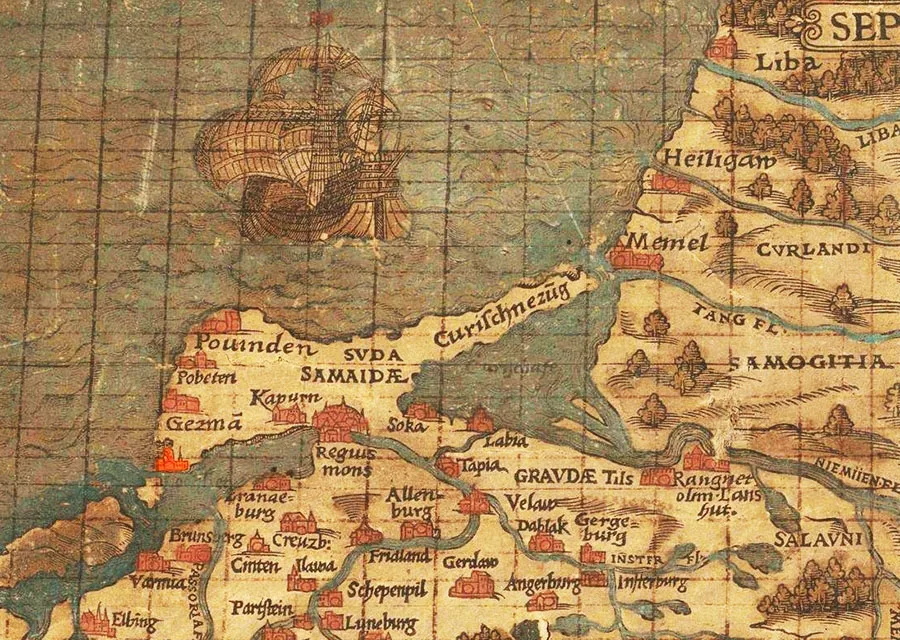
Lochstädt Castle was built on this spot for a reason. Up to and including the 13th century, this was where the strait connecting today's Kaliningrad Lagoon with the Baltic Sea lay, while at the site of present-day Baltiysk there was no strait at the time. Lochstädt controlled access from the sea to Fischhausen, Königsberg, Brandenburg and Balga.
One should not, of course, imagine that this control resembled the way coastal fortresses of later periods controlled straits. In the 13th and 14th centuries the castle could not have had any effective long-range means of acting against ships forcing their way into the strait. A boom of chains and logs could, however, be set up, and then a ship's crew would have had to land near the castle to open it. An equally important task was inspecting merchant ships, collecting duties from them, and exercising the right of wreck, under which any wrecked ship with its cargo became the property of whoever owned the shore. In addition, a considerable share of the commandery's income came from gathering amber on the shore, over which the Order held a monopoly.
Yet a mere 5–10 years after the castle was built, nature itself intervened in these plans: the strait at Lochstädt began rapidly to grow shallow and silt up with sand. Attempts were later made to deepen it, but the technical means of the day did not allow this to be done effectively. Meanwhile, near the village of Wogram, where Pillau would later arise, a new strait had already formed, becoming navigable in 1510.
As a result, Lochstädt Castle lost much of its purpose and became, in essence, merely a centre of amber extraction and amber administration. In the 14th century the Lochstädt commandery was abolished, the castle was placed under the Königsberg commandery, and its administrator was given the post of Pfleger, or castle warden. The Pfleger of Lochstädt also held the office of amber master. In 1429 the castle came under the administration of the hero of the defence of Marienburg during the Great War, the deposed but later rehabilitated Grand Master Heinrich von Plauen. In recognition of his past services he was given the rank of Hauskomtur, that is, a person equal in the hierarchy to a commander but in charge of a commandery castle without any subordinate territories.
At the very start of the Thirteen Years' War (1454–1466), in 1454, Lochstädt Castle was seized by supporters of the Prussian Confederation, but already the following year it was recaptured by a detachment under the Grand Hospitaller Heinrich Reuß von Plauen.
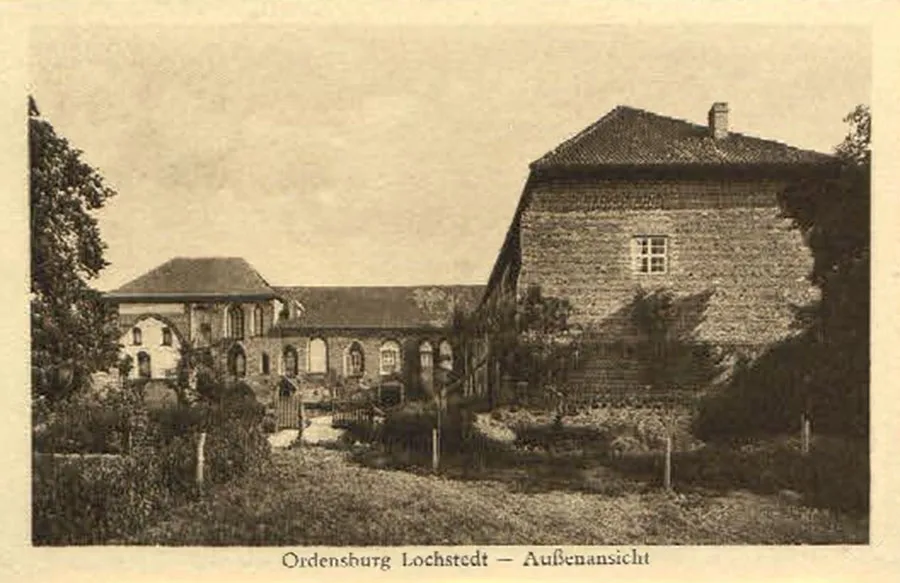
In 1456 a storm opened up a new strait next to Lochstädt. Attempts were made to widen it and make it fit for shipping, but after 1500 it was realised that it would be easier to develop the strait at Pillau.
By 1513 Lochstädt Castle had fallen into considerable disrepair and was in need of renovation. Short of funds, the Order handed it over to two knights on condition that they carry out the necessary repairs. In 1629 the Swedish king Gustavus Adolphus, who had made camp near Lochstädt, decided to build a stretch of rampart with bastions there, for which the wall of the castle's parcham was dismantled. But the serious destruction of the castle began in 1703, when King Frederick I ordered the demolition of the dansker, the great tower, the north and east wings and part of the south wing. In 1884 the remaining castle buildings were converted into a school. A fire in 1888 completely destroyed the Vorburg. Finally, in 1907, it was decided to carry out a thorough restoration of Lochstädt Castle as a historic monument. The work continued right up to the outbreak of the Second World War, when it was halted. In April 1945, during the fighting for Pillau, the castle came under artillery fire and bombing that destroyed it almost entirely, leaving only the cellars and fragments of walls. In the years up to 1989 these cellars were somewhat disturbed by local diggers, and some of the walls were taken apart for building material. But at the end of 1989 the magazine Der Spiegel unexpectedly provided money for a search for the Amber Room at Lochstädt. Work began in 1990, with the very active participation of the well-known local historian and treasure seeker Avenir Ovsyanov. The heavy construction machinery used in the operation almost completely destroyed the castle's cellars. The Amber Room, needless to say, was not found.
LABIAU AND LAUKEN
► Russian Federation, Kaliningrad Region, town of Polessk and settlement of Saranskoye, Polessk District
Coordinates: 54.862136, 21.110820 and 54.831127, 21.234199
Condition of Labiau Castle (2020): The castle has survived; its premises are let to tenants, and there is no museum activity or restoration work.
Condition of Lauken Castle (2020): A manor house built on the Order's foundations has survived.
Both castles played similar roles in the Order's state: they controlled the land along the banks of the Deima River and served as staging posts for the Order's campaigns against Lithuania. The castles were founded at almost the same time — Labiau around 1274, Lauken slightly earlier, around 1270. Curiously, the present-day town of Polessk (Labiau) and the settlement of Saranskoye (Laukischken) share the same official founding date: 1258. This, however, is connected not with the castles but with the mention of Prussian villages on these sites in the treaty dividing the Prussian lands between the Order and the bishop.
So, in the 1270s both castles were erected as earthwork fortifications with timber buildings. For a short time Labiau even became the seat of a commandery, but in 1289 Ragnit Castle was founded, and the administration of the eastern territories of today's Kaliningrad Region was moved there. In the early 14th century the Order began to have substantial funds available for modernising its fortifications, while a new enemy — the Lithuanian princes, whose forces were reinforced by warriors from the Russian lands and the Horde — clearly demonstrated that wooden castles posed no serious obstacle to them. Consequently, as early as 1327 Lauken was rebuilt in stone. Construction of the stone castle at Labiau began later, in 1360, after two devastating Lithuanian raids in 1347 and 1352. Labiau Castle itself was not attacked at that time, and its small garrison could only watch as the Lithuanian bands laid waste to the surrounding villages and burned them.
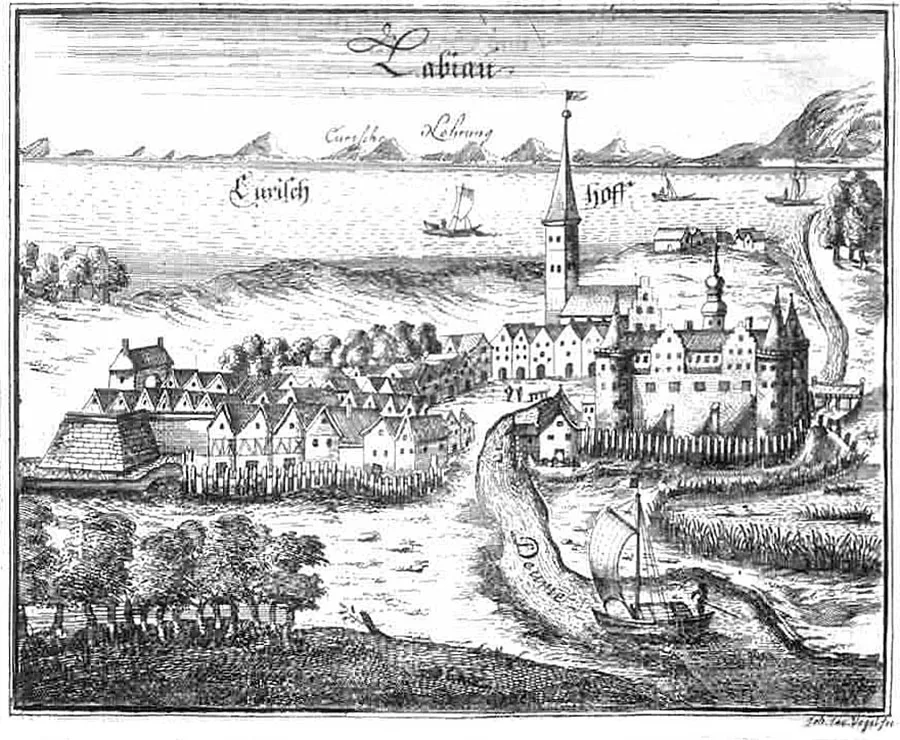
Once rebuilt in stone, the two castles became entirely different in their layout and in their importance to the life of the Order's state.
Lauken was built as a small castle amounting to a quarter of the full standard quadrangle; that is, it had a single wing, with the rectangular outline completed by three defensive walls. The castle had one square tower in its south-eastern corner. Labiau, by contrast, was built to the "full programme": the castle turned out not very large, but it had all four wings and two square towers. Lauken's Vorburg was a standard rectangle, whereas Labiau was given an irregularly shaped Vorburg vaguely resembling a quarter circle. The Vorburg contained a gate with a gate tower, and St George's Church was also built there, surviving as a utility building until 1880. The dansker of Labiau Castle was built into the wall. The ground floors housed domestic and service rooms, including the kitchen and bakery; the upper floor held the living quarters, a hall for meetings and ceremonies, and the Remter.
In the 14th to 16th centuries Labiau Castle housed the administration responsible for building the canal later known as the Großer Friedrichsgraben (Polessk Canal). The canal was completed by 1410, but for another 120 years work continued on widening it and periodically clearing it. This was a unique undertaking for its time, intended to ensure reliable navigation from Königsberg to Ragnit without going out to sea or into the lagoon. Interestingly, for a time the work on the canal was directed by a woman, Katharina Truchsess von Wetzhausen (d. 1526).
During the Thirteen Years' War (1454–1466), Labiau remained loyal to the Order. At the very start of the war, Prussian Confederation detachments from Wehlau (Znamensk) and Allenburg (Druzhba) attacked the castle and met stout resistance from its garrison. They failed to take it.
Lauken, for its part, appears from time to time in lists of castles right up to the secularization of the Order (including in the Treaty of Kraków of 1525), but no events of any significance took place around it.
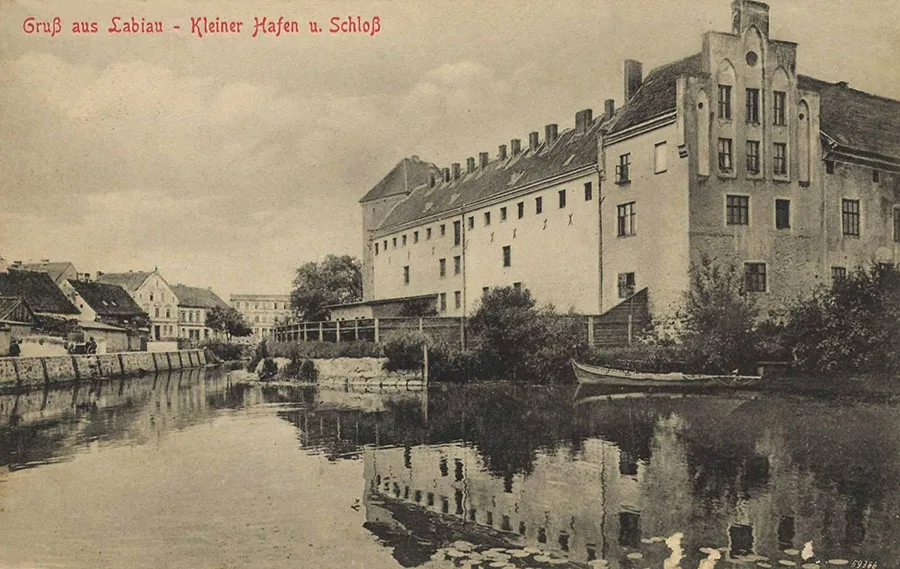 Labiau Castle.
After the secularization of the Order, the town of Labiau became the seat of an Amt, and the castle of the same name was given as a wedding gift to Albrecht's first wife, Dorothea. After Dorothea's death and Albrecht's remarriage, it passed to his second wife, Anna Maria. In Duke Albrecht's time, Lauken Castle served as a hunting lodge. Both castles were partially rebuilt for civilian use.
In 1581–1584, Lauken Castle was rebuilt once again, this time as a country residence. On this occasion the reconstruction was radical: of the knights' castle, only the cellars and foundations survived. The work was directed by Blasius Berwart, court architect to the regent George Frederick. Lauken later became a manorial estate and remained one right up until the Second World War.
Labiau, meanwhile, under the Great Elector Frederick William, became the citadel of the Labiau fortress built around the castle. From 1818 it was the residence of the Landrat, the head of the Labiau district, and it also housed a court and a prison. The outer bailey was partly demolished and the moats were partly filled in. Yet the castle itself remained quite attractive from an architectural and historical point of view.
After 1945, a school was opened in the former estate at Lauken, and the castle has kept this role to this day. The original cellars and foundations are still preserved, and the school even has an amateur museum devoted to the history of Lauken Castle.
Labiau met a different fate. In 1945 the castle was converted into a prison, and it served in this capacity until 1963, when it was damaged by fire. Even after the fire, as photographs show, the half-timbered walls and part of the tiled roof survived. Of the outer bailey, the gate tower and remnants of the defensive walls still stood. Afterwards the building was used by the Polessk branch of the Leningrad Agricultural Institute, and then handed over to the Yantar factory for production premises. When the castle was converted into workshops, the interiors and exterior walls suffered, and the defensive walls and the gate tower were demolished. In the 1990s the castle became municipal property. One corner was given over to the town museum, while the rest was taken up by various commercial businesses. At present the museum is effectively closed. The Order-era cellars and some elements of the Order-period rooms have survived.
THE MOST INTERESTING CASTLES IN POLAND
 A great many sites dating from the Order period have survived in Poland. Local experts have singled out the most interesting of them, which are now united in an association.
(Pictured: a map of the castles of the Pomeranian Voivodeship, displayed in the grounds near the principal castle museum, Marienburg, in the town of Malbork, about an hour's drive from the border of the Kaliningrad Region.)
MEWE (GNIEW)
► Poland, Pomeranian Voivodeship, Tczew County, town of Gniew (Gniew)
Coordinates: 53.834357, 18.827852
Condition of the site (2020): The castle is in perfect condition. Inside are a hotel and spa complex, numerous conference rooms and function halls. Weddings are held in the chapel. The covered courtyard hosts a variety of events. There is an excellent restaurant next to the castle. Re-enactments of knightly tournaments and other historical events are held regularly.
Mewe (Gniew) Castle is considered the mightiest Teutonic stronghold on the left bank of the Vistula. Mewe is first mentioned in 1229, when this territory was granted to the Cistercian monks of Oliva Abbey near Danzig. In 1276, under the will of the Pomeranian duke Sambor, the lands of Mewe passed to the Order. The Commandery of Mewe was established at once, and after the Treaty of Milicz (1282) construction of the castle began, at first as a temporary wooden fortification. The work was directed by the first Komtur of Mewe, Dietrich von Spira (Dietrich von Spira). The builders used timber structures from the dismantled Potterberg stronghold in Kulmerland, which were brought to Mewe by water. Almost immediately after the wooden fortification was completed, its rebuilding in stone began. Work started with the defensive moats and the laying out of a quadrangle of defensive walls up to six metres high. At the corners of this quadrangle, towers were built projecting beyond the perimeter: three of roughly equal size and one considerably larger. Then the residential quarters were built. By that time German colonists had founded a settlement at the foot of the castle walls, and on 25 September 1297 the Landmeister of Prussia, Meinhard von Querfurt (Meinhard von Querfurt), granted it town rights under Kulm law.
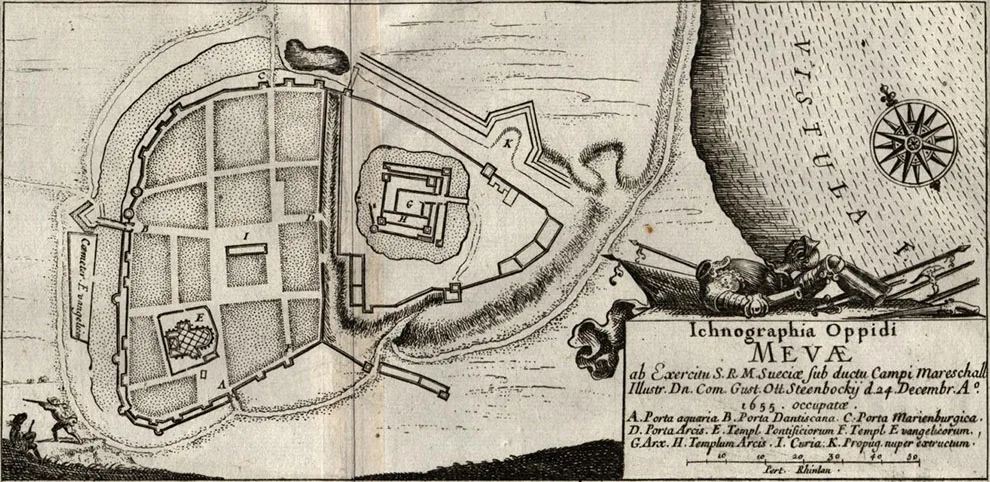
At the beginning of the 14th century, Mewe Castle was rebuilt: the walls and towers were raised, two wings were added to the main building, and wooden defensive galleries were built along the walls. At the height of the Order's power in the second half of the 14th century, Mewe Castle was its most important stronghold in the west of the state.
On the eve of the Great War (1409–1411) against Poland and Lithuania, the arsenal of Mewe Castle held 162 crossbows and 40,000 bolts (arrows) for them, along with a certain number of firearms; 105 warhorses stood saddled, and another 405 horses could be used for the baggage train. Yet neither the castle's fortifications nor its arsenal helped it hold out in the Great War (1409–1411): after the Battle of Grunwald, in which the Komtur of Mewe, Sigismund von Ramungen (Sigismund von Ramungen), was killed, Mewe Castle was taken by Polish troops without a fight. Under the First Peace of Thorn in 1411, however, Mewe was returned to the Order. In the period between the Great War and the Thirteen Years' War, Mewe became the residence of Michael Küchmeister von Sternberg, who had resigned as Grand Master in 1422. The castle even underwent some rebuilding, as a result of which apartments for the former Grand Master were built in the north wing and the castle acquired an imposing outer bailey. A year and a half later, however, the residence's occupant died, and the castle returned to its former life.
During the Thirteen Years' War (1454–1466), the town of Mewe beneath the castle walls went over to the Prussian Confederation. The town militia, which was nevertheless led by a Polish commander, Jan of Jani, laid siege to the castle as early as February 1454. After a week of continuous fighting, the garrison realized that the insurgents would take the castle sooner or later. To the besiegers' surprise, it set fire to the castle's wooden structures and fled to Marienburg. Jan received the castle as a royal reward for the successful siege, but by then the people of Mewe could no longer be stopped. They plundered the castle even though it was effectively Polish by that point and on their side. The oddities of the Thirteen Years' War did not end there for Mewe Castle. By September 1454 the Order had recovered from its first defeats and begun to turn the tide of the war in its favour. The townspeople of Mewe then went over to its side and helped the Order's troops retake the castle. The castle was left with a garrison made up of knights of the Order proper, led by Grand Commander Ulrich von Isenhofen, and of the Order's mercenaries. This garrison soon came under attack from a Polish army that greatly outnumbered the castle's defenders.
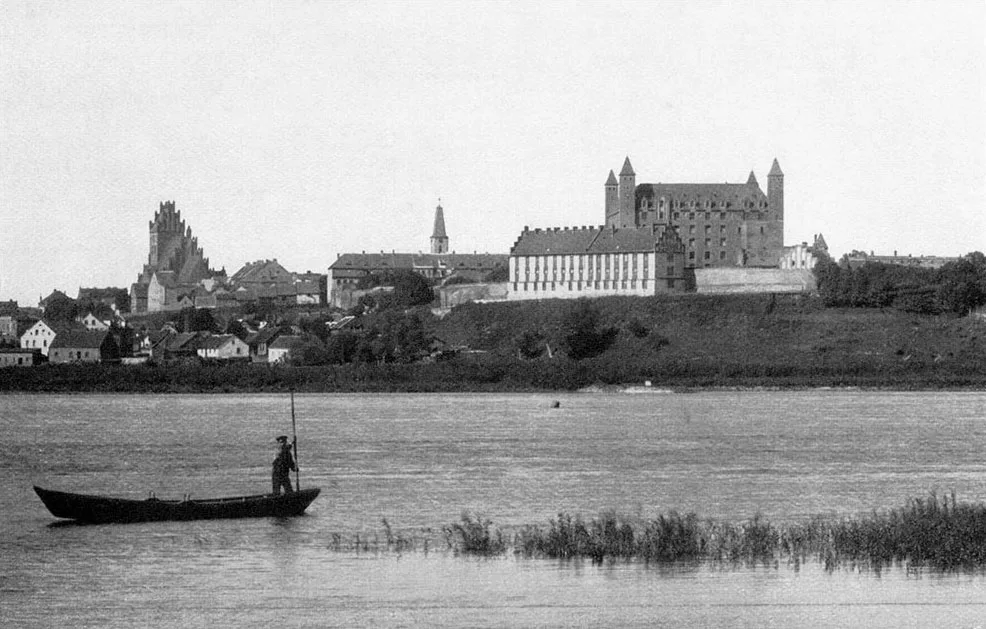 View of the castle and town of Mewe from the Vistula in the first half of the 20th century.
On top of that, an epidemic broke out in the castle, and the mercenaries, who had mutinied over unpaid wages, began bargaining with the Poles over the terms of surrender. Nevertheless, the Polish army soon lifted the siege and returned to Poland. As it later emerged, Fritz von Raveneck, one of the leaders of the castle's defence, had simply bribed some of the enemy soldiers through a Polish knight.
In 1457 the Polish army besieged Mewe once more, and once more it failed. Finally, in 1463, Mewe was surrounded by an army reinforced with artillery under the command of Hetman Piotr Dunin. This army began a methodical siege, blockading the castle completely and building earthworks around it. After a nine-month siege, Mewe Castle capitulated. Two years later the Thirteen Years' War came to an end. Under the Second Peace of Thorn, Mewe found itself in the territory annexed to the Kingdom of Poland. The castle became an administrative centre governed by a starosta and a stronghold against a possible Teutonic offensive.
In 1625 the castle, by then already called Gniew, was taken by the Swedish army under King Gustav II Adolf during the Polish–Swedish War of 1621–1626. The truce expired and the next Polish–Swedish war (1626–1629) broke out, and in 1627 the Poles recaptured the castle. By then, however, this was no longer really part of the castle's military history. The castle had lost its military significance and simply changed hands as the surrounding territory was seized (or liberated). During the next Polish–Swedish war (the "Swedish Deluge", 1655–1660), Gniew Castle was captured by the Swedes in 1655 and returned to Poland in 1657. This war caused Gniew considerable destruction: the outer bailey and sections of the defensive walls were lost entirely.
From the second half of the 17th century, the castle became the residence of Jan Sobieski, the hetman and starosta of Gniew and future King of Poland. During his time in Gniew he helped the town recover after the wars. He also rebuilt the castle somewhat to suit his own needs; among other things, a wing was added for his wife and children. After Jan Sobieski's death, Gniew passed to his widow, Marie Casimire.
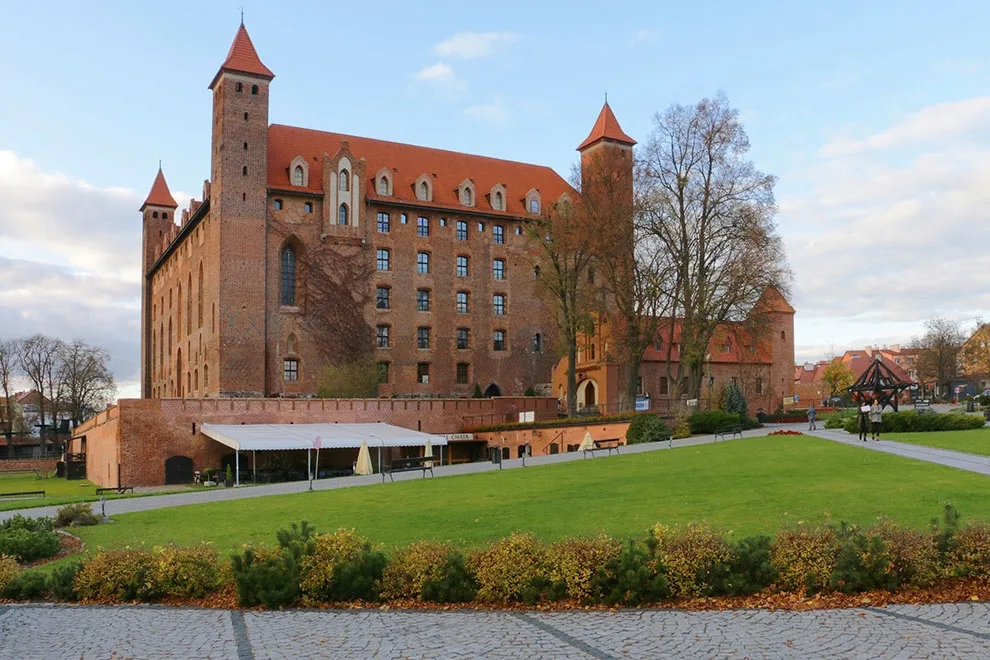
In 1772, after the First Partition of Poland, Gniew became a Prussian town once again. A use was found for the castle as well: it was rebuilt yet again, this time to store military equipment and fodder and to house soldiers.
It served as barracks and storehouses until 1856. That year it was handed over to the Ministry of the Interior, and work began on converting it into a prison. A number of old structures and features were lost during the conversion; the dansker, for instance, was dismantled. On the other hand, in keeping with the fashion for the Gothic Revival, the pointed arches and windows were restored, as were the corner turrets. The outer bailey was remodelled and rebuilt from scratch, and skylights appeared in the roof. Gniew (Mewe) remained a prison until the outbreak of the First World War, when it was once again given over to house soldiers.
The year 1921 proved fatal for the castle. By then the territory had passed to Poland once again. According to legend, the castle was set on fire by a German saboteur, but in fact the causes of the great fire remain unknown to this day. The fire brought down the floors in three of the four wings. The walls held, but they were completely blackened with soot.
During the Second World War, the castle housed a Hitler Youth unit and served as an assembly point for conscripts and as a transit camp for prisoners of war. After the war, the castle ruins were occupied first by a Polish sapper battalion and then by a prison.
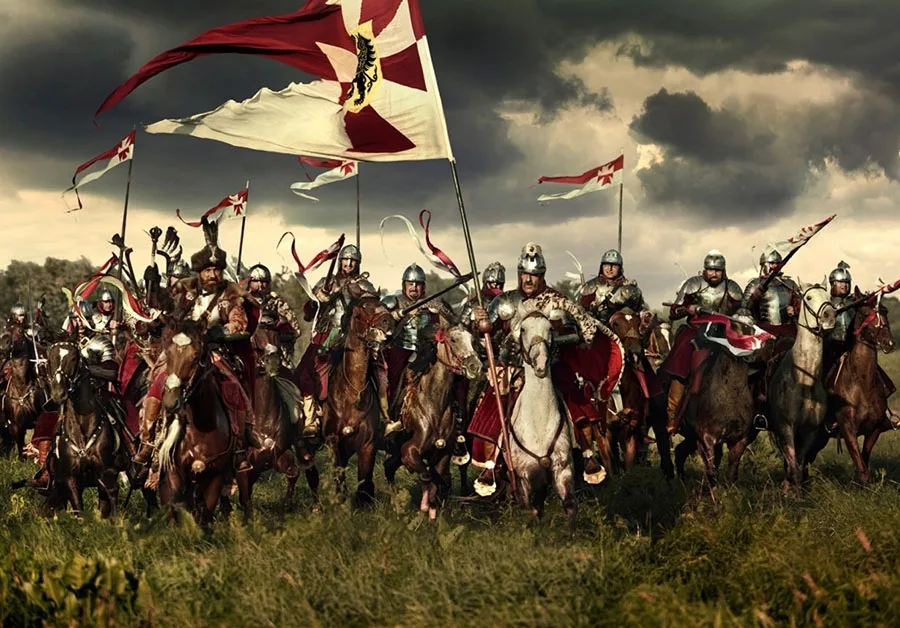
Two spectacular historical re-enactment festivals are held at the walls of Gniew (Mewe) Castle every year.
(Photo from the castle's Facebook page.)
Finally, in 1967, it was decided to restore the castle as a historic building with a museum complex. The first stage of restoration took place in 1968–1975. During this stage the rubble was cleared, and some of the floors and the roofs of two wings were restored.
The second stage of restoration began in 1992. Today the castle is home to a branch of the Archaeological Museum in Gdańsk, as well as historical, equestrian and hunting clubs, a choir studio, a smithy and a school of magic. The castle and its surroundings host traditional re-enactments and tournaments, among them the Battle of Gniew (1625) and "Sobieski's Sword". It also hosts a wide range of events, from academic symposia to weddings.
Gniew (Mewe) Castle online:
Facebook — Zamek-Krzyzacki-w-Gniewie
Gniew Castle website — zamek-gniew.pl
MARIENWERDER
► Poland, Pomeranian Voivodeship, town of Kwidzyn
Coordinates: 53.735730, 18.921871
Condition (2020): The castle and its cellars are in excellent condition. It houses a local history museum.
Marienwerder Castle (Kwidzyn) was founded in 1233 as a timber-and-earth fortification. It stood on an island in the middle of the Vistula, near the old Slavic settlement of Quidin. Soon afterwards, however, the castle was moved to a new site right next to the settlement of Quidin itself. This is how these events are described in the "Chronicle of the Prussian Land" by Peter of Dusburg:
OF THE BRETHREN'S WAR WITH THE POMESANIANS AND OF THE BUILDING OF MARIENWERDER CASTLE
“After … by the grace of God… the bounds of the land of Kulm had been purged of the old leaven of vice and the guile of the heathens, so that God our Saviour might grant us success on the road into the lands of the neighbouring heathens, as some confidently believe, the master and the brethren, having made ready all that is required for the building of castles, crossed unnoticed to the island by Quidin, which now lies almost opposite Marienwerder, and there, in the year of Our Lord 1233, raised a castle upon a hill and named it Marienwerder. But when that noble man and valiant knight from Saxony, the burgrave of Magdeburg, called ‘with the little hand’, came to the castle of Kulm surrounded by many knights and squires, in the course of the year he spent there he went forth with the master and the brethren and moved the aforesaid castle of Marienwerder from the island of Quidin to the place where it now stands, in the Pomesanian district called Reisen, changing its site but not its name.”
In 1234 the settlement by Marienwerder Castle received town rights. Nine years later, in 1243, the question arose of dividing the Prussian land of Pomesania between the Order and the Bishopric of Pomesania.
The point is that the papal bull blessing the Teutonic Knights' conquest of Prussia and granting them the lands they seized provided for a third of those lands to be handed over to the Church, that is, to the local bishop, under his full administrative and economic control. In the remaining two thirds, the bishop retained full ecclesiastical authority. The charter of 29 July 1243 states, among other things: “The second diocese we delimit thus: it is bounded by the Ossa, the Vistula and the Drausensee, and from there upstream along the river Pasaluk, so that Werder, Marienwerder, Zantir and Groß Werder shall belong to this diocese…”. In December 1248 the Dominican friar Ernst became the first Bishop of Pomesania, and representatives of the Order took part in confirming his candidacy. Because of the Prussian uprising, however, he was only able to take up his duties in 1249. The actual division of Pomesania between the Order and the bishopric took place in 1250: the Order's Vice-Landmeister, Ludwig von Queden, divided all the conquered lands into three roughly equal parts and invited the future bishop to choose one of them. The bargaining over the land was evidently quite tense, since the charters confirming the final partition of the territory were not signed until 1255. The bishop chose the western part of Pomesania, with the castles of Marienwerder, Riesenburg (Prabuty) and Schönberg (Szymbark). After Bishop Ernst died in 1258, the second Bishop of Pomesania was Albert, a brother of the Order (whose appointment to the post was, naturally, promoted by the Order's authorities). Then came the second and most powerful Prussian uprising. Bishop Albert was forced to leave his domains. He returned only in 1276 and settled in Riesenburg Castle, not far from Marienwerder. Here his former membership of the Order made itself felt: when the time came in 1284 to establish the bishopric's highest collegial body, the cathedral chapter, it was made up (with the Order's approval) exclusively of brothers of the Teutonic Order. Since the chapter itself was empowered to elect the bishop, from then on all the heads of the Pomesanian bishopric and all the members of its cathedral chapter came from the Teutonic Order. In subsequent agreements the bishop reserved for himself the unconditional right to ecclesiastical and administrative authority (the collection of taxes and dues) in his domains. Matters of defending the lands against external and internal enemies, however, remained within the competence of the Teutonic leadership. Marienwerder Castle was given over as the residence of the Pomesanian cathedral chapter, which was also granted full authority over the town of Marienwerder and the surrounding area. In this way the Bishopric of Pomesania was in effect incorporated into the Teutonic Order. Marienwerder Castle can therefore be called both an episcopal castle (which is perfectly correct) and an Order castle, since it was just as much a stronghold of the Teutonic Order as the “purely Order” castles.
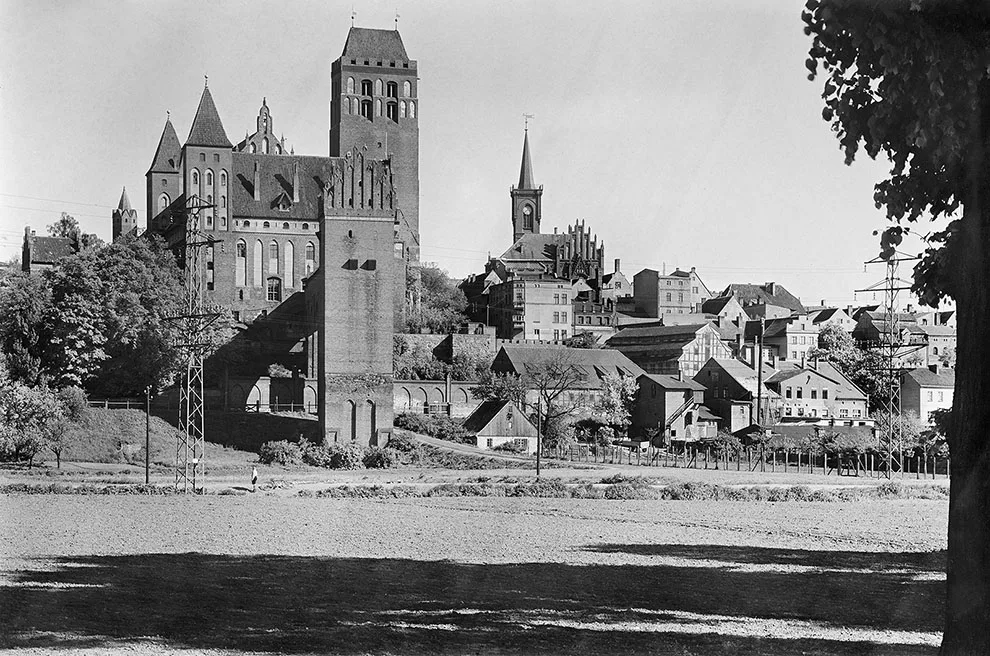
Construction of the stone castle of Marienwerder began in 1285, after it had been confirmed as the residence of the Pomesanian cathedral chapter. The building work lasted more than 50 years and was completed around 1340. The finished castle was a classic square of four wings enclosing a courtyard.
Square towers rose at the corners of the quadrangle. The functions of the buildings largely resembled those of a commandery castle: the east and south wings served mainly administrative purposes and housed the chapter house, the archive, the apartments of the head of the chapter, the treasury, the library, classrooms for the pupils of the cathedral school and an infirmary. The north wing was given over to domestic needs, its rooms occupied by the kitchen and storerooms, as well as the winter refectory and a chapel. The west wing contained the dormitories. Adjoining the castle to the north was an extensive outer bailey (Vorburg). Around 1393 a dansker was added, known today as the “Gdanisko tower”. The dansker projected far beyond the castle walls and was linked to it by a 50-metre brick arched bridge. Polish historians maintain that the Marienwerder dansker was (and still is!) the largest dansker of all the castles of the Teutonic Order and the Kingdom of Poland.
Around 1325, construction of a cathedral began near the castle. It was decided to join the new cathedral and the castle into a single complex, and to this end the castle's south-eastern tower was converted into a bell tower. In 1330 Grand Master Werner von Orseln, murdered by a mentally ill brother of the Order, was buried in the cathedral. There was in fact nothing unusual about this choice of burial place: the burial site of the Order's grand masters in St. Anne's Chapel at Marienburg came into being later, after the death of Master Dietrich von Altenburg in 1341. Moreover, St. Anne's Chapel apparently became the sole last resting place of the Order's leaders only with the death of Heinrich Dusemer (1351), since Master Ludolf König von Wattzau was once again buried in Marienwerder Cathedral in 1345. Looking ahead, I will add that the third grand master to be buried in Marienwerder Cathedral, in 1429, was Heinrich von Plauen. Why the master, removed from power in 1413, found his rest here rather than in Marienburg is still unknown. By the time of his death the disgraced master had been fully rehabilitated and had even gained renown as the “saviour of Marienburg”. Perhaps there were, after all, some reservations about his person; perhaps the very story of his arrest, which cast a shadow on the morals of the Teutonic leadership, played its part. In any case, Marienwerder holds the remains of three grand masters of the Order whose fates were out of the ordinary: one was murdered by a brother of his own Order, the second resigned because of mental illness, and the third was removed from power by a rival contender for the Order's highest office.
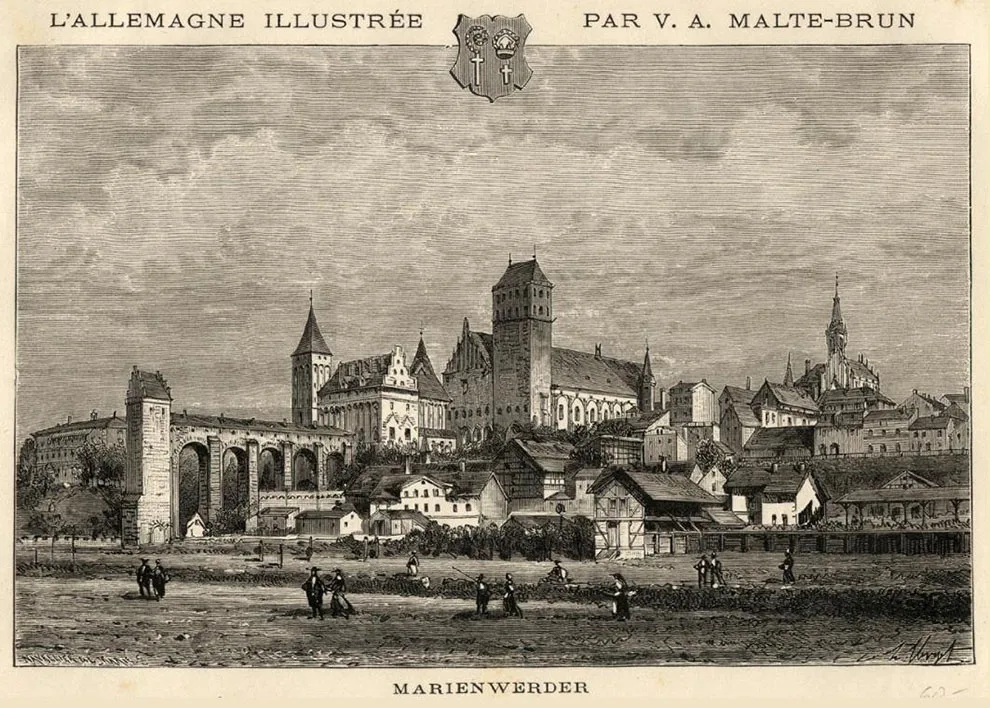
From the time it was built until the Great War (1409–1411) between the Order and Poland and Lithuania, the new castle of Marienwerder took part in no military action whatsoever. After the Battle of Grunwald, however, sieges and assaults became a fairly regular occurrence for it.
In the autumn of 1410, after its unsuccessful siege of the Order's capital, Marienburg, the Polish-Lithuanian army took Marienwerder Castle “on the way back” to Poland. When the war ended, the First Peace of Thorn left Marienwerder in the Order's hands. The sharp deterioration of the economic situation in the Order's state that followed, together with the discontent of the secular nobility and the burghers with the Order's rule, led to the creation of the Prussian Confederation of towns, which was founded in Marienwerder on 14 March 1440. Naturally, the town of Marienwerder itself joined the Confederation.
During the Thirteen Years' War, which broke out in 1454, Marienwerder Castle was threatened with attack more than once; the fiercest confrontation was the siege of the castle in 1460 by the Polish voivode Andrzej Puszkarz. The next time a Polish army appeared beneath the walls of Marienwerder was in 1478, during the so-called War of the Priests (1478–1479). This time the Poles took the town, but the castle, where the townspeople had taken refuge, held out. The next war in the chronology, the Horsemen's War (1519–1521), did not pass Marienwerder by either. In March 1520 a Polish army besieged and captured it. These military ordeals inevitably took their toll on the castle. At least two major repairs are known to have taken place, in the 1480s and the 1520s, during which the corner towers damaged in the assaults were dismantled.
After the signing of the Treaty of Kraków (1525) between the Teutonic Order and the Polish Crown, the secularisation of the Order and the creation of the secular Lutheran Duchy of Prussia in that same year of 1525, the castle became the residence of the now Protestant Bishop of Pomesania.
The first such bishop and master of Marienwerder Castle, from 1530, was a truly remarkable man, Paul Speratus, one of Martin Luther's earliest companions, a court counsellor to Duke Albrecht, and the author of Protestant writings and hymns. In the second half of the 16th century Marienwerder Castle lost all military significance and became the administrative centre of an Amt. Its rooms were now filled with administrators, tax collectors and judges. Like many other castles, Marienwerder could be used for official receptions, since it had spacious halls and its very appearance lent itself to affairs of state. Thus in 1709 Tsar Peter I stayed at Marienwerder Castle during one of his visits to Prussia. Under Frederick II, after the annexation of West Prussia, the province's supreme court (together with a prison) was established in Marienwerder. The castle underwent a major reconfiguration for this purpose. However, the building apparently suited the provincial judges very much, which is why by the end of the 18th century a new building was erected for them, using material from the dismantled south wing.
It is quite possible that Marienwerder Castle, like a number of others, would have been completely dismantled for building materials, but by the middle of the 19th century interest in the historical heritage began to grow in Germany. The castles of the Teutonic Order were surveyed at that time, and drawings and plans of them were made. In the case of Marienwerder Castle, King Frederick William IV ordered restoration work to be carried out so that the castle would regain its former medieval appearance.
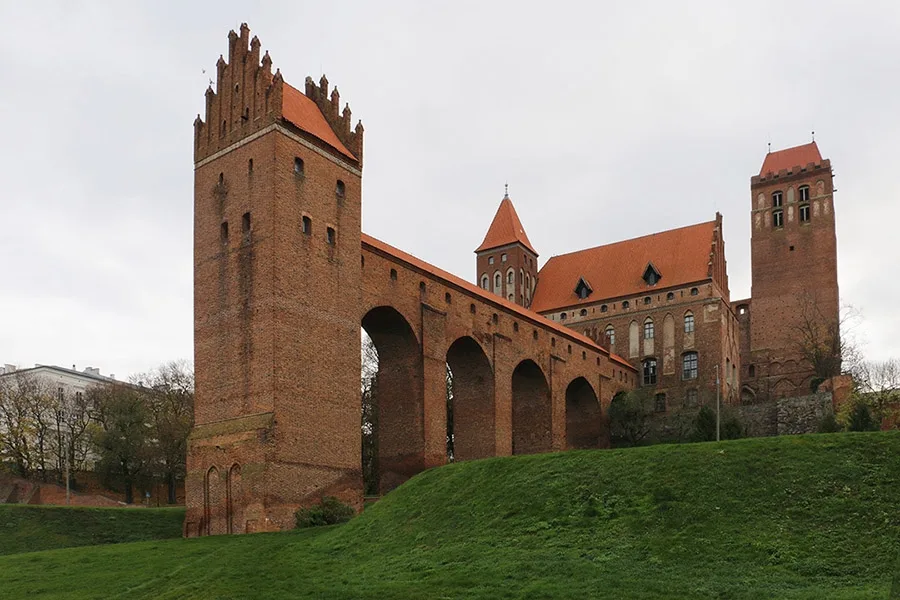
After the reconstruction, the castle's rooms were used for state and public purposes: soldiers were quartered here, pupils of a vocational school were taught here, and various officials held their sessions here. The Nazis also made use of the surviving medieval buildings: in 1936 a local branch of the Hitler Youth opened here.
After the war and the division of Prussia between the USSR and Poland, Marienwerder became the Polish town of Kwidzyn. As early as 1949 it was decided to convert the castle, whose walls had suffered almost no damage in the fighting, into a museum. Today it houses a rich collection of objects telling the story of the Teutonic Order and the Kingdom of Poland. The danzker of Marienwerder Castle is undoubtedly unique. In most other castles that have survived to our day, these medieval "defensive latrines" were demolished as early as the turn of the Middle Ages and the early modern period, as structures that had lost their original purpose, and so they can most often be seen only in pictures.
Marienwerder Castle (Kwidzyn) online:
Facebook — muzeumkwidzyn
Website of Marienwerder Castle (Kwidzyn) — zamek.kwidzyn.pl
MARIENBURG
► Poland, Pomeranian Voivodeship, town of Malbork (Malbork)
Coordinates: 54.039985, 19.028322
Condition of the site (2020): The castle is in excellent condition and is one of the main tourist attractions of the Pomeranian Voivodeship. Inside is a museum complex with a breathtaking permanent exhibition and numerous temporary ones.
Marienburg (Malbork) was founded as a commandery castle in 1274, after the suppression of the Second Prussian Uprising. The construction of yet another castle in the Vistula valley, on its tributary the Nogat, was clearly intended to control this waterway and to administer the fertile, and therefore profitable, lands of the surrounding area. Initially, a brick four-winged building with corner turrets, typical of a commandery castle, was erected.
Had some noble feudal lord from France or Northern Italy visited the future capital of the Order at that time, he would have noticed that Marienburg Castle was fairly large but insufficiently fortified by Western European standards. The castle's towers were too cramped to accommodate a significant number of defenders, and their design did not allow full control of the ground beneath the walls. The wings had massive, tall walls, but lacked the machicolations then coming into fashion, overhanging openings that allowed defenders, without risk of being hit by an enemy arrow, to drop stones on the attackers' heads or pour boiling pitch or sewage on them. However, the castle's komtur would have answered such a reproach by saying that everything had been built in the most rational way. Additional defensive features required first-class architects, which would have made construction considerably more expensive. Moreover, even among the neighbouring Poles the art of properly storming a castle, with the building of counter-fortifications, the erection of siege towers and the use of various throwing engines to batter the walls, was poorly developed, while among the Lithuanians and Prussians it was entirely absent. Therefore even a small garrison in a stone castle whose walls could not be set on fire could, with adequate provisions and a working well, hold out against the pagans for a very long time. And here spacious storerooms mattered more than the number of towers a castle had.
If the garrison numbered at least a dozen or two knights and a hundred foot soldiers (Knechte), the brethren of the Order preferred to settle matters with an inexperienced enemy in open battle on the ground in front of the castle, since the advantage of heavy armour and combat training was even greater than the protection offered by brick walls.
In the 1280s the castle was surrounded by a defensive wall. At the same time the convent was moved into the castle, and the convent cemetery was laid out within the defensive wall. As early as 1276 a settlement had arisen near the castle, and in 1278 it was granted town rights. Before the end of the 13th century a danzker and a large defensive tower were added to the square of the four wings. A Vorburg (outer bailey) was built onto the castle on its north-eastern side. On the whole, until 1309 Marienburg developed as a typical commandery castle. After Danzig was captured in 1308, and the whole of Eastern Pomerania was subsequently annexed under the Treaty of Soldin, it became clear to Master Siegfried von Feuchtwangen that the Order was faring well only in Prussia, all the more so since the Landmeister of Prussia, Heinrich von Plotzke, a figure of great authority within the Order, was urging him to focus more closely on Prussian affairs. And so in 1309 the Order's capital and the residence of the Grand Master moved from Venice to Marienburg.
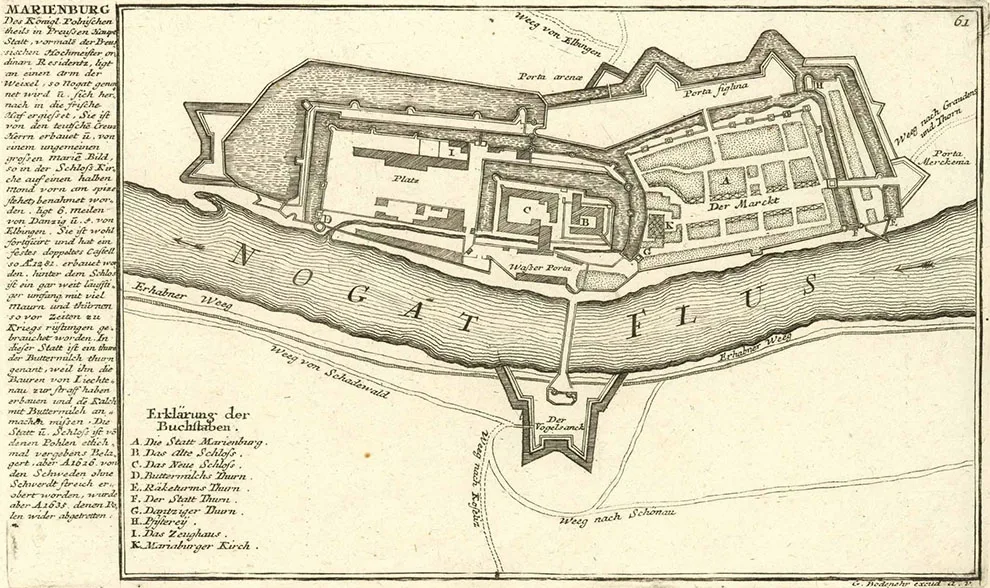
The choice of Marienburg as the Order's capital was justified, since the castle lay, on the one hand, beyond the reach of the Lithuanian pagans who raided the Order's lands and, on the other, in the busiest part of the state. Marienburg was officially proclaimed the capital of the Order on 14 September 1309.
Naturally, its status as the capital was bound to affect the castle itself. The need to house a considerable number of officials, servants and soldiers, and to receive official delegations and embassies, meant that the rebuilding of Marienburg began in that very year, 1309. By the 1330s the castle had acquired its three-part structure: the High Castle, made up of the reconstructed oldest buildings; the Middle Castle, which occupied the site of the former outer bailey; and the Low Castle, which took over from the old outer bailey as the area for workshops and storehouses. In the High Castle the Chapel of St. Anne was built, the future burial place of almost all the grand masters. Yet the tradition of burying the Order's leaders there did not take hold at once. Siegfried von Feuchtwangen, who had himself initiated the transfer of the capital, was buried in 1311 at Kulmsee (Chełmża). His successor, Karl von Trier, was laid to rest in his native Trier in 1324. Werner von Orseln and Luther von Braunschweig found their rest in the cathedrals of Marienwerder (1330) and Königsberg (1335). Only in 1341 was Dietrich von Altenburg buried in the Chapel of St. Anne. And burial at Marienburg became a tradition only ten years later, with the funeral of Heinrich Dusemer, since his predecessor, Ludolf König, had found his final resting place in Marienwerder.
Life at Marienburg centred on the Middle Castle, which housed the master's residence itself, also known as the Grand Master's Palace. This part of Marienburg was built mostly during the rule of Heinrich Dusemer (1345–1351), who spared no expense to give Marienburg castle buildings of grand scale and lavish interiors. The Great Refectory of the Middle Castle could seat up to 400 people. The walls of the Chapter Hall were painted with a fabulously expensive green pigment, which in the Middle Ages was made from molluscs. All in all, the sheer mass of the complex and its decoration were meant to underline the might of the Order. And, tellingly, Marienburg Castle grew in grandeur together with the grandeur of the Teutonic Order itself, and lost it together with the Order as well.
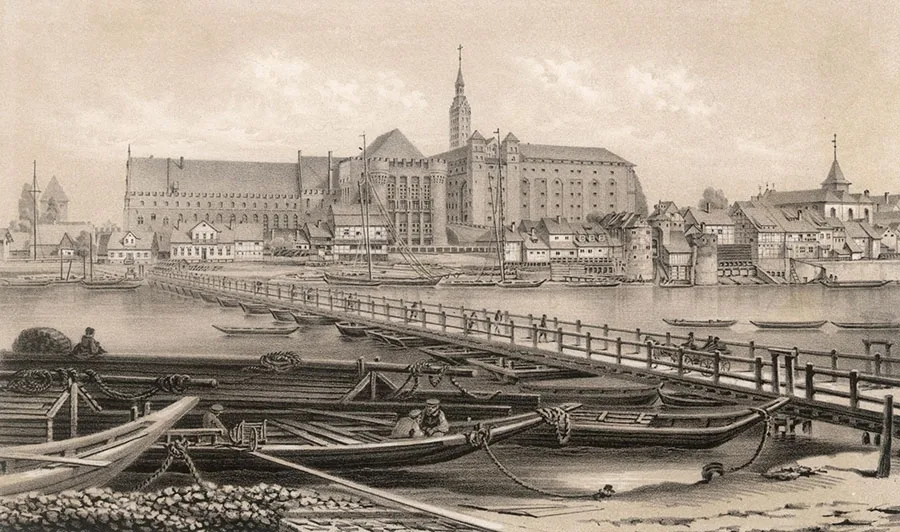
Curiously, from foggy Albion to the shores of the Baltic, medieval castles were laid out on one and the same principle: attackers had to storm obstacle after obstacle and take one line of defence after another. Thus an armed force that dared to capture Marienburg Castle from the west, its least protected side, would have had to get through some fifteen fortified gates and four drawbridges and break through three portcullises.
Something else is interesting, too: in the centuries-long history of assaults on thousands of castles across Europe, the situation in which the attackers really did take obstacle after obstacle and, in the end, besieged the remnants of the garrison in the citadel — the donjon or Bergfried — occurred only a handful of times. So was this a miscalculation on the part of those who devised the castle defence system? Hardly. Most likely it was a psychological weapon: after all, those same Polish envoys were granted audiences with the grand master on many occasions. Each time they were led along a tortuous route, with bridges and portcullises lowered and raised, locks opened on iron-clad doors, under the eyes of guards in numerous towers and turrets. And on their return from Marienburg they would report to the king that this castle was a veritable brick trap that simply could not be taken by storm. Oh, and by the way: in 1361 all these many obstacles failed to keep the Lithuanian prince Kęstutis in the castle dungeon. For a single traitor in a castle's garrison can undo all the ingenuity of its builders.
By the Great War of 1409–1411 the castle had been completed. After the Order's defeat at the Battle of Grunwald, the Polish-Lithuanian army decided to end the war at a single stroke and marched on the Order's capital. By every reckoning, taking Marienburg was no longer an impossible task. Left in Marienburg was a small garrison of Teutonic knights and Hungarian noblemen, some 50 knights in all, who, on receiving news of the utter rout of the Order's army and the death of Grand Master Ulrich von Jungingen, lost heart and practically ceased to be a fighting force. But the Polish king Władysław deigned, as was the custom of victors, to spend three days on the battlefield. Then came the burial of the fallen Poles and Teutonic knights. Only on 18 July 1410 did the royal army approach Marienburg. But by then a force led by Heinrich von Plauen, the komtur of Schwetz, had already arrived there: barely had he received word of the Order's defeat than he guessed the enemy's plans and set out with his troops to defend Marienburg. He was in the castle as early as 18 July, and his first order was to burn the town so that the Poles and Lithuanians could not use it for quarters. Władysław, meanwhile, was in no hurry, occupying minor castles along the way and receiving envoys from castles and towns that wished to surrender voluntarily to the Polish crown. Only on 25 July did Władysław's army approach Marienburg. The next day a first attempt to storm it was made, without success. After that the castle came under artillery fire. Even the primitive artillery of the early 15th century showed that brick fortifications could not withstand its fire for long. Because the Poles had few guns, their stone cannonballs did not do fatal damage to the castle buildings, but they did strike fear into the defenders. One of the stone balls, which damaged the Summer Refectory of the Middle Castle, was later set into its wall in memory of those events. The Order's artillery, however, did not stay silent either, firing stone balls at the Polish army with varying success. The siege dragged on. Through a parish priest, the Teutonic knights managed to smuggle the Order's treasury out of the castle and use the money to hire mercenary troops.
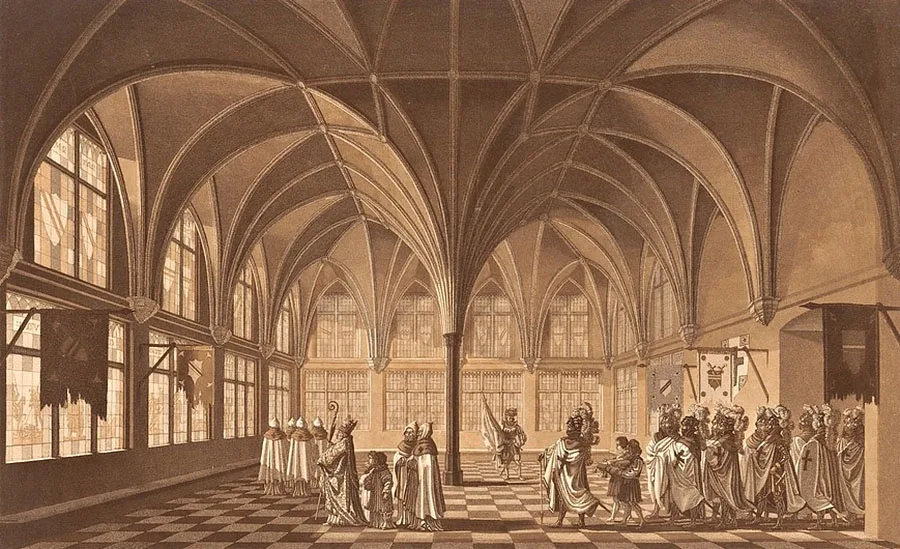 The interiors of Marienburg are simply breathtaking! As early as the 15th century it already had underfloor heating! And what ceilings!
On 9 September 1410 the Lithuanians left the combined besieging army. Then, no longer believing in success, the Polish princes began to depart as well. The king had no choice but to lift the siege and begin the return to Poland. Thus Heinrich von Plauen earned the title of “saviour of Marienburg”, while Marienburg itself could be regarded as the saviour of the Order, because had it fallen, the outcome of the Great War would have been quite different.
And that outcome, as has often been noted, was tolerable enough, given that militarily the Order had been crushed and further hostilities held out no promise of success. In territorial terms the Order lost only its very latest acquisition, Samogitia, and even that only for the lifetimes of King Władysław of Poland and Grand Duke Alexander of Lithuania. Meanwhile, the indemnity of 100,000 Prague groschen payable to the king seemed to the Order's leaders an altogether secondary clause of the peace treaty. Yet it was precisely this money that in the end achieved what the entire Polish-Lithuanian army could not: it destroyed the Order as an independent state and shattered its integrity, both territorial and social.
The period between the Great War and the Thirteen Years' War (1411–1454) was, for the Order and its capital Marienburg, a succession of political, financial and civil crises. When the time came to pay the first third of the indemnity, it turned out that the Order had no money: the treasury, the towns and the peasantry had been ruined by the war, and on top of the indemnity the Order was also burdened with domestic and foreign loans. Master Heinrich von Plauen did what European rulers had done for centuries: to pay off the debt he introduced a special tax that affected the entire population of the state, but above all the towns and the knights of the Order themselves. In response, predictably, he faced opposition both within the Order and in the towns. Danzig, the Order's most important source of revenue, rose in revolt; Rehden then joined the rebellion, and the anti-Teutonic Lizard Union stepped up its activities. The master had a single answer to all this: a military expedition, a trial and the execution of the ringleaders. But after the komtur of Rehden was convicted, the master lost the support of the Order's leadership as well. Plauen then took an unprecedented step: he began holding councils with townspeople and the lesser nobility, and in 1412 he established the “Council of the Lands”, the first attempt to bring representatives of the towns into the system of state government.
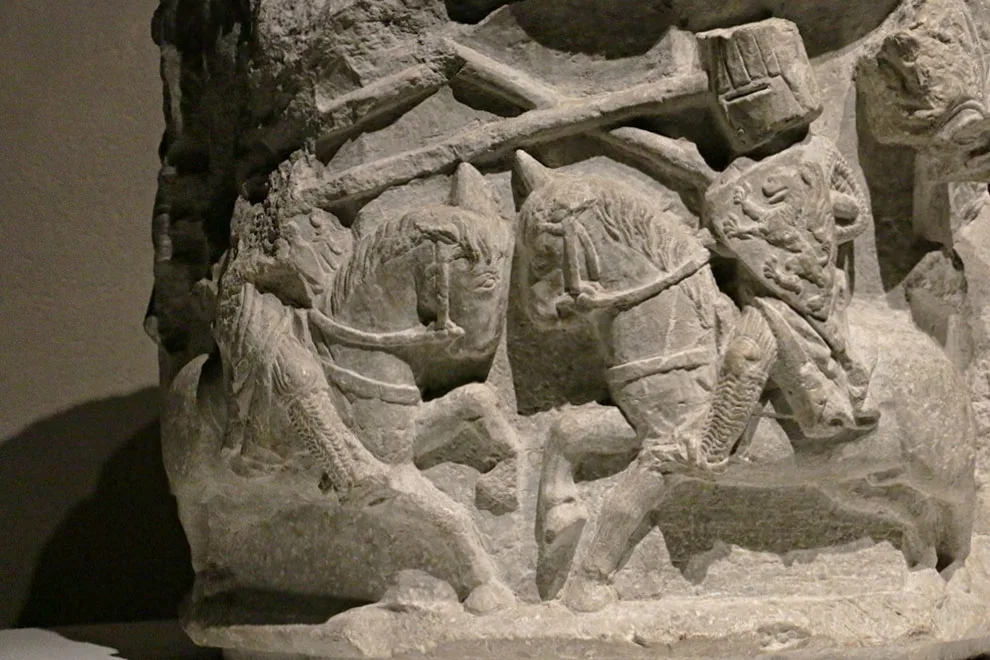 The columns in the courtyard of Marienburg's High Castle are adorned with numerous high reliefs.
Yet this "democratic step" in fact undermined the Grand Master's authority: now everyone was dissatisfied with Heinrich von Plauen – the brethren of the Order, the Livonian Landmeister, the urban patriciate and the clergy. The Polish king added fuel to the fire by sending letters to the Pope and the Emperor proposing that the Order be abolished altogether, since it no longer had any tasks left in the Baltic.
The Grand Master was bound to respond to such a provocation and launched premature military action against Poland. Being ill, he himself remained in Marienburg, which did nothing to raise his standing in military circles. In the end, the military leadership turned the army back, and the chapter convened at the Grand Master's own initiative rose against him, accused Plauen of treason and unforgivable blunders and ultimately forced him to abdicate "voluntarily". Von Plauen was sent to prison in Danzig, and the leader of the conspirators, Michael Küchmeister von Sternberg, became Grand Master. Thus Marienburg witnessed the first and last coup d'état in the history of the capital. The story of Heinrich von Plauen's subsequent burial remains unclear to this day. He was fully rehabilitated shortly before his death and, according to the Order's chronicles, laid to rest in St. Anne's Chapel in Marienburg. This fact appears in every biography of Heinrich von Plauen. However, when the crypt was opened, von Plauen's grave turned out to be empty. Then, in 2007, Polish archaeologists opened a crypt in the cathedral of Kwidzyn (Marienwerder) containing the burials of three men from the time of the Order. In one of them, anthropologists identified the 27th Grand Master of the Teutonic Order. His burial in Marienwerder is now considered an established fact.
Internal strife within the Order, high taxes and constant Polish pressure led to the Thirteen Years' War (1454–1466). On one side fought the Order and the towns loyal to it, on the other the Prussian Confederation – towns that wished to break free of the Order's rule – actively supported by Poland. Some towns even switched sides several times, depending on whose troops happened to be at their walls. The staunchest opponents of the Order and the backbone of the Prussian Confederation were Danzig (Gdańsk) and Elbing (Elbląg).
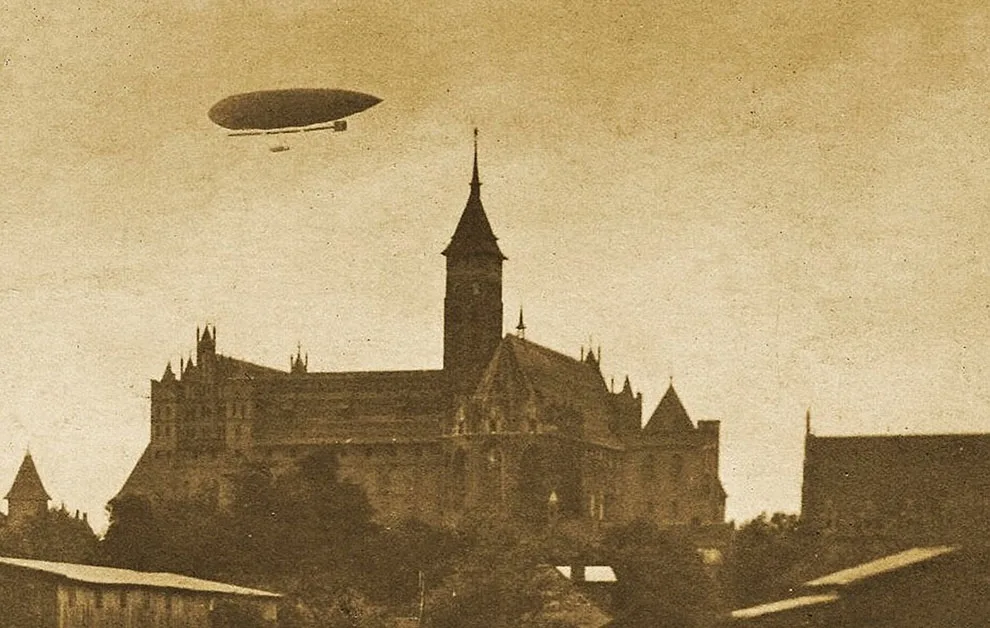 A zeppelin over Marienburg. Once upon a time in Prussia, they flew between cities the way aeroplanes do today.
From a modern statehood perspective, the actions of the Prussian Confederation, aimed at breaking up the Teutonic state and passing under the Polish crown, look like outright betrayal. But at the time this was quite normal, since vassal allegiance meant far more than nationality. Besides, the population of the Prussian towns was a colourful mix that included Poles, Lithuanians and ethnic Prussians.
Whereas the three Grand Masters who succeeded Heinrich von Plauen – Michael Küchmeister (1414–1422), Paul von Rusdorf (1422–1441) and Konrad von Erlichshausen (1441–1449) – pursued cooperation with the towns and later with representatives of the Prussian Confederation, the next Grand Master, Ludwig von Erlichshausen, insisted on the Order's monopoly on power and dealt with the municipalities solely by dictate. In response, representatives of the Prussian Confederation sent a letter to the Polish king Casimir IV asking him to take them under his wing. On 6 March 1454, the Polish side issued an act of incorporation under which the towns of the Prussian Confederation and the territories belonging to them became part of Poland. The rebellious townspeople surrounded the Order's castles nearest to their towns, demanding that the knights leave them and surrender them to the insurgents. The Order responded by opening hostilities at a time when it was completely unprepared for them. From the very outset, the Order suffered defeat after defeat. Mercenary troops were needed, but there was not enough money to pay for them. Marienburg was besieged by the Poles as early as 1554. By then the castle had acquired outer earthwork fortifications housing artillery. This reflected the spirit of the age: in an era when artillery and hand-held firearms were developing, Europe's military engineers were still not ready to abandon the old castles, so they surrounded them with outer earthen ramparts with redoubts, basteis and bastions, which withstood the besiegers' firepower. The siege of Marienburg also involved gunpowder weapons.
Gradually the Order began to turn the tide on the battlefields. Now, however, the main problem was the empty treasury. The Order began selling off its possessions to raise at least some funds for mercenaries. By 1456 matters had gone so far that the Grand Master pledged the capital itself – Marienburg Castle – to Bohemian mercenaries against the debt he owed them, and left for Königsberg. In 1457, when Polish troops approached Marienburg, the mercenaries simply sold it, which they were formally fully entitled to do. In 1466 the Order was utterly exhausted and sued for peace. The Polish side, and especially the towns involved in the war, had also been badly ruined by the fighting and military expenditure. That same year the Second Peace of Thorn was signed, under which the Order lost its sovereignty and most of its territories. The former capital of the Order, Marienburg, also went to Poland.
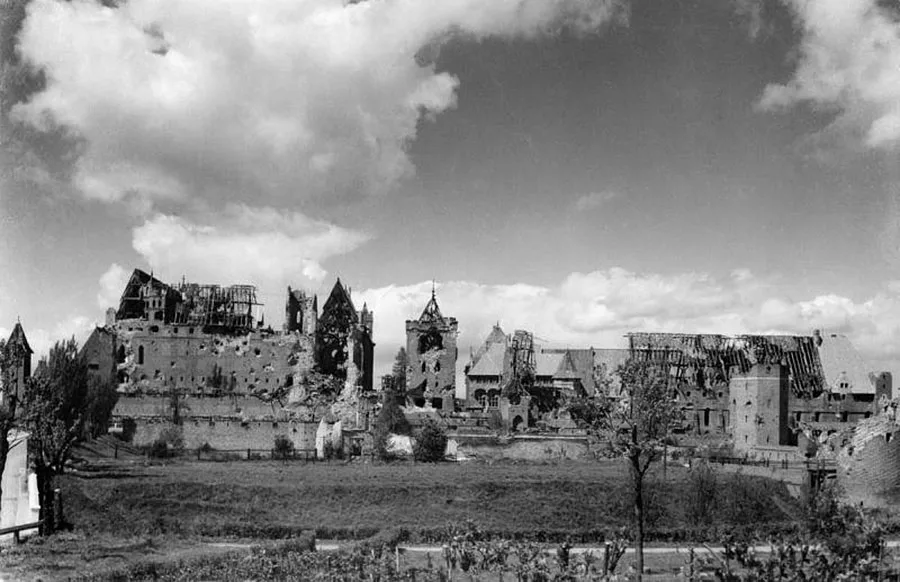 In 1945, Marienburg passed to Poland in an even worse state than Königsberg passed to Kaliningrad.
After passing into Polish hands, Marienburg Castle, now called Malbork, lost its former grandeur. The castle itself remained unchanged, but its status was considerably diminished. It became merely one of many royal residences, a venue for meetings of delegations and receptions of embassies, for balls and festivities. The castle grounds also housed a workshop, an arsenal and a sizeable garrison.
In 1618 the church in Malbork was handed over to the Jesuits. In 1626 and 1656 the castle was captured by the Swedes. It was here, on 29 June 1656, that Frederick William, Elector of Brandenburg and Duke in Prussia (the "Great Elector"), in the course of settling the question of Prussian sovereignty, signed the Treaty of Marienburg, under which the duchy became a fief of the Swedish king (a temporary arrangement, as Frederick William intended). During the long period of the Polish-Swedish wars, Malbork found itself in the war zone several times but suffered no damage.
After the Partition of Poland in 1772, Marienburg Castle faced a new danger: it came to be used extensively for economic purposes, with some of its rooms rebuilt and others dismantled for bricks. Its destruction was officially prohibited only in 1804, after Max von Schenkendorf, a student in Königsberg, had appealed to the public through the press the year before, demanding that the medieval monument be preserved. Prussia's wars with Napoleon disrupted the plans to save Marienburg. But once they were over, restoration of the castle began in 1816, funded mainly by donations. The restoration was completed in 1850, and the castle regained its former beauty. In 1872 it even hosted the celebrations of the centenary of West Prussia's incorporation into Germany, attended by Kaiser Wilhelm I. Reconstruction of the castle continued after these festivities. The work was directed by Conrad Steinbrecht, an expert on the castle's history.
In Nazi Germany, attitudes toward the Teutonic Order and the buildings it left behind were ambivalent. On the one hand, the ideologues of German Nazism drew direct historical parallels between the Third Reich and the State of the Teutonic Order, used the Order’s symbols and mythologised its history. On the other hand, they kept their distance from the Order, mindful of its rather inglorious end and its vassal dependence on Poland. Moreover, the Nazis believed that it was far more useful for young people to study present-day realities than to dig into an ambiguous past. Nevertheless, Nazi organisations made quite active use of the surviving buildings of the Order, and with an ideological subtext. The Grand Master’s Palace in Marienburg, for instance, repeatedly hosted members of the Nazi Party for various ceremonies, while the castle grounds served as a summer camp for the local branches of the Hitler Youth and the League of German Girls. Such use of historic buildings was by no means rare in other parts of the Reich either.
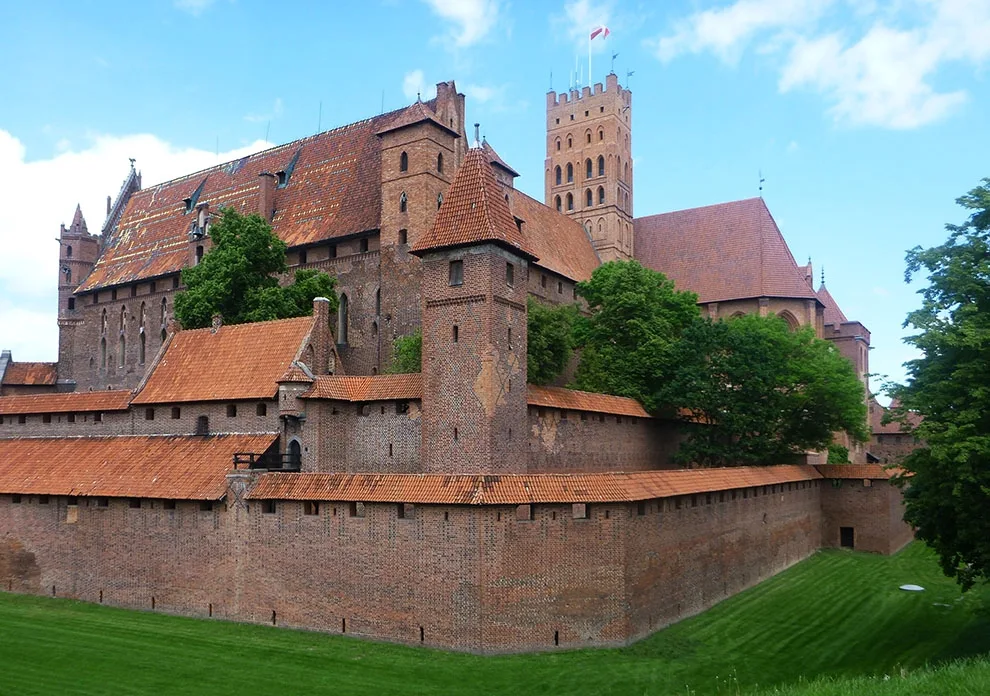 The rebuilt Marienburg is the largest brick castle in the world.
As units of the Red Army approached Marienburg, the Nazis declared the castle a fortress. It was a decision with plenty of propaganda value but little military sense. Unlike Königsberg, Marienburg was first bombed by Soviet long-range aviation, which should be described as tactical rather than strategic, as in the case of the British. This was followed by artillery shelling and an assault, again supported by aircraft.
As a result, by the end of the fighting for Marienburg the castle was a heap of ruins in which the former castle buildings could barely be made out. Yet as early as the late 1940s, the Polish side cleared the site of mines, removed some of the rubble and shut the castle off to scavengers hunting for building materials. In the late 1950s, a public committee for the restoration of the castle was set up in Malbork, made up of local historians, cultural figures and local history enthusiasts. In 1961, the Castle Museum was founded. The reconstruction of the castle went on for many years and is still not finished. In 1997, Malbork Castle was inscribed on the UNESCO World Heritage List. Experts noted the high degree of authenticity of the restored castle buildings. In 2014–2016, restorers completed the restoration of the castle cathedral, or, as it is now called, the castle Church of the Blessed Virgin Mary. The reconstruction of the castle complex is not yet fully complete. But even in its present state, the Marienburg Castle museum complex is a site astonishing for the sheer scale of its buildings and the richness of its exhibitions, attracting hundreds of thousands of tourists from many countries every year.
Marienburg (Malbork) Castle online:
Facebook — Muzeum.Zamkowe.w.Malborku
Instagram — @malborkcastlemuseum
Marienburg (Malbork) Castle website — zamek.malbork.pl
THORN
► Poland, Kuyavian-Pomeranian Voivodeship, city of Torun (Toruń)
Coordinates: 53.008953, 18.610752
Condition of the site (2020): Ruins in the Old Town near the bank of the Vistula.
Thorn (Toruń) was the first castle of the Teutonic Order in the Baltic region. It was built in 1230–1231 on the bridgehead granted to the Order, the Chełmno Land, or, as the Teutonic Knights themselves called it, the Kulmerland. It was named after the castle of Toron in Palestine. When first two and then another five brethren of the Order arrived in the Kulmerland on reconnaissance, they built, according to the legend recorded in the “Chronicle of the Prussian Land” by Peter of Dusburg, a kind of lookout post in an oak tree, which they surrounded with a palisade. There is every reason to believe that there never was any oak tree, and that the Order’s first fortified dwelling was in fact built of oak logs. A settlement immediately grew up next to the castle, and as early as 1233 it was granted town rights. However, in 1236, because of the river’s constant flooding, the castle was moved some seven or eight kilometres to the east, the new one being built on the site of an old Slavic stronghold whose ramparts had survived. The settlement, which already had town rights, moved together with the castle. Thorn and Kulm became the first towns with which the Order concluded an agreement setting out the terms of their existence on the Order’s lands. In drafting the agreement with the townspeople, Magdeburg town law was used, adapted to local conditions; it became known as Kulm law. This law was also applied in agreements with other towns in the State of the Teutonic Order, outlived the Order itself and was replaced by a new municipal code only in the 17th century. Kulm law was in force not only on the lands of the Order but also in Poland, including in towns on the territory of present-day Ukraine and Belarus.
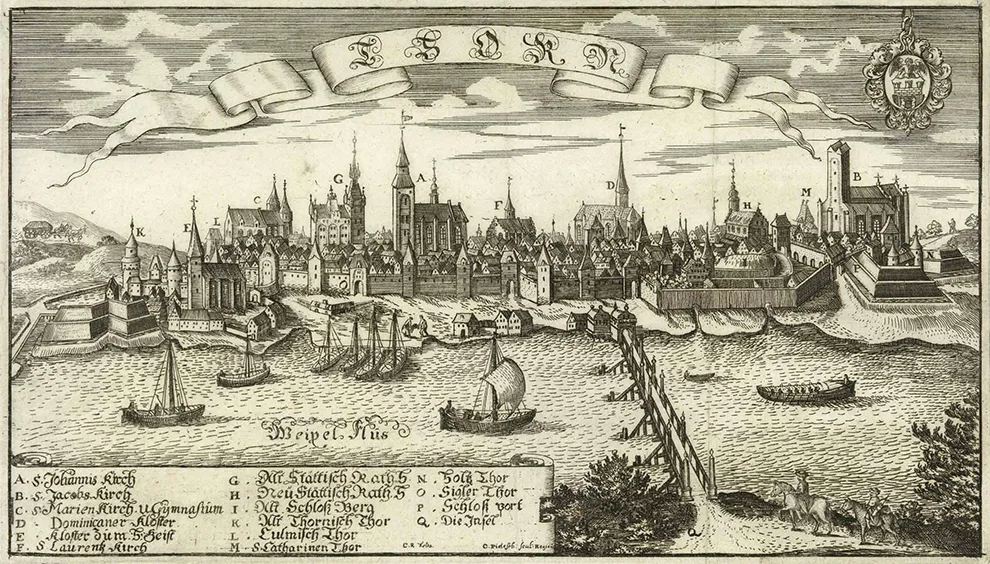
Even before the outbreak of the Prussian uprising in 1260, the castle began to be rebuilt in stone. The construction took several decades. The result was a castle of a shape somewhat unusual for the Teutonic Knights: a horseshoe whose ends were closed off by a rectangular wing.
The castle had two towers built into its walls, a tall main tower inside the castle and a dansker tower projecting over the moat, which also served a defensive purpose in wartime. Around this complex, known as the Hochburg, or upper castle, a lower castle was built, consisting of several lines of defensive walls (from two to four) with gates and towers, as well as farm and auxiliary buildings. In size and in the number of its lines of defence, Thorn surpassed Balga, for example, yet the chronicles note that in the 13th–14th centuries its arsenal and garrison were smaller than those of the northern castles. At that time Thorn lay deep in the rear and was therefore out of reach of Prussian uprisings and Lithuanian incursions. At the same time, Thorn Castle and the town beside it were the most important economic centre of the Teutonic state. The castle owned several mills, a brewery and a smithy. On the eve of the Great War, the castle estate had a grain reserve of 550 tonnes, 500 horses, 400 cows and oxen, 3,000 sheep and goats and 600 pigs. The Order’s records also mention 5,000 wheels of cheese, four barrels of butter, 16 barrels of salted lard and many other provisions. In addition, Thorn periodically became a venue for negotiations and the signing of documents: in 1329 a treaty of alliance between the Order and Bohemia was concluded here, as were the two Peaces of Thorn that sealed the Order’s fate — the First (1411) and the Second (1466).
But at the beginning of the 15th century everything changed radically. The worsening of relations with Poland and the union of Poland and Lithuania meant that the flashpoint now lay in the south of the Order’s state, and Thorn found itself within the zone of likely hostilities. All the more so because the Chełmno Land itself had become a bone of contention between the Teutonic Knights and the Poles: the Poles disputed the lawfulness of its acquisition by the Order and questioned both the authenticity of the charter transferring the Kulmerland to the Order and the legitimacy of the provisions of the Treaty of Kalisz (1343). However, the outbreak of war did not bring the expected siege for Thorn and the other border castles, since both armies considered themselves worthy of an unconditional victory and therefore sought a decisive battle rather than frittering away their strength on attacking castles. Such a decisive battle might have taken place near Thorn, where the Polish-Lithuanian army crossed the border for the first time since the truce of 1409. The Teutonic Knights had prepared field fortifications in advance on the plain near Thorn, but the Poles judged the position unfavourable, then declined battle and withdrew into Poland, only to reappear on the Order’s territory considerably further east of Thorn.
After the Order's defeat at the Battle of Grunwald, the defence of the Order's capital, Marienburg, began. While the main fighting of that period was unfolding there, another Polish detachment approached Thorn. The castle's small garrison held out for two weeks but was forced to surrender to the superior enemy forces. After its capture, King Jagiełło granted Thorn to the Polish military commander and official Wincenty Granowski, but that same year Granowski was poisoned by agents of the Order. It is worth mentioning that Wincenty Granowski's wife, Elizabeth (Elżbieta) Pilecka, was the heiress to her father's enormous fortune, and after Granowski's death she went on to marry none other than King Jagiełło himself, who became her third lawful husband (another of Elżbieta's marriages had been declared unlawful and annulled). She did not remain queen for long, however: three years later she died, presumably of tuberculosis.
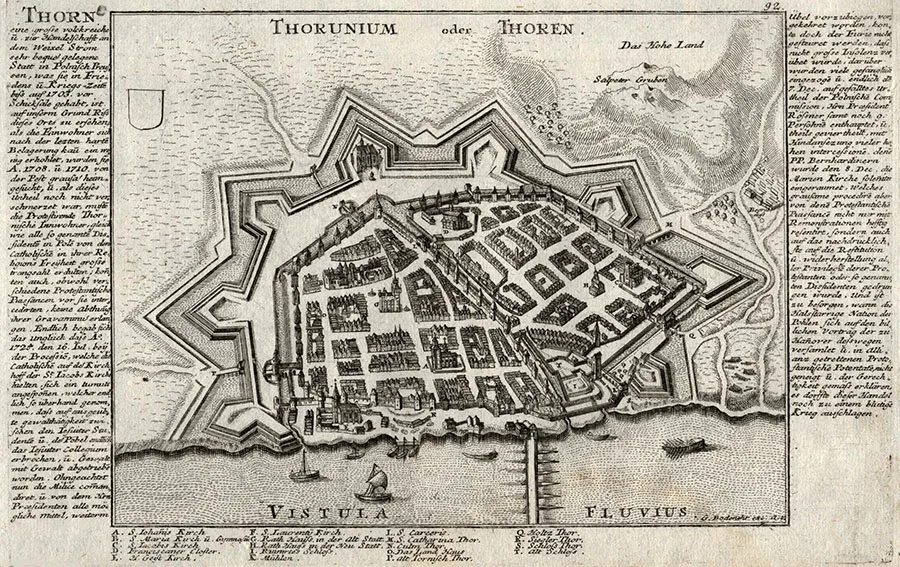
In 1411 the First Peace of Thorn, which ended the Great War, was signed in Thorn. Under its terms, Thorn Castle itself remained with the Order, and Eberhard Hallenfeld was appointed the new Komtur.
The castle had been badly damaged during the war, yet over the following 40 years the work to restore it was never completed owing to an acute shortage of funds. The castle arsenal, however, was modernised to some extent: as early as 1413 it comprised 19 pieces of artillery and hand-held firearms. Twice, in 1414 and 1422, Thorn Castle was besieged by Polish troops, since the First Peace of Thorn had not resolved all the contradictions between the Order and Poland, which led to two wars of low intensity. Both times the castle held. Between these events, moreover, there was a telling episode: in 1420 a fire broke out in the castle. The Komtur appealed to the townspeople for help, but they merely laughed at the knights' attempts to put out the flames.
Its proximity to the Polish border and the considerable Polish population of the town meant that Thorn became the stronghold and instigator of the towns' struggle against the Order. To begin with, in 1440 Thorn, together with 20 other Prussian towns, was among the founders of the Prussian League of towns. The Order tried to have this league declared illegitimate; at first it lost the dispute, but later, with the backing of the German emperor, it succeeded in having the Prussian League declared legally unlawful. By then, however, neither the towns themselves nor the course of history cared about such a ruling. The Order had ceased to be the undisputed master of its own land, and the development of European society, economy and warfare meant that the Order as an organisation was becoming superfluous there. Europe was undergoing an intensive process of forming fully fledged nations, at the core of which stood monarchs vested with absolute power. But since Prussia had no such monarch, the townspeople considered themselves free to swear allegiance to any overlord, be it the Polish king, the Order or anyone else. Nor did they see any betrayal of national interests in this, because such interests simply did not exist. From a military point of view, the Order, as a knightly organisation, had become an outdated structure. Now a hundred townsmen with clumsy arquebuses could, with a single volley, dispatch to a better world a dozen or two well-armed knights who had spent years honing their martial skills. Not long before, such losses would have marked a major battle and an irreparable loss for the brotherhood of the Order; now they could happen within a few minutes in the opening phase of a battle. The Order itself, too, increasingly resorted to the services of mercenaries, as this was both safer and more effective. Thus the role of the Order as head of state and as its military force was rapidly waning.
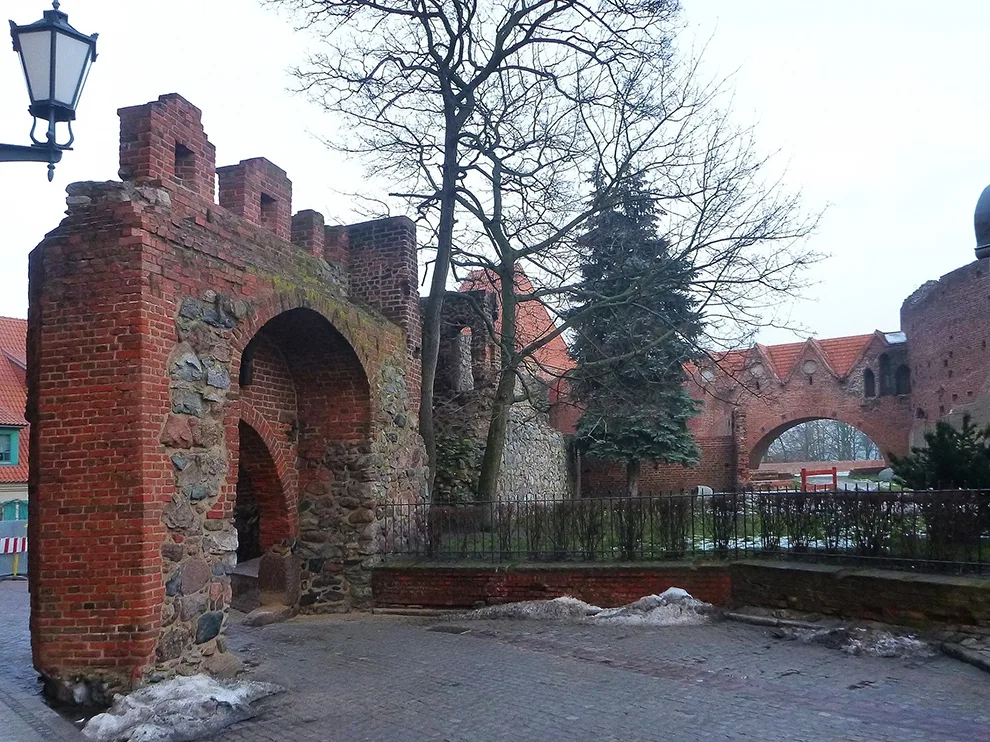 Ruins of the castle in Toruń. The town came through the Second World War unscathed. But its castle had been destroyed long before.
For Thorn it all began on 6 February 1454, on the third day of the Thirteen Years' War. On that day a delegation of Thorn's townspeople came to the castle and demanded that the Komtur come out to negotiate, which in itself was a flagrant breach of feudal subordination. Astonished by such unprecedented insolence, all twelve knights of the castle decided not to open the gates and to ask the capital of the state what this démarche meant and how the castle garrison ought to respond. Naturally, they did not know that similar situations were already unfolding around dozens of the Order's castles.
Two days later a large town army appeared beneath the castle walls and demanded its surrender. Komtur Albrecht Kalb rejected the ultimatum, threatened the rebels with reprisals and prepared to repel an assault. Soon, however, it became clear that the castle could not hold out for long and that no help from the Order's army was to be expected. The Komtur then surrendered to the townspeople on condition that the defenders' lives be spared and that they be free to leave the castle. The Thorn magistracy then decided that the very presence of the Order's castle by its walls was a constant threat, and that the castle must therefore be demolished. The townspeople welcomed this decision with enthusiasm and began dismantling the castle for building material. Soon all that remained of it was the dansker tower and the ruins of the wings. After the war ended in 1466, Thorn found itself in the territory ceded to Poland. The castle was never rebuilt; on the contrary, its remains continued to be taken apart for bricks. Nevertheless, the dansker tower has survived to this day in a somewhat truncated form, and the arcaded gallery leading to it has also been somewhat altered. The tower and the ruined walls are now protected as a historical and architectural monument and are included in tourist routes.
BIBLIOGRAPHY
- Авторский коллектив под рук. Кретинина Г. В. Очерки истории Восточной Пруссии. Калининград. Янтарный сказ. 2002.
- Бахтин А. П. Замки и укрепления Немецкого ордена в северной части Восточной Пруссии. Калининград. Terra Baltica. 2005.
- Петр из Дуйсбурга. Хроника земли Прусской.
- Вартберг Г. Ливонская хроника.
- Лависс Э. Очерки по истории Пруссии. М. URSS. 2011.
- Гаузе Ф. Кёнигсберг в Пруссии. История одного европейского города.
- Торнский анналист. Электронная версия.
● Editor's note: Aleksey Petrushin's article by no means covers all the castles of the Teutonic Order built by Christians in Prussia, but only the best known, those that have survived at least in part, and the most characteristic structures of the Order period. In future we will try either to expand the text or to offer a different format — perhaps, for our readers' convenience, each site will have a page of its own. Allenstein (Olsztyn), Braunsberg (Braniewo), Memel (Klaipėda), Neidenburg (Nidzica), Neuhaus (Zelenogradsk), Rössel (Reszel), Rossitten (Rybachy), Tilsit (Sovetsk), Heilsberg (Lidzbark Warmiński), Elbing (Elbląg)... This is far from a complete list of what has so far been left out. Many more fascinating stories await us!
Translated from Russian with the help of AI (Claude, Anthropic), October 2026.