* Elector (German: Kurfürst, literally "prince-elector", from German küren, "to choose, to elect", and Fürst, "prince"): a prince who had the right to elect the German king and, from the 13th century, the emperor. The margraves of Brandenburg received this prestigious title under the Golden Bull of 1356, after which the principality came to be called an electorate (German: Kurfürstentum). The institution of electors ceased to exist soon after the dissolution of the Holy Roman Empire of the German Nation in 1806.
** The Margraviate of Brandenburg (German: Markgrafschaft Brandenburg, also known as the March of Brandenburg, German: Mark Brandenburg) was one of the principalities of the Holy Roman Empire, existing from 1157 until the dissolution of the empire. The principality took shape on the lands settled by the Wends, who succeeded the tribes of the Vandals. Today the State of Brandenburg (German: Land Brandenburg), with its capital in Potsdam, is part of the Federal Republic of Germany.
In our recently published article "The Great Ice Manoeuvre" we described the culmination of the military career of Frederick William, the Great Elector of Brandenburg, when he proved himself not merely a mature commander but a truly extraordinary one. Yet the road to that glorious victory was long and far from always triumphant. It could hardly have been otherwise, for the situation both around and within the Prussian-Brandenburg state was anything but favourable to the reforms the Elector had undertaken.
When we analyse the career of a historical figure, we tend to draw analogies with other states at other times and to compare him with well-known personalities. All the more so since in the Soviet (and, after it, the Russian) school curriculum and popular literature Frederick William was treated briefly and rather negatively, with strange analogies drawn along the line "Prussian absolutism – German militarism – Hitler's fascism". Yet absolutism was in fact the most advanced form of government at the time, and Frederick William was no more a militarist than Peter I or Napoleon, the comparisons with whom seem most apt. If we compare Frederick William with that familiar model of the monarch-general, Napoleon I Bonaparte, the difference is plain: Napoleon was born to be a great strategist, whereas Frederick William made himself into the most renowned commander of his age, investing a colossal amount of strength and energy in it. Napoleon was carried to the top by the unbridled forces of a popular revolution; Frederick William had to overcome the resistance of the most influential and active part of the population of the Prussia of his day, the upper ranks of the nobility and the burghers. But the main difference is perhaps this: while all of France overstrained itself to secure Napoleon's glory, Frederick William spared himself nothing for the glory of Prussia. And here a comparison with another monarch bearing the epithet "Great", Peter I, is more fitting. Compared as reformers, they show that, owing to entirely different circumstances, the Great Elector's reforms were not as profound, and the military side of his activity outweighed the civil and administrative. But behind the Russian tsar stood the enormous potential of a boundless country, which bore no comparison with Prussia's modest starting resources. And if, in the poet's words, Peter "reared Russia up on her hind legs", Frederick William taught the Prussian pony not to stumble over its own feet, to run at the prescribed gaits and to obey its rider's commands strictly.
And so it turns out that Frederick William was a little bit Bonaparte and a little bit Peter I, but he was unquestionably the man who created Prussia and set it apart from the many other German states. And his path began with very great problems inherited from his predecessors.
Frederick William came to power in the Brandenburg-Prussian state in 1640, at the age of twenty. At that moment the state consisted of five parts: the Electorate of Brandenburg, the Duchy of Prussia, the Duchy of Cleves, the County of Mark and the County of Ravensberg. Not only were all these parts isolated from one another, but some of them had enclaves of their own in other German principalities. On the map, therefore, the Brandenburg-Prussian state looked like nine territories of unequal size. In terms of its political system, Brandenburg-Prussia in the 17th century was an estates monarchy: in each of its lands an elected body, the Landtag, met and approved or rejected all of the monarch's important decisions concerning that territory. There was no single body of law for all the possessions; a multitude of local legal acts was in force.
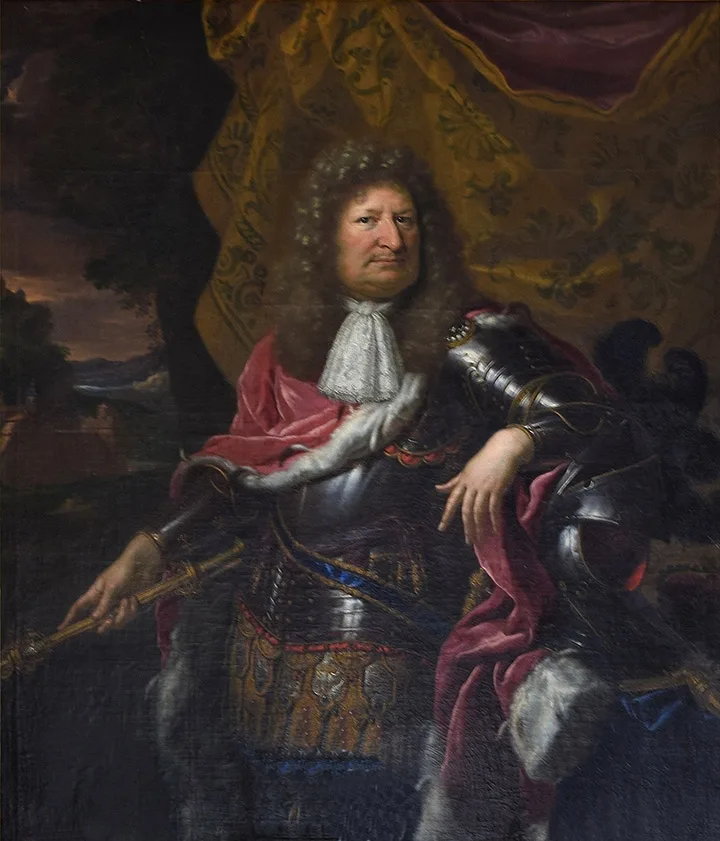
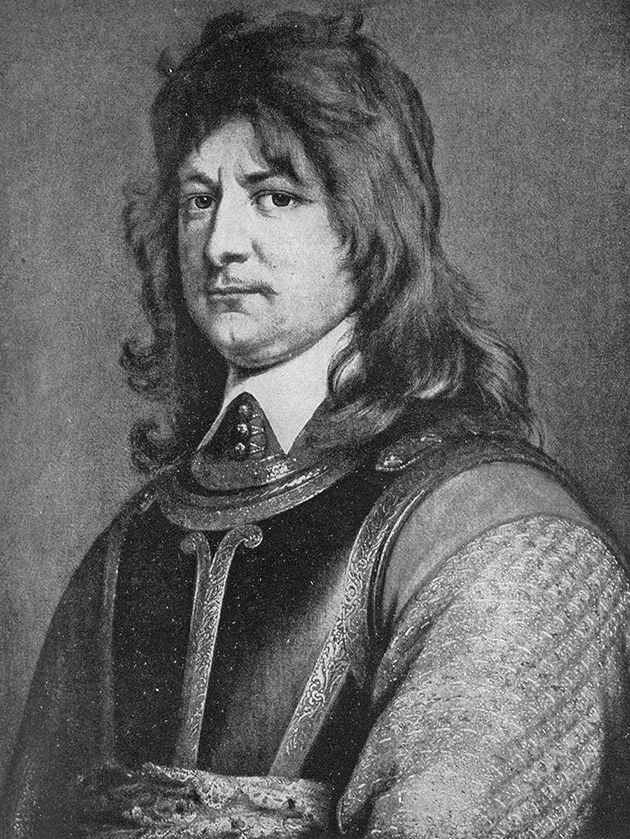 Frederick William at 29. Portrait by Adriaen Hanneman (1647).
The situation in the state at the close of the Thirty Years' War (1618–1648) was catastrophic. Prussia, which had declared armed neutrality during the Polish-Swedish wars, saw its population fall by some 20% and suffered a general economic decline; in the Electorate of Brandenburg less than a third of the population remained, and the territory had literally been laid waste by the war. Brandenburg, having taken the side of the Empire, was plundered by allies and enemies alike. Indeed, according to some accounts, it was the allied troops of the Habsburgs and the Catholic League that did the greatest damage to the towns and villages of Brandenburg. Frederick William had no effective military means of putting a stop to this: in 1640 he possessed a tiny army of only 4,000 soldiers. For comparison, a proper defence of a fortress such as Königsberg required some 12,000–15,000. That is why, as early as 1641, Frederick William became the first of the German princes loyal to the Empire to announce that he would no longer fight the Swedes. Others followed him, which eventually led to the Preliminary Peace of Hamburg, marking the readiness of the main powers to end the Thirty Years' War. This turn was the first political success of the not yet "Great" Elector. The next was compensation for the devastated territories under the Peace of Westphalia (1648), by which Brandenburg received Eastern Pomerania, the secularised archbishoprics of Magdeburg and Halle, and the secularised bishoprics of Minden and Cammin.
After the end of the Thirty Years' War, Frederick William made titanic efforts to build a single centralised state on the lands of Brandenburg and Prussia – what, after his death, would become the Kingdom of Prussia.
On this path he had to solve the following main problems: the fragmentation and devastation of the territories, Prussia's feudal dependence on the Polish crown, and the weakness of the economy and of the army (after the war the Landtag cut it down to 1,800 soldiers).
First of all, the Elector removed from his court all supporters of the Habsburg Empire and of an unconditional preservation of Brandenburg's status quo within it. As advisers he invited energetic people who supported the idea of creating a new, unified and independent state. In forming the new political elite, he relied on the ordinary nobility and the burghers.
At the beginning of his reign his chief political difficulties were with Prussia. The position of the Hohenzollerns there had been weak ever since the regency; the estates formally recognised the ducal authority over them, but real power in the duchy lay with the upper ranks of the nobility and burghers, represented by the appointed councillors and the heads of the municipalities of the Pregel towns. In Königsberg a kind of oligarchy had formed, which, whenever it disagreed with the Elector, immediately appealed to the Polish king as the duke's overlord. Generally speaking, the local nobility was bent on creating a so-called "noble republic" in the duchy, possibly even passing directly under the jurisdiction of the Polish king. With his authority weak, Frederick William could at first do nothing to counter such sentiments. To strengthen it he needed an effective army, and such an army could only be had by building a strong economy. Frederick William therefore launched a programme to replenish the population of the state and invited into the country all those persecuted for their religion – and, along with them, everyone else who had no prospects in their native lands. French Huguenots, Dutch, Swiss and people from a number of German lands answered the call. Later Jews were invited too. In Prussia and Brandenburg they were granted rights and guarantees unprecedented in Europe.
The Brandenburg-Prussian state was becoming the most tolerant country in the Old World.
To create a strong army of his own, Frederick William took the following steps. In 1644 the army of Brandenburg-Prussia became a standing army: the mercenaries were either taken on permanently or dismissed, and from then on the army was recruited on a voluntary basis. In 1651 the Elector placed all fortress garrisons and other military units under a single commander-in-chief, Baron von Sparr, while he himself took command of the field army. This ruled out the presence on the territory of the state of any armed formations not subordinate to the central command. Next, in 1653, he convened the Landtag in Berlin and sought its consent to enlarging the army by means of taxes, but was refused. The Prussian Junkers (the class of large landowners) and the municipalities likewise refused to increase spending on the army. Frederick William then resorted to a cunning move to bridle the elites: he struck a bargain with them. The nobility had all its privileges confirmed, and serfdom was introduced in the country – not as harsh as in Russia, but still providing for the subordination of village communities to the landowners and the delegation to the latter of judicial power, the functions of local self-government and of law enforcement on the territories under them, as well as the right to fix the amount of labour dues, quitrents and levies. In exchange the monarch received the full power of the state and consent to new taxes for the upkeep of the army. As a result, in five years (by 1658) the army was increased more than tenfold and reached a strength of 22,000 soldiers.
What, then, distinguished the new Brandenburg army? First, a high level of training, modern weapons and advanced tactics. Second, a strong officer corps. As soon as money became available, Frederick William began to call into his service experienced officers from the armies of Sweden, Holland and Denmark. Their combat experience was used in training officers of his own. Third, the Brandenburg army was extremely well organised and disciplined. Its regulations forbade any plundering and looting and proclaimed humane treatment of the civilian population. The army was supplied centrally through rear-area structures created for the purpose – magazines. Soldiers and officers were paid regularly and without delay. Frederick William and his generals began to employ the progressive Swedish tactical models. Their essence was that the main and decisive force on the battlefield was infantry armed with firearms. The emphasis lay precisely on firepower, for which a linear formation of several ranks was used. These ranks could fire a simultaneous volley in three tiers or a series of volleys, relieving one another. The volley of muskets, and later of flintlocks, was the principal means of defence against cavalry as well, in contrast to the outdated tactics in which the means of fighting cavalry were pikemen – foot soldiers with long pikes. The armies of Sweden and Brandenburg-Prussia used pikemen too, but they made up between a quarter and a third of the infantry, whereas in the typical armies of southern Europe pikemen and musketeers were equal in number. Thus, under the Swedish tactical model, an infantry unit had considerably greater firepower. In the Brandenburg-Prussian army the infantry was also given light field howitzers, which strengthened its fighting power still further, in particular its steadiness against cavalry. In addition, Frederick William paid great attention to dragoons – mobile infantry units that moved on horseback but fought on foot.
It can be said with certainty that an effective army of 22,000 soldiers was enough to make the European states of the time refrain from military adventures against its owner. That number of bayonets would have sufficed for one major battle – although, in the event of defeat, one might be left almost without any. Such an army could also be a decisive trump card for a strong ally. And this was what tempted Frederick William most of all. When your participation decides the outcome of a big war, far bigger than any you could wage on your own, your partner in the alliance will agree to all your conditions. Under certain circumstances, one such condition could be Prussia's release from feudal dependence. All that remained was to wait for those "certain circumstances".
Here we should recall once again that ever since 1466, when under the Second Peace of Thorn the Teutonic Order became a vassal of the Polish crown, the Order's leadership had never abandoned plans to rid itself of this dependence.
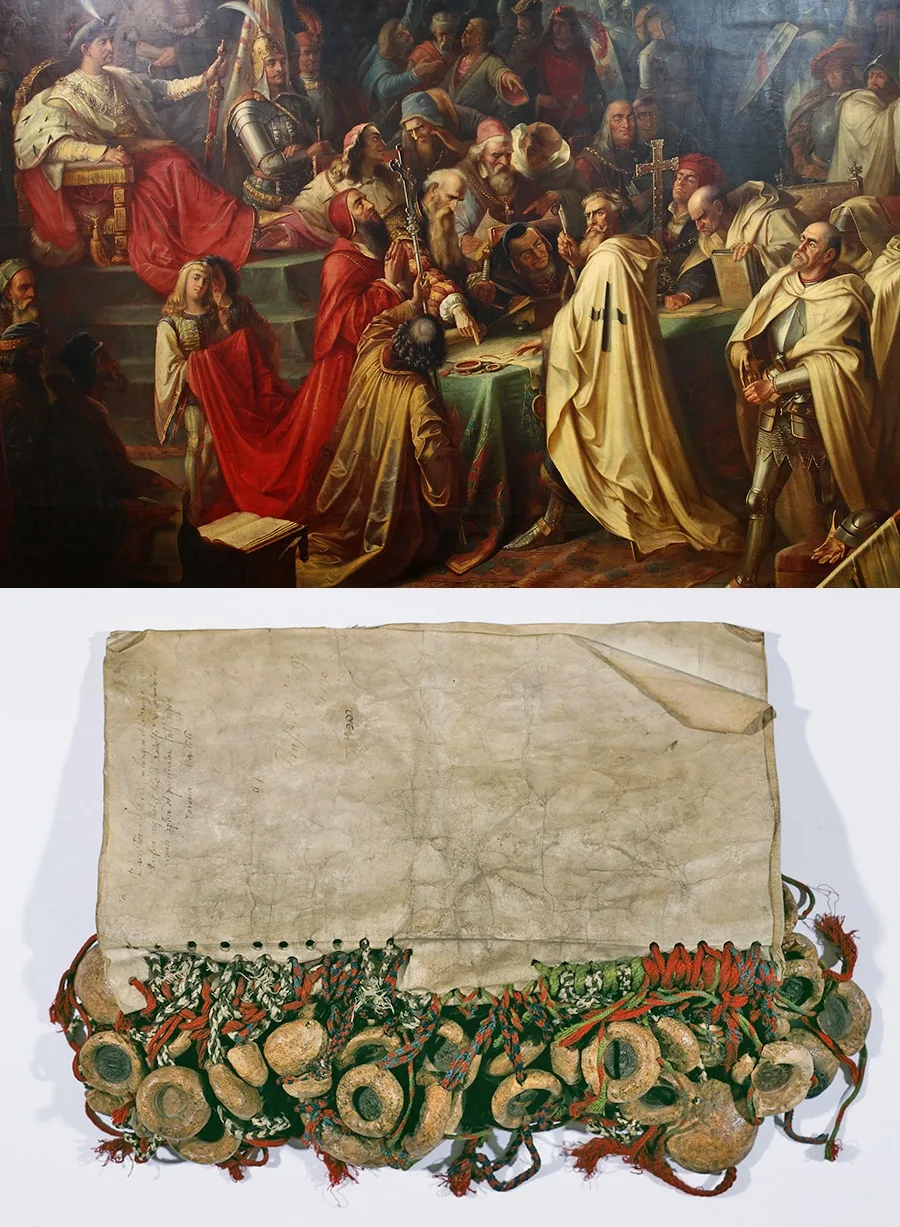
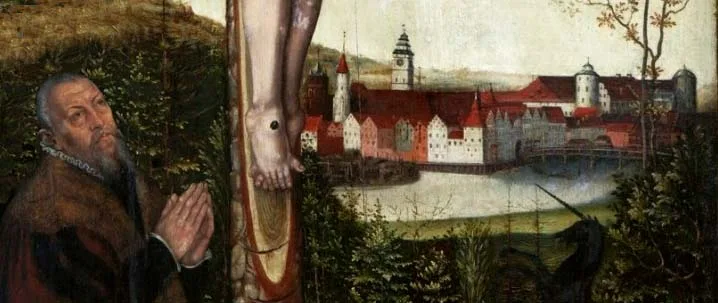
Sealed with a multitude of seals, the original of the treaty between the Kingdom of Poland and the Teutonic Order is kept in the Central Archives of Historical Records in Warsaw. Above: a detail of Marian Jarociński's painting "The Second Peace of Thorn" (1873).
The most straightforward plan, of course, was military revenge. But after the war, and right up to the twilight of the Order, its finances were too weak to hire an army capable of defeating the Polish one. Attempts were therefore made to escape vassalage by other means. Thus Grand Master Heinrich Reffle von Richtenberg chose open confrontation in 1472 and swore allegiance to the Hungarian king Matthias Hunyadi. The calculation was that Hungary would help the Order in its struggle with Poland, and that a Hungarian protectorate would not be so harsh. His successor, Master Martin Truchsess von Wetzhausen, went even further. He not only swore allegiance to the Hungarian king but in 1478 declared war on Poland. The kings of Poland and Hungary, however, unexpectedly came to terms. The master had to halt hostilities and swear allegiance to the Polish crown. Grand Master Johann von Tiefen, after taking office, avoided the oath for four years and took it only in 1493. The height of defiance was shown by the penultimate grand master, Friedrich von Sachsen (Frederick of Saxony). Before his election as grand master he had not even been a brother of the Order. The Order's leadership chose him from among the other candidates for the nobility of his family and his status as a vassal of the Holy Roman Emperor. Frederick of Saxony therefore refused to take the oath of vassalage to the Polish king, arguing that he was already the emperor's vassal. The emperor supported him fully in this refusal. And to avoid being compelled, the grand master left for his native Saxony. There he lived to the end of his days without ever becoming the Polish king's vassal. All this was, of course, a fine political move, but in practice the Polish side went on regarding the Order as its vassal and interfered in its internal affairs as if nothing had happened. Then Albrecht von Brandenburg-Ansbach became grand master. He too was summoned to the post by the Order from outside. The reasons for choosing Albrecht in particular were his kinship with the Polish king (on his mother's side he was a great-grandson of Jogaila) and his membership of the Hohenzollerns, a family influential in the Empire. The Polish king Sigismund I was troubled by neither of these and, as was customary, began to demand that he take the oath of fealty. Albrecht, in the spirit of Frederick of Saxony, began to evade it on every possible pretext. At the same time he sought strong allies for a struggle against Poland and found one in Grand Prince Vasily III of Moscow. The Moscow prince was very keen to see Poland weakened, and Prussia's withdrawal from vassalage would have greatly contributed to that. Vasily III therefore promised money to hire 10,000 soldiers. The money was allocated and sent to Königsberg, but for a number of reasons never arrived. Albrecht, for his part, declared war on Poland in 1519. It lasted two years, devastated the adjoining territories of both adversaries and lay heavily on the budget, but brought the Order no results at all. The hopelessness of the situation threw Albrecht into depression, and he even intended to give up the title of grand master. But then Luther's teaching came his way, and life was filled with new meaning: he set about creating a secular state in Prussia with Lutheranism as its state religion. He needed peace, during which he could introduce Protestant worship and secularise the Order's state. In exchange for such guarantees he was ready to swear fealty to the Polish king and to put off the question of Prussian independence for a long time. As it turned out, for 132 years. The time to return to the idea of gaining independence came only under Frederick William.
An opportunity to use the army he had created to win Prussia's long-awaited independence from Poland presented itself to the Elector fairly soon. In 1655 Sweden decided that Poland, weakened by its war with Russia, and Lithuania, dynastically allied with it, occupied territories far too vast for their ability to defend themselves effectively. Thus began the Northern War of 1655–60, or the Swedish Deluge, as it was called in the Polish theatre of war. Frederick William realised that this was a splendid chance for Prussia to free itself from feudal dependence. He could, of course, simply have announced that he no longer obeyed the Polish king and broken his oath of vassalage. But in the eyes of the whole European world of monarchs he would have looked like a rebel and an oath-breaker, legally still a vassal, only a mutinous one. According to Frederick William's design, the Polish king was to renounce his feudal rights to Prussia himself.
At first it may seem that the Elector was, as the saying goes, going with the flow and, manoeuvring among ever new circumstances, unexpectedly found himself close to the possibility of escaping the authority of the Polish crown. This is precisely the view current in modern historiography. But there is another view, according to which all of Frederick William's actions were guided by precise calculation. Not for nothing was he called "the most cunning fox in Europe".
If one traces the course of events carefully, the general line of a brilliant plan for escaping the insoluble situation created by the terms of the Second Peace of Thorn and Prussia's feudal dependence becomes visible. Everything points to roughly the following reasoning on the Elector's part: if it is impossible simply to leave the feudal treaty and become, in effect, the equal of your overlord, you can change overlords. That does not change your status and therefore will not provoke rejection among the European monarchs. Your status is merely an internal matter between your former and your present master. The affair was arranged in the most ordinary way: the Swedish king invades Prussia, the Polish forces are unable to defend it, and the duchy passes as a fief to the victor. And so it all happened – except that the cards were muddled by the Polish szlachta, who, realising that the Swedish offensive threatened Poland with the complete loss of its independence, began to promise any rewards in return for military help, up to and including the Polish throne. This was very tempting but, alas, unattainable. In the very first battle with the Swedes, the troops of Brandenburg-Prussia were defeated. Without waiting for the destructive hostilities to continue, while the Swedes were still approaching Königsberg, delegates were sent to the Swedish king asking for peace, which was signed in Königsberg on 17 January 1656. And on 29 June 1656 a treaty of vassalage was signed between the King of Sweden, Charles X Gustav, and Frederick William. Among other things, it required the Elector to field an army of four thousand against Poland and, in the event of joint victory, to receive the territories of Warmia, Greater Poland and Poznań. Charles X was not stingy with prizes, since they would belong to his vassal anyway. But for the Elector the danger of unchallenged Swedish dominance in the region cancelled out all the benefits of these acquisitions. It threatened to turn Prussia for decades from a Polish vassal into a Swedish one. Matters were made worse by the fact that it was not only the Duchy of Prussia that had taken Sweden's side: more and more Polish and Lithuanian magnates and voivodes were joining King Charles's army with their troops. Whole towns and entire voivodeships swore allegiance to the Swedish king. This created conditions that made it possible to overcome a characteristic feature of the wars of that period – the limited scope of their aims. This rule, rooted in the relatively small size of the armies of 17th-century European states, applied only where the enemy was ready to fight for its sovereignty. But when commoners and nobles willingly enter the service of the invader, the complete absorption of the territory of the attacked state becomes possible. All the more so since the Polish king John II Casimir and the Swedish king Charles X Gustav were of the same Vasa dynasty and could each lay claim to the other's throne (which, incidentally, was the officially declared cause of the war); the incorporation of Poland could therefore easily be explained as a conflict within the dynasty, which greatly eased the nobility's agonies in choosing a side.
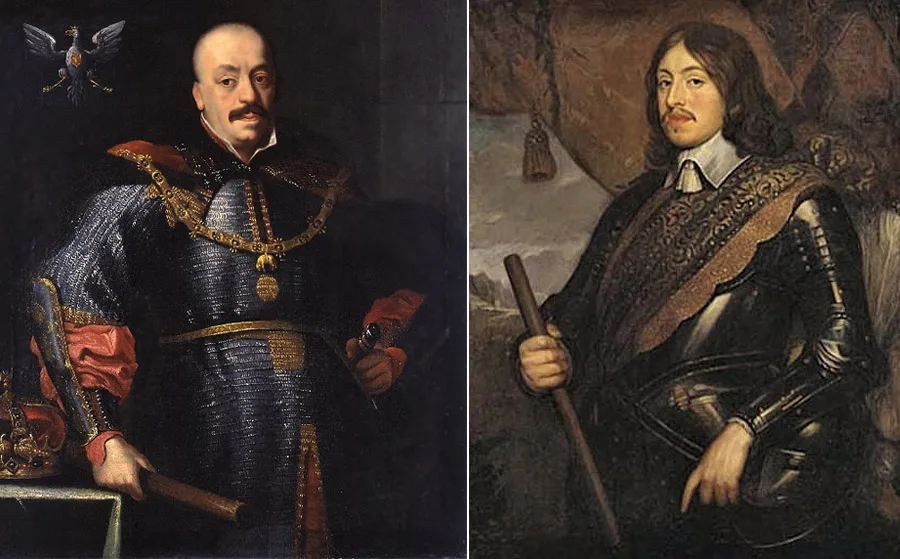
Members of the Vasa dynasty – the kings of Poland and Sweden, John II Casimir (left) and Charles X Gustav, contemporaries and colleagues of the Great Elector, who disputed each other's right to the throne.
Charles X Gustav's rapid successes, however, were accompanied by unforgivable mistakes, which in the end led to an equally rapid ebbing of the Swedish Deluge. First, he never managed to see Poland as his new territory and its inhabitants as his subjects; Swedish troops ravaged both the territories outside his control and the regions that had come over to his side voluntarily. As a result, the latter grew, to put it mildly, dissatisfied with them. Second, the interests of another major player in the region – Russia – were not taken into account. Had Charles Gustav joined forces with Tsar Alexei Mikhailovich in the conquest of Poland, the question of Poland's existence as such would have been settled. But for that he would have had to assure Russia of mutual benefits from seizing Polish territory, propose a plan for its partition and compromise on the disputed territories in the eastern Baltic – in other words, simply hand over to Russia lands in Livonia or Ingria together with access to the Baltic. The Swedish monarch was not ready for such grand gestures.
For Russia, both Poland and Sweden were age-old rivals in the region, so it naturally supported the weaker side, fighting first against Poland, then against Sweden and finally against Poland again. The Danes reasoned in exactly the same way: for them too, the emergence of a huge Swedish-Polish-Lithuanian empire in the region would have been a big problem.
In the end the situation around Poland became extremely tangled. There were three irreconcilable rivals: Poland (with Lithuania), Sweden and Russia. Each was out for itself, and all alliances were therefore temporary. Denmark was also an interested party; its claims were directed above all against Sweden and least of all against Russia. Another force was the Zaporozhian Host, which was compelled to lean towards Russia and regarded Poland as its chief danger, but also managed to fight on both sides. More distant states were drawn into the war as well: the Crimean Khanate supported Poland, while Transylvania and Romania, on the contrary, took Sweden's side. The Netherlands were hostile to Sweden and also supported Poland. And in the middle of this tangle of conflicts lay Prussia, which in the event of a big campaign the armies of the great powers could simply trample and ravage, as had happened to the March of Brandenburg during the Thirty Years' War.
But the Northern War (1655–1660) split into five main theatres of operations (Polish-Swedish, Russo-Swedish, Pomeranian, Danish-Swedish and Norwegian), and so in each of them the armies in battle usually numbered no more than 10,000–15,000 soldiers, only occasionally reaching 25,000. At the centre of this complex game stood the army of Frederick William (some 20,000 strong in all), who clearly understood that his participation in the war on one side or the other could radically change the course of events on any of the fronts.
So when something close to a miracle happened, and the Polish nobility passed from quietly surrendering their statehood to decisive action to free the country from the Swedish invaders, and a formidable anti-Swedish alliance took shape, the Elector understood that the time had come to change allies. But not just like that – on his own terms, since, unlike Poland's other allies, his army would be operating in the most important direction. It must be said that Frederick William did not arrive at the decision to break the alliance with the Swedes and join Poland at once. At first the Polish side wanted to bring Prussia back into vassalage by threats and force. To that end a special corps under Gosiewski was even sent into Prussia, reinforced with Lithuanian detachments and Crimean Tatar cavalry. This rather formidable force of almost 8,000 Poles and Lithuanians and 2,000 Tatars routed an army of Prussians and Swedes 4,000 strong at the Battle of Prostki on 8 October 1656. The losses of the Prussian troops were not fatal, but the defeat was followed by the devastation of south-eastern Prussia. Still, this setback did not break Frederick William's will. He entered into negotiations with Poland only a year later, when the Polish side was ready to make concessions regarding the status of the Prussian duchy. As with the Swedes, the new treaty was signed in two stages: on 19 September 1657 in Wehlau (Znamensk) and on 6 November of the same year in Bromberg, in Polish Bydgoszcz.
The 200-year-old dream of the Teutonic Order, and later of the Duchy of Prussia, of regaining state sovereignty had come true. Yet even then the Elector had not yet become "Great", although this was his most important achievement in all the years of his reign.
Once Brandenburg-Prussia had gone over to Poland's side, the outcome of the war was a foregone conclusion. In 1658 the troops of the Polish coalition fought to liberate Royal Prussia and, after a six-month siege, took the city of Toruń by 30 December 1658. During the siege Sweden undertook a manoeuvre with its army, landing troops on the Frische Nehrung (Vistula Spit) on 17 June 1658 in order to march from there on Königsberg and force Prussia out of the war. There, however, the Swedes met stubborn resistance and gave up the march on the Prussian capital.
By 1660 the war had exhausted the strength and resources of all the parties involved. The entry into the war of Denmark, aided by Austria and partly by England, brought the Swedish side to the brink of military collapse. Fearing a disruption of the balance of power in northern Europe, France joined in, promising in the form of an ultimatum to open hostilities on Sweden's side. The regional war threatened to grow into a general European one. All the parties therefore decided that it was time to begin peace negotiations. On 3 May 1660 the long-awaited Peace of Oliva was signed, intended to settle all the disputed questions in the region. Elector Frederick William signed it as an equal of the Polish and Swedish kings and the Holy Roman Emperor. The Peace of Oliva definitively confirmed Prussia's status as an independent state. A little later, peace between Sweden and Denmark was concluded in Copenhagen.
Gaining state sovereignty did not yet make Prussia a significant European power. As expected, an old problem resurfaced – the licence of the nobility, which had developed during the regency and the period when appointed and elected officials and councillors effectively ruled Prussia. The Prussian elite was used to doing without the firm hand of a sovereign. Even independence from the Polish crown was far from pleasing to all the factions of nobles and burghers. The pro-Polish party in Königsberg had always been strong: the Polish king could be used to good effect as the highest authority in disputes with the duke. And so, after the Wehlau–Bydgoszcz agreements, part of the nobility embarked on covert and open opposition to Frederick William's rule and even intensified its contacts with the Polish court. A conspiracy was ripening among the nobility, aimed at limiting the duke's powers. Moreover, should a direct conflict fail, the plan was to annul the Polish-Prussian treaty and petition the King of Poland to admit Prussia into the kingdom, for instance on the model of the union with Lithuania. The Polish king would then also bear the title of Duke of Prussia and would be nominally confirmed by the Landtag.
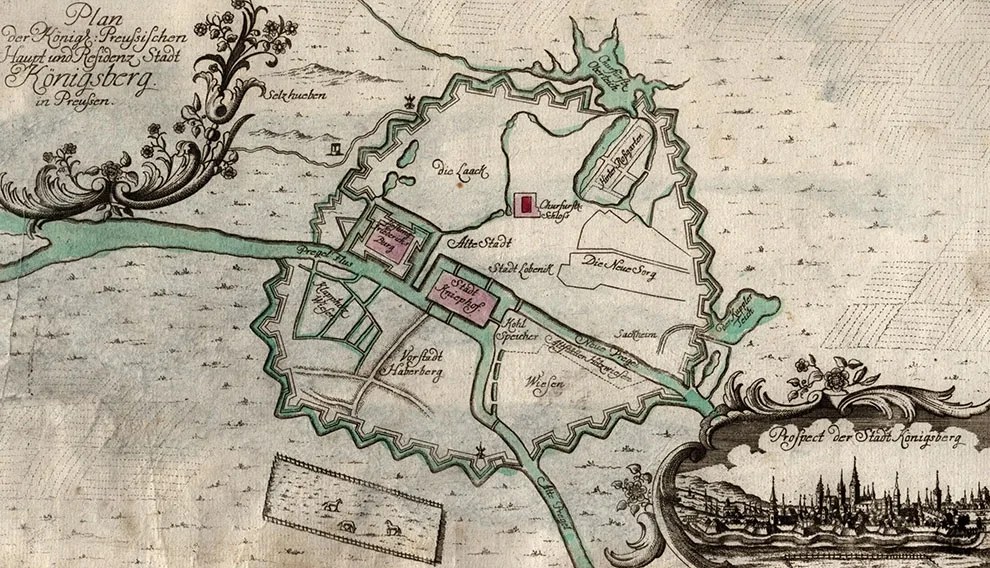
It hardly needs explaining that for Frederick William these ideas were utterly unacceptable, and the struggle against them began at once. As early as 1657, during the Northern War, he built Fort Friedrichsburg on the western edge of Königsberg. The fortress stood on the bank of the Pregel, where the boom barrier known as the "Holländer Baum" (Dutch Log) was located; it had four bastions and was capable of all-round defence. The fort clearly bore the marks of a dual-purpose fortification: on the one hand it protected the city against an enemy fleet, on the other it controlled all the seaborne cargo traffic from Königsberg. Moreover, any attempt to shut oneself up in the city behind its ramparts against the Elector's army became pointless. Local historians in their studies often point out that the fort's guns were trained on the city as an unambiguous warning to the municipalities. However, the distance from the fort to the centres of the three Pregel towns was 1,000–1,500 m, which allowed them to be kept only under a symbolic gunsight. At such a distance the guns of the day could fire a solid cast shot, but not a shell or a bomb. Moreover, they would have had to fire on a high, arcing trajectory, so the best one could count on was a psychological effect.
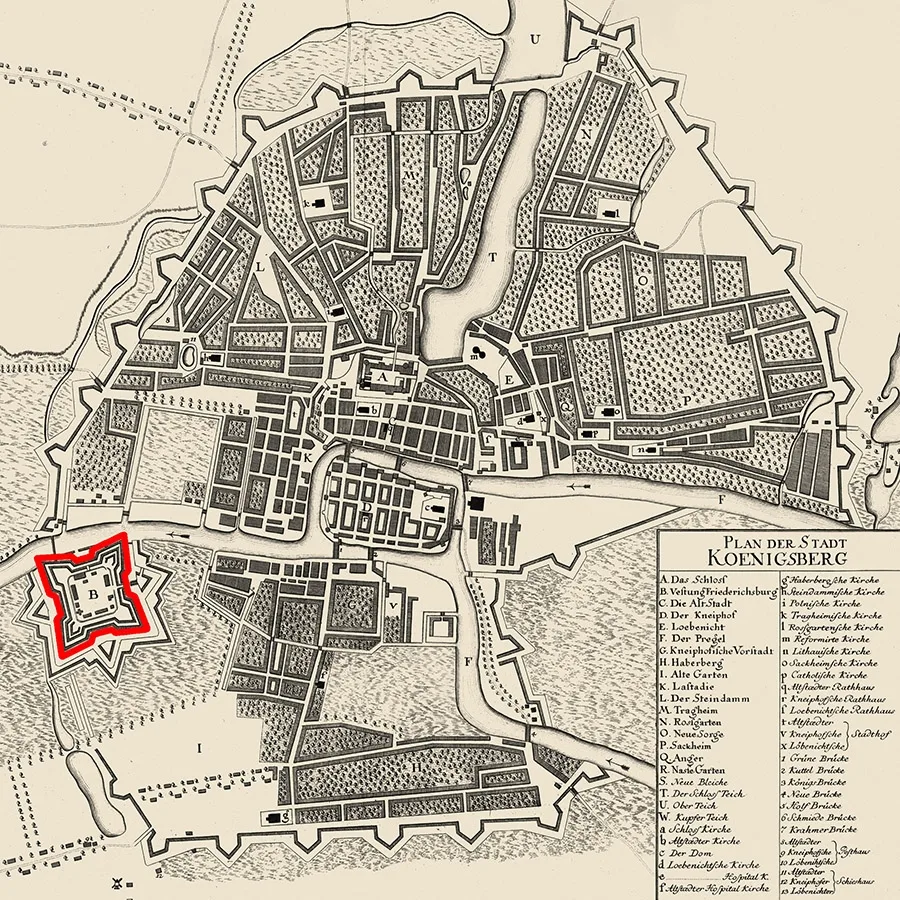 Fort Friedrichsburg (circled in red) on an 18th-century map of Königsberg. All that survives today is its mighty gate, home to the "Korabelnoye Voskresenye" historical and cultural centre.
The main struggle with the unruly Prussian nobility began after the end of the Northern War. In his domestic policy, moreover, Frederick William sided exclusively with the nobility, but demanded from it unconditional recognition of his supreme authority.
The rights of the nobles, and partly of the municipalities, in local self-government were expanded to an unprecedented degree. But at the same time no interference was permitted in affairs of state, foreign policy or military administration, other than through the nobles' service in state bodies. On the whole, the Elector's policy was extremely favourable to the service nobility, and many of them appreciated it.
Nevertheless, two opposition leaders emerged in Königsberg: among the civilian councillors, Hieronymus Roth (1606–1678), and among the military, Lieutenant General Count Albrecht von Kalckstein (1592–1667). Both considered Frederick William's actions in withdrawing from feudal dependence on Poland illegitimate, since they had not been approved by the Prussian Landtag. The opposition launched vigorous activity immediately after the end of the Northern War. In their appeals to the Prussian nobility they demanded a revision of the terms of the Peace of Oliva and of the 1657 agreements, and campaigned for the estates to recognise a Polish protectorate. One of the reasons for this campaign was the taxes Frederick William had imposed on the municipalities. The taxes were needed to maintain a strong army. Not that they were exorbitant – on the contrary, they had been carefully calculated and regulated. But since the subject of taxes was close to everyone's heart, it would have been foolish not to exploit it. The municipalities intended simply to ignore the tax collection and see how the supreme authority would react.
In 1661 Frederick William first arrested Albrecht von Kalckstein. However, after the general swore never again to act against the Elector, he was pardoned and spent the rest of his years on his family estate of Knauten (today the settlement of Prudki in Bagrationovsk District). Hieronymus Roth, for his part, only stepped up his activity and travelled to Warsaw for an audience with the Polish king, where he told him that the Königsberg estates wished to see him as ruler of Prussia. Such actions deeply perplexed John Casimir, but he understood perfectly well that Poland, ruined by war, was in no position to take any real steps to recover the duchy. The Elector learned of Roth's journey to Poland and regarded these actions no longer as politics but as high treason. In 1662 he entered Königsberg with a corps of 2,000 soldiers and arrested Roth. In those days a call for foreign intervention and a change of rule unequivocally merited the death penalty, but Frederick William showed astonishing magnanimity. He had the traitor taken to the March of Brandenburg and imprisoned in the town of Peitz in decent conditions. Roth was even told that if he admitted his guilt, renounced further opposition and submitted a petition for pardon, the petition would be granted. Roth refused these terms. What is more, he was soon caught passing letters against the Elector to his associates. Only then was he moved to ordinary prison conditions, and he remained in confinement to the end of his days.
But the anti-Brandenburg party in Prussia had not yet been finally crushed. The struggle against the Elector was continued by one of Albrecht von Kalckstein's sons, Christian Ludwig (1630–1672). He too was a soldier, with the rank of colonel; he had absorbed from his father a rejection of the rule of the Brandenburg electors in Prussia, and in his actions he went further than any of his fellow conspirators. After his father's death in 1667, his relatives, in a dispute over the inheritance, denounced Christian Ludwig to the Elector as a traitor. In 1668 he was arrested and sentenced to life imprisonment, but was pardoned at once and got off with a fine. This taught him nothing. In 1670 the colonel fled to Warsaw, where he made a speech before the Polish Sejm on the need to settle the question of incorporating Prussia into Poland by force. From there he also sent appeals to Prussia urging people not to submit to the Elector's authority and promising that help would soon come from Poland. At that very time Frederick William was convening the Landtag to increase the tax for the upkeep of the army. Colonel Kalckstein's agitation among the Prussian estates threatened to wreck these plans. And so a special operation worthy of the novels of Alexandre Dumas was undertaken.
The rebellious colonel was abducted in the Polish capital and carried off to Prussian territory rolled up in a carpet. Kalckstein was brought to Memel (Klaipėda), where he was interrogated under torture and sentenced to death by a special tribunal. The sentence was carried out on 8 November 1672. Incidentally, this was the only execution for political reasons in all the 48 years of the Great Elector's reign.
By this time the Elector himself was in his fifties. Four of the most important tasks had been accomplished: the devastation of the lands caused by the Thirty Years' War had been overcome, power had been centralised, an effective army had been created and Prussia's sovereignty had been achieved. One remained: the lands of Brandenburg and Prussia were still separated by territories belonging to Poland. Between them lay the lands of Royal Prussia and Eastern Pomerania (Pomerelia), lost by the Teutonic Order under the Second Peace of Thorn. At first sight the task of recovering them did not look insoluble: Poland was growing ever weaker and gradually losing its status as the regional leader. But in counterweight to this, the greatest powers of Europe, above all France and England, began to take on the role of a European policeman, watching over the balance of power in the regions and categorically refusing to allow it to be upset in favour of any one side. Nevertheless, Frederick William believed that a large-scale military and political campaign to conquer the territories separating Prussia and Brandenburg could succeed if a coalition of interested states – Brandenburg-Prussia, Russia and Sweden – were assembled. True, while an alliance between Brandenburg and Russia seemed quite logical, the antagonism in the pairs Russia–Sweden and Sweden–Brandenburg was obvious. In theory, then, Sweden might be persuaded to act against Poland, say, in return for territorial concessions. Then again, other states could also be drawn into the coalition, Denmark or Holland, for example. That is precisely why, as a counterweight to the imperial ambitions of France and England, a fairly stable alliance of Denmark, Holland and Brandenburg-Prussia took shape.
For Brandenburg, a new military conflict began precisely in 1672, with Holland. Europe in the 17th century was a veritable seething cauldron of wars and conflicts that hardly ever died down; only the theatres of war changed. Several permanent hotspots had emerged. We have already mentioned one of them above: the area of the southern and eastern Baltic, where mutual territorial claims had a centuries-old history. The second was northern France and Holland. France had long viewed everything that happened in Holland with irritation. First, because the Dutch supported their fellow Protestants, the Huguenots, in France itself. Second, because the Dutch successes in building capitalism and a market economy clashed with the economic interests of the French kingdom. Third, because the French king remembered that legally (if one dug through ancient manuscripts) he had feudal rights to the Dutch lands. For Holland the situation was further complicated by the fact that its former traditional allies against France, Sweden and England, had left the alliance and were even inclining towards an alliance with France. Brandenburg came down on Holland's side, fielding an army of 20,000 soldiers for the war. Brandenburg's help was very welcome, given that France, through secret negotiations and agreements, had taken Holland's traditional allies, Sweden and England, out of the war, while Austria was unable to help Holland because of its own war with the Turks. Spain and some German principalities also supported Holland. France and its foreign allied corps, meanwhile, had an army enormous for the time, numbering up to 160,000 men. Nevertheless, the defensive measures taken by the Dutch, up to and including flooding the land over which the enemy was to advance, wrecked France's plans for a quick victory. The French then decided to take Brandenburg out of the game. To this end they persuaded the Swedes to invade Brandenburg. And when reports began to reach the Elector of growing numbers of soldiers in Swedish Pomerania, he at first refused to believe that Sweden could violate the terms of the Peace of Oliva without serious grounds.
Meanwhile the Swedes crossed the border between Swedish Pomerania and Brandenburg. Over several months from November 1674, with an overwhelming military advantage, they occupied a large part of the March of Brandenburg without much resistance. The Swedish army was commanded by Field Marshal Carl Gustaf Wrangel (1613–1676), whom Frederick William had known since the Swedish Deluge – indeed, the Elector had come to know him both as an ally and as an enemy. News of the Swedish aggression reached Frederick William in Holland, but despite his wish to march against the Swedes immediately, common sense led him to postpone the campaign until the end of spring. First, it was impossible to strip the front against France, since that would have led to disaster in the whole Franco-Dutch War. Second, the Elector had an army roughly equal to the Swedish forces in Brandenburg. A winter march over such a distance would have put at least a quarter of his soldiers out of action, which was completely unacceptable. Third, assessing the situation soberly, he understood that winter hampered the Swedes too. Given the winter weather and the defensive capabilities of the fortresses, they would be able to take only a few of them, and the main campaign would begin in spring. But as soon as the warm weather set in, he immediately ordered the army to be withdrawn from the Dutch theatre and to return home at the fastest possible pace. Since such a transfer of troops would, by all regulations and rules, have taken at least two months, orders were given not to wait for supplies from the rear (the magazines), but to buy everything needed on the way from the local inhabitants. In addition, a vanguard of more than five thousand cavalry and about a thousand infantry was formed, which reached Magdeburg in only two weeks, covering a distance of 250 km.
All the events that followed, without any artistic licence, would grace any historical blockbuster – and the audience would come away feeling that the scriptwriters had overdone the plot.
So, in Magdeburg Frederick William counted the troops who had arrived there with him: he could rely on 5,600 horsemen and 1,000 infantry with 13 guns. That was roughly half of what the enemy had. But the Swedish command was expecting the Elector's army in two months at best – such was the speed of foot marches in those days. The Swedes were quartered in small garrisons in towns and fortresses. Frederick William therefore decided to attack the town of Rathenow, which lay at the centre of the territory occupied by the Swedes and was a road junction connecting the Swedish garrisons. "Disrupt the enemy's communications and command", "cut the enemy grouping in two and defeat it piecemeal" – all this sounds like directives and front-line reports from a quite different era, when such methods had become classics. And further on in Frederick William's actions we shall see quite modern methods of military operations as well.
Command of the assault on Rathenow was entrusted to the experienced Field Marshal Georg Derfflinger, who had fought in these parts back in the years of the Thirty Years' War. Since the infantry and guns were clearly insufficient for a proper siege and assault, it was decided to resort to a ruse of war. The Elector's army crossed the Elbe in secret, avoiding the main roads, and on 24 June found itself near Rathenow. Scouts made contact with the town magistrate and instructed the town officials to hold a banquet for the Swedish officers. Taking advantage of the fact that not a single sober officer was left in the garrison, Derfflinger disguised himself in Swedish uniform and persuaded the guard to open the gates. Unfortunately for the Swedes, Derfflinger was evidently a rather good actor. When the guard flung open the gates, the fate of the Rathenow garrison, taken by surprise, was sealed.
All the Elector's calculations proved correct. When one of the parts of the divided Swedish army encamped in Brandenburg learned of the enemy's sudden appearance and the capture of Rathenow, the nerves of its commanders gave way. The Swedes knew nothing – neither the number of soldiers with whom the Elector had so suddenly appeared, nor which towns they had already taken, nor Frederick William's further plans. Although even half of the Swedish army was not inferior in numbers to the army of Brandenburg, the Swedes, fearing encirclement, began to retreat from a position prepared for defence towards the town of Fehrbellin in the hope of reuniting their army. The Elector's advance detachments soon caught up with the Swedish rearguard and routed it in a brief clash. Learning that the rearguard actions had not forced the Swedes to halt and prepare for a general battle, Frederick William ordered a pursuit by 1,600 horsemen, who were not to engage in a decisive battle but to harass the retreating army constantly with skirmishes. Several days of such a retreat wore the Swedish army out; in addition, scouts destroyed the Rhin bridge ahead of the retreating Swedes. The Swedes were forced to give general battle. Incidentally, this Swedish force was commanded by Field Marshal Wrangel's half-brother, Wolmar (1641–1676).
It must be said that by all the rules the Swedes should have won this battle. As noted above, the opposing forces were roughly equal in numbers of soldiers, but the Swedes had twice as many guns (28 against 13 or 14). Moreover, the Swedish army was on the defensive, and it was the Brandenburgers who had to attack. In such a situation a successful attack required a tangible numerical superiority. But Frederick William not only lacked that superiority; there was also a clear imbalance between infantry and cavalry in favour of the latter – at a time when, in the 17th century, infantry was considered the main force on the battlefield and cavalry an auxiliary one. Yet at the council of war Frederick William and Georg Derfflinger insisted that the Swedes must be beaten now, while they were bewildered and disorganised. The Swedes' confusion was confirmed by the fact that, when reconnoitring the terrain, they had overlooked the commanding height on their right flank. Frederick William occupied this hill for his artillery position. In the battle fought on 28 June 1675, Frederick William chose the tactic of almost alternating cavalry blows against both Swedish flanks, which were to throw the Swedish order of battle into disarray and create the threat of encirclement. The plan fully justified itself. In addition, on the left flank of the Brandenburg army the well-placed battery had its say. At first the Swedes defended themselves bravely, but the local superiority of forces on the flanks did its work. The Brandenburg cavalry hurled the Swedish squadrons back onto their own infantry, which as a result could not meet the enemy with concentrated fire. The Swedish army wavered and began to retreat, gradually turning to flight. Swedish losses in killed and captured amounted to 3,000 soldiers, fifteen times the losses of the Elector's army.
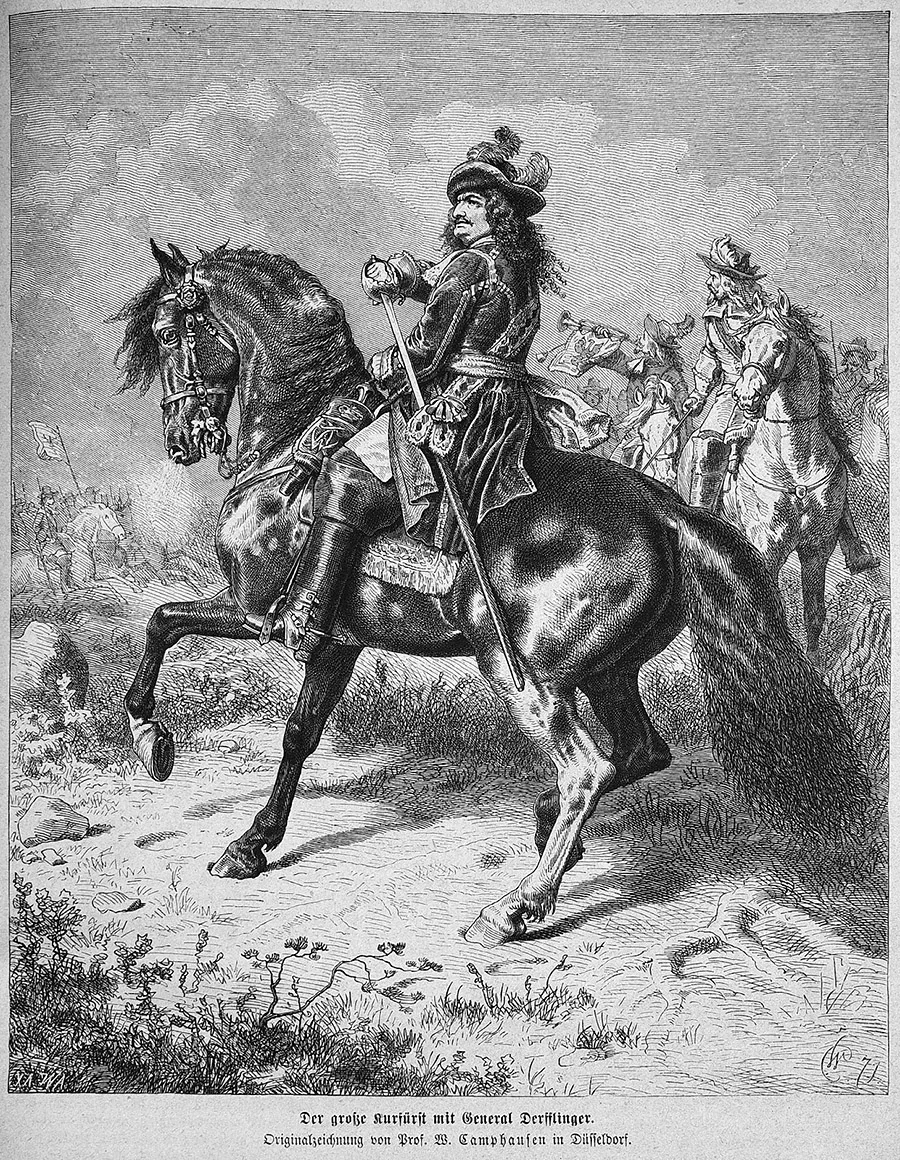 The Great Elector and General Derfflinger at the Battle of Fehrbellin.
Had some three times as many troops taken part in the Battle of Fehrbellin, it would have become the most famous battle in 17th-century European history. But in the history of Germany it certainly left its mark. German historians maintain that it was after this defeat of the Swedes that Frederick William officially came to be called the "Great Elector". This was the first epithet "Great" in the titles of German monarchs. The second and last was given to King Frederick II. The day of the victory at Fehrbellin was celebrated in Germany as a holiday right up to the First World War.
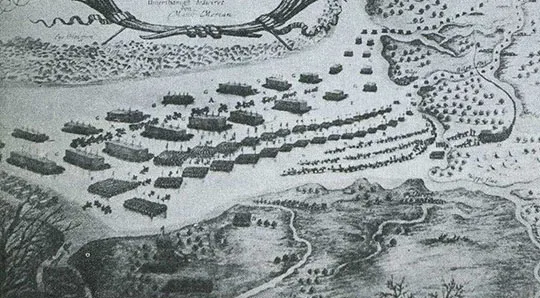
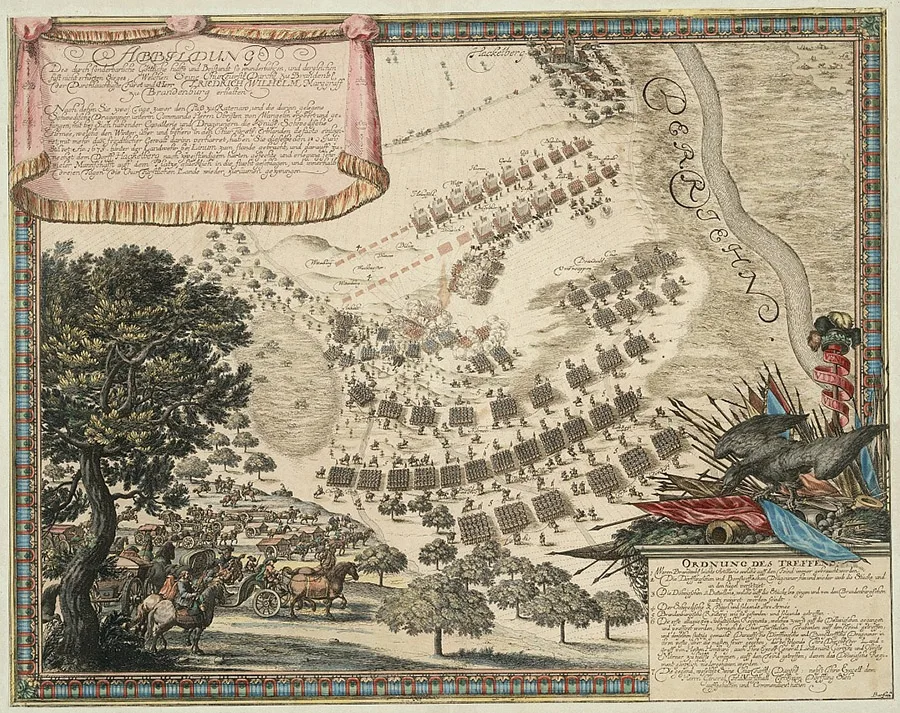 Map of the Battle of Fehrbellin.
After the defeat at Fehrbellin the Swedish army began a general retreat. Brandenburg's victory encouraged the Danes, and they soon joined the war against the Swedes, remembering the territories they had once lost that now belonged to the Swedish crown. The war quickly shifted to the territory of Swedish Pomerania. As early as the autumn of 1675 the towns of Stettin (now Szczecin in Poland), Wismar and a number of smaller ones were liberated. Then the war became protracted and was waged both on land and at sea, where the Swedes faced a Danish-Dutch fleet.
It was during this war that the story described in the article "The Great Ice Manoeuvre" took place. Then came a painful "rap on the knuckles" from France, which prevented the territories occupied during the war with Sweden from becoming part of Prussia. The war with Sweden was the Great Elector's last major campaign. Brandenburg troops did take part, as part of the imperial army, in the Great Turkish War (1683–1699), but their role there was not so significant, and the war ended after Frederick William's death.
In the 48 years of the Great Elector's reign, the Brandenburg-Prussian state was not at war for only 22 years. At times Frederick William waged three wars at once. Historians have counted 103 engagements (battles, sieges, skirmishes) in this period, of which 66 are considered won, 23 lost and another 24 of uncertain outcome. Frederick William was not a gifted general, but he was a diligent pupil and a very energetic man who understood perfectly that military and political success is the result of a whole complex of measures. Having taken over devastated and disunited territories at the end of the Thirty Years' War, he handed them on to his successor as a fully formed state, quite ready to become a fully fledged kingdom. Of course, like many European monarchs, he spared neither himself nor his subjects in pursuit of his goals. One might say that he laid the foundations of the notorious traditions of "Prussian militarism" and "Prussian drill", and led the country towards a bright future by coercion alone. But in those days this was an entirely normal state of affairs that met with approval in society. And yet, for all his uncompromising approach to military affairs, Frederick William turned Prussia into a land of tolerance and religious freedom. Here there were no Jewish pogroms, no one cut the throats of people of another confession at night, no one stormed towns because "heretics and blasphemers" had taken refuge there. On the contrary, here those who suffered such persecution in their homelands were welcomed, and this tradition continued after the Great Elector's death. Incidentally, Immanuel Kant's ancestors (on his father's side) moved to Prussia from Lithuania precisely during the reign of Frederick William.
Translated from Russian with the help of AI (Claude, Anthropic), October 2026.