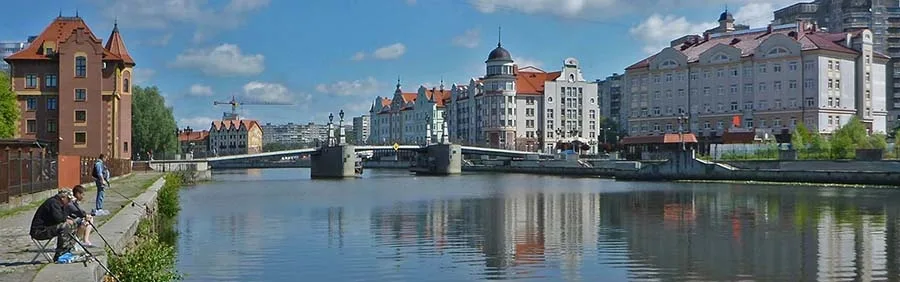
Haberberg (Haberberg, meaning "Oat Hill") stretches from west to east, from Crown Street (Kronenstraße, now the section of Leninsky Prospekt from the South Station to Bagrationa Street) to the Friedland Gate (Friedländer Thor). The High Bridge (Hohe Brücke) links Haberberg with the Willow Dam (Weidendamm, now Oktyabrskaya Street) on the island of Lomse (Lomse, now Oktyabrsky Island). To the south Haberberg is bounded by Haberberg Rampart Street (Haberberger Wallstraße). Two long parallel streets run through the suburb, Lower Haberberg (Unterhaberberg, Bagrationa Street) and Upper Haberberg (Oberhaberberg, Bogdana Khmelnitskogo Street), connected by lanes. In the east both of them come out onto the Meat Market (Viehmarkt).
Originally Haberberg was a small village belonging to the Teutonic Order (Deutscher Orden). Its main street was today's Lower Haberberg.
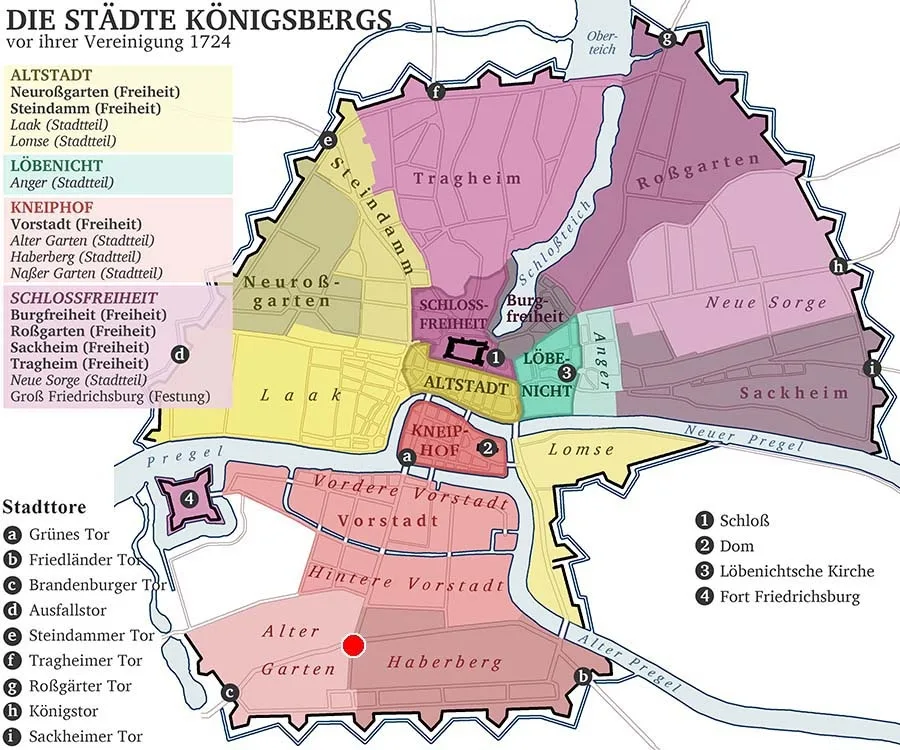
The southernmost districts of the "Innerstadt", Haberberg and Alter Garten, on a reconstructed map of the towns, suburbs and districts of Königsberg before their unification in 1724.
In 1522 the Order granted the village to the inhabitants of Kneiphof (Kneiphof) for their loyalty during the war with Poland of 1520–21.
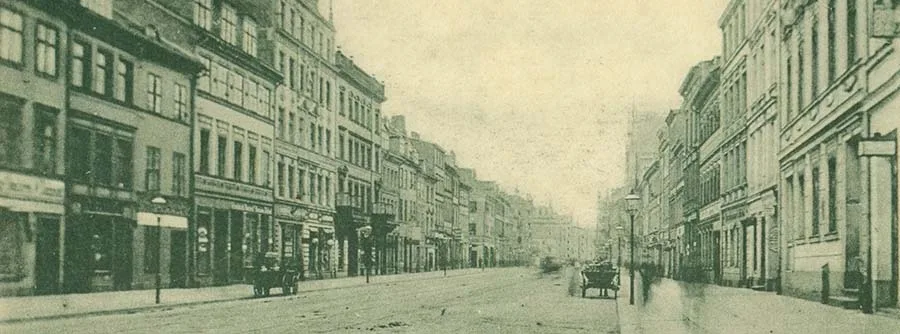
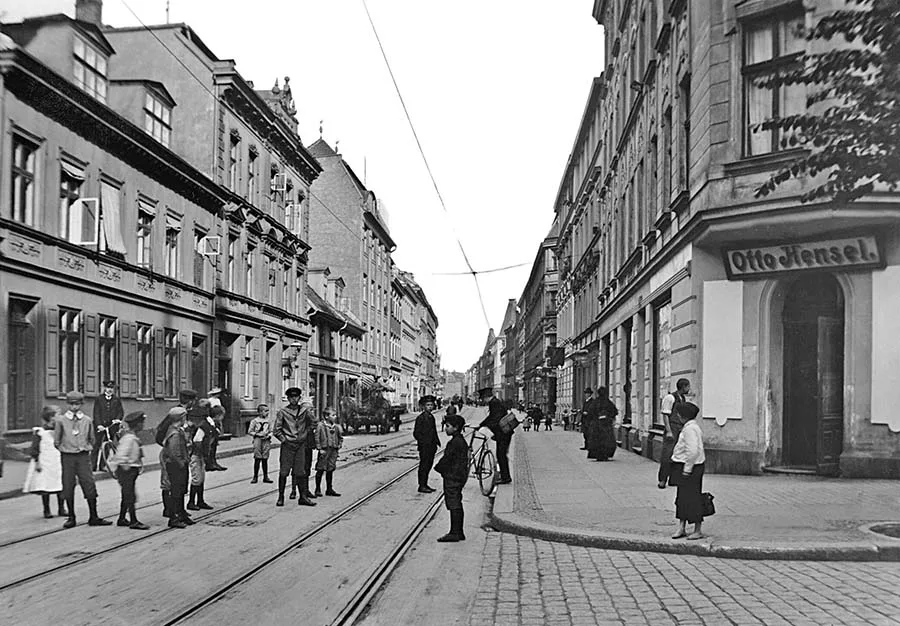 Lower Haberberg, the district's main street.
In the east, where the Meat Market is now, there used to be a hill that met Kneiphof's need for sand, as the name of the neighbouring Sand Lanes testifies (1–3. Sandgasse, now Bolshaya and Malaya Pesochnaya Streets).
To the east of today's Meat Market, as far as the hamlet of Neuendorf (Neuendorf, now the area before the junction of Yemelyanova Street with the Okruzhnaya ring road) beyond the Friedland Gate, a large oak forest once grew on the bank of the Pregel (Pregel); it has now vanished entirely. The local oaks were mostly used to build the street embankments in the Vorstadt (Vorstadt).
To the west Haberberg adjoins the village of Alter Garten, which stretches as far as the settlement of Nasser Garten (Nasser Garten).
In 1626 a fortification rampart was built that divided Nasser Garten into Old and New. The New one is today's Nasser Garten, while the Old one, which ended up inside the ring of ramparts, became Alter Garten (Alter Garten).
The "garden" name is explained by the many vegetable plots here that supplied the whole city with vegetables. Nasser Garten, lying just outside the city rampart, is still (1895) administered from Königsberg.
(The word "Nasser" can be translated as "damp" or "wet", so the whole name means Wet Garden. Alter Garten means Old Garden. Ed.)
This part of the city often suffered from fires. In 1520, during the military conflict with Poland that went down in history as the Horsemen's War (Reiterkrieg), the inhabitants of Kneiphof, seeing enemy detachments approaching, themselves burned the suburbs of Nasser Garten and the Vorstadt up to the Bypass Ditch (Zuggraben). On 10 May 1775, the Day of Repentance (Bußtag), fire again reduced everything here to ashes: Haberberg up to the Willow Dam, the Rear Vorstadt (Hintere Vorstadt), Alter Garten and Nasser Garten all burned down. Only the Haberberg Church (Haberberger Kirche) survived. The damage was estimated at a million thalers.
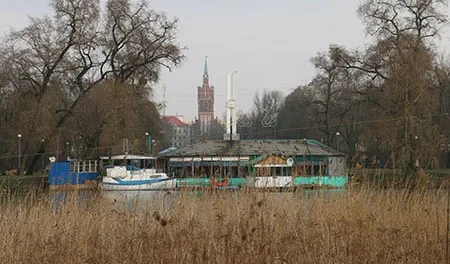
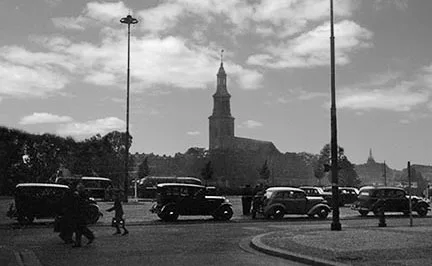
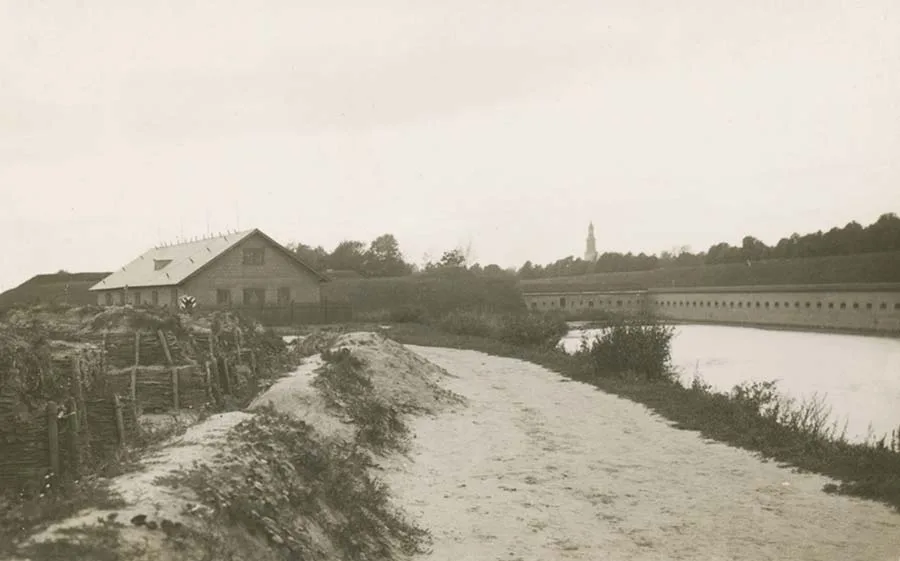 The spire of the Haberberg Church peeping out from behind the fortress ramparts.
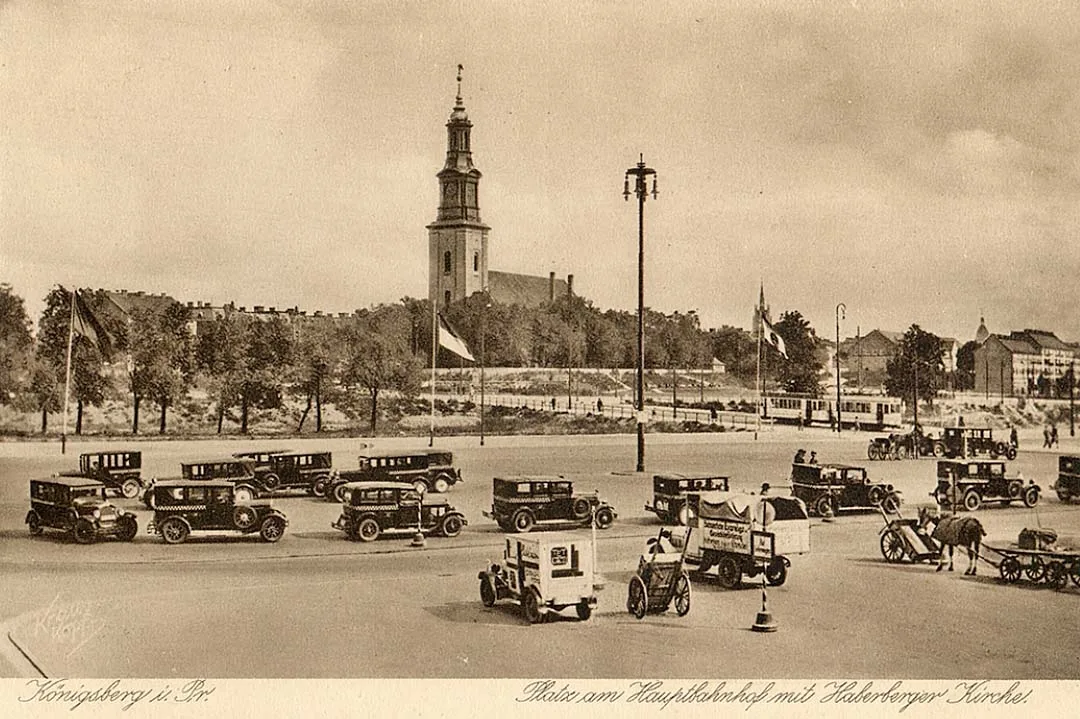
The district is poor in sights. Its most significant building is the Haberberg Church. It was founded in 1526 as a daughter church of the Cathedral (Königsberger Dom).
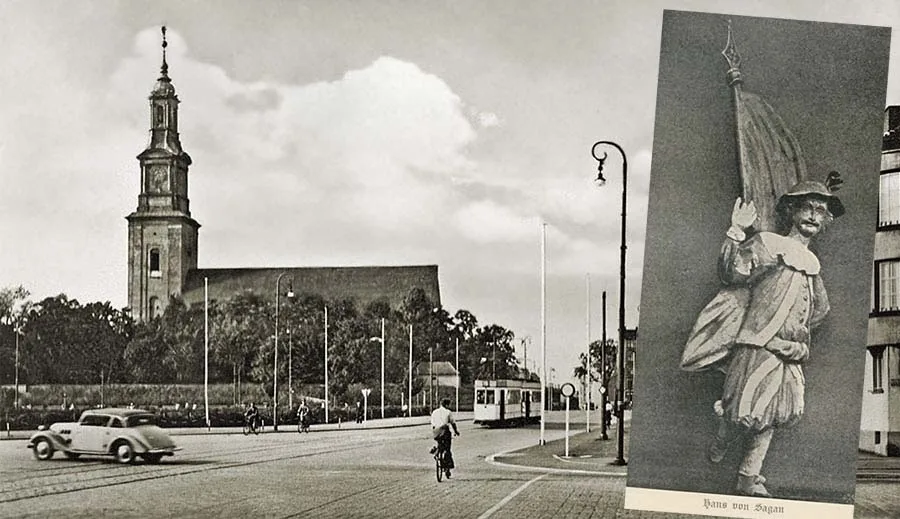
The Haberberg Church and the wooden statue of Hans von Sagan.
At first it was a chapel built with donations from the inhabitants of Kneiphof. In 1653 construction of a church began around it. Building proceeded slowly and was completed only in 1683.
Throughout the construction of the new church the old chapel remained inside it as if in a case, and it was dismantled only when the building work was finished. In 1652 an independent church congregation of Haberberg was organised, and the link with the congregation of the Cathedral was broken. In 1747 the church burned down completely after a lightning strike and was rebuilt in its present form in 1753–55. In 1783 it was struck by lightning again, but this time there was no fire. After that a lightning conductor was installed on the church, the first ever used in Königsberg.
The church is 57 metres long and 27 metres wide, and the roof is 36 metres high.
The plaster vaults of the ceiling are supported by 14 pilasters of Swedish stone in two rows. The pointed arches of the windows appeared only in 1853. Of great interest is the altar, richly decorated with carving and painting; it was consecrated in 1766 and cost 2,976 gulden.
(The church stood on the site now occupied by the House of Arts, known to old-timers as the Oktyabr cinema. Ed.)
In 1756 an organ built by Kasparini (Kasparini) was installed in the church. The tower is 77 metres high from its base to its highest point. The gilded figure of an angel on its spire is a weathervane 2.2 metres high and weighing 75 kilograms. It was put up in 1774 and regilded in 1820.
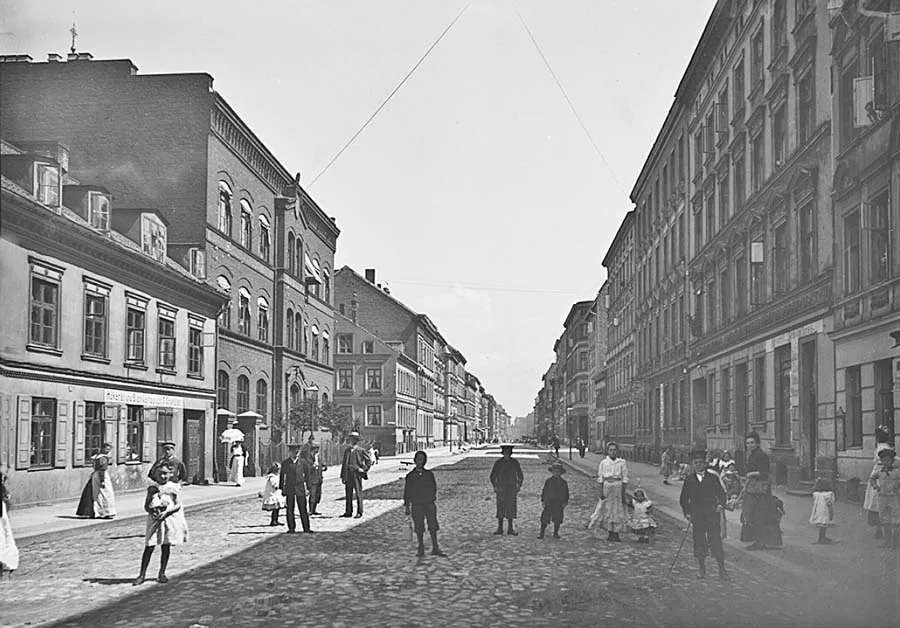 Upper Haberberg had no tram tracks, but was wider than Lower Haberberg.
In the outer wall of the churchyard enclosure a cannonball lodged in the masonry catches the eye. The inscription beside it reads: "In memory of the French bombardment of 14 June 1807".
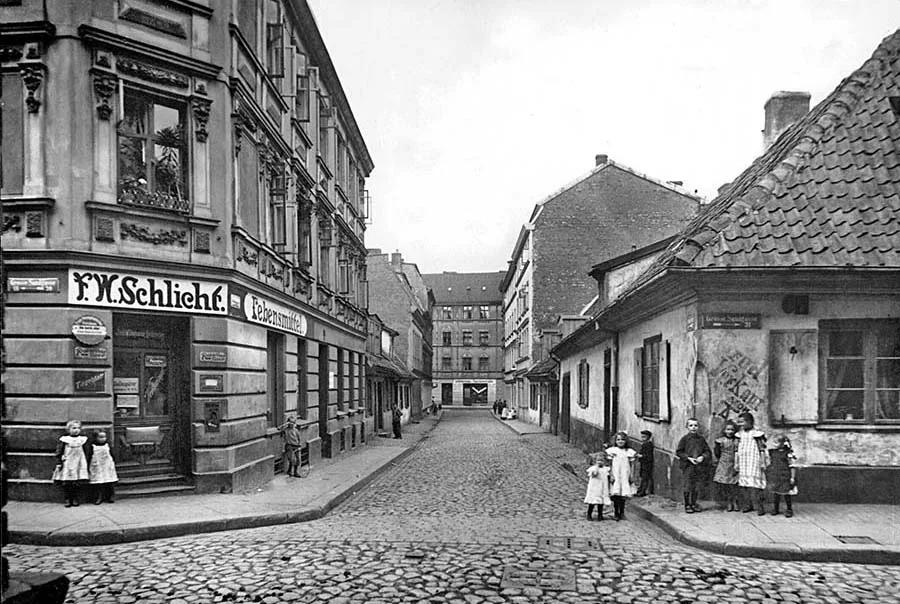 Sand Lane has kept its name to this day.
In the churchyard, in unmarked graves, lie three councillors of Duke Albrecht (Albrecht von Brandenburg-Ansbach, 1490–1568), Funck, Schnelle and Horst (Funcke, Schnelle, Horst), who in 1566 lost their heads on the scaffold for their part in the intrigues of the adventurer Skalich (Paul Skalich / Stanislav Pavao Skalić, 1534–1573). The Haberberg congregation's new cemetery is beyond the Brandenburg Gate (Brandenburger Thor), not far from Schönbusch (Schönbusch).
(Baltiysky Park, formerly Yuri Gagarin Park, was laid out on the site of this cemetery. Ed.)
Not far from the church there is an old pump (alte Pumpe), which until quite recently was adorned with a figure carved from wood. People called it Hans von Sagan (Hans von Sagan). Legend has it that during the war with Lithuania in 1370, at the Battle of Rudau (Rudau, now Melnikovo settlement), victory was won for the Teutonic Order by a cobbler's journeyman from Kneiphof, Hans von Sagan.
Although wounded in the leg, he boldly seized the fallen banner, thereby inspiring the small army of the Order, which decided the outcome of the battle in its favour. In gratitude the Grand Master invited the citizens of Kneiphof to a festive supper at the castle at Whitsun, and this became a city tradition.
Such a custom really did exist. But the festivity was probably held for reasons other than the story told above, and the Battle of Rudau took place not on Ascension Day but on the eve of Lent. The annual beer-tasting ceremony at the castle, the Schmeckbier (Schmeckbier), probably goes back to the traditions of the local guild of malt brewers: since the Order had its own brewery at the castle, a festive tasting was held there every year for its colleagues from the town, and the town's brewers in return invited their comrades from the Order, with their superiors, to a similar celebration. The chronicles last mention a beer party at the castle in 1619, when Elector George William came to power in Prussia.
(The Thirty Years' War (1618–48), which would all but ruin Prussia, had already begun, but few understood how long it would last and where it would lead. No doubt this and other medieval traditions were broken off by the calamities it brought. Ed.)
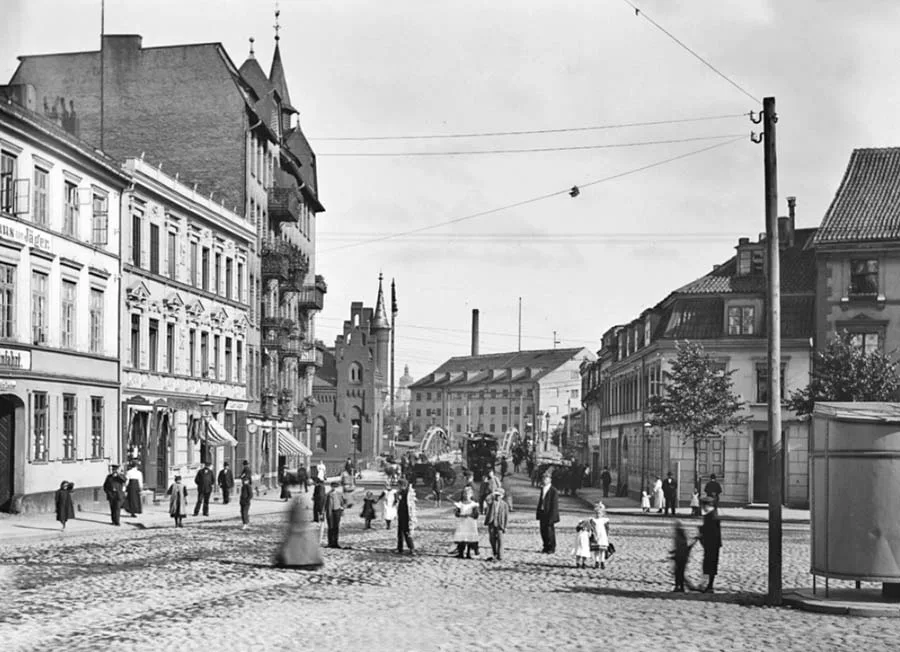 The Meat Market; in the background, the keeper's lodge of the High Bridge.
Incidentally, the plausibility of the legend of Hans von Sagan's feat also raises many questions. Although the name is mentioned in 16th-century chronicles in descriptions of various historical episodes, it appears only as that of a representative of the Kneiphof burghers.
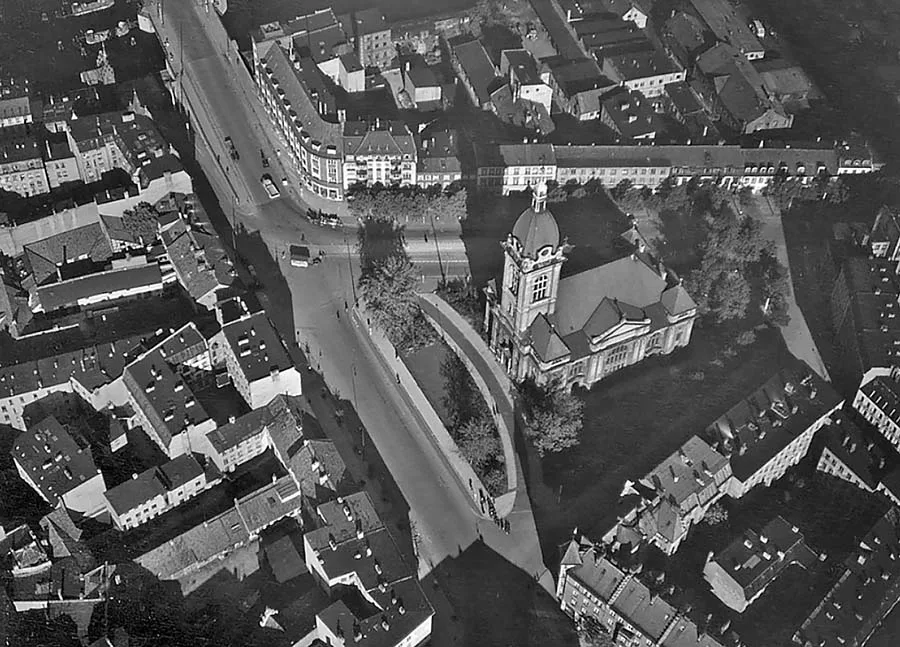 The Luther Church was built on the Meat Market in the 20th century.
Sometimes he appears as a shield-bearer in knightly armour supporting the coat of arms of Kneiphof. An image of the folk hero was on the old Shop Gate (Krämerthor). But his figure on the old well did not make the impression its makers had counted on.
Many people even believe that the figure on the well was Saint Florian (heiligen Florian), the protector against fires, whose figure traditionally adorns wells in many Catholic countries. Others see in it a generic image of a standard-bearer in 17th-century dress and regard it as merely decorative, with no resemblance to anyone in particular.
At No. 25 Lower Haberberg there is an educational institution for the deaf and dumb (Ostpreußische Vereins-Taubstummenanstalt), maintained mainly by private donations.
In the eastern part of the Meat Market, surrounded by large and unattractive buildings, the old Friedland Gate stood in front of the newest fortifications.
Remains of the old ramparts and moats can still be found today if we head towards the Grothe bathing establishment (Grotheschen Schwimmanstalt), the largest and oldest of the bathing places on the Pregel.
Not far from the baths is an oil store (Ölzmagazin) belonging to the city administration. It was built in 1812 as a field bakery, but in 1814 the building passed to the city and became a warehouse.
(The old fortifications used to run roughly along today's Olshtynskaya Street. Ed.)
The Friedland Gate is named after the town of Friedland (Friedland, now the town of Pravdinsk), since the road towards it passes through the gate. Like the other city gates, the Friedland Gate is built of brick and decorated with sandstone figures. On the inner side it is adorned with a figure of Count Friedrich von Zollern (Friedrich von Zollern, 1325–1368), and on the outer side with a figure of the Grand Master of the Teutonic Order Siegfried von Feuchtwangen (Siegfried von Feuchtwangen, 1273–1311).
Friedrich von Zollern was a member of the Prussian royal dynasty. He was Komtur of Balga Castle. During the Battle of Tannenberg on 15 July 1410, in which the Order was defeated, he was among those lucky enough to survive.
Siegfried von Feuchtwangen was Grand Master of the Teutonic Order in 1303–11. Having moved his residence from Venice to Marienburg (now the town of Malbork in Poland) in 1309, he transformed that town considerably for the better.
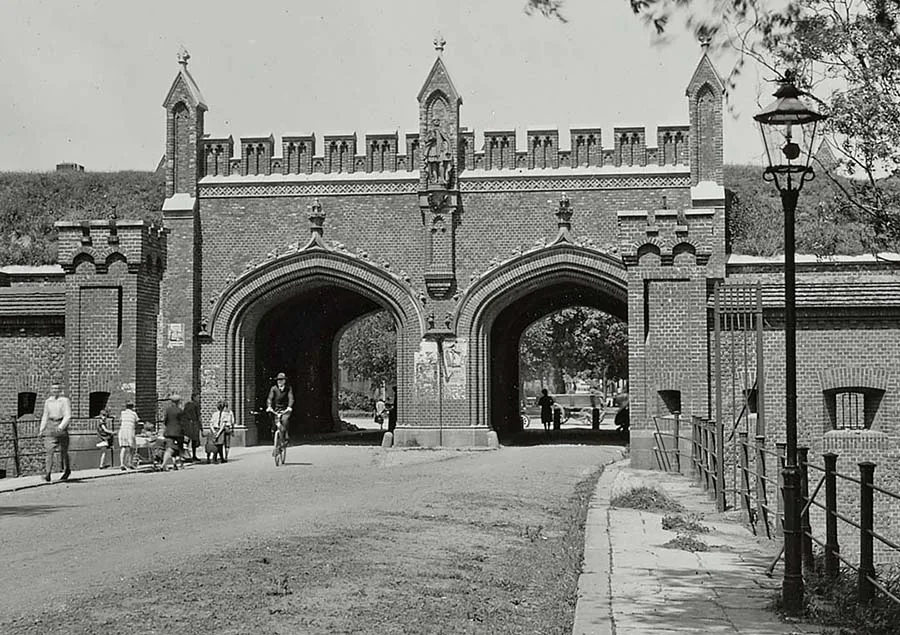 The Friedland Gate.
Along Haberberg Rampart Street (Haberberger Wallstraße) we walk past the ramparts and various military buildings and approach the Brandenburg Gate.
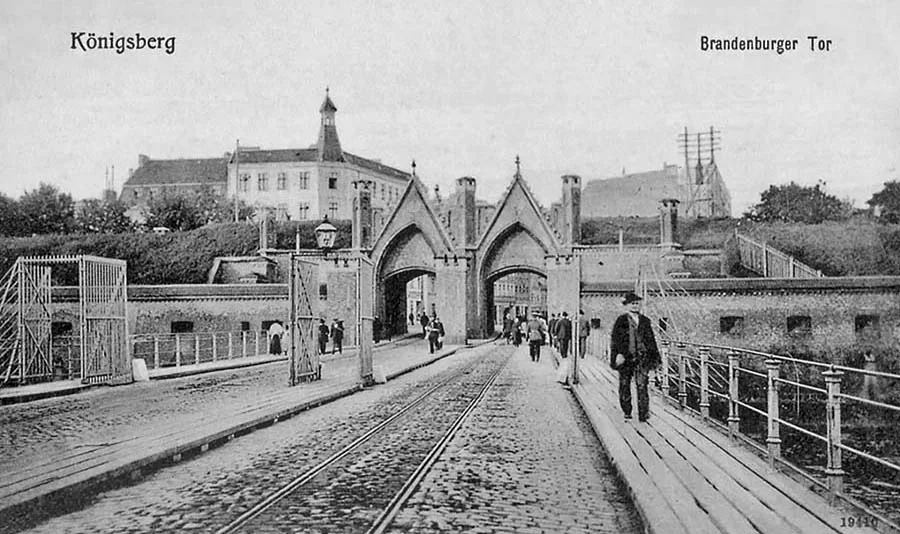 The Brandenburg Gate.
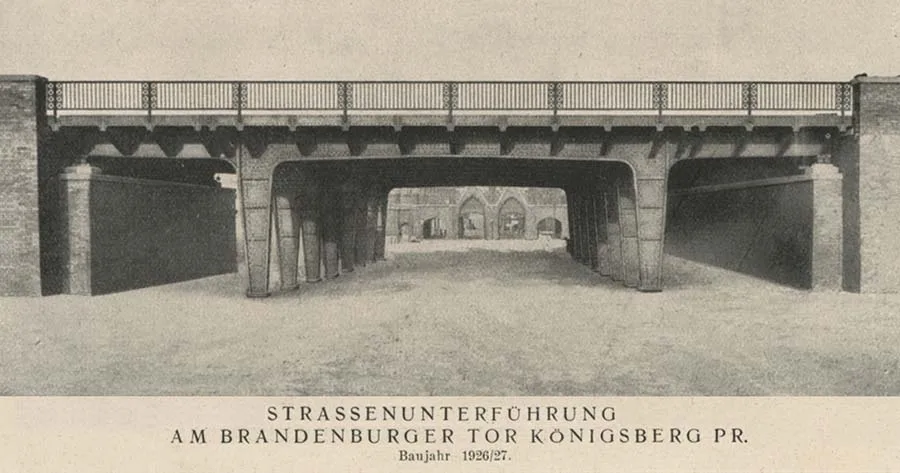 The railway viaduct in front of the Brandenburg Gate, built in the 1920s.
The gate takes its name from the small township of Brandenburg on the lagoon (Brandenburg, now Ushakovo settlement). On the inner side the gate is decorated with portraits of Generals Hermann von Boyen (Hermann von Boyen, 1771–1848) and Ernst von Aster (Ernst Ludwig von Aster, 1778–1855).
(Besides the village of the same name on the shore of the lagoon, the road through this gate led towards the Mark of Brandenburg. Ed.)
Hermann von Boyen took part in 1813, as chief of the general staff of the Third Army Corps, in the battles of Großbeeren, Dennewitz and Leipzig, and in 1814 in the battles of Laon and Paris, which brought him fame. Later he took part in the creation of the new Prussian army and headed the Prussian Ministry of War. His particular merit is considered to be the creation of the Landwehr (militia).
Ernst Ludwig von Aster rose to the rank of Prussian chief of the general staff of the Second Army Corps. He distinguished himself in 1815 in the battles of Ligny and Waterloo. He then served as inspector general of fortress construction.
The old Brandenburg Gate stood within the present rampart at the end of Brandenburg Gate Street (Brandenburger Thorstraße). It was plastered and painted yellow. It had only one passage. In front of it stood the Kneiphof Shooting House (Schießhaus der Kneiphöfer).
On this same street, at No. 4b (the street has not survived; it was the western continuation of Olshtynskaya Street), which runs past the Haberberg Church and continues as Upper Haberberg, stands the Provincial Institution for the Blind (Provinzial-Blinden-Unterricht-Anstalt), built in 1867. Here the blind are taught not only writing, arithmetic and reading, but also music, weaving and other crafts. All the goods they make are put up for sale. The proceeds go to the institution.
Photos on this page: Bildarchiv Ostpreußen / bildarchiv-ostpreussen.de.
Translated from Russian with the help of AI (Claude, Anthropic), October 2026.