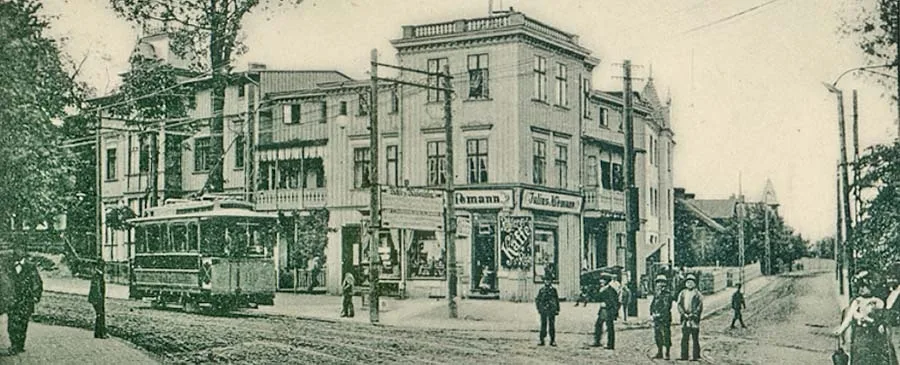
The connection between the city and the suburb of Hufen (Hufen) dates back to 1286, when the Order granted Altstadt possession of land on the northern bank of the Pregel (Pregel) as far as Lawsken (Lawsken, now Mendeleyev Street), extending half a mile inland from the riverbank.
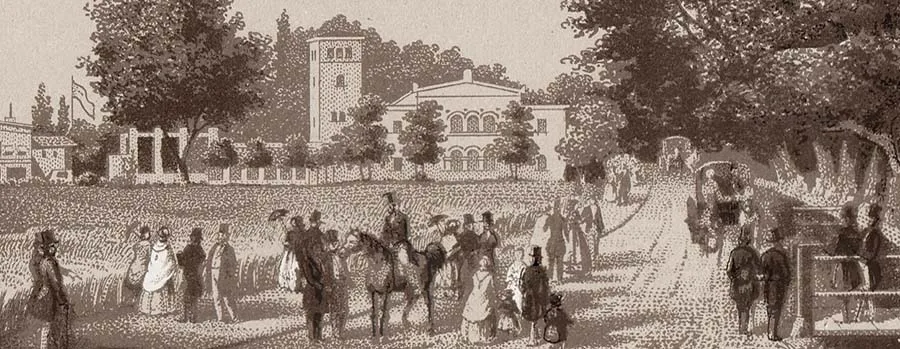
Gradually the suburb was settled and divided into three parts (from east to west): Near Hufen, Central Hufen and Far Hufen (Vordern Hufen, Mittern Hufen und Hintern Hufen, see below). These three parts did not form a single community, as they consisted of separate farmsteads and peasant holdings.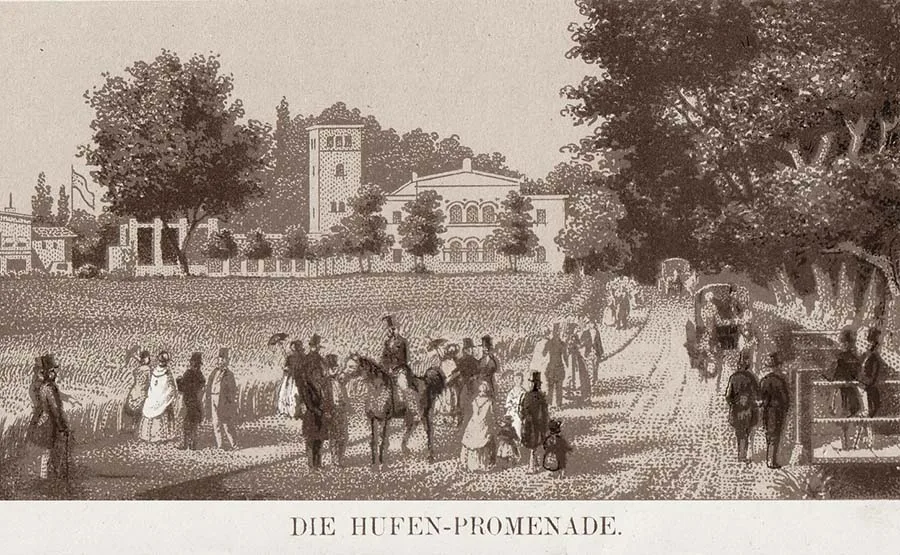 Hufen Avenue (today's Prospekt Mira) in the Napoleonic era.
There were once many woods in Hufen: as late as the beginning of the 18th century Altstadt kept a forester (Wildnisbereiter) here. His residence was in the very first house of Central Hufen, next to the Chaussee House (Chausseehaus).
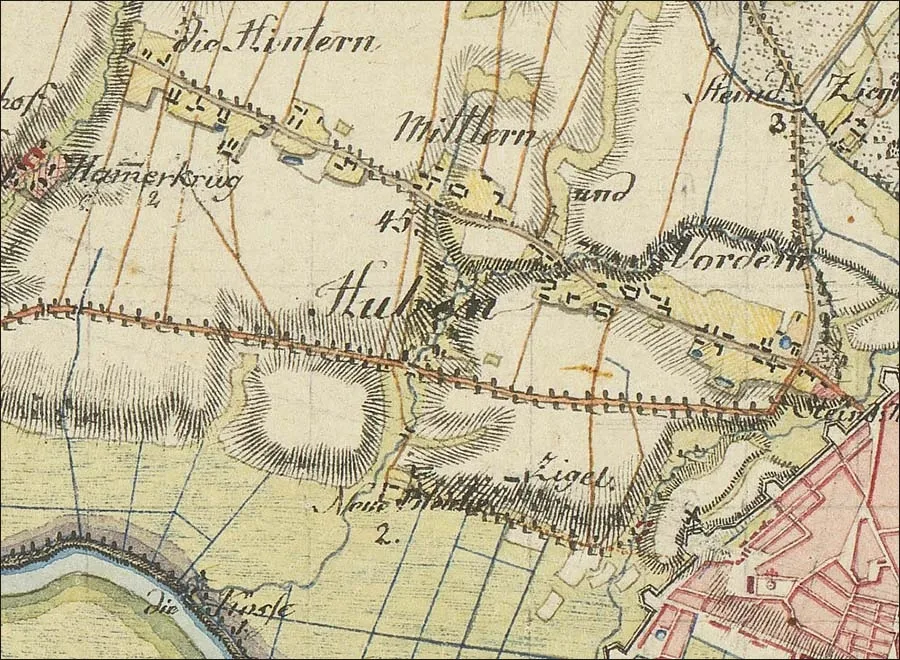 Hufen at the end of the 18th century, from the Steindamm Gate to the Ratshof Freigraben.
Today all three parts of Hufen form a single territorial unit.
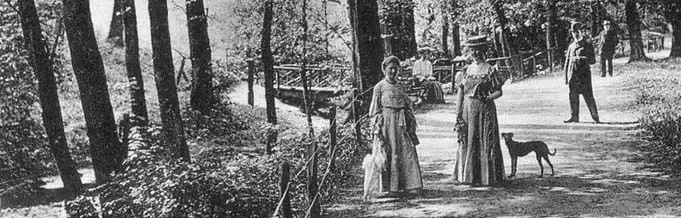
Crossed by a picturesque ravine, Central Hufen is a colony of villas with beautiful parks, among them our Tiergarten. In summer all classes of Königsberg society flock here. There is electric lighting, supplied by the power station in Luisenhöh (Luisenhöh).
(The name "Hufen" comes from an old term for a unit of area, which over time took on an abstract character.
In today's terms, the Hufen district occupies the area roughly from Sovetsky Prospekt in the east to Krasnaya Street in the west, and from Marshal Borzov Street in the north to Dmitry Donskoy Street in the south.
The forester's house stood on the site of today's Drama Theatre, near a former pond now marked by a small square with old willows. It is better to say nothing now about the "picturesque" ravine, as today it presents a rather neglected hollow. The division of the district into Near, Central and Far Hufen was somewhat arbitrary. Intensive building in the district began in the 1920s. Central Hufen was built up with multi-storey houses. On the outskirts of Hufen, in the 1930s, multi-section residential buildings appeared under a programme of mass housing provision for the population of Germany. — Editor's note.)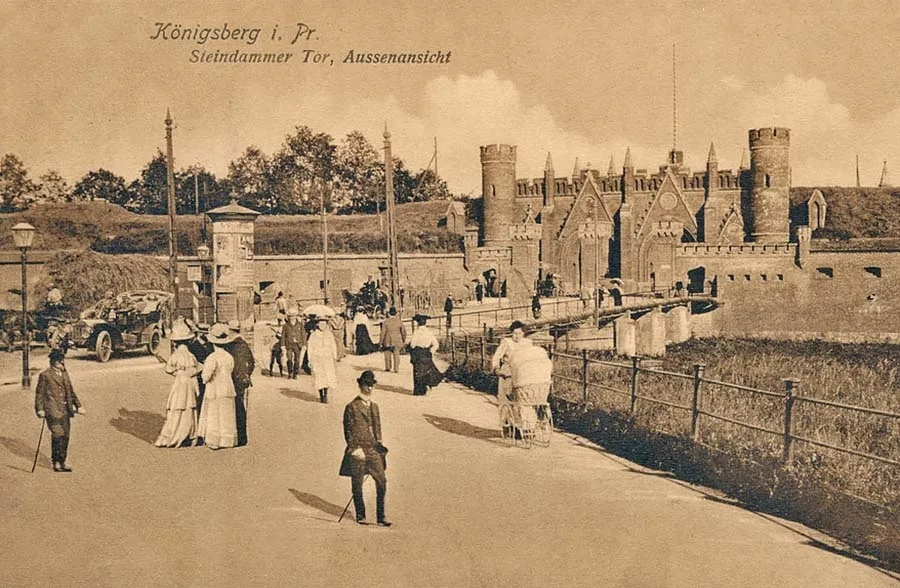 View of the Steindamm Gate from the Hufen side.
Street traffic is particularly busy on the road passing through the Steindamm Gate (Steindammer Thor).
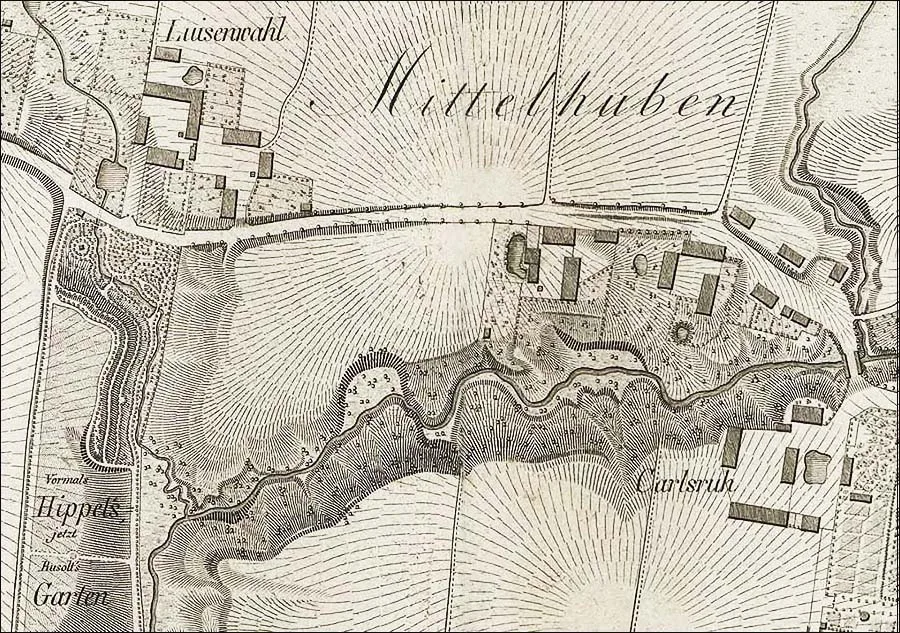
Hippel's Garden and Luisenwahl on a map of Central Hufen in 1815.
Immediately beyond the gate it forks: to the left a country road runs through Central Hufen (Mittelhufen) towards Fischhausen and Pillau (Fischhausen und Pillau), straight ahead it leads into Near Hufen (Vorderhufen), and to the right it goes to the simple half-timbered building of the Cranz Station (Cranzer Bahnhof).
In the immediate vicinity of the fork beyond the Steindamm Gate is a square belonging to the Horse Show Association (Verein für Pferdeausstellungen). Here we find the stables of the exhibition pavilion and the circus building (Cirkus).
To the west this site borders on the Panorama (Panoramagebäude), a rotunda building covered by a large dome. The Panorama was built in 1891.
Its inner walls are decorated with a panoramic painting. The spectators are meant to stand in the centre of the hall. This creates the impression that the viewer is, as it were, in the middle of the picture. Every year the Panorama is renewed.
(This area has changed beyond recognition today. The horse fair ground occupied quite a large area, now taken up by the buildings of the police and the Federal Security Service along Sovetsky Prospekt and by buildings on Handel and Brahms Streets. — Editor's note.)
At the beginning of Central Hufen is the Municipal Playground (Städtische Spielplatz), the like of which can hardly be found in any other German city.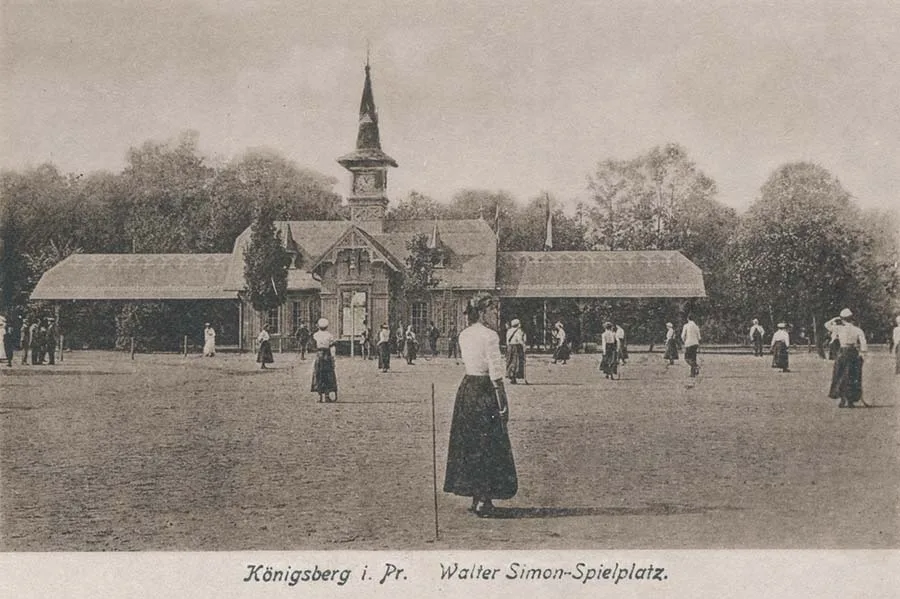 The Municipal Playground with a building for storing equipment and for exercise in bad weather.
Königsberg owes the appearance of the playground in 1892 to town councillor Dr Walter Simon (Walter Simon, 1857–1920), who made a donation that made it possible to finance its construction.
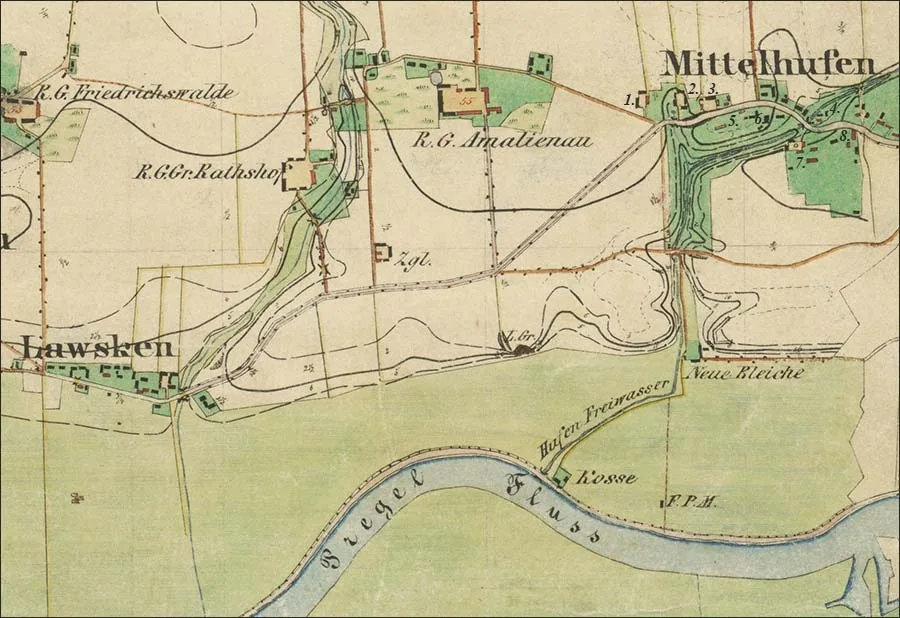 Amalienau appears on maps in the 19th century. 1. Kohlbornshof; 2. Louisenwahl; 3. Albrechtshöhe; 4. Hufenterrasse; 5. Villa Albrechtshöhe; 6. Julchenthal; 7. Carlsruhe; 8 Hufenpavillon.
He also contributed considerable personal funds for the upkeep of the facility and the purchase of play equipment. The children of Königsberg are able, under the guidance of experienced instructors, to play and do sports in the fresh air, taking a rest from their demanding school lessons. In 1895, at the expense of the same benefactor, an indoor gymnasium was built here, crowned, at his suggestion, with an elegant tower bearing a clock that can be clearly seen from afar.
The Municipal Playground covers 6.83 hectares, a third of which is taken up by paths and flower beds, which also attract many visitors. It is used most actively from May to October.
(The playground bore the name of its founder, Walter Simon (Walter-Simon-Platz). Under the Nazis the name of the Jewish patron was "forgotten", and the site was renamed Erich-Koch-Platz in honour of the Gauleiter of East Prussia (Erich-Koch-Platz). A football stadium was built on it, where the local team "Königsberg" played. In Soviet times the stadium was first renamed "Pishchevik", and later it came to be called "Baltika". — Editor's note.)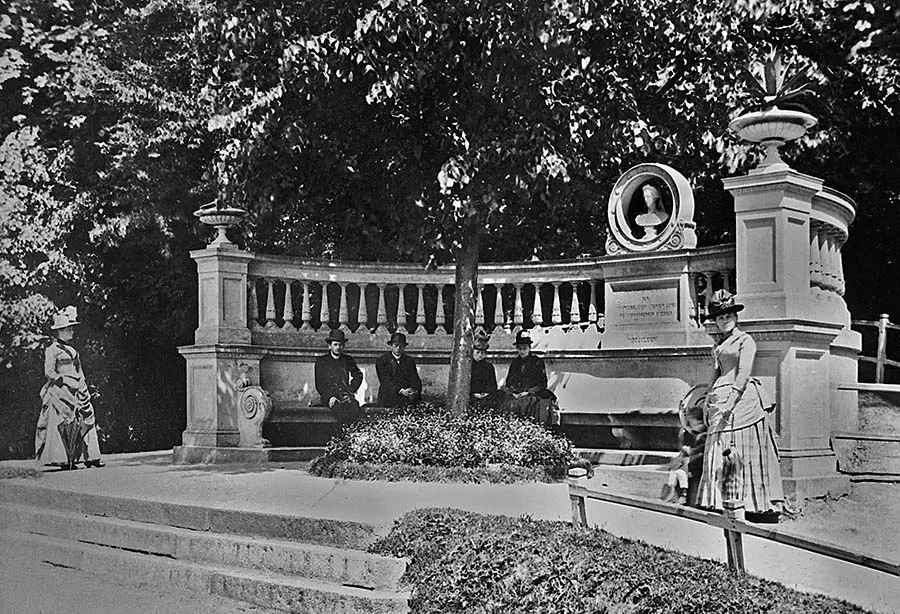
The Queen Louise Memorial by Christian Rauch (Christian Daniel Rauch, 1777–1857) in Luisenwahl Park.
Among the local luxurious gardens on both sides of Hufen Avenue (Hufenallee), let us mention Hufen Park (Hufenpark), where the North German Trade Exhibition (Norddeutsche Gewerbausstellung) is held.
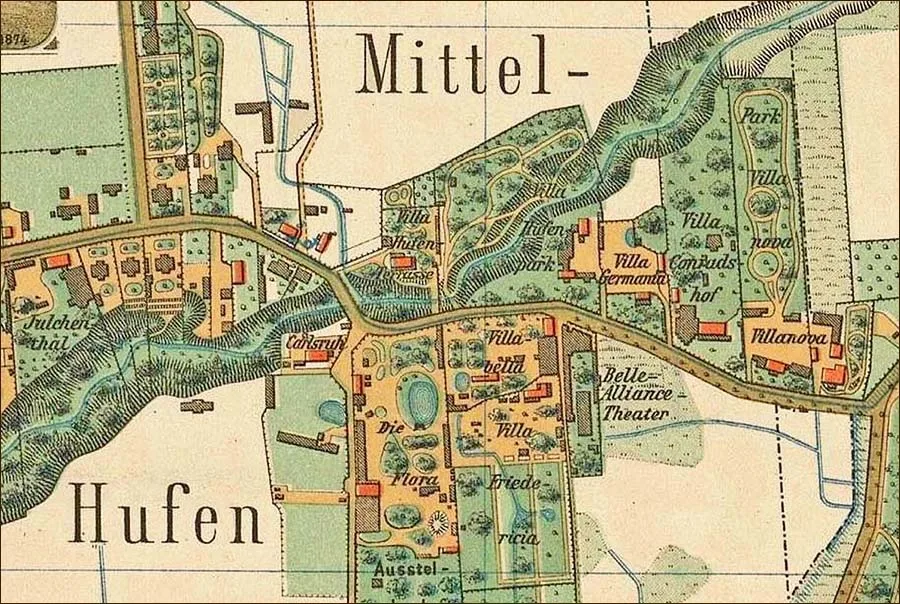 Gardens and villas of Central Hufen on an 1885 map.
Next to it is Luisenhöh, a charming natural park with a theatre, gardens and flower beds.
(Hufenpark occupied the western part of today's Zoo. On the south side of the street stood the "Belle Alliance" theatre. Luisenhöh is now an unkempt hollow of the Parkovy Stream, overgrown with wild plants, from Prospekt Mira to the Central Park — Editor's note.)
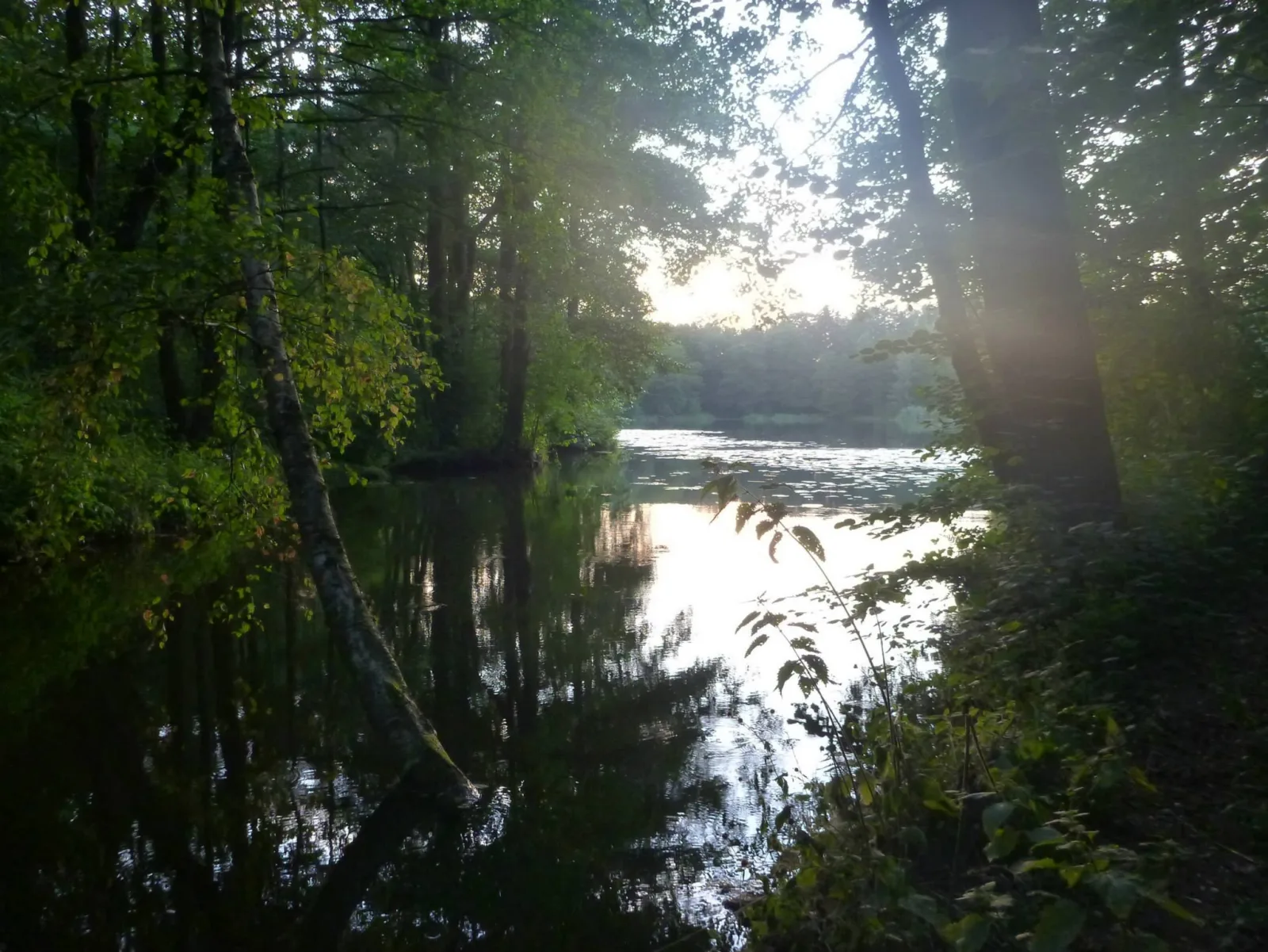
In the western part of Hufen lies Luisenwahl Park (Luisenwahl, which can be translated as "Louise's Choice"), through which flows the Hufen Stream (Hufenbach, now the Parkovy). The park is famous for its beautiful old trees and gardens with lawns. In its northern part, on a rise, stands a memorial to Queen Louise: a half-rotunda with a stone bench, adorned with a medallion bearing the queen's bust, beneath which a stone slab is inscribed: "To the Genius of Prussia, the unforgettable Queen Louise, from the citizens of Königsberg, 1874". The monument was consecrated on 2 September 1874. (The memorial half-rotunda in the Central Park has survived to this day in a sorry state — editor's note.)
Originally the land on which Luisenwahl Park was laid out belonged to the privy war councillor and city president Theodor Gottlieb von Hippel (Theodor Gottlieb Hippel von Hippel, 1741–1796).
He created a park here in the English style, as was typical of the time. After Hippel's death the park was acquired by government councillor Busolt (Gotthilf Christoph Wilhelm Busolt, 1771–1831). Opposite the park entrance, on the north side of Hufen Avenue, he built a simple country-style cottage, which still stands there unchanged. In the summer months of 1808 and 1809 Queen Louise (Königin Luise / Luise Auguste Wilhelmine Amalie zu Mecklenburg, 1776–1810) lived in this country cottage with her children. The great woman wept bitterly on learning of the horrors of the terrible war of 1806–1807; she hoped for the restoration of an independent Prussian state, which had been conquered by Napoleon. Without living to see her homeland rise again, Queen Louise died on 19 July 1810 at her father's castle of Hohenzieritz (Hohenzieritz) at the age of only 34. In memory of his mother, Queen Louise, Emperor William I (Wilhelm I / Wilhelm Friedrich Ludwig von Preußen, 1797–1888) later bought Busolt's estate.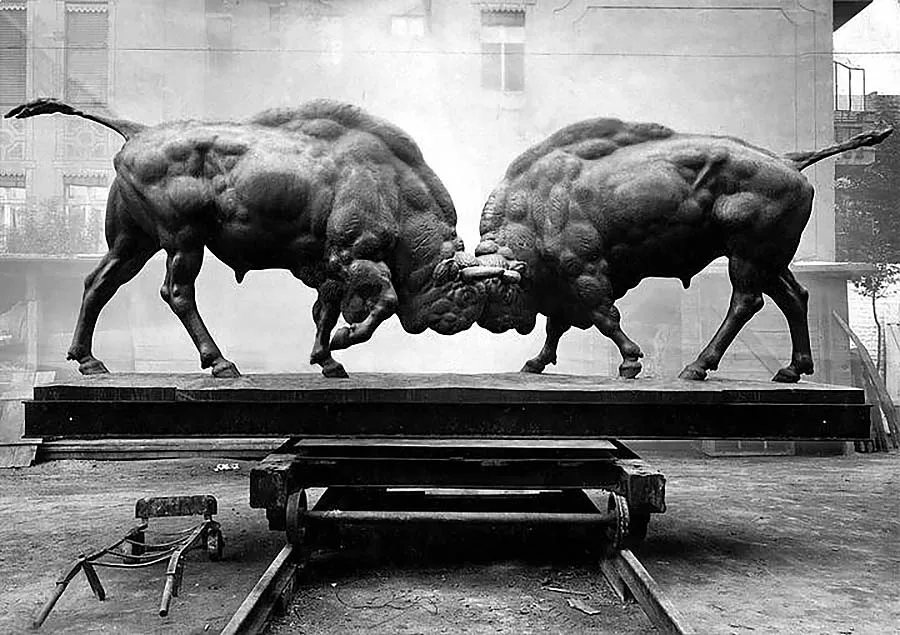 The Hufen "Bulls" by August Gaul (Georg August Gaul, 1869–1921) on leaving the foundry.
In the summer of 1812, before his campaign against Russia, the French Emperor Napoleon, planning to stay in Königsberg for three days, intended to put up at Busolt's estate, as he had heard that the royal family had lived there.
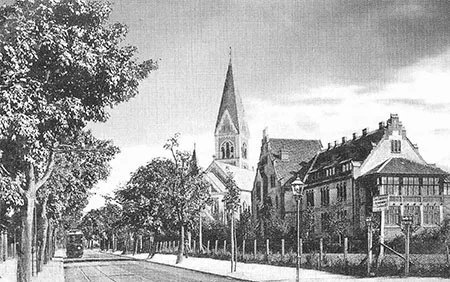
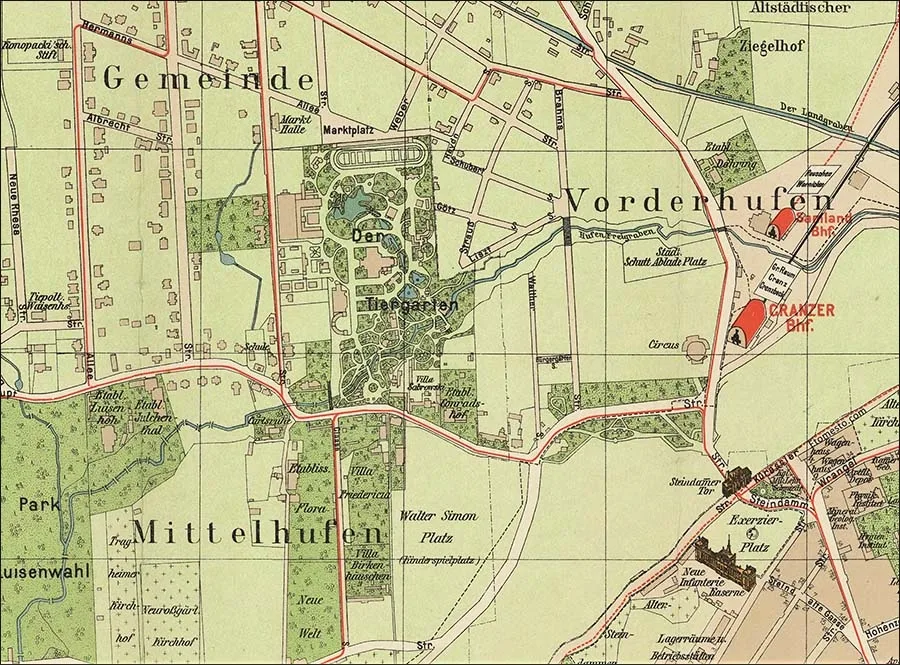 Hufen at the beginning of the 20th century, between Luisenwahl and the Samland Railway Station.
Bonaparte expected to see a luxurious royal residence and was extremely surprised to find a simple village cottage. He immediately turned back to the city and stayed at the castle.
(There is a version of how the park got its name: supposedly in 1796 councillor Busolt named the park after his wife Louise. After 1945, according to unconfirmed reports, the cottage housed a canteen and later a photo studio. Then this historical relic was demolished, and around 1995 a building of the Mormon religious community was put up in its place. — Editor's note.)
_______________
Königsberg from A to Z
In 2015–16 the same almanac published the work "Königsberg from A to Z" ("Königsberg von A bis Z", Dr. H. M. Mühlpfordt, 1972) by the Königsberg physician and keen local historian Herbert Mühlpfordt, who, forced to leave his native land, became a very prolific author in the post-war East Prussian émigré press. In the chapter "The Near Outskirts of Königsberg" he related everything he remembered about the history of Hufen. We offer this passage for your attention.
Hufen (Hufen), the western suburb of Königsberg, was first mentioned as early as 1300 as Huben (Huben); the name derives from an old measure of area. In 1710 the oldest inhabitant of Huben was the Altstadt forester of the Kapornsche Heide forest.
Wealthy Königsbergers loved summer outings to Hufen, so in 1786 city president Theodor von Hippel (Theodor Gottlieb von Hippel, 1741–1796) had the road in that direction covered with wooden planking, which made it possible to drive along it (later Hufen Avenue) as far as Pojenter Hof (Pojenter Hof) even in rainy weather.
When at the beginning of the 19th century this wooden surface began to rot, the owners of the local mansions set up the "Log Roads" society to renew it, which for some time coped successfully with the task.
Where the "Yellow" inn once stood on the land of the banker Adler, there is now "Carlsruhe". In a garden house belonging to it, which stood above the Freigraben ravine with its stream, where the villa "Hufenterrasse" later appeared, lived the deacon Christoph Wasianski (Ehregott Andreas Christoph Wasianski, 1755–1831), Kant's caring friend. Shortly before his death the great philosopher visited this place.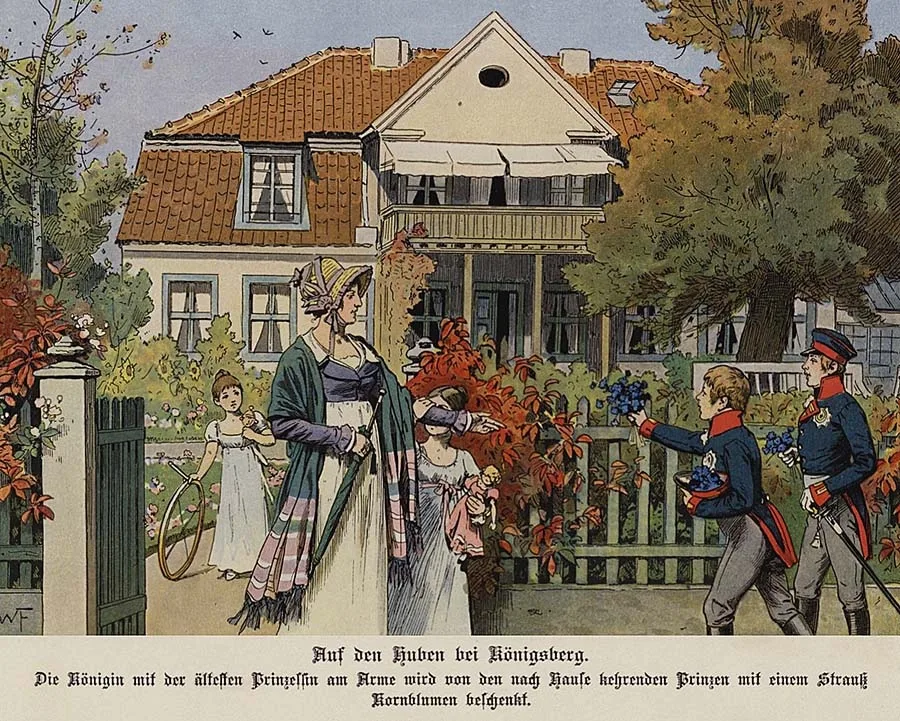 Queen Louise with her children in her Königsberg refuge in Hufen.
In 1807 the "Carlsruhe" grounds were sold to the "Flora" establishment, which became such a fashionable place for leisure and entertainment that in 1879 the city held an official reception there in honour of the imperial family.
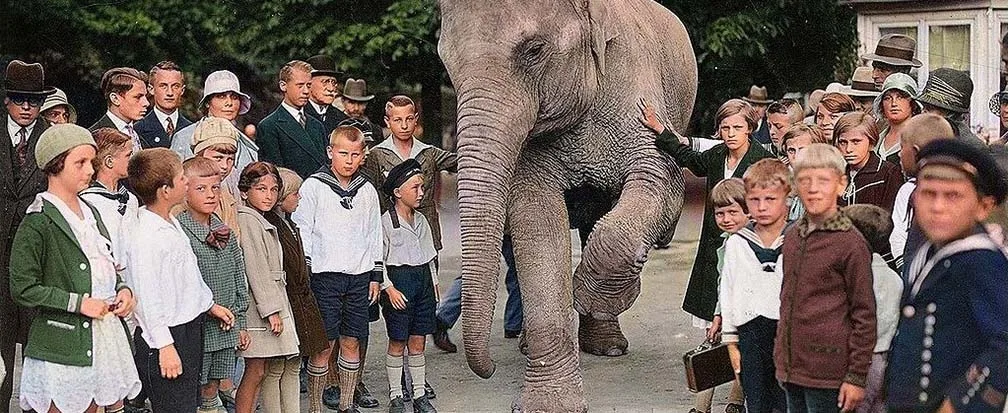
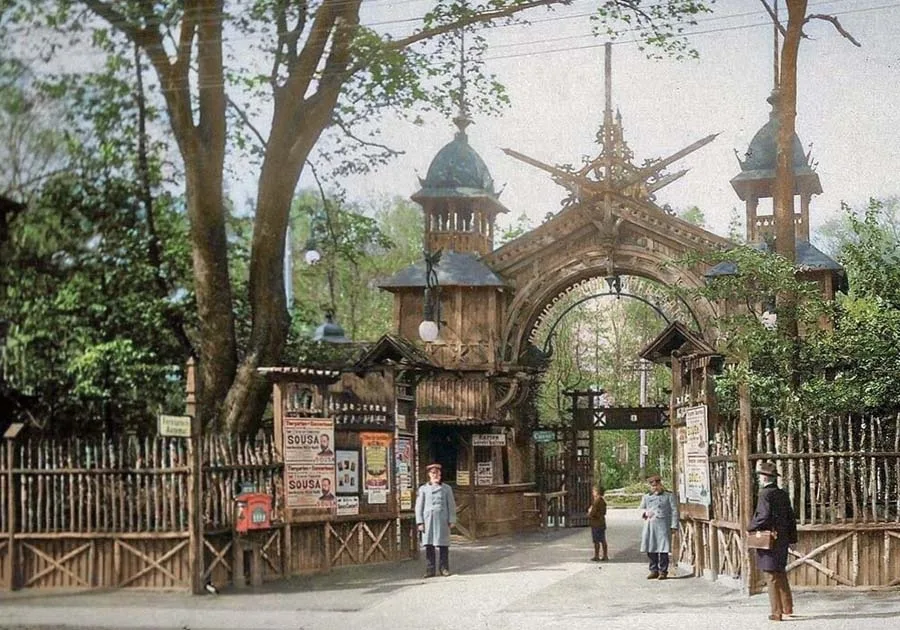 The old main entrance to the Zoo from Hufen Avenue.
In 1812 the old Lauerhof (Lauerhof) became the villa "Konradshof". In 1826 seven villas burned down together with everything around them. In 1829 the Kunststraße was built through Hufen as far as Lawsken. Near the forester's house, now the Chaussee House, was the "Legan" inn. On part of the estate of the district head (or tenant of state lands) Albrecht (Karl Gottlieb Albrecht) by the Hufen ravine (Hufenschlucht) east of Luisenwahl (Luisenwahl), the "Albrechtshöhe" establishment arose, later renamed "Luisenhöh". Here in 1870 the actor Saalmeyer (Saalmeyer) performed in the farces popular at the time.
Thanks to the villas built by financial magnates, the centre of the city's summer recreation moved from the Castle Pond to Hufen.
Here there appeared the "Konradshof" establishment, the "Villa Nova" park, and the villas "Hufenpark", "Hufenterrasse", "Ragutzki", "Friederike", "Bella" (later the Amende confectionery), "Birkenhäuschen" ("Little Birch House"), "Fortuna", "Flora", "Drachenfels", "Julchenthal" and the villa "Kurowski" by the Chaussee House (the last was demolished in 1911).
Closer to the city, by the "Legan" inn, the "Panorama" was built in 1891 (see above, in Armstedt and Fischer — ed.), and further east a wooden circus building appeared.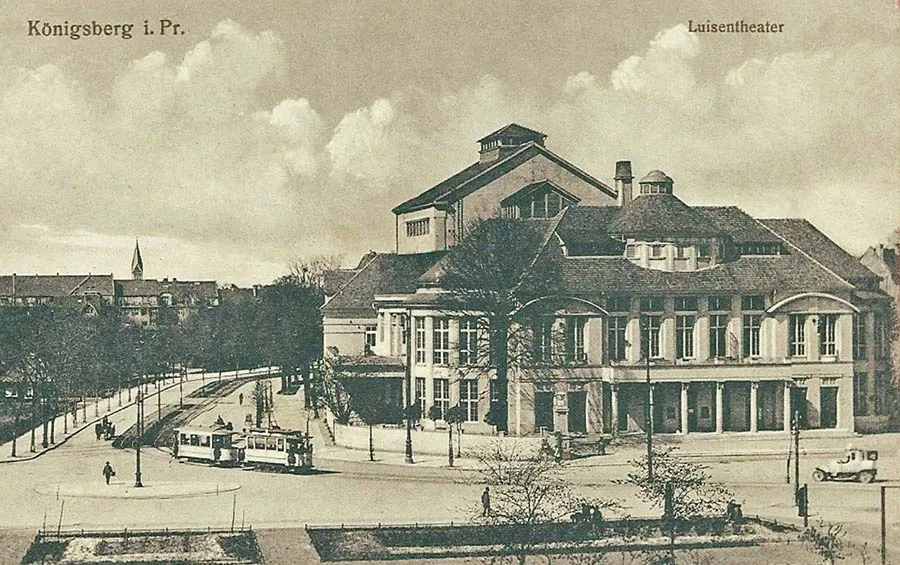 The Luisentheater, one of the symbols of Hufen, was built in the early 1910s.
Opposite the "Villa Nova" park, in 1892 town councillor Dr Walter Simon (Walter Simon) bought a plot and soon gave it to the city as a playground.
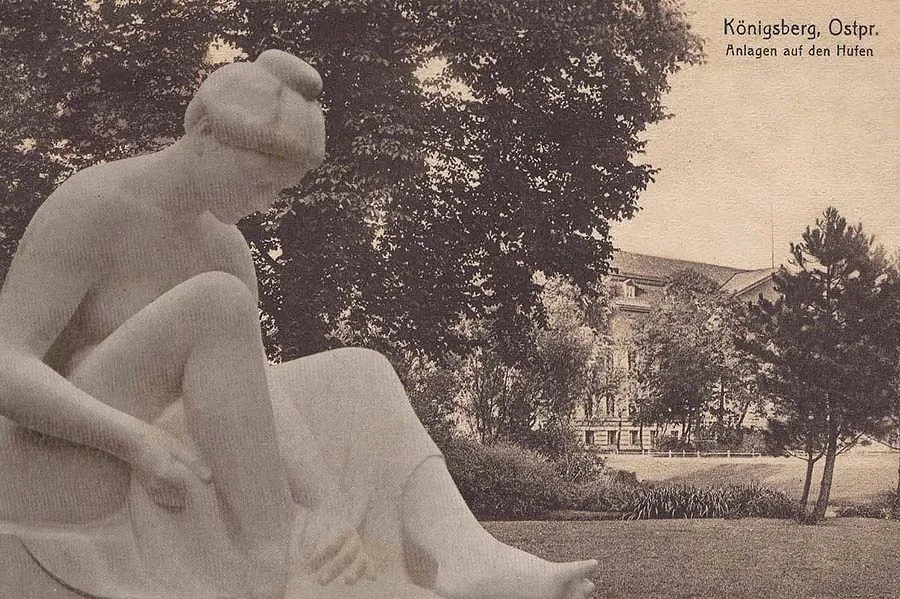 "The Bather" by Stanislaus Cauer, which adorned Hufen.
In 1899 Emil Hannemann (Emil Hannemann) founded the Summer Theatre (Sommertheater) in Luisenhöh. In the ravine by Julchenthal, in 1900, in connection with the "Boer enthusiasm" (Burenbegeisterung, support for the Boers' struggle against the English colonialists in South Africa), the establishment "Papa Kruger" (or "Uncle Kruger", German "Ohm Krüger") arose, later the "Julchenthal" confectionery ("Julchenthal"). In 1901 the Chaussee House and the "Legan" inn ("Legan") were demolished, and in 1911 a small pond was laid out on their site, next to which Cauer's "Bather" ("Badende", Stanislaus Cauer, 1867–1943) appeared. Nearby, the Luisentheater (Luisentheater, see above) was built to a design by the local architect Kuckuck (Otto Walter Kuckuck, 1871–1942).
Gradually the establishments gave way to residential buildings. In 1913 a promenade was opened along the bank of the Freigraben stream in the Hufen ravine (Freigrabenschlucht). In 1930, to a design by government building councillor Liebenthal (Robert Liebenthal), a building for the State Archives (Staatsarchiv) was erected on Hufen Avenue at a cost of 705,000 Reichsmarks.
Illustrations: Bildarchiv Ostpreußen / bildarchiv-ostpreussen.de.
Translated from Russian with the help of AI (Claude, Anthropic), October 2026.