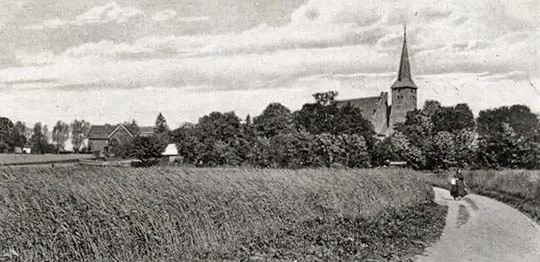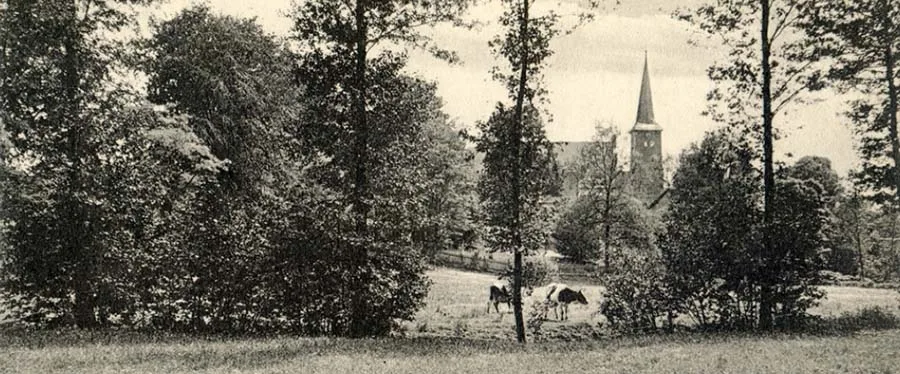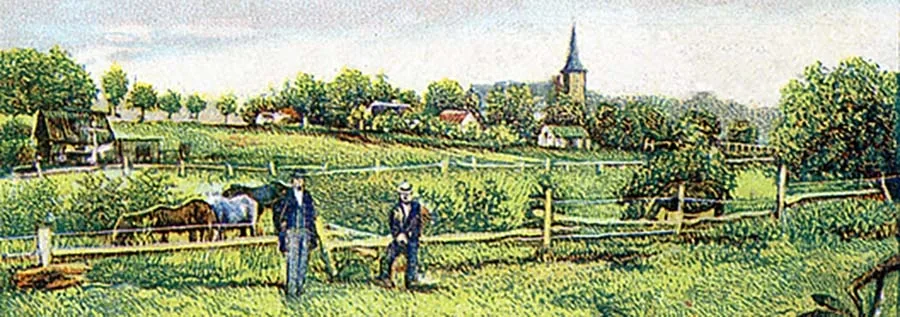
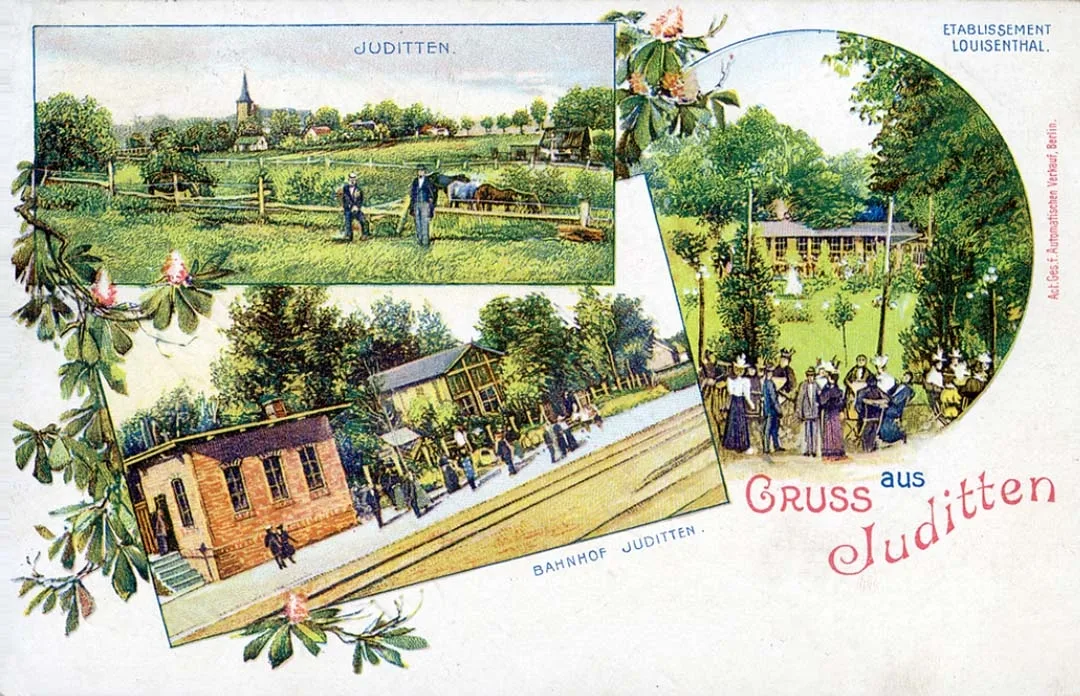
Between 1288 and 1298 a church was built in Juditten; it has survived to this day and is the oldest building on the territory of Kaliningrad. On its construction the church was dedicated to St Mary. Around 1330 the Juditten church received a new roof and vaulted ceilings. At the end of the 14th century a tower was built next to the nave; it was essentially a separate structure, joined to the main building only later. Around 1470 a family burial vault of the von Röder family was added to the church.
In 1577, during repairs to the church, the spire of its tower was adorned with a weathervane.
In 1672 a wooden altar with painted elements and gilding was installed in the Juditten church. In 1686 a carved wooden pulpit with portraits of the Evangelists was added on one side of the pointed arch.
On 02.02.1700 Johann Christoph Gottsched (d. 1766), the German writer, playwright and literary theorist, was born in the parsonage of the Juditten church. In 1760 the Juditten estate was acquired by the wine merchant Balthasar Schindelmeißer. In 1768 the Prussian field marshal and veteran of the Seven Years' War Johann von Lehwaldt (1685–1768) was buried in the vault of the Juditten church.
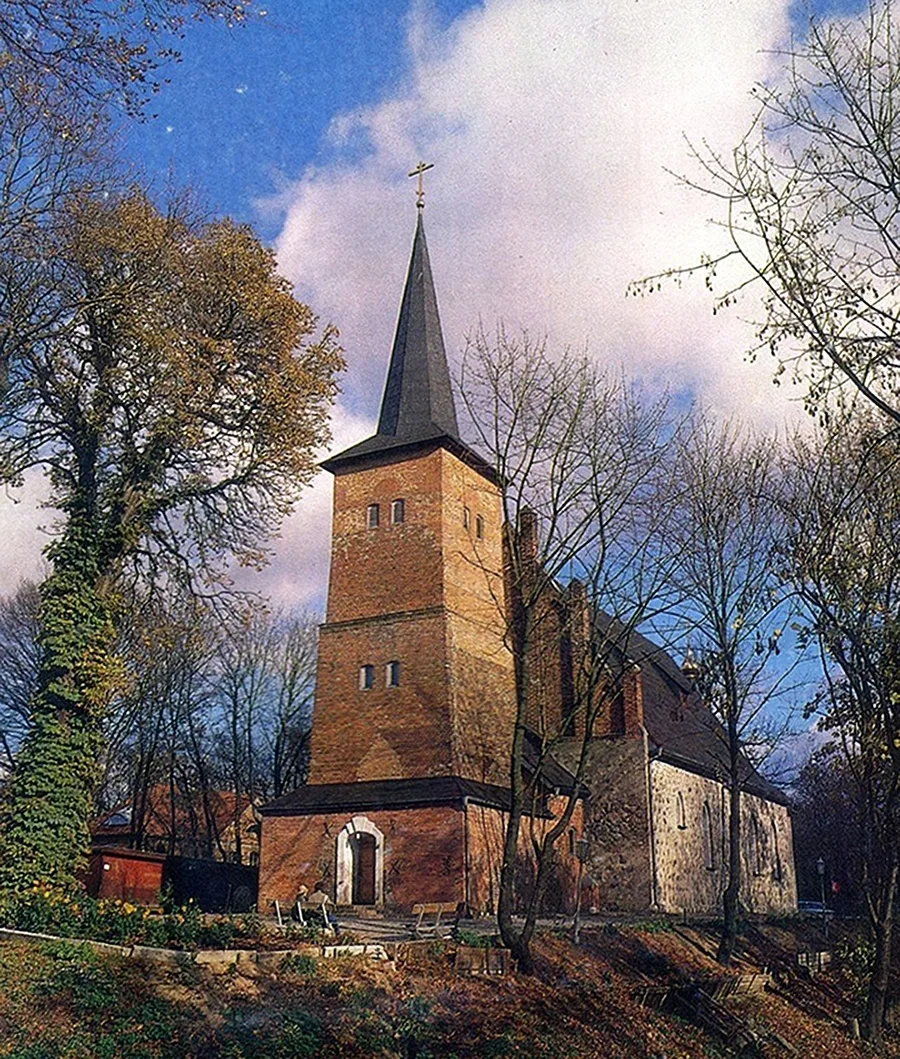 The tower was added to the Juditten church at the end of the 14th century.
In 1785 Juditten was classified as a "royal village with a church and a royal mill" (Königlich Dorf mit einer Kirche und einer Königlich Mahmühle).
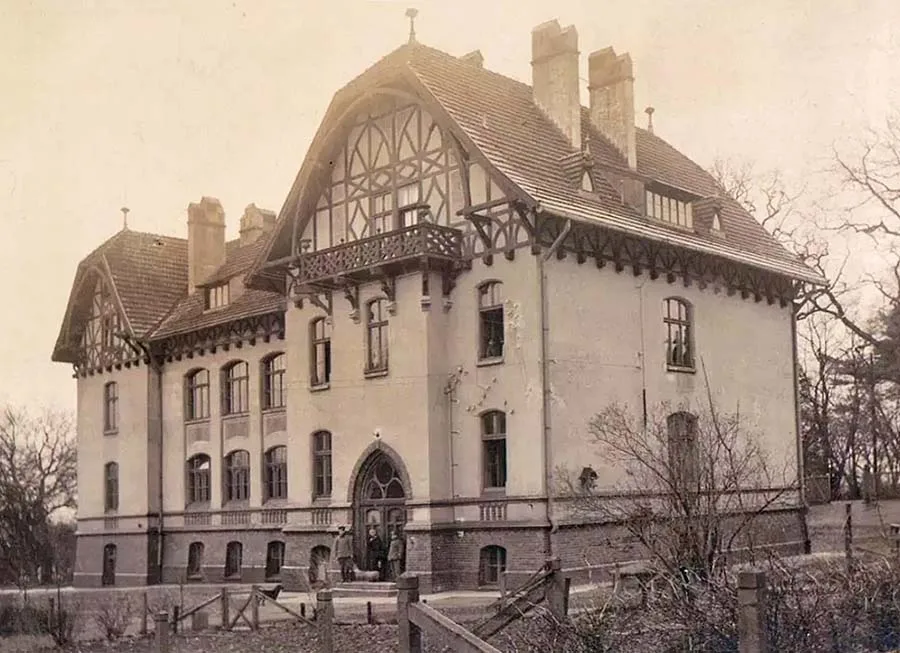 The Juditten old people's home, for those who were lucky in life.
The mill in Juditten also appears as the Kaddigmühle. At that time there were four households in Juditten. By 1818 their number had risen to nine. In this period Juditten appears in documents as a "royal village and mill" (Königlich Dorf und Mühle).
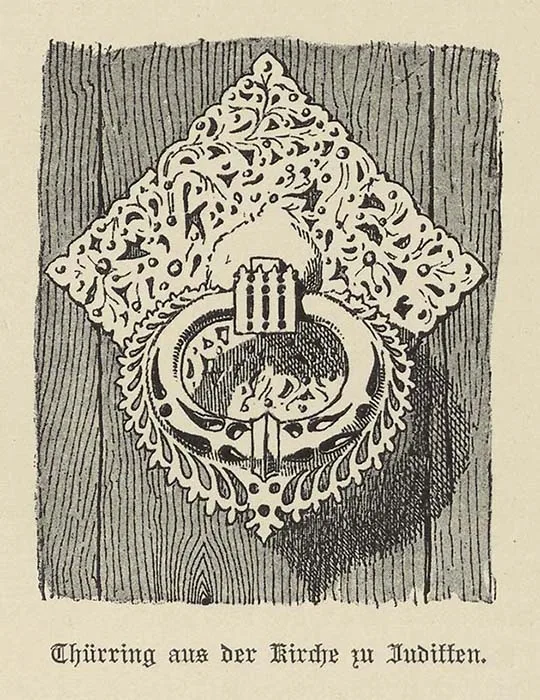
In 1819 the Juditten church underwent another repair, during which some rooms were remodelled and a vault was built connecting the tower with the nave. In 1840 an organ was installed in the Juditten church.
On 11.09.1865 traffic opened on the Königsberg–Pillau railway, which ran along the southern edge of Juditten. A passenger platform was built on it about half a kilometre from Juditten (today's Brusnichnaya station).
In 1871 the Juditten municipality had eight residential houses, home to 12 families and one single man. Of these, five houses stood in the village itself, while three more belonged to the Juditten mill. At that time the settlement had a contradictory status: whereas in 1871 a rural municipality is mentioned consisting of the settlement by the Juditten mill (Juditten Mühle) and the settlement by the Juditten church, by 1874 only the settlement by the mill appears, as a territory belonging to no municipality or Gutsbezirk. On 30.04.1874 the Juditten mill, as an independent entity, was included in the newly established Amtsbezirk of Juditten, and in 1883 the rural municipality of Juditten is again mentioned as part of this Amtsbezirk. On 30.03.1910 the village of Lawsken, which had previously formed a rural municipality of its own, was incorporated into the rural municipality of Juditten.
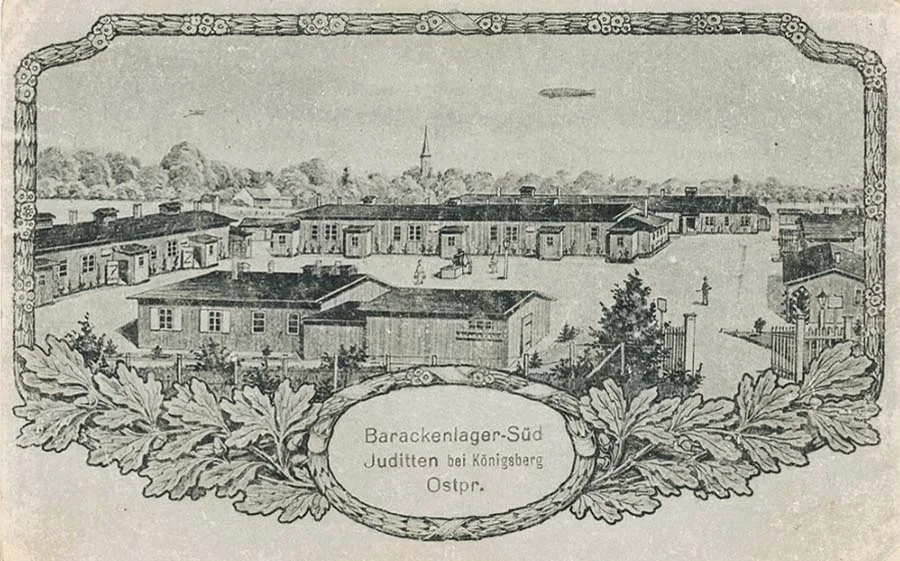
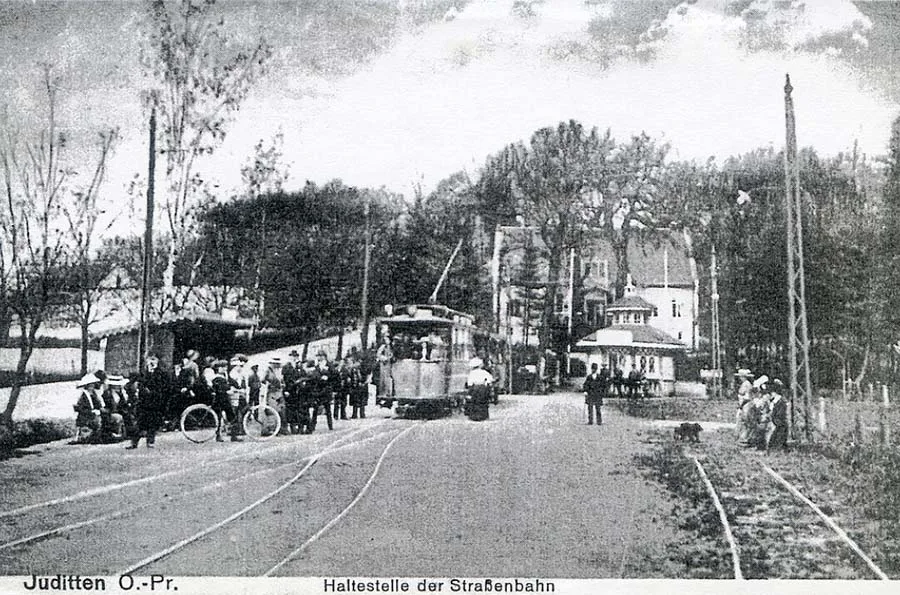 The terminus of tram route No. 7 in Juditten.
On 16 June 1927 the municipality of Juditten was incorporated into the city of Königsberg.
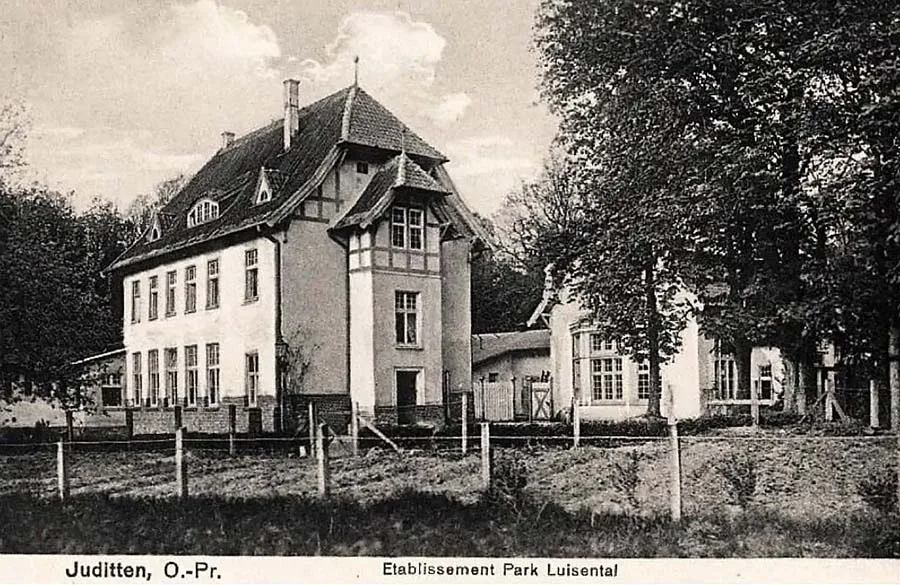 The "Etablissement" (out-of-town restaurant) "Luisenthal Park".
The Amtsbezirk of Juditten
On 30.04.1874 Amtsbezirk No. 21 Juditten was established in the Landkreis of Königsberg. It comprised four rural municipalities: Lawsken (part of Mendeleyevo), Moditten (the A. Kosmodemyansky settlement), Spittelhof (part of Mendeleyevo) and Wallenthal (54°42'55'' N 20°24'14'' E); five Gutsbezirke: Charlottenburg (Lermontovo), Adlig Friedrichswalde (part of Mendeleyevo), Groß Rathshof (Vozdushny), Klein Rathshof (Kaliningrad, beginning of Lomonosova Street) and Moditten (the A. Kosmodemyansky settlement); and also the Juditten Mill (Juditten Mühle), which belonged to no municipality or Gutsbezirk.
On 26.10.1882 the Gutsbezirke of Amalienau (Kaliningrad, Kutuzova Street) and Groß Friedrichsberg (Sovkhoznoye) passed to the Amtsbezirk of Juditten from the Amtsbezirk of Amalienau (Kaliningrad, Kutuzova Street).
By 1883 the Amtsbezirk of Juditten consisted of two rural municipalities, Juditten and Lawsken, and seven Gutsbezirke: Amalienau, Friedrichswalde (part of Mendeleyevo), the former Friedrichsberg demesne (Sovkhoznoye), Groß Friedrichsberg (Sovkhoznoye), Groß Rathshof (Vozdushny) and the forest Gutsbezirk of Kobbelbude, Forst, administered from the Kobbelbude Head Forestry (Bobrovo).
On 16.09.1904 a new Gutsbezirk, Waldgarten (Kaliningrad, the Fort 5a area), was split off from the Gutsbezirk of Amalienau (Kaliningrad, Kutuzova Street); it too became part of the Amtsbezirk of Juditten. On 01.05.1905 Amalienau was divided between the municipality of Königsberg and the rural municipality of Neuhufen (Kaliningrad, Sovetsky Prospekt – Marshala Borzova Street).
In 1908 the Amtsbezirk of Juditten consisted of three rural municipalities, Juditten, Lawsken and Moditten (part of the A. Kosmodemyansky settlement), and four Gutsbezirke: Adlig Friedrichswalde, Groß Friedrichsberg (Sovkhoznoye), Rathshof (Vozdushny) and Waldgarten (Kaliningrad, the Fort 5a area). On 30.03.1910 the municipality of Lawsken lost its independence and became part of the municipality of Juditten.
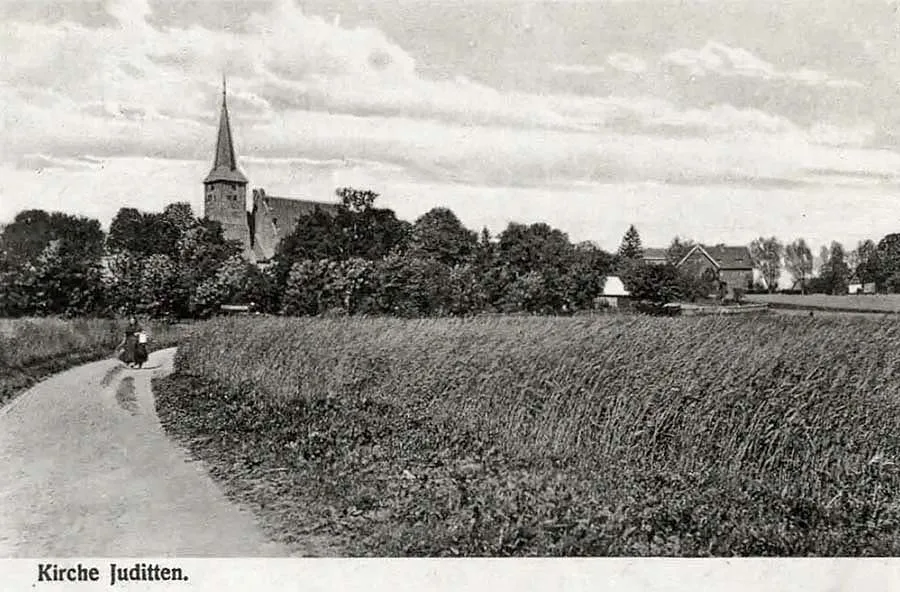 The road to Juditten Church.
On 16.06.1927 the municipality of Juditten and the Gutsbezirke of Friedrichswalde and Rathshof (Vozdushny) were incorporated into the city of Königsberg. On 02.12.1927 the Amtsbezirk of Juditten was renamed the Amtsbezirk of Moditten.
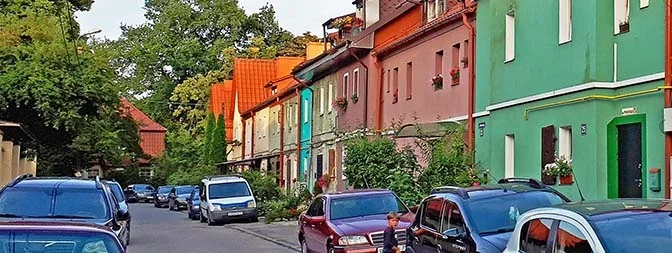
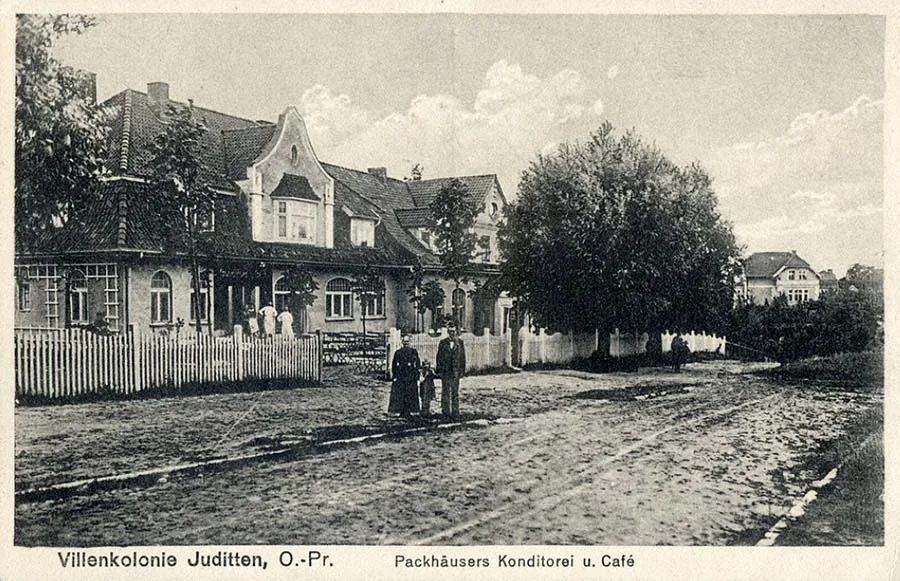 The villa colony of Juditten.
Lawsken is apparently first mentioned in 1286, in the founding charter of the Altstadt, as the village of Lauchsen (Lat.). In 1299 it appears as Lauxen, and in 1396 as Lauken. From 1405 the name Lawsken is found.
In 1785 Lawsken is mentioned in documents as a royal village (Königlich Dorf) with ten households. By 1818 the status of the village, which still had 10 households, had changed to royal peasant village (Königlich Bauer-Dorf).
In the 19th century Lawsken was a village which from 1818 formed a rural municipality in the Landkreis of Königsberg. The village belonged to the parish of Juditten (part of Mendeleyevo). In 1865 the Königsberg–Pillau railway (Kaliningrad–Baltiysk) was laid along the northern edge of Lawsken. There were two passenger platforms near Lawsken (at distances of 0.7 and 1 km). Right next to Lawsken there was a linesmen's house on this line.
In 1871 Lawsken had 23 residential houses, home to 50 families. In 1874 the Willky estate (part of Mendeleyevo) became part of the Lawsken municipality as a Vorwerk. On 30.04.1874 the rural municipality of Lawsken was included in the newly established Amtsbezirk of Juditten. On 01.04.1905 the eastern part of Lawsken became part of Königsberg. On 30.03.1910 the remaining part of Lawsken lost its independence and became part of the rural municipality of Juditten. On 21.02.1911 Lawsken was fully incorporated into Königsberg, becoming one of its districts.
During the two inter-war decades (1919–39) several houses for workers were built in Lawsken. In 1930 Lawsken had 50 houses.
Adlig Friedrichswalde is mentioned in 1785 as a "royal Vorwerk let on hereditary lease" (Königlich Erbpacht-Vorwerk).
In the mid-19th century Adlig Friedrichswalde was an estate which from 1867 formed a Gutsbezirk in the Landkreis of Königsberg. The estate belonged to the parish of Juditten (part of Mendeleyevo). On 30.04.1874 the Gutsbezirk of Adlig Friedrichswalde was included in the newly established Amtsbezirk of Juditten. The owner of the estate, Douglas, served as head of the Amtsbezirk in 1884–91, and another resident of Adlig Friedrichswalde, Charisius, first the estate manager and later its owner, headed the Amtsbezirk in 1901–13. After 1874 the Juditten mill also came to belong to the Gutsbezirk of Adlig Friedrichswalde. In 1879 the Gutsbezirk held 266 ha of land, and the estate's net annual profit that year was 4,079 marks. On 26.06.1927 the Gutsbezirk was abolished and incorporated into the municipality of Königsberg. In the pre-war years there was a brickworks in Friedrichswalde, as well as an experimental field of the University of Königsberg.
Luisenthal was founded in 1766 as Charlottenberg. After 1814 it came to be called Luisenthal in honour of Queen Louise. After 1871 the spelling of the place name changed to Louisenthal.
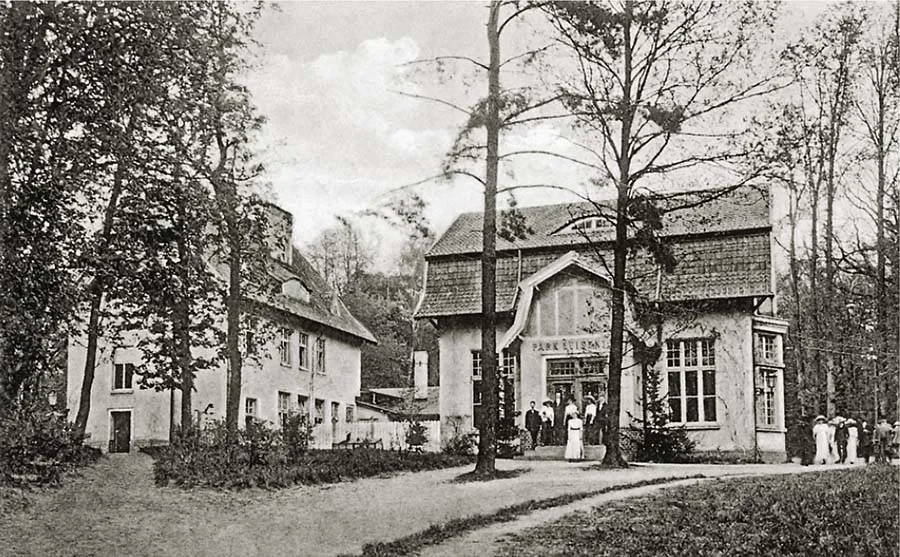 Luisenthal Park.
In the 19th century Luisenthal was a village which from 1818 formed a rural municipality in the Landkreis of Königsberg. The village belonged to the parish of Juditten (part of Mendeleyevo). Besides the village itself, the municipality also included a forest house (Waldhaus).
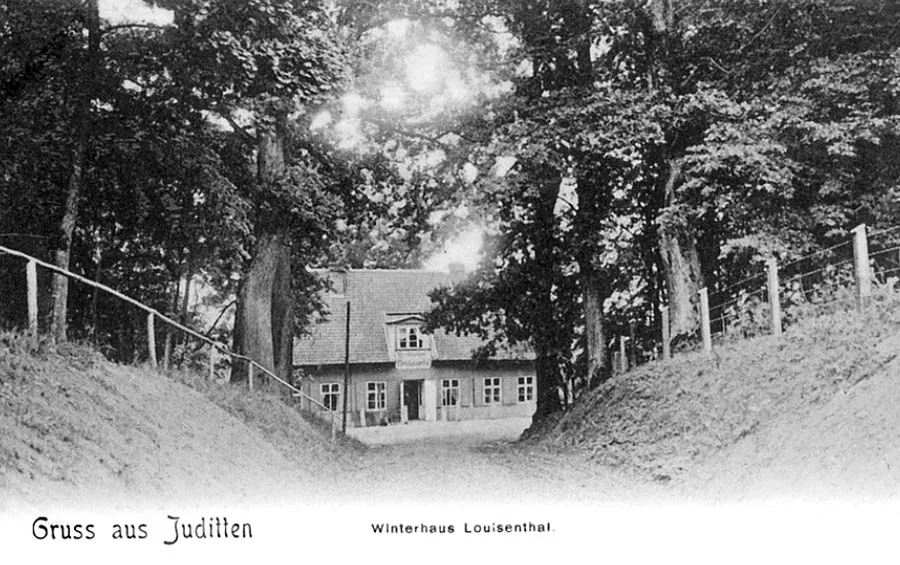 Waldhaus Luisenthal.
In 1871 the Luisenthal municipality had four residential houses, home to five families. Three houses belonged to the village of Luisenthal, and one more was the Waldhaus. In the course of the administrative reform of 1874 the village of Luisenthal lost its independence and (together with the Waldhaus) became part of the Juditten municipality. On 30.04.1874, as part of the Juditten municipality, Luisenthal was included in the newly established Amtsbezirk of Juditten. On 16.06.1927 the village of Luisenthal became part of the municipality of Königsberg, as one of its districts.
Marienberg was called Toussanthöfchen until 1818. In 1871 Marienberg consisted of one residential house, home to one family. Marienberg was a settlement belonging to no rural municipality or Gutsbezirk; territorially it belonged to the Landkreis of Königsberg and to the parish of Juditten (part of Mendeleyevo). In the course of the administrative reform of 1874 Marienberg was included in the Gutsbezirk of Domäne Friedrichsberg (Friedrichsberg, Domäne; Sovkhoznoye).
On 21.05.1883 Marienberg passed from the Gutsbezirk of Domäne Friedrichsberg (Sovkhoznoye) to the rural municipality of Juditten. On 16.06.1927 the village of Marienberg became part of the municipality of Königsberg.
Spittelhof is mentioned in 1785 as a royal administrative Vorwerk (Königlich Amtsvorwerk) with seven households. By 1818 the number of households here had fallen to six, and Spittelhof itself had become a royal estate let on hereditary lease (Königlich Erbpachtgut).
In the mid-19th century Spittelhof was an estate forming a Gutsbezirk in the Landkreis of Königsberg. The estate belonged to the parish of Juditten (part of Mendeleyevo). In 1865 the Königsberg–Pillau railway (Kaliningrad–Baltiysk) was laid next to the Spittelhof estate. The distance to the nearest station was 1.4 km (by road). Near the Spittelhof estate there was a linesmen's house. In 1871 the Spittelhof estate had five residential houses, home to 10 families. In the course of the administrative reform of 1874 the Gutsbezirk of Spittelhof was transformed into a rural municipality of the same name. On 30.04.1874 the rural municipality of Spittelhof was included in the newly established Amtsbezirk of Juditten. No later than 1883 the municipality of Spittelhof lost its independence and became part of the rural municipality of Juditten (part of Mendeleyevo).
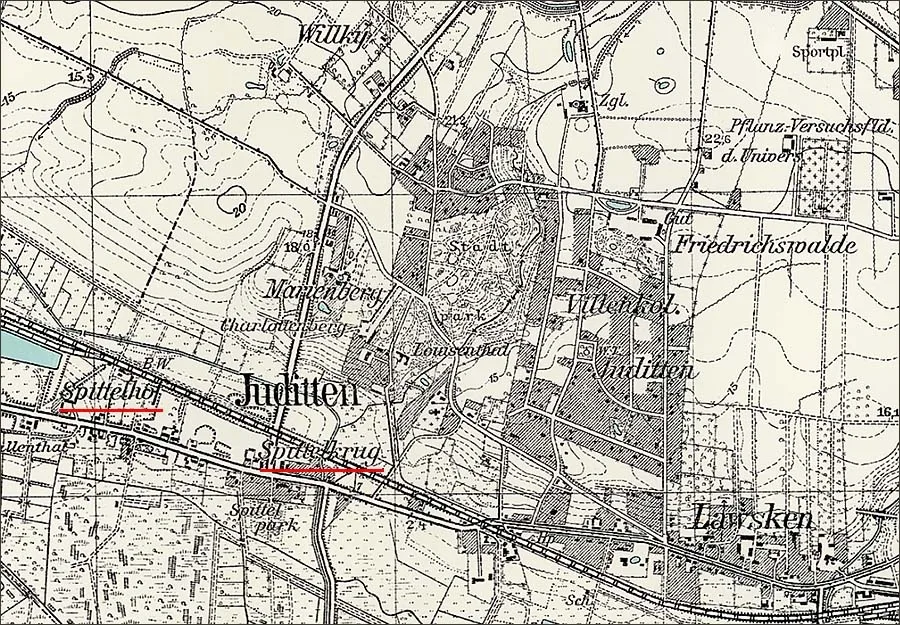
On 16 June 1927 the village of Spittelhof became part of the municipality of Königsberg.
Spittelkrug was known from 1540 as Spyttelkrog. In 1818 it is classified as a royal estate let on hereditary lease (Königlich Erbpachtgut) with four households.
In the mid-19th century Spittelkrug was an estate forming a Gutsbezirk in the Landkreis of Königsberg. The estate belonged to the parish of Juditten (part of Mendeleyevo). In 1865 the Königsberg–Pillau railway (Kaliningrad–Baltiysk) was laid along the northern edge of Spittelkrug; the nearest passenger platform on it was 0.8 km from the estate. In 1871 Spittelkrug consisted of seven residential houses, home to 16 families. In the course of the administrative reform of 1874 the Gutsbezirk of Spittelkrug was dissolved and the Spittelkrug estate became part of the rural municipality of Juditten. With the formation of the Amtsbezirk of Juditten on 30.04.1874, the estate became part of it. Residents of Spittelkrug held the post of head of the Amtsbezirk in 1880–81 (Wewel) and in 1891–94 (the former teacher Jaruschewski). In 1879 the Spittelkrug estate owned 61 ha of land, and its net annual profit was 981 marks. On both counts Spittelkrug ranked among the last in the Landkreis. On 16.06.1927 Spittelkrug became part of the municipality of Königsberg.
Spittelpark was a Vorwerk belonging to the rural municipality of Juditten (part of Mendeleyevo) in the Landkreis of Königsberg. The Vorwerk belonged to the parish of Juditten. On 30.04.1874 Spittelpark, as part of the Juditten municipality, was included in the newly established Amtsbezirk of Juditten. In 1905 there was one house in Spittelpark. On 16.06.1927 Spittelpark became part of the municipality of Königsberg.
Willky bore various names over the years: Wilcky (1818), Neu Lawsken (1860), Willky (from 1871). The name Abbau Lawsken is also found.
In 1818 Willky is mentioned as an establishment under Kulm law (Cöllmisch Etablissement) with seven households. In the mid-19th century Willky was an estate forming a Gutsbezirk in the Landkreis of Königsberg. The estate belonged to the parish of Juditten (part of Mendeleyevo). In 1871 Willky consisted of one residential house, home to one family. In the course of the administrative reform of 1874 the Willky estate lost its independence and became part of the rural municipality of Lawsken as a Vorwerk. On 30.03.1910 the Willky Vorwerk passed to the rural municipality of Juditten.
On 16.06.1927 Willky, together with the whole Juditten municipality, became part of the municipality of Königsberg.
On 29 July 1948, by decision of the Kaliningrad City Executive Committee, the former district of Juditten was given the name Gorodok Bumazhnikov ("Papermakers' Town"), since Pulp and Paper Mill No. 2 was located nearby and many of its workers had been given housing in Juditten.
However, this name did not last long, and on 18.08.1949, by a new decision, the City Executive Committee renamed Juditten, Marienberg, Lawsken and Willky as the settlement of Mendeleyevo. According to the city's old-timers, the settlement's name was quite widely used by the local population in the early years.
The Juditten church, which had not been damaged during the fighting, began to fall into ruin without proper care, and in 1960 this led to the collapse of the roof and part of a wall.
On 06.10.1985 the first Christian church in Kaliningrad opened in the Juditten church, which had earlier been handed over to the Russian Orthodox Church. In the Orthodox diocese the church received the name of St Nicholas Church.
Today the name of the settlement of Mendeleyevo has almost fallen out of use, although the settlement officially exists and appears from time to time on city maps and plans. It is mainly used by people who have lived in the city and in Mendeleyevo itself for a long time.
For reference
The parish of Juditten comprised: Adlig Friedrichswalde (part of Mendeleyevo), Am Fort (part of Pregolsky), Bahnhof (Lesnoye-Novoye station), Bahnhof Juditten (Brusnichnaya station), Charlottenburg (Lermontovo), Dammkrug (Kaliningrad, 54°41'53'' N 20°26'21'' E), Fischhof (Kaliningrad, 54°41'24'' N 20°23'53'' E), Forsthaus (part of the A. Kosmodemyansky settlement), Fort 5, Fort 6, Fürstenteich (Kaliningrad, Basseyny Lane), Groß Friedrichsberg (Sovkhoznoye), Groß Holstein (Pregolsky), Halbehufe (54°45'00'' N 20°26'00'' E), Klein Friedrichsberg (part of Sovkhoznoye), Klein Holstein (54°41'40'' N 20°21'42'' E), Lawsken (part of Mendeleyevo), Louisenthal (part of Mendeleyevo), Marienberg (part of Mendeleyevo), Metgethen (the A. Kosmodemyansky settlement), Moditten (the A. Kosmodemyansky settlement), Rathshof (Vozdushny), Rieselfeld (part of Pregolsky), Spittelhof (part of Mendeleyevo), Spittelkrug (part of Mendeleyevo), Spittelpark (part of Mendeleyevo), Waldgarten (54°44'25'' N 20°26'19'' E), Waldschlößchen (part of Veselovka), Wallenthal (54°42'55'' N 20°24'14'' E), Wehrdamm (Kaliningrad, 54°41'19'' N 20°22'52'' E), Willky (part of Mendeleyevo).
Population of the Juditten municipality: 1818 – 56, 1831 – 68, 1840 – 29, 1858 – 51, 1864 – 86, 1867 – 75, 1871 – 721, 1885 – 157, 1905 – 12602, 1910 – 2130 inhabitants.
Population of the Lawsken municipality: 1818 – 104, 1867 – 278, 1871 – 276, 1885 – 293, 1895 – 303, 1905 – 4253 inhabitants.
Population of Adlig Friedrichswalde: 1885 – 111, 1905 – 93, 1910 – 115 inhabitants.
Population of the Luisenthal municipality: 1867 – 34, 1871 – 264 inhabitants.
Population of the village of Luisenthal: 1871 – 14, 1905 – 14 inhabitants.
Population of Marienberg: 1867 – 6, 1871 – 6, 1905 – 50 inhabitants.
Population of Spittelhof: 1818 – 44, 1905 – 112 inhabitants.
Population of Spittelkrug: 1818 – 17, 1905 – 53 inhabitants.
Population of Spittelpark: 1905 – 3 inhabitants.
Population of Willky: 1818 – 40, 1867 – 12, 1871 – 12, 1905 – 146 inhabitants.
Population of Juditten station: 1905 – 4 inhabitants.
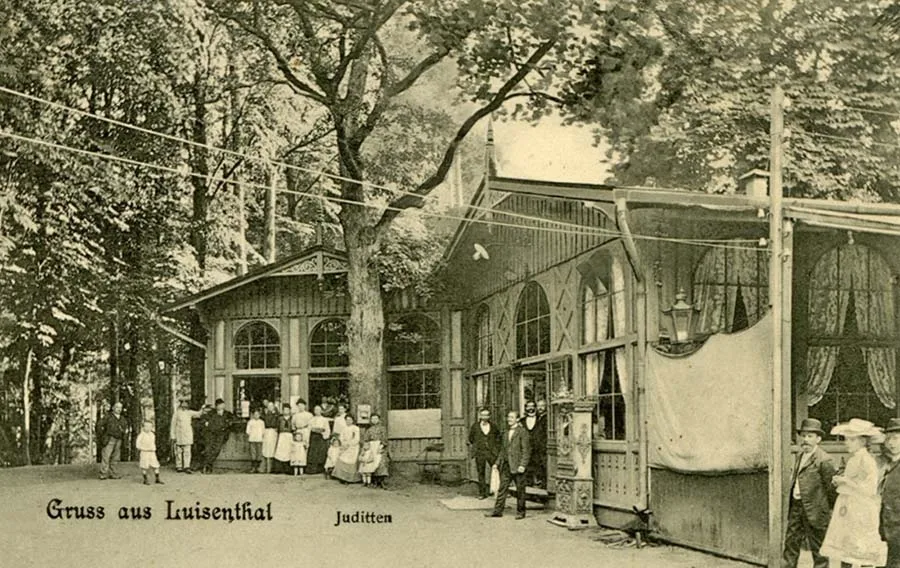 The restaurant in Luisenthal Park.
Composition of the Juditten municipality's population in 1871: Protestant Christians – 71, Catholics – 1, children under 10 – 16, literate – 49 (89%).
Composition of Lawsken's population in 1871: Protestant Christians – 275, Catholics – 1, children under 10 – 76, literate – 159 (82%), insane – 1.
Composition of the population of the Gutsbezirk of Friedrichswalde in 1871: all 91 Protestant Christians, children under 10 – 25, literate – 55 (86%).
Composition of the Luisenthal municipality's population in 1871: all 26 Protestant Christians, children under 10 – 6, literate – 11 (55%).
Composition of Marienberg's population in 1871: all 6 Protestant Christians, children under 10 – 0, literate – 6 (100%).
Composition of Spittelhof's population in 1871: all 63 Protestant Christians, children under 10 – 19, literate – 31 (78%), blind – 1.
Composition of Spittelkrug's population in 1871: Protestant Christians – 73, Catholics – 1, children under 10 – 17, literate – 34 (61%).
Composition of Willky's population in 1871: all 12 Protestant Christians, children under 10 – 1, literate – 7 (64%).
1 – including 37 inhabitants in the village of Juditten and 35 at the Juditten mill.
2 – including 638 inhabitants in the village of Juditten itself.
3 – including 275 inhabitants in the village of Lawsken itself.
4 – including 14 inhabitants in the village of Luisenthal itself and 12 in the Waldhaus.
Photos on this page: Bildarchiv Ostpreußen / bildarchiv-ostpreussen.de
– – – – – – – – –
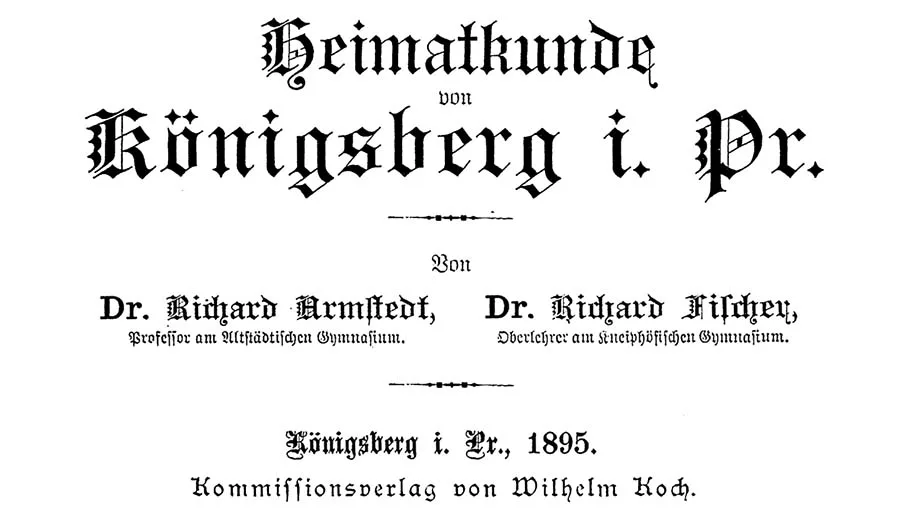
The chapter "Juditten and the Caporn Heath"
from the book by local authors "Königsberg Local Studies",
published at the end of the 19th century
In 2012–2014 "Pregola", the literary supplement to the "Baltic Almanac", published
a translation, by an unknown translator, of the book "Königsberg Local Studies" ("Heimatkunde von Königsberg i. Pr.", 1895, Kommissionsverlag von Wilhelm Koch, Königsberg) by the Königsberg authors Dr Richard Armstedt, professor at the Altstadt Gymnasium, and Dr Richard Fischer, senior teacher at the Kneiphof Gymnasium. The idea of publishing it belonged to Igor Vladimirovich Afonin. The text was adapted and annotated by Aleksey Borisovich Gubin and Igor Fyodorovich Avtukhov. That book contained a separate chapter on the surroundings of Königsberg, part of which is devoted to Juditten and the Caporn Heath. Having edited it substantially, we offer it to you as a supplement to the text by Aleksey Yevgenyevich Petrushin.
– – – – – – – – –
Juditten und die Caporner Heide
Since time immemorial the surroundings of Königsberg were covered with dense forests. As late as the early 19th century a spruce forest grew along the Landgraben, where one could easily come across elk and wild boar.
In the 18th century the forests west of Königsberg served the local nobility as hunting grounds. The villages of Friedrichswalde and Friedrichsberg (Friedrichswalde und Friedrichsberg, the former Sovkhoznoye settlement and the end of Prospekt Mira respectively) were founded by King Frederick I (Friedrich I, 1657–1713) as hunting lodges and named in his honour. A few decades ago the Willky guest house (Gasthaus Willky, now the Mendeleyevo settlement) still stood in the middle of a dense forest, of which only small groves now remain: the woodland was infested with insect pests, caterpillars laid it waste, and the trees had to be felled almost entirely. The forest at Willky, where in former times one could always meet plenty of people, suffered especially badly. Walking trails were laid out there in the 1840s and 1850s, and festivities were often held. Now these places are almost forgotten by the people of Königsberg. Only a small wood, as a reminder of the past, has survived near Juditten (Juditten). This is the Parish Forest (Pfarrwald), which you reach if you set out from Hufen (Hufen) along the footpath that runs along a former forest clearing through Amalienau and Hammer (Amalienau und Hammer, today's Prospekt Mira).
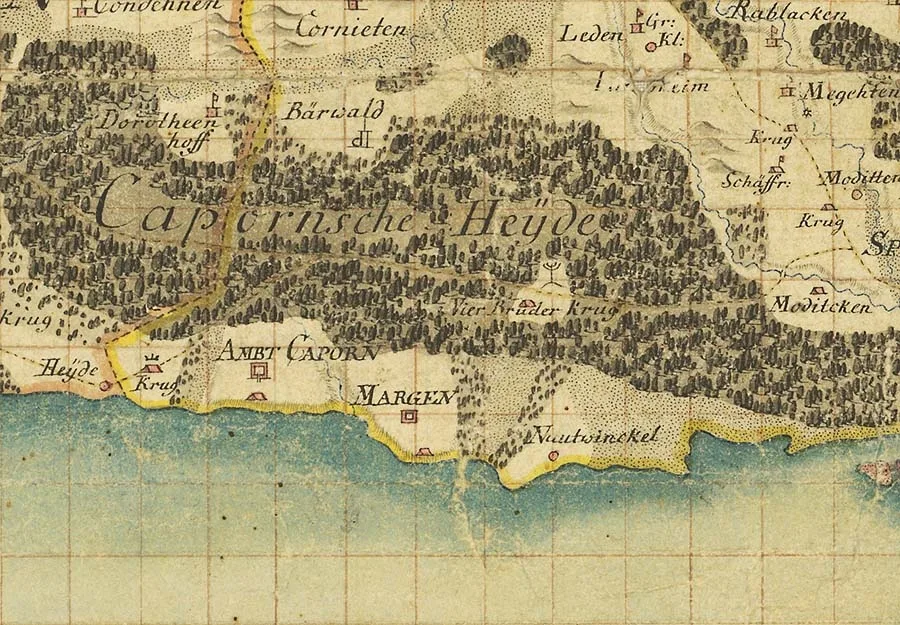 The Caporn Heath on a 1730 map of East Prussia.
The Juditten church stands on top of a hill in a picturesque spot. It was built, in all probability, between 1288 and 1298, or perhaps even earlier. Its walls are five feet thick: the church was meant to serve as a fortress at the same time.
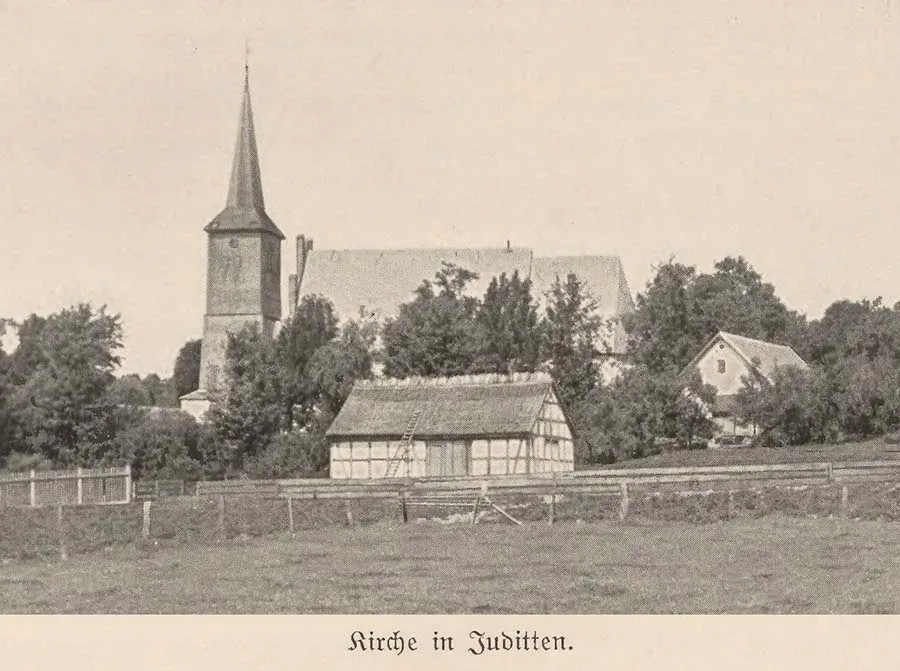
In 1577 a tower was added, which was later joined to the church. In the choir hangs the painting "The Resurrection of Christ", a gift of Kaiser Wilhelm I (Wilhelm Friedrich Ludwig von Preußen, 1797–1888); above the altar hangs a portrait of Queen Louise (Luise Auguste Wilhelmine Amalie zu Mecklenburg, 1776–1810), painted by the local artist Professor Knorr (Hugo Knorr, 1834–1904) and presented by him to the Juditten church in 1883 in memory of the fact that during her stay in Königsberg Queen Louise used to visit this church to pray. On either side of the altar hang portraits of Prussian commanders, Field Marshal von Röder (Erhard Ernst von Röder, 1665–1743) and Field Marshal von Lehwald (Johann von Lehwaldt, 1685–1768), painted by the Königsberg artist Knopke (A.E. Knopke). Lehwald was known for his defeat by the Russians at Groß Jägersdorf on 30 August 1757. The portraits were commissioned by Sophie von Buddenbrock (Anna Sophie Agnes von Lehwald, geb. von Buddenbrock, 1699–1773), the wife of Field Marshal Lehwald, and donated to the church.
(Field Marshal Lehwald was buried in the cemetery in Juditten. As for the church, it survived the war unscathed and after 1945 served as a warehouse, then burned down, was abandoned and gradually fell into ruin. By 1988 it had been restored as an Orthodox church. Editor's note.)
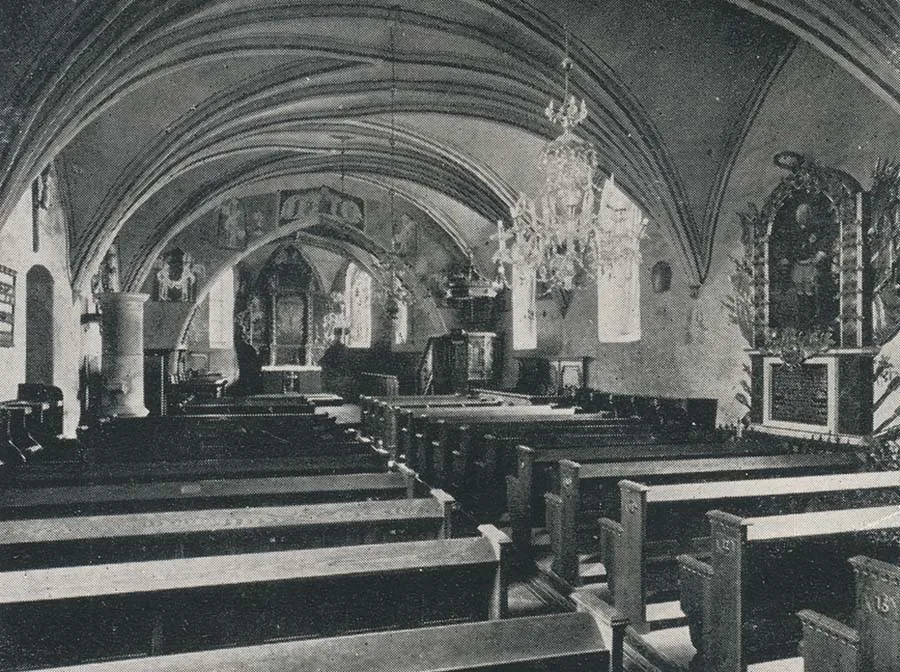 The nave of Juditten Church with the portraits of the generals. (A magnificent ceiling!)
The origin of the name Juditten still raises questions. According to one version it comes from the name of a wealthy local Prussian, Jedetus, who, if this legend is to be believed, adopted Christianity in 1288 and swore allegiance to the Teutonic Order.
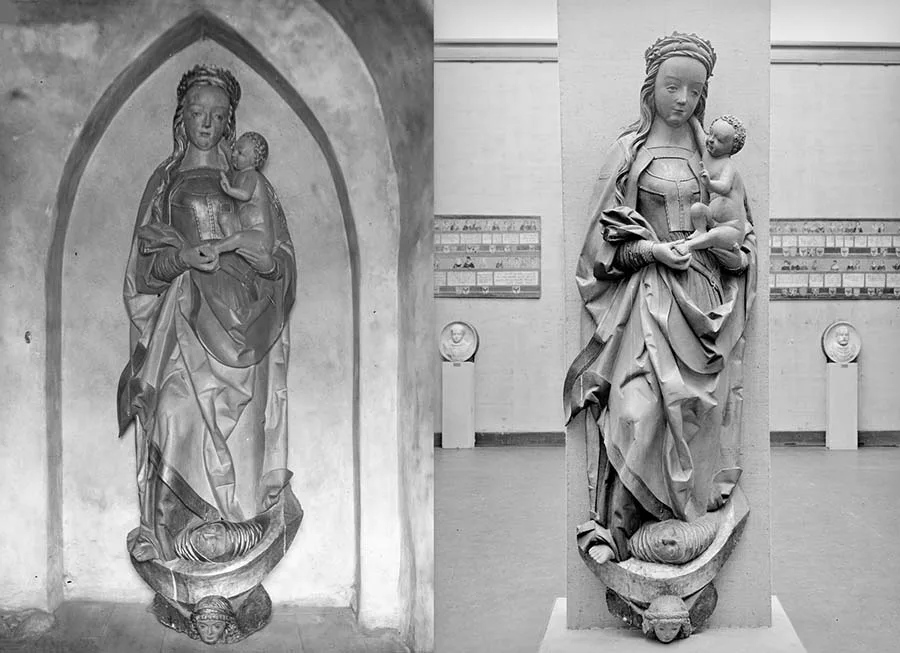 The statue of the Virgin Mary from the Juditten church.
According to another, it comes from the name of St Judith (German: Jutta). The second version seems less plausible, because the church is dedicated to the Virgin Mary and in Catholic times was a place of pilgrimage to a wooden statue of the Mother of God, a very old image of Mary to which miraculous powers were attributed. Even after the Reformation of 1525 pilgrims came here from distant lands to obtain from the local Lutheran clergy a certificate that they had completed the pilgrimage prescribed to them as penance, and absolution of their sins. The statue is well preserved and can still be seen in the church.
Three kilometres west of Juditten, near the village of Moditten (Moditten, now the A. Kosmodemyansky settlement), heading west, we find ourselves in a predominantly coniferous forest stretching along the lagoon from Königsberg to Fischhausen (Fischhausen, now the town of Primorsk). This woodland was formerly called the Caporn Heath (Caporner Heide), then the Bludau Forest (Bludausche Forst), and now it is the Fischhausen Town Forest (Fischhauser Stadtwald).
As late as the mid-19th century these forests were a refuge for many representatives of the local fauna, including the giant deer that once inhabited our forests in abundance. Today they are no longer to be met west of Königsberg. A small population (about a hundred animals) has remained in the forests where the river Memel (Memel, the Neman) flows into the Curonian Lagoon.
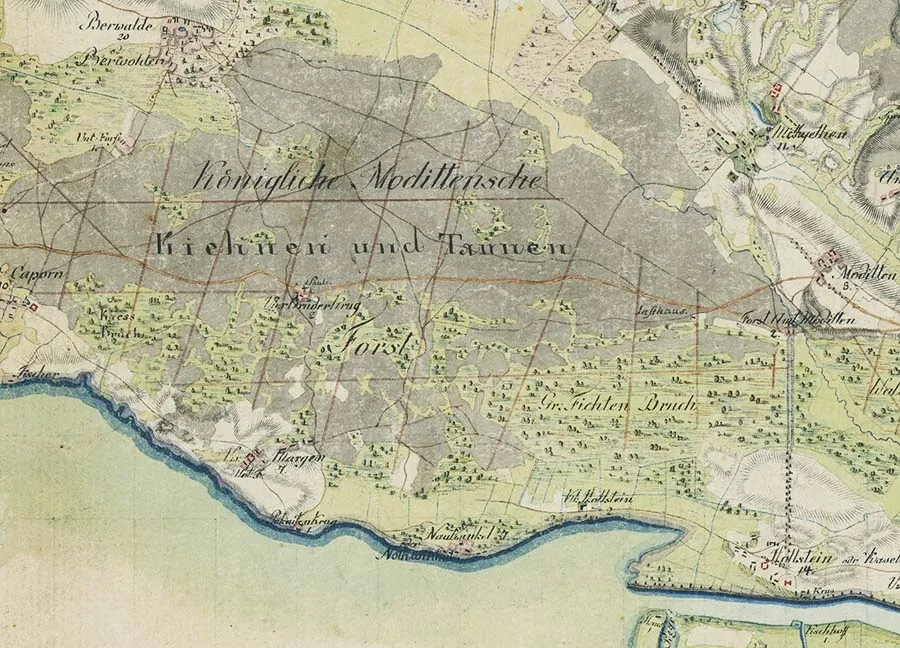 The road through the forest from Caporn (left) to Moditten (right) on a map from the 1790s.
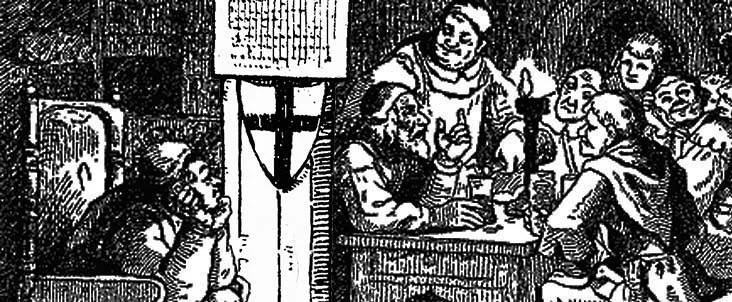
In the forest wilds of the former Caporn Heath, some five kilometres west of Juditten, travellers are greeted by the roadside by the famous Four Brothers Inn (Vierbrüderkrug).
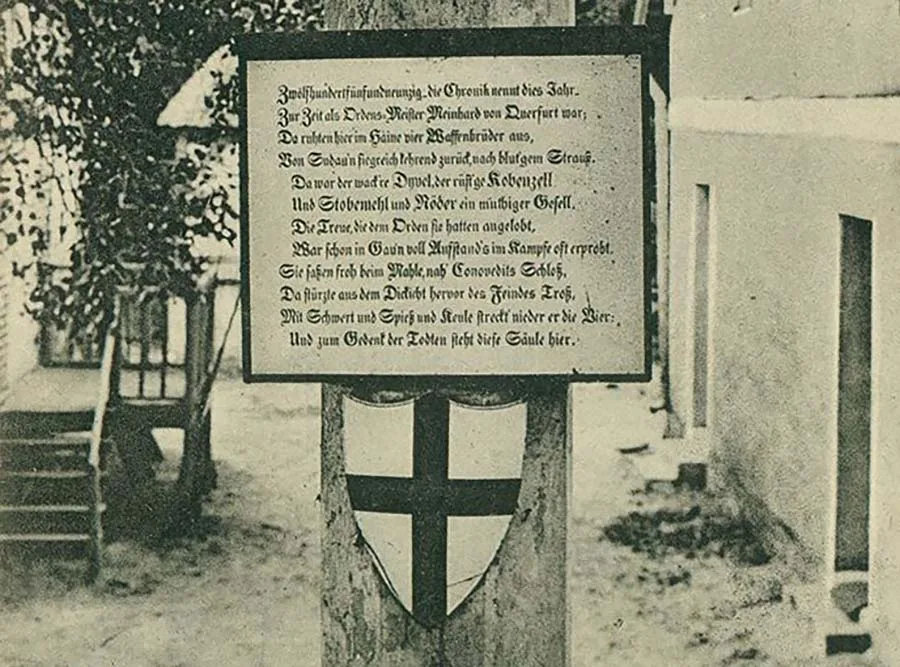 The name of the place is explained by a poem on the wooden memorial column set into the ground here:
Twelve hundred ninety-five it was, as the chronicles declare.
Meinhardt von Querfurt was the Order's master then.
Here in the grove four brothers sleep in their eternal rest,
Returning from Sudau with a great and swift-won victory…
Brave Diewel was among them, and stubborn Kobenzel too,
And Stobemel the valiant, and Röder, swift with the sword.
All faithful to the Order, the oath that they had sworn
They sealed with their own blood in battle with the foe.
Near Conowedit Castle once they sat down to a meal,
When suddenly from the thicket murderers fell upon them.
By sword, by stake and spear all four of them were slain,
And to those heroes' memory this column was set in the ground.
♥ ♥ ♥ ♥
The legend says:
In 1295 a great uprising broke out in the so-called Sudovian Corner of Samland. To suppress it, a detachment under the command of Martin von Golin with four companions was sent from Conowedit Castle (Conowedits), which is said to have stood on the so-called Castle Hill near the village of Margen (Margen) on the shore of the lagoon. On the way back the knights fell into an ambush laid by the pursuing Sudovians and, with the exception of Golin, all were killed. Meinhard von Querfurt (Meinhard von Querfurt 1240–1298), Landmeister of the Teutonic Order in Prussia, ordered a monument to be erected on the spot where they died. The original memorial has not survived; the present column was erected only in the 19th century.
(The fortress of Conowedit, or Caporn (Caporn), stood on the shore of the lagoon not far from the mouth of the Pregel, apparently from the end of the 13th century until the mid-17th century. As for the Four Brothers monument, not a trace of it remains. It stood on the site of the public transport stop opposite the Memorial Sign at the place where A. A. Kosmodemyansky was killed, on the 27A-002 Kaliningrad – Baltiysk highway, at the turn towards the Kaliningrad Sea Shipping Canal. Editor's note.)
The easiest way to reach the Four Brothers Inn is from Metgethen station (Metgethen) on the Königsberg – Pillau (Pillau) railway line. The forest house (Waldhaus) nearby, like the Four Brothers Inn, is a popular summer retreat for the people of Königsberg.
Translated from Russian with the help of AI (Claude, Anthropic), October 2026.