
Tver, 18 May 1789
I have parted from you, my dear ones, I have parted! My heart is bound to you by all its tenderest feelings, and yet I keep moving ever farther from you, and shall go on moving away!
O heart, heart! Who knows what it is you want? — For how many years was travel the sweetest dream of my imagination? Was it not in rapture that I said to myself: at last you shall go? Did I not wake every morning in joy? Did I not fall asleep with pleasure, thinking: you shall go? For how long could I think of nothing, busy myself with nothing, but the journey? Did I not count the days and the hours? But — when the longed-for day came, I grew sad, picturing vividly for the first time that I must part with the people dearest to me in the world and with everything that, so to speak, made up my moral being. Whatever I looked at — the table where for several years my unripe thoughts and feelings had poured out onto paper; the window under which I used to sit in dejection during my fits of melancholy and where the rising sun so often found me; the Gothic house, the beloved object of my eyes in the night hours — in a word, everything that met my gaze was a precious memorial of the past years of my life, not rich in deeds, but rich indeed in thoughts and feelings.
I took leave of soulless things as of friends; and at the very moment when I was softened and moved, my servants came in and began to weep and to beg me not to forget them and to take them back when I returned. Tears are contagious, my dear ones, and especially on such an occasion.
But you are always dearer to me, and from you I had to part. My heart felt so much that I forgot to speak. But why tell you! — The minute in which we said farewell was such that thousands of pleasant minutes in the future will hardly repay me for it.
Dear Ptrv. saw me off as far as the city barrier. There we embraced, and for the first time I saw his tears; there I got into the kibitka, looked back at Moscow, where so much that was dear to me remained, and said: farewell! The bell jingled, the horses dashed off... and your friend was orphaned in the world, orphaned in his soul!
All that is past is a dream and a shadow: ah! where, where are the hours when my heart felt so good in your midst, my dear ones? — If the future were suddenly revealed to a man, even the most fortunate, his heart would freeze with horror and his tongue would grow dumb at the very moment when he thought to call himself the happiest of mortals!..
The whole way not one joyful thought entered my head; and at the last post station before Tver my sadness grew so strong that in the village tavern, standing before caricatures of the Queen of France and the Roman Emperor, I wished, as Shakespeare says, to weep my heart out. It was there that everything I had left behind appeared to me in so touching a light. — But enough, enough! I am becoming excessively sad again. — Farewell! God grant you consolation. — Remember your friend, but without any sorrowful feeling!
St. Petersburg, 26 May 1789
Having spent five days here, my friends, I leave for Riga in an hour.
In St. Petersburg I did not enjoy myself. When I arrived at my friend D*'s, I found him in the deepest dejection. This worthy, amiable man {He is no longer in this world.} opened his heart to me: it is sensitive — he is unhappy!.. "My state is the very opposite of yours," he said with a sigh. "Your chief wish is being fulfilled: you are going off to enjoy yourself, to be merry; while I shall go to seek death, which alone can end my suffering." I did not dare console him and contented myself with sharing his grief with all my heart. "But do not think, my friend," I said to him, "that you see before you a man content with his lot; in gaining one thing I lose another, and I regret it." — Together we lamented from the bottom of our hearts the unhappy lot of mankind, or else we were silent. In the evenings we strolled in the Summer Garden and always thought more than we spoke; each thought of his own. Before dinner I used to go to the Exchange to see an Englishman of my acquaintance, through whom I was to receive my bills of exchange. There, looking at the ships, I took it into my head to go by sea, to Danzig, Stettin or Lübeck, so as to be in Germany sooner. The Englishman advised the same and found a captain who intended to sail for Stettin in a few days. The matter seemed settled; but it turned out otherwise. I had to present my passport at the Admiralty; but there they would not endorse it, because it had been issued by the Moscow and not the St. Petersburg provincial administration, and because it did not say how I would travel; that is, it did not say that I would go by sea.
My objections had no success — I did not know the procedure, and it remained for me either to go overland or to obtain another passport in St. Petersburg.
I decided on the former; I took out an order for post-horses — and the horses are ready. And so farewell, dear friends! When will I be merrier? Until this minute everything is sad. Farewell!
Riga, 31 May 1789
Yesterday, my dearest friends, I arrived in Riga and put up at the "Hotel de Petersbourg". The road has worn me out. It was not enough to have the heartache whose cause you know: heavy rains had to fall as well; I had to take it into my head, to my misfortune, to travel from St. Petersburg by relay horses, and nowhere could I find a good kibitka. Everything vexed me. Everywhere, it seemed, they overcharged me; at every change of horses they kept me too long. But nowhere was it so bitter for me as in Narva. I arrived there soaked through and covered in mud; I could barely find two bast mats to buy, to cover myself at least somewhat from the rain, and paid for them at the very least as for two hides. They gave me a worthless kibitka and wretched horses. We had gone no more than half a verst when the axle broke: the kibitka fell into the mud, and I with it. My Ilya went back with the coachman for an axle, while your poor friend remained in the pouring rain. Nor was that all: some policeman came along and began to make a fuss because my kibitka was standing in the middle of the road. "Put it in your pocket!" I said with feigned indifference and wrapped myself in my cloak. God knows how I felt at that moment! All the pleasant thoughts of travel were eclipsed in my soul. Oh, if I could have been transported to you then, my friends! Inwardly I cursed that restlessness of the human heart which draws us from object to object, from certain pleasures to uncertain ones as soon as the former are no longer new — which tunes our imagination to dreams and makes us seek joys in the unknown of the future!
There is a limit to everything; a wave, having struck the shore, rolls back, or, having risen high, falls down again — and at the very moment when my heart was full, a well-dressed boy of about thirteen appeared and, with a sweet, heartfelt smile, said to me in German: "Your kibitka has broken? What a pity, a great pity! Please come to us — here is our house — father and mother told me to invite you in." — "Thank you, sir! Only I cannot leave my kibitka; besides, I am dressed too much for the road and am soaking wet." — "We shall set a man to watch the kibitka; and who looks at the clothes of travellers? Please, sir, please come!" Here he smiled so persuasively that I had to shake the water off my hat — in order, of course, to go with him. We took each other by the hand and ran at a run to a large stone house, where in the hall of the ground floor I found a numerous family sitting round a table; the mistress of the house was pouring tea and coffee. They received me so kindly, regaled me so warmly, that I forgot all my woe. The master, an elderly man with good nature written on his face, asked me about my journey with an air of sincere sympathy.
A young man, his nephew, recently returned from Germany, told me the most convenient way to travel from Riga to Königsberg. I stayed with them about an hour. Meanwhile the axle was brought, and everything was ready.
"No, wait a little longer!" they said to me, and the mistress brought three loaves of bread on a dish. "Our bread, they say, is good: take it." — "God be with you!" added the master, pressing my hand, "God be with you!" Through my tears I thanked him and wished that he might continue by his hospitality to console sad wanderers who had parted from dear friends. — Hospitality, sacred virtue, common in the days of the youth of the human race and so rare in our days! If I ever forget you, then let my friends forget me! Let me be forever a wanderer on earth and nowhere find a second Kramer! {One of my friends, being in Narva, read this letter to Kramer — he was pleased — and I still more!} I said farewell to the whole kind family, got into the kibitka and galloped off, gladdened at having found good people! — The post from Narva to Riga is called German, because the commissaries at the stations are Germans. The post houses are everywhere alike — low, wooden, divided into two halves: one for travellers, while in the other lives the commissary himself, from whom one can get everything needed to still hunger and thirst. The stages are short; some are twelve and ten versts. Instead of coachmen, retired soldiers do the driving, some of whom remember Münnich; telling their tales, they forget to urge on the horses, and that is why I arrived here from St. Petersburg no sooner than on the fifth day. At one station beyond Dorpat I had to spend the night: Mr Z., travelling from Italy, had taken all the horses. I talked with him for half an hour and found him an amiable man. He frightened me with the sandy Prussian roads and advised me rather to go through Poland and Vienna; but I do not wish to change my plan. Having wished him a happy journey, I threw myself onto the bed; but I could not fall asleep until the very moment when a Chukhonets came to tell me that the kibitka had been harnessed for me.
I noticed no difference between the Estlanders and the Livlanders except in language and in their caftans: the one wear black, the other grey. Their languages are similar; they have little of their own in them, many German and even some Slavonic words. I observed that they soften all German words in pronunciation: from which one may conclude that their ear is delicate; but seeing their want of nimbleness, their clumsiness and slowness of wit, anyone must think that they are, to put it plainly, rather dull. The gentlemen with whom I managed to talk complain of their laziness and call them sleepy people who will do nothing of their own free will: and so they must be greatly compelled, for they work a very great deal, and a peasant in Livonia or Estonia brings his master four times as much as one of ours from Kazan or Simbirsk.
These poor people, who work unto the Lord {to the glory of the Lord (Church Slavonic). — Ed.} with fear and trembling on all working days, make merry beyond all measure on holidays, of which, it is true, there are very few in their calendar. The road is strewn with taverns, and as I passed they were all full of people making merry — they were celebrating Whitsun.
Peasants and masters are of the Lutheran confession. Their churches are like ours, except that on top there stands not a cross but a cockerel, which is meant to recall the fall of the Apostle Peter. Sermons are preached in their language; but the pastors all know German.
As for scenery, in this region there is nothing to look at. Forests, sand, marshes; there are neither high mountains nor broad valleys. — In vain would you look for villages such as ours. In one place you see two farmsteads, in another three, four, and a church.
The cottages are larger than ours and are usually divided into two halves: in one live the people, while the other serves as a cattle shed. — Those who do not travel by post-horses must stop at taverns. However, I saw almost no travellers at all: so empty is this road at the present time.
There is not much to say about the towns, because I did not stop in them. In Yamburg, a small town known for its cloth mills, there is a fair stone building. The German part of Narva, or, properly speaking, so-called Narva, consists for the most part of stone houses; the other, separated by the river, is called Ivangorod. In the first everything is in the German manner, in the other everything in the Russian. Here our border once lay — oh, Peter, Peter!
When Dorpat came into view, I said: a lovely little town! There everything was celebrating and making merry. Men and women walked through the town arm in arm, and in the surrounding groves strolling couples flashed by. So many towns, so many tempers; so many villages, so many customs. — Here lives the brother of the unfortunate L* {Lenz, the German author, who for some time lived in the same house as I. Deep melancholy, the consequence of many misfortunes, drove him mad; but even in his madness he sometimes astonished us with his poetic ideas, and still more often touched us with his good nature and patience.}. He is the chief pastor, loved by all, and has a very good income. Does he remember his brother? I talked about him with a Livonian nobleman, an amiable, ardent man. "Ah, sir!" he said to me, "the very thing that makes one man famous and happy makes another wretched. Who, reading the poem of the sixteen-year-old L* and all that he wrote up to the age of twenty-five, will not see the dawn of a great spirit? Who will not think: here is a young Klopstock, a young Shakespeare? But clouds darkened that beautiful dawn, and the sun never shone forth. Deep sensibility, without which Klopstock would not have been Klopstock nor Shakespeare Shakespeare, destroyed him. Other circumstances, and L* would be immortal!"
As soon as you drive into Riga, you see that it is a trading town — many shops, many people — the river covered with ships and vessels of various nations — the Exchange full. Everywhere you hear German — here and there Russian — and everywhere they ask not for roubles but for thalers. The town is not very beautiful; the streets are narrow — but there is a great deal of stone building, and there are good houses.
In the inn where I am staying, the landlord is very obliging: he himself took my passport to the government office and to the police, and found me a carrier who has agreed for thirteen chervontsy to take me to Königsberg, together with a French merchant who has hired four of his horses for his own carriage; while I shall travel in a kibitka. — I am sending Ilya from here straight back to Moscow.
Dear friends! Always, always I think of you, when I am able to think. I have not yet left Russia, but I have long been in foreign lands, because I parted from you long ago.
A Courland tavern, 1 June 1789
I had not yet managed to finish my letter to you, dearest friends, when the horses were harnessed and the innkeeper came to tell me that in half an hour the town gates would be shut. I had to finish the letter, settle the bill, pack my trunk and give Ilya some instructions. The landlord took advantage of my haste and handed me a real apothecary's bill; that is, for a single day and night he took about nine roubles from me!
I still wonder how, in such a hurry, I forgot nothing at the inn. At last everything was ready, and we drove out of the gates. There I said goodbye to good-natured Ilya — he has gone to you, my dear ones! — It began to grow dark. The evening was quiet and cool. I fell into the sound sleep of a young traveller and did not feel the night pass. The rising sun woke me with its rays; we were approaching the frontier post, a little house with a turnpike. The Parisian merchant went with me to the major, who received me courteously and after an inspection ordered us to be let through. We entered Courland — and the thought that I was already outside my fatherland produced a wondrous effect in my soul. I looked at everything that met my eyes with particular attention, although the objects in themselves were quite ordinary. I felt such joy as I had not yet felt since our parting, my dear ones! Soon Mitau came into view. The look of this town is not handsome, but to me it was attractive! "Here is the first foreign town," I thought, and my eyes searched for something special, something new. On the bank of the river Aa, which we crossed on a raft, stands the palace of the Duke of Courland, no small house, though in its outward appearance not magnificent at all. The windows have nearly everywhere been broken or taken out; and it is evident that the rooms inside are being refitted. The Duke lives in his summer castle, not far from Mitau. The bank of the river is covered with timber, in which the Duke himself has the sole trade and which brings him no small income. The soldiers standing on guard looked like invalids. As for the town, it is large but not good. The houses are almost all small and rather untidy; the streets are narrow and badly paved; there are many gardens and vacant lots.
We stopped at the inn which is considered the best in the town. At once we were surrounded by Jews with various trinkets. One offered a pipe, another an old Lutheran prayer book and Gottsched's "Grammar", a third a spyglass, and each wanted to sell his wares to such kind gentlemen at the most reasonable price.
The Frenchwoman travelling with the Parisian merchant, a woman of about forty-five, began to arrange her grey hair before the mirror, while the merchant and I, having ordered dinner, went for a walk around the town — we saw a young officer drilling old soldiers, and heard an elderly snub-nosed German woman in a bonnet scolding her drunken husband, a cobbler!
On our return we dined with a good appetite and after dinner had time to drink coffee and tea and to talk at some length. I learned from my fellow traveller that he is Italian by birth, but left his fatherland in his earliest youth and trades in Paris; he has travelled a great deal and came to Russia partly on business and partly to learn the full severity of winter; and now he is returning to Paris, where he intends to stay for good. — For everything together we paid at the inn a rouble a head.
On leaving Mitau I saw the most pleasant country. This land is much better than Livonia, which one would not regret crossing with one's eyes shut. We met German carriers from Libau and Prussia. Strange vehicles! Long wagons drawn in tandem; the horses enormous, and the rattles hanging on them make a noise unbearable to the ears.
Having gone five miles, we stopped for the night at a tavern. The yard is well roofed; the rooms are fairly clean, and in each a bed stands ready for travellers.
The evening is pleasant. A few steps from the tavern flows a clear river. The bank is covered with soft green grass and shaded in places by dense trees. I declined supper, went out onto the bank and remembered a Moscow evening when, walking with Pt. below the Andronikov Monastery, we watched the setting sun with particular pleasure. Did I think then that exactly a year later I would be enjoying the charms of an evening at a Courland tavern? Another thought came into my head too. Once I had begun to write a novel and meant to travel in my imagination through exactly those lands to which I am now going. In that imaginary journey, having left Russia, I stopped for the night at a tavern: and the same has happened in reality. But in the novel I wrote that the evening was most foul, that the rain had not left a dry thread on me and that at the tavern I had to dry myself before the fireplace; whereas in fact the evening turned out most quiet and clear. This first night's lodging proved unlucky for the novel; fearing that the foul weather might continue and trouble me on my journey, I burned it in the stove in my blessed dwelling at Chistye Prudy. — I lay down on the grass under a tree, took from my pocket a notebook, an inkwell and a pen and wrote what you have just read.
Meanwhile two Germans, who are travelling with us as far as Königsberg in a kibitka of their own, came out onto the bank; they lay down beside me on the grass, lit their pipes and out of boredom began to abuse the Russian people. I stopped writing and coolly asked them whether they had been in Russia farther than Riga. "No," they replied.
"In that case, gentlemen," I said, "you cannot judge the Russians, having been only in a border town." They did not think it wise to argue, but for a long time would not accept that I was Russian, imagining that we cannot speak foreign languages. The conversation continued. One of them told me that he had had the good fortune to be in Holland and had amassed a great deal of useful knowledge there. "Whoever wants to know the world," he said, "must go to Rotterdam. There people live splendidly, and everyone goes boating in sloops! Nowhere will you see what you see there. Believe me, sir, in Rotterdam I became a man!" — "A fine goose!" I thought — and wished them a good evening.
Palanga, 3/14 June 1789
At last, having travelled more than two hundred versts through Courland, we crossed the Polish border and stopped for the night at a rich tavern. In a day we usually cover ten miles, or some seventy versts. At the taverns we have so far found something to eat and drink: soup, a roast with salad, eggs; and for this we paid no more than some twenty kopecks a head. Coffee and tea are to be had everywhere; true, none of it is very good. — The road is rather empty. Apart from carriers, whom we met some three times, and old-fashioned berlins in which the Courland nobles drive to visit one another, we encountered no travellers. Yet the road is not dull: everywhere you see fertile land, meadows, groves; here and there little villages or scattered peasant cottages.
The French Italian and I get on well. My heart does not warm to the Frenchwoman, because I do not like her physiognomy and her manners. However, she can be praised for her tidiness. As soon as we stop, our carrier Gavrila, whom she calls Gabriel, must carry her dressing case after her into the room, and for at least an hour she pomades, powders and paints herself, so that we always have to wait for her at dinner. We deliberated for a long time whether to invite the Germans to our table. I was charged with finding out their station. It turned out that they are merchants. All doubts vanished, and since then they dine with us; and since the Italian and the Frenchwoman do not understand German, and the Germans do not understand French, I have to serve them as interpreter. The German who became a man in Rotterdam assured me that he had once known French perfectly and had forgotten it only very recently; and to convince me and his companion of it all the more, at every bow to the Frenchwoman he says: "Oplishe, matam! Oblige, Madame!" {Your humble servant! (French). — Ed.}
At the Polish border the inspection was not strict. I gave the officials some forty kopecks: after which they only glanced into my trunk, trusting that I had nothing new.
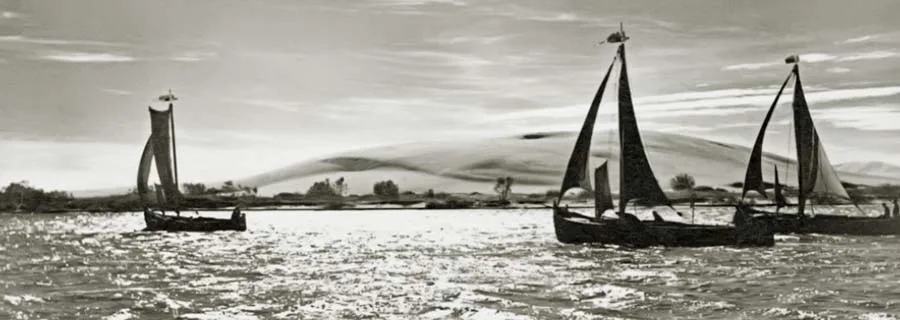
The sea is no more than two hundred sazhens from the tavern. I sat on the shore for about an hour and looked at the expanse of heaving waters. A majestic and melancholy sight! In vain did my eyes seek a ship or a boat! No fisherman dared to show himself on the sea; the gusty wind would have capsized his skiff. — Tomorrow we shall dine in Memel, from where I shall send you this letter, my friends!
Memel, 15 June 1789
I expected that on entering Prussia we would be stopped at the border itself; but this did not happen. We arrived in Memel after ten o'clock, put up at an inn — and gave the inspectors a few groschen so that they would not rummage through our things.
The town is small; there are stone buildings, but few decent ones. The citadel is very strong; yet our Russians managed to take it in the year 57.
Memel may be called a good trading town. The Courland Haff, on which it lies, is very deep. The harbour is filled with various vessels, which are loaded for the most part with hemp and timber for shipment to England and Holland.
From Memel to Königsberg there are three routes; along the shore of the Haff it is reckoned 18 miles to Königsberg, and by way of Tilsit 30: a great difference! But the carriers almost always choose the latter route, sparing their horses, which are greatly exhausted by the terrible sands of the shore road. They all take tickets here, paying for each horse and each mile as far as Königsberg. Our Gabriel paid three thalers, saying that he would go along the shore. In fact we are going via Tilsit; but the Russian fellow reckoned that for 30 miles they would have charged him more than for 18! The third route, by water across the Haff, is the shortest of all in good weather, so that one can be in Königsberg in seven hours. Our Germans, who hired the carrier only as far as Memel, are going by water, which will cost the two of them only two chervontsy. Gabriel tried to persuade the Italian and me — with whom he usually talks either by signs or through me — to go with them too, which would have been very profitable for him, but we preferred the comfortable and certain to the uncomfortable and uncertain, and, in case of a storm, dangerous.
At dinner we ate fresh, tasty fish, in which Memel abounds; and since we were told that the Prussian taverns are very poor, we laid in a stock of good bread and wine here.
Now, dear friends, it is time to take the letter to the post; our horses are being harnessed.
As for my heart... thanks be to fate! it has grown somewhat merrier. Now I think of you, my dear ones — but no longer with such sorrow as before — now I let my eyes wander over meadows and fields, thinking of nothing; now I picture the future to myself, and almost always in a pleasant light. — Farewell! Be well, be at peace, and picture your wandering friend as a knight of the cheerful countenance!
A tavern a mile beyond Tilsit, 17 June 1789, 11 o'clock at night
Everything around me is asleep. I too had lain down on the bed; but, after waiting in vain for sleep for about an hour, I decided to get up, light a candle and write a few lines to you, my friends!
I am glad I did not agree to go from Memel by water. The places we passed through are very pleasant. Now wide fields with splendid grain, now green meadows, now little groves and bushes, arranged as if in artificial symmetry, presented themselves to our eyes. The little villages in the distance also made a pleasant view. "Qu'il est beau, ce pays-ci!" {What beautiful country! (French). — Ed.} the Italian and I kept repeating.
In general the land in Prussia seems to be even better cultivated than in Courland, and in good years grain is very cheap throughout this region; but last year the harvest was so poor that the government had to supply the people with grain from the established storehouses. For five or six years the grain grows well; in the seventh year — badly, and the countryman has nothing to eat — because he always relies too much on the next summer, imagining neither drought nor hail, and sells everything beyond what is necessary.
Tilsit is a quite nicely built little town and lies amid the most fertile valleys on the river Memel. It carries on a considerable trade in grain and timber, sending everything by water to Königsberg.
We were stopped at the town gates, where not soldiers but citizens stood on guard, because the regiments forming the local garrison had not yet returned from the review. A fat sentry, under whose belly a little sword dangled, raised to his shoulder a broken musket tied together with string, took three steps forward with a haughty air and shouted at me in a most terrible voice: "Wer sind Sie? Who are you?" Being occupied with examining his extraordinary physiognomy and figure, I could not answer him at once. He puffed himself up, screwed up his eyes and shouted in a still more terrible voice: "Wer seyd ihr?" {Who are you people? (German). — Ed.} — far less politely now! Several times I had to tell him my surname, and each time he shook his head, marvelling at the odd Russian name. With the Italian the story was longer still. In vain did he plead ignorance of German: the pot-bellied sentry was determined that he should answer all his questions, which had probably been learned by heart with great effort.
At last I was called to help, and with difficulty we got them to let us through. — In the town they showed me a tower pierced in various places by Russian cannonballs.
In the Prussian taverns we find neither meat nor good bread. The Frenchwoman makes us des oeufs au lait, or a Russian omelette, which together with milk soup and salad makes up our dinner and supper. On the other hand the Italian and I drink some ten cups of coffee a day each, which we have found everywhere.
Hardly had we settled in at the tavern where we are now spending the night when we heard the clatter of hooves, and half a minute later in came a man in a dark tailcoat, with an enormous hat and a long riding whip; he came up to the table, glanced at us — at the Frenchwoman, busy with her evening toilette; at the Italian, studying my travel map; and at me, drinking tea — took off his hat, wished us a good evening and, turning to the landlady, who had only just poked her forehead out of the other room, said: "Good day, Lisa! How are you getting on?"
Lisa (a lean woman of about thirty). Ah, Herr Lieutenant! Welcome! Where have you come from?
Lieutenant. From town, Lisa. Baron von M* wrote to me that they had comedians there. "Come, brother, come! The rascals will amuse us for our groschen!" Devil take me! Had I known what creatures those comedians are, nothing would have made me go.
Lisa. Why, your honour! Don't you care for comedy?
Lieutenant. Oh! I love everything that is amusing, and in my life I have paid out plenty of full-weight thalers for Doctor Faust with Hanswurst {Doctor Faust, according to superstitious popular legend, is a great sorcerer and to this day is usually the hero of silly plays performed in villages or in towns on fairground stages by strolling players. In reality Johann Faust lived as an honest citizen in Frankfurt am Main around the middle of the fifteenth century; and when Gutenberg, a native of Mainz, invented the printing of books, Faust shared with him the profits of this invention. After Gutenberg's death Faust took as his assistant his scribe, Peter Schöffer, who brought the art of book printing to such perfection that the first books to appear astonished people; and since the common folk of that age ascribed to supernatural forces everything they could not explain, Faust was proclaimed an accomplice of the devil, as which he is known to this day among the rabble and in tales. — And Hanswurst means on the German fairground stage the same as Harlequin among the Italians.}.
Lisa. Hanswurst is very funny, they say. — And what did the comedians play, Herr Lieutenant?
Lieutenant. A comedy in which there was nothing funny. One shouted, another pulled faces, a third goggled his eyes, and nothing sensible came of it.
Lisa. Were there many people, Herr Lieutenant?
Lieutenant. Are there few fools in Tilsit?
Lisa. Was the Herr Burgomaster there with his spouse?
Lieutenant. Is he one of the last? The pot-bellied fool yawned, while his stuck-up wife kept rubbing her eyes with a handkerchief, as if snuff had got into them, and poking him in the ribs so that he would not fall asleep and would stop gaping.
Lisa. What a mocker you are!
Lieutenant (sitting down and putting his hat on the table next to my teapot). Um Vergebung, mein Herr! Pardon me, sir! — I am tired, Lisa. Give me a tankard of beer. Do you hear?
Lisa. At once, Herr Lieutenant.
Lieutenant (to his servant, who has come in). Kaspar! Fill my pipe. (Turning to the Frenchwoman.) May I ask, with all respect, whether you favour tobacco?
Frenchwoman. Monsieur! — Qu'est ce qu'il demande, Mr. Nicolas? {What is he asking, Monsieur Nicolas? (French). — Ed.} (That is what she calls me.)
I. S'il peut fumer? {May he smoke? (French). — Ed.} — Smoke, smoke, Herr Lieutenant. I will answer for her.
Frenchwoman. Dites qu'oui {Say that he may (French). — Ed.}.
Lieutenant. Ah! Madame does not speak German. I regret it, I greatly regret it, madame. — Where are you travelling from, if I may ask, sir?
I. From St. Petersburg, Herr Lieutenant.
Lieutenant. Delighted, delighted, sir. What news of the Swedes, of the Turks?
I. The old song, Herr Lieutenant; both the one and the other are running from the Russians.
Lieutenant. Devil take me! The Russians stand firm. — I will tell you as a friend, sir, that had my king not dissuaded me, I would long since have been by no means the least of staff officers in the Russian service. I have friends everywhere. For instance, my nephew serves as senior adjutant to Prince Potemkin. He writes to me about everything. Wait — I will show you his letter. Devil take me! I have left it at home. He describes to me the taking of Ochakov. Fifteen thousand fell on the spot, sir, fifteen thousand!
I. That is not true, Herr Lieutenant.
Lieutenant. Not true? (Mockingly.) No doubt you were there yourself?
I. Though I was not, I know nonetheless that about 8,000 Turks were killed, and 1,500 Russians.
Lieutenant. Oh! I do not like to argue, sir; but what I know, I know. (Taking up the tankard that the landlady has meanwhile brought him.) Do you understand, sir?
I. As you please, Herr Lieutenant.
Lieutenant. Your health, sir! — Your health, madame! — (To the Italian.) Your health! — The beer is decent, Lisa. — Listen, sir! — Now you call me Herr Lieutenant: why?
I. Because the landlady calls you so.
Lieutenant. Say rather: because I (putting on his hat) bowed to my king — and retired before my time. Otherwise you would now be saying to me (raising his hat): "Good day, Herr Major!" (Finishing his tankard.) Do you understand? Devil take me if I did not fall head over heels in love with my Anyuta! True, she was like a rosy bun. And even now she is not bad, sir, though she has already borne me four. — Lisa! tell him, what is my Anyuta like?
Lisa. Ah, Herr Lieutenant! As if you did not know it yourself! What is there to say — she is comely! — I'll tell you a funny thing, Herr Lieutenant. When you drove to town in Easter week in the evening, a young gentleman from Königsberg was staying the night with me — to tell the truth, a kind gentleman, and he paid me honestly for every trifle. He did not ask for much to eat.
Lieutenant. And what is funny about that, Lisa?
Lisa. Well, this kind gentleman was standing on the porch and saw the Frau Lieutenant, who was sitting in the carriage on the right-hand side — isn't that so, Herr Lieutenant.
Lieutenant. Well, and what did he say?
Lisa. "Now there's a woman!" he said. Ha! ha! ha!
Lieutenant. He was no fool, evidently. Ha! ha! ha!
I. So it was love that made you retire, Herr Lieutenant?
Lieutenant. Accursed love, sir. — Kaspar, my pipe! — True, I was counting on a good dowry. I was told that old von T* had mountains of gold. "The girl is fine," I thought, "come, let's marry!" The old man was glad to give me his daughter: only she would on no account marry a serving man. "Mamsell Anyuta!" said I. "I love you as my own soul; but I love the king's service too." Tears welled up in her sweet little eyes. I stamped my foot and — retired. And what came of it! The day after the wedding my dear father-in-law, instead of mountains of gold, rewarded me with three hundred thalers. There's a dowry for you! — There was nothing to be done, sir. I had sharp words with him, and afterwards, over a bottle of old Rhine wine, concluded eternal peace. To tell the truth, the old man was kind-hearted — God rest his soul! We lived in harmony. He died in my arms and left us a nobleman's house as our inheritance.
But let us break off this conversation, which has already taken up more than two pages and is beginning to tire my silver pen {I wrote all my notes on the road with a silver pen.}. The talkative lieutenant had spun a whole cartload of yarns by ten o'clock, which I, sparing Gabriel's horses, shall not take with me. Among other things, hearing that from Königsberg I would travel in the public coach, he advised me: 1) to take a seat in the middle and 2) if there were ladies with me, to treat them to tea and coffee all the way. In conclusion he wished that I might travel with profit, like the well-known Baron Trenck, with whom he is supposedly on very friendly terms. — The Herr Lieutenant, sticking his pipe into his boot, mounted his horse and rode off at full gallop, shouting to me: "A happy journey, sir!"
What one will not write in moments of sleeplessness! — Farewell until Königsberg!
Königsberg, June 19, 1789
Yesterday at seven in the morning I arrived here, my dear friends, and together with my fellow traveller took lodgings at Schenk's inn.
Königsberg, the capital of Prussia, is one of the large cities of Europe, being about fifteen versts in circumference. Once it was among the famous Hanseatic towns.
And today its commerce is fairly important. The river Pregel, on which it lies, though no wider than 150 or 160 feet, is so deep that large merchant vessels can sail on it. The houses are reckoned at about 4,000, and the inhabitants at 40,000 — how few for the size of the city! But now it seems populous, because a multitude of people has gathered here for the fair, which begins tomorrow. I have seen a good many fine houses, but none so huge as in Moscow or St. Petersburg, although on the whole Königsberg is built perhaps better than Moscow.
The garrison here is so numerous that uniforms meet the eye everywhere. I would not say that Prussian soldiers are better dressed than ours; and I particularly dislike their bicorne hats. As for the officers, they are very neat and receive a little less pay than ours. I had heard that in the Prussian service there are no officers as young as ours; but here I have seen at least ten fifteen-year-olds. The uniforms are dark blue, light blue and green with red, white and orange facings.
Yesterday I dined at the common table, where there were some thirty old majors, stout captains, portly lieutenants, beardless second lieutenants and ensigns. The subject of the loud conversation was the recent review. Officers' jokes poured from every side. For example: "What is the reason, Herr Rittmeister, that your windows are now shut even in the daytime? Surely you are not busy writing letters? Ha! ha! ha!" — "Just like von Krebs! He knows everything that goes on at my place!" — and so on and so forth. Yet they are courteous. As soon as our Frenchwoman appeared, they all rose and at dinner served her with great zeal. — Be that as it may, the next time I thought it wise to dine alone in my room, with the windows open onto the garden, from which the aromatic exhalations of lush greenery flowed into my German soup.
Yesterday, too, after dinner, I called on the famous Kant, the profound, subtle metaphysician who refutes Malebranche and Leibniz, and Hume, and Bonnet — Kant, whom the Jewish Socrates, the late Mendelssohn, never called otherwise than der alles zermalmende Kant, that is, the all-crushing Kant.
I had no letters of introduction to him, but boldness takes cities — and the doors of his study opened to me. I was met by a small, thin little old man, exceptionally pale and delicate. My first words were: "I am a Russian nobleman, I love great men and wish to pay my respects to Kant."
He at once asked me to sit down, saying: "I have written things that cannot please everyone; not many love metaphysical subtleties." For half an hour we talked of various things: of travels, of China, of the discovery of new lands. One could only marvel at his historical and geographical knowledge, which, it seemed, might alone have crammed full the storehouse of human memory; but for him this is, as the Germans say, a side matter. Then, not without a leap, I turned the conversation to the nature and morality of man; and here is what I was able to retain in memory of his reasoning:
"Activity is our destiny. Man can never be entirely content with what he possesses and always strives for acquisitions. Death overtakes us on the way to something that we still wish to have. Give a man everything he desires, and in that very minute he will feel that this everything is not everything. Seeing no aim or end to our striving in this life, we posit a future one, where the knot must come undone. This thought is all the more pleasing to man in that here there is no proportion between joys and sorrows, between enjoyment and suffering. I console myself with the fact that I am already sixty years old and that the end of my life will soon come, for I hope to enter another, better one. Recalling the delights I have had in life, I feel no pleasure now; but picturing to myself those occasions when I acted in accordance with the moral law inscribed in my heart, I rejoice. I speak of the moral law: let us call it conscience, the sense of good and evil — but they exist. I have lied, no one knows of my lie, yet I am ashamed. — Probability is not evidence when we speak of a future life; but, having weighed everything, reason bids us believe in it. And what would become of us if we were, so to speak, to see it with our own eyes? If it pleased us very much, we could no longer occupy ourselves with the present life and would be in ceaseless languor; and in the opposite case we would not have the consolation of saying to ourselves amid the sorrows of this life: perhaps it will be better there! — But in speaking of our destiny, of the future life and so on, we already presuppose the existence of an Eternal Creative Reason, which creates everything for some purpose, and everything good. What? How?.. But here the first of sages confesses his ignorance. Here reason extinguishes its lamp, and we remain in darkness; imagination alone can soar in this darkness and create what never was." — Venerable man! Forgive me if in these lines I have disfigured your thoughts! He knows Lavater and has corresponded with him. "Lavater is most amiable for the goodness of his heart," he says, "but, having an excessively lively imagination, he is often blinded by fancies, believes in magnetism and so on." — We touched on his adversaries. "You will get to know them," he said, "and you will see that they are all good people."
He wrote down for me the titles of two of his works, which I have not read: "Kritik der praktischen Vernunft" and "Metaphysik der Sitten" {"Critique of Practical Reason" and "Metaphysics of Morals" (German). — Ed.} — and I shall keep this note as a sacred memento.
Having written my name in his pocket book, he wished that all my doubts might be resolved; then we parted.
There you have, my friends, a brief account of a conversation most interesting to me, which lasted about three hours.
Kant speaks quickly, very quietly and unintelligibly; and so I had to listen to him straining every nerve of hearing. His little house is small, and inside there are few furnishings. Everything is simple, except... his metaphysics.
The cathedral church here is enormous. With great attention I examined there the ancient weapons, armour and helmet {a type of helmet. — Ed.} of the most pious of the margraves of Brandenburg and the bravest of the knights of his time. "Where are you," I thought, "where are you, dark ages, ages of barbarism and heroism? Your pale shades terrify the timid enlightenment of our days. Only the sons of inspiration dare to summon them from the abyss of the past — like Ulysses calling the shades of his friends from the gloomy dwellings of death — in order to preserve in their mournful songs the memory of the wondrous changes of nations." — I mused for about an hour, leaning against a pillar. — On the wall is depicted the margrave's pregnant consort, who, forgetting her condition, throws herself on her knees and with heartfelt fervour prays to heaven to preserve the life of the hero going forth to vanquish his foes. A pity that here the art does not match the poignancy of the subject! — There one also sees a multitude of many-coloured banners, the margrave's trophies.
A Frenchman, a hired lackey who accompanied me, assured me that from there an underground passage leads out of town to an old church some two miles away, and showed me a small door with a staircase leading underground. Whether this is true or not, I do not know: but I do know that in the Middle Ages such passages were dug just in case, to save wealth and life from the hand of the mighty.
Yesterday evening I said farewell to my companion, Mr F*, whose friendliness I shall never forget. I do not know how it was for him, but I was sad to part with him. He and the Frenchwoman have gone to Berlin, where perhaps I shall see him again.
Today I called on our consul, Mr I*, who received me kindly. He told me a good many things, to which I listened with pleasure; and although he has long lived in a German city and speaks German very well, he has not become Germanised in the least and has preserved the Russian character intact.
He gave me a letter to the postmaster, in which he asked him to assign me the best seat in the mail coach.
Yesterday fate acquainted me with a young Frenchman who calls himself a skilled tooth doctor. Having learned that foreigners had arrived at Schenk's inn — he had been told they were French — he appeared before Mr F* with a load of compliments. I was there — and so we became acquainted. "In Paris there are men equal to me in the art," he said, "and so I did not wish to stay there; I went to Berlin, treated and cleaned German teeth by the score; but I had to do with great misers, and therefore — I left Berlin. Now I am going to Warsaw. The Polish gentlemen, I hear, know how to value merit and talent: we shall try, we shall treat, we shall clean! And from there I shall set off for Moscow — to your fatherland, sir, where no doubt I shall find more intelligent people than anywhere else." — Today, just as I had finished my dinner, he came to me with papers and, saying that he knows people at first glance and already has complete confidence in me, began to read... a treatise on toothache.
While he was reading, the hired lackey came to tell me that a Russian courier, a captain of the Guards, had stopped at the neighbouring inn. "Allons le voir!" {Let's go and have a look at him! (French). — Ed.} said the Frenchman, hiding his treatise in his pocket. We went together — and instead of a captain I found a quartermaster sergeant of the Horse Guards, Mr ***, an amiable young man who is travelling to Copenhagen. It is the first time he has been sent as a courier, and he does not know German, at which the Prussian officers who surrounded us on the porch marvelled greatly. Indeed, it is inconvenient to travel through foreign lands knowing only French, which not everyone speaks. — While we were talking, one of those standing on the porch received a letter from Berlin in which he was told that near that capital the post had been robbed, the postilion's throat cut and several thousand thalers taken: unpleasant news for those going there! — I wished my compatriot a happy journey.
In the old castle, or palace, built on a height, travellers view the arsenal and the library, in which you will find several folios and quartos bound in silver. There is also the so-called Moscow Hall, 166 paces long and 30 wide, whose vault is built without pillars and where they show an old octagonal table valued at 40,000 thalers.
Why this hall is called the Moscow Hall, I could not find out. One man said it was because Russian prisoners were once kept here; but this is not very likely.
There are fine gardens here where one can stroll with pleasure. In large cities public promenades are very necessary. The artisan, the artist, the scholar rests in the fresh air after finishing his work, without needing to go out of town. Besides, the exhalations of gardens freshen and cleanse the air, which in large cities is always full of putrid particles.
The fair is beginning. Everyone dresses in their best clothes, and crowd after crowd is met in the streets. Guests are received on the porch, where tea and coffee are served.
I have already sent my trunk to the post. Those travelling in the public coach may carry sixty pounds free of charge; mine is under sixty.
Adieu! {Farewell! (French). — Ed.} My compatriot Gabriel, who, in his own words, has not yet found work, has come to tell me that the mail coach will soon be ready.
I love you just as before, my friends; but separation is no longer so sorrowful for me. I am beginning to enjoy travelling. Sometimes, thinking of you, I sigh; but a light breeze ripples the water without troubling its clearness. Such is the human heart; at this minute I thank fate that it is so. — Only be happy, my friends, and never worry about me! In Berlin I hope to receive a letter from you.
Marienburg, 21 June, at night
The so-called Prussian mail coach is nothing at all like a coach. It is nothing other than a long covered wagon with two benches, without straps and without springs. I chose a seat on the front bench. I had two companions, a captain and a second lieutenant, who sat at the back on the trunks. I thought my seat was the more advantageous; but the outcome proved that their choice was better than mine. The captain's servant and the so-called Schirrmeister, or conductor, sat with us in the coach on the other bench. The sad thoughts with which my head filled at the Gothic sight of our vehicle soon scattered. In the city I saw everywhere the pleasant picture of a holiday — people making merry everywhere; my officers were very courteous, and the conversation that began between us interested me a good deal. We talked of the Turkish and Swedish war, and the captain from the goodness of his heart praised the bravery of our soldiers, who in his opinion are hardly worse than the Prussians. He told anecdotes of the last war, all of which redounded to the honour of the Prussian warriors. He dearly wished the king would grow weary of peace. "It's time to fight again," he said, "our soldiers have lain about too long; we need exercise, exercise!" My peace-loving heart was offended.
I took up arms against war with all my eloquence, describing its horrors: the groans and cries of the unhappy victims borne away to the other world on a river of blood; the devastation of lands, the anguish of fathers and mothers, wives and children, friends and kinsfolk; the orphaning of the Muses, who hide in darkness, just as in stormy weather poor robins and tits hide in the bushes, and so on.
My merciless captain laughed and shouted: "We need exercise, exercise!" At last I noticed that I had taken on the labour of the Danaids; I fell silent and turned all my attention to the pleasant surroundings of the road. Our postilion did not spare the horses; and thus, imperceptibly, we reached the change of horses, where we had just time for a hasty supper.
The night was pleasant. Several times I fell asleep, but not for long, I felt the advantage that my companions had. They could lie on the trunks, while I had to doze sitting up. At dawn we arrived at the next station. To revive ourselves a little after the restless night, the captain and I drank some five cups of coffee each — which really did bring me back to life.
The country became quite unpleasant, and the road bad. Heiligenbeil, a small town seven miles from Königsberg, brings to mind the times of paganism. Here there once towered a majestic oak, the silent witness of the birth and death of many centuries — an oak sacred to the ancient inhabitants of this land. Beneath its gloomy shade they worshipped the idol Curcho, brought him sacrifices and glorified him in their wild hymns. The eternal twilight of this natural temple and the rustle of the leaves filled hearts with the awe in which the pagan priests clothed worship. So the Druids hid their religion in the depths of the forests; so the voice of the Greek oracles issued from the depths of darkness! — The Teutonic Knights in the thirteenth century, having subdued Prussia by the sword, destroyed the altars of paganism and on their ruins raised the temple of Christianity. The proud oak, venerable elder in the kingdom of plants, the bulwark against storms and whirlwinds, fell under the shattering hand of the victors, who destroyed all the monuments of idolatry: an innocent victim! — Superstitious legend says that for a long time they could not fell the oak; that all the axes bounced off its thick bark as off hard diamond; but that at last an axe was found which broke the spell, severing the tree from its root; and that in memory of the victorious axe the place was named Heiligenbeil, that is, the axe of the saints. Nowadays this axe of the saints is famous for some excellent beer and white bread.
Braunsberg, where we dined and changed horses for the third time, is a fairly populous little town. "Here Copernicus lived and died," the captain told me as we drove through a small township. — "So this is Frauenburg?" — "Exactly."
How vexed I was that I could not see the rooms in which that famous mathematician and astronomer lived and where, by his observations and calculations, he determined the motion of the earth about its axis and about the sun — the earth which, in the opinion of his predecessors, stood motionless in the centre of the planets and which after him Tycho Brahe wished to stop again, but in vain! — And so the ideas of Pythagoras, which were mocked by the Greeks, who trusted their senses more than the philosopher, were resurrected in the system of Nicolaus Copernicus? — This astronomer was more fortunate than Galileo: superstition — though he still lived under its sceptre — did not force him to abjure the teaching of truth on oath. Copernicus died peacefully in his tranquil dwelling, but Tycho Brahe had to leave his philosophical castle and his fatherland. The sciences, like religion, have had their martyrs.
Towards evening we arrived in Elbing, a small but commercial town and quite nicely built, where two or three regiments are stationed. The post was to remain there for more than an hour. We went to an inn where, apart from the landlord and the guests, everything was fairly clean. Since leaving Königsberg I had not yet seen a decently dressed person. Two men were playing billiards: one in a green caftan, a fawn waistcoat and a greasy wig, a man past forty, and the other a young man in a gaudy, skimpy tailcoat; the first played very badly and grew angry, while the other wanted to make fun of him, laughed at the top of his voice at each of his misses, glanced at us and into the mirror, and kept adjusting his thick, soiled neckcloth. Caricature after caricature came into the inn, and every caricature demanded beer and a pipe. I was very bored. Besides, I felt a strong agitation in my blood from the coffee and the jolting of the mail coach.
When we came out to take our seats, we found by the coach a young officer and an old woman, who commended themselves to our goodwill and announced that they were travelling with us. Thus it became much more cramped for us. My officers were glad of a new companion with whom they could talk about the recent review. The woman, a native of Swedish Pomerania, hearing that I was Russian, raised her hands to heaven and cried: "Ah, you villains! You are ruining our poor king!" The officers laughed, and I laughed, though not entirely from a good heart.
Meanwhile the beautiful evening tuned my soul to pleasant impressions. On both sides of the road spread rich meadows; the air was fresh and pure; numerous herds with their bleating and lowing celebrated the setting of the sun.
Peasant women were milking the cows, breathing in the healing vapour of the milk, which constitutes the wealth of all the villages there. The inhabitants belong, if I am not mistaken, to the sect of Anabaptists, Wiedertaufer. Their morals, peaceableness and honesty are praised.
Their hand is never raised against their neighbour. "Human blood," they say, "cries out to heaven." — The stillness of the night that had fallen closed my eyes.
Now we are in Marienburg, where I have had time to write you so many pages. This town is noteworthy only in that its ancient castle was once the capital of the Grand Masters of the Teutonic Order.
From the old woman, my enemy, we have been freed here; but her place will be taken by a tall officer, who is now sitting beside me waiting for the post to depart. — Day is breaking. Farewell! From Danzig I hope to add something more.
Danzig, 22 June 1789
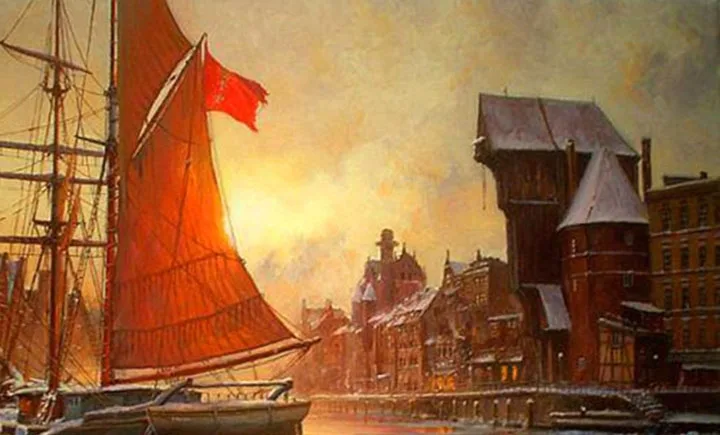
Having passed through a suburb of Danzig, we stopped in the Prussian township of Stolzenberg, which lies on a high hill of that name. Danzig lies beneath our feet as if on a saucer, so that one can count the roofs. This beautifully built city, the sea, the harbour, the ships at the quay and others scattered over the heaving, boundless expanse of the waters — all this together forms such a picture, my dearest friends, as I have never yet seen in my life, and at which I gazed for two hours in silence, in deep stillness, in sweet forgetfulness of myself.
But the brilliance of this city has faded for some time now. Trade, which loves freedom, shrinks and declines more and more under the oppressing hand of the mighty. Just as monks of the strictest order, meeting one another in the dismal gloom of their dwellings, in place of any greeting utter in a dying voice: "Remember death!", so the inhabitants of this city in deep dejection cry out to one another: "Danzig! Danzig! Where is your glory?" — The King of Prussia has imposed an excessive duty on all goods shipped from here to the sea, from which Danzig lies some five or six versts away.
The Scots, who send their herring here, enjoyed all the rights of citizenship in Danzig, because a Scot named Douglas once rendered the city an important service. Those of the inhabitants with whom I spoke could not tell me what exactly Douglas's service had consisted of. Such a mark of gratitude does honour to this city.
I did not know that the post would stay here so long, or I would have managed to see some things worthy of note in Danzig. Now it is already too late: they are about to harness the horses. Most of all I should have liked to see the famous painting by Eichel in the principal Lutheran church, representing the Last Judgement. A King of France — I do not know which — offered a hundred thousand guilders for it. — I should also have liked to see Professor Trendelenburg, to thank him for the Greek grammar he composed, which I have used and hope to use in future {The author was then beginning to learn Greek; but afterwards he no longer had time to think of it.}. — The largest building in the city is the town hall. In general all the houses are five storeys high. The exceptional cleanliness of their window panes adorns their appearance.
Danzig has its own money, which, however, does not circulate outside the city; and even in the city itself Prussian money is preferred.
To the west of Danzig rise three sandy hills, whose summits are much higher than the city towers; one of these hills is Stolzenberg. In the event of a siege, enemy batteries could destroy the city from there. On the Hagelsberg there was once a robber castle; the echo of the terror it spread resounded far through the surrounding country. There they show the grave of the Russians killed in 1734, when Count Münnich stormed the city. The besieged knew from which side the assault would come, so the garrison and the inhabitants turned all their forces there and fought like men in despair. It is well known that the city took the side of Stanisław Leszczyński against Augustus III, on whose behalf Russia intervened. In the end Danzig submitted.
My companions the officers wanted to inspect the city fortifications, but the sentries would not let them pass and threatened to fire. They laughed at this excessive strictness and turned back. The soldiers are for the most part old and untidily dressed. The magistracy usually entrusts the post of commandant to some foreign general with a large salary.
The first station out of Danzig
In Danzig we were joined by an officer, a young French merchant and a magister. For them and for the captain's servant the Schirrmeister took an open wagon there. The officer sat with us in the coach, where one more seat remained, which the magister wanted to take; but the Frenchman raised an outcry, asserting his seniority, and the Schirrmeister decided the matter in his favour, having learned that he had indeed booked at the post office earlier. The magister earnestly begged us to squeeze up somehow and give him a seat in the coach, arguing in learned fashion that he would be bored with the Schirrmeister and the servant; but he was preaching to deaf ears, as the Germans say. The Frenchman, very well dressed for the road, triumphantly sat down on the bench between two officers, mockingly pitying the poor magister, who would be soaked by the rain that had begun to spit. Our new companion, the officer, wishing to sit more comfortably, looked at him very askance and began to squeeze him. The Frenchman very politely declared that he was becoming a little cramped. "So much the worse for you," the officer answered him angrily; he lit his pipe and began to blow clouds of smoke into his nose and mouth. The Frenchman sneezed, coughed, and finally asked what this might mean. — "It means that you should take yourself off to the wagon with the magister." — "Sir!" said the Frenchman with a haughty air. — "Sir!" replied the officer with annoyance. "You are being told to take yourself away from us."
The Frenchman gravely insisted that he had an equal right with him to sit in the coach; but the officer, a poor jurist, began to shower him with ash and embers, saying that after smoke Vesuvius throws out flame. Nor was that all: he jabbed the hilt of his sabre into his side.
The poor Frenchman, seeing that patience would not get him off, begged the officer through his tears to leave him in peace until the next change of horses, promising to move to the wagon there. My old companions, having laughed their fill, took pity on the martyr and persuaded their comrade to content himself with his promise. I laughed too, yet sincerely pitied the Frenchman, although he at once forgot everything and grew cheerful.
Now they are changing the horses and preparing a light supper for us.
On leaving Danzig I looked at the sea, which showed blue on the right-hand side. Nothing else of interest met my eyes, apart from the extensive Danzig promenade, where there were very few people, because the sky was clouding over on every side...
The full text of Nikolay Karamzin's book "Letters of a Russian Traveller" is available to read on a number of websites. For example, here.
Translated from Russian with the help of AI (Claude, Anthropic), October 2026.