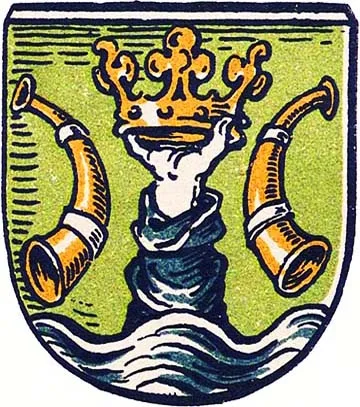
 Coat of arms
of Kneiphof
A number of castles and settlements (Labiau Castle / Labiau, today's Polessk, for example) ended up surrounded by water on all sides, but they were founded in a river bend, after which an artificial, not very wide and not very deep canal was dug to close the ring of water. In the case of Kneiphof, however, we are dealing with the deliberate building of a settlement cut off from the rest of the world by wide water barriers whose currents are not controlled by man.
Settlement of Kneiphof apparently began as soon as the Shop Bridge (Krämerbrücke) was built in 1286. This bridge led from Altstadt across the New Pregel (or, as it was then called, the Lipza / Lipza) to the island. Otherwise there would have been no point at all in building a bridge to this marshy, deserted ground.
At the beginning of the 14th century the island appears in the Order's documents under the name Vogtwerder / Vogtwerder, which can be translated as "the Vogt's river island". In 1322 a second bridge was built across the Natangian Pregel (Natangische Pregel), which we now call the Old Pregel. This bridge, named the Green Bridge (Grüne Brücke), became perhaps the most famous of all Königsberg's bridges. By 1324 merchants' houses had already appeared on the island, forming a street between the two bridges. In time it would become the main street of Kneiphof and be named Kneiphof Long Street (Kneiphöfische Langgasse).
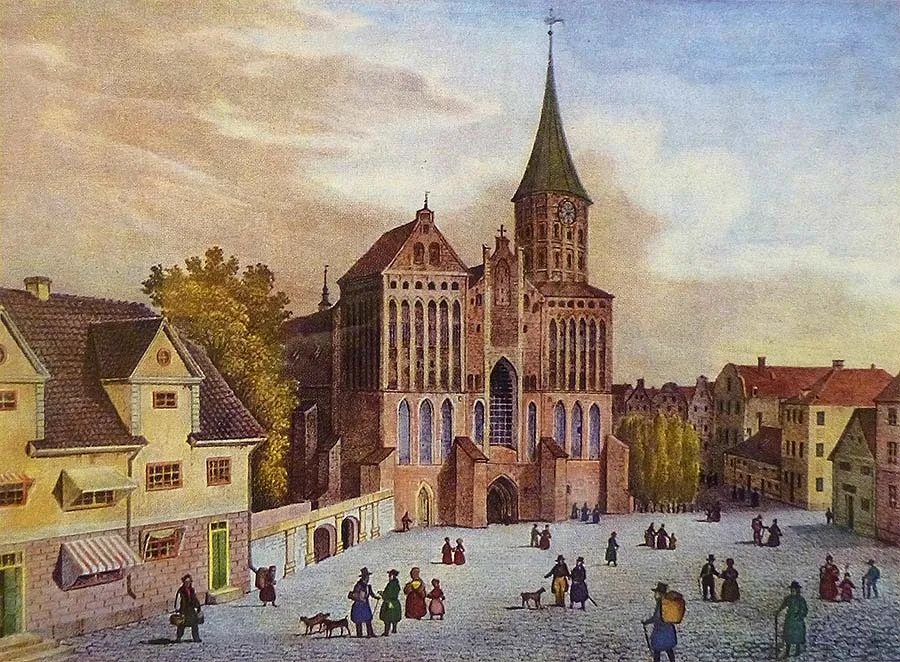 Cathedral Square in an 18th-century engraving.
Kneiphof's acquisition of town rights in 1327 was presumably closely linked to the building of the Cathedral. The decision to build it coincides in time with the founding of the town of Kneiphof and evidently became a kind of "encumbrance" for the townspeople.
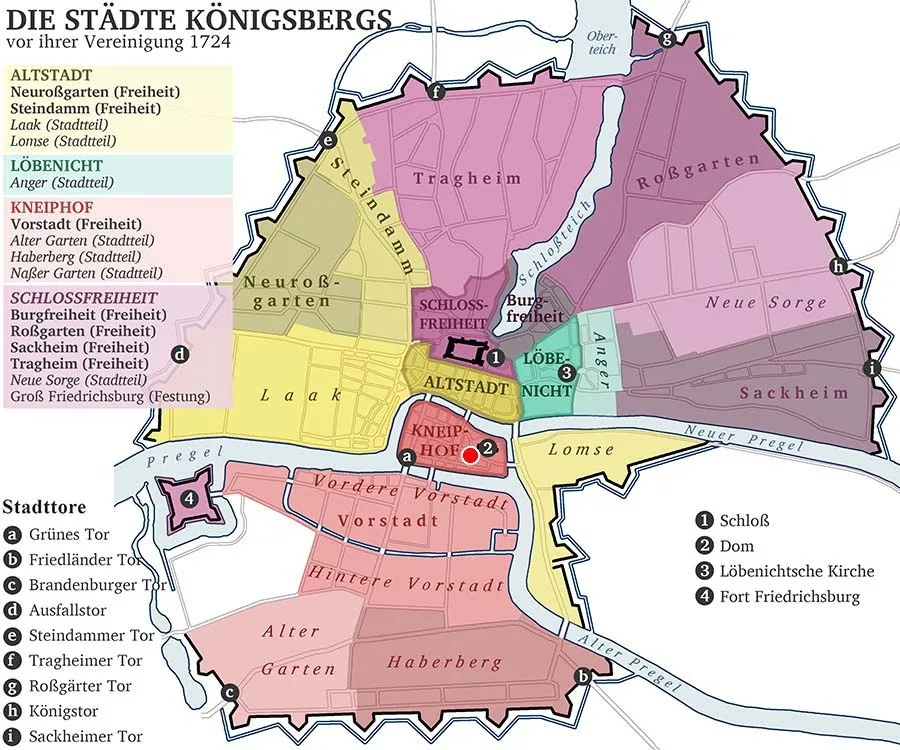
Kneiphof on a reconstructed map of the towns, suburbs and districts of Königsberg before their unification in 1724.
After all, town rights are also called "town privileges", and in return for these privileges the settlers had to set aside a site on the island for the cathedral and the land around it (including the traditional churchyard by the church walls). One way or another, Kneiphof received its town rights, and in 1330 construction of the cathedral began. It should be noted here that building on the island was far more difficult and costly than in neighbouring Altstadt and Löbenicht. The marshy ground required oak or larch piles for any substantial building. The Cathedral, too, stands on such piles. Yet despite all these precautions, over the years of its existence the cathedral has sunk more than a metre into the ground. The settlers also had to take measures to protect themselves against wind-driven floods.
There is a recorded case when, after a sudden rise of the water, its level inside the cathedral reached the parishioners' knees.
But the advantages of living in a town with its own law, charter, coat of arms, seal, market and privileges motivated the people of Kneiphof to overcome all the difficulties. As in other towns, the number of people wishing to settle within Kneiphof's walls quite soon exceeded the space the island could offer. To say that people lived cheek by jowl would be an understatement. The houses were literally glued to one another, violating every conceivable modern fire regulation. At the same time it was strictly forbidden to build beyond the plot allotted for the foundations or to "grab" public land by narrowing streets and squares. For economic activity outside the town walls, in 1329 Kneiphof was granted land south of the Pregel (that is, already in Natangia), which later became the town's suburb, the Front Suburb (Vordere Vorstadt).
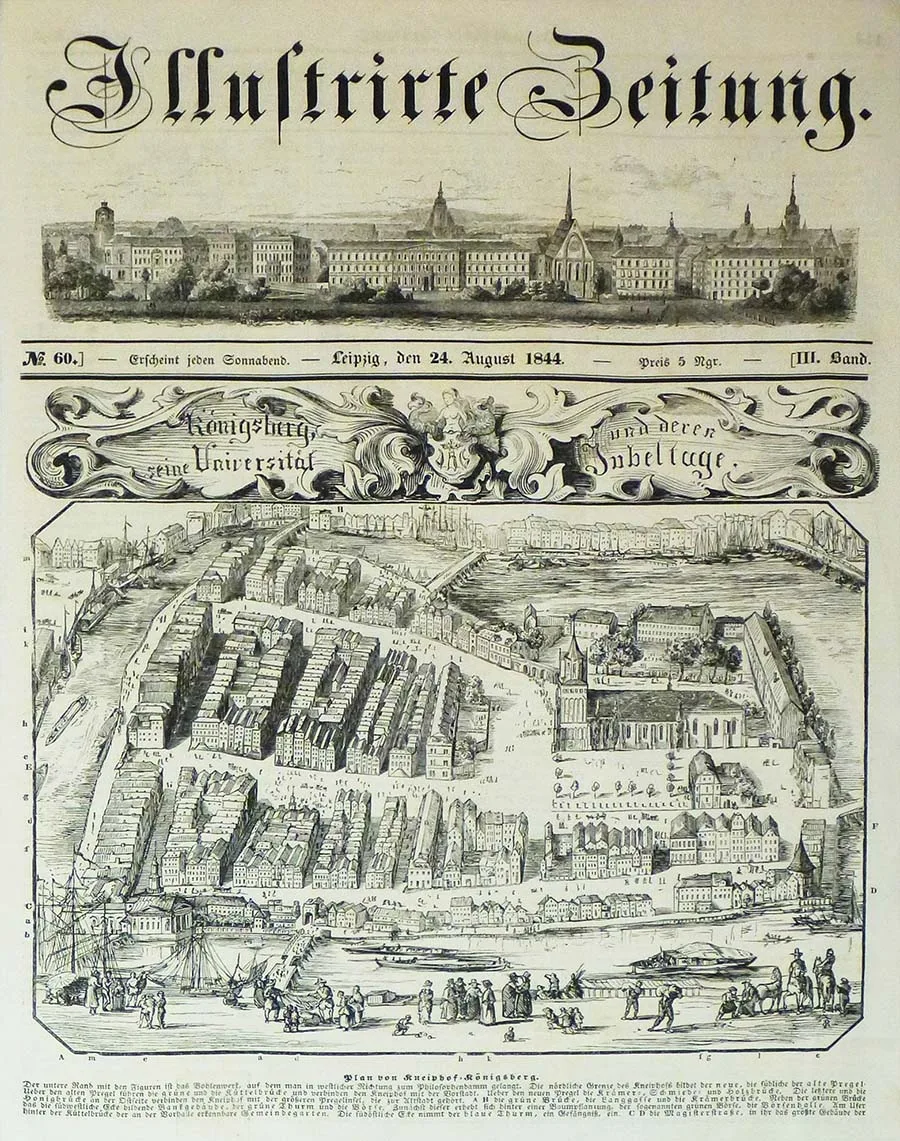 Kneiphof on the front page of the Saxon newspaper "Illustrirte Zeitung" (August 1844).
Having used the word "Kneiphof" (Kneiphof) repeatedly here, we should point out that the new town on the island did not come to be called Kneiphof (which translates as "beer yard") straight away. At the time of its founding it bore the old Prussian name Knipaw / Knipaw. There were other variants too: Knipab / Knipab and Knypabe / Knypabe.
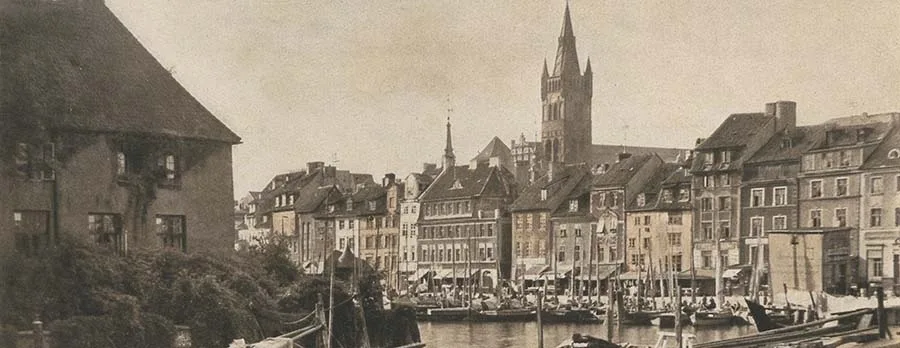
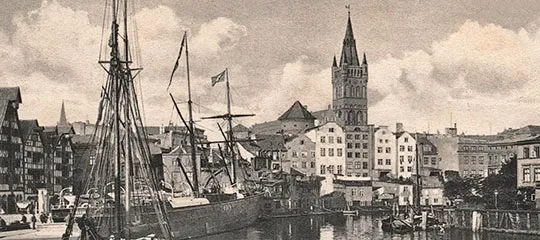
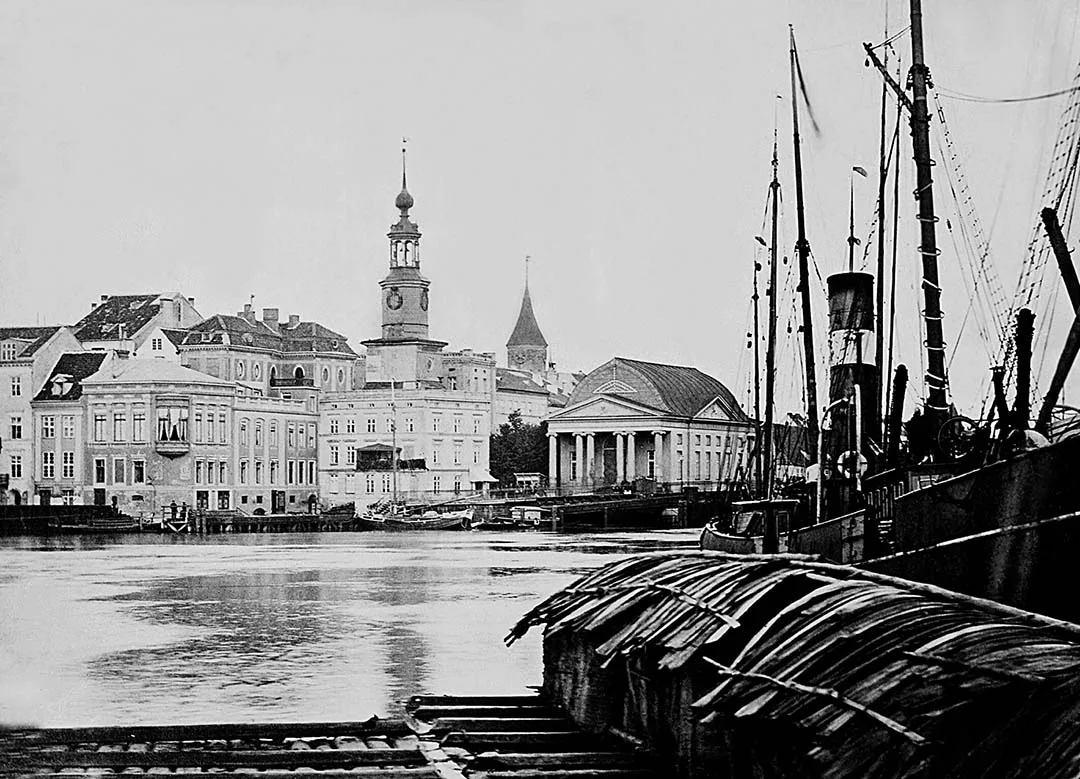
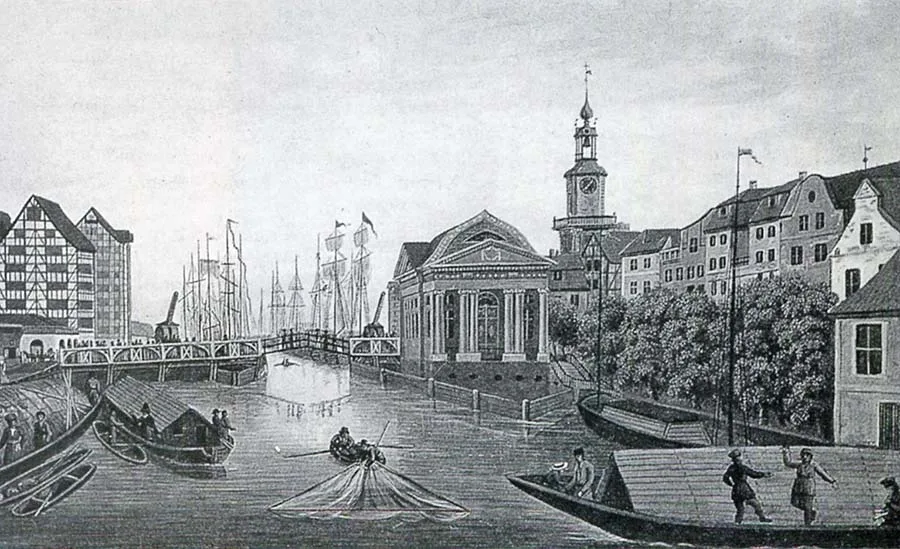 The southern bank of Kneiphof (right): the old Exchange (centre) and the Green Gate tower.
Nobody should be surprised that one and the same place had three different spellings: these were German transcriptions of a Prussian word taken down by ear, since the Prussian language had no writing. Nor did German itself have any fixed grammar at the time; any scribe could write down the name of the town as he saw fit, choosing the letters that in his opinion best matched the sound of its name. In Prussian, Knipaw or Knipab meant "a low-lying, marshy place", possibly "a marshy place by a river", and perhaps even "a marshy island in a river", which is exactly what Kneiphof was in those days. Before the name Kneiphof finally took hold, the new town managed to change several names, which often existed side by side.
On the earliest surviving seal of Kneiphof (1383) the inscription around the edge reads SIGILLUM: BURIENSIUM: DE: NOVO KONIGSBERCK, which can be translated as "Seal of the settlement of New Königsberg".
The name Pregelmünde / Pregelmünde was also used (the ending "-münde" in German denotes towns and places at the mouths of the rivers concerned). In the end, though, the time-tested Prussian variant "Knipaw" won, transformed into "Beer Yard" (Kneiphof). The name carried no particular meaning, since breweries were to be found in large numbers in all Prussian towns in those days, and Kneiphof actually had fewer of them than neighbouring Altstadt and Löbenicht.
Although it was under the (rather nominal) protection of Königsberg Castle, Kneiphof nevertheless remembered the unwritten rule of feudal society: every feudal lord has the right to his own defence. And a town, as we remember from our history lessons on the Middle Ages, was a collective feudal lord. So, without relying on the duty of its overlord (the Order) to protect it and without placing much hope in the waters of the Pregel, the inhabitants of Kneiphof began to build their own defensive walls and towers around the perimeter of the town.
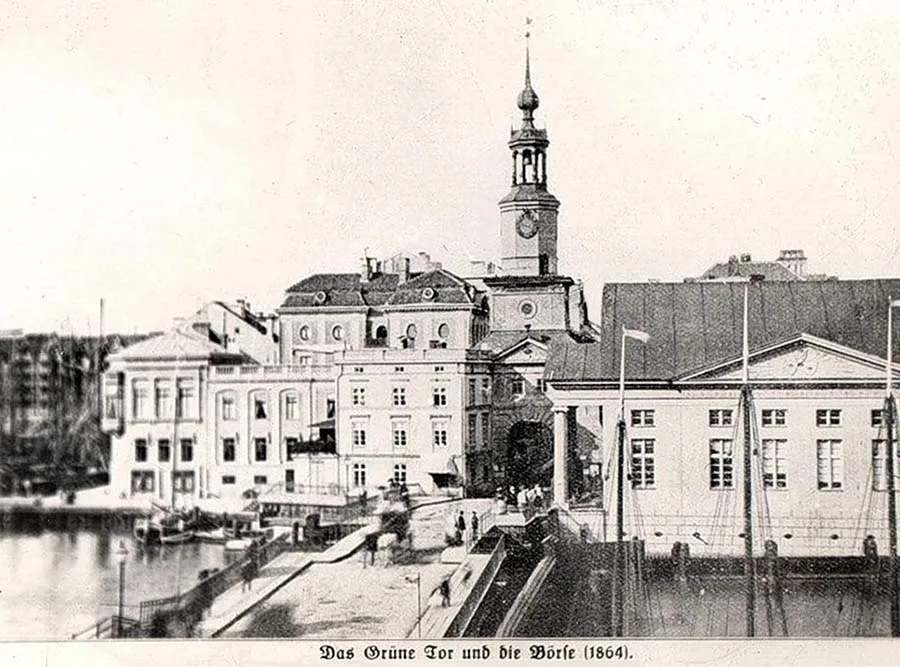 The Green Gate, the bridge and the old Exchange in 1864.
The two existing bridges (the Shop Bridge and the Green Bridge) and two new ones, the Giblets Bridge (Kettelbrücke, 1377) and the Smiths' Bridge (Schmiedebrücke, 1379), were guarded by gates with gate towers, and towers stood at the corners of Kneiphof.
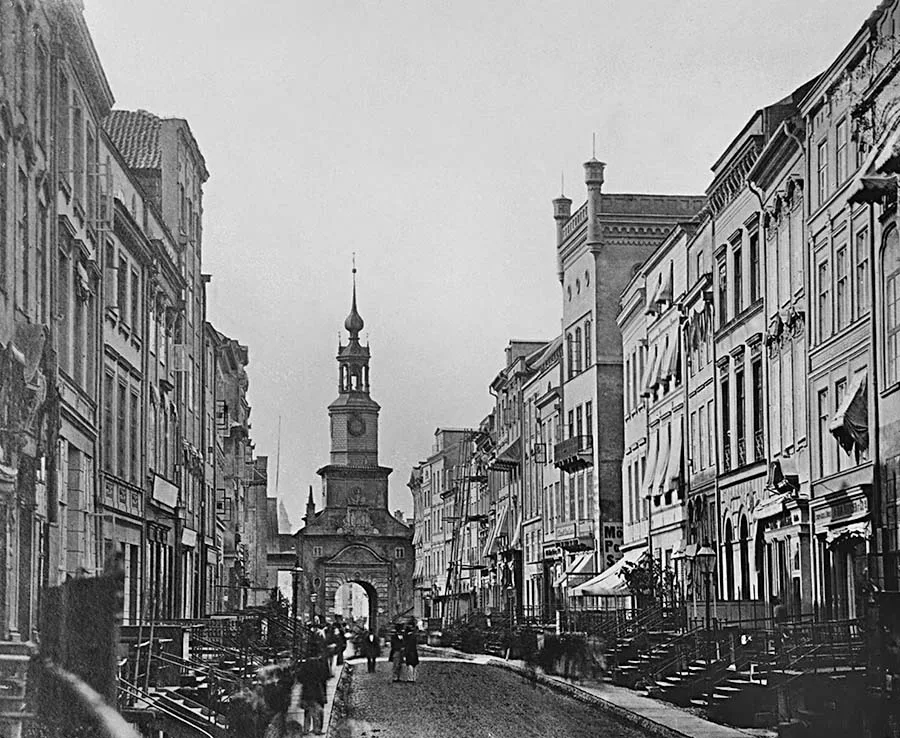 Kneiphof Long Street and the Green Gate in the mid-19th century.
As in other towns, Kneiphof had a town militia, which, under its vassal agreement with the Order (the town rights), the municipality had to raise not only for its own defence but also for taking part in the Order's military campaigns. The knights of the Order themselves, it is true, regarded the militiamen with great and undisguised prejudice, calling on them only in exceptional cases and as an auxiliary force.
As early as 1370 the young town of Kneiphof acquired its first legend and its first hero. This was the shoemaker Hans Sagan / Sagan. During the Battle of Rudau, when the Order's army and the town militia faced a massive Lithuanian-Russian-Tatar raid, the shoemaker Sagan picked up the Order's banner that had fallen to the ground, thereby averting the panic that was about to break out in the ranks of Königsberg's defenders, who then went over to a counter-offensive and won the day. As a reward for his feat, the humble shoemaker was raised to the nobility and given the corresponding prefix (von / von) to his surname. His full name now became Hans von Sagan (according to some versions of the legend, even at the instigation of Emperor Charles IV himself, 1316–78). The event was celebrated in poems and hymns, and Sagan's figure was immortalised as a statue on the Kneiphof town hall, in the painting "The Battle of Rudau" and in many other works of art.
Thanks to Sagan's feat, a tradition arose at the "Beer Festival", held from the time of the Order until 1619, of inviting 300 inhabitants of Kneiphof, headed by their burgomaster, to the castle.
Every year they marched in solemn procession across Altstadt Market Square (Altstädtischer Markt), and the authorities held a ceremonial banquet in their honour, at which the burghers were treated to March beer. Although the story of Hans Sagan was in all likelihood woven into the fabric of the festival post factum, it undoubtedly added to the glory of Kneiphof.
Modern German historians, however, are increasingly inclined to believe that the legend of Hans Sagan's feat was invented from beginning to end, which moves the hero of Kneiphof from the ranks of historical figures into those of fictional ones. But it is surely nicer to think that the legend has historical roots and that there once lived a brave shoemaker, Hans Sagan, who through his resolve and fearlessness managed to overturn all the feudal notions of the day about honour, valour and the role of common people in the fate of the state.
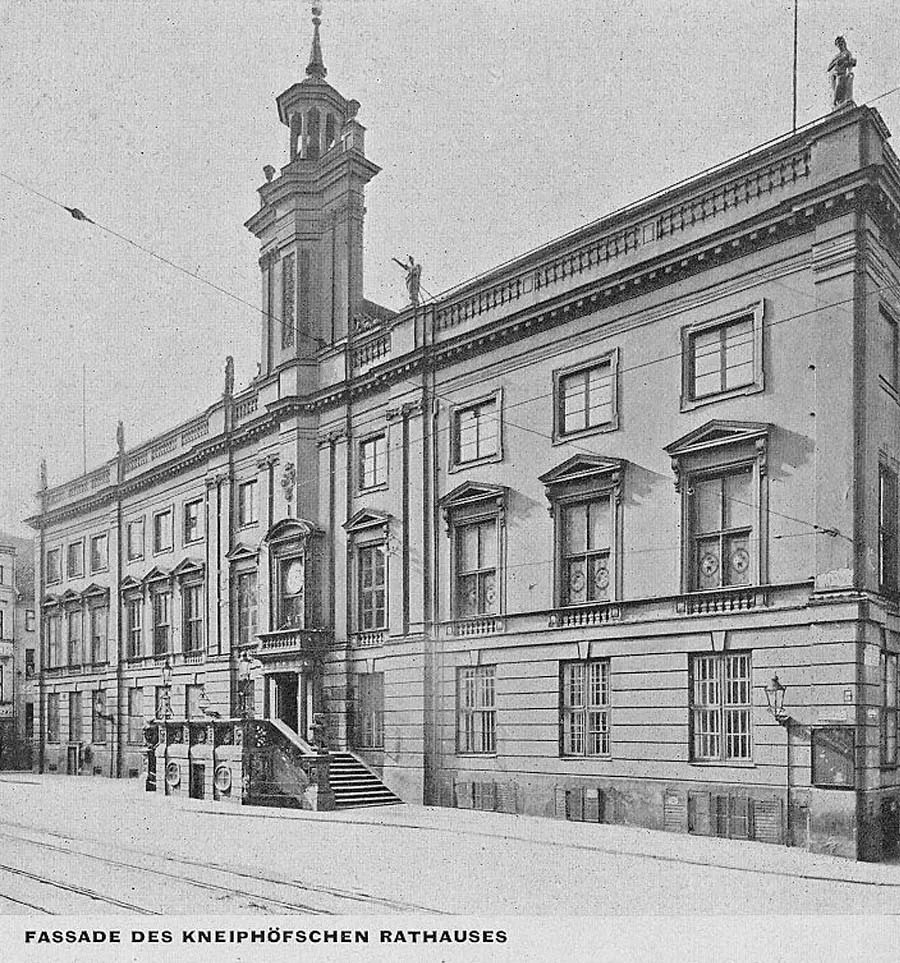 Kneiphof Town Hall on Bread Stalls Street (Brodbänkenstraße).
In February 1440 Kneiphof became one of the founding towns of the Prussian Confederation. The Prussian Confederation aimed to break free from the jurisdiction of the Teutonic Order, with a considerable extension of the rights of the municipalities and the bounds of self-government, as had happened with some of the free cities of Germany.
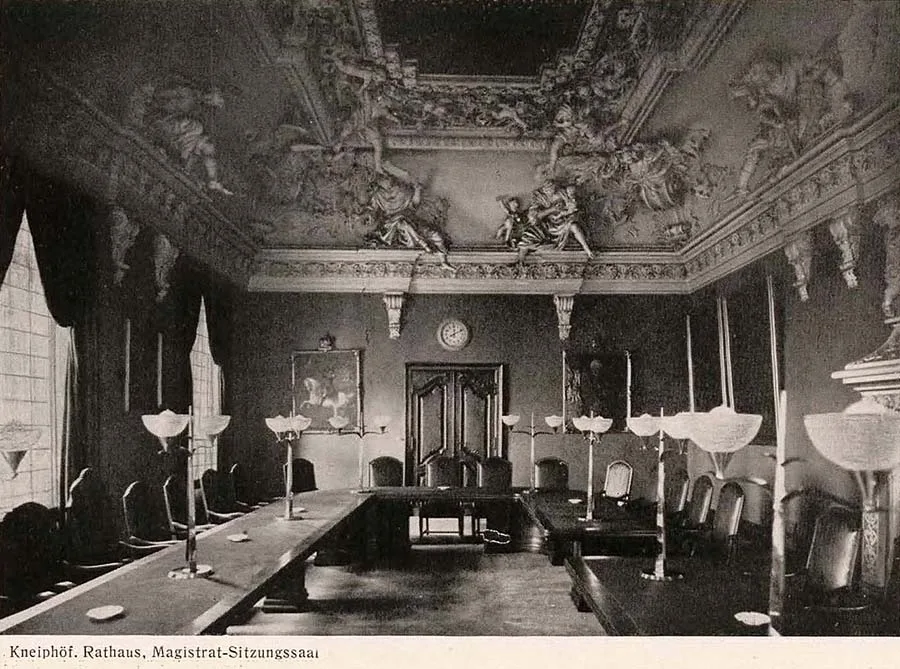 The council chamber of the magistracy in the Kneiphof Town Hall.
Fourteen years passed in political debates, exchanges of charters and demands for new rights, until by 1454 the situation had reached a deadlock. The Prussian Confederation then turned to the King of Poland with a request to take the towns under his jurisdiction and grant the municipalities an extensive list of liberties. On Kneiphof's side, the initiator of this step was its burgomaster Jürgen Largenbein / Largenbein. The townspeople entered into open confrontation with the Order, going so far as to try to demolish the southern wall of Königsberg Castle. But here Kneiphof was in for an unexpected turn of events. While in Kneiphof itself most townspeople shared their burgomaster's political views, in neighbouring Altstadt the burghers loyal to the Order rose in revolt, and Altstadt's chief troublemaker and supporter of the Prussian Confederation, the town's burgomaster Andreas Brunau / Brunau (c. 1400–57), was forced to flee to Kneiphof, where other supporters of the Prussian Confederation had also taken refuge.
There was a moment when Kneiphof found itself an island twice over: not only geographically, but also as a little island of the Prussian Confederation surrounded by territories controlled by supporters of the Order's state.
On 13 April 1455 the Komtur of Elbing (Elbląg, Poland; German Elbing) and future Grand Master Heinrich Reuss von Plauen (d. 1470) and his detachment made an unsuccessful attempt to attack Kneiphof from the south. And on 15 April 1455 Kneiphof was surrounded by the combined forces of the Order, Altstadt and Löbenicht. On 18–19 April there were minor skirmishes that brought success to neither side. Then Heinrich Reuss von Plauen carried out a real "amphibious landing": since the bridges to Kneiphof had been destroyed earlier, the landing on the island was made from ships and boats.
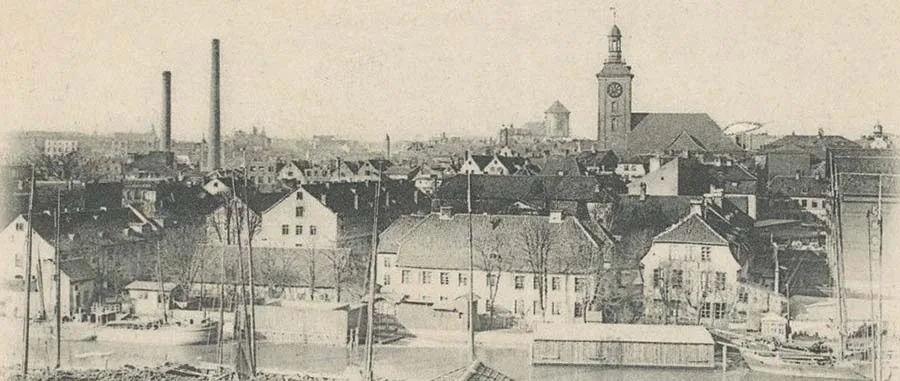
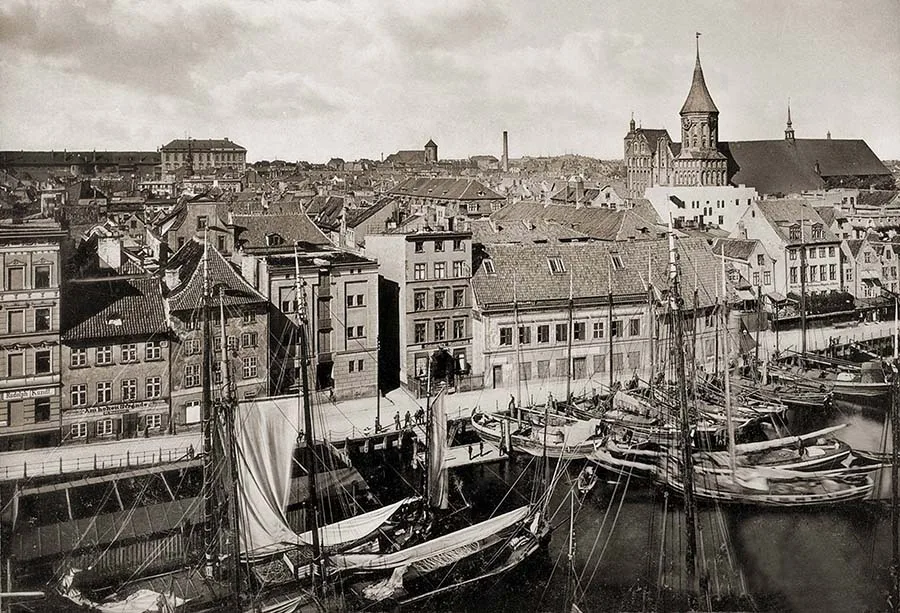 View of the southern bank of Kneiphof and the cathedral from the roof of the Exchange.
This was the only occasion in history when Kneiphof's town fortifications fully served their purpose. The Order's attack was repulsed, and a siege began.
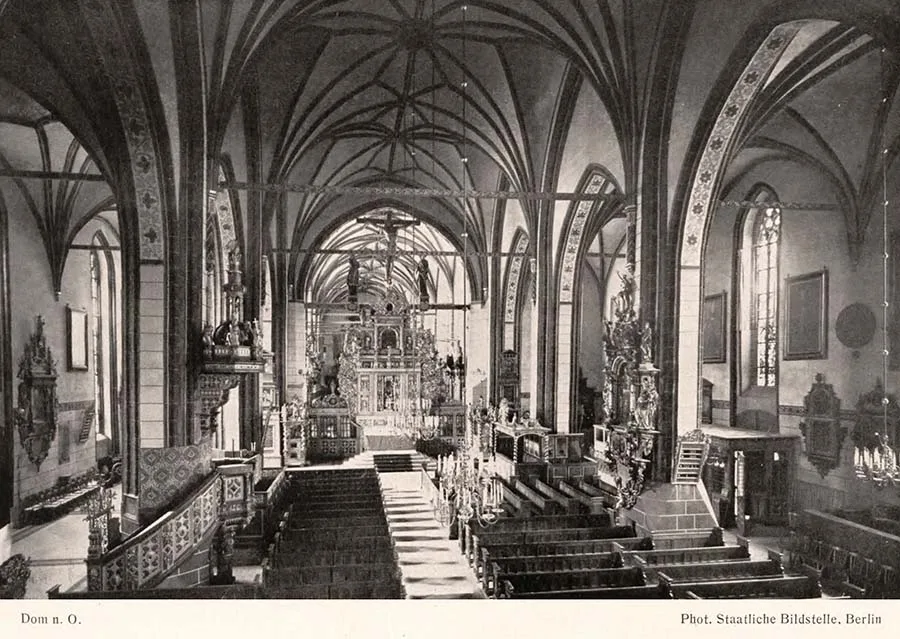 The nave and altar of the Cathedral in Kneiphof.
Both sides built up their forces. Detachments totalling 300 men, made up of Sambians and mercenaries under the command of Balthasar von Sagan / Sagan (1415–72), Hans and Adolf von Gleichen / Gleichen, Johann von Wartenburg / Wartenburg and Botho von Eulenburg / Eulenburg (d. 1480), came to the aid of the Order's army. The Livonian Landmeister sent the Order another 500 mercenaries. Meanwhile, reinforcements broke through to Kneiphof: some 400 men from Danzig on ships. Neither side had enough superiority to launch decisive action to storm the town or break the blockade. The fighting came down to periodic artillery exchanges. The siege ended three months after it had begun, on 14 July 1455. After the Danzigers, who had arrived by water to break through, failed in four days of fighting, Kneiphof's supporters of the Prussian Confederation entered into negotiations on surrender. As a result, Andreas Brunau was forced to leave Königsberg and went to Elbing, the Kneiphof town council was entirely replaced, and officials of the Order were installed in the administration of the municipalities. This ended Kneiphof's part in the Thirteen Years' War, but not the story of local free-thinking...
In 1523 Kneiphof became the place from which Luther's teaching began to spread in East Prussia. On 27 September 1523 Pastor Briesmann preached the first Protestant sermon in the Cathedral. A little later the Catholic cathedral chapter was dissolved here. The land it had occupied, one third of the island, was handed over to the municipality of Kneiphof in 1528.
But an even more important contribution to the cause of the Reformation was Kneiphof's role in the founding of the Albertina, the first university of a Protestant state. Duke Albrecht, heeding the opinion of the Lutheran preachers and theologians around him, became fired with the idea of opening a university in Königsberg: a kind of higher Christian school whose main aim would be to create an evangelical scholarly milieu in the state, while along the way training other much-needed personnel, such as physicians, lawyers and officials... In 1540 negotiations were held with the town authorities of Kneiphof: the duke would take back the chapter lands previously handed over to the town in order to build the university, and in return would grant Kneiphof the right to build a bridge that was important to it, later named the Honey Bridge (Hönig-Brücke). One may suppose that the town authorities weighed up all the pros and cons of this proposal for a long time, but in the end decided that a national academic and educational institution on the town's territory would bring it more benefit than trouble.
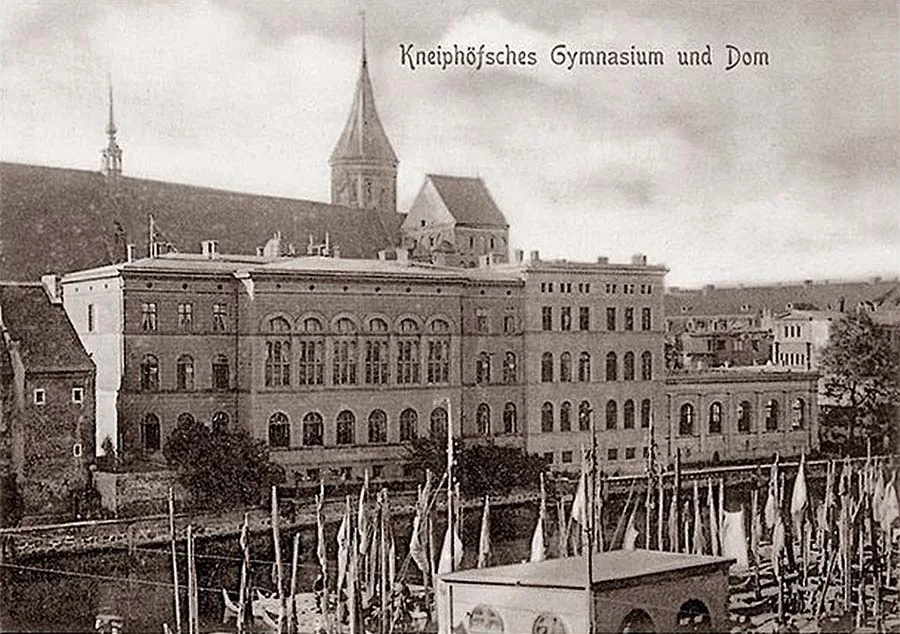 The north-eastern corner of Kneiphof: the gymnasium and the cathedral.
Thus two important events took place in 1542: the last of Königsberg's seven famous bridges, the Honey Bridge (Honigbrücke), was built, and on 11 December a ducal gymnasium was opened between the Cathedral and the northern bank of the island, which became an intermediate stage in the process of founding the university.
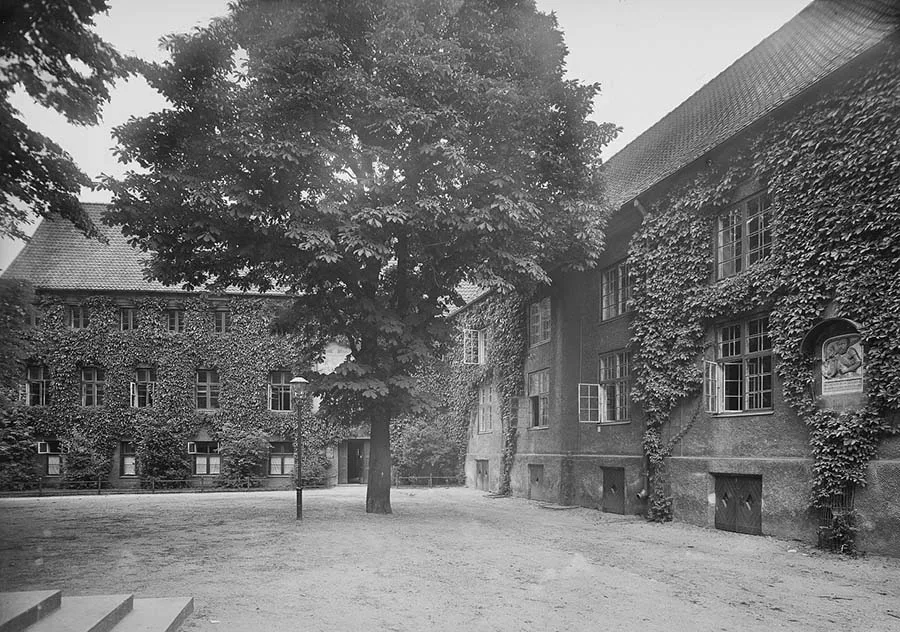 The courtyard of the old Albertina.
Once all the founding documents had been drawn up, the university, named the Albertina in honour of the duke, was solemnly opened in its building on 17 August 1544. The year was marred only by a fire in the eastern part of Kneiphof. Several houses and numerous shops burned down, and the wooden parts of the cathedral's towers were damaged. The towers were later restored in the form familiar to us from numerous pre-war photographs.
Under Duke Albrecht, Kneiphof strengthened its position as a trading centre as the duchy's business ties with Holland expanded.
By hook or by crook, Dutch merchants began buying houses in Kneiphof, choosing the most expensive buildings on the island's main street, Kneiphof Long Street. Even the boom across the entrance to the Pregel came to be called the "Dutch tree" (Holländerbaum).
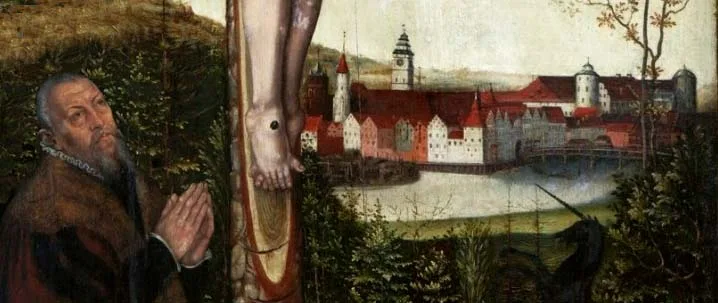
Before long, however, the Dutch began to settle in the other Pregel towns as well. In 1550 an engraving by an unknown artist was printed in a book by Georgius Braun / Braun showing Königsberg, or more precisely the three Pregel towns, the castle and the suburbs that had appeared outside the town walls. It clearly shows all five of Kneiphof's bridges, the gates with towers at the foot of each bridge, and a continuous fortress wall on the southern side of the island. One can also see that Kneiphof is crossed by five transverse streets and that there is a square by the cathedral. The longitudinal streets cannot be made out in the engraving, but clearly the town could not have done without them. Kneiphof's bridges do not yet have lifting mechanisms, so the merchant ships arriving in the town moor at the Kai embankment (Kai) on the side of the Hundegatt channel (Hundegatt).
The growth of foreign ties also had its downside: in 1564, 1580, 1597 and 1601–02 plague epidemics swept through Prussia, Königsberg and Kneiphof among them. The situation was especially grave in 1602, when even the burgomaster of Kneiphof died of the disease, market trading was halted, the university was closed, and the townspeople tried to save their lives in nearby villages. That year the cemeteries could not cope with the flow of the dead.
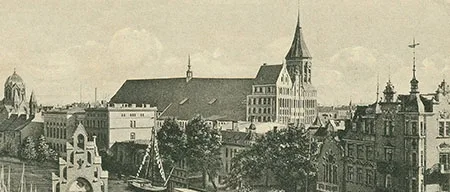
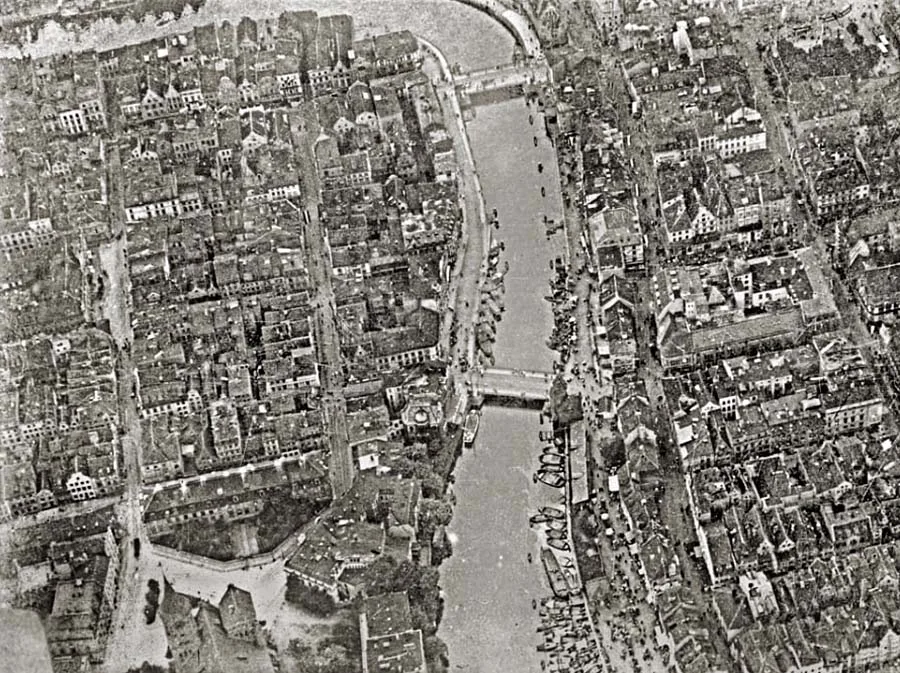 Kneiphof (left) in an aerial photograph from the first half of the 20th century. The cathedral is in the bottom left corner.
The extreme density of houses in Kneiphof fostered the two most terrible scourges of towns in the Middle Ages and the early modern period: epidemics and fires.
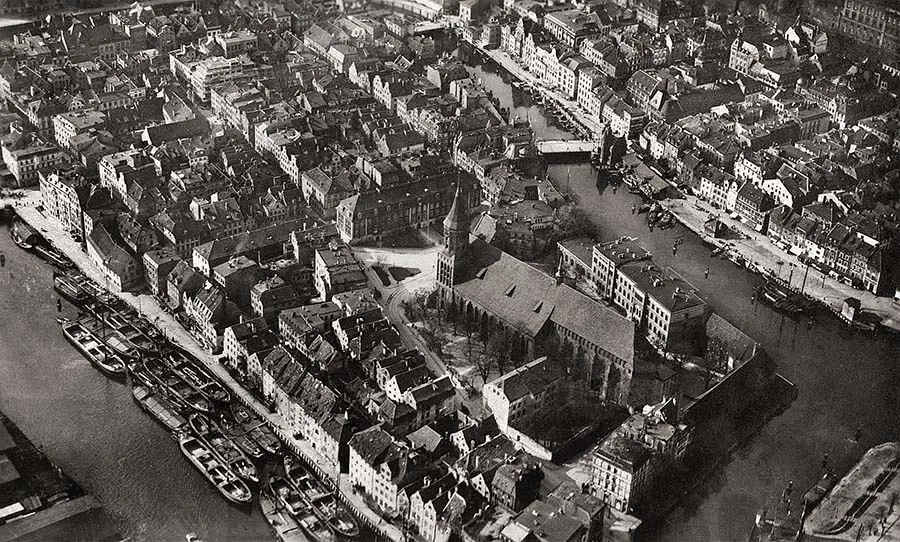 A bird's-eye view of Kneiphof in the first half of the 20th century.
The death of Duke Albrecht, the regency and the passing of power to the Electors of Brandenburg affected Kneiphof to the same extent as the fate of the neighbouring towns and of Prussia as a whole. The new town ordinance of 1620 settled some of the disputes between the ducal authority and the municipalities and introduced uniform laws for all three towns, which brought them closer together. Kneiphof's suburbs, the Vorstadt (Vorstadt) and Haberberg (Haberberg), were being built up with houses and now stretched all the way to the Nasser Garten. When construction of common town fortifications, the First Bastion Belt, began in 1626, there was no longer any need to keep Kneiphof's medieval walls and towers. Those that got in the way of town life were dismantled, and the rest would be taken down later as the need arose. Next to the Green Gate (Grünes Tor), built back in 1592 and named after the bridge whose crossing it guarded, stood the post office building. Here, between the post office and the gate, merchants gathered to conclude deals with one another. However, the town's medieval statutes forbade a "guest" to trade with another "guest" (only with local merchants), and deals within the town were subject to duty; this compelled the merchants in 1624 to build the first exchange outside the town, by the Green Bridge, standing on piles by the Kneiphof bank. This exchange became common to Kneiphof, Altstadt and Löbenicht.
The Green Gate itself housed Königsberg's musicians, members of a special guild whose duty was to play chorales from the main tower of Königsberg Castle.
In 1668, in faraway Nuremberg, Christoph Egidius Negelein / Negelein (d. 1746) was born. In 1694 he bought a house on Kneiphof Long Street and entered service as a state secretary in Königsberg, engaging in trade and money-lending on the side. It was Negelein's house overlooking the river that in 1697 was chosen as temporary lodgings by the bombardier Pyotr Mikhailov, the name under which the Russian Tsar Peter I unsuccessfully tried to conceal his identity. Peter became such good friends with Negelein that from then on he always stayed at his house in Kneiphof, ignoring offers to lodge in the castle. Negelein himself became burgomaster of Kneiphof in 1711 (according to other sources, in 1717) and held the office until the unification of the towns on 13 June 1724. In that same year, 1724, he was granted a noble title and the post of state commercial councillor.
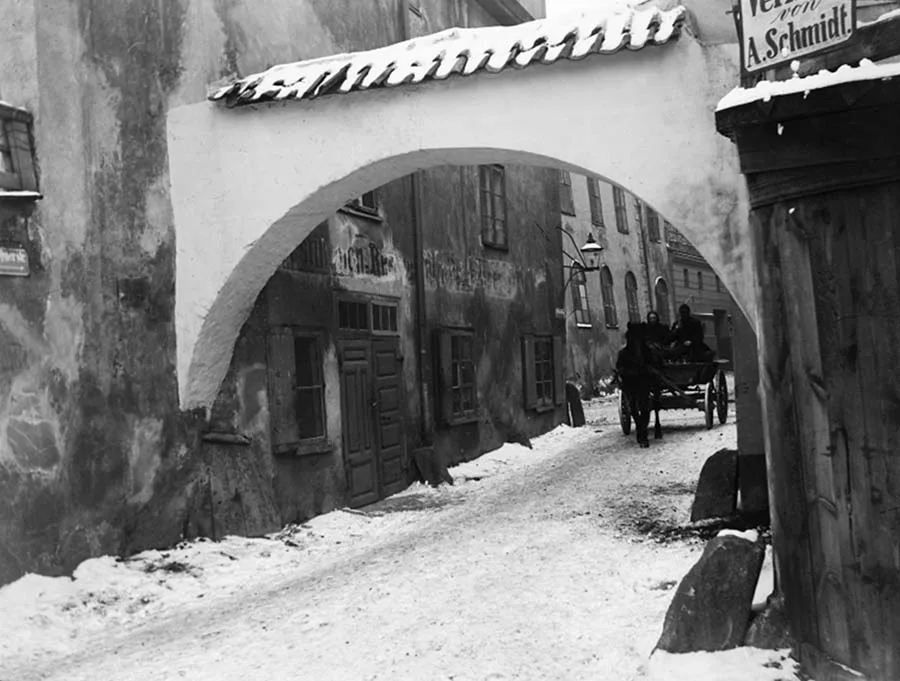 The Pregel Arch on the southern bank of Kneiphof.
In unified Königsberg, Kneiphof was one of the central districts, its main sights remaining the Albertina University and the Cathedral. The industrial revolution of the 18th and 19th centuries had virtually no effect on the old town, since there was simply no room here to develop manufactories, let alone large plants and factories, because of the dense building.
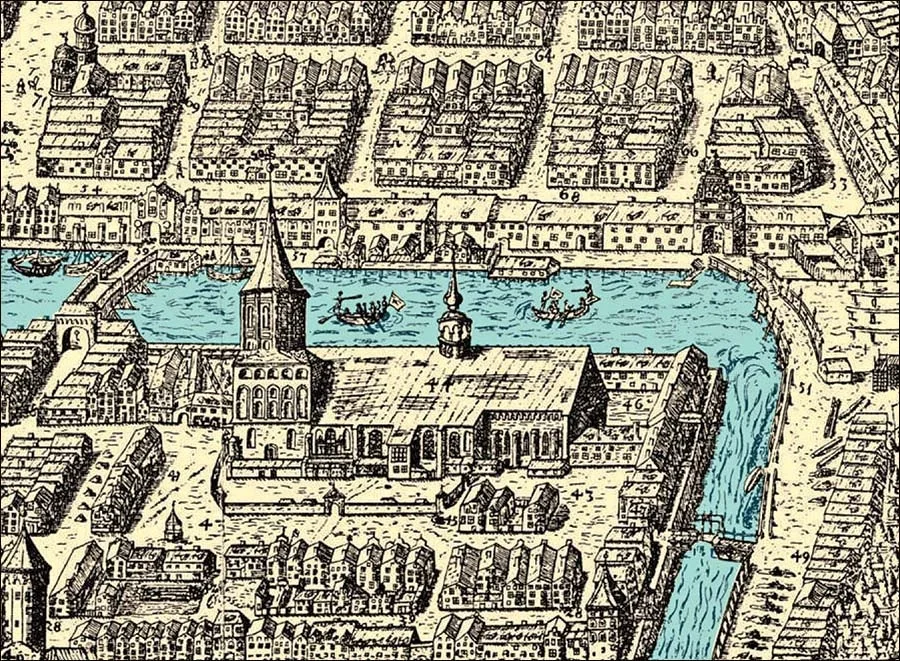 A fight of boatmen with poles off the Kneiphof bank on Bering's plan of 1613.
Handicraft and guild production gradually died out, and Kneiphof was increasingly left with only residential houses, shops, administrative services and institutions. In 1864 the Green Gate in front of the bridge of the same name was demolished: it had begun to obstruct traffic onto the island. In 1851, for instance, a trench more than half a metre deep had to be dug in it so that the equestrian statue of King Frederick William III, being transported through Kneiphof, could pass. The bridges themselves were radically rebuilt: the Honey Bridge in 1881–82, the Giblets Bridge in 1886, the Smiths' Bridge in 1896, the Shop Bridge in 1900 and the Green Bridge in 1907. The last of these came to be regarded as the most beautiful of Königsberg's bridges, and so it appears more often than the others in pre-war photographs.
All the bridges had lifting spans and tram rails. At the beginning of the 20th century trams ran across all of Kneiphof's bridges. One line ran along Kneiphof Long Street over the Shop and Green Bridges, with a reserve branch over the Giblets Bridge. The second line ran over the Smiths' Bridge past the cathedral and on over the Honey Bridge.
Before the Second World War Kneiphof had six longitudinal streets (from west to east), two longitudinal passages, eight transverse streets (one of which was called a square) and two more squares. At that time there was only one working tram line on the island: along Kneiphof Long Street over the Green and Shop Bridges. But the rails over the other bridges were not removed and were left just in case. The island was also linked to Laak (Lastadie) by a ferry. Three gas mains and a water main were laid to Kneiphof. Despite its "medieval" look, there were no longer any houses from the Order's period in Kneiphof (apart from the cathedral), but buildings from the era of the Kingdom of Prussia and even from the time of the duchy were still standing.
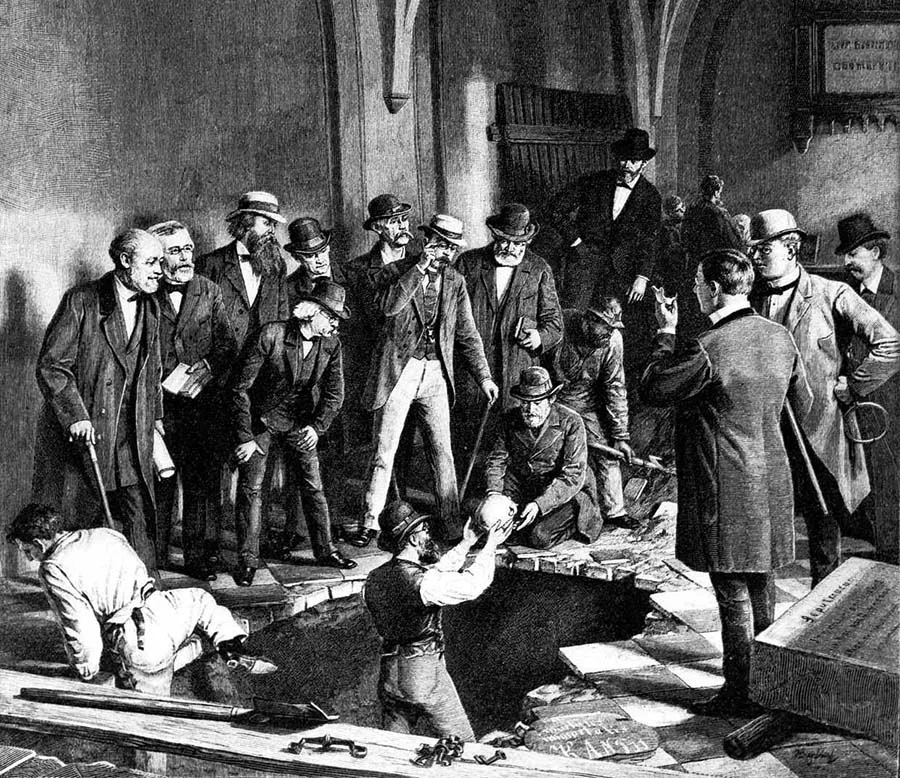 Exhumation of Immanuel Kant's grave before the demolition of the chapel in 1880.
On the night of 30 August 1944 Kneiphof suffered a disaster unequalled in its entire six-hundred-year history: 189 bombers of the British Royal Air Force dropped 480 tonnes of incendiary and high-explosive bombs on Königsberg. Kneiphof found itself at the epicentre of a firestorm of incomparably catastrophic consequences, and its island location did not help fire crews to arrive quickly.
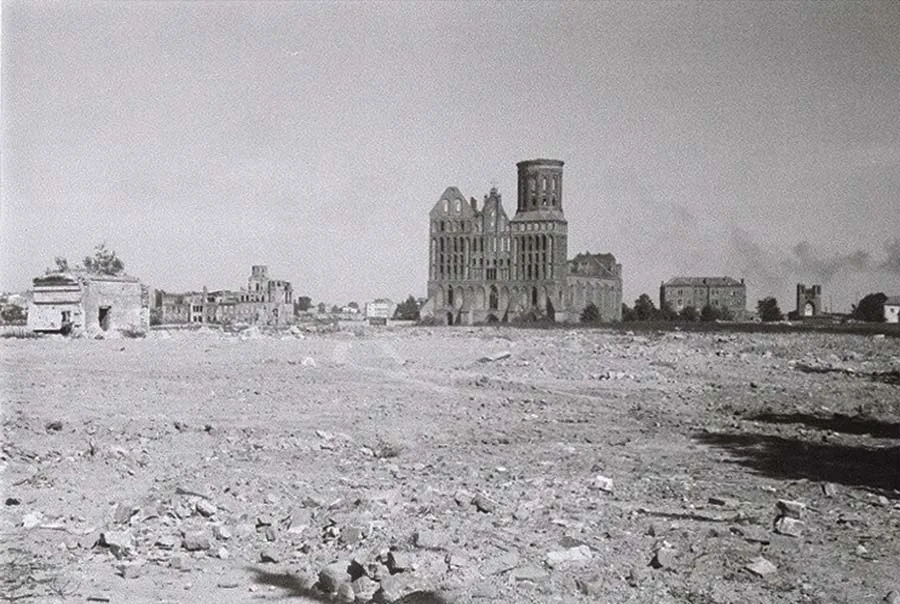 Kneiphof in the second half of the 20th century. No birds sing here...
All the town's buildings and structures were damaged by the fire; the roof of the cathedral burned and collapsed, and its interior was completely gutted. The old university building met the same fate. In effect, all that remained of Kneiphof's houses were charred walls, many of them partly destroyed by the intense heat. It is quite possible that this time, too, the town would have been rebuilt from the ruins, its most important buildings restored to their former appearance and its old streets preserved within their centuries-old lines... But misfortunes never come singly: during the storming of Königsberg on 6–9 April 1945, one of the main lines of defence inside the city ran along the southern bank of the island.
The bridges were blown up, and the façades of buildings facing the enemy were turned into strongpoints and firing positions. Guns pounded them with direct fire, mortars lobbed their shells into the roofless buildings, and ground-attack aircraft poured fire from the air onto the positions of the Wehrmacht and the Volkssturm…
It must be said that, despite the most brutal destruction of Kneiphof's houses and other buildings, their fate was not as unconditionally sealed as it was sometimes presented in Soviet and Russian local history publications. Proof of this is the fact that in 1948 the Kaliningrad City Executive Committee gave the old German streets of Kneiphof new Russian names. Here are the names of these streets, now forgotten by all, to convey the flavour of the time: Bordyurnaya (part of Junkergarten / Junkergarten), Bordyurny Lane (Johann-Jacoby-Straße / Johann-Jacoby-Straße), Brustvernaya (Kai / Kai), Verkhnegorodskaya (Magistrstraße / Magistrstraße), Verkhnegorodskoy Lane (Ruppstraße / Ruppstraße), Kamnelomskaya (Köttelstraße / Köttelstraße), Kubanskaya (Schönberger Straße / Schönberger Straße), Likhoslavskaya (Kneiphofische Hofgasse / Kneiphofische Hofgasse), Tyumenskaya (Kleine Domstraße / Kleine Domstraße), Ugolnaya (Kohlmarkt / Kohlmarkt). Kneiphöfische Langgasse also became part of Mayakovsky Street, later renamed Leninsky Prospekt. But it seems that no one ever even considered the option of restoring Kneiphof's buildings.
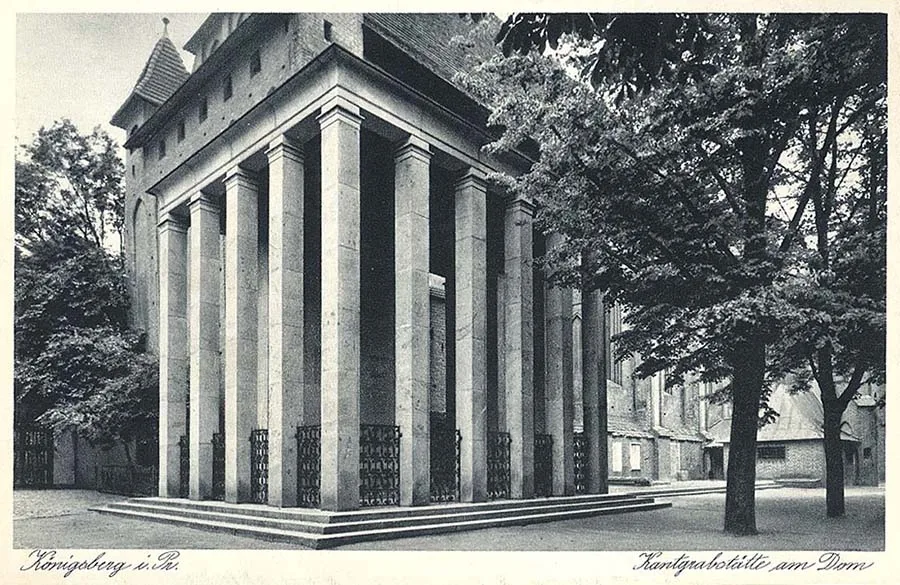 The Immanuel Kant Memorial by the walls of the Cathedral in Kneiphof.
The ruins of its buildings were immediately turned into a "quarry" of bricks and brick rubble. The latter was used to fill road beds and as a substitute for crushed stone in concrete. The materials obtained in this way were loaded straight onto barges. Some of the bricks were used in the city itself to restore housing and public buildings; some went to war-ravaged cities of the USSR.
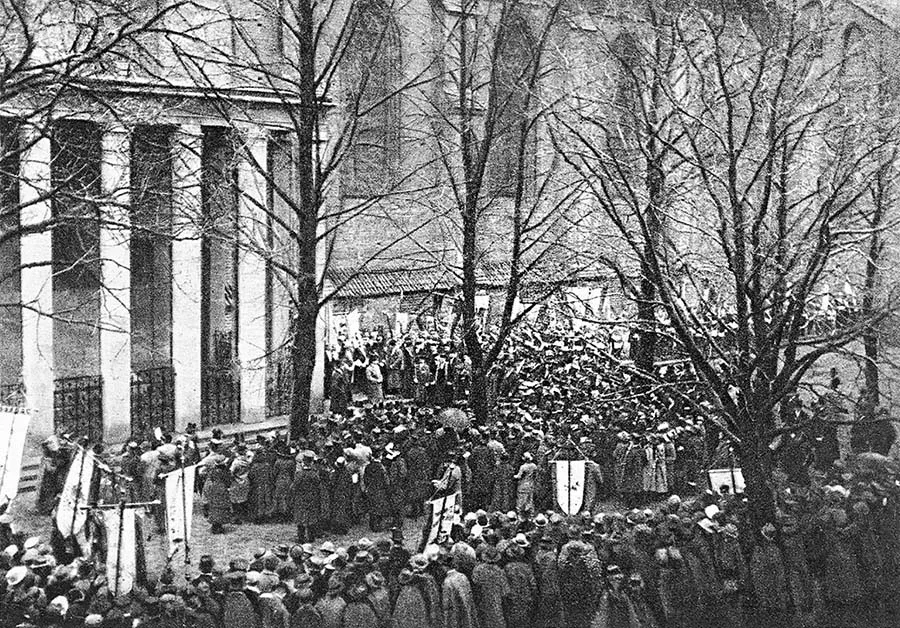 On 22 April 1924 the bicentenary of the philosopher who brought the city fame was celebrated in grand style.
By the mid-1950s everything that could be dismantled had been taken apart, after which the site was levelled so that only the occasional exposed edge of a foundation reminded one that there had once been a town here. At the edge of the island, flat as a table, stood only the soot-blackened ruins of the cathedral with Immanuel Kant's grave, which had survived and been scrubbed clean of soot (and of post-war graffiti). The island was named Tsentralny (Central), but nobody called it that. If someone invited someone else for a walk on Kneiphof, they would simply say: "Shall we go to Kant's grave?" By the 1970s this expression had turned into a popular place name, pronounced as a single word with no connection to the grave or to Kant himself: "Magilakanta".
In 1972 the Estakadny (Overpass) Bridge was built over the former Kneiphof Long Street. Before it was built, the Shop and Green Bridges, which had been restored in simplified form after the war, were demolished. Pedestrian stairways were built down from the Overpass Bridge to Kneiphof.
In those years, however, hardly anyone went walking on the island: it was too deserted and bleak. The occasional curious Kaliningrader would squeeze through the bars installed in the cathedral's doorways to look at the ruins from the inside. Official tours did not usually linger long at the cathedral.
This went on until 1984, when a Sculpture Park was created among the trees and shrubs that had grown up there. For those times it was a very bold idea to create an extensive ensemble of 26 works by sculptors from the RSFSR, Latvia and Poland on an uninhabited island: A.M. Belashov (1933–2011), E.F. Belashova (1906–71), P.I. Bondarenko (1917–92), L.V. Bukovsky (1910–84), S. Horno-Popławski (1902–97), E.Zh. Leimane (1910–2004), N.S. Mogilevsky (1895–1975), V.P. Mokrousov (1936–2021), R.Kh. Muradyan (b. 1938), Yu.G. Orekhov (1927–2001), M.V. Pereyaslavets (1949–2020), N.G. Petina (1932–2022), L.S. Romanova (b. 1949), V.E. Semyonova (1928–2023), L.G. Terentyeva (1937–95), V.I. Fedorin (1936–2007), L.M. Kholina (1918–1998), A.N. Chernitsky (1918–2010), V.B. Shelov (1928–2013).
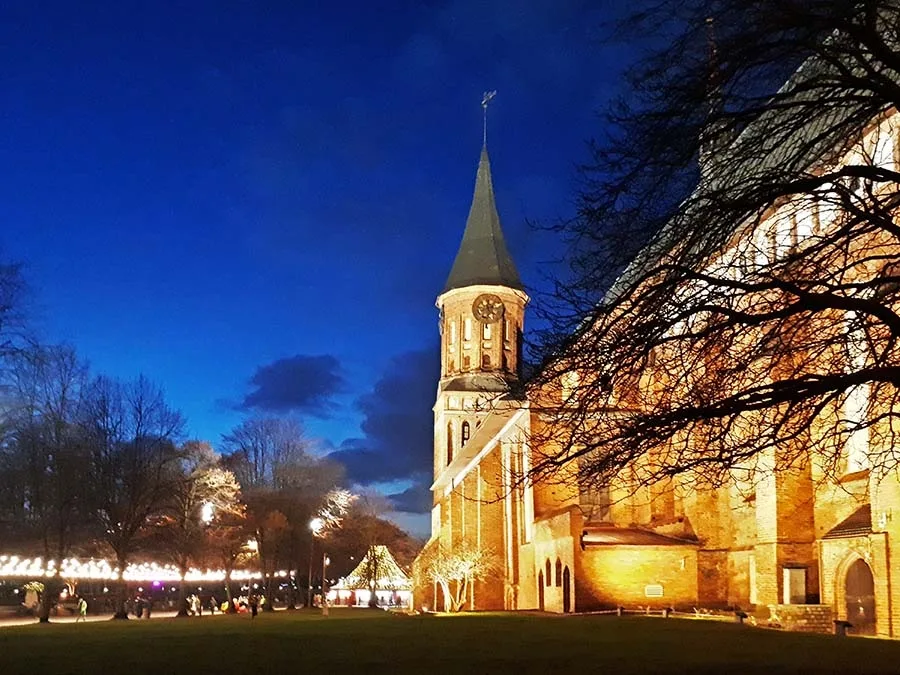 Christmas market on Kant Island (2022).
A rich dendrological collection of trees and shrubs from various countries and regions was assembled in the park, a central avenue was laid out, and benches and lighting were installed. As a result of this transformation, Tsentralny Island became popular with Kaliningraders and visitors to the city as a place for walks and relaxation.
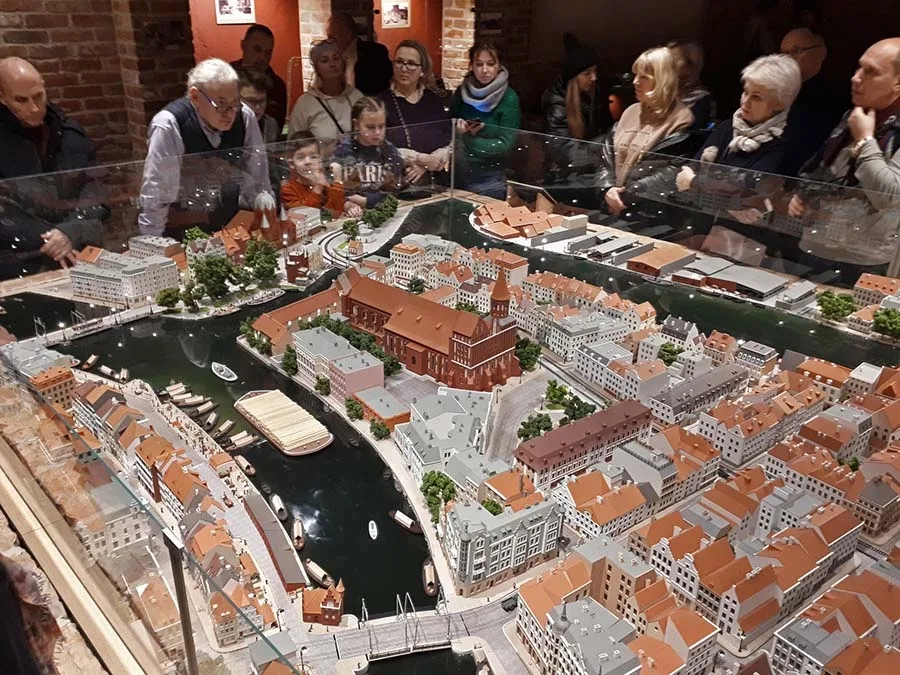 Model of Kneiphof in the "Königsberg" Museum of History and Architecture in Zelenogradsk (2023).
But the island gained even greater popularity from the work to restore the Cathedral. It began in 1992, and in 1994 the whole city could watch a helicopter set the dome on the main tower. From 1995 the island became the venue for all kinds of festivities and festivals, of which, in the second half of the 1990s, several were sometimes held in a single year. By 2000 the phase of large-scale construction work in the cathedral, including the restoration of Kant's grave, had been completed. Further work concerned the recreation of the interiors, the installation of the organ and the opening of a museum and concert hall. Kaliningraders came to call the island "Kant Island" without exception. A tradition arose of wedding processions visiting the island and, in particular, the Kant memorial.
By a decision of 13 April 2016, the City Council renamed Tsentralny Island Immanuel Kant Island, which in essence legalised the established status quo.
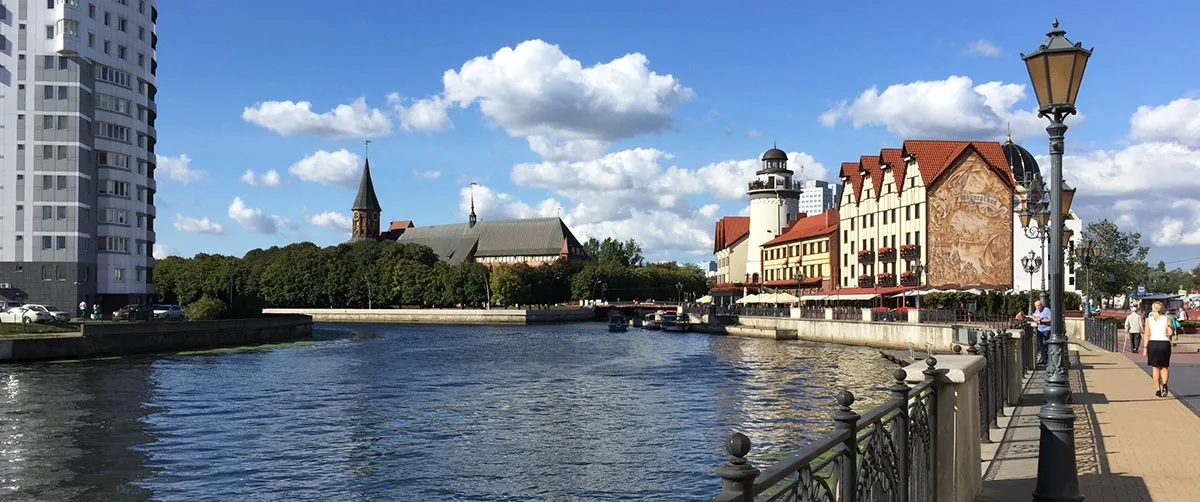
Today the former Kneiphof is one of the most popular places for walks, tours, photo shoots and all kinds of festivities and fairs. The question of partially recreating the historic buildings on the island has been raised more than once, but on the whole public opinion has so far (2024) been negative towards the idea. For local residents understand that as soon as the veto on capital construction on the island is lifted, it will immediately, by hook or by crook, be built up with faceless shopping centres and "apart-hotels", as has happened more than once (and is still happening!) to iconic historic places in Kaliningrad and the region.
The design uses photographs from the East Prussia Photo Archive and by Mikhail Ogorodnikov.
– – – – – – – – –
The chapter "Kneiphof"
from the book by local authors "Königsberg Local Studies",
published at the end of the 19th century
In 2012–2014 "Pregolya", the literary supplement to the "Baltiysky Almanakh",
published a translation of the book by the Königsberg authors Dr Richard Armstedt, professor at the Altstadt Gymnasium, and Dr Richard Fischer, senior teacher at the Kneiphof Gymnasium, "Königsberg Local Studies" ("Heimatkunde von Königsberg i. Pr.", 1895, Kommissionsverlag von Wilhelm Koch, Königsberg), made by an unknown translator. The idea of publishing it belonged to Igor Vladimirovich Afonin. The text was adapted and annotated by Aleksey Borisovich Gubin and Igor Fyodorovich Avtukhov. That book had a separate chapter on Kneiphof. Having edited it substantially, we present it to you as a supplement to the text by
Aleksey Yevgenyevich Petrushin.
– – – – – – – – –
Der Kneiphof
Kneiphof is the youngest of the three towns of Königsberg. It was proclaimed a town on Palm Sunday (Palmsonntag; in the Orthodox tradition, Willow Sunday), 6 April 1327, by the Grand Master of the Teutonic Order, Werner von Orseln (Werner von Orseln, c. 1280–1330). By then, since 1324, building had already begun in the area of today's Kneiphof Long Street (Kneiphöfsche Langgasse).
When the town's history was just beginning, the island on which it stood was called Vogtswerder (Vogtswerder) or simply Werder, which in German means "islet", while a Vogt was a governor in the time of the Teutonic Order (Deutscher Orden) who administered it; but in the founding documents the new town itself is already called Knipab (Knipab). The name, one may suppose, was somehow connected with the town's location, separated from its surroundings by the arms of the Pregel (Pregel). The explanation that the word Kneiphof is an abbreviation of Kniprode-Hof, in honour of Grand Master Winrich von Kniprode, must be rejected, since the name Kneiphof was in use even before his rule. In later documents the town was for some time called Pregelmünde (Pregelmünde, the mouth of the Pregel).
Coat of arms of Kneiphof: on a green field, an arm in a blue sleeve rises from the water holding a crown. On either side of the arm are two hunting horns. The crown symbolises King Ottokar of Bohemia (Ottokar II. Přemysl), the presumed founder of Königsberg (Königsberg). The two horns stand for the hunting of beavers, otters and wildfowl, which were found here in great numbers. The coat of arms is supported on both sides by bears.
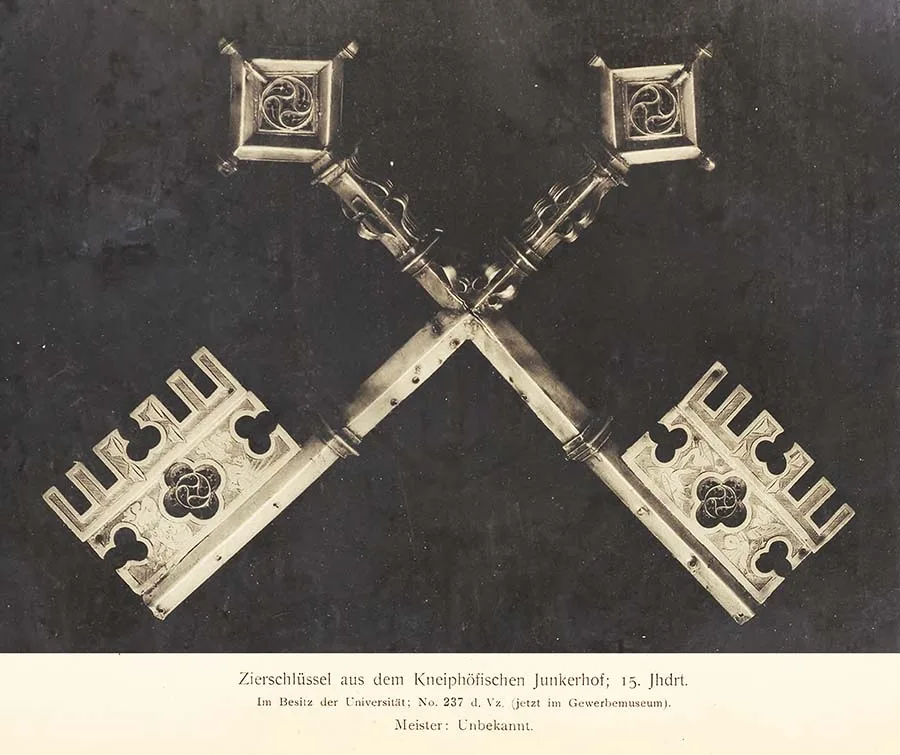 Decorative keys to the Kneiphof Junkerhof.
In shape, the island town of Kneiphof is an irregular rectangle. Its main and oldest street is now called Kneiphof Long Street (Kneiphöfsche Langgasse; today the space beneath the Overpass Bridge).
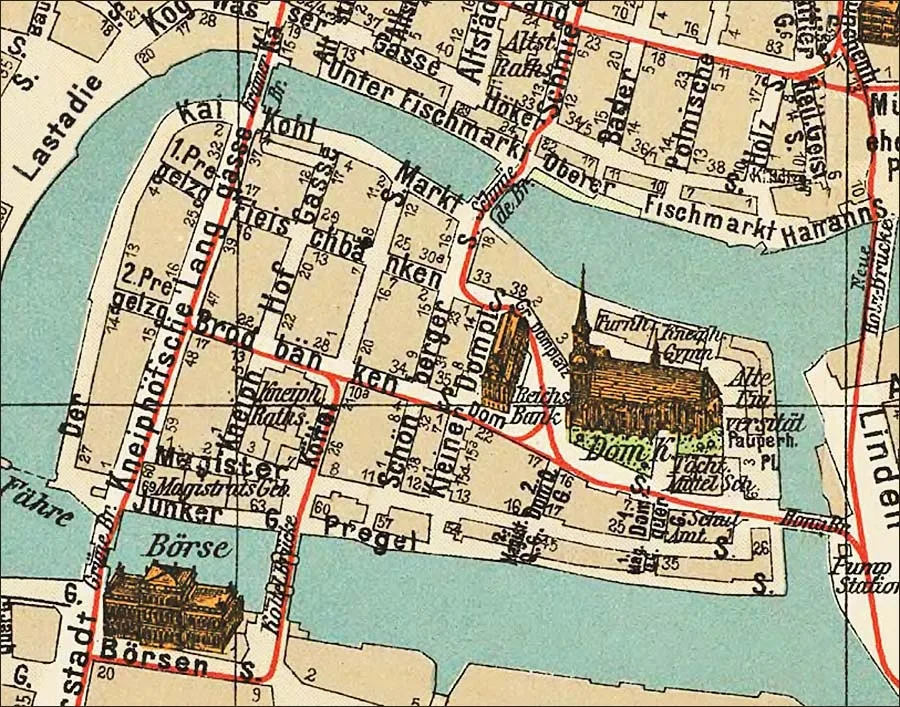
Parallel to it and perpendicular to the Pregel run four lanes: Junkerhof Lane (Hofgasse), Giblets Lane (Köttelgasse), Schönberg Lane (Schönbergergasse, named after a burgomaster who owned houses here), Little Cathedral Lane (Kleiner Domplatz), plus two minor lanes that were called by different names at different times.
Kneiphof's three longitudinal streets are Meat Stalls Street (Fleischbänkenstraße), Bread Stalls Street (Brodbänkenstraße) and Magister Street (Magisterstraße). In the eastern part of the island, where the Cathedral quarter lies, the first two open onto Cathedral Square, while the last runs parallel to the southern bank almost as far as the Honey Bridge (Honigbrücke).
The longest embankment of the island town, the southern one, is called Pregel Embankment (Pregel Gasse). Vegetables have been sold on the opposite bank since time immemorial, which is evidently why the northern embankment is called the Cabbage Market (Kohlmarkt). The western embankment, facing the warehouse district of Lastadie (Lastadie), is called the Kai. The eastern bank, from where one could cross from Kneiphof by the Honey Bridge to another Königsberg island, Lomse, was never honoured with a name of its own. There were no burghers' houses or moorings there, which is perhaps why it never acquired an address of its own. In olden days Kneiphof was protected along its banks by fortress walls and watchtowers, with gates at the bridges.
It is logical to suppose that there were as many gates as there were bridges, namely five: the Shop Gate (Krämerthor), the Green Gate (Grüne- oder Langgassenthor), the Giblets Gate (Köttel- oder Kittelthor), the Smiths' Gate (Schmiedethor) and the Honey or Church Gate (Honig- oder Kirchenthor). The Shop Gate, at the northern end of Kneiphof Long Street, was adorned with a sculpture of the master shoemaker Hans von Sagan (Hans von Sagan) and a painting of the Battle of Rudau (Rudau). This gate was in the charge of Altstadt and was demolished in 1752.
At the southern end of Kneiphof Long Street, the way into the town led through the Green Gate, so called because of the colour it was painted. In 1592 the gate acquired a tall, stately tower. It was repaired many times and stood until 1864. The tower served as lodgings for the town musicians. From here they announced the opening and closing of the exchange every day with a few tunes. On high holidays the musicians played solemn melodies. In the event of fires they sounded the alarm. At Christmas the musicians went round the town with their apprentices, collecting gifts and donations from the townspeople, a custom that survives to this day. Immediately beyond the Green Gate was the bridge of the same name, and crossing it we come to the Front Suburb (Vordere Vorstadt, the southern suburb of Kneiphof).
In 1329 Altstadt founded St George's Hospital (St. Georghospital) in the Vorstadt, which was probably one of the reasons for speeding up the construction of the Green Bridge in the 14th century.
The Giblets Gate at the southern end of the lane of the same name was demolished in 1866. The Giblets Bridge (Köttelbrücke) led from Kneiphof to what is now Exchange Street (Börsenstraße). When in 1339 the Teutonic Order granted Kneiphof the right to establish its own Lastadie (Lastadie) in the Front Suburb, this part of Kneiphof was quickly built up. A second bridge was therefore soon needed, and it was built in 1377. It was in this very year, as a document testifies, that privileges were granted to the slaughterhouse on the other side of the Pregel (Köttel- oder Schlahthof). The Low German word "Köttel" means "guts" (German Gedärme). In former times butchers were called "Kottler" or "Köttler" (Kottler oder Köttler). The wooden Giblets Bridge was pulled down in 1885 and replaced with an iron one.
The Smiths' Gate at the end of Schönberg Lane was demolished in 1736. The Smiths' Bridge (Schmiedebrücke) was built in 1376 at the expense of Altstadt and Kneiphof. It gave access to the nearby Honey (or Church) Bridge for crossing to Lomse Island. (The Smiths' Bridge was built because the inhabitants of Altstadt had previously had certain difficulties reaching Lomse Island via the Wood Bridge, which belonged to Löbenicht.)
The Honey Gate (Honigthor), which covered Kneiphof from the east, was taken down in 1787. The Honey Bridge across the Pregel was built in 1542. It is the youngest of Königsberg's bridges. Its construction was connected with disputes between Altstadt and Kneiphof over meadows lying east of Kneiphof on the neighbouring island of Lomse (Lomse). Altstadt's construction of the Wood Bridge and the High Bridge (Holzbrücke und Hohe Brücke) gave the inhabitants of Kneiphof good reason for concern, since the trade routes to the south for trade with Natangia (Natangen), which had previously passed over Kneiphof's bridges, now ran straight into Altstadt, depriving Kneiphof of the tolls on goods carried across its bridges. The Kneiphof authorities asked Duke Albrecht (Albrecht von Brandenburg-Ansbach, 1490–1568) for permission to build a bridge to Lomse Island. The duke agreed to the construction of the bridge on condition that Kneiphof would provide for the building of the High School (Hohenschule) founded by the duke, and a specification was issued stating exactly what the people of Kneiphof were to provide: several villages, money, and more than 100 cartloads of stone and brick.
Since this bridge from Kneiphof to Lomse was built to spite the inhabitants of Altstadt, it was originally called the Mocking Bridge (Hohnbrücke), but it was later renamed the Honey Bridge (Honigbrücke). According to another version, the name "Honey" arose because the duke tried to win over the people of Kneiphof with two tons of honey and permission to build market stalls between the cathedral and the new bridge, in order to obtain their consent to a new tax. (The most plausible version says simply that beekeepers from Lomse Island sold honey by the bridge.)
Besides the gate towers already mentioned, Kneiphof's fortifications had other towers too. The location of three of them is known for certain.
The first tower stood in the south-west of Kneiphof on the Kai embankment (Der Kai), where the large crossing over the Pregel (Pregel) is now.
The second tower stood at the end of Little Cathedral Lane, next to the Kneiphof Community Garden. It was called the Blue Tower (Blauer Turm) after the colour it was painted (by analogy with the Green Gate). In later times the Blue Tower served as a prison and, according to popular tales, got its name because the adjective "blau" (blue) sounds similar to the German word "zerbläuen" (Zerbläuen), which means to beat cruelly. Supposedly those who had served their sentences in it told of such beatings on their release. The Blue Tower was demolished in 1735.
The third tower still stands at the south-eastern corner of the island, not far from the Honey Bridge. It used to be called the Powder Tower (Pulverturm). After the Blue Tower was demolished, it strangely took over its name. In 1879 the tall hipped roof of this new Blue Tower was reduced, and it now has an ugly box-like appearance. (The German name Blaue Turm is sometimes translated into Russian as the "Light Blue Tower", which is not quite accurate.)
Thanks to its advantageous position between the arms of the Pregel, Kneiphof quickly became a prosperous town. While Altstadt bore a certain imprint owing to its close ties with the castle, and Löbenicht was famous for its fields and meadows, in Kneiphof crafts and trade flourished. The noblest and richest families of Königsberg built their houses on the island. The peculiarities of the four parts of Königsberg are captured in a little poem:
Im Kneiphof die Pracht,
In der Altstadt die Macht,
Im Loebenicht der Acker,
Auf dem Sackheim der Racker
In Altstadt, power and the law,
In Kneiphof, the clink of gold,
In Löbenicht, beer and the plough,
In Sackheim, by day you're afraid.
Crossing the Honey Bridge from Lomse (Lomse) into Kneiphof and continuing along Cathedral Street (Domstraße), we shall see on our right, a few steps away, Charity Square (Kneiphöfscher Pauperhausplatz). On this square stands the town's shelter for the homeless (Kneiphöfsches Pauperhaus), founded in 1580. In 1803 it merged with a similar institution in Löbenicht (Löbenicht). On the west side of the square stands the building of the Municipal Higher School for Girls (Städtische höhere Mädchenschule).
As early as the beginning of the 19th century, attention began to be paid to the education of women, and higher schools for girls began to be founded.
The plan for establishing such educational institutions was drawn up in Berlin by a group of influential people who in 1810 formed an association in tribute to Queen Louise (Luise Mecklenburg-Sterlitz, 1776–1810). The director of the Kneiphof girls' school was Superintendent Dr Weiss (Dr. Weiß). The school was founded on 4 November 1811. At first it rented premises in the house at No. 23 Bread Stalls Street, later on Gesecus Square, and in 1867 it moved into the building of the Kneiphof Gymnasium (Kneiphöfsches Gymnasium), which had moved out. This building was erected in 1827 on the site of a former monastery, whose building had been used as a school and collapsed during the Whitsun holidays in 1825. (The school building adjoined the south-eastern part of the Cathedral, where there is now a small square with the monument to Julius Rupp.)
Right next to the girls' school rises the massive building of the Cathedral (Königsberger Dom). On 13 September 1333 the Grand Master of the Teutonic Order, Luther von Braunschweig (c. 1275–1335), authorised the construction of the cathedral, which was being transferred from Altstadt to Kneiphof. This day is regarded as the founding day of Königsberg Cathedral. Both Luther von Braunschweig himself and Bishop Johann of Samland, who blessed the start of construction, were laid to rest in it. The new church was dedicated to the Virgin Mary and to St Adalbert, the Apostle of the Prussians (Jungfrau Maria und heiligen Adalbert dem Apostel der Preußen). About two centuries later, on 27 September 1523, the first Lutheran pastor, Johannes Briesmann (Johannes Brießmann, 1488–1549), preached a sermon in the Cathedral. The last Catholic procession went from the cathedral through the streets of the town in 1519. In 1528 Duke Albrecht handed the cathedral over to the people of Kneiphof. After the founding of the Albertina it became the university church.
Architecturally, Königsberg Cathedral is not very attractive, but thanks to its historical role and considerable size it has become one of the main local sights. According to the original plans, it was to have two towers on its west side. However, after the fire of 1544 only one had been rebuilt by 1553. And with that one it has stood to this day.
Although the cathedral is not built in a single style, the Gothic dominates in the shape of the window arches and vaulted ceilings. The height of the cathedral from the base to the spire is 57 metres, the height to the roof is 30 metres, the length is 88.5 metres and the width 29 metres.
Roughly in the middle of the roof, directly above the altar, rises a small turret, the so-called Matins Turret (Mettentürmchen).
In Catholic times a bell hung in it, announcing the start of the early Mass (matins). The main entrance to the cathedral is on the west; there are side entrances on the north and south.
Inside, the cathedral is divided into three parts: the church proper, the choir and the princely burial vault. The church part of the cathedral consists of a nave 17 metres high to the ceiling and two side aisles, which are two metres lower than the nave and half as wide. Each side aisle is separated from the nave by six columns. In the north aisle is the baptistery, which houses an ancient octagonal granite font. The font was donated by a town councillor, Peter Resekirch (Peter Resekirch). Above the font a wooden bell-shaped canopy decorated with various figures hangs from the ceiling. In the northern part of the nave is the pulpit, made in 1589 of Dutch sandstone with money from the burgher Sigismund Scharff (Sigismund Scharff).
The eastern end of the cathedral is closed by the altar, created in 1591 with voluntary donations from the citizens of Kneiphof. Above the top of the altar a large wooden crucifix rises almost to the vault. On the column to the left of the altar hangs a painting of the Madonna by the famous Wittenberg painter Lucas Cranach (Lucas Cranach, 1472–1553). The organ was built in 1888 by the Königsberg master Terletzki (Max Terletzki, d. 1903). It is one of the largest and most beautiful organs in Germany.
The choir is separated from the church by a glass wall reaching up to the ceiling. The choir is 35 metres long, up to 10 metres wide and up to 15 metres high. Originally the services for the cathedral canons were held here, and a carved oak stall was installed; it still stands in its old place. Since the Reformation the stall has been used as a stand for coffins. Among the epitaphs adorning the walls, some made of wood, some of marble or other precious stone, particular mention should be made of those on the south side to Grand Master Luther von Braunschweig, Landhofmeister Johann Ernst von Wallenrodt (Johann Ernst von Wallenrodt, 1615–1697) and the cathedral pastor Johannes Briesmann, and on the north side to the Bishop of Samland, Georg von Polentz (George of Polentz, 1478–1550).
On the south side there are also busts of the Grand Master of the Teutonic Order Luther von Braunschweig and Pastor Johannes Briesmann, and on the north side a bust of the Bishop of Samland (Samland), Georg von Polentz.
Georg von Polentz came from Saxony and at first had no ambition for an ecclesiastical career. In 1511 he and his friend Albrecht joined the Teutonic Order.
In 1516 he became Hauskomtur (steward) of Königsberg Castle. In 1519 he was elected Bishop of Samland. In 1525 he was one of the first bishops to go over to the Lutheran teaching, and he began to carry out the Reformation in the state of the Teutonic Order. He transferred his possessions, a third of Samland with the castles of Fischhausen (Fischhausen, now the settlement of Primorsk), Medenau (Medenau, the settlement of Logvino), Powunden (Powunden, the settlement of Khrabrovo) and Laptau (Laptau, the settlement of Muromskoye), to the ownership of Duke Albrecht, and himself settled in Balga Castle (Balga), where he died in 1550. His remains were transferred to the Cathedral.
Johannes Briesmann was the first evangelical pastor in Königsberg. He was born in Cottbus and began his spiritual path as a Franciscan monk. Then, in Wittenberg, he converted to Lutheranism and in 1523 came to Prussia. Here he served as pastor of the Cathedral until 1546. The aged Bishop of Samland called on him to become "President of the Bishopric of Samland". Johannes Briesmann died in 1549. The third Prussian evangelist, in Luther's opinion, after Briesmann and Johannes Poliander (Johann (Graumann) Poliander, 1487–1541), was Paul Speratus (Paul Speratus, 1484–1551).
The eastern part of the cathedral choir is the burial vault of the Electors. In the middle stands the so-called "tumba", a sarcophagus of Swedish sandstone. On the lid of the sarcophagus, life-size figures of Duke Albrecht (Albrecht von Brandenburg-Ansbach, 1490–1568) and his first wife Dorothea (Dorothea af Danmark, 1504–1547) are depicted. On the sides are their six children, of whom only their daughter Anna Sophia (Anna Sophie von Preußen, 1527–1591) outlived her parents; she later became the wife of John Albert of Mecklenburg (Johann Albrecht I. zu Mecklenburg, 1525–1576). She is shown standing on the west side of the sarcophagus. The other five children, who died in infancy, are shown lying down with funeral wreaths. Beneath the tumba is a crypt. It consists of three narrow vaults running from east to west. The coffins are placed here.
The northernmost vault has been walled up since 1809. In it rest the Grand Masters of the Teutonic Order who had their residence in Königsberg: Ludwig von Erlichshausen (c. 1410–1467), Heinrich Reuss von Plauen (Heinrich Reuß von Plauen, c. 1400–1470), Heinrich Reffle von Richtenberg (c. 1415–1477), Martin Truchsess von Wetzhausen (1435–1489) and Johann von Tiefen (Johann (Hans) von Tiefen; c. 1440–1497). Only Duke Frederick of Saxony, who preceded Margrave Albrecht of Brandenburg in the line of Grand Masters of the Teutonic Order, is absent here: he died in Saxony and is buried in Meissen (Sachsen, Meißen).
Besides the Electors and their families, and besides Duke Albrecht and his two wives, the second Duke of Prussia, Albrecht Frederick (Albrecht Friedrich von Preußen, 1553–1618), is buried here.
His wife Maria Eleonora (Marie Eleonore von Jülich-Kleve, 1550–1608) and their daughter Anna (Anna von Preußen, 1576–1625), who expressed the wish to be buried next to her parents, also rest in the cathedral. Anna's son, Elector George William of Brandenburg (Georg Wilhelm von Brandenburg, 1595–1640), is buried here as well.
Duke Albrecht Frederick of Prussia (duke from 1568 to 1618) was born on 29 April 1553 at Neuhausen Castle, the son of Duke Albrecht of Brandenburg by his second wife, Anna Maria of Brunswick (Anna Maria von Braunschweig, 1532–1568). When his parents died in 1568 he had not yet come of age, and his guardians were four government councillors, later the appointed Electors. Wounded by the guardianship of the regents, the supervision of the councillors and the religious disputes that had begun, the young man gradually fell into a mental disorder, which later turned into an incurable illness. Shortly before this sad turn he had been betrothed to Princess Maria Eleonora of Jülich-Cleves. Of their children only two daughters survived, of whom the elder, Anna, was betrothed to Elector John Sigismund (Johann Sigismund, 1572–1619), while the second, Eleonora (Eleonore von Preußen, 1583–1607), became the second wife of Joachim Frederick (Joachim Friedrich von Brandenburg, 1546–1608), who shortly before the wedding had become ruler of the Brandenburg lands. Through these marriages the ruling dynasties of Brandenburg and Prussia were closely linked (the point being that John Sigismund was the son of Joachim Frederick). Poland, for its part, had received only feudal obligations from Prussia since 1563.
After the death of Duke Albrecht Frederick, Prussia was united with the Margraviate of Brandenburg. Exactly the same situation arose with Duchess Maria Eleonora regarding the inheritance of the Jülich-Cleves lands in favour of Brandenburg. Albrecht Frederick died on 27 August 1618 at Fischhausen Castle (Fischhausen).
The walls of the chamber holding the noble remains of the dukes and Electors are adorned with paintings and sculptures depicting the deceased.
The largest is the tomb monument of Duke Albrecht, which fills the entire eastern wall and is 13 metres high.
In all likelihood it was made during the duke's lifetime under the direction of the Danish court painter Jakob Binck (Jakob Binck, 1485–1568), a pupil of the great Nuremberg artist Albrecht Dürer (Albrecht Dürer, 1471–1528). The monument was made in Antwerp and brought to Königsberg in 1570; this date is carved on the memorial. The central part of the monument is occupied by the figure of Duke Albrecht kneeling in prayer. At the sides are images of the four biblical Magi. Jakob Binck himself made the epitaph for Duchess Dorothea, who died in 1547. She was Duke Albrecht's first wife, and her image is on the north wall. To the left of the monument to Duke Albrecht is the marble tomb, made of Öland limestone, of Margravine Elisabeth (Elisabeth von Brandenburg-Küstrin, 1540–1578), wife of Margrave George Frederick (Georg Friedrich I. von Brandenburg-Ansbach, 1539–1603), who died in 1578. From 1577 to 1603 George Frederick was guardian of the ailing Duke Albrecht Frederick, as an inscription on the tomb records. Those years were very hard for Prussia, and George Frederick's favourite saying was: "My time in unrest, my hope in God" (Meine Zeit mit Unruh, meine Hoffnung zu Gott). On the south side is the monument to Duke Albrecht's second wife, Duchess Anna Maria.
Before we leave the cathedral, let us look at its tower. It houses the library (Wallenrodtsche Bibliothek) of Chancellor Martin von Wallenrodt (Martin von Wallenrodt, 1570–1632). The chancellor's son, Johann Ernst von Wallenrodt (Johann Ernst von Wallenrodt, 1615–1697), held the post of Landhofmeister from 1660 to 1697, and in 1650 he obtained from the Kneiphof town authorities the right to display his books in a room in the cathedral tower. The library is still there today. It contains many valuable books and documents, including the letter of safe conduct that Emperor Charles V (Karl V, 1520–1556) issued to Martin Luther (Martin Luther, 1483–1546) when the latter had to appear before the Imperial Diet at Worms. This most valuable historical document was brought to Prussia by the church reformer's third daughter, Margarete (Margarete Luther-Kunheim, 1534–1570), and later came into the hands of Chancellor von Wallenrodt.
Along the outside of the north wall, alongside the choir, stretches an unsightly pavilion, the professors' vault, built in 1588 or shortly afterwards. Professors were buried here; the last professor to be laid to rest in the vault, on 28 February 1804, was Immanuel Kant (Immanuel Kant, 1724–1804). In 1809 the vault was closed and all the monuments were moved. Kant's coffin, however, was placed in the eastern end of the vault, and on the initiative of War Councillor Scheffner (Johann Georg Scheffner, 1736–1820) a covered gallery was built here, which soon came to be called the Stoa Kantiana (Stoa Kantiana). By the great philosopher's next birthday (22 April 1810) the famous sculptor Schadow (Johann Gottfried Schadow, 1764–1850) had made a bust of Kant in Carrara marble, which was installed here. Later, around 1826, the supervision of the Stoa Kantiana was entrusted to the university. When the building on Parade Square (Paradeplatz) was completed, Kant's bust was moved to the senate room of the new Albertina.
In the 1870s a Committee of admirers of the great man began to meet, campaigning for a worthy restoration of Kant's burial place.
It was then that the chapel now standing at the eastern end of the Stoa Kantiana was built. Its ceremonial opening took place on 9 June 1881 in the presence of the town authorities. Over the vault in which the philosopher's coffin rests lies a stone donated by the same Scheffner. Nearby, on a pedestal of white Carrara marble, stands a bust of Kant by the sculptor Siemering (Rudolph Siemering, 1835–1905), made of the same stone and an exact copy of Schadow's bust. The east wall is adorned with a copy of Raphael's painting "The School of Athens" made by a local artist, Professor Neide (Emil Adolph Neide, 1843–1908). The west wall bears Kant's words from his "Critique of Practical Reason": "Two thoughts fill my whole being with wonder, the more often and the more attentively I reflect upon them: the boundlessness of the heavens above me and the moral law within me" (Zwei Dinge erfüllen das Gemüt mit immer neuer und zunehmender Bewunderung je öfter und anhaltender sich das Nachdenken damit beschäftigt: der bestirnte Himmel über mir und das moralische Gesetz in mir). Every year on 22 April the chapel is richly decorated, and many people come to it, among them members of the Kant Society. Königsberg honours the memory of the great philosopher. (In 1924 a new memorial, designed by the architect Friedrich Lahrs (Friedrich Lahrs, 1880–1964), was built on the site of the chapel; it has survived to this day.)
The cemetery of the Kneiphof cathedral congregation was originally on the south side of the Cathedral. In 1810 this cemetery was cleared and the gravestones removed. After that a new plot was consecrated in Haberberg (Haberberg, one of the southern districts of Königsberg), where since 1785 there had already been a parish cemetery of the cathedral church on the square by the Brandenburg Gate. (Today this site lies between Bagration Street and the station square, east of the Brandenburg Gate.) But the burial ground in Haberberg soon filled up, and a site for a cemetery was allotted on Violet Hill (Veilchenberg, now the south side of Dmitry Donskoy Street).
The large square to the west and north of the cathedral used to bear the name of St Peter (Peterplatz). Now it is Great Cathedral Square (Großer Domplatz). In its eastern part, bordering Charity Square (Pauperhausplatz), stands the old complex of buildings of the Collegium Albertinum (Kollegium Albertinum), which formerly stretched along the bank as far as the Bishop's Court (Bischofshof) on the northern bank of Kneiphof. In 1541, on the spot where the Kneiphof Gymnasium (Kneiphöfsche Gymnasium) now stands, a higher school called the Pädagogium or Partikular (Pädagogium oder Partikular) was founded on Duke Albrecht's orders. The school was meant to prepare students and teachers. Besides the classical languages, law, theology and medicine were studied there. When in the course of time Königsberg's three town grammar schools had reached a sufficiently high level, the Partikular was no longer needed, and in 1619 it was closed. The pupils transferred to the town schools, the teachers began teaching at the university, to which the Partikular building was also handed over.
The Collegium Albertinum (the University of Königsberg) was opened on 17 August 1544.
Prussia did not have enough theologians and scholars to establish and interpret the ideas of the Reformation. The university was meant to make up for this shortage.
To fund it, Duke Albrecht assigned the revenues of the town of Fischhausen. In addition, Duchess Dorothea provided assistance from her own funds.
So that the newly founded university would not lag behind similar institutions in other countries, the duke sought recognition of his creation from Prussia's overlord, the King of Poland (Sigismund II. August, 1520–1572). It seems very strange to us that the duke also sent a request for confirmation of the university to the Pope (Paul III, 1468–1549). Stranger still, the duke might have obtained the Pope's consent, but this was thwarted by his simultaneous appeal to the Holy Roman Emperor (Karl V, 1500–1558), who, because of Prussia's conversion to the Lutheran faith, was sharply hostile towards him.
(Duke Albrecht's declaration on the founding of the university was proclaimed on 20 June 1544 and sent to several countries and cities. The ceremonial opening and consecration took place on 17 August 1544. However, in those days a higher educational institution had to receive official confirmation of its status either from the Pope or from the Emperor, and they were in no hurry to grant privileges to a Protestant university. The first diplomas issued by the University of Königsberg were therefore formally invalid. Only when Duke Albrecht turned to his Polish overlord, King Sigismund Augustus, did the latter, by a decree signed on 28 March 1560, grant the University of Königsberg the same rights as those enjoyed by the University of Kraków. On 30 September 1560 the royal privilege was solemnly proclaimed at a general assembly of the professors, dignitaries of the ducal court and representatives of the three towns, after which the first legitimate defence of a master's degree could take place. — Editor's note.)
Above the entrance to the Collegium Albertinum building on the cathedral side, an image of Duke Albrecht with a sword on his shoulder has survived. A reduced copy of it, cast in silver or gold, became from 1817 the official badge (Albertus) of the Albertina, worn by all students.
The university in Königsberg quickly flourished. In its best years it had more than a thousand students.
Among its first teachers, the name of the first rector, Georg Sabinus (Georg Sabinus, 1508–1560), deserves mention.
Georg Sabinus, whose real name was Schüller (Schüller, meaning "schoolboy"), changed his name, following the custom of the time, to the pseudonym he used as a poet; he was born in Brandenburg an der Havel into the family of a burgomaster. (The pseudonym Sabinus, that is, "the Sabine", chosen by Georg Schüller, goes back to the name of the Latin tribe of the Sabines, who lived where Rome would later stand.) He studied at the universities of Wittenberg and Padua, where he studied law, philosophy and the art of versification. In Wittenberg he embraced the evangelical teaching and soon struck up a friendship with Melanchthon (Philipp Melanchthon, 1497–1560), the well-known associate of Martin Luther. In 1536 Sabinus married Melanchthon's 14-year-old daughter. At the University of Frankfurt an der Oder he set an example of ennobling influence on the students. In 1544, on Luther's recommendation, Sabinus was invited by Duke Albrecht to be rector of the University of Königsberg. Here, however, he did not get on with his colleagues, and family troubles began. For these reasons he gave up the post of rector in 1547 and in 1555 left the university, returning to Frankfurt an der Oder. He died there on 2 December 1560, eight months after the death of his friend Philipp Melanchthon. His wife died in Königsberg on 26 February 1547.
The former aula (Aula, assembly hall) of the university building in Kneiphof now serves as the book depository of the town library, founded by Pastor Johannes Poliander (Johannes Poliandr) in 1541. Even then the library held more than a thousand volumes. Thanks to later donations, especially from the town council secretary Bartsch (Stadtsekretär Bartsch), who handed over a valuable collection of 500 Bibles, and the town elder Hensche (Stadtältesten Dr. Hensche), the library's holdings keep growing. It holds many important manuscripts and old chronicles, as well as scholarly books and various other rarities.
On the site where the former Partikular building and the university's New Collegium (Neues Kollegium) stood, there is now the Kneiphof Municipal Gymnasium (Kneiphöfsches Stadtgymnasium). This is the oldest educational institution in Prussia, the Cathedral School (Dom- oder Karhedralschule). It was founded in 1304 and was located on Holy Spirit Street (Heiligengeiststraße) next to the old cathedral (in Altstadt). Then in 1333 the school was moved to today's Cathedral Square (Domplatz), but even afterwards it changed addresses more than once. Finally, in 1560 the school found a place where it remained for more than three centuries. Until 1865 its home was the (former) monastery located where the Municipal Higher School for Girls (Städtische höhere Mädchenschule) now stands. Reorganised after the church Reformation on the model of the Wittenberg schools, it came to be called the Latin School (Lateinschule). In 1810, at the same time as the Löbenicht School (Löbenitsche Schule), it became a Higher Burgher School (höhere Bürgerschule), and from 1831 it was transformed into a Gymnasium (Gymnasium).
The present gymnasium building, decorated with medallions of Albrecht and Melanchthon, was built in 1864. The school began working in this building in 1865.
Two outstanding teachers who worked there deserve special mention: the poet Simon Dach (Simon Dach, 1605–1659) and the professor of history Georg Pisanski (Georg Christoph Pisanski, 1725–1790).
Simon Dach, the best-loved poet of his Prussian contemporaries, was born on 29 July 1605 in Memel, where his father worked as an interpreter (from Lithuanian). He attended the local school there and then the Cathedral School in Königsberg. After finishing it he studied at the University of Wittenberg, where he studied theology and poetry. He completed his education at the University of Königsberg. In 1633 Simon Dach became a collaborator (teacher) at the Cathedral School, rising within three years to conrector (assistant or deputy to the rector). In 1639 Dach was invited to the Albertina as professor of poetry, where he worked for 20 years. He died on 16 April 1659 of galloping consumption. Simon Dach's sacred and secular poems and songs radiate a bright, unclouded joie de vivre, characteristic of young people just setting out on their path. Many of them were set to music already by his contemporaries, for example "I am, O Lord, with Thee and in Thy power". Simon Dach wrote this poem in memory of his friend Robert Roberthin, chief secretary of the Prussian government and a quite well-known poet.
The Cathedral organist Heinrich Albert, a close friend of Simon Dach, wrote the music for his friend's wedding to Dach's famous song "Ännchen von Tharau", which is now regarded as a folk song. Simon Dach also wrote dramas, but they did not enjoy the same success as his poems and songs.
A vivid imagination and a gift for wonderful inventions were all characteristic of him. Simon Dach's play "Sorbuisa" (Borussia, the Latin name for Prussia) was staged several times in the presence of the Great Elector and his sister, Queen Maria Eleonora, wife of the Swedish King Gustavus Adolphus. The Great Elector was very well disposed towards Simon Dach and gave the poet a small estate.
Georg Christoph Pisanski was born on 13 August 1725 into a clergyman's family in Johannisburg (Johannisburg, now the town of Pisz (Pisz) in Poland), and attended the town schools in Johannisburg and in Angerburg (Angerburg, now the town of Węgorzewo (Węgorzewo) in Poland). In 1742 he came to Königsberg and entered the university, where he studied theology, philosophy and, with particular diligence, mathematics. In 1748 he became a collaborator at the school in Altstadt, rising there to the posts of conrector and prorector. In 1759 he was elected rector of the Cathedral School and served with distinction in this honourable post until his death in 1790. His ardent devotion to learning also helped him make his way to the University of Königsberg, where, without holding an academic title, he lectured on theology, philosophy and history. The outstanding teacher left behind numerous works on the history and literature of his homeland. His "History of Prussian Literature" is still a valuable source of knowledge about the intellectual life of our country. An oil portrait of Pisanski adorns the conference hall of the Kneiphof Gymnasium.
In 1836 the name and traditions of the Cathedral School passed by inheritance to the Kneiphof School (Kneiphöfsche Elementarschule), which had split off from it.
After moving to Haberberg (Haberberger Schulstraße, 12–13) it was officially named the Second Municipal Middle School (II. Städtische Mittelschule).
Adjoining the Kneiphof Municipal Gymnasium on the west was the Bishop's Court (Bischofshof), a dilapidated building erected in 1542. It was meant to serve as the residence of the Bishop of Samland, Polentz. But the bishop gave it up to Pastor Briesmann. After the abolition of the Samland bishopric in 1567, the Samland consistory began to hold its sessions in this building. After the consistory moved to the castle, where it remains to this day, the building in Kneiphof was used from 1840 to 1844 as a gymnasium hall, and later as the university's chemical laboratory. Then, until 1895, it stood empty. Finally, the town bought it and intends to build a gymnasium hall for the Kneiphof Municipal Gymnasium on its site.
Next to the bishop's house stands a building belonging to the local Merchants' Association (Kaufmännischer Verein). This is the Kneiphof Artus Court (Artushof), built in 1882–83 and used for public events.
In the western part of the spacious Great Cathedral Square stands the massive building of the Imperial State Bank (Kaiserliche Reichsbank).
The Royal Bank Office was founded in 1768. It was located in the house known as the House of Burgomaster Negelein (Hause des frühern Bürgemeisters Negelein). Peter I stayed in this historic building during his visits to Königsberg); it is now the Simon House (Simonsches Haus) at No. 2 Kneiphof Long Street. The present bank building passed from the Schindelmeisser family (Schindelmeisser) to the state in 1845 and was fitted out for the purposes it serves today.
The main tasks of the Imperial State Bank are to regulate the circulation of money in Germany, to simplify settlements, to secure interest rates, to keep valuables in pawn, to ensure the safety of deposits and to exercise supervisory functions over the imperial treasury. Consequently, all the financial activity of the empire is subordinate to the Directorate of the State Bank. The president of the bank is confirmed by the Emperor and the Bundesrat, as are the members of its board (directorate).
Branches of this bank operate throughout Germany. The Königsberg branch is one of the largest.
The total turnover (receipts) of all branches of the Königsberg bank in 1894 amounted to 13,194,214,000 marks, whereas in Berlin it was 33,647,542,000 marks and in Hamburg 12,330,555,900 marks.
In the western part, two shopping streets open onto Great Cathedral Square: Meat Stalls Street and Bread Stalls Street, whose names testify that numerous bakers and butchers once worked and traded here. We shall walk along Bread Stalls Street and cross Schönberger Lane, named in honour of a respected Kneiphof family. Among the people, though, this street was more often called "Schenkberger-Straße" or "Schemper-Gasse". (Which probably echoes the German words "Schenke", a tavern or pothouse, and "Schemper", frothy beer, from the French "Champagne".) Meanwhile we are approaching the Kneiphof Town Hall.
The large block, almost entirely occupied by the Town Hall (Rathaus), faces Bread Stalls Street with its main northern façade and is bounded on the west by Junkerhof Lane (Hofgasse). Along its southern side runs Magister Street. The name Magister Street is explained by the fact that university teachers lived there, and in Latin "teacher" is "magister". The lane is called Junkerhof Lane because the Kneiphof Junkerhof (Junker Hof, see the chapter on Altstadt) stood in it.
The first mention of the Kneiphof Town Hall dates from 1374. As early as 1387 the building had to be rebuilt. The part facing Bread Stalls Street was built in 1695, the others later. An old stone double staircase with two shield-bearing bears at its sides leads to the portal of the main entrance. Above it rises a slender tower decorated with the united coat of arms of Königsberg. If we go inside, we first find ourselves in a lofty room with a stone-tiled floor, the town hall's hall (Rathaushalle). To the right, behind its wall, is the council chamber of the magistracy (Sitzungsaal des Magistrats). The wall separating the hall from the chamber is decorated with portraits of the rulers of Prussia. Here, too, hangs Rechlin's famous canvas "The Battle of Leipzig" (Carl Gustav Rechlin, 1802–1875, "Schlacht bei Leipzig", this battle is better known to Russian-speaking audiences as the Battle of the Nations, 16–19 October 1813). The painting shows the Königsberg Landwehr under the command of Major Friccius (Friccius) storming the Grimma Gate (Grimmaisches Tor) of Leipzig on 19 October 1813. The early 18th-century ceiling painting depicts allegorically the coronation of Frederick I (Friedrich I, 1657–1713) in Königsberg.
After the three parts of the town were united into a single Königsberg on 13 June 1724, the town hall in Kneiphof became common to the whole city.
The influence of the burghers on the system of town government came to an end, as the posts were taken by appointed officials. The times when only rich and influential citizens could rise to town office were a thing of the past. From now on all business at the town hall was run by the bureaucracy. The local police was replaced by a state (royal) one, subordinate to the Police Presidium. The Prussian Municipal Ordinance (Preußische Städteordnung), in force since 19 November 1808 and revised in 1831 and 1853, changed once more: the burghers returned to the town administration, but in a greatly altered form. Their governing role was now divided into two branches: the elected town council of representatives and the magistracy.
Owing to a lack of free space in the town hall, the Municipal Education Office is housed in an official building at No. 6 Cathedral Street. Since 1893 the Statistical Council has also been located here; its task is the quick and careful processing of all the figures and information needed for the work of the magistracy.
The branches of the Municipal Savings Bank (Städtische Sparkasse), housed in the south-western part of the town hall building, are subordinate to the municipality. This extremely important institution was founded in 1828 on the proposal of Commercial Councillor Tammnau (Tammnau). In 1894 the Municipal Savings Bank held 33,618,382 marks in deposits at three per cent interest. The sum received by depositors in the same year was 831,849 marks. A branch of the Savings Bank is located at Passage No. 5.
The western wing of the town hall block was occupied by the Junkerhof (Junkerhof). Its main hall was used for the meetings of the town deputies. This hall was thoroughly renovated in 1704. Its ceiling, like that of the main hall of the town hall, was expressively decorated with stucco.
One of the best-known artists of our time, Professor Dr Heydeck (Johannes Heydeck, 1835–1910), painted a fresco on the ceiling depicting allegories of the arts and entertainments that were welcomed in this hall. Even today, besides its proper purpose, the hall is used by private individuals as well as by various businesses and organisations for holding events. At the suggestion of town councillor Walter Simon (Walter Simon, 1857–1920), the vestibule of the building was decorated with a painted portrait of Immanuel Kant (Immanuel Kant, 1724–1804).
The Kneiphof Junkerhof was in many ways similar to the Altstadt one. Each professional community also had its own "corner". Only the name of the brewers' corner was different: here, for some reason, it was the Rose Corner (Rosenwinkel).
The Kneiphof Junker Garden (Kneiphöhscher Junkergarten), which served for the burghers' summer entertainments, was laid out in 1440 between the Giblets and Green Bridges.
Later the Garden was next to the old exchange (alte Börse) and was sometimes used as a summer trading place. In 1840 King Frederick William IV (Friedrich Wilhelm IV, 1795–1861), on the occasion of the oath-of-allegiance ceremony and as a mark of respect for the town, held a banquet here, during which the entire Junker Garden was turned into one gigantic marquee. Recently the old name of this area between the bridges, the Junker Garden, has been restored.
Giblets Lane separates the Junker Garden from the Kneiphof Community Garden, which, according to a surviving document, was founded as a gift from the Marshal of the Teutonic Order, Ulrich von Jungingen, in 1407. (Given the density of medieval building in the Königsberg towns, the word "garden" here should be understood as a small green space somewhat resembling a small modern town square.)
Among the streets of Kneiphof, attention should first of all be paid to Kneiphof Long Street, which is mentioned in very old documents and, judging by them, was already then the main trading artery in this part of the town. After the railway to Königsberg and the Main Station (Hauptbahnhof) were built not far from Kneiphof, the importance of Long Street, which practically links the island town with the station, grew immeasurably. (Let us recall here that the Vorstadt was the southern suburb of Kneiphof, which means that Vorstadt Long Street, connected by the Green Bridge to Kneiphof Long Street and running as far as the station, was a continuation of the latter.) Houses of wealthy merchants with their offices began to appear on the street. The style of these buildings is solid and pleasant, without excessive luxury. Even now, thanks to them, the street retains a relative faithfulness to the character of old Königsberg, although the increasing intensity of street traffic makes demands that rob the local architecture of its distinctiveness.
Looking at the exteriors of the houses on Kneiphof Long Street, especially in photographs taken before 1864, one can see that formerly almost all of them had massive front extensions up to three metres high, called Wolms, which served as porches (Wolm; synonymous variants: Podest, Beischlag, meaning respectively porch, pedestal, extension). From the Wolms, steps with iron railings led down to the street; the railings were decorated with brass balls and other ornamental elements that gleamed in the sun.
In summer the Wolms were covered with awnings (fabric canopies), and the whole family sat in the shade, enjoying the fresh air.
The doors of the houses were decorated with carvings and fitted with heavy brass knockers, which have now been replaced by bells. Passing through the door, we enter a spacious hall with a high ceiling, lit by large windows. The floor is laid with stone tiles. Here stand two or three cupboards of oak or pearwood, and by the window a table and a few chairs. This room is used mainly in the warm season for lunches and suppers. From the hall we pass into the merchant's spacious office. Here, too, large windows let in plenty of light. Adjoining the office were two small auxiliary rooms, used for rest and for storing everything that helped business run successfully. A dark carved oak staircase led to the first floor (in the Russian tradition it would be called the second), where there were bedrooms, rooms for receiving and lodging guests, and a salon with windows overlooking the street. Bulky furniture upholstered in heavy silk damask, large glass-fronted cabinets with sets of expensive porcelain complete the picture of a typical house on the Langgasse. (In keeping with the tradition of the time, the servants' rooms were above the owners' rooms, on the second (third) floor or even higher.)
Nowadays it is increasingly hard to find houses with old, richly decorated façades: most of them have disappeared, and with them the charm of the old streets has gone. One of the rare surviving examples is the house of the wine merchants "Steffens und Wolter" (Steffens und Wolter) at No. 27 Kneiphof Long Street.
The Wolms, which gave the houses such an attractive appearance, were sacrificed to the ever-increasing intensity of street traffic; all of them had been demolished by the end of the 1860s.
Immediately beyond the former Green Gate, at which Kneiphof Long Street ended in the south, the old exchange stood until the new exchange was built in the Vorstadt. From 1728, after the closure of the Altstadt exchange (Altstädtischen Börse), it served as the meeting place for the merchants of the whole city. The old exchange building was built on piles in the Dutch manner in 1624. Its northern part overhung the Pregel, and the main entrance was directly from the Green Bridge. At first it was an open platform, and only in 1729 was it boarded up on the Pregel side. The whole structure remained wooden even when walls and a ceiling appeared, which were decorated with paintings by the Dutch master Greger Singknecht (Greger Singknecht) and with sayings by the Königsberg professor Samuel Fuchs (Samuel Fuchs).
For especially large gatherings the deck of the Green Bridge was used: benches were set up for visitors along the railings. During such gatherings, traffic of carts and riders on the bridge, and on the Pregel beneath it, was suspended. Because of its dilapidated state, the police banned visits to the old exchange in 1798.
In 1800 construction of a new exchange building began to a design by the chief inspector of mill construction Dittrich (Obermühlenbauinspektor Dittrich), and by 1 September 1801 the new building already stood roughly on the site of the old exchange.
It was a simple wooden structure in the form of a Greek temple, with a semicircular Dutch roof topped by a sharp ridge. A large elliptical hall occupied almost the entire area of the building. The corners of the building were separated from the hall by semicircular walls, and they housed four small rooms for storing various office and other supplies. This building, which cost 126,000 marks to erect, very soon ceased to satisfy the merchants. Moreover, owing to the plans published in 1864 for widening the Langgasse and demolishing the Green Gate, the fate of the exchange by the Kneiphof bank was also sealed. In 1867 it was decided to begin building a large new exchange in the Vorstadt. After it was completed in 1875, the old building was demolished.
Translated from Russian with the help of AI (Claude, Anthropic), October 2026.