Central Park lies in the north-western part of Kaliningrad, on the high southern slope of the Sambian Plateau, and currently covers 23.5 hectares between Prospekt Mira and Dmitriya Donskogo Street. The park's terrain is fairly complex, combining flat and hilly areas, the deep "ravine" of a stream formed by two branches, and the hollows of their beds. The park's setting was undoubtedly an interesting and attractive basis for creating a green space in the "English" landscape style. Kaliningrad's best-known park has a long and at times romantic history, bound up mostly with its owners, and several periods can be distinguished in it:
- The first period, which precedes the formation of a private and later public park and is not properly part of it: the future park grounds were land owned until 1786 by a local landowner named Pointer;
- The second period, lasting 10 years, from 1786 to 1796: the romantic "English" garden of Theodor von Hippel, Lord Mayor of Königsberg, lawyer, writer and poet — Gippels Garten;
- The third period (from 1796 to 1872): the private garden of Louisenwahl, owned by Councillor Busolt (Gotthilf Christoph Wilhelm Busolt) and his family, and from 1872 to 1914 by the royal family (before the war with Napoleon the garden's name was spelled in the French manner, Louisenval, and from the time of the war onwards in the German way, Luisenwahl);
- The fourth period in the park's life coincides with the creation of a system of green spaces in Königsberg in the 1920s. The former private garden's new flowering was linked to changes in its layout and to the incorporation of the public grounds of Luisenwahl into the city's overall green attire;
- The fifth stage in the park's history began after the war, when it became the M.I. Kalinin Park of Culture and Leisure, and in recent years Central Park, whose land belongs to the municipal cultural institution of the same name and is designated in the city's general plan as a public green space: "A multifunctional park of city-wide significance offering active and quiet recreation for various groups of the city's population, whose infrastructure includes fairground rides, a café, a shooting gallery, a dance hall, a doughnut shop, a pay toilet and a carpentry workshop".
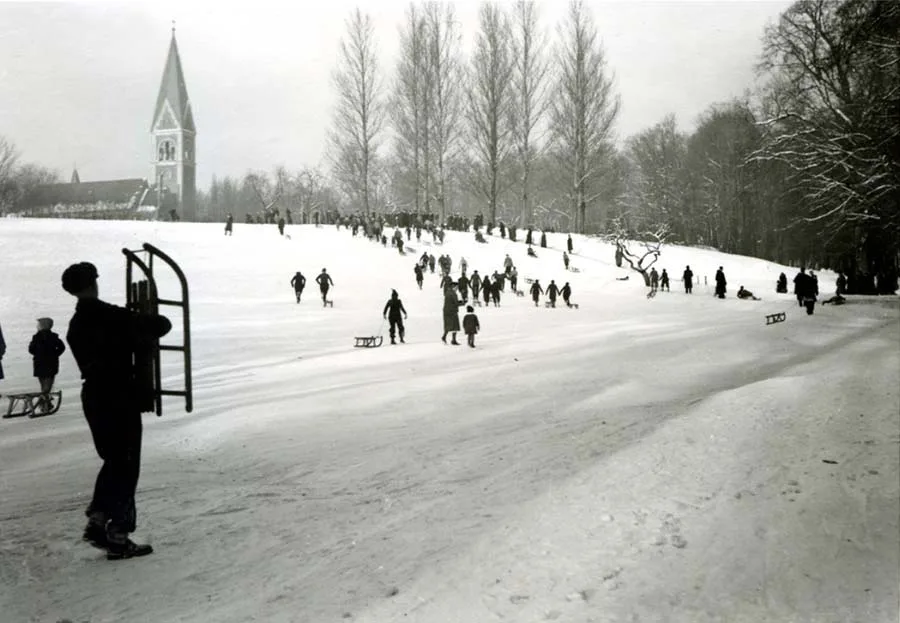 Children from all around flocked to Luisenwahl in winter to go sledging down the hill.
To attempt an assessment of the historical and artistic value and the natural and recreational potential of Central Park, one should become acquainted, if only briefly, with the early stages of its history.
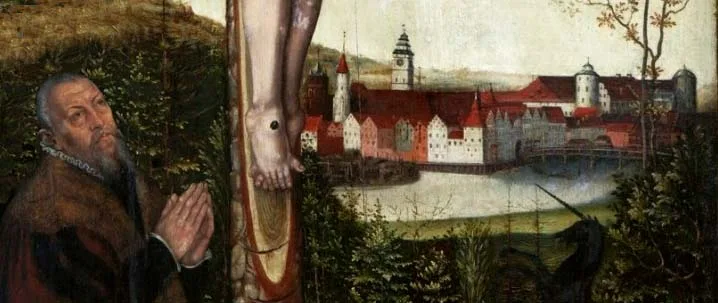
In 1786 Theodor Gottlieb von Hippel (1741–1796) — head of the criminal police and Lord Mayor of a city of 50,000 inhabitants, with a lively trade and, at that time, flourishing humanities, appointed to his post by King Frederick the Great when he turned 40 — bought from a certain Pointer an estate in Mittelhufen (Mittelhufen), a prestigious suburb close to Königsberg. The estate's land lay on the slopes of the Freigraben (Freigraben) stream and stretched from today's Prospekt Mira (in those days the Hufenallee (Hufenallee), a narrow country road along which the owners of country houses rode out to their residences) to today's Dmitriya Donskogo Street (then the Old Pillau Road).
As a young man, Theodor Hippel and his friends used to visit a certain Hessen's garden (later the garden of Inspector D.), which also lay in this romantic suburb and matched the contemporary idea of park beauty — it was natural. Hippel long cherished the memory of this garden that had touched his soul, and even as a mature man he rented the garden next door so that, when Inspector D. and his family were away, he could stroll in the garden of his youth. Later Hippel bought an old estate not far (no more than 0.5 km) from the Steindamm Gate, which included a small house with five or seven living rooms and grounds extending along the banks of the Freigraben stream.
At that time the Lord Mayor's country house was the very last in a row of private residences in the suburb of Hufen — the little house stood almost by the Old Pillau Road (Alte Pillauer Landstraβe, now Dmitriya Donskogo Street), in the lower part of the park. An avenue of old lime trees led along the stream to the house, hidden in the shady depths of a natural stand of beeches and hornbeams. In the mid-18th century, along the Old Pillau Road next to the Lord Mayor's country house, there were still craftsmen's houses, smithies and the "Milk House" tavern, where milk, sour cream, curd cheese and cream were served right up until 1914.
The walls of the country house were promptly adorned with paintings and engravings, of which Hippel, an art lover and collector, had a great many, and the land was divided into two gardens: a kitchen garden right next to the house, and the romantic garden of Hippel, which soon became widely known — an embodiment of his ideas and knowledge of landscape gardening, reflecting some of what he had seen in Berlin and Wiesbaden, but substantially altered and in his own interpretation. The deep stream beneath the canopy of a natural woodland of sombre hornbeams, limes and beeches, the complex terrain and the high banks were skilfully used to shape the structure of an English-style garden, which lacked only one thing — space: the garden was relatively narrow. This shortcoming, however, was typical of most gardens in Königsberg and its suburbs — land was expensive.
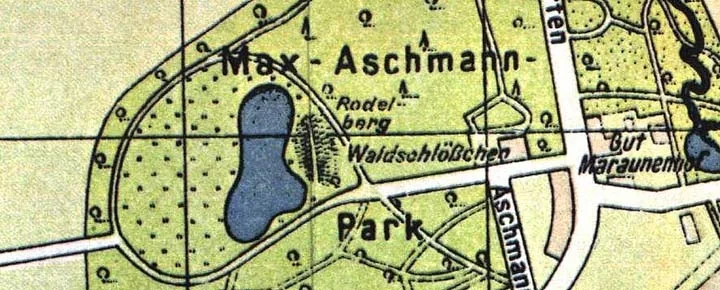
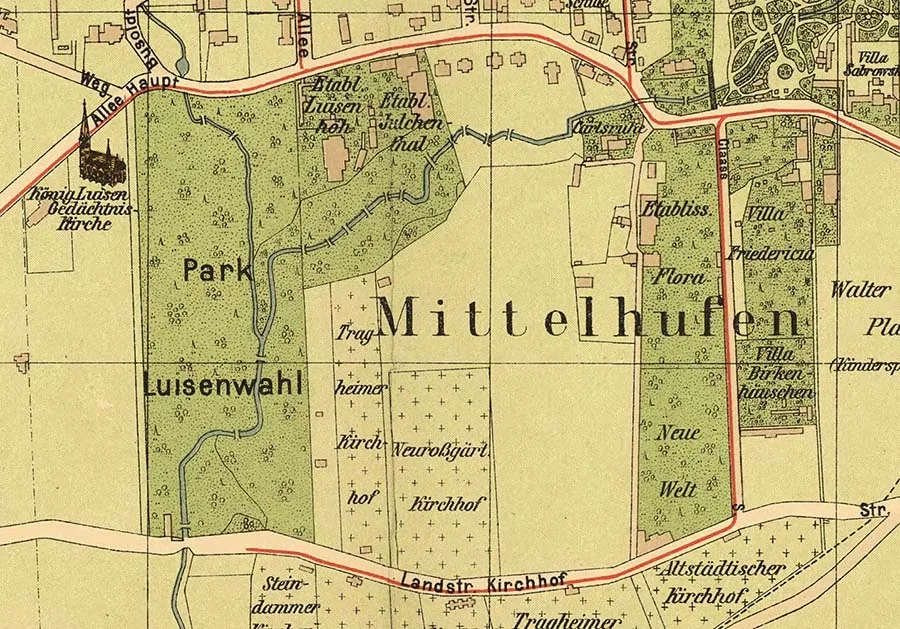 Luisenwahl on a map of Hufen.
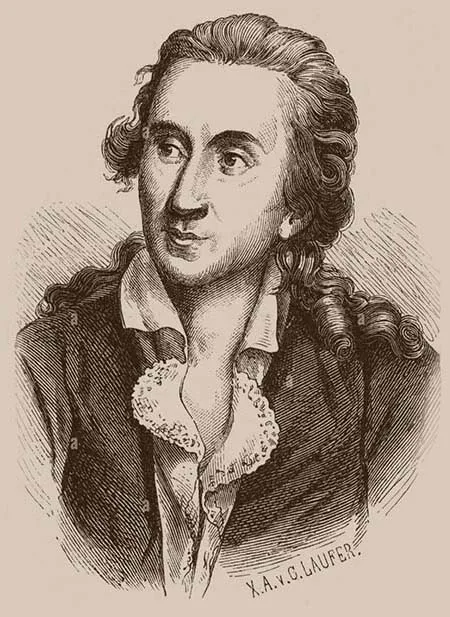
The appearance of a garden and the personality of its creator are, as a rule, quite closely linked: what kind of man was Theodor von Hippel, and what did his garden look like?
Theo Hippel was the son of a school headmaster in Gerdauen (Gerdauen, now the settlement of Zheleznodorozhny). He stood out for his intellect even as a child, studied theology at the University of Königsberg, was keen on poetry and cultivated asceticism in himself. After the Seven Years' War he visited Russia as part of the delegation accompanying the Amber Room, presented as a gift to the Russian Tsar Peter I; he was enchanted by the country and found it "a land impossible for him to understand". On returning to Königsberg he threw himself into the study of law, later became a brilliant lawyer, and in the end rose to high office. A writer and poet, a member of the Masonic lodge "Three Crowns", which included a number of senior officials, professors, officers, wealthy merchants and noblemen, a friend of many outstanding figures of the age, the "central head", as Kant called him, Hippel was a contradictory man: he lived ascetically, yet owned a magnificent collection of paintings, which 40 years after his death were handed over to the city by his nephew and became the core of the municipal Museum of Fine Arts. As Lord Mayor and police chief he was an extraordinarily effective administrator, but he went down in history as a man of letters, the author of novels, treatises on marriage and satirical works. His verse combines motifs of death, the search for God, didacticism and an extraordinary irony. Having suffered an unhappy love in his youth, he attempted suicide; he remained a bachelor, sought solitude, was prone to melancholy and exaltation, and could be harsh and cold-blooded.
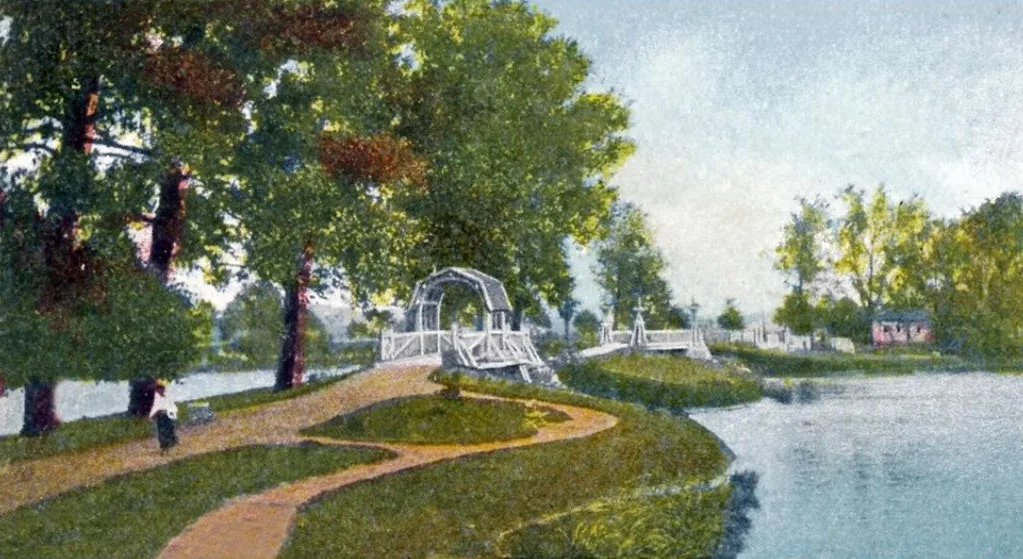
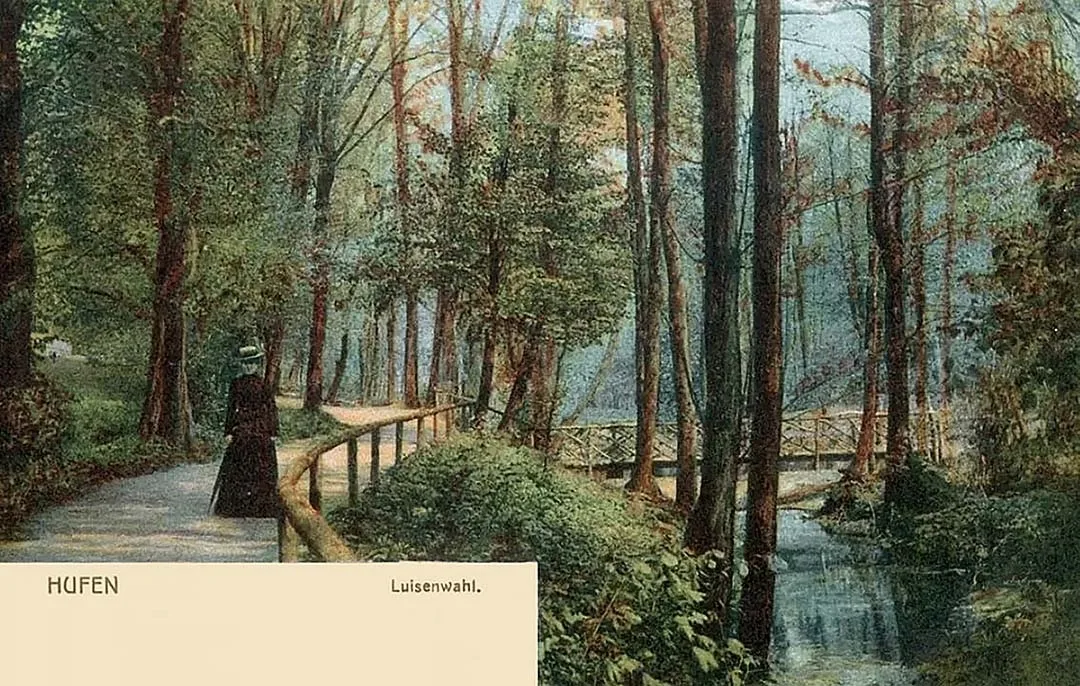
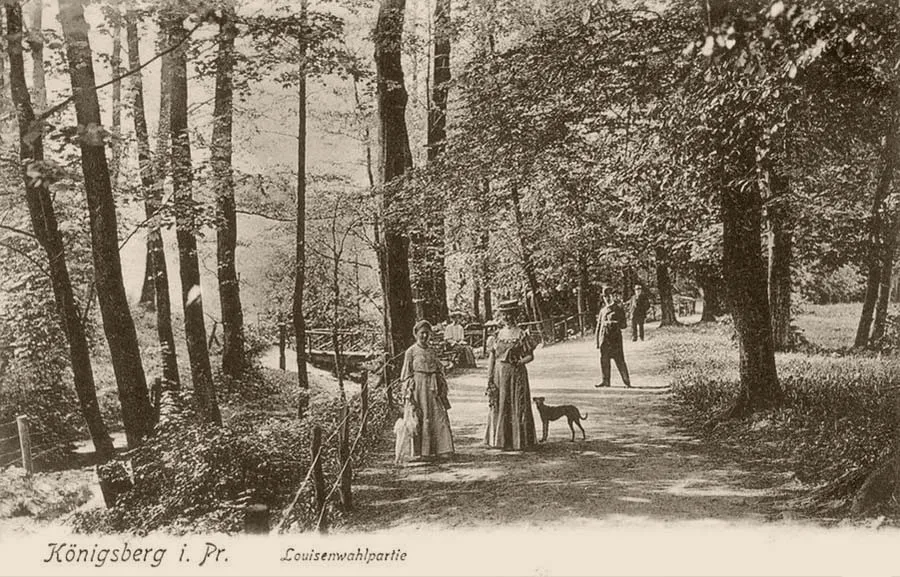 La Belle Époque (the Beautiful Era) on the paths of Luisenwahl in the early 20th century.
He is full of irony — the free play of the mind, through whose prism he views the world — and at the same time he rushes about in search of an ideal, reflecting it in a whimsical play of mystical forces, soaring into the lofty spheres of the spirit, into the world of an irretrievable past.
Many events in Königsberg were associated with Hippel’s name: the opening of the School of Arts in 1790, the improvement of a stretch of the Philosophers’ Dam, the draining of the swamp between the Castle Church, the Pregel embankment and the post office building, and the upgrading of the road from the Steindamm Gate to Mittelhufen, which was paved with logs to make travel easier.
Everything in his garden was a reminder of death, the theme he sang of in his verse, and reflected his strange, morbid attitude towards it. The park was a sentimental landscape full of melancholy, with an abundance of meaningful sayings intended to make the visitor reflect on the transience of life.
Part of the garden resembled a country churchyard, adorned with flowers and strewn with gravestones and nameless mounds... The first slab, which opened this garden, bore the inscription: “I, you, he, we, you, they.” One cannot help noticing that the pronoun “she” is missing. In the centre of the plot lay a slab inscribed: “Here all are equal, the master and his serf, the great and the insignificant, the noble and the base. In heaven and below, all is the same. Happy life will go on without me and without you. Learn, wanderer, to be worthy of it!” One of the garden’s avenues was adorned with a phrase carved into a tree: “This life is a corridor. Whether it be short or long, in any case, I give thanks.” Elsewhere, where three paths parted (one across a bridge, another leading uphill, the third running off into the depths of the park), the visitor was met by the following saying: “Lovers go down into the valley, thinkers seek the heights. The choice is agonising, but we go where we go.”
In the upper part of the garden, where there was an open meadow at the time, a bench stood beneath a silver poplar. From here there was a view of Königsberg, the Pregel River and its meadows. Part of the garden on the western slope (where the large clearing is now) was taken up by fruit trees, but even the sight of apple and cherry trees in blossom during a walk through Hippel’s garden “brought visitors no joy, leaving a feeling of dejection and unease.” It was a deeply personal garden, the garden of its owner and for its owner.
The garden’s long avenues led downhill along the stream bed; at the end of one of these damp, dark avenues was a small grotto with a bench, in front of which grew two lime trees (this spot is now near the staircase leading up from the park to Dmitriya Donskogo Street; Hippel’s limes have survived and are at least 250 years old, but no one protects them or looks after them).
The semi-rotunda in memory of Queen Louise, built in the park a century later, is positioned symmetrically to this grotto and echoes it in outline; a lime tree was likewise planted in the centre of the semi-rotunda. Evidently, the semi-rotunda was conceived as a counterpart to Hippel’s grotto.
Having furnished his country house to his own taste, here too, as in his poems, he celebrated the theme of death. In Theodor von Hippel’s country house the upper rooms were decorated as arbours. The kitchen, which stood separately in the garden, was decorated as a hermit’s grotto containing a small chapel (one of the arbour rooms was dedicated to the memory of “two departed souls,” by whom he meant himself and his late beloved: here allegorical pictures celebrated His love for Her, from the beloved’s name carved into the trunk of a young tree to a depiction of her grave). The Lord Mayor visited his garden every day, in every season and in all weathers…
In his will, Theodor von Hippel directed that this garden must be sold. By then it had become widely known beyond Königsberg, and for that reason it was often visited by travelling aristocrats, much to the displeasure of its owner, who sought nothing here but solitude and peace.
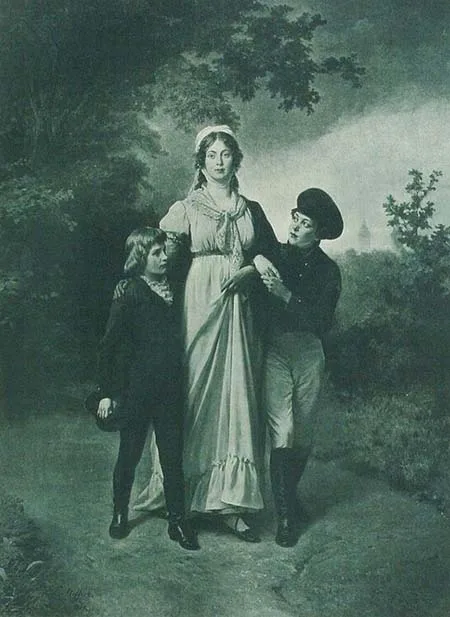
At that time there were many gardens in Königsberg and outside the city, but Hippel’s garden was special among them, and buying it was considered a prestigious acquisition. After the death of its famous owner, who was not only Lord Mayor of Königsberg but also, by the king’s decision, the city’s “president” (a title held otherwise only by the Lord Mayor of Berlin), the estate and house passed in 1796 to the very wealthy Gotthilf Christoph Wilhelm Busolt (1771–1831), who was then 25 years old and whose fortunate marriage to Louise Gramatzkie zu Reichtum (Louise Gramatzkie zu Reichtum) had made him rich. Perhaps that is why he named his new estate after his wife: Luisenwahl (Louisenwahl), “Louise’s Choice.”
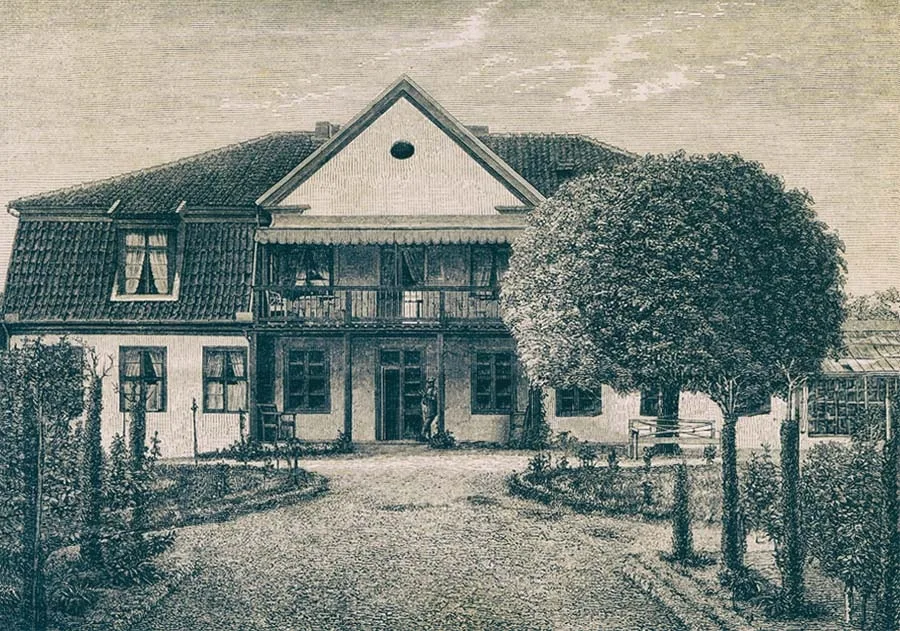 The house that sheltered the Prussian royal couple in 1808–09 and was spurned by Napoleon in 1812.
During the war with Napoleon, the royal couple, forced to flee with their children from French-occupied Berlin, were received hospitably by leading merchants and other well-to-do citizens of Königsberg.
Among them, the Busolts hosted them in 1808 and 1809 in the former Hippel garden. The Busolt house stood on the north side of the Hufenallee, at that time a narrow, log-paved street, and was surrounded by a small apothecary garden, flower beds and an orchard.
Later, in memory of the royal family’s pleasant stay at the Busolts’ house, King Friedrich Wilhelm III hung on the wall of his bedroom a small watercolour, probably painted by one of his sons, depicting this country house. Another watercolour showed part of the garden: a flower bed on the south side of the house with a shell-shaped arbour, entwined with climbing plants and intended for rest. It is known that on the other side of the house lay the obligatory kitchen garden with traditional vegetables and herbs, a somewhat altered but still thoroughly Baroque “apothecary garden.” To the south of the house stretched a narrow ravine with the Freigraben (Parkovy) stream and a park along the stream, some 600 m long.
Napoleon, on his way to Russia in 1812, stopped for three days in Königsberg, which he had conquered in 1806–07, and intended to stay in the Busolt house, remembering that the royal family had lived there during the occupation of Berlin. He expected to see a luxurious royal country residence and was astonished to find this modest little house. The emperor turned his horses back towards the city and spent the night in the castle.
On the occasion of his coronation in 1861, the by then quite elderly Kaiser Wilhelm I, while in Königsberg, visited this estate, where as a child he had once spent two summers with his parents that had left him with fond memories. Later, in 1872, he bought both the house and the garden, and ordered a marble bust to be erected in the park, at the spot where his mother, Queen Louise (Königin Luise), who died young in 1910, had loved to rest. He commissioned it from the well-known sculptor Christian Rauch (Christian Rauch), the son of Queen Louise’s valet. The foundation stone was laid on 2 September 1872. A small, charming head of Louise in white marble, framed by a hemispherical medallion and resting on a semi-rotunda of cement stone decorated at its ends with two stone flower vases: this work by the sculptor C. Rauch and the stonemason Bellert was installed in the park on 2 September 1874 and consecrated. The inscription on the monument read: “To the guardian spirit of Prussia, the unforgettable Queen Louise, from the citizens of Königsberg” (Dem Genius Preuβens der unvergeβlichen Königin Luise — die Königsbergerger Bürger. 1874).
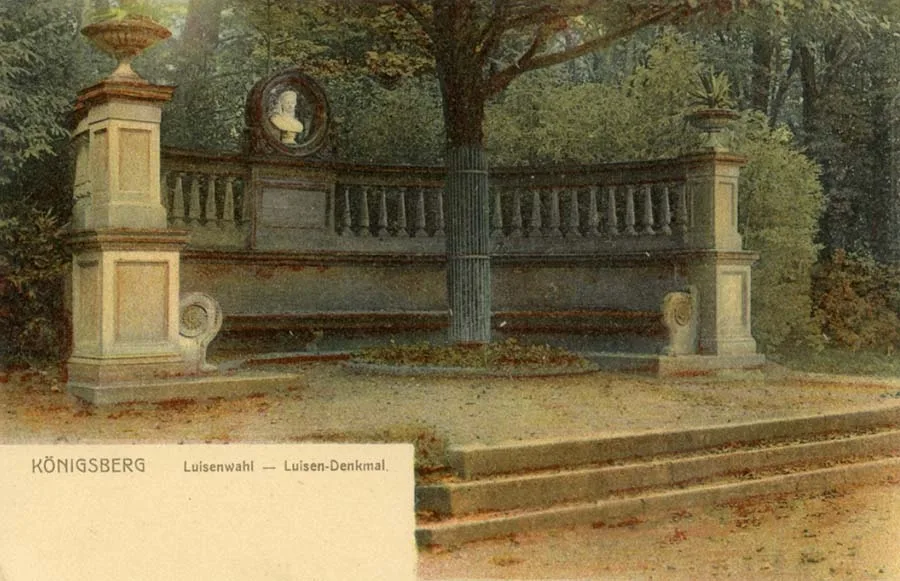 The semi-rotunda with the bust of Queen Louise on a retouched postcard from the early 20th century.
The semi-rotunda has survived to this day, though it has lost its architectural elements, along with the vases that once stood on it and the queen’s marble head. Everything else vanished in unknown circumstances. The lime tree planted at the steps of the semi-rotunda in 1874 is still alive…
In Königsberg, the following were named after Louise Auguste Wilhelmine Amalie, a princess of the house of Mecklenburg-Strelitz and Queen of Prussia:
- The theatre built on Hufenallee in 1911–12 to a design by the architect Walter Kuckuck (its site is now occupied by the rebuilt Regional Drama Theatre);
- Luisenhöh Street (Luisenhöh), which led from Hufenallee to Luisenwahl;
- Fort No. 6 "Queen Luise" (Fort VI Königin Luise) on the western outskirts of the city;
- Luise Avenue (Luisenallee, now Komsomolskaya Street);
- The gymnasium on King's Street (Königstraβe, now School No. 41);
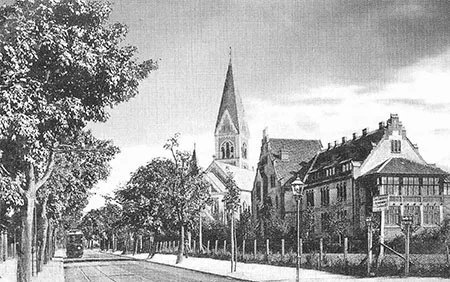
- The Neo-Romanesque Protestant memorial church, designed by the architect Friedrich Heitmann (1853–1921), whose foundation stone was laid in 1889 and which was consecrated and opened on 9 September 1901 in the northern part of the cemetery next to Luisenwahl Park, not far from one of the park's northern entrances and from the semi-rotunda dedicated to the queen.
The church's two spires, one taller and the other smaller, were meant to symbolise the royal couple. The church was consecrated in the presence of Queen Luise's great-grandson, the last German Emperor Wilhelm II, and his wife, a princess of Schleswig-Holstein-Sonderburg-Augustenburg; in 1918 both were driven from the throne by the German Revolution.
In 1914 Luisenwahl Park, until then a royal family estate, was donated to the city by the Kaiser and became municipal property. The layout of the garden had not changed since Hippel's day, but since the suburb of Mittelhufen (Mittelhufen) had been incorporated into the city in 1905, many permanent buildings sprang up around the public park of Luisenwahl, and Hippel's once-narrow road, paved with wooden planks, became the broad Hufenallee. Encroaching slightly on the park, the avenue cut off the Busolt house, also known as Luise's cottage, from the main part of the park, which spread out south of the street along the banks of the brook (later this house would accommodate a Mütterheim, a home for poor single mothers). The area south of the Queen Luise Church was occupied by the 3rd Cemetery of the Altstadt parish, which stretched as far as the Old Pillau Road (now Dmitriya Donskogo Street). To the east, the park bordered on a residential quarter steeped in the greenery of its gardens, while below the second branch of the Freigraben (now the Parkovy Brook), known as the Hufenfreigraben (Hufenfreigraben), the park adjoined the grounds of the 2nd Tragheim and 3rd Neuroßgarten cemeteries. South of the park, from today's Dmitriya Donskogo Street right down to the railway, lay another six cemeteries of various denominations. The park was bounded on the north by Hufenallee (Prospekt Mira) and on the south by the Old Pillau Road.
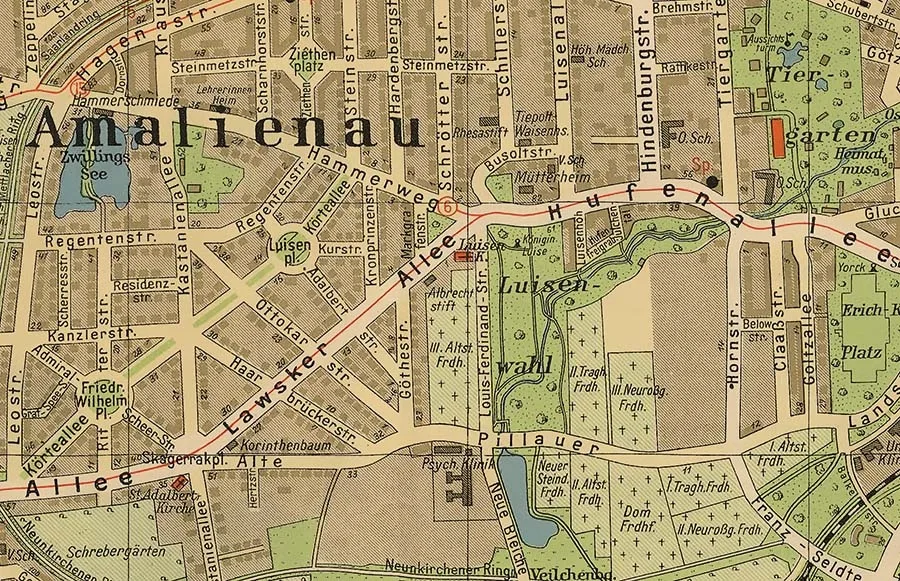 Luisenwahl on a map of Amalienau, surrounded by cemeteries.
In the 1920s, when the city undertook large-scale housing construction and laid out green spaces according to a single plan conceived by Ernst Schneider, the director of municipal gardens and parks, Luisenwahl Park was linked to other green areas lying to its south and north-east.
This came about in part because the park was enlarged through the landscaping of a section of the eastern branch of the Freigraben (Parkovy) Brook, begun in 1931. In 1937 the landscaped grounds of the brook's ravine were extended right up to Hufenallee, and an underpass beneath the street connected Luisenwahl with the Tiergarten (Tiergarten, the zoo). This promenade, named the Jülchental Promenade after one of the little streets running from Hufenallee to Luisenwahl, was fitted with flights of steps down the steep slopes and a complex network of avenues and footpaths, which made it possible to enjoy pleasant walks along the promenade high above the brook.
To the south, too, Luisenwahl gained an additional green area for walking: through a landscaped arched underpass beneath today's Dmitriya Donskogo Street, one could follow the Freigraben as it ran down towards the Pregel to the former mill pond — by the 1920s already a street, Neue Bleiche (Neue Bleiche), lined with old trees and running along the western edge of the cemeteries on the Old Pillau Road — and on to the Veilchenberg gardens (Veilchenberg, Violet Hill). Next to these lay the green grounds of six cemeteries, and from there it was only a short way to the Astronomical Bastion of the former fortifications with their tree-lined promenades, the bathing beaches on the pond by the Ausfall Gate, and the Volksgarten with the university observatory.
In the 1920s the layout of Luisenwahl's public green space was altered and supplemented with new amenities — flights of steps, thirteen footbridges across the brook, numerous avenues and a network of paths, viewing platforms, small architectural features, little waterfalls and fords across the brook made of stones and fallen trees. Yet the stylistic character of this late-18th-century park remained unchanged: it was still the romantic landscape park so beloved in Prussia, where one could sense the presence of Hippel and of the Prussian kings, whose trees Napoleon Bonaparte had seen, and over which hovered the ideas of the famous Peter Lenné (Peter Joseph Lenné, 1789–1866), creator of the best-known German landscape parks of the 19th century.
The winter of 1929–1930 was exceptionally cold, and the orchard planted by the park's first owner more than a hundred and forty years earlier on the slope of the brook's right bank froze completely.
At about the same time today's Prospekt Mira was widened still further, swallowing up part of the park. In memory of this loss, however, a small traffic island with mighty beeches and limes was preserved in the middle of the broad carriageway; to this day it surprises us and stirs the imagination with its originality — a living monument on modern Prospekt Mira to that part of the park which, out of necessity, became a road.
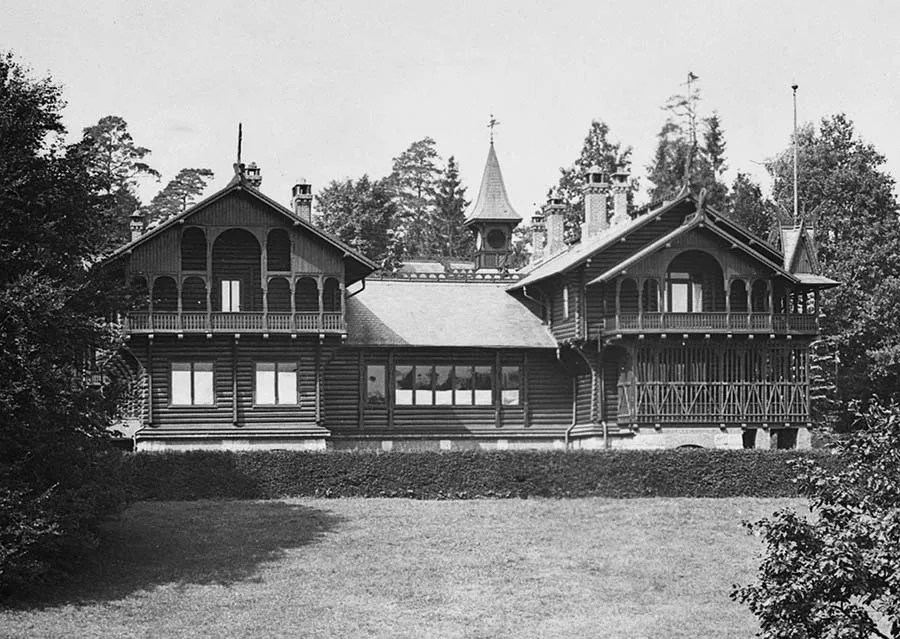 The Kaiser's hunting lodge in Rominten (Raduzhnoye), brought to post-war Luisenwahl (Central Park). It can still be seen there today, not far from the main entrance.
In 1949, by decision of the city executive committee, a Park of Culture named after M.I. Kalinin was opened in Kaliningrad.
As early as 1947 the grounds of the former municipal park of Luisenwahl — the future central city park of Kaliningrad, which at that time formed a single enterprise, "Zoopark", together with the zoo — had been enlarged compared with pre-war times: they now took in the devastated cemeteries to the right and left, as well as part of the square together with the Queen Luise Church.
In the 1950s log structures made of centuries-old spruce were brought to the Park of Culture from Rominten (Rominten, now the village of Raduzhnoye, Nesterov District), where the Kaiser's hunting lodge had been built in the Scandinavian style in 1891. For many years they housed the administration of Central Park.
Today the park has a single main entrance from Prospekt Mira, framed by a fence that is semicircular in plan, with arched entrance portals. The Queen Luise Memorial Church, which survived the war, was reconstructed in 1968–76 to a design by the architect Yu.M. Vaganov and converted into a puppet theatre. The semi-rotunda in memory of Queen Luise is in an unacceptable state. It is almost invisible from the main avenue, hidden as it is behind utility buildings. In the southern part of the park there was once a small open-air Green Theatre, next to which a stele bearing a relief portrait of Franz Schubert was erected in 1928 (sculptor Walter Rosenberg; now lost). Beneath the bas-relief were inscribed the words: "To Schubert, sovereign of song, from the Union of Friends of Song in Königsberg".
In the post-war years the park's layout of the 1930s remained largely unchanged: it stayed a landscape park whose dominant feature is the brook. As its designers intended, the central part of the park is mostly a bright, open space of broad meadows that gradually gives way to the semi-open areas, with their characteristic play of light and shade, that prevail throughout the park. The northern and southern parts of the park were enclosed, shady spots beneath a closed tree canopy, but proportionally the park had far fewer dark, enclosed areas than sunny ones. The ratio of the park's open, semi-open and enclosed spaces was 2:3:1.
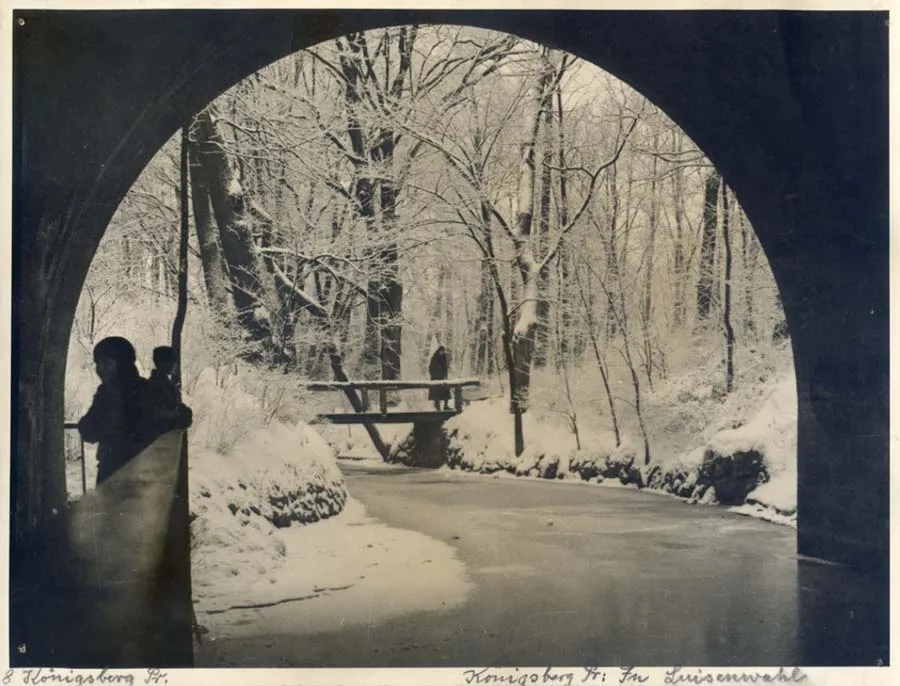 Before the Second World War, a purpose-built promenade along the stream bed allowed walkers to pass beneath the Old Pillau Road (today's Dmitry Donskoy Street, pictured). A similar solution was adopted at the time for the passage from Luisenwahl to the Tiergarten (zoo) beneath the Hufenallee (today's Mira Avenue).
Today the balance between light and shade has changed. The park is neglected, and the main functional areas of the modern park, occupied by amusement rides, lie on the site of the former 3rd Cemetery of the Altstadt parish.
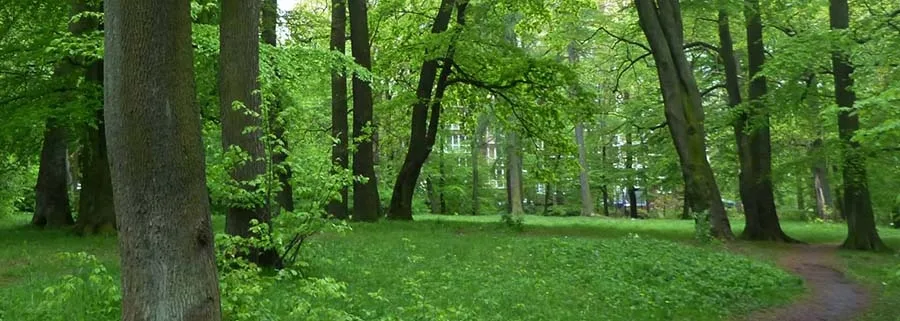
Since the war, the historic park itself has been subjected neither to heavy recreational use nor to any intervention by landscape architects. It is becoming overgrown with self-seeded trees and falling into decline, serving mainly as a through route, its main avenue linking Mira Avenue and Dmitry Donskoy Street. The section of the park along the eastern branch of the stream, the very Jülchental promenade that was laid out slowly but persistently in the 1920s, is no longer part of the park grounds, and one may assume that it will not share the park's fate if the park is ever restored. The park's compositional unity, its accessibility (three entrances in the north and three in the south), the landscaped walking area along the eastern branch of the stream linking it to the zoo, the comfortable setting of a well-planned public recreation space: all of this has now been lost. The park has retained its historic trees, oaks, beeches, limes, hornbeams and maples aged 150 and even 200 years, but hardy self-seeded maples and some Soviet-era plantings conceal its original layout. The only bright spot left in the park is part of the meadow once occupied by the orchard of Hippel's country estate.
The park's dominant landscape feature, the Freigraben (Parkovy) stream, has for many years been polluted by household and domestic wastewater from numerous authorised and unauthorised drainage connections. Sediment deposited in the stream bed causes the banks to erode and a new channel to form. The stream valley is prone to waterlogging, especially in the southern part of the park; the stream bed, lined with stone at the beginning of the century, is covered with a thick layer of silt and rotting wood. One cannot help recalling the words of André Maurois: " …It was a very old town. It had seen far too much to be surprised by anything any more…"
Translated from Russian with the help of AI (Claude, Anthropic), October 2026.