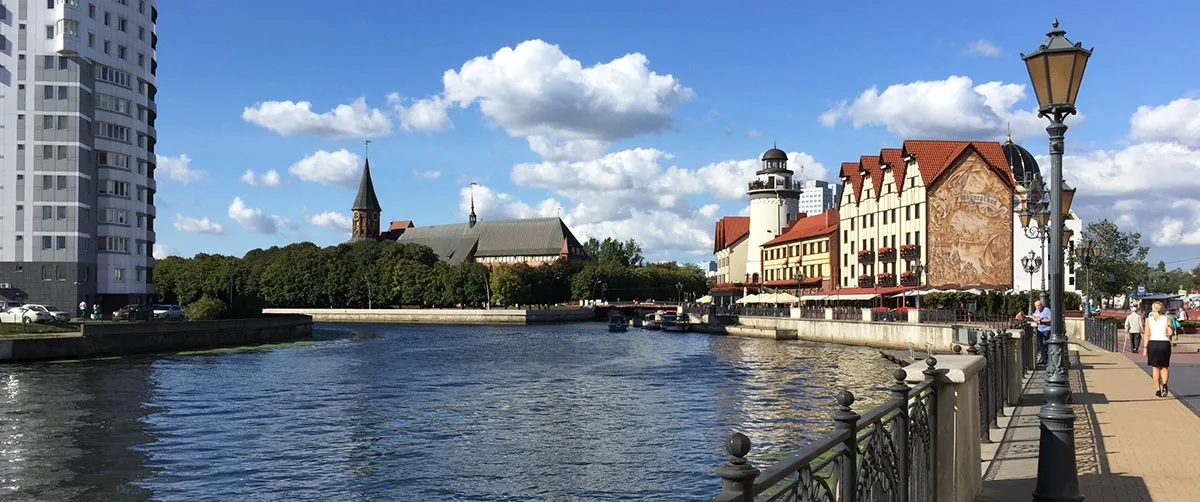
Obviously, if there was a "new Bleiche", there must also have been an "old" one somewhere. Only it left no trace of itself in place names. One such enterprise was in Devau / Devau (the Rizhskoye settlement within Kaliningrad's city limits); perhaps that was the very "old Bleiche". The bleaching process itself consisted of spreading the fabrics out in the sun on wooden frames, and sometimes simply on clean grass. The fabric was moistened with water to speed up bleaching. The ultraviolet in sunlight broke down the natural pigments contained in the flax fibre, and the linen turned white. For new fabrics the whole process took 40 days. Washed linen was bleached in the same way, with a much shorter cycle. Recipes that considerably shortened the bleaching time were in fact known at the time: kaolin (white clay) or even lime was used for this. But bleaching with these substances, which are alkaline, damaged the fibres of the fabric. And fabric was far from cheap in those days. So the environmentally clean method using only water and sunlight remained the most popular. Clearly, the ideal place for this kind of bleaching was a south-facing slope near a source of clean water. A riverbank was considered ideal, because the morning mists over the river moistened the fabric and made the bleachers' work easier. The terrain at Neue Bleiche was just such a slope. The nearby Freigraben / Freigraben stream (Parkovy) was a source of clean water.
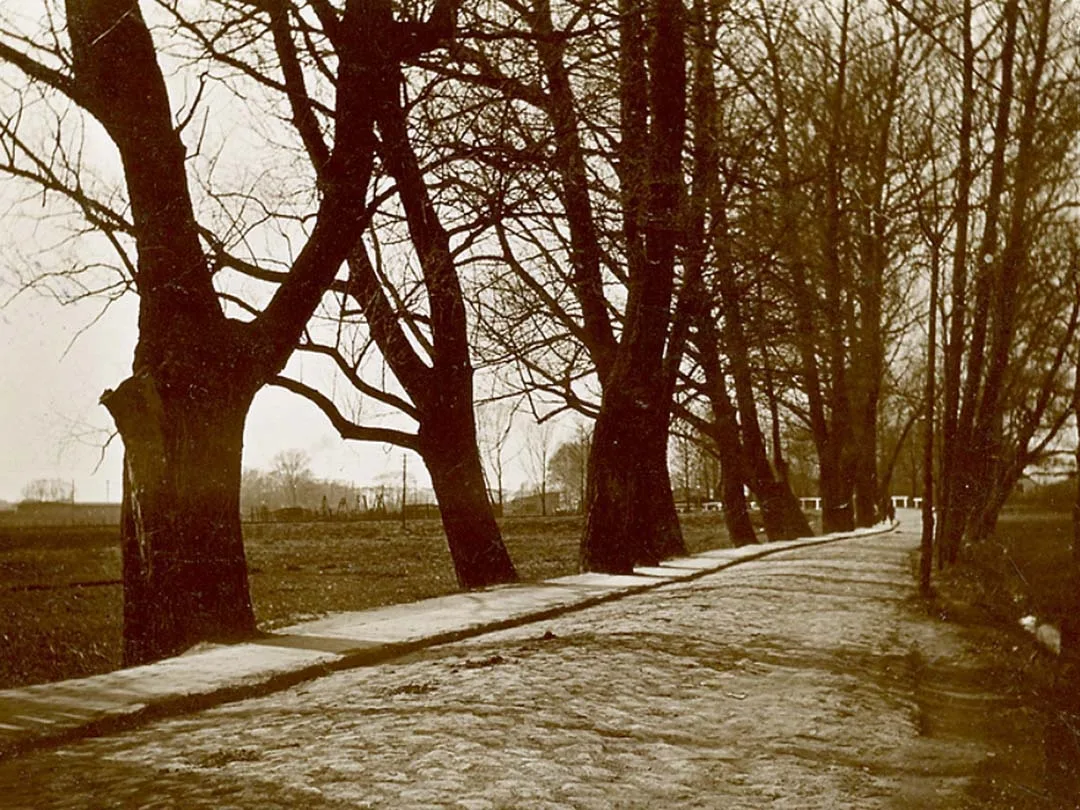
At the end of the 18th century Neue Bleiche itself was a settlement of two houses, reached from the Ausfall Gate / Ausfaltor by a tree-lined alley. Between the estate and the town rampart stretched the so-called town meadows (Stadtwiesen / Stadtwiesen).
Neue Bleiche did not live by bleaching alone, however. On 11.09.1865 the Königsberg–Pillau / Pillau (Baltiysk) railway went into service, and a station was opened at Neue Bleiche on this line. Weekend outings into the countryside had become fashionable at the time. For the excursionists arriving at the station an établissement / Etablissiments (pronounced "etablissemant") was opened, comprising a restaurant and a hotel. Here one could stay, have lunch after a walk and socialise with other holidaymakers. Next to the restaurant was Violet Hill (Veilchenberg / Veilchen-Berg), which offered an excellent view of the whole surrounding area, including Königsberg.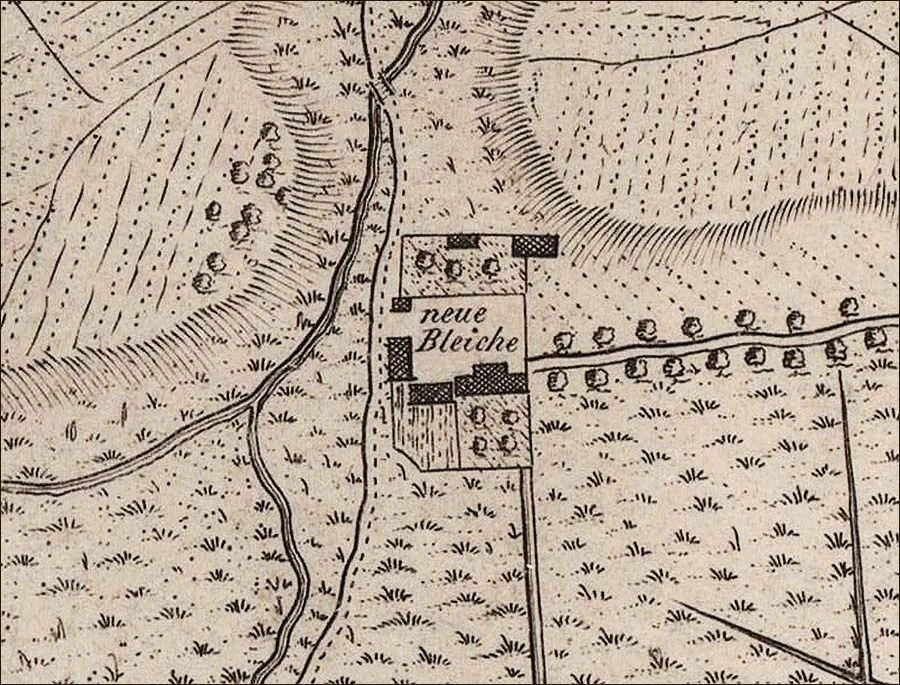 Neue Bleiche on a city map of 1800.
In 1871 Neue Bleiche was a settlement of three farmsteads in the Landkreis Königsberg. Three families and one bachelor lived there. The parish church for the people of Neue Bleiche was the church in the Altstadt.
It was intended that Neue Bleiche should form a Gutsbezirk in the Landkreis Königsberg, but this never happened. As a result, Neue Bleiche had the status of a separate locality belonging to neither a municipality nor a Gutsbezirk. On 30.04.1874 Neue Bleiche was included in the newly established Amtsbezirk of Hufen / Hufen. By 1885 Neue Bleiche had received the status of an estate without forming a Gutsbezirk.
The name Neue Bleiche is connected with an episode in the history of Königsberg's fortifications which could in itself be the subject of a separate article, or perhaps even a book, about the centuries-old rivalry between the means of attack and defence. But the format obliges me to keep it to a couple of paragraphs. The point is that the design and construction of Königsberg's Second Rampart Ring coincided with the beginning of a revolution in barrelled artillery. Therefore the fortification commission headed by Major General Friedrich Ludwig von Aster, chief of the Engineer Corps, suspecting that artillery would soon take a big step forward, designed, in addition to the traditional rampart ring, forward fortifications: lunettes. According to the design, these lunettes were to be placed several hundred metres in front of the main defensive rampart. The commission's idea was that such works would prevent the enemy from placing breaching batteries within point-blank range of the rampart. Many years later, historians of fortification came to regard such forward lunettes as a feature specific to General von Aster's designs.
During the main work on the rampart ring, 12 esplanades were left outside it: reserved plots of land on which building was prohibited.
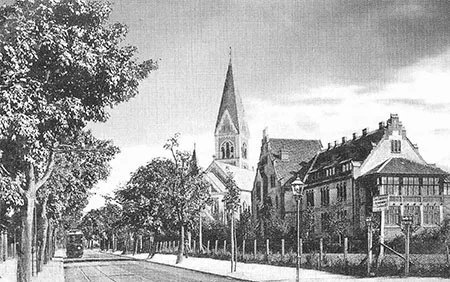
A 13th esplanade was to have been on Lomse island under the design, but it remained on paper. When work on the main rampart, bastions, ravelins and fortress gates was finished, construction of the lunettes began. Three were built in all. After that, the idea of lunettes was judged unsound. Firstly, because during the years the Königsberg rampart ring was being built, artillery had made such progress as von Aster's commission had never dreamed of. Placing the lunettes a few hundred metres forward became insignificant at the new firing ranges. Secondly, the very idea of small, isolated lunettes was not a very good one. As early as the end of the 17th century the great French military engineer Sébastien, Marquis de Vauban / Vauban (1633–1707) stressed that there should be no small isolated works. If they are intended for temporary defence, their garrison will abandon its positions and fall back to the line of the main rampart at the first sign of danger. If they are intended for stubborn defence with no possibility of retreat, the soldiers defending them will feel doomed, left to their fate, and will therefore surrender their sector to the enemy as soon as the opportunity arises.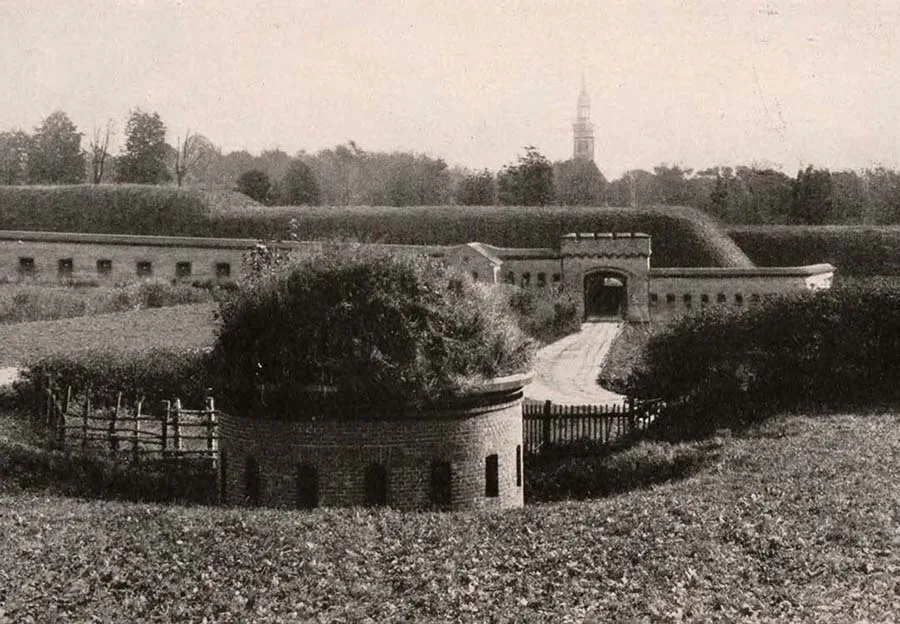 The Ausfall Gate. In the foreground, one of the lunettes; in the background, the Neuroßgarten Church.
Von Aster's lunettes resembled forts reduced several times in size, the kind that would ring Königsberg some 15–20 years later. But this is exactly the case where size matters. Curiously, the number of lunettes in von Aster's design (12) exactly matches the number of Königsberg's large forts.
Let us return to the three lunettes that were built. One of them was built on the way to Neue Bleiche and was therefore named after that settlement. It has survived to our day, though in a much altered form. It is now a mound in Victory Park, where after the storming of the city on 6–9 April 1945 a mass grave was made for the Soviet soldiers killed in the assault. To complete the picture, I will note that another lunette lay in what is now Yunost Park and was called Böttchershöfchen / Böttchershöfchen. Unlike the Neue Bleiche lunette, it kept its moat and the shape of its ramparts. In the centre was a small reduit to shelter the personnel. In 2004, during the construction of the so-called "Russian Language Development Centre", the reduit was demolished. Only the moat remained. The third lunette, Mühlenhof / Mühlenhof, was on the site of today's packaging plant (Dzerzhinskogo Street).
In 1889 another railway line passed through Neue Bleiche: to Labiau / Labiau (Polessk), later extended further, to Tilsit / Tilsit (Sovetsk).
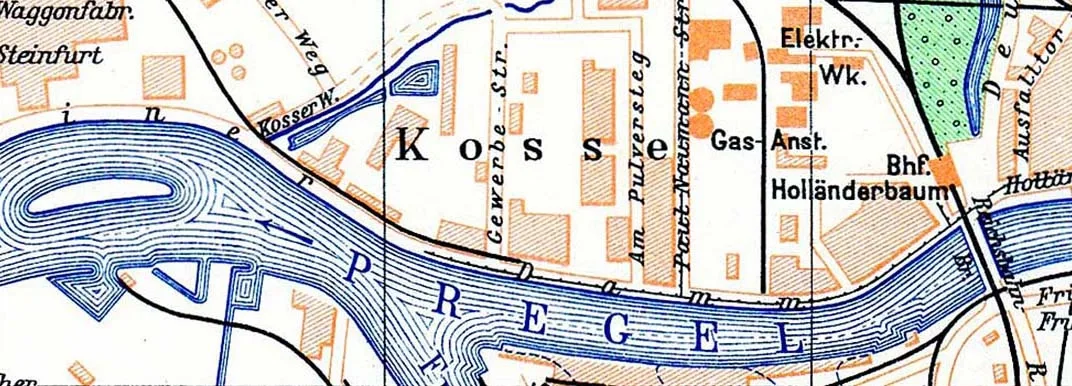
To anyone familiar with the geography of today's railways in the Kaliningrad Region, it may seem strange that trains heading north-east left Königsberg due west. However, until traffic opened on 26 August 1926 over the new Imperial Railway Bridge (now the Double-Deck Bridge), the railway to Labiau left the city limits through the Railway Gate, crossed Neue Bleiche and Ratshof (the Vozdushny settlement), skirted Amalienau / Amalienau on an intricate course and headed off towards Labiau along the line of today's Festivalnaya Alley. The Neue Bleiche station itself, admittedly, was soon closed and converted into a technical station for freight trains bound for the enterprises of the Kosse / Kosse district.
On 09.09.1901 the Queen Louise Memorial Church / Königin-Luise-Gedächtniskirche in Luisenwahl / Luisenwahl park (the Central Park of Culture and Recreation) was consecrated. This church became the parish church for the people of Neue Bleiche. In 1904 the Neue Bleiche estate was bought by the Königsberg municipality for 225,000 marks. On 01.04.1905, together with other suburban areas, it was incorporated into the city of Königsberg.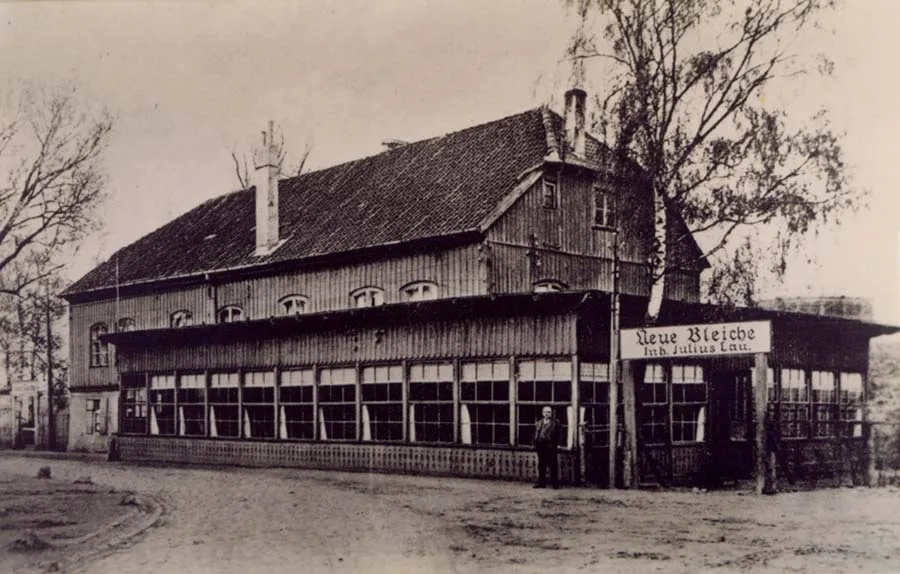 Julius Lau's "Neue Bleiche" restaurant.
The newly formed city district of Neue Bleiche included, besides the Neue Bleiche estate itself, an extensive green area from Alte Pillauer Landstraße / Alte Pillauer Landstraße (Dmitriya Donskogo Street) in the north to the Pillau (Baltiysk) railway in the south.
In the east the district began at the city's rampart fortifications and in the west ended at Kastanienallee / Kastanienallee (Chestnut Alley). From the end of the 19th century the north-eastern part of Neue Bleiche was occupied by city cemeteries: the New Steindamm, Second Altstadt, New Kneiphof (Cathedral), First Tragheim and Second Neuroßgarten cemeteries. It should be noted here that this historic district was the most "unofficial" of all. City plans and maps often simply marked it as part of the large historic district of Hufen / Hufen. Sometimes descriptions of Neue Bleiche limited it to the Stadtwiesen meadows and the estate alone. Here, in this article, it is presented within the widest possible boundaries.
At first there was no permanent construction in the Neue Bleiche district; it remained a large green area. Only an imposing brick aqueduct, inside which the city's main sewer was concealed, was thrown across Neue Bleiche street. But then new streets were laid out, and in the eastern and western parts of the historic district construction began on the first buildings, which turned out to be medical institutions. In 1910–14 the building of the university clinic for mental and nervous diseases was built on the Alte Pillauer Landstraße highway. During the First World War its blocks were converted into a military hospital. This was far from the only medical institution in the Neue Bleiche district. In 1921–23 the building of the dental institute was erected (architect Hans Gerlach / Gerlach, 1885–1980).
Two more medical buildings in this district are associated with Gerlach's name: the university dermatology clinic, built to his design in 1925, and the polyclinic on Alte Pillauer Landstraße, built in 1928.
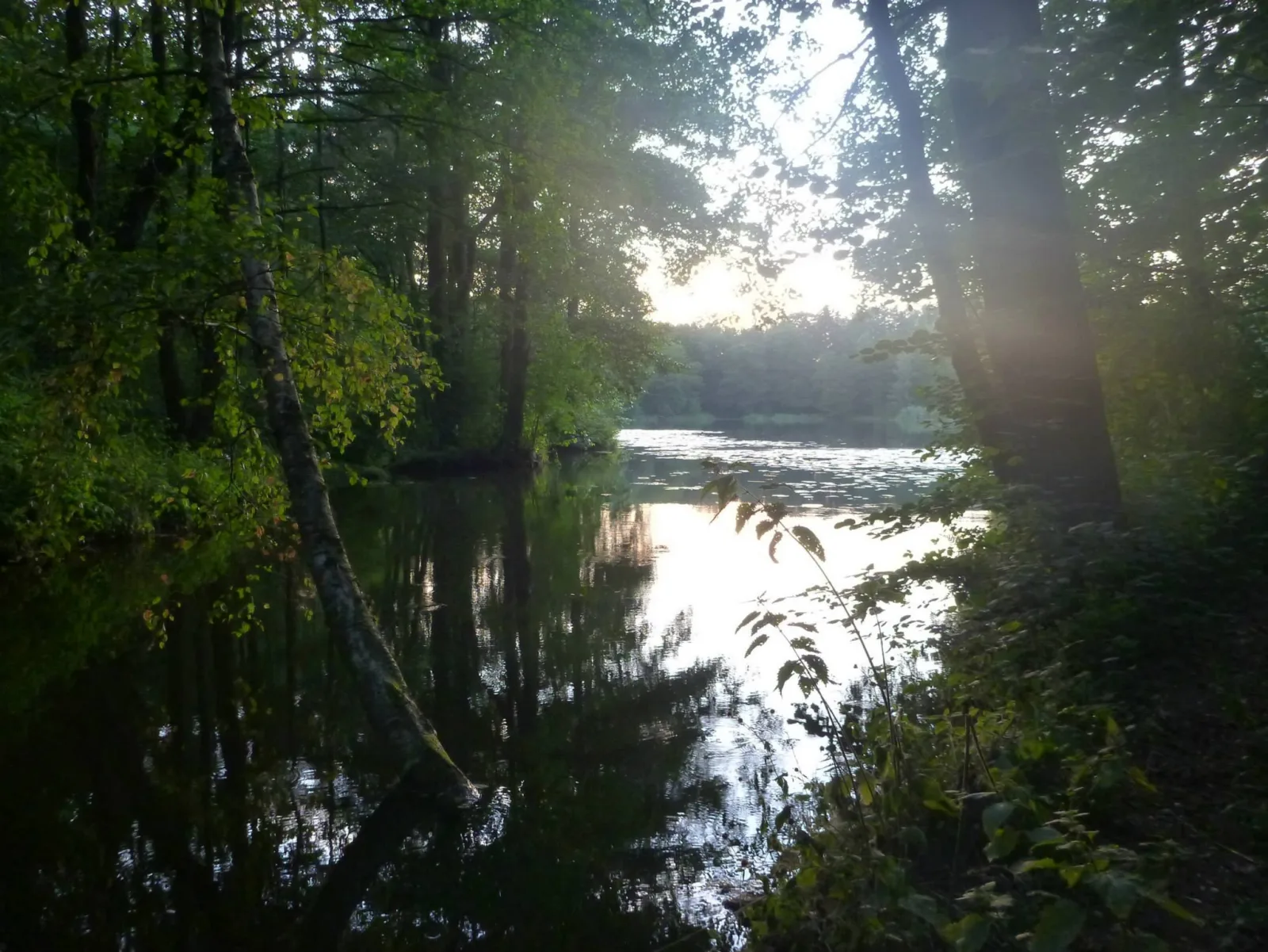
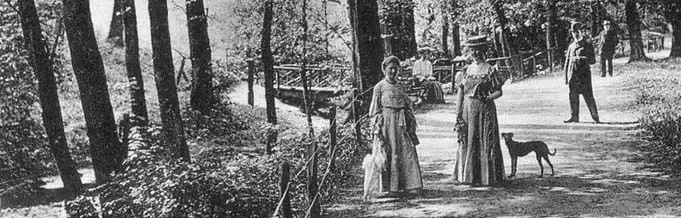
In the same year, 1928, the architect Friedrich Lahrs / Lahrs (1880–1964) built the district's best-known building on Alte Pillauer Landstraße: the Finance Office of the Province of East Prussia. In the western part of Neue Bleiche, bordering on Ratshof, detached houses and small apartment buildings also began to be built at the turn of the 1920s and 1930s. In the 1930s a picturesque pond was created on the Freigraben stream. Gazebos were put up in the park on the left bank of the stream. Although the park lay between cemeteries and a psychiatric clinic, it was popular with romantically minded Königsbergers. Also at their service was Julius Lau's / Lau restaurant, which continued the traditions of the Neue Bleiche inn. The restaurant was also frequented for a snack by the city's allotment gardeners, who were given plots on those very Neue Bleiche town meadows.
In this corner of peace and serenity even the beginning of a new era in the life of East Prussia passed almost unnoticed, except that people in Wehrmacht uniform began to appear in the restaurant, and diners discussed newspaper reports of the German army's latest victories over lunch.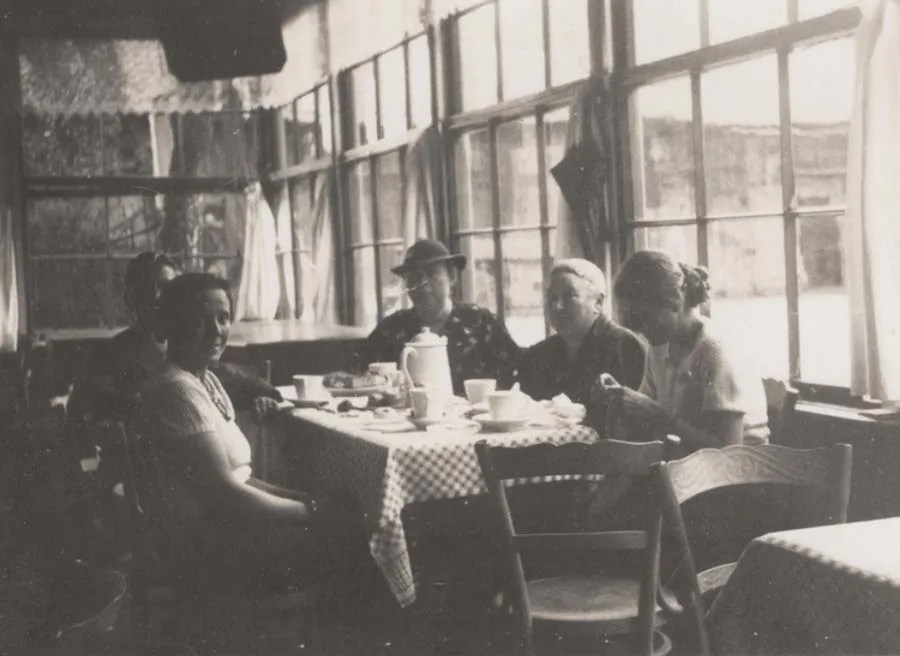 Lady guests of the "Neue Bleiche" restaurant.
And even when the city centre burned down in the night bombing raids, not a single house in Neue Bleiche was destroyed, not a single bomb fragment reached it. But the April battles for the city unfolded here with all their destructive force.
The night battle in Neue Bleiche became one of the key events of the storming of Königsberg on 6–9 April 1945. The fortress commandant, Otto Lasch / Lasch (1893–1971), being no fool as a commander, had as early as 7 April (the 2nd day of the assault) asked the army command for permission to break out of the city with all the garrison's forces towards Pillau, where the main body of German troops was located. He justified his request by the need to evacuate the civilian population from the besieged city and to save the fortress garrison, which would inevitably be completely encircled in the near future. But Lasch was refused and heard only an insistent demand to defend the city stubbornly. On 8 April units of the 11th Guards Army forced the Pregel and linked up with units of the 43rd Army in the Ratshof area. All at once it became clear to everyone that Königsberg's fate was sealed. Now the party (NSDAP) leadership as well, in the person of Deputy Gauleiter Grossherr and his aides, who commanded the Volkssturm divisions, began through their own channels to demand permission from their superiors for a breakout.
Only by 20.00 on 8 April did a message reach Lasch's command post stating that he was permitted to break out to the west with assault groups, but that Lasch and his staff were not relieved of their main task of continuing to defend the city and to hold the districts still under the garrison's control.
Under such conditions the slim chances of a successful breakout shrank to nil. Only a few hours were allotted to forming these assault detachments and drawing up a detailed plan of the operation. True, the recollections of surviving participants in the breakout show that preparations began somewhat before permission for the operation was received. The scheme devised by Lasch, in which the civilian population was to be evacuated in the gaps between the assault groups, does not stand up to any criticism. Even if successful, the breakout would have taken place under the point-blank fire of the Red Army's assault groups, and civilian casualties would have been catastrophic. All the more so since only part of the entire available force (contrary to Lasch's own demands) was to break through the encirclement.
But even this plan began to fall apart almost at once. Because of constant Red Army fire and rubble blocking the streets, the units assigned to the breakout could not reach their starting positions in full strength and on time.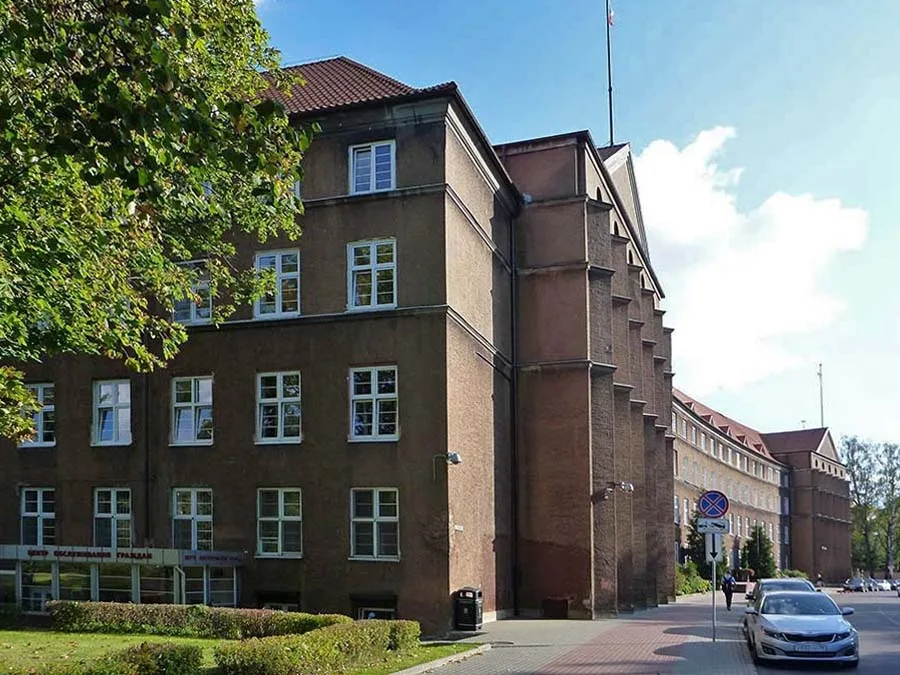 The Kaliningrad Region administration building, formerly the East Prussian Finance Office.
The party leadership, on the other hand, which was responsible for assembling the civilian population, brought people out of basements and shelters too early. The movement of a huge number of people wrecked the plan to bring the assault battalions to their starting positions covertly.
Soviet artillery struck the staging area where the battalions had begun to assemble. As a result, even before the breakout began, General Sudau, commander of the 548th Volksgrenadier Division, was killed, and General Sperl, commander of the 61st Infantry Division, was wounded.
The breakout operation itself began at 02.00 on 9 April. The main thrust ran from the Astronomical Bastion through Neue Bleiche, in particular through the cemeteries located in the district. The breakout group successfully crossed the area of today's Victory Park and the railway line, but in Neue Bleiche, in the cemeteries, the German troops came under crossfire from Red Army units. The element of surprise worked only for a very short time; reinforcements came up to the Red Army men under attack. Having partly lost its bearings, the combined German breakout force ceased to exist as a single whole. Under the fire of the Red Army men it broke up into groups of a few dozen soldiers each, which subsequently acted in isolation from one another. Most of those who survived the fighting in the cemeteries went back to Königsberg. Only a few groups of soldiers and officers reached the bank of the Pregel. For them the breakout turned into infiltration. These small groups, periodically returning the enemy's fire, managed under cover of the morning mist to make their way through the marshes south of Gross Holstein / Groß Holstein (the Pregolsky settlement) and link up with the Samland group of forces.
There could be no question of evacuating the civilian population under such conditions, and the entire breakout operation ended in complete fiasco.
After the fighting ended, Neue Bleiche became part of the Seventh District of Königsberg, and then, from 25.07.1947, of the Stalingradsky District of Kaliningrad (from 05.11.1961 the Oktyabrsky District). In former Neue Bleiche most of the administrative and residential buildings were preserved or restored. The exception was the Neue Bleiche estate itself (the railway station and the restaurant), which was destroyed in the fighting. In the pre-war cemeteries the monuments and gravestones were removed, and over time the area turned into an urban forest. On the whole, however, Neue Bleiche was not radically changed in the Soviet years. Between the 1950s and the 1990s no more than 10 new houses were built in this historic district.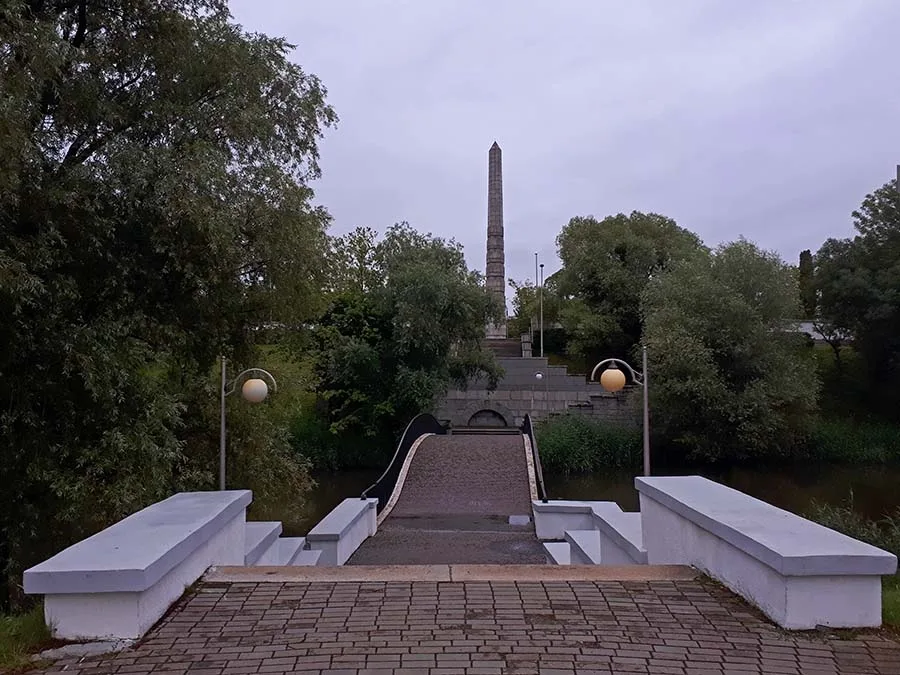
In Victory Park.
On 8 May 2000 Victory Park was opened beyond the defensive moat, on the site of the former glacis of the Butterberg bastion (now the "1,200 Guardsmen Heroes" memorial).
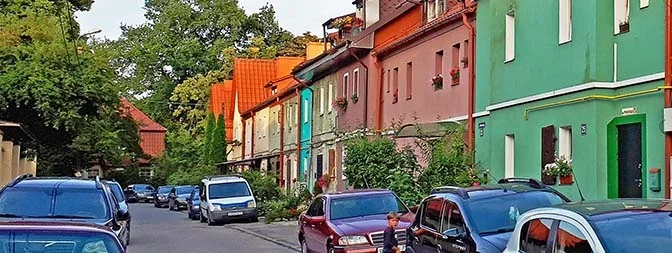
In 2007 a small residential complex of private houses and small apartment buildings was built on Kolomenskaya Street. Private houses appeared along Velosipednaya Doroga. In 2016–20 four apartment blocks were built on Marata Street. Developers have repeatedly tried to get their hands on the cemetery land, but so far the green belt along Dmitriya Donskogo Street is holding out. That is, apart from the fact that on part of the First Tragheim Cemetery a residential complex of two 12-storey buildings was built after all (in 2024 they are being prepared for handover).
As of 2024, 24 pre-war buildings survive on the territory of the former Neue Bleiche district, three of which are cultural heritage sites of regional significance. The mass grave of Soviet soldiers on the mound of the Neue Bleiche lunette has the status of a cultural heritage site of local significance.
A short list of the streets of Neue Bleiche
(for the period 1928–32)
Alte Pillauer Landstraße / Alte Pillauer Landstraße: the street arose on the site of the old road leading from Königsberg to Fischhausen / Fischhausen (Primorsk) and on to Pillau (Baltiysk). This road began at the crossroads by the Steindamm Gate, then followed the line of the present railway, turned and, beyond the Baltika stadium, coincided with today's Dmitriya Donskogo Street. Right up to the beginning of the 20th century the old road to Pillau was not built up with houses; on its left side (heading out of the city) several cemeteries were laid out at the end of the 19th century. One of the longest streets in Königsberg (2.05 km), Alte Pillauer Landstraße belonged to the Neue Bleiche district only in part, forming its northern boundary.
Balkestraße / Balkestraße arose around 1914 and was named in honour of Hermann von Balk / Hermann von Balk (d. 1239), Landmeister of the Teutonic Order in Prussia. Before the war it crossed the railway near the Astronomical Bastion by a bridge over the tracks, which was destroyed in early April 1945 during the storming of the city. In 1928 the building of the university dental clinic (dental institute) was built on Balkestraße. After the war the street was not renamed and ceased to exist. Today it is a nameless driveway in front of the Astronomical Bastion (the southern part of the street) and a similar nameless driveway opposite, beyond the railway. One pre-war building survives on the street, the dental clinic; as of 2024 it is occupied by ministries of the regional government.
Gaußstraße / Gaußstraße first appears on a city map in 1928. The street adjoined Alte Pillauer Landstraße and was named in honour of the German mathematician Carl Friedrich Gauss (1777–1855). Apart from two houses at the intersection with Alte Pillauer Landstraße, the street was never built up before the war. After the war it became part of Kolomenskaya Street. One pre-war house survives on former Gaußstraße; it belongs to Dmitriya Donskogo Street (No. 35).
Salzastraße / Salzastraße was planned before the First World War and first appears on plans in 1927. It was named in honour of Hermann von Salza / Hermann von Salza (c. 1179–1239), Grand Master of the Teutonic Order. After the war it was not renamed but became part of Marata Street in front of the regional government building (Dmitriya Donskogo Street 1). On 03.07.2019 this part of Marata Street was renamed Dmitriya Donskogo Lane. The former building of the East Prussian Finance Office (Dmitriya Donskogo Street 1) is the only pre-war building on former Salzastraße.
Kastanienallee / Kastanienallee: of this long Königsberg street (1.22 km long), only a small section at its very beginning belonged to Neue Bleiche. This section was the district's western boundary. On 23.11.1945, by order of the commander of the Special Military District, K. P. Galitsky, Kastanienallee was merged with Krausallee / Krausallee into Kashtanovaya Alleya (Chestnut Alley) street, so in effect it kept its name. A considerable number of pre-war buildings survive on Kastanienallee, five of which belonged to Neue Bleiche.
Neue Bleiche / Neue Bleiche, a street named after the estate, arose on the site of the road from Neue Bleiche to Kosse and belonged to Neue Bleiche only in its northern part. On 29.07.1948 it was renamed Katushechnaya Street. Later the street as such disappeared; according to official documents it became part of Velosipednaya Doroga street, but this does not correspond to reality. No pre-war buildings remain on it.
Neunkirchener Ring / Neunkirchener Ring arose on the site of the old road from Königsberg to Neue Bleiche, and around 1905 was extended further to Amalienau. Until the 1930s it was simply called Ring / Ring ("ring"). In its eastern part it was never built up. After the war it was not officially renamed, but today's Velosipednaya Doroga coincides with it almost completely. No pre-war buildings survive on the street within Neue Bleiche.
Feuchtwangenstraße / Feuchtwangenstraße, a small street leading from Alte Pillauer Landstraße to the railway. It arose after the First World War. It was named in honour of Siegfried von Feuchtwangen / Siegfried von Feuchtswangen (before 1273–1311), Grand Master of the Teutonic Order. No houses were built on it. After the war it was not renamed but became part of Marata Street. On 03.07.2019 this part of Marata Street was renamed Dmitriya Donskogo Lane. Today the site of Feuchtwangenstraße is a short stretch of Dmitriya Donskogo Lane between the regional government buildings and Dmitriya Donskogo Street 3a–3v.
Friedrich-Ebert-Straße / Friedrich-Ebert-Straße arose after the First World War. It received its name in 1925 in honour of the first President of the Weimar Republic, Friedrich Ebert (1871–1925). In 1933 the Nazis renamed it Franz-Seldte-Straße / Franz-Seldte-Straße after the Reich Minister of Labour, since the street itself began at the labour exchange (Arbeitsamt, now the Kaliningrad branch of the St Petersburg University of the Ministry of Internal Affairs). On 01.08.1946, by order of the city civil affairs administration, Hornstraße / Hornstraße and Franz-Seldte-Straße were merged and renamed Zaovrazhnaya Street. On 07.04.1961, by decision of the Kaliningrad City Executive Committee, the street was again divided in two: former Hornstraße became Serzhanta Koloskova Street, and Franz-Seldte-Straße became Gornaya Street. But that was not its last renaming. On 16.08.2017 Gornaya Street was renamed General-Feldmarshala Rumyantseva Street. At the time of the latest renaming there was not a single house on the street.
Hertzstraße / Hertzstraße, a small street adjoining Alte Pillauer Landstraße. It arose in the 1920s and was named in honour of Heinrich Rudolf Hertz / Hertz (1857–94), the physicist who discovered electromagnetic waves (radio waves). Symbolically, a radio broadcasting station stood at the end of this street. Before the war the street was never built up: apart from two houses at the intersection with Alte Pillauer Landstraße, only one house was built on Hertzstraße itself. After 1946 it was renamed Marata Street. One pre-war house survives on the street; it now belongs to Dmitriya Donskogo Street (No. 47).
Erlichshausenstraße / Erlichshausenstraße was planned around 1914 but appeared on city plans only in 1927. It was named in honour of Ludwig von Erlichshausen / Ludwig von Erlichshausen (1410–67), Grand Master of the Teutonic Order. After the war Erlichshausenstraße was not renamed and ceased to exist. Later the "Garden No. 1" allotment society appeared on the site of the street. The streets of this allotment society do not coincide geographically with former Erlichshausenstraße and have nothing in common with it.
Population of Neue Bleiche over time: 1818 – 10, 1867 – 23, 1871 – 16, 1885 – 34, 1905 – 34 inhabitants.
Composition of the population of Neue Bleiche in 1871: all 16 – Evangelical Christians, children under 10 – 2, literate – 11 (85%), blind – 1.
Photos on this page: Bildarchiv Ostpreußen / bildarchiv-ostpreussen.de, Mikhail Ogorodnikov.
Translated from Russian with the help of AI (Claude, Anthropic), October 2026.