VORDER ROSSGARTEN
Most of the land east of the Castle Pond (Schloßteich), stretching as far as Sackheim, was almost undeveloped in ducal times and consisted of ploughland and pastures. The Cross Gate (Kreuzthor) mentioned above stood on the boundary between the Burgfreiheit and Rossgarten (Roßgarten). Kalthof Street (Kalthöfische Straße; today it can be matched, at a considerable stretch, with Yaroslavskaya and 9 Aprelya streets – editor's note) was a country track running through meadows and fields to the ducal estate of Kalthof. (The word “Rossgarten” literally means “horse garden”, but historically it came to mean “a fenced pasture for horses”. The Kalthof estate was on today's Gagarina Street, where remains of the park survive and a Protestant church has been built – editor's note.)
Gradually the number of settlers in this area grew, which compelled Duke Albrecht (Albrecht von Brandenburg-Ansbach, 1490–1568) on 15 February 1545 to issue a special decree granting this locality the privileges of a princely liberty, that is, making the settlement self-governing. The Pig Ditch (Schweinegraben), later renamed the Swan Ditch (Schwanengraben) – a watercourse flowing out of the Upper Pond (Oberteich) and into the Castle Pond (Schloßteich) – became the northern boundary of Vorder Rossgarten (Vorder Roßgarten; in German the words for pig (Schwein) and swan (Schwan) sound alike, so the ditch's name, with its unpleasant associations, was replaced by a more euphonious one. The Pig-Swan footbridge stood at the lowest point of today's Klinicheskaya Street – editor's note.)
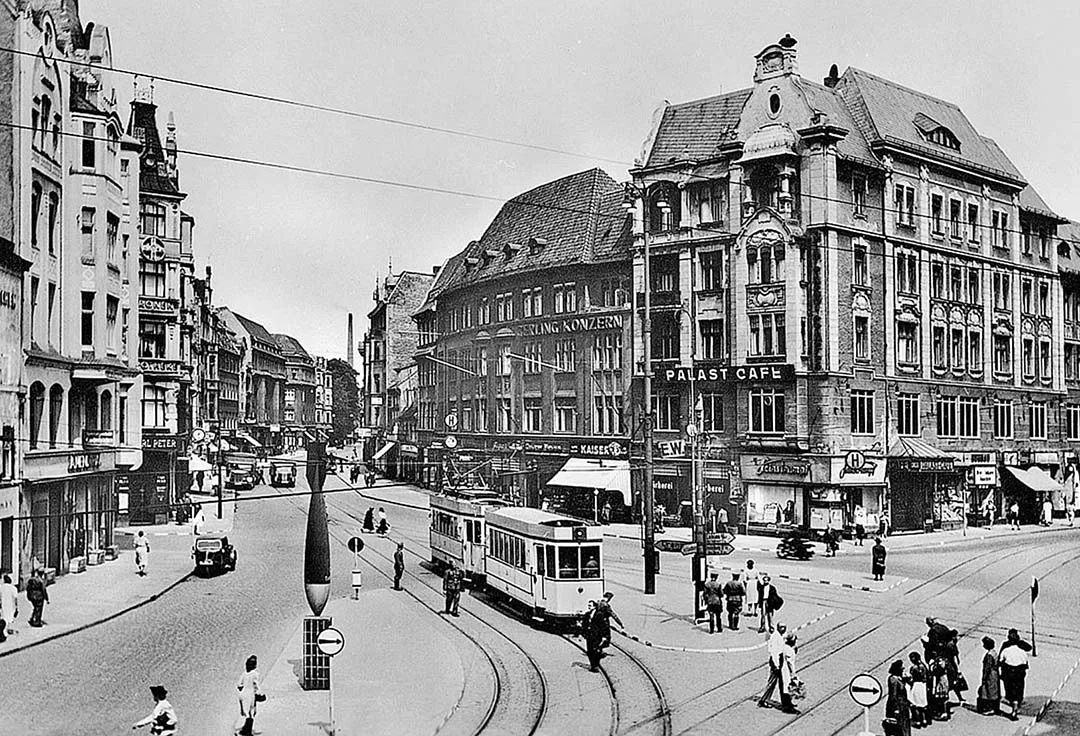
The village head and his eight assistants formed the court. On 10 October 1576 the settlement was granted a coat of arms: a white horse on a green field.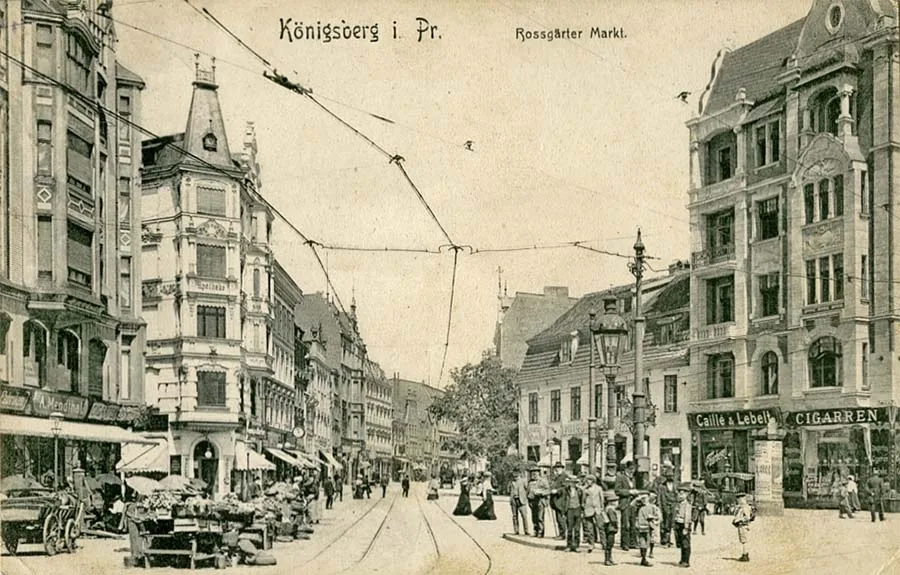 The Rossgarten Market. To the left runs Weißgerberstraße, to the right Königstraße, straight ahead Rossgarten.
The formerly unremarkable square of the Rossgarten Market (Roßgärter Markt; today the roundabout at the junction of Frunze, Klinicheskaya, Shevchenko and Zaraiskaya streets) has become a place with very busy traffic.
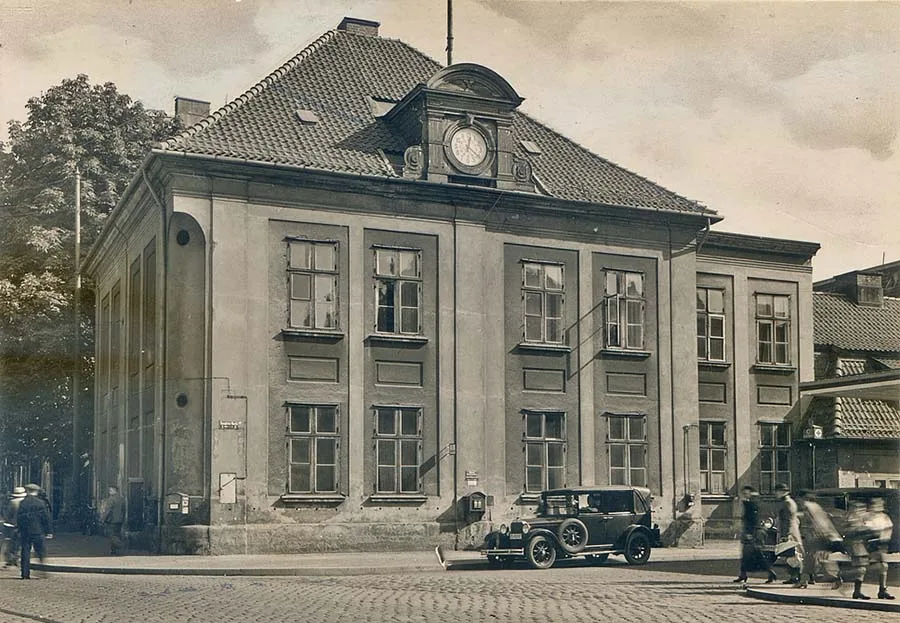 The Officers' Casino on the corner of Vorder Rossgarten and Königstraße.
It is crossed by two main horse-tram lines (Pferdebahn). The first links the King's Gate with the railway station, the second runs from the Rossgarten Gate to the Steindamm Gate.
The house with the electric clock at the very beginning of Königstraße (today Frunze Street) was formerly the Governor's House (Gouvernementshaus), then became the seat of the military intendant (Militär-Intendantur); today it houses the Officers' Casino (Offizier-Kasino). In Duke Albrecht's time this was the site of the harness yard (Schirrhof), which in 1724 was rebuilt as barracks for the von Winterfeld regiment (Regiment v. Winterfeld). Until recently the main building of this complex projected so far into Königstraße that it obstructed traffic. The bottleneck was removed only in 1887, on the eve of Emperor William I's (Wilhelm I, 1797–1888) visit to Königsberg, by demolishing part of the building.
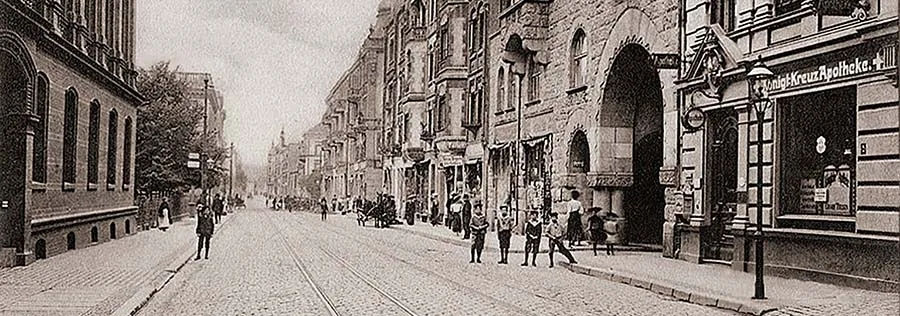
Apart from the Rossgärter Hinter Gasse and Weißgerberstraße (Tanners' Street), today a footpath from the bridge over the Lower Pond to Klinicheskaya Street), this district has no other passages or roads to the shore of the Castle Pond. The Passage on the right-hand side of Vorder Roßgarten street also serves as a way through to Königstraße. It was built by the manufacturer Robert Neumann in 1884 on the Berlin model. It is a tall building with a gigantic glass roof. Inside are numerous shops (today one would say boutiques – editor's note), a variety theatre (Spezialitätentheater) and a viewing platform called the “Panorama”, which offers a fine view of the city. At the entrance to the Passage is a popular large restaurant that is always very lively. (On the site of the destroyed Passage there is now a public garden at the junction of Klinicheskaya and Frunze streets, next to the Yantarenergo building – editor's note.)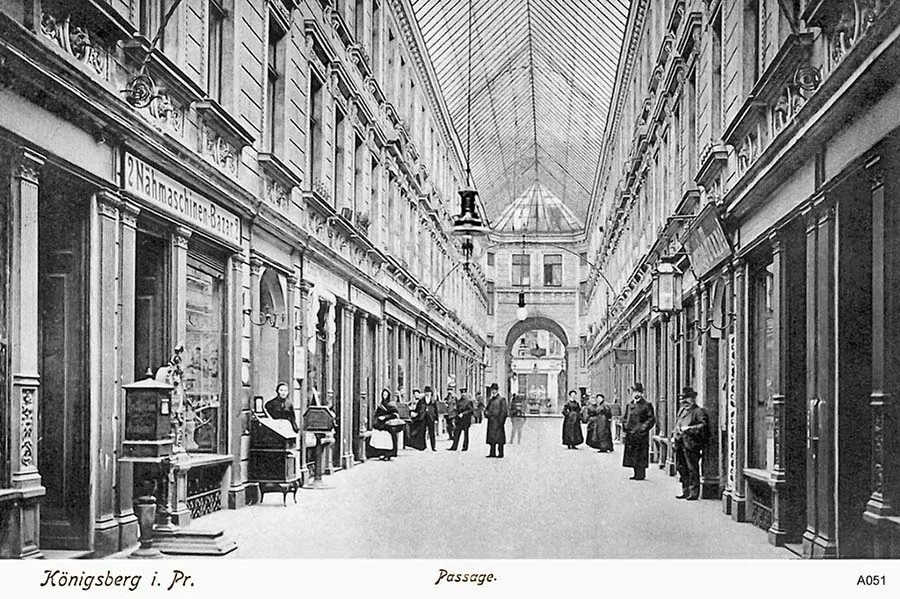
Inside the Passage, which linked Rossgarten with Königstraße in Neue Sorge.
Almost opposite the Passage, on the western side of Vorder Roßgarten street, at No. 49 (today the forecourt of the Museum of History and Art on Klinicheskaya Street), is the Museum of Arts and Crafts and Technology (Kunstgewerbliche und technische Museum; in the 20th century it was moved to the grounds of the zoo – editor's note), which has a large number of exhibits.
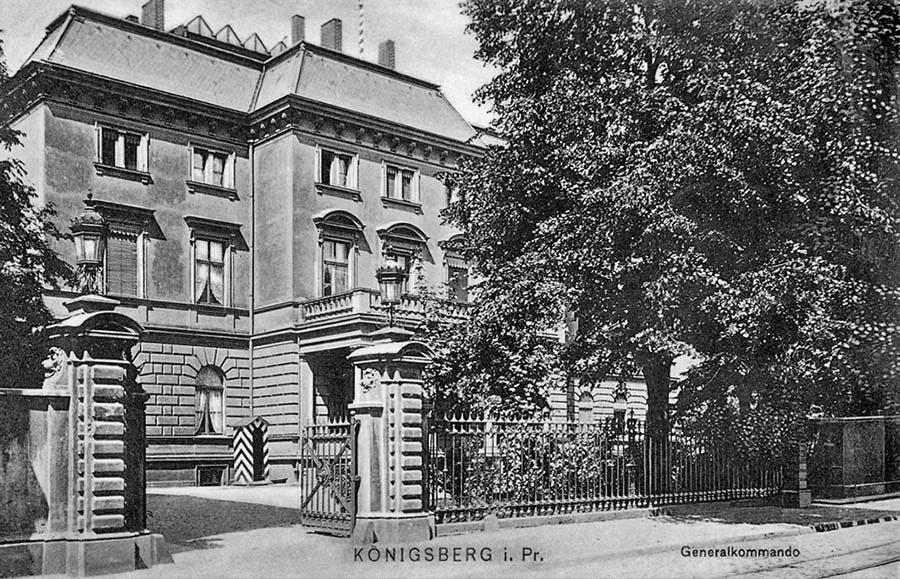 The former palace of Count Keyserlingk.
The museum belongs to the Polytechnic and Trade Association (Polytechnischen und Gewerbeverein), which was founded in 1875 on the basis of several previously existing organisations: the Polytechnic Society, formed in 1845 by Walter Simon, the Craftsmen's Society, founded in 1832, and the Art Society. In 1882 the state bought land on Vorder Roßgarten street for this museum, which made it possible to preserve priceless works of decorative and applied art here. But the lack of space does not allow them to be displayed to advantage. (A considerable part of the museum's exhibits was transferred in 1895 to the Ethnographic Museum in the Tiergarten (Zoo), which in the pre-war years was evacuated to what is now the Polish town of Olsztynek – ed.)
On the same side of the street, further towards the Swan Bridge, is the recently rebuilt General Command Palace (Palais des kommandierenden Generals / General-Kommando). Formerly this was the estate of Count Keyserlingk (Heinrich Christian von Keyserlingk, 1727–1787). In 1809 the palace was bought by King Frederick William III (Friedrich Wilhelm III, 1770–1840) and for a long time was called the Crown Princes' Palace (Kronprinzliche Palais).
(The palace of the Counts Keyserlingk was in its day the centre of the cultural and political life of Königsberg. Its visitors included Immanuel Kant, the Russian prince Paul, the Russian enlightener Dashkova and other celebrities. In terms of today's layout, the palace stood north of the Museum of History and Art building. – Editor's note.)
Jägerhofstraße (Hunting Lodge Street) links Vorder Rossgarten with Königstraße and Kalthof Street (Kalthöfischen Straße). The latter was formerly Lavender Lane (Lawendelgasse). They belong only partly to Vorder Rossgarten.
HINTER ROSSGARTEN
Building in this district began only in 1560. It was then that a certain David Pusch was appointed village head and granted a plot of land between the Pig Ditch (Schweinegraben) and the Old Sluice (alten Schleuse). Having become the owner of a hufen here, he was entitled under Kulm law to build and own an inn. The tavern he founded was named the “Blue Inn” (Blaue Krug).
(The term “hufen” here does not mean the Königsberg district, but the old measure of area, the “Hufe” or “Gufe”, equal to about 66 Morgen or 16.5 hectares. In this case, however, one may assume that the word “hufen” simply means a land allotment – Editor's note.)
The name Hinter Rossgarten (Hinter Roßgarten) arose and came into use between 1576 and 1596. On 5 May 1596 the liberty received from Margrave George Frederick its seal with the silhouette of a bull and the inscription: “Sigel des Gerichts aufm eußersten Rosgarten” (Seal of the Court in Hinter Rossgarten).
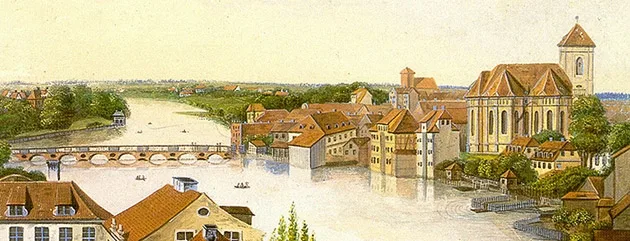
Let us walk along Hinter Rossgarten street (today the northern part of Klinicheskaya Street) towards the Rossgarten Gate, and on the left we shall see the new Kommandantur building. This piece of land was bought in 1693 by the commandant of Königsberg, Duke von Holstein (Friedrich Ludwig von Schleswig-Holstein-Sonderburg-Beck, 1653–1728). Later the building passed into the possession of the von Borck family (von Borck oder Borcke) and came to be called Borck's Garden (Borckscher Garten). The name survived for a long time. In those days the garden was open to the public. Concerts were held here. Thanks to its fine location by the Castle Pond (Schloßteich, today the Lower Pond) and its wonderful old trees, the garden was very popular with the townspeople.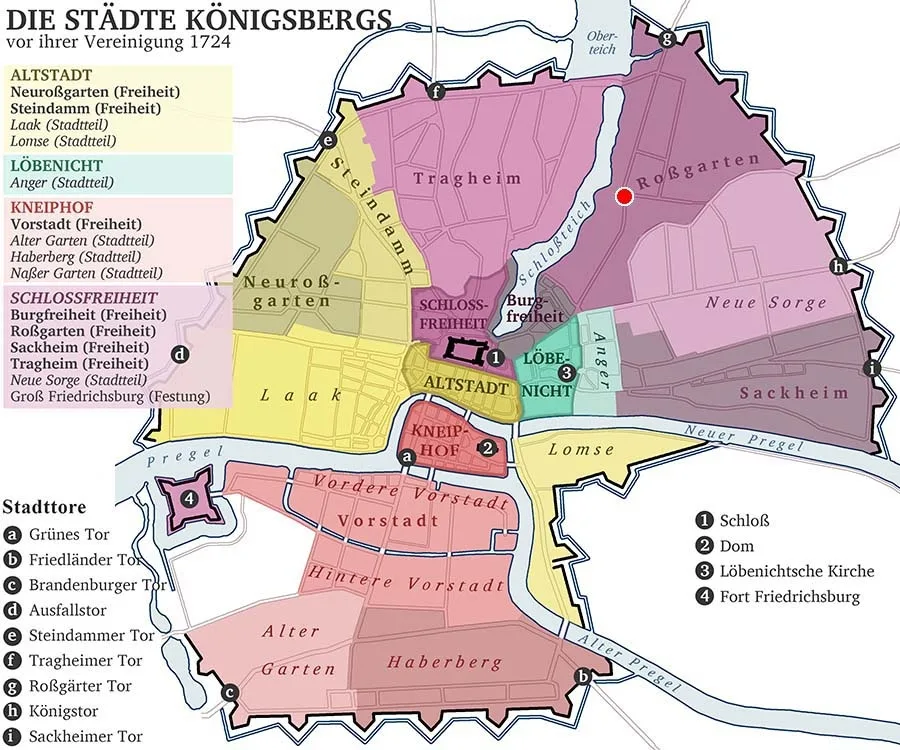 Rossgarten on a reconstructed map of the towns, liberties and districts of Königsberg before their unification in 1724.
Opposite the Kommandantur building, on the corner of Alt-Roßgärter Kirchenstraße (today Nerchinskaya Street), stands the Hospital of Mercy (Krankenhaus der Barmherzigkeit). This important medical centre began as a very small building and is now of great importance for the whole of East Prussia.
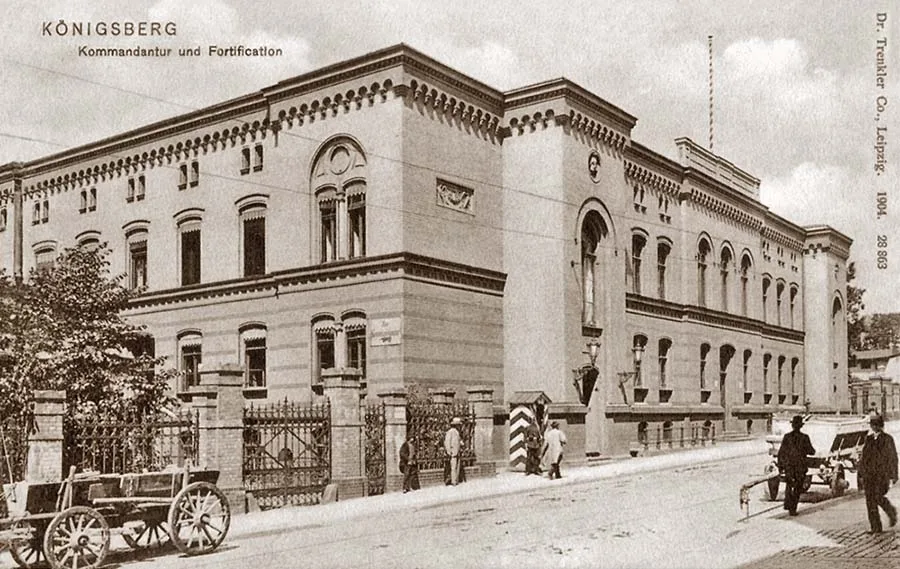 The Kommandantur, which has survived to this day.
As early as 1847 the Countesses Magda and Klara zu Dohna, daughters of the then commander of the First Army Corps, General Count Friedrich zu Dohna (Friedrich Ferdinand Alexander Burggraf und Graf zu Dohna-Schlobitten, 1771–1831), conceived the idea of founding here in Königsberg a house of deaconesses modelled on the one that existed in Kaiserswerth on the Rhine. But the political instability of 1848 prevented these noble aims from being realised. Only on 20 November 1848, thanks to the efforts of Colonel von Plehwe (Bernhard Joachim von Plehwe, 1792–1858), did matters get off the ground. The stated aims of the new medical institution were: 1. To help sick women in need with comfort and treatment, regardless of the nature of their illness or their denomination. 2. To train nurses to work in hospitals and private homes.
The new hospital was consecrated on 18 May 1849. The Queen herself became its patroness. The first patients were admitted on 30 May. At first there were only 12 beds. On 16 January 1856 a men's ward was opened. By 1859 there were already 80 beds. Today the hospital has grown even larger. In 1894, 1,056 patients (men, women and children) were treated here, 180 people were admitted daily, the total load amounted to 9,687 patient-days, and 24 people were treated free of charge every day. Local employers can buy a subscription at the hospital for the medical care of their employees.
Besides ordinary patients, the institution helps the infirm. For this purpose a new infirmary was opened on 15 July 1894. Last year 49 disabled and elderly people were treated there, divided into three categories of medical care. The new surgical wing is scheduled for completion on 1 October 1895.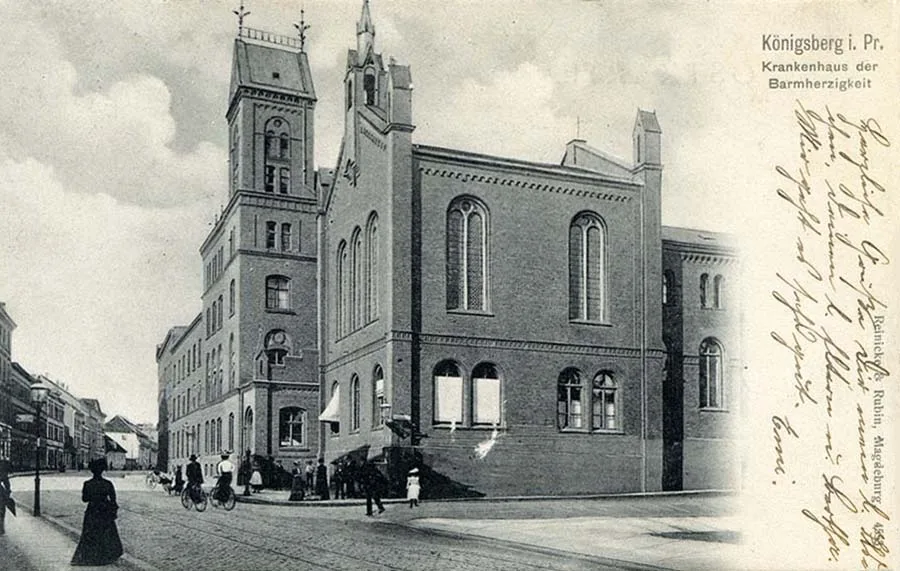 The exterior of the chapel of the Hospital of Mercy.
The hospital now has six physicians for internal, external and other diseases, as well as oculists and ear and throat specialists. They are helped by two assistants. The number of deaconesses (Lutheran sisters of mercy) has risen to 440. 181 nurses are doing their practical work here, and another 259 are training for the profession.
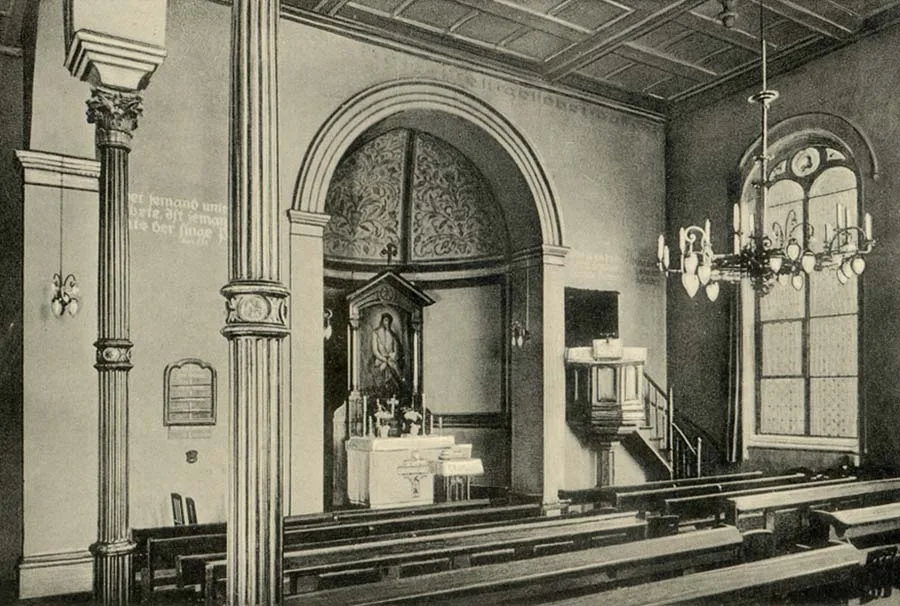 Inside the chapel of the Hospital of Mercy.
These sisters work in 43 hospitals and clinics, 13 leper houses and in the sanatoria for epileptics in Carlshof and in the St Magdalene refuge near the Steindamm Gate, newly built in 1895. (Later the refuge moved to Stresemannstraße 109–111 – today the prison on Sovetsky Prospekt – ed.) In addition, the nurses work in 11 orphanages for girls and in 27 kindergartens, as well as in community and private clinics. This is important, necessary and noble, but very hard work!
Like the successful development of the Hospital of Mercy, a fine example of charity in our time is the history of the Municipal Hospital (Städtischen Krankenhaus), located closer to the Rossgarten Gate (Hinter Roßgarten 63–66).
There were no hospitals for the poor in Königsberg until 1797. Sick paupers were simply taken to the New Tower of the Altstadt (Neuer Turm der Altstadt), which served as a prison and was completely unsuitable for treating the sick. Then the city president and privy councillor Gervais, together with city councillor Neumann, put forward the idea of setting aside several rooms for the sick in the municipal spinning and workhouse (Städtischen Spinn- und Arbeitshaus), which stood on the site of today's Municipal Hospital.
Here every patient was to be provided with a clean bed in a warm, light room, and each also received four Prussian groschen a day for his keep.
Those who were not bedridden had to earn their living by spinning. In addition, three doctors were to treat the poor inhabitants of their district free of charge in return for free accommodation and a salary of 50 thalers.
The Municipal Hospital, with 24 beds, opened on 31 August 1797. In its first year it admitted 155 patients.
In 1811 the spinning workshop and workhouse were merged with the house of correction on Kneiphof Wood Meadow street (Kneiphöfsche Holz Wiese, today the eastern part of the Staropregolskaya Embankment) and moved to the Vorstadt. As a result, 15 rooms for 120 patients were immediately freed up in the hospital. After the acquisition in 1830 of the building of the neighbouring almshouse (Fahrenheidscher Armenstift), which was moved to Sackheim, another important step in the hospital's development was taken. That year the hospital was already able to admit 790 people. 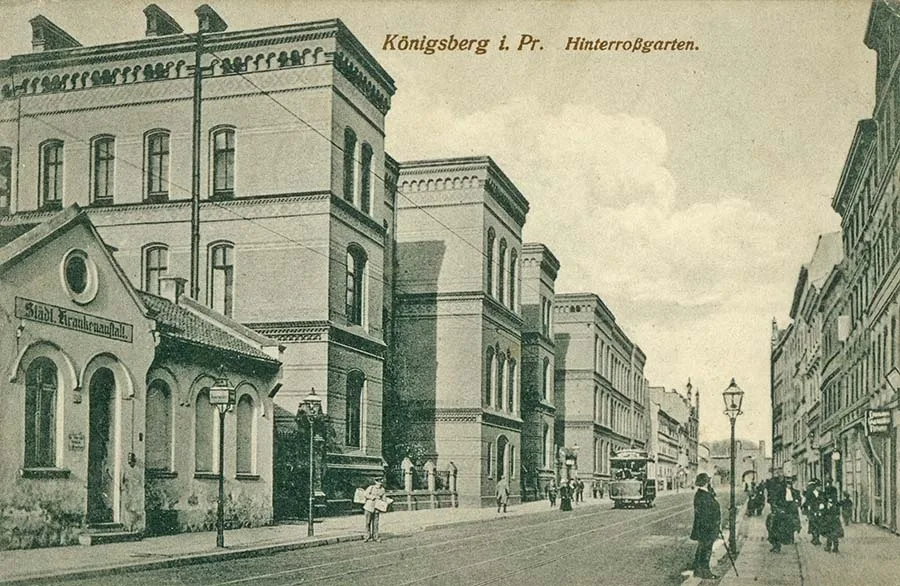 The Municipal Hospital, built closer to the Rossgarten Gate.
In 1832 a ward for smallpox patients was opened. The further development of the hospital and its building proceeded much faster, which is particularly noticeable today. A new surgical wing for 100 patients is now planned, at an estimated cost of 286,000 marks.
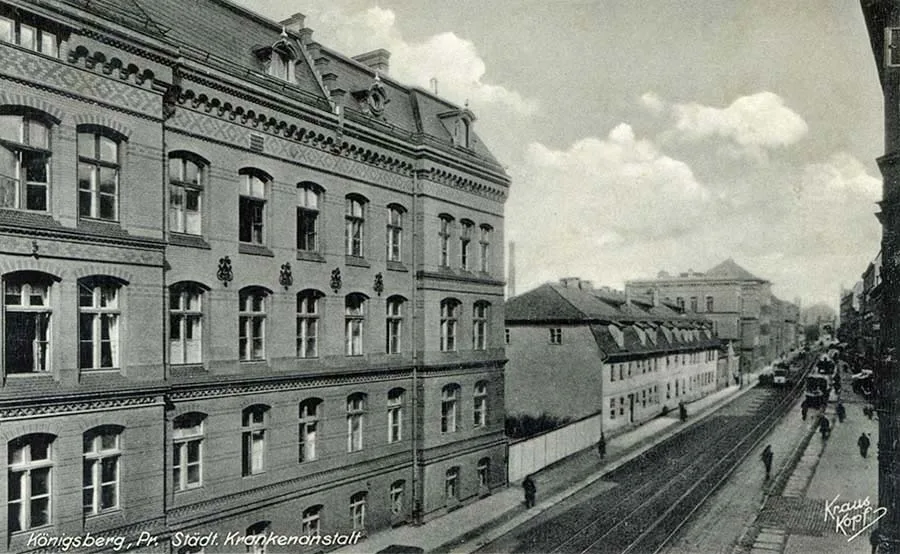 The new wing of the Municipal Hospital in Hinter Rossgarten.
The most telling illustration of the institution's growth is the increase in the number of patients admitted and treated, from 155 in the year of its foundation to 3,149 in 1894–95. Since September 1891 regular free meals have been provided for destitute patients.
The hospital also includes a psychiatric ward, which admits patients from Königsberg (and in exceptional cases from elsewhere) with curable mental illnesses. Since 1 October 1892 this ward has also served as the university psychiatric clinic.
The hospital's administrative expenses for 1895/96 amount to 183,400 marks. Its own income is forecast at 77,300 marks, which requires a subsidy from the city of 106,100 marks.
Besides the director and the physician of the outpatient department, three assistant doctors work at the hospital.
(These are descriptions of the medical institutions housed in buildings on the grounds of today's Regional Hospital on Klinicheskaya Street. It was here that the Hospital of Mercy and the City Hospital stood. Construction of the new buildings of the City Hospital was largely completed by 1895, and of the new buildings of the Hospital of Mercy in 1928. – Editor's note.)
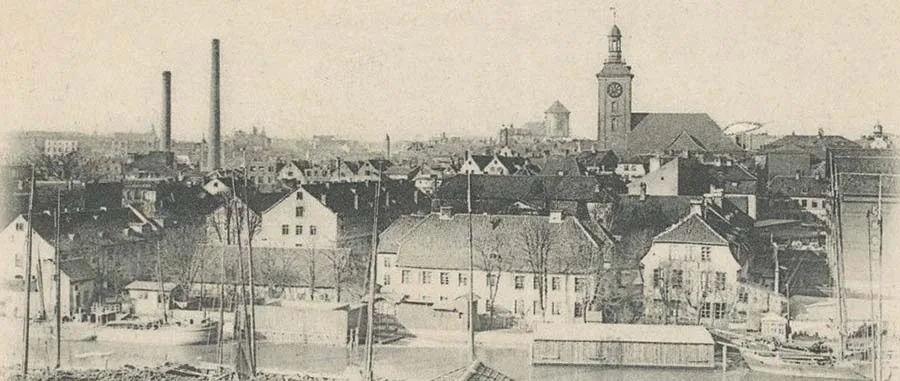
On Alt-Roßgärter Kirchenstraße stands the Altrossgarten Church (Old Rossgarten Church), which belongs to the parishes of both parts of Rossgarten. Originally it was simply called the Rossgarten Church. It received its present name when the Neurossgarten Church (New Rossgarten Church) was built west of the Steindamm.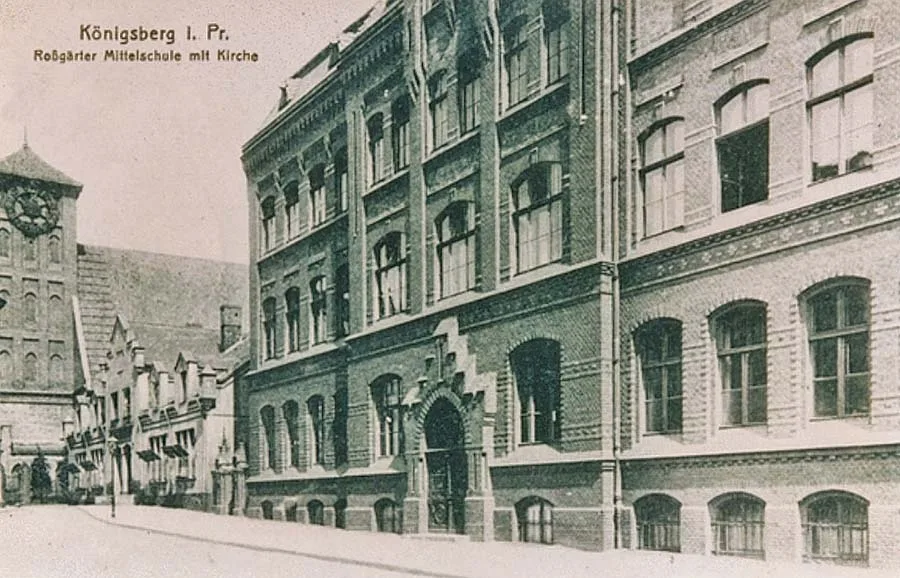 The Rossgarten Church (left). In the foreground, the IKBFU Clinical Diagnostic Centre (9 Aprelya Street, 60).
The inhabitants of Rossgarten, like those of Tragheim, were once parishioners of the Löbenicht Church, where they were allotted a small space behind the pulpit. When the population of the liberty began to grow, Elector George William permitted Rossgarten to build its own church.
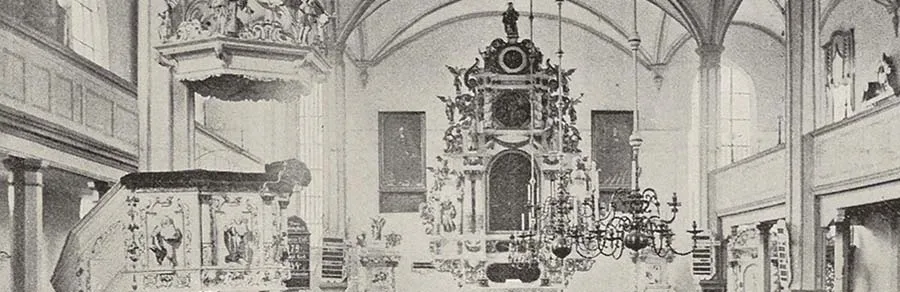
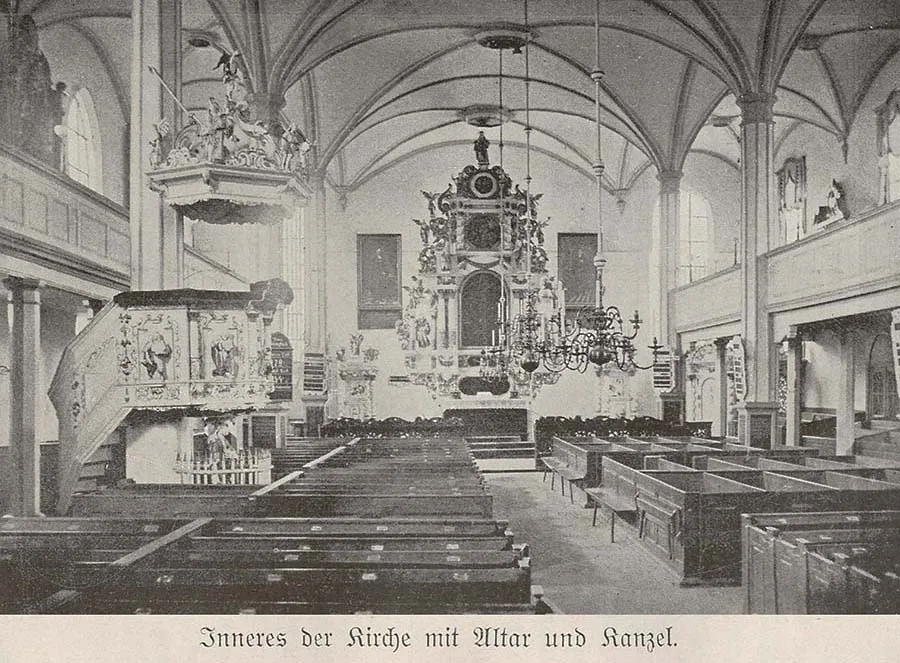 The nave of the Rossgarten Church.
Before Christmas 1625 a small church was consecrated on the site of the present one. It soon became clear that it did not meet the needs of the population, and as early as 5 June 1651 the foundation stone of a new one was laid. Construction proceeded slowly, as it was carried out around the old church, which was still in use. Only in 1692–1693 was the work completed with the erection of the tower, although the church itself had been consecrated back in 1683. Its interior is still very modest. The weathervane on the roof depicts a horse and the Prussian eagle. The church was consecrated in honour of the Holy Trinity.
Far more beautiful than the church is the much-praised local cemetery, where wonderfully beautiful lime trees tower. (Judging by maps of Königsberg, the cemetery occupied the area north and north-east of the church. Today nine-storey blocks of flats on 9 Aprelya Street stand on the site of the cemetery – editor's note.)
Another sight is the well next to the church, whose water, according to local legend, was considered holy until its owner began charging money for it. From that moment it lost its miraculous power.
From Alt-Roßgärter Kirchenstraße, Alt-Roßgärter Predigerstraße runs towards the Lithuanian Rampart (Litthauer Wallstraße). Here, besides the boys' elementary school (Knaben-Volksschule) and a crèche, a notable sight is the chapel of the Catholic Apostolic Congregation (Kapelle der Katholisch-apostolischen Gemeinde). (On the site of these buildings there is now an office building facing Marshal Vasilevsky Square – editor's note.)
The mission of the “Out-of-School Education” association (Verein Kinderhort) is to protect children aged two to fourteen from violence and to give them a good upbringing. To this end, public kindergartens and after-school programmes for boys and girls were set up. The association also runs a second club on Lomse Island.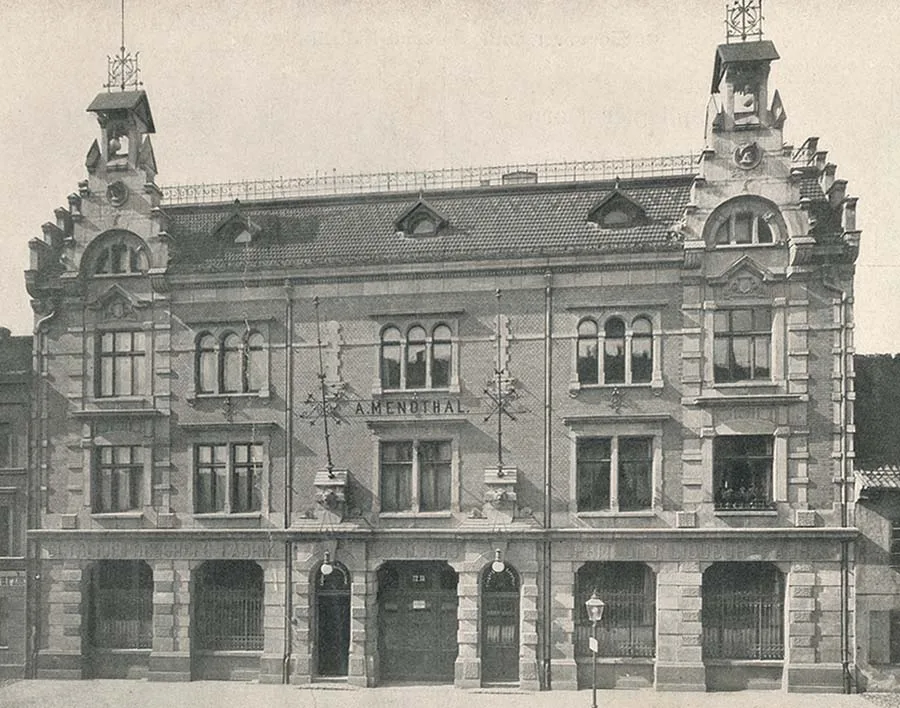 The A. Mendthal liqueur and vodka factory in Hinter Rossgarten.
The Catholic Apostolic Congregation was founded in 1830 by the Scotsman Edward Irving (Edward Irving, 1792–1834). Its members are called Irvingites. The adherents of the teaching recreated the setting of early Christianity. Their services are distinguished by a lavish and refined style. Strict order and piety reign in the community. In Königsberg the congregation has existed since 1853.
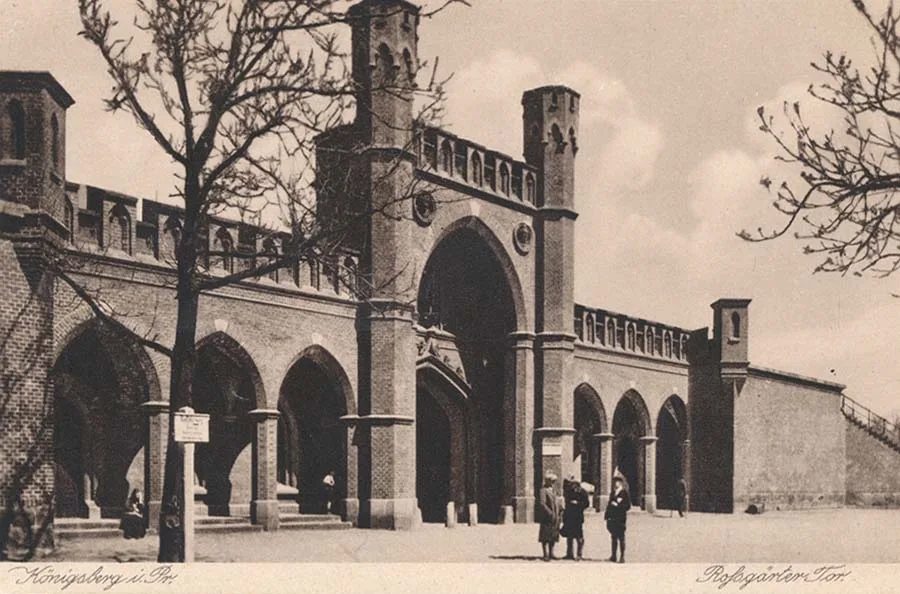 The Rossgarten Gate.
At first the congregation rented a hall in Altstädtische Tränkgasse (Altstädtischen Tränk Gasse), on the border between the Laak and the Lastadie. But then a new chapel was built in Rossgarten at Alt-Roßgärter Predigerstraße 4. The growth of the congregation led in 1890 to the fitting out of another hall for worship at Kneiphof, Junkerhofgasse 22 (today Kant Island).
Hinter Rossgarten street (today Klinicheskaya Street) ends at the Rossgarten Gate (Roßgärter Thor). It was built on the spot where a passage had been made through the ramparts as early as 1705. The inner side of the gate is adorned with medallions bearing portraits of generals of our valiant armed forces, Gerhard Scharnhorst and Neidhardt von Gneisenau, heroes of the War of Liberation against France. (The Rossgarten Gate survives on Marshal Vasilevsky Square, but today it serves not as a gate but as a restaurant – editor's note.)
Gerhard Scharnhorst (Gerhard Johann David von Scharnhorst, 1755–1813) was the son of a peasant from Hanover. In 1801 he entered the service of the Prussian army. In 1806 he lived through the unfortunate Battle of Auerstedt and was ennobled. That same year he was taken prisoner as a result of Blücher's capitulation near Lübeck.
After negotiations he was released, immediately returned to service and took part in the Battle of Preußisch Eylau on 7–8 February 1807. After the conclusion of peace at Tilsit, Scharnhorst began reforming the Prussian army from an army of soldiers into a people's army, removing all the barriers to promotion to officer rank for good soldiers of non-noble birth and banning degrading punishments. The Prussian army of 1813 was his creation.
At the Battle of Großgörschen on 2 May 1813 (known in Russia as the Battle of Lützen – the first general battle between Napoleon and the combined Russo-Prussian army under the command of the Russian general Wittgenstein – ed.) Scharnhorst was wounded but, ignoring his wound, moved with the troops towards Prague and died on that campaign from the effects of the wound.
Gerhard von Scharnhorst's successor as Chief of the General Staff was Neidhardt von Gneisenau (August Wilhelm Antonius Graf Neidhardt von Gneisenau, 1760–1831), who first distinguished himself in 1807 during the French army's siege of Kolberg, which he managed to hold until the conclusion of the Peace of Tilsit. Under Blücher's leadership he fought in the Battle of the Katzbach on 26 August 1813, and then on 16, 18 and 19 October 1813 at Leipzig.
After the conclusion of the Peace of Paris, Gneisenau was granted the high rank of count, and on 18 June 1815 he took part in the battle against Napoleon at Waterloo. Later Gneisenau received the rank of field marshal general. He died of cholera in Posen.
Wrangelstraße (today Chernyakhovskogo Street) lies west of the Rossgarten Gate and runs past the fortress walls surrounding the Upper Pond to the Tragheim Gate. (The fortress walls on the southern shore of the Upper Pond have not survived, nor has the Tragheim Gate at the junction of today's Baranova and Gorkogo streets – editor's note.) East of the Rossgarten Gate begins the Lithuanian Rampart, which runs to the King's Gate and on to the Sackheim Gate. Between the Rossgarten and King's gates lies the Herzogsacker (German for “Duke's Field”). Drill exercises are held here. The area was named after its owner, the Duke of Holstein. (Today the Herzogsacker area between Pionerskaya Street and Griga Lane is built up with new houses – editor's note.) The Herzogsacker is surrounded mainly by detached buildings belonging to the military authorities, the largest of which is the “Kronprinz” barracks. (The building survives; its premises are let. And now let us try to outline the boundaries of Hinter Rossgarten on a modern map of Kaliningrad. To the west it is bounded by the Lower Pond, to the north by the Rossgarten Gate, from which the boundary runs south-east along the Lithuanian Rampart. In the area of the “Kronprinz” barracks it turns west towards the Lower Pond – editor's note.)
Photos on this page: Bildarchiv Ostpreußen / bildarchiv-ostpreussen.de.
Translated from Russian with the help of AI (Claude, Anthropic), October 2026.