Before Frederick II ascended the Prussian throne in 1740, Prussia was a state whose possessions were scattered from the Lower Rhine to the Neman, with no territorial continuity between them. The idea of uniting these lands into a single whole had already been put forward by Elector Frederick William. He also made the first attempt to settle the “Pomeranian question” in his favour, so as to link Prussia and Brandenburg territorially. He did not succeed, however. Nor were the first Prussian kings, Frederick I and Frederick William I, able to accomplish this.
And now it was Frederick II's turn. Faced with the question of whether to direct his state-building efforts eastward, as was traditional, or to begin unification with the western possessions of the Hohenzollerns, he decided in favour of the east1.
Before becoming one of the leading states of Europe, the Kingdom of Prussia had to overcome the resistance of the European “grandees” (Austria, France, England and Russia), who jealously guarded their elite status. To gain entry to such a “club”, Prussia would have had to spend years, even decades — which, in fact, is what eventually happened. But the young and ambitious Prussian king could not bear to wait, and he made radical decisions.
Moving east, Prussia was bound to collide with the interests of Russia, which, although it did not yet border Prussia at that time, was close to doing so thanks to its active policy in the Baltic and in Courland.
The confrontation between Prussia and Russia in the Baltic region promised to be long and complicated, so Frederick set himself the task of first securing his interests in Silesia. And, to Europe's surprise, he accomplished this with ease. The two Silesian Wars of 1740–1742 and 1744–17452 allowed Prussia to lay the material foundation for the confrontation with the leading European powers that unfolded during the Seven Years' War of 1756–1763. With the acquisition of Silesia, the population of the Prussian kingdom grew by half, and state revenues by a third. The increased revenues, together with a number of economic measures taken by Frederick II, enabled him to build up a substantial financial reserve in case of war. A talented military commander, he proved no less talented an organiser and, despite the losses of the Silesian Wars, created one of the finest armies in Europe. In just fifteen years, from 1740 to 1755, its strength grew from 100,000 to 145,000 soldiers, and in the very first year of the war it was brought up to 180,000. The army was governed by the harshest discipline, and enormous military stockpiles were built up. And although the plans for preparing for war could not be carried out in full (Frederick believed he needed 20 million thalers to wage war, but by 1756 had amassed only 13.5 million), all this made the Prussian army a formidable rival for any adversary3.
At the same time, the looming confrontation with Russia in the Baltic demanded an adequate assessment of his main adversary in the region. It must be acknowledged that Frederick failed to make one. His opinion of the Russian army was low: “There is nothing to fear from the Russians, for they have few good generals, and their troops are good for nothing”4.
Proceeding from such premises, Frederick II ceased to fear Russia, and the realisation came much later, when he arrived at the conclusion already drawn by his father, Frederick William I, who had remarked with his characteristic soldierly bluntness that “it is easy to let the Russian bear off the chain; the only question is who will manage to put it back on the chain again.”
A few years after the Seven Years' War, the philosopher-king Frederick II, using the same soldierly vocabulary, would say: “One must strive to ensure that Russia never meddles in German affairs; it is best to leave the bear in its den and not even let it notice that it is needed or feared”5.
For its part, the Russian leadership also made a sober assessment of the Prussian king's capabilities. The Russian Chancellor A. P. Bestuzhev-Ryumin believed that after the war of 1740–1748 “the King of Prussia has become a neighbour more dangerous than any other... he must be regarded as Russia's constant and natural enemy”6. And Russia did more than make assessments: it tried to counter him in practice. When in 1752 Frederick began preparing an attack on Hanover, which then belonged to the English crown, Russia announced that it would send its 150,000-strong army to the borders of the province of Prussia. Frederick was forced to abandon his plan, and Bestuzhev-Ryumin noted once again that “it would be superfluous to explain how harmful to the interests of Her Imperial Majesty is the strengthening of the King of Prussia”, who “has become burdensome and dangerous to his neighbours”7.
In general, it should be noted that the conviction that the Prussian king was Russia's most dangerous enemy came from Empress Elizabeth Petrovna herself. This conviction took shape in response to the caustic witticisms that Frederick II made at her expense and that reached her ears. An important role was also played by the king's refusal to return to Russia the Russian soldiers serving in the Prussian army. These soldiers were very tall, which is why Peter I, Catherine I and Anna Ioannovna had sent them to Frederick William I, who formed elite units from them. The soldiers had served out all their terms, grown old and wished to return to Russia, but Frederick would not allow it. This act of the Prussian king only deepened Elizabeth Petrovna's hostility. Matters went as far as the mutual recall of ambassadors8.
This rupture, admittedly, did not yet mark the beginning of war. War would creep up from another direction. The point is that until the middle of the 18th century the Franco-Austrian antagonism remained the defining factor in European politics.
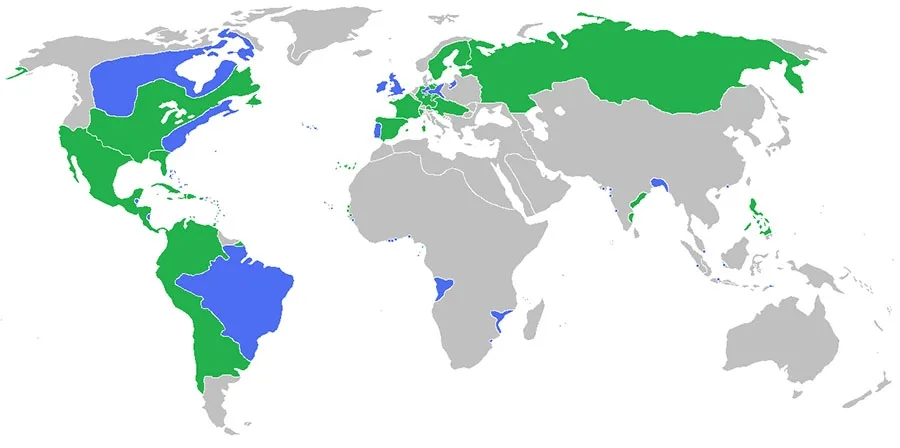
Participants in the Seven Years' War. The countries belonging to the opposing coalitions are marked in blue and green. The “blue” coalition included England, Prussia, Portugal, Hanover and their allies; the “green” one, France, Austria, Russia, Saxony, Spain, Sweden and their allies.
But in the course of a single year, 1756, the entire established diplomatic system collapsed and new alliances emerged, changing the political map of Europe so radically that specialists have called what happened the “Diplomatic Revolution”. This “revolution” was brought about by two fundamental factors: Prussia's growing expansion in Central Europe and the sharp intensification of the Anglo-French struggle for colonies in North America and India9.
Clashes in the colonies made war in Europe inevitable, and in that event England's weak spot immediately became apparent: English Hanover was vulnerable to a French attack. To protect his possessions, King George II, who was at the same time Elector of Hanover, literally “bought” Frederick II, offering him a large sum of money to guarantee Hanover's security on the Prussian side. Frederick did not hesitate for long and, breaking his alliance agreement with France, in January 1756 signed the Convention of Westminster, or the Treaty of Whitehall, which effectively formalised an alliance between England and Prussia10.
Versailles was shocked by Prussia's perfidy and lost no time in responding in kind. France, Prussia's long-standing ally, unexpectedly concluded an alliance with Prussia's “enemy No. 1”, Austria. Now it was Russia's turn. As early as September 1755, Russia had concluded the so-called subsidy convention with England, under which, in return for English money, it undertook a number of obligations, including guaranteeing the security of Hanover. The Treaty of Whitehall therefore compelled Russia, too, to have its say. And its word was specific: “The treaty recently concluded in London between the Kings of England and Prussia, in its present form, destroys the direct intent of the convention concluded here (in St Petersburg. — G. K.) with England.” These words meant Russia's unilateral termination of the subsidy convention with England, and at the same time ideas emerged of “courting France” and reconciling it with Austria11.
Thus the outlines of a new European coalition took shape, directed against Prussia, which had England as its ally (albeit only with money). Local disputes grew into a war of pan-European scale for the territorial redivision of the continent, and Russia, too, was drawn into its orbit.
At that time Russia had no direct interests in the West; they lay in the south, on the road to the Black Sea. Yet it was precisely this circumstance that led to Russia's alliance with Austria, which promised her help in the struggle against Turkey in exchange for joint action against Prussia. Viennese diplomacy proved stronger than that of Prussia and England, both of which tried to win the eastern colossus over to their side. As a result of secret negotiations and ingenious deals, in 1756 the largest states of Europe finally united into two opposing blocs: Prussia and England on one side, and Austria, France and Russia on the other.
The actions of Frederick II, who was the first to open hostilities and who had already forced Saxony to capitulate by the autumn of 1756, caused serious concern in St Petersburg. The Russian government was well aware that as soon as Frederick had secured his borders against Austria, he might begin to advance into the Baltic region. In that case Russia could find herself pushed back to the east, cut off from Europe, deprived of sea routes and direct links with her allies, and forced to fight one-on-one against a warlike, superbly armed enemy. In the opinion of some historians, the struggle for the Baltic was becoming a paramount, vital task. Aggressive and commercial ambitions also existed, but they were of secondary importance12.
Russia's war aims were formulated quite specifically: "By weakening the King of Prussia, to render him unfearsome and of no concern to this side; by strengthening the Viennese court through the return to it of Schlesien (Silesia. — G. K.), to make the alliance against the Turks more weighty and effective; by obliging Poland through the delivery to her of Royal Prussia, to receive in return not only Courland but also such a rounding-off on the Polish side as would not only put an end to the present ceaseless troubles and anxieties over them, but might perhaps also afford the means of joining the commerce of the Baltic Sea with that of the Black Sea, and thereby to hold almost the whole Levantine commerce in our hands"13.
Russia was ready to intervene in the armed conflict as early as September 1756, but a request from Empress Maria Theresa postponed this intervention by several months. Austria seriously feared that Russia, having achieved success in the struggle against Frederick II, would thereby upset the European balance of power. In Vienna the possibility of the province of Prussia being annexed to Russia was discussed with anxiety and regarded as "a great misfortune and a political loss". Of course, such worries were unfounded, since Russia's claims to Prussia took shape only in 176014, but they introduced serious discord into the relations between the allies.
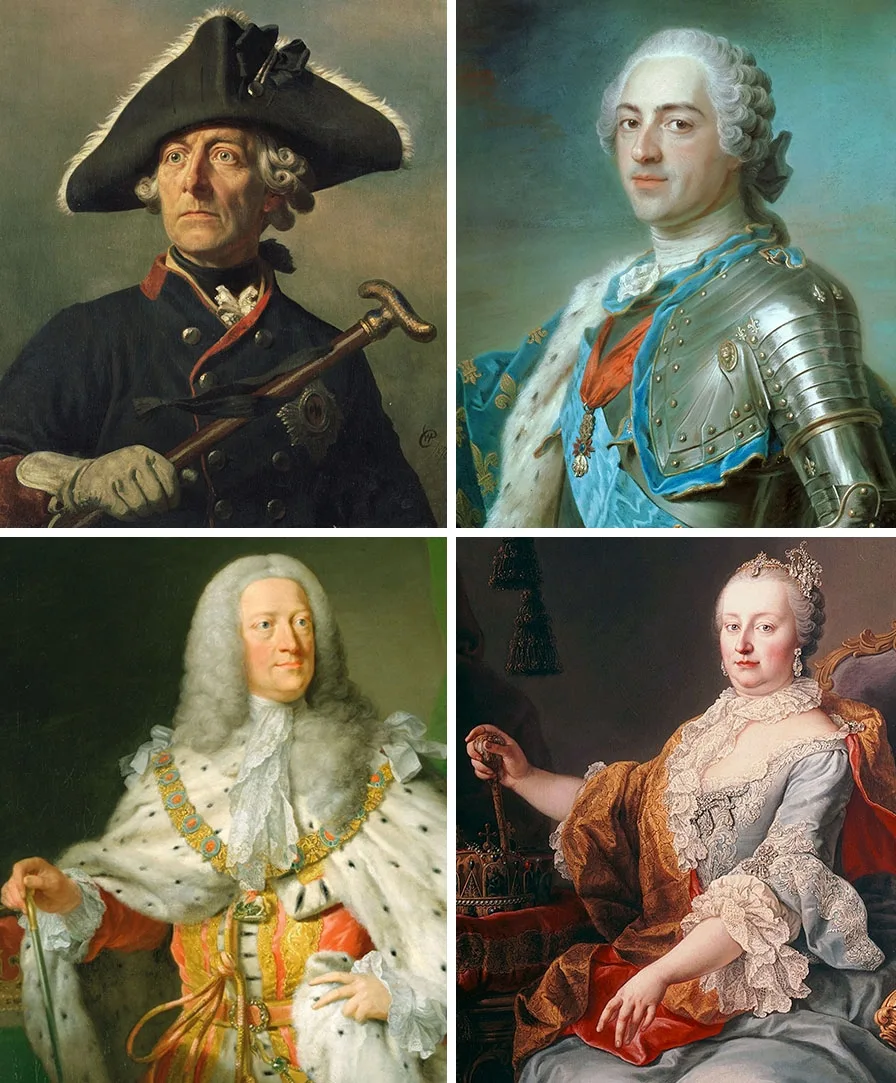
The protagonists
King Frederick II of Prussia (top left)
King Louis XV of France (top right)
King George II of England (left)
Austrian Empress Maria Theresa
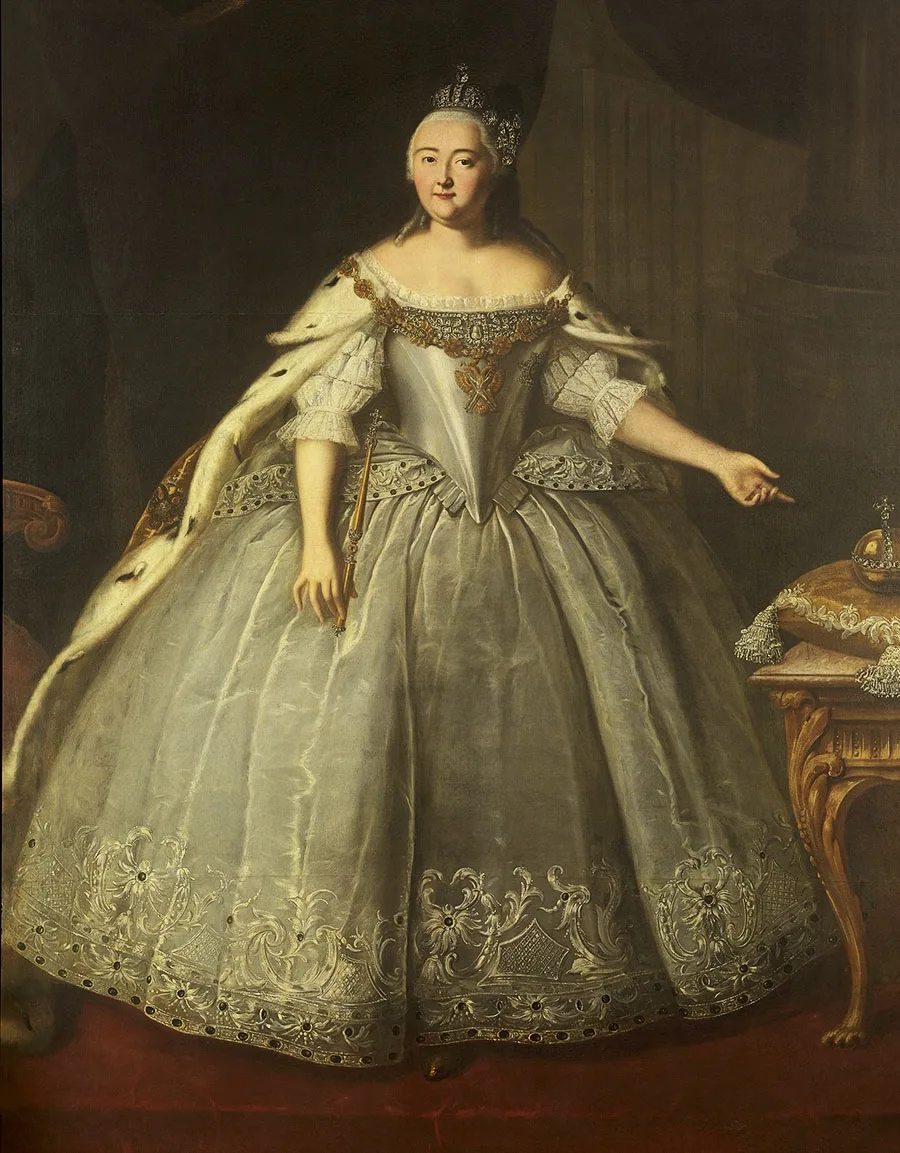
Russian Empress Elizabeth Petrovna (bottom)
According to the prevailing opinion in European military circles, the most vulnerable part of the Kingdom of Prussia was its isolated province of the same name. Occupying it required no special effort from the Russian army. Leaving political aspects aside, this was largely why the Russian army, which was preparing for operations primarily in the south-eastern Baltic, was assigned an auxiliary role.
Frederick II, too, took these circumstances into account in his plans for the war. Yes, the province was a convenient springboard for a possible diversion against the Russian Baltic territories. But it also demanded special care should circumstances change, which is exactly what happened in 1757. It cannot be said that Frederick paid no attention to strengthening his positions in the province.
The Russian military command believed that the best-prepared points of the Prussian defence were Memel, Königsberg, Pillau and the bridgehead fortifications at Marienwerder. Given the pro-German sentiments of their townspeople, Danzig and Elbing could also be counted among the fortresses. As a rule, the town fortifications consisted of earthen ramparts reinforced with palisades15 and fronted by ditches. The ramparts were strengthened with bastions, and Memel also had a citadel from which it was possible to fire on the strait and cover the bridgehead fortifications on the Dange river. The fortress had about 80 guns and 800 trained reservists16.
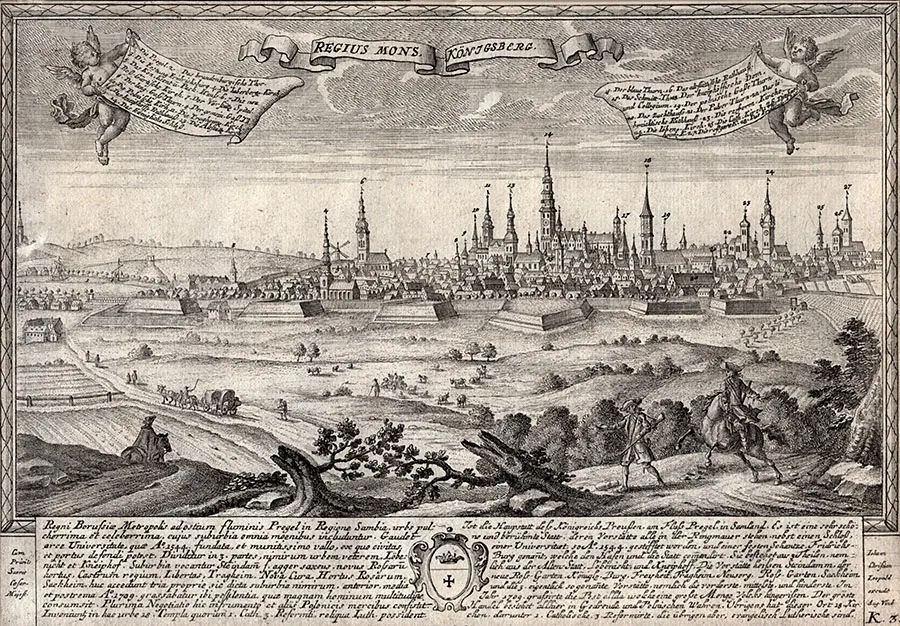
Königsberg possessed a far more developed system of fortifications. Its core consisted of the fortress works and the citadel, built as early as the first half of the 17th century. They were to be manned by two garrison battalions and two detachments of reservists, or town militia.
The more combat-ready of these detachments was the first, numbering 3,000 infantry and 150 horsemen. The infantry was armed with muskets, the cavalry with pistols and sabres. The second detachment was considerably weaker: it was made up of craftsmen and volunteers armed with swords, pitchforks and scythes. The battalions were quartered in the suburb and guarded the gates, storehouses and the citadel. Part of the cavalry served at outposts on the most threatened approaches. According to the battle roster, in the event of an enemy attack each bastion of the fortress was to be manned by a party of 100 men and two officers17.
In anticipation of war, in the spring of 1756 the German military leadership turned its attention to the need to restore the earthworks, which had fallen into considerable disrepair over their hundred-year history. Between the Brandenburg Gate and the citadel, for example, the parapet had been completely destroyed. However, it was only in the spring of 1757, after the Russian army under General Field Marshal S. Apraksin had already begun its campaign into Prussia, that 5,000 thalers and 400 men were allocated for this purpose. By August some of the trenches, ditches and palisades had been restored, though not completely18. These works were carried out largely to create obstacles against a cavalry raid19.
Naturally, in the event of an attack on the city by a strong force, the fortifications of Königsberg would most likely have been unable to sustain a lengthy defence. At the same time, the approaches to Königsberg, both from the sea and from the land, were barred by a number of strong positions. Pillau protected Königsberg very well from the sea. On land, the defensive areas of Kalenen, Taplacken, Petersdorf, Tapiau and Labiau had been prepared. Their distinctive feature was that the positions in these areas were closely tied to the marshy, wooded terrain east of the Kurisches Haff and the Deime river. To cover Königsberg against an enemy advancing along the left bank of the Pregel, a position had been prepared at Wehlau. At this town the Alle flowed into the Pregel, which made preparing the defence considerably easier. Having overcome this position, the enemy would inevitably have to advance on Tapiau, where bridgehead fortifications presented a new obstacle. Incidentally, the Tapiau fortifications were linked to the Labiau position via the Deime. The Russians knew this well, and a special landing force was assigned to capture Labiau, though its landing failed20.
The Prussian side also took defensive measures against irregular troops. Only on the very eve of the war did Frederick II become convinced that Russia was serious about the coming conflict. True, he believed that Prussian troops would cope quite easily with the regular Russian army. But a “Tatar” raid by irregular troops worried him seriously. The Prussian command therefore decided to fight the Cossacks and Kalmyks by exploiting the broken terrain and the patriotism of the local population. To this end, a so-called “people's defence” was to be organised along the border, but this measure, conceived too late and carried out unsystematically, brought the civilian population more harm than good.
The Prussian command failed to take into account that horsemen like the Kalmyks could not be stopped by a flimsy cordon of local inhabitants. Indeed, the Russian troops could expect a shot from behind every bush, and individual riders from patrols were sometimes killed.
But these incidents provoked a fury among the irregular troops that proved fatal for the local inhabitants, as the irregulars began to clear the occupied territory with fire and sword. To prevent such actions, Apraksin was forced, to his own detriment, to hold these troops far in the rear, using them only when absolutely necessary.
It must be said that, strategically, the Prussian military command had achieved success even before hostilities began in the province. The point was that an advance along the shortest route, Riga—Königsberg, was extremely disadvantageous for the Russians. Making use of the terrain and of prepared positions, the defenders could hold back the attackers with relatively small forces. For this reason the Russian military command chose a longer route for its main thrust on Königsberg, via Kovno. On the other hand, Memel could not be ignored, since the troops in that fortress could always threaten the flank of the advancing army. The Russians were forced to advance in two columns, and a division of effort does not always guarantee decisive success. Moreover, within Prussia itself the terrain on the left bank of the Pregel was on the whole more favourable for a Russian advance on Königsberg than the right bank. Strategically, however, the advance needed to proceed along the right bank, which was now the shortest route. Yet the measures taken by the Prussian commander-in-chief H. Lehwaldt to fortify positions on the right bank forced the Russians to advance in a direction unfavourable to them, thereby prolonging the campaign21.
Before the war, military and civil administration of the Prussian province was concentrated in the hands of Field Marshal Hans Lehwaldt. Lehwaldt was born in 1685 near Labiau and began his service under Elector Frederick III. Much of his career was spent in his native province. He served in Bartenstein and Friedland, and was commandant of Pillau, Memel and Königsberg. In 1748 he became the senior military commander in the province, and in 1751 a field marshal22. His appointment as the man responsible for the defence of Prussia therefore seemed logical.
The total number of regular troops under the field marshal's command was 30,000 men, of whom 20,260 were infantry, 7,614 cavalry and 2,214 men (6 companies) “properly organised militia”. The militia companies were formed in Johannisburg, Lyck, Treuburg, Goldap, Stallupönen and Pillkallen. Each company consisted of 1 officer, 4 non-commissioned officers, 18 mounted and 12 foot foresters, a trumpeter and 333 soldiers23.
According to Russian historians, by April 1757 the plan of the Russian command had become more or less clear to Lehwaldt. To counter the enemy, he deployed his forces between Tilsit and Nordenburg, with his headquarters in Insterburg; two strong detachments, composed mainly of cavalry and commanded by Generals Kanitz and Ruesch, were sent from Tilsit and Ragnit towards the Neman.
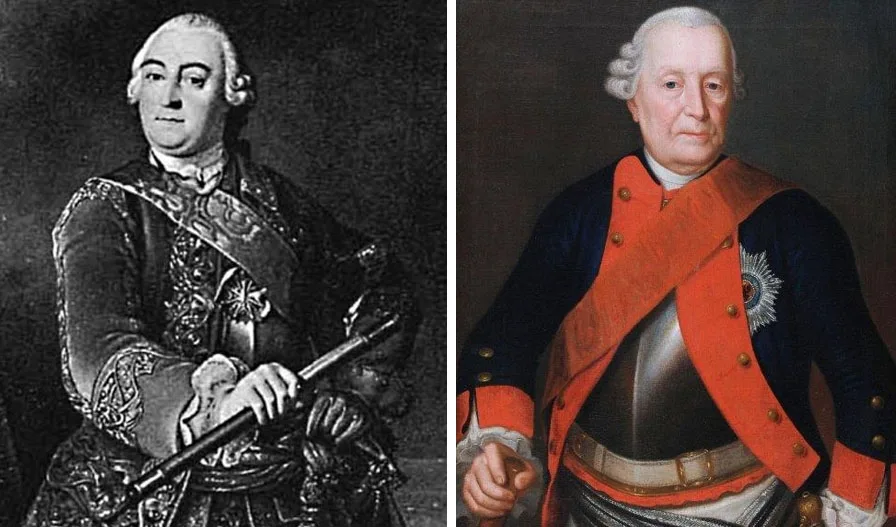 The protagonists
General Field Marshal Stepan Fyodorovich Apraksin (left)
Prussian Field Marshal Johann von Lehwaldt
The rest of the cavalry was concentrated near Angerburg and Oletzko. The border area from Memel to Johannisburg was guarded by the militia. Lehwaldt was expected to resist the Russians, falling back if necessary towards Königsberg while destroying food supplies along the way. Frederick was then to arrive with his army and launch a counteroffensive. The decision to confine himself to passive defence was one of the reasons why Lehwaldt did not occupy Kovno and, indeed, did nothing at all to hinder the Russian crossing of the Neman24.
When considering the strength and composition of the Russian army intended for operations in Prussia, the following must be borne in mind.
Having taken a stand against a coalition of the leading European states, Prussia was from the outset at a numerical disadvantage in armed forces. According to information obtained by the Russian Chancellor Bestuzhev, the troop strengths of the European powers in 1755 were as follows:
Russia — 331,422 men
France — 211,753 men
Prussia — up to 145,000 men
Austria (excluding Imperial and garrison troops) — 139,000 men
England — 91,179 men
Saxony — 8,000 men25
Such overwhelming numerical superiority did not mean, however, that these armies would be deployed in Central Europe in their entirety. This applied especially to Russia, France and England. Russia, for instance, could field just over 200,000 men for offensive operations — but not in a single theatre of war. The total strength of the Russian army designated for the Prussian campaign in May 1757 exceeded 128,000 men. Yet only 98,000 were on active duty, of whom 72,000 were infantry, 7,000 regular cavalry and 16,000 irregular cavalry. It should also be borne in mind that in the 1757 campaign the Russian army was weakened not so much by fighting as by disease, brought on by the very long march and the hot weather. In the first months of the campaign there were up to 11,000 sick in the army, and during the retreat in October of the same year more than 58,000, against 47,000 healthy men26. Nevertheless, the numerical superiority of the Russian troops was beyond doubt.
The Russian regiments set out from Riga in the spring of 1757. Advancing along two routes — via Memel and via Kovno — the Russian army entered Prussian territory and moved in the general direction of Königsberg.
A separate corps of the Russian army under General-in-Chief W. Fermor forced the fortress of Memel to surrender on 6 July after a brief bombardment from the sea. However, despite an overwhelming superiority in strength (16,000 against 800 men!), Fermor allowed the Prussian detachment to leave the town on the most honourable terms (with their arms), which caused discontent in the Russian army. Fermor then led his corps through Tilsit and reached Insterburg, where on 18 August he joined the main Russian forces.
Apraksin's army moved through the province, meeting resistance that was weak but armed. The Prussian troops attacked the Russians most actively near Gumbinnen and at Insterburg, which changed hands twice. The relatively rapid Russian advance to Insterburg forced Lehwaldt to take up a defensive position at Wehlau, on the right bank of the Pregel. Apraksin decided not to give battle on terms that were unfavourable to him from the start and resolved to undertake an outflanking manoeuvre. In the Norkitten area he crossed to the left bank of the Pregel, heading towards Allenburg, so as to bypass the Prussian positions at the confluence of the Alle and the Pregel and approach Königsberg from the south-east.
Prussian reconnaissance detected this Russian manoeuvre, and Lehwaldt in turn moved his troops across the river and took up an advantageous position near the village of Gross-Jägersdorf. Early in the morning of 30 August, Apraksin gave the order for the troops to begin moving towards Allenburg. The road along which the army set off ran through a narrow hollow, then climbed uphill through a forest and suddenly emerged onto a broad field in front of Gross-Jägersdorf. Here, at the edge of the forest, the Prussian army lay in wait for the Russians, drawn up in battle order. Lehwaldt struck at the Russian formations before they could deploy.
“The first fire began from the enemy's side... The Prussians advanced in the most courageous and orderly manner to attack our army, which was stretching out alongside the forest, and having come within range, they fired a well-ordered volley at our men... from our side not a single musket shot was returned...
The Prussians, having fired their volley, did not halt but continued to advance, and, loading their muskets on the march and coming still closer to our men, gave our men another orderly volley with their whole first line... on our side not a single musket shot was returned to this volley either... Continuing to watch, we saw that the Prussians, even after this volley, kept on advancing, loading their muskets on the march, and having loaded them and come much closer still, gave our men a third most dreadful and orderly volley... no sooner had the enemy delivered the third volley than cannon and musket fire blazed up on our side too, and though not in volleys but without order, yet far heavier than the enemy’s. From that moment the Prussians, too, ceased firing in volleys. The fire on both sides became incessant, without a minute’s pause, and we could no longer tell the enemy’s firing from our own. Only the cannon shots stood out, and especially those of our secret Shuvalov howitzers, which, by their peculiar sound and thick black smoke, we could clearly see and distinguish from the rest of the cannonade, which, like the musketry, became most ferocious and incessant on both sides.”27.
The main blow of the Prussian infantry was borne by the 2nd Division under General-in-Chief V. Lopukhin, who was killed in this battle. The Russian regiments, having suffered heavy losses, were pressed back against the forest and went over to hand-to-hand fighting, yet they held their ground. Lehwaldt tried to build on his success with an attack by the cavalry of the Prince of Holstein. In repelling it the Cossacks distinguished themselves, luring the Prussians into their positions under the fire of the artillery and cavalry: “The battery... managed in good time to turn its guns about, and the volley of canister it fired had the most desired success, for as it happened to fire across the Prussian squadrons galloping one after another, it carried off almost an entire squadron, thereby broke their charge, and not only halted the riders but compelled them to turn back headlong.”28.
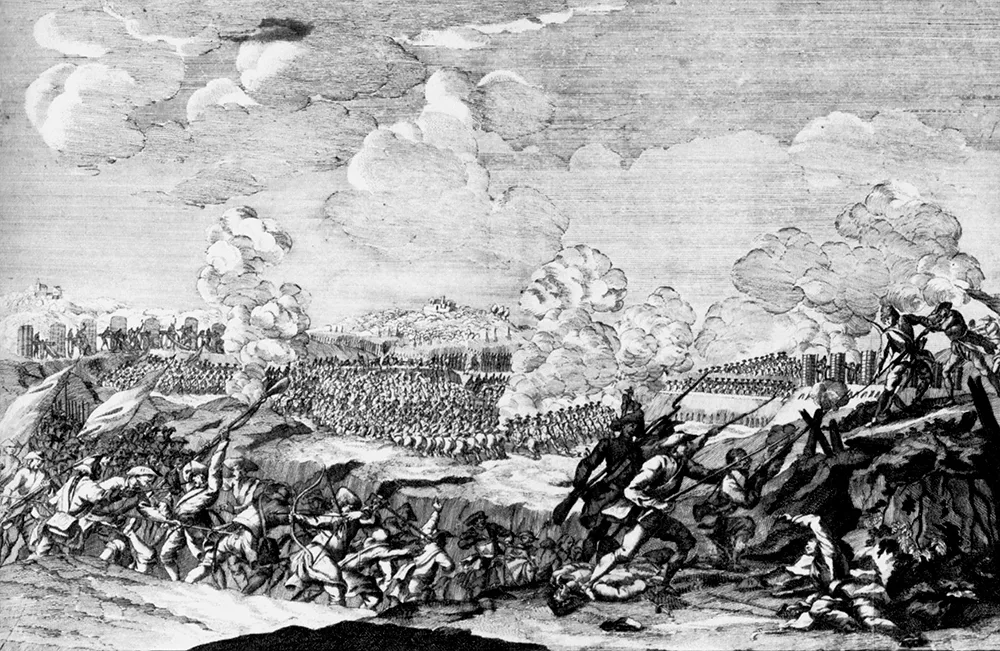
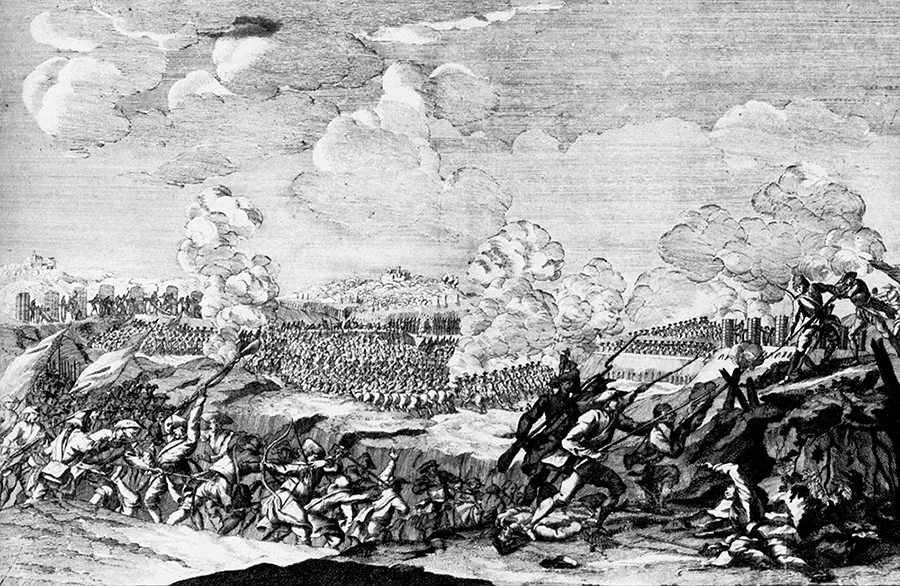 The Battle of Gross-Jägersdorf in East Prussia, 30 August 1757. Drawing by Alexander von Kotzebue.
Lehwaldt launched several more attacks on the Russian battle lines, changing the direction of his advance, but without success. Meanwhile the Russians, gradually recovering from the surprise of the first Prussian attacks, began to restore the situation. Once all three Russian divisions, supported by artillery, had entered the fray, the outcome of the battle, which lasted 10 hours, was decided. The same Bolotov wrote: “However much the Prussians boast in their reports that they retreated in good order, there was not a trace of order to be seen. They vanished from our sight in an instant, and the whole field was strewn with them.”29.
The opening of the campaign, marked by the victory at Gross-Jägersdorf, was encouraging for the Russians and disheartening for the Prussians. But, to the latter’s delight, Apraksin failed to reap the fruits of this victory. The Russian army stood on the battlefield for several days and in the end lost contact with the enemy. Lehwaldt, after his crushing defeat, had no firm grasp of the situation either; retreating, he moved swiftly along the left bank of the Pregel through Wehlau and took up a fortified position on the opposite bank near Petersdorf. The position lay at the confluence of the Alle and the Pregel. Earthen breastworks heaped up on the high banks and ditches, both dry and water-filled, made it difficult for attackers to overcome. Apraksin could probably have taken Wehlau at once, but he hesitated, and Lehwaldt and his troops entrenched themselves firmly there. The Russians had no choice but to proceed in the previously chosen direction towards Allenburg, which the army reached on 6 September. There the advance came to a halt, and a few days later the Russian army turned back.
Field Marshal Apraksin, who commanded the Russian army, would be accused of cowardice, treacherous conduct and even outright treason. Some historians would link his retreat to the illness of Empress Elizabeth Petrovna. The real reason why the Russian command abandoned the advance on Königsberg after the victory at Gross-Jägersdorf and withdrew the army to Lithuania and further into Courland was stated by Apraksin himself under interrogation: an extreme shortage of provisions and the loss of soldiers30.
The summer of that year in Prussia was indeed exceptionally hot. The army’s campaign journal recorded: “the unbearable heat, which makes the march arduous, has moreover deprived us of the means of receiving provisions and fodder by water, for because of it the rivers have grown so shallow that vessels could not pass.”
The main supply artery was the Neman River. But the river, and even the Curonian Lagoon, had grown shallow. “It was necessary to bring provisions to the army on the inhabitants’ carts, which required as much labour as time.”31 Local resources could not be relied upon, as reconnaissance confirmed. The Campaign Journal of the Russian army reported: “However much trouble we have had hitherto in obtaining provisions, and however complete a want of fodder we have endured, none of it can be compared with what has come to pass this month, for the parties sent out into the surrounding country for more than 20 versts found not a trace of fodder to be had. The enemy, not expecting the attack here (the Battle of Gross-Jägersdorf. — G. K.), retreated further beyond the river Den towards Königsberg, so that Colonel Krasnoshchekov, sent out with a detachment to reconnoitre, reported on his return that, having ridden to within eight versts of Königsberg, he had seen nothing but the traces of the most grievous ruin and devastation, which the enemy had wrought upon his own land and his own subjects in order thereby to hinder our march, whereby the inhabitants were not only deprived of all their grain and cattle, but their household goods too were broken and spoilt.”32.
Nor could it be ignored that Lehwaldt, though he had lost the battle, had managed to preserve his army and even to bring it up to 25,000 men with the land militia. He withdrew to Tapiau, where he had substantial defensive fortifications and a natural water barrier: the Pregel and the Deime, which flows out of it. Lehwaldt felt confident, since reserve units were being formed all over Prussia to assist him. Scouts reported to Apraksin: “The land militia has been gathered into small corps and has all its munitions; it has been organised into companies, battalions and regiments and is drilling incessantly.” And further: “From every peasant household having but two men, one has been taken into that land militia.”33.
Taking all these unfavourable circumstances into account, the army’s Military Council (not Apraksin personally) resolved: “To turn aside from this place and make our way by the best routes to Tilsit, and, having arrived there... while it is still autumn, to seize the town of Labiau and the river Deime, and in this manner to clear the way for securing ourselves sufficient provisions.”34.
Apraksin’s hopes for Tilsit were not fulfilled. There too provisions proved to be very scarce, and the Russian commander-in-chief, having made a series of tactical and strategic errors (in particular, failing to hold Tilsit), crossed to the right bank of the Neman and led the army off to winter quarters.
The government did not take the field marshal’s justifications into account; it relieved him of command of the army and appointed General-in-Chief V. Fermor in his place, charging him with launching an offensive in November 1757 and occupying “the good towns and Ämter in Prussia abandoned in vain... to take Labiau and Tapiau” and then to advance on Königsberg, Pillau and Brandenburg. The new commander-in-chief intended to set out only in spring, but in mid-December he received a categorical order to occupy Königsberg35.
The offensive began in two columns: one from Memel, across the ice of the Curonian Lagoon, the other via Tilsit. Once the columns had joined, the army was to proceed to Labiau and Königsberg. Provisions were taken along for a month; supplies for the period thereafter were to be brought overland from Riga.
The Prussians offered almost no resistance, since Frederick II had recalled Lehwaldt back in the autumn to fight the Swedes. The small units assigned to guard the border could do nothing, and the militia dispersed to their homes. On 14 January 1758 the garrison left Königsberg. Two days later the commandant of Pillau, von Wuthenow, abandoned a fairly well-armed fortress to its fate, taking the treasury with him. On the day Russian troops occupied Labiau, most officials of the highest government authority, including the ministers, evacuated to Danzig. Amid the general confusion, the heads of the districts (chambers) took over the functions of governing the province. On 18 January, meeting the Russian vanguard, Rachow, the Amtmann of Labiau, reported: “...from Königsberg, from the chief commercial administration there, decrees have been sent to all the local Ämter to meet and receive the troops of Your Imperial Majesty everywhere without resistance”36.
Even earlier, on 12 January, Fermor had informed Rumyantsev that “...yesterday I received from the Amt of Russ, from the Amtmann Kuwert, the pleasant news that there are no troops whatsoever in that Amt and that almost all of Prussia is submitting to Her Imperial Majesty as her subjects...”.
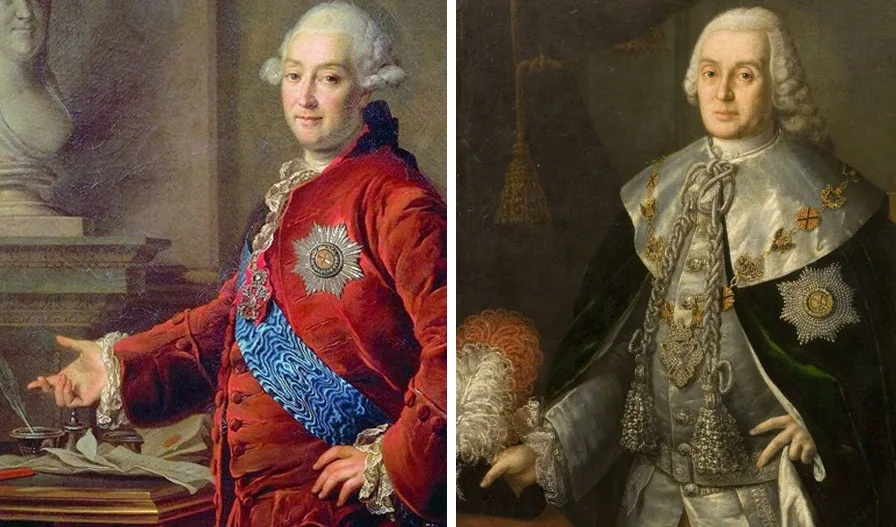 The key figures
Field Marshal General Pyotr Alexandrovich Rumyantsev (left)
General-in-Chief Villim Villimovich Fermor
Kuwert in general gave the Russians very active assistance in occupying the lower Neman region. Although his conduct can be explained by a wish to avoid possible clashes between the local population and the Russian military (he made a great point of citing the large number of sick people in his Amt), his eagerness to shift the hardships of wartime from his own people onto his nearest neighbours nonetheless looked rather strange. For example, he told Major General P. Rumyantsev, whose division had occupied Russ, that there was almost no sickness in the neighbouring Amt of Kuckerneese (implying that it would be better to go there). The Kuckerneese Amtmann, Schreiber, acted differently from Kuwert. Realising that occupation was unavoidable, he tried to make the process of Russian troops taking over his villages more manageable. To this end he immediately offered a number of villages for quartering, at the same time reporting that both hay and oats were available there37.
On the whole, the actions of Prussian officials during this period were rather contradictory. On the one hand, they sought to keep their estates and settlements intact; on the other, later historians characterised their conduct as “turning into obedient servants of the Russians”. A telling example is that of Domhardt, Kammerpräsident of the Gumbinnen district, who later became to the Germans, if not a national hero, then at least a provincial one, supposedly having led the resistance against the Russians. Gumbinnen lay away from the route of the main Russian forces advancing on Königsberg and the Vistula, and was therefore occupied later. Yet Domhardt was among the first to write to General Rumyantsev about “taking under protection” the Gumbinnen district, petitioning only that “for such voluntary submission (the inhabitants) not be overly burdened with quartering”38.
The part of the provincial leadership that had stayed in place rather than evacuating to Danzig acted in the same spirit. Anticipating the inevitable seizure of the province by Russian troops, they decided to pass “under another crown”.
On 21 January a Prussian delegation consisting of the vice-president of the tribunal, Grabowski, Councillor Auer and the Königsberg burgomaster Hindernis arrived in Kaymen, where all the “councillors of the district Ämter” had already gathered. The delegation carried a letter signed by seven high-ranking officials: the Actual Privy, State and War Councillor and Obermarschall Wallenrodt, the Actual Privy, State and War Councillor Lesgewang, the Kammerdirektor Reck and others39.
The letter contained “extraordinarily bold terms of capitulation”, as their first publisher, General D. Maslovsky, put it. So bold, in fact, that they effectively allowed the population to live even better than under the former royal rule.
In all, 17 points were “requested”. The first deserved particular attention. It read: “The city of Königsberg to be protected in its privileges, liberties, rights and prerogatives, as these were received from time to time from each of its natural sovereigns.” In practice, nothing was to change in the life of Königsberg. Then followed the additional benefits demanded:
to limit the number of troops quartered in Königsberg;
to leave civil officials and clergy in their posts, with their former salaries and other income;
to grant the city the right to manage its treasury; not to restrict trade or disrupt communications by water or land, either within the province or abroad; to secure the rights of the local nobility and their income from their estates; and also to preserve the rights and privileges of merchants and brewers, along with a number of other concessions40.
Having heard the delegation, Fermor, while pleading that he lacked the authority to decide such important matters, nevertheless “gave (the deputies) hope of the general monarchic grace” and promised “to submit their petitions to the most high consideration”41.
The unexpected arrival of the envoys in Kaymen pleasantly upset Fermor’s plans. Only the day before, he had intended to give his troops a rest after an extremely arduous march and only then to enter Königsberg. He had to abandon this intention.
At three o’clock in the morning on 22 January the Russian infantry set out from Kaymen, and by eleven o’clock they had occupied the Vorstädte (suburbs) of Königsberg.
The “burghers’ guard” of the Prussian militia handed over its posts to Colonel Yakovlev’s grenadiers. Königsberg was effectively in Russian hands. Preparations began for the reception of the Russian commander-in-chief Fermor, vividly described in Bolotov’s “Memoirs”: “His entry into this city was splendid and magnificent. All the streets, windows and roofs of the houses were thronged with countless multitudes of people. The crowd was immense, for everyone was eager to see our troops and the commander himself; and as to this was added the ringing of bells throughout the city and the playing of trumpets and kettledrums on all the towers and belfries, which continued for the entire procession, all this lent it still greater splendour and magnificence”42.
Fermor and his retinue made their way through the crowd of curious onlookers and rode into the castle. There he was met by the remaining members of the local government, headed by Lesgewang, who presented him with “the keys to the city”. The question of the keys “to Königsberg” comes up from time to time in historical literature and is most often treated as purely symbolic. However, keys really were handed over. The matter is settled by Fermor himself, who reported in his dispatch on the January events: “At the same time the keys of the local citadel of Friedrichsburg and of the Pillau fortress were brought to me by the local government”43.
Troops continued to enter Königsberg. At dusk an artillery brigade arrived in the city, and a little later the remaining regiments of Rezanov’s brigade. The guns were placed on the castle square and some of the troops in the city itself, but most of the regiments and squadrons that had surrounded Königsberg since morning remained without shelter for a long time. Residents invited only officers to be quartered with them. Gratified by the magnificent reception, the commander-in-chief seems to have forgotten amid all this about the main protagonist, the soldier, who, having marched more than twenty versts since three in the morning, was left to spend the night in the open field. Nevertheless, there were no incidents: discipline was quite strict, and there were no cases of houses being seized or local residents being mistreated44.
It should be noted that Fermor, as commander-in-chief of the Russian army that had occupied a considerable part of the province, including its capital, remained the senior military commander but as yet had no instructions on organising civilian life in the province. He therefore provided for only one measure, one already practised by Apraksin: administering the oath of allegiance to the inhabitants of the region.
The legal basis for these actions was a decree issued by Elizabeth Petrovna on 31 December (Old Style) 1757. The decree noted that during the “previous campaign” (in the summer of 1757) “the inhabitants of their own free will placed themselves under Our protection.” The Empress expressed regret that her army had then been forced to abandon lands it had already occupied, and that some places “were burned and laid waste.” All this had been done “against Our wish.” Now, however, the Empress guaranteed the population of Prussia her “goodwill and favours,” again on condition that they voluntarily place themselves under her “protection”45.
On 23 January Fermor gave orders for the inhabitants and officials to be sworn in. In the view of Russian and German historians, the oath substantially altered the terms of the “agreement” concluded at Kaimen. The Prussian side had counted on all “persons remaining in peaceful possession of their estates, wherever they might be.” The preservation of property was also promised by Elizabeth Petrovna’s decree, but only to those inhabitants who remained within the province. Fermor stressed precisely this point, ordering “an inventory to be made of the property of those... who withdrew before the entry (of the Russians) into the city... and it is to be announced that their villages and houses in the city are to be placed under sequestration (held until the end of the war), because they... dared... to leave the city, and if they do not return, all their movable and immovable property shall be confiscated.” He also tightened the rules on spending money in the province. All revenues were to go to the Russian treasury, “and were not to be spent on anything without permission.” Particular attention was paid to keeping faith with the oath once sworn. Here the commander-in-chief reserved to himself the right to punish all who broke it in accordance with the law: “...to undertake nothing, either secretly or openly, against the interests (of the Empress)”46.
Two months were allotted for swearing in the inhabitants of the province, and the procedure began on 24 January in Königsberg. It was the birthday of Frederick II, and one can only imagine what the townspeople, at heart still loyal to their king, must have felt. The most solemn ceremony took place in the church of the royal castle. First the Empress’s manifesto was read out. Then the pastor recited the text of the oath. Those present in the church repeated it aloud, swearing “to be faithful and obedient to the Russian government.” The highest officials took the oath first, followed by the professors and lecturers of the university and officials of various institutions47. Among them was the Privatdozent Immanuel Kant, although Kant scholars have not yet found the philosopher’s signature beneath the text of the oath. But this does not mean that Kant shied away from pledging loyalty to the Russian Empress.
His letter to Elizabeth has survived, written in connection with his application for the post of full (salaried) professor of logic and metaphysics, in which he declares his desire to serve the new authorities faithfully and truly48.
Russian authorities were appointed only to the largest towns occupied by Russian troops. General Rezanov became commandant of Königsberg, with Brigadier Treyden as chief commandant; Major Meister was appointed in Tilsit, and Lieutenant Colonel Gerbel in Pillau. The duties of the commandants and senior officers were limited to overseeing internal order. In all other matters the local authorities remained independent, except that they might be instructed “to submit a register of how much grain and fodder of every kind is held by all the inhabitants.” Suppliers were paid in money for provisioning the Russian army. Special officials were appointed “to collect the revenues and the monetary contribution imposed on this and the other towns in Prussia,” and also “to collect, according to military custom, a contribution of fodder and provisions for the maintenance of the army.” These orders were set out in corresponding decrees “to the chancellery of the Königsberg Government, as also to the presidents of the Königsberg and Gumbinnen Chambers, to the magistrate and to the consistory... which was at the same time instructed in what manner prayers are to be offered in the churches during divine service for the most exalted health of Her Imperial Majesty and the whole Imperial family”49.
The local press was also placed under Fermor’s authority; it now appeared bearing the Russian double-headed eagle (by the end of January the Prussian coats of arms had been replaced in all official places).
On 19 February 1758 a decree of Elizabeth Petrovna arrived in Königsberg appointing Fermor Governor-General of Prussia. The same decree contained responses to the “points” of the Kaimen petition. Analysing this decree, N. M. Korobkov concluded that it became “a kind of constitution” for the new Russian province. And the point is not merely that a supreme administration was established for the province, through which the local bodies could communicate with the central government. The imperial decree granted the province privileges it had not enjoyed under its former status. Here are the main points of the decree:
“1. The city of Königsberg shall be protected in its privileges, liberties, rights and prerogatives.
2. Light troops shall never be quartered therein save in extreme and unavoidable necessity; wherefore
3. The city and its inhabitants may rest firmly assured that they shall suffer no disorders or extortions.
4. Complete freedom in the exercise of their faith and of public divine service is left inviolate on its former footing.
5. Churches, schools, hospitals and other almshouses and orphanages are left with their foundations and estates, but exact statements of their revenues are to be submitted.
6. Civil and church servants who continue to perform their duties diligently as before shall retain their former salaries and incomes.
7. All treasuries and revenues without exception belong to Us; but should any revenues belong specially and properly to the city, exact statements thereof, setting forth its right to them, are to be submitted for consideration.
8. The town halls are left their archives and registries.
9. Private libraries are left at the disposal of their owners, but exact inventories of the public ones are to be submitted.
10. Free, unlimited and secure domestic and foreign commerce, contrabant (i.e. contraband. — G. K.) excepted, by water and by land, We not only permit but shall moreover endeavour to protect, and We shall command Our fleet not only to let ships bound for Königsberg and sailing from Königsberg pass freely, but moreover, in case of need, to render them the necessary assistance and show them every goodwill.
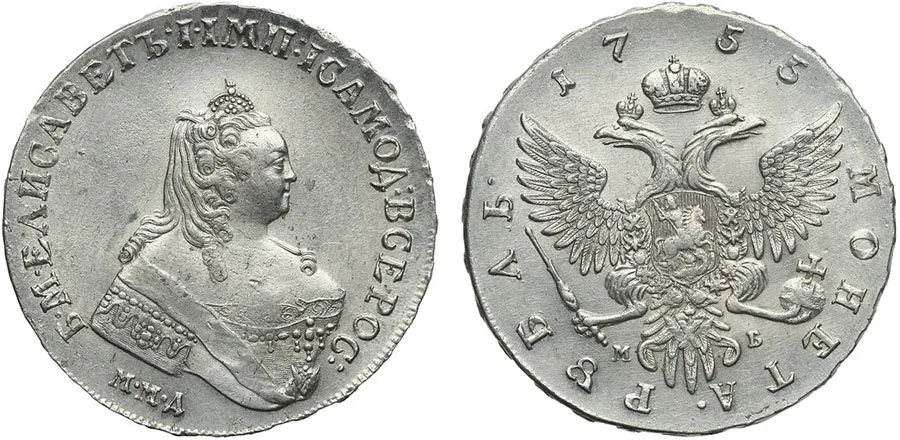
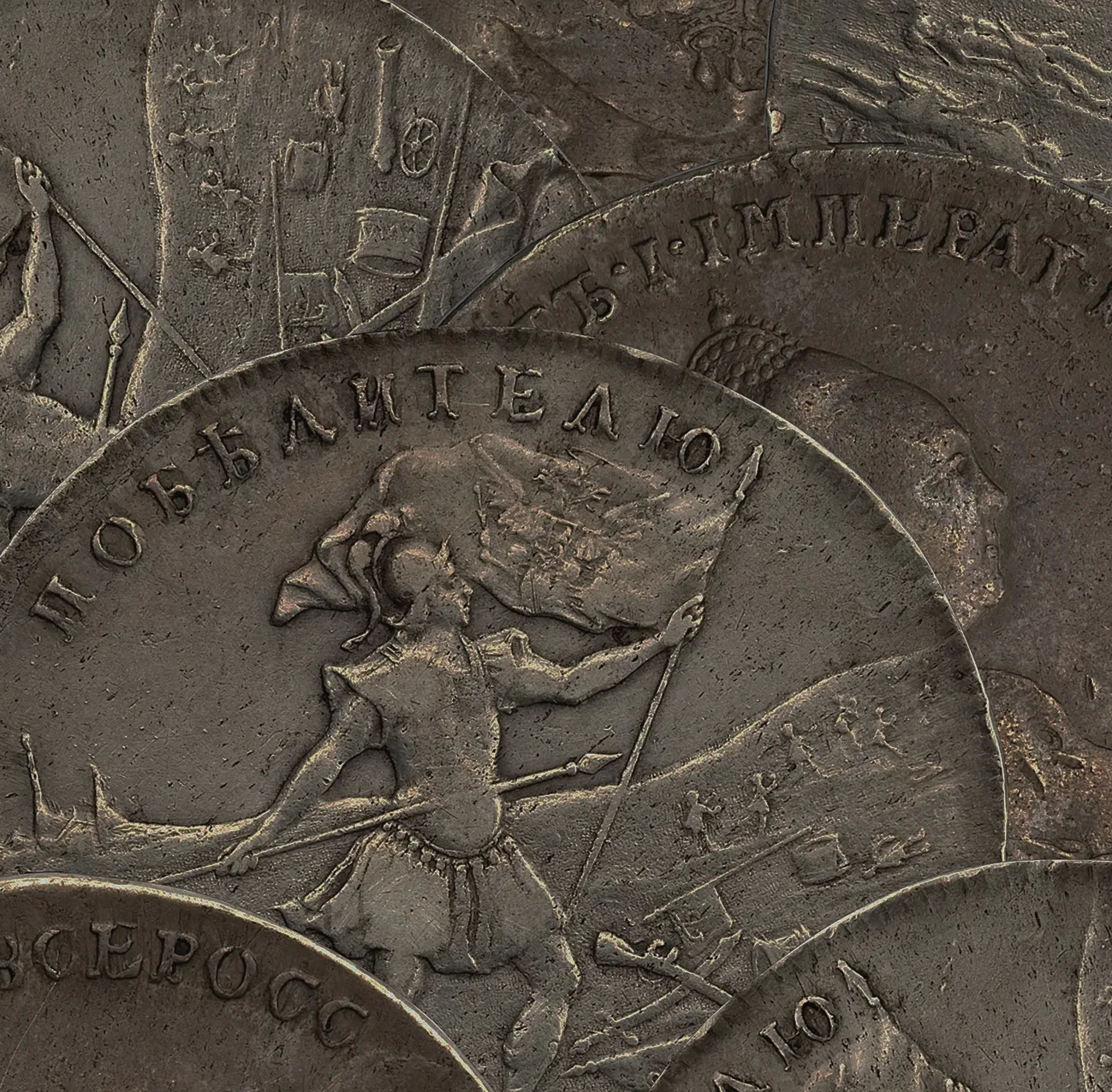
Russian silver rouble of the Seven Years’ War period.
11. Goods kept in public warehouses and storehouses, to whomsoever they belong, remain at the disposal of their owners, but on those for which duty has not yet been paid it is to be collected faithfully and in full for Our treasury.
12. Inhabitants of every rank are, without exception, left in peaceful possession of all their property.
13. Those who are absent may return with their households and property securely and safely, and need only hand over any weapons they may have to Our military commands for safekeeping.
14. All posts shall keep their unhindered course; likewise equal freedom is granted to all arriving from and departing for the villages and towns, and all imports in general are permitted.
15. All crafts and guilds are left with their privileges and rights, with the free exercise of their crafts and trades.
16. No one whatsoever shall be compelled against his will to enter service, just as, conversely, those who wish to earn Our special favour by their service shall not be prevented from doing so.
17. The city and the whole Kingdom of Prussia may rely fully on Our bounty and favour for as long as each person remains in due obedience and applies himself solely to his own calling.”50
Commenting on the “points” of this decree, one may say that Prussia, even though the Kaimen agreement was not satisfied in full, received rights, liberties and privileges such as no internal province of Russia possessed.
Above all, the decree confirmed all the privileges previously held by various corporations and individuals. Freedom of religion and freedom of domestic and foreign trade were guaranteed. What is more, foreign trade came under the protection of the Russian fleet, which dominated the Baltic Sea.
All state revenues of the province of Prussia went to the treasury. Strictly speaking, this merely confirmed Fermor’s earlier order, but the decree exempted public funds from the treasury: church expenses, the income of charitable societies, and so on. Estate owners were allowed to return to their properties, and free passage through the territory occupied by Russian troops was guaranteed. The estates of all those in the service of Frederick II were subject to sequestration. One more provision of the decree is of interest. It concerned service, both military and civilian. It was confirmed that no inhabitant of the province would be taken into Russian service by force, but that it was open to anyone who wished to join. And this at a time when the Prussian army was being manned under harsh requirements, in Saxony, for example. The same liberalism extended to Prussian officials, who were free either to serve in the Russian administration or not.
In addition, the Empress’s decree devoted an entire section to the University of Königsberg, which was guaranteed all its expenses and granted complete freedom of teaching.
Taken together, all this later allowed Fritz Gause to describe the rule of the Russian administration as humane: “The Russian soldiers kept good discipline... For the citizens there were almost no restrictions on either freedom of movement or economic activity... The Russian authorities did not requisition premises for themselves, since Prussian officials and pastors continued to serve in the offices and churches... The Russians showed great respect for the university and did not interfere with academic freedom...
Russian officers were welcome guests in the lodges and in merchants’ homes, and took part in balls, sleigh rides and masquerades. The people of Königsberg ventured to smoke tobacco in the streets and learned to drink punch; their manners became freer. The rouble was livelier than the thaler.”51
Having obtained official authority to govern the province, Fermor sought to broaden the scope of his activities and take up administrative and economic matters. For this, however, he needed a more detailed picture of the province, its organisational structure, the size of its population and so on.
On Fermor’s instructions, Colonel Yakovlev compiled a military and statistical description of the province. The information Yakovlev gathered, however, was mainly of a general, informative nature. His report noted, for example, that Prussia grew every kind of grain and had an abundance of hay and vegetables. The province was short of timber. At the same time, Yakovlev reported that the region had been badly drained by taxes. Since the beginning of the Seven Years’ War, Frederick II had collected 600,000 thalers in Prussia as a loan, on top of the usual levies. By way of comparison, Prussia’s expenditure on maintaining the Russian army from January 1758 to September 1759 (that is, over a comparable period) did not exceed 94,509 thalers52.
Thanks to Colonel Yakovlev, we have the most reliable information on the population of the province. It totalled 521,232 people. The urban population reached 20 per cent, with 40,000 living in Königsberg, while the other towns had about a thousand inhabitants each on average. It should be borne in mind that the overall population had declined during the war years, since recruitment drives for the Prussian army had been carried out in 1756 and 1757, and part of the population, especially in the border districts, had left for Poland. Moreover, a devastating plague had swept through the region half a century earlier. If we add that the province included lands that now belong to Poland and Lithuania, the overall population density appears very low. Under such conditions the war was especially hard on Prussia53.
It was much later that the Russians gained a clear picture of the province’s administrative and territorial organisation. At the time the province was occupied by Russian troops, it consisted of three districts: Samland, Natangen and Oberland. The districts were in turn divided into 33 Ämter. In 1751 the Ämter were grouped into nine newly created Justizkollegien, three in each district. The number of Ämter in them varied. Thus, in the Samland district, the 1st Justizkollegium of Memel had only one main Amt under its jurisdiction, Memel itself; the 2nd, of Insterburg, had three main Ämter: Tilsit, Ragnit and Insterburg; the 3rd, of Neuhausen, had six: Tapiau, Labiau, Schaaken, Neuhausen and Fischhausen, and so on. In all, the province of Prussia had 63 towns at that time, including Königsberg. Each town had its own magistracy and municipal court. The province had its own government, the Regierung, made up of ministers of state. In addition to ordinary provincial affairs, the ministers of state oversaw religious institutions, the university, hospitals and orphanages, schools and so on. The highest judicial body was the Tribunal. No appeal against its decisions was admitted, and only in exceptional cases, when a case had been brought directly before the Tribunal rather than a lower court (the Hofgericht), was it permitted to appeal to the royal court.
There were also the Königsberg municipal court and the French court, which dealt with the affairs of French settlers and was subordinate to the chief French court in Berlin. The economic activity of the Ämter and the collection of taxes were overseen by two Kammern, one based in Königsberg and the other in Gumbinnen.
The Kammern included a Lizentkollegium, which collected port duties, and an Akzisekollegium, which collected minor duties in the towns of the province. In addition, the government and the magistracies directed the work of a number of other commissions and departments. For example, besides its tax-collecting bodies, the Königsberg Kammer included a manufactures office, a fire office and a police office54.
The way posts in provincial and local government were filled is worth noting. Most positions were filled through competitive selection. To obtain a post in a religious or educational institution, one had to hold a degree from a faculty of theology and pass the relevant examination before the consistory. To take up a post in the judiciary, one had to undergo a public examination at the Hofgericht. Furthermore, in the Tribunal and the Hofgericht half of the posts were reserved for persons of noble birth and the other half for learned men of non-noble origin. Only a nobleman could be director of a Justizkollegium. As for military organisation, five infantry, five dragoon and two hussar regiments were quartered in the province. In addition, there was one garrison regiment each in Königsberg, Memel and Pillau. Most regiments had their own cantons, from which they drew their recruits. However, it proved impossible to obtain data on which regiments had received recruits before the war, and how many. Officials of both Kammern stated that only the regimental commanders knew the exact number of recruits55.
The Russian governors found themselves in a difficult position in working with such a highly developed structure of provincial and local government. The simplest solution, of course, would have been to replace the German officials with Russians, but this raised a language problem: where could one find so many Russians with a knowledge of German to staff 33 local government bodies? Nor had they been set such a task. Evidently, it was enough to “take into their own hands” bodies such as the Regierung, the Lizentkollegium and the Akzisedirektorium, as well as the police office and the commission that collected money from townspeople to pay for the quartering of troops. Yet among the heads of the Russian administration, neither Fermor nor Korff understood how the region’s civil administration was organised; only Suvorov began to look into this, and a full picture was obtained only under Panin. As a result, the province was unable to make a fitting contribution to Russia’s war effort.
Speaking of the Russian administration in Prussia, it should be noted that the authors of many modern publications make no distinction between the governor-general and the governor proper, although these two offices existed here side by side.
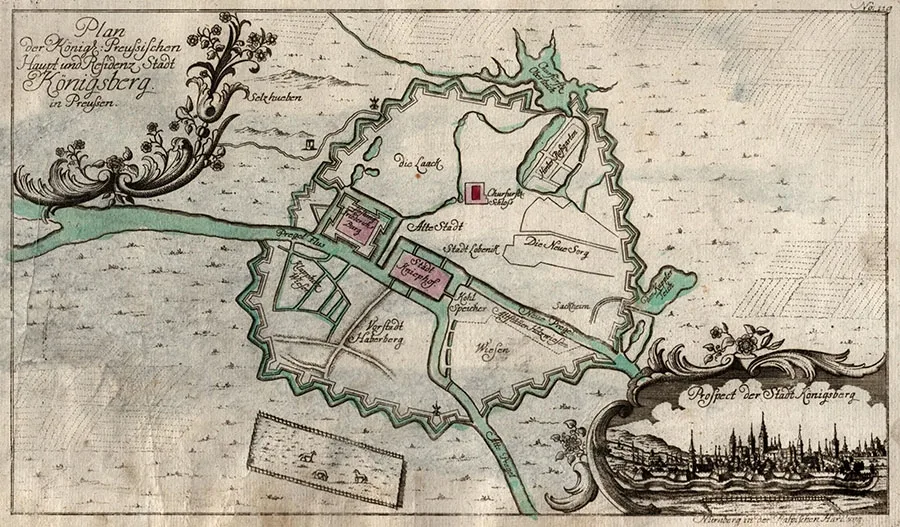
Willim Fermor was appointed the first governor-general of the new Russian province. He also retained the post of commander-in-chief of the Russian army.
In March, however, he left for the Vistula, where the army was being concentrated for new campaigns. Governing the province became difficult. It was therefore decided to transfer the administrative functions to a separate governor, subordinate to the commander-in-chief (the governor-general)56. At the beginning of May, Fermor announced to all military commanders “that, to ease my labours in the governor-generalship of the Kingdom of Prussia, Lieutenant General Korff has been appointed, with a salary of 500 roubles a month from the revenues of Prussia”57.
According to eyewitnesses, Korff was "not overly capable for such a responsible charge, and his talents were so unremarkable that he… could not even then write in Russian, nor indeed so much as sign his own name, but always signed it in German"58.
The instructions given to Korff in St Petersburg stated that, despite the conquest of the Prussian province, "it is nevertheless Our wish to leave forever a memory of Our magnanimity and mercy." The newly appointed governor was given his route (via Riga and Memel by the shortest road to Königsberg) and his powers ("to take command not only of all civil administrations, but also of Our troops forming the garrisons of Königsberg, Pillau, Memel and Tilsit"). The salary of 500 roubles a month originally set for Korff, to be paid out of the revenues collected in Prussia, was soon increased. Korff was permitted to bring with him from St Petersburg seven "servants." At the same time, "We hereby most earnestly enjoin that good order and strict discipline be maintained in all the towns and places of the Kingdom of Prussia, and above all that swift justice be done everywhere, without the slightest rudeness or offence being shown; all of which We entrust to your oversight and care." Korff's work as governor was made easier by the fact that "the government of the Kingdom of Prussia has been established upon its own rights, and nothing whatsoever has been abolished by Us, so that nothing remains for you but to see that the points granted by Us to Königsberg and to the whole Kingdom of Prussia at its petition, as set out in the enclosed copy of Our decree to General Fermor of 24 January of this year, be inviolably upheld, and that every office not slacken in the diligent performance of its duty"59.
More specific instructions were to be given to him by the Governor-General of Prussia, W. Fermor. Korff set out for Königsberg on 8 June and arrived there on 11 July 1758, by which time Fermor was no longer in Prussia, as the Russian army was then in the theatre of war, deep inside Prussia. Without waiting for Korff, Fermor left him a list of tasks the governor was to carry out in the near future. Among them were the collection of taxes (1 million efimki was to be raised in three stages: the first stage had already been completed, the second was to end on 12 July and the third on 12 September); the reconstruction of the fortifications and bringing them into a "defensible condition"; ensuring that Russian troops guarded the province's border along the Vistula; and maintaining order among the population of the province ("although all have taken the oath, they are not to be trusted, owing to their natural devotion to the king; rather, one must watch with an unsleeping eye and keep such trustworthy people as would report on ill-wishers and on correspondence").
A separate point concerned the extraction of amber: "Good watch must be kept over the gathering of amber along the sea shores, so that large and precious pieces may not by any cunning be concealed or carried across the border"60.
Governor Korff's rule was fairly liberal. There was none of the harsh policy so typical of wartime, whether in the collection of taxes or in suppressing the anti-Russian activities of certain German officials who had remained in service. At the same time, he led a life of luxury. Korff's secretary, A. Bolotov, later recalled: "...throughout his time in Königsberg he lived truly gloriously and magnificently, not as a lieutenant general would, but as some sovereign prince... His clothes, carriages, livery, horses, servants, table and everything else were kept on so lavish and magnificent a footing that he drew the attention of all the inhabitants of Prussia to himself; and as in time he added to all this very frequent entertainments at his house for all the most distinguished inhabitants of Königsberg, and endeavoured to provide amusements of every kind, ...his rank came to seem to everyone as exalted as if he were indeed some sovereign duke and monarch..."61
Korff remained governor of Prussia until the end of 1760, when he was transferred to St Petersburg as Chief of Police.
Fermor and Korff were both of German descent. This presumably explains why they treated the local population as fellow countrymen. They also granted concessions, often unjustified ones. Officially, however, they were guided by Elizabeth Petrovna's manifesto of 6 March 1758, which stated: "...it is Our pleasure, even in the midst of war, to care as far as possible for the welfare of lands not guilty of their ill fate, and therefore not to cut off their trade and commerce, but to protect and assist them"62.
Trade was the instrument by which the Russian government and the senior representatives in Prussia hoped to win the goodwill of the local population, understanding that Königsberg was first and foremost a merchant city.
Russian merchants were encouraged in every way to establish trade links with Prussian traders. The documents have preserved for us the names of Spiridon Falin from Ostashkov, Aleksey Zboilov from Velikiye Luki, Akinf Antonov from Toropets and others who came with their goods to the local market or supplied produce to the Russian army. (Unlike other victorious armies, which lived at the expense of the vanquished, the Russian troops received part of their provisions and other necessary goods from the Empire.)
Yet, despite the government's calls to develop trade, its volume remained small, and so on 23 May 1758 the Empress was obliged to issue another decree: "Many, however, hesitate to send their goods and ships to the lands of the King of Prussia. And for that reason We hereby declare a second time that, since We are firmly devoted to the expansion of free general commerce on the Baltic Sea, it is Our pleasure that such commerce not only be conducted without hindrance with the lands of the King of Prussia from here and from other places, but that the other provinces of the Kingdom of Prussia also... may enjoy it, and meet with no interference therein from Our fleet"63.
And what of the local merchants? There was no discrimination against them. On the contrary, as early as January 1758 the contracts for supplying provisions and fodder were awarded to local merchants headed by Adolf Saturgus. Restrictions were sometimes imposed on the export of grain and on trade with Hamburg and Lübeck. But these were dictated by military circumstances.
One of the most difficult issues the Russian administration had to resolve concerned religious worship. Königsberg itself now had a large Russian population: a considerable number of servicemen (from March 1758 the Azov and Arkhangelogorod Infantry Regiments, a hospital and the commandant's office), as well as merchants.
Meanwhile, the city had 18 churches, fourteen of them Lutheran, three Calvinist and one Roman Catholic. There were no Orthodox churches64.
What solution was found? Regimental churches were used. These field churches, with their modest furnishings, were set up in turn (as the regiments rotated) in the royal castle and were regarded as the garrison church. In Pillau, whose garrison consisted of a battalion first of the Perm and then of the Troitsk and Siberian Infantry Regiments, there was likewise no Orthodox church. In these circumstances Governor Korff petitioned the Empress "to send to Königsberg, Pillau and Memel one church each with the proper church furnishings." In April 1759 the Russian Synod received the imperial instruction "to prepare suitable houses or the local public churches in Königsberg, Pillau and Memel," and on 20 July 1760 (!) Archimandrite Yefrem reported his arrival in Königsberg and asked for instructions on allocating suitable buildings for churches. Korff proposed six premises in the Prussian capital, among them the Muscovite Hall in the castle, above the Lutheran church; the King's House, which stood on the street "leading towards Gumbinnen" (the former Königstraße, now Frunze Street); and the Lutheran-Catholic church "called the Polish one" on Steindamm... The clergy chose the church now better known as the Steindamm Church. It was one of the oldest churches in Königsberg, known as early as 1256. From 1526 it had been used by Polish and Lithuanian parishioners. Korff reports this as well: "...as the better and more fitting they chose that very church which was the first built in Königsberg, being named after St Nicholas...". On 4 September 1760 the church was consecrated with great solemnity before a large crowd of local people. Much testified to the interest the people of Königsberg took in Russian customs and traditions: any Russian feast drew crowds. And after the consecration of the church, when the Divine Liturgy followed, and "a most excellent sermon"... "throughout the whole time, which lasted from ten o'clock in the morning until one o'clock in the afternoon, the people watched it all with the utmost amazement; the splendour of the church ornaments and furnishings, together with the church singing, amazed them most of all"65.
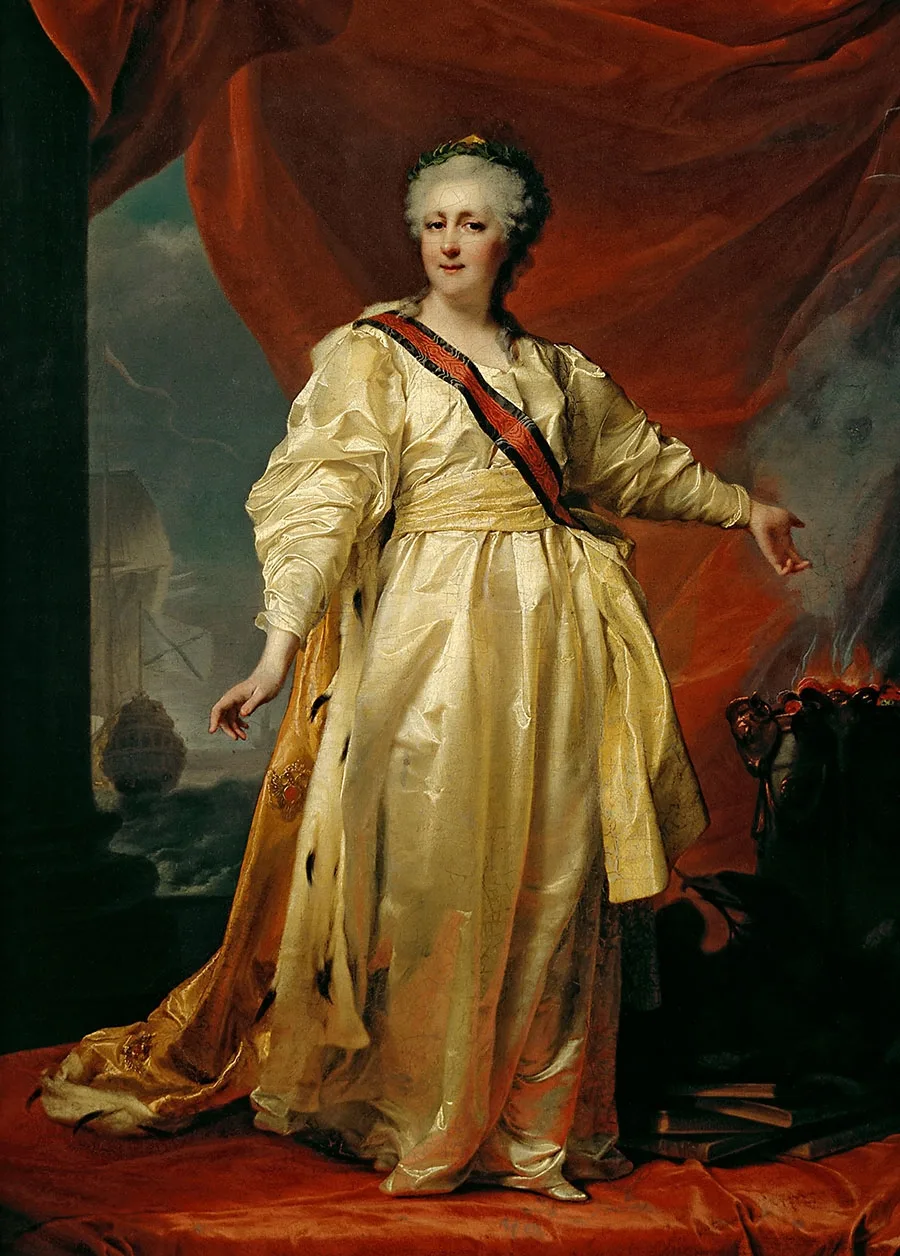
The key figures
Russian Empress Catherine II (top)
General-in-Chief Baron Nikolai Andreyevich Korf
Field Marshal Count Pyotr Semyonovich Saltykov (right)
General-in-Chief Pyotr Ivanovich Panin (bottom left)
Lieutenant General Vasily Ivanovich Suvorov (bottom right)
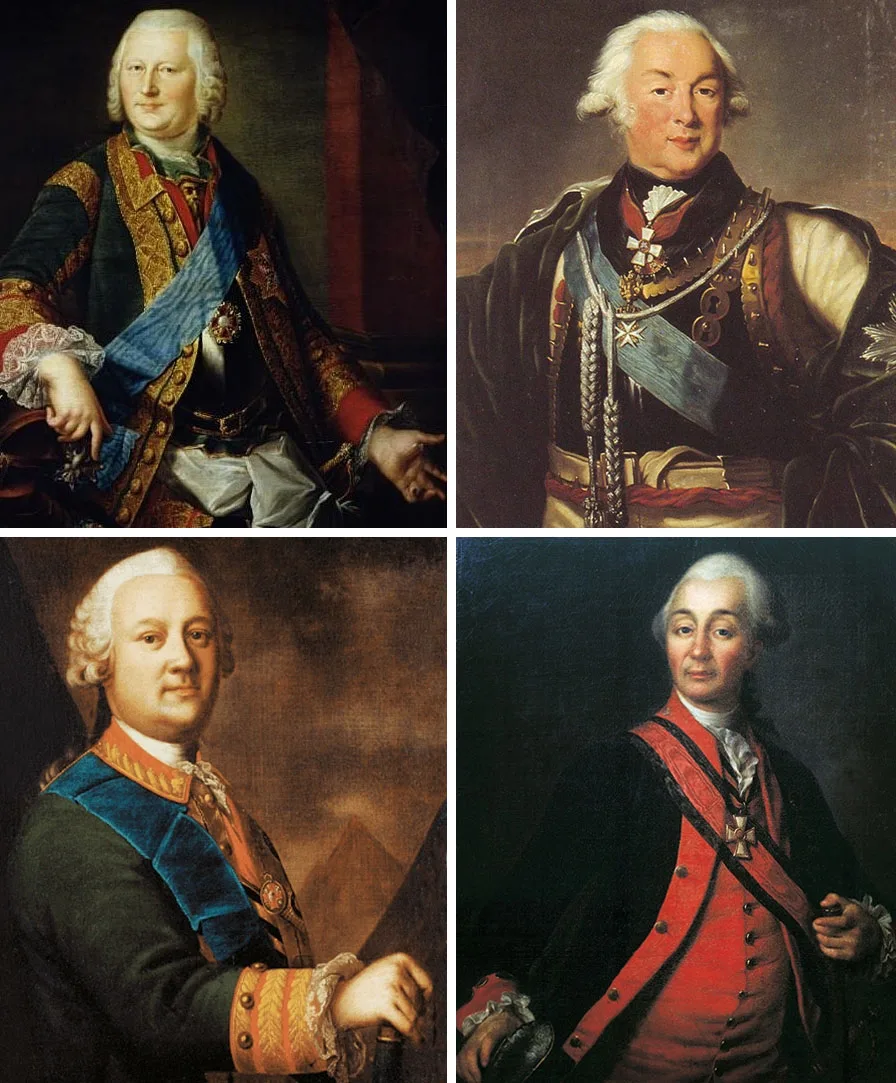
...War was raging in Europe, yet only faint echoes of it reached Prussia. Russia, however, was directly involved in the war and felt the full weight of its burdens. Its economy and finances were being drained. Russian society grew ever more vocal in its discontent that the new province bore virtually no obligations whatsoever to help support the army.
Moreover, it seems that as long as the Russian authorities held to the idea of exchanging the conquered Prussian province for Courland once the war was over, they were quite content with a situation in the province that caused no unforeseen trouble. The “peace and quiet” in relations between the population and the Russian authorities suited everyone. “We stood firmly in East Prussia; its ancient capital, Königsberg, had been turned into a Russian provincial town, Russian society made merry there without a care, and Russian governors-general peacefully ruled over all the conquered lands.
A Russian ecclesiastical mission headed by an archimandrite arrived in Königsberg; Russian coins were minted; and, finally, all the inhabitants of the subjugated country were made to swear allegiance as subjects of the Russian empress” — such is a brief summary of the situation that had taken shape in Königsberg at the time, and whose influence was still felt in Russian society a hundred years after the events described66.
Under these circumstances, it was only natural that the idea of fully annexing the Prussian province to Russia should take shape in St. Petersburg. True, the province was occupied by Russian troops, it was governed by a Russian governor, and Russian laws were being applied there ever more widely. But from an international point of view it was not yet a lawful Russian possession. International recognition was required. Russia was waging the war in alliance with several European states, and naturally their consent to such a step was needed first and foremost. On 30 April 1760, Empress Elizabeth Petrovna personally approved a plan for the annexation of Prussia to Russia drawn up by Chancellor M. L. Vorontsov. Some time later it was handed, as a Russian proposal, to the ambassadors Count Esterházy (Austria) and the Marquis de L’Hôpital (France)67.
The pro memoria stated that, in accordance with earlier agreements and the new treaty of alliance between Austria and France of 30 December 1759, most of the states taking part in the war in one way or another would receive “recompense.” Among them were Austria and France, Saxony, and even “the Danish court, for little more than its neutrality.” The Russian side, however, considered that these agreements failed to take all circumstances into account — above all those concerning Russia. For instance, once the war was over and all of Russia’s allies bordering on Prussia had returned to peaceful life, “Her Majesty (Empress Elizabeth Petrovna. — G. K.) will even then find herself in great difficulty as to how to bring back an army led so far afield, and how to preserve the magazines established in Prussia at countless expense and the artillery brought there.” Furthermore, in Russia’s view, these agreements did nothing to curb Prussia’s aggressiveness. In view of these and a number of other circumstances, Elizabeth Petrovna proposed to “the Empress-Queen Maria Theresa and King Louis XV” that — not as compensation for the losses Russia had suffered in the war, but in recognition of Russia’s contribution to European security through “the taming of the disturber of the peace” — at the post-war peace conference the “Kingdom of Prussia” (meaning the province of Prussia. — G. K.) “...be ceded.” All the more so since the province had been “truly conquered by the arms of Her Imperial Majesty, and its inhabitants have voluntarily sworn the oath of allegiance to Her Imperial Majesty.” This province, “resounding in name alone as a kingdom, yet in itself a far less weighty acquisition... suffices to prove that it does not belong to the Roman Empire, that the House of Brandenburg has not always possessed it, and that no new war need be started to conquer it — it is already conquered.” The Russian empress believed that in this way she would “worthily and justly obtain illustrious satisfaction.” The allies had only to compel Frederick II “to renounce it entirely” and to give “their guarantee thereof”68.
The negotiations between the allied powers, however, dragged on. Then came the death of Elizabeth Petrovna, and Russia turned from a mortal enemy into the most magnanimous friend of Prussia and of Frederick II. The pro memoria was simply forgotten.
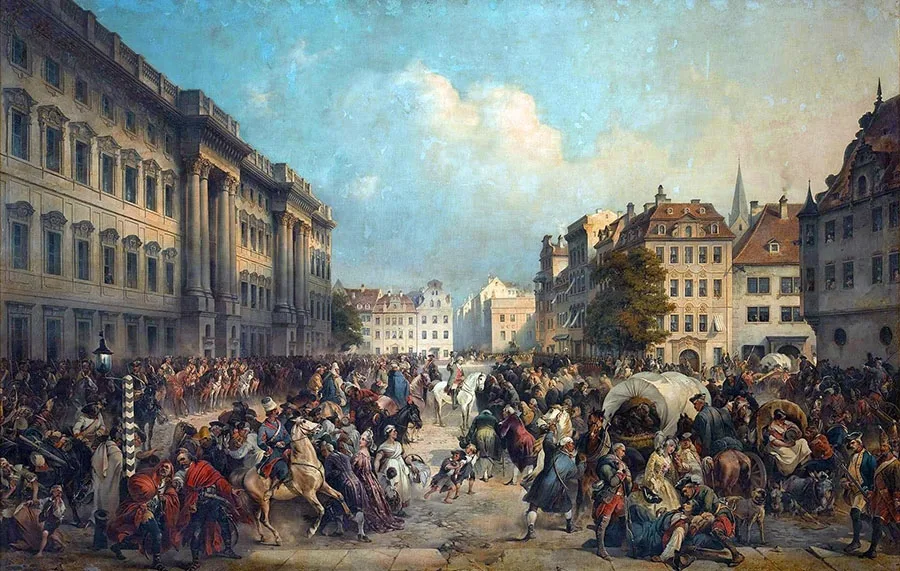 “The Capture of Berlin on 28 September 1760” (Alexander von Kotzebue, 1849).
At the same time, until Russia switched sides in the war in 1762, it still held the Prussian province, and so St. Petersburg concluded that, since the province might ultimately be annexed to Russia, Prussia should already be bearing the burdens of the war on an equal footing with all the other Russian provinces. But the province’s existing administration was incapable of such a change of course, and so, at the end of 1760, the Russian government sent V. I. Suvorov to replace Korf; he took office as governor on 5 January 1761.69
The father of the future Generalissimo was an influential figure in military circles and a member of the War College. On 20 April 1760, V. I. Suvorov was appointed General Provision Master in order to improve the supply of food to the army in the field. The Field Provisions Office was located in Königsberg at the time. In those years the city saw many Russian military and civil officials, so the arrival of one more official was nothing out of the ordinary. The local population was the first to feel his presence. With V. I. Suvorov’s direct involvement, permanent transport columns began to be set up for delivering provisions, and a pool of carts was assembled, whose upkeep was entrusted to the population. All of this was carried out in a planned manner and was paid for out of the treasury70.
The new governor’s work on restoring the protective structures in the Labiau area met with a favourable response among the population. A severe storm in January 1761 had destroyed the coastal dikes and swept away bridges, leaving seventy villages flooded. Alexander Obrezkov, a captain of the Perm Regiment, was dispatched to the disaster area to organise the restoration work. The governor personally monitored how the aftermath of the storm was being dealt with, demanding weekly reports from Obrezkov: where work had been done, how, and how many carts had been used. One of his letters to the captain has survived: “I have received three of your reports. Keep Lieutenant Karelin with you as an assistant. You are right to assure the Amtmänner that repair costs will be reduced. Serve the treasury. Instructions have been given to the Gumbinnen Chamber that the Amtmänner are not to hinder those wishing to take up the work”71.
Obrezkov's report on the work carried out is of particular interest (the urgent tasks were completed by November 1761, while others continued into 1762 until the new governor, Panin, halted them in the spring). It records, month by month and day by day, how many people worked with carts and without, how much earth was moved, and how much was paid per day for the work. It notes the Sundays, days of bad weather and Lutheran holidays, when no work was done. It lists the materials used and their cost, down to paper and ink: four thalers. And the result: expenditure amounted to 6,295 thalers 56 groschen, a saving of about 35 percent against the budget. Finally came Suvorov's gratitude: “...does not fail, for such care and diligence of yours in safeguarding the interests, to declare to you praise and the commendation of my satisfaction”72.
It was common knowledge that many of Prussia's engineering structures were in a rather dilapidated state. At the outset of its rule, the Russian command tried to put them in order.
However, owing to a shortage of funds, Empress Elizabeth Petrovna ordered in 1759 that this work be suspended for the time being73. It soon became clear that halting the work had been a mistake. The situation in Pillau was especially alarming.
The fortress itself was, by the standards of the time, a fairly substantial fortification. It had five bastions and was reinforced with ravelins, a water-filled moat and an auxiliary rampart, a counterguard. Inside the fortress there were powder magazines, a grain magazine (storehouse) and an arsenal. There was also everything needed to house the garrison, from the commandant's house to the church and the soldiers' quarters. The fortifications played an important role in peacetime too. Under their cover lay the “Vorstadt”, which had all the services a border town required: the “customs guardhouse”, the “state post yard” and the town warehouses. The “canal for the mooring of vessels” served as the place for loading and unloading. Its entrance was protected by a special defensive structure. In the view of the Russian military command, the fortress of Pillau could, if necessary, play an important role in the ongoing war. Above all, it was closer to the theatre of war than, for instance, the fortress at Memel. Moreover, it had a direct water connection with the province's capital. Naturally, the Russian administration paid it special attention.
In the summer of 1758, Governor Korf issued a written order “On the Repair of the Harbour at Pillau”. The work was carried out by the local population under the supervision of Russian engineers and was financed from provincial funds74.
On 15 April 1760, the commandant of the fortress, Colonel Khomutov, informed the governor “that the stone and wooden buildings of the fortress have fallen into great ruin in many places” and asked for an engineer officer to be sent to carry out an appropriate inspection.
In June of the same year, Korf received another letter pleading for help, “for the bridge before the ravelin has come into extreme disrepair”. If it were not repaired, “all communication between the fortress and the Vorstadt will be cut off”. The commandant asked for specialists to be sent and for money for the repairs, promising to find the necessary building materials locally75.
At this point Korf did not dare to violate the Empress's decree, even though circumstances demanded action. He turned to his immediate superior, Governor-General V. Fermor. Then, in November 1760, an appeal was sent to St Petersburg, to the Conference: repairing the fortresses of Pillau and Memel required 49,091 rubles 45 kopecks. The money was there in the Königsberg treasury; all that was needed was permission to spend it. While the Conference deliberated, a report was sent on 27 December to the commander-in-chief of the Russian army, Field Marshal A. Buturlin: if the “repairs” were not carried out, the winter storms would cause even greater damage. Here, too, there was a concrete proposal: pending a reply from the Conference, permission was sought to pay the inhabitants of Pillau for the work done at least 15 groschen on an ordinary day and 12 on a short one. But no swift answer came from either quarter. No one was willing to take responsibility76.
Only on 11 February 1761 did Buturlin send a reply to the new governor, instructing him not to build new structures but to restore the old ones, and only with the consent of the Main Chancellery of Artillery and Fortification in St Petersburg. In essence, Buturlin was evading a concrete decision, and so Suvorov, a persistent man with a firm grip on practical matters, turned to the commander-in-chief again on 1 March, reminding him that “not a little has collapsed in the fortress” and that a threatening situation had arisen in which “a very great danger presents itself to the Pillau fortress from the damaged places, for owing to the continuing strong and extraordinary winds the bulwark (the fortified part of the shore. — G. K.) along the glacis (the gentle earthen slope in front of the fortress's outer moat. — G. K.) has been so spoiled that the earth on the outer side has collapsed to almost two sazhens, and if the necessary preparations for repair are not made shortly, the sea will without doubt join the fortress moat, whereby the town may also be cut off from the fortress”. At his own risk, in breach of the Empress's ban, Suvorov promptly began the work, and as early as 12 March 1761 he reported to Buturlin, the commander-in-chief of the Russian army, “that many of the damaged places have already been restored to their former better condition”77.
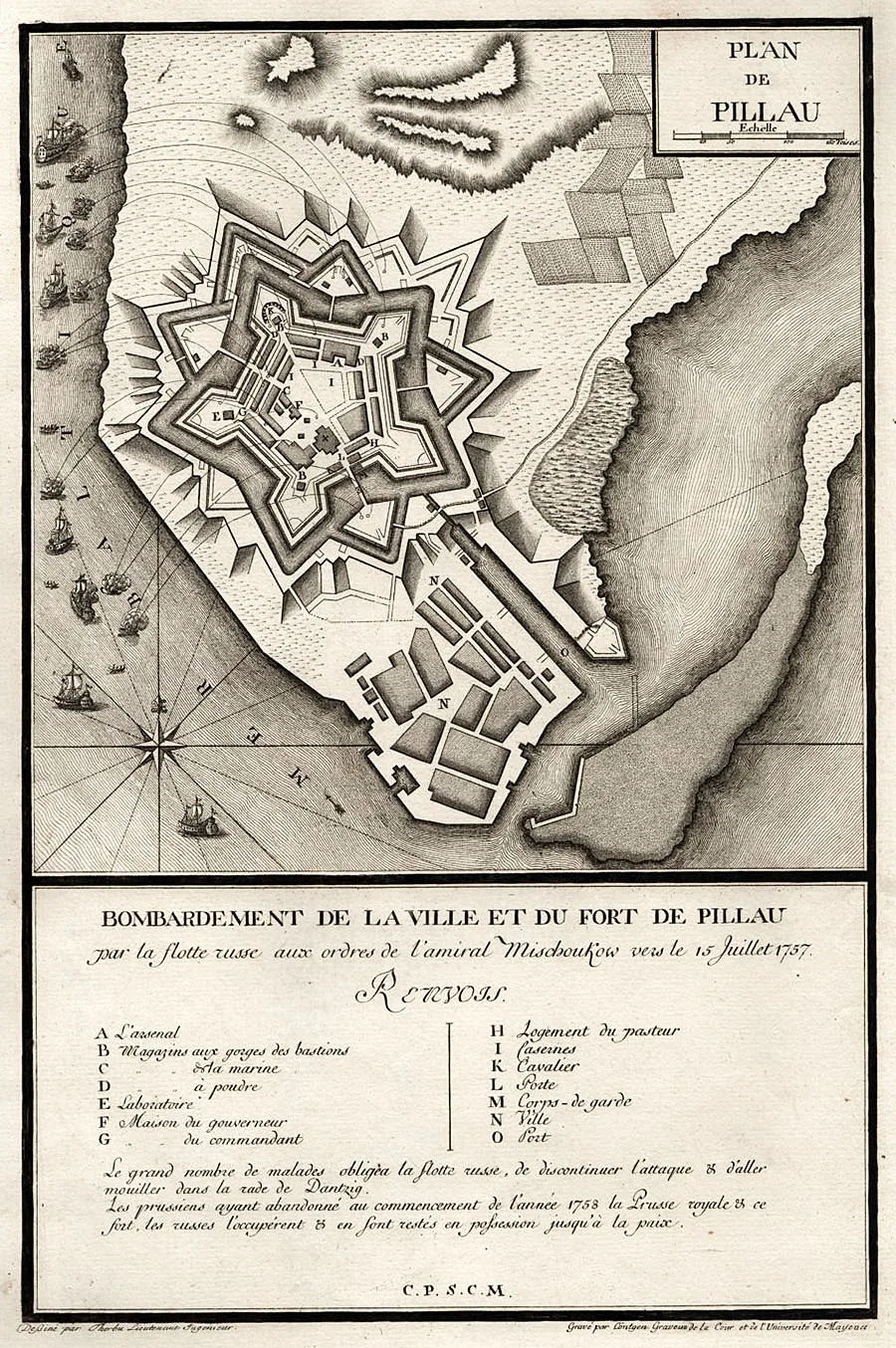
In pre-war Pillau this spot was known as the “Russische Damm”, and in present-day Baltiysk the name has survived as “Russkaya Damba” (the Russian Dam).
Yet perhaps the most significant event of V. I. Suvorov's tenure as governor was his campaign for leasing out the Ämter.
In Prussia there was a system whereby lands, together with the villages on them, were leased out for a fixed term. When it expired, the lease was renewed by concluding a new contract. Over the years, however, this had become an empty formality. The leaseholders, the Amtmänner, effectively held their estates permanently78.
Suvorov petitioned the Senate for permission to arrange for new contracts to be concluded on a competitive basis. To obtain greater revenue from the Ämter, he proposed leasing the land (where the previous term had expired) to any inhabitant who would pay the most. This guaranteed additional income. For example, the contract for the Amt of Friedrichsberg had been paying 2,037 thalers 24 groschen 4 pfennigs a year. At auction the Amt went to a townsman from Tapiau with a premium of 400 thalers a year. Suvorov's actions met with mixed reactions. The Senate approved them. The old Amtmänner proved unable to compete. Complaints followed. The situation was ambiguous. On the one hand, genuine farmers were pushed aside, and the Ämter were often leased to chance people with no knowledge of or experience in agriculture. On the other, revenue to the treasury rose. The governor saw that the income could be greater still and, despite the Amtmänner's discontent, planned to continue the scheme the following year. But he did not have time...79
V. I. Suvorov, like the other governors, was close to the court and kept abreast of all the affairs of the rival political factions. As a protégé of Peter I, he supported his daughter, Elizabeth Petrovna, but sensing that her reign was drawing to a close, he went over to the camp of Grand Duchess Catherine Alekseyevna, the future empress. And he suffered for it: immediately upon Peter III's accession he was dismissed as governor and summoned to St Petersburg. He faced exile in the guise of an appointment as governor of Tobolsk, but Suvorov did not go to Siberia and even took part in the overthrow of Peter III80.
Suvorov's governorship in Prussia lasted exactly one year. He did not manage to accomplish much, but he went into everything thoroughly and meticulously, cut back on extravagant balls and masquerades, and put an end to the dinners at the castle for the numerous officials.
The governor “during his administration was too zealous for the benefit of the state and not so well disposed towards the Prussians as his predecessor, but at times undertook matters not altogether agreeable to them”81. The situation in the province changed. Its tax burden and obligations were increased; the collection of recruit money began, as did the exploitation of local forest resources.
But then a change of power took place in Russia. Almost at the same time as the climax of the war between Prussia and Russia, the capture of the fortress of Kolberg by General Rumyantsev in December 1761, which heralded Frederick II's imminent defeat and the subsequent end of the war, Empress Elizabeth died and Peter III ascended the throne.
A supporter of Frederick II, Peter III dispatched to him that very same day his envoy Andrey Gudovich, a Germanophile who had shortly before completed his education in Königsberg, Halle and Leipzig82, to announce his accession and his intention to establish eternal friendship with Prussia. Russian historians believe that Peter III realized these intentions as early as the first treaty of 24 April 1762, under which all the territories occupied by Russian troops were unconditionally handed over to Frederick II83.
In the opinion of A. Mylnikov, one can find in Peter III's actions regarding the return of the Prussian lands occupied by the Russian army certain elements that, if they do not justify those actions, at least explain them, and the Russian tsar's pro-Prussian sentiments were not boundless84. Yet to Russian public opinion of the time (and today as well), Peter III's actions appeared strange, bordering on betrayal. After all, once Russian troops had taken Kolberg, the war was already threatening the vital centres of the Kingdom of Prussia, and Frederick II was prepared to give up his eastern province. Instructing his envoy Goltz on the conduct of peace negotiations with Russia, he wrote: "They (the Russians) will offer to withdraw their troops beyond the Vistula and to return Pomerania to us, but they will wish to keep Prussia either forever or until a general peace is concluded. To the latter you may agree; but if they wish to keep Prussia for themselves forever, then let them compensate me elsewhere..."85.
The Russian tsar's actions were the king's salvation. And Peter III's decision to transfer one of the finest corps of the Russian army to Frederick II's side, albeit without taking part in combat operations, seems utterly incredible.
In early 1762 Prussia was intensively, and not unsuccessfully, sounding out the possibility of a separate peace with Austria. France began to show peaceful inclinations towards England. The resolve of the allies had clearly cracked. Russia, of course, faced a serious danger of finding itself in international isolation. Frederick II, understanding how complicated the situation was for Russia, strove by every means to keep the ally who had appeared so unexpectedly. Peter III therefore received guarantees from the king that he would render every possible assistance, up to and including military aid, in recovering his native Schleswig from Danish occupation, would support the election of Prince Georg Ludwig of Holstein, the emperor's uncle, as Duke of Courland in place of E. Biron, and would back a king friendly to Russia for the Polish throne86.
And yet, despite the clearly negative assessments of Peter III's actions by Russian historians, there are circumstances that cannot be ignored when studying that period. Moreover, they had, to one degree or another, a corresponding influence on how the situation developed in the Prussian province.
Thus, on 5 May 1762 a peace treaty was concluded between Russia and Prussia, under which the eastern province was to be returned to Frederick II. And on 14 May Peter III signed a decree to the Admiralty Board stating that, owing to "the unrest continuing in Europe, our army cannot soon be brought back from its present positions, but is rather compelled to replenish without delay, from here, the magazines established for it" (including those in Pillau and Königsberg). Accordingly, the Kronstadt squadron was ordered to be made ready to put to sea ("but not to be dispatched until our decree"), whereas the Reval squadron under Rear Admiral G. A. Spiridov was, on the contrary, to be sent out as soon as possible "to cruise from the Gulf of Riga to the Stettin Lagoon, covering the transport vessels"87.
None of these details were known to the population of Prussia, but some echoes of the wavering in St Petersburg may have reached the province's military leadership. The local inhabitants, aware of Peter III's sympathy for Frederick II, and taking into account the concessions the Russian tsar had granted in Prussia's tax policy and other signs of favour, became firmly convinced that the province would soon return to the king's rule. All the more so since a deadline had been set: two months after the signing of the treaty of 5 May 1762.
Prussia was to pass under the jurisdiction of Frederick II. This date became known to everyone, but the official announcement of the peace treaty was to appear in print only after its ratification.
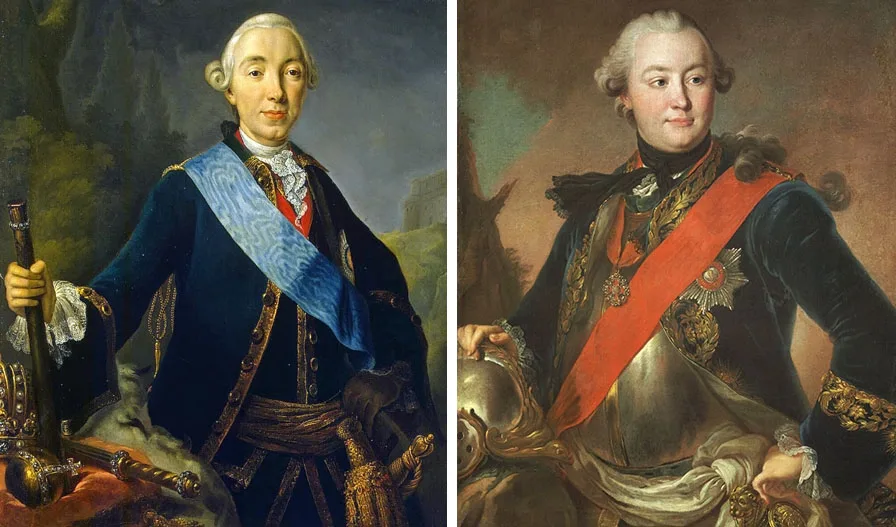 The key figures
Russian Emperor Peter III (left)
Master-General of the Ordnance, Prince Grigory Grigoryevich Orlov
The Russian governor P. I. Panin thus had to prepare for the handover of power in the province, while his successor F. M. Voeikov had to think about how to strengthen Russian authority there.
P. I. Panin was appointed governor on Christmas Eve, 6 January 1762.88 His rule in Königsberg was short-lived but exceptionally difficult, since he had to prepare for the return to the Prussian king Frederick II of the lands occupied by the Russian army during the war. A combat general, he had no experience of administrative work, yet he nonetheless managed to identify the essentials, the matters that had to be resolved for the successful withdrawal of troops from Prussia. The whole burden of the preparatory work, above all for the transfer of power, fell on him, and he believed, quite justifiably, that all measures for the change of power had to proceed on a lawful basis rather than as a fait accompli: "And since every execution of this treaty takes its beginning from the announcement and publication of the concluded peace..." Meanwhile, unlike the local inhabitants, who learned of the signing of the treaty relatively quickly, Panin for a long time had no official information on the matter. Turning to his superiors clarified nothing. In response to his inquiry, the commander-in-chief of the Russian army, P. S. Saltykov, could tell him nothing definite. "I have the copy concerning the peace for information only"; there was no permission to publish it89.
On 31 May Panin, having at last received news of the peace and of the duties assigned to him for "handing over the kingdom to the Prussians", turned to the emperor himself with a request to clarify certain "points". He asked what was to be done with the artillery, ammunition and arms (the treaty spoke only of handing over towns, lands and fortresses). Were they to be removed or handed over?
The treasury held cash, there were remaining stocks of salt, and Russian coinage was being struck in Königsberg: the mint held 1000 poods of copper (sale price 10 rubles per pood); there were stocks of flour (4813 chetverts), oats (28,288) and barley (1431). What was to be done with these stocks? What about the sick and wounded (833 in Königsberg, 255 in Pillau, 198 in Memel, 2154 people in all)? The governor demanded instructions as to where the Russian churches and their utensils should be sent, and where the officials and files should be dispatched.
Meanwhile, the publication of the peace treaty in Königsberg was being delayed, and the Prussian king's representatives, without waiting for official instructions, began to put forward their demands.
Particularly active was Domhardt, president of the Gumbinnen Chamber, whom Frederick II had temporarily placed in charge of the economic affairs of both chambers. On 4 July he sent Panin a sharply worded memorandum in which he announced that he was assuming full authority and demanded clarification of the procedure for handing over affairs. Domhardt wrote that a solemn peace had not been proclaimed to this day, nor would it be tomorrow, even though the Russians were awaiting news from St Petersburg. Therefore "we inquire in advance how you would be pleased to carry out the surrender of the city?" The remaining points were couched entirely in the form of orders: "That tomorrow morning the Friedrichsburg fortress be handed over to the Prussian commandant Colonel von Heydeck with all its appurtenant supplies. 3. That the soldiers be relieved at all state premises, both in the city and at the gates, and that guards from the magistrate be posted in their place tomorrow morning... 4. That the commandants installed until now in Memel and Pillau be likewise relieved, and the fortresses there, with their requisite appurtenances, be handed over to Prussian officers"90.
Panin had to reckon with Peter III's sympathy for Frederick II, on which the Prussian authorities were counting, but he could not sacrifice order in the province or the safety of the Russian troops stationed in Prussian towns. His reply and his actions were therefore measured. Panin announced that “as of tomorrow the Government, the Kammerjustiz, the police and other offices are handed over to the local college and department.” At the same time, several of Domhardt's demands were rejected. It was pointed out, for instance, that the Friedrichsburg fortress held a large quantity of munitions “which cannot be entrusted to a civilian guard.” Panin ordered the commandant of Königsberg, Colonel Reinsdorf, and the commandants of Memel and Pillau to replace the guards with the magistrate's (town) guard “at the state offices and the town gates.”
On 7 July Panin handed over his post to F. M. Voeikov, who had been appointed in his place91. Panin himself was ordered to join the troops who, according to Peter III's plan, were to prepare for war with Denmark over the Holstein inheritance.
However, the war never took place, and Catherine, who had come to power, promoted Panin to general-in-chief and entrusted him with an important task: “Knowing your zeal and devotion to Us, We most graciously confer upon you the rank of full general and command you to take the corps under the command of General Rumyantsev into your full command, and, upon receipt of this, to return with it to Russia without delay”92. Voeikov's assumption of office was made easier by a dispatch received from St Petersburg on 7 July with answers to Panin's queries about the procedure for handing over the province. These answers gave the governor a certain freedom of action. He was advised to sell the stocks of salt and copper held in Russian depots at the prevailing prices. The proceeds could be used to maintain the sick and wounded Russian soldiers in German hospitals. Artillery, ammunition and weapons were to be properly stored and not handed over to anyone on any pretext whatsoever. Moreover, the Russian guard was to be retained: “Our garrisons, although they will be relieved by royal ones, are nevertheless to remain there until Our further decree.” The most important answer came in point 13: “Concerning the conclusion of eternal peace between Us and His Majesty the King of Prussia, We most highly command you to make this known in that kingdom by promulgating the peace treaty, and thereby to declare the inhabitants of that kingdom of every rank... released from the oath of allegiance... sworn to Us.” Voeikov thus obtained the legal authority to hand the province over to the new authorities93.
On 8 July Voeikov published a proclamation releasing the population from the oath of allegiance to Russia that the inhabitants of the province had sworn back on 24 January 1758.
On the same day a coup took place in Russia, bringing Catherine II to power. A courier was immediately dispatched from St Petersburg to the army in the field to deliver to the commander-in-chief, Field Marshal P. S. Saltykov, the decree announcing the new empress's accession to the throne. The courier, a Guards officer named Koromyshev, travelled by way of Königsberg, where he arrived around 13–14 July. Although the decree was secret, the courier told Voeikov by word of mouth what had happened in St Petersburg. Official news of Catherine II's accession reached Königsberg from Commander-in-Chief Saltykov on 16 July. The following day the empress's decree, addressed directly to Voeikov, arrived94.
In his report to Saltykov in reply, dated 17 July, Voeikov informed the commander-in-chief of the steps he had taken, before receiving the official decree, “to make dispositions for taking this city once again under our government” and to prepare the oath of allegiance to the new empress. These are the measures he carried out on his own responsibility:
1. “Into the Friedrichsburg fortress, where there was already a Prussian commandant and where the garrison consisted of a very small number of men, partly Prussian invalids and partly townsmen, I ordered our soldiers, both from the battalions and from the artillery detachment, to be brought in under the pretext of work being carried out to empty our magazines and arsenals there.”
2. He took steps to increase the number of Russian soldiers performing guard duty and keeping order in public places. To the new authorities, the latter was justified on the grounds that
“the present fair, and still more the celebration of the peace being held here by the Prussian side, which began this past Wednesday, the whole city having been illuminated for two nights, requires that, should fights occasionally break out between our soldiery and their townsfolk, all this may be curbed and discipline thereby best maintained.”
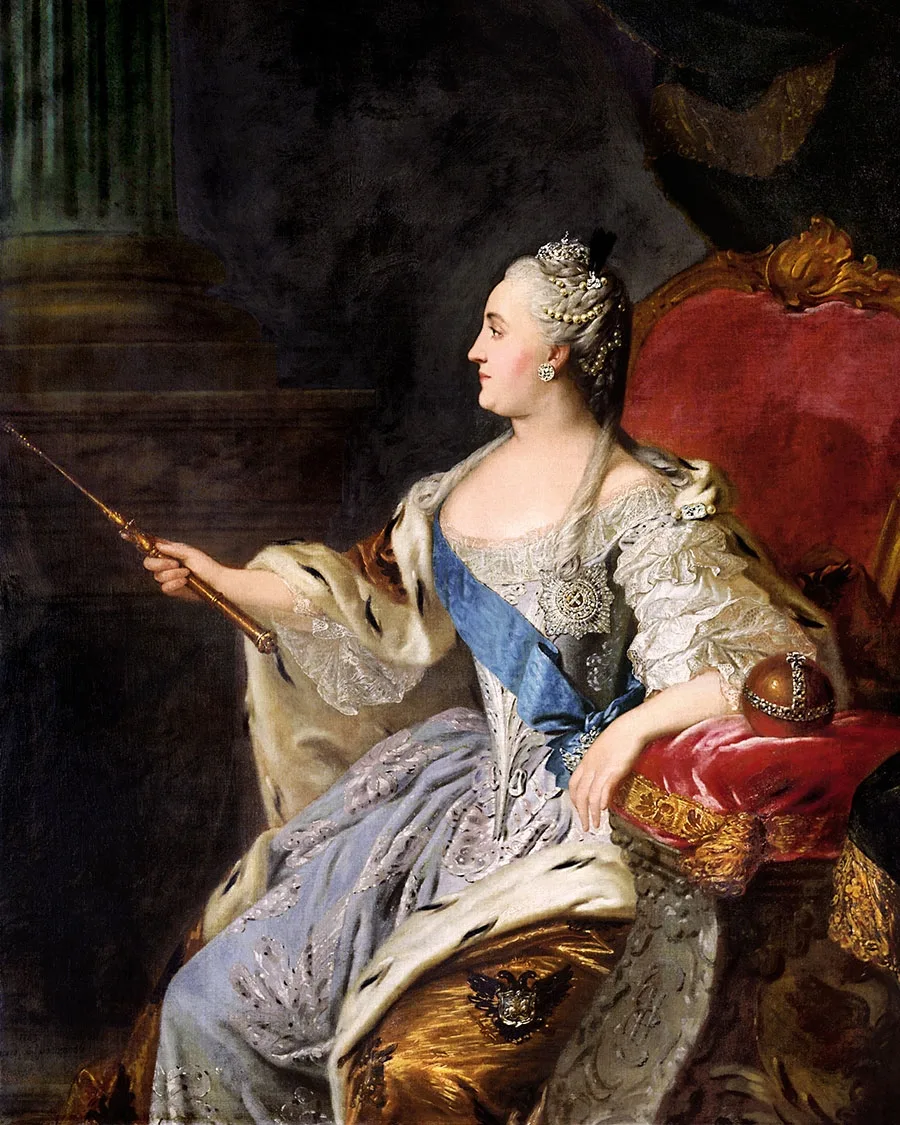 Portrait of Catherine II (Fyodor Rokotov, 1763).
3. He ordered the head of artillery, Colonel Burtsev, to make the artillery and ammunition ready to open fire, “and the soldiery posted both at the main guardhouse and at the pickets are to keep their muskets loaded, keeping all this secret.”
4. He ordered assembly points to be designated for the battalions in the event of an alarm.
After 16 July, Catherine II's manifesto was proclaimed in Königsberg, a service of thanksgiving was held, and the Russian soldiers and all Russian subjects were sworn in. Voeikov received instructions from Saltykov to take every measure to maintain order in the province and, to that end, not to allow Prussian officials to perform their duties. But “your chief endeavour must be not only to preserve peace and quiet in the Kingdom of Prussia, but also to put into effect everything that may serve... the obedience of its inhabitants, and in particular you are, without the slightest delay, to have the administration of the whole kingdom, together with its revenues, taken over by Russian officials, and the former posts occupied by Russian military men...”. It was assumed that “peace and quiet” could be achieved only when “all administrators who may already have arrived in the Kingdom of Prussia are without exception removed from their posts by you forthwith, and although they are to remain in their homes until a decree is issued or an order comes from me, Your Excellency shall not fail to keep a vigilant watch both over their conduct and that they retain nothing of the revenues collected...”95.
The situation in Königsberg gave cause for concern. The local inhabitants' festivities had to be cut short. The town commandant, Reinsdorp, was therefore given a special instruction ordering him not only to proclaim the manifesto, swear in the Russian subjects and have the Prussian coats of arms removed from the town hall and other buildings, which he duly did, but also to post the necessary guards, confiscate weapons from the local inhabitants and warn the soldiers “not to cause the inhabitants any unpleasantness.” Voeikov decided to move some of the troops stationed in the province closer to Königsberg. This is what he wrote to Colonel Bilov in Zinten: “Upon receipt of this, Your Honour will be pleased to take with you at once as many mounted and armed cuirassiers of the Cuirassier Regiment as possible and proceed to Königsberg with the utmost haste, but, without entering the city, first report to me in person and station the detachment outside the city... P.S. The cuirassiers are to have cartridges with bullets, and make the utmost haste here”96.
Voeikov's intuitive actions seemed to find support in the empress's first manifesto: “The glory of Russia, raised to great heights by her victorious arms, has, through the conclusion of a new peace with her very worst foe, in truth been delivered into utter servitude”97.
However, this manifesto was intended first and foremost for Russian society, which was dissatisfied with the peace with Prussia. A special rescript informed Frederick II that “We shall uphold the peace concluded with His Majesty sacredly and inviolably.” Neither Saltykov nor Voeikov could have known at the time that, simultaneously, General Chernyshev, who commanded the corps assigned to Frederick II, had received a special rescript instructing him to announce to the Prussian king that “We shall uphold the peace concluded with His Majesty sacredly and inviolably”98.
Voeikov's and Saltykov's actions in Prussia therefore naturally provoked discontent among the civilian population. Complaints and protests followed, reaching as far as St Petersburg itself. Saltykov was ordered to “correct his haste”, and the commander-in-chief in turn instructed Voeikov to gather the Prussian officials and announce to them that the measures he had taken had been prompted by ignorance of the situation in the Russian capital. Now that the situation had been clarified, they could resume their duties99.
Such contradictory first political steps by Russia’s new empress can hardly be explained, as some historians do, by Catherine II’s gratitude to the Prussian king for his part in arranging the destiny of Fike, a once obscure princess of modest standing. More likely, they were dictated by the need to withdraw Chernyshev’s Russian corps from Frederick II’s command. Subsequent events bear this out. On 11 July 1762 a special courier was dispatched to the Vistula with the order “to free the entire Kingdom of Prussia from occupation”. Yet the same courier brought Saltykov another letter, written in Catherine’s own hand. This letter is quoted in one of his works by Catherine II’s biographer V. A. Bilbasov: “Lord General Field Marshal! You will see from the dispatch enclosed herewith what I have declared for the world. Be assured, however, that I and all the true sons of the fatherland are most pleased with your action in ordering the occupation of the Kingdom of Prussia. God willing, this intolerable peace may yet be remade to our liking. Do not hasten, and be cautious: should the King of Prussia not release Count Chernyshev, see to it that our place d’armes remains securely in our hands. Truly, everyone thanks you. Catherine”100.
The correspondence between Saltykov and Voeykov shows that the Russian empress’s contradictory instructions concerning the fate of Prussia did nevertheless greatly confuse the situation in the province, where, in effect, a state of dual power had arisen.
At last the final Russian governor of Prussia received Saltykov’s order of 25 July 1762, instructing him to announce the definitive decision to hand over the province, henceforth to refrain from interfering in its internal affairs, and to allow Prussian garrisons to occupy the fortresses.
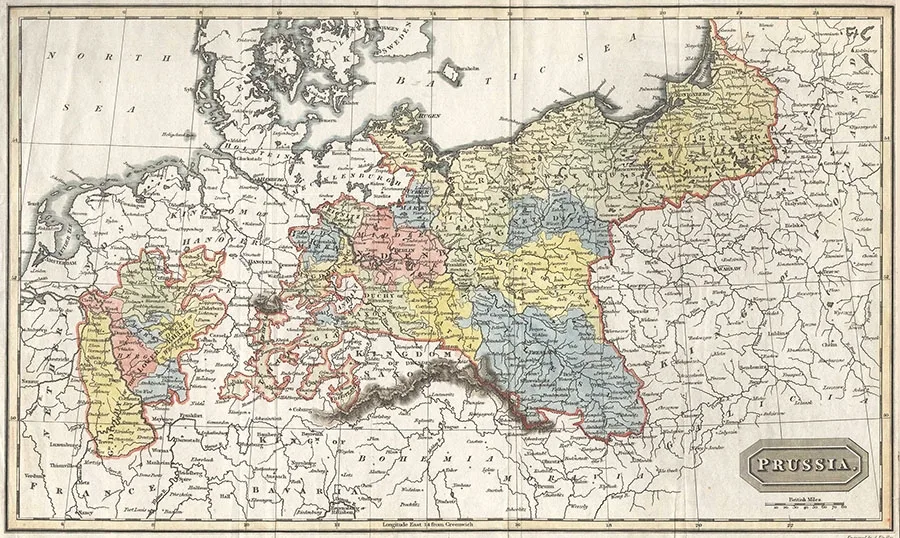 Map of Prussia from the early 19th century.
And, most importantly, Voeykov was informed that Catherine II had instructed her envoy in Prussia, Repnin, to settle with Frederick II the appointment of “special commissioners” to oversee the withdrawal of the Russian troops and the removal of provisions and fodder101.
Now came the most critical period: the return of the Russian army to Russia. The main burden of organising it fell on Lieutenant General Fyodor Matveyevich Voeykov. Saltykov instructed him not to wait for Repnin’s reply but to inform the Königsberg government of the task entrusted to the Russian envoy, and to try to determine the routes the troops would take via Tilsit and Gumbinnen, as well as the prices and quantities of provisions and fodder the Prussian authorities could supply to our troops. “You may also add, and give assurance, that the swift fulfilment of this demand will hasten the return of the troops... to Russia”102.
The Königsberg chancellery replied that the Russian troops would be helped with provisions and fodder, but that this required information on the number of servicemen and horses, the length of the routes and the timetable for the army’s withdrawal. Naturally, the Russian command could not supply information that every nation regards as a military secret, and so it was decided to make the fullest possible use of its own supplies and to ask for help only in exceptional cases.
The withdrawal of the troops began in August 1762, yet some of them still remained in Prussia. Although their total number stationed in the province itself was small (about four thousand men, not counting Chernyshev’s corps), the withdrawal was held up by numerous obstacles: the removal of state property, weapons and the wounded (2,154 men), a shortage of carts hired from the local population, and disputes with the Prussian authorities over various financial and material matters. The situation around the remaining garrisons grew more complicated. In early October 1762 Voeykov reported to the empress that the Prussian governor Lehwaldt “by his frequent demands, both oral and written, most insistently pressed not only for the fortresses of Pillau and Memel to be vacated as quickly as possible, but also for several military detachments to be withdrawn from Königsberg itself and stationed in other places nearby”. The magistrates of the Vistula towns of Thorn, Marienburg and Elbing also petitioned for the withdrawal of the troops. Such “massive” pressure forced Voeykov to react. He withdrew some of the battalions from Königsberg and Pillau and continued removing property and weapons103.
Pressure was also brought to bear on Voeykov by the Prussian court. Frederick II informed the Russian envoy, Prince N. Repnin, that he had been receiving letters from Königsberg about the presence there of Russian troops numbering as many as eight battalions. What was the reason for this? In his reply to the Russian envoy, Voeykov had to repeat what he had written to Catherine II in order to clarify the situation for the Prussian king. He also reported that it had been decided to sell off the grain stocks, but that the Prussian authorities were offering far too low a price104.
The army’s return to Russia proved neither easy nor quick, and by the end of 1762 it had still not been completed. After the departure for Russia of the commander-in-chief of the Russian army, P. I. Saltykov, Voeykov remained in Prussia as the senior Russian military commander.
On 22 April 1763 Catherine II sent Voeykov a message reading as follows: “Fyodor Matveyevich. The absence of Field Marshal Saltykov from the command has made it necessary to leave you in command”105. This is one of the last documents to record the final period of the Russian troops’ presence in Prussia. In the same year, 1763, soon after his return to Russia, F. M. Voeykov was appointed Governor-General of Kiev and Novorossiya.
Thus ended the Seven Years’ War for Russia. Because of Peter III’s actions, Russia took no part in concluding the Peace of Hubertusburg in February 1763. Prussia, for its part, not only retained under this peace the territories it had gained in the Silesian Wars, but also considerably strengthened its position on the European stage.
__________________
1 – Туполев Б. М. Фридрих II, Россия и первый раздел Польши // Россия и Германия. М., 1998. С. 55.
2 – In historiography these two wars are sometimes treated as a single war — 1740—1748. — См., напр., Яковлев Н. Н. Европа накануне Семилетней войны. М., 1997. С. 7.
3 – Коробков Н. М. Семилетняя война (1756—1762 гг.). М., 1940. С. 53, 54.
4 – Politische Korrespondenz Friedrichs des Großen. Bd. V. Berlin, 1880. S. 64.
5 – Politische Korrespondenz Friedrichs des Großen. Bd. II. Berlin, 1879. S. 406.
6 – Цит. по: Масловский Д. M. Русская армия в Семилетнюю войну. Вып. 1. СПб., 1886. С. 125.
7 – Цит. по: Соловьев С. М. История России с древнейших времен. М., 1964. Т. 23. С. 193—194.
8 – Коробков Н. М. Указ. соч. С. 19; Яковлев Н. Н. Указ. соч. С. 24; Черкасов П. П. Двуглавый орел и королевские лилии. М., 1995. С. 54; Пуцилло М. Русские великаны на прусской службе (1711—1746). М., 1878. С. 25-27.
9 – Черкасов Ц. П. Указ. соч. С. 50.
“Анисимов Е. В. Россия в середине XVIII века // В борьбе за власть: Страницы политической истории России. XVIII в. М., 1988. С. 139—140. However, P. P. Cherkasov believes that Frederick himself imposed his will on the British. См. указ, соч., с. 60.
11 – Архив кн. Воронцова (в дальнейшем — АВ). Т. 3. М., 1871. С. 377, 379.
12 – См., напр.: Коробков Н. М. Указ. соч. С. 24—25.
13 – Сб. РИО. 1872. № 9. С. 27-29.
14 – Русская старина. 1873. Т. VII. С. 706—713.
15 – Palisade: a continuous stockade of logs sharpened at the top.
16 – Масловский Д. М. Указ соч. С. 149—150.
17 – Beckhern С. Geschichte der Befestigungen Konigsbergs. Konigsberg, 1890. S. 83—84.
18 – Hasenkamp X. Ostpreussen unter dem Doppelaar. S. 112—117; Beckhern C. Ebd. S. 84.
19 – D. Maslovsky, however, believes that the restored fortifications, if they could hold back cavalry at all, could only have held back regular cavalry. Irregular cavalry, represented by Cossacks and Kalmyks, would have overcome such obstacles in any case. This was well understood in Königsberg too, which explains the panic that seized the city authorities on news of the Russian advance. — См. Масловский Д. М. Указ. соч. С. 150.
20 – Масловский Д. М. Указ. соч. С. 151.
21 – Масловский Д. М. Указ. соч. С. 153.
22 – Stamm H.-U. Schicksal in sieben Jahrhunderten. 1980. S. 75.
23 – Коробков H. M. Указ. соч. С. 98; Stamm H.-U. Ebd. S. 'll.
24 – Коробков H. M. Там же.
25 – Масловский Д. М. Указ. соч. С. 53.
26 – Масловский Д. М. Указ. соч. С. 68; Коробков Н. М. Указ. соч. С. 76, 78; Семека С. А. Медицинское обеспечение русской армии во время Семилетней войны 1756—1763 гг. М., 1951. С. 55.
27 – Болотов А. Т. Жизнь и приключения Андрея Болотова, описанные им самим для своих потомков. СПб., 1871. Т. 1. С. 524—529. The battery of Shuvalov howitzers, which reached the army on the eve of the campaign, was commanded by Lieutenant Ivan Gannibal, the future grandfather of A. S. Pushkin. — See: Масловский Д. М. Указ. соч. Приложения к первому выпуску. Табл. 24.
28 – Болотов А. Т. Указ. соч. С. 535—536.
29 – Цит. по: Коробков Н. М. Указ. соч. С. 124.
30 – Russian historians still argue over whether the decision to retreat was justified. D. M. Maslovsky defended Apraksin, while N. M. Korobkov found Maslovsky's arguments unconvincing. — See, e.g.: Коробков Н. М. Указ. соч. С. 131. See also: Кретинин Г. В. Генерал-фельдмаршал Апраксин в Пруссии // Вопросы истории. 1998. № 7. С. 147—151.
31 – Российский государственный военно-исторический архив (РГВИА). Ф. ВУА. Д. 1657 (А). Л. 664—668. См. также: Голованова Л. Д. Кретинин Г. В. О походе русской армии в Пруссию в 1757 году // Калининградские архивы: Материалы и исслед. Калининград, 1998.
32 – Журнал о военных действиях российской императорской армии. СПб., 1761. Ч. ГС. 30.
33 – Масловский Д. М. Указ. соч. С. 259.
34 – РГВИА. Ф. ВУА. Д. 1657 «А». Л. 633.
35 – АВ. М., 1877. Т. 4. С. 350; Коробков Н. М. Указ. соч. С. 147.
36 – Масловский Д. М. Указ. соч. М., 1888. Вып. 2. С. 45—46.
37 – РГВИА. Ф. ВУА. Д. 1663 «А». Л. 5; Масловский Д. М. Указ. соч. Приложения 2-го выпуска. С. 8.
38 – Масловский Д. М. Указ. соч. Вып. 2. С. 46.
39 – РГВИА. Ф. ВУА. Д. 1657 «А». Л. 664-668; АВ. Т. 4. С. 337.
40 – Масловский Д. М. Указ. соч. Вып. 2. Приложение 12.
41 – Там же. Вып. 2. С. 47, 55.
42 – Болотов А. Т. Указ. соч. Т. 1. С. 626.
43 – Семилетняя война. Материалы о действиях русской армии и флота в 1756—1762 гг. М., 1948. С. 235—236; Журнал о военных действиях... С. 51.
44 – Масловский Д. М. Указ. соч. Вып. 2. С. 48. Maslovsky in turn cites: Hasenkamp Н. Ebd. S. 268.
45 – Масловский Д. М. Указ. соч. Приложения 2-го вып. С. 19—20.
46 – Там же. Вып. 2. С. 51—52.
47 – Коробков Н. М. Указ. соч. С. 150—151.
48 – Филиппов М. М. Эм. Кант. Его жизнь и философская деятельность. СПб., 1893. С. 21—22.
49 – РГВИА, Ф. ВУА. Д. 1657 (А). С. 664-668.
50 – Масловский Д. М. Указ. соч. Приложения 2-го вып. С. 106—108.
51 – Гаузе Ф. Кенигсберг в Пруссии. 1994. С. 140—141.
52 – Масловский Д. М. Указ. соч. Приложения вып. 2. С. 27—34; Коробков Н. М. Указ. соч. С. 152.
53 – АВ. 1873. Т. 6. С. 443.
54 – Масловский Д. М. Указ. соч. Приложения 2-го вып. С. 35—43.
55 – Там же. С. 44—48.
56 – The governors of Prussia were N. A. Korf (1758—1760), V. I. Suvorov (1761), P. I. Panin (January — June 1762) and F. M. Voeykov (June — August 1762). The post of governor-general was abolished at the request of V. I. Suvorov.
57 – Масловский Д. Указ. соч. Вып. 2. С. 139.
58 – А. Т. Болотов в Кенигсберге: Из записок А. Т. Болотова, написанных им самим для своих потомков. Калининград, 1990. С. 69.
59 – Полное собрание законов Российской империи. Т. XV. Ст. 10833.
60 – РГАДА. Ф. 25. On. 1. Д. 9. Л. 1-10.
61 – А. Т. Болотов в Кенигсберге. С. 90—91.
62 – РГАДА. Ф. 25. On. 1. Д. 128. Л. 2.
63 – РГАДА. Ф. 25. On. 1. Д. 128. Л. 14.
64 – РГВИА.Ф. ВУА. Д. 1657 (А). Л. 664—668; А. Т. Болотов в Кенигсберге. Калининград, 1990. С. 59.
65 – РГАДА. Ф. 25. On. 1. Д. 25. Л. 31—32, 59—60. Более подробно см.: Кретинин Г. В. Под Российской короной, или Русские в Кенигсберге. 1758—1762. Калининград, 1996. С. 46—48.
“ Присоединение Пруссии к России. Листки из записной книжки «Русской старины» // Русская старина. СПб. 1873. Т. VIE С. 705.
67 – Там же. С. 705-706.
68 – Там же. С. 706—713.
69 – А. Т. Болотов в Кенигсберге. С. 138.
70 – РГАДА. Ф. 25. On. 1. Д. 312. Л. 2.
71 – Там же. Д. 376. Л. 1, 9 и далее.
72 – Там же. Л. 72-73, 103, 151-158, 160.
73 – РГАДА. Ф. 25. On. 1. Д. 144. Л. 2; Д. 328. Л. 45.
74 – Там же. Д. 144. Л. 2.
75 – Там же. Д. 328. Л. 2, 6.
76 – Там же. Л. 45.
77 – Там же. Л. 46.
78 – Масловский Д. Указ. соч. Приложения 2-го вып. С. 44—45.
79 – РГАДА. Ф. 25. On. 1. Д. 393. Л. 1-19.
80 – Штелин Я. Я. Записки // Русский архив. 1909. № 7. С. 531.
81 – А. Т. Болотов в Кенигсберге. С. 170.
82 – Бантыш-Каменский Д. М. Биографии российских генералиссимусов и генерал-фельдмаршалов. СПб., 1840. Ч. 3. С. 10, 31, 286.
83 – См., напр.: Коробков Н. М. Указ. соч. С. 321.
84 – Мыльников А. С. Искушение чудом: «Русский принц», его прототипы и двойники-самозванцы. Л., 1990. C. 83.
85 – Цит. по: Коробков Н. М. Указ. соч. С. 320.
86 – Мыльников А. С. Указ. соч. С. 82.
87 – Там же. С. 82-84.
88 – РГАДА. Ф. 25. On. 1. Д. 431. Л. 1.
89 – РГАДА. Ф. 25. On. 1. Д. 529. Л. 70-71.
90 – Там же. Л. 94.
91 – Panin's report on handing over his post was signed on 27 June (Old Style). — РГАДА. Ф. 25. On. 1. Д. 438. Л. 26. See also: Коробков Н. М. Указ. соч. С. 326.
92 – Энциклопедический словарь. Брокгауз и Ефрон. Т. 44. С 595—596'
93 – РГАДА. Ф. 25. On. 1. Д. 529. Л. 87.
94 – РГАДА. Ф. 25. On. 1. Д. 530. Л. 23.
95 – РГАДА. Ф. 25. On. 1. Д. 530. Л. 1-21.
96 – РГАДА. Ф. 25. On. 1. Д. 530. Л. 6.
97 – Бильбасов В. А. Исторические монографии. СПб., 1901. Т. 5. С. 333.
98 – Там же. С. 333.
99 – РГАДА. Ф. 25. On. 1. Д. 454. Л. 4.
100 – Бильбасов В. А. Указ. соч. С. 333—334.
101 – РГАДА. Ф. 25. On. 1. Д. 454. Л. 21.
102 – Там же.
103 – РГАДА. Ф. 25. On. 1. Д. 500. Л. 4, 5, 23, 26.
104 – РГАДА. Ф. 25. On. 1. Д. 500. Л. 26-27.
105 – РГАДА. Ф. 25. On. 1. Д. 438. Л. 37.
Translated from Russian with the help of AI (Claude, Anthropic), October 2026.