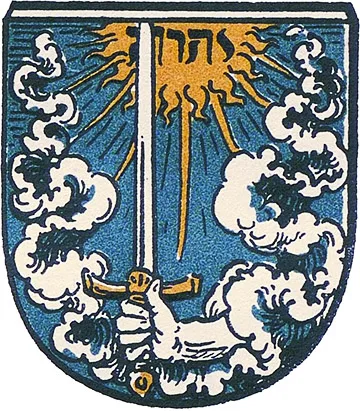
 Coat of arms
of Tapiau
In 1275 Tapiow was besieged by the Lithuanians, but they failed to take the fortress. By 1280 the frontier of the Order's conquests had moved far to the north-east. It was decided to rebuild Tapiow in a better-protected place, on a peninsula surrounded by rivers and marshes. From 1280 to 1301 the new castle was the seat of a Komturei (commandery). The first Komtur was Ulrich Bauwarus, who fell in 1281 in battle with the Sudovians. In 1281–90 the Komtur was Dietrich von Speyer, and in 1290–1301 the knight Werner, nicknamed Werniko. In 1301 the Komtur's residence moved to Insterburg / Insterburg (Chernyakhovsk), and Tapiau came under the Komturei of Königsberg. In 1326–28 the Pfleger (keeper) of Tapiau Castle was Heinrich Dusemer, later elected Grand Master of the Order.
In 1383 the Lithuanian prince Vytautas was baptised for the first time in Tapiau.
After 1340, construction of a new castle in stone began. The castle was meant to protect the canal then being built from the Pregel to the Curonian Lagoon – the future Deime river. The first lock on this canal was located by the castle. Around 1347–59 a four-wing building without towers was erected. In front of the castle lay an outer bailey with numerous living quarters to house the brethren of the Order and the "guests" who took part in the campaigns against Lithuania. During such campaigns many eminent persons stayed at the castle: in 1377 Duke Albrecht of Austria, in 1378 the Duke of Lorraine, and in 1390 and 1391 Henry of Derby, the future King Henry IV of England.
During the Thirteen Years' War (1454–66) Tapiau Castle was seized in 1454 by supporters of the Prussian Confederation, but as early as 1455 it was retaken by the Order's troops.
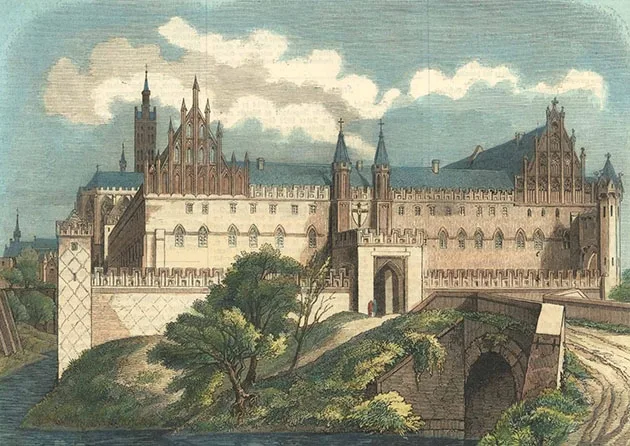
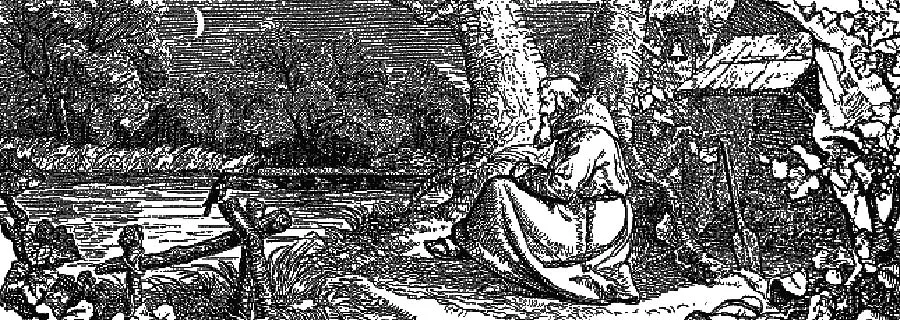
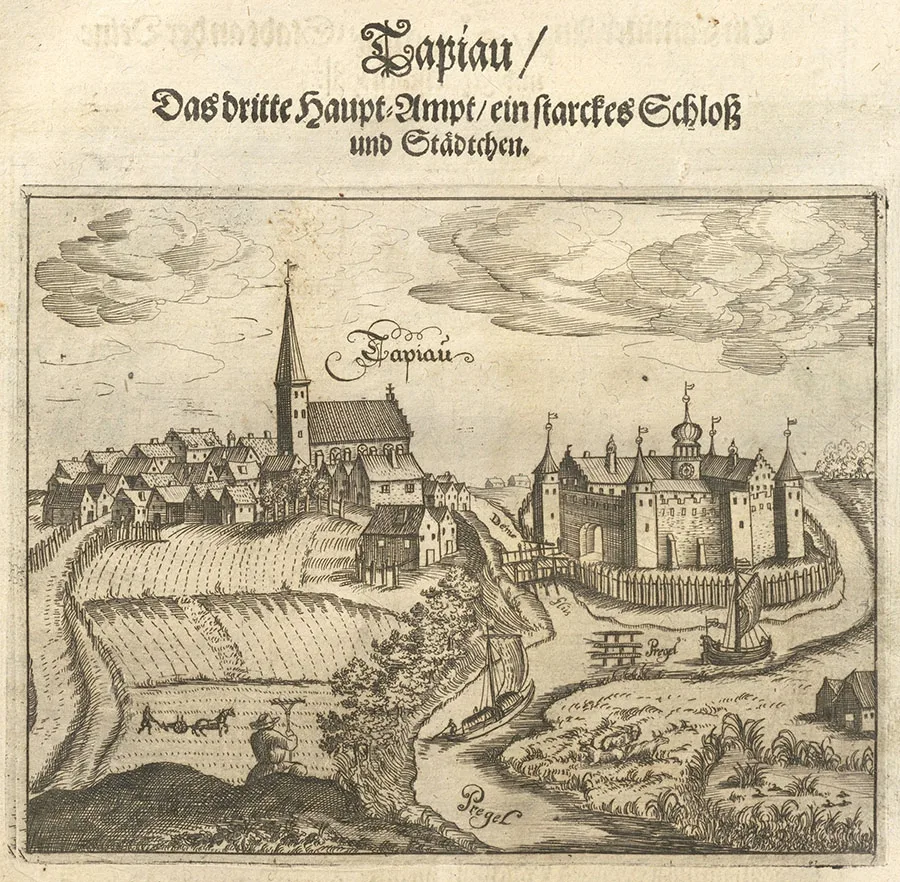 View of Tapiau from the Königsberg side. Engraving by Christoph Hartknoch, 17th c.
After the loss of Marienburg / Marienburg (Malbork, Poland) in the first half of the 15th century, the Order's authorities moved their archive to Tapiau. In 1474 the disgraced Bishop of Samland, Dietrich von Cuba, starved to death in the castle cellars, which were used as a prison.
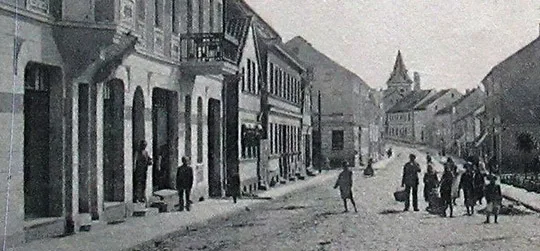
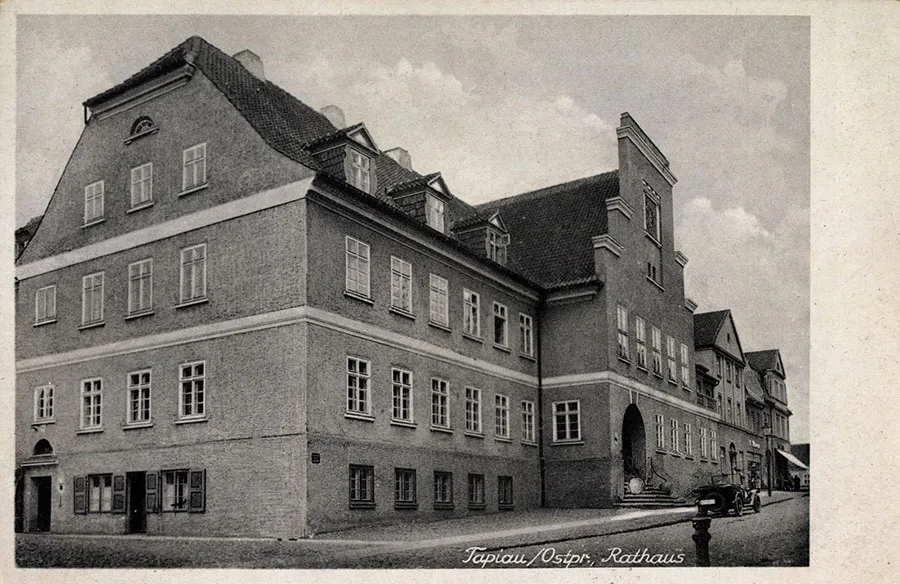 Town Hall of Tapiau.
In 1502 the parish church was built in the town, and in 1520 the first school opened.
After the secularization of the Teutonic Order, the administrative bodies of the Amt were housed in Tapiau Castle. The castle itself became a temporary ducal residence. On 20.03.1568 the first Duke of Prussia, Albrecht of Brandenburg, died in Tapiau Castle.
On 03.01.1615 Johann Ernst von Wallenrodt / Wallenrodt was born in Tapiau – the son of Martin von Wallenrodt, founder of the Wallenrodt Library in Königsberg, later Landhofmeister (from 1660) and continuer of his father's work of expanding the family library.
In May 1697 the Grand Embassy passed through Tapiau, stopping there to rest. (Peter I was not with it; he had travelled to Königsberg by water.)
On 06.04.1722 Tapiau received town rights from King Friedrich Wilhelm I.
In 1723–1808, under the new administrative division, Tapiau was the seat of the Kammeramt of the same name, which (after 1752) comprised the Hauptämter of Labiau / Labiau (Polessk), Tapiau, Taplacken / Taplacken (Talpaki) and Wehlau / Wehlau (Znamensk). In 1786 an almshouse was opened in the castle premises.
In 1818, when the districts – Landkreise – were created, Tapiau was not granted the right to head a district of its own and was assigned to the Landkreis of Wehlau / Wehlau (Znamensk).
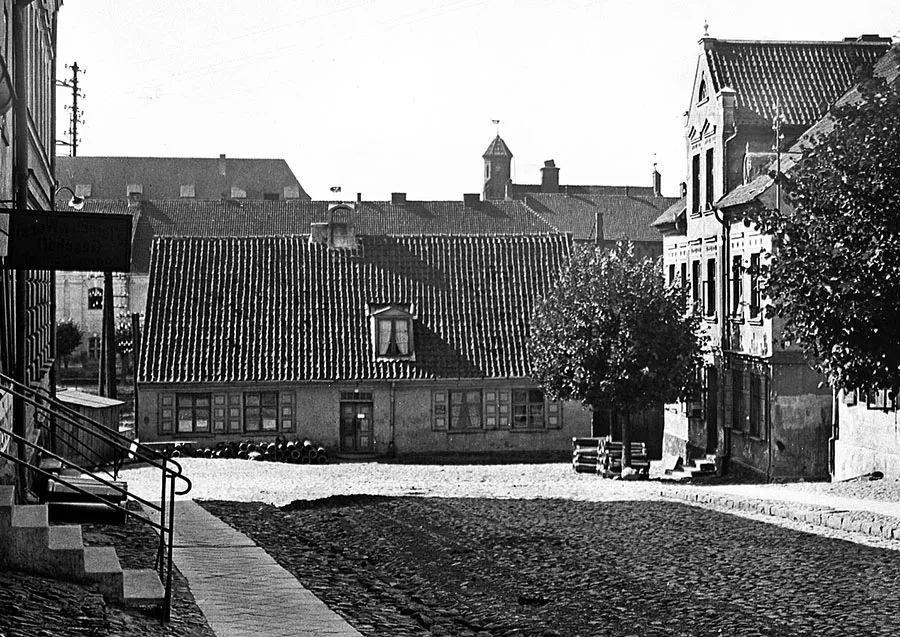 The house where Lovis Corinth was born, the great Prussian painter.
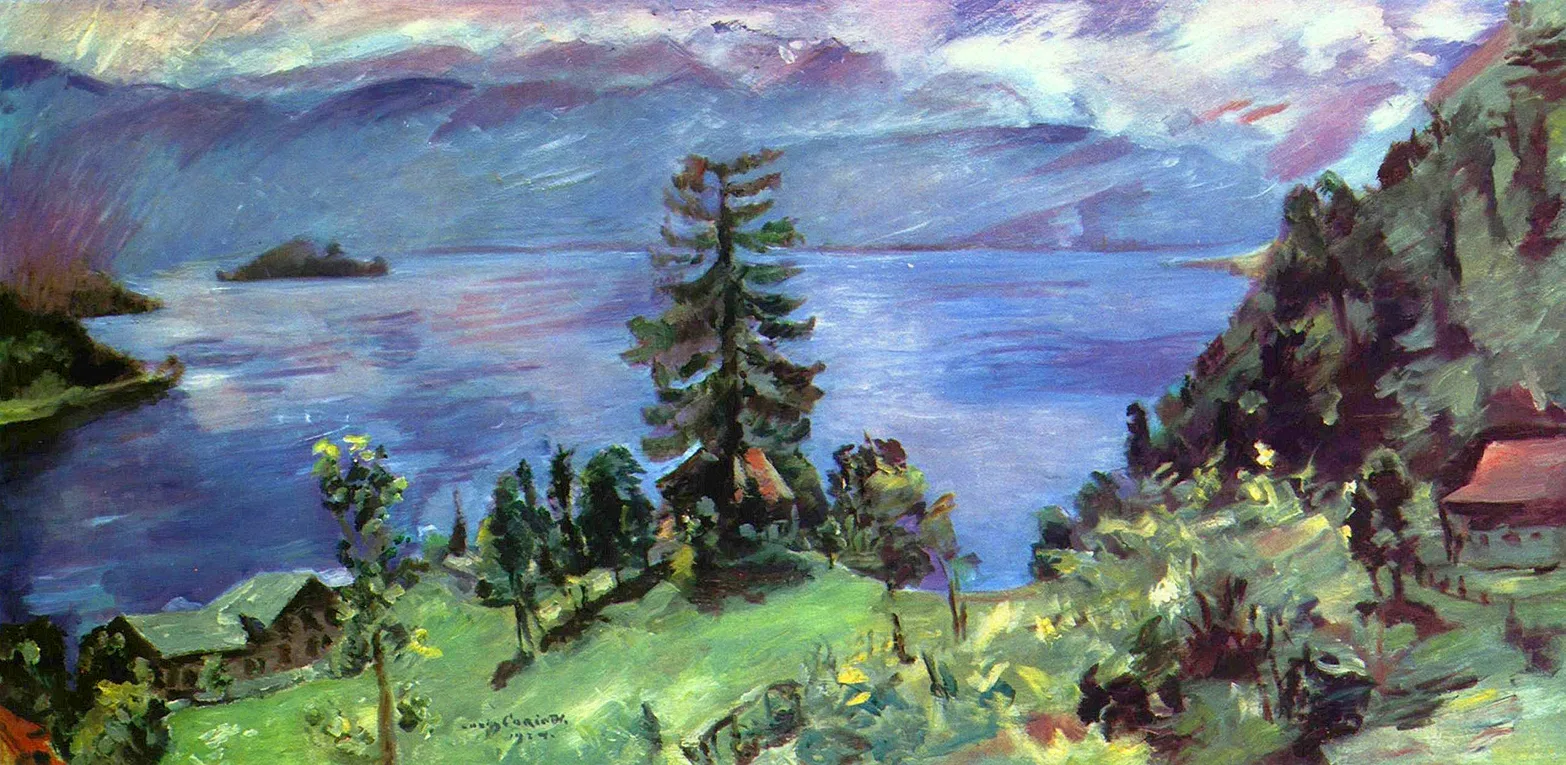
On 21.07.1858 the Impressionist Lovis Corinth / Franz Heinrich Louis Corinth (1858–1925), regarded as the town's most famous native, was born in Tapiau.
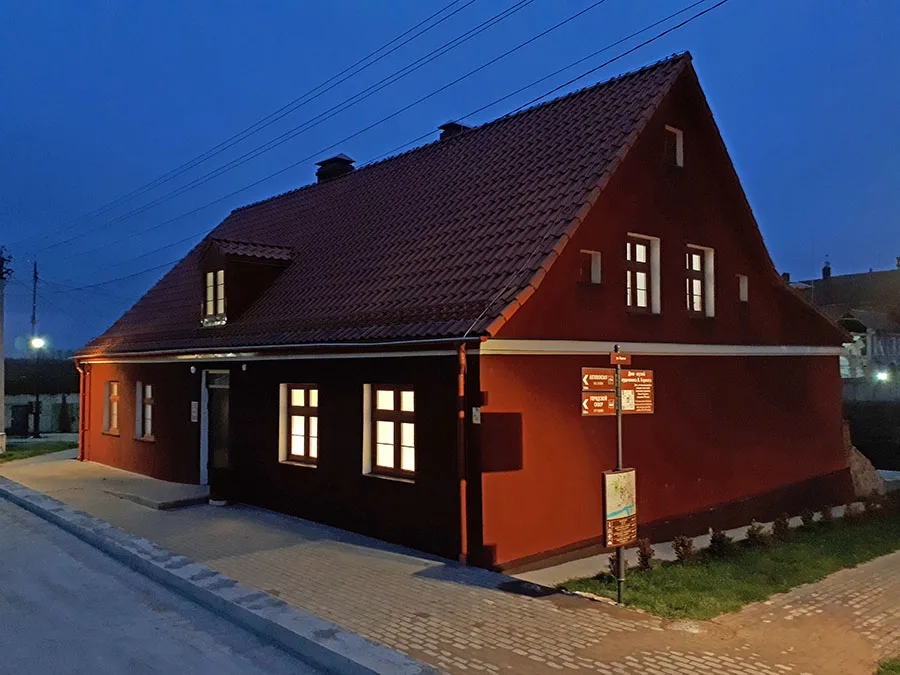
The Lovis Corinth House Museum after restoration (2022).
In 1860 the Prussian Eastern Railway (Preußische Ostbahn) was laid south of Tapiau, and Tapiau station was opened on it.
In 1871 Tapiau had 153 residential houses. In 1879 large-scale building work was carried out in the castle, in the course of which it was converted into a prison. In 1896 a steam mill and a bakery began operating in Tapiau.
On 09.04.1898 the narrow-gauge railway (750 mm) from Tapiau to Friedland / Friedland (Pravdinsk) was completed. The narrow-gauge station was 300 m from Tapiau's main station.
On 15.01.1900 this narrow-gauge line was linked near the village of Possindern / Possindern (Roshchino) with the Königsberg narrow-gauge railway / Königsberger Kleinbahn, after which regular train services began on the Königsberg – Neuhausen / Neuhausen (Guryevsk) – Tapiau route. In Tapiau itself, besides the main narrow-gauge station, there were two more platforms (today's landmarks: 20 Krasnoarmeyskaya Street and 39 Telmana Street).
In 1902 the old buildings in the castle's outer bailey were demolished and replaced by a complex of red-brick buildings with a turret. In 1904 the town's first newspaper began publication. On 13.12.1909 services opened on the narrow-gauge railway from Tapiau to Labiau (Polessk).
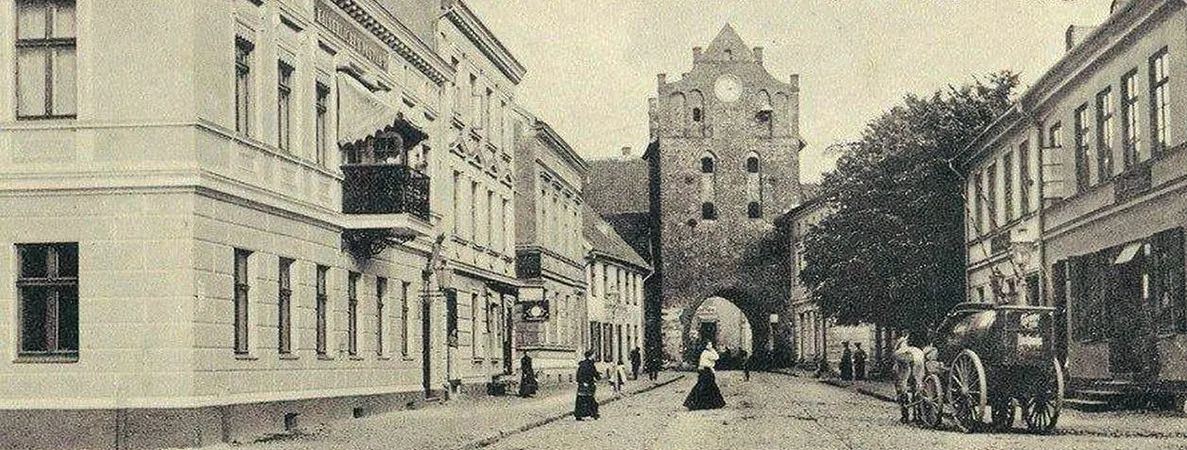
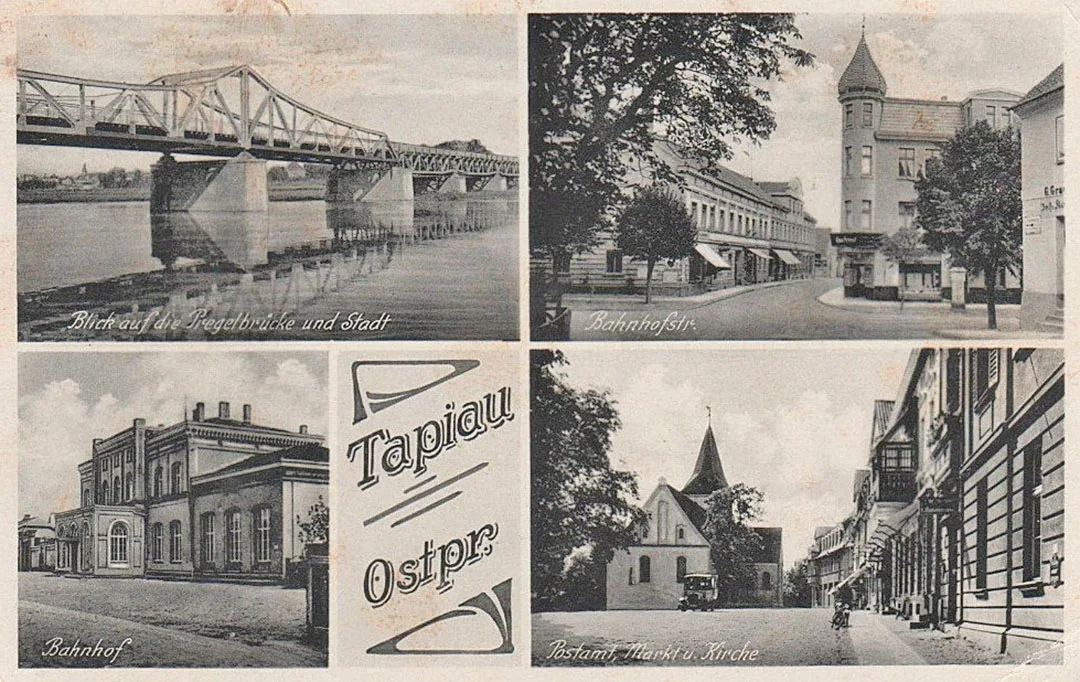
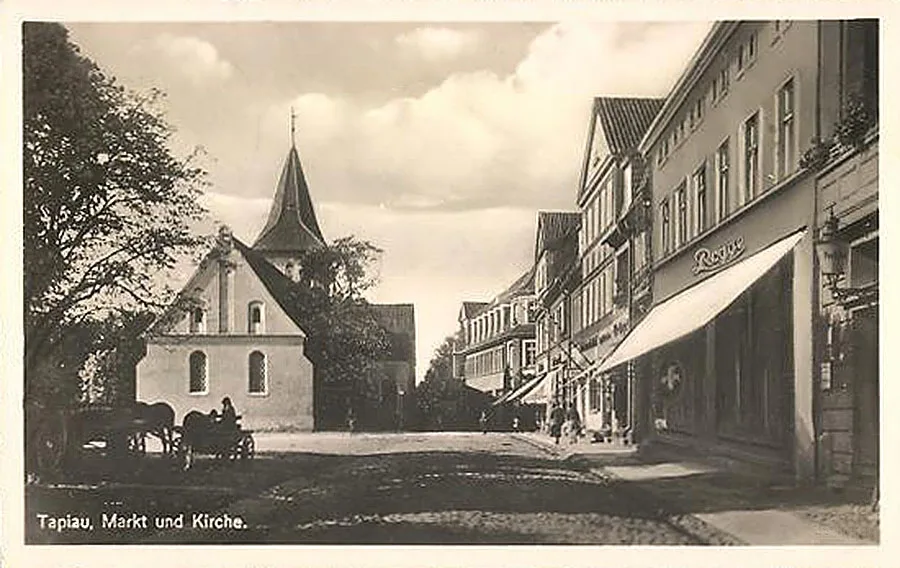 The market square and church of Tapiau.
A 1910 directory states that Tapiau had a Lutheran church (in the photo above) and a Catholic church, as well as a synagogue.
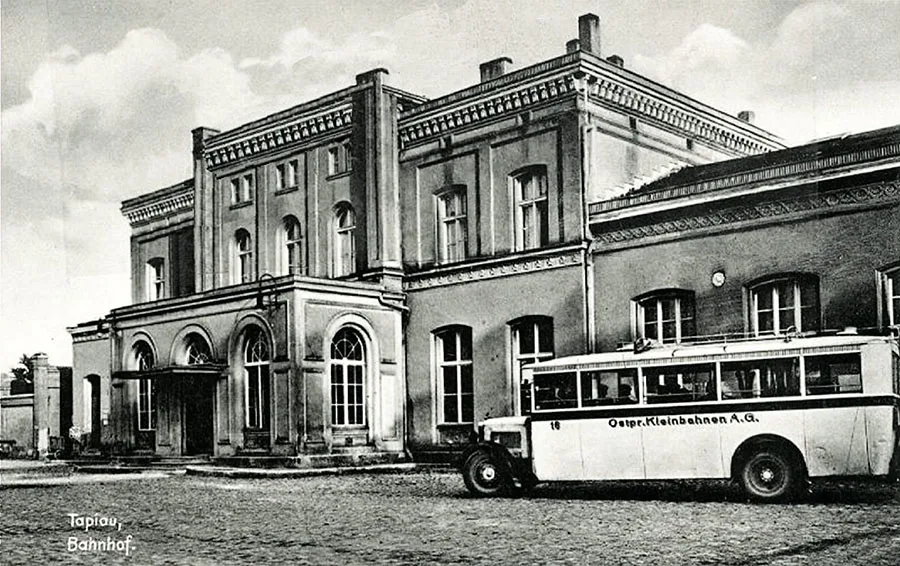 Railway station of Tapiau.
As a result of the fighting during the East Prussian Operation of 1914, the town was partly destroyed. On 26.08.1914 troops of the 25th Infantry Division (Gen. P. I. Bulgakov) and the 2nd Guards Cavalry Division (Gen. G. O. Rauch) of the Russian 1st Army under the command of Gen. P. K. Rennenkampf reached the outskirts of Tapiau. On 28.08.1914 the town came under artillery fire during counter-battery fighting. However, the Russian army never took Tapiau.
On 30.09.1928 the Gutsbezirk (estate district) Kleinhof-Tapiau was abolished, and its main part became part of the municipality of Tapiau.
In the pre-war years Tapiau had all the typical infrastructure of a small town. It had a post office, a telegraph office, a court, a secondary and a vocational school, a horticultural college, a hospital and a bank branch. There were a gasworks, a dairy, a woodworking plant, pasta, sugar and soap factories, a meat-processing plant and a mill. There were shipyards building and repairing river vessels and boats. Reeds were harvested and processed. The head forestry office of Tapiau (Oberförsterei Tapiau) was also located in Tapiau.
Among the civic associations were a rifle club, a veterans' association, choral societies, a sports club and a rowing club, a women's association and a housewives' association.
On 22.01.1945 forward units of the 39th Army entered Klein Schleuse but were thrown back across the Deime in the fighting.
On 23.01.1945, during the Insterburg–Königsberg offensive operation, the 17th Guards Rifle Regiment of the 5th Guards Rifle Division of the 39th Army, commanded by Lt. Col. A. I. Bankuzov, reached Tapiau. The regiment's soldiers crossed the Deime and dug in in the south-east of Tapiau, blockading the system of pillboxes and occupying the hospital grounds. On 24.01.1945 they were supported by units of the 94th Rifle Corps and the 2nd Battalion of the 12th Guards Rifle Division.
On 25.01.1945 Tapiau was taken by soldiers of the 17th Guards Rifle Regiment of the 5th Guards Rifle Division and units of the 221st Rifle Division of the 39th Army, commanded by Maj. Gen. V. N. Kushnarenko. The town's buildings were damaged in the fighting. Tapiau Castle, however, was unharmed and was already being used as a prison in 1945. In February 1946 a children's labour colony was opened at the prison.
On 07.09.1946 Tapiau was renamed Gvardeysk. At the same time Gvardeysk District was formed. The settlements of Kleinhof-Tapiau, Großhof and Klein Schleuse, which had previously belonged to the municipality of Tapiau, became de facto part of Gvardeysk.
The village of Lindenhof also ended up within Gvardeysk. In 1946 Gvardeysk had a 100-line telephone exchange, an outpatient clinic with therapeutic, surgical and dental departments, a post office, a school, a pharmacy, a district library and a children's library, several shops, two bakeries and several workshops. In May 1947 the Kaliningrad–Gvardeysk–Polessk–Sovetsk river passenger line opened, on which the motor ship "S. M. Kirov" made a trip every other day. In July 1948 the Kaliningrad–Gvardeysk–Chernyakhovsk river line was put into operation. A sawmill and a meat-processing plant were started up, the pre-war dairy was handed over to a textile factory, and the gasworks and power station were not restored to their former function, since they lacked equipment.
In 1949 a steam mill began operating in Gvardeysk, and in 1953 a pasta factory started work.
In 1954 the canning shop of the poultry factory in Gvardeysk was put into operation, and at the same time the region's first greenhouse farm began work near Gvardeysk. In 1956 a butter and cheese plant with a processing capacity of 3,000 tonnes of milk a year began operating.
Around 1975 the settlement of Khlebnoye, which still consisted of four houses, was deregistered and incorporated into the town of Gvardeysk.
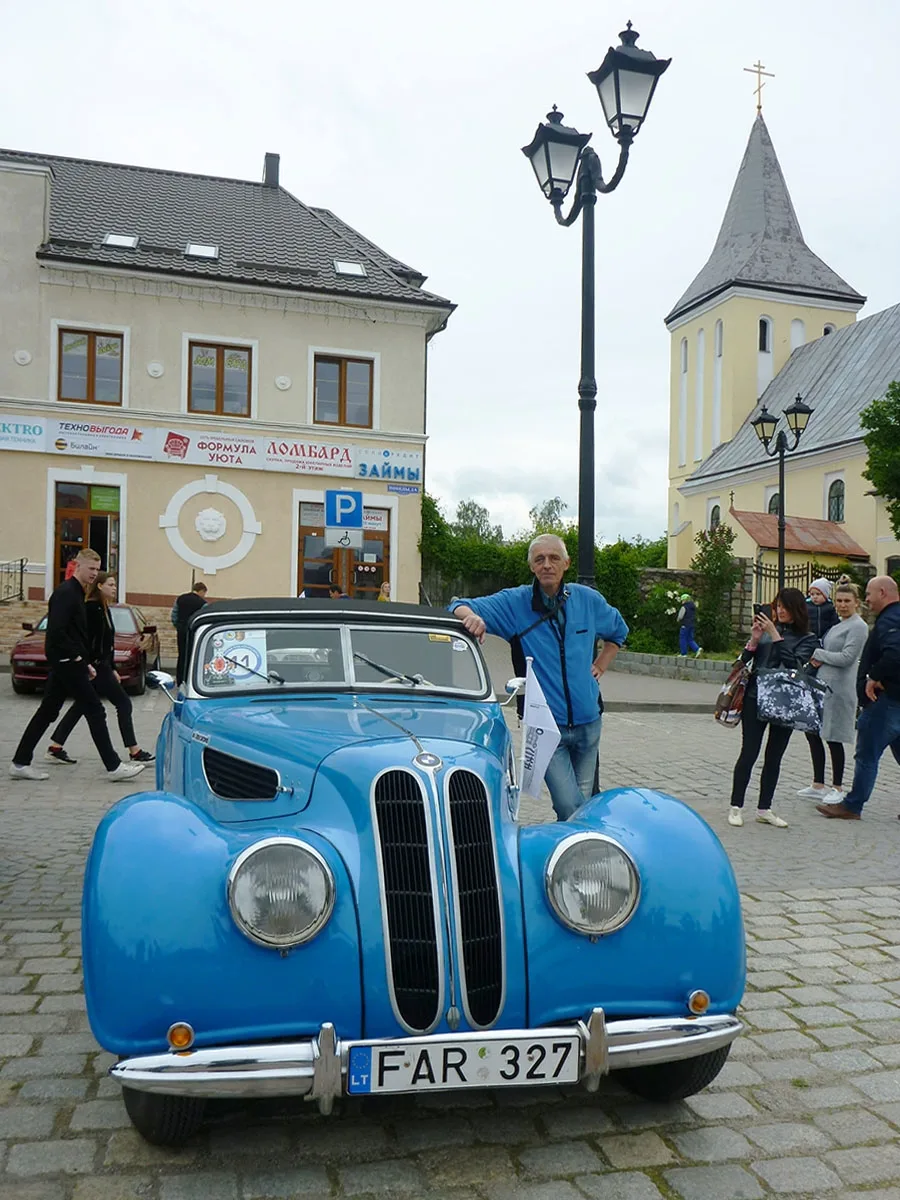 Prussian local historian Nikolay Tregub (1959–2020) on the central square of Gvardeysk.
In the 1980s the town's infrastructure continued to develop: a consumer services centre, a local radio studio, a bookshop, a second-hand shop and several grocery shops opened, as did a 480-seat house of culture (1989). In 1989 the Lutheran church building was handed over to the Russian Orthodox Church to create an Orthodox church, which opened in 1991.
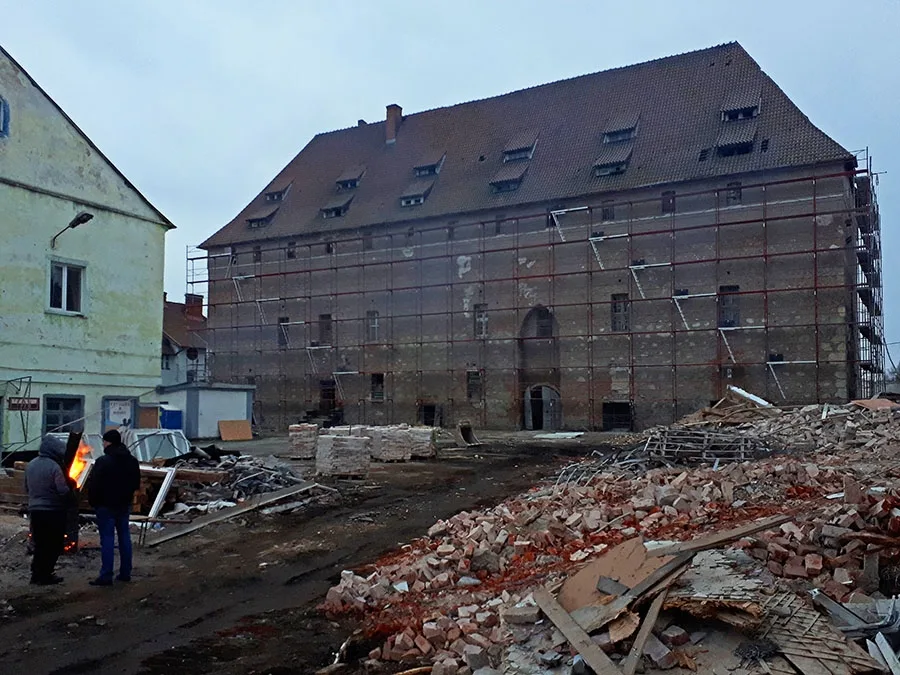 Tapiau Castle rises above the brick rubble of the demolished prison (2022).
In 1998 the Gvardeysk District Culture and Leisure Centre opened in Gvardeysk.
Today Gvardeysk has a meat-processing plant, a hosiery factory, a bread and confectionery plant, a branch of the Pravdinsk butter and cheese plant, a meat-canning facility, a forestry enterprise, two schools, a kindergarten, a hospital and a military hospital. The town has Orthodox and Catholic parishes.
At the end of 2021 the castle grounds were transferred to the ownership of the Kaliningrad Region. As of 2022, work continues on restoring it and creating a tourist complex in the castle.
Since the pre-war gasworks was never restored and the gas pipelines bypassed Gvardeysk, the town still (2022) has no mains gas supply.
Sights: Tapiau Castle (1283), church (1502), water towers (1890 and 1920), the house where the painter Lovis Corinth was born, chapel (1930), the building complex of the Tapiau psychiatric hospital, town hall building (1922), entire districts of pre-war buildings. First World War military burials: 54°39'27'' N 21°04'26'' E (condition unknown), 54°38'42'' N 21°06'10'' E (south-east of the town, condition unknown), memorial on the mass grave of Soviet soldiers (approx. 1,900 people), the "Cats' Yard".
For reference
Kleinhof-Tapiau was founded in 1414. After 1650 it was called Klein-Hoff / Klein-Hoff, and after 1683 Kleiner Hof / Kleiner Hof. Then, after 1785, the name changed to Kleinhof Tapiau / Kleinhof Tapiau (from 1905 Kleinhof-Tapiau).
In the 19th century Kleinhof-Tapiau was a state domain that was leased out. The domain formed a Gutsbezirk in the Landkreis of Wehlau / Wehlau (Znamensk). Besides the estate of Neuhof-Tapiau itself, the Gutsbezirk also included the Vorwerke (outlying farms) of Großhof / Großhof (Gvardeysk, at the intersection of Telmana Street and 2nd Severnaya Street), Neuhof / Neuhof (54°40'05'' N 21°05'25'' E), Fohlenwiese / Fohlenwiese (54°38'20'' N 21°05'17'' E), Fährkrug Tapiau / Fährkrug Tapiau (Gvardeysk, Zarechnaya Street area), Milchbude / Milchbude (54°38'07'' N 21°05'46'' E), Tapiau mill / Mühle Tapiau (54°38'59'' N 21°03'02'' E), as well as the head forestry office of Tapiau / Oberförsterei Tapiau (Gvardeysk market) and Tapiau station / Bahnhof Tapiau (Gvardeysk station). On 13.06.1874 the Gutsbezirk Kleinhof-Tapiau was included in the newly established Amtsbezirk Kleinhof. The first head of the Amtsbezirk was the domain's administrator and leaseholder, Schrewe / Schrewe of Kleinhof-Tapiau. Only in 1917 was he succeeded by another leaseholder of the estate, Dieckman / Dieckman, who headed the Amtsbezirk until 1922.
From 1880 onwards, parcels of the Gutsbezirk Kleinhof-Tapiau were transferred to the municipality of the town of Tapiau, and these transfers were sometimes very large. Thus on 12.07.1885 Tapiau mill and the head forestry office of Tapiau / Oberförsterei Tapiau passed from the Gutsbezirk Kleinhof-Tapiau to the municipality of Tapiau, and on 15.05.1889 the Tapiau plantation / Plantage Tapiau. On 28.10.1898 Klein Schleuse (Tapiau, part) came under the municipality of Tapiau. On 24.08.1911 a new Gutsbezirk, Domäne Großhof / Großhof, Domäne, was separated from the Gutsbezirk Kleinhof-Tapiau; it comprised the Vorwerke of Großhof (Gvardeysk, at the intersection of Telmana Street and 2nd Severnaya Street) and Neuhof. On 30.09.1928 the Gutsbezirk Kleinhof-Tapiau was abolished, and its main part, including the estate itself, became part of the town of Tapiau. In the pre-war years Kleinhof-Tapiau had a school.
Amtsbezirk Kleinhof. On 13.06.1874 Amtsbezirk No. 14 Kleinhof was established in the Landkreis of Wehlau / Wehlau (Znamensk), comprising three rural communities: Frischenau / Frischenau (Yelnyaki), Magotten / Magotten (Rechnoye) and Sielacken / Sielacken (54°37'07’‘ N 21°07'13'' E), and two Gutsbezirke: Domäne Kleinhof (Gvardeysk, part) and Tiefenthamm / Tiefenthamm (Yelnyaki, part). On 24.08.1911 a new Gutsbezirk, Domäne Großhof / Großhof, Domäne, was separated from the Gutsbezirk Kleinhof-Tapiau; it comprised the Vorwerke of Großhof (Gvardeysk, at the intersection of Telmana Street and 2nd Severnaya Street) and Neuhof.
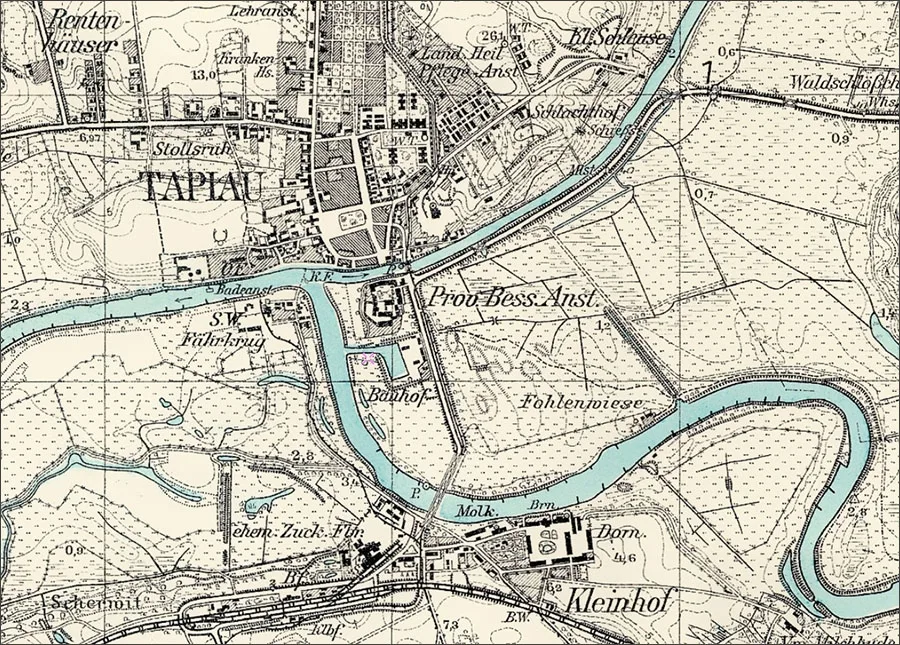
On 30.09.1928 the Gutsbezirke Kleinhof-Tapiau (main part without exclaves) and Domäne Großhof were abolished and incorporated into the municipality of Tapiau. The Amtsbezirk Kleinhof now consisted of three rural communities: Frischenau (Yelnyaki), Magotten (Rechnoye) and Sielacken. It existed in this form until the territory was occupied by the Red Army in January 1945.
Klein Schleuse was founded around 1692. It belonged to the parish of Tapiau. In the 19th century it was part of the Gutsbezirk Kleinhof-Tapiau. On 28.10.1898 Klein Schleuse, together with about 66 ha of land, became part of the town of Tapiau. In the pre-war years Klein Schleuse had a state sanatorium and an old people's home.
Hubenhof is mentioned in 1875 as Höfchen / Höfchen. Later it was called Tapiausche Hube / Tapiausche Hube, and from 1820 Hube / Hube. In the 19th century Hubenhof was a village within the municipality of Tapiau (Gvardeysk) in the Landkreis of Wehlau / Wehlau (Znamensk). The village belonged to the parish of Tapiau. On 05.07.1950 Hubenhof was renamed the settlement of Khlebnoye. In 1955 Khlebnoye had four houses.
Lindenhof was a small village belonging to the rural community of Zophen / Zophen (Suvorovo) in the Landkreis of Wehlau (Znamensk). The village belonged to the parish of Tapiau. On 13.06.1874, as part of the community, the village of Lindenhof was included in the newly established Amtsbezirk Pregelswalde / Pregelswalde (Zarechye).
Population of Tapiau-Gvardeysk: 1782 – 1,200, 1802 – 1,637, 1810 – 1,462, 1818 – 1,628, 1821 – 1,923, 1828 – 2,987, 1831 – 2,574, 1858 – 2,729, 1867 – 3,269, 1871 – 2,733, 1875 – 2,679, 1880 – 3,116, 1890 – 3,763, 1895 – 4,061, 1905 – 5,118, 1910 – 5,986, 1933 – 7,683, 1939 – 9,326, 1959 – 7,560, 1970 – 10,544, 1979 – 10,819, 1989 – 11,904, 2002 – 14,572, 2009 – 13,088, 2010 – 13,889, 2012 – 13,779, 2015 – 13,321, 2017 – 13,186, 2020 – 13,313 inhabitants.
Population of Tapiau in 1871 by composition: Protestant Christians — 2,664, Catholics — 25, Jews — 44, children under 10 — 596, literate — 1,713 (82%), blind — 2, deaf — 2.
Population of the Gutsbezirk Kleinhof-Tapiau: 1867 – 357, 1871 – 366, 1905 – 564, 1910 – 449 inhabitants.
Population of the Gutsbezirk Kleinhof-Tapiau in 1871 by composition: Protestants — 349, Catholics — 17, children under 10 — 95, literate — 183 (68%).
Population of Klein Schleuse: 1905 — 81 inhabitants.
Population of Großhof-Tapiau: 1905 — 91 inhabitants.
Population of Tapiau station: 1905 — 86 inhabitants.
Population of Fährkrug Tapiau: 1905 — 82 inhabitants.
Population of Hubenhof: 1905 — 32 inhabitants.
Population of Neuhof: 1905 — 35 inhabitants.
Population of Fohlenwiese: 1905 — 9 inhabitants.
Population of Milchbude: 1905 — 10 inhabitants.
Parish of Tapiau: Altenfelde / Altenfelde (54°40'37'' N 21°03'41'' E), Bieberswalde / Bieberswalde (Ruchyi), Adlig Damerau / Adlig Damerau (from 1938 Damerau / Damerau, Krasnoye, part), Eisingen / Eisingen, Freiwalde / Freiwalde (54°35'59'' N 21°05'38'' E), Frischenau / Frischenau (Yelnyaki), Großhof-Tapiau / Großhof-Tapiau (Gvardeysk, at the intersection of Telmana Street and 2nd Severnaya Street), Hasenberg / Hasenberg (Prigorodnoye), Hubenhof / Hubenhof (Khlebnoye), Ilmen / Ilmen (Karyernoye), Kleinhof-Tapiau / Kleinhof-Tapiau (Gvardeysk, part), Lindenhof / Lindenhof (Gvardeysk, part), Magotten / Magotten (Rechnoye), Koddien / Koddien (54°38'49'' N 21°02'19'' E), Neuendorf / Neuendorf (Kruglovka), Neuhof / Neuhof (54°40'05'' N 21°05'25'' E), Pomauden / Pomauden (Luzhki), Pregelswalde / Pregelswalde (Zarechye), Romau / Romau (Rovnoye), Sielacken / Sielacken (Polyana), Tapiau (Gvardeysk), Tiffenthamm / Tiffenthamm (Yelnyaki, part), Zophen / Zophen (Suvorovo).
Contemporary photos by Mikhail Ogorodnikov.
Translated from Russian with the help of AI (Claude, Anthropic), October 2026.