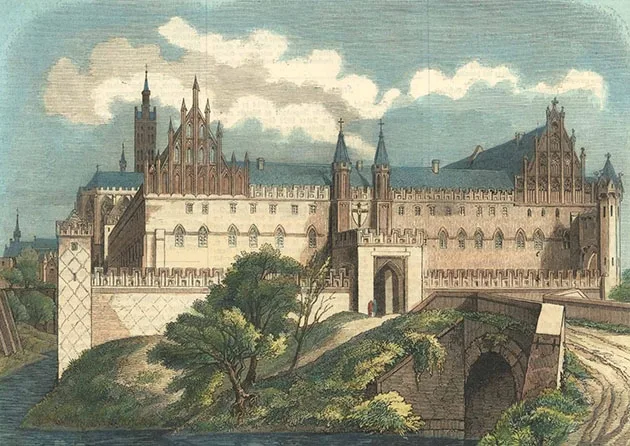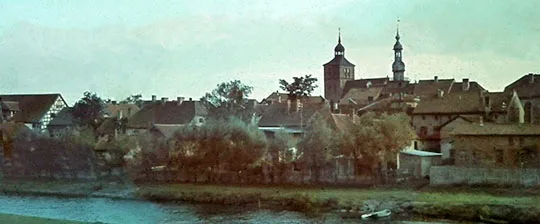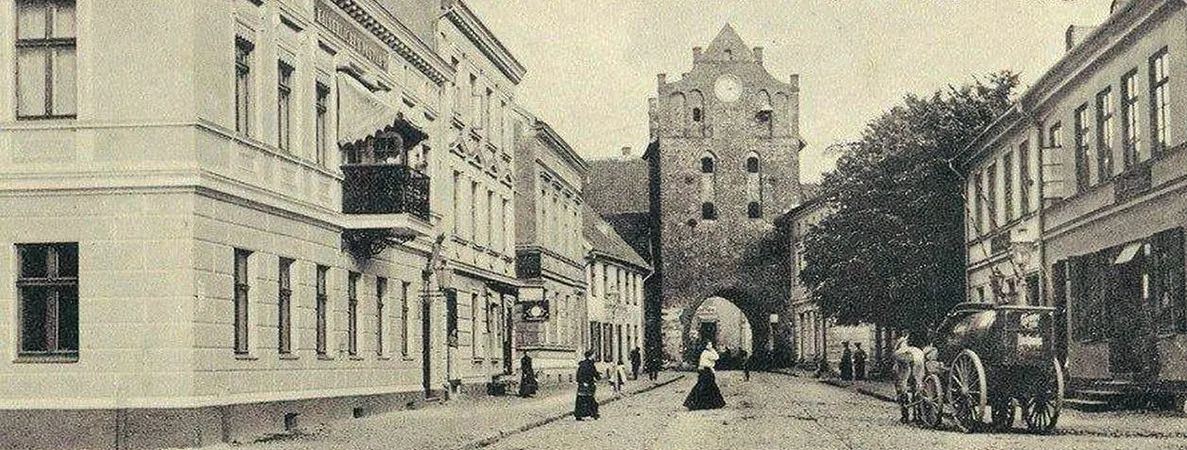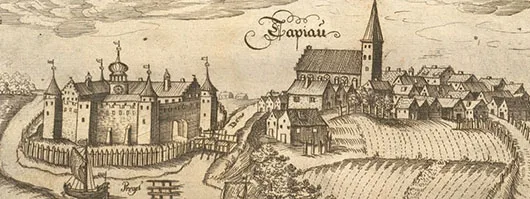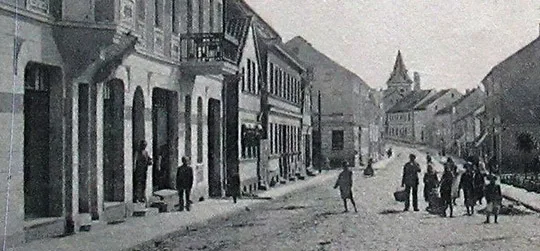
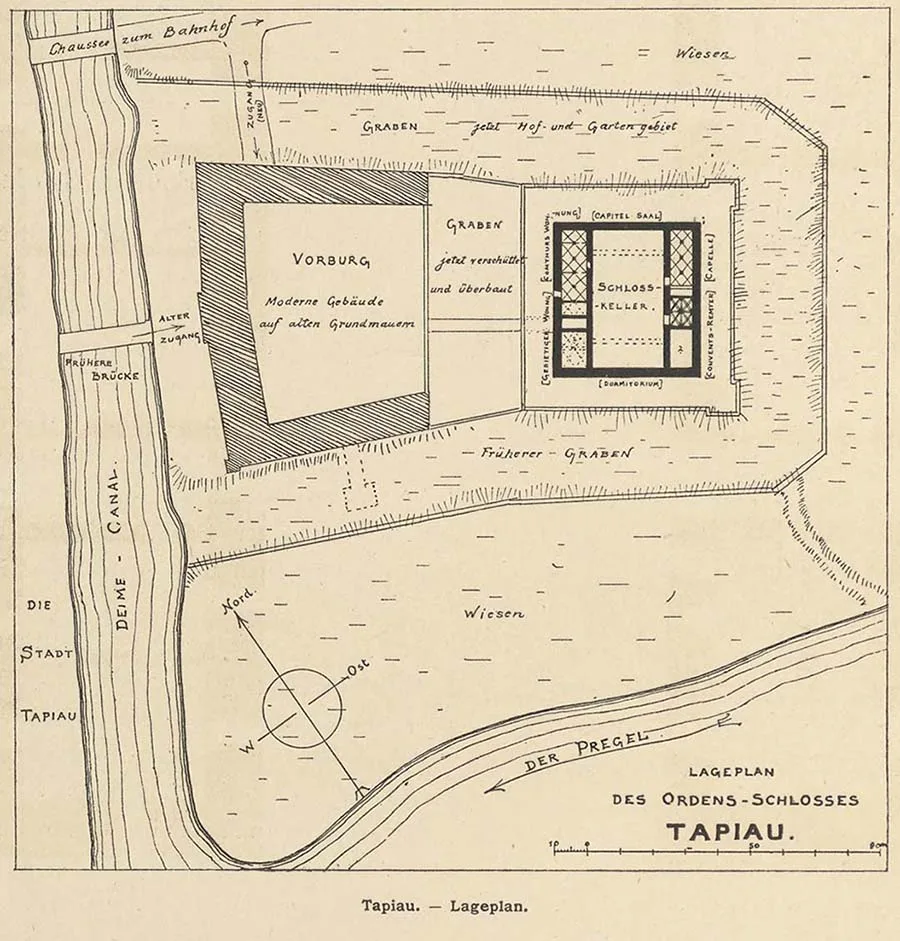
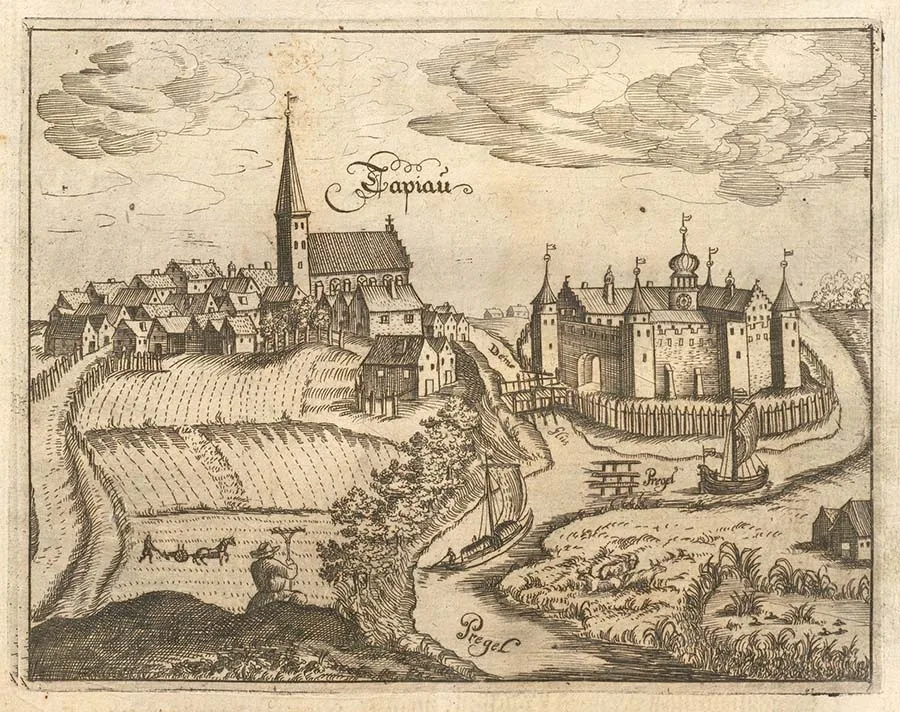
There is reason to believe that the fortress was built on the site of an old earthwork stronghold of the native inhabitants. The location itself lent itself to the construction of a castle: it was to serve as a kind of outpost on the route from Nadruvia to Königsberg. In addition, the new fortification controlled two vital waterways, the Pregel and the Deime. After the Prussian uprising was finally crushed in 1272, colonists founded a settlement beneath the castle walls.
In 1275 the fortress was besieged and stormed by the Lithuanians. Despite some successes, they were unable to take it. Naturally, the surrounding countryside was laid waste and the settlement by the castle burned down. This siege evidently revealed that the site chosen for the castle was a poor one. And so in 1280 the castle was moved to a peninsula surrounded by water on three sides.
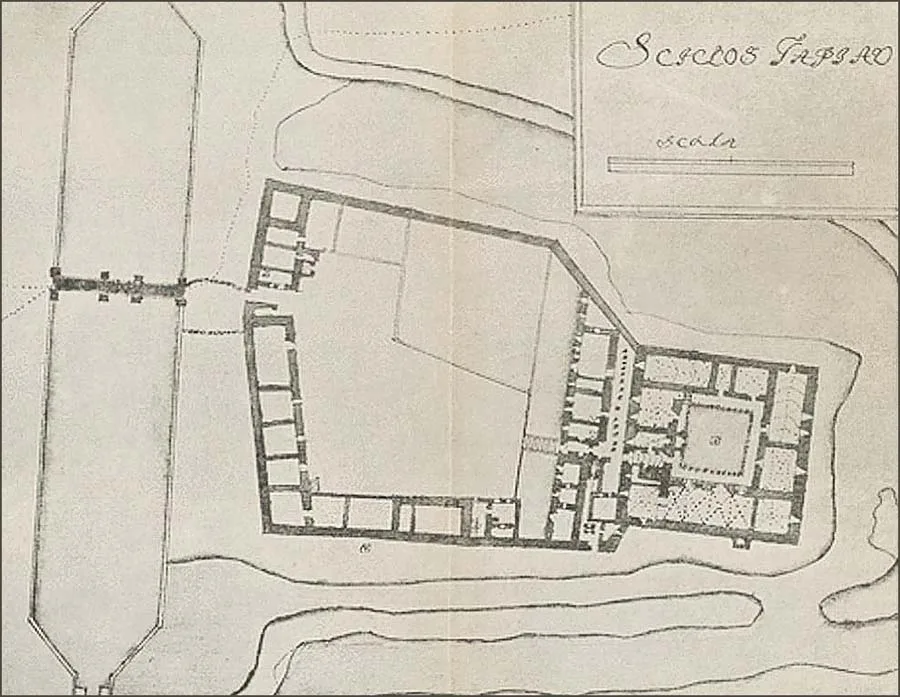
Once the moat had been dug, the fortress was connected to the mainland only by a drawbridge. In that same year, 1280, Tapiow became the seat of a commandery and remained so until 1301. The name of Tapiow's first komtur is known: Ulrich Bavarus. A year later, in 1281, he was killed in battle against the Sudovians. When the Order's campaigns against Lithuania began and its theatre of military operations shifted far to the east, the Tapiau commandery was moved first to Insterburg (Chernyakhovsk) and then even closer to the notional front line, to Ragnit (Neman). The Teutonic Knights considered keeping a commandery at Tapiau an unjustifiable luxury, and Tapiau Castle was assigned to the Königsberg commandery.
After the Order moved its capital to Marienburg (Malbork, Poland) in 1309, the State of the Teutonic Order took its final shape in the Prussian lands. This, together with constant raids by Lithuanian tribes, spurred the building of new castles in stone and the rebuilding of old ones in stone.
After 1340 this rebuilding reached Tapiow Castle as well. At the same time, the Tapiow–Labiow (Polessk) canal with its locks was built to provide water transport within the Order's state.
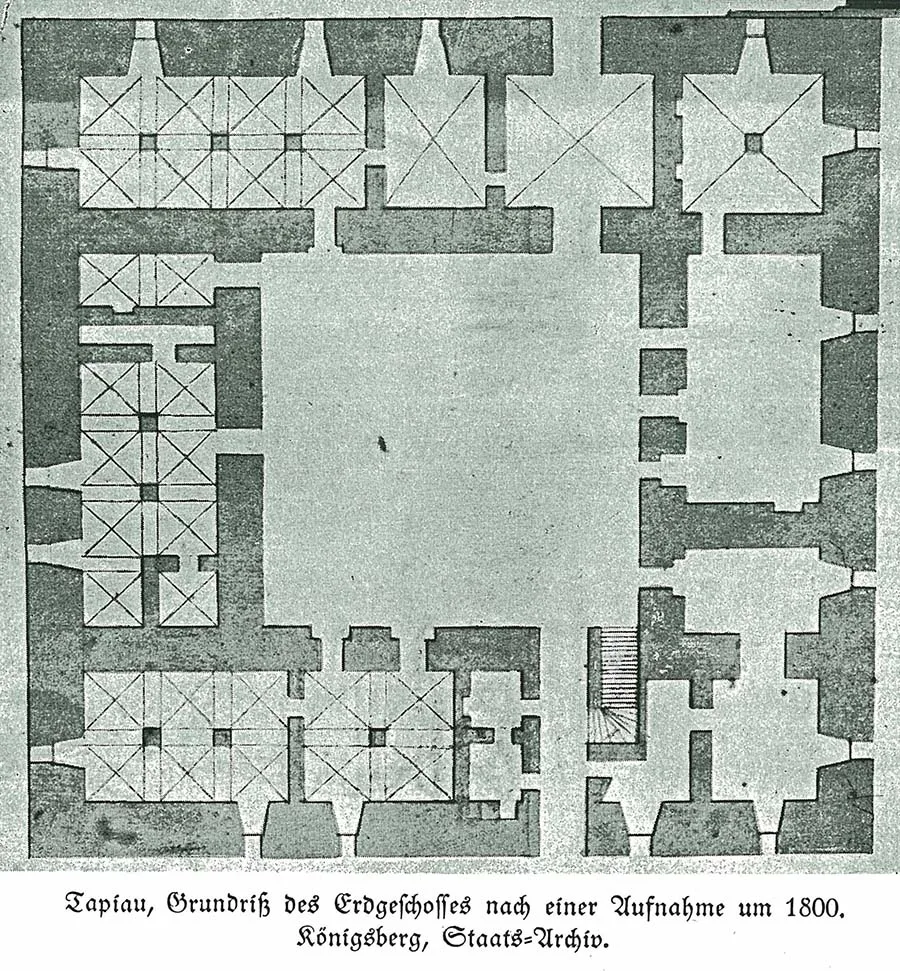
Construction of the castle, directed by the Order's Marshal Siegfried von Dahenfeld, was finally completed in the 1350s. The result was a classic four-winged structure forming a closed rectangle measuring 48x46 m. The castle was distinctive in having no towers as part of the main building. Instead, to strengthen its defences, the gable end of each wing, fitted with embrasures, projected slightly beyond the perimeter of the quadrangle, forming a kind of semi-caponier. The castle also had an extensive outer bailey (Vorburg) in the shape of an elongated rectangle. A new settlement grew up on the opposite bank of the river from the castle, though it received town rights much later.
In 1382, in the castle chapel at Tapiow, Grand Duke Vytautas of Lithuania was baptized into the Catholic faith. He was hoping for the Teutonic Order's help in his struggle for power in Lithuania and was therefore willing to go along with such formalities. Incidentally, Vytautas was baptized three times in all, once according to the Orthodox rite.
From around 1450, Tapiom-Tapiow came to be called Tapiau. During the Thirteen Years' War (1454–1466) between the Order and the Prussian Confederation of towns, the castle was taken by the Confederation's forces, but was recaptured the following year by supporters of the Teutonic Order. After the Order's defeat in that war and the loss of its former capital, the archive of the Teutonic Order was brought from Marienburg to Tapiau Castle, where it remained until 1722. In 1474, Dietrich von Cuba, Bishop of Samland, who had spoken unflatteringly of Grand Master Heinrich von Richtenberg, was imprisoned in the castle dungeon and left to starve to death. From then on, the castle acquired an enduring ill repute.
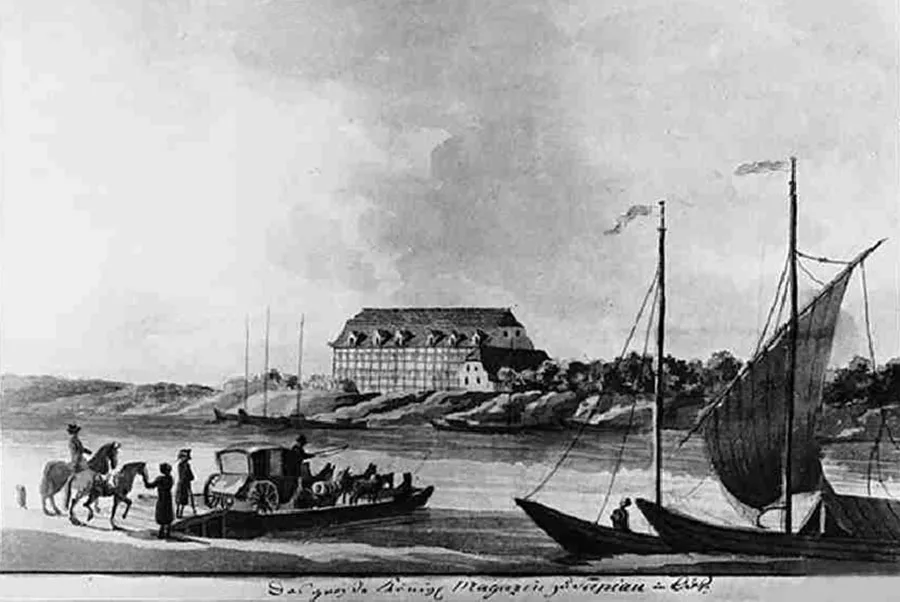 Watercolour "The Royal Carriage Crossing the Pregel at Tapiau".
The status of Tapiau Castle rose considerably under Duke Albrecht of Brandenburg. He made it his residence, and the castle also housed the administration of the Hauptamt ("main office") of Tapiau.
To this end, Albrecht carried out an extensive reconstruction of the castle, as befitted the status of a secular ruler. Albrecht often stayed at Tapiau in his final years. He died here in 1568 and was buried in the castle, but his remains were later moved to a crypt in Königsberg Cathedral.
After Albrecht's death the castle, gradually falling into disrepair and decay, served as an administrative centre housing various local authorities. In 1786 it was converted into an almshouse. From 1793 Tapiau Castle took in paupers, beggars and the sick poor. During the reconstruction, three of the castle's four wings were demolished, and a further building was erected on the grounds in their place to serve as the almshouse.
In 1879, during its conversion into a prison, two storeys were added to the castle, the upper one housing a church. In 1902, a Gothic-style red-brick building with gables and a small tower was built on the site of the former outer bailey. This is the very building that some guides today pass off as the Order's castle itself.
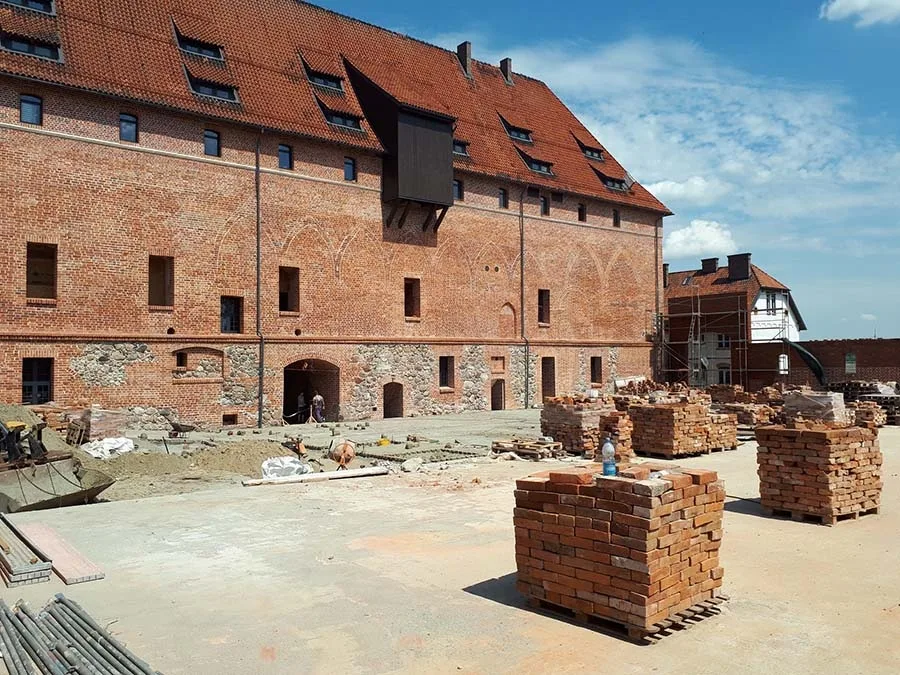 Tapiau Castle (courtyard) during restoration in 2024.
After Tapiau was taken by units of the Red Army in 1945, the new authorities decided not to change the building's purpose, and the castle once again housed a prison, this time a Soviet one. The castle has remained in this form to the present day. The status of the correctional institution changed several times, but its essence stayed the same.
Over the past 10 years, the question of turning the prison into a local tourist attraction has been raised regularly. The few researchers who have managed to visit the high-security facility note that one of the wings of the Teutonic castle has survived, along with the ancient cellars of another. There is no doubt that the castle, so long inaccessible, would be of interest to history enthusiasts and tourists alike, yet the relocation of the correctional facility is, with enviable regularity, postponed indefinitely for one reason or another.
Illustrations: Bildarchiv Ostpreußen, bildarchiv-ostpreussen.de, Mikhail Ogorodnikov.
Translated from Russian with the help of AI (Claude, Anthropic), October 2026.