Sig transit gloria mundi
— Thus passes the glory of the world.
This fairly large area of naturally grown vegetation in the western part of the city found itself enclosed within the "city within the walls", i.e. the "Inner City", when by the middle of the 17th century Königsberg's First Defensive Rampart was built, taking in not only the existing urban buildings but also the adjoining land. At the beginning of its history the People's Garden lay in two city districts: the southern, narrower part extended into Laak, while the northern part was in Neurossgarten, near the Ausfall Gate (Ausfalltor). When the second ring of ramparts was built, this old gate, which opened the road to Pillau (now Baltiysk), ended up below the level of the new, modernised fortifications and was consequently turned into a tunnel under the new rampart (today a small Orthodox chapel stands on this gate in memory of the Soviet soldiers who fell here in April 1945).
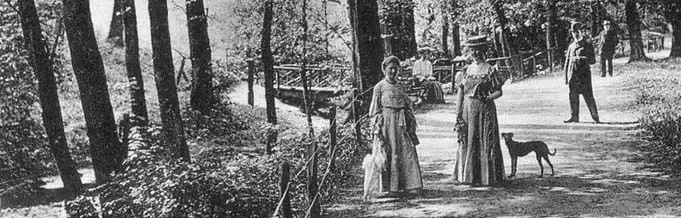
Until 1753 the People's Garden was evidently a small wood — a kind of reserve of undeveloped city land; later it was known as the City Garden (Stadtgarten), while essentially remaining a woodland park with a minimum of garden landscaping.
From 1780 several artesian wells were set up in the low-lying part of the park, with which the city authorities tried to solve the drinking-water problem of one of Königsberg's districts — Laak. The walls of the wells were lined with logs, and the wells themselves were covered with special structures that looked like little houses.
The "Society for the Embellishment of the City" (Gründung des Kesselschen Verschönerungsvereinst), founded in 1838 on the initiative of Doctor of Medicine Kessel, took care of the city's green spaces, including this city garden: clearing them, fitting out places to rest and planting flowers. As far as one can judge from the topographic map of Königsberg (1890), by this time the garden was already a well-kept green area with hard-surfaced paths, flower beds and resting places with benches.
The garden enjoyed the attention of townspeople who were not spoilt with chances to spend time in nature — in the densely built-up quarters of the "Inner City" all gardens were privately owned.
Moreover, building within the city's fortress walls continued especially actively at the end of the 19th century. The area of the People's Garden shrank again at that time: the railway became its southern boundary, and the railway's installations occupied the former southern part of the garden. And at the beginning of the new 20th century yet another piece of the southern part of the garden was cut off by the new Friedrich-Ebert-Strasse (now Gornaya Street). The land taken from the garden was gradually sold off to construction firms carrying out planned urban development… [A familiar picture, isn't it?]
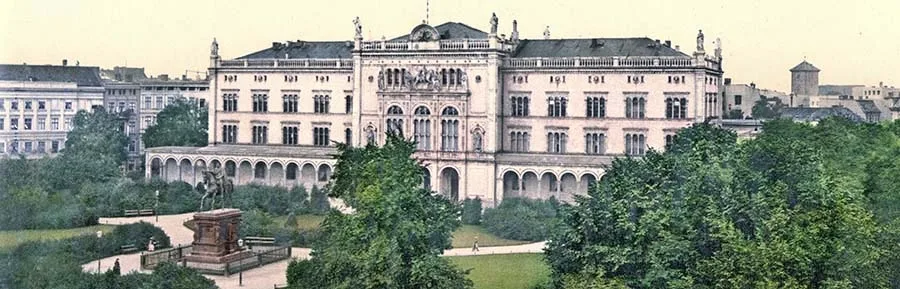
In this period the western part of the garden was bounded by a narrow-gauge railway whose first station was by the Parkstrasse (Park Street), a narrow, horseshoe-shaped street that cut deep into the green area of the People's Garden. A little earlier, the southern and middle parts of the remaining garden area had been built up with a complex of buildings now occupied by an institution known in the city as the Police School (the Kaliningrad branch of the St Petersburg University of the Ministry of Internal Affairs of Russia). This complex of buildings appeared in Königsberg by 1931 and was intended for the Land Exchange and the Labour Exchange: according to Fritz Gause, there were more than 30,000 unemployed in Königsberg at that time.
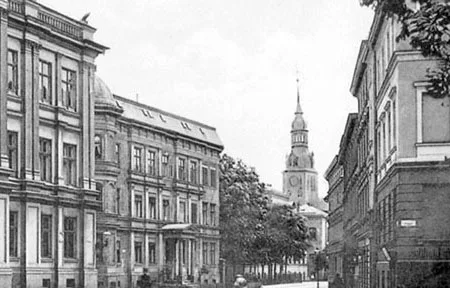
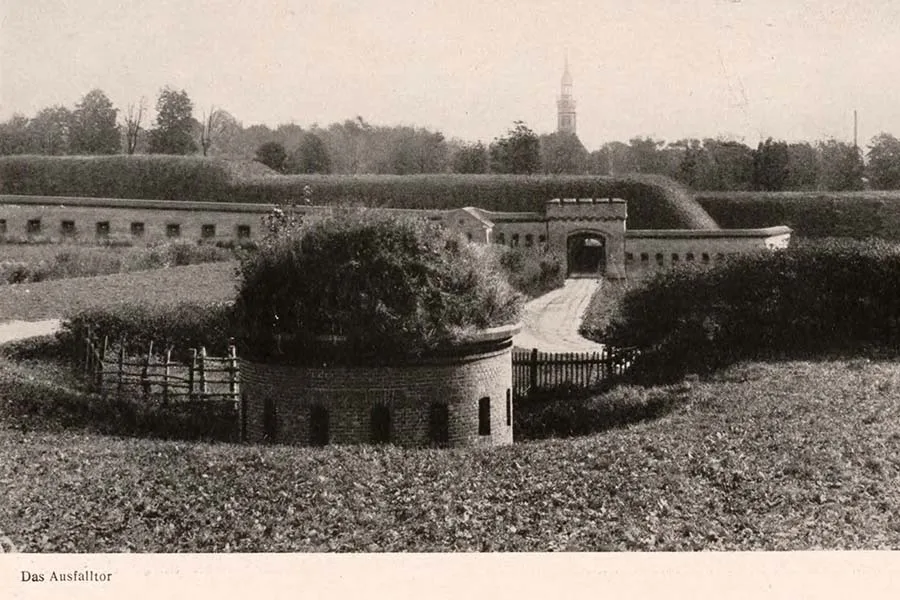 The Ausfall Gate, in the distance the spire of the Neurossgarten Church, and between them the People's Garden (and the Albertina Botanical Garden).
Thus a considerable part of the People's Garden was lost to development.
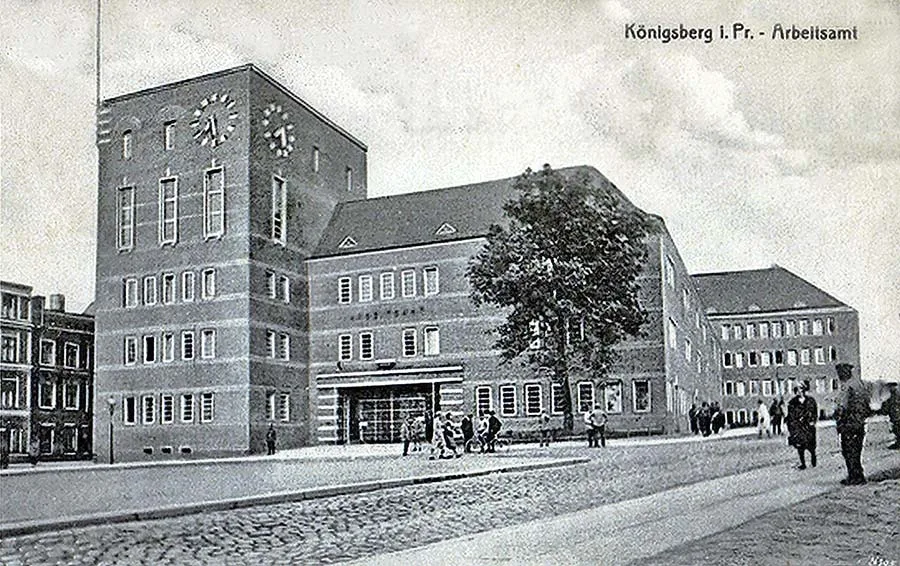 The building of the Königsberg Labour Exchange.
The narrow-gauge railway, skirting the People's Garden on the west, ran below the level of the garden and of the Deutschordenring (now Gvardeysky Avenue) — this hollow, very poetically named Lilienthal (Valley of Lilies), was laid out towards the Litauer Wallstrasse (Litovsky Val) and further along the Königstrasse (now Frunze Street) to the north-eastern districts of the city, Kalthof and Devau (the Gagarina Street area).
So at the beginning of the 20th century the People's Garden occupied just under half of its historical area and lay between the Deutschordenring on one side and the Ausfalltorstrasse (now Generala Butkova Street) and Steindammer Wall (now Generala Galitskogo Street) on the other. In the 18th and early 19th centuries the northern part of the People's Garden merged into the grounds of parish cemeteries, but on the 1928 plan of Königsberg the cemeteries are already occupied by barracks and other military buildings. In the same period the old Deutschordenstrasse, planted with chestnuts, was joined by the areas of the railway cutting, of the Astronomical, Butterberg, Krauseneck and Laak bastions, planted to the design of the same Ernst Schneider, plus the planted banks of the pond, which was based on the water-filled moat of the former fortifications. The northern part of the People's Garden, which kept its function, was evidently unpromising for building because of its position in the terrain and the narrow-gauge railway running nearby. In addition, the surviving part of the garden contained a memorial, begun in 1873 and erected in 1877 — a monument to the soldiers who fell in the Franco-Prussian War of 1870–71. The monument was designed by a civil engineer named Krüger; it was made of Saxon sandstone, was octagonal in shape and was crowned by a column bearing aloft an eagle with outspread wings. The circumference of the monument was decorated with eight alternating panels — four of bronze and four of sandstone.
Mottoes were carved on the slabs of the monument, attributed to professors of the University of Königsberg: "A warrior's highest treasure is love for his people" (Felix Dahn); "Not your reward, but our gratitude" (Ernst Wichert).
On the south side of the monument were carved the mask of a dying warrior and an image of the Iron Cross, as well as the names of the places where units of the First Army Corps had fought.
Today [early 21st century] the ruins of the memorial survive; in Soviet times the base of the monument, stripped of its memorial plaques, was used for a small children's merry-go-round.
In the northern part of the garden lay the Cemetery of Honour (Ehren Friedhof), consecrated in 1817, where many professors of the local university were laid to rest. People often called it the Professors' Cemetery, since the Neurossgarten Church and several other cemeteries were located nearby.
Perhaps that is why Wagnerstrasse (Wagnerstraße) was called Totenstrasse — the Street of the Dead — until 1889, for it was along this street that people were taken on their last journey to the cemetery of the Neurossgarten Church. The street was later named after the famous surgeon Karl Ernst Albrecht Wagner, who headed the Albertina's surgical clinic from 1858 to 1871 (the building of the former University of Königsberg clinic now houses the Port Hospital). During the Franco-Prussian War of 1870–71 Albrecht Wagner, chief physician of an army corps, died of typhus and was buried in Königsberg's Professors' Cemetery, yet in all the years that followed the clinic was still called Wagner's clinic.
The Neurossgarten Church was founded in 1644; in 1737 an organ by the famous master Casparini was installed in it; the height of its tower, built in 1685–1695, was 90.7 m. Apart from the Castle keep, it was the tallest tower in the city; its spire was clad in gleaming copper and crowned with a cross and a crown, the same as on the coat of arms of Altstadt, to which this church originally belonged. The cost of building the church was covered by voluntary donations from the townspeople.
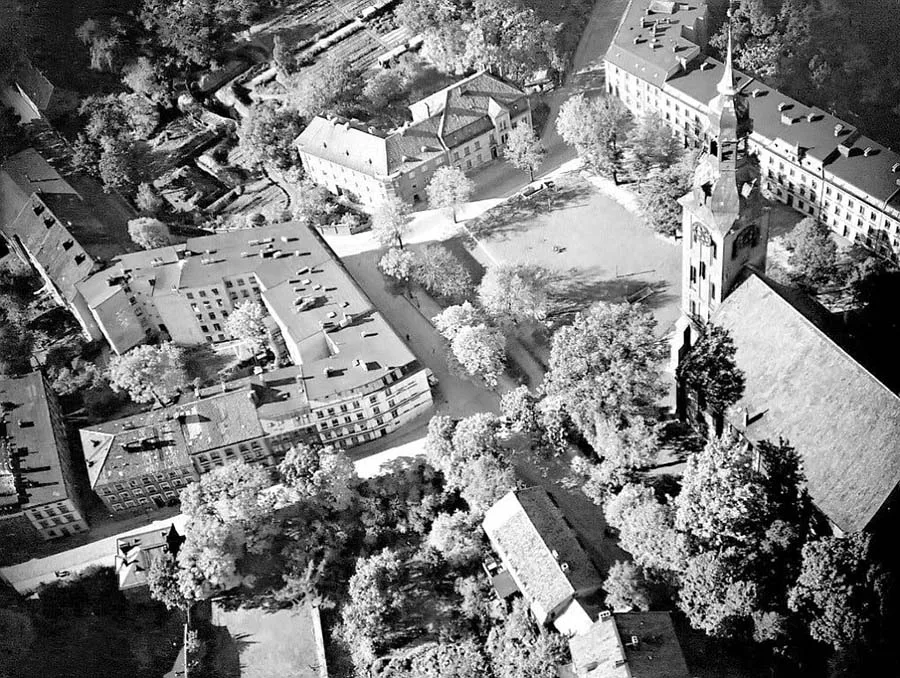 The Neurossgarten Church was for a long time the tallest in the city and served as a landmark for ships.
After the terrible battles for Königsberg in April 1945 many monuments of the Professors' Cemetery, with expressive sculptures and old wrought-iron railings, survived, but in the 1960s they were systematically destroyed, and the cemetery land was given over to garages and the production base of the Soyuzgazavtomatika plant.
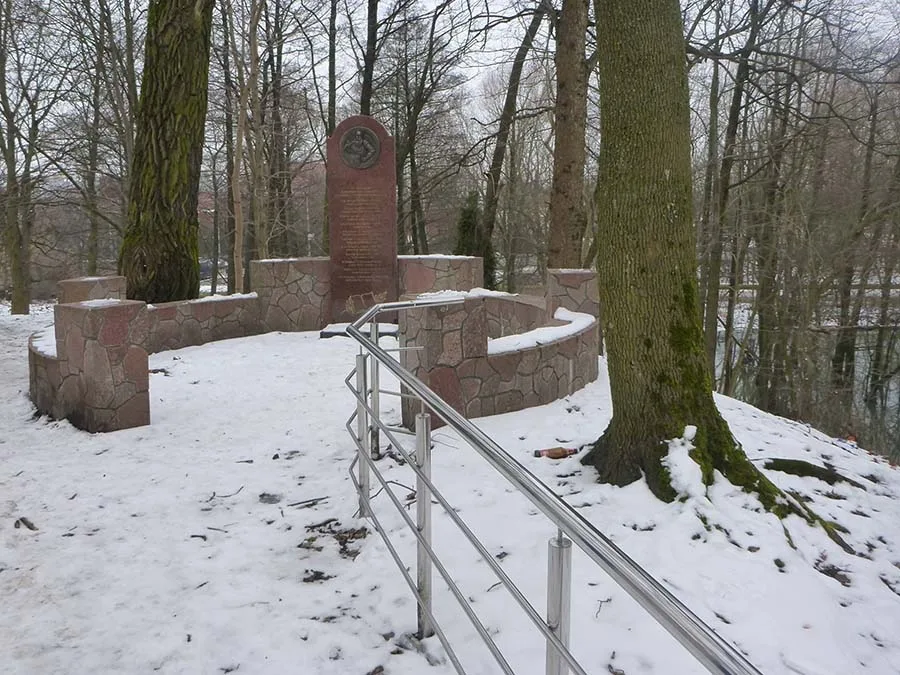 Monument to the professors of the University of Königsberg (2014).
Today this area is abandoned and is a wretched, litter-strewn wasteland: a few old trees (chestnuts) left from the cemetery days, fragments of the factory's brick wall, the lairs of homeless people, the ashes of campfires… Among the other professors buried here were: Friedrich Wilhelm Bessel, astronomer, 1784–1846; Robert Caspary, botanist, one of the directors of the University Botanical Garden, 1818–1887; Theodor Gottlieb Hippel, President of the City of Königsberg (this title was given only to the mayor of Berlin and, by way of exception, to a single mayor of Königsberg — T.G. Hippel), 1741–1796 (according to other sources, he was buried by the church); Karl Lehrs, philologist, 1802–1878; Franz Neumann, physicist, 1798–1895; Karl Rosenkranz, philosopher of the Hegelian school, 1805–1871; Albrecht Wagner, surgeon, 1827–1871.
Among these famous names is the German mathematician and renowned astronomer from Westphalia (the town of Minden), invited to the University of Königsberg at Easter 1810 from the University of Cologne, Friedrich Wilhelm Bessel, who lived in Königsberg for 36 years, died here and, as a prominent member of society, was buried by the Neurossgarten Church on 17 March 1846; yet even his grave, despite his services to humanity, was not preserved. The future famous astronomer discovered his gifts early: while an apprentice at a trading house in Bremen, he studied mathematics and astronomy privately from the age of 15, and from 1806 he worked as an assistant at a private observatory near Bremen. Bessel's scientific legacy comprises some five hundred works covering a very wide range of subjects. His name has remained for ever not only in history but also in modern astronomy, mathematics and geodesy.
Having begun work at the Albertina in 1810, F.W. Bessel built the university observatory in 1811–13 on the highest point of Königsberg's old ramparts; rising above the People's Garden on the Butterberg hill, it was not only a scientific asset of the university but also one of the city's most striking sights.
…Here on the Butterberg, in the days of the Order, a gallows once stood. This steep height above a deep ravine, one of the seven hills of Königsberg, was called Glappenberg among the Prussians, after the leader of the native inhabitants who rose again and again in revolt; after the Knights suppressed one of the uprisings (1269–1273) he was captured and executed here, on this hill…
Later, and right up to 1811, one of the many windmills in Königsberg at that time stood on the Butterberg hill on the Windmühlenplatz (Windmill Square); it was demolished to make way for the observatory.
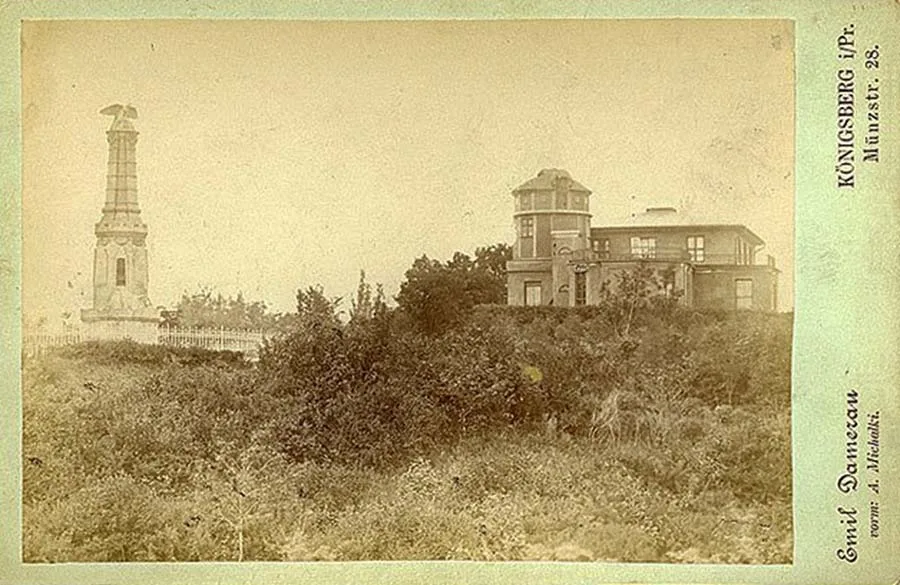 The observatory and the monument to the heroes of the Franco-Prussian War.
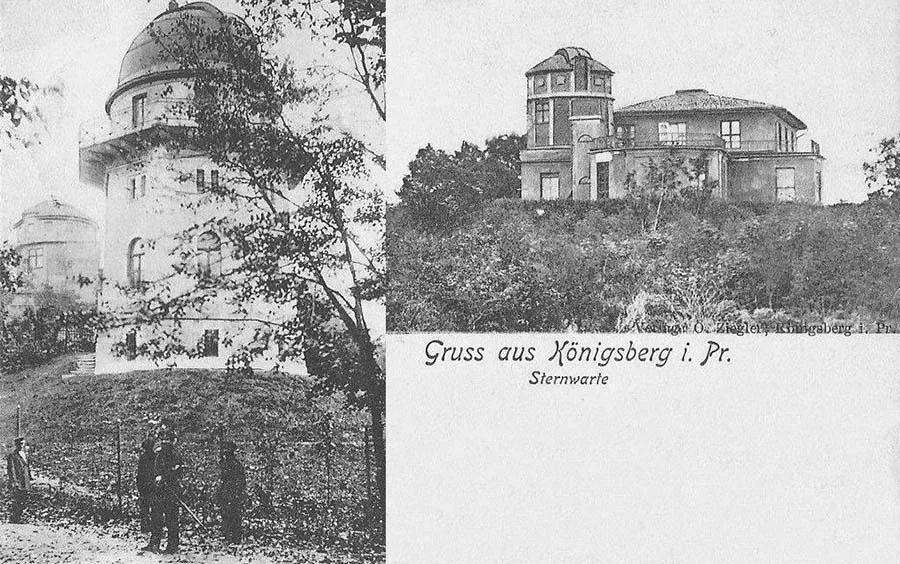 There was a time when no fewer than two observatories stood side by side in Königsberg's People's Garden.
A telling development: at a very difficult time for Prussia, the old city gives way to the new Königsberg of the 19th century — a major centre of science and trade.
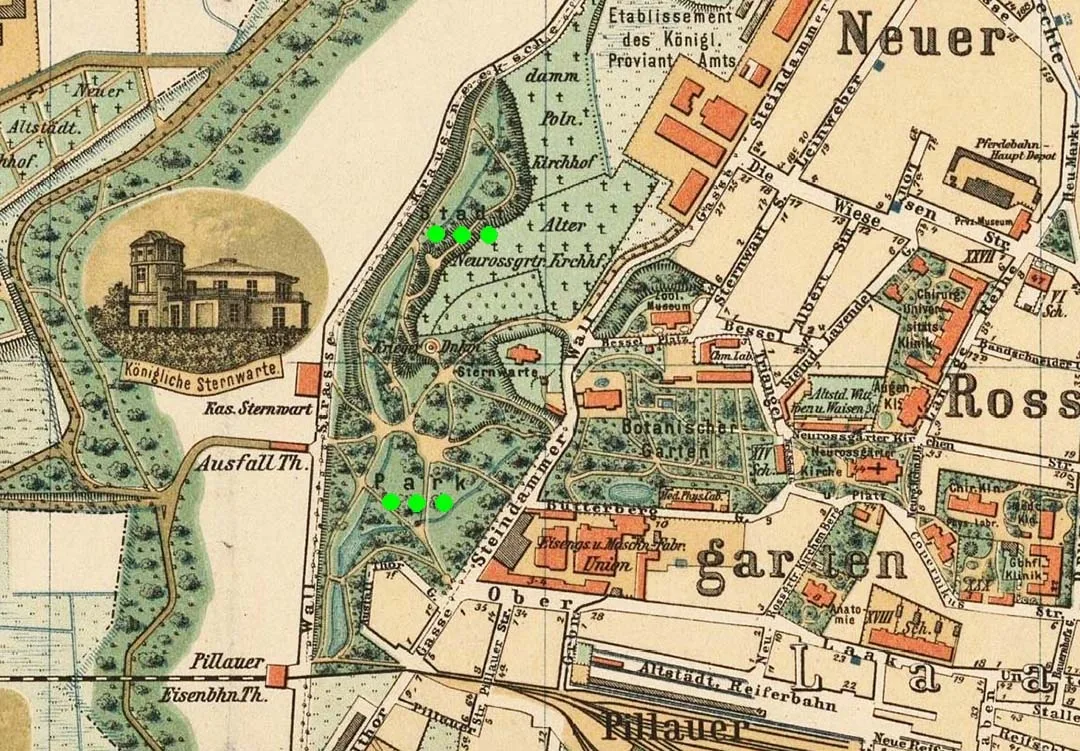
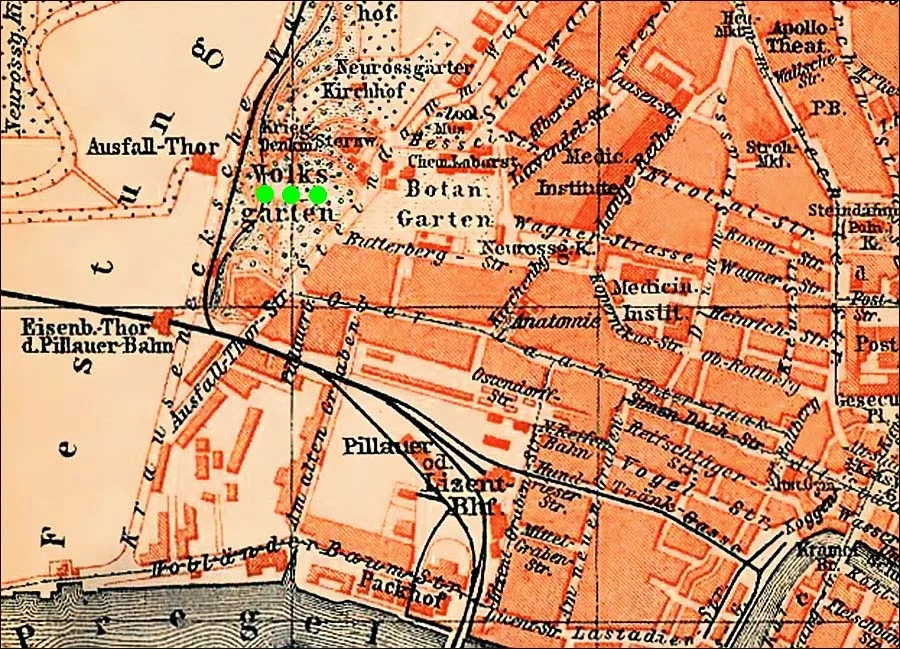 The People's Park (VolksPark) on an 1880 map.
…Napoleon, who passed through Königsberg on his way to Russia in 1812 and saw the observatory under construction, is credited with the words: "My God, after a war that went so badly for him (meaning the war of 1806–1807), the King of Prussia still finds time to think about such things…".
The People's Garden surrounded the observatory building, which was cruciform in plan, on three sides. The observatory was small in area, but widely known… Sculpted portraits of Bessel could later be seen on the façade of the new University of Königsberg and on the monument to Frederick William III.
…Königsberg's second ring of ramparts was built in the mid-19th century, when the observatory was already standing on the Butterberg. This is evidently why one of the bastions of the defensive rampart (built in 1831, architect Johann Müller / Johann Valerian Theodor Müller, 1771-1839), located not far from the People's Garden, across the Deutschordenring, was named the Observatory Bastion (Sternwarte, now the Astronomical Bastion).
Bessel's observatory was visited by famous astronomers of the time — German, Polish, Russian and American — who made observations here, and the Russian Academy of Sciences elected the famous astronomer an honorary foreign member.
In 1831 a new observatory was built to a design by the same Johann Müller. Müller, incidentally, also designed the theatre on Parade Square. The new observatory was equipped with a tower with a rotating dome and the most up-to-date telescope of the period.
In 1884 a bronze bust of F.W. Bessel by the sculptor Johann Friedrich Reusch (1843–1906) was set up in the People's Garden surrounding the new observatory building (it has not survived).
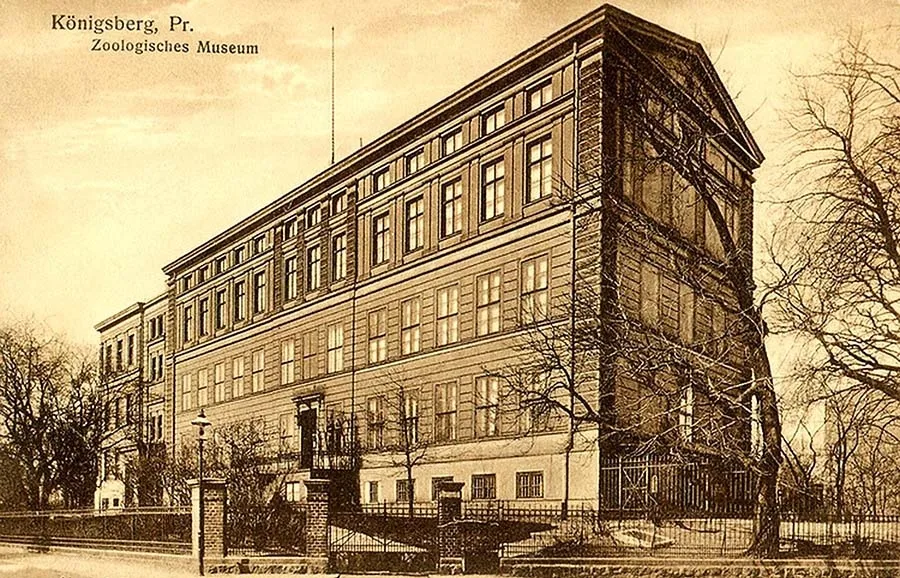 The Zoological Museum.
A small street running round the northern side of the Botanical Garden was named after the famous astronomer, and the observatory's address became Besselstrasse 4 (the street name has survived to this day).
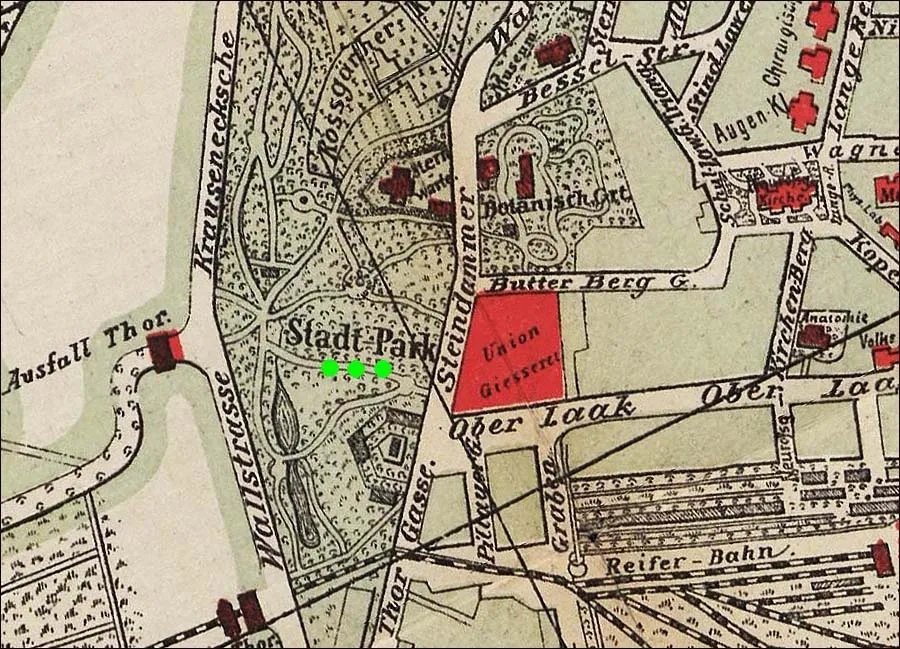 The City Park (Stadt Park) and the two observatories on an 1881 map of Königsberg.
The sculptor Reusch, although he came to the city only in 1881, was a well-known master in Königsberg, a teacher at the local Academy of Arts and the author of a number of well-known Königsberg monuments, among them those to Duke Albrecht, to Kaiser Wilhelm I (1797–1888), to the "Iron Chancellor" Otto von Bismarck (1815–1898), who effectively ran the state during the reign of Wilhelm I, and of the bronze sculpture of the German Michel (Deutsche Michel), set up next to the Wrangel Tower (Wrangelsturm). The tower still stands today on Professora Baranova Street, as does the low pedestal, without the Michel (the sculpture was lost in the post-war years; the German Michel is a collective figure personifying the German spirit, something like the Russian Ivanushka — a simple, cheerful, hard-working peasant, which is evidently why the Michel immortalised in bronze held a flail for threshing grain).
The observatories, and even the tower, survived the war, but at the end of the 1950s they were destroyed for no apparent reason, as was the Professors' Cemetery, which had been placed under state protection as a historical monument but in spite of this did not survive the 1960s. Now, since the 1990s, the place where the observatory stood has been marked by F.W. Bessel's gravestone (found and restored in 1989). At the top of the hill, densely overgrown with maples, among which a few old trees with bouquet-like crowns have survived, under the canopy of old surviving oaks, in the twilight of the neglected and now nameless green area that was once the People's Garden, very close to the Botanical Garden of the University of Königsberg, lies this slab, reached by a short flight of steps framed by old lime trees, among withered young spruces and rampant dandelions — in place of the observatory, in place of the People's Garden, in place of the historic graves of the Professors' Cemetery…
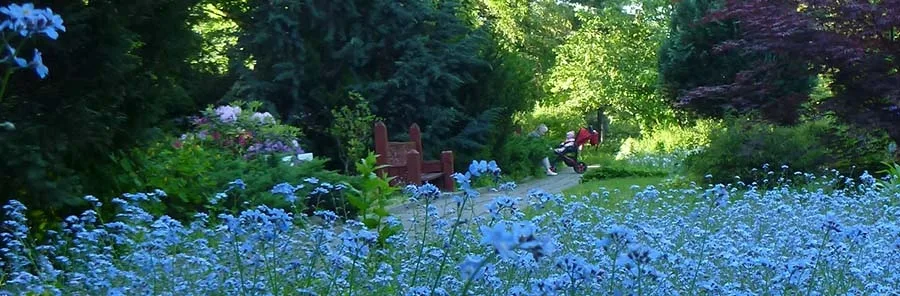
West of this sad and little-visited place, in the former Valley of Lilies, lies what in Königsberg was called the People's Garden and is now [early 21st century] a wasteland by Generala Galitskogo Street, 8.0 ha in area, damp, neglected and densely overgrown with self-seeded trees. Small wonder, since here, a few dozen metres from the Memorial to the Guardsmen who fell in the battles for Königsberg, is a collector for storm water and sewage — the former Valley of Lilies, flooded with dirty water.
Ash trees with dead branches, limes and chestnuts with trunks up to 3 metres in girth, now nearing the end of their lives, are reminders that here there was once a very old garden, one of the three oldest gardens of this ancient city; exotic, foreign species of trees were not planted in it, for this was not a private garden but a People's Garden, yet it was undoubtedly part of the architectural and artistic image of Königsberg.
A 1910 guidebook to the city notes that this garden "has adorned Königsberg for 40 years already, as have the new planted promenade areas on the Castle Pond and on Münzplatz in the southern part of the Castle Pond".
The discrepancy between the dates from which the history of the People's Garden is counted — 1753 and 1870 — is probably explained by the existence of two periods in this history: in the first period, from 1753, an almost natural woodland; in the second period, which should be dated to the time when the monument to the soldiers who fell in the Franco-Prussian War was set up here, and which began in 1875, a well-kept city garden with flowering parterres, laid out for the townspeople's leisure. However, already in the text of the 1928 guidebook one may notice the expression "the remains of the People's Garden". And yet the neighbouring grounds of the Botanical Garden, the planted observatory hill, the remains of the People's Garden with the Professors' Cemetery and the Valley of Lilies, and the planted earthworks — the glacis of the bastions of the former fortifications — formed in the urban landscape a charming historic green zone within the quarters of the old city, with an interesting layout set in complex terrain.
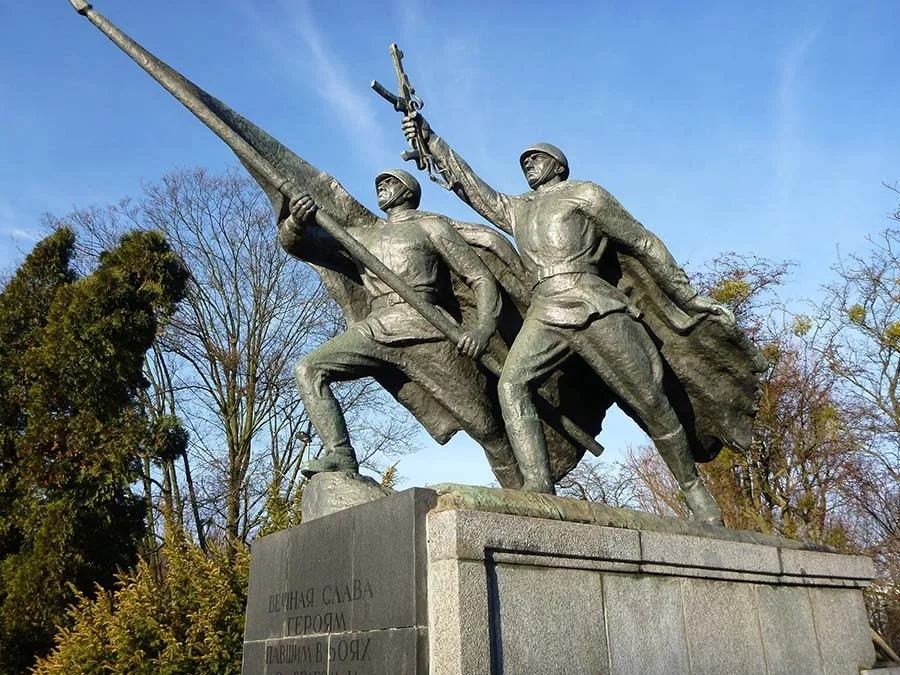 Detail of the Memorial to the 1,200 Guardsmen on Gvardeysky Avenue.
On 8 May 1945 Colonel General K.N. Galitsky, commander of the 11th Guards Army, ordered a memorial to be erected over the mass grave of Soviet soldiers.
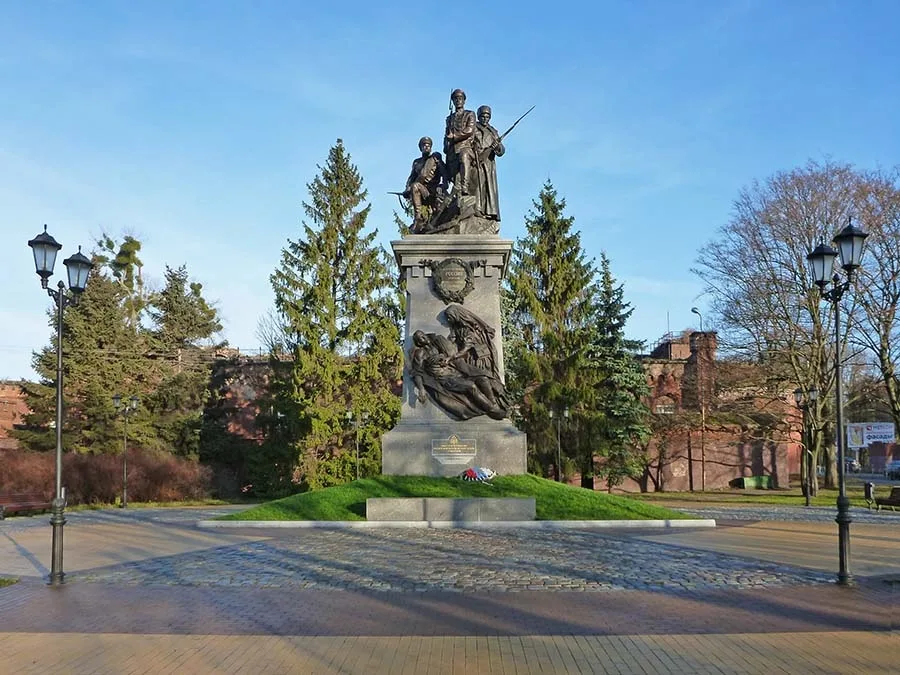 Monument to the heroes of the First World War by the Astronomical Bastion.
Work on the monument to the 1,200 Guardsmen who gave their lives in the hard battles for the fortress city of Königsberg lasted four months, and on 30 September 1945 the memorial to the soldiers of the 11th Guards Army was unveiled on Gvardeysky Avenue. The monument was created by the Moscow architects I.D. Melchakov and S.S. Nanushyan and the Lithuanian sculptors B. Pundzius, R. Vaivada, K. Jarošiūnas and others, under the direction of J. Mikėnas, Honoured Art Worker of the Lithuanian SSR and Honoured Architect. The construction work was carried out by soldiers of the 11th Guards Army; the head of construction was Guards Lieutenant Colonel M.V. Bevzo. The Memorial to the 1,200 Guardsmen stands on Gvardeysky Avenue, next to the Astronomical Bastion and the Ausfall fortress gate. Across Gvardeysky Avenue, almost opposite, lies the abandoned green zone — for more than half a century now — of the former People's Garden, whose unsightly state is described above.
From the end of the 1980s there were plans to lay out a Victory Park — the second stage of the Memorial complex — down below behind the memorial, on the bank of the pond that stretches from Gornaya Street to the end of Generala Butkova Street. A commemorative stone, as a token of intent, lay on the bank of the pond until 2000, when, on the initiative of the governor of the Kaliningrad Region, the park was founded (landscape architect T.G. Vedeneyeva, landscape gardener L.N. Telysheva).
The park covers part of the green zone adjoining the fortress moats, which long ago lost their practical purpose.
The moats were cleaned at the beginning of the 20th century, and according to eyewitnesses the water in them was still clear after the war. These ponds were surrounded by a beach area fitted out for the townspeople's leisure. By 2000 the area had become overgrown with self-seeded species of little value: hawthorn, elder, poplars and so on. When the park was laid out, most of the trees and shrubs were removed, leaving only a huge copper beech (Fagus silvatica) in the centre of the park, plus maples and hornbeams on the hill with the graves of Soviet soldiers near Gornaya Street.
In the new park the layout and the planting techniques are clearly visible. From the little bridge over the pond there is a view of the new Memorial in honour of the Guards divisions, units and commanders, whose red marble is like spilt blood. A few very young red-leaved weeping maples and blood-red hawthorns echo this colour like separate drops. Behind the Memorial are plantings of northern white cedar — when and if the young trees grow up, they will form a clipped hedge screening the railway line and creating a suitable backdrop for the monument. The space in front of the memorial is adorned with plantings of conifers — junipers (Savin and columnar); their muted, greyish needles symbolise the grey hair that came with the hard-won victory.
Along its south-western boundary the park is edged by an avenue of hornbeams, still young and translucent; later they will become dark green, romantically melancholy trees with silky patterned bark and spreading crowns.
The park is crossed at an angle to each other by two avenues of variegated Drummond maples — bright, festive trees that divide the park into several sunny glades.
The creation of the park as a whole is not finished: the third stage of the Memorial to the 1,200 Guardsmen will be laid out further south (from the heating main onwards, to the south) and will include a summer theatre, a children's playground, a café and so on. …Some day the slender young trees of the new Victory Park, the first Russian park laid out in Kaliningrad, will reach about 3 metres in girth…
Illustrations and photos by Mikhail Ogorodnikov.
Translated from Russian with the help of AI (Claude, Anthropic), October 2026.