LEGENDS OF PRUSSIA in the blog of Tatyana Kolivay.
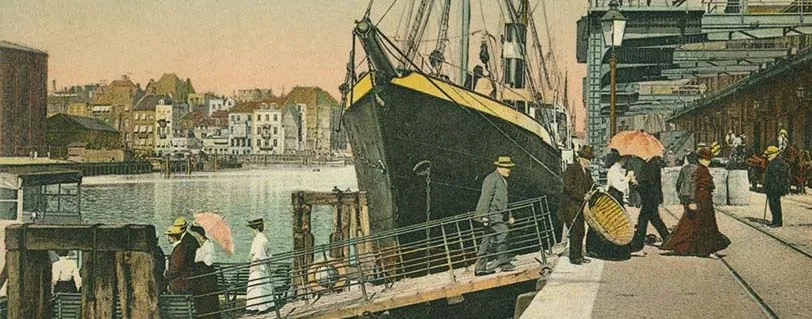
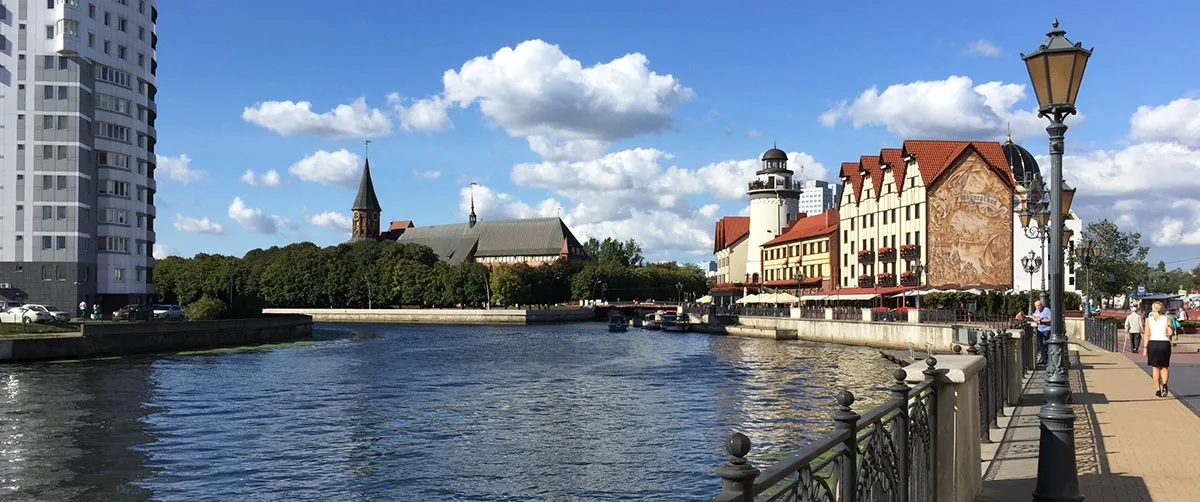
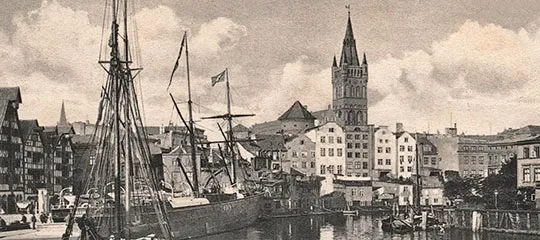
As our steamer glided over the surface of the lagoon, gilded by the sun's rays, past the buoys marking the fairway for a safe entry into the Pregel, we did not expect that majestic Königsberg would so soon appear on the horizon with its grandiose castle towering above the whole city, and its numerous, no less venerable towers.
On our port side we passed Holstein, one of the liveliest and best-loved places of recreation of the people of Königsberg. A large crowd had gathered on the shore, and as our steamer, the Swallow, went by, we were greeted with waving hats and cries of "hurrah", to which we did not fail to respond with enthusiasm. From Holstein to Königsberg a beautiful avenue runs along the left bank of the Pregel, crowded at almost any hour of the day with pedestrians, riders and carriages, while the right bank of the river, right up to the ramparts of Fort Friedrichsburg, is adorned with lush meadows. Part of these fertile lowlands is called by the locals the Nasser Garten, the "wet garden".
Although life in Königsberg on the Pregel cannot even remotely be compared with life in London on the Thames or in Hamburg on the Elbe, it still presents a most interesting picture. Königsberg is a highly distinctive seaport, full of colourful, noisy, lively and cheerful bustle.
Especially original are the floating Polish colonies. They catch the newcomer's eye at once. These are huge rafts, or rather platforms, up to two hundred feet long, called wittinen1. Their population consists entirely of Jews. Here, in the port, there is a great multitude of such platforms. They are moored close to one another. Thanks to the never-ending trade conducted on them in grain, timber, flax and all kinds of other goods, and to the unimaginable din, they contribute much to the image of a lively port city.
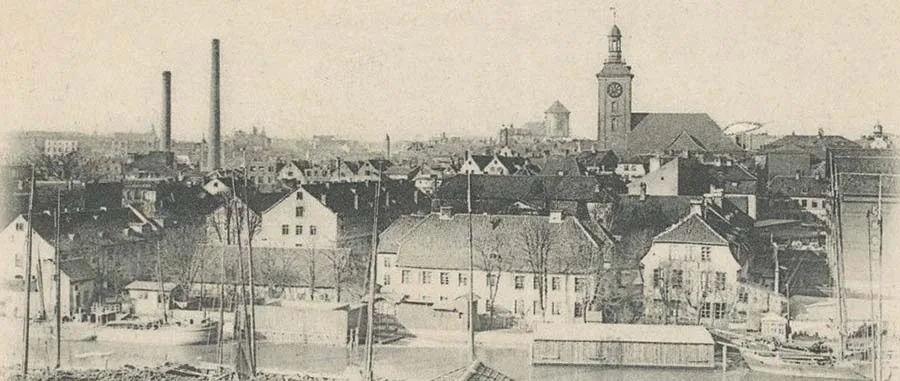
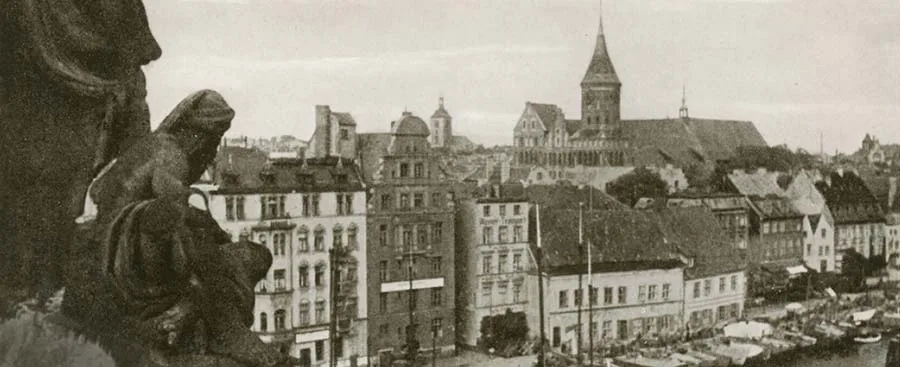
The view of Königsberg from afar, and in particular from the lagoon, is the usual panorama of a city with many towers. Its surroundings are a flat plain, but the land here is fertile, the landscapes colourful, and when seen from high points they are very pleasing to the eye, all the more so as the expanses of water enliven them greatly. Besides the castle itself, which faces us with its western front containing the magnificent Muscovite Hall, seven towers rise above the boundless sea of buildings. Yet neither by nobility nor by splendour of architecture can they charm the traveller's eye. But in contemplating Königsberg the soul is strangely and strongly stirred! How much this city has achieved and how much it has suffered over the centuries! What fine examples it has given the world to follow, and what great geniuses it has borne and sheltered!
Kant, Herder, Hamann, Dinter and Werner lived and worked here, and Bessel, Burdach, Herbart, Jacoby, Rosenkranz, Voigt and many others still live and work here for the good of mankind. It was along these narrow, unregal streets of Königsberg that, during the ill-fated war2, King Frederick William III3 walked with a stooping gait in a simple soldier's greatcoat, winning people's hearts by his simple manner and affable character...
..Less comforting is Königsberg's present material situation. Lying on the periphery of Prussia, it is remote from its centre, and from the rest of Germany too. Moreover, its once lively trade with Poland, Courland and the other Russian provinces has now completely ceased because of the border barriers set up by Russia.
Once the University of Königsberg was one of the most flourishing; the wealthy sons of Courland and Poland studied there, they brought money here and breathed life into it, but now its students come almost exclusively from the impoverished province, and even then their number sometimes does not reach four hundred.
Königsberg's literary life is also extremely meagre. In this large city, so rich in talent and learning, apart from one small privileged newspaper printed on wretched paper resembling blotting paper, there are no magazines or periodicals that could inform the rest of Germany about the life of Königsberg, almost isolated from the rest of the German world. Attempts to launch such publications as the Luftballon and Die Ostseeblätter4 failed for financial reasons.
There is little of the splendour characteristic of modern large cities in Königsberg, nor does it have spacious avenues. Only a few places, among them the Royal Garden near the theatre and the so-called Vorstadt5, a broad, elegant street, are fully worthy of a metropolis. Here, as in all the old Baltic towns, narrow lanes and tall gabled houses predominate, but the city itself is far from the splendour of Danzig or Lübeck. Still, the Hanseatic lanes of the Kneiphof, or the Löbenicht built on a hillside, are unique and deserve special mention.
* * *
Our steamer came alongside the quay on the Pregel embankment. From here the liveliest part of the city was only a stone's throw away. The stock exchange is also nearby. At this spot Königsberg undoubtedly makes the most vivid impression on visitors, especially on those who live deep inland and rarely, if ever, find themselves in a seaport.
Travelling by steamer has this advantage over all other ways of journeying: the traveller suffers neither fatigue, nor hunger, nor thirst on the way and can set about getting to know the city immediately on arrival.
We began looking for a place to stay the night, so as to leave our things there and set off at once on a walk. But we could not find one quickly. Everything was taken, and where there were still vacancies, they brazenly demanded a whole louis d'or for one night: the king was expected to arrive the day after tomorrow, and the city was experiencing an influx of guests. In short, we risked having to bivouac in the open air. But a lucky chance decided everything: it led into our arms friends who helped us to settle quickly in a decent place.
"Good heavens!" exclaimed one of us, a native of Elbing, after long trials in search of lodgings. "I don't recognise Königsberg! The number of people here has grown at least tenfold, and, worse still, the place is now full of uncouth country bumpkins, and the lanes of Königsberg are narrow enough as it is. My children, I fear there will be a lot of jostling, little chance of a decent dinner, and at the end they will present us with an enormous bill."
At last we set off on our walk and crossed the Green Bridge into the so-called Kneiphof, the part of the city lying on an island between two arms of the Pregel. The houses in this part of the city are all old; moreover, it is home to the cathedral, the university, the town hall and the Junkerhof6.
In the last two buildings it would undoubtedly have been worth seeing their rococo interiors. But we did not linger here and tried to make our way over very poor paving to the castle, in order to view the panorama of the city and its surroundings from its tower, some three hundred feet high.
"Königsberg," our friend from Elbing began again, "is, like Rome, built on seven hills, and on the highest of them stands the castle. The city was, as you know, founded in 1255 by King Ottokar of Bohemia on the hill of Twangste, and in 1257 the foundations of this colossal structure were laid here. Königsberg Castle shows a different face from each side to the one who looks at it and is a mixture of the styles of five centuries7."
The north wing of the castle, especially the part containing the rooms of the secret archive, is more interesting than the others, for it has been preserved almost unchanged in the form in which it was built back in the days of the Teutonic Order...
...For my part, I would like to draw the reader's attention to the west wing, which, I would venture, has no equal. Its vaults are used as wine cellars, above them is the castle church, and higher still, above its vaults, is the Muscovite Hall, where a collection of old weapons is displayed and various ceremonial events are held from time to time.
The south wing is occupied by the apartments of Heinrich von Schön, Oberpräsident of East and West Prussia. He enjoys great respect among his fellow citizens and deserves it in the highest degree. In other parts of the castle, besides the offices of the government and the consistory8, there are the royal apartments, which, however, frankly speaking, are hardly worth a look.
On visiting the castle I would have preferred first of all to look into the depths of the cellars of the "Blood Court" (German: Blutgericht). But that is risky! For the Blutgericht, despite its rather sinister name, is nothing other than a cosy little wine restaurant where you can taste the noblest samples of intoxicating nectar that the vine has ever shed. So true connoisseurs, such as we were, run the risk of going so deep into its bowels that they cannot find their way back.
So, up quickly! Let us climb the tower! The castellan's daughter, a tall girl of almost six feet, led us up the two hundred and fifty-five steps of a steep staircase that seemed to lead straight to heaven.
A strong wind was blowing up there, but the all-round view to the farthest horizon that opened out from there, and especially the panorama of the ancient city lying at our feet, steeped in flowers and green foliage, was the most charming and astonishing spectacle imaginable.
The castle church is of little interest: here one can see the coats of arms of the first knights of the Order of the Black Eagle, with which King Frederick I had its walls decorated in 1701. The Muscovite Hall had been restored in view of the approaching ceremony of the oath of allegiance9, but nevertheless looked terribly empty and somehow ravaged. It is a huge room a hundred and fifty paces long and thirty-three paces wide. The hall is relatively low, nineteen to twenty feet high.
As evening was approaching, we went down into the Blutgericht. How lively it was here, life bubbling everywhere, crowds of people sitting! Only cheerful, blissful faces were to be seen! Already in the front room we met friends who were ridding themselves of life's cares by shooting champagne corks at the ceiling. A huge barrel served them as a table and small kegs as chairs. But we did not look for the easy way and went further. Elderly people do not like to come here because of the prevailing damp and cold, so the long tables of the lower floor are usually occupied only by carefree, romantic youth. In the background, huge barrels are barely visible in the darkness, and a lantern hanging from the ceiling burns day and night, lending the whole scene a certain Rembrandtesque colouring. But who can describe our joy and amazement when we suddenly saw our companions in misfortune, whom we believed to be still languishing in prison as convicts! But here they were, sitting all together in a small, intimate company. King Frederick William's amnesty10 had brought them all back to life, and now, over noble Rhine wine, they were celebrating with cheers and songs the feast of their resurrection almost from the dead.
And so the circle of friends grew, and guitars were brought. Solos, quartets and choruses followed one another, the sounds echoed wonderfully up under the lofty vaults, and our joy truly knew no bounds. Someone suggested that we all go to the Castle Pond for a moonlight stroll. The proposal was greeted with applause.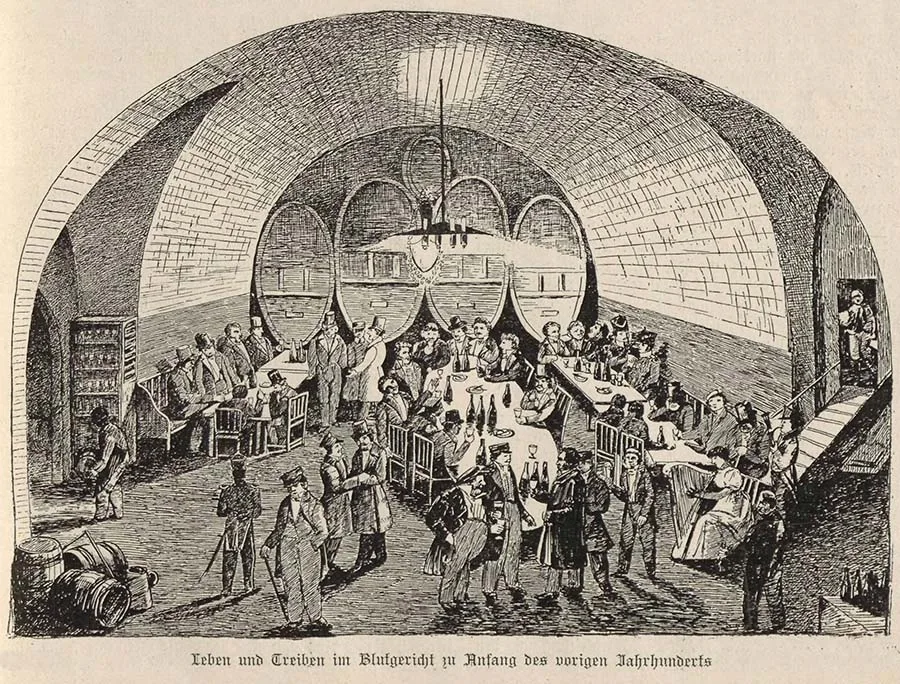 A party at the Blutgericht castle restaurant in the first half of the 19th century. Drawing from the magazine Der Wanderer durch Ost- und Westpreußen (German: The Prussian Wanderer).
As soon as nine o'clock struck and, according to good old custom, the sound of a horn blowing the tune of a pious hymn came from the castle tower, we moved in procession across the castle courtyard.
At the head marched our friend from Elbing, followed by the guitarists, then the singers, and the procession was worthily closed by the waiters11 carrying baskets of wine.
The man from Elbing was in excellent spirits. Most skilfully parodying a drunkard's gait, he sang the following little song, which he later repeated to us countless times until we had all learned it by heart.
As I come home to my own front door,
The street looks strange as never before.
As I come home to my own front door,
The street looks strange as never before.
Left side or right side, which way's to go?
Street, oh you street, you're drunk, I know!
Why do you pull such faces, old moon?
Squinting your eyes like a strange buffoon.
One glass of wine too many, brother, you've had,
Shame on you, at your age, it's bad!
Left side or right side, which way's to go?
Street, oh you street, how drunk you grow!
And the street lamps flicker so dim and so faint,
Standing still is a thing that they can't,
Flitting about, now here and now there,
Gentlemen, you're all drunk, I declare.
Left side or right side, which way's to go?
Street, oh you street, let's drain it, ho! 12
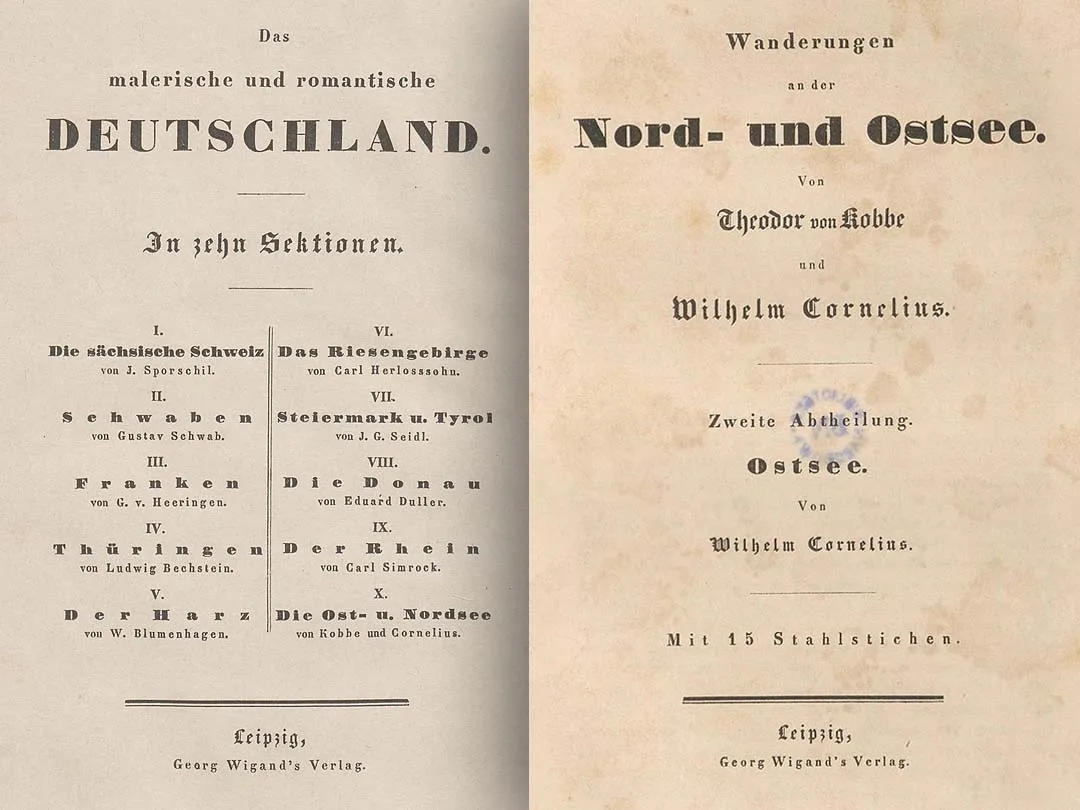
We passed through the gate in the east wing of the castle, past the guardhouse, came out onto Französische Strasse and then approached the Castle Pond.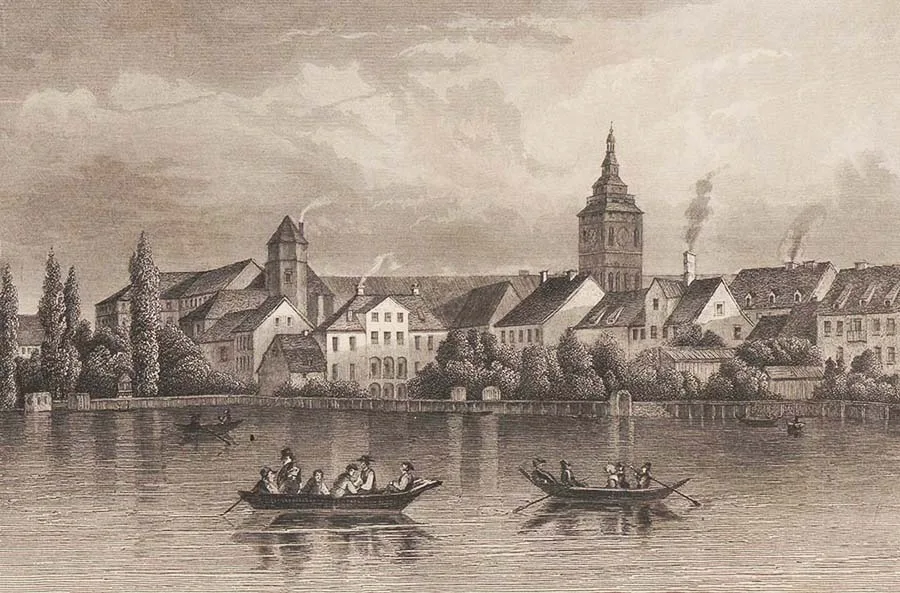 Evening on the Castle Pond in Königsberg. Steel engraving by Franz Abresch /Franz Abresch/ after a drawing by Bernhard Peters /Bernhard Peters/ (c. 1850). Illustration from the second book of the two-volume "Wanderings along the North Sea and the Baltic"
What would Königsberg be without this wonderful body of water!? Its calm green waters, surrounded on all sides by tall, venerable lime trees and chestnuts, cosy gardens, garden houses and arbours of every kind, awaken the most sublime and poetic feelings in the inhabitants and guests of Königsberg.
Truly, this special place is a small, warm, soulful oasis in the midst of the vast territory of cold calculation characteristic of a big city. Here, on wonderful summer evenings, a northerner can get a taste of southern life. Here lovers dream, swans glide over the water and the moon shines in all its beauty. It is here that the poets of Königsberg hunt for images and ideas.
Our outing on the water was one of the most vivid episodes of our whole stay in Königsberg. The night was exceptionally wonderful, clear and warm. The voices of our male quartet rang out masterfully and almost passionately. The Castle Pond came more and more alive: boats pushed off from the shore one after another, a small flotilla formed on its smooth water, and the moon lit up many beautiful female faces. From time to time the ladies applauded the singers enthusiastically.
Then the unsurpassed tenor of one of our companions rang out:
"There is a legend that the roses once,
Like lilies, were as white as driven snow.
But God made woman, and in sudden shame
They blushed at once, and purple-red did glow...." 13
This song concluded an unforgettable trip, and we went back to our lodgings at peace.
The next day, early in the morning, we walked round Königsberg along its fortress ramparts, and then strolled along beautiful avenues overgrown with limes, quinces, poplars and beeches.
We visited the observatory, the workshop of the great Friedrich Bessel, which stands on the highest point of the rampart, from where wonderful views opened up before us.
Before us, as if on the palm of a hand, lay the busy Pregel with all its bends and turns, visible, as it seemed to us, almost to its mouth in the Frisches Haff.
Since everything had already been prepared for the arrival of the royal couple the next day, we preferred this time to begin our walk through the city at the Brandenburg Gate, so as to walk to the castle along the road decorated with flowers and garlands. Thanks to its artful decoration, this Brandenburg Gate in Königsberg now strikingly resembled its famous namesake in Berlin and was an astonishing sight, especially from a distance.
Along Alter Garten street we passed the Haberberg Church and came out onto Königsberg's widest and most elegant street, the Vorstädtische Langgasse. It is famous for its beautiful buildings. This district is very lively; one may say it is the centre of Jewish life, and the Jews' synagogue, of quite imposing size, is also located here.
In the immediate vicinity of the Haberberg Church we were shown a water tower whose wall was decorated with a colourful image of the brave shoemaker Hans von Sagan. According to legend, in 1370, at the height of the battle between the Teutonic Knights and the army of the Grand Duchy of Lithuania, he raised the fallen standard, thereby inspiring the knights of the Order, who had already begun to retreat, and led them to victory.
Through the Green Gate with its pretty little tower, visible from afar, we came out onto the Kneiphöfische Langgasse. To this day it has retained most of its original character.
The high front terraces of many houses, decorated with railings and sculptures, are called Wolme14 here. In good weather, especially in summer, they serve as additional rooms where the local residents like to spend their time. Here people drink coffee, chat with their neighbours and, of course, discuss the passers-by.
This lively street vividly reminded us of Italy: here, too, elegantly dressed ladies were strolling, most of them, moreover, unexpectedly beautiful for a town so remote from the European capitals.
At last we came out onto the square of the Old Church of the Altstadt, which is buried in the greenery of trees and flower beds. Its backdrop is a row of houses with not very expressive gables. And above all this the castle rises impressively.
Then we turned towards the Löbenicht along the Altstädtische Langgasse, which stands out among all the others for its six- and seven-storey houses. The heavy brewers' wagons rumbling over the Löbenicht cobblestones and the sweet smell of malt remind you that this district is their home. The local beers are very popular.
After a walk around the Löbenicht, we set off for the numerous large granaries on the banks of the Pregel and, crossing the Venice Island (German: Insel Venedig, also called the Klapperwiese)15, found ourselves on the so-called Philosophers' Dam, where the great Kant once liked to stroll. This street had been laid out on the orders of Theodor Hippel when he was mayor of Königsberg. Later we did not fail to walk past the famous yellow house on Prinzessinstrasse and read the following inscription above its front door:
IMMANUEL KANT
lived and taught here
from 1785 until 12 February 1804.
Today a dentist lives in this house, and right next door there is a bathhouse, which we visited with pleasure...
We also visited the cathedral, which was begun in 1333 in a simple Gothic style without any decoration. The building shows that later there was not enough money, or indeed taste, to finish the work as thoroughly as it had been begun. Of the two towers that were to adorn the structure, only one was begun, and it was later hastily completed, so that the tower's height is utterly out of proportion to the considerable length and width of the cathedral.
The interior of the cathedral, on the other hand, is impressive. The vaults are majestic and lofty, so that visitors entering through the disproportionately low entrance portal are presented with a fine perspective of columns reaching right up to the altar. The building is picturesquely lit thanks to the coloured stained glass in the pointed window openings.
Among the many wooden sculptures, some are very valuable and worthy of attention. It is only a pity that the cathedral, like most Protestant churches in Germany, is greatly overloaded with family vaults and all kinds of inscriptions.
If you stand on Cathedral Square, to the right of the cathedral there is an avenue lined with poplars, and to the left you can see a wall with two weathered stone portals on which time has worked hard. They are almost hidden in the shade of tall, magnificent lime trees with spreading crowns. Here is the entrance to the Albertina, the University of Königsberg. These are old, dilapidated buildings housing the students' lecture halls, and they have long needed a thorough restoration. Adjoining the cathedral is the Stoa Kantiana, where the great Immanuel Kant is buried.
That, perhaps, is all about Königsberg in brief. It is a pity that in these brief notes we have hardly managed to convey the joy of our stay in this wonderful city and of our dealings with the people of Königsberg, whom we must thank for the hospitality and kindness they showed us, strangers. The days spent here will remain in our hearts for ever.
LEGENDS OF PRUSSIA in the blog of Tatyana Kolivay.
TRANSLATOR'S NOTES
1. Wittinen /Wittinen/ were sailing barges used for inland navigation in Lithuania . Other Polish and Lithuanian names for them were wicina, strug , bajdak and kurak. The boats were long and of shallow draught. They had a mast with a square sail and no covering, only planks joined with bast fibres serving as a deck. High sides at the bow and stern. Such barges could be towed along small rivers. At the end of the 19th century they were used mainly on the Memel and in the Curonian Lagoon. They served Memel's trade with Poland and Königsberg. More about wittinen and the raftsmen (dzimken) can be read in the article "In the Port of Königsberg". The authors' claim that the raftsmen were all Jews is, to put it mildly, untrue. As a rule, only the captain was a Jew...
2. This refers to the so-called Wars of the Third and Fourth Coalitions — the wars of Napoleonic France and its satellites in 1805–07 against a coalition of great powers that included, among others, Russia and Prussia.
3. Frederick William III (German: Friedrich Wilhelm III), King of Prussia from 16 November 1797. Son of Frederick William II and Frederica Louisa of Hesse-Darmstadt, grandnephew of Frederick II the Great, father of the Russian Empress Alexandra Feodorovna, consort of Nicholas I, and grandfather of the Russian Emperor Alexander II. Took part in the wars against Napoleon and in the Congress of Vienna.
4. Luftballon — literally "Air Balloon"; Die Ostseeblätter — "Baltic Leaves". The translator was able to establish that these newspapers were published in Königsberg in 1840.
5. Vorstadt — literally "suburb".
6. The Junkers' Court /Junkerhof (German) Wikipedia link (German)
7. You can read about the history of Königsberg HERE.
8. Consistory — in a number of Protestant denominations (Lutherans, Calvinists, etc.), a body of church administration.
9. The translator was unable to establish which oath of allegiance, between whom, is meant in this case (i.e. Königsberg, 1840/41).
10. The reign of Frederick William IV (1795–1861). Having ascended the Prussian throne in 1840, Frederick William IV ended the restoration policy of his father and put an end to the conflict with the Catholics by granting them some important concessions. He also stopped the persecution of the Old Lutherans, releasing the Lutheran pastors, and allowed them to form their own organisation and build their own churches, albeit with certain restrictions — without towers or bells. Many death sentences were commuted, the so-called "persecution of demagogues" was ended, and all liberal thinkers were released from prison. Only press censorship remained.
11. A waiter at the Blutgericht was called a Küfer (cooper; der Küfer).
12. In Russia this poem was first published in 1859 in the magazine "Arlekin" with the note "translated from the German"; then, many years later, in 1904, it was included in a songbook issued by the Soikin publishing house under the title "Song of a Drunken Student". In neither case was the author of the words named, and in 1863 it was set to music by the composer and pianist A. I. Dubuque. And the song "Street, Oh Street" became widely known in Russia. Nowadays the authorship of the verses is mistakenly attributed in Russia to the 19th-century Russian poet Vasily Sirotin.
13. The poem "The Creation of Woman" /Die Schöpfung des Weibes/ by Karl Simrock; music by Ferdinand Stegmayer. It seems never to have been translated into Russian. T.K.
14. "Wolme (die Wolme) were front terraces about 10 feet high, reached by flights of steps. These terraces were enclosed by iron railings of the simplest kind and decorated with large brass balls, which the people of Königsberg simply called 'shiny balls', since polishing them to a gleam was a matter of honour for every housewife. In summer the Wolme were covered with awnings and benches were put out on them. The adults came out onto them to get some fresh air, and the children used these quasi-balconies as playgrounds all year round."
An excerpt from "My Life Story" by the German writer Fanny Lewald / Meine Lebensgeschichte, S. 35.1863.
15. Klapperwiese — literally "clatter meadow" (German). Another name is Venice Island (Insel Venedig). This name is first recorded as a spoken one in 1737 and received official recognition in 1763. The numerous ditches cutting through the plot of land by the Pregel prompted a jocular comparison with the canals of Venice. In terms of today's layout, Venice Island is the unnamed passage running from Portovaya Street towards Polotskaya Street. Link.
Translated from Russian with the help of AI (Claude, Anthropic), October 2026.