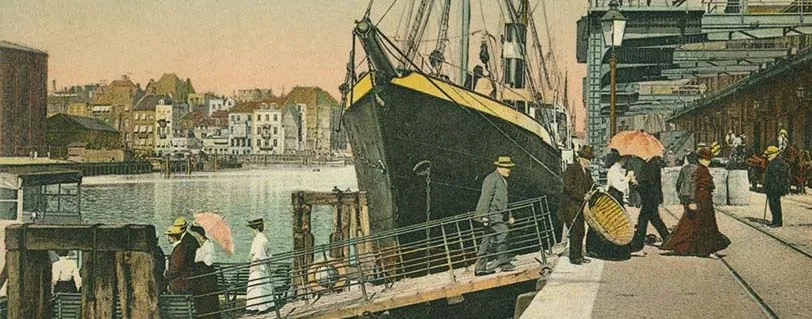
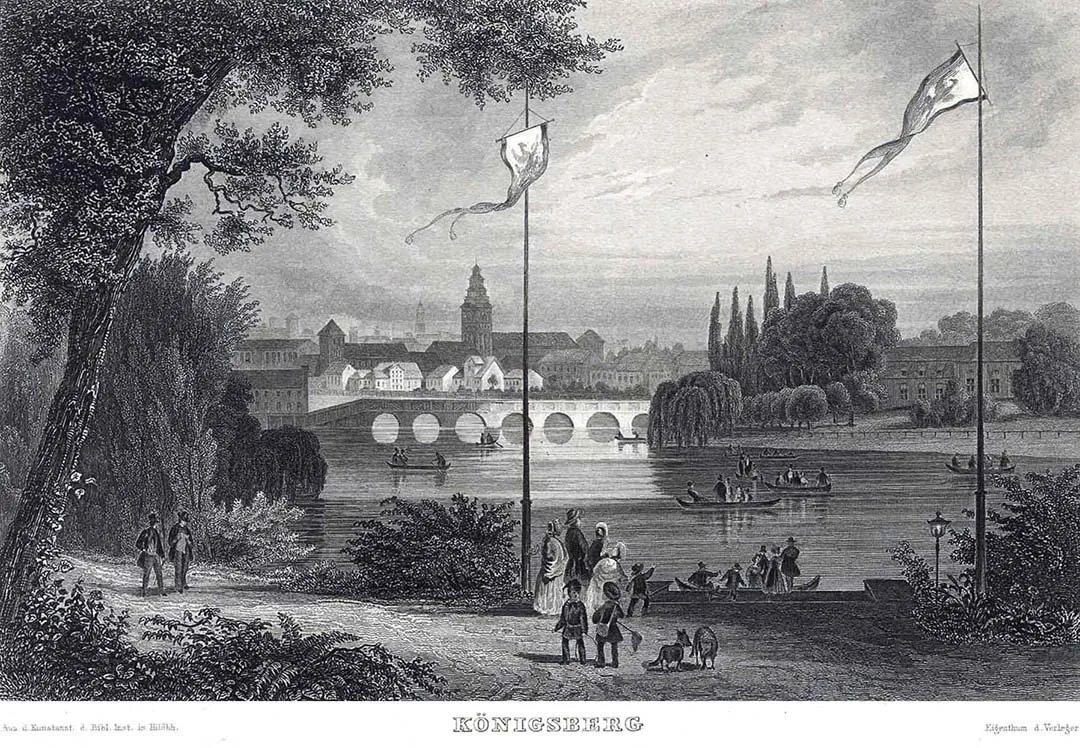
LEGENDS OF PRUSSIA in the blog of Tatyana Kolivay.
East Prussia may have changed its face by now,
but I know it only as it was twenty years ago.
August Lewald
As you approach the Vistula from the heaths and poor buckwheat fields of West Prussia, you are surprised by the rich black soil that suddenly appears beneath you, in which the cart wheels get stuck and the horses sink almost up to their bellies. This is the Vistula lowland, called the Werder, where wealthy farmers live, their frock coats adorned with rows of large silver buttons and their rooms distinguished by Dutch cleanliness and elegance. From the bright mirror-glass windows of their houses they look out at the desolate misery of the roads, phlegmatically taking the hardships of travellers as entertainment.
This is the most fertile region of the Prussian kingdom, and the Werder peasant, thanks to his wealth, has become proverbial and has even been celebrated in a folk song:

("And here's the rich peasant, a rogue and a cheat. His name is Harder, and this land is the Warder.")
Apart from the bad road, however, this country offers nothing of interest to travellers. The houses, surrounded by low hedges and huge dung heaps, are painted in bright colours, and the posts and fences are covered with the kind of fine carving that ship's carpenters know how to make. Here you can see grotesque masks and faces, all of it carved in wood painted in two-coloured stripes, which adds colour to the tasteless monotony of the whole.
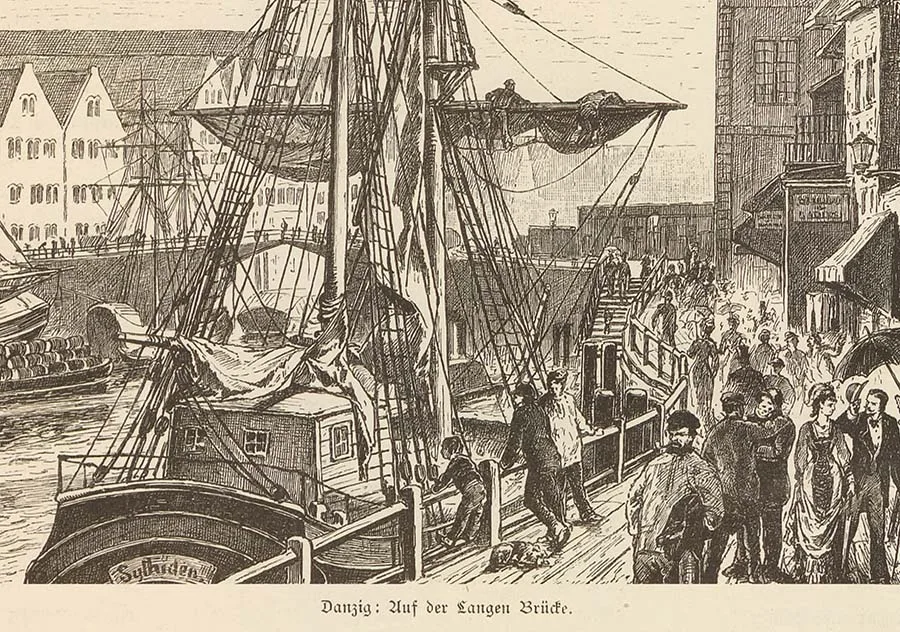 In the port of Danzig (Gdańsk, Poland).
Whoever passes through here in spring, when the trees are in blossom, can of course enjoy the generous beauty of nature, but the road is usually at its very worst then, impassable, and this spoils all the pleasure of the warm spring days.
Soon, however, the traveller leaves this Prussian paradise and comes to the shores of the Baltic Sea, in order to reach the old capital of the kingdom, Königsberg.
A new misfortune! A new calamity! There it was impassable mud, here there is water everywhere. The carriage rolls through great puddles and bogs, on the left the sea waves often beat against the axle, and wherever you look a barren sandy plain stretches out, in whose sands only here and there poor fishing villages can be seen.
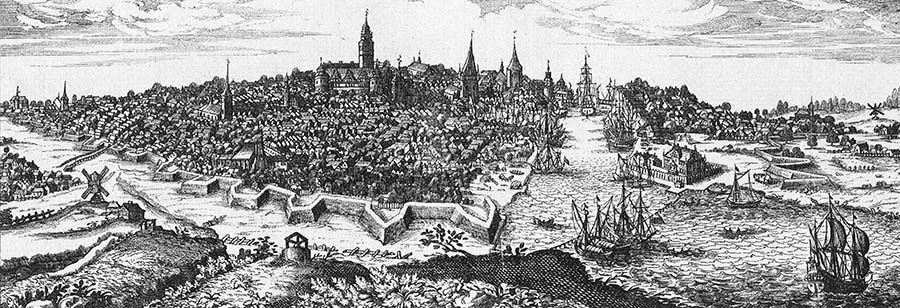
So you feel true happiness when at last Königsberg appears ahead in a wide semicircle on the bank of the Pregel, opening to the traveller its hospitable gates, but at the same time its very poor inns.
In my youth I paid little attention to all these discomforts of the road, making numerous excursions to the most interesting places in the surrounding country. There was neighbouring Frauenburg with its ancient cathedral and memories of Copernicus, the picturesque lake shore near Pobethen, and Pillau with its lively harbour life and the picturesque shores of the Frisches Haff.
But I also made longer journeys: to Danzig, an old city with charming surroundings; to Memel, which looked exactly like an English settlement, where the Argelanders, Ogilvies, Simpsons, Macleans and Motherbys lived in true elegant comfort1; to the banks of the Neman and the beautiful lands of Prussian Lithuania; to the hilly orchards of the so-called Oberland, where crucifixes stand along the roads, where monasteries and majestic churches, as if by the wave of a magic wand, carry us away from the lands of pure Protestantism into the sacred darkness of the biblical fields of early Christianity, where flocks of sheep graze peacefully and a shepherd with his staff can be seen nearby.
A journey to Memel in those days never passed without strange adventures and discomforts, although the distance from Königsberg was no more than twenty-four German miles2. Memel could be reached in three ways. The first: by water, in an open boat across the treacherous Curonian Lagoon; the second: along the Curonian Spit, a narrow strip of sand between the lagoon of the same name and the Baltic Sea; the third: via Tilsit, which meant a detour of twelve miles on a road that looked much the same as in the Vistula lowland, that is, impassable. Now, I have heard, this is the main route, as a good road has been built there. But in our day people usually travelled to Memel along the Spit.
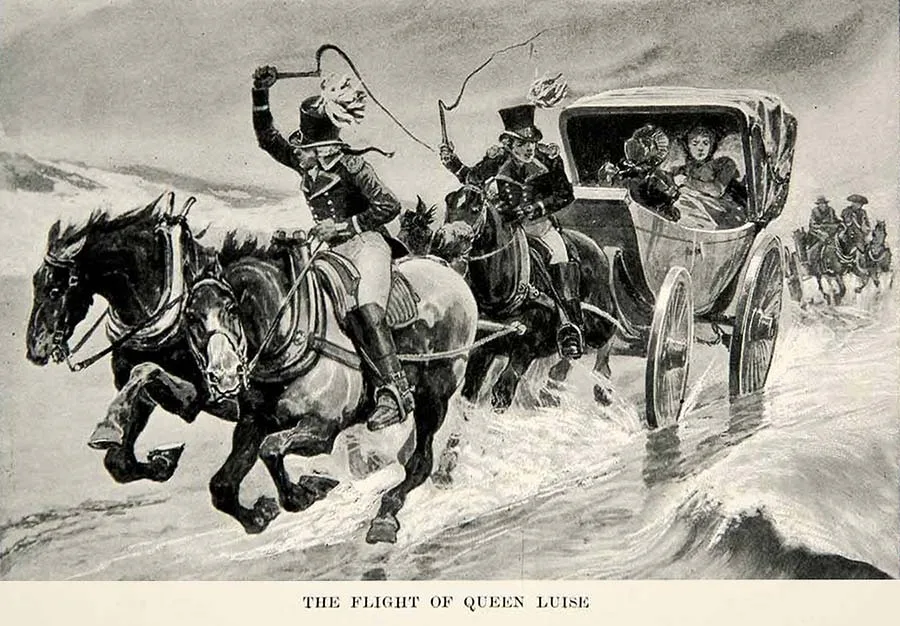 The flight of Queen Louise with her children from Königsberg to Memel along the Curonian Spit in January 1807.
The easiest way was to board the express mail coach in Königsberg, but travellers often chose the company of the so-called "Riga carter", whose heavily laden goods wagon sank deep into the sand, covering at best no more than four miles a day.
Once I made such a journey in the company of a count from a noble Courland family, a captain of a Saxon Guard Hussar regiment and a wealthy Russian merchant.
The memory of that ride along the Spit will stay with me forever. Steffens3 describes something similar in one of his novellas when he speaks of the north-eastern coast of Jutland, but the Curonian Spit has the peculiarity that in some places its width barely reaches a mile and a half. A high sandy ridge runs along the entire length of the spit. Its slopes, partly made of shifting sand, now form a dune called the "Nehrung".
We drove along the seashore, or rather in the sea itself, where the pebbles, polished by the waves, formed a kind of natural highway and eased the lot of the horses pulling the heavy wagon. Of course, the waves beating against the wheels of the carriage were not a pleasant sight, but in fact there was nothing dangerous about such a journey, if you were lucky enough not to run into quicksand!
Strong winds sometimes carry large quantities of sand from the dunes far out into the sea. This sand lies level with the firm ground and outwardly is hardly distinguishable from it. If a wagon ends up in such a place, it immediately begins to sink into this sandy grave. And if the traveller is making the journey alone, with no help to be expected from anywhere, then usually "man and mouse"4 perish quickly.
Apart from a few huts resembling the shelters on high Alpine passes, there was nothing on the sea coast of the Spit that could serve as any kind of refuge. These huts were used for a short rest in bad weather and for resting the horses when they were fed at midday. There were no people there. There was nothing there at all, and all kinds of provisions and fodder for the animals had to be carried along.
In the evening, as the sun was nearing its setting and the weary people on tired horses were completing their four-mile stage, the driver turned off the shore towards the middle of the Spit, and our wagon began to climb the steep slopes of the sand hills, to which every gust of wind gave new and fantastic shapes. After incredible efforts we finally reached the top and from there saw a sight so astonishing that we thought we had been transported to some island in the South Seas.
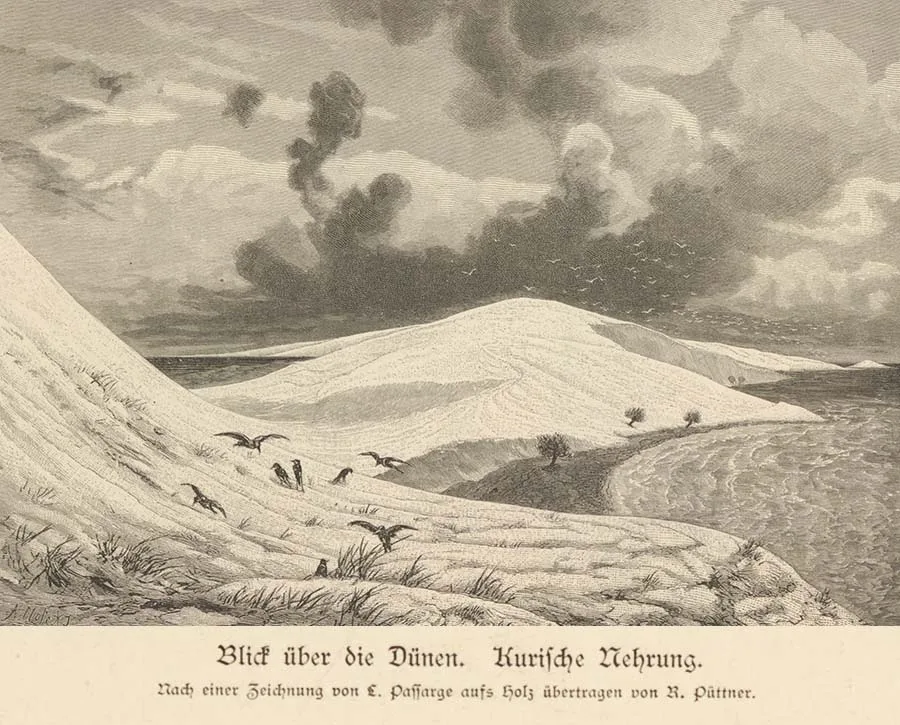 Dunes of the Curonian Spit.
Before us lay an entirely different "sea". It was darker than the Baltic, waves rolled furiously across it, and somewhere in the distance a coast could be made out, wrapped in a misty haze. This was the Curonian Lagoon. All around was sand, as everywhere else. On the shore of the lagoon stood huts: a poor fishing village.
The local church, half in ruins, was sinking into the sand; the crosses and gravestones of the little churchyard were also half buried in sand and seemed abandoned, as if nothing were firm on this treacherous ground: everything was merely a plaything of the winds. Only five or six stunted trees growing not far from the even more wretched cottages made a friendly, touching impression.
Nearby, on the shore, by the splashing cool waves, where a fresh breeze could be felt, sat the local women. They were weaving fishing nets and singing the songs that Martin Rhesa5 collected for us so diligently: dainos, love songs, simple but melodious and full of poetry.
Meanwhile the men were catching salmon and huge eels in the sea, the daily bread of the inhabitants of the Spit, or were busy with work about the house.
This is that very amber coast, preserved in its original state to our day, as Werner6 so wonderfully described it in his novel "The Cross on the Baltic Sea". It seems that at any moment one might see the master of the land, the dreadful zhupan7, approaching, and hear the agitated voices of the frightened chorus:
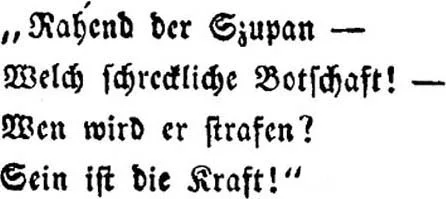
("Here comes the zhupan! What dreadful news! Whom will he punish? All power is his!")
Here I saw the hamlet of Kunzen with that very church buried in sand, as well as Nidden, Rossitten, Negeln and Schwarzort, from where people cross the narrow strait to the other shore to land in Memel.
Apart from fish with potatoes and a gulp of strong grain spirit, these people had nothing to offer us, but they received us courteously and hospitably with their "mile kunx"8.
We spent the night at the inn, on high canopy beds, and early in the morning we again began to clamber up the sandy ridge to continue our way along the deserted seashore.
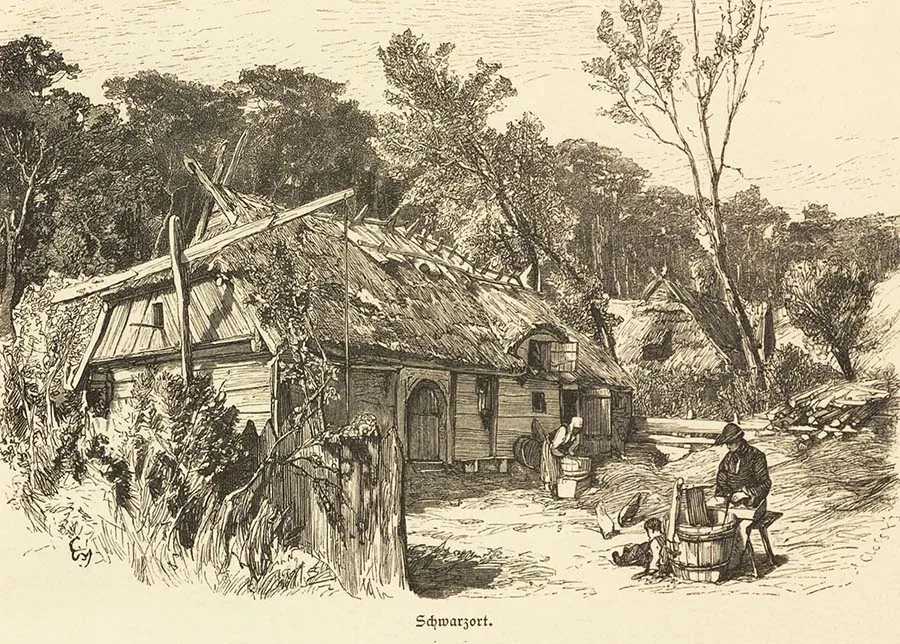 Fishermen's huts in Schwarzort (Juodkrantė, Lithuania).
If such a journey was tiring, reaching Memel by water was harder still. Travellers usually went from Königsberg to the fishing village of Schaaken on the southern shore of the Curonian Lagoon and boarded there the so-called Schaakener, a large open sailing vessel whose passengers were exposed to all the whims of the weather.
For safety reasons no fire could be lit on board, so travellers on these stormy waters, at any time of year, might go without anything hot for several days, making do with cold food alone. A dubious undertaking, on which a person of means would hardly venture. In the hope of a fair wind, this option was usually chosen by people of modest means.
The third way, via Tilsit, was also devoid of comfort. So, as you see, getting to Memel was by no means easy, and in the end the ride along the Spit still turned out to be the best choice.
The most interesting place not far from Königsberg at that time was the Ermland archbishopric. The pilgrimage to Heiligelinde, to the Holy Linden9, attracted Catholics and Lutherans alike. A night in the beautiful forest was romantic, the season was warm, the people were cheerful, the church procession was impressive, and all of this captivated and attracted us enormously.
In my early youth I made a trip to these parts every summer in the company of my dear friends. One of them died long ago; the other two perhaps smile pensively when they recall those days. Our life has become more serious and harder, but back then we did not think about the future!
You young people who enjoy the blessings of the year 1836! You for whom swift trains are no longer enough! You who will soon see all distances vanish thanks to steam and railways: you will not be able to understand me when I say that a trip of twelve miles was for us, the young people of 1813–1814, an extraordinary, marvellous journey.
You who travel along the Rhine every year, who know both Paris and London, you who climb the snowy summit of the Rigi10! You do not know how the hearts of us poor Königsbergers beat when we heard of travels, and how we longed to ride at least a little along the bumpy roads of the old kingdom!
What a multitude of things we took with us, and how much we forgot to take that we sorely missed later in the course of our great voyage! I think it is easier now to get to Livorno, and from there by steamer to the Levant, than it was in those years to travel to Heilsberg11, where I usually stopped on my way from Heiligelinde.
I made that trip through East Prussia in the summer of 1814 with my friends.
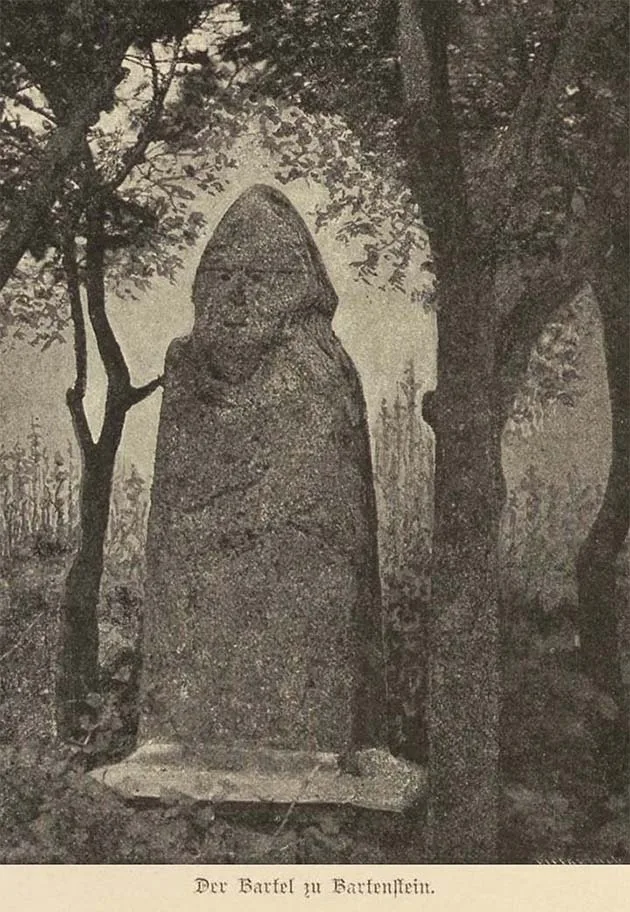
Bartel of Bartenstein.
On a beautiful June morning we drove out of the Friedland Gate of Königsberg in a light cart. Before us lay a green plain on which the little church towers of local villages appeared every now and then; on the left flowed the Pregel, on the right the forest of Aweyden could be seen.
We were all happy for no reason and looked at the familiar world with joyful eyes.
The taverns were wretched, the beer was undrinkable, and comfort was out of the question. We usually slept on straw bedding. But we took the most trivial things that happened to us on the road as yet another interesting adventure!
Not far from Königsberg lies the village of Mühlhausen. There lived the daughter of the great reformer Martin Luther, who had married a nobleman, von Kalckstein. Here we stood before the portraits of Father Martin and his daughter Margarethe, which were supposed to have been painted by Holbein. [In fact by Lucas Cranach. — Ed.]
From there our company went on to Bartenstein12, a small, dirty town. Here we saw the old stone lying in front of the town hall [Bartel — see above.]. It resembled a human figure and had once been worshipped by our pagan ancestors. That was the legend still current among the people, though long since refuted by scholars. And although we were well aware of this, we still joined the crowd of onlookers. So we stood for a while, studying the ancient idol while our horses were being fed. We tried to see in this lump of granite the real Perkunas, the old Prussian thunder god, now standing before us!
In Markeim13 we were given a friendly reception by the local Amtmann14, and we carried out a small etymological inquiry. Before leaving, we discovered that the local manor had in fact once been called Mag es keimen, "May it sprout", and that the name Markeim was derived from this.
From Markeim to Heiligelinde is not far at all. But we were badly shaken about before we got there. The primeval forest in which the monastery stands is a magical sight. The white monastery buildings in its midst make an extraordinary impression, for we were not used to seeing anything of the kind in our homeland. The galleries around the monastery courtyard (the so-called cloister walks) with their chapels, like the bright, welcoming church itself, were painted al fresco15. I had never seen painting of this kind before visiting this monastery. The artist was a Swiss named Felix Meyer16, if my otherwise faithful memory does not deceive me after so many years. I stood in amazement, my head thrown back, and gazed. And although I did not like the profusion of architectural forms in the pictures and the too artificially intertwined rows of sacred allegories, I could not hold back my admiration, as if I were standing before Raphael's Loggias. Such is the magic of the first impression of art on a young mind!
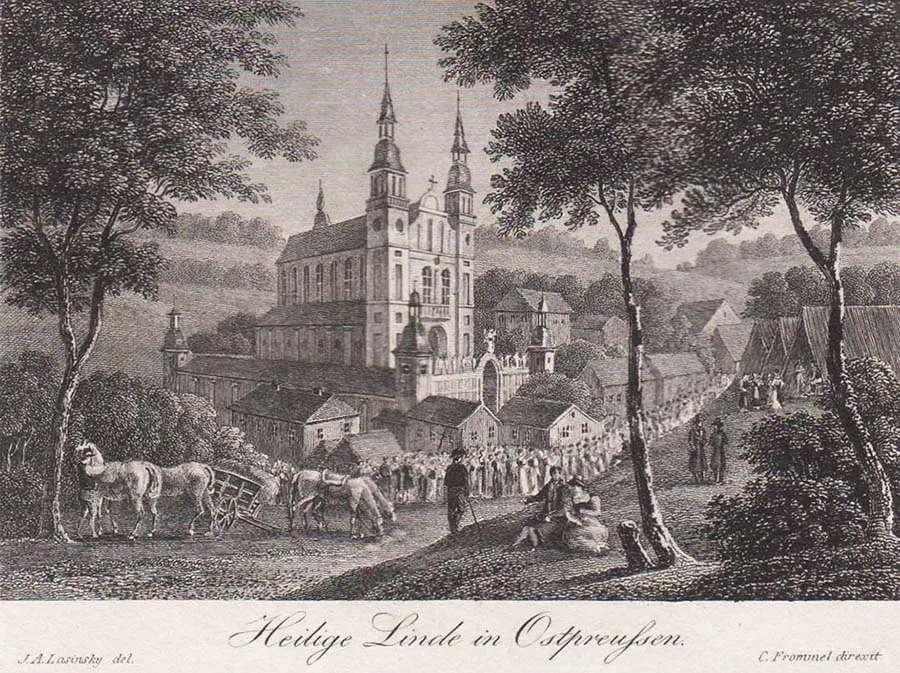 Heiligelinde (Święta Lipka, Poland).
From the inn on the hill opposite there were beautiful views, and we found a worthy welcome there. I stayed by the door to sketch the monastery and all its surroundings in the moonlight, and was very happy when I succeeded. Never before had I seen anything so beautiful!
From Heiligelinde we set off for the neighbouring town of Heilsberg. It was surrounded by green hills forming a graceful frame for the little river flowing there. I believe it is called the Alle, and I beg the pardon of Professor von Baczko17, who taught me the geography of Prussia, if I am mistaken.
When we saw this beautiful valley, we decided to send our coachman back and go on foot. "We shall have to walk through mountainous country!" one of us remarked. Well then! On this trip we would get to experience all the joys of travelling the mountain paths of Switzerland. No sooner said than done!
The coachman stayed at the inn, and we, with guitars and rucksacks on our shoulders, entered Heilsberg as walkers. As we made our way along one of the narrow streets of the town, a terrible sight met our eyes. We were horrified to see the half-decayed remains of a mother who had killed her child, on a wheel18. Truly, such a thing is not soon forgotten! We were forced to pass so close that we almost touched the rags of clothing that the wind played with and the bones of the skeleton hanging from the wheel, which threatened to fall on us. However, the sense of life that we felt in our own bones once we had passed through the lane cheered us and lifted our spirits again.
Heilsberg was built in a very strange way. Vaulted arcades ran along the fronts of the houses, as one often sees in southern Germany. Here, too, rose an old castle, where the Prince-Bishop of Ermland once resided. In all other respects this little town is insignificant, dirty and, as usual, badly paved. Very tired, we returned to the inn, where, having rested, we went into the billiard room.
There two distinguished gentlemen were passing the time at this game of kings, stepping in the pauses to a side table to take a swig of brandy from a glass and a bite of sausage. One of them, a stout little man in a grey frock coat and a cap of the same colour on his head, which he did not even turn when we appeared, amused himself by constantly cracking jokes. His listeners sat at the tables, mixing, so to speak, spiritual food with their daily bread. Our arrival seemed to interrupt the conversation for a moment.
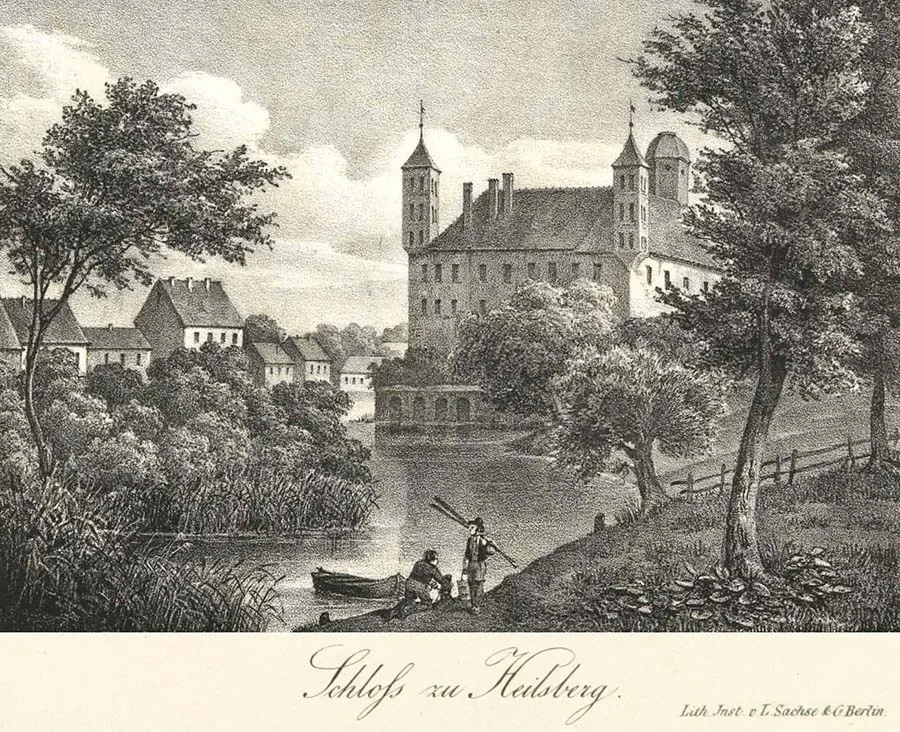 Heilsberg (Lidzbark Warmiński, Poland).
… Among different nations I have often observed the reactions produced by the sudden appearance of complete strangers nearby. Here are my conclusions. The English will carry on their conversation without paying attention to the stranger and often without even glancing in his direction. In any case, however, they will without fail display a proud indifference.
Incidentally, it is pointless to greet the English on entering, since they rarely return a greeting. Even those who on closer acquaintance turn out to be quite courteous and polite gentlemen behave this way. Observing meaningless, burdensome forms of politeness towards complete strangers makes no sense to them, and I actually find this at least honest. How often do we ourselves notice that behind outward politeness lie boorish rudeness and vulgarity!
The French answer a stranger's greeting by putting on a very serious face, and in this our whole well-bred world imitates them. Nowadays, when a stranger approaches Frenchmen conversing in a public place, they fall silent for a moment and cast a few fleeting glances at him, in which a certain mockery always shows through.
The Germans, with a rather irritated face, look long and pointedly at the stranger approaching them. It seems that these people, otherwise the kindest and most good-natured in the world, would gladly devour the stranger for daring to disturb them. Only later does this first exasperation pass without a trace.
Whoever thinks that every greeting must be answered with a friendly ear-to-ear smile, or even a set of stock phrases, is surely a philistine from some small German town, or perhaps a person without manners and breeding.
Inhabitants of small towns and villages are usually friendlier than those of big cities. They are more curious and therefore more talkative.
But the most unpleasant thing is when a stranger is introduced into a so-called closed society. This usually results in the most stubborn silence in response to every attempt at conversation. I myself have seen my neighbour at table, who was always very friendly and talkative, unable to squeeze out a word on seeing an unfamiliar face opposite…
The man in the grey frock coat, however, seemed unaware of such subtleties. After a brief but noticeable bewilderment he relaxed and went on with his jokes. The laughter of the others resumed too, and everyone stopped paying attention to us. To us, however, all these coarse witticisms seemed so wretched that we exchanged sleepy glances, seeing no reason to laugh. The wit could not bear such treatment, for anyone who has got into his stride and, as he thinks, is showering witticisms will sooner endure an insult than tolerate a serious face beside him. Or rather, that is precisely what will be the greatest mockery to him. Having finished his game of billiards, the grey frock coat left the room, and soon a servant appeared and rudely summoned us to the room of the Herr Landrat19.
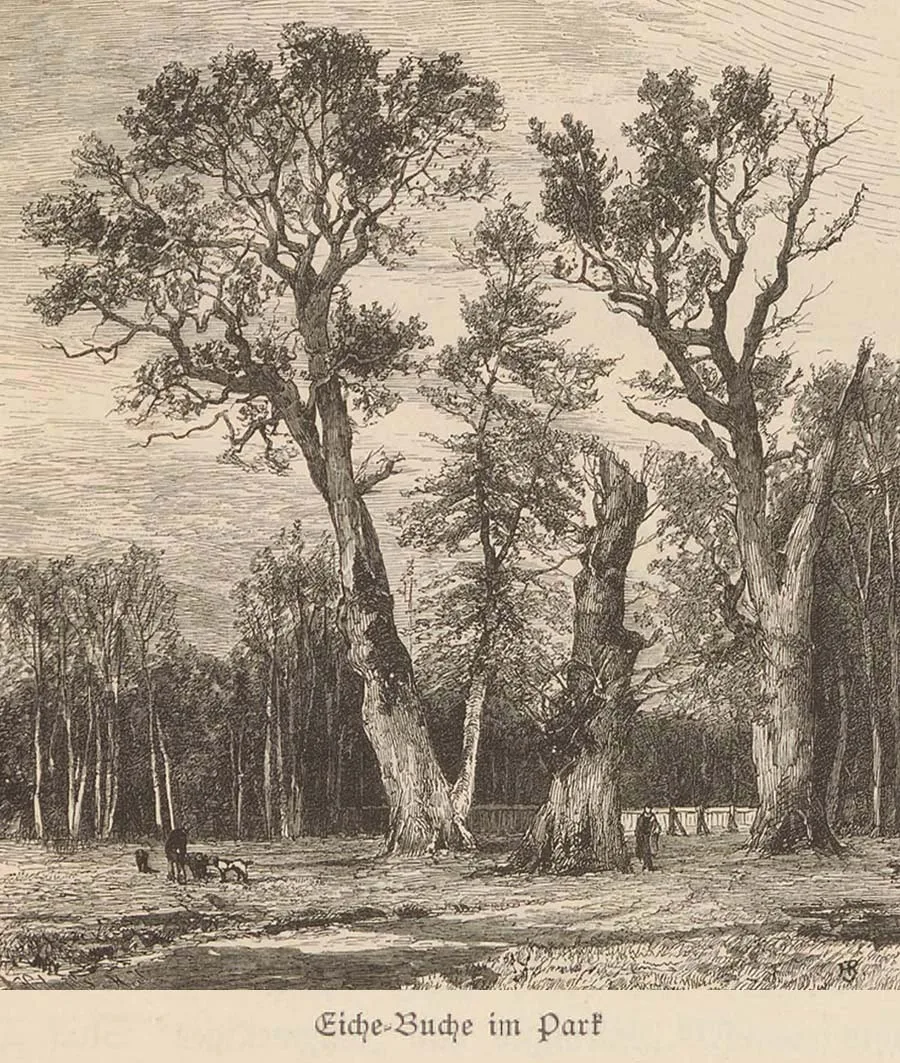
Oaks, a symbol of Prussia.
We were not a little surprised to find ourselves suddenly face to face with our unfunny joker, whose face now wore the sternest expression. It was the Herr Landrat himself, who at once began a real interrogation.
He declared bluntly that he had immediately noticed our excessive seriousness. When everyone around was laughing, we had tried to hide our concern and unease. It seemed to him that we were pondering some secret plan, and so he wished to see our passports. I explained that we had decided on our own to make an excursion through the Elysian groves of the Herr Chief (here our judge smiled) and had not thought it necessary to obtain police permission for it.
As for our seriousness, we were accustomed to laugh only at witty jokes whose point we understood. And in the billiard room we had failed to grasp any grounds for laughter. Probably the jokes were intelligible only to a small circle of initiates. Nor did we consider that we ought to try to please anyone here.
My serious reply so agitated the district official that he began explaining to us confusedly that serious people in merry company always seemed suspicious to him, and all the more so those who, as defiantly as we, took no part in the general merriment.
This assertion provoked in us the hearty laughter that the local Landrat had so long been trying to achieve, and when we told him that we had no passports with us, he declared that we were his prisoners. The official rang a bell, and a powerfully built man came into the room, an overseer or jailer.
We looked at one another questioningly; our gloomy glances confirmed it: the situation could not be worse. How were we to know how far this little man would go in his arbitrariness? Each of us was already preparing himself for a wearisome confinement until the necessary inquiries had been made in Königsberg.
After a thorough interrogation, which was officially recorded, we were to be taken to the town jail. All protests were useless, but the jailer winked at us so slyly that the thought of escaping with his help occurred to all of us at once. Chance helped to make our journey truly piquant.
We took a mocking leave of the judge, who looked at us haughtily as he gave the jailer the appropriate orders. Then we were led across the market square into a narrow lane, where we entered barrack quarters in a tall black building.
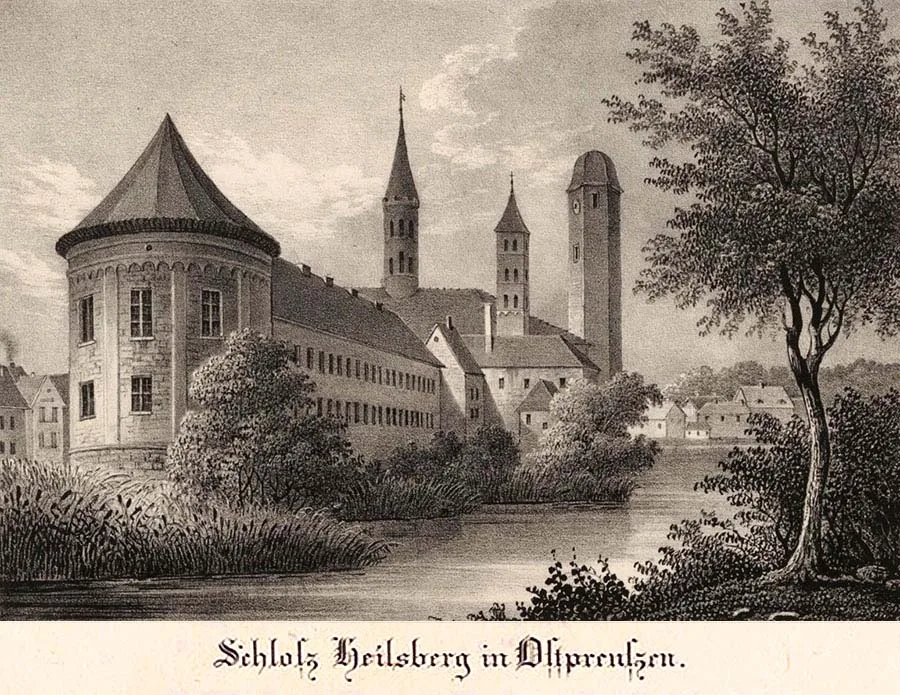 Heilsberg Castle (Lidzbark Warmiński, Poland).
Here our kind escort explained that he was entirely at our service and desired nothing so much as to bring us beer and tobacco. His wife lit a big fire in the stove and asked what we would like to eat for supper.
In short, we soon realized that our confinement would not be strict and that we could lead a quite tolerable existence here, contrary to the wishes of the Herr Landrat. But it saddened us that we could not spend the evening in the open air! We told our friendly host about this, and he expressed his wish to accompany us on a walk together with his dog.
And so the six of us, the four of us, the warder and his dog, went out to the town gate and strode up the hills until we reached the highest summit, with the proud name of Kreuzberg. When we returned late in the evening, the good woman had already laid the table for us so that we could satisfy the hunger we had brought back from our walk. The brave jailer also set to eating, and his wonderful mutt, to keep us company, crunched the bones in his bowl with such a racket that it was a joy to watch.
At the end of supper, when we took a bottle of punch out of the rucksack and asked for hot water, the warder smiled mischievously and said: "I didn't see that, but I'll gladly keep you company!"
Never had a prison held happier and more contented people! We loved and valued one another and sang so loudly that the townsfolk strolling in the street could hear the brazen cries of the imprisoned "criminals", who had been promoted to French spies by the summary justice of a high-born judge. And then sweet sleep descended on our innocent, punch-fuddled heads, and we woke only when the golden midday sun lit up the friendly dungeon.
"What the devil! What are you doing here?" a familiar bass voice cried to us, laughing, as we were enjoying our morning coffee from the mugs that Frau Jailer had set before us. Into our room stepped the stalwart Amtmann of Markeim, who had come to Heilsberg on business. As soon as he heard the remarkable story that had befallen us, he hastened to secure our release.
His surety was accepted, and the doors of the dungeon opened even before dinner, to the great regret of our hosts. We did not fail, however, to repay the husband and wife for the food bought for us, and when we said goodbye, the jailer assured us that he had never received within his walls such good vagabonds as we, and he had seen plenty of them in his life.
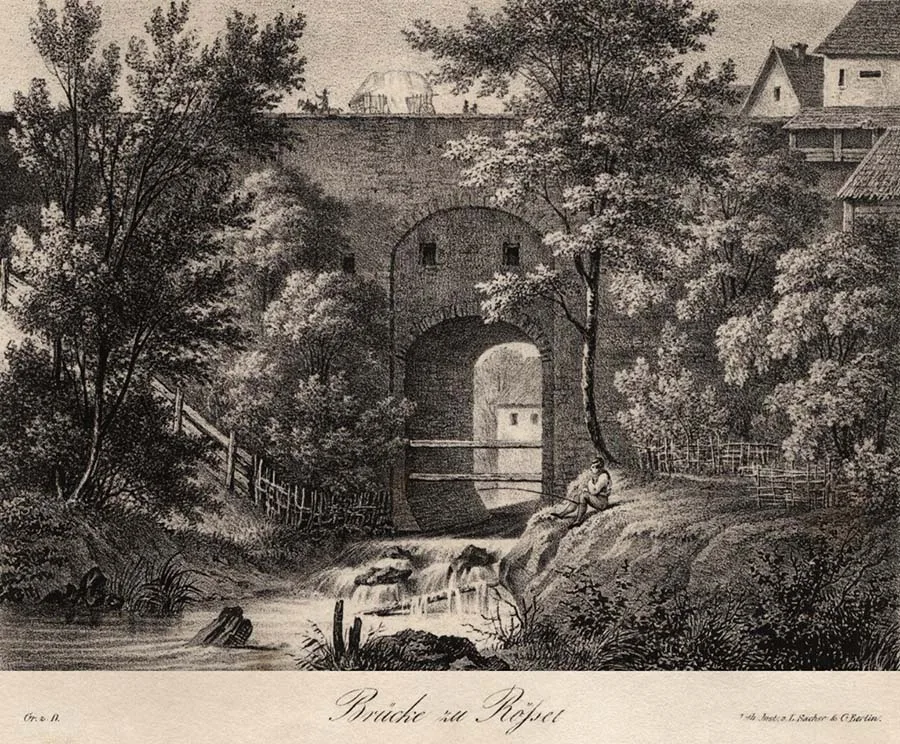 Bridge in Rössel (Reszel, Poland).
Our friend the Amtmann had left a permit for our stay with the innkeeper, and we proudly walked into the billiard room, where we again beheld the local high society. This time, however, not a single joke escaped the lips of the local head.
After dinner we left in our Amtmann's carriage for Rössel20, a pleasant little town with a convent, where we bought fine lace and the famous convent pastries from the pious sisters, to delight our families with welcome gifts on our return to Königsberg.
* * *
It was pleasant to travel about the fatherland in winter as well, when snowfields stretched all around as far as the eye could see and people drove across them in horse sleighs to the merry ringing of bells. Then you could choose any route: across frozen ponds, through bushes, hedges and fences deep under snow. My favourite ride was across the Caporn Heath to the old fishing village of Tenkitten near Fischhausen, where the first church in Prussia stood on the spot where the preacher of Christianity Adalbert was murdered by the pagans. Here, in the spacious official building, a long row of windows was lit in the evenings, and everyone passing by could drop in. As soon as the table was laid, one guest after another would appear, whom the friendly innkeeper did not even know by name but warmly welcomed each one. Never since then, in any country, have I met with such noble, magnificent hospitality.
LEGENDS OF PRUSSIA in the blog of Tatyana Kolivay.
NOTES
1. These are the most prosperous families of Memel of that time. In 1807, when Prussia had been crushed by Napoleon's army and the Prussian royal couple took refuge in Memel, the Argelander merchant house became the residence of the Prussian princes: the future King Frederick William IV and his brother William, the future Kaiser, the first German Emperor William I. Their playmate was Wilhelm Argelander, later the well-known Bonn astronomer. Many English gentry also lived in the town, since it was the most English-speaking town, it seems, not only of Prussia but of all continental Europe.
"If a Russian or a German intends to visit England, he should spend some time in Memel to get used to certain customs and to the manner of the English, which at first repel any non-Briton. The people of Memel, who conduct their foreign trade almost exclusively with the English, are so enamoured of the customs and manners of these islanders that they imitate them at every opportunity, and there is no shortage of comic situations. People speak only English, especially in the big trading houses; they eat, drink, play and amuse themselves in the English manner; they have the same whims as the English and are just as rude and unsociable. A stranger invited into society on the strength of his letters of recommendation may be left to himself for hours, and no one will even think of starting a conversation with him. Those present behave as if he were not there, and every question he asks is cut short with a monosyllabic answer. Only when those present learn that the newcomer has come from a trading town may he be asked, in the English manner: how much is this or that person worth? that is, what capital does he have at his disposal?"
Gottfried Rauschnick,
"Letters of a Russian Traveller",
1814, First Letter.
2. The geographical or German mile (Geographical mile) is 1/15 of a degree of the equator. If the Earth is taken as a sphere whose volume equals that of the Earth with the dimensions of Bessel, the geographical mile comes to 7.42 km.
3. Henrik Steffens (1773, Stavanger — 1845, Berlin): a European polymath, natural philosopher and Romantic writer, a native of Norway.
4. An old seafaring saying ("mit Mann und Maus untergehen"). If a ship sinks, the sailors, the passengers and the animals living on board (for instance, rats or mice) perish together, sharing the same sad fate. But the same fate can befall people on land too, so the maxim can also be applied to a disaster on land.
5. Martin Ludwig Rhesa (1776, the village of Karwaiten on the Curonian Spit — 1840, Königsberg): Lithuanian poet, critic, philologist, translator, Protestant pastor and collector of Lithuanian folklore.
6. Friedrich Ludwig Zacharias Werner (1768, Königsberg — 1823, Vienna): German poet and dramatist, author of numerous tragedies, Catholic priest.
7. Ancient Prussia was divided into eleven provinces, each headed by a chief, the zhupan (Sczupan). The name comes from the Slavic "zhupyn", meaning "master of the land". The Prussian provinces were nominally united under the authority of the high priest Kriwe Kriwaito.
9. Mile Kunx: Dear sir. The Curonian dialect spoken here is probably Old Prussian and differs greatly from Latvian (in Courland and Livonia), Estonian (in Estonia) and Lithuanian. These dialects sound very melodious, and indeed the language of the ancient Prussians was in no way inferior to them. This is attested by the names of the gods Potrimpos, Pikollos and Perkunas, as well as Kriwe Kriwaito, Waidelot and so on.
9. Święta Lipka (German: Heiligelinde) is a small village in the Warmian-Masurian Voivodeship, in north-eastern Poland. It lies about four miles south-east of Reszel (German: Rössel) and eight miles south-west of Kętrzyn (German: Rastenburg). The village is located in the historical region of Masuria. Święta Lipka is known for its pilgrimage sanctuary and its Baroque church. The name may actually derive from a sacred grove of the ancient Prussians that stood here.
10. The Rigi is a mountain massif in central Switzerland, part of the Alps. The Rigi lies between Lake Zug and Lake Lucerne, on the border of the cantons of Lucerne and Schwyz. Height: 1,797 m above sea level.
11. Heilsberg, now Lidzbark Warmiński, is a town in Poland, part of the Warmian-Masurian Voivodeship.
12. Bartenstein, now Bartoszyce, is a town in Poland, part of the Warmian-Masurian Voivodeship.
13. Markeim: a rural community in the district of Heilsberg. Since 1945 it has belonged to Poland and is called Markajmy in Polish.
14. Amtmann: an official, a functionary (German).
15. "Al fresco", on wet plaster: a technique of wall painting on damp plaster (fresco), the opposite of "al secco" (painting on dry plaster).
16. Felix Meyer (1653, Wülflingen near Winterthur — 1713, Wyden Castle near Ossingen): one of the most outstanding Swiss landscape painters of his time.
17. Ludwig Franz Adolf Joseph von Baczko (1756, Lyck — 1823, Königsberg): German writer, lecturer at the Albertina University of Königsberg. In intellectual history he stands between the Enlightenment and Romanticism. His main work is the six-volume "History of Prussia". He was blinded in an accident at the age of 26.
18. Breaking on the wheel: a form of capital punishment common in antiquity and the Middle Ages, also known as the "Catherine wheel" or simply "the wheel". Breaking on the wheel was already practised in ancient Rome. In the Middle Ages and the early modern period it was widespread in Europe, especially in Germany and France, where it was considered the most agonizing (after quartering) and the most shameful execution. All the major bones of the condemned person's body were broken with an iron bar or a wheel, after which he was tied to a large wheel, and the wheel was set up on a pole. The condemned lay face up and died of shock and dehydration, often quite slowly. The sufferings of the dying were aggravated by the birds that pecked at him.
19. Landrat: in Germany, a government official who exercised state functions in the territory of a district and was the sole executive body of the district's local self-government.
20. The municipality of Rössel was part of the Rössel district in the administrative region of Allenstein. The town has belonged to Poland since 1945; its current Polish name is Reszel.
LEGENDS OF PRUSSIA in the blog of Tatyana Kolivay.
Illustrations (2, 4, 5, 9) by Gustav Schönleber from Edmund Hoefer's book "Travels on the North Sea and the Baltic", published by the Kröner brothers in Stuttgart in 1881.
Translated from Russian with the help of AI (Claude, Anthropic), October 2026.