"Being itself is comparison…"
(Osip Mandelstam).
The Green Spaces of Königsberg's New Districts
The leafy suburbs that became city districts made a major contribution to Königsberg's green lacework. Between 1905 and 1910, Kalthof, Tragheimsdorf, Vorder- and Mittelhufen, Lawsken, Ponarth, Schönfließ, Amalienau, Groß Ratshof, Karolinenhof, Mühlenhof, Neue Bleiche and Rosenau were incorporated into the old city. As of 1 December 1910, these territories covered 24.11 km2 and had 30,868 inhabitants. By 10 June 1927, Juditten, Devau, Kummerau, Neuhufen, Friedrichswalde, Maraunenhof, Ratshof and Speichersdorf had been added, bringing Königsberg another 40.2 km2. By 15 November 1928, Ballieth, Metgethen and Jerusalem (418 ha, 253 inhabitants) had come within the city limits, followed on 1 January 1929 by Groß Holstein and Spandienen (820 ha, 391 inhabitants). In 1933 came Altenberg (278 inhabitants), Beydritten, Charlottenburg, Lauth, Moditten, Quednau, Palmburg, Seligenfeld and Neuendorf (7,138 ha). In total, the suburbs added 7,416 ha and 13,190 inhabitants to the "inner city".
Let us consider the kinds of green spaces that, over time and by the early 20th century, had taken shape in some of the city's districts laid out on the "garden city" principle.
Amalienau (Amalienau)
The Königsberg suburb of this name came into being after 1820, when Commercial Councillor Gustav Schnell (Gustav Schnell, 1793–1864) bought up all the land of the remote western suburb of Hinterhufen (Hinterhufen) and merged it into a single estate, Amalienau (not far from Hinterhufen, to the north, lay the Amalienhof estate, recorded since 1558 — it may well be thanks to it that the whole district got its name).
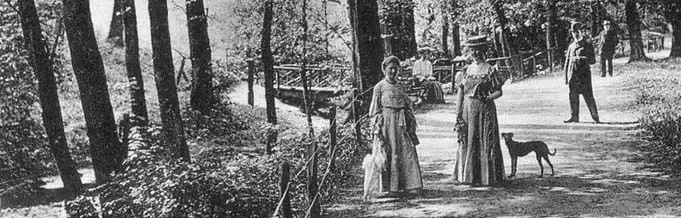
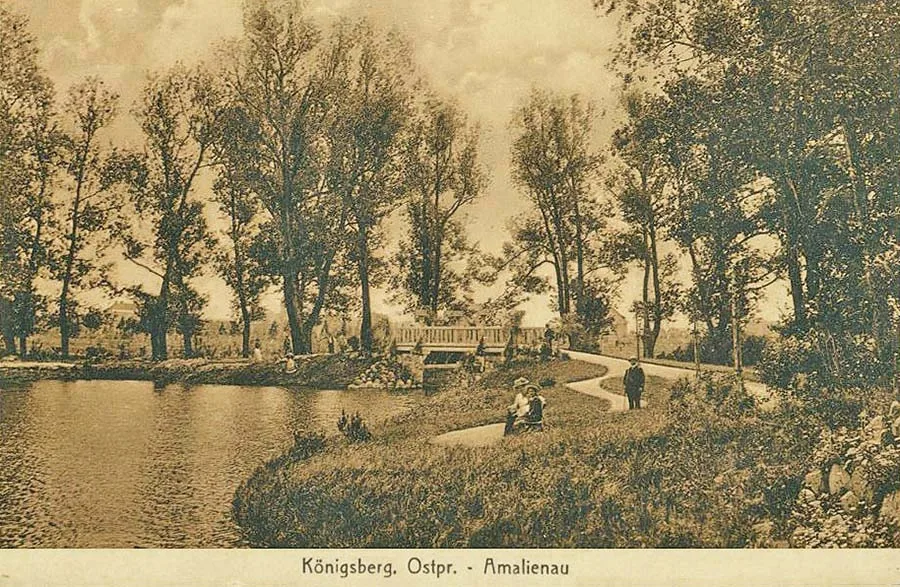 Twin Pond in the days when Amalienau was taking shape.
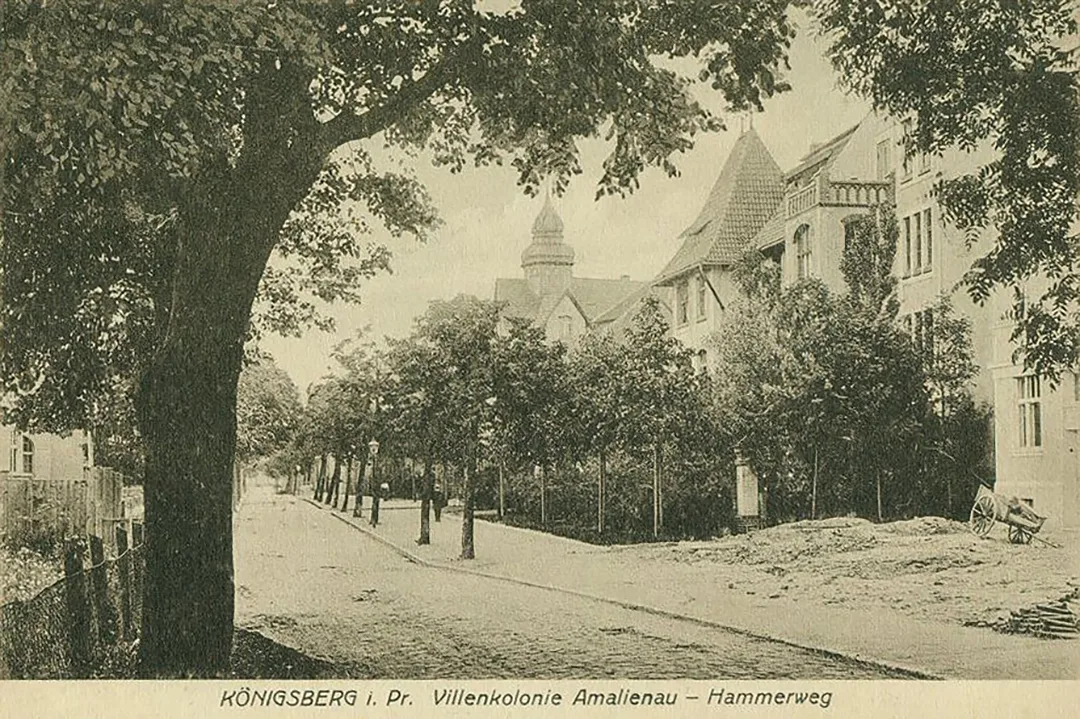
By the early 20th century, the Amalienau district was bounded to the north by Am Landgraben / Am Landgraben (German for "along the Landgraben", now Yanalova Street), to the south by Lawskerallee / Lawskerallee (now Pobedy Avenue), to the east by Schrötterstraβe / Schrötterstraβe (Krasnaya Street) and to the west by Dürerstraβe / Dürerstraβe (Lesoparkovaya Street). Hammerweg / Hammerweg (Mira Avenue) divided this large district into a northern and a southern part.
For whatever reason, the southern part proved the more prestigious, and from 1901 until the First World War it was developed by the Terrain joint-stock company in the finest architectural traditions of the day, with villas in the style of a country manor house. The villas were no more than two storeys high, with complex, irregular outlines of walls and roofs, an emphatically grand entrance porch and a lofty, two-storey hall and dining room (many of the district's villas were designed by Königsberg's best-known architect, Friedrich Heitmann (Friedrich Heitmann, 1853–1921), and by the Berlin architect Joseph Kretschmann (Jozeph Kretschmann, 1847–?). Among the city's other new districts, Amalienau stood out for the richness and variety of its greenery. This district of wealthy villas was immersed in the green of private gardens, abounding in a wide range of introduced species, that is, exotic plants that had been in fashion among local garden designers ever since the Royal Garden was laid out. The gardens were adorned with flower beds and terraced, clipped parterres, small ornamental ponds, little fountains and garden sculpture — the green attire of every villa was unique.
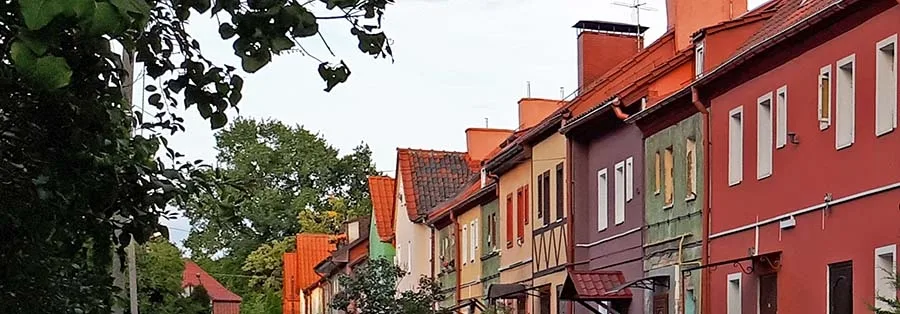
Not all the villas in the district kept to the style of a rich manor house: in the 1920s and 1930s, owing to the inflation that struck the German economy after the First World War, Amalienau continued to be built up, but with simpler and often smaller houses, although the "garden city" layout was preserved. The northern part was developed differently. At the turn of the 21st century, the former Amalienau district of Kaliningrad once again found itself at the centre of a boom in building new mansions and modernising old ones, but this time the distinctive features of the historic architectural landscape are not being respected.
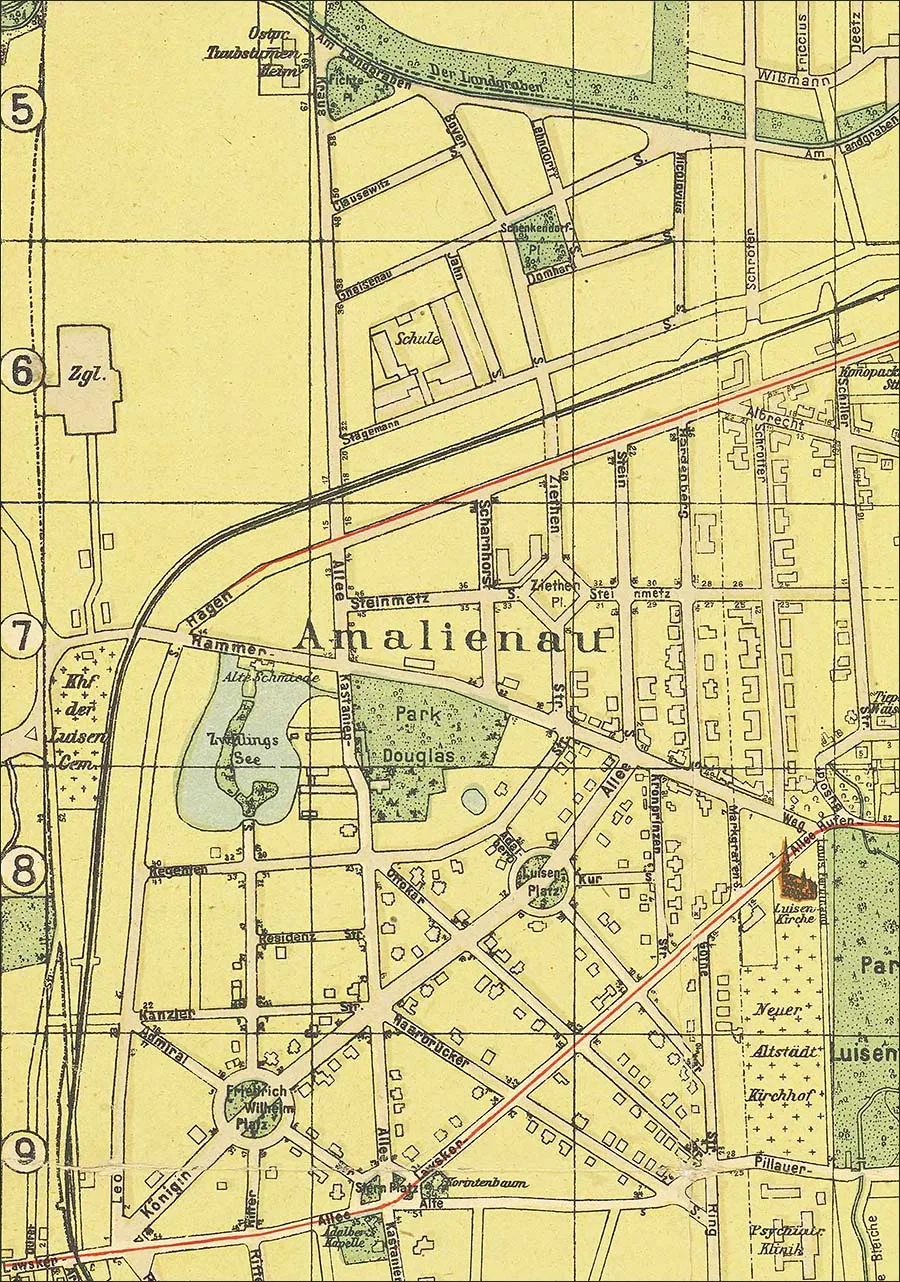 Map of Amalienau from the early 20th century: the large Douglas Park is still in the centre.
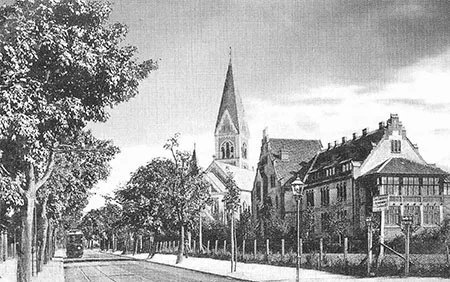
Running diagonally through the centre of southern Amalienau, dividing it into a north-western and a south-eastern part, was Königinallee (Königinallee), named, of course, in honour of Queen Luise (now Kutuzova Street). During the construction of the new district this broad, tree-lined street acquired two small round squares with flower beds — Luisenplatz (Luisenplatz) in the north and Friedrich-Wilhelmplatz (Friedrich-Wilhelmplatz) in the south — evidently the townspeople's tribute to the royal couple.
Königsberg had many names associated with Queen Luise (1776–1810), who died young: Luisenallee / Luisenallee (now Komsomolskaya Street), the Luise Home (the building has not survived), the Königin-Luise-Gedächtniskirche, built in 1901 (now the Puppet Theatre), Luisenhöh street (Luisenhöh), which branched off Hufenallee (Hufenallee / now Mira Avenue) into the depths of Luisenwahl Park (Luisenwahl / now Central Park), Fort Königin Luise on the western outskirts of the city, the Luisentheater, built in 1892, which has barely survived and has been rebuilt, the Königin-Luise-Schule for girls (now School No. 41 on Tyulenina Street), and Luisental Park (Luisental) in the suburb of Juditten (Juditten).
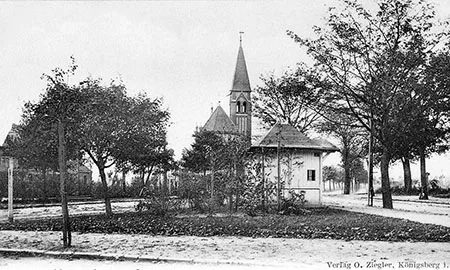
Where Kashtanovaya Alley (Chestnut Avenue — it bore the same name in Königsberg, too!) crosses Lawskerallee (Lawskerallee / now Pobedy Avenue), Sternplatz (Sternplatz, Star Square) took shape, adorned with a small public garden. Nearby, the St. Adalbert's Church was built. The layout of the garden has since been changed, and at its centre now stands a monument to the Lithuanian poet, critic, philologist and translator Liudvikas Rėza (Martin Ludwig Rhesa / Lith. Martynas Liudvikas Gediminas Rėza, 1776–1840).
In 1909–10, the man-made lake Zwillingssee (Zwillingssee / Twin Lake, now Khlebnoye, "Bread Lake", or Poplavok Pond — both names are in use today) appeared in the north-western part of the villa district of southern Amalienau.
The lake's historical name comes from the fact that it is divided into two almost equal halves by a broken causeway, which served as a tree-lined promenade, with small bridges linking the islets that formed part of it. At the northern end, the promenade was complemented by the Hammerschmiede hotel (German for "hammer forge"), which had a veranda restaurant overlooking the lake. The hotel building survived the battle for Königsberg, and in the post-war years it housed a bakery, which may be why the lake came to be called Khlebnoye ("Bread Lake"). In the 1960s, for reasons unknown, the hotel building was demolished. In the early 21st century a new business centre was built on its site, and for some time the townspeople firmly associated it with the state corporation Rosatom.
In 1920, in this new district of the city, the old garden of the Klein Amalienau estate was turned, with funds from the wealthy amber merchant Anton Douglas (Anton Douglas, 1817–1883), into a small (2.8 ha) park bearing his name. Today it partly survives behind the Musical Theatre (formerly the Fishermen's Palace of Culture), whose building was erected on the grounds of this miniature park in 1958.
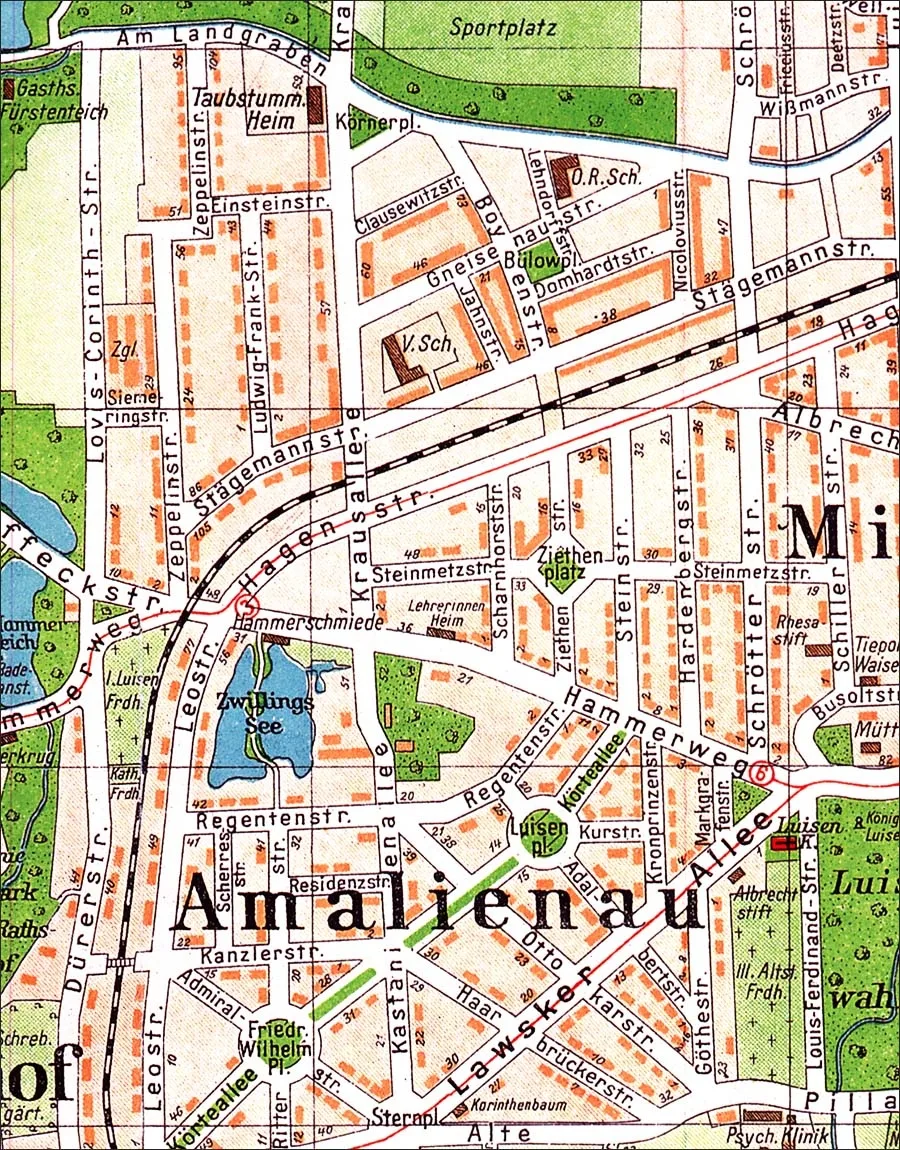 1928: Königinallee has already been renamed Körteallee.
Private gardens were unquestionably the backbone of Amalienau's greenery. Even so, the district was also adorned by public spaces: Douglas Park, the promenades of Twin Lake, a nameless square at the intersection of today's Mira Avenue and Pobedy Avenue (next to the main entrance to Central Park, formerly Luisenwahl), the two round squares with flower beds on what is now Kutuzova Street, and the garden square at the intersection of Chestnut Avenue and Pobedy Avenue, the Sternplatz (Sternplatz, Star Square).
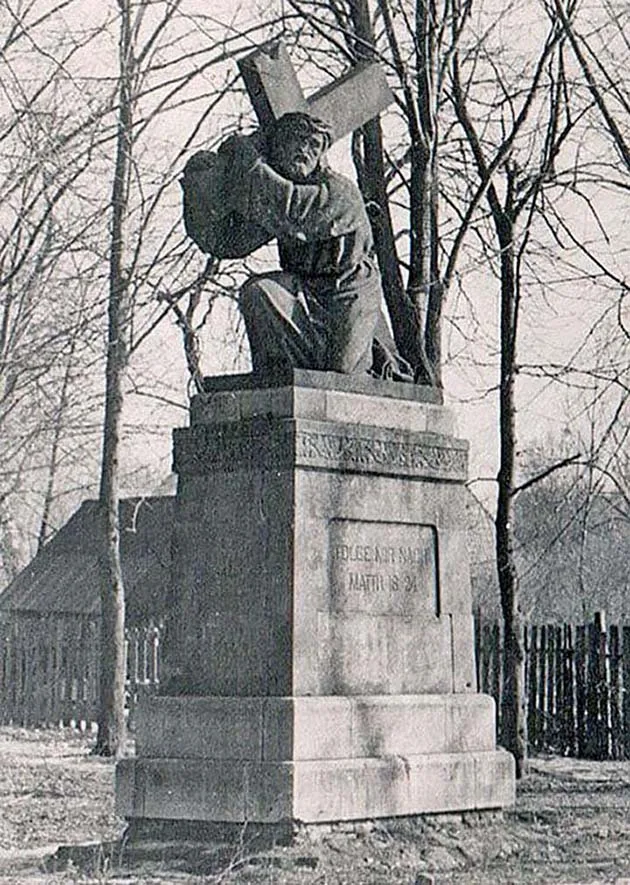
Christ Carrying the Cross, sculptor Paul Koralus, 1913.
Not far from Bliznetsy Lake lay a small green expanse: the cemetery belonging to the Königin-Luise-Gedächtniskirche (Queen Louise Memorial Church), located in today's city in the area between Engelsa, Chapayeva and Lesoparkovaya Streets. Until 1960 it was home to the sculpture "Christ Carrying the Cross" (sculptor Paul Coralyus, 1892–1991), erected in 1913. Its pedestal bore an inscription from the Gospel of Matthew, "Follow me" (German: FOLGE MIR NACH).
There is no doubt that this delightful part of Kaliningrad will continue to be intensively built up in the near future. Yet all its charm and prestige lie in the extraordinary intimacy lent to this corner of the city by its tree-lined streets, the spaces between its houses and the garden squares of former Amalienau: may they remain in pace, in peace and tranquillity…
Translated from Russian with the help of AI (Claude, Anthropic), October 2026.