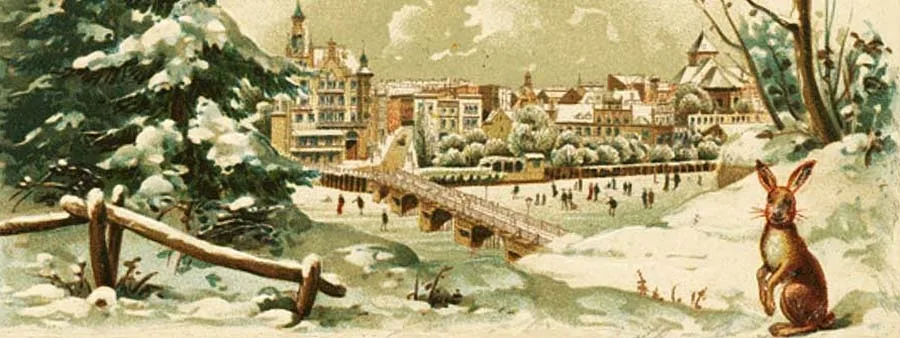
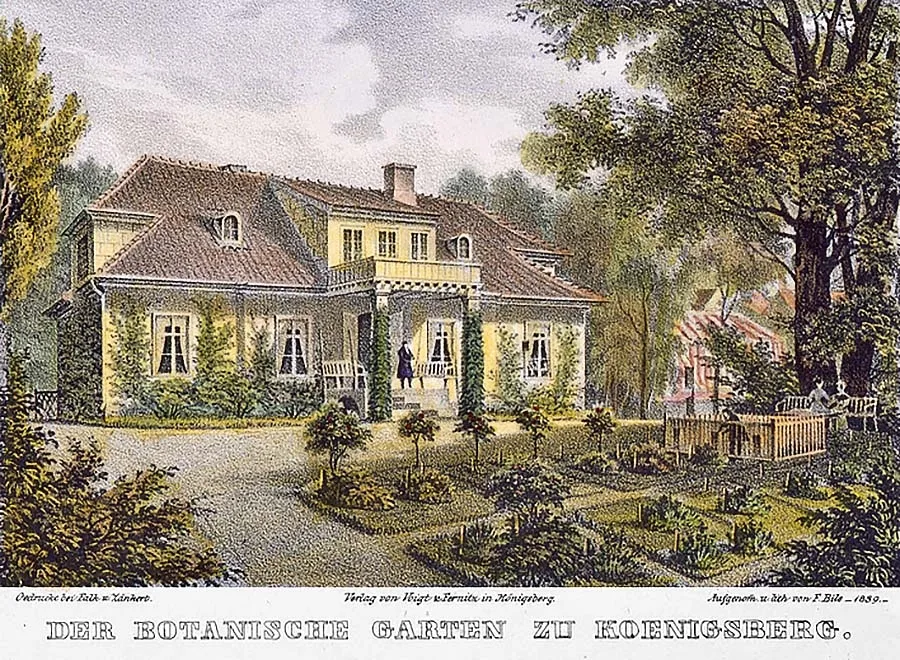
Wagner Street, Observatory Street and Laak (Wagnerstraße, Sternwartstraße, Laak) were certainly among the least inviting streets in Königsberg, yet they led to a delightful, if not very popular, corner of the city. We are speaking here of the University Botanical Garden (Botanischer Garten der Universität), which was open to the public at certain hours.
Had you come here in May, you would have been greeted from afar by the beautiful old hawthorns, covered in blossom, in front of the Zoological Museum (Zoologische Museum). Incidentally, the Altstadt Plague House (Altstädtisches Pesthaus) once stood on this spot, as was long recalled by the old name of the lower part of Sternwartstraße: Plague House Lane (Pesthausgasse).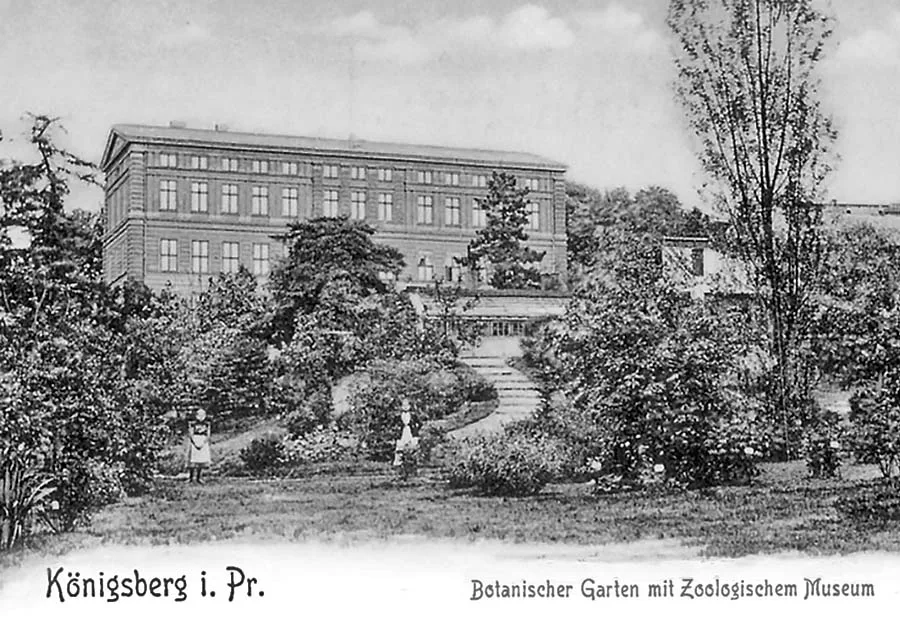 The Botanical Garden and the Zoological Museum.
Opposite the Zoological Museum was the gate to the Botanical Garden, behind which visitors were greeted by bright yellow bushes of flowering laburnum.
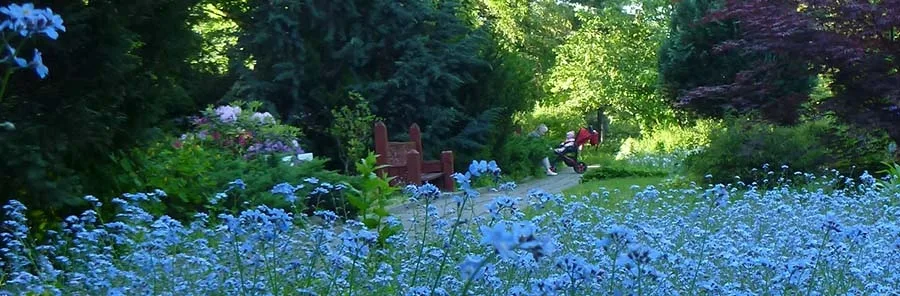
The steep slope, the hill on which the Botanical Institute stood, a small pond with cheerful ducklings and a charming rock garden on the slope turned the quiet, sun-drenched garden into a delightful idyll. Watching the ducks on the pond, the bright green emerald lizards scurrying about or basking in the sun, or their piebald offspring (the result of crossing with ordinary sand lizards), strolling along the paths of the blossoming garden or sitting in the pleasant coolness beneath the huge crown of the old chestnut tree, adorned with thousands of white candle-like flower spikes, one could always enjoy peace and serenity here.
Most of the few visitors were probably students spending their free time between lectures revising and talking, or fathers lovingly showing their small children the idyllic charm of this delightful park.
The Botanical Garden had formerly been the garden of War Councillor Scheffner (Johann Georg Scheffner, 1736–1820); his house probably stood on Neue Schulstraße (Neue Schulstraße), not far from the Butterberg (Butterberg). This name is a corruption of the original Büttelberg (Büttelberg. Büttel was the surname of the local executioner — ed.). It had fairly spacious rooms, and on the whole the building was considered handsome. Above all, the owner's hospitality was highly prized!
The elderly Johann Georg Scheffner, having sold his estates of Sprindlack and Ellerswalde (Sprindlack und Ellerswalde) in 1796, returned to his native Königsberg at the age of sixty. Having acquired a plot of land bounded by Butterberg Lane, Neue Schulstraße, Besselstraße, Triangel (Triangel), Besselplatz (Besselplatz) and the Steindamm Rampart (Steindammer Wallstraße), he laid out this magnificent garden on it.
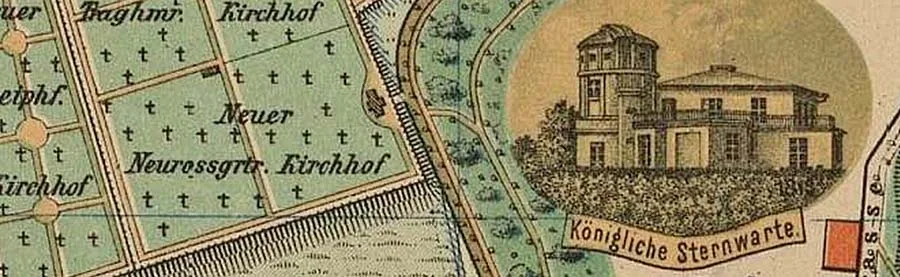
He tried to plant rare trees in it, and probably a number of trees that had seen him have survived to our day, such as the chestnut mentioned above. Whether he personally planted the ginkgo biloba, I dare not say.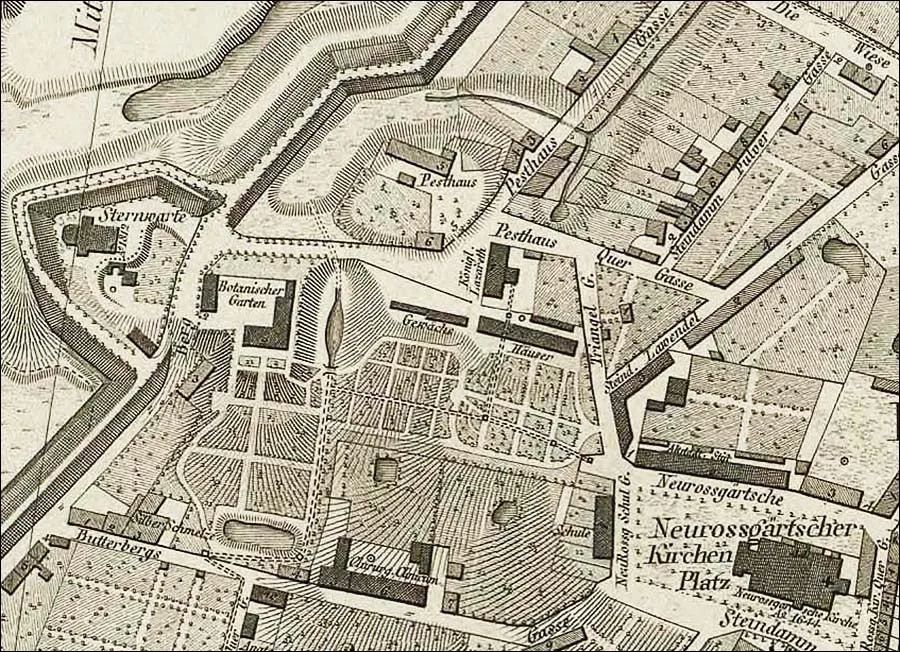 The Botanical Garden and the area around it on a map of 1815.
As is well known, Goethe celebrated this curious intermediate form between conifers and broadleaved trees in his poetic cycle West–Eastern Divan.
"This little leaf from the East
Was carried to my modest garden,
And to the seeing eye
It reveals a secret meaning."
„Dieses Baums Blatt, der von Osten
Meinem Garten anvertraut,
Gibt geheimen Sinn zu kosten,
Wie's den Wissenden erbaut“.
This "Buddhist temple tree", which grows in Japan, India and Persia, could also be found here in Königsberg in just three places: in the Botanical Garden, on the Neuroßgarten Church Square (Neuroßgärter Kirchenplatz) and in the Zoo (Tiergarten). All these ginkgos coped well with our harsh but healthy climate.
The green area in front of the Neuroßgarten Church (Neuroßgärter Kirche), by the way, lies on the site of the former "Lazy Pond" (Fauler Teich), one of those in which loaches were bred for Duke Albrecht. That is why the church was built in the eastern part of the square.
How did Scheffner's park turn into the Botanical Garden?
Let us hear his own account. In his now rare but still much sought-after book My Life he writes the following:
"The laborious supervision required to maintain a semi-rural residence, and the vexation one suffers from indispensable helpers, led me, on the occasion of the founding of a botanical garden at the local university and the difficulties that arose in finding a suitable site, to resolve to cede to the King my house, yard and garden, which had cost me more than 12,000 Reichstaler, in exchange for a life annuity of 700 Taler. Since the most tangible advantages lay on the side of the acquirer, my offer was approved by a cabinet order of 20 September 1806, and I was permitted to live there until Easter 1807.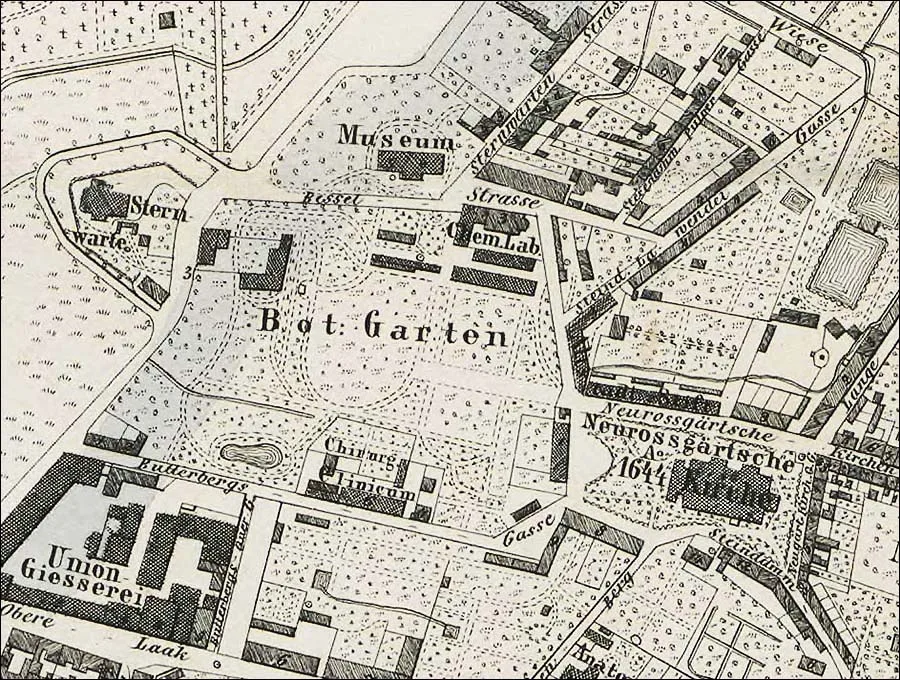 The Botanical Garden, the Observatory, the Museum, the Clinic, the Church and the Union Giesserei works on a map of 1860.
The actual laying out of the botanical garden began only in the autumn of 1809, with the participation of the Minister of Finance, Baron von Altenstein (Karl Sigmund Franz Freiherr vom Stein zum Altenstein, 1770–1840).
A connoisseur and enthusiast of botany, he considerably enlarged the grounds by acquiring additional plots, and also engaged a suitable director in the person of Professor Schweigger. At practically the same time the observatory, built nearby on a very suitable site, gained a tireless astronomer in the person of Professor Bessel. In August 1809 my house was acquired by the King, and the Crown Prince moved into the lower rooms with his teachers and tutors, Delbrück and Gaudy."
Incidentally, the fact that Scheffner's garden was handed over to the university as a botanical garden in 1811 is also partly due to the efforts of Karl Gottfried Hagen (Karl Gottfried Hagen, 1749–1829), professor of pharmacy and a close friend of Kant (Immanuel Kant, 1724–1804).
The Botanical Garden had to give up part of its grounds when construction of the Botanical Institute began; later, unfortunately, it lost several more plots, handed over for the construction of the University Pharmaceutical Institute (Pharmazeutisches Universitätsinstitut) on Besselstraße opposite its junction with Sternwartstraße, and of the Granulosis Ward of the Eye Clinic (Granulosestation der Augenklinik) on Butterbergstraße (Butterbergstraße).
Worth mentioning is the monument in the Botanical Garden to Professor Schweigger (August Friedrich Schweigger, 1783–1821), who was murdered in Sicily in 1821; it is crowned with a genuine vase from the gardens of the Villa of Maecenas in Tivoli. Indeed, our Botanical Garden was so beautiful that many other botanical gardens at major universities could not even compare with it. Sitting in one of the most famous gardens in the world, in Padua, I even found myself wondering: is our Königsberg garden not more beautiful?
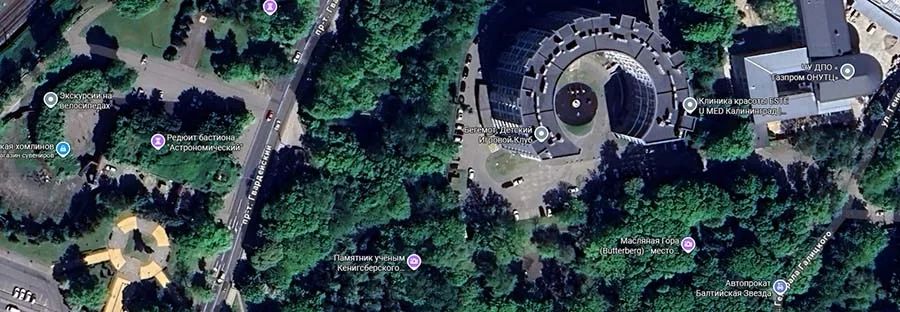
And what does it look like today?
Translated from Russian with the help of AI (Claude, Anthropic), October 2026.