Colourful Königsberg? Come off it! You can't take a word out of a song:
All Königsbarg is a tangle of ungainly streets,
A haunt of shabby corners and of dirty back alleys…
So wrote the local poet Robert Johannes (Robert Lutkat, 1846–1924). And now you are telling us that Königsberg was colourful?
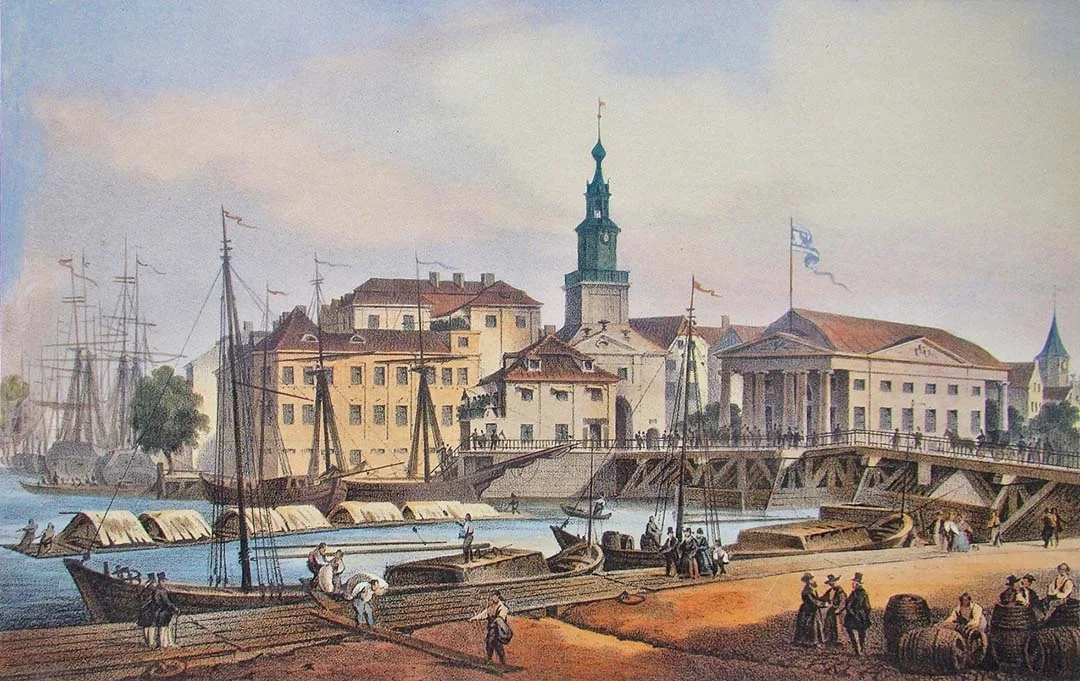
The thing is, dear reader, that memories of a distant happy past will always shine in our minds in the brightest colours — but that is not what I mean. I am speaking of a Königsberg that was truly multicoloured; it shimmered with a multitude of colours — though only a child born on a Sunday could see them!
First of all, there was the Motley Bridge (Bunte Brücke) across the Castle Moat. It led from Danzig Cellar Lane (Danziger Keller Gasse), which ran along the eastern side of what was then the not-yet-existing Gesekus Square (Gesekus Platz) and was so called because until 1630 a dansker tower stood there, to Princess Street (Prinzessin Straße, later the upper part of Kantstraße). In 1867 the moat was filled in, and the bridge and all the old houses were demolished, which made it possible to lay out Gesekus Square.
Now let us turn to the more recent past: the first bright splash of colour on the city's palette will be the Centralhotel, built in 1907–1908 and at once the most prestigious hotel in Königsberg.
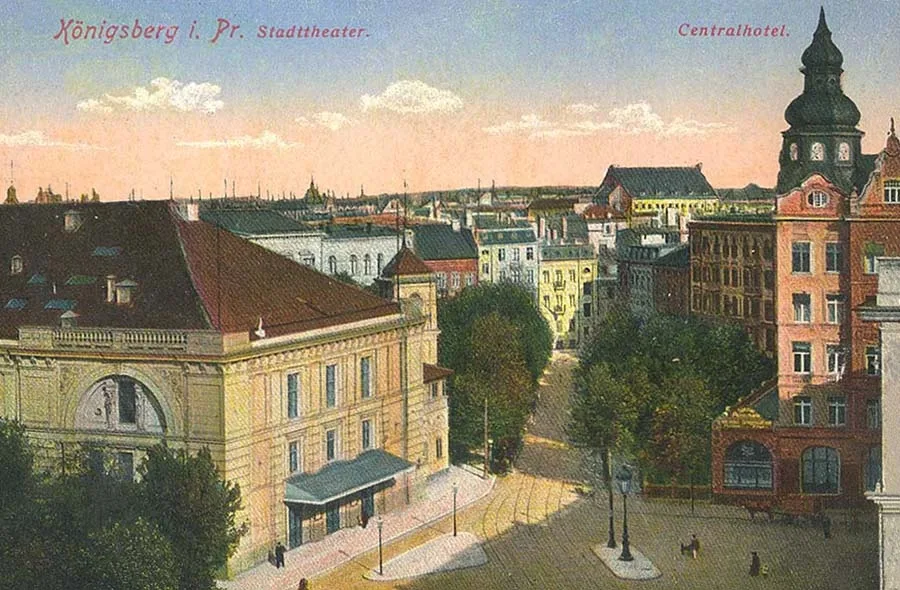 The theatre and the Centralhotel on Parade Square.
Before that, the title had indisputably belonged to the Hotel Deutsches Haus on Theaterstraße, but after Prince Friedrich Wilhelm (Friedrich Wilhelm Viktor Karl Ernst Alexander Heinrich Prinz von Preußen, 1880–1925) stayed at the Centralhotel, the reputation of the Deutsches Haus faded, and in the end it met the most inglorious of fates: it was turned into a tax office! And so the people of Königsberg now spent far more money in that establishment than foreigners had once spent in the Deutsches Haus.
The staff and waiters had counted on generous tips from Prince Friedrich Wilhelm. It never even occurred to him, however, to live up to their expectations. He was, on the other hand, a great lover of music, and later, when he had "settled" in the castle, he promoted three grand music festivals held in 1909, 1910 and 1911 in the Festival Hall of the Königsberg Tiergarten (Festhalle im Tiergarten).
Before the Centralhotel was built, the same site was occupied by the Centralhalle, an inn surrounded by trees. It was considerably more modest. Before the Centralhalle there had been Meyer's confectionery (Meyersche Conditorei) and then the Wiener Café, popular with theatregoers.
Blue
We now move on to blue, and therefore to the "Blue Tavern" (Blaue Krug), which in days of old adorned the open ground east of Hinter Roßgarten, not far from the Rossgarten Gate. It got its name, of course, from its "signature" blue colour.
The people of Osterode had their own "Red Tavern" on the road to Pillauken, the people of Insterburg the "Green" and the "Red" pharmacies. Danzig had its "White Tower" and its "Green Gate". Halle has a "Red Tower", Wimpfen am Neckar a "Red" and a "Blue" tower — all names from times long past. One also recalls the iron bridge across the Elbe near Loschwitz in Saxony, which, because of the sky-blue paint it was coated with, acquired a second name — the "Blue Wonder".
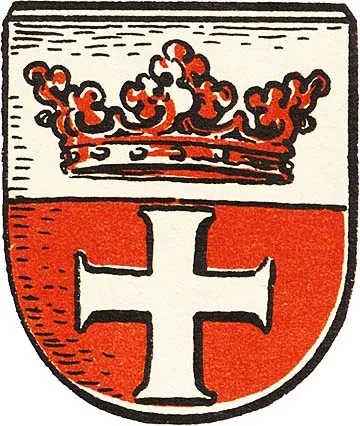
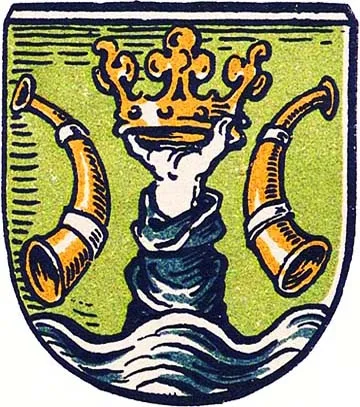
The "Blue Tavern" was one of the many taverns along the long-vanished old road from Berlin through Königsberg and the Curonian Spit to Petersburg. But why was this inn painted blue, and not red or, say, yellow? Because Rossgarten was a suburb of Löbenicht, whose heraldic colour was blue (see below).
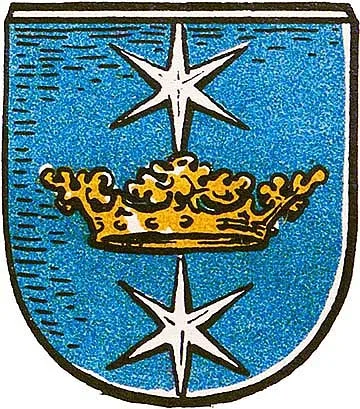
The "Blue Tower" (Blauer Turm) is well known to the people of Königsberg. Until 1879 it had a pointed roof instead of battlements.
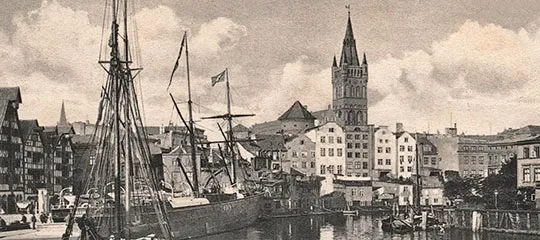
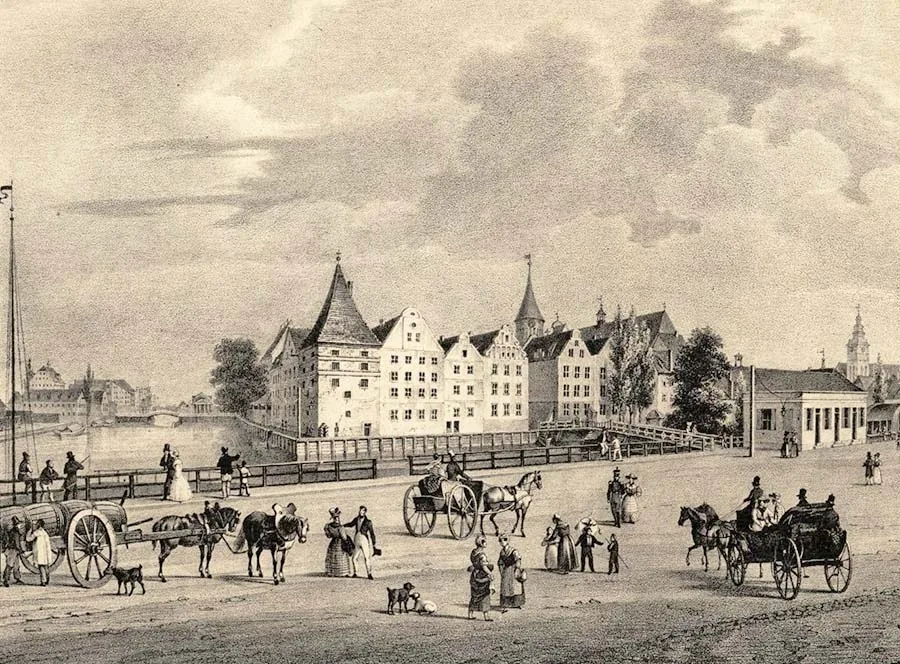 The Blue Tower (centre) at the north-eastern corner of the Kneiphof.
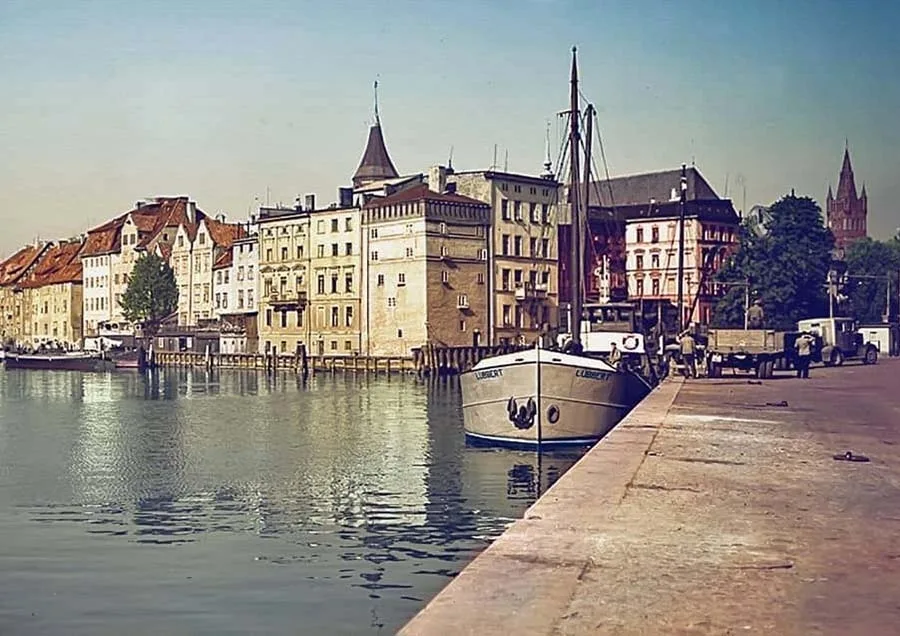
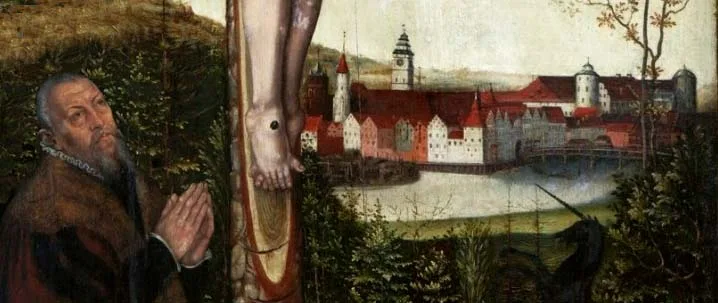
This is how it can be seen in the Cathedral on the oldest surviving painted image of Königsberg (1557) — the epitaph of Johann von Niemitz, who in his lifetime was a court councillor to Duke Albrecht. The tower was immortalised by a local painter (Heinrich Königswieser, 1530–1583, see below) at a time when it was still painted white rather than blue. In the Gothic and Renaissance periods the heraldic colour was a decisive factor, and in the Kneiphof they would certainly never have painted it in the colours of Löbenicht! The colour of the Kneiphof was green. Only in the Baroque era, and especially after Altstadt, Kneiphof and Löbenicht were united into the single city of Königsberg in 1724, did colour cease to be regarded as a mark of allegiance.
It was the only surviving fragment of the old walls of the Kneiphof, which had once encircled the whole island town, for the three sister towns trusted one another as little as they trusted their external enemies. During the Thirteen Years' War (1453–1466), for example, when the Kneiphof took the side of Danzig and the Poles, fierce fighting broke out between the Kneiphof townspeople and the people of the Altstadt, who had remained loyal to the Order. The fortress walls of all three towns on the Pregel were built during the rule of Grand Master Winrich von Kniprode (Winrich von Kniprode, 1310–1382).
The next fortress tower of the Kneiphof, which stood a little to the west of the Blue Tower, next to the former Common Garden of the Kneiphof, was called the Powder Tower (Pulverturm) because, like similar towers that have survived to this day in Lindau and Passau, it housed an arsenal and stores of gunpowder. Later this imposing round tower, painted blue, became the Kneiphof debtors' prison under the name "Blue Tower". In 1735 it was demolished — prematurely and quite needlessly. The empty plot on Magisterstraße where the tower had stood was offered for sale as a building site for many years afterwards, but without success. The name "Blue Tower", however (in keeping with a curious local tradition1 — editor's note), was transferred to the neighbouring tower, built back in the days of the Order, which, thanks to its walls one and a half metres thick, safely survived into our own times.
In 1697 a 14-year-old girl languished within the walls of this corner tower, accused of witchcraft and sentenced to death by beheading followed by burning at the stake.
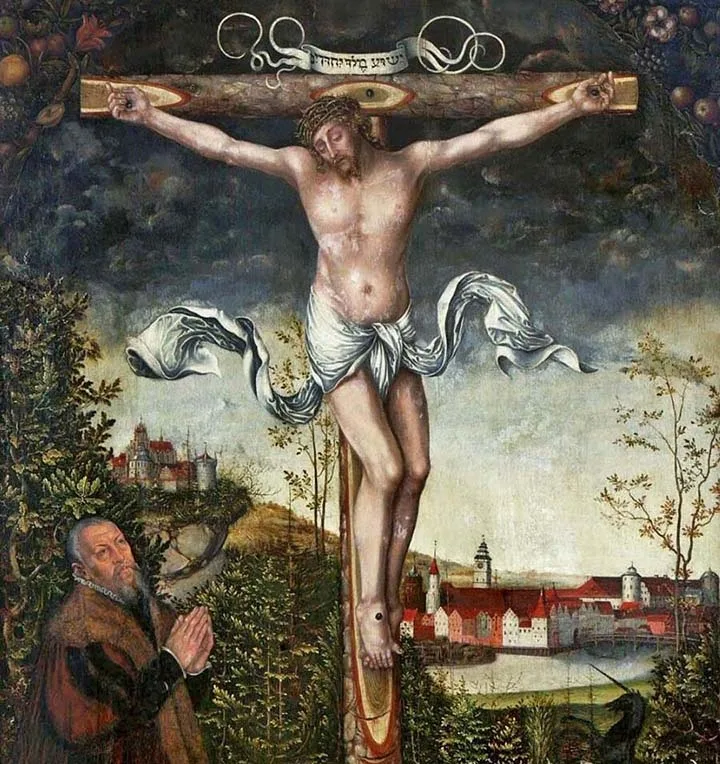
The epitaph of Johann von Niemitz by Heinrich Königswieser (detail).
Although Elector Friedrich III (1657–1713), a native of Königsberg and the future first King in Prussia (Friedrich I, 1701–1713), ordered a retrial, the poor girl was nevertheless executed in accordance with the original sentence! A terrible example of barbarity, stupidity, dark medieval superstition and the bigotry of judges!
Incidentally, next to the Blue Tower stood the house of the poet Simon Dach (Simon Dach, 1605–1659), who died there in 1659. His memory was commemorated with a bronze plaque. Just as Goethe thanked his duke for his garden house, Dach wrote:
"God will forever thank the wise council of the Kneiphof, which kindly allowed me to live here. The Almighty was never a stranger to the gloomy anxieties I suffered day and night in search of a home. The snail and the tortoise bring their huts into the world, but man must struggle long before he finds a home of his own!"
So much for blue; now for black.
Black
This colour was represented solely by Königsberg's Black Sea (Schwarzes Meer).
Johann von Bösenrade (Oberburggraf Herzog Albrechts, Johann v. Bösenrade), Duke Albrecht's chief burgrave, had ponds dug for breeding loaches2, fed by channels carrying water from the Upper Pond. The duke was particularly fond of loaches; according to legend, however, the fish vanished of their own accord when Bösenrade strictly forbade fishing in these ponds, reserving them for the ducal table. The legend reflects the deep hatred the people of Königsberg felt for this excessively energetic and enterprising nobleman, whom they, without further ado, nicknamed the "Evil Councillor".
The fact remains, however, that the ponds later turned into stagnant pools, and their musty smell troubled the residents of the houses near the castle. The worst was considered to be the pond called the Black Sea, located between Tiepoldstraße and Wrangelstraße (Tiepoldstraße und Wrangelstraße). Its name speaks for itself... Later these artificial pools were filled in.
White
Which of the many oarsmen and sailors travelling down the Pregel to the lagoon did not stop at the "White Man" (Weißer Mann)? For those who do not know, the "White Man" was the name of a stone tower about a hundred years old, painted almost entirely white and only black at the base. It stood at the start of the Sea Canal on the island between the canal and the lagoon and served as a landmark for boatmen and fishermen. Near it one could rest serenely and bask in the sun on the dry mudflats and among the reeds. In his little book "Dear Old Königsberg", Wilhelm Matull (Wilhelm Matull, 1903–1985) quotes the sayings with which sailors greeted the "White Man" as they put out to sea:
"O white man with the one black leg,
We send to you our greeting.
Please grant us a fair wind today,
So that we may soon be home again!"
On the way back, everyone had to say, aloud or to himself:
"Old man in the white hat, we thank you! The voyage went well!"
Red
Now it is the turn of red.
In the old days, on the western side of today's Münzstraße, there was an old noble estate known as the "Red Court" (Roter Hof), granted in 1572 to the district administrator of Lötzen, Fabian von Lehndorff. It later passed into the possession of the von Tettau family, and then of the von Buddenbrock family (v. Buddenbrock). Alas, the "Red Court" has long since sunk into oblivion.
We shall come across red twice more, namely in the Altstadt, whose heraldic colour was red (see below). The Altstadt exchange by the bank of the Lastadie on the Hundegatt of the Pregel was enlarged in 1728 and came to be called the "Red Scales" (Rote Waage), since the Kneiphof exchange, which stood on piles by the Green Gate, was inadequate for the newly formed city of Königsberg. The "Red Scales" stood until the 1870s.
Next to the Altstadt exchange stood the Red Crane, whose image has survived on Bering's famous engraving of 1613 (see below). The crane had a domed roof bearing the figure of a crane bird — a symbol of vigilance.
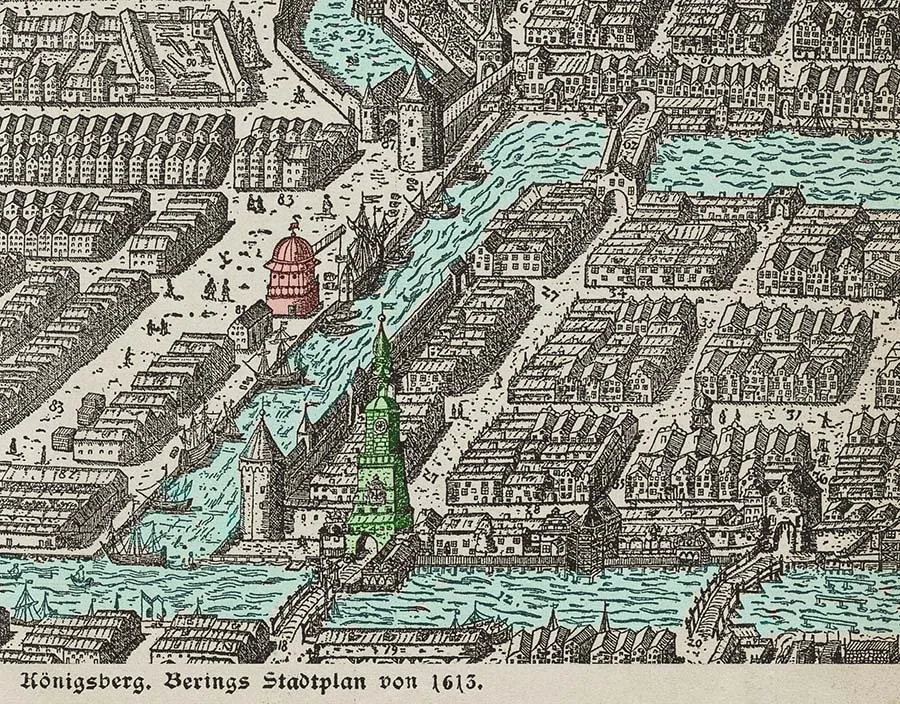 The Red Crane on the bank of the Hundegatt, the Green Gate and the bridge on a detail of the 1613 map of Königsberg.
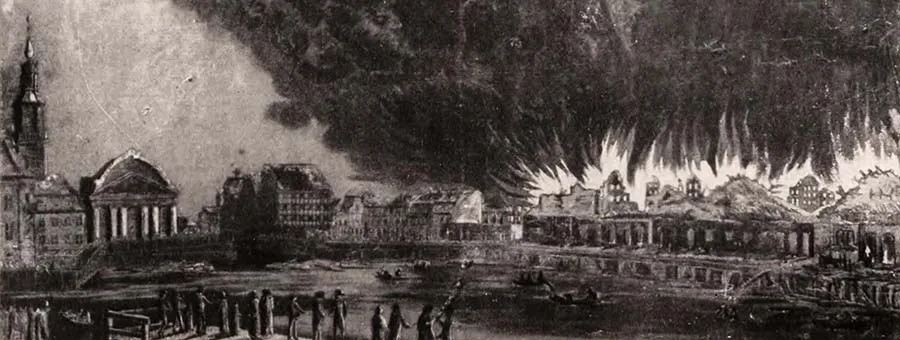
The Red Crane burned down during the famous fire of 2 August 1839. Rosenkranz (Johann Karl Friedrich Rosenkranz, 1805–1879) has left us a vivid description of the event:
"The spectacle that met our eyes at about nine in the evening on the bank of the Pregel was, in the literal sense of the word, a fairy-tale extravaganza! The water, saturated with smouldering embers, was jet black in streaks, and the waves glittered like polished, gilded steel. Large barrels of burning oil and spirits floated on the surface. Guard boats patrolled the quays and the Green Bridge, since the Lastadie warehouses were still burning and sheaves of sparks kept flying from them in all directions. The centre of the spectacle was the Red Crane2, reaching up to the sky through the fire. When the flames flared up furiously, it seemed as if the crane were drowning in them. And yet it went on standing. From the burning granaries of the Lastadie came now rattling, now crackling sounds, and now a dull rumble — like the blows of a spade on a coffin lid — as something inside them fell to the ground. Hark: to the sounds from the crane were added creaking noises, like sighs. The mighty iron masses jerked and quivered, but it still stood. At last the wooden frame burned out, the wheel burned up, and the crowd waited impatiently for the collapse. Only the iron skeleton of the 'crane' remained, barely visible in the raging flames, but it held out until the relentless fire had burned its whole structure to the ground, and only then did it fall."
Green
Only green and yellow are left on Königsberg's colour palette.
Green was the heraldic colour of the Kneiphof (see below). That is why the bridge was called the Green Bridge (Grüne Brücke). How often the people of Königsberg crossed it! And how they grumbled when they were in a hurry and found it raised! And what countless numbers of people, over the long history of the Green Bridge, admired the magnificent view of the harbour that opened from it! Especially in the evening, when the rays of the setting sun fell on the sparkling waters of the Pregel — this view was one of the most beautiful and memorable in Königsberg.
Few people know that the Green Bridge, first mentioned as early as 1322, in the days of the Teutonic Knights, was then called the Langgasse Bridge (Langgasser Brücke).
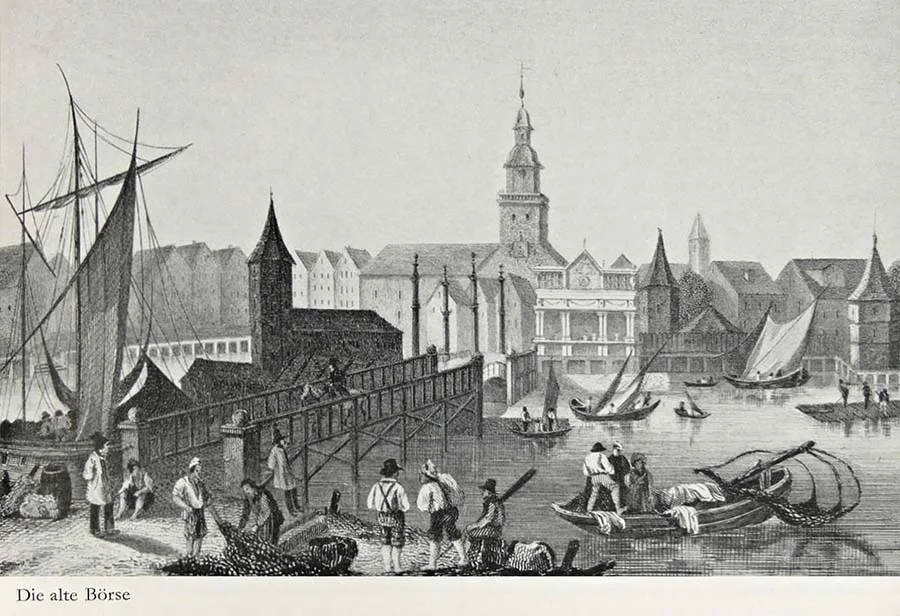 The wooden Green Bridge and the old Kneiphof Exchange in the 18th century.
We find the new name only in the late Middle Ages. Belonging to the Green Bridge were the Green Crane (Grüne Kran) and the Green Gate (Grüne Tor), for green was the heraldic colour of the Kneiphof.
A model of the Green Bridge was exhibited in the Deutsches Museum in Munich as an example of a bascule bridge.
Today's generation knows the Green Gate only from photographs, since it was demolished in 1864.
A gate was first built on this site in the time of Winrich (Winrich von Kniprode, 1310–1382, Grand Master) and was then called, like the bridge, after the Kneiphof Langgasse (Langgasser Tor). The Gothic gate of that time was rather modest, one might even say plain. Only in the Renaissance was the magnificent Green Gate built on the foundations of the Gothic gate — by then its new name had already taken hold.
The view along the whole length of the Kneiphof Langgasse (Kneiphöfische Langgasse), adorned with numerous Wolmen, from the Krämer Gate to the Green Gate, was just as impressive as the view in Danzig along the Jopengasse (Jopengasse, where Jopen is the name of a local kind of dark, strong and thick "Jopen beer" (Jopenbier), brewed in Danzig from the 14th century onwards) towards St Mary's Church (Marienkirche; the city is now called Gdańsk and the street Piwna. Editor's note.)
Construction of the Green Gate began during the rule of Margrave Georg Friedrich (Georg Friedrich I. von Brandenburg-Ansbach, 1539–1603). In 1592 Master Wilhelm erected a magnificent tower on top of the Green Gate and, insisting that he must fix the finial and the weathervane himself, accomplished a dizzying feat of engineering.
On each side of the tower there were lofty inscriptions. I was able to find three of them in the chronicles; I hope one of you will find the fourth and share it with us.
The first read: Jus et aequitas sunt vincula civitatum.
(Justice and equity are the bonds of the state.)
——●——◌——●——
The second: Sint aliis turres, sit inexpugnabile vallum, Nos deus et rectum simplicitasque regent.
(Let towers and impregnable ramparts serve others,
But let us be guided by God, by justice and by simplicity.)
——●——◌——●——
The third: Vultus Fortunae veriatur imagine Lunae Crescit, decrescit, constans persistere nescit.
(The face of Fortune changes like the image of the Moon: it waxes, it wanes, and knows no constancy.)
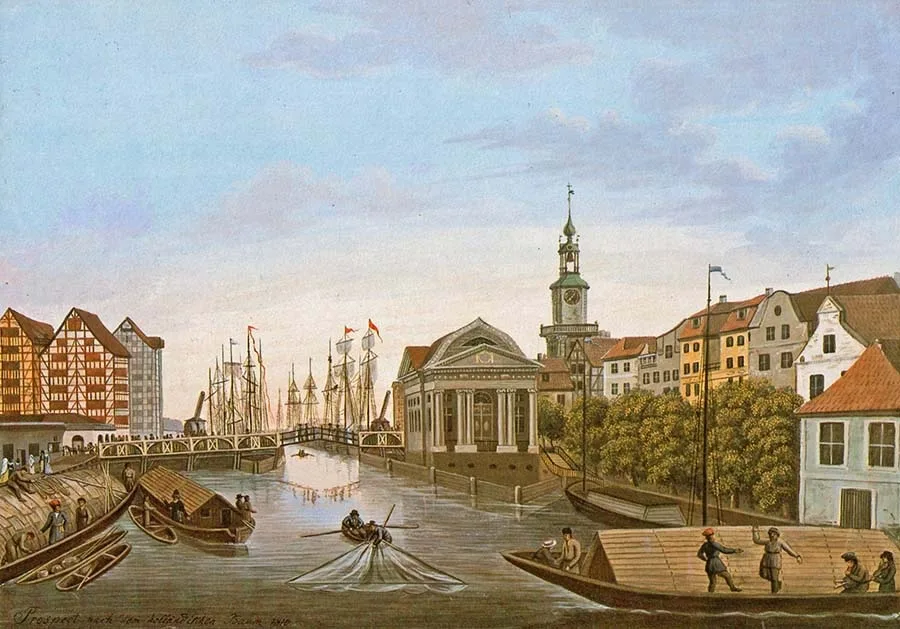 The Old Pregel between the Vorstadt (left) and the Kneiphof: beyond the Green Bridge, the Kneiphof and Altstadt harbour cranes and the masts of ships can be seen. In the centre: the Kneiphof Exchange and the tower of the Green Gate. On the right: Dzimken dancing on a raft. Read more about life in the port of Königsberg here.
Well, Königsberg has indeed experienced the truth of the last one for itself!
Later the tower was adorned with a clock, the coat of arms of the Kneiphof, the Black Eagle and three allegorical figures: Justice, Diligence and Tranquillity.
Incidentally, a vaulted underground passage ran from the Green Gate to the Great Crossing over the Pregel; it was filled in only in 1885. The tower above the gate was home to the Kneiphof town musician and his journeymen.
Let us travel back in time and recall just a few of the colourful scenes the Green Gate witnessed — for it was part of the Kneiphof Langgasse, Königsberg's main thoroughfare, laid out before 1324!
It was through this gate that in 1466, after the painful loss of Marienburg Castle, Grand Master Ludwig von Erlichshausen (Ludwig von Erlichshausen, 1410–1467), who had barely escaped his pursuers in a daring flight across the Vistula, entered his new residence. In 1526 the gate welcomed a new duke by the name of Albrecht, who had already been ceremonially received at the Haberstrom (Haffstrom), but the townspeople lined the Kneiphof Langgasse and greeted him with jubilation. Here, on 21 May 1578, Margrave Georg Friedrich, cousin and guardian of Duke Albrecht's mentally ill son, made his solemn entry into the city with the coffin of his wife Elisabeth, who had just died in Warsaw. Here too, at the head of a mounted procession, came the Elector of Brandenburg Friedrich Wilhelm (Friedrich Wilhelm von Brandenburg, 1620–1688), as the reigning Duke in Prussia, escorted by the butchers' guild in their finery (it was he who had granted them the honorary right to escort the monarch). Here too, in 1701, Elector Friedrich III rode in his splendid carriage when he arrived in his native city for his coronation. The Russian Tsar Peter the Great often passed through the Green Gate, gladly staying in 1711, 1712 and 1713 in the neighbouring house of the Kneiphof burgomaster Negelein. This house was demolished only at the beginning of the 20th century to make room for the building of the Norddeutsche Kreditbank. The bankers needed the best possible view of life in the harbour... How often Kant must have passed through the Green Gate when, from his house — so shamefully demolished in 1893 — he took his walk through the Vorstadt past the house in which he had been born.
On 10 July 1807, after the conclusion of the Peace of Tilsit, Napoleon entered Königsberg through the Green Gate.
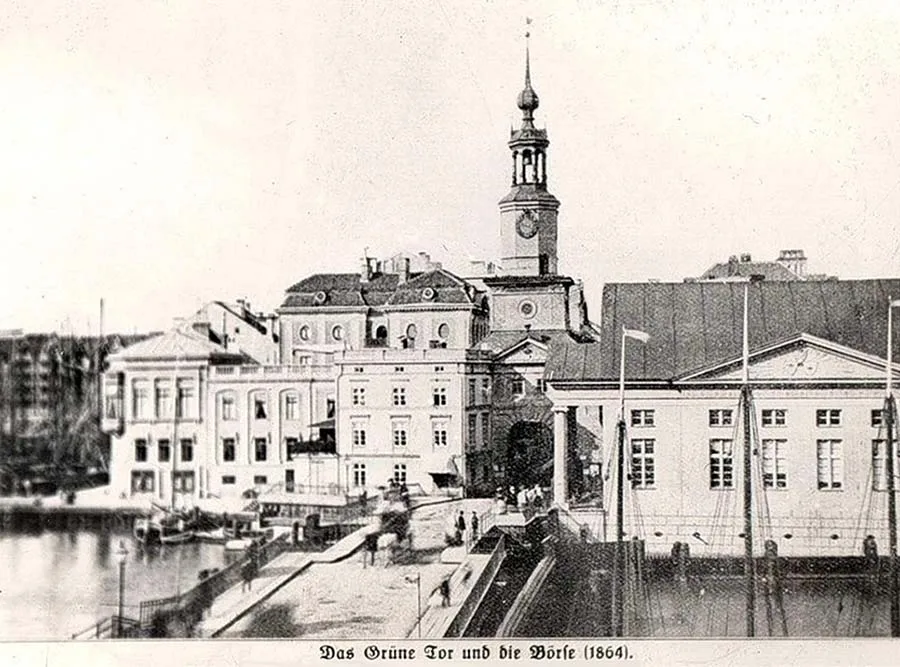 The Kneiphof Green Bridge, Green Gate and Exchange (right).
Queen Louise (Königin Luise) also passed through this gate several times: in happy days as crown princess, and in bitter times as an ailing queen in flight, accompanied by her faithful physician Hufeland (Leibarzt Hufeland). It was through the Green Gate that Murat, King of Naples, left Königsberg for ever in 1812. Through it King Wilhelm I entered the city for his coronation in 1861. But then its hour came to make way for the growing flow of traffic.
The new Ostbahnhof railway station, built in 1857 and at the time the most beautiful in Europe, urgently demanded this radical intervention. Despite the objections of artists and restorers, and even against the wishes of the Crown Prince, the future Emperor Friedrich III (Friedrich Wilhelm Nikolaus Karl von Preußen, 1831–1888), the Green Gate and the Wolmen were demolished on 19 September 1864.
During the demolition it turned out that the wooden beams inside the belfry had completely rotted; in order to lower the bells, the bridge was raised, the main street of the island town was closed, and the belfry itself was bound with chains for greater stability. The heavy bells were lowered without incident, apart from a minor injury to a worker caused by a falling heavy iron ring.
A certain G. Karl (real name Springer), who worked as an accountant at the post office and was known as a great patriot of his native city, in his pamphlet "Old Königsberg" shares the text of a petition he found in the archives, submitted by the Königsberg intelligentsia with an appeal to preserve the Green Gate:
"The Green Gate is not only the most elegant work of the Renaissance in our city, which is so humiliatingly deprived of architectural beauty. Above all, even beyond Königsberg one cannot find another work of architecture in which the character of commercial and civic life is expressed in so inspiring a manner.
Our forefathers showed great foresight in choosing this site, where a small but elegant tower exerts a considerable beneficial effect in four directions.
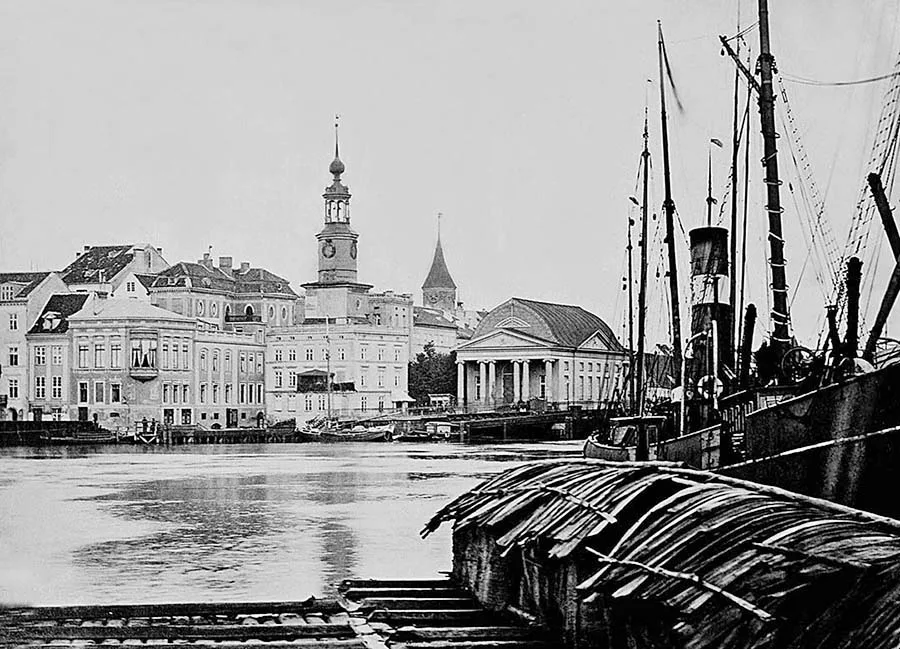 View of the Kneiphof from the Great Cranes quay in the Vorstadt.
It contributes substantially to the unique appearance of the Kneiphof Langgasse, the city's main commercial artery, being in fact its central point; it provides an irreplaceable vantage point and defines the face of the city as seen from the Vorstadt. Viewed from the harbour, the group of buildings that includes the old exchange and the bank, ideally positioned in relation to one another, is crowned by this tower. Even from Lindenstraße on the Lomse embankment the eye involuntarily picks out the graceful tower beside the exchange. It is a true harbour tower, on which festive decorations for the waterfront can moreover be displayed, while the Green Gate forms a triumphal arch for all festive processions — qualities that the discerning eye of His Beloved Majesty was able to recognise at once. The destruction of this outstanding architectural ensemble, in whose place nothing will remain — that is, utter austerity — will clearly demonstrate how important an element of the cityscape has been lost…"
All efforts proved futile — two years later the Green Gate fell victim to traffic. The story that the gate was supposedly demolished to let through the monument to Friedrich Wilhelm III, which in 1851 was brought over bad country roads from the Lauchhammer iron foundry (Eisengießwerk Lauchhammer) near Elsterwerda to Königsberg on a sixteen-horse wagon, is, however, a slander. True, the arch of the Green Gate proved too low for the equestrian statue, very tall by local standards, to pass through, so a pit two feet deep had to be dug under the arch. But the upper part of the then quite new Brandenburg Gate was indeed taken down, because it too turned out to be not high enough for the monument.
The Green Gate will be hard to forget. There is probably no one in Königsberg who does not regret that the city had to bid it farewell.
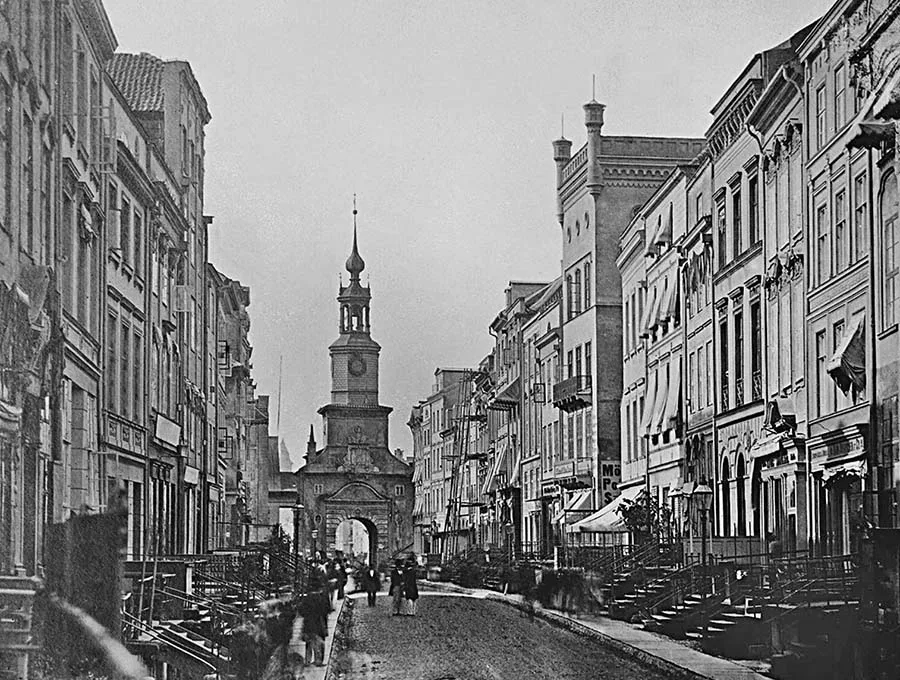 The Kneiphof Langgasse and the Green Gate.
Together with the gate, the beautiful Wolmen (see above) also passed into history — the traditional open terrace-like extensions on the Kneiphof Langgasse where, in the warm season, a good part of the Kneiphof residents' life was spent. The Wolmen were a striking architectural feature of old Königsberg.
When, before the First World War, the entrance gate of the Tiergarten with its "elephant trunks" began to fall into disrepair, a proposal arose to recreate the Green Gate as the entrance to the Tiergarten, based on old plans and images. The conscience of the city was still fighting for the Green Gate when the old Hagen pharmacy on Junkerstraße — a beautiful house rebuilt in the Baroque style in 1654 and owned in the 16th century by the ducal physician Dr Mantanus — was ruthlessly demolished.
The undoubtedly well-meaning, but at the same time highly questionable proposal to rebuild the Green Gate as the entrance to the Tiergarten was fortunately never carried out. For demolished buildings should be rebuilt only where they stood before. In such cases, having regained their rightful place, the luckiest of them get the chance of a full new life. (Examples: the campanile of San Marco in Venice, St Michael's Church in Hamburg, the Zwinger palace in Dresden.)
Yellow
Let yellow conclude this essay on colourful Königsberg!
Königsberg had not only a "Blue Tavern", as already mentioned, but also a "Yellow Tavern" (Gelber Krug).
Above the bridge over the Hufen Brook (Hufenbach, now the Parkovy Stream) lived a respected banker named Adler — incidentally, the great-grandfather of our poetess Agnes Miegel (Agnes Miegel, 1879–1964) — who owned a wooden country house in what was then Hufen. In pre-Napoleonic times this area was a suburb built up with villas and was called Carlsruh (Carlsruh). The "Yellow Tavern" stood on the opposite, left bank of the brook. The name was later forgotten, but every Königsberger knows the place, because later the popular dance hall "Drachenfels" (Drachenfels) stood here.
The Yellow Tower (Gelber Turm) will be the grand finale of our journey! Its fate is especially interesting.
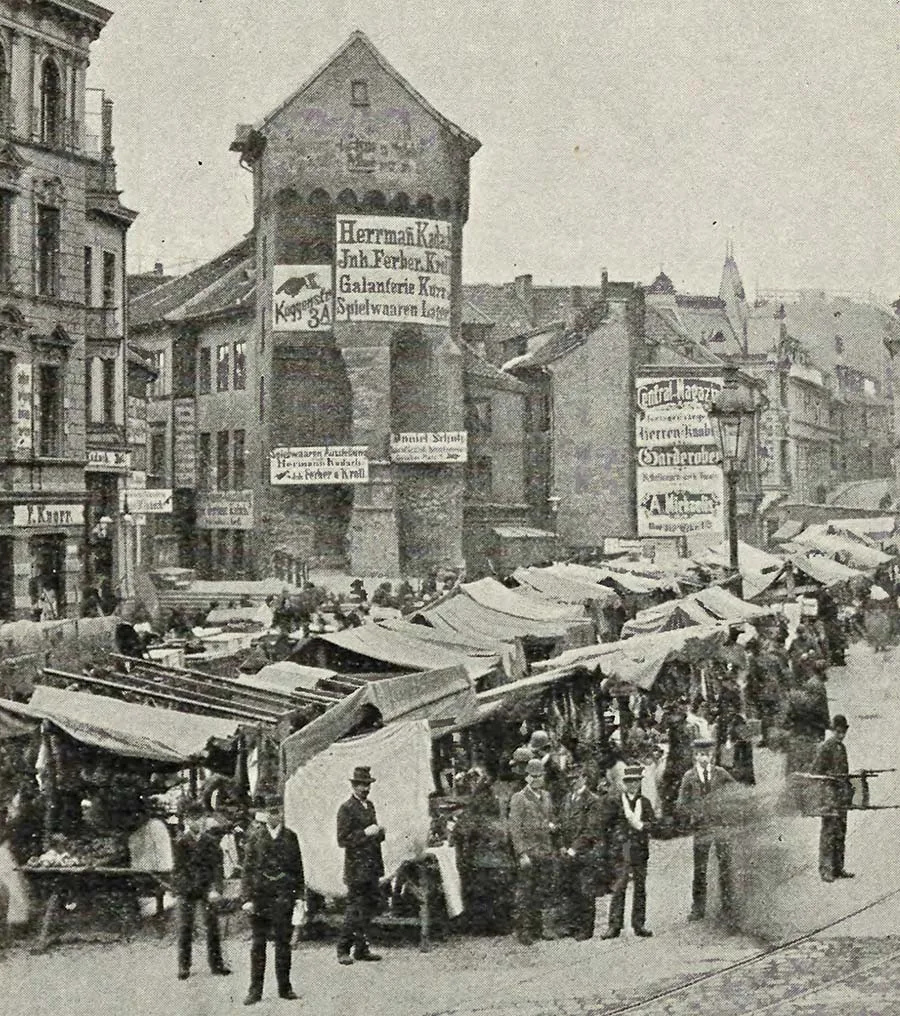
Market day on Gesekus Square. Our heroine is hard to miss.
It was built as a watchtower and was part of the fortress wall of the Altstadt. The buttress visible on it is merely a pitiful remnant of that wall. The Yellow Tower was connected by a passage to its neighbour, which stood about 20 metres to the east of it and was the only way into the tower, since the Yellow Tower, like, for example, the Castle Tower that made Königsberg famous, was built without an entrance of its own.
While the neighbouring tower served for a long time as a prison, the Yellow Tower was not used at all, and on 21 January 1797 the then city architect Blick had to present a report to the town hall on what could be done with it:
"The old abandoned tower is very solid and has four storeys, two of them with vaulted ceilings. Converting the abandoned tower into a prison would probably entail great expense and extraordinary difficulties, since it would be impossible to provide rooms for the guards. Having examined the structure carefully, I found that the old thick walls contain no whole bricks but are built only of fragments and fieldstones; consequently, if it were taken down, there would be no profit. In my humble opinion it would be advisable to try to let the tower. Its use might be advantageous, for example, to spice merchants, pedlars and so on, who could use it as storage space. The fire resistance of the structure should be noted, which makes it quite suitable for such purposes."
This expert report prompted the town council to declare on 23 January 1797: "In these circumstances the abandoned tower shall not be used and shall remain in its present state!" Apparently the tower had not yet been painted yellow at that time, since in both documents it is called "abandoned" and not yellow.
As you can see, the old tower was not only a venerable relic of a great era but also a real stumbling block! Three years later, in April 1800, it was in danger again. This is what happened: such large cracks suddenly appeared in the neighbouring tower, the prison, that eight prisoners — three men and five women — had to be moved elsewhere at 3 o'clock in the morning on 12 April so that they would not be buried under rubble. They were taken to the nearby "New Tower", which stood at the corner of the Altstadt Langgasse (Altstädtische Langgasse) and Pulvergasse. That tower was demolished only in 1888. The crumbling neighbour of the Yellow Tower also fell victim to the pickaxe later that same year because of its dilapidated state.
There was talk of demolishing the Yellow Tower at the same time. But, as before, a good spirit saved it from destruction.
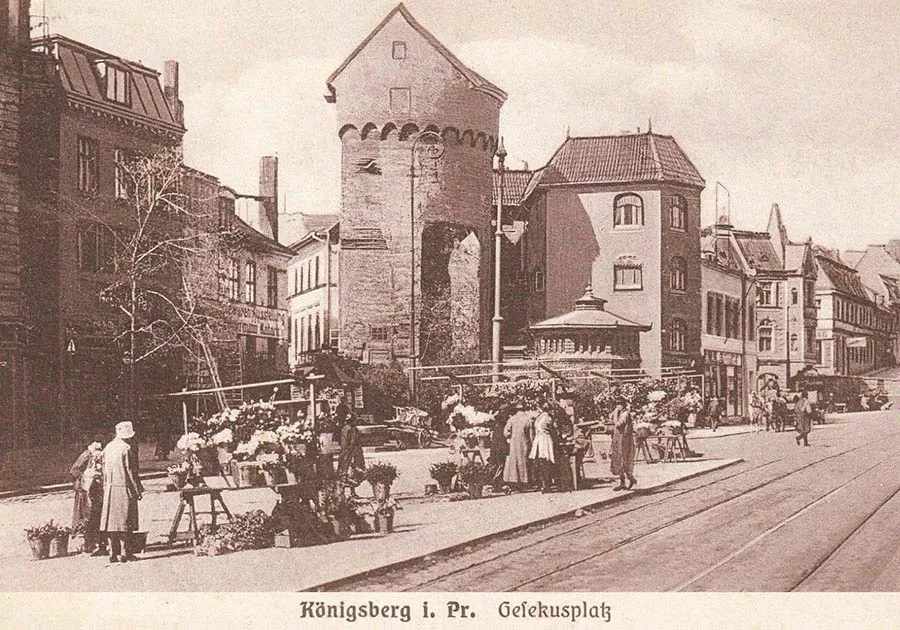 The Yellow Tower on Gesekus Square.
In 1811 the hatmaker Ritter complained to the town council that on stormy nights tiles and stones fell from the roof of the Yellow Tower onto his house next door. At the same time Ritter offered to buy the tower. The town council did indeed sell the Yellow Tower in 1812 — not to Ritter, however, but to the master baker Werner, for "100 thalers at 52.5 dinars to the thaler". There was, however, one condition: "Under §3 the buyer shall keep the tower in good repair and also put a roof on it like that of a house".
And so it happened. The old tower lost its pointed roof with its crenellated parapet and, having been turned into a granary, acquired its present roof shape.
After that it changed hands several more times. In the 1840s the Yellow Tower belonged to a lottery operator named Heygster (Heygster), and in 1863 to the senior physician of the Wrangel Cuirassiers. Who knows what crazy idea led him to own this old defensive tower? He must have tired of it quickly, or perhaps it was mortgaged, but by 1864 the tower had passed into the possession of the merchant Hermann Kadach (Kadach), who used it as a warehouse. In my childhood the window of the shop next door was always decorated with wonderful toys that delighted our childish hearts. Apparently many such treasures were kept inside the tower. From the outside, however, this could not be seen; only a giant advertisement in yellow letters on the grey plaster indicated that the old tower was used as a warehouse, disfiguring it terribly. In 1901 a public toilet was added to the venerable Gothic structure; it survived the bombing unscathed and may still be there today.
The era of toys also came to an end with Kadach's departure; then the Königsberg Gymnastics Club (Königsberger Turnclub) bought the old tower, and finally it became the property of the city once again.
---
(We have had to strike out the last paragraph of this on the whole remarkable article, because it strikes revanchist notes characteristic of the German émigré press of the third quarter of the last century. Editor's note.)
TRANSLATOR'S NOTES
1.It happened more than once in Königsberg that a structure which had sunk into oblivion "bequeathed" its name to a chosen successor. For example, the Muscovite Hall of the local castle was originally in the north wing, whereas the one now known is the hall that was above the church in the west wing. The Blue Tower in the Kneiphof. Luisenwahl. Plus Prussia proper, which, thanks to the efforts of the dynasty that ruled here, suddenly greets us on the banks of the Rhine...
2. The word "kran" (crane) came into Russian from German, where it arose as a shortening of the word "Kranich" — the crane bird. As is easy to guess, the hoisting crane got its name from its resemblance to this bird.
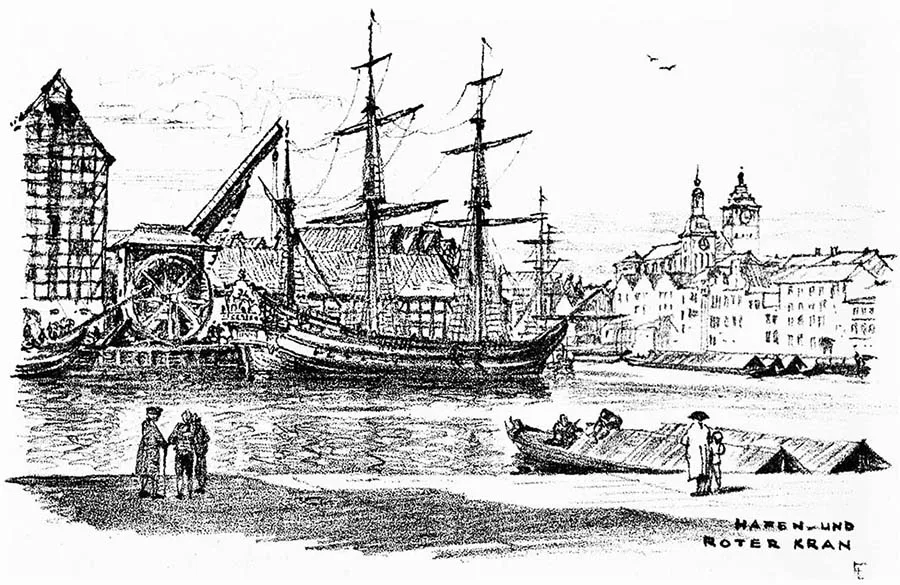
"The Harbour and the Red Crane". Lithograph by Friedrich Lahrs (Friedrich Lahrs, 1880–1964)
from the series "The City of Kant. Eight Views of 18th-Century Königsberg".
Unnumbered note. For some reason the author did not include in his selection the Lilac Mill in Kalthof (Vergnügungsort Fliedermühle), a popular leisure spot in the immediate suburbs of old Königsberg. The little restaurant was set up in the building of a former windmill. From the city one could get here either through the Sackheim Gate and then round the cemetery of the Löbenicht Hospital, or through the King's Gate, walking along Sprinta and turning right.
At the end of the 19th century the spot gradually declined, as the neighbouring land was handed over to the military, who built a large garrison there with a parade ground and a shooting range. Among other things, barracks appeared in the immediate vicinity for French prisoners of war, of whom, after the Franco-Prussian War of 1870–1871, there were very many in the province.
Translated from Russian with the help of AI (Claude, Anthropic), October 2026.