Two days after the British bombed our city with phosphorus bombs on 29/30 August 1944, we read in one of the Königsberg newspapers a beautiful poem by our poetess Charlotte Wüstendörfer, coming from her deeply grieving heart:
“Tell me about the old city!
Tell me of times gone by!
When hundreds upon hundreds of ships
Sailed down the Pregel to the bright sea.
…But perhaps one day from the black ruins
The city will rise, as beautiful as before,
And through the streets of my childhood my shadow
Will wander for ever, remembering…”1.
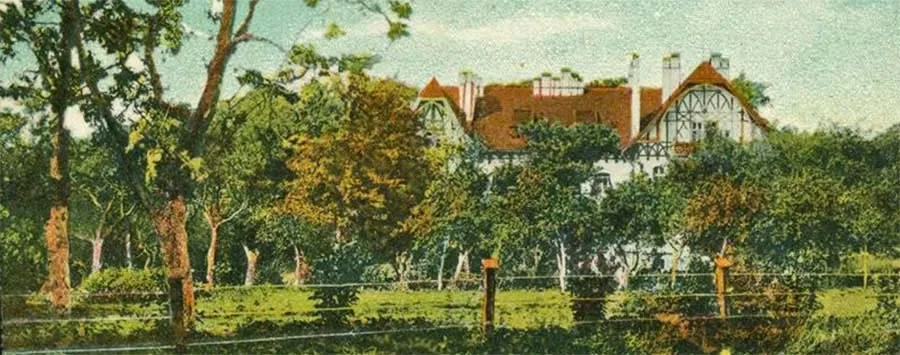
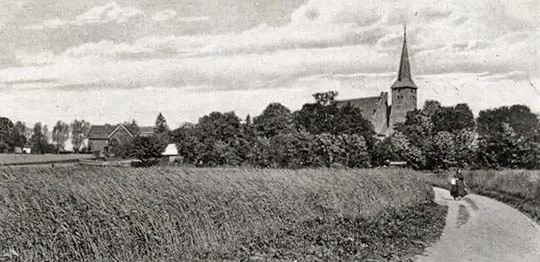
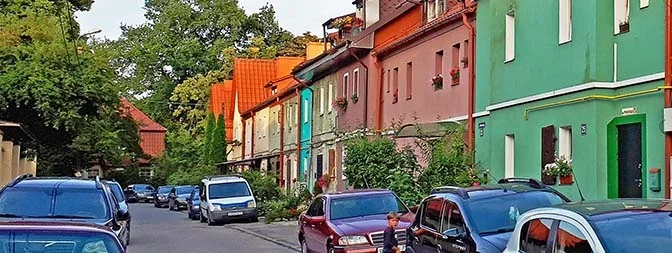
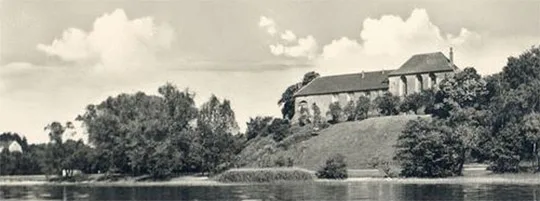
I too often walk in my mind along the roads of my childhood – and today I ask my readers to follow me far beyond the gates of Königsberg, to a place that later became merely one of its suburbs, but which is dear and familiar to us all: to Juditten!
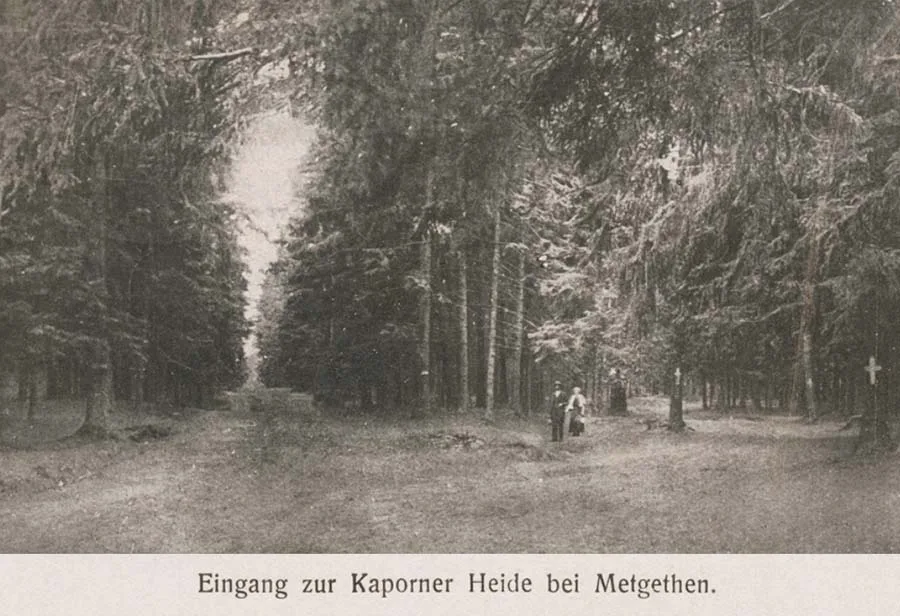 The road into the Caporn Heath from the Metgethen side (today the Aleksandr Kosmodemyansky neighbourhood).
In the days of the Order the Caporn Heath (Kaporner Heide) was a vast wild forest where the knight brothers always had to be ready for attacks by the Prussians.
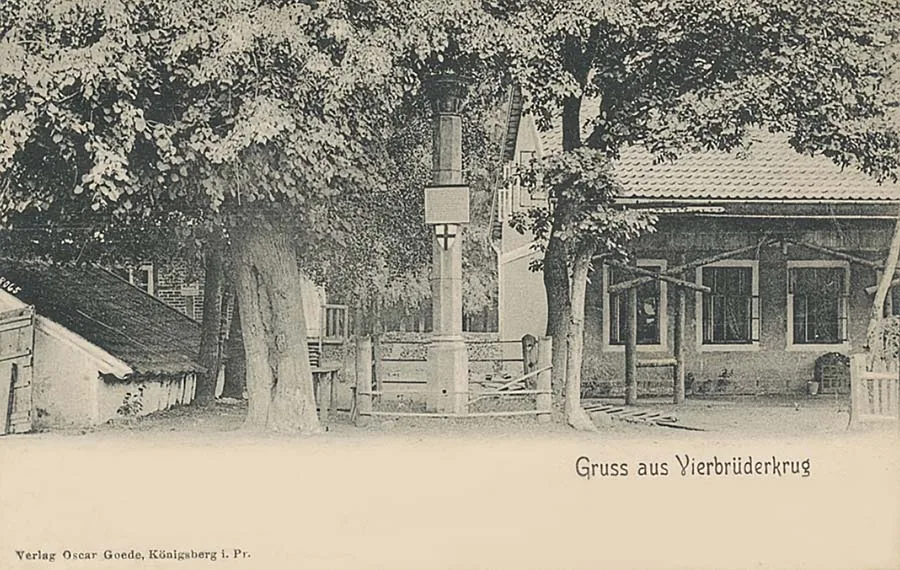 The inn and the Four Brothers Column.
The Legend of the Four Brothers is also well known. The pagan Prussians attacked and killed them at a spot where later, during the Landmeister tenure of Meinhard von Querfurt, an inn was built by the road from Königsberg to Bischofshausen and Lochstedt (Bischofshausen, Lochstedt; Bischofshausen is an earlier name of Fischhausen, today the town of Primorsk).
The Four Brothers Column has preserved this story2 to this day, and the modest inn turned into a cosy little restaurant. Its cakes and especially the local “Kopskiekel” wine (Kopskiekelwein) are well known to us all. In this forest, on the shore of the lagoon near Margen, stood the small castle of Conovedit (Conovedits Schloß), whose location can still be made out from its ditches and ramparts.
Until the reign of Frederick the Great the Caporn Heath reached almost to Königsberg itself. More precisely, the Königsberg City Forest joined it and became part of it.
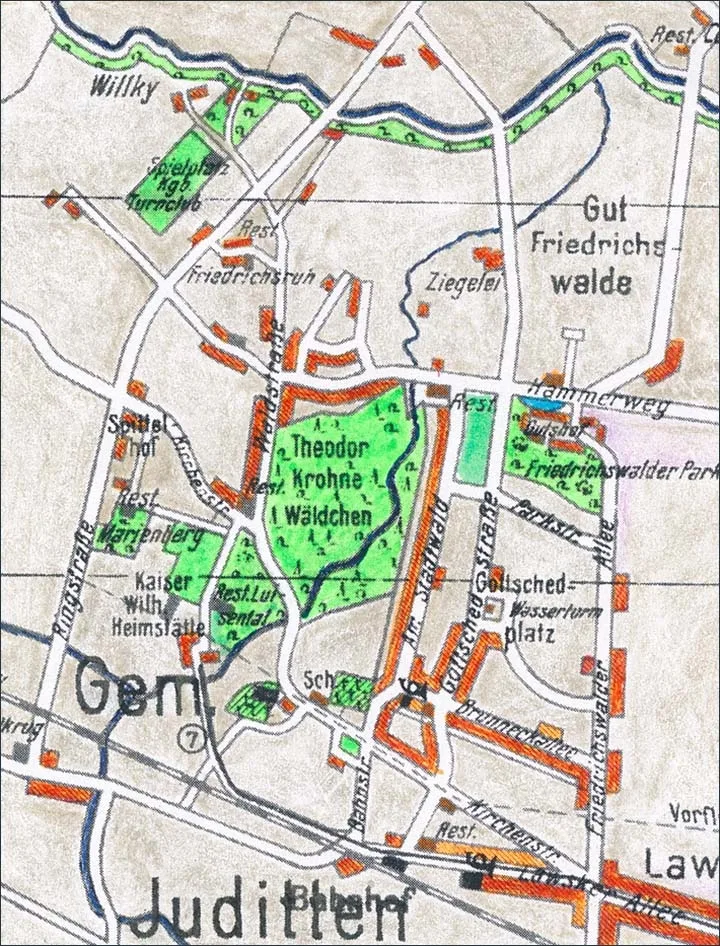
During Königsberg's first Russian period, in 1758–1762, the new masters cut down the Königsberg City Forest, which began immediately beyond the Pojenter estate (Gut Pojenters), as Luisenwahl was then called. Only a small piece of it has survived to this day, which we knew and loved as the Theodor Krohne Grove (Theodor Krohne; 1846–1925), or the Juditten Grove.
Numerous old trees testified to the antiquity of this relict forest. Evidence of this were the two old pines at the crossroads by the exit from Luisenthal park. Like two giant sentinels, they guarded the entrance to the grove.
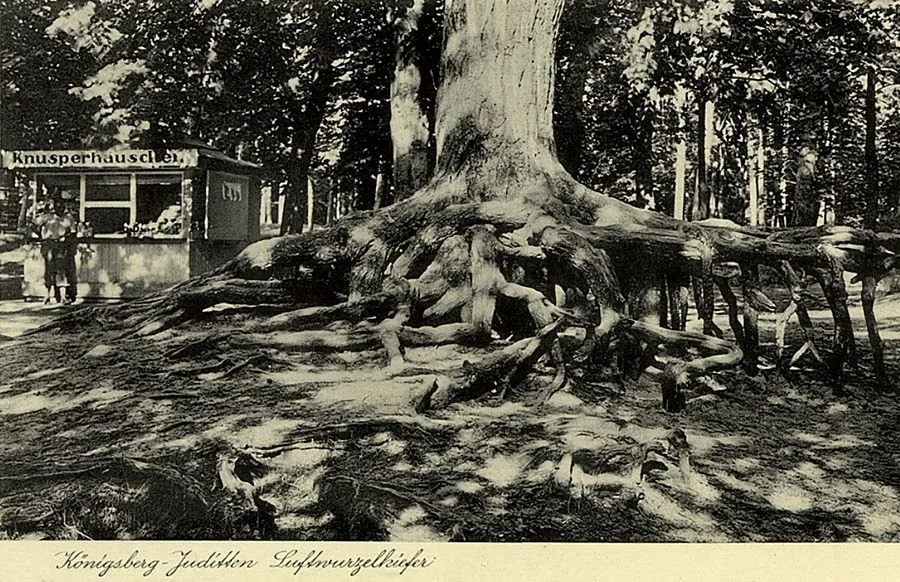 The roots of one of the two pines that “guarded” the entrance to Luisenthal.
Countless generations of children played hide-and-seek among their roots, which were exposed and seemingly tanned by wind and weather. Some liked to balance on them.
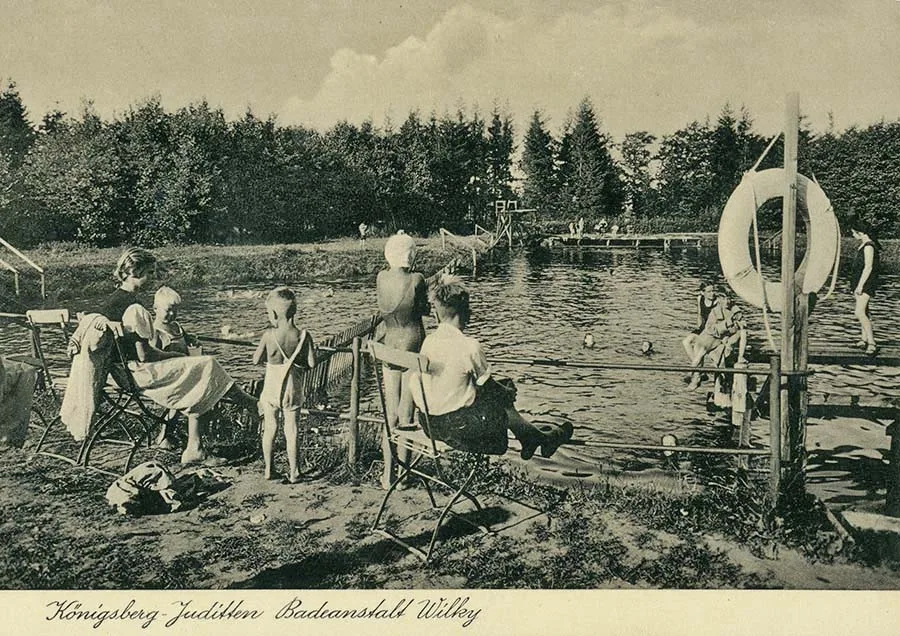 The bathing pool in Wilkie was filled with water from the Landgraben.
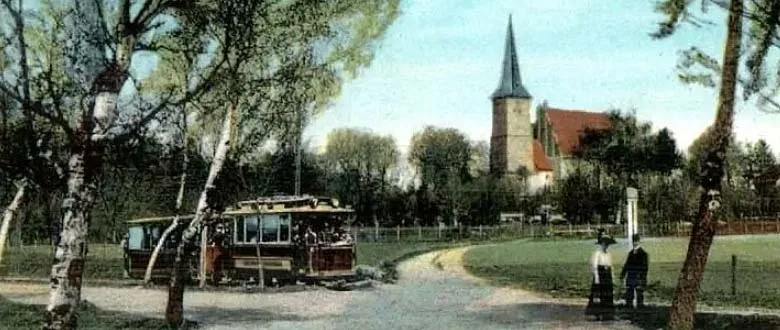
And yet these pines were young compared with the mighty oaks that could still occasionally be found in Juditten. The tallest and probably the oldest oak grew by the old estate as you climbed up to Luisenthal from the terminus of the white-and-red tram line, later line No. 7. This tree had undoubtedly seen the pagan Prussians.
In my childhood, where Forest Street (Am Stadtwald, today Tikhonenko Street) was later laid out, there was an oak grove of very old trees. One of the oaks, on the eastern edge of the grove, had several tiers one above the other, which we children loved to climb.
Our medieval forests were very rich in oaks; as late as the time of Margrave George Frederick, not far from here, in Wilkie, in Wolfswalde (Wilkie, Wolfswalde), there grew a dense grove of old oaks.
It is a pity that later almost all of them were felled to be used as ceiling beams for the guardroom in the castle.
How beautiful the Juditten grove was in spring! A real carpet of anemones shone between the trees, and however many of them the Königsbergers picked, every year they bloomed just as luxuriantly. And in the brook valley there were plenty of golden saxifrages, touch-me-nots and yellow anemones.
How poetic it was to dine in the café in the former garden of the Luisenthal estate, that ancient, fairy-tale garden, and then to enjoy the quiet of the evening calm. Around 1760 this garden was bought by Balthasar Schindelmeisser, the tenant of the “Blutgericht” castle restaurant. Later, like the “Blutgericht”, it passed into the possession of Commercial Councillor Richter.
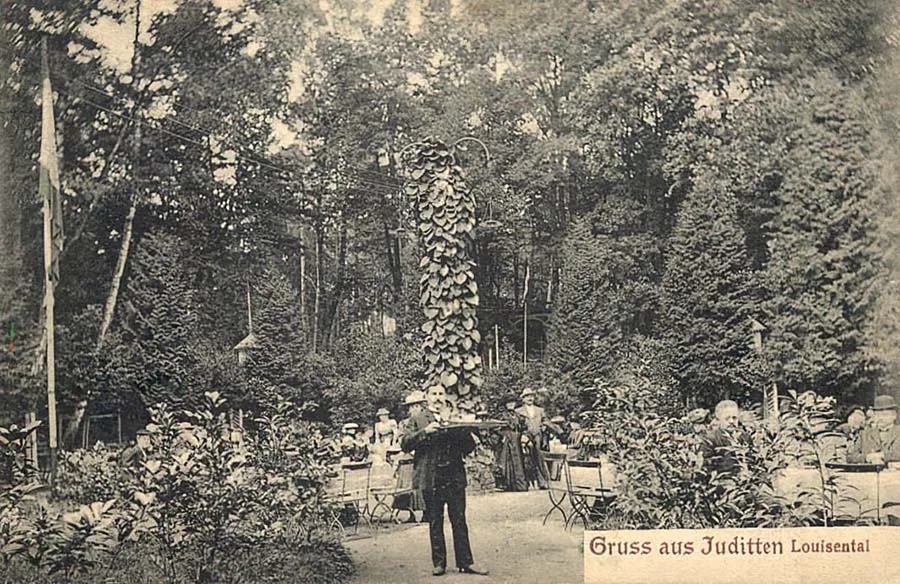 The veranda of the “Luisenthal” restaurant and café.
When Theodor Krohne, long-serving chairman of the city council, retired before the First World War, the 206-hectare grove that he had saved from felling in 1898 was renamed in his honour, and he presented it with a comfortable bench, which was placed not far from the entrance.
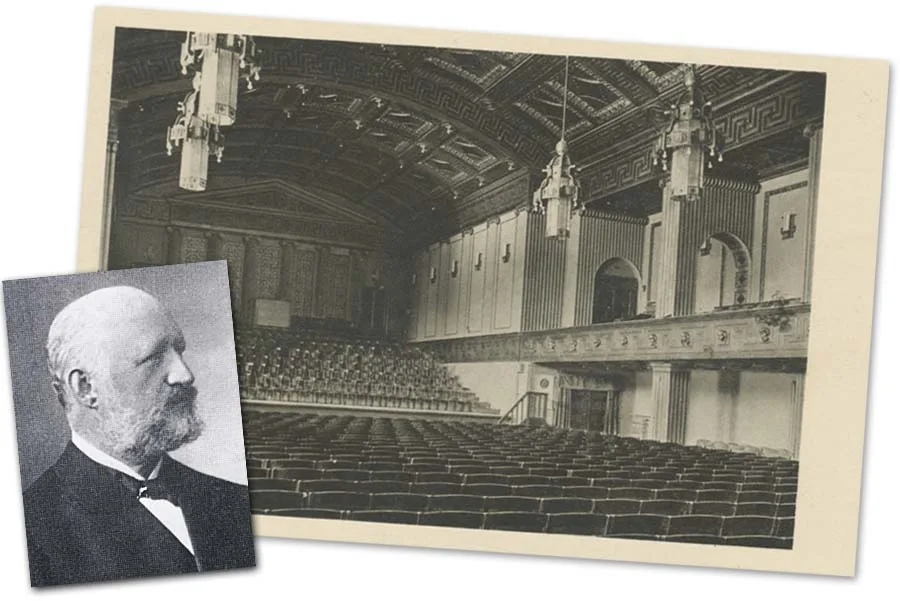
Theodor Krohne and the hall named after him in the Stadthalle (today the Kaliningrad Regional Museum of History and Art).
One fine day, perhaps in 1907 or 1908, in the shade of a small group of trees not far from that very bench Theodor Krohne had given the park, two large notice boards caught my eye. My first thought was: some kind of prohibitions?!
Out in nature that always causes an awkward feeling. The discovery, however, turned out to be a pleasant one: it was neither a prohibition nor a threat of punishment that loomed before me – each of them bore a poem!
One of them read:
“If on the path of life you chance
To meet with suffering, grief and sorrow,
Fight on, and in the fight be steadfast.
And you shall have a blessing from on high for it.”3
The other was no less profound in meaning:
“Do not wish me unearthly happiness,
Do not wish me a rain of star money4 –
In this dark fairy-tale forest
I would like to see God just once
And press my lips to His hands in token of love!”5
They probably disappeared during the First World War. I still remember them with emotion, because with their simple, heartfelt words they fitted so harmoniously into the fairy-tale forest of Juditten!
Our great compatriot Ferdinand Gregorovius (Ferdinand Gregorovius; 1821–1891) also fell under the spell of this small, soul-stirring grove and wrote in his “Roman Journals”:
“Sometimes the voice of the past reaches me like the rustling of the Juditten forest.”
As if out of a very old fairy tale, by the exit from Luisenthal park one came upon a weighing chair (Wiegestuhl). A wide wicker armchair stood there, for as long as I can remember, on a real scale. It had grown old together with its owner, or rather with several generations of its owners. You sat down in it, and behind you they immediately weighed you with huge iron weights of 100 pounds each.
The results of the weighing were accurate and certainly more reliable than those of modern scales. From my father's stories it turned out that he too had been weighed in this chair every spring for many years. But one “fine” day in the 1930s the chair disappeared. It no longer fitted into the joyless and cruel times that had set in.
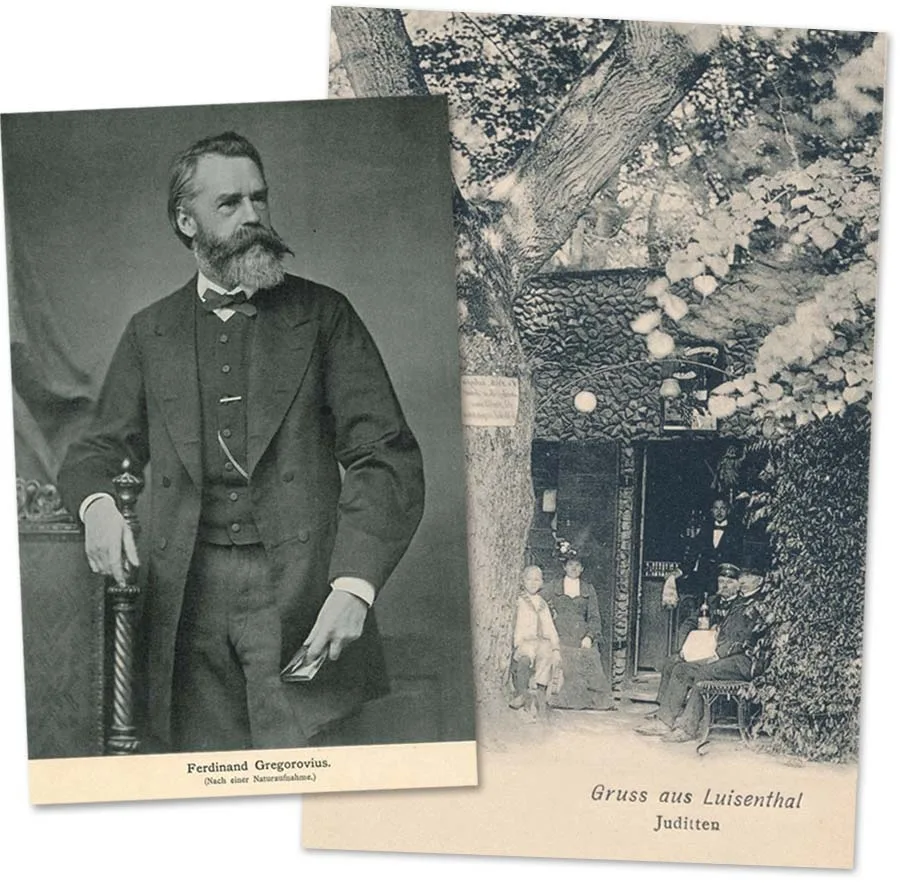
Ferdinand Gregorovius and the “Queen Louise's Cottage” café.
Besides the oaks, the forest paths and the mystical weighing chair, Juditten had one more truly important sight: its church.
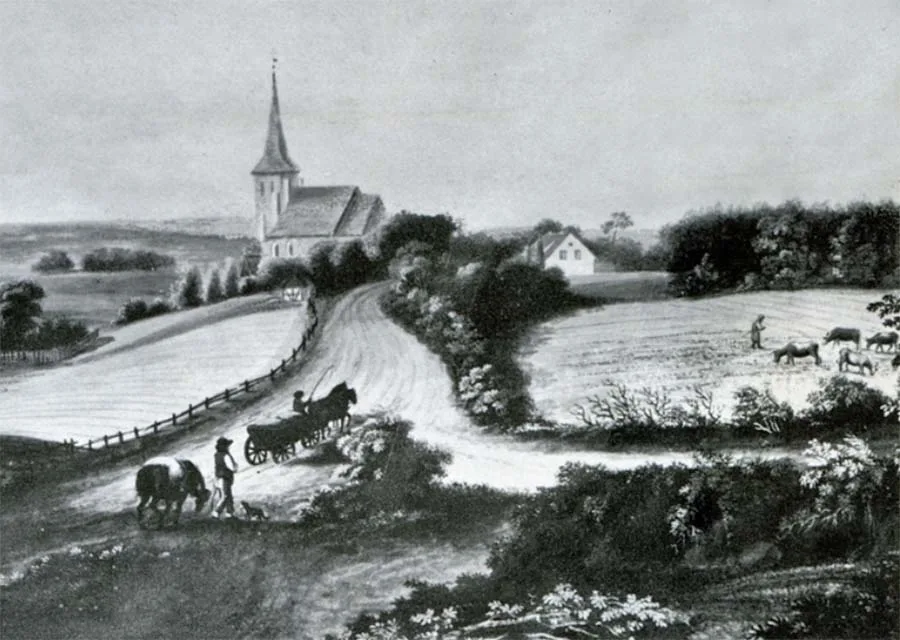 Juditten Church in a painting by an unknown artist of the first half of the 19th century.
The village of Juditten is very old: the ending -itten is Prussian. So it already existed in the Prussian era. It is said to have taken its name from the Prussian chieftain Joduthe. The chronicler Peter of Dusburg calls this noble Prussian from Sudovia Jedetus; in 1288 Landmeister Meinhard von Querfurt granted him land “prope villam Mednicken” (near the village of Mednicken), which also included “Gaudithin” (Juditten).
There was undoubtedly a fortress in Juditten. It stood opposite the church hill on the heights of the Luisenthal estate. Its name is not known to us.
Such an ancient place could not have been without an old church. Hartknoch's (Christoph Hartknoch, 1644–1687) opinion that its name derives from St Jutta is incorrect.
In 1402 it is mentioned in the “Book of the Order's Treasurer” (Ordens-Treßler-Buch) as Judynkirchen.
It is truly a real gem, if only because it is the oldest church in Samland (Samland; today the Sambia Peninsula) and possibly in Natangen (Natangen; today the entire left bank of the Pregolya as far as and including the town of Mamonovo). What is more, it is the only Gothic church in Königsberg that has survived to this day, although its interior furnishings were plundered during the Seven Years' War and its organ was destroyed.
It was built in 1288 of boulders, had very thick walls without buttresses and was dedicated to St Jutta.
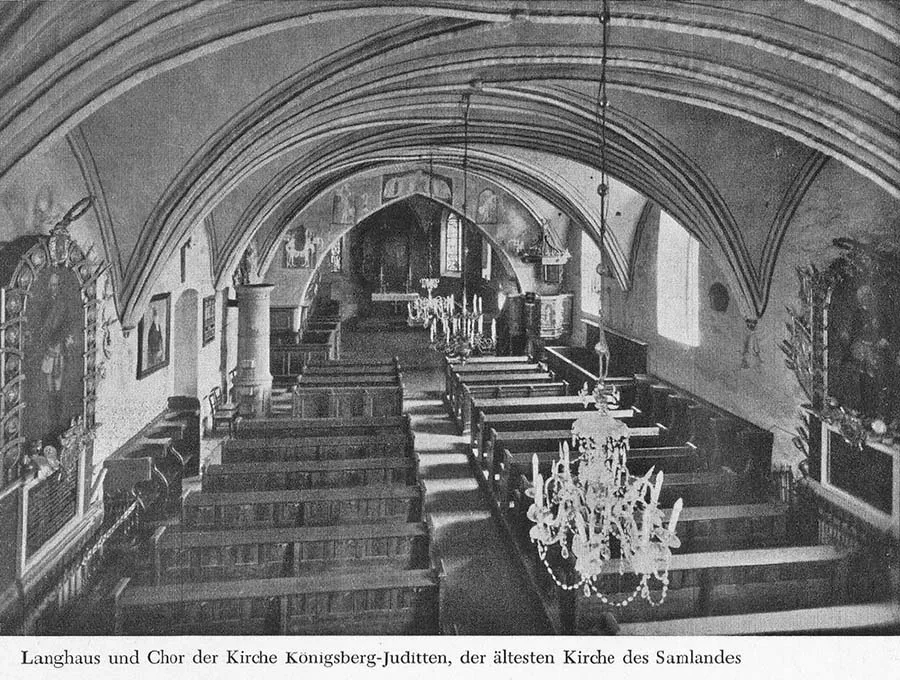 The nave of Juditten Church.
During restoration after the First World War, magnificent Gothic paintings depicting the legend of Christ were discovered in the choir.
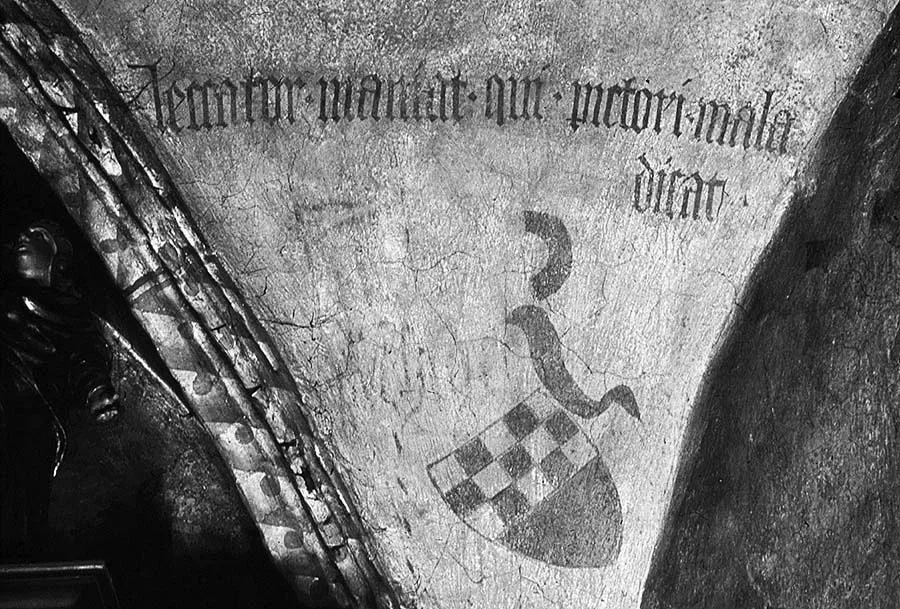 The autograph left by the medieval artist on the wall of Juditten Church, which he painted.
The walls of the nave were adorned with numerous family coats of arms of the brothers of the Order, the monk-knights, among them the arms of the Grand Masters Ulrich von Jungingen (Ulrich von Jungingen; 1360–1410) and Konrad von Wallenrodt (Konrad von Wallenrode; between 1330 and 1340–1393) and of the Order's Marshal Engelhard Rabe (Engelhard Rabe; 1387–1392). They are the work of an unknown master from the time of Konrad von Jungingen (Konrad von Jungingen; c. 1355/1360–1407) and must have created a magnificent harmony of colours.
Perhaps this master was that same painter Peter who was painter to the Order from 1398 to 1414, lived at the court of Grand Master Konrad and bought two paintings from him for himself, for four and seven silver marks respectively. Be that as it may, the artist, who worked in the same style as the magnificent frescoes in Lochstedt Castle, was well aware of his skill: on the vaulted ceiling behind the altar of Juditten Church he wrote in Latin, in characteristic Gothic minuscules (lower-case letters): LECCATOR MANIAT, QUI PICTORI MALA DICAT (in English: “A contemptible toady seeks to please when he makes up ill of the painter!”)
Several ancient Gothic pews have also survived in the church.
There was no bell tower, as bells were not cast in Prussia and transporting them from Germany was too long and difficult.
NOTES
1.
Erzähl‘ von der alten Kaufmannstadt!
Erzähl‘ von der alten Zeit!
...Erzähl‘ mir vom Schloss und vom Dom.
Als die tausend Schiffe noch zogen den Weg
Zum Meere auf goldenem Strom. –
Wird vielleicht einst eine schönere Stadt
Aus den Trümmern von heute ersteh’n;
Wird meine Erinn’rung doch nimmersatt
Die Straßen der Kindheit gehn.
2. The Four Brothers Column bore the inscription:
Zwölfhundertfünfundneunzig – die Chronik nennt dies Jahr
Zur Zeit, als Ordens-Meister Meinhard von Querfurt war,
Da ruhten hier im Haine vier Waffenbrüder aus,
Von Sudau’n siegreich kehrend zurück nach blutgem Strauß.
Da war der wackre Dyvel, der rüstge Kobenzell
Und Stobemehl und Röder, ein mutiger Gesel’.
Die Treue, die dem Orden sie hatten angelobt,
War schon in Gau’n voll Aufstands im Kampfe oft erprobt.
Sie saßen froh beim Mahle, nach Conovedits Schloß,
Da stürzte aus dem Dickicht hervor der Feinde Troß.
Mit Schwert und Spieß und Keule streckt nieder er die Vier.
und zum Gedenk’ der Toten steht diese Säule hier.
_ _ _
“Twelve hundred ninety-five – so do the chronicles say.
Meinhardt von Querfurt was then the Order's master.
Here in the grove four brothers sleep their eternal sleep,
Back from Sudovia with a great and swift victory…
Among them were brave Diwel and steadfast Kobenzel,
And valiant Stobemel, and Reder, quick with his sword.
All faithful to the Order, the oath that they had sworn
They sealed with their own blood in battle with the foe.
Near Conovedit Castle once they sat at table,
When from the thicket murderers fell upon them.
By sword, by stake and spear all four were slain,
And to the memory of those heroes this column was set in the ground.”
3.
Wenn dich auf dem Weg der Pflicht
Einst ein Leid begegnet, —
Ring' mit ihm und lass es nicht,
Bis es dich gesegnet!
4.In the original “Sterntalerregen” – “a rain of star thalers”. A reference to the Brothers Grimm fairy tale “The Star Money” (German: Die Sterntaler), a short legend about a poor orphan girl who for her kindness and fear of God received a reward from heaven – a shower of golden thalers.
5.
Wünsch mir kein Märchenglück, Sterntalerregen,
Möchte dem Herrgott nur
Einmal begegnen.
Wenn ich im dunkeln Tann
Einmal ihn fände.
Küsste dem Gütigen dann
Dankbar die Hände!
Source
Photos
Bildarchiv Ostpreußen bildarchiv-ostpreussen.de.
● Editor's note: Read on VisitPrussia.com an interview with the translator of German and, in particular, Prussian fairy tales, our regular contributor Tatyana Kolivay, who runs her own blog, where countless other parables, legends and fairy tales in her translation have been published.
Translated from Russian with the help of AI (Claude, Anthropic), October 2026.