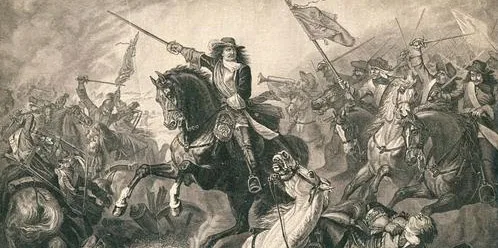
It is generally held that it was at precisely this time, after the victory at Fehrbellin (28.06.1675), that Frederick William acquired the epithet “the Great” in addition to his title of Elector of Brandenburg. It is worth noting that in the modern era not a single German emperor, nor a single English or French monarch, was honoured with the name “the Great” (and in those countries every king was given some apt nickname). Of the Russian autocrats, only two, Emperor Peter I and Empress Catherine II, achieved such an addition to their title. In Germany itself, the epithet “the Great” was bestowed a second time in history on the Prussian king Frederick II, the Great Elector's great-grandson. Loyal flattery has, of course, always existed, but if the name “the Great” is not supported by the people, it does not survive in history.
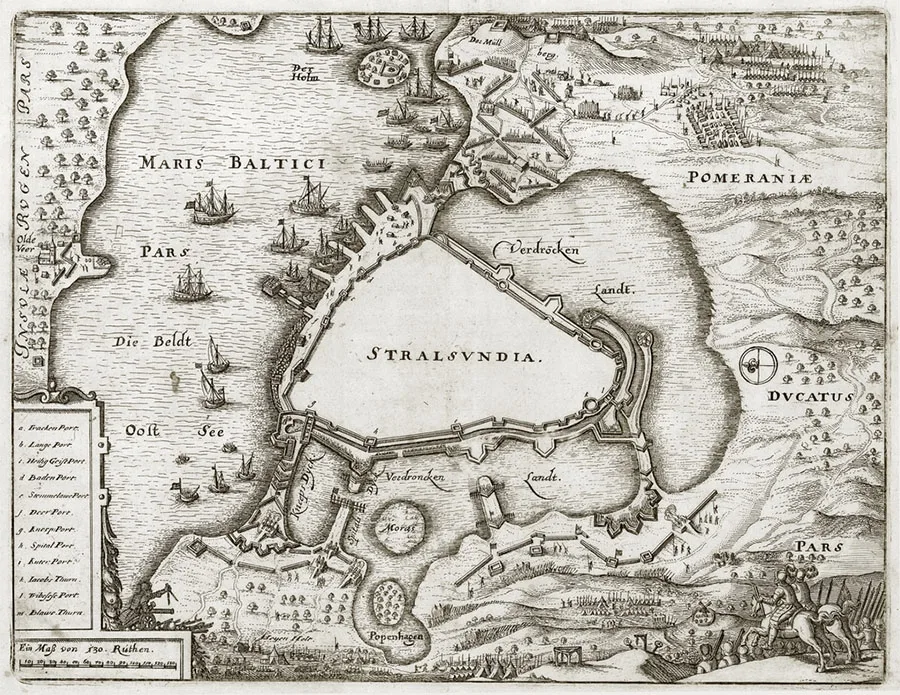
In October 1678 the Great Elector's troops laid siege to the principal citadel of Swedish Pomerania, the fortress of Stralsund (above), which was famous for having been besieged in vain by Wallenstein's army during the Thirty Years' War (1618–48).
For this reason, the Swedish king now expected it once again to put up stubborn resistance lasting many months. Frederick William, however, had other plans. He concentrated a powerful artillery force of 22 mortars and 50 howitzers beneath its walls. On 10 October the bombardment of the town began, continuing with short breaks until the evening of 11 October. By the end of the very first day of shelling numerous fires had broken out, and the town authorities sent envoys to the Great Elector. By the end of the day on 11 October the fortress garrison, too, could hold out no longer. On 15 October an honourable capitulation of the fortress was signed, and on the 20th Frederick William entered it. After the fall of Stralsund, no one any longer had any doubt about the outcome of the Swedish-Brandenburg War.
Throw Them Out the Door, They Come Back Through the Window
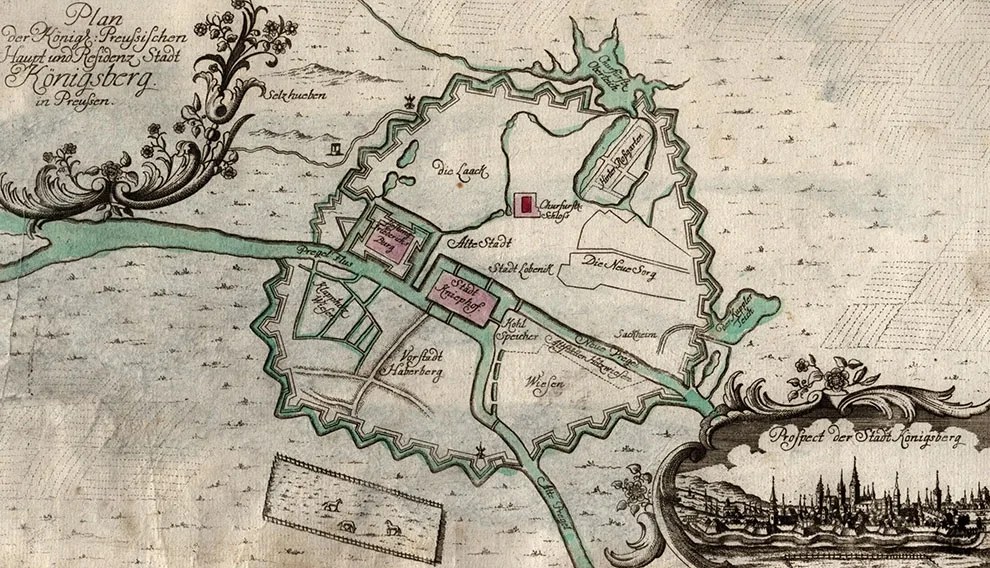
Yet even before Stralsund went up in flames, the Swedes had decided to expand the theatre of war dramatically and carry the fighting onto the territory of Brandenburg-Prussia. The strategic plan of the Swedish operation in Prussia consisted of a vigorous march on Königsberg, at a time when the duchy lacked any substantial body of troops capable of defending it. The idea was to use a force that was small and therefore mobile, which, setting out from Riga in October 1678, could reach Königsberg as early as the second half of December. In Courland the Swedish army numbered 15–16 thousand soldiers. Even if a corps of ten thousand reached Königsberg, that would be enough to force the small garrison remaining there to capitulate. The capture of the Prussian capital would undoubtedly have compelled Frederick William to lift the siege of Stralsund and advance towards Königsberg. But by then Sweden could well have shipped additional forces to Königsberg by sea, and the war would no longer have been fought over Pomerania but over Prussia, and it would now be the enemy's territory that was laid waste.
On 15 November 1678 the Swedish army that had set out from Riga, numbering 11,200 soldiers (according to German data; according to Swedish data, 11,547), entered Prussian territory near Memel (Klaipėda).
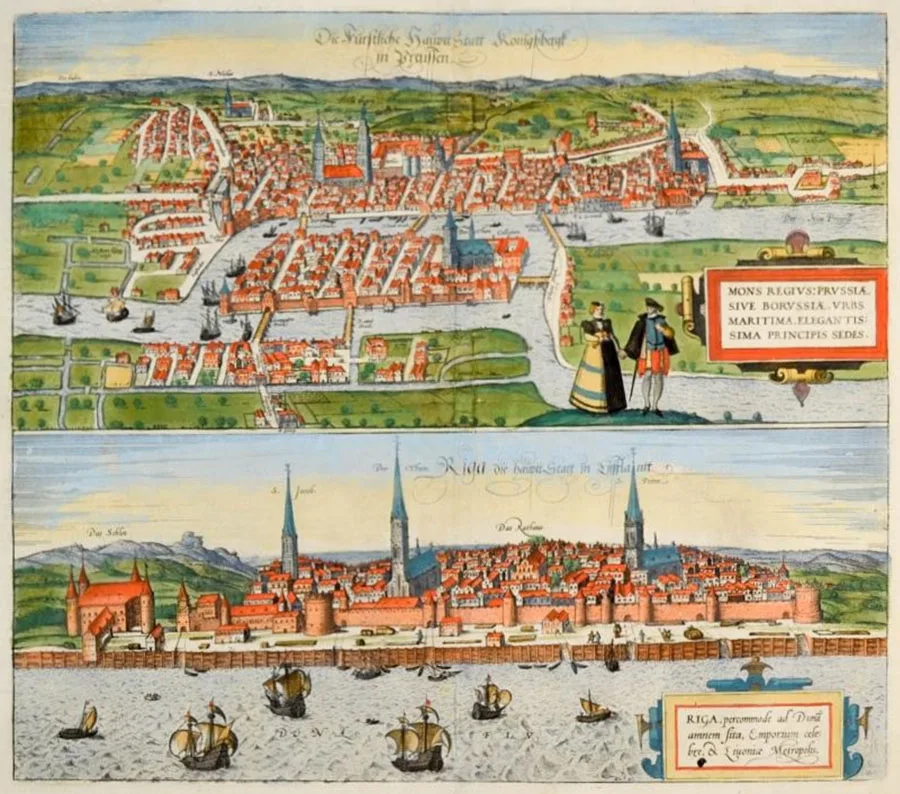 A 17th-century “double poster” with maps of Königsberg (top) and Riga.
The army, commanded by Field Marshal Henrik Horn, comprised, according to German data, 14 cavalry regiments, 6 dragoon regiments and 12 infantry regiments. According to Swedish documents, on leaving Riga it numbered 4,136 infantrymen, 5,174 reiters and 2,237 dragoons. The force had 36 guns of artillery. The Swedish army immediately tried to take Memel on the march. The bombardment caused a great fire in the town, but the fortress withstood the first assault. Horn did not have time for a proper siege of Memel, so he contented himself with burning some of the town's buildings and continued his march on Königsberg.
The Swedish advance followed a fairly well-known route via Memel to Tilsit (Sovetsk), which they occupied on 6 December. This means that on the march the Swedish army covered an average of 10 km a day. Once in Prussia, however, owing to general fatigue, the shortening days, the need to move with combat security and to set up camp by the book, the army's rate of movement fell to 4 km a day. Nevertheless, by Field Marshal Horn's reckoning, Frederick William's troops could not reach Königsberg before March 1679 even by forced marches, and, given the practice of postponing major campaigns to the spring and summer, not until midsummer at all. He was therefore in no hurry to leave Tilsit and gave his army a good rest.
It was here in Tilsit that news reached him from Sweden that, while they had been marching from Riga, the fortress of Stralsund had fallen, so that the whole operation to draw the Great Elector's forces away from the siege had lost all purpose.
Horn was instructed to entrench himself in the positions he had taken, securing a bridgehead for the main forces of the Swedish army to invade Prussia in the spring and summer of 1679. And Tilsit was the best possible place for such winter quarters. Yet for some reason Horn unexpectedly decided to continue the march on Königsberg and set off towards Insterburg (Chernyakhovsk), intending then to turn towards Wehlau (Znamensk) and proceed from there to the Prussian capital. His army still met no appreciable resistance. The next major halt after Tilsit was at Insterburg. Horn's headquarters were set up in Georgenburg Castle (the settlement of Mayovka). On 6 January the Swedish army entered Wehlau. On the way from Tilsit to Wehlau the pace of the Swedish army slowed to roughly three and a half kilometres a day, which shows how gruelling winter campaigns were for the armies of that period.
Manoeuvre Is Everything!
Frederick William was celebrating his glorious victory in Pomerania, which promised the long-awaited territorial unification of the lands of Brandenburg and Prussia, when in December 1678 reports reached Berlin that Swedish troops had entered Prussia. News travelled slowly in those days. In Berlin itself the Elector had an army of 9,000 soldiers, including 5,000 cavalry, with 30 guns. The reports estimated the enemy army at 12–15 thousand soldiers. The Elector realised that he would have to attack, straight from the march, a superior enemy force in prepared positions, which in a head-on clash hardly promised success. And so a plan was drawn up that became legendary in German military history. Under this plan, a compact army would march swiftly to Königsberg in winter conditions. There the entire cavalry, without waiting for the infantry and joining up with the cavalry units of the fortress garrison, would pin down Horn's army in minor skirmishes, preventing it from withdrawing unpunished to Livonia. Meanwhile the main forces, the infantry and artillery, would use an outflanking manoeuvre to cut the lines of communication by which the enemy army was supplied. The Elector's combined forces would then complete the rout of the enemy.
The plan was astonishingly innovative. The mere mention of severed lines of communication takes us to events of a much later era — this tactic became a classic during the Second World War.
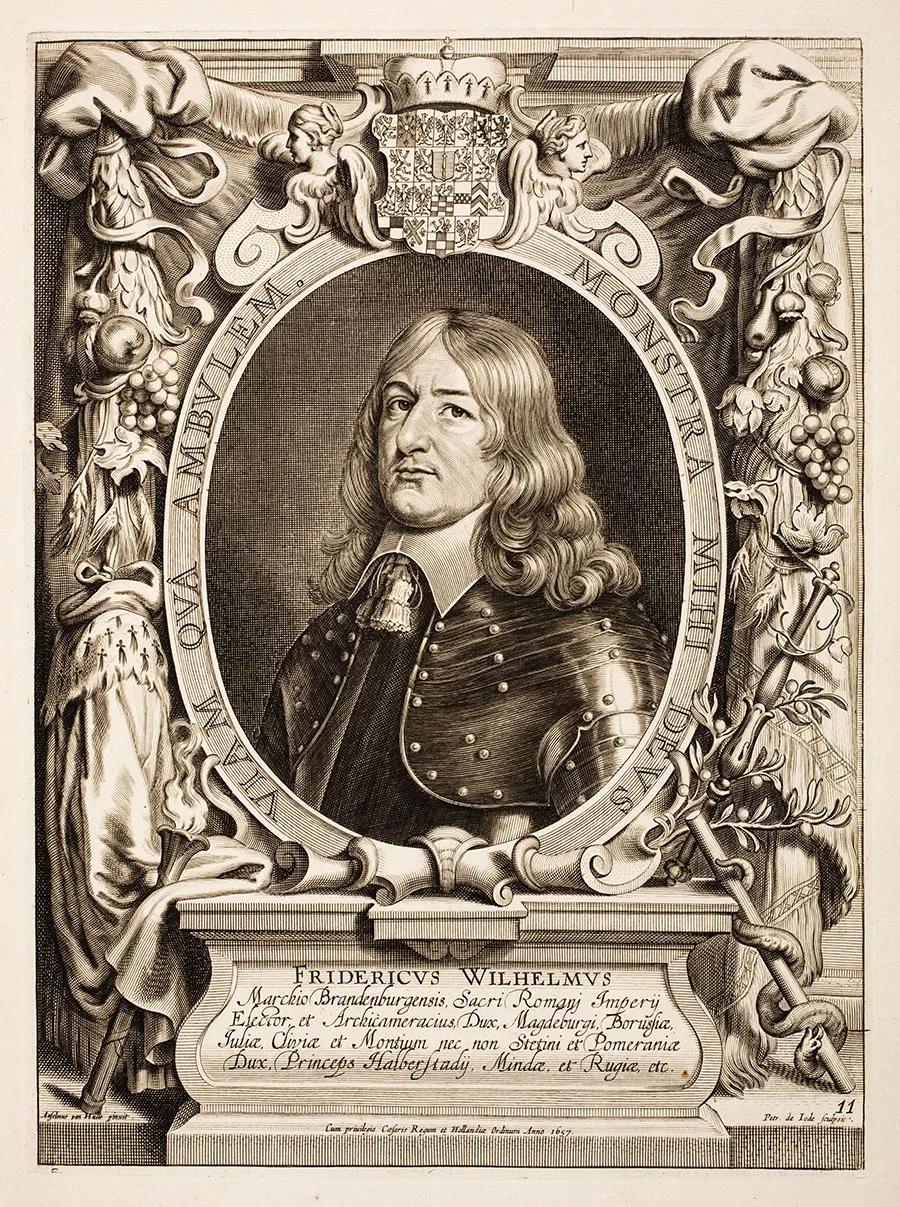 The Great Elector Frederick William.
If one adds to this the winter transfer of an army over hundreds of kilometres, one gets the impression that we are not talking about the 17th century at all. But the main surprise, the real “highlight” of that campaign, still lay in store for the Swedes.
The route from Berlin to Marienwerder (Kwidzyn, Poland), which became an interim assembly point for the troops, was covered at an average pace of 15 km a day. That was one and a half times faster than the Swedes had marched, but still not fast enough, at least in the Elector's view. Couriers were therefore sent ahead to Marienwerder and handed the municipality an order to gather every available sledge in the town and all the surrounding villages. The order was carried out at once. Nowhere is there any mention of the Duke-Elector's subjects obstructing the supply of sledges to the troops. The nearly 40 preceding years of Frederick William's reign had taught peasants and burghers two things: 1) it was unwise to oppose the will of the Great Elector; 2) Frederick William's army never plundered its own population, so sledge owners could reasonably count on having their property bought out or fairly compensated. In all, 1,100 sledges were temporarily requisitioned, along with up to 700 horses in addition to the Elector's cavalry mounts.
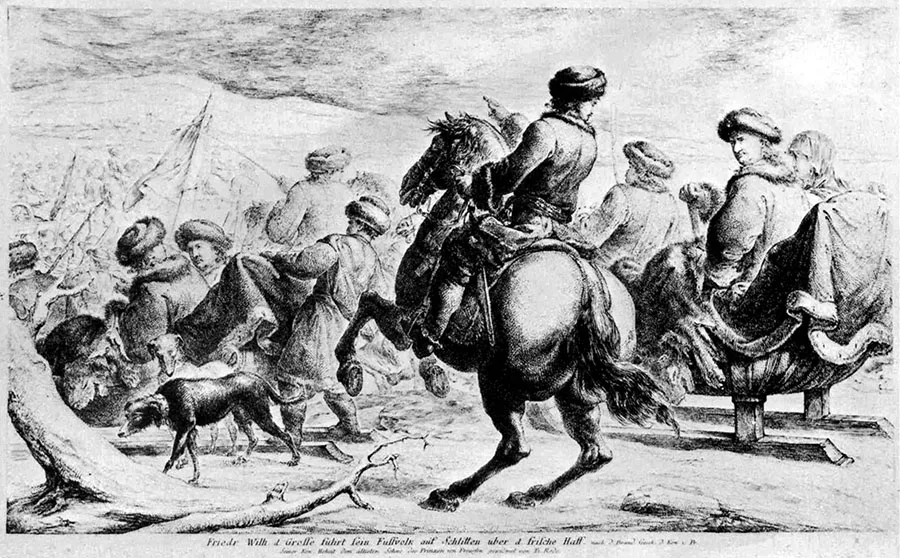
The sledge train, or rather the sledge armada, set off along the Weichsel (Vistula) and the Frisches Haff (Kaliningrad Lagoon) to Heiligenbeil (Mamonovo), and from there on to Königsberg (Kaliningrad).
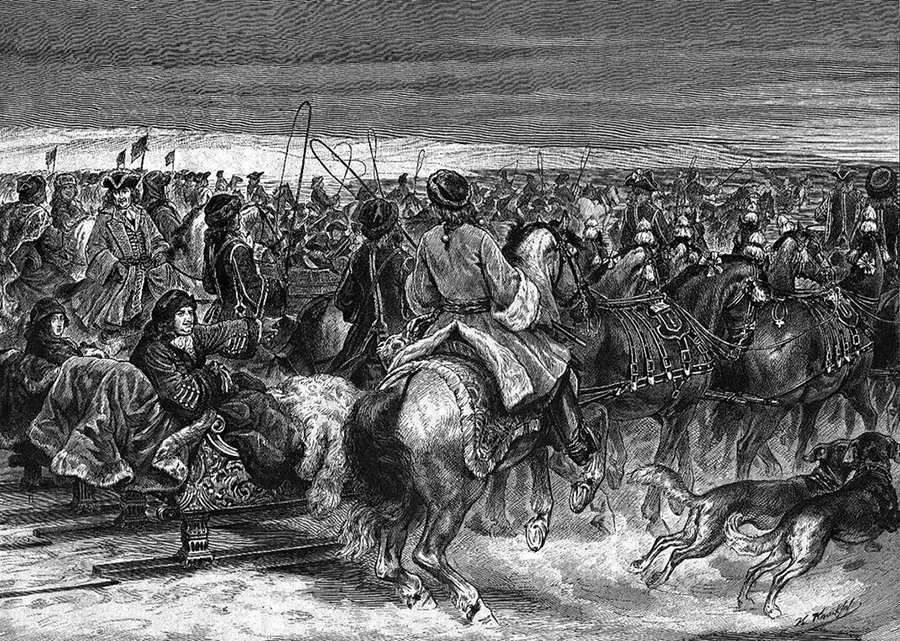
The sledge-borne infantry moved so fast that the cavalry, led by the Elector himself, pulled only slightly ahead of it. In Königsberg the infantry and cavalry parted ways once more.
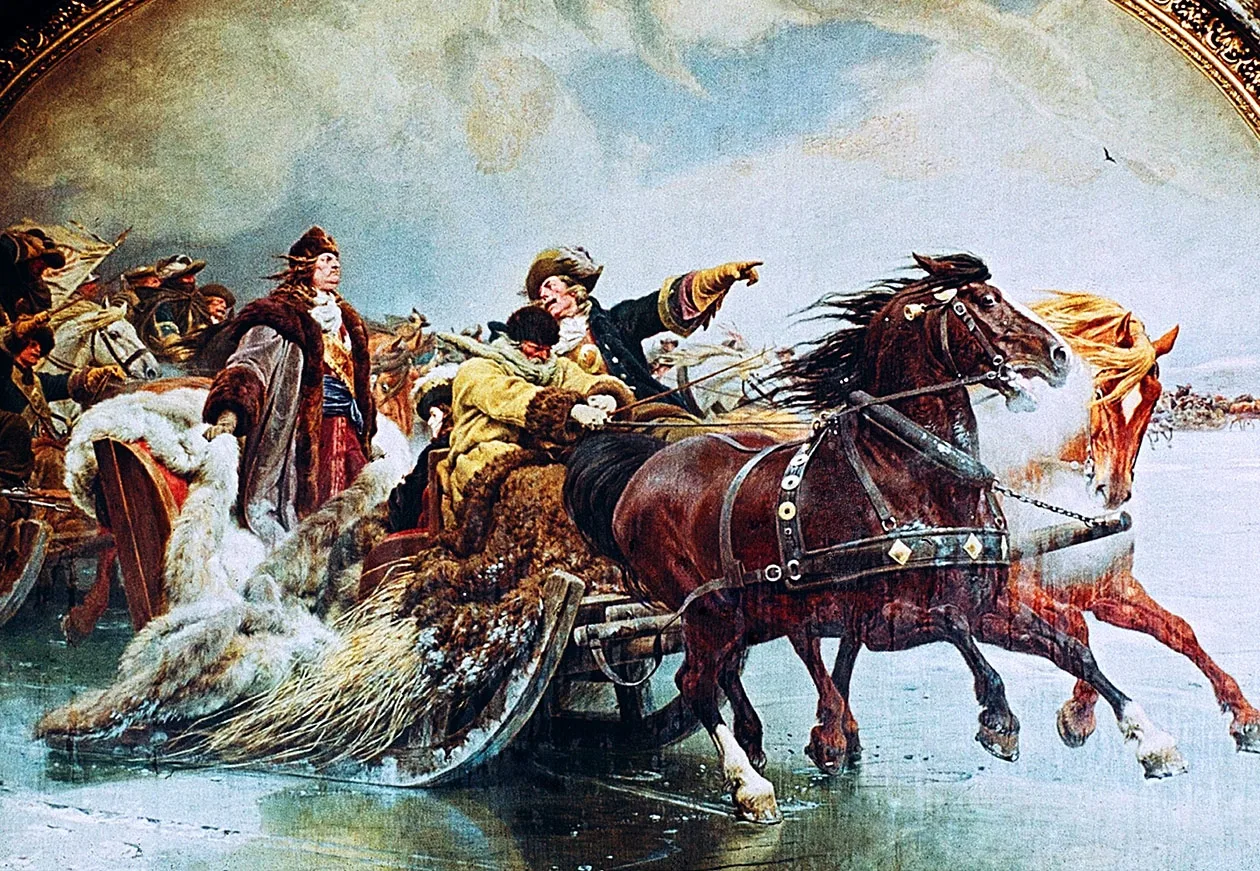
The cavalry under General Joachim Ernst von Görtzke rushed off in search of the Swedish army, while the infantry, led by the Elector himself, continued by sledge. This time the route ran along the Pregel and the Deime to Labiau (Polessk), and from there across the Kurisches Haff (Curonian Lagoon) to the village of Gilge (Matrosovo). Between Marienwerder and Königsberg, Frederick William's army reached a speed of 30 km a day, and between Königsberg and Gilge 33 km a day. Such rates would have been excellent in the First World War and good in the Second. Allowance must of course be made for the number of troops being moved, since the Elector's entire army was equivalent to a single Second World War division. Even so, it was the stuff of fantasy! The imagination can barely conjure up this astonishing scene: a thousand sledges racing across the ice, crammed with more than eight thousand soldiers and officers fired up by their commander's ingenuity and resolve. In essence, this was the first use of mobile infantry, the forerunner of today's motorised riflemen. This unconventional move, it must be said, wrecked the Swedes' plans for a long wait for the enemy.
Even once the Swedish command had been informed that the Brandenburg-Prussian army had arrived in Königsberg, nobody could have expected it to turn up in Gilge three days later. At their own pace, the Swedes would have needed about a month to get there.
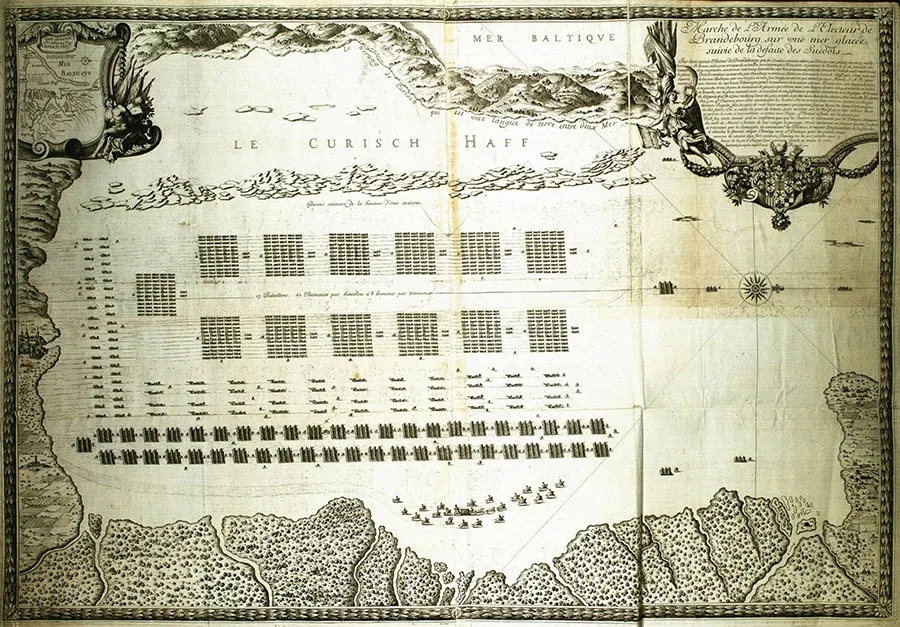
An entire army with its artillery crossing the Curonian Lagoon by sledge over the ice: a breathtaking spectacle that long stirred the imagination of battle painters and military cartographers (in this case, French ones).
The Final Blow, or the Strongest Wins
But let us step back a little to the Swedes and their field marshal, Horn. While at Wehlau, he learned through his scouts that Königsberg was defended by a somewhat larger garrison than he had originally reckoned. In particular, in addition to the fortress troops, there was von Görtzke's cavalry detachment of up to 3,000 horsemen. Although Horn's army outnumbered the enemy more than 2.5 to 1, he showed prudence and abandoned the march on Königsberg. He also judged his position at Wehlau to be weak and began to withdraw towards Tilsit. Horn did not yet know that the Elector's army was already hurrying into Prussia at full speed. Had it not been for this withdrawal, Frederick William's plan would have worked to perfection. Horn chose the most sensible of three possible courses of action, yet even this promised the Swedes nothing good. Any retreat demoralises an army, and Horn's retreat followed the very road whose nearby villages had just been laid waste. Provisions and fodder ran short, and the number of soldiers falling out through exhaustion kept growing. In Tilsit, however, Horn could count on a supply train from Riga to make up the shortage of food, fodder and powder. In Tilsit it would have been possible to hold out until spring, receive reinforcements and continue the campaign.
Curiously, the Swedes reached Tilsit and the main Brandenburg force reached Gilge on the same day, 29 January 1679. Frederick William had hurried with all his might for a month and a half, only to arrive a mere day or two too late.
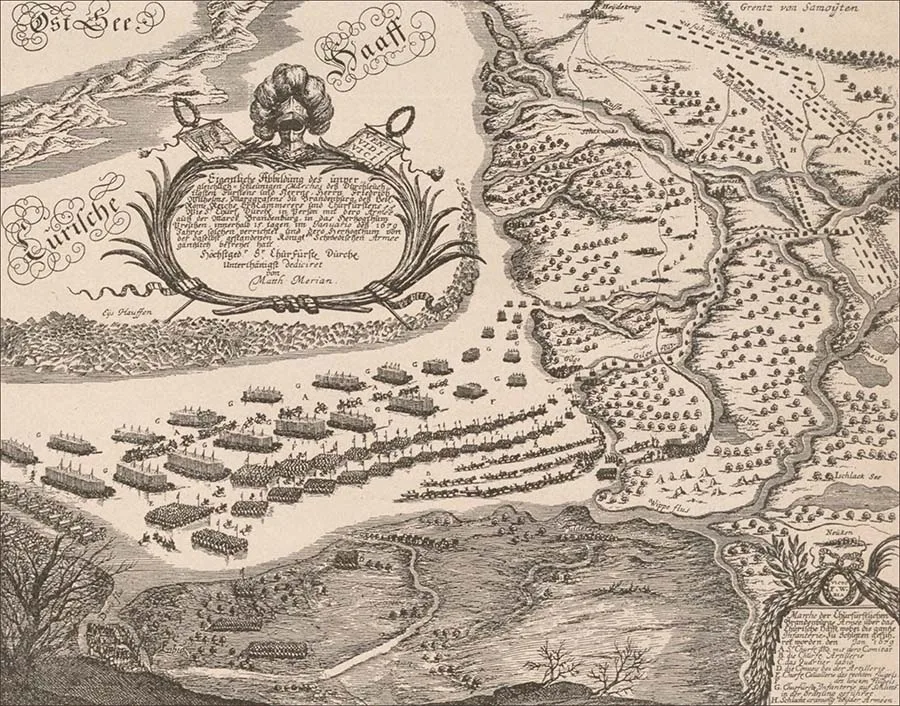 If an artist of the period is to be believed, when the rearguard of the Great Elector's army was only just setting out across the lagoon from Labiau (Polessk), the vanguard had already passed the mouth of the Gilge (Matrosovka) and advanced several kilometres along the ice of the frozen river into the snowbound expanses of the Elchniederung (Elk Lowland).
Had it not been for this delay, his crossing of the ice would have entered every history textbook as the most dazzling military victory of the 17th century. Yet Field Marshal Horn's experience also deserves credit: at a difficult moment of decision, rather than suffer a spectacular and inevitable rout, he chose to save at least part of his army.
Meanwhile, the Prussian cavalry caught up with the Swedes near Tilsit. To keep Horn from slipping away, a vanguard of 1,000 horsemen under Colonel Joachim Hennigs von Treffenfeld attacked the rearguard regiments of the Swedish army straight off the march. The next day, 31 January 1679, the entire cavalry engaged the Swedes. The battle took place near the village of Splitter (now part of the town of Sovetsk, near Chapayeva Street) and ended in a decisive Prussian victory. The Swedes lost about a thousand men, another 300 were taken prisoner, and 5 guns were captured. (Until 1945, Tilsit, which absorbed the village of Splitter, still had its “Swedish cemetery”.) Meanwhile, Frederick William's infantry was moving onto the road to Memel (Klaipėda), cutting off both the Swedes' line of retreat and any chance of sending reinforcements and supply trains. At Splitter Horn again faced a choice: had he halted his retreating army and drawn it up in battle order, he could have put up a worthy resistance to the Prussian cavalry. But then time would have been lost, and the Lithuanian gate would have slammed shut on his army for good. As it was, he still had a chance.
It must be said that, on the whole, the Swedish army had no incompetent field marshals. Horn evidently saw through Frederick William's plan and so did not lead his soldiers into the trap that had been set, choosing instead to retreat along Lithuanian country tracks.
This, of course, slowed his pace even further and did nothing to help him shake off the enemy. Horn threw one rearguard battalion after another into deadly clashes. But credit where it is due: he avoided a general rout. Moreover, we must set aside the realities of our own day and picture a commander leading thousands of men along roads marked on no map. Through unknown villages, across snow-covered fields, over frozen rivers. Along tracks barely wide enough for two horsemen abreast, so that the column stretched out for many kilometres and those at its head had no idea what was happening at its tail. An orderly retreat under such conditions is an extraordinarily difficult task. Some 130 years after these events, the great Napoleon would lead his army victoriously across all of Europe, yet it was a retreat that would destroy it almost entirely.
After three days of pursuit, the Great Elector realised that his own army now faced the same hardships that had reduced the Swedish army to such a sorry state. The supply trains had fallen behind, the soldiers were collapsing from exhaustion, and disease had broken out. It was decided not to cloud the victory with excessive losses of their own. The main force fought its last engagement on 2 February 1679 near the village of Alt Weynothen (today the settlement of Oktyabrskoye in Slavsk District), where one of the straggling Swedish detachments was routed. Only a detachment of 1,500 cavalrymen under Major General Hans Adam von Schöning was sent to “see the Swedes off”. Schöning’s conduct drew mixed assessments at the time. He mauled the Swedish rearguard only once, near the village of Telsche (Telšiai, Lithuania), after which he avoided battle and shadowed the Swedish retreat almost all the way to Riga, stopping 50 km short of the city.
Hot-headed Prussian officers took his passivity in the pursuit for cowardice and indecision. Schöning himself justified his conduct by a shortage of ammunition and the fatigue of his men. It is quite possible that, seeing Swedish soldiers perish on the march without any help from his bullets, Schöning chose not to add to the bloodshed of the campaign, well aware that for the overall victory it no longer mattered in the least whether 1,000 Swedes or 5,000 straggled back to Riga. His own soldiers, on the other hand, were worth sparing.
Speaking of Swedish losses: Swedish sources tell us that some 5,000 soldiers returned to Riga out of the 11,547 who had set out on the campaign four months earlier. German sources, however, claim that 1,000 cavalrymen and 500 infantrymen came back.
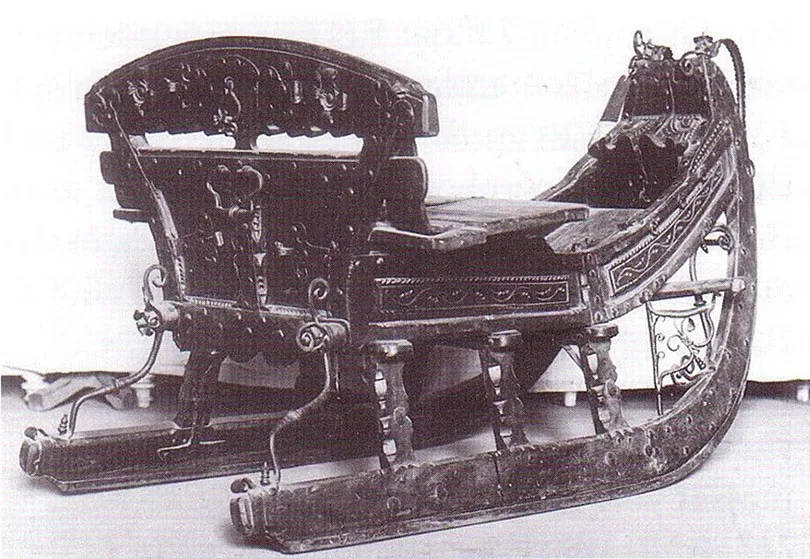 The Great Elector’s sleigh, in which he carried out the Ice Manoeuvre, was carefully preserved in Königsberg Castle, in the famous Prussia-Museum that we recently covered in detail.
The truth most likely lies closer to the Swedish figures; this is indirectly confirmed by the fact that Schöning, with his detachment of fifteen hundred, did not dare to attack the remnants of the army. In any case, Swedish losses amounted to at least 6,500 men and at most 9,700. Of these, about two thousand were killed in actual fighting. The rest fell victim to the harsh conditions of the campaign, which once again confirms the grim arithmetic of those times, when non-combat losses exceeded battle deaths two to four times over. But in assessing this military operation devised by the Great Elector, what matters far more is that all the objectives of the forced march into Prussia were achieved. And, of course, the elegance of its execution and the utterly unconventional approach to a task that seemed impossible for that period of history: moving troops rapidly over hundreds of kilometres.
Logical Outcomes and Dashed Hopes
Victory in the “hunt on the Curonian Lagoon” brought the long war to a close. Sweden no longer had the means to defend its interests on the southern shores of the Baltic. Brandenburg-Prussia’s allies had also exhausted their capacity to wage war and opened peace negotiations. Had Frederick William stayed out of the negotiations, he would have found himself at war with France alone. In the course of the peace talks he came to appreciate all the “charms” of military alliances of convenience: France demanded that the captured territories in Pomerania be returned to Sweden, and the allies did not back the Elector’s wish to resist this. Not even the Holy Roman Emperor supported him, which finally convinced the Great Elector and all his successors that Brandenburg’s participation in the Holy Roman Empire should be merely nominal, since membership in the imperial conglomerate was more of a burden than a venture promising any benefit. France justified the need to return the captured territories by appeal to the Westphalian system in Europe, a kind of settlement that had fixed the existing borders. In exchange, Brandenburg-Prussia was to receive a substantial indemnity, which was of course welcome too, but nowhere near as desirable to Frederick William as the lands of Pomerania. His descendants later conquered them, but it was the Great Elector who set the course for these acquisitions.
Evidently, after this brilliant military victory and the political fiasco that followed it, Frederick William came to understand that Prussia and Brandenburg would not be united during his reign.
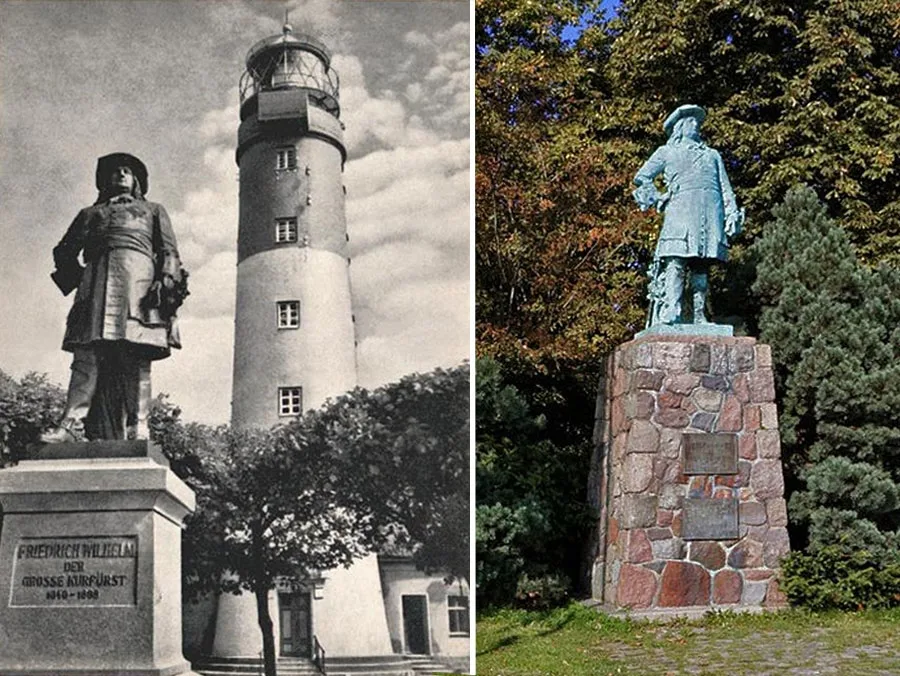
Before the Second World War, the monument to the Great Elector stood next to the lighthouse on the waterfront of Pillau (Baltiysk). The Germans evacuated the statue to Hamburg, from where it was moved to the seaside town of Eckernförde, where it still adorns the local park (right).
The forces opposed to this ambition were simply too powerful. The Brandenburg-Prussian state still had to gain political and economic weight, build up its military might and win strong allies with a stake in its success. Only then could it overcome the natural reluctance of the leading powers to see a new state on the map of Europe capable of competing with them.
The “hunt on the Curonian Lagoon” (that very “Ice Manoeuvre”) became, in its way, the pinnacle of the Great Elector’s military glory. And here a reasonable question arises: how did it come about that only 30 years earlier foreign armies invading Brandenburg or Prussia had plundered the local villages, camped wherever they pleased and dictated the terms of their stay in the territory or their passage through it, without expecting any military resistance whatsoever? And yet, within a single generation, the Brandenburg-Prussian state had turned into a force that had not only to be reckoned with but was preferably to be counted among one’s allies. We will talk about this next time, and once again our main hero will be the Great Elector Frederick William.
Translated from Russian with the help of AI (Claude, Anthropic), October 2026.