—
Editor's note. Even a well-prepared reader may find this article full of unfamiliar names and words whose meaning has to be looked up in reference books. So let us forestall that:
The Hufe (German Hufe, plural Hufen) was a medieval measure of the area of peasant holdings used in the German states and in East Prussia. The historical size of one Hufe could vary from 7 to 25 hectares depending on the fertility of the soil. On the poorest land it could reach 30 hectares. In essence it equalled the amount of land a peasant family could work with one plough and which could at the same time feed that family. It was in use from the 9th to the 18th century. A standard Hufe was divided into 30–40 Morgen (another medieval measure). Accordingly, Hufen (German Hufen) means “Hufes”, and Mittelhufen (German Mittelhufen) means “the central Hufes”.
“Etablissement” here means an “establishment”, i.e. a place offering a range of entertainment services; Hufenallee / Mittelhufen Street is today's Prospekt Mira from Victory Square to the Puppet Theatre (the Queen Louise Memorial Church); Luisenwahl is Tsentralny Park; Tiergarten is the Zoo; the Old Pillau Road is Dmitriya Donskogo Street; Freigraben / Hufen Brook is Parkovy Stream; the Hufen Gorge is the ravine through which Parkovy Stream flows.
—
“At last I am in Königsberg! What a large and spacious city!” exclaims the hero of “Biographies in an Ascending Line”1, newly arrived from Russia. The name of the anonymous author of this once very popular novel was first revealed by Johann Georg Hamann (1730–1788), that perceptive “Magus of the North”. He turned out to be Theodor Gottlieb von Hippel the Elder (1741–1796), who two years later became Lord Mayor of Königsberg.
What resident of the city on the Pregel, on hearing this name, will not immediately think of our beloved Luisenwahl park? For it was Hippel who created it. It was he who in 1785 laid the famous plank road to Huben. As early as 28 February 1286, by a charter of Landmeister Konrad von Thierberg2 (1230–1287), this area, right up to the village of Lauchsen / Lawsken, had been granted to the Altstadt.
When the Prussian royal house and government moved to Königsberg on 11 January 1808, the royal family spent two summers at the Bussolt estate (Gut Bussolt), in the Queen Louise's Cottage we all know. Issue No. 62 of the “Royal Prussian State, War and Peace Gazette” (Kgl. Preuß. Staats-, Krieges- und Friedenszeitung) of Thursday, 4 August 1808, described the celebration of the King's birthday:
“The inhabitants of Huben (a pleasant little village beyond the Steindamm Gate, where Both Their Majesties have settled to spend the summer quietly and with dignity) petitioned to be allowed to present Their Majesties with the first blessing of their fields in the form of a wreath... At the entrance to the village triumphal arches were erected, entwined with young fir branches and ribbons bearing words of welcome...”

Huben (Hintern-, Mittlern-, Fordere-) on a map of 1796.
At that time Hufen was still a village amid fields, although already fifty years before that event it had been a popular destination for country outings.
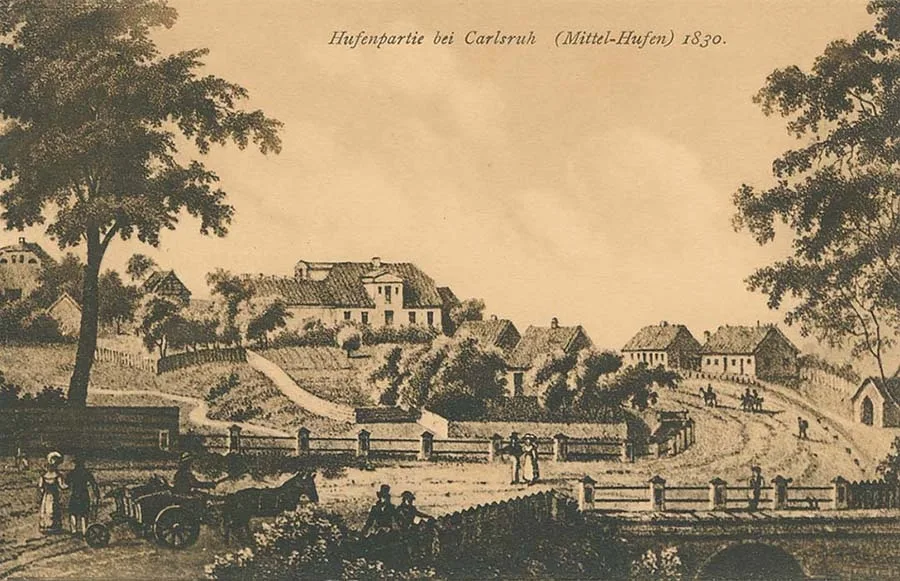 The landscape by the bridge over the Hufen Gorge in 1830.
Of Königsberg at the time of the first Russian occupation (1758–1762), Stavenhagen (Kurt Stavenhagen, 1885–1951) writes as follows3:
“…one could see young ladies who until then had not even been allowed to appear at the window or in the street sans cortège4 of an older companion. Now they raced along in sleighs to the jingling of bells, flirting recklessly with the gentlemen they met. They whirled along the Steindamm, now up towards Huben, now back down.”
In Hippel's day many well-to-do Königsbergers acquired estates of their own “on the Huben”. It was probably just such romantic rides on horseback that made the area a popular summer retreat. People did not travel to Italy or Egypt in those days, but contented themselves with a modest country house “not far from the city gates”.
The owners of such houses could only be envied, and Hippel's plank road became an important part of the life of Königsberg's beau monde.
There was so much mud on the carriage road leading to Hufen at that time that Goethe's old friend, the master mason and director of the Singakademie Carl Friedrich Zelter (1758–1832)5, reported in a letter of 5 August 1809:
“The King's outing on his birthday went badly. The weather and the road were indecently bad. On the way back the carriage carrying the royal children toppled over in the dark of night right in front of Queen Louise's Cottage. The King lit his lantern to inspect the damage himself and almost at once slipped and fell into the mud. Fortunately, no one was hurt...”
On 8 August Zelter, together with Hufeland (Christoph Wilhelm Hufeland, 1762–1836)6, visited the King and Queen at the Huben estate, and they sent their greetings to Berlin with their guests: “Our conversation took place in a tent in front of the house.”
The plank road (Bohlenweg), which apparently reached only as far as the bridge over the Freigraben gorge (Freigrabenschlucht), had by 1804 “almost completely rotted away and will soon be unusable” (L. Baczko). Later it was maintained by the so-called “Plank Road Association” (Bohlenwegverein), afterwards renamed the “Dr. Kessel Beautification Society” (Dr. Kesselsche Verschönerungsverein), which until 1900 did a great deal to modernise Königsberg.
 Mittelhuben, Luisenwahl and Hippel's Garden on the city map of 1815.
 The “Legan” and “Sprechan” taverns, as well as the “Konradshof” etablissement, on the same map of 1815.
Meanwhile more and more of the Hufen farmsteads eventually became villas of Königsberg residents.
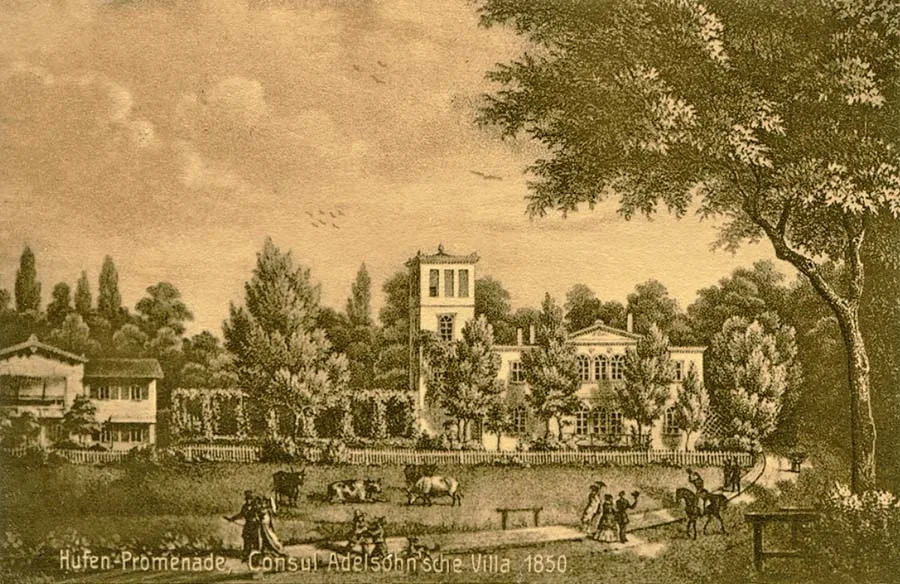 The Hufen villa of Consul Adelson in 1850.
Faber (Karl Peter Andreas Faber, 1773–1853)7 wrote in 1840:
“On 17 March 1826 seven houses and barns burned down, some of which belonged to residents of Königsberg as country estates; two people died and several were injured.”
The furthest point of this first villa colony was at first the former Pojenter farm (Pojenters Hof), today's Luisenwahl. Beyond it lay open fields stretching as far as the Douglas family's estate of Amalienau.
In 1829 a paved highway half a mile long was built to Lawsken. The royal treasury granted a substantial subsidy – perhaps Frederick William III, remembering that ill-fated night, understood better than many the need for a decent road. Among the people it was known as the “Legan” (Faber); later the name passed to a local establishment which the blind Professor von Baczko (Ludwig Adolph Franz Josef von Baczko, 1756–1823)8 already mentioned in 1804 in his history of Königsberg. A similar one in Vorderhufen was called “Sprechan”. However, this highway in Mittelhufen was by no means the Hufenallee we remember, once the plank-covered Main Street (Haupt Straße). Rather, what was modernised at the King's expense back then was the Old Pillau Road (Alte Pillauer Landstrasse).
Hufenallee was only improved after King William I granted the city the royal estate of Luisenwahl.
As a result, Queen Louise's Cottage with its magnificent hornbeams was mercilessly cut off from the park. This probably happened in the 1860s. I have not been able to determine the year more precisely. Officially the estate was handed over to the city only in April 1914.
Let us travel back to 1891 and take a Sunday walk from the Steindamm Gate (Steindammer Tor) through Hufen. (By then the letter “b” had already changed to “f”.)
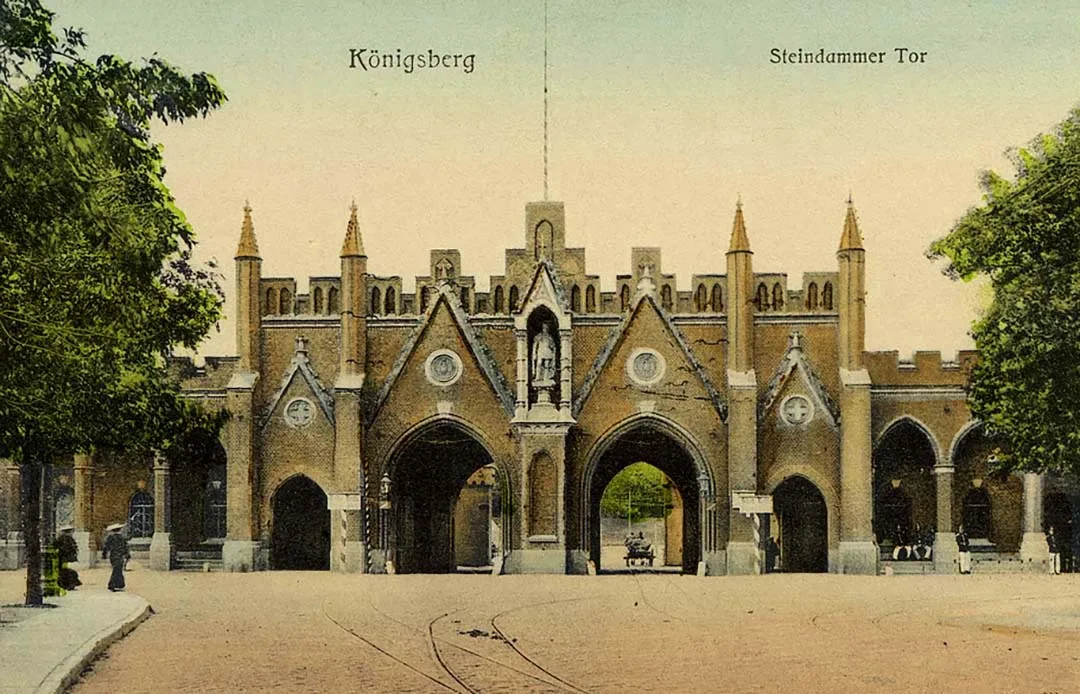
We are standing by the building that would later become the University Institute of Hygiene (Hygienisches Universitätsinstitut) on the Steindamm. Opposite, where the hotel “Zum Winkel am Tore” (“At the Corner by the Gate”) appeared after the First World War, there once stood the old Steindamm Gate of the Baroque fortifications of 1626–1634. In 1891, from this corner, around which uhlans, cuirassiers and hussars in bright, colourful dress uniforms would ride out from time to time, a young ash avenue led north past the brick building of the farriery school (Lehrschmiede; after 1919 the building was occupied by the Statistical Office), along the northern side of the Drum Square (Trommelplatz / Exercier Platz) to the Steindamm Gate of the third fortification of 1840.
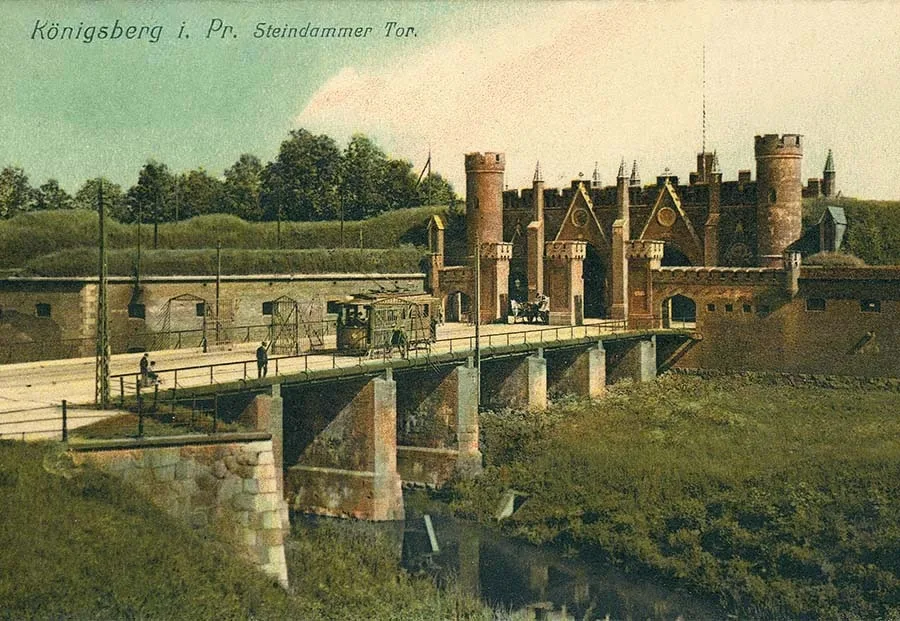 The Steindamm Gate. View across the bridge from the outer side.
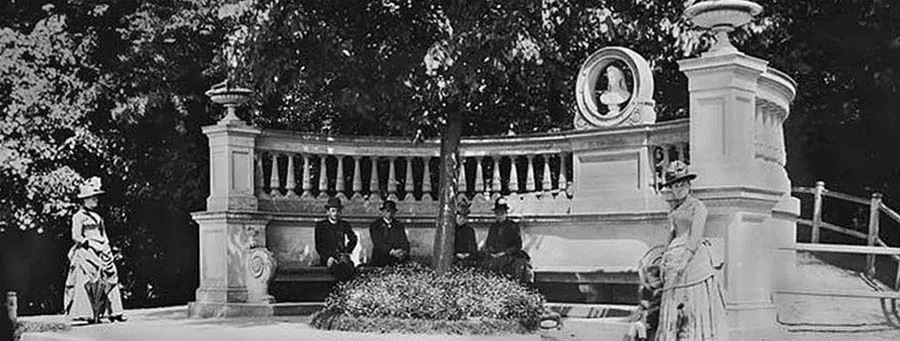
On the right was a small ornamental square with a grey stone Polyhymnia – one of the nine Muses, patroness of solemn hymns and the art of oratory.
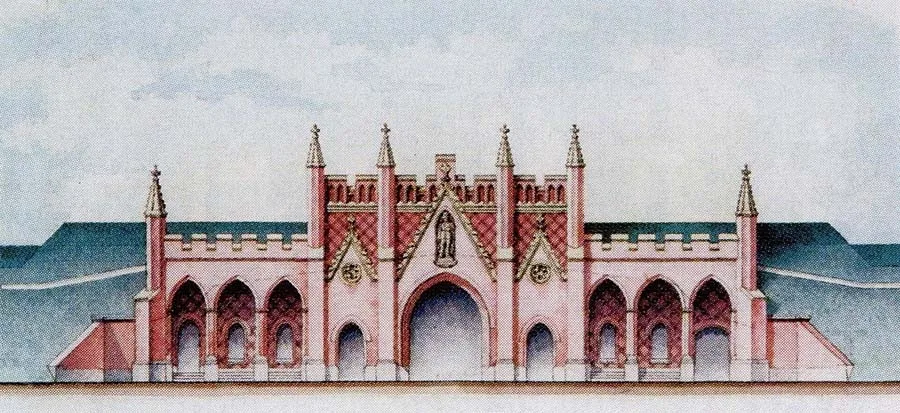
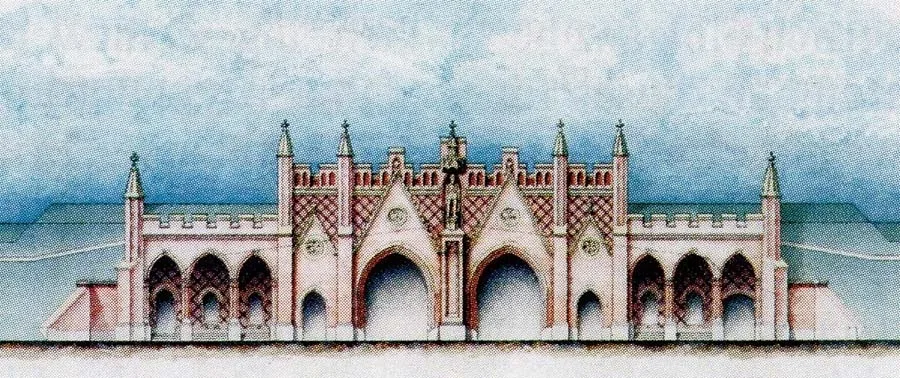 Both versions of the Steindamm Gate – with one passage and with two.
This square was in harmony with the “Little Green House” (grünes Häuschen). Then one passed through the echoing Steindamm Gate, which originally had only one carriage passage; only from 1879 were there two.
The bridge over the moat (Wallgrabenbrücke) beyond the gate, built in the 1850s, was originally a drawbridge, but by 1891 it had lost this function. Instead, an iron fence with gates had appeared on it. Mittelhufen Street, along which the horse-tram route then ran, led westward through them. Beyond the gate began the Fuchsberg Highway (Fuchsberger Chaussee), running north to the Fuchsberg estate and on into Samland; later it was called Fuchsberger Allee, then Stresemannstraße and finally Litzmannstraße.
Where the Old Pillau Road branched off westward from the Fuchsberg Highway, on the site of the courthouse built in 1912–13, there stood a large round wooden circus building.
Further north, behind it, along the Fuchsberg Highway, were the stables of the Königsberg Horse Racing Club (Königsberger Pferderennverein), whose racecourse was first in Metgethen and later in Carolinenhof.
Touring circus companies performed in the circus, and once even the famous “Barnum and Bailey” gave a show there. In 1901 the circus did not shrink from showing at the end of its performances, as a special novelty, films of “great length” – about 5–7 minutes!
West of the circus lay the fairground with merry-go-rounds, Russian swings, shooting galleries and amusements. Pedestrians walking towards it from the gate turned onto a path almost immediately after the bridge over the moat, to cut off the bend in the street. Beyond the fairground the path, which later became Brahmsstraße, led north along the Citizens' Gardens (Bürgergärten) – the first garden allotments of Königsberg residents – to the Hufen Gorge, where there was a tavern. From 1900 its owner began lighting the road here after dark with blazing torches on tall poles – a picturesque sight that stood out romantically against the meagre gas lighting.
In 1891 one could already see the “Panorama” building under construction taking shape. It opened its doors to visitors that same year. Admission cost just one mark. Inside, a gigantic circular painting was displayed, partly painted on canvas and supplemented by installations. These were tropical landscapes and battle scenes.
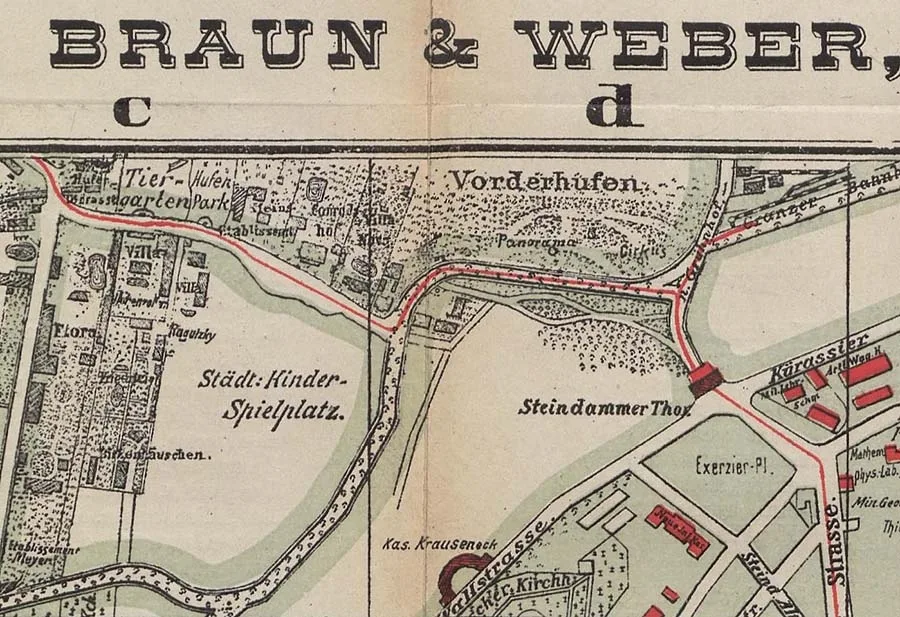 A map from “Braun and Weber's Guide” – one of the few on which the “Panorama” was marked.
The pictures were of no great artistic value, but they stirred the imagination of the not overly sophisticated people of the time.
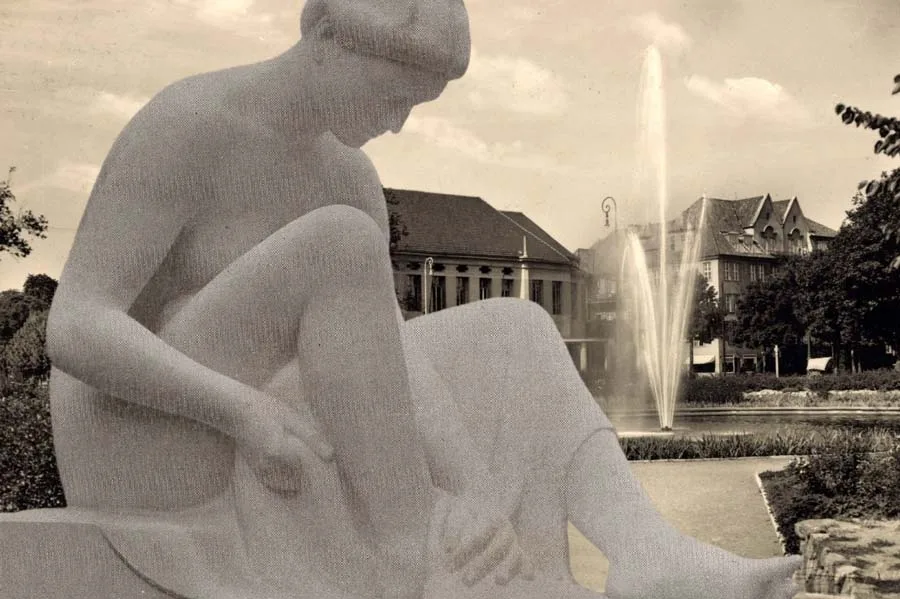 “Nymph after Bathing” by Stanislaus Cauer adorned the square by the Luisentheater in the 20th century.
The paintings were renewed every year and aroused universal admiration – all the more so as this fashion spread to all the big cities. A similar panorama, depicting the Battle of Bergisel9, can still be seen in Innsbruck today.
From the “Panorama” one could go out onto the glacis, where fairly dense trees prevented grass and undergrowth from growing. From it there was a view of the moat and the grass-covered city fortifications. Descending to the fork where the Old Pillau Road branched south off Mittelhufen Street, you saw a beautiful garden with a rockery and a fountain, inviting travellers to rest and refresh themselves.
Until 1850, when the glacis was formed here, its site was occupied by the summer house of Georg Friedrich Schwinck (1702–1756), a respected Königsberg merchant and son-in-law of the banker Jacobi, where Kant was a frequent visitor. In olden days the Altstadt forester10 lived here, since the Caporn Heath woodland began right by the city walls. And where in the mid-20th century the “Bather” by Cauer (Stanislaus Cauer, 1867–1943) could be seen amid the greenery, in 1891 Königsberg residents beheld the little house of the toll collector who levied tolls on passing carts.
At this point the road forked: the Old Pillau Road ran further south along the city ramparts to the new cemeteries, while Mittelhufen Street led west to Luisenwahl.
In the triangle between them the wind rippled over the golden ears of a wide field of rye.
An engraving of this spot has survived. It dates from 1860. Along the field runs the plank road, on which Königsberg residents in their Sunday best are strolling. All the gentlemen wear top hats, the ladies crinolines and carry little parasols. Along the somewhat rutted road roll phaetons drawn by pairs of horses, each carrying a smart gentleman and a beautifully dressed lady. On the northern side no footpath can be seen, only a row of old trees along a roadside ditch crossed by small footbridges. A carriage is heading over one such bridge into one of the parks, all of which are evidently privately owned. In the background a handsome building can be seen. Its projecting central section has curved arched windows and a pointed roof; next to it rises a lookout tower. The building faces the extensive rye field. Further to the left another villa is visible.
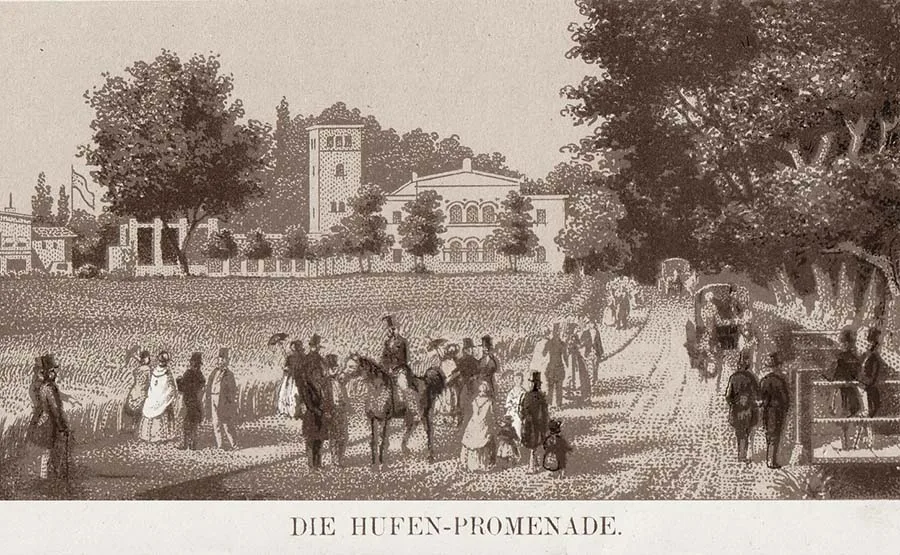
The whole scene makes a very refined impression. The building before us is undoubtedly the “Villa Bella”, and on the left is the “Villa Fridericia”.
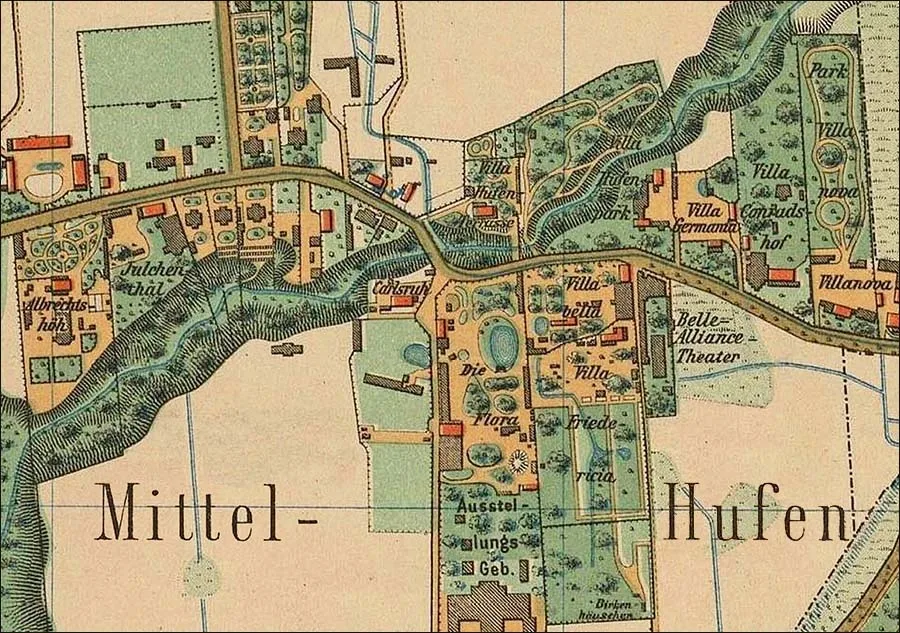 The villas of Mittelhufen on the well-known 1895 map of Königsberg.
We shall visit them during our “walk in 1891”. Where the theatre building stands today, in 1891 there stood the then still new “Villa Kurowski” – a handsome mansion with arched windows. It was located on the grounds of the “Konradshof” park estate.
Already in 1804 Baczko mentioned the “Konradshof” as a place of recreation for Königsberg residents. It was the oldest of the coffee houses with dance halls that were built in Hufen in the last quarter of the 19th century, right next to one another.
In time the well-to-do residents of Königsberg gave up their villas here and moved further from the city, to quiet and elegant Neuhäuser near Pillau, which lay not far from the railway. Others took a liking to Cranz, which was easy to reach by train. (The Pillau railway opened in 1865, the line to Cranz in 1883.) The seaside resorts were beginning to flourish, and the standard of living was rising.
Königsberg innkeepers, for their part, seeing excellent business opportunities, bought up the Hufen villas abandoned by the local beau monde. That all these buildings were wooden and easily dismantled, and moreover were to become strongpoints of the city's defence in the event of war, did not trouble them. They were counting on long years of peace.
As a result, the villa colony in Mittelhufen quite quickly became a “city of etablissements” (Etablissementstadt, where Etablissement is French for establishment and Stadt is German for city).
The reverse process in the case of the “Villa Kurowski”, being an exception, only proved the general rule. In all the beautiful, large, shady gardens of these “establishments”, signs on the trees read: “Families may brew coffee.” And the residents of Königsberg, dressing up on Sundays in their best suits and dresses, gladly made use of this opportunity right into the 20th century. For just a few pfennigs one could get large pots of boiling water. Thoughtful housewives took tins of ground coffee out of their baskets, brewed it and opened the packets of cakes they had also brought with them. All around this feast reigned general merriment and sunny summer languor.
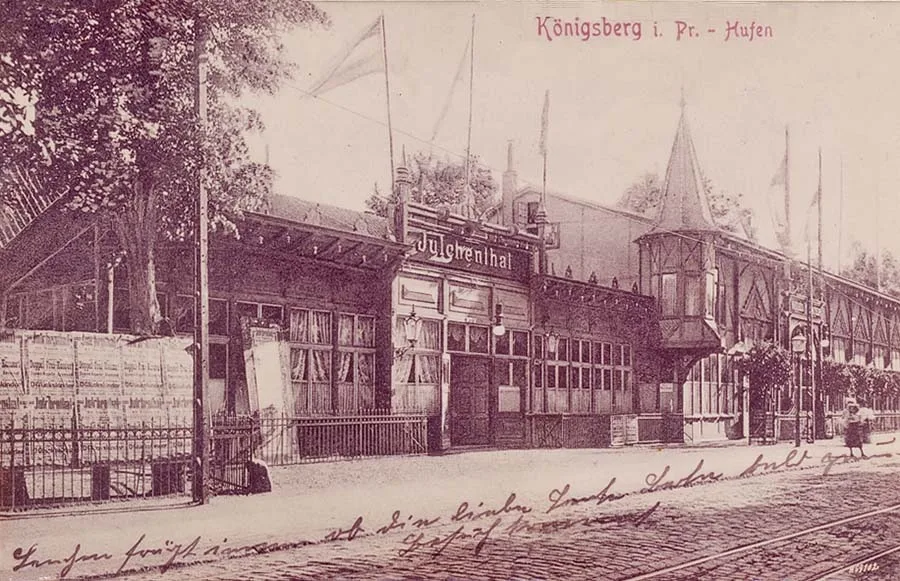 The “Julchenthal” etablissement on Hufenallee.
Having eaten their fill, the young people frolicked on the green lawns. There was space enough! The “Konradshof” park, for example, stretched all the way to the Hufen Gorge.
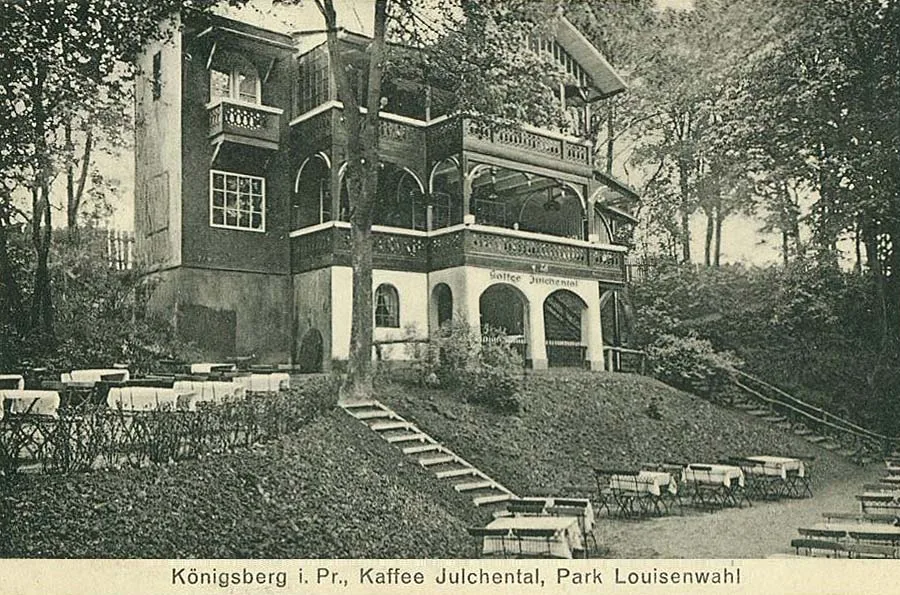 Café “Julchenthal” in the ravine of the Hufen Brook.
In the evenings there was dancing. Young shop girls and housemaids whirled with students and milkmen in waltzes and rheinländers11, polkas and galops. Each “round of dancing” cost a Dittchen12. Adjoining the “Konradshof” was the “Park-Villa Nova” etablissement.
In front of this etablissement (establishment), built in the style of a villa, a lawn had been laid out by 1891 where a captive monkey entertained the children. The beautiful park, especially the areas along the ravine grandly called the “Hufen Gorge” (Hufenschlucht), had by then become overgrown, turning into a real paradise for children. The old trees on the much later “Bird Meadow” (Vogelweide) are remnants of that park. In the evenings the “Villa Nova” was a popular dance hall. Next came “Klein's Etablissement – Villa Hufenpark” (Kleins Etablissement Villa Hufenpark), and then the country estate of the wealthy banker Oppenheim (Martin Wilhelm Oppenheim, 1781–1863) with a magnificent garden reaching to the edge of the deep Hufen Gorge.
Oppenheim's villa, with its two splendid red wooden columns, served until 1945 as the headquarters of the zoo administration and the residence of its director.
Of course, a passer-by in the street in 1891 had not the slightest idea that on the grounds of the Oppenheim estate and the “Hufenpark”, with the addition of the still undeveloped banks of the Hufen Brook (Hufenfreigraben), five years later, on 21 May 1896, the Königsberg Zoological Society (Königsberger Tiergartenverein) would open one of the most beautiful zoos in Germany. Whether it included the land holdings of Mr Warschauer (Marcus Warschauer, 1777–1835), described by Faber in 1860 as “remarkable for their beautiful grounds”, and whether he was the previous owner of the Oppenheim estate, I have not been able to establish.
Beyond the bridge over the brook, on its northern right bank, stood the “Villa Hufenterrasse”, which also later became an etablissement (Etablissement Hufenterrasse). This small house, picturesquely situated high on the slope of the Hufen Gorge, had once been the residence of the pastor of the Tragheim church, Ehregott Andreas Christoph Wasianski (1755–1831), Kant's former secretary and one of his three biographers. Kant sometimes visited him here.
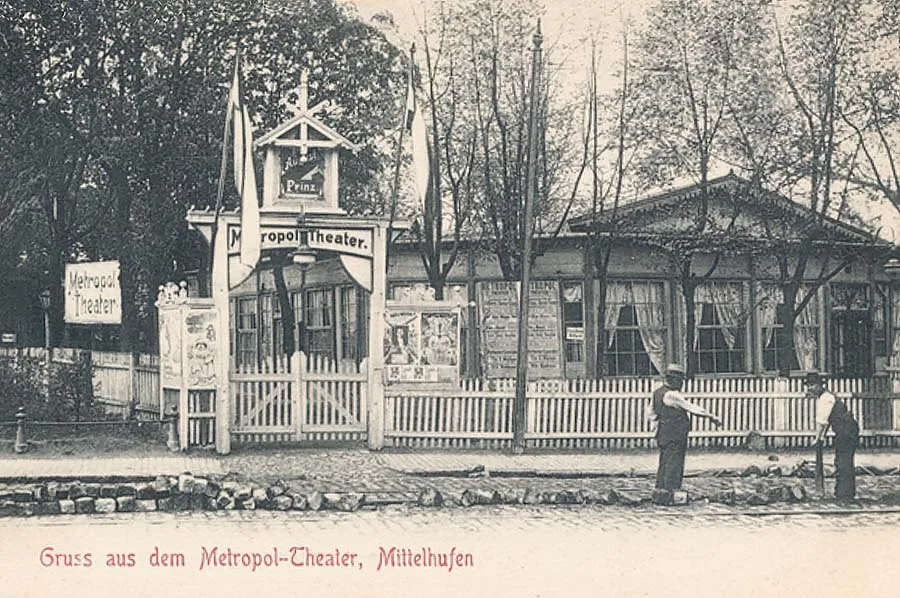 The “Metropol-Theater” in the days of the etablissements.
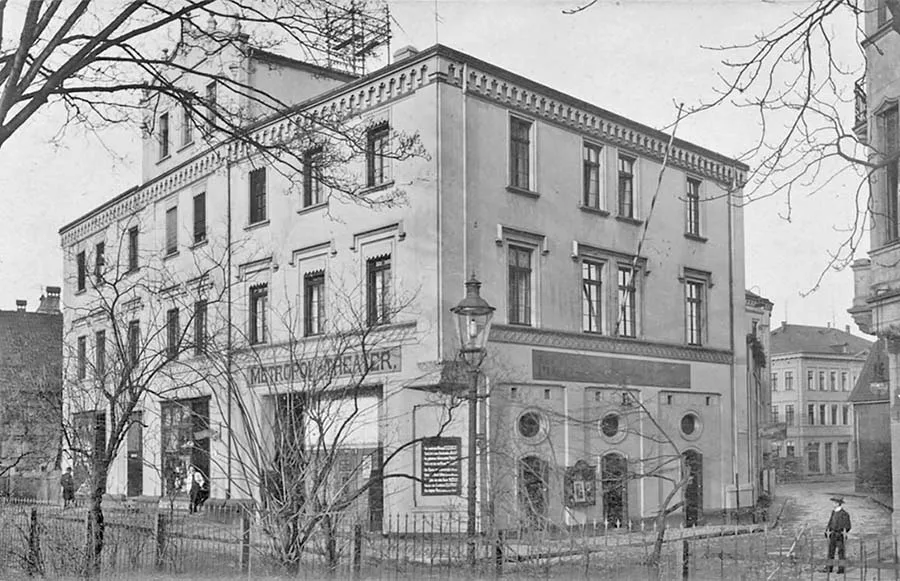 At the turn of the century the theatre moved and outwardly came to better match its “metropolitan” name.
By the time of our walk the “Villa Hufenterrasse” had long since become a venue for dance evenings, like all the others. A bridge and a staircase led to its grounds from Mittelhufen.
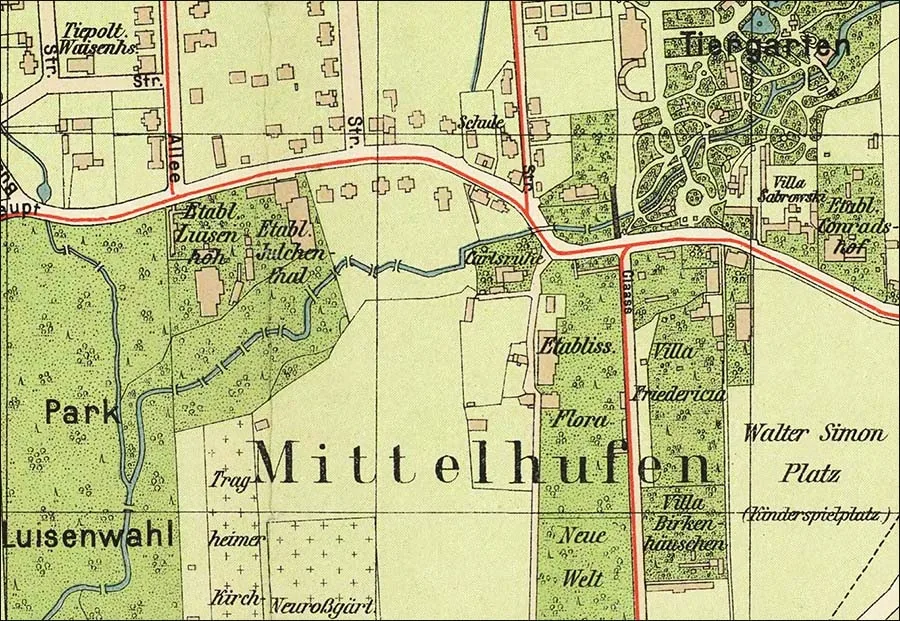 Etablissementstadt Mittelhufen with Luisenwahl and the Tiergarten on the 1901 map.
When on 1 April 1913 the little house was finally to be demolished to make way for the new building of the Hufen Gymnasium (Hufengymnasium), laid out further up the slope, the famous graphic artist Professor Wolff (Heinrich Wolff, 1875–1940) or, according to others, the professor of anatomy Zander (Richard Zander, 1855–1918), known for the wide range of his interests, proposed holding a so-called “artists' ball”13 in the style of a “rag ball”14 to mark the occasion. According to the local historian Matull, the chief organiser of the event was “Professor Ladislaus Klauer, keeper of the collection of plaster casts of classical sculptures and their fragments, honorary member of the League for the Struggle against General Stupidity, Corsets and the Smells of the Pregel”. The party was a success, attended by many members of the Academy of Arts and students of all faculties. It all ended only when the bricklayers arrived at six in the morning and almost immediately set about taking down the roof.
Beyond the bridge and the “Hufenterrasse”, in 1891 the road narrowed, made a slight turn and then rose gently westward.
However, to look at the southern side of Mittelhufen Street, let us return to the grain field rippling in the wind by the Steindamm Gate. At the time we had no idea that the city councillor and consul, later Privy Commercial Councillor Walter Simon (1857–1920)15, intended to buy most of it at a reasonable price, except for the edge along the Old Pillau Road, which ran east of the area he had chosen. And he, a true friend of youth, who far-sightedly supported the idea of physical education for young people at a time when sport in education was valued as little as classical languages are today, was nurturing far-reaching plans: he wanted to leave this land to his native city on condition that it would preserve his name for ever and be used exclusively as a sports ground and playground.
As early as 1892 this noble man carried out his plan. Generations of pupils from all schools played and did sports here – and were happy. At that time they still wore high, stiff collars with an “iron” tie and long trousers. On 5 February 1913, to mark the centenary of the liberation from French occupation, Walter-Simon-Platz was adorned with a monument to General Yorck (Johann David Ludwig Graf Yorck von Wartenburg, 1759–1830), sculpted by Walter Rosenberg (1882–1945)16.
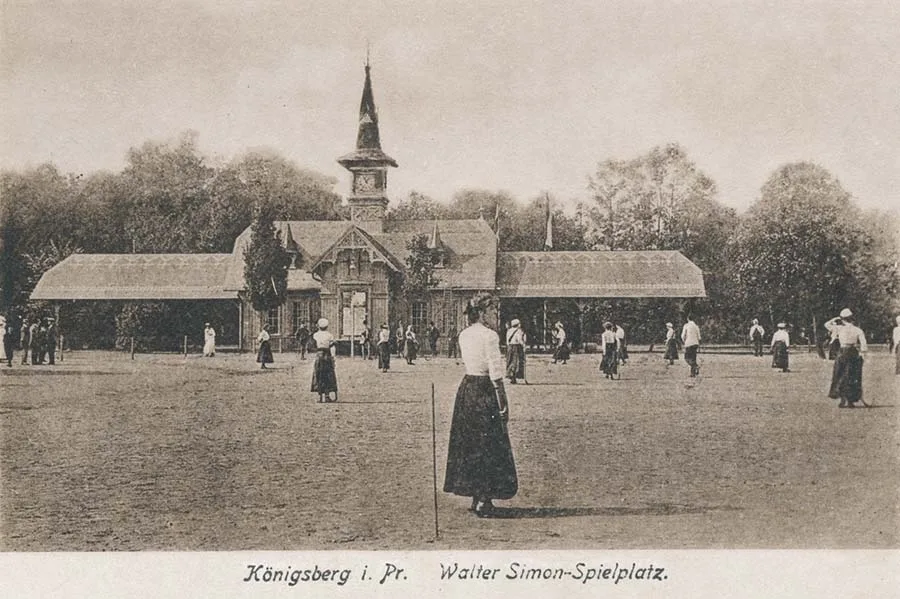 The clock tower on Walter-Simon-Platz, also built at WS's expense.
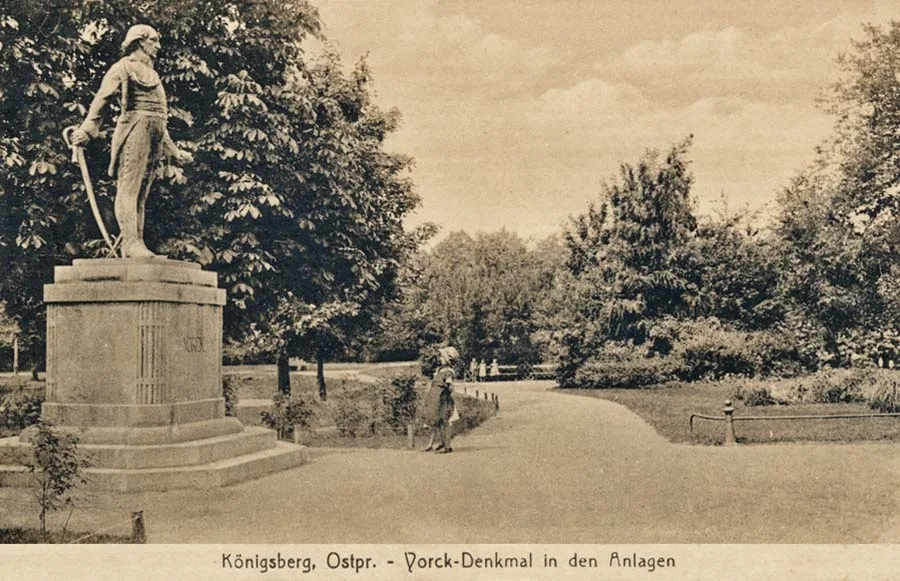 The monument to General Yorck on Walter-Simon-Platz.
The patron died in 1920, and just 13 years after his death his will was shamefully forgotten. The square bearing his name came to be used for Nazi marches and for displays of the new regime's arrogant self-assurance.
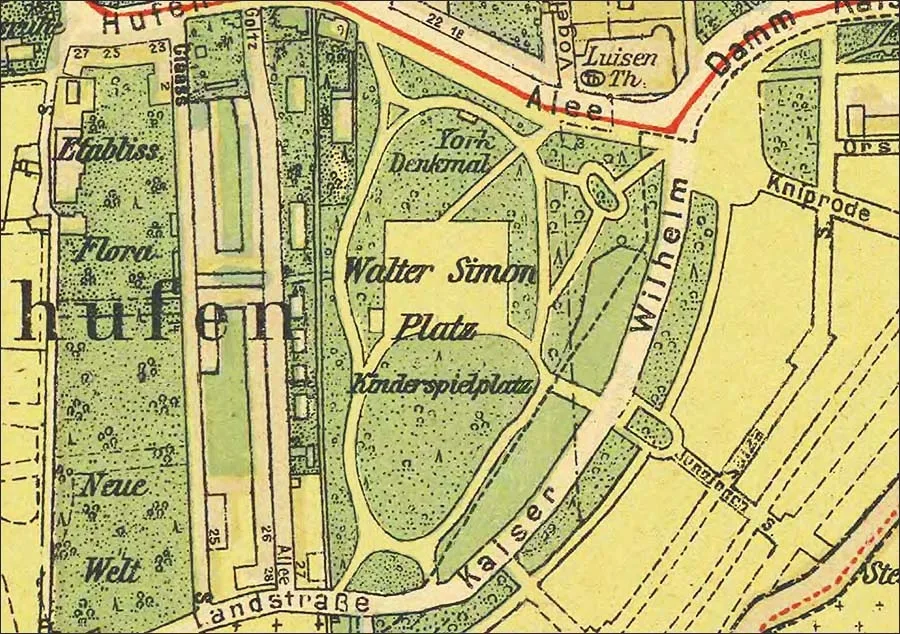 Walter-Simon-Platz on the map.
And yet, during our walk the wind is still rustling gently in the golden ears of grain as we approach “Ragutzki's Pleasure Establishment” (Vergnügungsetablissement von Ragutzki). This primitive wooden building was at one time grandly called the “Belle-Alliance-Theater”, later the “Metropol-Theater”. Variety shows and wrestling matches were held there. As far as I remember, at one time it bore the name of another of its owners, Krestinski. A narrow path leads us from it to the “Villa Fridericia”, whose garden reached as far as the Old Pillau Road.
North of the “Fridericia” stood the “Villa Bella”, familiar to us from the engraving described above. Not far from the “Bella” stood the “Villa Fortuna”. Later the “Villa Bella” gradually turned into the “Amende” patisserie, where we were all treated to coffee and cakes.
In 1891 there was no way through from this part of Mittelhufen to the road to Pillau and the cemeteries along it: Claaßstraße, named after Hermann Claaß (1846–1914), the son of a West Prussian country pastor, who started out as a dental technician and from 1895 to 1913 was the respected director of the Tiergarten (zoo) and a member of the city council, was laid out only in the twentieth century; Goltzallee in 1912, Hornstraße after the First World War.
West of the “Fortuna” lay the extensive grounds of the “Villa Flora” – the largest, most popular and even most prestigious place of entertainment of its time.
It had a large theatre hall where the Leipzig and Stettin choirs often performed, and later the Zillertal choir as well.
All the summer events of Königsberg's clubs and associations took place in the villa's large garden, including the parties of the Student Council and the Merchants' Association. The garden was laid out in the style of the time, with various ornamental flower beds, box hedges and other features, magically lit by the red and green Bengal lights then in fashion.
A particularly impressive spectacle was the imitation of Alpine glow. The lighting also included gas lamps, which the “Flora” had had from the very beginning. As late as 1930 the author saw the main building of the Tivoli Gardens in Copenhagen lit in this way. Nor should we forget the many different exhibitions and shows held at the “Flora”.
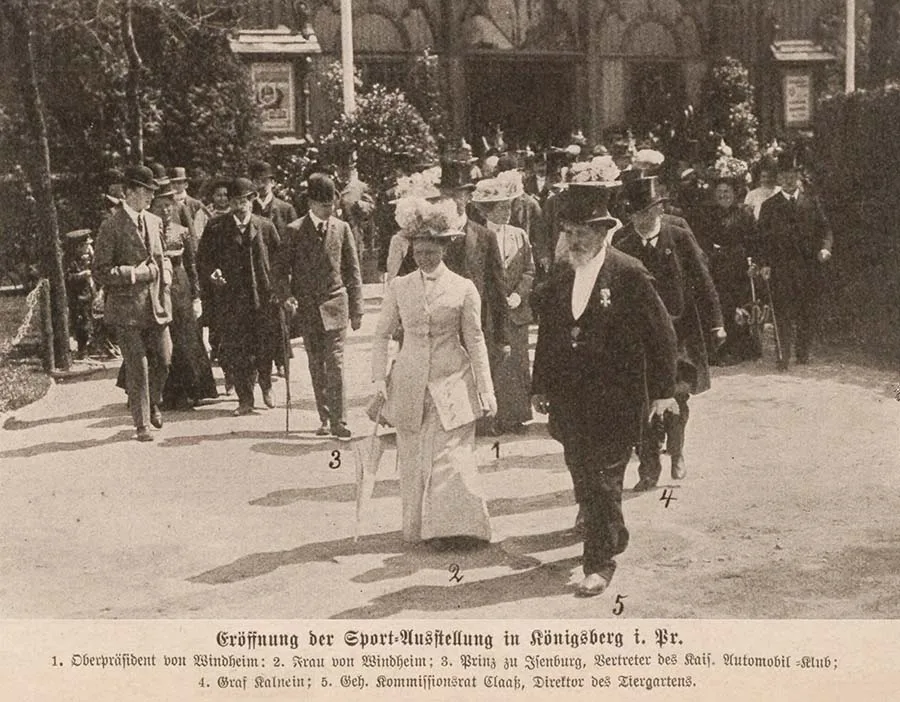 At the opening of an exhibition Tiergarten director Hermann Claaß (5) escorts the wife of the Oberpräsident, Frau von Windheim (2), followed by Herr von Windheim (1), the Prince of Isenburg (3) and Count Kalnein (4).
They faced considerable competition from the “human zoos”17 organised by the energetic director of the Königsberg Tiergarten.
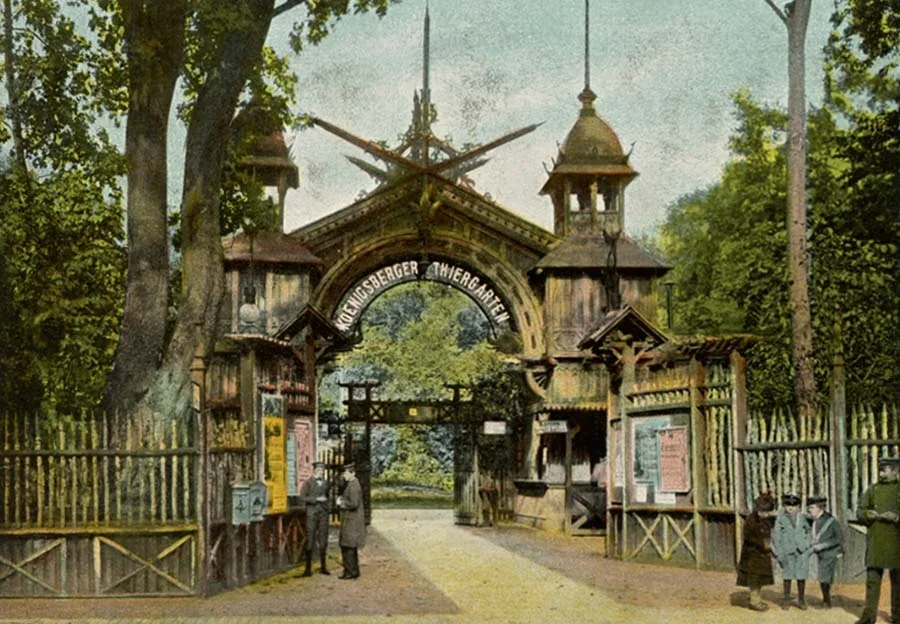 The entrance to the Tiergarten in Hermann Claaß's day.
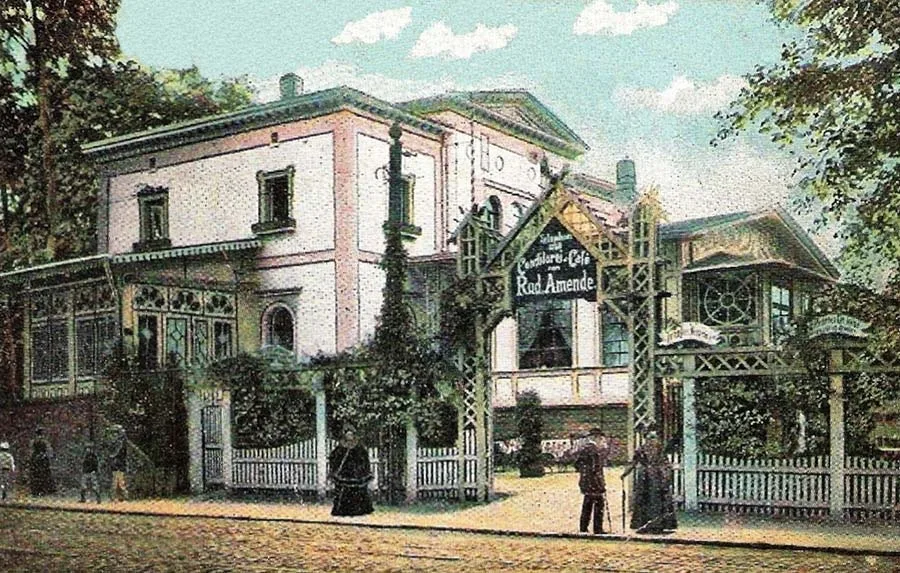 The “Amende” patisserie opposite the entrance to the Tiergarten.
Right before the bridge over the Freigraben (the brook flowing through the Hufen Gorge, today's Parkovy Stream), a footpath ran south along the fence of the “Flora” garden. In 1891 it was the only way to get from Mittelhufen towards the cemeteries. The furthest part of the “Flora” garden, facing the Old Pillau Road, was later acquired by the “Neue Welt” (“New World”) establishment, which existed until 1945. The “Flora” itself, completely dilapidated and long since squeezed by the widened Hufenallee, barely made ends meet until 1930. By then its entrance was from Hornstraße.
If we now – in 1891 – turn along this footpath towards the Pillau road and follow it back towards the city, at the end of the “Flora” garden we shall come upon the “Villa Fridericia” mentioned above.
It was a small, architecturally attractive villa where, in the evenings, dancing was again the main entertainment. In the daytime elderly gentlemen played cards there (skat and whist), while the younger generation admired the “wildlife park” which the enterprising innkeeper had opened here in that same year of 1891.
It was a real mini-menagerie: there was a deer and a tame brown bear of the kind often led around fairs by the animal trainers of the time, as well as a lame stork and a pelican.
A seal frolicked in a small pond. In neighbouring cages lived an angry fox and a wolf. There were several monkeys. A couple of years ago the newspaper “Ostpreußenblatt” told how one of these monkeys escaped and caused a real commotion, stripping the branches of fruit trees and getting up to all sorts of other mischief along the way. Only one resolute lady was found who managed to lure the runaway into a room with a cup of rice and lock her in. But even there the owner of the “wild park” had a hard time catching the little rascal.
Next to the “Villa Fridericia”, at the bend of the Old Pillau Road, opposite the grain field, was the “Birch Cottage” establishment (Etablissement Birkenhäuschen). The well-known East Prussian physician Arthur Kittel recalls it in his book “From Student Life in Königsberg 1858–1862”:
“In summer the student fraternities often took afternoon walks beyond the Steindamm Gate through the Hufen district, to the ‘Citizens' Gardens’, to the ‘Birch Cottages’ and ‘Hufen Terrace’ etablissements, singing rousing songs as they went.”
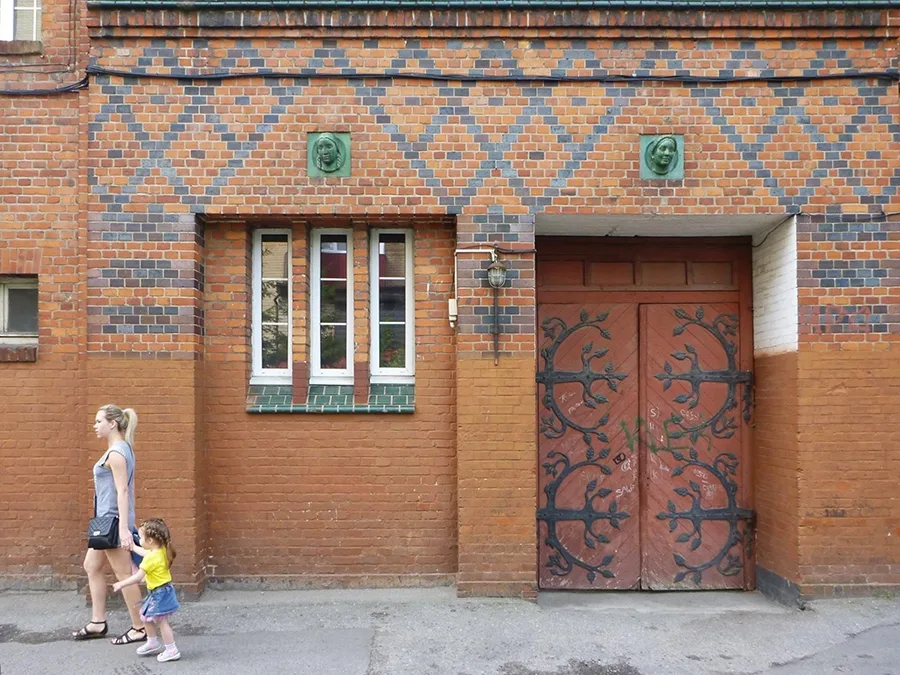 The Hufen Lyceum – formerly a private girls' high school, today Lyceum No. 18.
Incidentally, establishments such as the “Villa Nova”, the “Neue Welt” and others, as well as those built beyond the King's Gate in Kalthof, were popular duelling grounds.
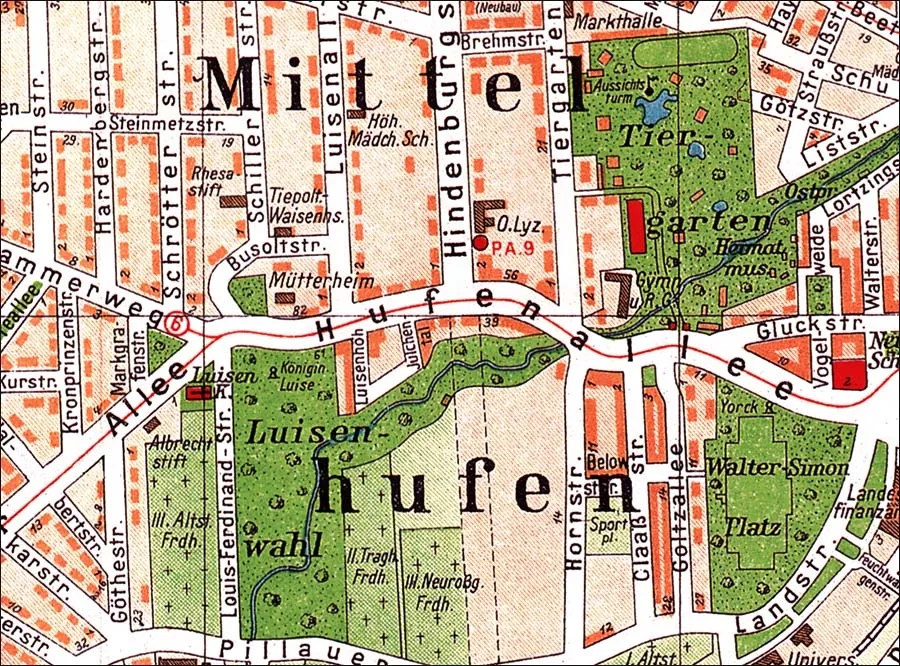 The 1928 map clearly shows that Luisenwahl and the Tiergarten formed a single green area. The passage from one part to the other ran along the brook under the bridge.
Let us now return to the bridge over the brook in Hufen. Right above the ravine on the left stood a small house romantically called “Dragon's Rock” (Drachenfels). During the Second World War it was used to hold French prisoners of war. Before that it was one of the best-known dance venues in Königsberg. In its large hall many of us whirled in dance with our sweethearts.
Once there had been a “Yellow Tavern” here, but as early as 1804 Baczko mentions on this spot an inn called “Karlsruhe”, built on a hill a little away from the brook, which probably later gave way to a new building – a country house called “Karlsruhe” that belonged to the Königsberg banker Adler, whose daughter Agnes was the grandmother of one of our famous poetesses…
Yes, we are speaking of Agnes Miegel, who received from the city an honorary rent-free flat on Hornstraße, which grew out of that narrow path along the garden of the “Flora” etablissement – from her windows the poetess could see the land that had belonged to her ancestors.
A picture from 1830 that I own shows, on the top of the hill a little away from the Hufen Brook, the country house “Karlsruhe” – a single-storey building with a pediment and one window. Right on the edge of the ravine, at the bottom of which the Freigraben flows, stands the little house of Dr. Heißrath; then the Hufen bridge; and one of the two houses on the right is the old school that still stands on Hufenallee.
When the era of the villas came to an end, an innkeeper turned Heißrath's little house into the “Dragon's Rock” etablissement – he undoubtedly chose the name because the house literally hung over the abyss. Military music was sometimes played there.
But we shall not see it on our walk: by 1891 it had been demolished, and in its place appeared the dance hall of the same name that we remember.
Having crossed the narrow bridge, immediately beyond which Tiergartenstraße (Zoo Street) was later laid out running north, the traveller would have seen a row of villas, one after another, on the right and on the left. The last of them, in the distance at the edge of the open field, opposite the Queen Louise Memorial Church consecrated in 1901 on Schrötterstraße, belonged to the cigar manufacturer Louis Großkopf (1830–1901), who had shops all over Königsberg, which made him one of the city's best-known residents.
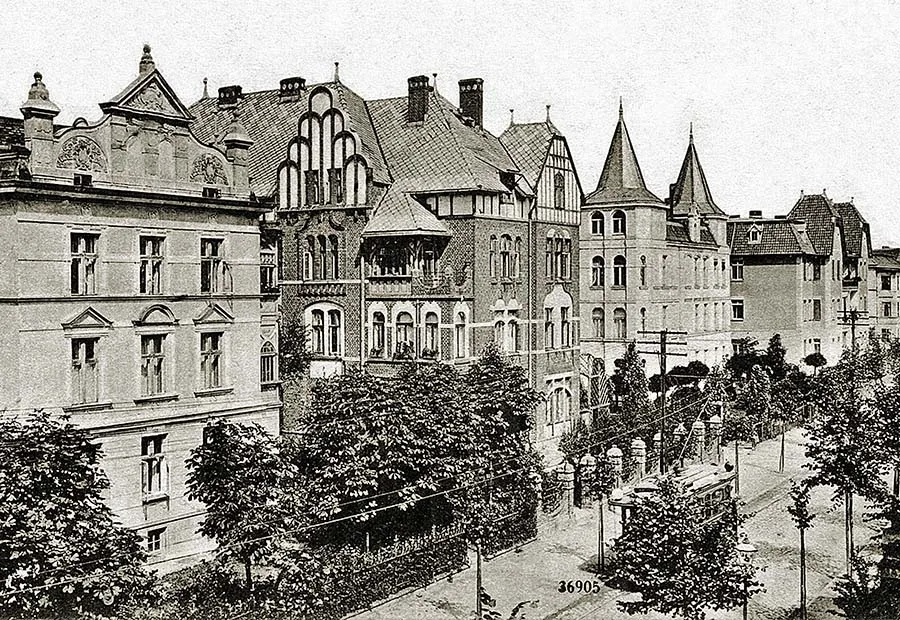 The façades of the houses on Tiergartenstraße face the Tiergarten.
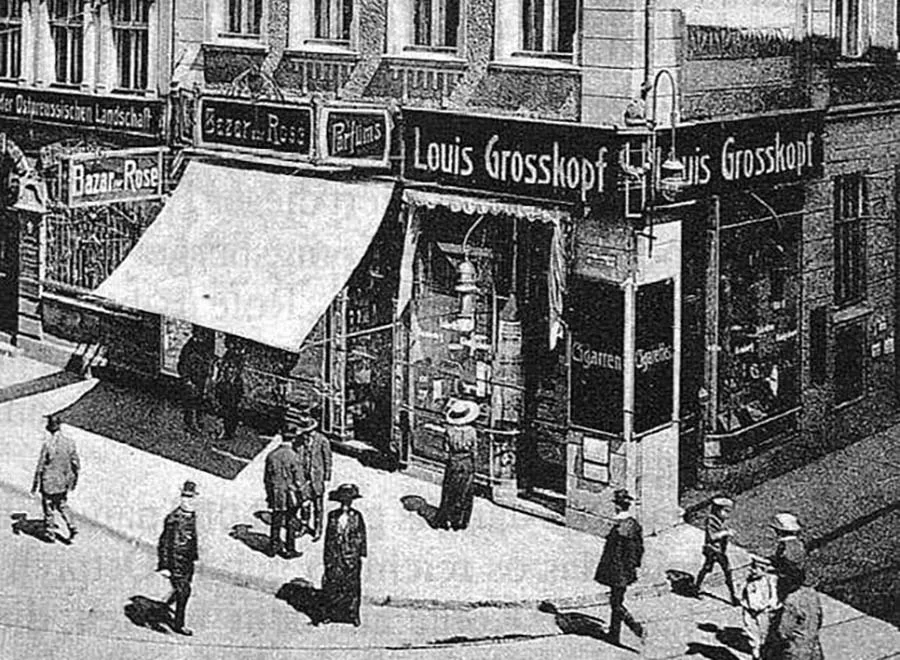 The “Louis Großkopf” shop at Kneiphöfsche Langgasse 45–47.
He came up with the idea of producing very cheap cigars for the working class at three and five pfennigs – at that time people in Germany did not yet smoke cigarettes.
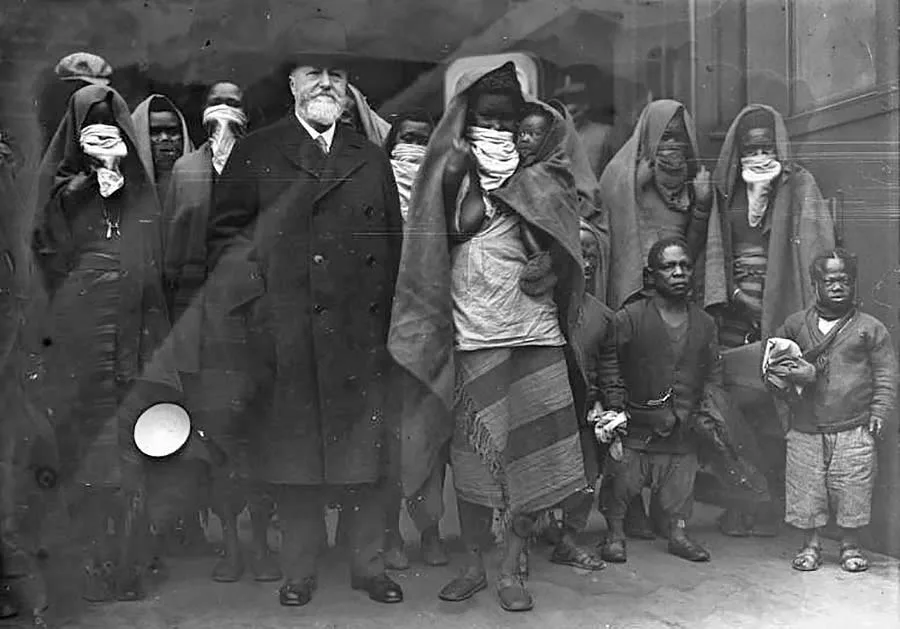 The director of the Berlin Zoological Garden Ludwig Heck with new “charges” for a “human zoo” in 1931.
This was a Russian monopoly, thanks to which Großkopf became very rich. His smug appearance evoked memories of Napoleonic arrogance, especially when he was seen sitting in the front row before the proscenium of the City Theatre. Although Großkopf died at the beginning of the 20th century, his villa continued to be popularly called the “Villa Großkopf” right up to 1945.
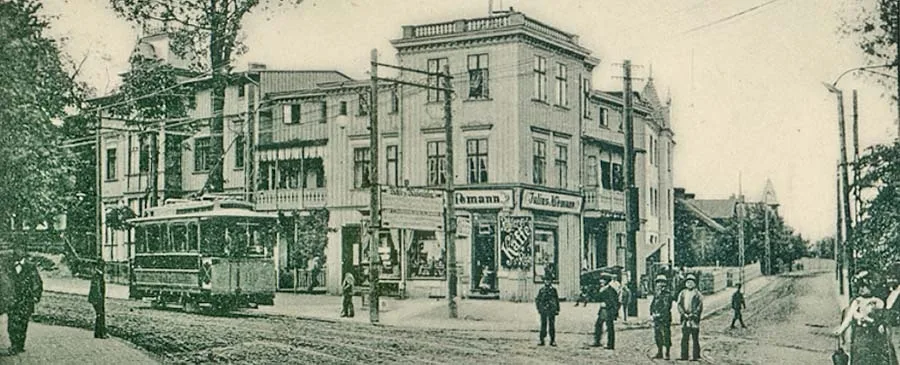
In this remote part of Hufenallee the private villas did not yield their positions to the newfangled etablissements; only opposite the points where Bahnstraße (Railway Street) and the later Luisenallee met Hufenallee did two popular establishments arise: “Julchenthal” and “Luisenhöh”.
In 1891 “Julchenthal” belonged to Franz Rußpauls, an innkeeper who had previously kept a dance hall in Vorderhufen, not far from the railway station of the Königsberg–Cranz line.
Now, at “Julchenthal”, with its deeply indented wooded ravine, he organised “human zoos” (Völkerschauen) and “fairy-tale” light installations in grottoes.
Remains of these grottoes were still visible in 1945. For countless generations of pre-school children they served as wonderful hiding places in games of “robbers and soldiers”18. When the bicentenary of the Royal Collegium Fridericianum was lavishly celebrated in August 1898, a solemn assembly of the teaching staff, students and their parents was held here.
Around 1900 a wooden house was built deep in the gorge which – as a sign of general sympathy for the Boers – was named “Zum Uncle Krüger” (“At Uncle Krüger's”)19. However, the Anglo-Boer War soon ended, and the house was boarded up and forgotten until 1913, when, after the landscaping of the Hufen Brook gorge, it was restored, brightly repainted and renamed “Café Julchenthal”. As we all remember, it was a delightful place with a well-kept garden where on hot summer days one could sit in the cool, enjoying coffee and cakes.
The main restaurant of the “Julchenthal” etablissement stood between Bahnstraße – much later renamed after Hindenburg – and Luisenallee, but on the opposite side of Hufenallee from them. And after 1900 this building, with a large glazed veranda that served as its porch and a huge hall running along the street, stood at the terminus of the white-and-blue tram line. Every day after lunch gentlemen from several clubs gathered here to drink coffee together, and around 1903 films also began to be shown here for the guests' evening entertainment. For in those days we were all – as with television today – hypnotised by the flickering screen.
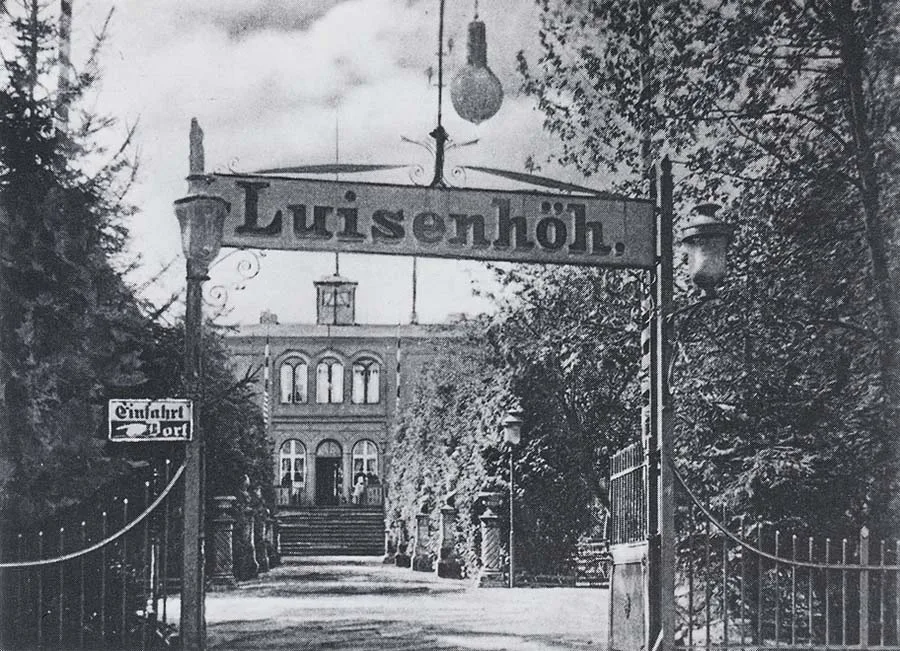
Next to “Julchenthal” was the “Luisenhöh” estate. Originally called “Albrechtshöh”, it too could boast a huge hall and had a well-equipped stage.
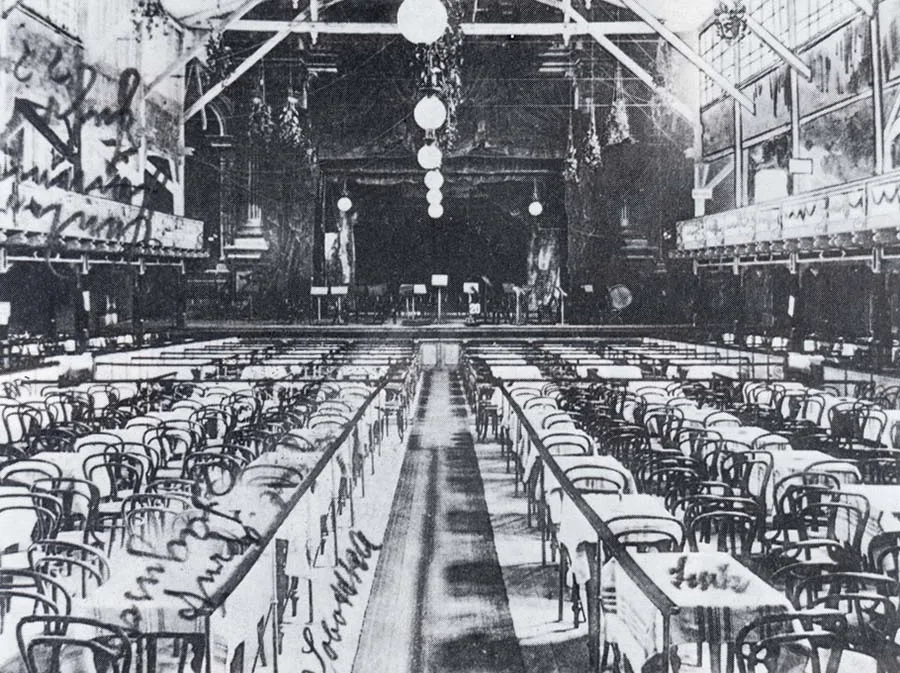
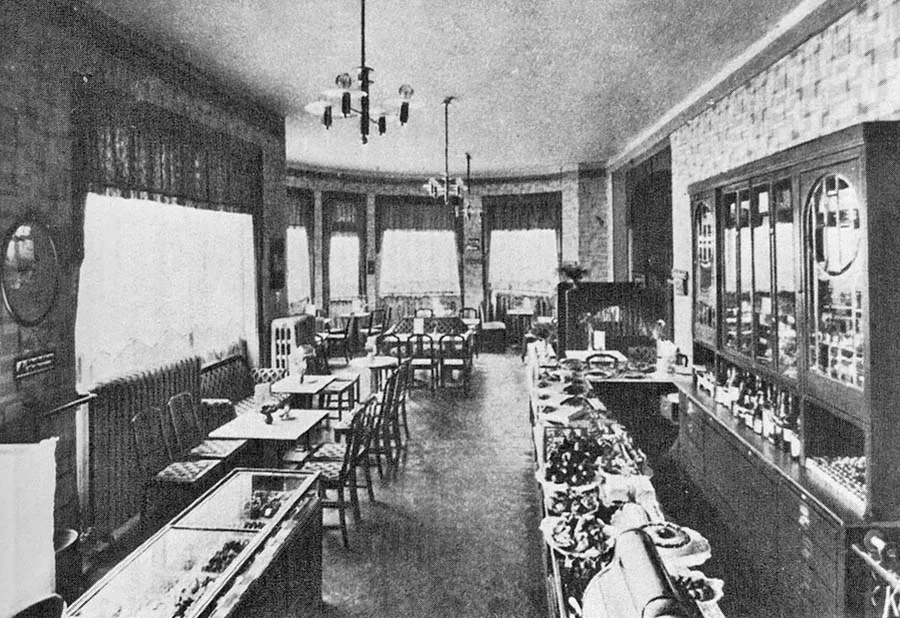 The “Luisenhöh” etablissement outside and inside.
The sign reading Luisenhöh looked impressive. Entering the grounds, you found yourself in a long passage lined with tall thujas, leading to a wide staircase and the hall itself – it all almost resembled princely palaces…
“And marble statues
stand and look at me…”20
Well, they were not exactly marble statues, but plaster busts of members of the Hohenzollern dynasty on tall, white-painted wooden pedestals, which stood out magically in the moonlight against the dark thujas.
All sorts of costume performances were constantly staged in the hall. The large stage was suitable for the most varied shows – dances, variety acts, tableaux vivants.
Around 1900, as a child, I saw a conjurer there who proudly called himself Ben Ali Bey, and he astonished me, for to a little boy his “magic” was something utterly extraordinary21.
If I am not mistaken, the former owner of the “Klein” establishment in the Hufen park, whose first name, I believe, was James, having sold it to the Tiergarten, now ran the “Luisenhöh”.
One thing is certain: after 1900 Martin Klein, presumably his son, opened an operetta here which enjoyed great popularity. The musical “Old Heidelberg”, for example, drew stormy applause at the final curtain, since it was almost as sentimental as the play itself. What is more, quite mature men appeared here as extras, and, in keeping with the latest theatrical fashion, the operetta had a breeches role22, which in those days still made every man's heart beat faster! Then came “The Merry Widow”, “The Dollar Princess”, “The Merry Peasant”, “Polish Economy”…
Summer theatres were also very popular at that time. One such existed, for example, in the old Riflemen's Guild House in Mitteltragheim. Actors, who were very poorly paid then and were on leave from mid-May to September, readily agreed to summer engagements at seaside resorts or anywhere else to earn some extra money – in engagements of this kind, for example.
The outstanding businessman Martin Klein earned so much on this operetta stage that, when the establishment on Hufenallee closed (at the same time as the city fortifications were demolished it was decided to build blocks of flats on the site), he was able to lease the “Luisentheater”, designed around 1910 by the Königsberg architect Walter Kuckuck (Otto Walter Kuckuck, 1871–1942), and for a long time continued to delight Königsbergers, creating one successful production after another on its stage.
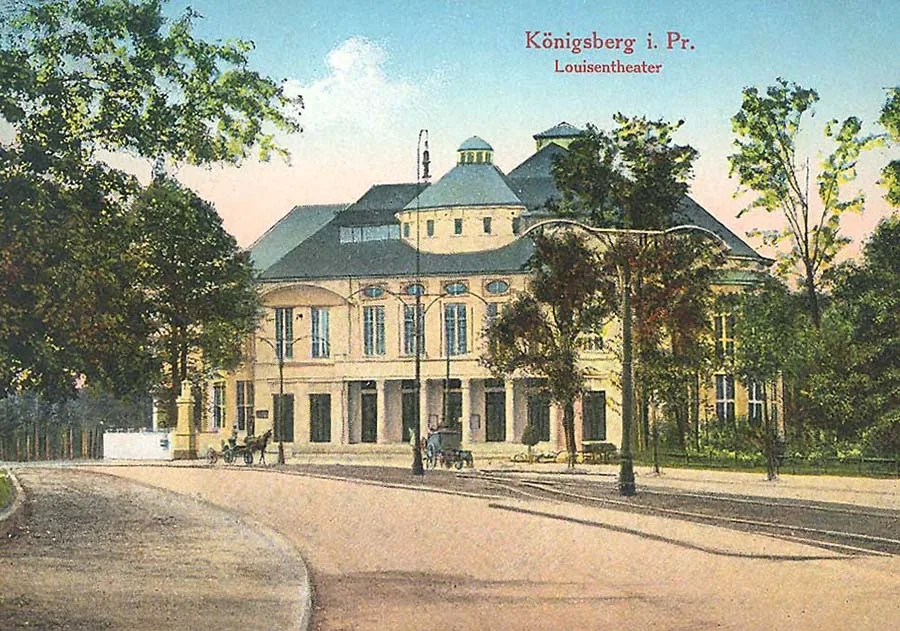 The Luisentheater in the first quarter of the 20th century.
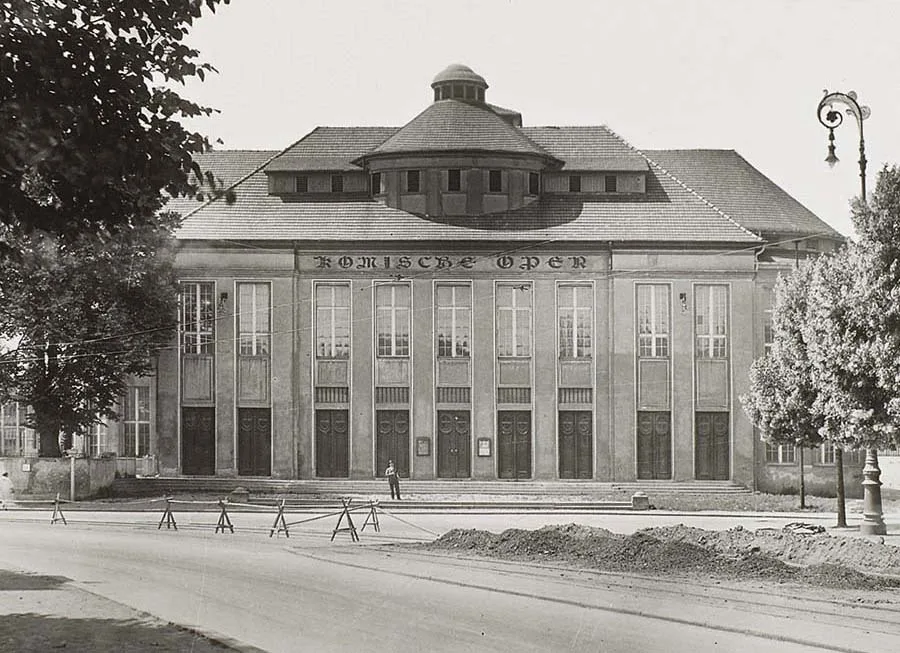 The Komische Oper in the 1940s.
After the fall of all the royal thrones and standards, the name “Luisentheater” was no longer considered appropriate, and it became the Komische Oper (Comic Opera).
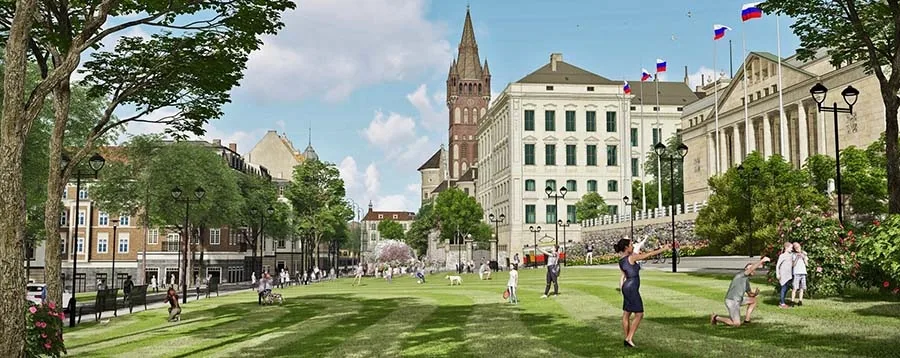
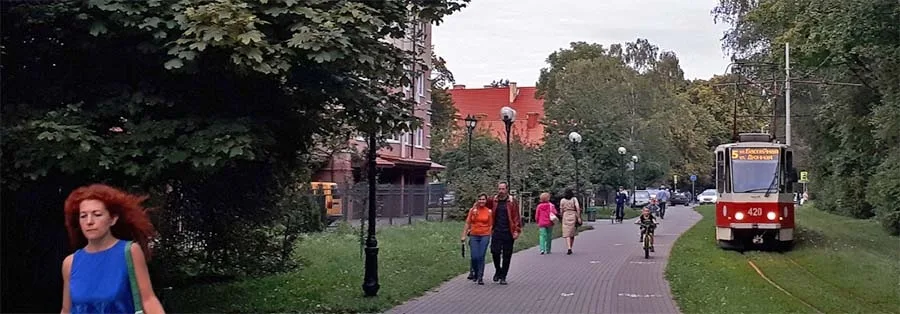
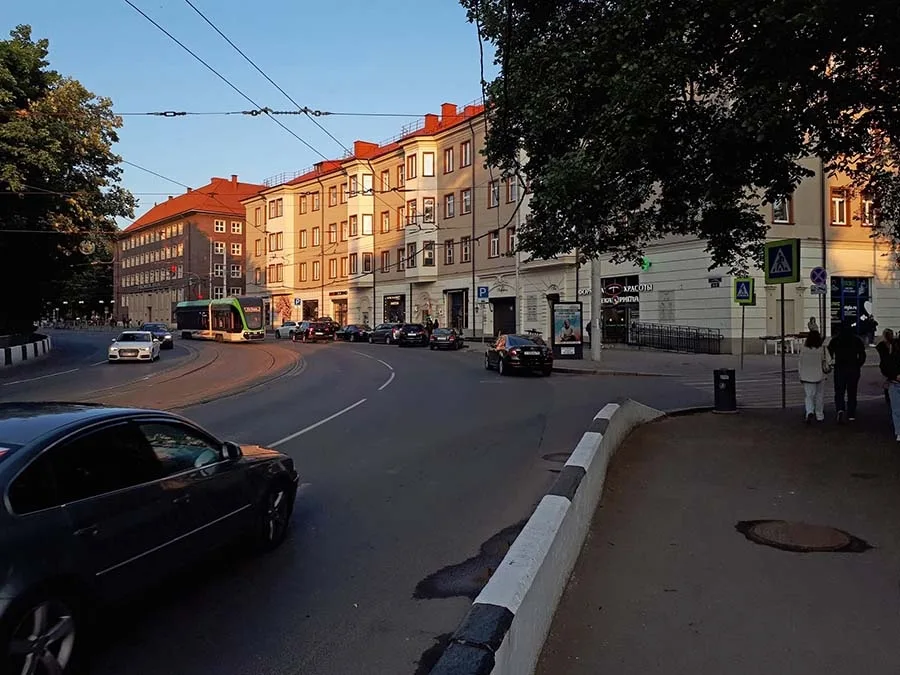 Hufenallee today – the Prospekt Mira everyone knows well.
But the old name “lived on among the people” for a long time. On 29 September 1927, after a reconstruction carried out by the Berlin architect Kaufmann (Oskar Kaufmann, 1873–1956), the “New Theatre” moved here from the Rossgarten Passage.
Yet anyone walking through the city with us in 1891 had no inkling of any of this, and if someone had foretold the fate of the Mittelhufen district that would unfold a little more than half a century later, he would probably have taken such a seer for a madman. But we, who had to witness the bitter truth, affirm, following our compatriot E.T.A. Hoffmann: “what really happens is almost always the most incredible thing of all.”
Translator's notes:
1. This refers to the work “Lebensläufe nach steigender Linie”, a famous satirical and psychological novel of the German Enlightenment, written and published anonymously by Theodor Gottlieb von Hippel. Its four volumes came out in 1778–1781.
2. Konrad von Thierberg the Younger – Landmeister of the Teutonic Order in Prussia in 1283–1288.
3. This refers to the historical and philosophical essay by the phenomenological philosopher Kurt Stavenhagen
“Kant und Königsberg”, first published by the Göttingen publisher “Deuerlich” in 1949.
4. “Without an escort”.
5. Carl Friedrich Zelter – composer and music teacher.
6. Christoph Wilhelm Hufeland – physician, educator, author of medical works, personal physician to the Prussian King Frederick William III.
7. Karl Peter Andreas Faber – a prominent Prussian historian, archivist and educator. He left a notable mark on the study of Prussian history with his work “Die Haupt- und Residenz-Stadt Königsberg in Preußen”.
8. Ludwig Franz Adolph Josef von Baczko – historian, writer, lecturer at the Albertina. He went blind at the age of 26 as a result of an accident. His main work is the six-volume “Geschichte Preußens”.
9. Mount Isel (Bergisel) – a historic hill and popular sight in the south of Innsbruck, Austria. Height: 746 m. A historical monument. The site of the decisive battles of the Tyrolean militia led by Andreas Hofer against Napoleon's troops in 1809.
10. A mounted forester was a patrolman or inspector who guarded woodland on horseback.
11. The rheinländer is a German folk dance – a couple dance from the Rhineland performed at a brisk, cheerful tempo with characteristic hopping steps.
12. Dittchen (Dittchen / 10-Pfennig-Stück) – a 10-pfennig coin.
13. The term “Artistenball” (artists' ball) usually refers to a famous cultural and charity event whose tradition goes back to the golden age of cabaret and circus in Germany (in particular to the historic International Artists' Ball in Berlin). Before the Second World War these balls brought together acrobats, dancers, musicians and other bohemians from all over the world in the atmosphere of a lavish costume carnival.
14. In the original “Lumpenball” (literally, a ball of rags) – a traditional German carnival-style party held at the end of the carnival season. Its main feature is that participants come in torn, worn-out clothes, since “all the money has already been spent on the previous ones”. This format, which appeared as early as the late 19th century, was distinguished by a relaxed, ironic atmosphere. Excessive pomposity was mocked. Instead of expensive costumes people wore rags and old or shabby outfits, and the decorations were deliberately simple.
15. Walter Simon – banker and patron of the arts. He came from a wealthy Jewish family and was the son of the Royal Prussian Privy Commercial Councillor Moritz Simon and his wife Hedwig Simon, née Hirschberg.
16. Walter Rosenberg (1882–1945) – a local sculptor and artist.
17. “Human zoo” (also known as an “ethnological exhibition” or “exhibition of people”) is a collective name for various forms of commercial display of indigenous peoples, called “savage” or “exotic”, in zoos and amusement parks, as well as at various exhibitions and fairs. Russian merchants were also engaged in such “zoos”, taking representatives of the indigenous peoples of the Far North on “tours” of Europe with all their belongings. The “charges” were well paid for this. Entertainment of this kind for the general public in Europe, the USA and Japan was practised from 1875 to the 1930s; isolated cases were recorded even after the Second World War. “Exhibitions of people” helped to cultivate in colonial societies pronounced racist and chauvinist ideas drawn from social Darwinism.
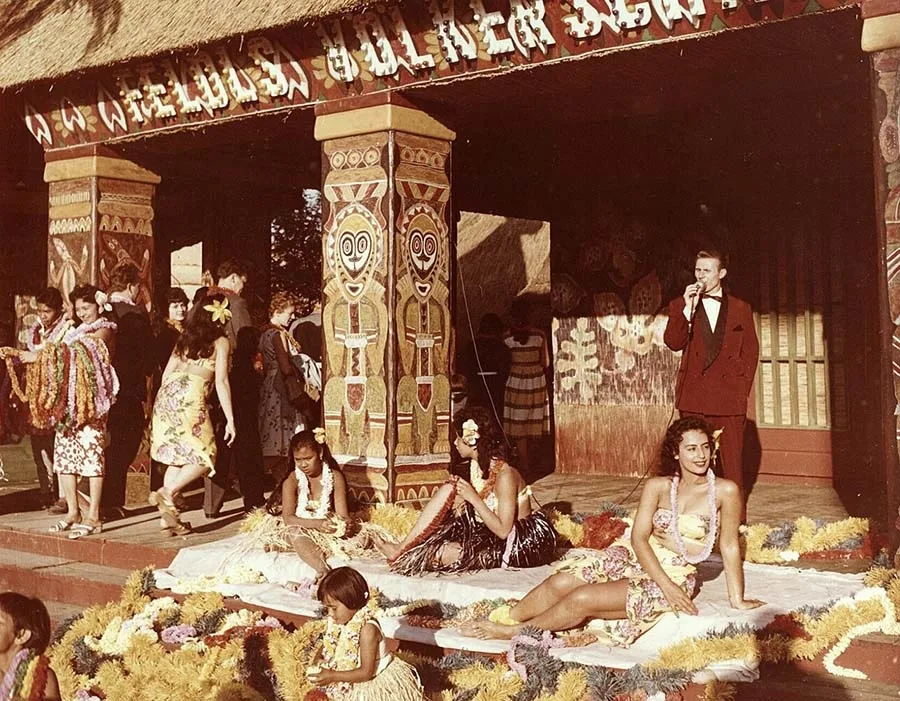 Hawaiian girls at the Munich Oktoberfest in 1959.
18. “Robbers and soldiers” is a classic outdoor hide-and-seek game. The participants split into two groups: the robbers are given a head start to hide, and the soldiers (or policemen) then search the area to catch them.
19. In 1941 the historical film “Uncle Krüger” (Ohm Krüger) was made in Germany. This large-scale biographical drama tells the story of the life of the South African politician Paul Krüger and his struggle against the British Empire during the Anglo-Boer Wars. The leading role was played by the outstanding German actor Emil Jannings (Emil Jannings, gebürtig Theodor Friedrich Emil Janenz, 1884–1950). It was one of a series of major Nazi German propaganda projects directed against Great Britain.
20. Lines from J. W. Goethe's poem “Mignon”:
«Und Marmorbilder
Stehn und sehn mich an»
21. Max Auzinger (1839–1928) was a German actor and illusionist who performed in the guise of the oriental character Ben Ali Bey. Auzinger is credited with inventing “black light theatre”. Around 1875 he discovered the principle by chance while watching an actor with a blackened face playing a scene in a dark dungeon. From the stage only the actor's white teeth and eyes could be seen. From 1913 to 1920 Auzinger appeared in many black-and-white silent films.
22. Breeches roles – actresses playing teenage boys.
Source:
Spaziergang durch Mittelhufen 1891
Von Meinhard Mühlpfordt
Ostpreußen-Warte Folge 02 vom Februar 1959
Ostpreußen-Warte Folge 03 vom März 1959
The editors once again thank the Bildarchiv Ostpreußen website for its colossal work in preserving the visual heritage of the region. Modern photos: ©Mikhail Ogorodnikov.
Translated from Russian with the help of AI (Claude, Anthropic), October 2026.