The Conquest of Prussia by the Teutonic Knights
The Fate of the Teutonic Order
Jacques de Vitry relates that “an honest and pious German, at God’s prompting, built in Jerusalem, where he lived with his wife, a hospital for his fellow countrymen.” This was in the year 1128. Had this honest and pious German, like the patriarch Jacob or many other historical and legendary figures, been granted a prophetic dream, an astonishing spectacle would have unfolded before his eyes. The hospital brethren, not content with tending the sick, take up arms and turn into the military Teutonic Order. The new order quickly catches up in growth with its elder companions, the Templars and the Hospitallers, and wins such favour with the Pope, the Emperor and various kings that it is granted privilege upon privilege and estate upon estate. Soon the castle of its Grand Master becomes one of the most magnificent palaces in Palestine. But suddenly the picture changes. His Teutons, in their white mantles with black crosses sewn on them, now fight not on the banks of the Jordan but on the banks of the Vistula, and not against the Saracen clad in white wool but against the Prussian covered in an animal hide. In this struggle they exterminate an entire people in order to create a new one in its place; they build towns, issue laws and govern incomparably better than any sovereign in the world. For a long time they flourish, until at last, weakened and pampered by wealth and good fortune, they fall victim to a simultaneous attack by their subjects and their enemies. Here the founder of the Jerusalem hospital would have seen a sad sight: these once so mighty knights become vassals of Poland. More than once they try to rise again, but all in vain; nothing can save them when the Reformation assails the old faith of the Middle Ages and begins to persecute the cult of the Virgin, whose armed servants they had been. Their Grand Master himself becomes a follower of Luther and turns into a hereditary duchy the land they had conquered from the Prussians for the glory of Christ and His Mother. Yet, by a strange play of fate, this usurpation opens a new era of good fortune before which all the past grows pale.
This Grand Master is a Hohenzollern by birth, and his heirs are his Brandenburg cousins, who are destined to turn the ducal crown of Prussia into a royal one and then to unite it with the imperial crown.
The kings of Prussia, having become German emperors, have not forgotten the origin of their power: the knightly eagle adorns their banners; and in 1872 William I, laying in Marienburg the foundation stone of a monument to Frederick II, listens with pleasure to a learned patriotic orator,* who sets out before his “most illustrious and most mighty Emperor, most gracious King and Lord” the whole course of this wondrous history that began in Jerusalem. A little later the Crown Prince of Prussia and Germany attended the unveiling of this monument: before him stood the statue of Frederick II and the statues of four Grand Masters who, placed on the sides of the pedestal, seem to bear this hero of Prussia aloft. The son of Emperor William has evidently followed with interest the search for monuments and documents relating to the history of the Teutonic Order now being conducted in the Holy Land. And that is understandable. Having reached the summit of good fortune, people readily turn their eyes to its cradle, and the cradle of the Prussian monarchy was, of course, that hospital founded by an unknown German, quadam Allemanus, as Jacques de Vitry puts it.
I shall set out here one period of this history, beginning with the establishment of the knights in Prussia and ending with the fall of the mighty state they founded**. It is an old story, played out in a remote corner of the world. But old stories should not be disdained: whoever looks down on them may easily overlook many important aspects of the greatest events of our own time.
* Mr Winter, Burgomaster of Danzig and member of the Reichstag. I take this opportunity to express here my warmest gratitude to him for the hospitality he showed me in Danzig, which he governs; while, as a historian, he respects the old monuments and saves them from destruction, he is at the same time an excellent administrator who sees to all the needs of a modern city. Winter invited me to travel with him to his estate at Gelens, not far from Thorn, that is, to the very places where the Teutons first established themselves. I owe a great deal to my host and guide, an excellent connoisseur of the ancient history of the country he showed me.
** I. Scriptores rerum Prussicarum, 5 vol., 1861–1874. II. Perlbach, Preussische Regesten bis zum Ausgange des dreizehnten Jahrhunderts, 1875–1876. III. A. L. Ewald, Die Eroberung Preussens durch die Deutschen, 1872–1875. IV. G. Freytag, Vom Mittelalter zur Neuzeit, 1867. V. Treitschke, Das Ordensland Preussen, 1871. VI. L. Winter, Festrede am Tage der westpreussischen Säcularfeer, 1872. VII. Toeppen, Historisch-comparative Geographie von Preussen, 1858. VIII. Lotar Weber, Preussen vor 500 Jahren, 1878.
Old Prussia. Travellers and Missionaries
The Prussians, exterminated in the 13th and 14th centuries by the Teutonic Knights, were a people of Lithuanian stock with an admixture of a Finnic element. They lived on the shore of the Baltic Sea between the Vistula and the Pregel, extending somewhat beyond these rivers. The position and nature of this country are such that its population could long live in complete tranquillity, apart from its neighbours. In the west the Vistula, which was then wider than it is now, flooded its delta every year and choked it with ice which, as summer came on, melted into a sea of mud. In the north, along the coast and at varying distances from it, stretch the nehrungs, that is, long narrow strips of land covered with shifting dunes that rise steeply to a height of 60–80 metres between the open sea and lagoons of almost fresh water called haffs. These are true bastions, and if one looks at the horizon from certain points on the shore, the ships appearing from behind the nehrungs seem like fantastic buildings erected on the tops of distant hills. Here and there these bastions are broken and give way to channels through which vessels pass; but these channels readily change their position — the sea keeps silting up some and digging out others. No seafarer would be drawn to such a coast! In the east Prussia is less sheltered; but neighbouring Lithuania was inhabited by a people akin to the Prussians, who professed the same religion and were their allies in the struggle against Western civilisation. To the south, towards Poland, the land is by no means as free of obstacles as is usually thought by those who picture the northern plain as perfectly flat. A long chain of heights, not very considerable, it is true, runs from Holstein through Mecklenburg, Pomerania and Prussia and, having crossed the whole of the European far-east, joins the Urals. Near the left bank of the Vistula these hills grow higher, and a traveller going from Berlin to Danzig sees before him, as he approaches the city, an uneven landscape where brooks take on the character of mountain torrents and in places even form waterfalls. The Turmberg, whose height reaches 330 metres, is quite a large and picturesque mountain. The lower hills of the right bank of the Vistula frame the Prussian land on the south. Especially characteristic of this region is its abundance of lakes: you meet them here at every step. These lakes are most often very small, but there are so many of them that there is hardly a spot from which the eye does not take in several. There are plenty of streams as well. And all this land, now completely bare, was in the old days densely covered with pine forest, which shielded the country against enemy invasions.
History explains even better than geography why the land of the Prussians remained so long apart from the world.
The Roman legions halted on the banks of the Elbe and then fell back to the Rhine. A more serious danger threatened Prussia from Charlemagne, for the Christian emperor, defender and servant of the apostolic and universal Church, intended to conquer the whole world and convert all the infidels. The army that gathered round him every year from every corner of the empire had its permanent outposts on the Elbe: these were the marches, military districts organised for offensive and defensive operations against the Slavic and Finnic population that occupied the east of Europe. But Charlemagne died without crossing the Elbe, and the wave that had risen menacingly over Prussia and all the eastern lands rolled back. Germany, it is true, remained Christian; but it was then far too occupied with its internal strife, which shook the whole empire and in the 9th century led to its break-up into three parts. In later times the emperors of the Holy Roman Empire of the German Nation did not think it worthy of themselves to continue Charlemagne’s enterprises against obscure little peoples, and the Prussians, separated from the Elbe by the whole breadth of the Oder basin, thus obtained a long reprieve.
At the end of the 9th century they were visited by a bold seafarer, Wulfstan of Schleswig. Setting out from the Schleswig settlement of Hedeby, Wulfstan sailed for seven days and seven nights to this land, then unknown to anyone. He relates that he saw many towns, each with its own king — small towns, of course, with small kings. Then, mixing the most varied reports in the naive manner of early travellers, he tells that there is much honey in the country, that a great deal of fish is caught there, that the king and the rich drink mare’s milk while the poor and the slaves drink mead, that internal wars are frequent there and there is no beer at all. What struck him most were the Prussian funeral rites. The body of the deceased, he says, is left in the house for a month, sometimes for two, and if the dead man was a king or a nobleman, then for as long as half a year. The inhabitants preserve the bodies by the same method by which they cool their drinks in summer. But the house where the dead man lies is not abandoned by its occupants: relatives and friends spend their time there in games and drinking bouts, which are held at the expense of the inheritance. When at last the time comes to carry the body to the pyre, everything that remains of the dead man’s property is gathered and divided into three unequal parts. The largest is placed a mile from the town, the smallest quite close to it, and the middle one halfway between them. Then all the horsemen within 5 or 6 miles around are told of the coming funeral race. The horsemen gather and gallop three times for these three prizes. That is what Wulfstan saw in this country, where a good share of life was spent on burying the dead.
But quite different travellers are already preparing to go to Prussia, drawn there neither by curiosity nor by thirst for plunder. Christianity began to make rapid progress among the Slavs from the day when the apostles Cyril and Methodius, coming from the east, brought to Moravia a Slavonic translation of the Gospel and taught these pagans the Word of God in a language they could understand.
By the end of the 10th century Bohemia and Poland had already accepted baptism, and one might have thought that it would be the Poles who would pass on the new faith and Western civilisation to the Prussians. Had they done so, the history of Eastern Europe might have taken an entirely different turn. But at least the first missionary to Prussia was nevertheless a Slav, St Adalbert.
Adalbert came of a noble Czech family. For nine years he studied in Magdeburg under the famous Otric, whom his contemporaries called the Saxon Cicero. While still very young he was raised to the episcopal throne of the diocese of Prague, founded shortly before: Adalbert was the second bishop of the Czech capital. His flock, not yet accustomed to obedience, put up badly with his severity, and the bishop, laying down his mitre and crozier, left it for Rome, where he settled on the Aventine Hill in the monastery of St Alexius. There he became friends with an original personality, the Emperor Otto, the pupil of three learned women — his mother, grandmother and aunt — and of Gerbert, that disciple of the Arabs and profound expert in philosophy, mathematics, astronomy and all the sciences of his time; a writer, a mechanic, a clockmaker, a naturalist who so astonished his contemporaries with his learning that they saw him as a sorcerer and believed him capable of entering houses without passing through either doors or windows; a most cunning politician who could arrange several betrayals at once; a sycophant out of ambition and, finally, a pope, proud of the greatness of the Roman pontiff and dreaming together with his pupil of some wondrous revival of the ancient Roman Empire. Carried away by these dreams, Otto calls Rome “the head of the world” and “the golden city” and himself the august Roman emperor, assumes the title of consul and addresses the Roman senate and people in his decrees. When conferring offices that carry jurisdiction, he hands each new dignitary the code of Justinian, saying: “Judge Rome and the universe by this book, and beware of violating in any way the laws of Justinian, my most holy predecessor.” Yet at the same time Otto is an ardent Christian; dreaming of a world empire, he is filled with the longing to renounce the world. From time to time he leaves the palatium romanum and lives now in some cell at Subiaco, now in a hermit’s cave. He walks barefoot to the tombs of the martyrs. But it would have been far better had he served Christ with arms in hand on the German frontier, where the Danes, who had been all but converted to Christianity, returned to paganism under the son of Harald Bluetooth, while the margraves of the Elbe, those guardians set by Charlemagne, forgotten by the successor of Justinian, defended themselves with difficulty against the Wends.
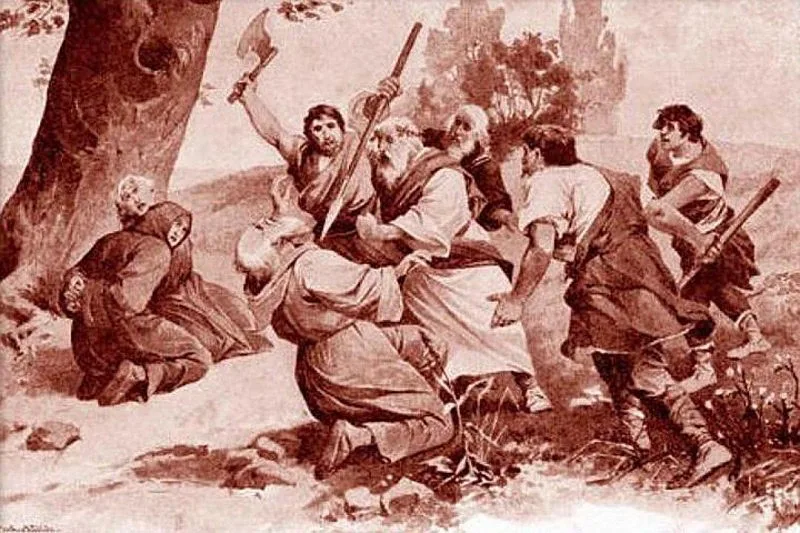
Such was the world in which Adalbert lived in Rome: a world without foundations, without life, where people pedantically immersed themselves in contemplating the ruins of the past, as if expecting nothing from the future. Perhaps it was precisely under the influence of the mood that prevailed there, and of the thought that the end of the world was near, that Adalbert resolved to go to the Prussians, of whom he had heard in Bohemia, in order to win the martyr’s crown and with it eternal salvation. In 997 Adalbert passed through Germany into Poland. He asked the Polish prince for a few men as escort and for a boat, went down the Vistula to the sea, sailed along the coast and after several days’ voyage landed on the eastern shore of Prussia. With him went the priest Benedict and the monk Gaudentius. To them we owe two chapters of the account of the passion of St Adalbert, which vividly reflect the feeling of horror that the memory of the Prussian land left in their souls. The boat had barely landed when the sailors, hastily putting their companions ashore, at once set off on the return voyage in order to get away as quickly as possible, under cover of darkness, from this godless Prussia. The missionaries too gave way to fear and lived on the shore for several days, not daring to go to the pagans. But then the pagans heard that some strange people had come into their land “from the other world,” and went themselves to seek out our apostles. Adalbert was sitting reading the Psalter when suddenly a crowd of natives appeared before him, “gnashing out something savage.” The fiercest of these villains, cursing, raised “his calloused hand” against the bishop and struck him with an oar. The book slipped from Adalbert’s hands and he fell, whispering: “Blessed be the Lord in His mercy! Even if I am not granted to suffer further for the glory of the Crucified, I have at least been granted to receive this precious blow!” The blow was not fatal; the savages only wanted to frighten the strangers. “Get out!” they said. “Or else we will kill you!”
The three companions set off and came to a place where there was a market. The market was crowded with people, and no sooner had the holy man appeared there than he was surrounded by a pack of these dog-heads, opening wide their terrible jaws. They began to question him: where was he from, who was he, what was he seeking and why had he come to them when they had not called him.
These wolves thirsted for blood and threatened death to the one who had brought them life. Without letting him say a word, they already mimic him and mock him... “Speak!” they shout at last, shaking their heads. The bishop says in a few words what Catholic missionaries usually say in such cases: he has come to snatch his brothers from the hands of the devil and from the jaws of hell, to reveal to them the true God and to cleanse them in the font of salvation. The Prussians laugh at the divine words, strike the ground with their sticks and fill the air with roaring, but they do not touch the strangers and only order them to leave. The champion of Christ found life a burden, yet his flesh was troubled at the thought of death. Once he was walking along the seashore when suddenly a huge wave rose up before him, as if raised by some sea monster, and broke with a roar at his feet. The bishop turned quite pale, like a timid woman. Another time, at night, Gaudentius dreamed that, having heard a Mass celebrated by Adalbert, he went to take communion from the chalice, when suddenly the sacristan stopped him and said: “It is not for your lips to drink from this cup of life: it is meant for the bishop.” When the monk told him his dream, Adalbert understood that it referred to the cup of martyrdom. Then “this son of woman” trembled at the thought of the sufferings to come and said: “My brother, God grant that this dream foretells only good!”
The cup was at last sent to him from heaven. Gaudentius celebrated Mass, and the three companions, after their meal, lay down to sleep on the grass. A crowd of Prussians, led by a man whose brother had been killed by the Poles, seized them in their sleep. “The awakening was not a pleasant one.” Adalbert was dragged away, “and his flesh, which was about to die, changed its colour.” Seeing the executioner ready to strike him, Adalbert had time only to whisper: “Father, Thy will be done.” His companions, whom the savages spared, later told that at the moment when, pierced by seven spear thrusts, he fell, the ropes that bound him broke of themselves and the martyr’s hands folded in the form of a cross. This was the first miracle of St Adalbert.
From the story of this martyr we learn nothing about the Prussians, and to prove the extraordinary ferocity of this people other witnesses are needed, not Gaudentius and not Benedict. The history of missions in the Middle Ages is a most rewarding subject: the historian need only make it his rule not to side unconditionally with the martyrs, but to try honestly to imagine what might have gone on in the souls of the pagans when the missionaries appeared*.
The spread of the Christian religion in the Roman Empire was brought about by a multitude of causes, and it is still not hard to understand why the barbarian tribes that conquered it quickly adopted the faith of the population among which they had to live. But even here it must be noted that only the Franks accepted this faith in all its fullness, while the other tribes rejected the doctrine of the Holy Trinity as incompatible with the dogma of divine unity. Nothing could compel them to bow their heads before the Roman Church. Theodoric knew that by continuing to deny the equality of the Father and the Son he risked ruining his state, yet he stubbornly persisted. On the eve of Clovis’s attack, Gundobad, King of the Burgundians, whom the bishops had, so to speak, driven into a corner, forcing him to choose between submission to the Church and war with the Franks, decides with deep sorrow that he would rather face a danger about which he has no illusions than believe, as he puts it, in three gods. And yet these kings were surrounded by Catholics — Cassiodorus was at Theodoric’s court, Avitus at Gundobad’s — and they themselves spoke the language of the Church, or at least understood it. How much stronger, then, must have been the resistance of the savages who remained in their wild lands when strangers began to come to them preaching Catholicism. Picture these people who had remained faithful to the cult of nature and continued to worship its mysterious forces: the thunder that frightened them, the beneficent waters of springs, the nourishing earth, the age-old oak that grows green again every year and is held to be immortal. Suddenly missionaries come to them: they desecrate the sacred groves whose shade and silence the savages revere; they load with burdens the white horse, the soothsayer in the temple of Svantevit, god of the sacred fire; they drive an axe into the roots of the oak whose branches, swaying in the wind, reveal the will of heaven to men. They declare this cult, hallowed by centuries, which was the cult of our Aryan ancestors, to be the work of hell and Satan, and in its place at once set about expounding the most mysterious of the dogmas of the Christian Church — the Fall and the Redemption, the Immaculate Conception, the Holy Trinity and so on. One can imagine what must have gone on in the heads of the barbarians!
Often these missionaries do not even know the language of those they intend to convert. They preach by signs, they explain the mysteries of the Christian religion by symbolic images and actions. Such visual teaching was, of course, not very easy to understand.
But even when the missionaries did know the language, were they always able to clothe their preaching in suitable forms? Certainly, with good sense and skilful guides such as the incomparable Pope Gregory VI, they succeeded: one need only read Gregory’s instructions to the Anglo-Saxon missionaries, in which he teaches them how carefully the transition from old pagan customs to the new religion must be arranged. But far from all missionaries had enough tolerance and flexibility of mind to cope with so delicate a task. Adalbert, for example, tells the Prussians that he has come to snatch them from the jaws of Avernus; but the Prussians did not feel in the least in danger of perishing in those jaws. This preaching recalls the exhortations that, according to Gregory of Tours, Clotilde addressed to Clovis. Seeking to convert him to the true faith, she reproached him for worshipping idols — yet the Franks had none; for worshipping Jupiter, that stuprator vitorum, that adulterer and committer of incest who married his own sister, since Juno says (in Virgil) that she is “sister and wife of the lord of the gods” — whereas Clovis was doubtless hearing of Jupiter himself for the very first time. So, understanding nothing, he answers Clotilde briefly: “Your God is not of the family of the Aesir, so he is not a god.” Now it is Clotilde’s turn to understand nothing. This conversation, related by the Bishop of Tours, may never have taken place at all; but in these words that the historian puts into Clotilde’s mouth one may see one of the formulas composed for missionaries when they had to deal with Graeco-Roman paganism, and which remained in use in the conversion of the Germanic pagans. Old phrases are tenacious — perhaps they never disappear without trace — and, if one wished, it would not be hard to produce a multitude of examples where not only the language but also the reasoning of the missionaries was utterly incomprehensible to their listeners.
For this reason most missions would have remained fruitless without the support of politics and force. “I am completely powerless,” says Boniface, the apostle of Germany, “without the protection of the Frankish dukes and the fear they inspire.” Thirty-four years of war, massacres and mass resettlements were needed to convert the Saxons; and after their final pacification there was needed the Saxon Capitulary, in which the death penalty appears in every article, and the harsh rule of bishops and counts. The pagans sensed instinctively that in defending their gods they were defending their freedom, and that in becoming Christians they would have to become subjects. When missionaries appeared, they knew that the prince followed in their footsteps and that the prince was bringing them servitude. Adalbert tells the Prussians that he has been sent by the Polish duke; but it was precisely the Polish yoke that the Prussians feared most of all. They were waging war with the duke on the border, and the very murder of the missionary bishop was an act of blood vengeance, since the brother of his executioner had been killed by the Poles. The barbarians would gladly have left the missionaries alive so as not to have to pay for their deaths later: twice they order these unknown “newcomers from the other world” to go back whence they came. They considered them harmful beings, and the chronicler puts remarkable words into the mouths of these savages: “Because of these people our land will cease to yield harvests, the trees fruit, the animals young, and those that are born will die at once.” The Prussians were mistaken, for their land was still able to yield harvests afterwards, even unheard-of ones; but the day was destined to come when not one of the Prussians remained to gather them. This whole people perished, falling victim to Catholic civilisation, and left behind only its name, appropriated by its conquerors. And it was right when it said to the forerunner of the Teutonic Knights: “Get out!”
* A model of such works is Mignet’s article La Germanie au huitième et neuvième siècle, in his Notices et mémoires historiques.
The Conquest of the Prussian Land by the Teutons
Adalbert died without having converted a single Prussian soul to the Christian faith; but all Europe learned that one of its bishops, a friend of the emperor, had found the martyr’s crown among pagans hitherto unknown to anyone, and the name of the Prussians emerged from the darkness of obscurity. From then on the Prussians knew no peace: from the north the Danes attacked them, from the south the Poles. Neither, however, achieved lasting results, and the crises of anarchy that periodically recurred in Poland constantly saved the Prussians. They themselves usually kept to a strictly defensive course: when the enemy attacked them, they hid in the forests, waited there until he began to retreat, and then set off in pursuit. In the middle of the 12th century King Bolesław IV, after one victorious expedition, managed to impose tribute on them; but they at once refused to pay it again, and when he once more went to war against their country, almost his whole army perished there. That was the last great war, and at the beginning of the 13th century Prussia still remained independent and pagan.
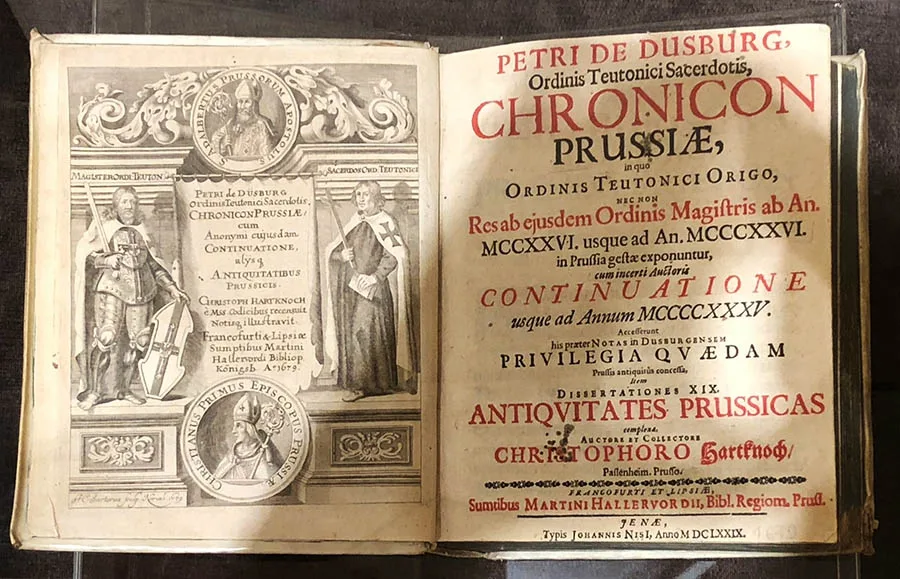
The Prussians were not the kind of enemy that could be disregarded. True, they were divided into eleven small peoples, but they were bound together by a common religion. Peter of Dusburg tells us that this terrible people had its own pope, the Kriwe, who lived in the place called Romove — a name derived from Rome, he adds, with that boldness of fancy which distinguishes medieval writers in their etymological constructions.
“Indeed, just as our lord the Pope governs the universal Church of the Christian faithful, so the commands of the Kriwe are obeyed not only by the Prussians but also by the Livonians and the Lithuanians. The high priest has no need to appear everywhere in person: an envoy to whom he gives his staff or some other agreed sign is met everywhere with the same honour as he himself.” The dead were no less devoted to him than the living: before departing for the life to come, they all “passed” through his house, and so the relatives of the dead constantly came to him to ask whether he had seen such-and-such a person on such-and-such a day. The priest, without hesitation, described the deceased, his clothes, his horses and the servants who had been burned with him, and even showed the hole that this emigrant to the other world had made with his spear as he passed by. Since the Prussians were very devout and undertook nothing without asking the advice of their gods, the authority of the mysterious head of their priesthood was very great. The Kriwe lived and flourished in the depths of the sacred forest at the very time when the great Pope Innocent III presided in the Lateran over a council of bishops and envoys of all the Christian states. Germany under the Hohenstaufens shone with the brilliant splendour of chivalric civilisation; in Paris Notre-Dame soared aloft, St Louis was preparing to build the Sainte-Chapelle, and a university had been founded to which young people thirsting for knowledge flocked from every corner of Europe to hear professors who discoursed de omni re scibili et guibustdam aliis; while the Prussians did not yet understand that on a piece of parchment one could convey one’s thought to a person in an altogether different place, and the secrets of arithmetic were so foreign to them that for counting they cut notches in a piece of wood or tied knots in their belts.
Meanwhile Christian civilisation was already advancing upon them from all sides — slowly but irresistibly. The Scandinavian states become Christian from the 11th century. In the 12th century, through the joint efforts of the margraves of Brandenburg, the dukes of Saxony and the kings of Denmark, Christianity is established in Brandenburg, Mecklenburg and Pomerania, and the Pomeranian land is Prussia’s neighbour: only the Vistula separates them. Poland, which bordered Prussia on the south, had long since accepted baptism. Finally, in Livonia, Albert of Buxhoeveden, that bishop and knight, won his bishopric of Riga from the pagans and founded the Order of the Sword Brothers, whose emblems were the sword and the cross on a white mantle. How, then, could Prussia preserve its independence and its religion? No people can with impunity differ so sharply from its neighbours. Civilisation, that is, the sum of ideas accepted by the majority of the peoples of a given region in a given epoch concerning man’s relation to God, forms of government and the organisation of society, is not tolerant towards dissenters, be they individuals or whole peoples. It constantly strives to crush all individual resistance within a nation and to bring overly distinctive tribes down to the common level. Its work, swift in epochs of swift circulation of ideas, went slowly in the Middle Ages, but it did not stop. It was moving then from west to east: from its homeland, Italy and France, it penetrated into Germany, the northern countries, Poland and the distant shores of the Baltic Sea, so that in the 13th century Prussia was already encompassed by it on all sides and was an exception that could no longer be tolerated.
At the beginning of the 13th century a new attempt was made to convert the Prussians. The monk Christian, coming from the Pomeranian monastery of Oliva, that Christian outpost situated only a few versts from pagan land, crossed the Vistula and built several churches on its right bank. That was enough for the Pope to take the whole country under the protection of Saints Peter and Paul and to make Christian Bishop of Prussia. But the new diocese still had to be conquered, and to provide the bishop with soldiers the Pope ordered a crusade to be preached against the northern Saracens. The former crusading ardour had already cooled by this time, and the knights had more than once shown that they preferred crusades closer to home. Although the popes regretted this, they had willy-nilly to reckon with the conditions of the time and to grant indulgences just as generously to the Burgundian crusader knights marching against the Albigensians, or to the Saxon knights who took up the cross against the Prussians, as they had once done to Godfrey of Bouillon or Frederick Barbarossa. “The road is neither long nor hard,” said the preachers of the Albigensian campaigns, “and the booty is rich.” The preachers of the crusade against the Prussians said the same.
Several hosts went against the northern Saracens, but these campaigns came to nothing: the crusaders came, burned and plundered everything they met on their way and then departed, leaving the Christian churches to the vengeance of the Prussians, who had been driven to despair.
In 1224 the savages massacre the Christians, destroy the churches and cross the Vistula to burn the monastery of Oliva, and the Drewenz to plunder Poland. The Polish kingdom was then divided among the sons of King Casimir; one of them, Konrad, held Masovia and, as Prussia’s neighbour, had to bear the full weight of the most terrible of all the wars that Poland ever had to wage against it. No longer relying on the irregular and dangerous help of crusaders coming from afar, he remembered that the Bishop of Livonia, by founding a knightly order in his land, had thereby obtained a permanent crusading army at his disposal, and he sent to the Grand Master of the Teutonic Knights to ask for help.
The summoning of the German knights by a Polish prince was an event of extraordinary importance in the history of Poland. It was evidently this country’s duty to pass on Christianity to the peoples along the Oder and the Vistula. But in order itself to live out its full span within its natural limits, between the Bohemian mountains and the sea, Poland had to hold Silesia and Pomerania firmly in its hands and on no account allow the Germans to establish themselves in Prussia, as in a fortress, amid the Slavo-Finnic population. But at no moment of its history did Poland do what it needed to do. In the Middle Ages it had its hours of greatness and splendour; but it never had the patience either to learn to govern itself or to hold to a single plan for long in its ambitions of conquest. Its feudal cavalry, encamped on the plain between the Vistula and the Oder, open to all the winds, kept bursting out of its borders and rushing now to the Elbe, now to the Dnieper, now to the Dvina. It would have been far better had it concentrated its forces instead on subjugating Prussia alone: for the day when Konrad of Masovia, acknowledging his own impotence, summoned the Teutonic Knights against Prussia prepared the downfall of Poland.
The Grand Master to whom Konrad turned was Hermann von Salza, the most skilful politician of the 13th century, without whose participation no major event took place. In that epoch of merciless struggle between Empire and Papacy, when the two heads of Christendom hated each other so fiercely, when the Pope excommunicated the Emperor and the Emperor deposed the Pope, when each spared no insults, comparing his adversary now to the Antichrist, now to the vilest creatures of the Apocalypse, Hermann managed to remain not only the friend but even the confidant of both Frederick and Gregory IX. It is always dangerous to invite such a man to take part in a political enterprise for a share of the profits: he will always take care to measure out that share for himself with a generous hand — otherwise, what would he need his adroitness for? Konrad of Masovia and Christian of Oliva no doubt hoped that the Teutonic Knights would be content, in return for their services, with the cession of some scrap of land that could be taken back from them when the occasion arose; but they soon noticed that they had miscalculated. Konrad offered the order the Kulm land, between the Ossa and the Drewenz. It was the object of endless dispute between the Poles and the Prussians, and at that time it still had to be conquered. Hermann accepts it, but asks the Emperor to give his permission for the acceptance of this gift and, while he is at it, to add the whole of Prussia to it.
The Emperor, as lord of the world, cedes to the Grand Master and his successors the ancient right of the Empire to the mountains, plains, rivers, forests and sea in partibus Prussiae. Then Hermann asks the consent of the Pope, and the Pope in turn not only gives him this land, to which in his view no one but God had until then had any right, but also orders a crusade to be preached against the infidels.
He commands the knights to raise their sacred arms against the Prussians and to smite them until their whole country is fully subjugated, and the princes to help the order in every way. Later, after the first victories, the Pope will again declare Prussia the property of St Peter and again hand it over to the order “as full and unrestricted property,” threatening anyone who dares to encroach upon this possession with “the wrath of the Almighty and of His apostles Saints Peter and Paul”*.
In 1230 all the preparations were complete, and the war began. When the Prussians first saw in the ranks of the Poles these horsemen dressed in long white mantles with a sharply standing-out black cross, they asked one of the prisoners who these people were and where they had come from. The prisoner, Peter of Dusburg relates, replied: “These are pious and brave knights, sent from Germany by our lord the Pope to fight you until your stubborn heads bow before our holy Church.” The Prussians laughed a great deal at the pretensions of this lord Pope. The knights were not so merry. The Grand Master, sending Hermann Balk, whom he had invested with the title of “Master of Prussia,” to fight the pagans, said to him: “Be bold and steadfast, for you will lead the sons of Israel, that is, your brothers, into the promised land. God be with you!” But this promised land seemed a sad one to the knights when they first saw it from a castle situated on the left bank of the Vistula, not far from Thorn; this castle bore the melodious name of Vogelsang (birdsong).
“Standing as a small band before a countless multitude of enemies, they sang a song of sorrow, for they had left their dear homeland, a peaceful and fertile land, and were going into a country of horror, into a vast wilderness where a terrible war raged.”
This terrible war lasted 53 years. It is by no means part of our plan to set out its history in every detail. It should be noted that this would be a very difficult task, one that the Germans themselves have not yet managed to accomplish. In their remarkable edition Scriptores rerum prussicarum they do, it is true, give all the testimonies that have come down to us about this great event. But unfortunately the fullest, most sensible and most thorough of the old historians of Prussia, Peter of Dusburg, lived a century after the events he describes; moreover, he was a priest and a member of the order — and this is reflected not only in his partiality towards the knights but in his very view of the meaning of the whole struggle: true to a narrowly ecclesiastical spirit, he sees in it only the holy enterprise of God’s warriors against the infidels. His legends are beautiful, and since the miraculous can no longer lead us astray, we gladly forgive him them. But he does not stand on ceremony with facts either, inflating some and passing over others altogether if they are inconvenient to him; on every page he exaggerates the numbers of crusaders and pagans, and as a result gives an utterly false picture of the conquest of Prussia. On the other hand, he captivates by his merits — the ease, the liveliness and, one may even say, the charm of his narrative. That is why even modern German historians submit to his authority, and in their accounts the conquest appears to us as a great drama in several acts in which enormous forces clash in a gigantic struggle. These historians bring into their descriptions the colouring of the beautiful and gloomy poetry of the north, relating with rapture the winter campaigns when the ice cracked under the hooves of the knights’ horses, and they depict that mystical patriotism which makes them admire everything German, even German coarseness and cruelty.
They see in the German the instrument of some supernatural force, of some special Providence that particularly protects the Germans but is not indifferent to the rest of the world either, for the whole universe is destined to be transformed by the power of German genius.
There is no doubt that the German knights and colonists stood above the Prussians they conquered or drove out, and one would have to be extremely prejudiced not to marvel, when comparing the country described by Wulfstan with the country governed by the order, at the extraordinary work accomplished by these Germans who came from every region of Germany and from every class of its society. But in the interests of truth one must admit that the history of this slow conquest lasting half a century is by no means as poetic as it is usually presented.
In the period of the order’s greatest power, that is, around 1400, Prussia counted 1,000 knights. In the 13th century their number was considerably smaller, especially at the beginning of the conquest, when the members of the still very weak order were scattered across Germany, Italy and the Holy Land. The “Chronicle of the Order,” written apparently earlier than Dusburg and by better-informed people, speaks only of small wars in which the few knights, receiving no support from their brethren in the German commanderies and not relying on the colonists, shut themselves up in fortresses and were glad if their weak garrisons managed to keep in touch with one another along the Vistula. Ten years after the beginning of the war, when many towns had already been founded, the knights of Kulm sent three times to Rehden asking for o n e knight to come to their aid. Then they sent envoys to Germany, to their Grand Master, to Bohemia and to Austria, declaring that all was lost if they were not given reinforcements. In response, ten knights with thirty horses came to them — and that was enough for Kulm to rejoice. As for the crusading hosts that were often sent to Prussia by papal bulls, they were never as numerous as the old chroniclers tell, who in the liveliness of their imagination arrive at amusing exaggerations. When Dusburg asserts that the Bohemian King Ottokar penetrated deep into Sambia with an army of 60,000 men — such a mass could, of course, neither move nor feed itself there — one must assume that he adds two extra noughts. In proportion to this, the number of enemies is also inflated beyond all possibility. One Livonian chronicle says that the Sambians could put 40,000 men into the field. But that whole country covered no more than 1,700 square versts and was densely covered with forests in which beavers, bears and aurochs lived; it is hard to suppose that there were more than 20 inhabitants per square verst — the whole population of Sambia can be reckoned at perhaps 34,000 people. Thus the conquest of Prussia, whose population at that time cannot have exceeded 200,000 souls, was the work of a very small number of knights, helped moreover by small crusading hosts and by colonists placed on a war footing. The superiority of their armament, which made each knight something like a mobile fortress, better tactics, the art of fortification, the disunity of the Prussians, their carelessness and the inability, common to all savages, to foresee the future and provide for it — all this explains the eventual success of the conquest, while the small size of the forces drawn into the war makes the length of the struggle understandable.
This conquest moved forward like a rising tide, now advancing, now receding again. When an army of crusaders arrived, the order unfurled its banner. They set out cautiously, sending ahead special scouts well trained in their craft. The enemy was almost always taken by surprise.
The army would occupy some skilfully chosen point on a hill commanding an open view of the surrounding country and set about digging ditches and building palisades. Thus a fortress arose, at the foot of which a small village was laid out. In this village, where every house was built as a blockhouse, settled the colonists who had come with the crusaders. These were artisans or farmers who had left their homeland accompanied by their wives and children and had come, with the cross on their breasts, to seek their fortune in a new land. The work had to be hurried, for no such crusade lasted more than a year. When the crusaders left, the fortress was immediately attacked by enemies thirsting for revenge. They often succeeded in taking it by storm and burning it, and then, having laid waste the village, they recaptured the territory the Germans had only just conquered. Meanwhile the knights, shut up in their castles, anxiously awaited news of the arrival of fresh help. These ebbs and flows were repeated so often that people had willy-nilly to adapt to them. The Germans built refuges on steep hills and on islands, where the colonists sought shelter at every alarm signal, and these hasty retreats were repeated so often that innkeepers received special privileges “for themselves and t h e i r d e s c e n d a n t s” to sell strong drink in the places of refuge.
The knights founded their first, and at the same time their most durable, settlements on the Vistula, in the corner it forms between the mouths of the Drewenz and the Ossa. Kulm and Thorn were founded by them as early as 1232. Even now the Kulmerland is full of monuments that speak eloquently of the age of the conquest, and the traveller there is in for the most striking impressions, of which few people in Germany itself have a proper idea. In October 1877, having left the railway at Terespol, not far from the left bank of the Vistula, I was walking to the ferry on which one crosses the river opposite Kulm. Evening was coming on. In the east the sky was covered with grey and black clouds piled one upon another; but in the west the horizon glowed with a transparent golden light, and against it, down to the smallest detail, stood out the steep hill on which the bell towers of Kulm rise. Having crossed the river, you climb a steep road to the town, which the Vistula and one of its tributaries embrace so that the town seems a hilly island cast down amid an endless plain. Skirting part of the ancient town walls, you enter a long, narrow underground passage with massive vaults that leads you into the town. There, beside yourself with amazement, you pass from ancient churches proudly raising their lofty brows to the sky to the town hall, which with its openwork turret seems to have come here from Italy, until at last you reach the new part of the town with its dreary, monotonous houses. These churches and the town hall tell you of the mighty knights who brought to Prussian soil memories from every corner of the world; while the new houses, built under Frederick II to a plan sent from Berlin and lined up like a rank of soldiers, represent, beside the poetic grandeur of the old age with its powerful imagination, Prussian prose and discipline. And the whole of this country between Kulm and Thorn is full of such contrasts; I travelled all over it on utterly impossible roads where the horses have to knead living mud with their hooves: the Prussian government does not care overmuch for its eastern provinces, which on its part is perhaps not altogether wise. When you stand on this gently undulating plain, strewn with little lakes and huge boulders under which the ancient Prussians buried the ashes of their dead, your eye almost always picks out somewhere on the wide and gloomy horizon the silhouette of a bell tower or a ruin. Now it will be the massive stone walls of Papau with their brick-faced pointed arches; now Kulmsee, a little village at the foot of two colossal churches with mighty towers rising above their portals; now, finally, Thorn. In Thorn one marvels at the remains of the castle with its Cyclopean foundations and mighty walls that still bear the traces of the fire that destroyed the castle in the 15th century; at the town hall, one of the proudest monuments of German civic architecture; at three churches where brick works wonders. The philologist and the historian will be interested in two most curious inscriptions in them: one is considered Prussian but has not yet been deciphered, the other is written in Arabic and serves as the ornament of one of the portals.
And how pitiful the present seems when you look at these mighty monuments of the past, which suit the towns and villages around them as well as the armour of a knight seven feet tall would suit a sickly child.
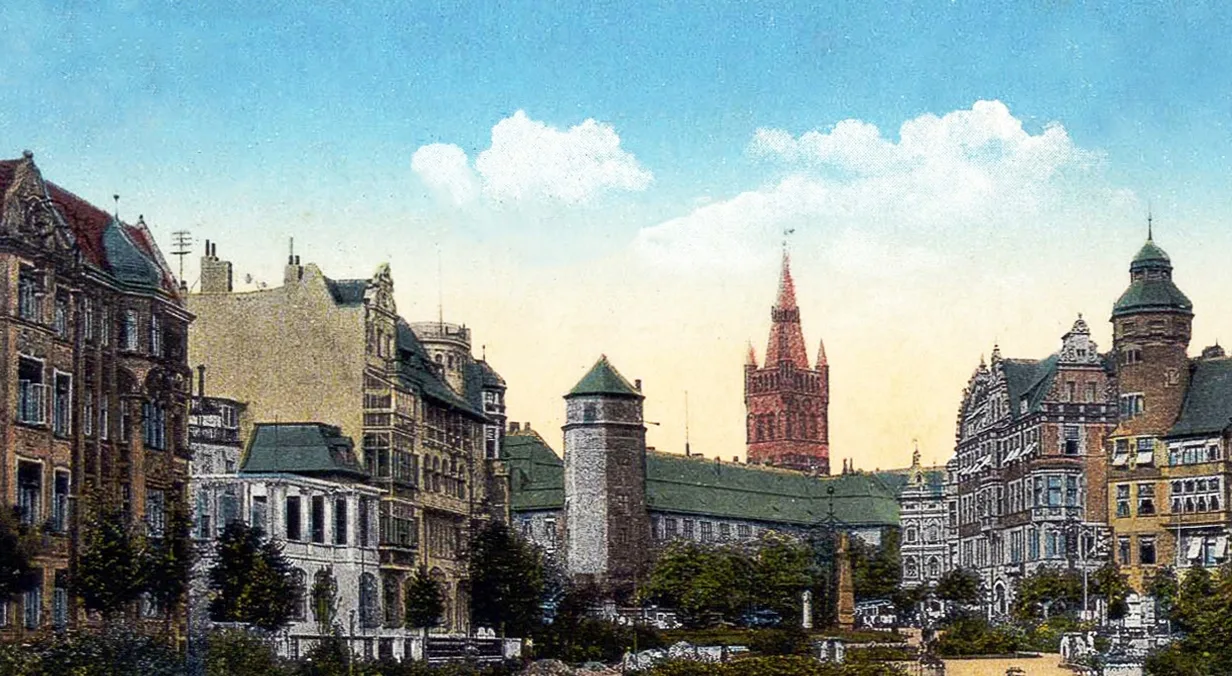
After the subjugation of the Kulm land, the conquest proceeded along the Vistula, on which fortresses arose commanding its whole course: Thorn, Kulm, Marienwerder and Elbing. At the same time the knights gained the opportunity to communicate with Germany by sea. This was important for them, since by land they were cut off from it by a Slavic principality, Pomerania, which was an unreliable neighbour. The Pomeranians watched the establishment of the German conquerors on Slavic soil with an uneasiness that had its grounds. The war declared on the order by Prince Świętopełk in 1241 became the signal for a rising of the Prussians; it lasted eleven years and was terrible. The knights were victorious, and the noise of this victorious struggle attracted new crusaders, among whom there appeared in 1254 the Bohemian King Ottokar. It was then that the Christians first penetrated the sacred forest of Romove; it was then too that Königsberg was built — the town’s coat of arms, which shows a knight in a helmet with a crown, as well as the very name of the town, still preserve the memory of the Bohemian king. Ottokar later said of himself that he had baptised an entire people and extended the borders of his state to the Baltic. But this was mere boasting, of the kind that, with the noisy but indolent medieval Slavs, was generally not backed by deeds. The knights, on the other hand, making the best possible use of the help that came to them, pursued the work of conquest in the most persistent and serious manner. No sooner had the first rising been put down than they sent colonists beyond the Kurisches Haff and founded Memel there. In 1237 they absorb the Order of the Sword Brothers, which had conquered Livonia, and begin to dream of dominion over the whole eastern coast of the Baltic Sea, along which their possessions already stretch for almost 100 miles**.
But the Prussian land was by no means pacified yet, and seven years after Ottokar’s campaign everything there was again ready for a new rising. Secret councils were held in the forests, the high priest made his existence known once more, and the oaks began to speak. The children of noble Prussians, placed by the order in monasteries to be educated, secretly flee to their homeland. The knights sense the approach of the storm and hope to avert it by cruelty. One of the dignitaries of the order invites to dinner a large company of noble Prussians who seemed suspicious to him, makes them drunk, then goes out, locks the door behind him and, as Dusburg says, turns both the castle and the Prussians to ashes. But all this is to no avail; the revolt flares up even more terribly than the first time. The Master of Livonia is defeated by the Lithuanians, Courland frees itself, the Pomeranian princes, forgetting their baptism, help the Prussians against the Germans. The order’s castles fall one after another, and for ten years misfortune follows misfortune. At last, exhausted and having suffered enormous losses, the rebels begin to weaken. But the knights needed another ten years to recover the lost territories. The slaughter of the Prussians meanwhile went on without ceasing, and the struggle ended only when the Yotvingians — a small people living in the very depths of the forests beyond the main lakes of this region — admitted defeat and, unwilling to submit to the yoke of the knights, went over with their leader, the formidable Stardo, to Lithuania. Over this corner of the earth where the Slavs put up their last desperate resistance to the enemy, and where the villages of the Yotvingians once crowded together, there now stretches the Johannisburg wilderness.
The period of this struggle is the heroic age of the order. In those terrible years the knights were sustained by faith. Their castle is besieged, they have nowhere to expect help from, and they fight with despair in their hearts; hunger forces them to eat their horses and harness — but all the more ardent are the prayers they send up to the Mother of God.
Before throwing themselves upon the enemy, they do penance, subjecting themselves to merciless scourging. Seized by ecstasy, they pray to heaven for miracles. And the miracles are not slow in coming — the whole of Dusburg is full of stories about them. On the eve of one of the bloodiest battles with the rebellious Prussians, the Virgin Mary appears to a knight who had served her with particular zeal and says: “Hermann, you will soon be with My Son.” The next day Hermann, hurling himself into the thickest ranks of the enemy, said to his companions: “Farewell, brothers, we shall not see each other again! The Mother of God is calling me to the eternal world!” A Prussian peasant who witnessed this battle, in which the knights were put to flight and fell in heaps under the blows of the enemy, ended his account of it thus: “Then I saw women and angels carrying the souls of the brethren up to heaven; brightest of all shone the soul of Hermann in the hands of the Holy Virgin.” Another time, in the evening after a battle, the wife of one of the colonists, seeing that her husband did not come home, went to look for him on the battlefield. She found him still alive but could not persuade him to get up and go with her. “I have just seen the Holy Virgin,” he said. “Two women accompanied her, carrying lamps, and she walked along censing the bodies of the dead; coming up to me, she said: ‘Rejoice! Three more days, and you will ascend into eternal life.’” And the wounded man wished to die on the battlefield.
A hardy breed were these conquerors. One knight wore out several coats of mail in his lifetime; and many did not take off their penitential chains by day or by night. The colonists — men and women — were of the same mettle as the knights. As a general rule, the widows of men killed in the war had to remarry at once, to the first bachelor who came along, for the survival of the colony was placed above everything. One day in Kulm two women on their way to church saw a very ragged but very pretty boy playing knucklebones. Both wanted to take him with them. A quarrel arose; at last the more nimble one managed to win him, took him to her house and dressed him decently. Then “the priest betrothed this interesting couple,” and in the course of time the wedding was celebrated as well. The story of these two women fighting each other for a husband on the way to church in a deserted little town is one of the most striking features of the whole history of this region, where the demands of the “struggle for existence” return the Christians of the 13th century to the conditions of primitive life.
By the end of the century the colonists and the knights had finally won their cause. Their castles and towns were firmly established on Prussian soil — and the remnants of the vanquished would never stir again. At first the conquerors spared the Prussians, leaving the peasants their freedom and the nobility its position, provided they accepted baptism. They sent native children to study in monasteries; but the Prussians brought up there later proved the most dangerous enemies of the knights. On the other hand, during and after the risings the vanquished were placed entirely outside the law. The Germans put an enormous number of them to the sword, and the survivors were resettled in various districts, where they were divided into classes no longer according to their degree of nobility but according to their former conduct towards the order, thus breaking at one stroke both their bond with their native land and the old social order. The order showed some consideration to those Prussian noble families that had not taken part in the risings and had thereby earned the right to freedom and honour. It also appointed Prussians to some public offices; but the number of these privileged persons was negligible, while the mass of the vanquished found themselves in a condition close to slavery.
These Christian conquerors did not want to see in the vanquished even simply human beings with souls like their own, whose salvation ought to be considered. From the very beginning of the war the Pope complained that the knights were leaving the Prussians to remain in paganism, and the order maintained this indifference to the end.
Dusburg, describing the ancient customs of the Prussians, relates that hospitality was considered incomplete among them unless the whole household — husband, wife, sons and daughters — got drunk together with their guest; that their wives were no more than purchased servants who did not even dine with their husbands and every day washed the feet of the master and the servants; that a settlement in a case of murder was permitted only after the murderer or one of his kin had himself fallen under the blows of the victim’s relatives.
We find these customs of the 13th century still in force in the 15th. After the defeat that forced the order to become a vassal of Poland, Grand Master Paul von Rusdorf undertook an inquiry into the causes of his country’s deep decline and asked all knowledgeable persons to give their opinion on it. A Carthusian monk then wrote a kind of admonition in which he reproaches the order for its sins, and above all for its conduct towards the common people, especially the Prussians, whom he calls the poor Prussians. The Prussians, this witness says, have kept their pagan customs, and how could it be otherwise? Their masters say to the priests who intend to convert them to Christianity: “Let the Prussians remain Prussians.” They prevent them from going to church, burden them with labour service even on feast days and care only about squeezing as much money and labour out of them as possible. At every step they make them take oaths and at every step lead them into perjury, for this sin, which entails eternal damnation, is atoned for by a trifling fine. On the days of Prussian weddings they allow satanic dances in which women dress as men; because of this the murders “customary in Prussia” multiply, for faith is so low that it is cheaper to kill a man than to buy a horse. Murders most often occur at orgies, when whole families get drunk and fight one another. This Carthusian monk, a friend of the order, says the same thing as its enemies. At about the same time the Bishop of Poznań accuses the knights of leaving two-thirds of the Prussians in the errors of paganism and of sending these barbarians to war against their Christian neighbours. Indeed, the order constantly took Prussians as soldiers, and the levies, no less than servitude, contributed to the dying out of the native population. It must be added that the Prussians, as always happens in such cases, while keeping all their barbarian vices, very soon adopted many of the vices of the victors as well. Under the influence of these corrupting elements, to which in the 15th century were added devastating wars whose main burden fell precisely on the natives, the Prussian people began to melt away very rapidly. It seems that right up to the 16th century priests in some villages still needed interpreters to translate their sermons into the vernacular. Moreover, in that period we still come across remnants of paganism: we hear of nocturnal gatherings at which pagan priests sacrificed goats to the ancient deities. But in the 16th century the Prussian language disappeared completely. What remains of it now is as much an object of learned philological research as the remains of the ancient Greek dialects. An entire people was destroyed to make room for a German colony.
* Several years passed between the arrival of the first Polish embassy and the beginning of the conquest. This delay is explained partly by the complexity of the Grand Master’s affairs and by his participation in the crusade of Frederick II; but undoubtedly Hermann himself was in no hurry: by making them wait for the help they had asked for, he counted on making Duke Konrad and Bishop Christian more amenable to his terms. Christian at first dreamed of creating for himself out of Prussia an independent principality like that of Albert of Buxhoeveden in Livonia: he wanted the knights to serve him merely as the soldiers needed for the conquest. During the years that separate the dispatch of the embassy from the beginning of the conquest, he tried to create a new military order directly subordinate to himself — the Brothers of Dobrin. Had this order survived and continued to recruit, as it did at first, in the Slavic lands, the fate of Prussia might have been completely different: Prussia would have become not a German but a Polish colony. But the order did not develop quickly enough, the danger was pressing, and Christian, having secured for himself rich possessions and important prerogatives, was forced to renounce entirely all sovereign rights over the Teutons, all jurisdiction over them and the right to levy the tithe in the conquered lands.
** The merger of the two orders was also the work of Hermann von Salza. Bishop Albert and the Sword Brothers very quickly achieved extraordinary success in their enterprises. But even in Albert’s lifetime grave dangers began to threaten the existence of the order he had founded. In Livonia supreme authority belonged to the bishop, not to the order. Dissatisfied with this, the Sword Brothers began to demand special privileges and a share of the conquered lands. The bishop had to make important concessions to them. In addition, the German colony was threatened by the Lithuanians and the Russians. Hard pressed by these enemies, Christian called the Danes to his aid. These lands were already familiar to the Scandinavians, and, having come there, they soon became, under the leadership of Valdemar, formidable rivals of the order. In 1219 Valdemar founded Reval and took possession of part of Estonia. After Christian’s death the difficulties grew still greater: the Lithuanians and the Russians began to attack with redoubled force. Valdemar, who had for a time lost his possessions, again laid claim to Estonia. Within the order itself discipline had completely broken down, and it was apparently on the verge of disintegration. The Sword Brothers then sent an embassy to the Teutonic Knights proposing a merger. Hermann, as usual, was in no hurry. He had no wish to inherit from the Sword Brothers all their tangled relations. He particularly disliked the war with Denmark. He was waiting for some major setback of the Sword Brothers in the war with the Lithuanians to make them more tractable, since at first they would not hear of ceding northern Estonia to the Danes. After the defeat suffered by the Sword Brothers in 1236, the Pope, from Viterbo, where Hermann was with him, himself ordered the two orders to merge into one. When the matter was settled, Hermann informed the Sword Brothers that he had undertaken to return Estonia to Denmark. It was too late to protest. The Sword Brothers formed a separate branch within the Teutonic Order, and Livonia received its own Master. The union of the two orders was on the whole an event of great importance, and for us it has a special interest, because in this old story there come onto the stage the Germans, the Scandinavians and the Russians, that is, all the main participants in the struggle for the Baltic Sea, which began in the Middle Ages, continued in modern times and has not ended even now.
The Age of the Teutonic Order’s Power
The Grand Master at Marienburg
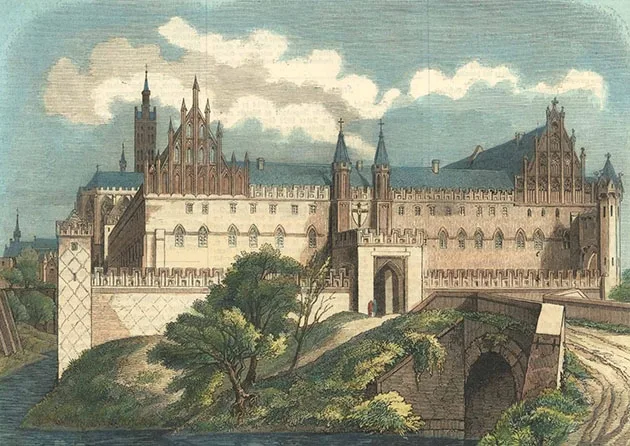
The whole Prussian town of Marienburg is one continuous monument to the former greatness of the knights, but the most striking thing in it is the two castles of the Teutonic Order. The older of them forms a rectangle 60 metres long and 53 metres wide. Its high walls were once pierced by two rows of pointed arcades, but unfortunately these were walled up when the old palace was adapted to its new purpose — to serve as a granary. The castle church suffered no less: the Jesuits decorated it with florid carving featuring torches, flaming hearts and various other Catholic absurdities. Amid this licentious rococo the knights’ oak stalls have survived in the choir; one of them, which belonged to the Grand Master, is covered by an oak canopy. From outside, the church, whose pure Gothic style has remained untouched, looks like a gigantic shrine set into the body of the palace. Behind the altar a huge mosaic of dazzling colours, eight metres high, depicts the Virgin Mary with the Infant Jesus, whom she holds playfully, like a feather, on her left arm.
She is a powerful woman, breathing not mercy but formidable strength, as befits the patroness of those Teutons from whom she accepted a whole people as a sacrifice without pouring a single drop of mercy into their hearts.
The second castle forms a trapezium open on the side of the first, to which it adjoins with its largest wing, 96 metres long. The opposite wing ends in the Grand Master’s pavilion, which is built in a very fanciful manner: above a heavy ground floor of stone slabs with six buttresses and only one very low door rise six light arcades on slender columns. Throughout this upper part, right up to the crenellated edges of the enormous tiled roof, the dark brick is enlivened by ornaments of white stone that enter into the indentations of the roof and frame it. The model for the building was taken from Venice: this is true Venetian architecture, which charms with its grace even when it produces an incongruous combination of the fragile and the massive. The new castle was luckier than the old one: it has been restored. It contains three marvellous halls: in the two smaller ones the whole vault descends like stalactites onto a single squat granite pillar, and it seems as if this pillar were throwing up a jet of water that flies upward, spreads out into a vault and runs down the walls in regular curls. Three more slender columns crowned with moulded capitals support the vault of the great hall, which is lit on one side by fourteen tall pointed windows.
The restoration of this castle is the work of admirers of their native antiquity. They can perhaps be reproached for having been far too lavish with putty and paint. One cannot help regretting, too, that the window panes display the names and coats of arms of the donors who helped to cover the costs: historical monuments are not made to serve as an account book of donations on behalf of history. The lithographs and photographic cards of various gentlemen in frock coats hung on the walls should also have been removed. The little field altar of the Grand Masters is at home in this palace, but how ill-suited to it are the upholstered armchairs or the handkerchief embroidered by a Prussian princess, which the custodian takes out of a cupboard and shows to visitors with signs of deep reverence. Perhaps in time a collection of all the objects that have come down to us from the age of the knights will be assembled in this castle: it would be worth the effort. From whichever side you look at the castle — from the courtyard, from the embankment of the Nogat, from which the Grand Master’s pavilion looks like a tall and gloomy battlemented fortress crowned with towers, or from the foot of the statue of Frederick, before which the main façade unfolds — it makes a profound impression, making you marvel at how the human spirit can transform stone. For the Teutonic Knights, these wanderers who had at last come to a halt on the banks of the Vistula, united in their palace, a blend of Saracen, Italian and German architecture, echoes of Palestine, Germany and Italy. The whole of this gigantic monument — at once monastery, fortress and palace — breathes the history of these monks who took up arms in defence of the Church and became rulers.
It was to this very castle of Marienburg that the Teutonic Grand Master moved his residence in the first years of the 14th century*. The infidels had taken from the Christians in the Holy Land every last inch of their possessions, and the knightly orders had to leave the land where they had arisen.
What fate awaited them? They had been born of the crusades, that is, of the war waged against the infidel possessors of the Holy Sepulchre by the whole Christian world, without distinction of nationality, at the call of the head of the Church, who was then mightier than the emperor and the kings. These monks, who appear now as hospital attendants, now as soldiers, now tending the sick and wounded, now dashingly cutting down Saracens, were true sons of the merciful and militant Church of the Middle Ages, as was St Louis, who washed the feet of the poor and found that in a dispute with infidels there was no better argument than a good sword stroke. The religious military orders were imbued with the universal spirit of the Church: at least the Hospitallers and the Templars belonged to no country, and if they had a fatherland, it was the Holy Land. After its loss they did not lack places of refuge, since they owned countless possessions in Europe.
But how Europe had changed! At the time when the military orders were coming into being, the royal power in France was modestly beginning its career. Philip I, a king who robbed merchants, was succeeded by Louis VI, justice of the peace and gendarme, forever roaming over hill and dale, sweating under his armour before fortresses and arousing the admiration of Suger, who proudly informs us that his king was feared even in the depths of Berry. At the time when the star of the knights began to set, the triumph of the royal power in France was an almost accomplished fact. Philip the Fair was busy taking back from the English the royal lands they had seized and from the feudal lords the royal authority they had seized. His counsellors and he himself nursed a cold hatred of the past and despised its representatives. The German emperor took it into his head to assert his ancient rights to the Burgundian fiefs and towns. To the ponderous harangues of the German chancery Philip replies with these simple words — Latin in sound, French in spirit: “Nimis germanice — this is far too German.” The Pope took it into his head to appropriate certain rights of the royal power; everyone knows that the answer to this was unheard-of insults and the outrage against Boniface VIII. By placing his trust in this sovereign, greedy for power and money, and settling amid the world of the legists, those “knights of the law” who were the mortal enemies of the true knights, the Master of the Templars acted extremely rashly. The spirit of universality had vanished from the European world; of the two supreme leaders of Christendom, one, the Pope, was in captivity, and the other, the Emperor, was simply a petty prince busy with his own trifling affairs. Crusades were talked of only at feasts and drinking bouts. But the Templars kept thinking of the Holy Land, sensing instinctively that with the end of the crusades the knightly orders must perish. They were discussing a plan for an expedition to Palestine when the executioner laid his hand on them.
The fate of the Teutons was by no means so tragic. They owned not only possessions scattered in various places: the conquest had given them a homeland. Founded by a German for Germans, their order had never been universal like the other two, and the work undertaken by the Teutons in Prussia, where German merchants and settlers were their collaborators, was as much German as it was Christian. Even after their expulsion from Palestine their existence did not lose its meaning, and everyone understood why the cross adorned their mantles, since Lithuania, the neighbour of their Prussia, remained pagan and was therefore subject to conquest and conversion to Christianity. That is why the lot of the Teutons proved so unlike the fate of the Templars: the latter left the Holy Land to perish, the former to reign. And the palace of Marienburg rose towards the sky at the same time as the pyre of the Templars.
Marienburg became the capital of a large state. The order was quick to extend its rule beyond Prussia and Livonia: it acquired Pomerania with Danzig and kept this province after a thirty years’ war with Poland**, while the conquest of Estonia from the Danes moved its borders, which in the west reached the Leba, up to Lake Peipus.
In this region the order made a very important acquisition at the beginning of the 15th century: German colonisation in the Mark of Brandenburg had spread as far as the Vistula, but with the extinction of the Ascanian dynasty the Mark fell into decline and nearly perished. The order then bought the Neumark from the margraves, thus extending its possessions to the Oder and securing its communications with Germany***. No state in Eastern Europe could compare in the perfection of its government with the one headed by the sovereign corporation of the Teutons.
* In 1308.
** We have spoken above of how this conquest was accomplished.
*** It is noteworthy that the two states from whose union Prussia was formed in the 17th century more than once drew close to each other in this way, rendering each other mutual services. When the Mark fell into decline, the order acquired from it the Neumark, which might otherwise have been lost to Germany. We shall see later that when the order in its turn fell into disarray, the Mark, grown strong under the Hohenzollerns, recovered the Neumark. The unity of the two histories stems from the fact that the margraves and the knights were German colonisers in a foreign land.
The Institutions of the Teutonic Order
This corporation is free of all aristocratic prejudice in recruiting its members. Founded by an entirely unknown man, owing the support and means for its new rise, after the fall of the Kingdom of Jerusalem, to the merchants of Lübeck, being itself a merchant just like them and at the same time a farmer and an industrialist, the order cannot regard the burghers with contempt. It comprises clerical and lay brethren. The clerical brethren, who serve as priests in its communities, are necessary to it so that it may depend as little as possible on the bishops. The lay brethren are divided into knights and ordinary brothers; only the former wear the white mantle with the black cross and are entitled to the highest posts, while the latter, the so-called grey mantles, hold minor offices in which they render the order great services, since the knights are quite incapable of going into the details of a complex administration that uses up a great deal of parchment on reports and accounts. But the ordinary brothers do not hide away in the chancery, and nobody looks down on them: they fight in war, form part of the Grand Master’s guard of honour, and sit and vote in the consistory that elects him.
The election of the head of the order is carried out with solemn simplicity. When a Grand Master dies, messengers notify all the commanderies of Prussia, Livonia and Germany, summoning each commander to appear at Marienburg accompanied by the “best” of the brothers of his commandery.
On the appointed day the consistory assembles. The knight acting as Grand Master appoints a “commander-elector”; the latter chooses a second elector, who together with him co-opts a third, and so on, until the whole college is formed. In all it has thirteen electors: a priest, eight knights and four ordinary brothers. In the elections care is taken that every province of the order should have its representative and none should have a majority. The thirteen electors swear not to elect either a man of illegitimate birth or a knight who has been sentenced to a year for an offence against chastity or for theft. Then the commander names his candidate and bids the others declare theirs with complete frankness and freedom. When the election is over, the bells are rung, the clerical brethren sing the Te Deum, and the newly elected man goes to the church. There a speech is made to him concerning the duties imposed by his office, so that he should not remain in ignorance and could not plead that ignorance on the Day of Judgement. He then receives the ring and the insignia of the Grand Mastership from the hands of the priest, whom he kisses. At this whole ceremony there is neither prelate, nor nuncio, nor envoy; the order is its own master and conducts its affairs itself, without any witnesses, and this election is an act of sovereign power, arranged in such a way that chance has almost no place in it: the one elected is chosen from among the worthiest by the worthiest themselves.
The Grand Master is not a despot; he is the head of an aristocratic government. Legislative power belongs to the general chapter, with whose consent the Grand Master appoints the highest dignitaries of the order. The chief of them are the Masters of Germany and Livonia. With the Marienburg chapter he chooses the Prussian dignitaries — the Grand Commander, the Grand Hospitaller and others — who form around him something like a council of ministers. Only the most insignificant matters are subject to his sole decision. Thus, in a question of alienating property worth 2,000 marks, the consent of the Masters of Germany and Livonia is already required; when a smaller sum is involved, the consent of the highest dignitaries of Prussia is required. The Grand Master holds only one of the three keys to the treasury.
The territory of the order is divided into commanderies, which are in turn subdivided into districts. The commander lives in one of the principal castles. The knight-officials who administer an individual district are called, according to the character of the locality, masters of the forests or of the fisheries. They convene their council every Friday, and the commander every Sunday, for the order strictly follows the rule that affairs go the better the more thoroughly they are discussed. Discipline in the order is ensured by its religious rule. The brethren have taken a vow of chastity — the rule forbids them to kiss even their own sisters and mothers; a vow of obedience — as a sign of their submission they must wear their hair short; a vow of poverty — and they have nothing of their own; they wear neither gold nor silver nor bright colours, nor any distinguishing ornaments on shield or armour; arms and a horse may be taken from one brother and given to another — and however much a knight may love his steed, he dares not make the slightest objection. The smallest details of dress are laid down by the rule, and every minute of life has its purpose. At the common table, after prayer, the brethren listen to a reading, the subject of which is for the most part the stories of the deeds of the warriors of the times of Moses and Joshua, or of the deeds of the warrior Judas Maccabeus and his brothers. Three days a week they live on milk and eggs; on Friday, one of these days, they fast, and after the Lenten supper, between Vespers and Compline, until they go to bed, they must speak in low voices and only of edifying matters.
The brethren sleep in a common dormitory lit by a lamp. They go to bed half-dressed, keeping their swords at hand. The brethren must have no secrets from their superiors and may neither write nor receive news without their knowledge.
It is easy to understand what forces this corporation, in which the individual will of each member was subordinated to the supreme will of the Grand Master and the dignitaries of the order, had at its disposal for as long as religious ardour and obedience to the rule were preserved in it. But how is it to be explained that the Teutons not only governed themselves well but also ruled others with consummate skill? By the fact that they had immense experience: they began to acquire it in the Holy Land and completed it in Prussia, to which colonists and crusaders flocked from all the territories of Germany and Europe. To this must be added widespread trade connections and regular communication with the commanderies and masterships outside Prussia. If it still holds true today that travel broadens the mental horizon and that with the study of a new language people acquire a new soul, it was even truer in the Middle Ages. We have books, newspapers and schools, through which rays of light penetrate the darkest corners; but in the Middle Ages only those knew the world who had seen it with their own eyes. Distances that seem shortest to us appeared enormous then. When, under Louis VII, the Bishop of Gévaudan came to the king to assure him of his loyalty, the king was so surprised, praised and thanked the bishop so warmly, that one might have thought Gévaudan lay at the end of the world. Each person’s homeland is so small — and how many wonders await those who go beyond its bounds! On the way to the Holy Land, before every town bell tower, the peasants immediately ask whether this is Jerusalem itself. Joinville, finding himself in Egypt, imagines that he is at the gates of the earthly paradise, from which the Nile flows, carrying on its waters ginger, rhubarb, aloes and cinnamon — the fruits of trees that the wind tears off in paradise. Woe to anyone who would seek the sources of this river. There, on a height sheer on every side which no one can climb, are gathered monsters of every kind and shape — lions, serpents and oliphants — who gaze down from above on the waters of the river. So says Joinville, and he is a thoroughgoing sceptic compared with St Louis. The ideas of the people of that time were as narrow as their homeland, and in the Middle Ages the Church was so mighty precisely because it possessed the greatest sum of ideas. The greatness of the Teutons was due to the same causes: their universality helps them in their special task — the government of Prussia — and not a single crumb of their varied experience could be lost in any way. Corporations never part with what has once come into their hands.
The people under the government of the Teutons consisted of Prussians, Poles and Germans. The Germans held first place in number and importance; they came from every region of Germany, and in Prussia a German could hear all the dialects of his native land: Low German in Danzig and High German in Thorn. The colonists from various provinces also brought their antipathies with them, which were very strong in the Middle Ages and have not entirely faded even now. The Germans have a very high opinion of their nation but do not greatly respect one another, and the various German regions constantly exchange coarse jibes. The German of the northern provinces is inexhaustible in his mockery of the Swabian and the Bavarian. He calls bedbugs Swabians and tells how, if a fat Bavarian were granted by some fairy the right to make three wishes, he would first ask for beer in plenty, then for a heap of money, and then, after a little thought, for more beer. This attitude towards the Bavarians already existed in Prussia in the 14th century, and the sedate Dusburg, who was apparently born on the Rhine — so at least one may think, judging by his name — inserts poor anecdotes into his narrative merely for the pleasure of holding the Bavarians up to ridicule. These petty provincial quarrels will become dangerous when the order is close to its fall, and in the civil wars of the 15th century the Bavarian and the Swabian will go to fight against the Rhinelanders and the Saxons. But until the dark days came, these people who flocked to Prussia from every corner of Germany were useful to the common cause through their professional abilities.
The order had created Prussia — on this rested its right to command it. To bishops, free men, feudal landholders, townspeople and peasants — to all it assigned their place and duties. It had come before them and stood above them.
The Pope and the Emperor, who had ceded the Prussian land to Hermann von Salza, were to some extent the suzerains of the order; but the Emperor was in no position to exercise his rights, and the papal curia confined itself to drawing revenues from the order. The order’s procurator living in Rome did not stint on money; he made generous gifts on certain solemn occasions, for example after the election of a Grand Master. But if the Teutons paid a great deal, they did not surrender a single one of their rights. Never did they allow the Roman curia to levy one per cent of the revenues of the order’s clergy, as was done elsewhere; never was Peter’s Pence collected in Prussia. Belonging to the Church, these knights do not fear it; when necessary they bear excommunication with fortitude, and if a papal verdict displeases them, they appeal from the Pope who has erred to the Pope better informed. The claims of the Roman pontiff sometimes drove them to fury, and Grand Master Wallenrode liked to repeat that in truth one priest would be enough for every state, and even he ought to be kept in an iron cage so that he could do no one any harm. The Teutons had few monks. The only rich monasteries, Oliva and Pelplin, were in Pomerelia, an annexed province, and had arisen even before the annexation took place. In Prussia proper the monasteries were small and poor, and there were not many of them either. In all the conquests made by laymen, for example in Merovingian and Carolingian Germany, the bishop and the monk were very important persons who had to be thought of first — and indeed were thought of — in the division of property: the first towns of northern Germany arose at the foot of monasteries or episcopal churches. But the Teutons were at one and the same time monks and knights, and they would not hear of sharing with the “cowl-wearers,” as one priest of the order put it, mocking the gluttony and idleness of the monks. “The cowl-wearer,” he says, “could be happy enough if he took his drinking water from the river and were willing to grow vegetables, but the abbot throws away a dish of beans as soon as he catches sight of fish, and throws away the fish as soon as he catches sight of meat. His cowl will not bring him to heaven; what use is the strictness of the rule if the soul is impure?”
The three bishoprics of Prussia proper were richly endowed with land when they were founded; but to prevent the endless growth of inalienable estates, the law ordered the churches to sell any new estate that came into their hands within a year and a day at the latest. The Grand Master treats the bishops respectfully and does not allow himself the commanding tone towards them that he uses with the order’s dignitaries. Nevertheless, it is he who rules in the episcopal lands, not excepting even Livonia, where the bishop who founded the Order of the Sword Brothers had granted the church of Riga great privileges. At an assembly in Danzig in 1366 the Livonian bishops asked not to be compelled to appear with their levies in a war if that war had been declared without their consent. To this the knights replied: “This is done not under compulsion but by the laudable custom of this land. Being equally neighbours of the infidels, we and the vassals of the church of Riga are accustomed to help one another in the struggle against them, both in attack and in defence. It is fitting and necessary that it should always remain so.” The Bishop of Riga demands for himself and his vicars the right to send envoys to the Lithuanians and the Russians, especially missionaries preaching the word of God. “God grant,” the knights replied, “that you send your missionaries there as often as possible and go yourselves to preach to the infidels; but in all other cases your envoys, when going to Lithuania, must go with ours and only to carry out what they are commanded: so it has always been done.” In Prussia the order left the bishops not a shadow of doubt as to their obligations. Once, when the contingent of the bishopric of Ermland failed to appear at the appointed time, the Grand Master, addressing the bishop’s men, said: “Know that you must render us the service you owe us, just as our subjects do, for the order created the bishops, not the bishops the order.”
While unswervingly demanding that the bishops fulfil all their obligations towards it, the order on the other hand left them complete freedom of administration in their rich domains, to which they attracted colonists and where, like the knights, they founded villages and towns. The most remarkable feature of the Teutons’ government was precisely that, while insisting strictly on the rights of the state, they at the same time granted the various classes of their subjects wide independence.
Thus, for example, the Prussian towns were almost republics. This freedom of theirs is explained by historical circumstances: the position of a colonist in Prussia at the time of the conquest was dangerous, and to attract settlers great privileges had to be promised; the order did not stint on them, and the first towns it founded received charters that the freest German towns of the 13th century might have envied. The Kulm charter of 1233 recognises the townspeople’s right to elect their own judges. It defines the boundaries of the town territory, which would later be enlarged on condition that the townspeople themselves see to the protection of their town. Within this territory the order may not buy houses, and if it receives any by bequest, it must, like any other owner, submit to the town’s taxes and regulations. The citizens hold their property in full ownership, pass it on to their descendants as a perpetual inheritance and may sell it, the only requirement being that the buyer be capable of performing the military service fixed by law in proportion to the size of the property, and of paying a small land tax which is a sign of the order’s overlordship — in recognitionem domini. At first the citizens had to perform military service whenever the order demanded, but once the conquest was over they were obliged to defend only the Kulm land between the Drewenz and the Ossa. The town was not obliged to admit a garrison, was exempt from billeting and could even refuse passage to troops marching through. Only one coinage was to be in circulation in Kulm and in the whole of Prussia, and its value was to remain unchanged. Markets were to be free of all road tolls and customs duties. Such are the main provisions of this Kulmische Handfeste, whose liberties spread in Prussia to most of the towns and the free population of the villages and thus became, as it were, the great charter of Prussian liberties. The largest towns — Danzig, Elbing, Thorn, Kulm, Braunsberg, Königsberg — naturally enjoyed the greatest privileges as well. They joined the Hanseatic League, sent their deputies to the Hanseatic diets and even had their own diets and their own foreign relations, in which the order took no part; they waged war against states with which the order was at peace. Once they turned to the Grand Master for mediation in a quarrel with the King of Denmark; another time they offered him their mediation to end the war with the Lithuanians.
Outside the towns there also lived in Prussia a fair number of free men, a kind of vassals of the order. These were Germans, Prussians who had earned their freedom by their unshakeable loyalty, and privileged Poles. Immediately after them came the peasants of the German villages.
In Prussia, as in Brandenburg, villages were built by contract. The contractor received from the Grand Master or from one of the commanders a concession of a plot of land, undertaking to find colonists and to guarantee payment of the land tax due from the plot after a number of years of free use; he himself enjoyed Kulm law and, after the village was founded, became its hereditary judge and administrator. The peasants received their land from him and not directly from the order, as the citizens of Kulm did, but the charter given to the contractor defined the conditions of their dependence on him and protected them from his arbitrariness. The peasants had to pay the land tax and perform military service, and to this state labour service was soon added. Thus their property was not entirely free, but they enjoyed full personal freedom. The German peasants in Prussia fell into servitude only after the great devastations of the 15th century. Until that time only the Prussian and Polish peasants had no rights at all: they were protected by no agreement, and they really could be burdened with taxes and labour service at will.
The Teutonic officials collect in their districts the land tax laid down by the town and village charters, as well as the tithe, which belongs to the order by virtue of agreements concluded with the bishops. In addition, the order, like all sovereigns, has fiscal rights over mines, waters and forests, over hunting and fishing, and its enormous domains bring it excellent revenues. The officials of the order are at the same time the military commanders of the districts and sit in the town and rural courts (Landgerichte), where free men living under Kulm law are judged by their peers under the presidency of an elected judge. However, the commanders and other trusted officials of the order have the right only to be present at the court, not to take any part in it; the order may judge only its own members and the Polish and Prussian peasants belonging to it. Here again a very skilful balance between the rights of the sovereign and the privileges of the subjects is revealed.
In the period of the order’s prosperity, that is, in the 14th century, its government sat lightly on the governed; neither taxes nor military obligations were burdensome, because the order had large resources of its own and was itself a standing army.
The obligations it imposed were an acknowledgement of the benefits it had conferred on the colonists by giving them land and freedom, and which it conferred on them daily through its government. It compensates its subjects for losses caused them by war, helps in times of famine — and these are not yet its greatest merits. The single article of the Kulm charter declaring that there would be only one coinage of constant value in the whole of Prussia was enough in itself to attract colonists at a time when every prince and every large town had its own coinage and a merchant constantly had to resort to money-changing, suffering heavy losses and running the risk of ruin from counterfeit money. The strict policing of the commanderies safeguarded the security of the land and water routes, and the commercial policy of the knights opened markets in every direction to Prussian merchants. Finally, the order itself set an example of agricultural and industrial labour. History can say almost the same as one Grand Master said in the 14th century when pointing to the merits of his government: “All our towns and the common people live under good protection; the prelates, vassals and common folk cannot rejoice enough in peace and justice; we oppress no one, we impose no unlawful burdens on anyone; we do not demand what does not belong to us, and all, thanks be to God, are governed by us with equal goodwill and justice.”
The Prosperity of the Order’s Lands
It would be hard to believe in the astonishing prosperity of the Teutonic lands were it not confirmed by a multitude of testimonies and irrefutable facts. We shall meet them more than once in what follows, but the most striking of these facts is that Prussia proper counted at that time 85 towns, 60 of which were founded in the 14th century, and 1,400 German villages, not counting the Prussian and Polish ones. Everywhere there is astonishing activity. The order assists the development of agriculture by every means. Even now, among the stone statues adorning the bridge at Dirschau, one can see the statue of a knight leaning his hand on a wheel: it was erected in memory of the great drainage works in the marshy district overgrown with forest and reeds that stretched between the Vistula and the Nogat. Dykes were built there, and countless little villages clustered on the werders, or drained tracts, which yielded, and still yield, rich harvests. Throughout the Prussian territory there were special administrations for drainage and irrigation works, entrusted to sworn officials. Every village was obliged to keep its rivers, ponds and wells clean, and supervision of this was entrusted to special sworn overseers.
In Prussia they sowed wheat, rye, barley, oats, beans, peas and carrots, which played an important part in the people’s diet. The knights introduced plants previously unknown in the country. Thus their account books list pepper and saffron, which, together with hops, were cultivated on the more fertile tracts of Prussia. And not without surprise do we read in the chronicle that in the severe winter of 1392 the frost killed the vines and the mulberry trees.
In those days the wines of Thorn, Kulm and Danzig were in use, and the order kept casks of them in its cellars; one must suppose, however, that these wines could be drunk without falling into the sin of gluttony.
In this land of soldiers and farmers, horse breeding was the object of particular care. Alongside the native breed, small and tireless, suitable for post-horse service and light cavalry, the colonists bred horses for farm work and heavy cavalry. The order introduced into its lands a new breed of cattle brought from Gotland. There were then a great many sheep in Prussia, and if the export of wool was forbidden, it was not because there was little of it. The point is that Prussia itself exported cloth, and the order wanted to keep the raw material for the craftsmen of its towns. Great numbers of pigs fed on the acorns of the oak forests. There were also very many goats; since they take up less room and are less demanding than cows, they were kept at the castles as provisions in case of siege. Poultry abounded: among the revenues collected by the order in kind, 60,000 cockerels are listed. From the official data of Teutonic bookkeeping one can form some idea of the wealth of the country at the beginning of the 15th century. The order had about 16,000 horses, 10,500 head of cattle, 61,000 sheep and 19,000 pigs. Its domains covered about 1,100 square kilometres.
The export of grain was one of the chief articles of Prussian trade, for despite its dense population the country produced more corn than it consumed. This is explained by the predominance of small landholdings, which arose because the Order very early gave up granting large estates. If in our day excessively small property is an obstacle to the development of agriculture, large property would have been ruinous at a time when there were no machines, when farm accounting was very imperfect and roads were poor. The exploitation of the forests was profitable. Timber was exported in the form of fence stakes or bows. Besides this, the forests yielded tar, potash and ash. In addition to the game still found in the Prussian forests today, hunters killed the aurochs, the bear, the wolf, the beaver, the squirrel and the marten there. Game was so plentiful that it even went to provision armies. In the forests, finally, the honey of wild bees was gathered, and many hamlets lying at the edge of the Wilderness lived by this trade – the Wilderness being the name then given to the vast wooded expanse between Prussia and Lithuania, a dangerous region where brigands lay in wait for the hunter, the fisherman and the beekeeper. The Grand Master often went there with a large escort and invited neighbouring princes to great hunts that sometimes lasted whole weeks.
In Prussia industry was not a privilege of the towns, since the Order's castles needed craftsmen. The numerous mills did not serve only for grinding grain: their motive power found the most varied applications.
The knights owned 390 mills, on which they spared no expense. Some of these solid structures cost from 20 to 30 thousand thalers, and the grinding done in them can be estimated at 300,000 hectolitres – enough to feed 560,000 people. The list of crafts is the same as in every country: bakers, butchers, shoemakers, brewers in enormous numbers – in Danzig alone there were 476 of them; barbers and surgeons, physicians whose visits were dearly paid and among whom there were specialists in the stone and in eye diseases; apothecary-confectioners, who made the sweets the knights took with them on campaign; shipbuilders – ships are known to have been sold to the English and the Flemings; sea and river boatmen. For the work of administration the Order kept scribes and surveyors; for its festivities, singers, mimes, jesters, bear-tamers – in short, all the court entertainers of the Middle Ages; for its churches and castles, organ builders, sculptors and painters, who were sometimes very generously rewarded: one Marienburg painter was once paid 2,880 thalers for a picture.
Prussian trade in the 14th century was in a flourishing state. It was not difficult for the Order to route through Prussia the transit of goods coming from Poland and southern Russia to the shores of the Baltic Sea. Although the Polish and Russian towns were only beginning to develop, a great many German families had already settled there – in Lviv, for example, there were 1,200 of them. The German colonists in Prussia and in Poland easily came to terms with one another. Besides, the Order found the best instrument of commercial propaganda in its uniform and reliable coinage. In the 14th century this coinage penetrated all the northern provinces of Poland and acquired full rights of citizenship there. Thus Thorn, situated on the southern border of Prussia, developed very lively relations with Kraków and Galicia, and the trade route from west to east ran through Prussia. The Silesian towns were full of German colonists who sent goods to Russia and brought back its produce. And when the Polish king Casimir closed the road through his realm to the burghers of Breslau, they concluded a treaty with the Order and began to travel through Prussia. In the Middle Ages the shortest roads were by no means the most convenient, and a detour could greatly shorten a journey if it passed through a country where there were neither internecine wars nor robbers. The Polish king, complaining that the Order drew traffic away to itself and so reduced his royal revenues, thereby paid a compliment to the Teutonic government. But the main transit trade went from south to north along the natural route – the Vistula. The Order forbade foreigners to navigate this river, and the corporation of Vistula shipowners, founded with its consent, received great privileges from it on condition that all its landing places be built on the right, that is, the Prussian, bank of the river. This monopoly irritated the Poles. But the Vistula was the shortest and at the same time the safest route to the Baltic Sea, and Polish merchants had to entrust their goods to Prussian shipowners.
In the pagan era the trade of Prussia proper – almost insignificant, of course – consisted of the import of salt and iron and the export of amber and marten skins. With Prussia's transformation into a civilised country it began to develop rapidly. At first Prussia lived on Polish grain, but in the 14th century it was itself already exporting grain, forest products and even some manufactured goods – for example, Marienburg cloth. Large-scale trade in Prussia was in the hands of burghers who belonged to the Hanse*.
This vast league, which embraced all the towns of those lands whose population spoke the Low German dialect, was divided into four districts: the Rhenish, whose capital was Cologne; the Saxon, whose chief towns were first Magdeburg and later Brunswick; the Wendish, where Lübeck dominated; and the Prussian, where Danzig was not slow to eclipse Thorn. These last two towns grew rich earlier than the others, because the Baltic Sea was then the richest in fish in Europe. Salmon and eel swarmed in the river mouths, and every year herring passed through the Sound in countless numbers. The love of adventure and religious zeal undoubtedly played a large part in the colonisation of the Baltic shores. An important place in history must be given to the papal bulls exhorting Christians to go and conquer the realm of the Holy Virgin. But the herring must not be forgotten either – it too was an important historical "personage", of a very capricious character: its whims more than once stirred the whole northern world to its depths and cost thousands of people their lives. Until the end of the 12th century it ran along the Pomeranian coast, where it was so abundant that one had only to throw a basket into the sea to find it full of fish. It was then that Lübeck, Wismar, Rostock and Stralsund rose to prominence. In the 13th century the fish changed its course and went past Scania and the Norwegian coast. The northern seafarers followed it, and the Hanseatic merchants, having fought a series of battles with the English, the Scots and the Dutch, destroyed many Danish fortresses and sent many foreign ships to the bottom, kept the field of battle.
Herring fishing laid the foundation of the prosperity of the Prussian towns. They owned a share of the famous fishing establishment in Scania, which the Hanseatic merchants had won for themselves and turned into a fortified place.
Each town, or each league of towns, had its own quarter there, separated from the others by a fence and governed by the laws of its homeland. There stood a row of stone houses where fish was salted and smoked, and a multitude of wooden taverns and shops. The church and the cemetery, located in the centre, were shared. During the fishing season, between the feasts of St James and St Martin, the flotillas of the North Sea and the Baltic put in at Scania. Then, day and night, all along the coast, by sunlight or by torchlight, the fisherman cast his nets tirelessly, while on the shore the cooper's hammer knocked without pause. Scania also served as a market to which goods of every kind flowed: southern fabrics and wines and eastern spices were brought here. When the season was over the colonists vanished, and in Scania there remained only a garrison of soldiers and those fearsome dogs which the Hanseatic merchants trained to guard their trading posts.
Prussian Hanseatic merchants are also found in Novgorod, where the Germans crowded into the fortified courts of St Olaf and St Peter, piling bales of goods inside the churches themselves in such quantities that scarcely a little free space remained by the altar. Subject to rules reminiscent of a monastic rule, these colonists ate at fixed hours at a common table, went to bed as soon as the watchman called out that it was time to put out the lights, and left the house only on business. They were forbidden to visit other taverns or to bring a stranger into the quarter in the evening – though in any case the dogs themselves let no stranger into their quarter. At the other end of Europe, Prussian ships sailed every year to the Bay of Bourgneuf for salt, which was considered the best for salting herring. Here, too, merchants brought wines, fruit and silk from the south, and great fairs were held on the coast. In London the Prussian towns accounted for a third of the trade turnover of the Hanse. The wealth and power of these towns at that time can be judged from the fact that they were obliged to furnish a third of the effective strength of the Hanseatic forces during the fierce wars with pirates and the northern kings. Even today a number of monuments bear witness to their former greatness, and the town halls of the Prussian towns are no less remarkable than the knights' castles and churches.
The Order grew rich along with its subjects and by the same means. A great consumer and producer, it was at the same time a trading house with extensive commercial connections.
The Grand Schäffer, attached to the Grand Master, was a kind of minister of trade, and every commandery had its own Schäffer. These officials sent their agents to all the trading centres and commanded considerable working capital. The Marienburg Schäffer sometimes had as much as 4,320,000 francs in our money in his coffers. The broad independence granted to the commanders greatly encouraged their commercial enterprise. A commander was subject to supervision by the Order's inspectors and could be removed. But dismissals were rare, and as long as a commander remained at his post he was a petty king in his district; he had his own treasury, paid out of it for local expenses and kept all the savings in it. When he died or left the service, these savings were transferred to Marienburg. The knights' treasury was considered the richest in all Christendom, and crusaders travelling to Lithuania through Prussia marvelled at the prosperity of this country, where everyone worked in peace, where wages, as always happens in any new land made fruitful by labour, were very high, and where every year town after town and village after village sprang up. Knights who came from Metz in 1339 relate that they saw 3,007 towns in Prussia! The fact is that they took the rich villages in the Werders and in Kulmerland for towns. And it was easy for them to make the mistake. The records of the losses suffered by villages burned during the wars of 1411 and 1418, which give exact prices for cattle and grain, tell us that for some villages the losses were reckoned, at the present value of money, at 200,000 francs!
* German trade too had its heroic period, in the era when margraves and knights were conquering new provinces for Germany in the east. The merchant went even ahead of the knights and, like them, was a soldier of Christ. Before the Order brought the banner of the Holy Virgin to Prussia, the Baltic coast had already been placed under the protection of the Mother of God, and when the papacy first turned its gaze on the northern Saracens, Innocent III wrote to the Bishop of Riga that the realm of the Mother and the realm of the Son – that is, the shores of the Baltic Sea and the Holy Land – were equally dear to his heart. A German ship then resembled a floating monastery. When one of these ships, setting out on a long voyage, was half a day's sail from the harbour, the captain gathered the crew and the passengers and addressed them thus: "Now we are given over to God, to the winds and to the waves; before God, the wind and the waves we are all equal. Dangers surround us, storms and sea robbers threaten us, and we shall not reach our goal among them unless we submit ourselves to a strict common rule. Let us begin with prayer and hymns, asking the Lord for a fair wind and a happy voyage, and then let us choose judges who will judge us impartially." When the prayer and the election were over, the maritime code was read. Its first articles stated that "it is forbidden to blaspheme, to invoke the devil and to sleep during prayer". These Christian merchants were on the misty shores of the Baltic Sea what the ancient Greeks had been for the sun-drenched coasts of the Mediterranean, that is, heralds of civilisation. They were the first to bring the rough pagans of Eastern Europe into human society, founding trading posts on the coasts which often later turned into towns. At the end of the 12th century, merchants from Bremen, having landed on the Livonian coast, built the fort of Üxküll there under a hail of stones with which the natives pelted them. On their next visit they brought missionaries with them, then a priest from their cathedral – and Üxküll became the city of Riga. German merchants also founded Reval under the protection of a citadel built by the Danish king Valdemar the Victorious, and Dorpat, laid out on the site of a castle of Livonian and Russian sea robbers which they had destroyed. Men of Lübeck, landing at the mouth of the Vistula, built a fortified trading post near the huts of the local inhabitants, who gathered amber and smoked herring – and from this trading post Danzig grew.
The Military Power and Historical Significance of the Order
What foreigners admired above all, without any doubt, was the military strength of the Teutons. The Order had a navy on the Baltic Sea and several river flotillas. Its army consisted of peasants, who served partly with the baggage train and partly as infantry on ships and war wagons; of light cavalry, in which the free Prussians served; and of heavy cavalry, in which the knights with their vassals and mercenaries were distributed into "lances". The Order's artillery very early became a formidable force. The Order closely followed every invention in the field of armament and adopted it at once. The bow, which the knights had borrowed from the Saracens in the Holy Land, helped their first victories over the Prussians just as the musket helped Cortés's victories over the Mexicans. No one had gathered in their arsenals so many war engines of the old type, bequeathed to the Middle Ages by the ancient world – battering rams, ballistas, siege towers and the like. Scarcely does the first mention of the use of the cannon in Europe appear (this was in 1324) – and four years later we learn that a Lithuanian chieftain was killed by a Teutonic cannonball. The Order had field artillery, naval artillery and siege artillery. Its special pride was the casting of cannon of monstrous size: in 1408 a gun weighing 200 hundredweight was cast in Marienburg; it cost 135,000 francs. "In vain would one seek such a cannon in Germany, in Poland or in Hungary," a contemporary proudly declares. When they began preparing balls for this monster, it turned out that stones of sufficient size could not be found nearby, and the workers had to go to Labiau, where the ground is covered with gigantic boulders. The following year this king of cannons was tried out on the Poles – and in four days the walls of Bobrowniki on the Vistula were smashed to pieces. The tactics of the knights, constantly perfected by experience, were fully worthy of their armament. If the Grand Master himself is absent, the Grand Marshal is in command: all owe him obedience – not only the mercenaries, who swear to it, but also the crusaders. The order in which the "banners" move is fixed in advance. The army is guarded by a vanguard and a rearguard. No one dares leave the ranks or take off his armour without permission. In the presence of the enemy the greatest caution is observed: the Teutons do not begin a battle without having made a reconnaissance and learned exactly the strength of the enemy (pensare exercitum).
It is difficult to determine the numerical strength of the Order's armies, but no neighbouring state, left to its own resources, was able to put more warriors in the field. In especially important cases the Order could increase its contingent with mercenaries. Thus in 1411 it spent 10 million francs on them.
How, then, did the knights use such power? To appreciate their role in world history, one must remember that the destinies of Eastern Europe in the 14th century had not yet been settled. The West of Europe had natural divisions, as if designed to contain nations. And nations did live in them. At first they were strangers to one another, then they were united in the Roman Empire, then separated again after the barbarian invasions and reunited under the sceptre of Charlemagne, only to fall apart once more in the 9th century. But even after the break-up they still retained common traditions and common feelings. Not such is the aspect of the East, nor such its destiny. On the immense plain stretching from the Elbe to the Ural Mountains there are no cradles for nations; peoples are deployed across it like detachments of an army, and the farther from the West, the rougher they are. None rises above another, for none has a right to dominion. Predominance in Eastern Europe belongs to the Slavic race, but it is itself split into tribes that hardly know one another. Here there is neither a common spirit nor a common language such as Latin was in the West. No Charlemagne appeared here: for a shepherd of peoples to appear, the peoples themselves must be able to gather into one flock. This whole region lay open to conquest. German margraves and merchants touched it on the shores of the Baltic Sea, the Elbe and the Danube, while at its other end raged the invasions of hordes, sometimes merely passing through, sometimes settling there – like the Mongols, the Hungarians and the Turks.
In this huge region two parts must be distinguished: the one bordering on the West and the one adjoining Asia. In the first, three states form early – Hungary, Bohemia and Poland. Having accepted Christianity, they enter the society of European peoples and, as neighbours of the Holy Roman Empire, are regarded as its vassals in the era of its power; after its fall in the 13th century the young House of Austria lays claim to Bohemia and Hungary. The other part stagnates in barbarism. Fragmented Russia is a tributary of the Mongols, mercilessly exploited by German and Scandinavian merchants and heavily cut down by the conquests of Lithuania. The Lithuanians occupied the regions of Vilnius and Kaunas. They came in the rearguard of the Aryan migrants, and their language, closer to Sanskrit than any other European tongue, preserved memories of the East. They were a primitive and rough people compared with the Prussian Germans, but very gifted, and on the battlefield the terror of their enemies. They settled by clans, in hamlets, in small round huts; each family had its own hut, and besides these there were communal huts where the inhabitants cooked, brewed beer and baked bread. Lithuania might have been taken for a horde of nomads who had only just halted. The Lithuanian knew no money, and his agriculture was in its infancy: he ate only black bread, and even that was often lacking. The only wealth there was horses – in the 14th century the Grand Duke of Lithuania Vytautas had 20,000 of them. Excellent soldiers, masters at entrenching and marvellous horsemen, the Lithuanians lived chiefly by the wars they constantly waged against all their neighbours – the Poles, the Prussian Germans and above all the Russians. A national dynasty that created the unity of the country conquered a considerable part of Russia; and a strange spectacle was presented by this pagan state which, in the era of the decline of the old medieval faith in the West, threatened to swallow up Eastern Europe and contested with the Mongols the country later called Holy Russia.
The Teutons established themselves on the boundary between these two parts of Eastern Europe, one of which had already been strongly touched by German conquest or German policy, while the other continued to live the obscure life of primitive peoples. This explains both the difficulties and the greatness of the Order's historical role.
Raised by the Pope and the Emperor to the rank, so to speak, of margrave of Christendom, the Order had to take its place in the line facing east, and the cross the knights wore on their breasts obliged them to wage perpetual war on Lithuania. The Order did indeed wage this war, and the knights, at the head of crusaders and adventurers, cruelly plundered their infidel neighbours; but all they managed to take from them was a small strip of coast separating Prussia from Lithuania. The only great victory over Lithuania was won by them on Teutonic territory itself. In 1369 the knights and the Lithuanians were, as usual, waging war on the banks of the Memel, taking each other's fortresses, losing them and taking them again – and finally ended the campaign with an exchange of prisoners agreed at a meeting between the Grand Marshal and the Lithuanian prince Kęstutis. On parting, the Lithuanian said: "Next winter I am thinking of paying a visit to the Grand Master and asking him for hospitality." – "Please do not change your mind," replied the Marshal, "and rest assured that we shall receive you with due honours." Kęstutis did not lose a minute: he raised levies among his own people and among his neighbours, the Russians, and sent to ask for help from his ally Mamai, the great khan of the Tatars. The commander of the border fortress of Ragnit watched the enemy's preparations. All Prussia was in turmoil. The Grand Master set out for Königsberg with a large army to prevent the Lithuanian invasion. But he expected them only by Easter, and meanwhile Kęstutis and his brother Algirdas deceived the Order's spies, and the Grand Master was still in Königsberg when news arrived there at night that both princes had already entered Prussia – one through the Galindian Wilderness, the other over the ice of the Kurisches Haff – and were advancing, lighting their way with fires. The Grand Master left the city and sent the Marshal to reconnoitre against the enemy, who had halted near Rudau. The battle began early in the morning, and its outcome remained unclear until noon. And when the pagan troops finally had to retreat before the better-armed cavalry of the Order and the towns, the whole battlefield was already strewn with dead knights, among them the Grand Marshal himself. In memory of the fallen three monuments were erected and two chapels built, where priests were to say masses continually for the repose of their souls. In addition, the Grand Master wished to set up a stone column on the spot where the Grand Marshal fell; it stands there to this day.
The Teutons were invincible at home, as the Lithuanians were in Lithuania. Yet the Grand Masters asserted, and themselves believed, that a day would come when they would do to Lithuania what they had done to Prussia. The reproach levelled at them in the 14th century by many Christian countries, that they were deliberately prolonging the Lithuanian war, appears to be groundless. Every force has its limits, even the expansive force of the German race. And it is remarkable enough that this people, having lost the supreme leadership it had in the era of Charlemagne and Henry the Fowler, and advancing in separate detachments – here under the margraves, there led by Hanseatic captains or under the banner of the knights – nevertheless managed to colonise an entire country between the Elbe and the Memel. Where could these eastern colonists so quickly have obtained a surplus of population that would have allowed them to send new throngs farther afield? Moreover, the Order could not devote all its strength to the struggle against the eastern pagans. It could not remain an indifferent witness of another struggle that had begun between Germans and Slavs in the first of the two parts of the European East we outlined above. If the Slavs had lost for ever Lusatia, Silesia and Brandenburg, these ancestral domains of their race, they were still fighting in Pomerania, and Poland at times became a truly formidable power.
Serving as the vanguard of German colonisation, the Teutons had to turn back to cover the main army, and the greater part of their strength went not against the pagans but against the Christian enemies of the German race. Against these enemies they fought worthily, and their most glorious battles secured them victories over Poland.
Let us recall that the Slavic duke Swantopolk of Pomerania helped the Prussians during their revolts in the 13th century and placed the Order in great danger. After the death of his successor Mestwin the Poles occupied this region, which the Order and the margraves of Brandenburg disputed with them with their combined forces. The Order acted so successfully that, having conquered Pomerelia, it began to threaten Poland itself. Casimir the Great hastened to open negotiations and in 1343 at Kalisz renounced the disputed province at a solemn meeting where the King and the Grand Master swore – the one on his crown, the other on the cross – to keep the peace holy and inviolable. This reconciliation, like every perpetual peace, lasted a very short time. The fact is that in this war between Germans and Slavs the struggle for Pomerelia had the significance of those decisive battles which a belligerent fights in order to cut the enemy off from his base of operations and blockade him. Pomerelia linked Prussia with Germany: Poland would be the first to seize it again in the hour of her triumph, and Frederick the Great would be the first to claim it at the partition of Poland. This struggle ended only with the destruction of one of the adversaries, and as long as five centuries ago it was clear to many that the German colony in Prussia and the most powerful of the Slavic nations were irreconcilable enemies, one of whom must destroy the other. The proof is that even then there was talk of partitioning Poland.
This was at the end of the 14th century, when two German princes of the House of Luxembourg – Sigismund and Wenceslas – reigned in Hungary and Bohemia. A Silesian duke who was friendly with this house came to the Grand Master at Thorn and made the following speech: "My lord the King of Hungary, the Margrave of Moravia, the Duke of Görlitz, the Duke of Austria and I, having carefully considered the matter, have agreed to attack the King of Poland. The King of Bohemia will help us. We think that you might take part in our undertaking." The Grand Master said: "To tell the truth, I do not know what to answer you." – "Wait," the duke went on, "you do not yet know what our plan is. We want there to be no more king in Poland. Everything lying on this side of Kalisz, together with Masovia, is to go to Prussia; the land beyond Kalisz will fall to Hungary, and all the land along the Warta to Brandenburg and to Sigismund, King of the Romans." The Grand Master would not commit himself to anything; he merely declared that he was at peace with the King, but that the King had many times broken treaties, and if the Holy Father proclaimed a crusade and the King of the Romans drew his sword against this perjurer, then he for his part would also fight for the just cause, sparing not his life. This plan came to nothing, but there is no doubt that, had the Teutonic corporation lived longer, it would have reappeared on the scene.
That is why this old history of the Teutons breathes life for us and is not nearly so remote from the present as it might seem. The Teutons held broad views on policy, as one Prussian writer remarks in this connection. But it is better to say simply that they were actors in a drama which continues even now and is still far from its conclusion – the struggle of the Slavic and Germanic races.
There was a long interval in this drama: a hundred years ago one could not even imagine that it would resume. The East of the 18th century was quite unlike the East of the 14th. Force had established order there, squeezing within strict borders the small peoples that had spread in all directions across this plain. Prussia, Austria, Turkey and Russia divided them among themselves. Tribal enmity died down, and policy disposed of peoples autocratically. But in the 19th century they again demand the right to dispose of themselves; their inner feeling protests and rebels against policy – and race once again becomes a fatherland. True, Russia's participation in the partition of Poland and the presence of the Ottoman state on the European continent greatly complicate the relations between peoples and governments. Even now, behind the play of political combinations, it is impossible to discern clearly the level of ethnographic patriotism. But the weaker Turkey grew, the clearer it became that in this East – the region of future storms – the contest is still between Germans and Slavs, just as in the days when the knights galloped over the ice of Lithuanian rivers and lakes and loaded their cannon with balls hewn from the moraines of prehistoric glaciers.
The Fall of the Teutonic Order
The Causes of the Order's Decline
At the beginning of the 15th century the Teutonic Order reaches the zenith of its power, and then, without any transition, plunges at once into the abyss. It was not its enemies who struck it down – it carried the seeds of death within itself. The fact is that it was a corporation, and why the fates of corporations are so unlike the fates of peoples has been admirably explained by Freytag. The life of a people, its views and deeds, are determined by a multitude of ideas and passions: it has moments of surging strength and of weakness, of health and of sickness; many times it may fall and rise to its feet again, until the day when its path reaches the fatal limit and disappears for good beneath the ashes of its thoughts and deeds. But even then individuals remain after it who carry its civilisation to other peoples, thereby widening their national horizon. So it was with the Jews, so it was with the Greeks. A corporation, by contrast, lives by a single idea, and in the hour when that idea becomes alien to a world that never ceases to move, it falls at once, and falls low, ingloriously, amid general indifference or even contempt and hatred, for history cherishes only those peoples and persons who lived by human passions, and turns away from organisms created by cold reason which, with the general course of development, have lost every rational ground for existence.
It is interesting to compare the fate of the German colony in Prussia with that of the colony in Brandenburg. The state founded by the Order was just as artificial as the state founded by the margraves: here as there, an entire people was exterminated to make room for a colony exposed to great dangers. But the Brandenburg colony was governed by a dynasty, that is, by an unbroken succession of men who, though they bore one and the same name and pursued one and the same task, were nevertheless able to keep pace with the times and live the life of each new human generation, simply because they followed one another while retaining complete freedom of action. In the Middle Ages kings create nations. As soon as the feudal system fell, giving way to the dominance of certain families, states came to be embodied in the persons of their sovereigns. Neither the sovereign nor his subjects any longer distinguish between the public and the private affairs of the sovereign. The family joys of the reigning houses gladden the subjects too: the enlargement of the sovereign's domains is the enlargement of the state itself. All government is conducted in the sovereign's household: justice is done there, laws are issued there, coin is minted there. The sovereign's private servants become public officials: his master of the horse becomes commander of the cavalry, the chamberlain directs the royal chancery and sits in the supreme court. Once such an order has taken root, peoples cease even to imagine the possibility of any other political arrangement. All their patriotism is embodied in loyalty to their sovereign, and this loyalty becomes part of their religion. There was no man who in the eyes of others stood so close to the divine as the French king in the eyes of the French of the 14th century. Today most of the old royal dynasties have vanished, and those still alive have bought their existence at the price of profound changes: they have come down from heaven to earth, which will not bear them forever either. The historian cannot cherish a mad faith in the resurrection of these dead, but on their tombstone he must record the services they rendered. Only those peoples have attained greatness in modern times which had universally recognised dynasties in the Middle Ages.
Bohemia, Poland and Hungary lost their independence because they entrusted themselves to the hazards of royal election, while the Teutonic state perished because it was governed by a corporation that was, so to speak, superimposed upon the German colony, and not by sovereigns who would have become one flesh and blood with the people.
At the beginning of the 15th century the Order is in evident discord with its subjects. These subjects – peasants and burghers, free men and vassals, living in their towns, villages and estates as defined by separate charters – had in the end almost merged into a single new people. Living together on the same land, serving together in the Order's armies, and sharing industrial and commercial interests had brought them close to one another. Two aristocracies arose, one urban and the other rural, and both were very dissatisfied with their master. The merchants grumbled at the competition of the largest merchant in the country – the Order itself, which sometimes used its sovereign power to the advantage of its trade. Thus, for example, when it banned the export of grain, it did not consider itself bound by the ban. True, the superiority of the Order's commercial policy, which enriched both the Order itself and the whole people, was due precisely to its being a trader itself. But its subjects, while reaping the fruits of this policy, were all the more angered by its competition. The discontent provoked by a government's cruelty and recklessness cannot compare with the ingratitude engendered by its benefactions when they are not carried to the full measure. Besides, the burghers and the vassals resented being ruled by a foreign caste. They sought to enter the Order, but the Order could not grant them this satisfaction. Had it opened its ranks to the sons of burghers and Prussian vassals, it would not have been long before they became both the highest dignitaries and Grand Masters. And what would the knights of Germany, Austria and all other countries have said to that? A schism would then have been inevitable. For the sake of self-preservation the Order needed to become a national Prussian institution; but at the same time it necessarily had to remain an institution of a universal, or at least pan-German, character, inseparably bound to Germany, where it recruited its members and where it possessed large estates. There was no way out of such a position.
Against the grumbling burghers, against the vassals who formed secret societies, the Order could not seek support in the lower classes. A monarchy can be democratic, but an aristocracy cannot: these two words occur together only as opposites. The French king loves the little people, and the little people love the French king, because the great are as far below the king as the small, and because before a throne set so high something like universal equality arises. The king and the people have one and the same enemy – the nobility, and even in moments of revolt the people fall upon the great lords, not upon the king. "When Adam delved and Eve span," sing the English peasants, "who was then the gentleman?" But let the king appear before them – and they greet him with joyful cries. In France the shepherds rose up at the news that Saint Louis was a captive and demanded the king's return. After Poitiers the people's wrath falls upon the nobles for having failed to defend the king on the battlefield, and the people expect their salvation from the liberation of King John, who had himself ruined the whole affair.
A knightly corporation that recruited its members abroad could not inspire such passionate devotion in the people, and for its defence the Order could count only on itself.
But would it have the strength to hold out? In the full bloom of its prosperity it was growing weak within. However widespread the monastic virtues may have been in the Order in times of hardship and struggle, they did not outlive those times. The quarrels, the deposition of Karl of Trier and Heinrich of Plauen, the murder of Werner of Orseln by one of the knights show that the vow of obedience had been forgotten. And was it possible to keep the vow of poverty amid such wealth, or even simply to observe the rules of strict abstinence amid the incessant festivities with which now Marienburg, now other commanderies honoured noble guests on their way to Lithuania? A 14th-century poet says that in Marienburg money is at home. And it would be one thing if only the Order were rich while each knight remained poor! But the knights of the 15th century leave wills – which means they had property of their own. As for the vow of chastity, it was broken at every step. In the 14th century the struggle against the doctrine of mortifying the flesh and enslaving the spirit – a struggle soon to take the double form of the Renaissance and the Reformation – had already begun, and everywhere the flesh heeded the calls to liberation, but most readily of all in Germany. The German likes to live pleasantly and very early began to mock ascetics, not sparing his jibes at the knights. The latter, it must be said, gave little cause for it. The vow of chastity seemed heavy to them, and even the stern Dusburg said that a special grace of God was needed to preserve chastity: "castus nemo postus esse, nisi Deus det". One proverb advises a peasant with daughters to lock his doors well at the sight of knights. And we know that, when they came to the towns, these men, whom the rules of the Order forbade even to kiss their mothers, often appeared in their white cloaks in quarters where the colour of innocence was quite out of place. At the beginning
of the 15th century unseemly escapades occur more and more often. In one castle knights locked up and raped Polish women. One commander gave his mistress a country house for which he paid a large sum; another executed an innocent man in order to take possession of his wife. And soon Długosz, drawing the portrait of one Grand Master, will relate that he served Bacchus and Venus immoderately: in Bacchum et Venerem parum temperatus. Thus the Order's chronicle of scandal grows constantly, to the great delight of its enemies, who spread it through towns and villages.
Another object of mockery was that the knights were ignorant and considered ignorance a condition of the soul's salvation. They had never been very educated, and apparently many of them entered the Order without knowing even the Lord's Prayer and the Creed. At any rate, the Rule of the Order gave new brethren six months to learn the most important of prayers and the Creed. But the Rule did not oblige the knights to study, and if it allowed a brother who had entered the Order with some education to keep up his knowledge, it prescribed, on the other hand, that unlearned men should remain so – no doubt to prevent a knight who had become learned from throwing down his sword and becoming a priest. Still less did it tolerate in them a philosophical spirit. One of the brethren, a Duke of Nassau, after a secret inquiry and trial, was sentenced to life imprisonment because a "spirit of doubt" showed itself in him.
Meanwhile the Prussian burgher in the towns was studying. He attended foreign universities; he knew that everywhere the great intellectual movement of the Renaissance was arising and that it was the pride of Germany; with the arrogance that a first acquaintance with learning imparts to a novice, he despised the ignorant knights and considered it humiliating to be under the rule of Grand Masters who could neither read nor write.
For the ills to which the subjects of the Teutons pointed there was no remedy, since these ills were organic. The fundamental Rule did not allow the Order to become Prussian. It also forbade admitting burghers and vassals to government, not wishing the brethren to take counsel with laymen. It also protected and sustained ignorance. The Rule bound the Order hand and foot and did not let it stir. And in this condition the Order had to face all the dangers of the 15th century – the era of the final fall of the great institutions of the Middle Ages. Its old services were forgotten, as always happens, and there is no reason to be horrified at human ingratitude on that account. Peoples cannot be grateful against their own interests: they must live, and once they meet an obstacle in their life, they cannot tolerate it. There was a time when the Teutonic fortress was a defence and a refuge, but in the 15th century it serves the colonists as a place of amusement and debauchery. The citizens of Danzig call the Order's castle the Lupanar. There was a time, in the era of great dangers, when the arrival of the white cloaks with black crosses was a sign of imminent deliverance from disaster; but now, when there is no longer any enemy to fear, when the neighbours themselves must defend themselves, the knight has become a useless person who must be fed, and that costs a great deal. One Prussian song says: "To dress, to undress, to drink, to eat, to sleep – that is all the work of the lords knights!"
A caste in its own land, the Order was a foreigner in Christendom. To explain the causes of its decline, one must, at the risk of repetition, recall once more what had by then become of the Pope and the Emperor, who in the 13th century had sent and blessed the Teutons on their conquest. At the beginning of the 15th century there is schism in the Empire and in the Church: there are two popes and three emperors. The rival popes anathematise and excommunicate one another, to the great delight of the pagans. "So it turns out," they said in Lithuania, "that the Christians now have two gods: if one will not forgive them their sins, they can turn to the other." Troubled by this situation, the leaders of Christendom themselves demand reform of the Church. But what turmoil in the minds of simple people! It is for the sins of the rich and the great, they say, that this disorder has been sent upon us; for them, too, other calamities come upon us, such as the terrible Black Death. And it was then mercilessly destroying the population of Europe and strewing with corpses the streets of towns that echoed with the plaintive cry: "Kyrie eleison!" All feeling of respect for superiors vanished among the people. In one German town the public women send a deputation to the council complaining that the councillors' daughters are undermining their trade with their debauchery. Peasants and communes march against the knights and defeat them. The Flemings adorn the church at Courtrai with eight thousand gilded spurs taken from French knights. Swiss peasants, having routed the Austrian knights, sing: "We gave them a good thrashing, and it did them no good." And even the Prussian peasant begins to stir, so that the Order is obliged to forbid armed gatherings. The spirit of the age, which once had borne the Teutons on its waves, had withdrawn from them, and by a curious reversal of fortune the Order in the 15th century found itself in the same position as the Prussians it had exterminated in the 13th: it represented a vanished civilisation in the midst of a new world, a monument of the past, a ruin ready to collapse at the slightest shock.
The Crusades against Lithuania
However, the Teutonic Order apparently did not lose its right to exist until the very end of the 15th century: the war against pagan Lithuania still continued. It is worth mentioning, since the history of this war not only forms a curious chapter in the history of 15th-century civilisation but also reveals all the complexity of the position of the Teutonic Order, which, to maintain its standing in the world, was forced to exploit the folly of a dying chivalry. From Germany and other Christian countries a multitude of princes, barons and noble adventurers flock to Prussia in the 14th century and from there march on Lithuania. Of any serious intention on their part to convert the Lithuanians to Christianity there can be no question: they were drawn by curiosity to see at close quarters this Order, the pride of chivalry, which ruled over a land taken from the infidels, and above all by the pursuit of strong sensations and interesting adventures, the tales of which could later entertain the ladies. This chivalry, which had not yet lost its courage but was full of boastfulness and foppery, and which resembled the chivalry of the 13th century as declamation resembles eloquence, chose Lithuania as the field for its tournaments, and the Teutons solemnly threw open the gates of the arena to their guests.
The most famous of these guests who succeeded one another in Prussia were: the kings Ottokar and John of Bohemia, Louis of Hungary, the German kings Charles IV, Günther of Schwarzburg and Rupert of the Palatinate; the heroic Bolingbroke, who later ascended the English throne as Henry IV, the Earl of Warwick, two Austrian dukes, two Dutch counts, the Frenchman Boucicaut, the Scot Douglas and, finally, the remarkable adventurer Oswald von Wolkenstein, who at the age of ten left his father's castle with three pfennigs and a piece of bread in his travelling bag and set off on foot after the knights of Albrecht of Austria, earning his keep by tending horses and cleaning weapons. He spent eight years in Prussia serving in the Order's forces, where he entertained the knights with his songs. Then he wandered through Europe and Asia, fought at Nicopolis, returned to Prussia and set off on his travels again, singing everywhere and fighting wherever he could.
One must suppose that these distant campaigns made a deep mark on knightly manners. Many German songs begin with the words: "There was once a knight who rode to Prussia." Many French tales preserve for us the memory of the sorry plight of a knight who, having taken part "in the most holy expedition to Prussia", found himself in the position of a deceived husband; and King Charles V, who had no liking for any folly and who needed his knights in the struggle against the English, forbade going to Prussia on pain of death.
But these crusaders of the 15th century were playing out a real parody of the crusades. William IV of Holland went to Prussia three times. During his second expedition, in 1344, he had in his retinue 38 knights, 55 squires and a crowd of craftsmen and servants, among whom we find heralds, a painter, a tailor and a Jew taken along to buy horses, cloth and furs.
In Prussia William met Louis of Hungary and John of Bohemia, that royal adventurer who later came to die in our ranks at Crécy. It was still winter, and since the time until the campaign had to be filled somehow, they played dice in royal style. John won 600 florins from Louis of Hungary, that is, about 30,000 francs in our money. When the poor king began to lament his loss, John took the gold coins and flung them to the people, showing thereby with what contempt a true knight should treat money. In the army with which these kings marched into Lithuania there were three minstrels lent for the occasion by the Grand Master, as well as fiddlers, trumpeters, dancers, jesters, criers and buffoons. There were, however, priests there as well. We read that William of Holland paid his chaplain Peter well for a dispensation from keeping the fasts.
Strictly speaking, these expeditions into Lithuania were simply robbery, as can be seen from the description of the campaign undertaken in 1377 by Duke Albrecht of Austria, left to us by the poet Peter Suchenwirt. We reproduce it here almost word for word.
In the year of Our Lord 1377 the valiant Duke Albrecht took up the cross against Lithuania in order to receive the dignity of knighthood: for he rightly thought that a knight's golden spurs would suit him far better than a squire's silver ones. Together with him five counts and a multitude of knights and squires mounted their horses. Never had so fine a host been seen: the arms and trappings of men and horses dazzled the eyes with their brilliance. To no town, to no country on their way do the crusaders do the slightest harm. In Breslau the duke invites fair ladies to a feast; they are as bright as a forest in blossoming May; and the castle is full of merriment, dancing and laughter. Another festivity follows in Thorn, in Prussia, where scarlet lips and rosy cheeks, pearls, garlands and ribbons sparkle. There is no end to the dancing, and all goes in seemly fashion. From there the host makes for Marienburg, where the Grand Master Winrich von Kniprode resides. The noble host receives the duke in full state and treats his guests generously to good drinks and sumptuous dishes. But the life grew especially free and lavish, quite as at a royal court, in Königsberg. The noble duke opens a series of festivities with a dinner at the castle. Each course is announced by a sound of trumpets. Mountains of roasts and pastries are carried round on golden plate, and French and Austrian wines sparkle in golden cups.
At last the preparations for Lithuania begin – after all, it was for her sake that the guests had gathered. The Marshal advises everyone to lay in provisions for three weeks, and all, sparing no money, buy even more than is needed. The Grand Master proclaims the campaign in honour of the Austrians and of the Mother of God. On the bank of the Memel 610 barges have been made ready, and the boatmen have to work without rest from noon till evening. On the other bank a thousand men go ahead, clearing a path with axes through the thickets, and the army follows them across a plain cut up by ditches, streams and bogs. Ah, how much better to gallop across the Hungarian plain! Here one does nothing but get off one's horse and get on again, jump over ditches and bend low over the saddlebow in the forest, where the branches keep trying to catch the rider by the collar. Here no one is in the mood for jokes or laughter any more. Night comes; camp must be made. Needless to say, one had to sleep wherever one could. But the next day the knights enter the land of the pagans and joyfully put their horses to a trot. In front, as is the custom, rides the banner of Ragnit, then the banner of St George, after it the Styrian banner, the Grand Master's and the Austrian. And many other banners besides wave in the air. The proud Christian heroes have adorned their helmets with garlands and plumes; gold, silver, precious stones and pearls – gifts of noble ladies to their faithful servants – glitter in the sun. And here at last is a village. The knights fall upon it like guests who were not invited to the wedding, and open a "ball" with the pagans. Fifty of these wretches are killed, the village is set on fire, and the flames rise high into the sky. Then Count Hermann of Cilli draws his sword from its scabbard, brandishes it in the air, says to the duke: "Better to be a knight than a squire" – and dubs him knight. The duke, in his turn, draws his sword and, in honour of holy Christendom and the Ever-Virgin Mary, knights everyone who presents himself to him. After this the plundering of the country begins. God showed such favour to the Christians that the pagans let themselves be taken by surprise. It costs them dear: they are stabbed and slaughtered. There were many people and much property in the district: what a loss for the pagans, what booty for the Christians! Ah, how fine it was there!
The night proved less merry. The Lithuanians attacked: one had to take blows without seeing the enemy. But one could hear them roaring like wild beasts. The next day the Marshal drew up the army; each man stood beneath his banner in his rank. The pagans went on shouting in the thickets, but it did them no good. Many of them were slain, many of their women and children were carried off.
And how funny it was to see those women, each with two children tied to her – one in front and one behind – and those men who walked in gangs, tied to one another as if on a leash. The day had been a success, and so in the evening a merry feast was held. Geese, chickens, sheep, cows and mead were served without end. The feast lasted until bedtime. So that the previous night's story should not be repeated, the Marshal had a strong palisade built and posted sentries, thanks to which everyone could sleep peacefully that night.
On the third day the host enters another district. Here the same exploits: the pagans are hunted down like foxes or hares, and in the evening Count Hermann of Cilli entertains the Duke of Austria and the new knights. The provisions for this supper had been brought from a good distance. A stag was served that had been hunted down 200 miles from the camp, and all the wines were from Wippach, Luttenberg and Reisal.
So a week passed. Three whole districts had been laid waste. The smoke of burned villages veiled the entire horizon. But then foul weather set in: rain and hail began, the provisions began to spoil, and so there could be no more talk of pleasure. Then the host sets off back to the Memel, through ravines and bogs. In Königsberg the knights and the Austrians, having congratulated one another on their success, part company, and it is pleasant to think how well everything ended! In Riesenburg the duke receives news from the duchess that a son has been born to them. What joy for Albrecht, for whom this is the first child! The balls begin again. In Schweidnitz the duchess, herself a native of Austria, gives a royally generous reception: everything is free, one cannot buy even an egg with one's own money. The ladies and maidens are the height of graciousness, and three days pass delightfully. And here, at last, is Austria. "To every noble man I give the counsel to serve St George and to remember the words: better to be a knight than a squire – if he wishes praise to adorn his name. That is the counsel I give, I, Peter Suchenwirt."
The old poet's account fully agrees with the testimony left to us by historians. This war, which the knights and their guests waged in Lithuania, was completely safe for them and merciless for the Lithuanians. Against pagans everything is permitted. To kill not only men but also women and children, to burn harvests and dwellings – this, in the expression of the time, was to wage war in honour of St George, exercere militiam in honorem sancti Georgii.
These expeditions are followed by a veritable trade in pagans: the noble crusaders take prisoners home with them to show them there like strange beasts, while the commanders, and even the Grand Master, put their captives up for sale. Some border officials live directly by this trade. It must be repeated that these crusaders give no thought at all to converting the infidels. The Duke of Austria came to Lithuania only to earn his knightly spurs, and by what exploits we have just seen. As for the Teutons, although it is unjust to reproach them with deliberately not wanting to conquer Lithuania, it must nevertheless be admitted that they were very glad to have next door a hunting ground for chasing pagans. From time to time, once or twice a year, more often in summer but sometimes in winter too, they invite lovers of adventure from all Christendom to come and hunt together. They take care of everything, not forgetting the hunting fare: provisions, wine and tableware travel with them. The Order directs the campaign, maintains discipline, sends out scouts to cut roads through the forests and pontoon detachments to build bridges over the rivers. Every crusade costs it dear: the guests must be received in grand style – given presents, lent money when their pockets turn out to be empty, and ransomed from captivity. But the Teutons readily make all these sacrifices, so long as Europe's eyes are not opened, so long as it goes on believing that the Order stands as the frontier guard of Christendom. The most effective means to this end were the splendid celebrations it organised for the noble travellers on their return from the expeditions into Lithuania. In a magnificent tent a round table was laid, at which, to the sound of trumpets and cymbals, the ten knights acknowledged as the bravest took their seats, and their names were then glorified by poets throughout Christendom. These rhymed tales kindled courage just as the preaching of Peter the Hermit or St Bernard had done in former times. Thanks to this whole comedy, the Order's existence continued to seem necessary. But when, with the conversion of Lithuania to Christianity, it had to put an end to the play-acting, all Europe came to think the thought that Luther expressed: "What is the use of crusaders who do not go on crusade?"
Wars and Internal Strife. The Fall of the Order
Lithuania accepted Christianity in 1386. In that singular country the prince at the time was a remarkable man named Jogaila. He was a pagan philosopher of sorts, a strict friend of justice, a passionate hunter, a lover of forests and of the song of nightingales, and at the same time a brave and skilful warrior. But he did not seek war and lived at peace with all his neighbours, except the Order, which constantly forced him to take up arms. There was not a drop of fanaticism in this pagan; he could not bring himself to raise his hand against missionaries, and he maintained diplomatic relations with the Roman Curia. It was he whom fate made a great sovereign, who avenged Lithuania. After the death of King Louis the Poles, not wishing to recognise Sigismund of Luxembourg as king, sent an embassy to their neighbour Jogaila, offering him the crown if he agreed to accept Christianity. On 15 February 1386 this pagan was baptised. Three days later he married Jadwiga, the daughter of the late king, and a few weeks later he was crowned. Returning to his homeland, he extinguished the sacred fire that burned in Vilnius, killed the sacred snakes and set about converting his people to Christianity. With the Lithuanians things went as they once had with the Saxons: many let themselves be baptised for the sake of the shirts alone that were given to the newly converted, and one had to watch that the over-zealous did not get baptised several times to replenish their wardrobes.
For Lithuania the time had come when gods vanish of their own accord, and Jogaila – or Władysław Jagiełło, as he called himself on becoming a Christian and King of Poland – met no serious resistance among his people. He made his subjects enter streams in crowds, where they were baptised, all the men being given one and the same name and all the women another.
It was in this way that Lithuania entered Christian society. A few years later Jagiełło made his cousin Vytautas Grand Duke of Lithuania, and Vytautas was his faithful lieutenant and ally. Poland and Lithuania formed, as it were, a single state, and their combined forces were turned against the Teutons*.
There is no doubt whatever that the great war of 1410 was a war of hatred and vengeance against the Germans. Vytautas desires their destruction and declares it for all to hear. This prince, whose power over Russian and Tatar tribes extends far into the depths of the Russian plains, is more the khan of an eastern horde than the leader of a Christian people. He wants to drive the Teutons into the Baltic Sea and drown them there. As for the new Polish king, he has to revive the old dispute over Pomerelia. Moreover, the troubles that had come to light in the Teutonic state spur on his ambition. Jagiełło allows neither merchants nor soldiers bound for Prussia to pass through his lands, and a multitude of constantly arising petty clashes herald the decisive struggle. Finally, in July 1410, the King and the Grand Duke appoint Prussia as their meeting place, and there their armies join. We are on the eve of a true battle of nations: alongside Lithuanians, Poles and mercenaries from Bohemia and other lands, we find in Jagiełło's army Tatars as well, led by their khan, as though the whole European East touched by German conquest had now risen against the Germans. The pagan Tatars wage war mercilessly and arouse terror by the cruelty of their plundering. Jagiełło maintains discipline as best he can; two Lithuanians who robbed churches are sentenced, according to the custom of the country, to hang themselves. As the enemy approaches, precautions are doubled. The council of war forbids anyone to go ahead of the vanguard, which marched under Marshal Zyndram, or to sound a horn; only the royal horn is to be heard in the army: at the first signal all rise, at the second they mount, at the third they march off. On the morning of 15 July, on the way to Tannenberg, the Polish king learns that the Teutonic army stands before him. He hears mass to the end while Zyndram and Vytautas draw up the army in battle order, dividing the Poles into 50 banners and the Lithuanians, Russians and Tatars into 40 detachments. On the Lithuanian standards is the image of a horse, which was once the sacred animal of the Lithuanians, and on the Tatar standards the image of the sun, which they worship to this day.
When mass is over, Jagiełło rides up a hill to survey the enemy army. Here he knights several Poles, girding them with a gilded belt, makes his confession without dismounting and puts on his helmet. At that moment two heralds of the Order appear before him with drawn swords and demand that the King choose the field of battle. The King replies that he accepts the one the Lord has appointed, and orders the horns to be sounded.
The Lithuanians, who stood on the right wing, hurl themselves furiously at the Teutonic army. The Teutons stoutly withstand the onslaught, and the fire of their cannon wreaks terrible havoc in the enemy ranks, so that after an hour's fighting they are forced to retreat. The Lithuanians scatter in all directions; many flee all the way to Lithuania, where they spread the news of Jagiełło's defeat. A small part of the Polish army was also swept into flight. The banner of St George fell back, and even the royal banner fell to the ground, but was raised again at once. The wavering centre held firm, and the left wing was not touched at all. Meanwhile the Teutons had scattered in pursuit of the Lithuanians. Seeing the flight of Christ's enemies, they joyfully struck up a hymn of victory. But by directing their main efforts against the Lithuanian detachments the Teutons had broken their battle order and ruined everything. At the moment when, giving up the pursuit, they were returning to their position, Jagiełło struck them in the flank and crushed them. Soon the Grand Master was forced to commit sixteen reserve banners. He led them himself against the centre of the Polish army, where the King, as had been decided at the council of war, stood within a fortification of baggage wagons. Jagiełło wanted to throw himself into the fray, but one of his attendants seized his horse by the bridle. The King thrust the bold man aside with his lance, but then remembered that he must not move, and stayed where he was. He wanted at least to send forward his guard of 60 "lances", but his guard remained with him. The Teutons could not break through the fortification; one of them did fight his way through to the King, but with a well-aimed thrust of his lance the royal notary and future archbishop Zbigniew struck this bold man down dead at the King's feet. Then came the Grand Master's order to move to the right, where the royal banner was. A small heroic detachment rushed there and was surrounded on all sides. The Grand Master did not ask for quarter and fell with almost all his officers.
The Teutonic army was in such disarray that no one supported this desperate attack. The fugitives crowded into the wagon fortification set up above the village of Tannenberg. Jagiełło forbade the pursuit to begin before this last stronghold was taken. A quarter of an hour later it too fell. Then the Polish king moved to the hill where the Grand Master had stood the day before, and before him unfolded the scene of the disorderly flight of the Teutons, on whose arms played the last rays of the setting sun. Many knights were taken prisoner, many drowned in the lakes. The Kraków canon Długosz, the most truthful of the historians of that momentous day, says, though he himself does not quite believe it, that the Prussian army lost 50,000 men killed and 40,000 taken prisoner. These figures are exaggerated, but the defeat of the Teutons was severe. On the evening after the battle the weary Jagiełło threw himself down under a tree while his tent was being prepared, and gave orders for the bodies of the commanders to be buried in the small church of Tannenberg.
The next day, during mass, the captured Teutonic banners fluttered around the Polish king's field altar. All day long six secretaries drew up the list of prisoners, while the victorious soldiers counted their booty and, amid a sea of wine, held a funeral feast for the Teutonic Order.
The blow was terrible; but it was not of this defeat that the Order was destined to die. True, the victor's further march at first resembled a triumphal procession. Jagiełło, avoiding violence, tried to present himself as a liberator, and many of the Teutons' subjects willingly agreed to believe it. The bishops, who did not love the Order, set the example of submission. The nobles accepted the gift of the "Polish liberties" promised to them, and in Danzig Jagiełło's envoy was welcomed with triumph, to the sound of trumpets and drums. But it took only one energetic man offering resolute resistance to change the outcome of the campaign. Heinrich von Plauen was standing with his observation corps on the Pomeranian border when news of the disaster reached him. Without losing a minute he hurried to Marienburg and shut himself up in the castle, having first burned the town. Jagiełło could do nothing against these heroically defended walls. After two months of blockade, bombardment and fruitless assaults he lifted the siege and returned to his domains. Poland showed once again its incapacity for sustained effort. Fearing war with Sigismund of Hungary, it concluded with the Teutons a peace so honourable for them as they could never have hoped for**. But the reception given to the conquerors by the subjects of the vanquished revealed that the old corporation carried within itself the causes of its fall, which the external war had only hastened.
Heinrich von Plauen, having become Grand Master, ventured on a very bold step to save the Order. The military strength of the knights had dwindled greatly; the best part of them had remained at Tannenberg, and at his first military review the new Grand Master saw before him a handful of weary old men and young men who, never having seen better days, brought a spirit of restlessness and disorder into the thinned ranks. And yet the Order, weakened to such a degree, had to demand great sacrifices from its subjects. To ransom the prisoners and pay the mercenary troops, enormous taxes had to be laid on a country half ruined by the invasion. The Teutonic accounts show that the profits from minting coin increased enormously after the Battle of Tannenberg: hence the new coinage was of poor quality. And this was a heavy addition to all the other charges levelled against the knights by their Prussian subjects. The Grand Master conceived the idea of easing discontent, forestalling resistance and interesting the people in the fate of their ruler by proposing – contrary to the Rule, which forbade the brethren to take counsel with laymen – that the deputies of the towns and the nobility form an assembly of the Prussian Estates. But he soon saw that the Prussian people would agree to the alliance offered them only once all their demands had been satisfied. When the decree on the collection of a poll tax was issued, Danzig refused to pay and built a tower in front of the castle, from the top of which the townspeople watched what went on inside. This tower was called Kiek in de Kök, that is, a window into the kitchen. The commander of Danzig, the Grand Master's brother, had to seize and execute several members of the council. The townspeople never forgave the knights this cruelty. Moreover, everything seemed to conspire against Heinrich von Plauen: the plague rages, the harvest fails, and the people, mistrustful of innovations, suspect the Grand Master of being a Hussite. The fact is that Plauen did not like priests. When the Prussian bishops, who had fled after the Polish king's retreat, asked his leave to return by virtue of the promised amnesty, he refused them, saying that he did not wish to warm snakes in his bosom.
Meanwhile Jogaila and Vytautas did not lose sight of these disorders. The first plunders the Prussian borders and robs merchants seized on the roads; the second builds a castle on Teutonic territory, and when the Order protests he replies that he considers himself entitled to dispose freely of land that has belonged to his people since time immemorial. A significant word, and one to be remembered. It shows that the terrible past has not been forgotten and that Vytautas is carrying out the work of national vengeance.
Exasperated by all the difficulties of his position and by the challenges of his enemies, Plauen wants to start the war again, but he has no authority even over the knights. The Grand Marshal Sternberg does not allow the army to follow the Grand Master. Plauen convenes a chapter to depose the rebel; but instead the rebel deposes the Grand Master and takes his place. The hero of the days of disaster was reduced to the rank of a simple commander and could not bear his misfortune. It soon came to light that he was corresponding with the Polish king. Plauen was thrown into prison, where he spent 16 years, complaining that his guards did not give him enough even of bread and barley***.
What discipline can there be where a subordinate drives out his superior and a hero ends in treason? The further history of the Order presents only the spectacle of a long agony. In vain does it seek protection from the Emperor, from the Pope and from the councils, which at that time were working to restore peace in the Church. The monarchical Europe of the 15th century no longer understood this old aristocratic institution. The Pope had forbidden attacks on Lithuania ever since Lithuania was baptised. There was talk of transferring these idle crusaders to Cyprus or to the Danube, against the Turks. And meanwhile the Slavs calmly continued their struggle against the Germans. The Polish king entered into an alliance with the Pomeranian dukes and even with the Bohemian Hussites, invoking kinship of blood. The Poles preached the heresy of Jan Hus in Prussia; they asserted that Prussia was a Polish country and, calling philology to their aid, proved it by the names of provinces and towns. Bands of Hussites, furiously exterminating knighthood and everything German, spread across Teutonic territory. The monastery of Oliva, from which in the 13th century the monk Christian had set out to convert Prussia, was plundered and burned, as if in sacrifice to the shades of the perished Prussians. The Hussites greeted the Baltic Sea with Czech songs and filled their flasks with water from this sea as a sign that it belonged to the Slavs once more. The best proof that the destruction of the Order was inevitable is that even such dangers could not restore its internal harmony. The Grand Master was at daggers drawn with the Master of Germany, who wanted to take his place. The knights of Lower Germany did not get on with the Swabian and Bavarian ones. The further things went, the more the people turned away from these rulers, who could not govern even themselves and gave no protection to their subjects. The roads were unguarded and swarmed with robbers. To this were added calamities for which the Order could no longer be held responsible. The Hanse, in a state of complete disintegration, allowed the Kalmar Union and let Scandinavia slip from its hands. Finally, in 1425, the herring abandoned the coast of Scania and moved to the shores of Holland, where Amsterdam was to flourish.
The German colony resolved to throw off the yoke of servitude. The Grand Master Paul von Rusdorf tried, like Plauen, to lean on the nobility and the towns. The towns declared their readiness to support him on condition that he protect their rights and liberties against the claims of the Order's officials. Rusdorf did not dare take on such an obligation. Then the towns offered him their help in restoring discipline in the Order; but he could not make any decision, fearing to give the Master of Germany the desired pretext to take the Grand Master's place. The Teutonic Order was in complete disintegration. Then, in February 1440, the towns and part of the Prussian nobility formed a league in Marienburg itself. Its members at first spoke only of preserving everyone's rights, then elected a council from among themselves and set up a treasury of their own. Thus a state within the state grew up. The confederates revealed their intentions when, after the election of Konrad von Erlichshausen, they declared their submission no longer to the Order but to the Grand Master personally. His brother and successor Ludwig von Erlichshausen they wanted to refuse it altogether, so that he had to promise an extension of the privileges of the Estates. In this extremity the papacy and the Empire at last took part in the bitter fate of the Order. But these old, decrepit rulers had nothing but words to defend their perishing contemporary. The Pope and the Emperor declared the league contrary to laws divine and human. In reply to this appeal to the law of bygone times, the league loudly proclaimed its own right – the new right of peoples to dispose of themselves as they see fit. On 4 February 1454 the nobles and the towns signed the act of their emancipation, and a bailiff of the Thorn council immediately carried it to Marienburg.
There follows the war of the townsmen against the castles. The inhabitants of Thorn storm and burn their venerable fortress, one of the first built in Prussia and for centuries the defender of the town.
Within a few weeks 54 poorly defended castles fall into the hands of the rebels, who, to complete the work, turn to the Polish king. Casimir IV was celebrating his wedding in Kraków when deputies from the Order and from the league came to him. In the debates that opened before the King, the Teutonic deputies, who were also backed by the papal legates, argued that under the last treaty the Order and the King had mutually promised not to support rebellions by each other's subjects. But the members of the league offered to recognise the sovereignty of the Polish king and threatened, should he refuse, to give themselves to the King of Bohemia. Casimir, in the presence of the Archbishop of Gniezno, received the oath of the Prussian deputies, established voivodeships in Thorn, Elbing, Danzig and Königsberg, freed the towns and the nobles from all obligations, forbade the rebuilding of the destroyed castles and declared war on the Teutons. On 23 May 1454 he made his solemn entry into Thorn; then he went to Elbing to receive the oath of the bishops, the nobles and the towns. One might have thought that the Order had come to the end of its existence. Yet the war went on for another 13 years. It dragged on without decisive action, being at the same time a civil war, since in every town there were hostile parties. In Königsberg three quarters fought one another on the river that divided them; in Danzig the patricians mercilessly slaughtered the craftsmen. The league accused the Poles of slowness and lost patience watching how long the Teutons and their mercenaries held out. The knights did indeed hold out only with the help of these soldiers, recruited from every country in the world. At last, when the knights had no money left to pay them, they were forced to give the mercenaries Marienburg Castle as a pledge. Once inside, these bandits, most of them Hussites, amused themselves there to their hearts' content. They broke into the cells, cut off the long beards of the old knights they found there and drove them with whips to the cemetery.
The Grand Master escaped in a boat and fled down the Nogat to Königsberg, where the council, in return for the trust he had shown the city, sent him a barrel of beer as a gift. The mercenaries handed the castle over to King Casimir, who came there to celebrate Whitsun.
It was time to speak of peace. The once wealthiest country was so devastated that, in the words of a contemporary, from the height of the town walls not a single tree could be seen anywhere to which a cow might be tied. The "traitors to Our Lady the Virgin Mary" themselves complained to the Polish king of the poverty to which they had been reduced. When negotiations began, Pomerelia and the western provinces had already been taken from the Order. The negotiations showed once again that the Teutonic state had been ruined by its internal discord and not by external force. At the congress on the Frische Nehrung the debates were held not between the Order and the King but between the Order's enemies and its supporters. Baysen, a partisan of the King, argues with Steinhaupt, burgomaster of Königsberg, which had remained loyal to the Teutons. It is curious to see with what intensity these enemy brothers seek a means of agreement in order to secure for the German colony at least a common government. Let us all remain together under the rule of one sovereign, said Baysen; the King will become the protector and suzerain of the Order, which will keep part of its possessions. Steinhaupt replied that those who had shed their blood for the Order would not allow themselves to be separated from it. He advised the members of the league not to rely too much on the King, who would forget all his promises the moment the knights lost their possessions. In reply the members of the league advised the friends of the Order not to scorn the King's protection, since the Grand Master might need his help to keep the Order's own dignitaries in obedience. The subject of long deliberations was the following proposal: the Polish king is paid compensation for his war expenses; the Order retains its independence and sovereign power but adopts a different constitution, under which the colonists receive equal rights with the knights, up to and including participation in the election of the Grand Master. The Teutonic state would then have remained German, and that would have been a happy outcome after so many calamities, "for," said the supporters of the Teutons, "it is not good to be governed by people who were not born Germans."
This invocation in the name of the fatherland proves that the colonists debating their fate understood the full importance of the decision before them. They wavered between patriotism and love of independence. The latter feeling prevailed. When in 1466 the deliberations, which had been briefly interrupted, resumed in Thorn, the results of the Thirteen Years' War – that is, the defeat of the Order and the partition of the country – were consecrated in the name of perpetual peace. Poland received in full possession the land west of the Vistula and the Nogat, where Marienburg, Elbing and Danzig lay, then Kulmerland, with Thorn and Kulm, and Ermland, which cut like a wedge into the provinces left to the Order as a Polish fief. The treaty laid down that the Grand Master, the Order and its territory were forever united with the Kingdom of Poland, forming with it one body, one family and one people living in friendship, love and heartfelt concord; and that the Grand Master would sit in the Polish Sejm at the King's right hand, as a Polish prince and councillor. It would be hard to find another treaty that rings with such irony. And with tears in his eyes the Grand Master came to the Thorn town hall to swear allegiance to his king.
* Jogaila and Vytautas were brought together chiefly by their common struggle against the Teutonic Order. In other respects, as is well known, they were for a long time first irreconcilable enemies and then jealous rivals; Vytautas wrested the dignity of Grand Duke of Lithuania from Jogaila by force, stopping short not even of an alliance with the Order to do so, and towards the end of his life dreamed of turning Lithuania into an independent kingdom. (Translator's note).
** Under the First Peace of Thorn (1 February 1411) the Polish king returned to the Order all the castles he had conquered. The Order, for its part, ceded the land of Samogitia to Vytautas, on condition, however, that after the death of Vytautas and Jogaila it would revert to the Order, and undertook to pay Poland 100,000 marks for the ransom of prisoners and war expenses. (Translator's note).
*** He was finally released from confinement by Grand Master Rusdorf. After his death he was buried in the Marienburg chapel beside his fortunate rival Sternberg. (Translator's note).
The Second Triumph of the German Element in Prussia
If we bear in mind that Poland opened hostilities against the Order in 1454, at the very moment when the Turks had just planted the crescent on Hagia Sophia, and that one of the Christian states was waging such a merciless war against the Teutonic crusaders at the very time when Pope Pius II was vainly filling Italy with his appeals to sovereigns and peoples, urging them to rise against the Muslims, it becomes clear that the misfortunes of the Order and the general indifference towards it are one of the many signs of the end of the Middle Ages. Born at a time when Christendom was strong, united under the authority of its spiritual head and itself on the offensive against the infidels, the Order falls when the infidels are overpowering divided Christians who have to think only of defending their ancestral possessions. But the fall of the Order is an especially important date in the history of the struggle between Germans and Slavs. Poland had at last won the battle for Pomerelia. It had cut the communications between the German vanguard and the centre. The Germans retreat everywhere at once: on the right bank of the Elbe the Schleswig nobility recognised the King of Denmark as Duke of Schleswig-Holstein; the Baltic trade is being taken from the Hanse by the Scandinavians, and alongside them the Russian people then appears.
Moscow takes possession of Novgorod, and opposite the German town of Narva Ivangorod arises. Hungary and Bohemia, which had become entangled in the nets of German policy, free themselves from them and under Poděbrady and Corvinus begin their national life.
To understand the further history of this struggle between two races, one must look with particular attention at how the Elector of Brandenburg, Frederick of Hohenzollern, conducted himself amid such tangled circumstances. Here the words we spoke at the beginning of these essays will find their justification: that knowledge of this old history is necessary for anyone who wishes to understand the causes of the most important events of our time. Brandenburg had at last found again what it had lost with the extinction of the House of Ascania, namely a national dynasty. The Ascanian inheritance had greatly diminished, but the Hohenzollerns were firmly resolved to gather it together and increase it. Let us recall that the Teutons, in the period of their power and prosperity, had annexed the Neumark and thus preserved for Germany this acquisition of German arms. The aim of Frederick's ambition was to regain this country, which was now threatened by Poland. He alone remained an ally of the Order in the hour of its misfortunes. The Grand Master and the Margrave felt themselves bound by the community of their interests; in the face of the same danger from the successes of the Slavs, they were both true German patriots. Standing on the brink of ruin, the Grand Master implores the Margrave to cover himself with unfading glory among all the nobility by not letting the enemy drive the knights out of Prussia. And on the very day that King Casimir declared war on the Order, a Teutonic messenger set off to Frederick with a treaty under which he received the Neumark as security for a loan of 40,000 florins. And it was high time. Polish propaganda had already begun there too: Casimir had promised the towns and the nobility Polish liberties. And when the Order's envoy appeared in the church at Friedberg, where the Estates had been assembled to ratify the treaty, the nobles and burghers still hesitated before declaring for their union with Brandenburg, that is, with Germany.
Frederick was too weak and too poor to save the Teutons. He tried to offer his mediation and obtained an appointment from the Emperor as his plenipotentiary in Prussia. But his efforts to reconcile the Estates with the Order were in vain, and he had to turn back to his electorate, the mercenaries searching his carriages to make sure that he was not carrying off the Marienburg treasury. Then he began to seek loans for the Order. The King of Denmark, at his urging, promised to send a fleet to the mouth of the Vistula to compel the Prussian towns to break away from the Polish league. The Elector begged the Emperor to send 3,000 horsemen, to whom he intended to add his own troops, in order to carry out a diversion in Poland. The Emperor did not heed him, the King of Denmark did not keep his promise, and fate took its course. But this solicitude of a German margrave for the German knights held out hope for the future.
Indeed, Brandenburg was destined to avenge the Teutons. In the very first lines of these essays a curious chain of facts was noted. It was told there how one of the Hohenzollerns, Albrecht of Brandenburg, elected Grand Master in 1511, accepted the Reformation, secularised the possessions left to the knights by the Peace of Thorn and became hereditary Duke of Prussia; how, when this new ducal dynasty died out some hundred years after its foundation, the Brandenburg Hohenzollerns succeeded their Prussian kinsmen; and how, finally, the history of the Teutonic land merged with the history of the Prussian state. A considerable part of the history of this new German state consists in the demand for the return of the lands seized by Poland. But for this demand to be heeded, much time and effort were needed. For a long time the Duke of Prussia was a very insignificant figure among the ruling princes. Immediately after his election as Grand Master, Albrecht of Hohenzollern tried to throw off his vassalage to the Polish king, holding that it did not befit a prince of the Empire to be the vassal of a foreigner. In this he counted on the help promised him by the German Emperor Maximilian of Austria and hoped to awaken in the old German corporation the pride and patriotism of former times. These calculations, however, were not borne out. Austria was too busy with its own affairs, and Germany sent to the Grand Master's aid in his war with Poland only a few bands of adventurers, among them the son of Franz von Sickingen, "the last of the knights". Having suffered defeat, Albrecht of Brandenburg went in search of new help. It was then that he met Luther and heard the preaching of the new doctrine from the Reformer himself.
Meanwhile the Reformation was making the same progress of its own accord in Prussia as in the German heartlands. At Christmas 1523, in Königsberg Cathedral, the bishop proclaimed to the faithful "the joyful news that the Lord has been born a second time!"
A year later the first printing press appeared in Prussia. The spirit of the new age was making rapid progress. The knights themselves came to Protestant sermons, and when light descended upon the Grand Master – as much from Luther's preaching as from his own ambition – and he resolved to secularise his possessions, he met with no serious obstacles from any quarter. But the Grand Master did not thereby become independent: as duke he had to obtain confirmation of his new dignity from the Polish king, who was no ordinary suzerain, even after the Electors of Brandenburg had become Dukes of Prussia. This suzerain demanded that on the breast of the black eagle in the ducal coat of arms – the eagle which the Emperor Frederick had once granted to Grand Master Hermann von Salza and which called up such great memories – there should appear the initial letter of the Polish king's name. He disposed so freely in the duchy, whose nobility was devoted to him, that he even convened diets without consulting the dukes. To please this nobility, which adhered to strict Lutheranism, he placed Calvinism under a ban in Prussia, paying no heed to the fact that the Elector-Dukes were themselves Calvinists. When Duke George William died in 1640, his son had to ask the Polish court for special permission to bury his father according to the Calvinist rite. And this son was Frederick William, the Great Elector, that is, the sovereign who founded the modern Prussian state by abolishing the spirit of regional separateness in his possessions scattered between the Vistula and the Rhine. After him Cleves, Brandenburg and Prussia became members of one body governed by one head. Defeated by him, Poland had to renounce its sovereignty over Prussia. And when the Great Elector's son wished to become king, the chief argument he put forward in support of his right to do so was that outside the German Empire he had possessions where there was no other suzerain over him but God.
Thus, after two centuries had passed, part of the Teutonic land once more became part of a German state. But two large portions of it remained in foreign hands: these were the eastern provinces, that is, the old possessions of the Brothers of the Sword, which, having separated from the Order after the upheavals of the 15th century, were gradually swallowed up by the immense Muscovite state, and the western provinces, which had passed to Poland under the Peace of Thorn. These latter soon became entirely Polonised.
Danzig, which remained almost entirely a free city, receives from the King, as a mark of favour, the right to place the royal crown on its coat of arms. Elsewhere the country lost its German character even faster. People and towns take Polish names: Kulm becomes Chełmno, and Marienburg Malbork.
These provinces hardly enjoy the privileges secured to them by the Peace of Thorn, and at the end of the 16th century they are fully incorporated into the Kingdom of Poland. Their deputies no longer form a separate assembly but sit in the Polish Sejm.
But none of this prevented Frederick II from laying hands once again on the old Teutonic land. True, when he claimed it for himself in 1772, he did not invoke any rights passed on to him by the Order, and in the justificatory memorandum he published after the seizure of Polish Prussia the Order is not mentioned by a single word. It was not mentioned either on the day when General Thadden appeared before the gates of Marienburg, or on the day when the King received the oath of the deputies of the province in that town. Frederick did not love the Middle Ages; their institutions and their monuments were equally repugnant to him, and Marienburg Castle fell into utter decay during his reign. This country was for him simply arable land, the possession of which secured him the mouths of the Vistula and free communication between his German and Prussian provinces. But willy-nilly the philosopher of Sanssouci became the continuer of those barbarian knights. It was only because they had colonised the right bank of the Vistula that Frederick I became king and Frederick II took part in the partition of Poland. Modern German historians are right in saying that between the Grand Masters of former times and the Prussian kings of our day there exists continuity and an inner kinship, and that the Prussian monarchy, despite its astonishingly rapid growth in recent years, cannot be regarded as an upstart state. These last two centuries were preceded by a long historical development, and, as Treitschke says – whose fine work we have already cited – to understand the deep inner qualities of the Prussian people and state one must know well the history of merciless wars we have just related. The Prussian, often without suspecting it himself, has preserved traces of them in his whole character, habits and life.
However, the task of taking back the lands once colonised by the Germans, which the Prussian state apparently set itself, has not yet been completed: the Baltic provinces still remain in the hands of Russia.
It is not without interest to note in this connection that the writer mentioned above, who was at the same time a very authoritative political figure, one of the leading lights of the National Liberal Party in literature and in parliament, expresses a rather sharp feeling of patriotic regret whenever he has occasion to speak of the Baltic provinces. He curses the terrible war of Ivan the Terrible with the Livonian knights and plainly hints that Peter the Great and Catherine, who subjected the "German plantation" to the Russian sceptre, are to be regarded as usurpers. He regrets that Livonia and Estonia are no longer called duchies as of old and that their German population is declining: out of a total of two million one hundred thousand it now accounts for only two hundred thousand. True, in his eyes these two hundred thousand are worth more than all the rest. "From these provinces," he says, "a multitude of people set out every year into the depths of Russia, carrying German culture with them." Finally, his cherished thoughts show through in the joy with which he points out that in recent years German pedagogy and the Lutheran Church have again begun to make conquests in Livonia. Does he not think that the work of Albrecht of Brandenburg, the Great Elector and Frederick the Great has not been brought to an end and ought to be completed? That after the patrimony of the Teutons, the inheritance of the Brothers of the Sword remains to be won back? Yes, certainly, the Baltic provinces too are in his eyes "a German colony threatened by the Russians". But this is merely a scholar's fantasy: the successors of the margraves and Grand Masters long ago ceased to stand breast to the east, and before winning back the Baltic provinces they would do well to pay more attention to the Prussian region itself, which was the cradle of their monarchy. Treitschke complains that this country has never again been able to attain the prosperity it enjoyed before Tannenberg, and Weber, in the conclusion of his book "Prussia 500 Years Ago", repeats the same complaint with even greater warmth. He even shows ingratitude towards Frederick the Great himself, forgetting that sovereign's efforts to populate Prussia. But he rightly reproaches the Berlin government for having left this cruelly afflicted country, after the Napoleonic wars, to suffocate under the burden of the exorbitant taxes those wars had brought about. The large towns, he says, have even now not yet fully paid off their debts; the province long stood on the brink of bankruptcy; land lost its value – until 1807 it was dearer in Prussia than in Brandenburg and Pomerania, whereas now it is valued lower, although in quality it is undoubtedly superior. The poor economic condition of the country makes itself felt in emigration, which draws a great many people away from these provinces and stands in sharp contrast to the immigration of former times.
To regret that Prussia has not gone further on the path of regaining the territory of the old German colonies, and at the same time to admit that it takes no care at all of the parts of that territory it has annexed – is this not an obvious contradiction? Is it not clear to Treitschke why the Baltic provinces have remained with the Russians and why the land of the Order is so neglected? Both phenomena have one cause.
It has been rightly remarked that its rulers began to treat the old Teutonic country worse from the time Prussia was transformed into a kingdom. The fact is that Prussia, having become a great European power, abandoned the narrow field of its former activity and threw itself proudly and gloriously into the arena of European politics.
It acted just as Austria had in the 16th century. Austria too began as a march; it defended the German frontier against Slavs and Hungarians, as the margraves and Grand Masters defended it against Slavs and Lithuanians, and like them it pushed this frontier eastwards. Having attained great political importance earlier than the margraves of Brandenburg, the Austrian sovereigns became German emperors and at the same time went beyond their former bounds in order to rule Germany and the whole world from the height of their tower of Babel, built by peoples of many tongues. But they spent all their strength and lost their dominion both over Germany and over the world.
It is curious for the historian now to observe how they have had to return to their former role as defenders of German interests in the Danube valley. The omnipotence of Prussia has brought them to it. But Prussia itself, from the day its kings appeared on the main political stage, likewise turned its gaze away from the east, directing it towards Germany and the Rhine valley. Since the end of the last century the successors of the northern margraves have become western margraves, and their chief enemies are not the Slavs but we, the French.
No one, of course, will maintain that the fate of Austria is inevitable for Prussia. Its structure is simpler and stronger than that of its rival ever was. And the time is no doubt far off when it will regret having abandoned the former ground on which its growth developed slowly but surely. But one who goes as far back into the past as we have just done may look beyond the present state of affairs into the distant future, and this acquaintance with the past allows one to suppose that a day will come when the successors of the margraves and Grand Masters will find it hard to govern Germany and at the same time successfully guard both the Moselle and the Niemen.
_________________
All three editions of Ernest Lavisse's "Essays on the History of Prussia" can be found and purchased on the second-hand book site alib.ru.
Translated from Russian with the help of AI (Claude, Anthropic), October 2026.