LEGENDS OF PRUSSIA in the blog of Tatyana Kolivay.
Some believe that the fashion for seaside resorts is already passing, but this opinion contradicts reality: seaside holidays grow more popular every year. The sea still remains a powerful magnet for people; for a great many, sea water has become a universal remedy. If you still doubt this statement, look at a map of the Baltic coast from Kiel to Memel and count how many seaside resorts have sprung up and flourished over the last 20 years.
Where only a few years ago wretched fishermen's huts stood among the sands of the dunes, villas like little palaces now rise.
Just as a scattering of precious stones adorns a golden bracelet, a broad, unbroken belt of seaside resorts adorns the Baltic Sea.
And the coast of Samland is a vivid confirmation of this. From the lighthouse on Cape Brüsterort1, the northernmost point of the Prussian Baltic shore, to Cranz (Cranz), which lies at the very beginning of the Curonian Spit – that is, over a stretch of six miles – in summer every little coastal village is full of holidaymakers, both on foot and on horseback, and there are almost more horsewomen than horsemen.
At this time of year almost everywhere along the coast you can see bathing cabins built of straw or wood and colourful canvas tents, and the whole often reminds us of some wild African settlement.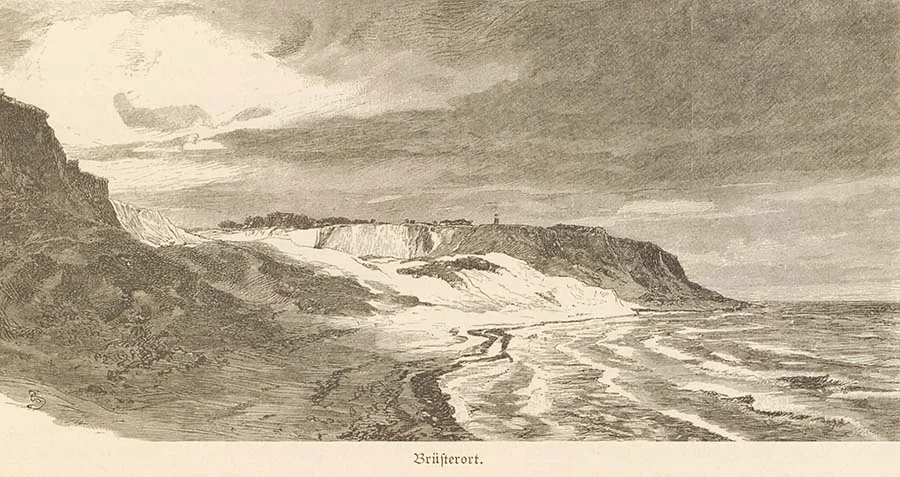 The lighthouse on Cape Brüsterort (Cape Taran).
Every well-to-do East Prussian, every more or less prosperous citizen of Königsberg has long since picked out a spot by the sea that he prefers to all others. As soon as June draws to a close, a motley procession of carriages and calashes, carts and wagons begins to stretch from Königsberg and its environs towards the coast, people walk in an endless stream and riders gallop along.
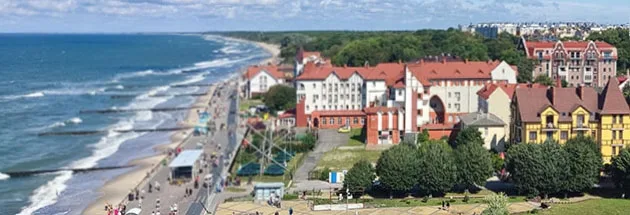
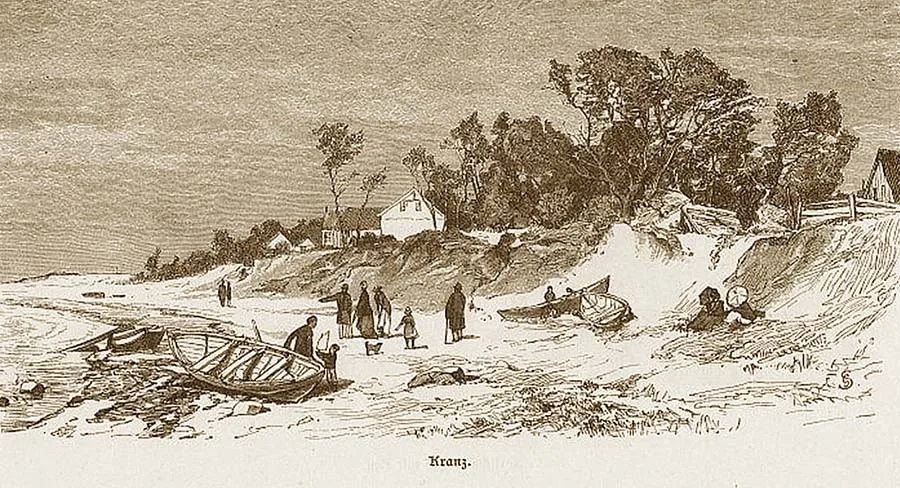 Cranz (Zelenogradsk) in the 19th century.
Soon, however, this whole mass of people divides into two equal streams. One half heads for Neukuhren or further west along the coast, while the other makes for Cranz. Let us follow this stream too. Along an excellent road it will lead us to the local El Dorado – blessed Cranz. Only thirty years ago this was Cranzkuhren, a poor fishing village buried in the sands of the Curonian Spit.
Only a very few misanthropes who shunned human company came here from the capital in summer to enjoy their rest in solitude, listening to the murmur of the waves and regularly refreshing themselves with sea bathing. But gradually people realised that it is precisely here that the surf beats hardest against the shore, which is undoubtedly very good for the health. The place became very popular, the visitors began to settle in more comfortably and even built a first, very primitive guest house here, which fortunately burned down at just the right moment to make room for a spacious, well-appointed hotel.
Soon a multitude of villas, boarding houses and guest houses to suit every taste and purse sprang up around it, and nowadays Cranz usually accommodates more than two thousand resort guests in summer.
The tiled roofs of the cottages peeping through the green of the trees along the Corso, the large spa park "Plantage", the hotel building, more like a palace, the charming Swiss-style chalets, the little Kirchengasse leading to the local church, and the delightful views of the boundless expanse of the sea merge into a single whole that is most pleasing to the holidaymaker's eye. Those who are economising stay in thatched peasant houses, while their owners, out for profit, move into the cowshed for the season and end up sharing it with the livestock for almost the whole summer...
Here, out of every twelve people only one will be genuinely ill, four will turn out to be Polish Jews, and the remaining seven idle holidaymakers in search of every pleasure a seaside resort can offer them in summer. Unforgettable bright evenings, Saturday balls and concerts, cosy children's parties, group excursions to the nearby Sarkau forest and the neighbouring beach villages – rare is the visitor who leaves this place dissatisfied! 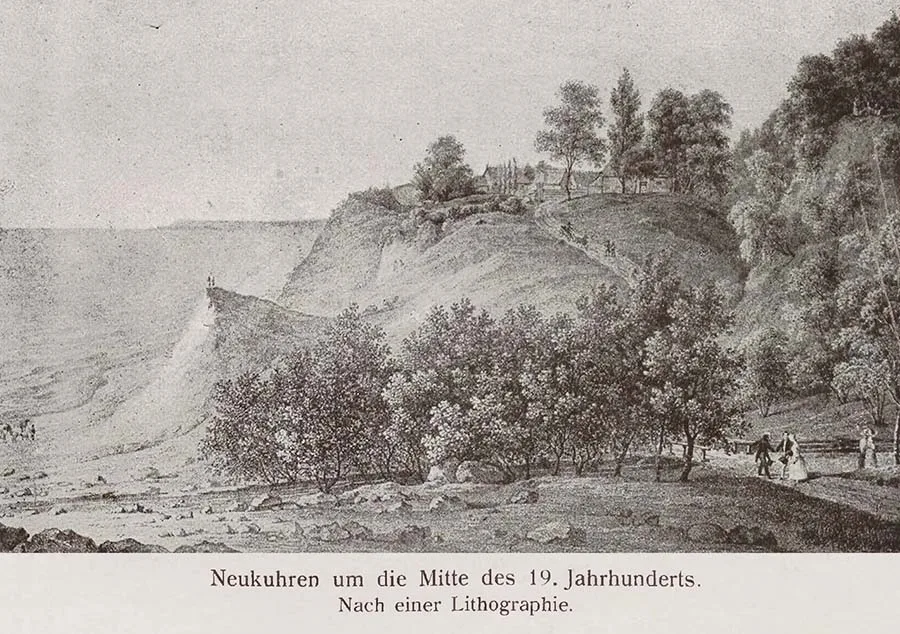 Neukuhren (Pionersky) in the mid-19th century.
Alongside Cranz, Samland's favourite seaside resort is Neukuhren. The road to it is highly romantic: it runs through the hamlet of Eulenkrug deep in the forest and passes the famous "church village" of Pobethen (Pobethen), widely known for its picturesque surroundings and the many old legends connected with it.
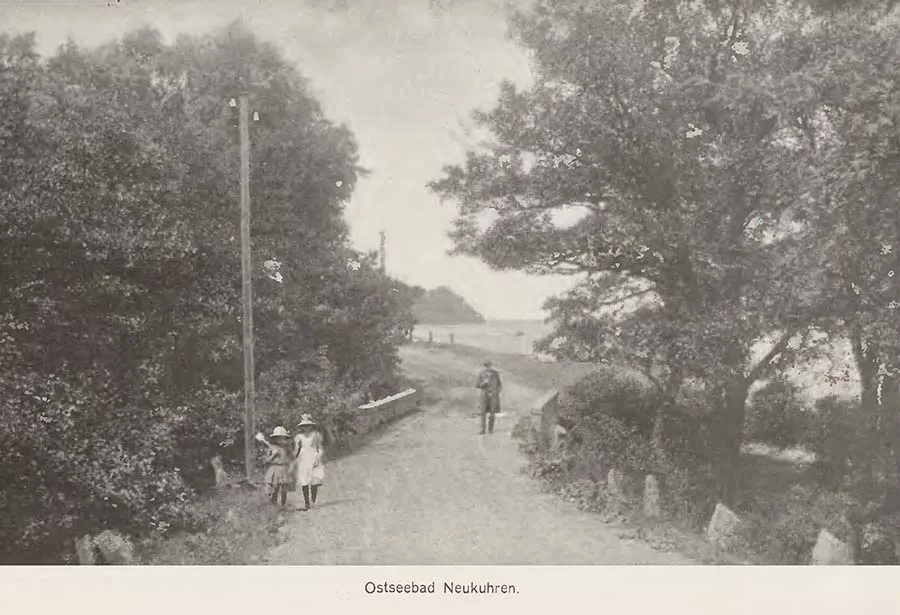 Neukuhren (Pionersky) in one of its earliest photographs.
Here a lively, almost urban life is in full swing. We leave Pobethen behind, and soon delightful views open up before us of Neukuhren, the most frequented seaside resort on the Samland coast.
It lies fairly high above sea level and combines everything that makes a seaside resort so pleasant. The bathing area is very close. It is convenient and safe. The surroundings of Neukuhren are pleasant and full of sights. With very little effort we can visit them all in a few days.
That is why this resort is becoming more popular year by year. As recently as three years ago the houses here were in no way remarkable; now four splendid houses, recently built with great taste, lend the former fishing village elegance and style. A fifth is nearing completion.
It must be admitted that life in Neukuhren is more pleasant than in Cranz, the atmosphere is more informal, and it enjoys great popularity among holidaymakers.
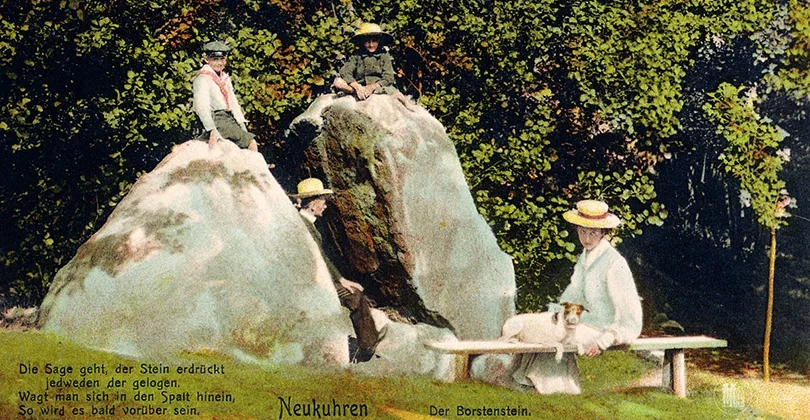
One of the visitors' favourite outings is a walk to the "Stone of Lies", a huge boulder in the middle of a wooded ravine, split in two – presumably by a stroke of lightning. And who does not know the legend connected with it!
"Near Neukuhren, in a little wood,
Not very far from where we stood,
But well away from dwellings,
There lies a stone that's split in two –
Of which we'll tell a tale to you
Well worth the telling...
...When love's sweet season comes along,
Then lead your sweetheart, true or wrong,
Between the two stones in the hollow.
The legend says that only she
Who tells her love no lie may be
Allowed to pass and follow.
Or else the stones will shift their ground
And crush her fast and hold her bound…"
"The Stone of Lies near Neukuhren". Full text
My translation. T.K.
*************
Not far from Neukuhren lies Rantau (Rantau). This too is a seaside resort, even though it is a quarter of a mile from the coast. But the way from the village to the beach is easy and pleasant, and the shore is ideal for bathing.
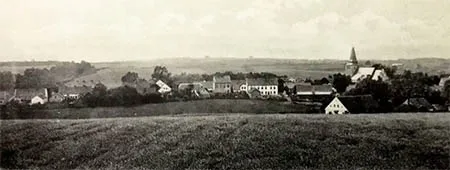
Rantau is especially popular with those who do not intend to spend a great deal on their holiday, for life here is very cheap. But... the surroundings of the resort are desolate and deserted. Immediately beyond Rantau begins a heath, entirely overgrown with mosses and thickets of heather. It surrounds the traveller on all sides: as far as the eye can see, the boundless, dreary plain stretches on and on. Yet it, too, teems with its own life: partridges, shyly poking their heads out of the grass, scurry in flocks through the dense thickets, while high in the sky hawks soar on outspread wings, looking out for prey. The cries of wild geese, flying like a pink cloud in the rays of the evening sun, echo in the nearby valleys and gullies, and from somewhere far away come the calls of marsh birds hurrying to roost at one of the nearby lakes of Samland.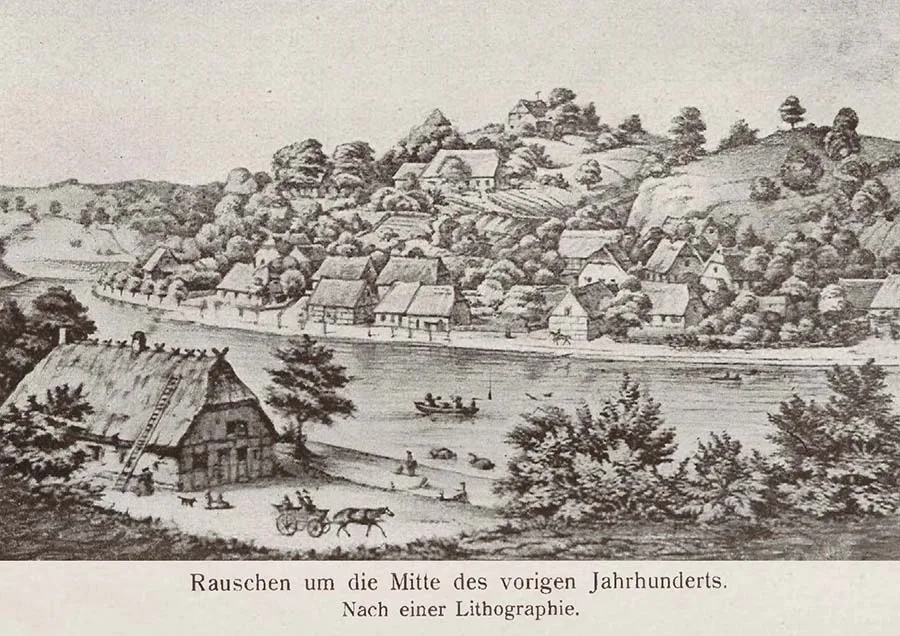 Rauschen (Svetlogorsk) in the mid-19th century.
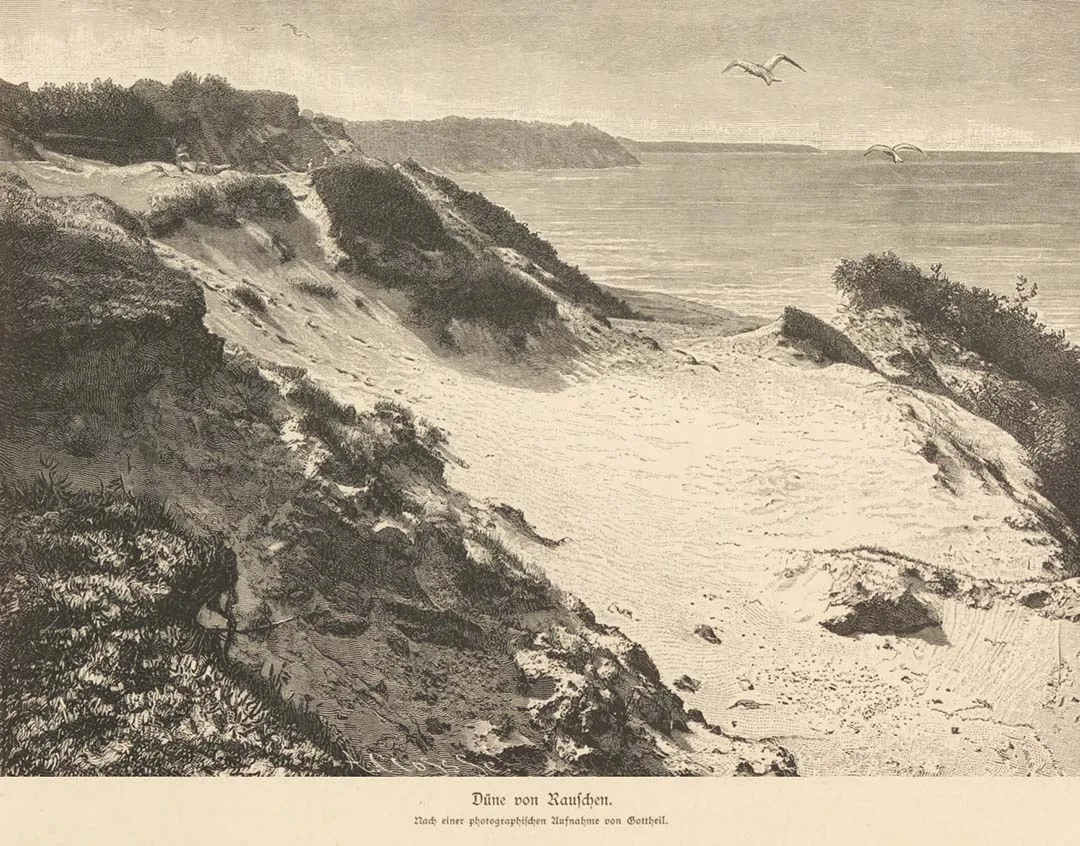
Via Wangenkrug (Wangenkrug) and Loppöhnen (Loppöhnen) one can get from Neukuhren in a couple of hours to the large fishing village of Rauschen (Rauschen), which is separated from the sea by high dunes and is nevertheless beautifully situated. It lies on the shore of a very picturesque lake; here and there on the slopes of the wooded hills around it many country cottages can be seen.
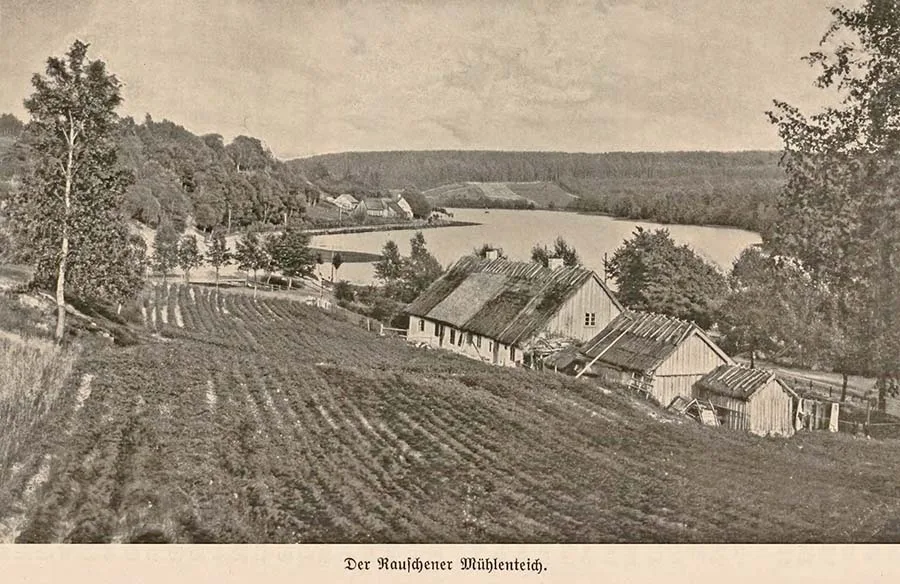 Rauschen (Svetlogorsk) in the early 20th century.
The way to the lake itself, however, is rather arduous, for although it is laid with boardwalks, it crosses a high sand dune. Truly, there is nothing drearier than this monotonous path.
But while granting Neukuhren and Cranz all their merits, one must confess that the most enchanting spot not only on the coast but in the whole of Samland is undoubtedly the seaside resort of Warnicken. Nature has truly excelled herself here to satisfy the most exacting taste. It is no secret that in our northern latitudes her gifts are meagre and rare, but in Warnicken nature lavishes her riches so generously that you seem to have found yourself in the blessed South.
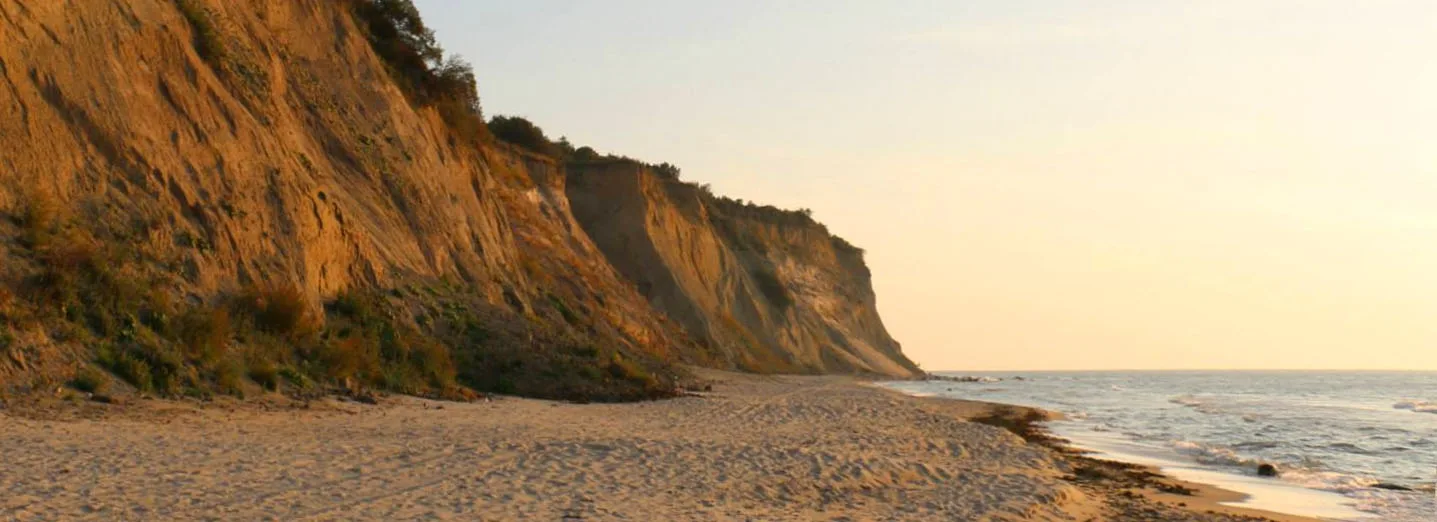
Near Warnicken begins the narrow, deep, densely wooded Wolf Gorge (Wolfsschlucht). It is the longest and most picturesque ravine on the northern coast of Samland. From the viewpoint called the "Hunter's Peak" (Jagerspitze), on the eastern side of the gorge, truly breathtaking views open up.
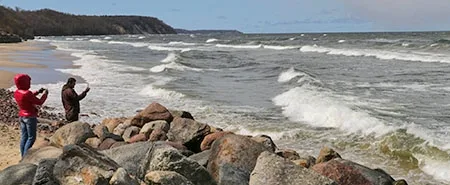
Standing up here, you can watch the sea waves breaking far below against the jagged cliffs. Foaming spray flies high into the air, and the waves, shattered by the mighty rocks, hastily retreat to launch a new attack, furious and… once again in vain.
From the depths of the ravine, wherever you look, dense treetops rise in tiers towards the sky, and somewhere below, beneath this whole swaying wall of green, you hear the friendly splashing of a mountain brook running along the bottom of the gorge. It babbles along, carelessly rolling its pebbles, unaware that very soon its joyful young life will end and the boundless sea, opening its arms to meet it, will take the little stream into itself.
...Up here you can sit for hours listening to the roar of the waves beating against the cliffs and the rustle of the mighty oaks in the gorge, never tiring of this mysterious eternal music of nature. And even when the sea, weary of its struggle with the cliffs, grows calm and laps below, meek as a lamb, glittering like molten crystal in the sun, being here fills mortal souls with harmony and peace. Truly, nothing in the world heals our soul as the sea does...
LEGENDS OF PRUSSIA in the blog of Tatyana Kolivay.
TRANSLATOR'S NOTE
1. Now Cape Taran. The Brüsterort lighthouse (Brüsterort) was built in 1846 to a design by Alexander Veitmeyer (Ludwig Alexander Veitmeyer, 1820–99).
Translated from Russian with the help of AI (Claude, Anthropic), October 2026.