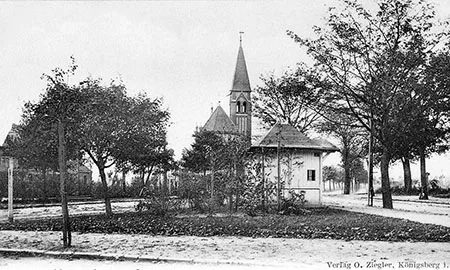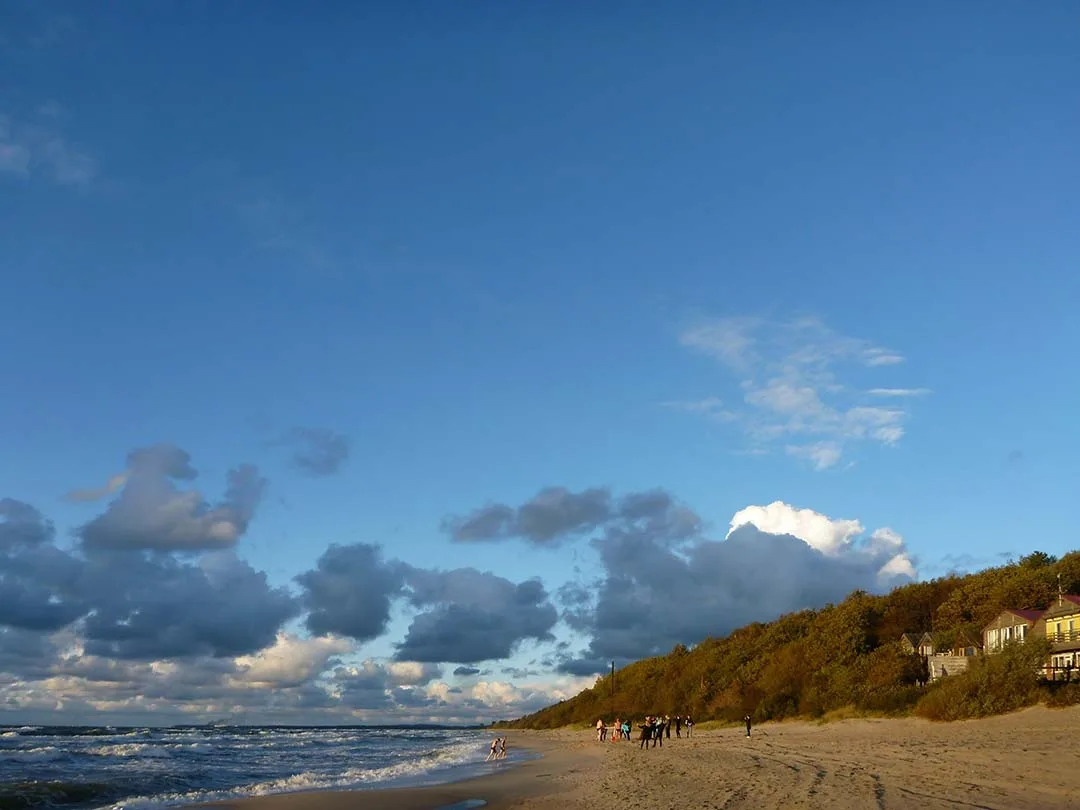
Tenkitten was founded in 1391 as Tenkyten, although a Prussian settlement probably existed on this site even earlier. According to a widespread version, it was near Tenkitten that on 23 April 997 Bishop Wojciech of Prague, also known as Saint Adalbert, was killed by pagans. The first chapel in Tenkitten was probably built in 1320–43 by Bishop Johannes Clare (d. 1344). In 1424, on the orders of the Order's Marshal Ludwig von Landsee (d. 1451), a new one was built to replace the first, which had burned down. It, too, soon fell into disrepair, and in 1523 a third was built in its place, which also did not stand for long and was destroyed by a hurricane in 1669. 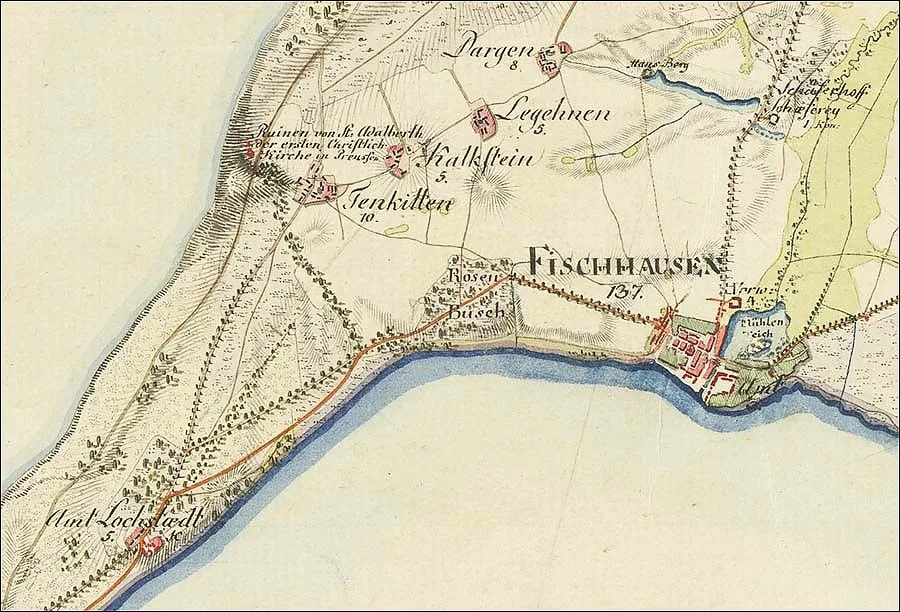 Tenkitten and its surroundings on a map from the late 18th century.
In 1785 Tenkitten is mentioned as a royal village and the residence of the pastor of Lochstädt (Pavlovo) and Alt-Pillau (Baltiysk). At that time the village had ten households.
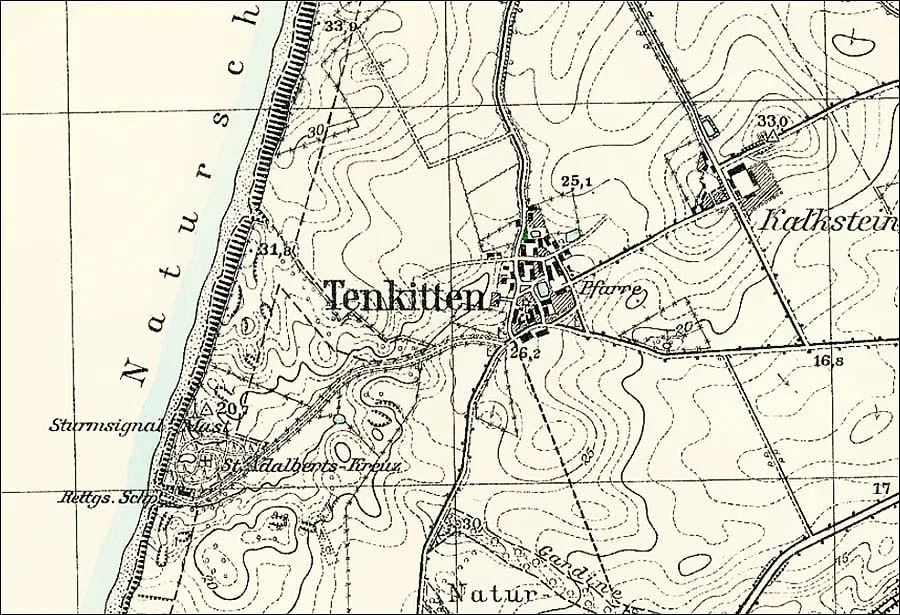 Tenkitten on a map from the first half of the 20th century.
In the 19th century Tenkitten was a village which from 1818 formed a rural community in the Kreis of Fischhausen (Primorsk; from 1939 it became part of the Landkreis of Samland).
The village belonged to the parish of Lochstädt (Pavlovo). In 1818 Tenkitten still had ten households. In 1871 Tenkitten had nine residential houses, occupied by ten families. On 13.06.1874 the rural community of Tenkitten was included in the newly established Amtsbezirk of Lochstädt (Pavlovo).
In 1920 an underwater telephone cable 170 km long was laid from Tenkitten to the town of Leba in Pomerania — the longest underwater telephone cable at that time.
On 17.10.1929 the village of Kalkstein (Uspeshnoye), previously an independent community, became part of the rural community of Tenkitten.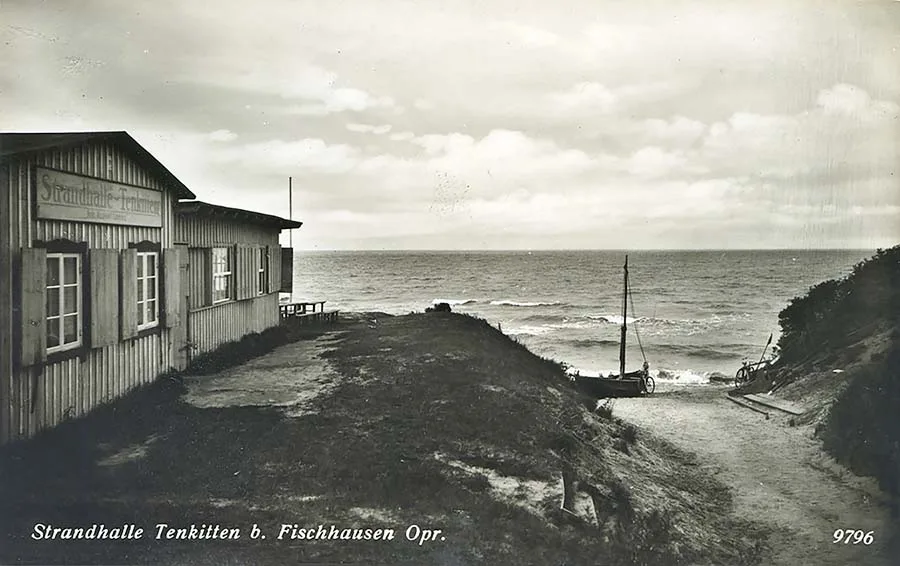 The beach pavilion in Tenkitten.
Amtsbezirk Tenkitten
On 14.03.1914 the Amtsbezirk of Lochstädt was renamed the Amtsbezirk of Tenkitten. At the time of the renaming the Amtsbezirk comprised three rural communities: Kalkstein (Uspeshnoye), Legehnen (Popovka) and Tenkitten (Beregovoye). No later than 1929 the community of Kalkstein (Uspeshnoye) lost its independence and became part of the rural community of Tenkitten. At about the same time the community of Legehnen (Popovka) passed to the Amtsbezirk of Neuhäuser (Mechnikovo). On 23.04.1930 the rural communities of Dargen (Lunino), Gaffken (Parusnoye) and Sanglienen (Khmelyovka) joined the Amtsbezirk of Tenkitten. Together with the community of Tenkitten itself, they made up the Amtsbezirk of Tenkitten until 1945.
In the spring of 1945 the so-called "Tenkitten line" of the German army's defences (Tenkitten-Riegel) ran near Tenkitten. On 17.04.1945 Tenkitten was taken by Red Army troops. To break through the line further, the command of the 3rd Belorussian Front committed the 11th Guards Army to battle on 20.04.1945. On 22.04.1945 the commander of the 16th Guards Rifle Corps, Major General S.S. Guryev (1902–45), was killed near Tenkitten.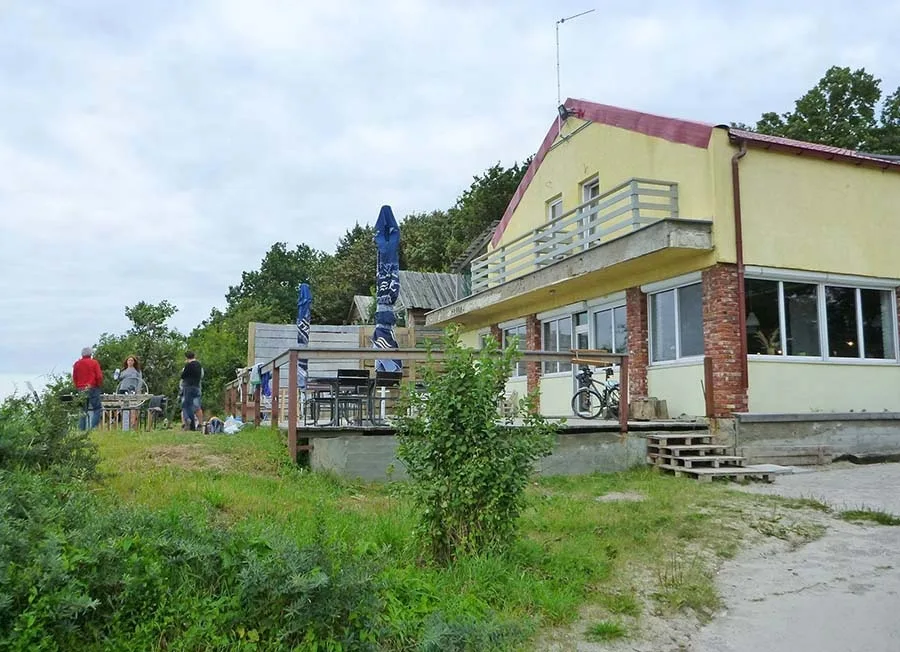 The Witland art village is a small hotel with a conference hall and a café with a veranda on the seashore.
The exact date when Tenkitten was renamed Beregovoye is unknown.
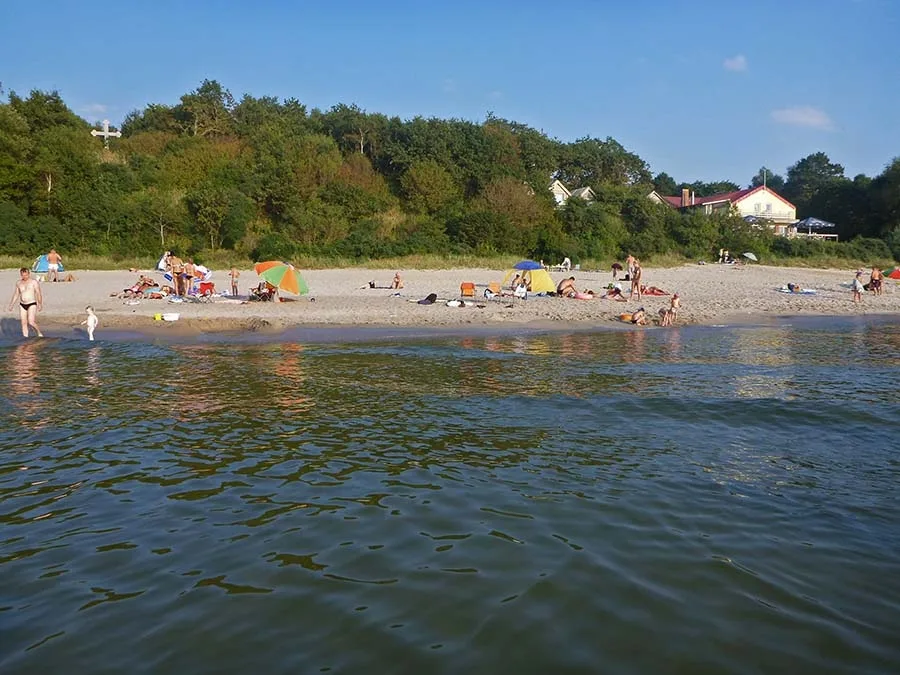 The spot became popular thanks to its cosy beach, hidden away from tourists.
Initially the settlement became part of Primorsk District (from 1963 Zelenogradsk District) and was subordinate to the Primorsk Town Soviet. In 1955 it was designated as a "settlement" without a name of its own. In 1975 it was subordinate to the Primorsk Town Soviet. No later than 1988 it became part of the settlement of Lunino. In the 1990s it was unofficially known as Tankiteno and consisted of six houses. Soon, however, it regained its former name — Beregovoye. On 20.04.1997, for the 1000th anniversary of the death of St Adalbert, a new cross in his memory was erected on the shore near the settlement and soon consecrated (02.05.1997). As of 2018 the settlement has six houses.
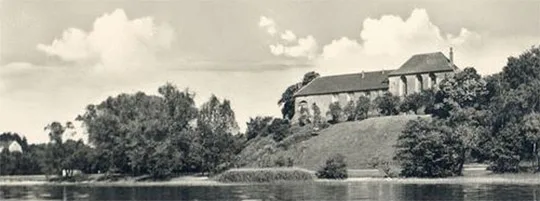
Sights: a memorial cross at the presumed site of St Adalbert's death, a Prussian earthwork fortification (the so-called "Gardine"), the ruins of Lochstädt Castle, a rangefinder tower of the railway artillery (post-war).
Population: 1818 – 62, 1867 – 116, 1871 – 87, 1885 – 78, 1905 – 122, 1910 – 114, 2010 – 13 inhabitants.
Population of the Tenkitten community: 1818 – 62, 1867 – 116, 1871 – 87, 1885 – 78, 1905 – 122, 1910 – 114, 1925 – 202, 1933 – 216, 1939 – 258 inhabitants.
Composition of the population of Tenkitten in 1871: all 87 Protestant Christians, children under 10 – 17, literate – 58 (84%), deaf-mute – 1.
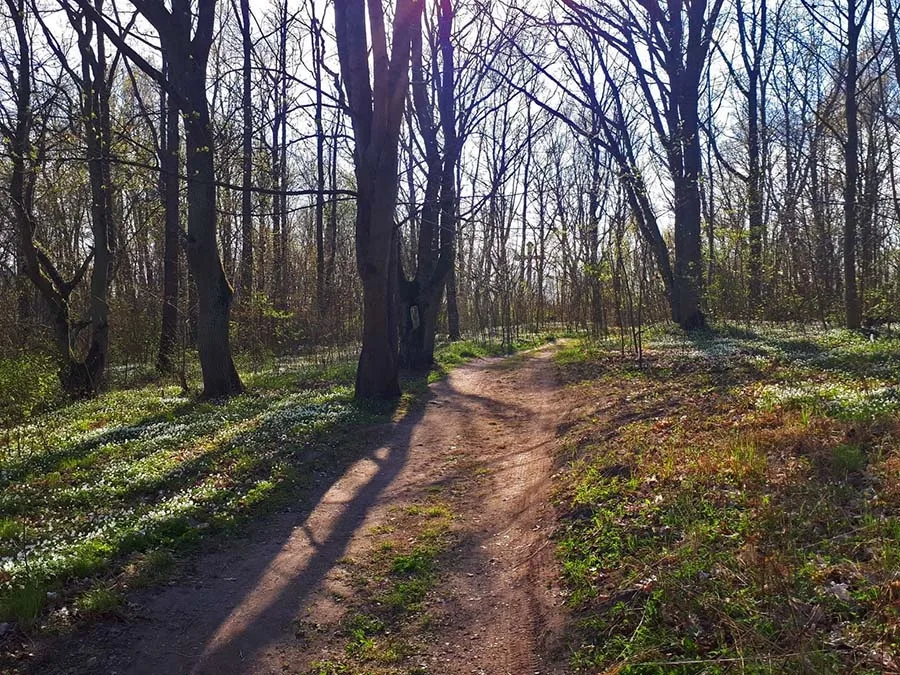 The road to the St Adalbert memorial on the seashore.
An excerpt from the chapter "The Shores of Samland"
from the book by local authors "Königsberg Local Studies",
published at the end of the 19th century
In 2012–2014 "Pregola", the literary supplement to the "Baltic Almanac",
published a translation of the book by the Königsberg authors Dr Richard Armstedt, professor at the Altstadt Gymnasium, and Dr Richard Fischer, senior teacher at the Kneiphof Gymnasium, "Königsberg Local Studies" ("Heimatkunde von Königsberg i. Pr.", 1895, Kommissionsverlag von Wilhelm Koch, Königsberg), made by an unknown translator. The idea of publishing it belonged to Igor Vladimirovich Afonin. The text was adapted and annotated by Aleksey Borisovich Gubin and Igor Fyodorovich Avtukhov. That book had a separate chapter on the more distant surroundings of Königsberg, which contains several paragraphs about Tenkitten. Substantially edited, we offer them to your attention as a supplement to the text by Aleksey Yevgenyevich Petrushin.
– – – – – – – – –
North of Lochstädt Castle, between the sea and the lagoon, a curious ridge of hills covered with old oaks, limes and dense undergrowth stretches across the whole peninsula. This is the so-called Gardine, an earthen rampart said to have been built by the native inhabitants of Samland between 1242 and 1250 as a defensive fortification against the Teutonic Knights.
Where this rampart approaches the seashore, not far from the village of Tenkitten (now the settlement of Beregovoye), an iron cross rises in memory of the first Christian missionary in Prussia, Bishop Adalbert of Prague (Bischof Adalbert von Prag, 955–997).
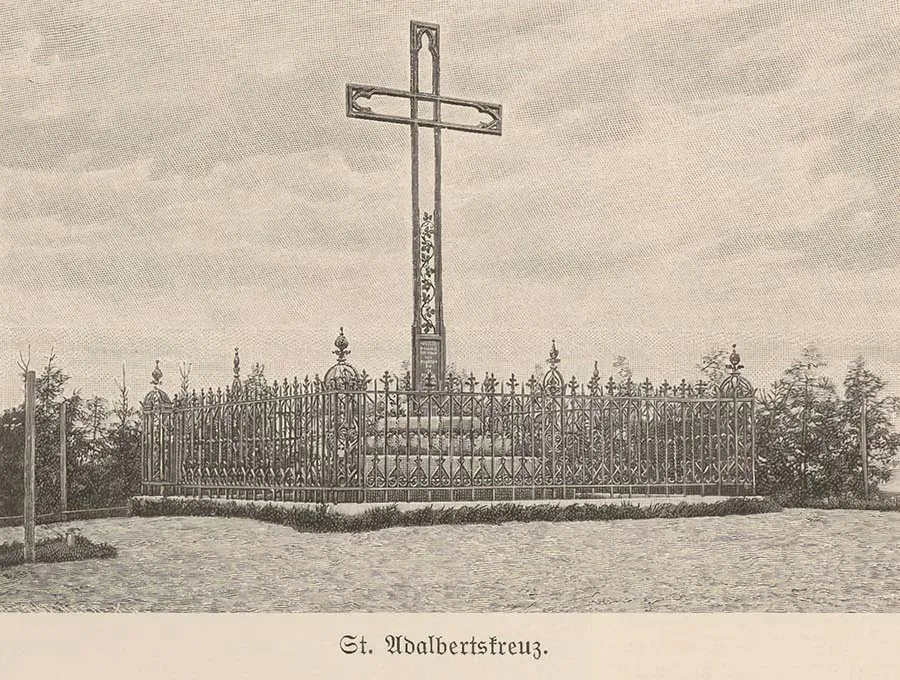 The memorial cross that stood here until 1945.
It is 8.78 metres high. It was made and erected at the expense of Countess Wielopolska (Gräfin Wielopolska).
(The memorial was created at the expense of Countess Wielopolska, who had been forced to move to this area because of the November Uprising in Poland (1830–1831). She donated 400 thalers to the administrator Lange of Fischhausen for the making and erection of the cross, which was cast at the Union foundry in Königsberg. Additional costs were covered by donations from other people. Count Dohna-Wundlacken added wrought-iron leaf ornaments at his own expense. The cross was erected in 1834. In 1897 it was renovated, and after 1945 it disappeared. In 1991 a temporary wooden cross was put up in place of the lost one, and in 1997 it was replaced by a permanent one — editor's note.)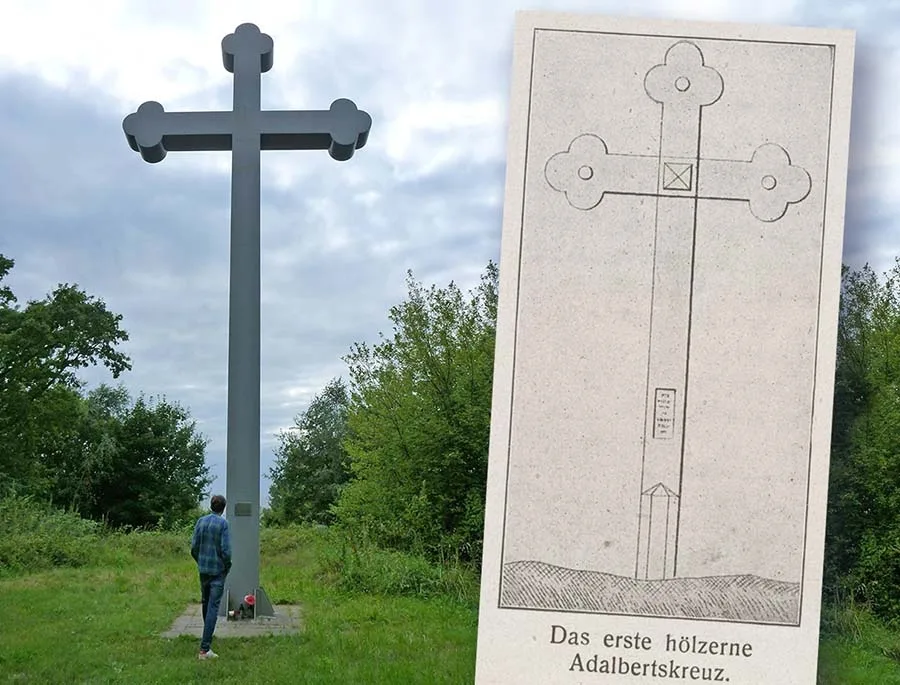 The cross erected in 1997 repeats the shape of the oldest, wooden one.
Adalbert came to Prussia in 997 as a missionary to convert the local pagans to Christianity.
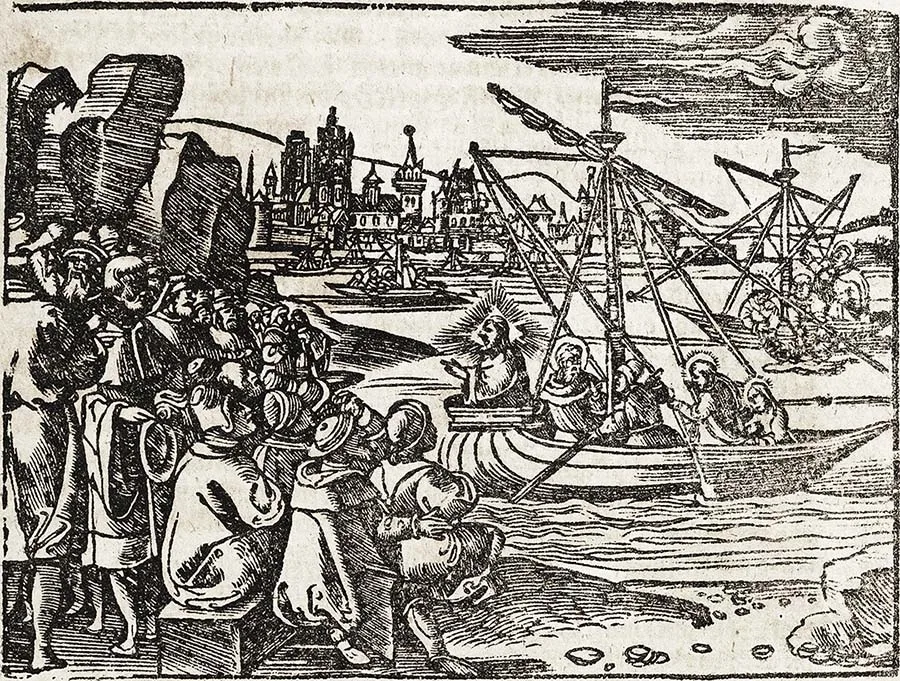 St Adalbert arrives in Prussia by sea.
But as soon as he entered the sacred grove of Romowe, which was regarded as the abode of a Prussian deity, he was killed by the Prussians. Later his remains were ransomed and buried in Gniezno (Gniezno / Gnesen). He was proclaimed a holy martyr.
(There are several versions of where Bishop Adalbert died. According to one of them, it happened near the village of Tenkitten, where it was therefore decided to create a memorial to him. Adalbert's relics were ransomed from the Prussians by the Polish prince Bolesław the Brave (Bolesław I Chrobry, 967–1025) and placed in a church in the town of Gniezno — editor's note.)
After his death Adalbert was proclaimed a saint. On the spot where the cross now stands, the Order's Marshal Ludwig von Landsee built a chapel in 1422–1424, which became an important local attraction.
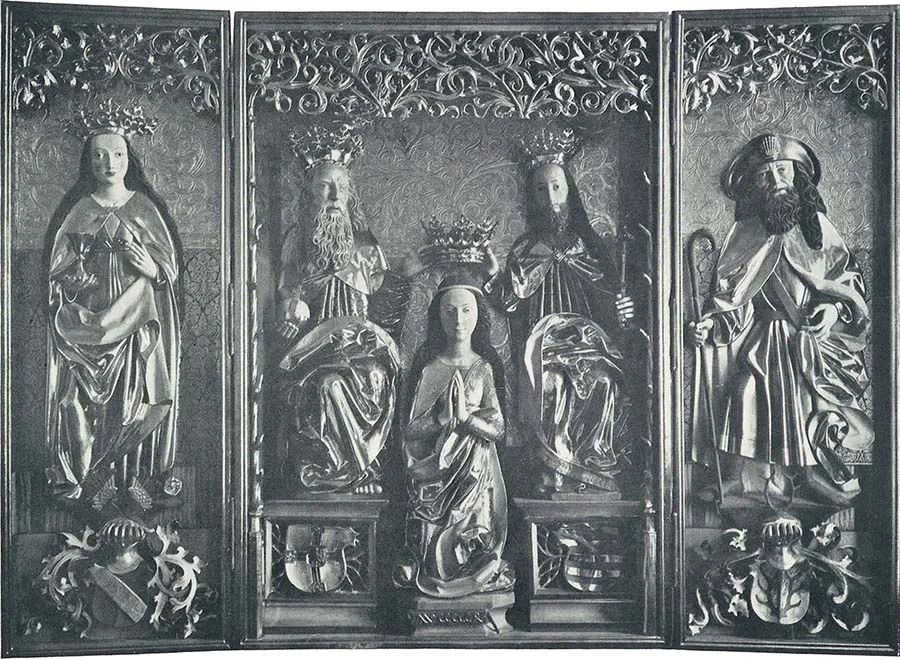 The altar of the Tenkitten Chapel of St Adalbert, shown on the right.
Its popularity grew especially after Pope Eugene IV (Papst Eugen IV, 1383–1447) declared in 1431 that a pilgrimage to it atoned for all sins. Only the Reformation, which began in the first quarter of the 16th century, put an end to this story. The chapel fell into disrepair over time and, in a violent storm in 1669, collapsed right in the middle of a service. The worshippers escaped by a miracle. Its altar (see above), donated in 1504 by Grand Master Frederick of Saxony (Friedrich von Sachsen, 1473–1510), was first moved to Lochstädt Castle and then to Marienburg (Marienburg, now Malbork in Poland), where it is kept to this day.
(In 1822 an oak cross five metres high was put up on the site of the chapel. The chapel itself was revived at the beginning of the 20th century in Königsberg itself. It adorned Amalienau, a new district in the western part of the city — editor's note.)
Modern photos: Mikhail Ogorodnikov.
Translated from Russian with the help of AI (Claude, Anthropic), October 2026.