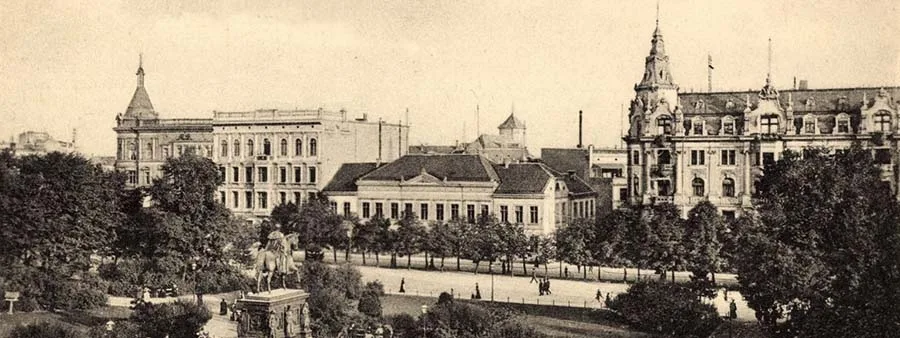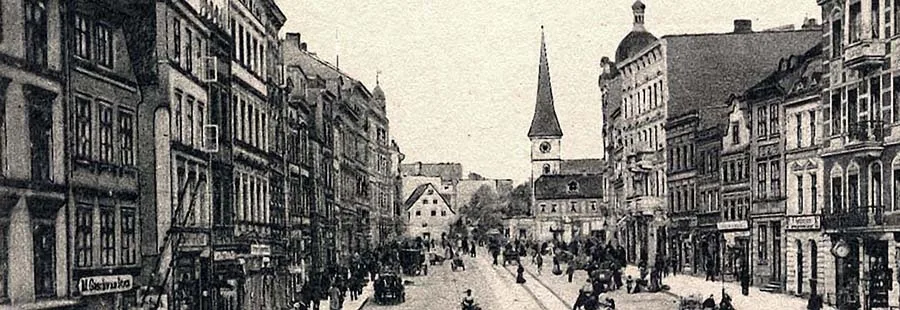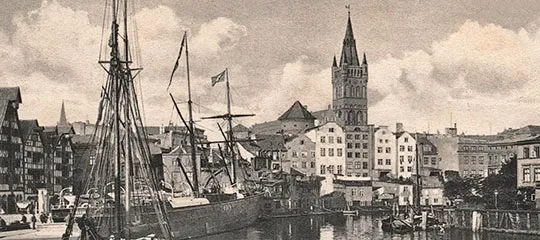
After the secularisation of the Teutonic Order (1525), Tragheim became a Freiheit of Königsberg Castle. A Freiheit is the German counterpart of the Russian sloboda: a territory that was not legally a town and was originally intended solely for economic activity, but was later settled. In Königsberg, the Freiheits were administered either from the castle (as in the case of Tragheim) or were handed over to the municipal authorities. If a Freiheit built its own church, it did not form a separate parish but became a "daughter" of a town church. Accordingly, the inhabitants of a Freiheit belonged to the same congregation as the townspeople. Some Freiheits were granted permission to set up their own administration and courts with rather limited powers (today's district administrations in cities are the equivalent of such bodies). In that case the Freiheit received a coat of arms and a seal (mostly a court seal).
Tragheim obtained its court in 1528 under Duke Albrecht, at the same time as it received the status of a Freiheit.
In 1577, already in the time of the nominal reign of Albrecht's son, Duke Albrecht Frederick, a seal of the Tragheim court was introduced for certifying judicial decisions. Apparently Tragheim acquired its own coat of arms at the same time: a stag's head between two fir trees on a blue field (yet another reminder of the "settlement at the forest edge").
Until the 17th century the duties of judge in Tragheim were combined with those of the local innkeeper, who had received the privilege of building his establishment near today's crossing of Sevastyanova and Rokossovskogo streets. He and the innkeepers who followed him belonged to the hereditary village headmen (Erbschulze), uniting in one person the authority to feed, water and judge the inhabitants of the sloboda. Besides this, the headman exercised general management of the sloboda, saw to it that the inhabitants performed their duties and made sure that the boundaries of the plots were observed. For this the inhabitants of Tragheim paid a levy for the headman's upkeep. If the headman left no heir in the male line, the post passed to the husband of his eldest daughter or to the second husband of his widow. (One may suppose that such brides were in great demand among the men of the time.)
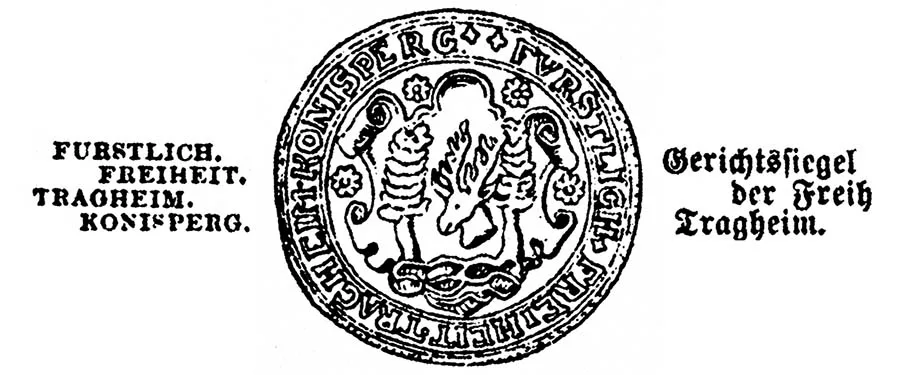 Seal of the Tragheim court.
In 1562 Duke Albrecht presented an estate in Tragheim, on Tragheimer Kirchenstraße, to his adviser and favourite, in reality a swindler and adventurer, Paul Skalich from Croatia.
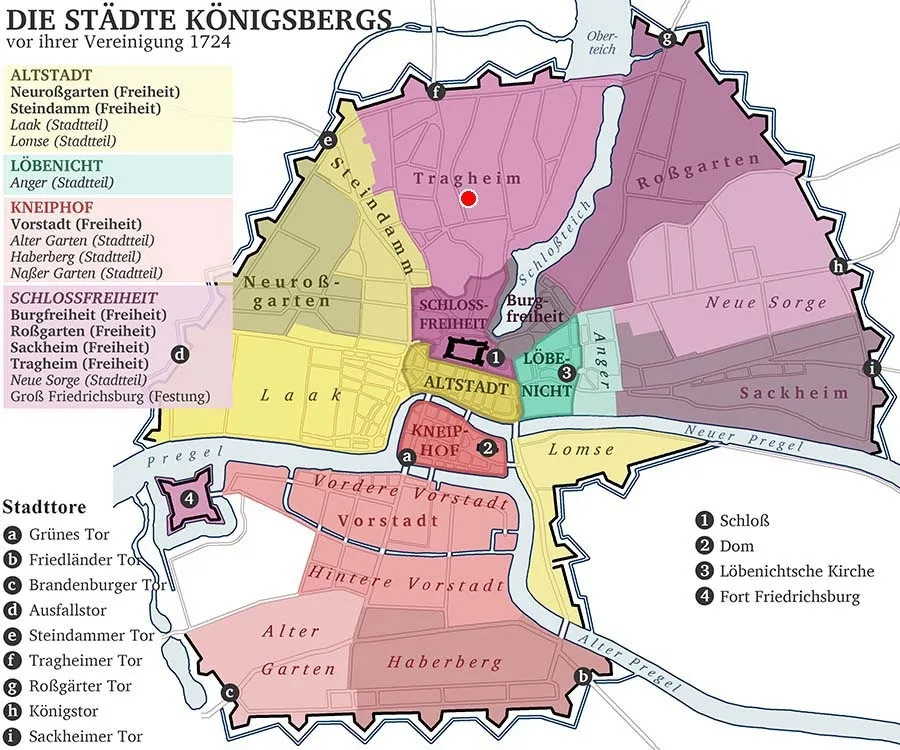 Tragheim on a reconstructed map of the towns, slobodas and districts of Königsberg before their unification in 1724.
The locals called this courtyard Kalixtenhof, noting that strange foreigners regularly gathered there. However, Duke Albrecht gave Paul Skalich even richer gifts, for example Kreuzburg Castle (the village of Slavskoye).
When in 1626, under pressure from the Swedes, the city began building the first bastion belt, Tragheim became a border district: an important section of the bastion fortifications ran along its northern side. The bastion front of Tragheim consisted of one half-bastion (by the Oberteich pond, now the Upper Pond) and three bastions, the last of which lay on the border with Steindamm. The Tragheim Gate stood between the first and second bastions. The bastions were linked by a rampart road, the future Wrangelstraße (Chernyakhovskogo Street). The main street of Tragheim ran from north to south, from the Tragheim Gate to the castle sloboda; it roughly coincided with today's pedestrian Rokossovskogo Street. This street later received the name Dritte Fließ Gasse (Third Brook Lane). The reason is that in those days a canal ran through Tragheim from the Oberteich (Upper Pond) to the Pregel, bypassing the Schlossteich (Lower Pond). On the canal stood two fulling mills and one grain mill. They were driven by the pressure of the water in the canal. In terms of today's landmarks, the first fulling mill stood at the very beginning of the canal, on the site of the former Russky Chai restaurant (61 Sergeyeva Street). The second stood on the site of the apartment building at 1–7 Minskaya Street. The grain mill stood where the Palaestra Albertina was later built (the Baltic Fleet sports palace, 16–18 Rokossovskogo Street). It is also known that in 1642 a dye works opened in Tragheim, where fabrics made by Königsberg weavers were dyed in various colours.
At the same time as the rampart ring was being built in Tragheim in 1626, construction began on its own church. Two years earlier, on 23 May 1624, Duke George William had sold Tragheim an old brickyard.
Once it was cleared, a square appeared on its site, where the people of Tragheim laid out their own cemetery (until then the dead of Tragheim had been buried in the Steindamm cemetery). At the cemetery a small chapel was first founded in 1626, and in 1632 a new church building was consecrated. The first pastor, in 1636, was Johann Benedikt Reinhardi (1603–70), a native of Erfurt. Surprisingly, although the Albertina had had a faculty of theology for more than 10 years by then, the next four pastors of the Tragheim Church were also newcomers. Only in 1696 did a native of Königsberg, Jakob Heinrich Ohlius (1650–1725), ascend the pulpit of the Tragheim Church. It was in his time, in 1709, that the Tragheim Church suddenly collapsed, which the pious inhabitants took as a bad omen. In the same year the most terrible plague epidemic in its entire history broke out in Prussia. It swept through Tragheim just as it did through other places in Prussia, where it killed up to two thirds of the inhabitants.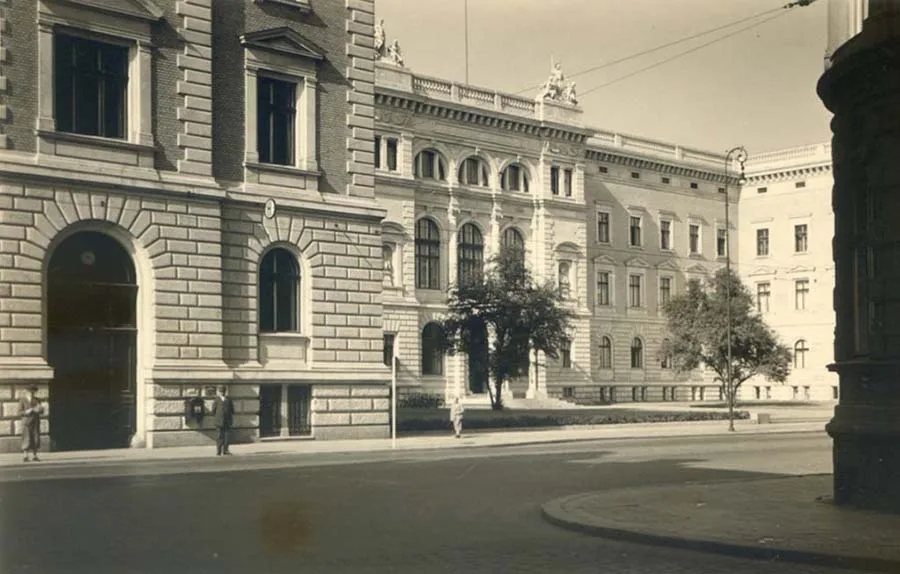 The government building of East Prussia on Mitteltragheim street.
In 1671 an event occurred that changed the whole subsequent life of Tragheim: the Great Elector Frederick William allowed Jews (mostly refugees from Austria) to reside permanently in Prussia. In Königsberg they were to settle in Tragheim.
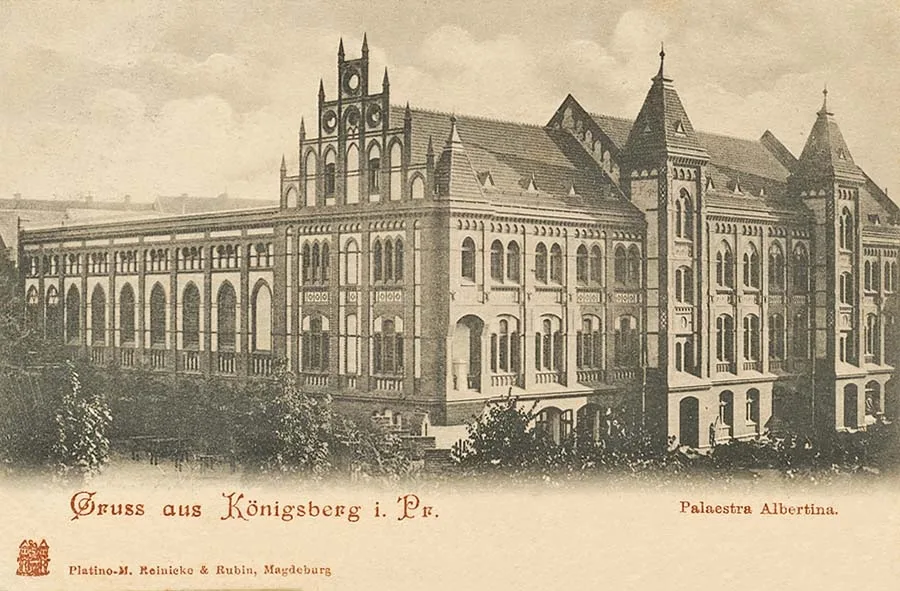 The Palaestra Albertina (left) on Third Brook Street.
A decree of 3 January 1676 guaranteed the protection of the Jews' rights and banned pogroms against Jews, which by that time had become "traditional" in the rest of Europe. It should be noted here that other European rulers, too, granted Jews permission to reside from time to time. Most often this happened when the state needed money, or when the country's economy needed reviving in general. The point is that in Europe before the Reformation, and in Catholic countries even after it, lending money at interest was permitted only to Jews (as non-Christians) and to monasteries. Monastic usury was considered a godly deed, while the Jews simply did not fall within the restrictions that applied to the Christian world. But Jews lent money at 10–20%, whereas monasteries sometimes wanted a full 100. So the choice of whom to borrow a large sum from was obvious. Each time, however, the sovereign's favour quite quickly turned to disfavour. Soon a series of pogroms initiated by the country's citizens would follow, after which a decree was issued expelling the Jewish population from the state. European Jews even developed a kind of code of conduct for pogroms, so regular and familiar a phenomenon had they become.
In Prussia, by contrast, the Jews' right to personal inviolability and the inviolability of their property was recognised at state level for the first time.
Of course, the rights of the Jewish settlers were somewhat restricted compared with those of Christian townspeople; in particular, they were not allowed to join guilds or found their own, or to hold public office. But at that time differences in rights were the norm. Practically every social, religious and national group of citizens had its own set of rights and privileges.
At first there were few Jews in Tragheim, just a few families. But as early as 1680 they were allowed to open a synagogue, and in 1703 came permission to lay out the first Jewish cemetery within Königsberg (today its site is a green area behind the regional traffic police headquarters). In 1704 the Königsberg Jewish burial society was formed. Before that, Jews had to take their dead to Poland for burial. By 1706 the number of Jewish families in Tragheim had reached ten. The first rabbi of the local Jewish community, in 1707–22, was Salomon Fürst.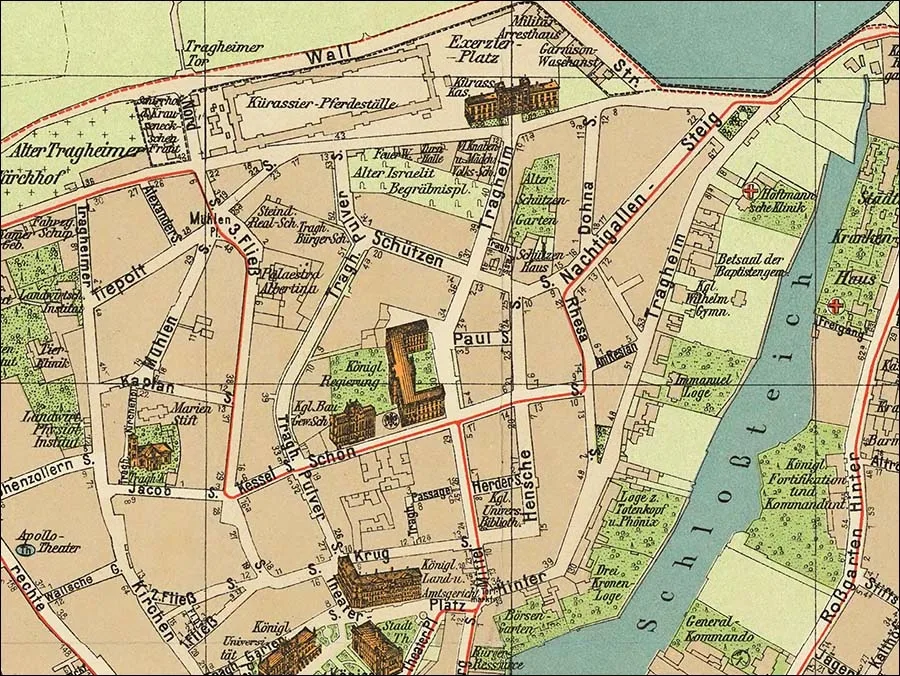
Tragheim on a map of 1901.
On 13 June 1724 the three towns on the Pregel – Altstadt, Kneiphof and Löbenicht – and the Freiheits belonging to them were united into the single city of Königsberg. But Tragheim legally remained outside this municipality.
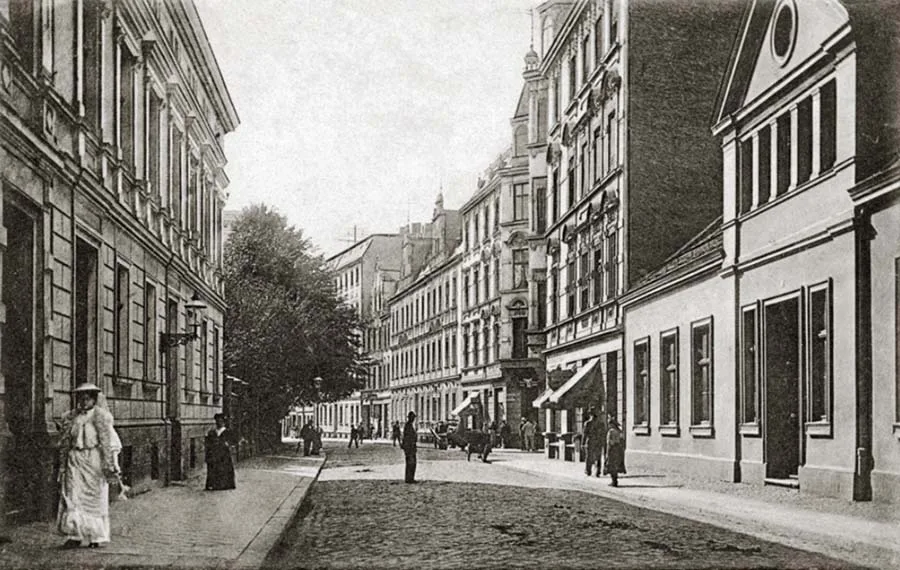 A view along Tragheimer Kirchenstraße.
It became part of the city of Königsberg only on 19 November 1808, when a new municipal ordinance was adopted in the course of the administrative reforms of Heinrich Friedrich Karl Baron vom und zum Stein.
The Tragheim Church burned in 1748 and 1783. After the latter fire it was rebuilt to the old drawings; only the roof of the tower was changed. In general, though, unlike other Freiheits (such as Vorstadt or Sackheim), Tragheim had no sweeping fires, since for a long time its buildings were interspersed with extensive vacant lots and green areas.
In the 18th century Tragheim was settled, as it were, from south to north and from west to east. As late as the middle of the 18th century the entire central and eastern parts of the Freiheit looked more like a forest than a city district. Since urban development advanced from the west, the western part (up to today's Minskaya Street) became known as "front" or "near" Tragheim (Vorder Tragheim), and the eastern part (today's Sergeyeva Street and the courtyards on both sides of it, as well as the area by the Lower Pond) came to be called "rear" or "far" Tragheim (Hinter Tragheim). Between them lay "middle" Tragheim (Mittel Tragheim).
By the end of the 18th century Tragheim was fairly well built up with houses along the street frontages, but huge (by the standards of the time) spaces remained between the streets.
In the north of Mitteltragheim (in today's terms, in the courtyard of the houses at nos. 74–82 Chernyakhovskogo Street) wax was bleached. It turns out that there was such a profession too. Wax in the form of thin discs, ribbons or threads (to increase its surface) was placed on linen sheets stretched over frames set up in the open, and was periodically moistened with water. The action of water and the sun's ultraviolet light turned the wax from brown to white. Candles of white wax cost several times more than ordinary ones and were used at festive services and in the houses of wealthy citizens of Königsberg.
In 1843 work began on building a new (second) bastion ring. In Tragheim, unlike some other districts, it did not coincide with the first one and lay some 100 metres further from the city centre. Here the bastion front was reinforced with the Tragheim Bastion, the Wrangel Tower and a new Tragheim city gate. Their construction gave rise to the rampart street Kürassier-Wall-Strasse (Professora Baranova Street and Ozerny Proyezd). And the Schleisen-Graben brook that had flowed here before was turned into a fortress moat.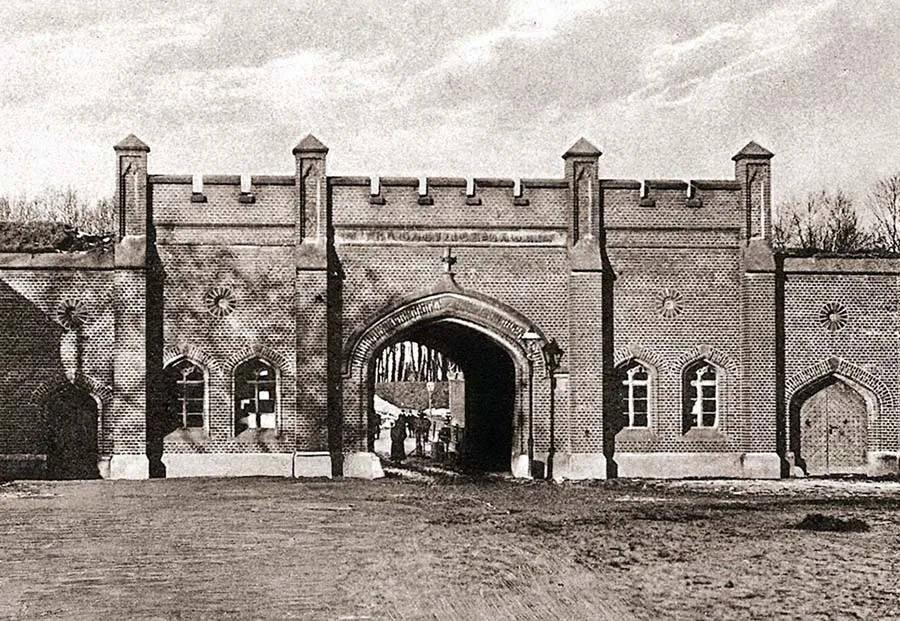 The Tragheim Gate.
The last quarter of the 19th century was the period of Tragheim's true heyday. Previously this district had not been as popular with entrepreneurs as Vorstadt, since it had no access to the river and lay at a distance from the port. But the 19th century changed the way it was seen.
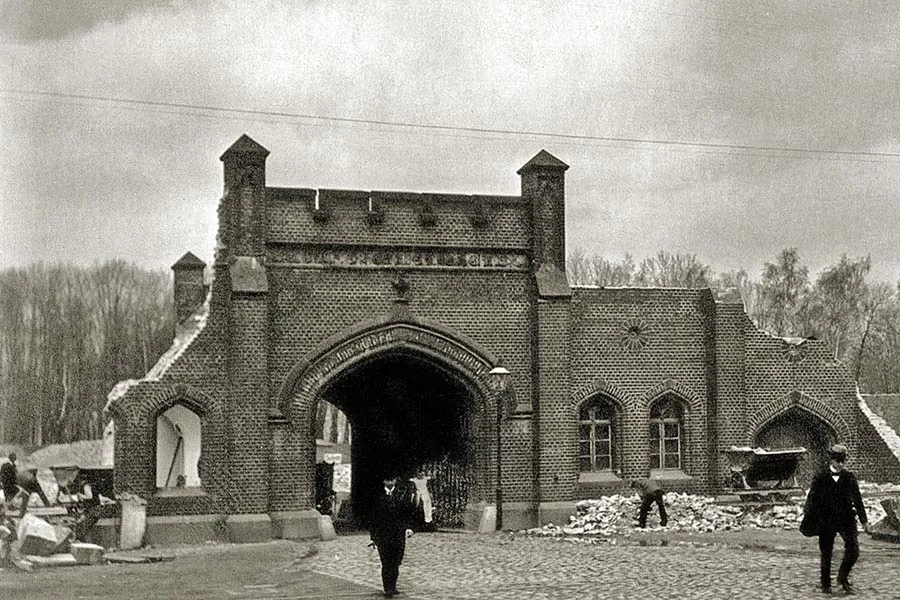
Demolition of the Tragheim Gate.
Cosy urban corners, parks and places of recreation came into demand, and with them undeveloped spaces within the city limits. Soon Tragheim had everything, and even a little more than many other districts. Garrison services: in 1873 a barracks and riding hall of the 3rd Cuirassier Regiment were built on Wrangelstraße. Schooling: in 1874 the Wilhelm-Gymnasium opened on Hintertragheim. In addition, the Tragheim municipal school was on Tragheimer Pulverstraße, the Steindamm Realschule on Dritte Fließstraße and an elementary school on Mühlenplatz. Higher education: in 1875 the Agricultural Institute opened here, with a veterinary clinic next to it; in 1887 the Physics Institute; at about the same time the Institutes of Hygiene and Physiology; and in 1896 the Palaestra Albertina sports hall. Also worth mentioning is the charitable institution Rhesianum for students from poor families, on the lane of the same name (Am Rhesianum), founded under the will of Professor Ludwig Rhesa. All these institutions belonged to the University of Königsberg. In addition, the university library was moved to Tragheim. Higher education was also provided by the Royal Higher School of Building, built on Schönstraße in 1897.
But, of course, what most influenced the attractiveness of Tragheim and the prestige of living there was the construction of the complex of the East Prussian government buildings.
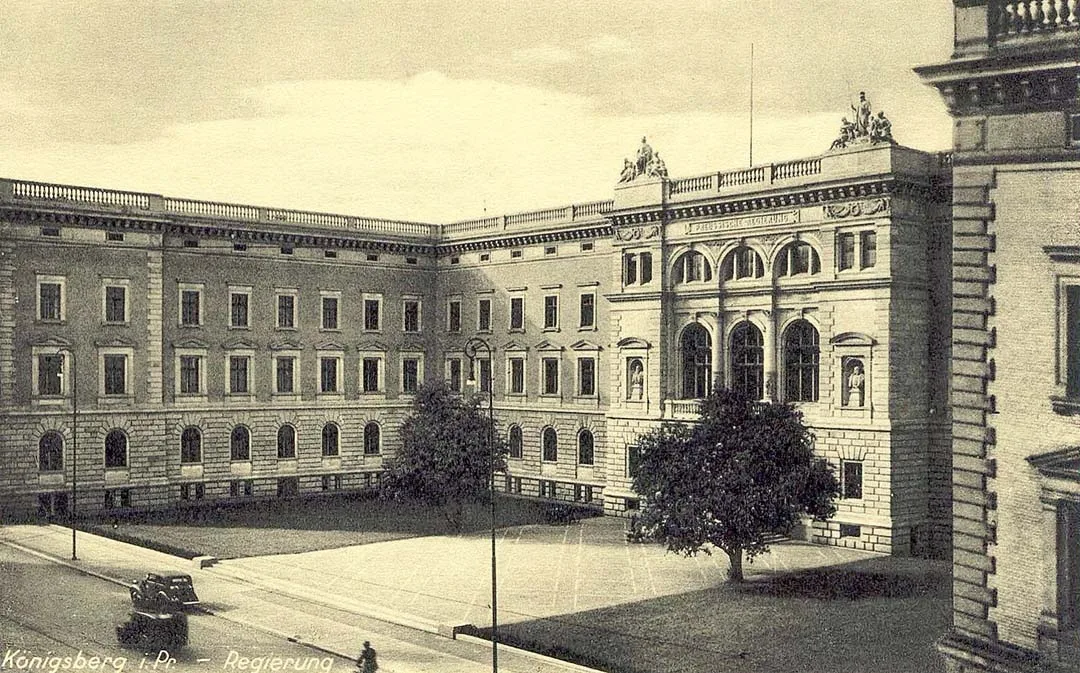
It was built in 1885 on the site of the once popular Wilhelmtheater. By 1872 the theatre had fallen into decline, the building had become dilapidated and was demolished, and it was decided to adapt the resulting vacant lot for state needs. The grand building was designed by the Königsberg architect Wilhelm Bessel-Lorck (1845–1925). It was decorated with sculptures by the well-known master Johann Friedrich Reusch (1843–1906), who at that time headed the Königsberg Academy of Arts. Busts of Emperor Wilhelm I and Duke Albrecht were mounted on the façade. On the roof stood two sculptural groups, one symbolising trade, shipping and industry, the other science, teaching and land management. Inside the building, the interior of the staircase landing was adorned with the composition "Strength, Justice, Temperance". There was a fountain in the courtyard.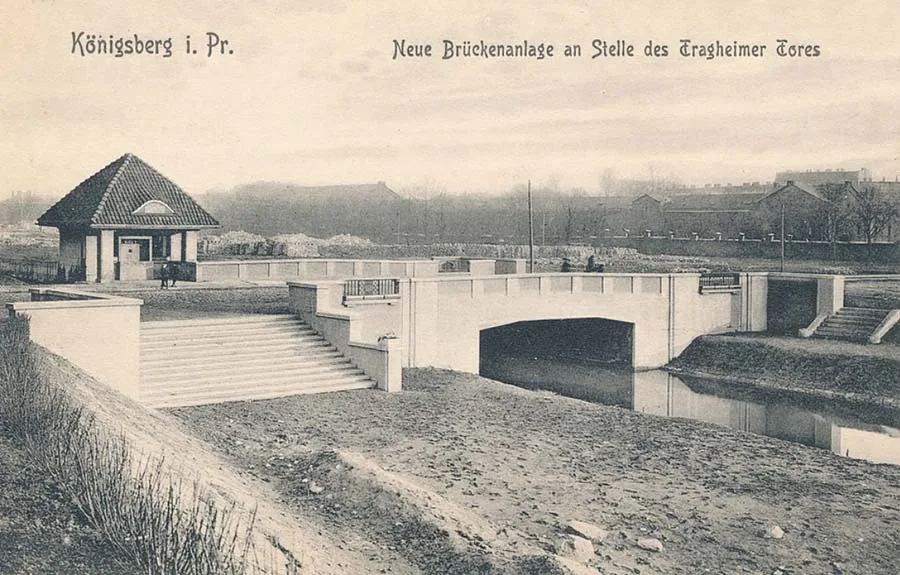 The bridge built after the demolition of the Tragheim Gate (on Gorkogo Street, before/after the Akropol shopping centre).
Among Tragheim's well-known establishments one should also mention the hotels Germanium and Kreutz on Tragheimer Kirchenstraße; on the same street stood the famous Schulte confectionery, whose almond cakes were popular throughout Königsberg.
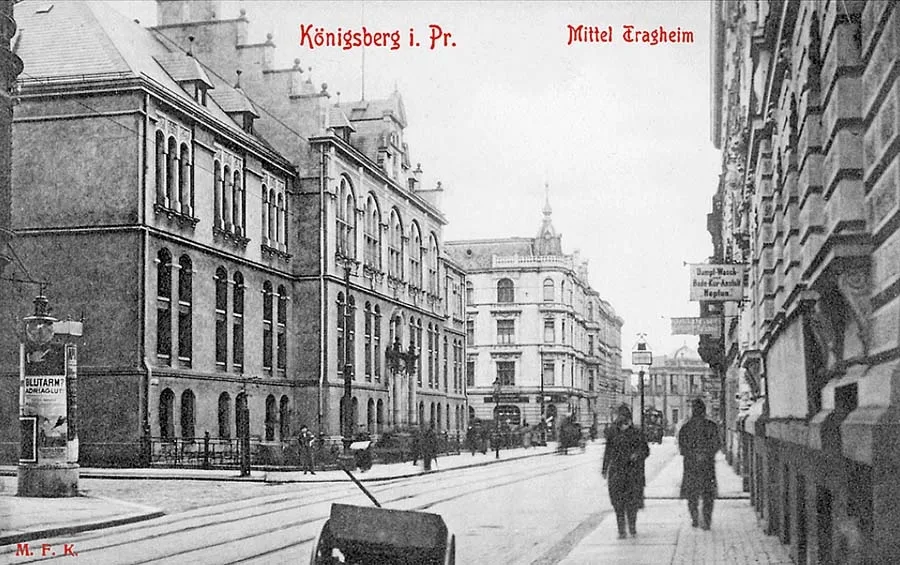 The university library (left) on Mitteltragheim street.
However, the fashion for living in Tragheim waned fairly quickly. Well-to-do citizens of Königsberg took up a new pastime: building country houses (villas) outside the city fortifications. Such districts were Amalienau, Hufen and Ratshof, and, near Tragheim, Maraunenhof.
The fortress wall in the north of Tragheim was the first place in the bastion ring where military engineers deliberately made a passage and, by filling in the moat, provided unobstructed access to the growing suburb of Maraunenhof. This happened in 1906, and an episode connected with it seems amusing today. After the rampart had been breached, Orthodox Jews found lines in the Talmud saying that on the Sabbath a devout Jew may take no more than 1000 steps in a ruined fortress. Not only are 1000 steps a day very few, but it turned out that Jews living in Maraunenhof who wanted to look in on their shops in Tragheim could not get back home without violating the Talmud's rule. But resourcefulness has always been part of Jewish culture: someone thought of stretching a cable over the gap in the wall, which, as it were, "restored" the integrity of the fortress and removed the annoying obstacle to movement. The cable became known as the "Jewish wire" (Judendraht). Today the place where this wire was stretched is on Proletarskaya Street by the Wrangel Tower.
Once the first free passage through the fortress wall had appeared, the fate of the bastion front in the north of Tragheim was sealed. In 1910–11 large-scale demolition works were carried out. The Tragheim Bastion was levelled and the Tragheim Gate dismantled.
Of the fortifications, only the Wrangel Tower and the cavalier on its left flank were left. The terms of the Treaty of Versailles after the defeat in the First World War also put an end to the Königsberg garrison. The barracks and riding hall were handed over to the civil authorities. The riding hall was then used as a venue for mass sports events. In 1918 a youth hostel opened in the Wrangel Tower.
The most important 20th-century event for Tragheim was the opening of the Eastern Fair (Ostmesse). The first fair was solemnly opened on 26 September 1920, but it spread into Tragheim from 1921, when the architect Hanns Hopp (1890–1971) built 50,000 sq. m of exhibition pavilions, some of which were on Tragheim's territory. In 1922 the Eastern Fair restaurant was built on Wallring, and in 1925 the House of Technology.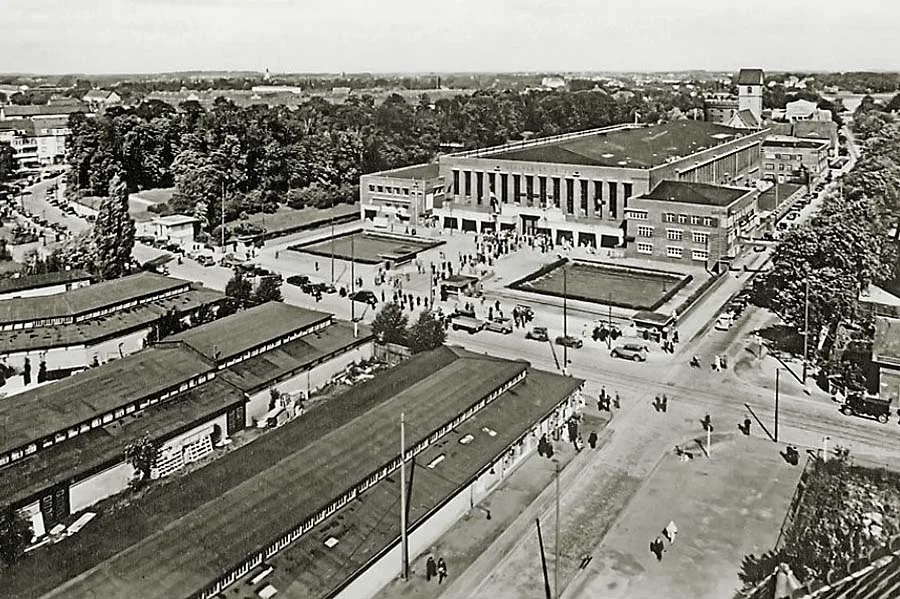 A bird's-eye view of the Eastern Fair and the House of Technology.
The fair was held twice a year (except in 1928, when it was held once) and ran until 1941, attracting up to 200,000 visitors in its best years. In scale it became the second fair in Germany after Leipzig's.
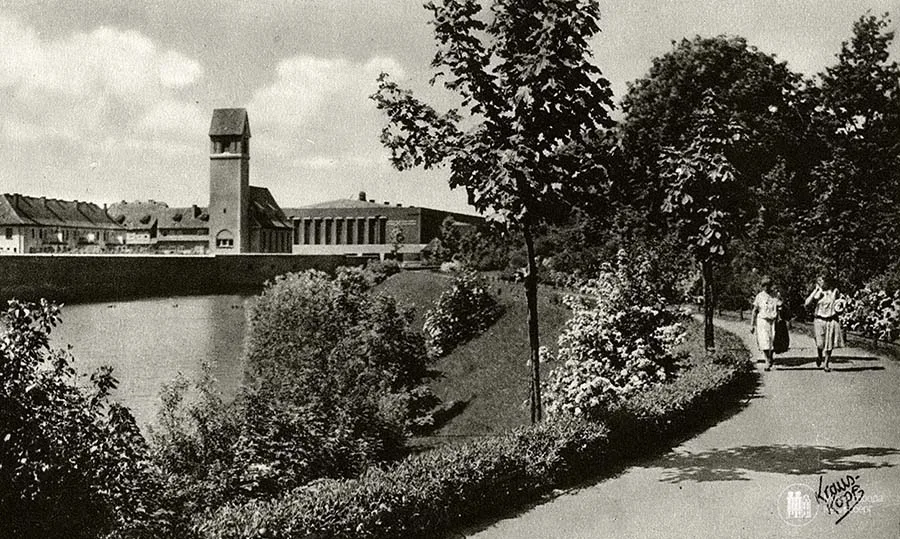 The fortress moat, the Church of Christ, the House of Technology and the Schneider belt.
The construction that unfolded on Wallring affected more than just the fairground. East of the future House of Technology, the Lutheran Church of Christ (Christuskirche) was founded in 1924. It was consecrated on 08.08.1926. Further along Wallring, somewhat earlier, in 1912–13, an exhibition hall, the Kunsthalle, was built to a design by Friedrich Lahrs (1880–1964). It originally belonged to the Königsberg Artists' Association but was transferred to the municipality in 1924. The post-war fates of these two buildings differed: the Kunsthalle was repaired and put into service as a retail pavilion, a status it retains to this day. The Church of Christ, damaged during the war, was not considered a valuable building and was demolished at the turn of the 1950s and 60s. Its foundations and parts of its walls could still be seen for some 30 years, until the stalls of the bird market were built on their site.
In 1930 the time came to connect Mitteltragheim and Cecilienallee (today they are one street, Proletarskaya). This meant sacrificing the integrity of the cuirassier regiment's barracks. The street literally passed through it. The two remaining halves (each even slightly less than half the building) became school buildings. The left one (as seen from the city centre) housed the Bismarck higher school (lyceum), the right one the Herder elementary (secondary) school.
Tram routes running through Tragheim were No. 1 along Wrangelstraße; No. 5 along Mitteltragheim, Wrangelstraße and Waldburgstraße; No. 6 along Mitteltragheim and Wrangelstraße; No. 7 along Mitteltragheim; and No. 11 along Wrangelstraße. (Today Mitteltragheim is Proletarskaya Street, Wrangelstraße is Chernyakhovskogo Street and Waldburgstraße is Gorkogo Street.)
For Tragheim the Nazis' rise to power was marked by the following episodes: Zweite Fließstraße was promptly renamed after the SA stormtrooper (Sturmabteilung, the "brownshirts") Otto Renke, who had been killed in one of the clashes with communist militants that were commonplace at the time. (Commemorating such "heroes" in street names was also a characteristic phenomenon of the period.) In addition, the House of Technology was turned into a hall for propaganda speeches by Gauleiter Erich Koch and by Adolf Hitler himself.
The Führer repeatedly and with displeasure stressed that his support in Königsberg was lower than it might be. This is why he came here himself to speak and appointed as party overseer Koch, who copied Hitler's behaviour in every way.
Retribution for the chimera of national superiority was not long in coming on a historic scale. The second (and best-known) bombing raid on Königsberg by the British Royal Air Force, on the night of 29–30 August 1944, destroyed three quarters of Tragheim by fire. The houses from the Schlossteich (Lower Pond) to Mitteltragheim (Proletarskaya Street) burned down completely, as did those in the northern part of the district, on Wrangelstraße and Wallring (Chernyakhovskogo and Professora Baranova streets respectively). Only a few blocks around the Tragheim Church (landmark: the corner of Podpolkovnika Ivannikova and Generala Sommera streets) remained relatively undamaged. But the April 1945 storming of the city was still to come, and it left not a single completely intact building in Tragheim.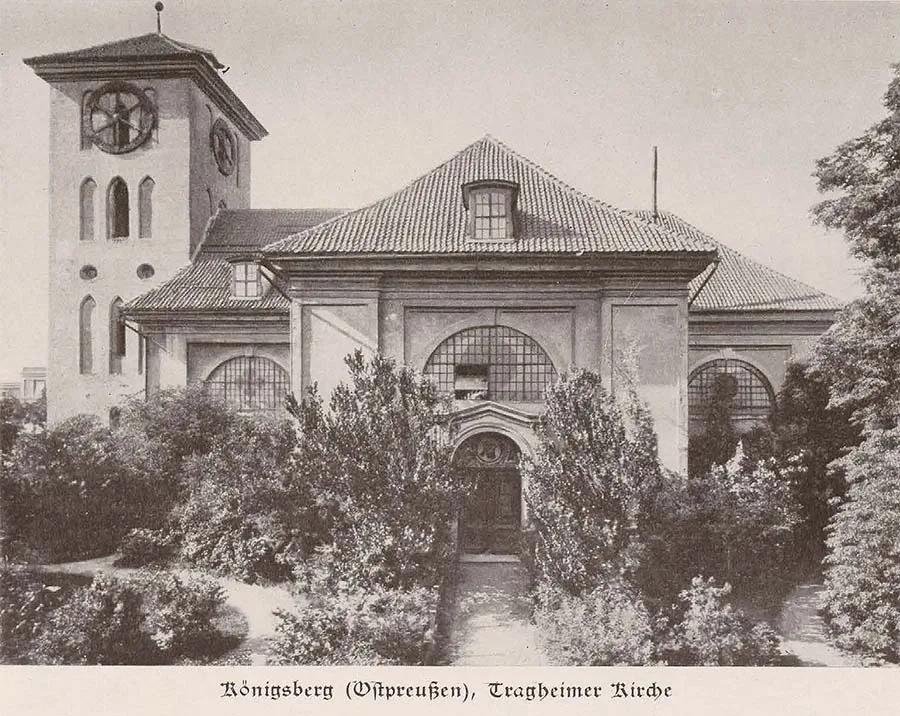 Exterior of the Tragheim Church.
After the war Tragheim was not given any name of its own, probably because most of the district had been completely destroyed. The district came under the jurisdiction of Kommandatura No. 1 of the city of Königsberg, and on 25 July 1947 it was incorporated into the Leningradsky district of Kaliningrad.
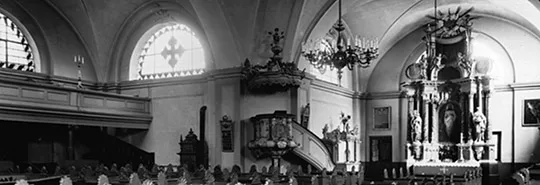
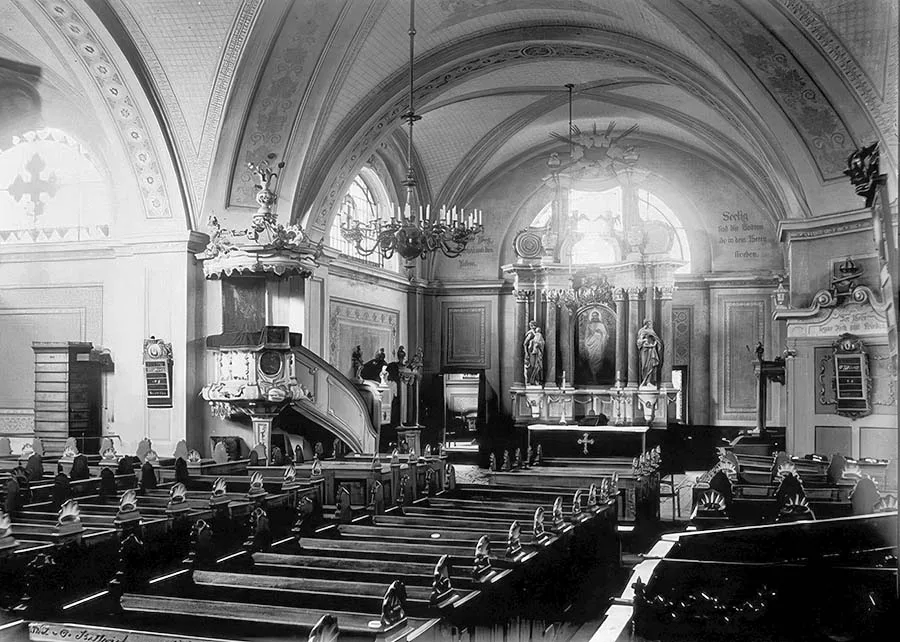 Inside the Tragheim Church.
For a long time there were ruins here; then they began to be demolished, and a gigantic wasteland formed, from which here and there jutted the remains of buildings that had been earmarked for possible restoration. Eyewitnesses recalled that riding the tram along Kavaleriyskaya Street (now Chernyakhovskogo) they saw a completely uninhabited district in the very centre of the city. The only exceptions were the cuirassier regiment's riding hall and the House of Technology. Their ruins were adapted for trade literally in the first post-war years (which is why after the war Wallring was called Torgovaya, Trade Street). The former housed a food market, the latter a flea market where people sold and bartered non-food goods.
Only at the end of the 1950s did the authorities turn to this district too. In 1959–60, Komsomol sailors (according to the text of the memorial plaque) repaired the Palaestra Albertina building, which went on serving physical culture and sport, but now as the sports palace of the Twice Red Banner Baltic Fleet.
In 1960 the first residential building went up at 2 Chernyakhovskogo Street. In 1961–62 four five-storey "khrushchyovkas" were built at the corner of Monetnaya (Generala Ivannikova) and Chernyakhovskogo streets.
The building of the Higher School of Building was restored in 1965 by the maritime transport fleet administration. In 1966 eight more five-storey "khrushchyovkas" were built on Minskaya Street, reaching through to Proletarskaya. In 1967 two of the district's schools, No. 31 and No. 32, opened in new buildings. In 1968 a large building with a shop and a post office was built at 32–40 Chernyakhovskogo Street, along with the houses on the even-numbered side of Proletarskaya Street.
The fate of the East Prussian government building deserves special mention. It burned out during the war, but structurally remained quite suitable for restoration. At any rate, judging by photographs from the 1960s, outwardly it had survived no worse than the present city administration building at 1 Victory Square. Incidentally, this building was most likely the reason why Kaliningrad's young people began calling the former Tragheim "Washington". As is well known, nature abhors a vacuum: if the official authorities do not take care to give a city district a handy, resonant name, the people fill the gap with their own oral creativity.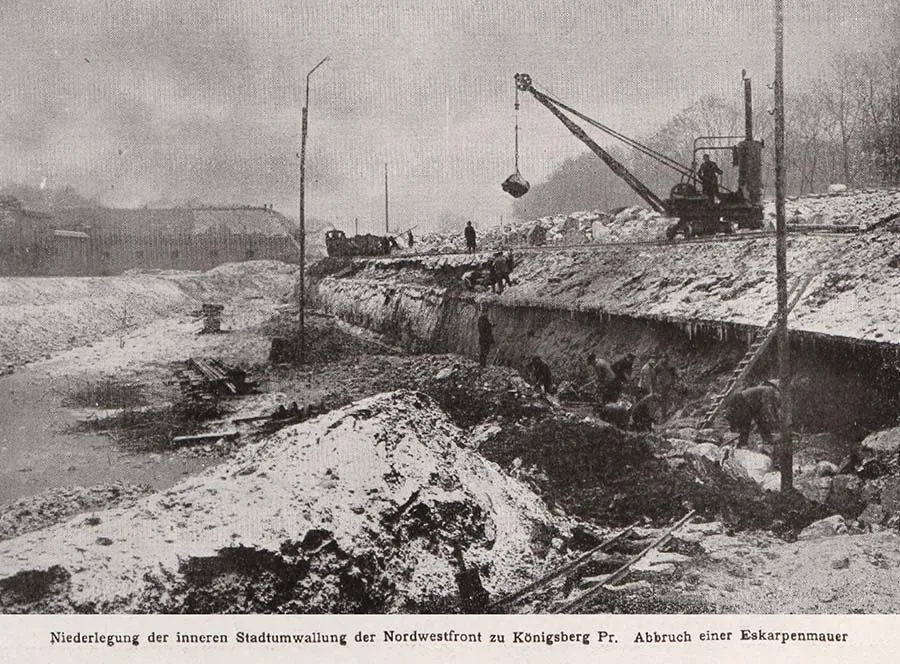 Dismantling of the fortress wall in the Tragheim area.
The answer to the question of why the government building was never restored can probably be found in the archival documents of those years. Its ruins were highly picturesque. Here and there the walls retained their marble facing and traces of former splendour.
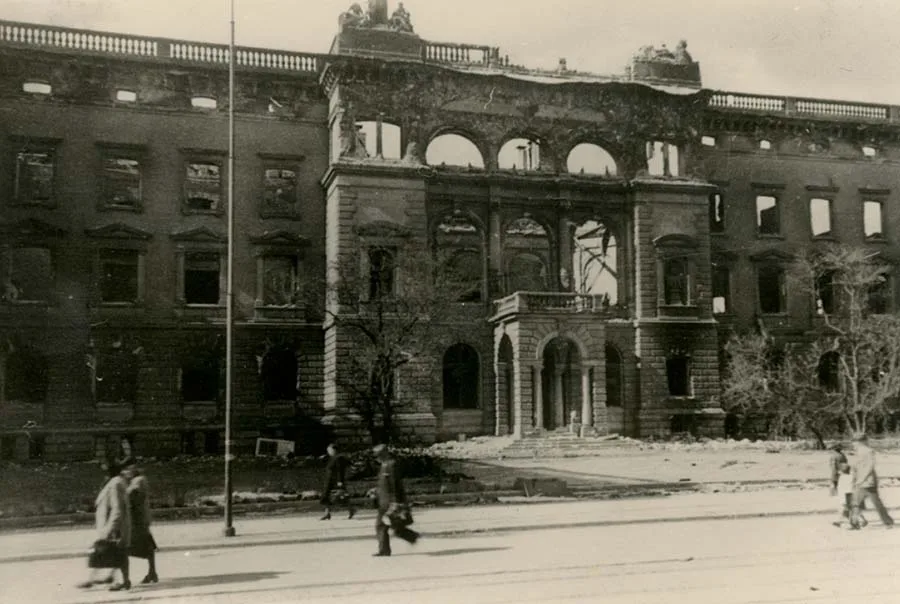 The provincial government building after the bombing of August 1944.
The ruined buildings and the area around them were therefore used several times as a film set, for which old damaged trams, lamp posts and other attributes of pre-war life were dragged into the courtyard. In particular, the film "Zhenya, Zhenechka and Katyusha" (1967) was shot here. But from 1967 the building was finally condemned to demolition. Work began on dismantling it, leaving a vacant lot that was built up only in 1967 with residential buildings with shops and a cafeteria on the ground floor.
That the Tragheim Church was demolished, however, is, alas, part of a pattern. Whether by evil fate or by the deliberate choice of party functionaries, it was precisely the oldest church buildings in the city, those built in the times of the duchy or of the Brandenburg-Prussian state, that were destroyed. The churches of Königsberg that were restored and adapted to modern needs turned out to be among those built in the late 19th and early 20th centuries. The only exceptions were the Juditten Church and the cathedral in Kneiphof.
The Tragheim Church stood in a state still fit for restoration until the end of the 1960s, when it was demolished. In 1973 an apartment block was built on its site (13 Generala Sommera Street).
Near the Baltic Fleet Sports Palace (the former Palaestra Albertina), in the courtyard of the house at 32–40 Chernyakhovskogo Street, a stadium with an earth embankment and a football pitch was built in the 1960s. The embankment was decorated with a concrete balustrade and figures of athletes, which stood until the early 1980s. Since the stadium also belonged to the Baltic Fleet, sports festivals and competitions among the fleets of the USSR were held here, and occasionally matches between teams of the Warsaw Pact countries. In the era of the general craze for tennis (early 1990s) the stadium was demolished, and indoor courts were to be built in its place. But for some reason things went no further than the rusting iron frames of unfinished structures.
Tram traffic was removed from the streets of former Tragheim and remained only on Chernyakhovskogo Street; there, however, up to five tram routes ran in different years, and the street itself became one of the busiest in Kaliningrad.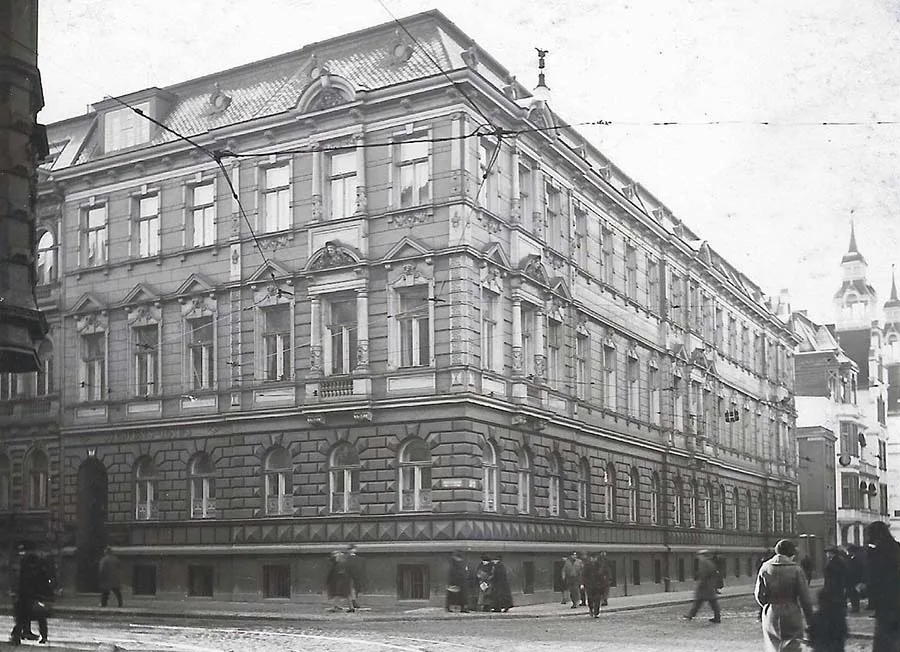 Siemens-Schuckert-Haus.
In general, in the 1970s and 1980s this district was considered the very heart of the city. On its territory were landmarks as significant for local people as the Central and Industrial Goods markets, the Okean shop (from 1975), the regional Palace of Pioneers (from 1984) and the House of Trade Unions (from 1982). Where the Akropol shopping centre now stands was the city bus station, from which buses left on routes around the city, the region and beyond.
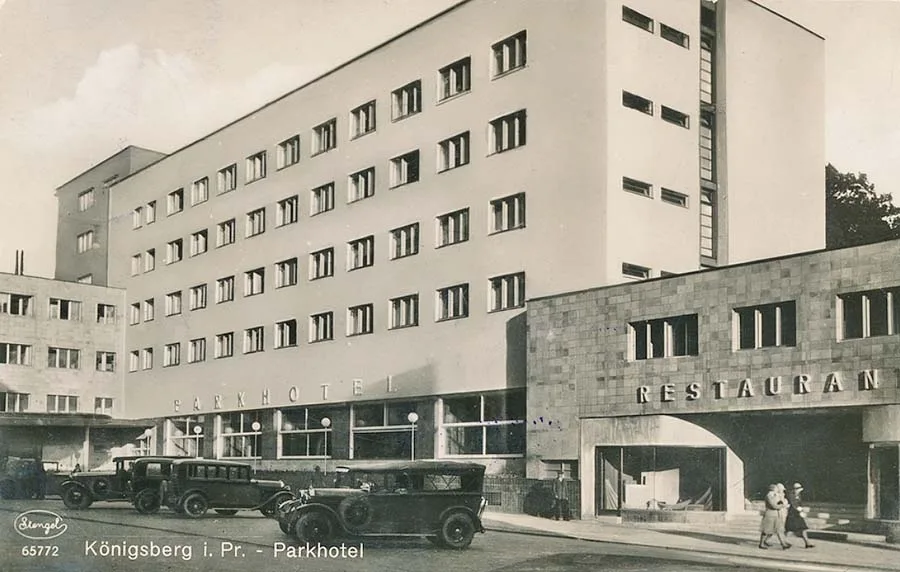 The Park Hotel on Hintertragheim street.
Among the industrial enterprises working here were a garment factory (in the former cuirassier barracks), a dairy plant (in the former flour mill building), a butter depot (the Otto Braun administrative building) and an electrical installation enterprise (in a wing of the court prison building). The city catering trust was on Rokossovskogo Street. Until the end of the 1970s the fire service headquarters was at 52 Chernyakhovskogo Street, after which the regional traffic police moved in. Of Kaliningrad's 18 grocery stores, two were in former Tragheim.
The Industrial Goods Market deserves special mention. In essence it was not even a market but a real hypermarket. For those who never visited it in Soviet times it is hard to imagine that in the ruins of the House of Technology there were many shops: furniture, household goods, Electrical Goods, Toys, Cultural Goods, crockery and housewares, discounted goods, as well as a department store with sections for clothing, footwear, jewellery, photographic goods, haberdashery and more.
Another well-known establishment was Canteen No. 49, popularly called "The Pig's Snout" because of its sign showing a piglet.
In the evenings the canteen premises housed a "2nd-category restaurant" with no name of its own, but very popular with young people for its democratic prices and loud dance music. The establishment carried the traditions of the Soviet era through the years, and today its walls house the Planeta entertainment complex. There were more fashionable restaurants in the district too: the expensive and prestigious Russky Chai restaurant at the corner of Chernyakhovskogo and Sergeyeva streets, and across the road from it, on the shore of the Upper Pond, the cosy Parus restaurant with an open-air terrace overlooking the water.
The 1990s and 2000s passed for Tragheim much as they did for the city as a whole. The number of tram routes on Chernyakhovskogo Street fell to one (now, in 2024, there are two). "Infill development" periodically made its way into the city courtyards. The House of Technology was restored, in a somewhat altered form, as the Epitsentr shopping centre. The Akropol shopping centre was built on the site of the bus station. The Clover shopping centre grew up on the site of the Tragheim cemetery. Where the Z-Fort shopping centre has appeared in recent years, during the years of market reforms there was the city's largest flea market, the place where shuttle traders sold their goods, mostly clothing and footwear, to the public.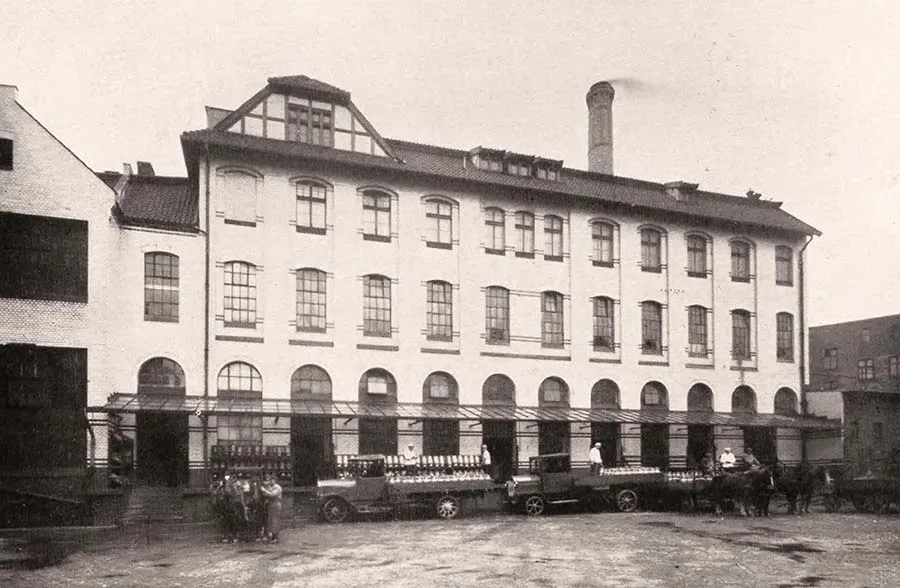 The office and factory of the Königsberg Dairy Cooperative were in Tragheim.
Remarkably, this Freiheit, once inhabited by Jewish merchants, has kept its orientation towards trade despite a complete change of population, state affiliation, political system and administrative status.
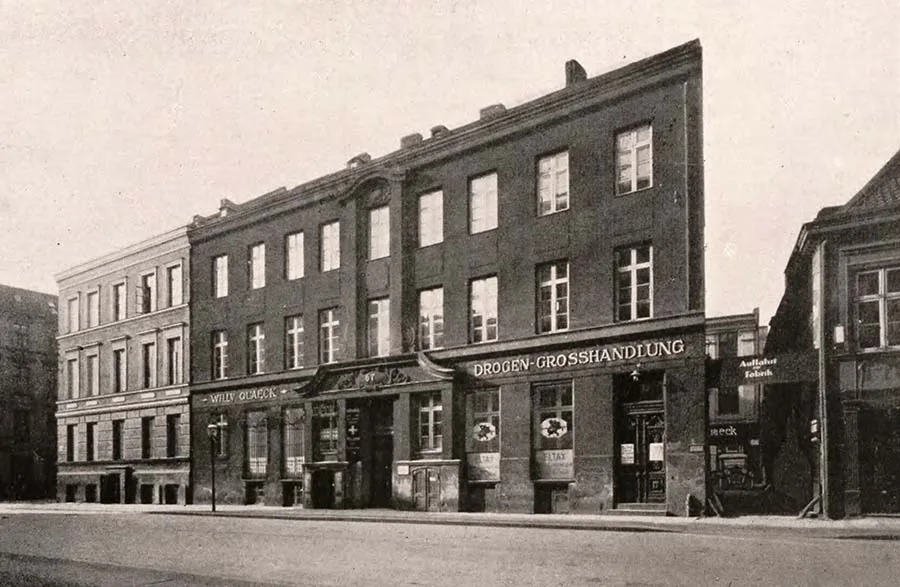 Willi Kueck's chemist's shop on Tragheimer Kirchenstraße.
Today 27 pre-war buildings survive within the boundaries of Tragheim, 24 of which are identified and registered cultural heritage sites. In the eastern part of the district, by the Lower Pond, there is a well-kept green area. There are things to see in modern Tragheim, but one needs a very rich imagination to picture the former grandeur of this district from what one sees.
The streets of Tragheim as of 1928–33
Alexanderstraße appeared at the turn of the 19th and 20th centuries. This short street connected Tiepoltstraße and Wrangelstraße. It was not renamed after the war. Today it is a nameless passage in the courtyard between the building at 20–24 Chernyakhovskogo Street and the Planeta entertainment complex.
Am Rhesianum, like Rhesastraße, is linked with the name of Professor Rhesa and likewise received its name in 1885. This short street connected Rhesastraße and Hintertragheim. It was not renamed after the war. In 1965 the five-storey building at 33–39 Sergeyeva Street went up across it.
Waldburgstraße appeared in 1920 on the line of the old road leading from Tragheim to Tragheimer Palve. It was named after Karl Heinrich Erbtruchsess und Graf zu Waldburg (1686–1721), president of the Königsberg war commissariat and author of a tax reform. Only the southern part of this street lay in Tragheim. Today it is the beginning of Gorkogo Street.
Wallring came into being during the construction of the second rampart ring as a rampart road linking the fortifications. In the 1880s it was named Kürassier-Wall-Strasse after the riding hall of the 3rd Cuirassier Regiment, whose northern side faced this street. After the war it was called Torgovaya (Trade) Street, as the Central and Industrial Goods markets were located on it. In 1965 it was renamed after Professor F. I. Baranov (1886–1965). Seven pre-war buildings survive on the street: the Wrangel Tower (1859, 2a Professora Baranova Street), the Kunsthalle exhibition hall (1912–13, 2 Professora Baranova Street), the House of Technology (1923–25, 30 Professora Baranova Street), the riding hall of the 3rd Cuirassier Regiment (1870, Central Market), the Hindenburg Oberrealschule (1914, 43 Professora Baranova Street), the house of the director of the Hindenburg School (early 20th century, 45 Professora Baranova Street) and the Eastern Fair restaurant (1922, 36 Professora Baranova Street).
Wrangelstraße: the street came into being around 1630 during the construction of the first rampart ring. For a long time it was simply a road, which is why it was called Palve ("wasteland"), and then, in its main part, Juden Kirchhofstraße (after the nearby Jewish cemetery). The dam of the Upper Pond was then called Obergasse ("upper lane"). And the very beginning of the street (by today's Victory Square) was part of Steindammer Wallstraße. In 1883 the street was named after a veteran of the Napoleonic Wars and one of the reformers of the Prussian army, Field Marshal Friedrich Ernst Heinrich Count von Wrangel (1784–1877). Wrangel gave more than half a century of his life to the Königsberg garrison, and especially to the 3rd Cuirassier Regiment. He was extremely popular among townspeople and soldiers, who called him "Papa Wrangel". The barracks and riding hall of the 3rd Cuirassier Regiment stood on Wrangelstraße. In the 20th century trams were introduced along Wrangelstraße. In 1945, by order of the Special Military District, Wrangelstraße was renamed Kavaleriyskaya Street. On 07.04.1961, by decision of the Kaliningrad City Executive Committee, it was renamed again, as Chernyakhovskogo Street. The street was mostly built up in the post-war period in 1962–75. At present (2024) both of Kaliningrad's tram routes run along Chernyakhovskogo Street. Chernyakhovskogo Street has eight pre-war structures that have survived in one form or another: the barracks of the 3rd Cuirassier Regiment and its riding hall (Central Market), the Physics Institute building (6 Chernyakhovskogo Street), two residential buildings (1–5 and 17 Chernyakhovskogo), the Nord fire station (52 Chernyakhovskogo), a late 19th-century building (7 Chernyakhovskogo) and one of the buildings of Carl Mendthal's liqueur factory (80 Chernyakhovskogo).
Großgörschenstraße appeared around 1913, at first as a path dividing the Tragheim cemetery into two equal parts. With the construction of the Tragheim parish building it became a proper, if small, street. After the war it was merged with Tragheimer Kirchenstraße and, together with it, became first part of Monetnaya Street, then part of Podpolkovnika Ivannikova Street (the section between Chernyakhovskogo Street and Professora Baranova Street). Two pre-war buildings survive on Großgörschenstraße: the parish house of the Tragheim Church (1911, 18 Podpolkovnika Ivannikova Street) and the house of the director of the Hindenburg School (45 Professora Baranova Street). Both are cultural heritage sites.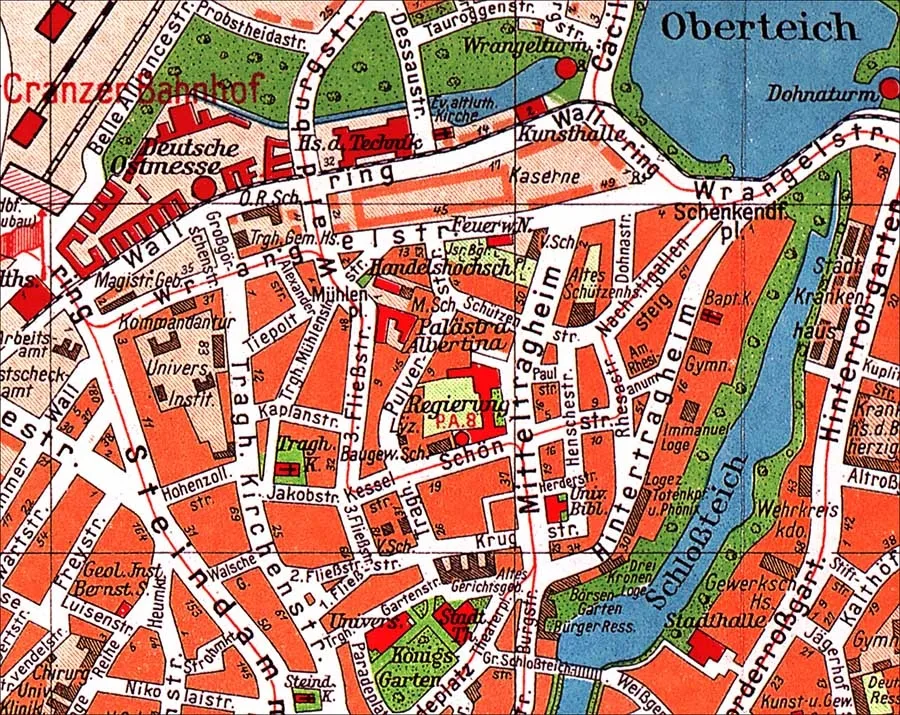
The streets of Tragheim on a 1928 map of Königsberg.
Hohenzollernstraße, a small street that connected Steindamm and Tragheimer Kirchenstraße and half belonged to Tragheim. It appeared at the end of the 19th century. It was not renamed after the war. Today it is a courtyard passage beginning between the houses at nos. 21–25 and 27–31 Leninsky Prospekt and ending in the archway of the building at 1–1B Podpolkovnika Ivannikova Street. The passage has kept its cobbled surface, but no houses remain on it.
Dohnastraße, a small street that received its name in 1892 in honour of Friedrich Ferdinand Alexander Count and Burgrave zu Dohna-Schlobitten (1771–1831). In the post-war period it was renamed Gromovoy Street, but in fact it disappeared in the 1950s. It lay in the courtyard of the building at 74–76 Chernyakhovskogo Street.
Dritte Fließstraße (3. Fließstraße), like the two previous ones, was named after the brook that was filled in in the 19th century. In 1938 it was renamed Am Fließ. By order of the Special Military District in 1945 it became Vechnaya Street, but as early as 29.07.1948 the civil authorities renamed it Kursantskaya Street. On 31.01.1974 Kursantskaya Street and part of Porokhovaya Street were renamed Rokossovskogo Street. One pre-war building survives on the former Dritte Fließstraße: the Palaestra Albertina (1896, 16–20 Rokossovskogo Street), which in 1952–60 was restored as the Baltic Fleet sports palace. Today part of the building is also occupied by the Zapadnaya Pressa media group.
Kaplanstraße (Chaplain Street) ran parallel to Jakobstraße but skirted the churchyard to the north. It got its name around 1730, when a chaplain lived here. By order of the Special District it was renamed 8 Marta Street in 1945, and then Bolshoy Lane in 1948. By the early 1960s only its eastern side remained, which in 2020 became part of General-polkovnika Lyudnikova Street. The main part of the street became part of the grounds of School No. 32.
Kesselstraße was named in 1874 after Dr Friedrich Christian Kessel (1765–1844), a pioneer of the spa movement in Prussia who turned Cranz (Zelenogradsk) into a seaside resort. After the war the street was not officially renamed, but in effect became part of Astronomicheskaya Street. By decision of the City Executive Committee of 30.01.1974, Astronomicheskaya Street was renamed Generala Sommera Street. The site of Kesselstraße is now occupied by the part of Generala Sommera Street that passes the tank crew memorial at the crossing with Rokossovskogo Street. No pre-war buildings survive on Kesselstraße.
Krugstraße. One of the oldest streets in Tragheim. It was named after an inn that once stood in this area. Before the war the court prison (remand prison) building stood on Krugstraße. On 29.07.1948 it became part of Bibliotechnaya Street. On 29.01.1994 Bibliotechnaya Street was renamed in honour of Professor N. B. Sevastyanov (1924–93) of the Kaliningrad Technical Institute, who had died the previous year. Of the pre-war buildings on Krugstraße, one wing of the remand prison survives (24 Professora Sevastyanova Street).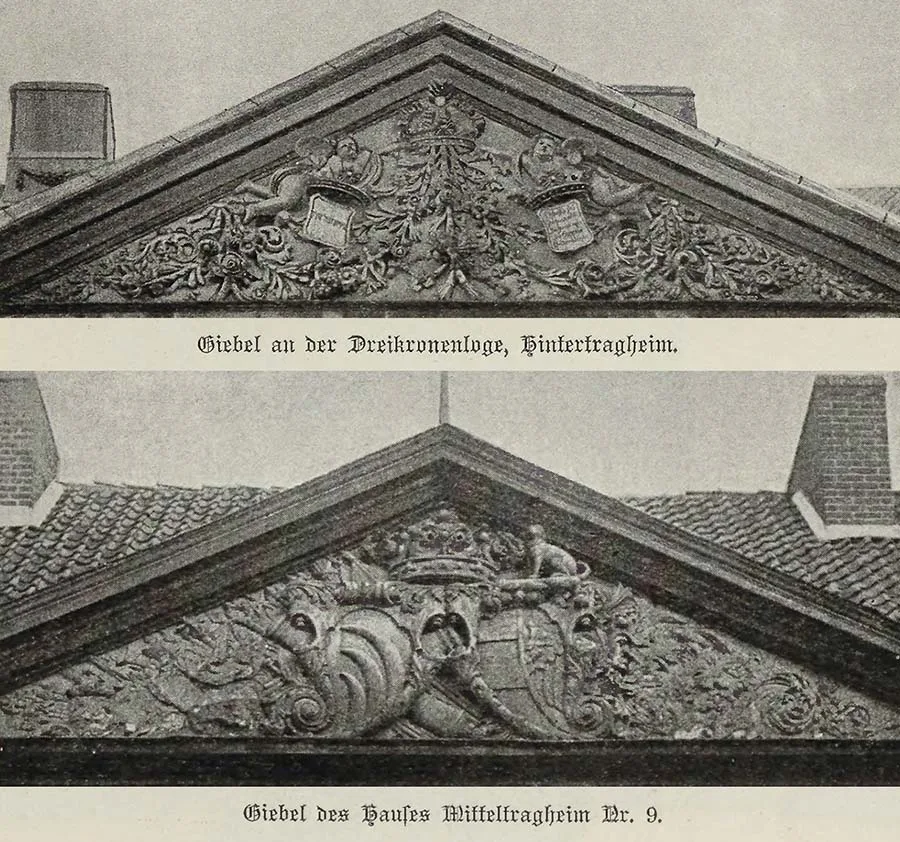 Extraordinary gables on Mitteltragheim and Hintertragheim streets.
Mitteltragheim appears on the city map of 1764 and was already almost fully built up then. In 1872–85 the building of the government of the province of East Prussia was erected on Mitteltragheim. The university library was also located here. In the 20th century trams ran along the southern part of Mitteltragheim. After the war, by order of the Special Military District, the street was named Minometnaya Street. However, on 01.08.1946, by a new order of the city civil affairs administration, Mitteltragheim was merged with Münzstraße, Burgstraße, Cäcilienallee and Auguste-Viktoria-Allee into one long Proletarskaya Street. Mitteltragheim suffered more than the other streets of Tragheim from the bombing and the storming of the city. Not a single pre-war house remained on it. In 1962–66 "khrushchyovka" blocks were built on both sides of the street. The ruins of the East Prussian government building stood until 1967, when they were demolished. The vacant lot was built up only in 1967, with a block of sand-lime brick.
Nachtigallensteig (Nightingale Path) was already recorded on the plan of 1763 as a road crossing the field used for bleaching wax. It ran along the bank of the brook until the latter was filled in. In the 20th century tram traffic was introduced on Nachtigallensteig. After the war, by order of the Special Military District, it was renamed Solovyinaya (Nightingale) Street in 1945, an inaccurate translation of the German name. However, as early as 29.07.1948 the Kaliningrad City Executive Committee merged it with Schützenstraße into a new street, Minskaya. When Tragheim began to be built up with "khrushchyovkas" in the 1960s, this part of Minskaya Street ended up inside the courtyards and in effect ceased to exist. Today a diagonal footpath through the courtyards of the houses at nos. 68–78 Chernyakhovskogo Street runs where Nightingale Path once was.
Rhesastraße received its name in 1885 in honour of Professor Ludwig (Liudvikas) Rhesa (1776–1840), who, among other things, was known for collecting and recording a large number of works of Lithuanian folklore. He also promoted social support for students from poor families. After Rhesa's death, under his will, a charitable institution for students, the Rhesianum (1854), was opened at the Albertina. Before the war a tram line ran along Rhesastraße. After the war Rhesastraße was not renamed but was lost among the courtyards of the houses on Sergeyeva Street. Part of the street is now a footpath inside the courtyards; the stadium of School No. 31 has been built on another part.
Tiepoltstraße was formerly called Groß Hader Gasse. It received its new name in honour of the apothecary Tiepolt and his widow (both died in 1800), who donated the considerable sum of 15,000 thalers for building a free Sunday crafts school for the poor on Groß Hader Gasse, which later became the Tiepolt orphanage; in 1900 the orphanage received a new building on Busoltstraße (now 2 Yermaka Street). After the war Tiepoltstraße was renamed Pechorskaya Street, and in 2003 Mikhaila Galkovskogo Street. The pre-war flour mill building survives on the street in a heavily rebuilt form; it is now used by the Ministry of Internal Affairs.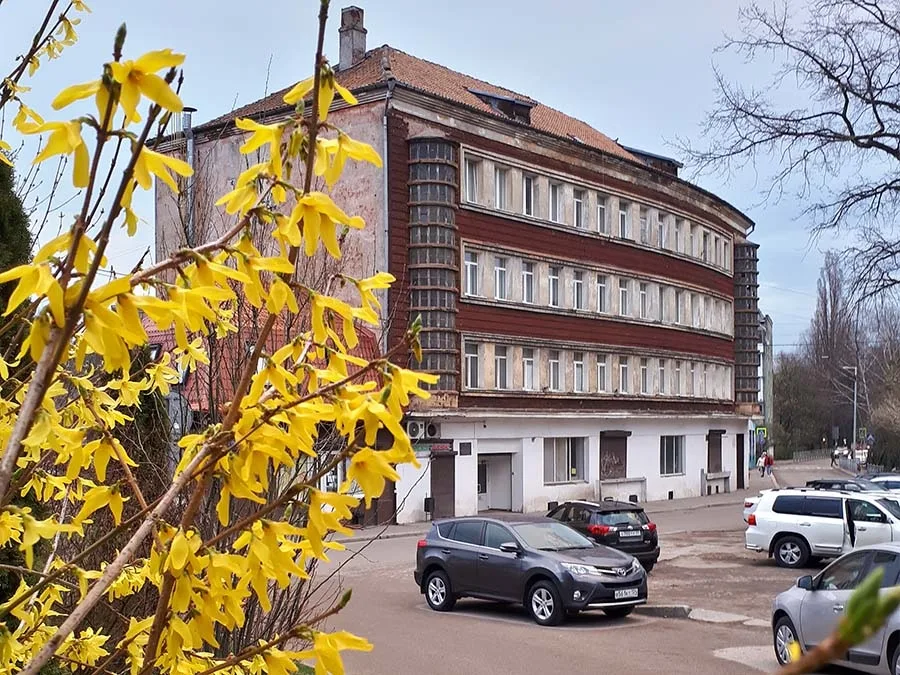
The Otto Braun House on Professora Sevastyanova Street (Tragheim's Second Brook Street). In Soviet times the building was known as the "butter depot".
Tragheimer Gartenstraße (Tragheim Garden Street) was the boundary street between Tragheim and Burgfreiheit. In the 1930s it was renamed Giesebrechtstraße after the University of Königsberg professor and historian Wilhelm von Giesebrecht (1814–89). It was not renamed after the war. Today it is a nameless driveway from the polyclinic (1–11 Universitetskaya Street) past the northern wing of the Immanuel Kant Baltic Federal University building. The university building is the only pre-war building surviving on this street.
Tragheimer Kirchenstraße is one of the main and oldest streets of Tragheim. It has been known since 1622 under the name Bärwinkel ("Bear Corner"). Later the street ran past the Tragheim Church, from which it got its name, which became official in 1811. On 23.11.1945, by order of the Special Military District, it was renamed Monetnaya Street. On 06.05.1975 Monetnaya Street was renamed in honour of Lieutenant Colonel A. M. Ivannikov (1913–74). Four pre-war buildings survive on the former Tragheimer Kirchenstraße, including one registered cultural heritage site: the building of the Albertina's Agricultural Institute (1873–75, 7 Podpolkovnika Ivannikova Street). In addition, the street has two early 20th-century residential buildings (1 and 2–4 Ivannikova Street) and the former veterinary clinic (5 Ivannikova Street)
Tragheimer Pulverstraße (Tragheim Powder Street) is also one of the oldest streets in the district.
Tragheimer Mühlenstraße (Tragheim Mill Street) got its name from the water mill that stood nearby and the flour mill built later on this street. The flour mill, destroyed during the war, was restored and converted into a dairy plant. Today the building houses the police department of the Leningradsky district.
Tragheimer Passage, a street with a bend, came into being at the end of the 19th century. It connected Krugstraße and Mitteltragheim. Despite its name, the Tragheim Passage was never covered (see photo). It was not renamed after the war. In 1965–67 five-storey apartment blocks were built on the site of the Tragheim Passage (58–68 Sommera Street and 43–53 Proletarskaya Street).
Henschestraße. For a long time an unsettled wasteland remained between Mitteltragheim and Hintertragheim, and it was there that Henschestraße came into being, at the turn of the 19th and 20th centuries. The street began at the university library and ended at the Schützenhaus (Riflemen's House). After the war Henschestraße was not renamed and for a while existed as a nameless driveway across the wasteland left after the ruins of the pre-war buildings had been cleared. Later School No. 31 and Kindergarten No. 101 were built on this driveway.
Hintertragheim is marked on the map of 1764, when it was already partly built up. The street is known for the fact that from the 18th century Masonic lodges began to be located there, their number reaching three by the 19th century. One of Königsberg's seven Baptist chapels was also opened on Hintertragheim. In addition, the Wilhelm-Gymnasium was located on Hintertragheim from 1874. During the bombing and the storming of the city the street suffered the most severe destruction. By decision of the City Executive Committee of 29.07.1948 Hintertragheim was renamed Tikhaya Street. However, by 1960 the main part of Tikhaya Street (beyond the bend after the Park Hotel) had been renamed in honour of Hero of the Soviet Union Guards Major A. A. Sergeyev (1915–45). By 1968 the whole of Hintertragheim was called Sergeyeva Street. Of the pre-war buildings, only the considerably rebuilt Park Hotel (1929, 2 Sergeyeva Street) survives on the street.
Zweite Fließstraße (2. Fließstraße), like the previous street, got its name from the brook that flowed here until the 19th century. In 1933, after the NSDAP came to power, it was renamed Otto-Reinke-Straße after the SA stormtrooper Otto Reinke (1913–32), who had been killed in clashes with communists. On 29.07.1948 it was merged with Krugstraße into Bibliotechnaya Street. On 29.01.1994 Bibliotechnaya Street was renamed Professora Sevastyanova Street. One pre-war building survives on the former 2. Fließstraße: the Otto Braun administrative building (1930, 3–5 Sevastyanova Street, see photo).
Schönstraße was laid out in 1891 and named after the Oberpräsident of Prussia Heinrich Theodor von Schön (1773–1856). The southern wing of the provincial government building faced this street. In the 20th century tram traffic was introduced on Schönstraße. On 29.07.1948 it became part of Astronomicheskaya Street. On 30.01.1974 Astronomicheskaya Street was renamed Generala Sommera Street. One pre-war building survives on the former Schönstraße: the Higher School of Building (1897, 27 Sommera Street).
Schützenstraße (which can be translated as Riflemen's Street) got its name from the Schützenhaus (Riflemen's House) built on it in 1855, which served as the office of the riflemen's guild. On 29.07.1948, together with the former Nachtigallensteig, it was renamed Minskaya Street. Today Minskaya Street lies entirely on the site of the former Schützenstraße.
Erste Fließstraße (1. Fließstraße) was named First Brook Street after the brook that flowed nearby and was filled in in the 19th century. In the 1930s it was renamed Gesecusstraße. After the war the street was not renamed and in effect ceased to exist. In 2005 the Yubileyny business centre (2G Universitetskaya Street) was built on the site of the street.
Jakobstraße was called Pladdergasse until 1805, which translates as "downpour lane". It is said that the street got this name because of the constant puddles that formed here after heavy rain. Originally it was a short street leading from Dritte Fließstraße to the cemetery by the Tragheim Church. In the 19th century it was extended along the southern edge of the cemetery to Tragheimer Kirchenstraße. On 29.07.1948 Jakobstraße became part of Astronomicheskaya Street. The site of this narrow street is now a pedestrian zone in the eastern part of Generala Sommera Street.
Photos on this page: Bildarchiv Ostpreußen / bildarchiv-ostpreussen.de, Mikhail Ogorodnikov.
– – – – – – – – –
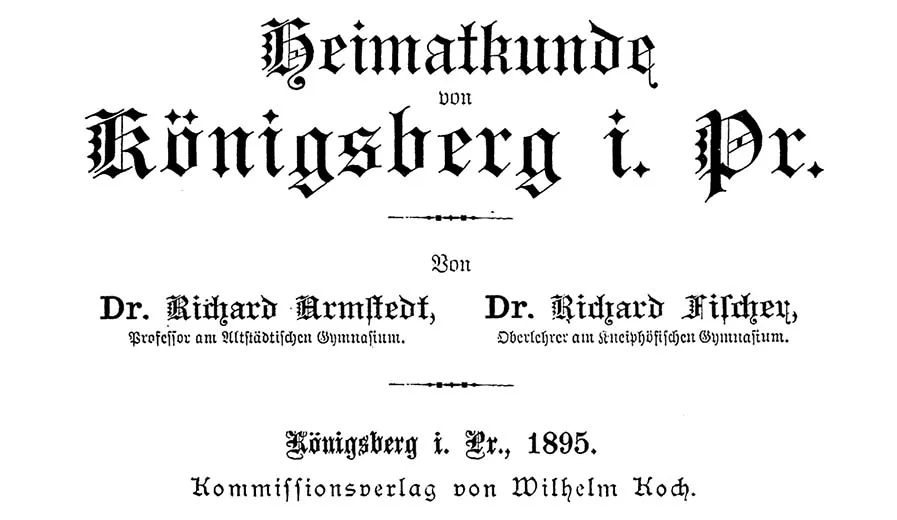
The chapter "Tragheim"
from the book "Königsberg Local Studies" by local authors,
published at the end of the 19th century
In 2012–2014 "Pregolya", the literary and art supplement to the "Baltic Almanac",
published a translation of the book "Königsberg Local Studies" by the Königsberg authors Dr Richard Armstedt, professor at the Altstadt Gymnasium, and Dr Richard Fischer, senior teacher at the Kneiphof Gymnasium ("Heimatkunde von Königsberg i. Pr.", 1895, Kommissionsverlag von Wilhelm Koch, Königsberg), made by an unknown translator. The idea of publishing it belonged to Igor Vladimirovich Afonin. The text was adapted and annotated by Aleksey Borisovich Gubin and Igor Fyodorovich Avtukhov. That book had a separate chapter on Tragheim. Having substantially edited it, we offer it to you as a supplement to the text
by Aleksey Yevgenyevich Petrushin.
– – – – – – – – –
Tragheim
The village of Tragheim is first mentioned as early as 1300, in the founding charter of Löbenicht. The area between Steindamm (part of Leninsky Prospekt), the Paradeplatz (Universitetskaya Street), the Lower Pond (Schloßteich) and Wrangelstraße (Chernyakhovskogo Street), which we now call Tragheim, was sparsely populated and almost undeveloped in the 16th century. Nor was there a church there at that time. The brook that flowed along Third Brook Street (3. Fließstraße) to the Paradeplatz drove several mills: the Powder Mill (Pulvermühle, burned down in 1692) at the end of Tragheim Powder Street, the Tragheim Mill (Tragheimermühle), the Tawers' Mill (Weißgerbermühle) and the Fulling Mill (Tuchmachermühle).
(The name "Tragheim" is borrowed from the Prussian language and may mean "village in a burnt clearing" — editor's note.)
Around 1528 the village acquired its own court. The duties of judge were performed by the owner of the inn that stood where First Brook Street (Erste Fließstraße) ended and Inn Street (Krugstraße) began. The judge was called the "hereditary judge", as the post was passed down by inheritance. Only in the middle of the 17th century was an educated man appointed judge, and 11 court officials were placed at his disposal. The judge also acted as village headman. The court seal was approved on 16 November 1577 by Duke Albrecht Frederick. It showed a stag's head between two fir trees on a round shield with the inscription:
"Princely Freiheit of Tragheim. Königsberg" (Fürstlich Freiheit Tragheim. Königsperg).
(First Brook Street is now Professora Sevastyanova Street. In the 1930s a prison (remand cells) was located on this street. The court building stood on the site of the five-storey block at 16–22 Professora Sevastyanova Street, exactly where the inn had once been — editor's note.)
The main streets of Tragheim run from the centre, from south to north, and are crossed by numerous side streets. The longest, Tragheim Church Street (Tragheimer Kirchenstraße, now Podpolkovnika Ivannikova Street), connects Junkerstraße with Wrangelstraße. In its southern part it skirts the Paradeplatz on the west. Until 1811 individual sections of this street had different names; for example, the "Black Sea" („Schwarzes Meer") between Wrangelstraße and Tiepoltstraße (that is, between today's Chernyakhovskogo and Mikhaila Galkovskogo streets. This name arose because there was once a huge puddle here that never dried up, with stagnant, rotten black water — ed.) The part of Tragheim Church Street from Tiepoltstraße southwards was called "Kingdom of Heaven" („Himmelreich"). For a time this same section was also called "Skalich's Court" (Skalichienhof / Skalikkenhof).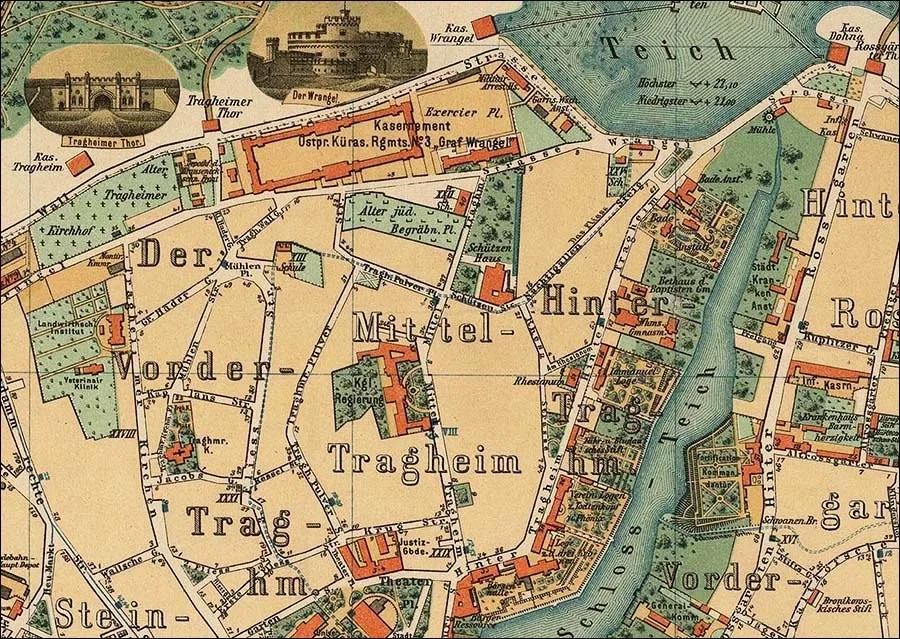 Tragheim on a map of 1885.
The name "Skalich's Court" recalls the last years of Duke Albrecht, whose favourite at the time was the notorious European adventurer and alchemist Paul Skalich, invited to Königsberg from Tübingen in 1561 on the recommendation of the councillor Friedrich von Kaniz.
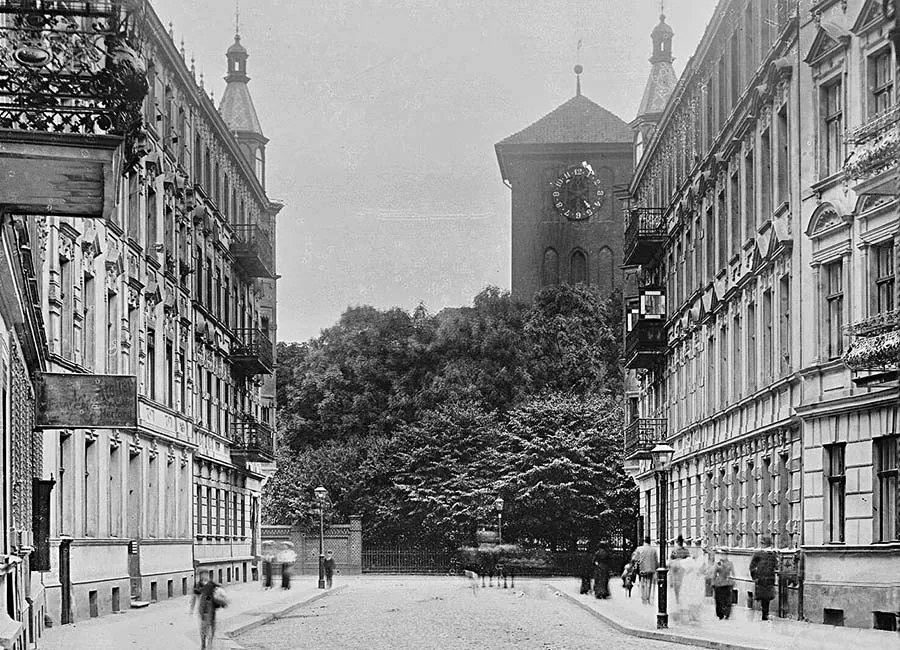 The Tragheim Church seen along Hohenzollernstraße.
Skalich claimed to be a descendant of the noble Italian princely house of della Scala and hence a relative of the Franconian Hohenzollerns, but in reality he came from a humble family. After a while Skalich received from his master as a gift a large estate (Skalichienhof) north of the castle, in Italian Lane (Wallsche Gasse, now the courtyard of nos. 6–10 Podpolkovnika Ivannikova Street), not far from the Hagedorn foundation (Hagedornsche Stift) and the Tragheim Church. Thanks to his extraordinary cunning and wide knowledge, especially in magic and astrology, which the duke valued highly, Skalich gained such influence over his patron that the latter trusted him completely and, as a mark of special favour, later gave the swindler, in addition to the estate mentioned above, the whole town of Kreuzburg (now the village of Slavskoye). But that was not enough for him: he wanted to be able to use his influence unhindered, sought to limit the power of the estates and even to get rid of his rivals altogether. The latter then turned for help to the King of Poland, whose vassal the duke was. A commission was sent from Poland to Königsberg to look into the situation.
Skalich managed to flee, abandoning almost all his property. Three of his followers, including the duke's confessor, were executed in front of the Kneiphof town hall. After this the ruined adventurer led the life of a homeless wanderer and died in Danzig in 1574.
In Duke Albrecht's time, on the site of the Tragheim Church there was a small brick building belonging to the castle. In 1624 it was bought, and a cemetery chapel was built in its place; soon a church was built on the site of the chapel, and it was consecrated on 24 October 1632. The consecration was performed by the pastor of Löbenicht, as Tragheim then belonged to his parish. Before that, funeral services had been held at the Polish cemetery in Steindamm. The Tragheim congregation got its own pastor in 1636.
The first church built in Tragheim served for 76 years and was demolished because it had become too small. The new one, whose foundation stone was laid on 16 June 1708, stood even a year less (75) and burned down completely on 11 September 1783 after being struck by lightning. However, using the old walls, it was restored fairly quickly and returned to the parishioners at Christmas 1784.
The Tragheim Church has the form of an equal-armed cross, each arm of which has large semicircular windows on each side. (In Russian architectural terms one could say that it has glazed zakomaras — editor's note.) The ceiling consists of four main vaults and one additional vault with simple ribs. The altar, decorated with Corinthian columns and rich carving, was donated by the apothecary Tiepolt. On the pulpit is an image of Christ with the inscription:
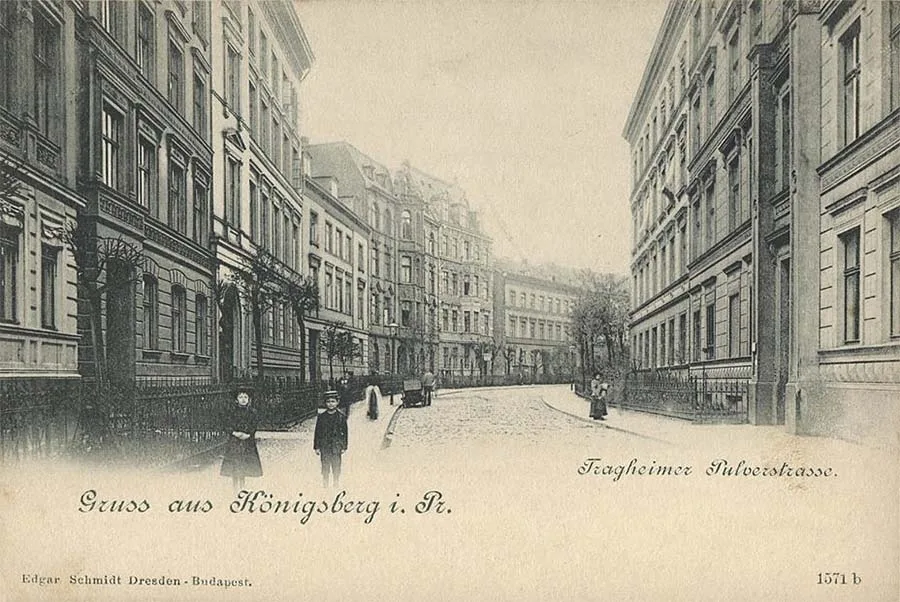 Tragheim Powder Street.
"This image of Christ is like the one that Lentulus painted and sent from Jerusalem to the Senate in Rome." (Later it was simplified and replaced with "Christ is all in all".)
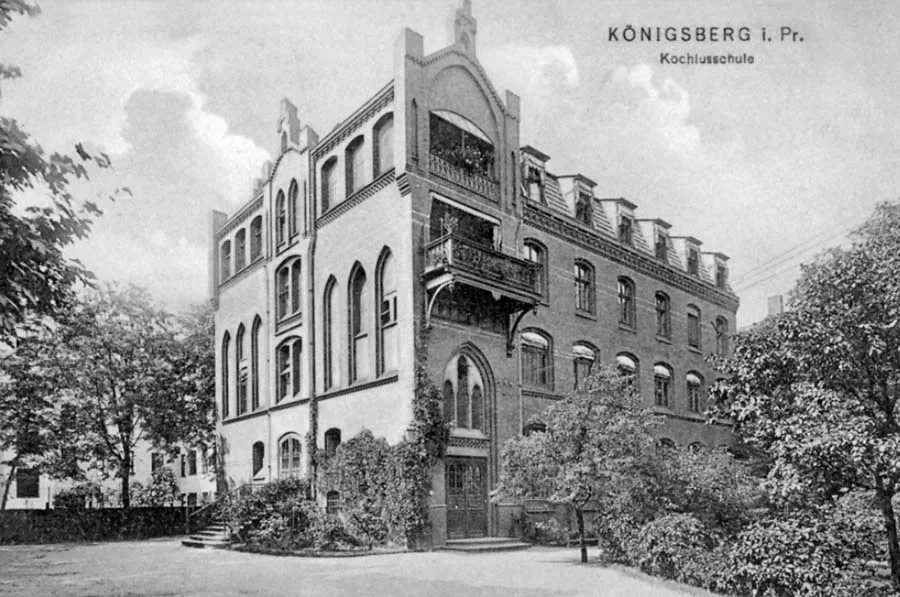 A private higher school for girls on Tragheim Powder Street.
(The celebrated German composer Richard Wagner [Wilhelm Richard Wagner, 1813–1883] married the actress Minna Planer [Wilhelmine „Minna“ Wagner, geb. Planer, 1809–1866] in the Tragheim Church on 24 November 1836 — editor's note.)
The cemetery adjoining the church closed in 1813. It was moved to the site of the present old Tragheim cemetery near the Tragheim Gate, between the Cuirassier Rampart (Kürassier Wallstraße / Wallring, now Professora Baranova Street) and Wrangelstraße. The Tragheim cemetery in use today is on Violet Hill (Veilchenberg, now a park area between Dmitriya Donskogo Street and Velosipednaya Road. The Tragheim Gate stood, in today's terms, at the crossing of Gorkogo and Professora Baranova streets, i.e. between the Akropol and Epitsentr shopping centres. And Tragheim Church Street, that is, today's Podpolkovnika Ivannikova Street, ran right up to the large cemetery of the Tragheim congregation. The Clover shopping centre with the Radisson Blu hotel was built on its site — editor's note.)
In 1894–95 Hohenzollernstraße was laid out from Steindamm to the Tragheim Church (Hohenzollernstraße, now a nameless alley between Leninsky Prospekt and Podpolkovnika Ivannikova Street, which comes out onto the latter through an archway in the building at no. 1A–1B, just north of the crossing with Generala Sommera Street — editor's note.)
Walking north along Tragheim Church Street, on the left we see the Agricultural Institute (Landwirtschaftliches Institut) with its laboratories and Agro-Botanical Garden (Landwirtschaftlich-botanischer Garten), as well as the Veterinary Clinic (Tierklinik).
In 1894/95, 350 domestic animals received treatment here: 168 horses, 16 cows and 166 dogs. (Most of these buildings have survived — editor's note.)
Tiepoltstraße (now Mikhaila Galkovskogo Street, which leads from Podpolkovnika Ivannikova Street past the former dairy plant to the pedestrian part of Rokossovskogo Street) was renamed in 1893 in honour of the apothecary who donated the funds for the altar of the Tragheim Church. Before that it was Rag Lane (Hader Gasse). The street leads past the Steindamm Middle School (Steindammer Mittelschule), which has stood here since 1890, to Wrangelstraße. (The school building has not survived; the school stood north of the Palaestra Albertina — ed.) The site of the school was formerly occupied by the Tiepolt Orphanage. It was moved to no. 20 on Mittelhufen street. The founder of the orphanage was the widow of the apothecary Tiepolt, née Bullen, who died in 1800. (The building of the former Tiepolt Orphanage on Schillera Street in Hufen now houses the Bank of Russia — editor's note.)
The memory of the brook that drove the mill east of Tiepoltstraße is still preserved thanks to Mill Street (Mühlenstraße; it survives and connects Podpolkovnika Ivannikova and Rokossovskogo streets south of Mikhaila Galkovskogo Street; the former Mill Street now bears the name of Colonel General Lyudnikov — editor's note.)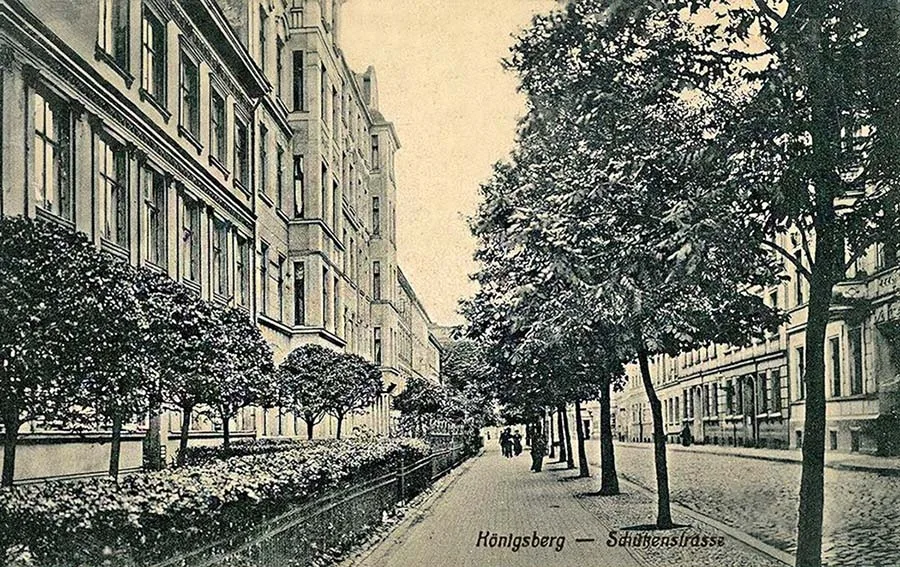
Königsberg had a Riflemen's Street too. Today it is in Kalthof, but back then it was in Tragheim.
Nearby runs Wrangelstraße, so called since 1872 after the barracks of the Wrangel Cuirassiers built here that same year.
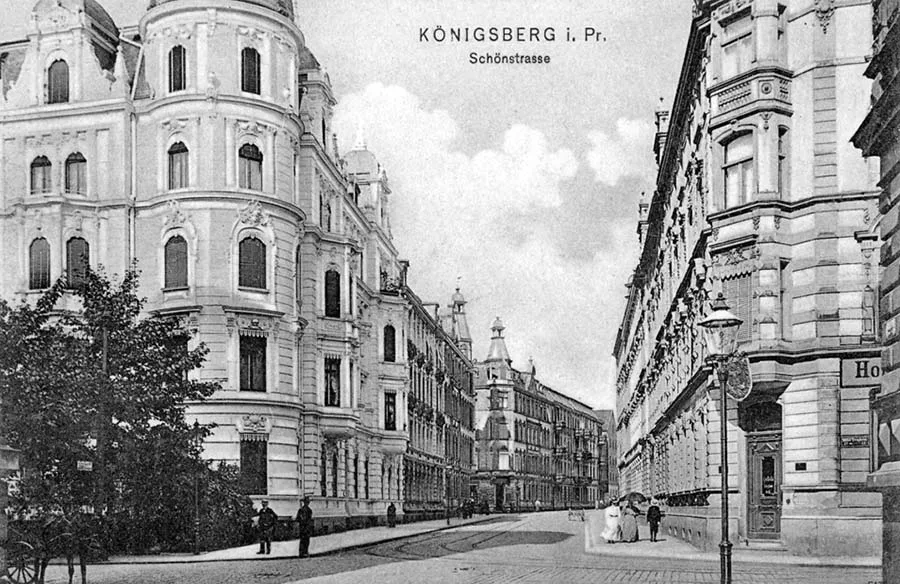
Königsberg also had a Krasnaya (Beautiful) Street. Today it is in Amalienau, but formerly it too was in Tragheim.
(Wrangelstraße now bears the name of Chernyakhovsky. The barracks of the 3rd Count Wrangel Cuirassier Regiment were built on it in 1870. At the end of the 1920s the central part of the building was dismantled in order to extend Mitteltragheim towards the Upper Pond. The western part was badly damaged and burned out during the storming of the city in April 1945, after which it too was dismantled. In 2007 the eastern part received the status of a cultural heritage site of regional importance; it stands to this day and is let as offices — editor's note.)
Field Marshal Count von Wrangel was born on 13 April 1784 in Stettin. In 1796 he entered service in an East Prussian dragoon regiment. With it he fought at the Battle of Heilsberg in 1807. He took part in the War of Liberation of 1813–1815. He rose to the highest military ranks. In 1845 he became chief of the regiment named after him. He commanded the Prussian troops during the first year of the Schleswig-Holstein War (1848–1851) and on 23 April 1848 defeated the Danes at Schleswig. The count died on 1 November 1877 at the age of 93. His bronze statue stands in the inner corridor of the barracks.
Of all the Tragheim streets leading north towards Wrangelstraße, the best known is Mitteltragheim (now Proletarskaya).
It begins between the Jewish cemetery (Judenkirchhof) and the Riflemen's Garden (Schützengarten. The remains of the Jewish cemetery can be found as a small public garden by the traffic police building on Chernyakhovskogo Street. The Riflemen's Garden has not survived; it was in the area of today's Minskaya Street, which in those days was called Tragheim Powder Street — ed.) The Jewish cemetery was founded in 1703 next to the former Powder Mill on Tragheim Powder Street. The Riflemen's Garden, with its magnificent old trees, beautiful paths and arbours, was for a long time very popular with the people of Königsberg. Formerly the eastern boundary of the garden was Dohnastraße (Dohnastraße ran east of Proletarskaya Street, parallel to it, through what are now courtyards; it has not survived — editor's note.) Now a considerable part of the garden has become an object of property speculation, while the Riflemen's House (Schützenhaus) standing in it, with the headquarters of the riflemen's guild, large halls and practice grounds, has survived. However, in 1854 the guild was forced to move its activities outside the city, and in 1894 it acquired a considerable property for its purposes beyond the Tragheim Gate.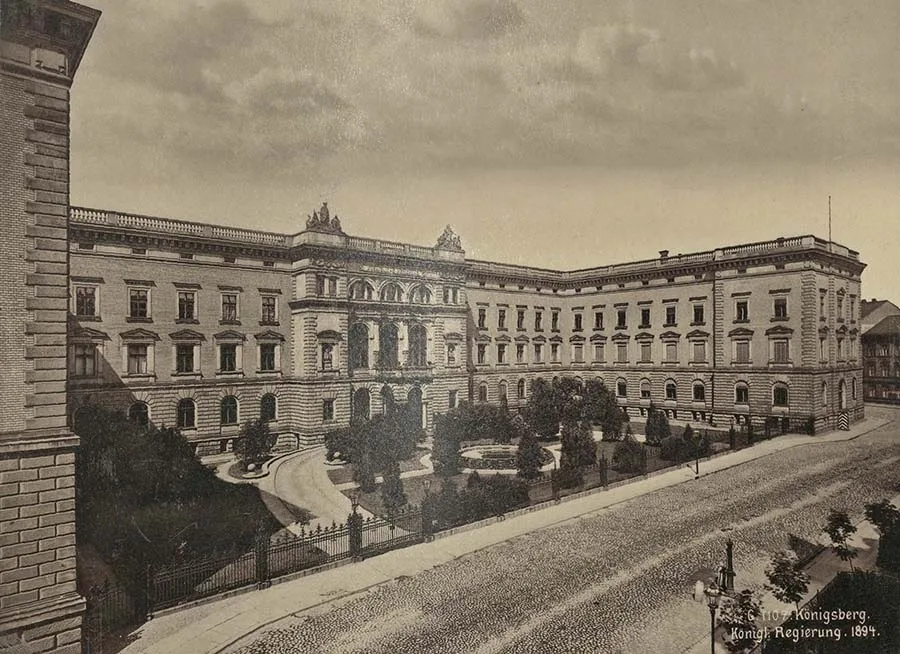 The East Prussian government building on Mitteltragheim street.
South of the Riflemen's House, about six years ago, a completely new district appeared with all the features of a modern city, and if someone from this fashionable quarter suddenly found themselves in, say, Sackheim, they would not believe it was the same city.
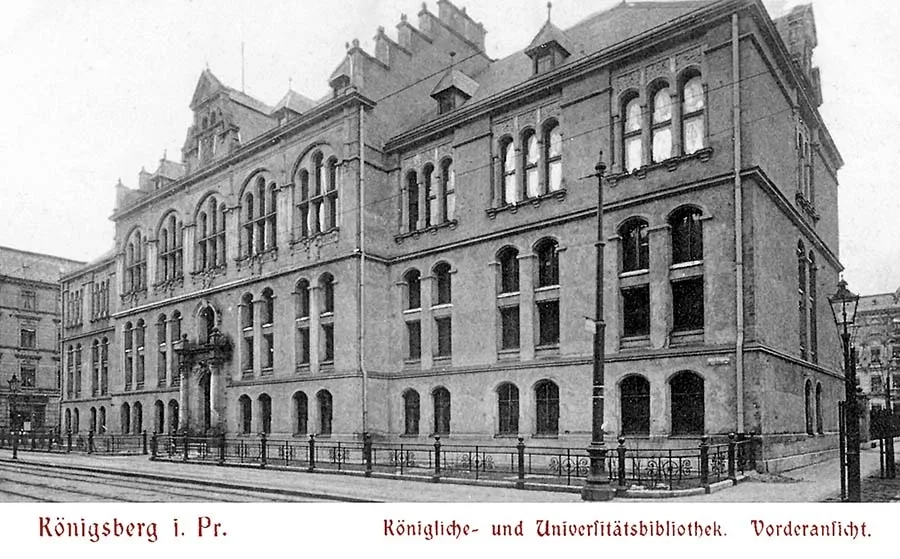 The university library on Mitteltragheim street.
The streets here bear the names of worthy men who rendered special services to East Prussia and Königsberg. For example, the above-mentioned Dohnastraße is named after a family well known in East Prussia. This name is also immortalised in the name of the tower near the Rossgarten Gate (Dohnaturm. As has been said, the street has not survived, but the Dohna Tower stands to this day; it houses the Amber Museum — ed.) Schönstraße (now named after General Sommer) was named after Minister von Schön (Staatsminister v. Schön), a great statesman who distinguished himself during the liberation of our province from French occupation and its restoration.
Henschestraße is named after a deeply respected local resident who earned the right to be called a City Elder (Stadtältester).
The street runs across his former property, where his descendants now live. (The street has not survived; it ran further east, parallel to Proletarskaya Street, ending at the Riflemen's Garden — editor's note.) The house at 9 Mitteltragheim, formerly the estate of the noble von Braxein family, has survived. It was recently bought for the construction of the Royal University Library (Königliche Universitätsbibliothek, not preserved). The small single-storey houses that stood on the Peat Market square (Torfmarkt) have now been demolished, which made it possible to extend Krugstraße beyond Mitteltragheim as far as the crossing with Henschestraße.
(The university library stood on the eastern corner of today's Professora Sevastyanova and Proletarskaya streets. Remarkably, at the first renaming of Kaliningrad's streets, the street was named "Bibliotechnaya" (Library Street), and only later renamed Professora Sevastyanova Street. Peat Market square was at the crossing of today's Proletarskaya and Sergeyeva streets. It bore this name in 1811–1885. Peat for heating stoves was sold here, the square — editor's note.)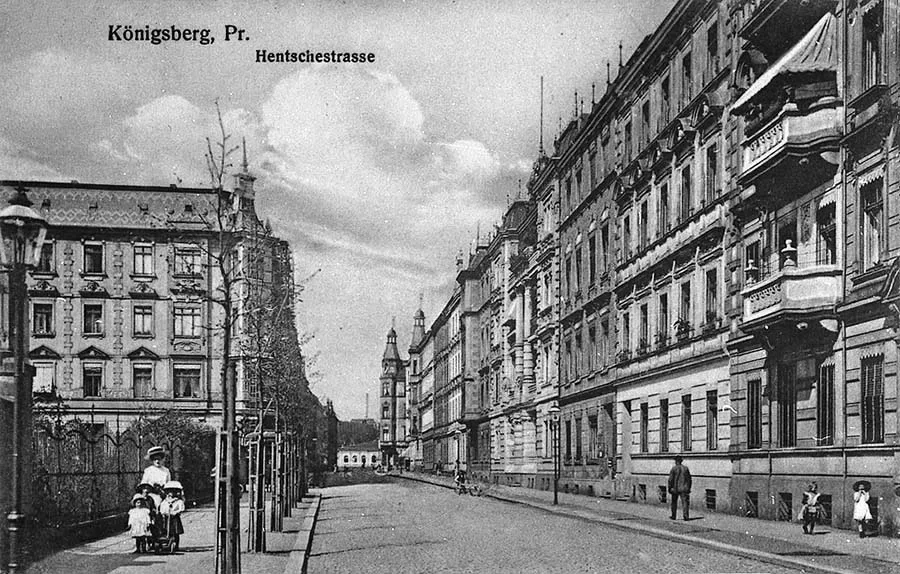
Henschestraße was named in honour of a local authority figure.
The main sight of Mitteltragheim is the grand Renaissance-style government building, the seat of the highest administrative body of the province.
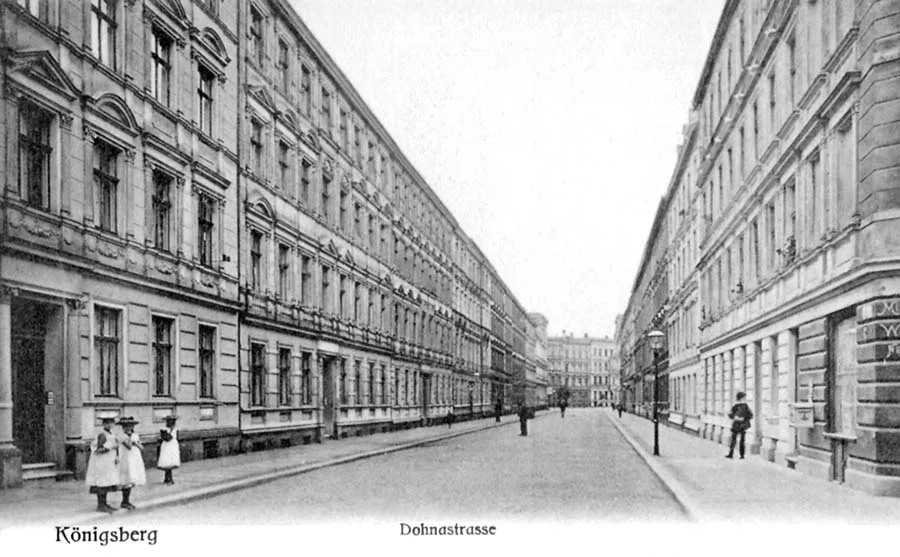
Dohnastraße. The houses stand as if on parade: Prussian drill in all its glory!
It consists of a central part and two wings enclosing an inner courtyard that resembles a garden. The palace radiates nobility, solidity and calm. Elegantly wrought iron gates separate the courtyard from the street. The walls are faced with sandstone and matt yellow brick. The central part is adorned with two busts made by Professor Reusch (Johann Friedrich Reusch, 1843–1906): of Duke Albrecht (Herzog Albrecht), founder of the duchy in Prussia, and of Emperor Wilhelm the First (Kaiser Wilhelm I), in whose reign construction of the building began. At the corners of the central façade stand allegorical groups, also by Professor Reusch, representing, one, trade, crafts and seafaring, the other, agriculture, science and education.
The staircase is especially beautifully executed; here Professor Reusch created another allegorical group: Justice, Strength and Temperance.
Worthy of attention are the frescoes by Professor Knorr (Hugo Knorr, 1834–1904), depicting the main occupations of the people of East Prussia: amber extraction, hunting, fishing, horse breeding, cattle breeding and agriculture. In the richly decorated festive hall, which measures 220 square metres, there are two large landscape paintings by Professor Max Schmidt (Max Schmidt, 1818–1901). Their content is expressed by the motto "From the rocks to the sea". They show the castle of the Hohenzollern dynasty (in Germany) and the seashore near Gross Kuhren (Groß Kuhren, the village of Primorye). Besides numerous offices, the building contains the apartments of the Oberpräsident. The southern wing houses a post office.
(The government building stood at the corner of today's Proletarskaya and Generala Sommera streets. It was badly damaged during the war; later war films were shot in it; in the 1960s the building was dismantled and residential buildings were erected in its place. Nothing remains of the little garden either — editor's note.)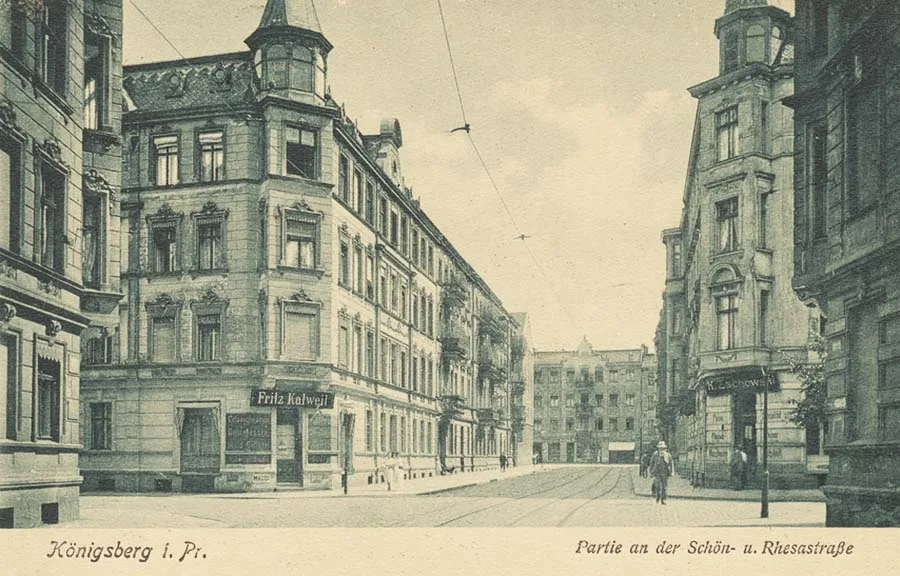 The crossing of Rhesastraße and Schönstraße.
Continuing our walk, let us turn east and, going along Schönstraße, we come to Rhesastraße, named after Professor Ludwig Rhesa.
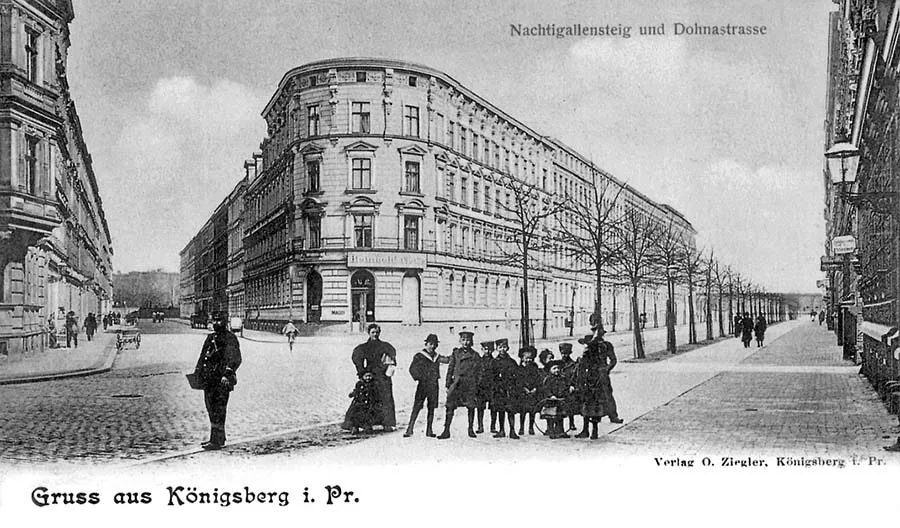 New streets: Nachtigallensteig and Dohnastraße.
(Schönstraße, today's Generala Sommera Street, crossed Mitteltragheim, today's Proletarskaya Street, continued east, crossing Henschestraße, and ended at Rhesastraße, which ran north from Hintertragheim, today's Sergeyeva Street, to the Riflemen's House. In the second half of the 20th century this part of today's Kaliningrad partly lost its original layout and was densely built up with five-storey apartment blocks known as "khrushchyovkas". Rhesastraße has not survived — ed.)
Ludwig Rhesa (Ludwig Rhesa) was born in 1777 into the family of a poor fisherman in the village of Karwaiten on the Curonian Spit, now buried by sand. He was orphaned early, but with the support of relatives and friends was able to study theology. He studied at the Löbenicht poorhouse (Löbenichtsches Pauperhaus) and attended the Löbenicht Latin School (Löbenichtsche Lateinschule) free of charge. As a student he lived in the Kypkeanum. He took part in the War of Liberation. He became a professor at the University of Königsberg and founded a school of academic study of the Lithuanian language. As a token of deep gratitude to those who had helped him during his studies, he founded, on the model of the Kypkeanum, the Rhesianum, where students could likewise obtain free accommodation. This institution is located at 51 Hintertragheim. Ludwig Rhesa died on 30 August 1840.
(The Rhesianum student residence on Hintertragheim, now Sergeyeva Street, has not survived. Ludwig Rhesa was the first to publish the works of the Lithuanian writer Kristijonas Donelaitis. Today a monument to the great Lithuanian scholar stands at the crossing of Kashtanovaya Alley and Prospekt Pobedy — ed.)
Rhesastraße leads us to Hintertragheim. Here the Eichmann Garden (Eichmannsche Garten) enjoyed wide fame; it made an unusual impression with its many ponds, waterfalls and fountains. This garden may be called the most beautiful in Königsberg. Later a certain Feldheim founded a hydropathic establishment here (Feldheimsche Wasserheilanstalt).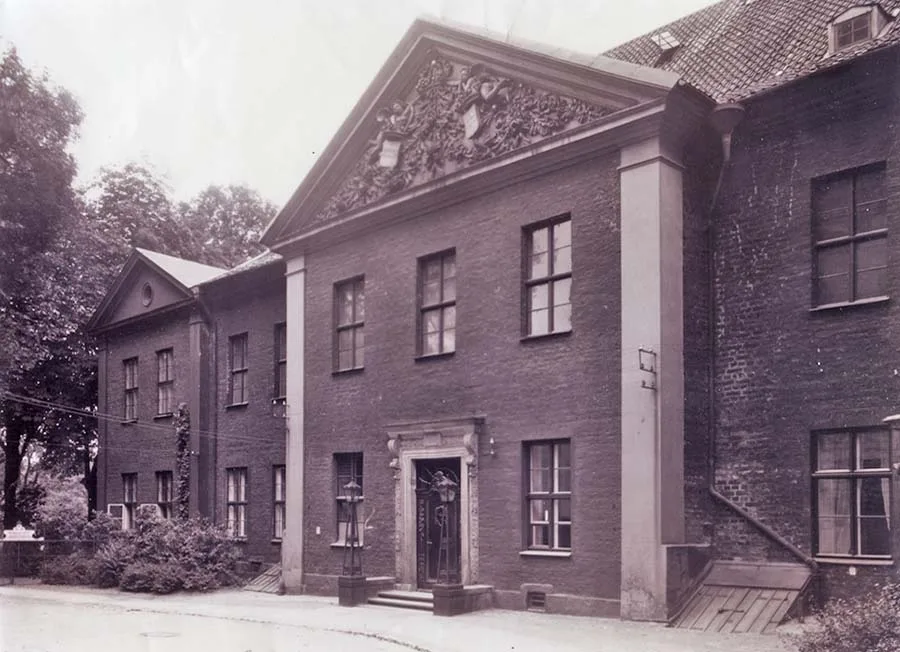 Three Crowns. One of the oldest Masonic lodges in Prussia (1746).
On Hintertragheim stands the Royal Kaiser Wilhelm Gymnasium (Wilhelmsgymnasium). It opened on 15 October 1874.
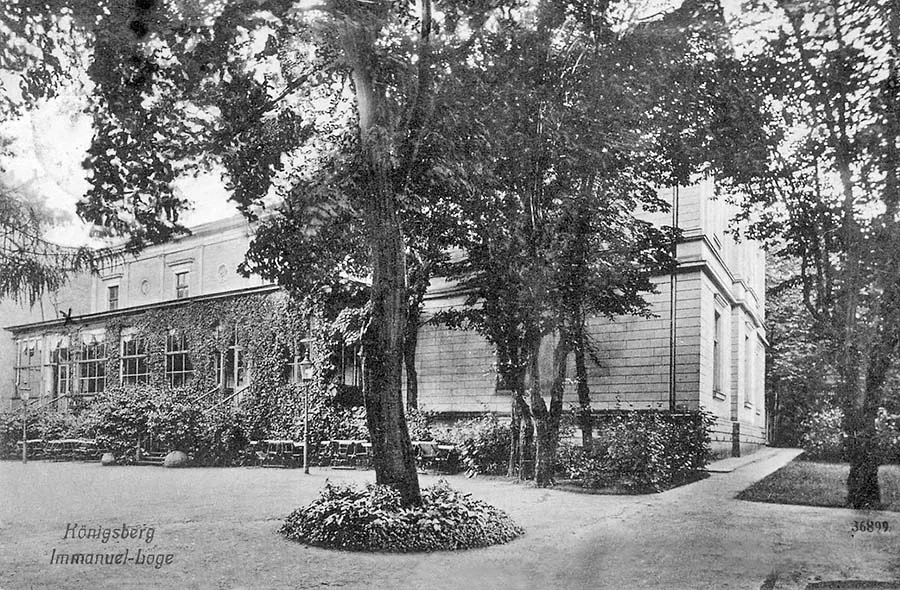 Immanuel. The youngest Masonic lodge in Königsberg (1884).
At that time it had 92 pupils in five forms. The gymnasium had a preparatory class in Rossgarten, opened a little later, in 1879. The gymnasium building itself is very plain, without any architectural refinements. But the assembly hall deserves attention thanks to the paintings that adorn it. The narrow northern wall, to the right of the entrance, is adorned with the canvas "The Entry of the Grand Master of the Teutonic Order Siegfried von Feuchtwangen into Marienburg in 1309". On either side of it hang the paintings "Frederick William III in Conversation with Yorck and Stein" and "Queen Louise with Her Elder Sons in Luisenwahl Park". The latter is not an original. All three of these paintings were painted by the late Professor Steffeck (Carl Constantin Heinrich Steffeck, 1818–1890). On the narrow southern side hang three works by Professor Neide (Emil Adolph Neide, 1843–1908). The middle one depicts Duke Albrecht introducing the Protestant order in Prussia in 1525. The canvases on either side show the great astronomer Copernicus in his observatory and the philosophers Kant and Fichte in conversation.
The paintings arouse interest because they seem to be continued in the portraits, hanging in the same hall, of famous scholars of the past and eminent men of Königsberg of our own time.
On the wall opposite the windows is a frieze decorated by Professor Knorr (Hugo Knorr, 1834–1904). Its four pictures show scenes of the religious education of youth in different periods. Antiquity is represented by the philosopher Socrates, the Middle Ages by a monastery school, modern times by the humanist scholars Erasmus and Reuchlin; the fourth shows a meeting of learned men of the Prussian Council of State and educators of youth at the beginning of the 19th century. Among the sculpture, let us note the bronze bust of Emperor Wilhelm the First made by Professor Reusch (Johann Friedrich Reusch, 1843–1906).
(This gymnasium stood on the eastern side of today's Sergeyeva Street, south of the present House of Trade Unions. It was completely destroyed, like all the German buildings on this street — editor's note.)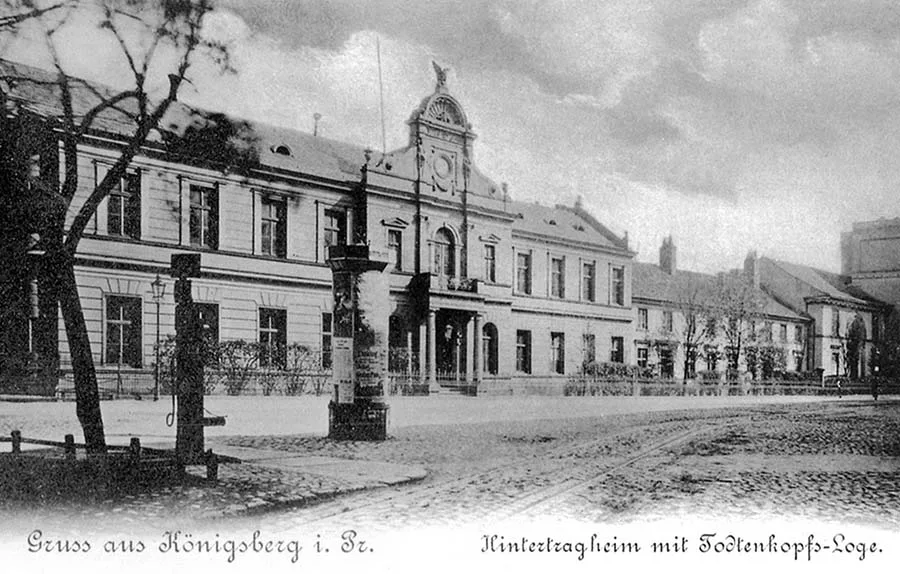 The Masonic lodge "To the Death's Head and Phoenix" on Hinterrossgarten street.
Next to the gymnasium stands the chapel of the Baptist congregation. This sect comes from England and is called the "Congregation of John the Baptist" (Täufer (Baptisten-)Gemeinde), because they baptise not children but only adults.
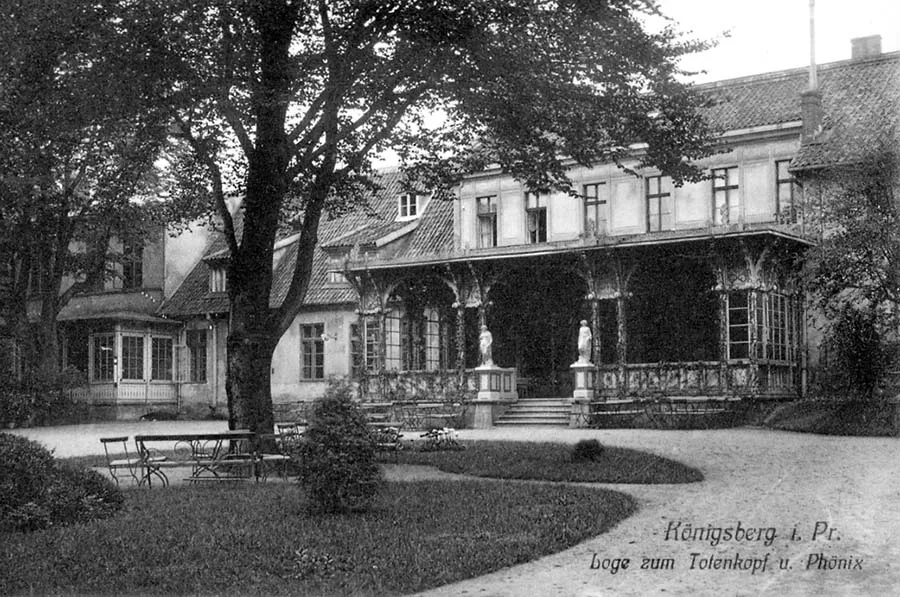 The garden of the lodge "To the Death's Head and Phoenix" on the shore of the Castle Pond.
The Baptists are known for their strict morals; they avoid strong drink. The first such Baptist congregation was founded in Hamburg in 1834 by the English missionary Ducken. The Königsberg congregation was founded in 1857 and numbers 1,100 people (not counting children). Besides this chapel on Hintertragheim (since 1870), the congregation has another one, on Lower Haberberg, no. 12 (since 1887; now Bagrationa Street).
Next to the chapel in Tragheim was an estate belonging to the famous physics professor Franz Neumann (Franz Ernst Neumann, 1798–1895).
(The Baptist chapel building stood next to the gymnasium, to the north of it. The site of the house where the physicist Franz Neumann lived and worked now adjoins the new building of the House of Trade Unions — editor's note.)
The three Masonic lodges of Königsberg, hidden in greenery on the eastern side of Hintertragheim, are interesting more for the beauty of their gardens than for their architecture.
The oldest of them is the Three Crowns Lodge (Dreikronenloge). It was founded on 1 December 1746 and was originally located in the Altstadt Lastadie at 9 Holländerbaumstraße (now Peter the Great Embankment). Since 1818 this lodge can be found on Hintertragheim, on an estate that belonged to Dr William Motherby (1776–1847).
The lodge "To the Death's Head and Phoenix" (zum Todtenkopf und Phönix), whose grounds border on those of the Three Crowns Lodge, formerly consisted, as its name suggests, of two lodges. The Death's Head Lodge was founded on 21 March 1772 by the chief forester Jester; his grave, adorned with a large granite cube, is in the lodge garden. The Phoenix Lodge existed as an independent lodge from 1775 to 1832.
The Immanuel Lodge (Immanuelloge), the youngest of the three, was founded in 1864. Its new building was opened in 1886. It is located in the once popular Bauer Garden (Bauerscher Garten).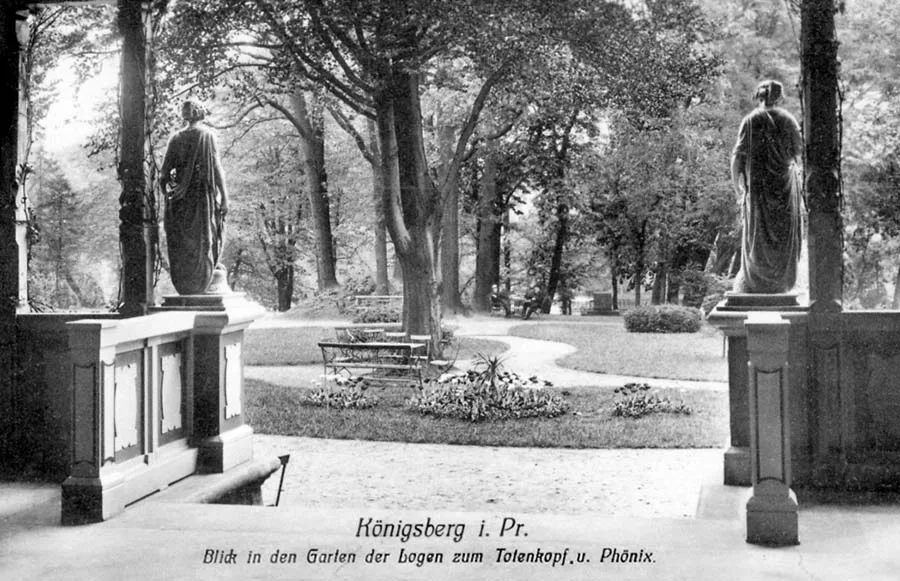 The way out into the garden on the shore of the Castle Pond from the lodge "To the Death's Head and Phoenix".
Freemasons are associations of people striving for personal and social improvement, for the spread of universal love and for raising the dignity and well-being of humanity.
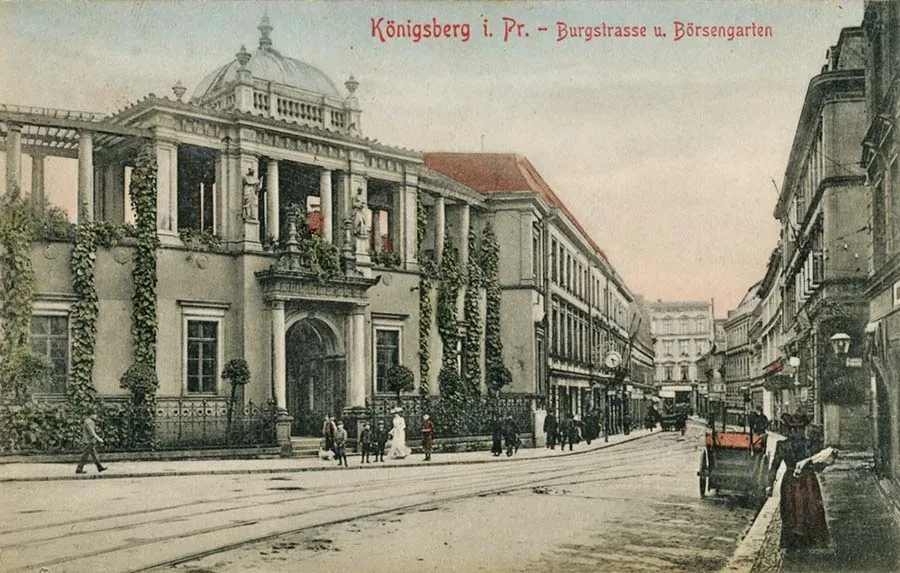 The portal of the Börsengarten on Hintertragheim street.
Emperors Wilhelm I (Wilhelm I, 1797–1888) and Frederick III (Friedrich III, 1831–1888) were members of these organisations. The three lodges on the shore of the Castle Pond (Schloßteich) in Tragheim work according to different systems, but all pursue the same goal. They are daughter lodges of the three Prussian Grand Lodges: "The Three Globes" (Zu den drei Weltkugeln), the "Grand Land Lodge" (Große Landesloge) and the "Grand Lodge Royal York" (Großloge Royal York). Their common patron is Prince Friedrich Leopold of Prussia (Prinz Friedrich Leopold von Preußen, 1865–1931).
(The Masonic lodge buildings have not survived. They stood in gardens on the western shore of the Castle Pond along Hintertragheim. The Immanuel Lodge was south of the gymnasium, next came "To the Death's Head and Phoenix", and at the beginning of the street, Three Crowns. The lodges' activities were ended after the Nazis came to power — editor's note.)
West of the Three Crowns Lodge is the summer restaurant Börsenhalle (Exchange Hall) with the adjoining Börsengarten (Exchange Garden). The entrance to the garden is an elegant domed portal. The garden itself is terraced and distinguished by fine trees and carefully tended grounds. The main building contains reading rooms and a large hall with numerous adjoining rooms.
The Börsenhalle society, which owned this summer venue, was founded on 18 December 1829. Its statutes were approved by the general meeting on 17 January 1830.
As early as 1830 the "Börsenhalle Gardeners' Society" was formed from among its members; every two weeks it held a concert in the Berlin Garden (as today's Börsengarten was then called). Any member of the Börsenhalle could become a member of the Gardeners' Society for an annual fee of 3 thalers. In 1833 a joint-stock company formed from members of the Gardeners' Society bought the Berlin Garden (2 Torfmarkt) for 6,000 thalers and later transferred it to the Börsenhalle society. As an old plan shows, the stepped terraces already existed here in the 1830s. In 1852 the "Stock Exchange" company acquired the houses at 1 Torfmarkt and 2 Modestengasse (Modestengasse) on this site, built residential and public buildings there and ceremonially opened them on 23 May 1855. Part of the land acquired in 1852 was handed over to the city council to widen Modestengasse, and part of the Torfmarkt was incorporated into the grounds of the Börsengarten. In 1880 large-scale landscaping works were carried out on its grounds, including improved gas lighting and the installation of a water supply system.
(Almost nothing of the Börsengarten has survived to this day. The whole area lay roughly where the Park Hotel was built in 1929, now an administrative building on Sergeyeva Street — editor's note.)
Photos on this page: Bildarchiv Ostpreußen.
Translated from Russian with the help of AI (Claude, Anthropic), October 2026.