LEGENDS OF PRUSSIA in the blog of Tatyana Kolivay.
[ 1814 ]
Gumbinnen. — Trakehnen. — Insterburg. — Norkitten. — Bubainen. — Wehlau. — Tapiau. — The house of correction.
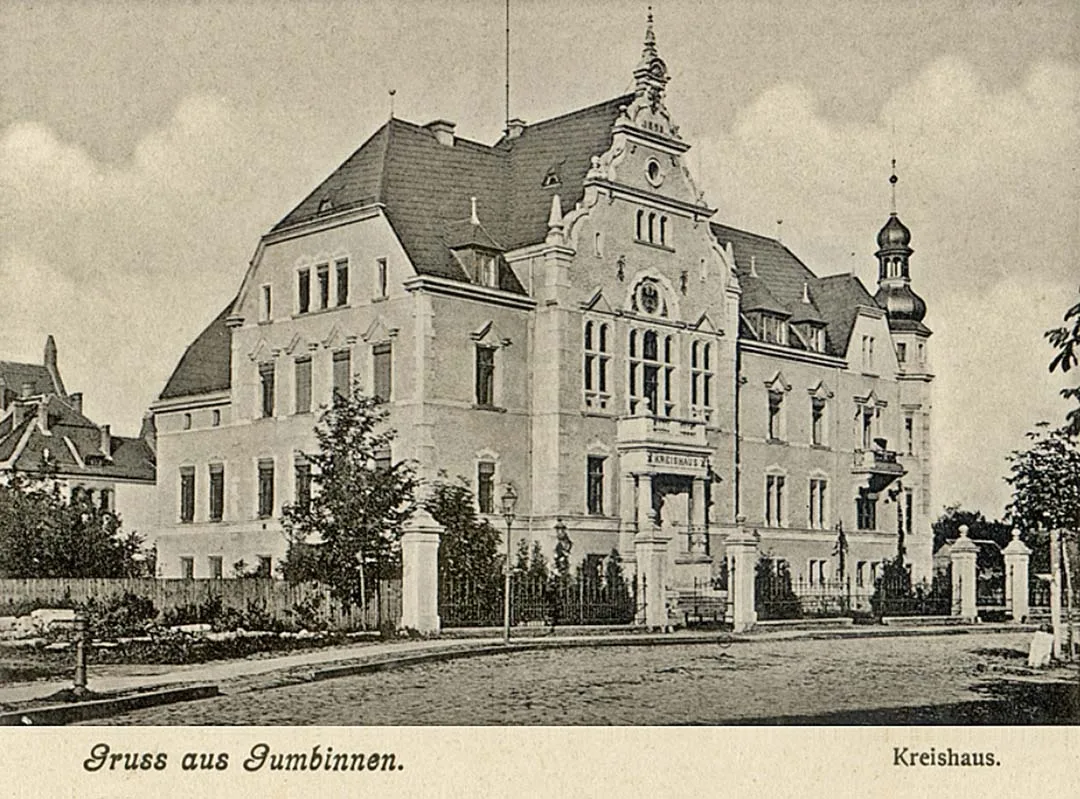
The sight of Gumbinnen surprised me to some extent: I had not expected to find here, deep in Lithuania, a pleasant, pretty little town with perfectly straight streets laid out as if with a ruler. This sizeable settlement was founded in 1732 and built to a plan drawn up by Frederick William I himself, hence the regularity of its layout. Its first inhabitants were the officials of the War and Domains Chamber (Kriegs- und Domänenkammer), which had its headquarters here, and refugees from Salzburg, who were soon joined by many Lithuanians attracted by the town's favourable location.
The Chamber, which under the new Ordinance is called the Government, is the highest financial and police authority of the province. Its staff numbers about a hundred people, who themselves form a kind of town within the town, all the more so in a provincial one. Gumbinnen derives its main income from its distilleries, which also brew a great deal of beer. The distilleries are run by Salzburgers.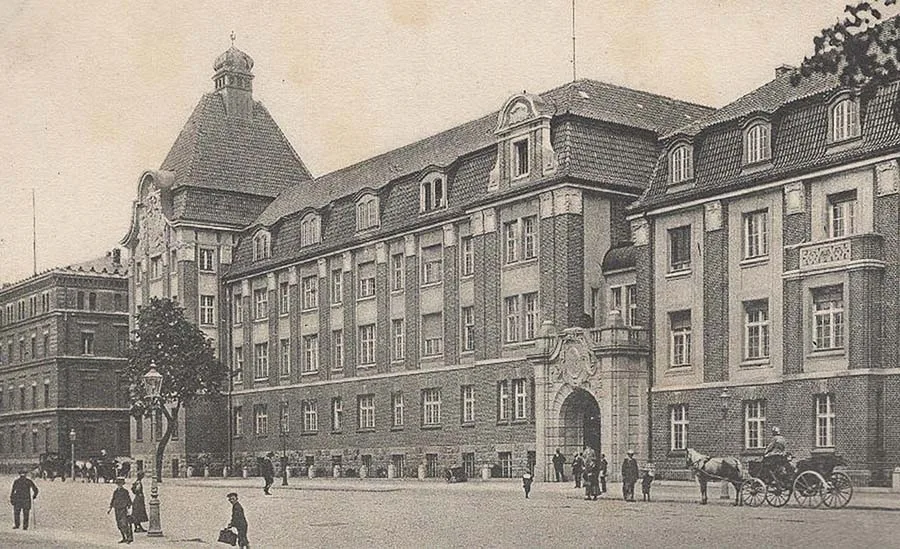 The government quarter of Gumbinnen.
Gumbinnen is also the residence of the province's Master of the Horse. This is a very high post, since the Lithuanian stud farms are considered among the most important in Europe. The Master of the Horse holds the second most important rank after the President of the Government, but is not subordinate to him.
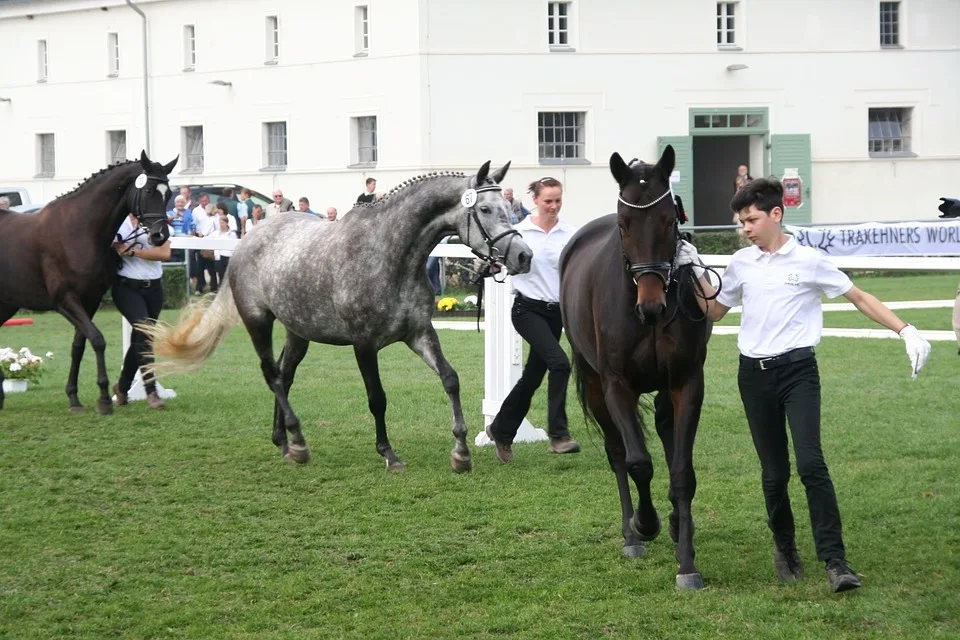
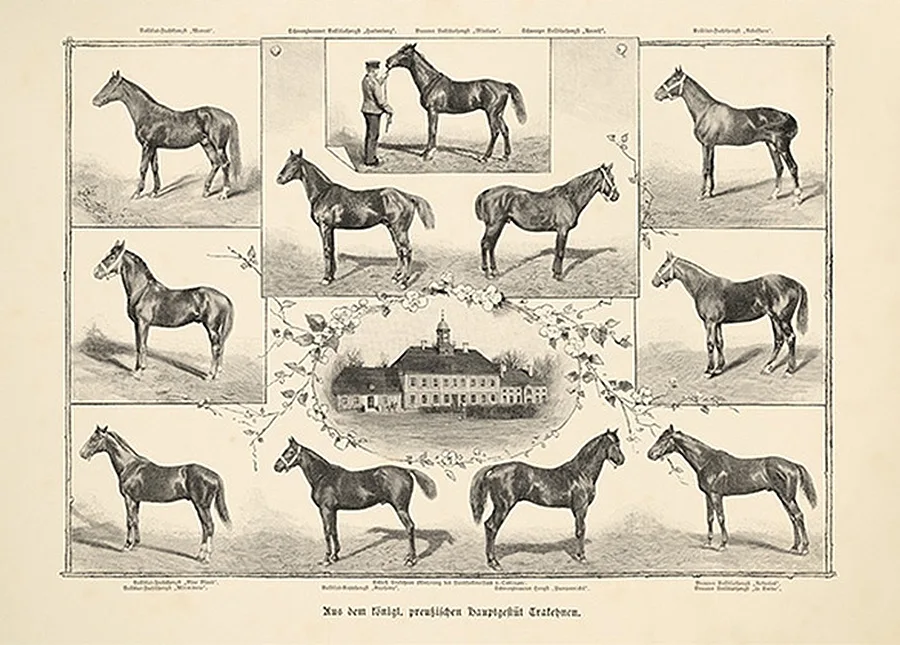 Silhouettes of Trakehnen.
The main Trakehnen stud, to which 14 farms belong, lies amid extensive meadows that provide enough pasture and fodder for the enormous number of pedigree horses belonging to Trakehnen. The organisation and order at the stud are admirable, and the horses are kept in exemplary fashion. Grooms, their assistants, fodder collectors and a large number of attendants constantly see to it that the horses receive excellent care, and the slightest negligence is punished severely and without delay on the spot.
The stallions, among which there are very handsome animals worth several thousand thalers each, are of Spanish, Neapolitan and Arab origin. Winter and summer they are kept in stables on a special farm. The mares are divided by colour and kept on different farms. The foals, too, are divided by age and sex. There are also special farms for donkeys and mules.
Every stallion and every mare has its own so-called genealogical register. These registers record all the animal's ancestors and family connections, and they are kept by special secretaries.
These horse passports are undoubtedly the most reliable and most accurate of all the pedigrees in the world: the way the records are kept does not allow any bastards to appear in the family tree of any animal.
Many of the finest horses of this stud are sold at very high prices to wealthy foreigners, especially the English and the Russians. The royal stables take horses only from this stud; the rest are put up for sale at the highest price.
During the French invasion of Prussia in 1807, every measure was taken to keep these breeding farms from falling into enemy hands. The horses were evacuated in good time to the right bank of the Neman.
Insterburg, though not as handsomely built as Gumbinnen, is livelier.
Nearby, the Angerapp and the Pissa merge into a single channel [here the author did not double-check himself; of course, the second river is the Instruch, after which the town is named – ed.]. From there they flow on as the full-flowing Pregel, which is navigable below Insterburg. That is why there is a brisk grain trade in the town. Here are the granaries of grain-rich Lithuania.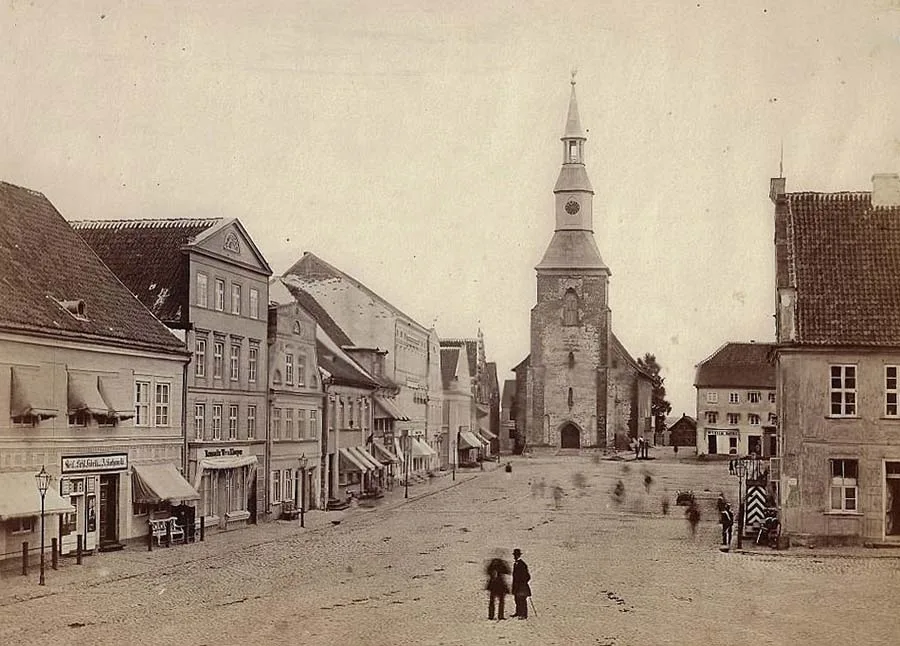 One of the first photographs of the Old Market in Insterburg.
Distilleries together with breweries are also important sources of income for Insterburg. The landscape around is not particularly beautiful, but the soil is very fertile. The open spaces are not impressive, but one feels so comfortable in this impeccably cultivated country that one does not want to leave it.
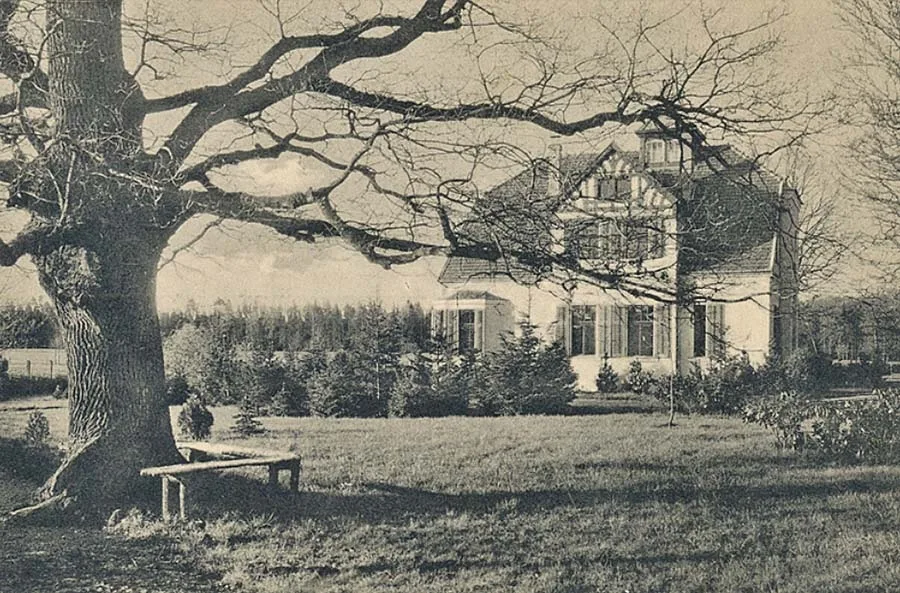 The Hubertus hunting lodge in Bubainen.
The old castle houses the Higher Regional Court of Lithuania (Oberlandesgerichts von Litauen), whose staff is as numerous as that of the Government.
Near Insterburg lies Norkitten, a fine estate of the Dukes of Anhalt-Dessau. It covers an area of about two square miles, which is excellently cultivated. Norkitten was given by Frederick William I to the famous Old Dessauer, the Prince of Dessau, and has remained with this ducal family ever since, belonging to it with all manorial rights except national sovereignty. Farming here is carried on in the same way as in Dessau itself, so the estate is in exemplary order.
In Bubainen, a neighbouring little town belonging to the Norkitten community, there are very impressive mills producing excellent pearl barley in quantities sufficient to meet the needs of the whole of Prussia, which formerly obtained several thousand hundredweight of it from Holland.
River lamprey is also caught here in considerable quantities. This tasty fish is mainly caught in autumn, dried or fried and packed into barrels; part of it they eat themselves, and part is sent to Warsaw, where it sells very well.
The walls of the palace built by the Old Dessauer are still standing. Legend has it that after his death the castle became uninhabitable because a ghost began to appear in it. Several attempts to drive out the spirit of the old master, who remained as unceremonious as he had been in life, were unsuccessful, and after all the windows and doors had been removed, it was decided to leave the castle for the sole use of the restless ghost. Little by little the palace fell into ruin, and finally its roof collapsed.
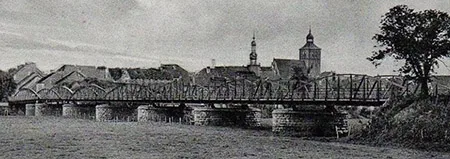
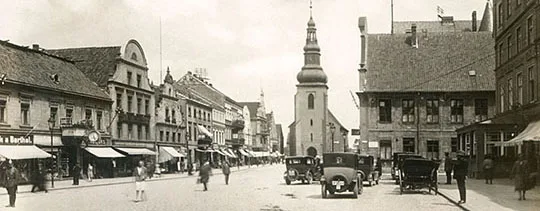
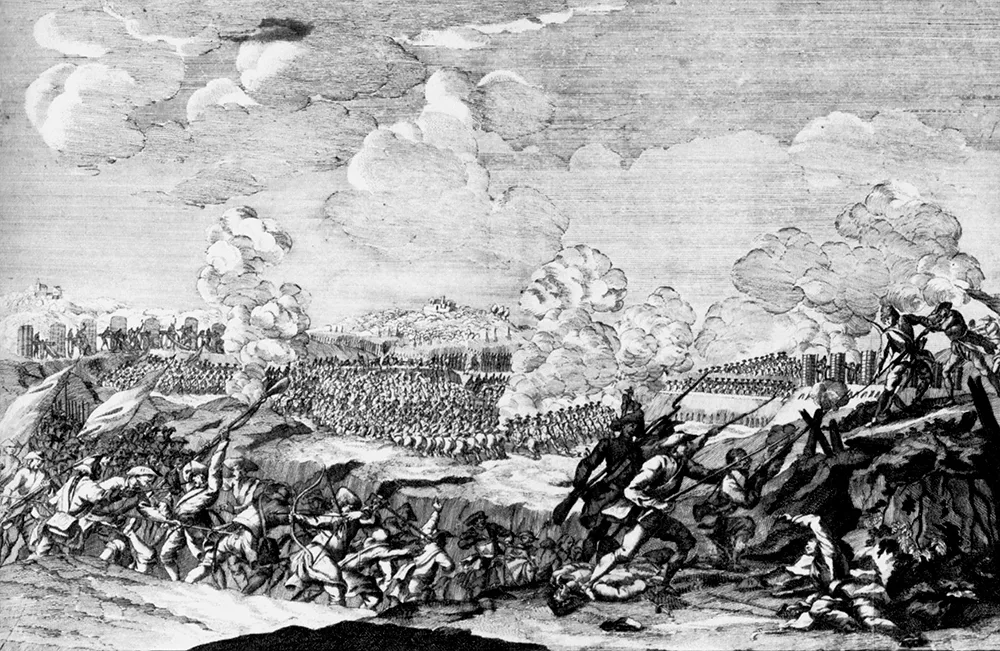
Wehlau, a lively but abominably built little town at the confluence of the little river Alle with the Pregel, is known for the battle between Brandenburg and Sweden in 1656, and also for the battle fought here between the Prussians and the Russians just a hundred years later, in the first Seven Years' War. The oddity of this battle is that in the end the Russians left Prussia, while the Prussians retreated beyond Königsberg. The battlefield is an hour's drive from Wehlau, on a large plain1. The local horse market is very well known.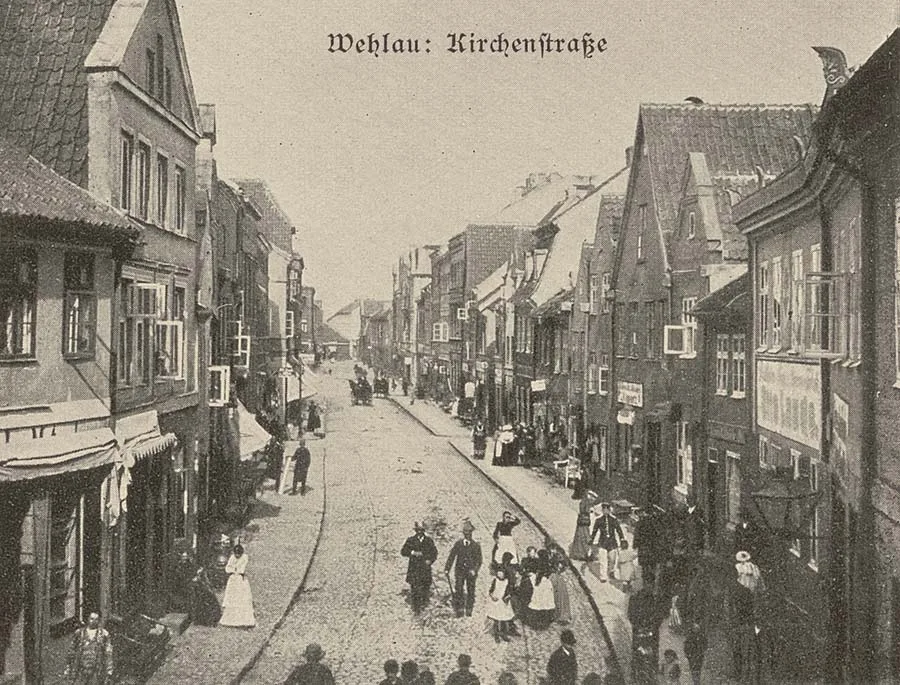 Kirchenstrasse in Wehlau.
Through fertile, beautifully cultivated country we drove from Wehlau to Tapiau, a very pleasant provincial town situated at the confluence of the river Deime with the Pregel.
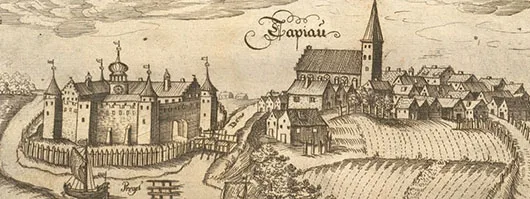
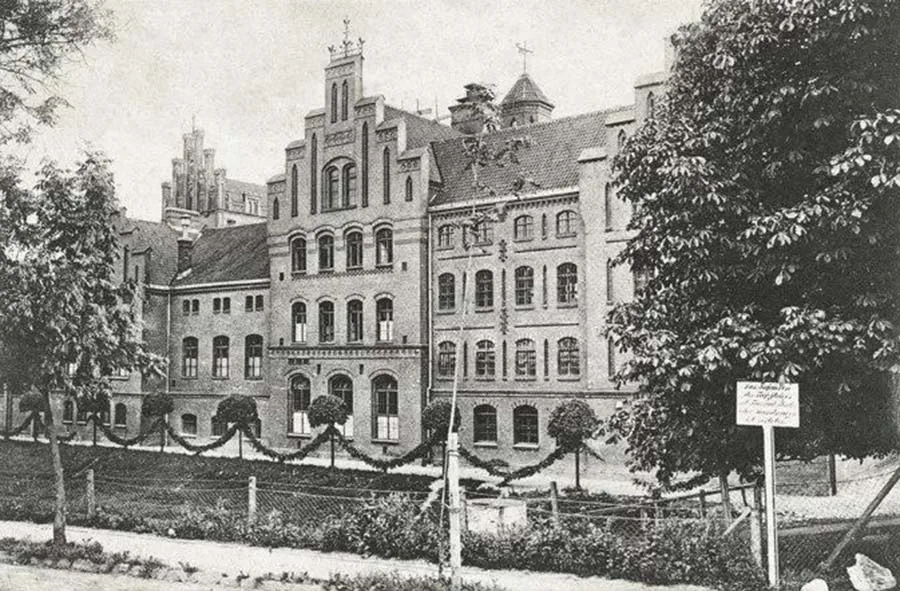 The house of correction in Tapiau.
What an abundance of rivers and lakes there is in Prussia! Undoubtedly no other country in Europe can compare with it. If the ambition of the local inhabitants were the same as that of the Dutch, one could, by building a few canals, travel all over the country in trekschuits, as in Holland.
On an island near Tapiau there is a large house of correction where all vagrants, beggars and suspicious persons are kept. Here they are given grey-and-white clothing with coloured sleeves, so that they can be more easily identified if they escape, and good food, but everyone must do work within his capacity.
Depending on their behaviour and on how diligently they work, their food is improved, and when there are sufficient signs of reform they are placed as labourers on good farms. The order and cleanliness that reign here speak of the institution's wholesome atmosphere.
The work consists of spinning, knitting and weaving. Very good room carpets are made here, which are in great demand because they are cheap and well patterned. Socks are also knitted here, and gloves and underwear sewn, which are sold through a shop in Königsberg.
NOTE
1. This refers to the Battle of Gross-Jägersdorf of 1757.
Translated from Russian with the help of AI (Claude, Anthropic), October 2026.