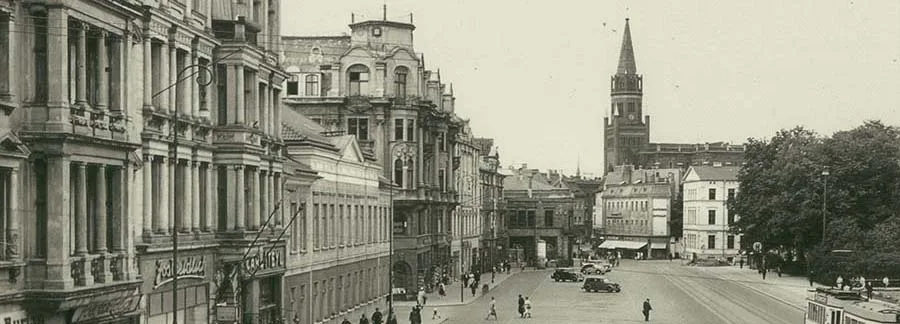
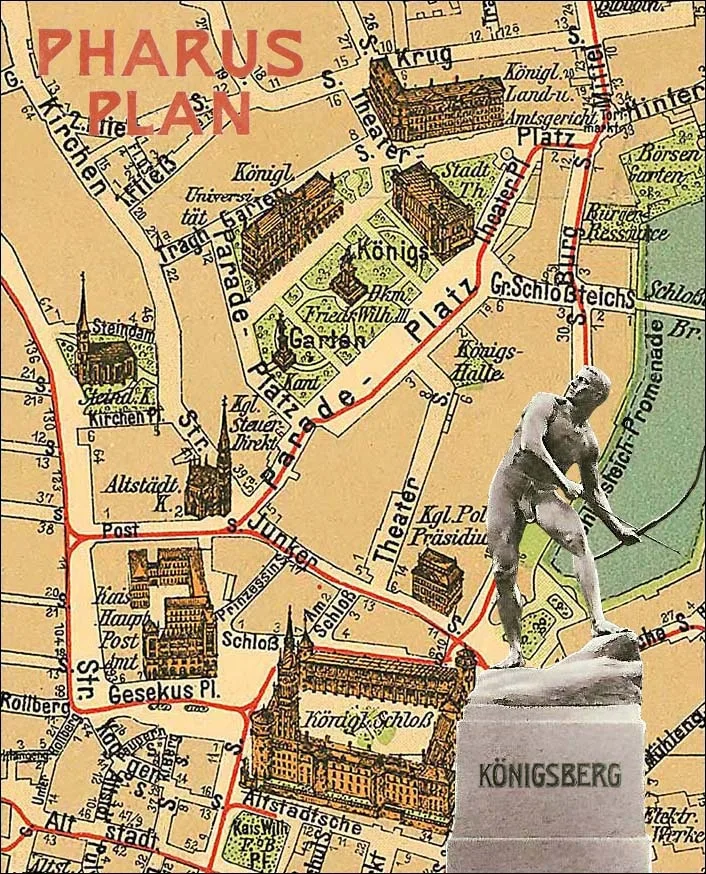
The beautiful and stately square that is now most often called Paradeplatz was in my youth often called the King's Garden (Königsgarten). After the First World War this name disappeared. Before that, only the avenue in front of the Königshalle and the publishing house of Gräfe und Unzer was called Parade Square, together with the square with two large gas candelabra, bordered by a beautiful chestnut avenue. It was here that small parades were always held on the Emperor's birthday. It was a festive, colourful spectacle: soldiers in black uniforms, officers in white, musicians in red spiked helmets with plumes — everything glittered and shone.
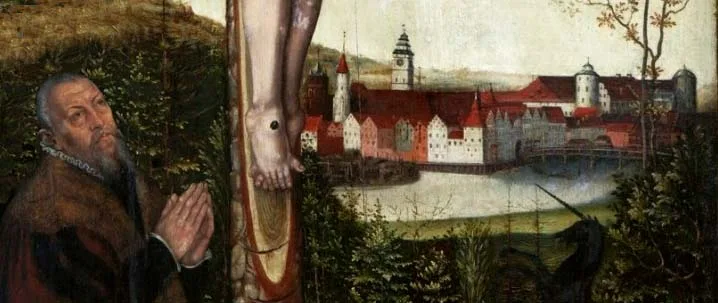
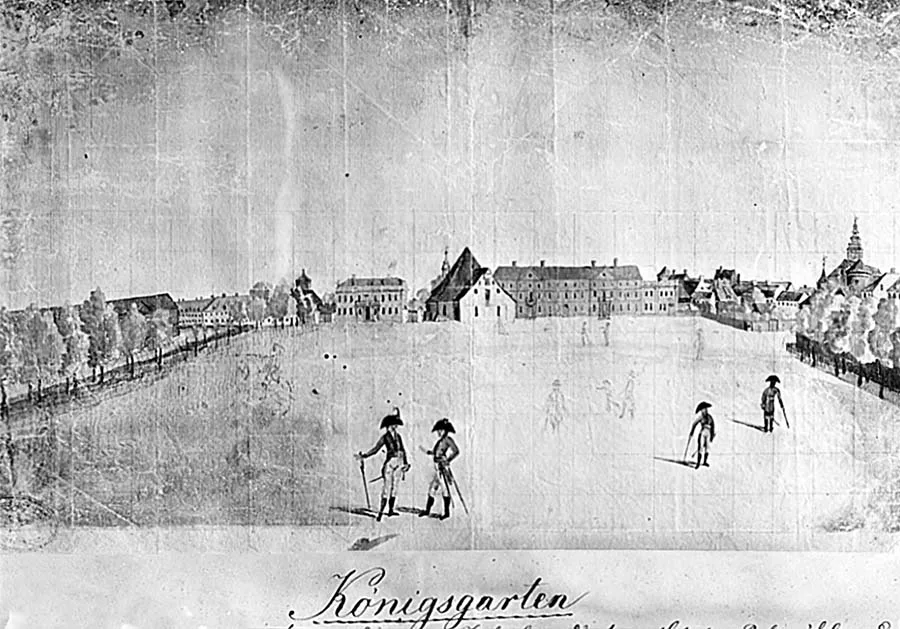 One of the earliest known depictions of the Königsgarten.
The name Königsgarten — King's Garden — did not exist for a very long stretch of time: it arose only when Prussia acquired a king (1701).
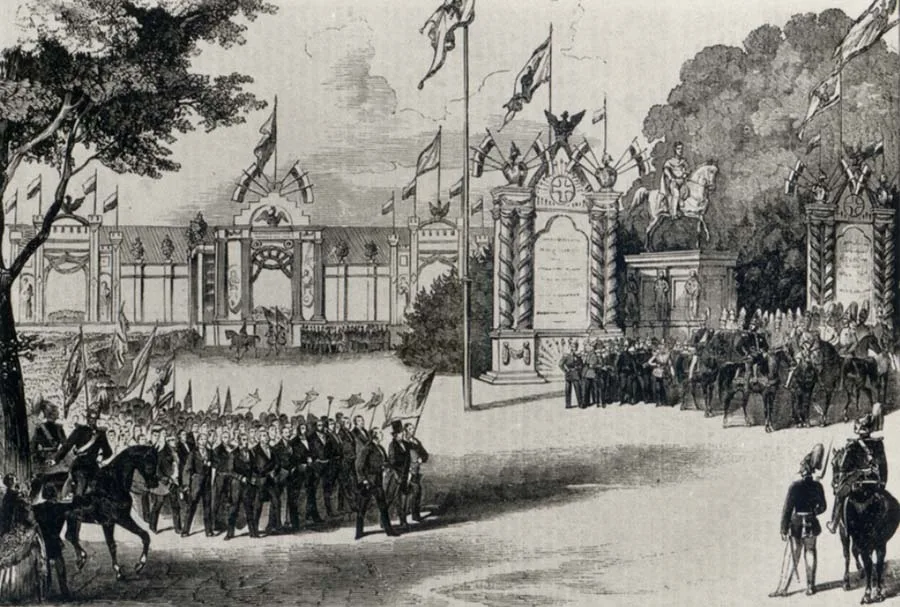 The route of the traditional procession of the Königsberg guilds passed through the Königsgarten.
Before that it was the Ducal garden by the castle kitchen. In the literal sense of the word. It was actually called the Kitchen Garden (Geköchsgarten), i.e. a vegetable garden where vegetables were grown, and in the reign of the Great Elector the first potatoes were planted here.
Of course, there was also a park adjoining it. Ancient and rare trees grew in it. This is not surprising, since it had been laid out by Duke Albrecht himself. To reach it, a little later high wooden footbridges were built across the castle moat and the Junkergasse directly from Königsberg Castle, offering a view of this garden. Caspar Stein (1592–1652), in his famous book "Peregrinator", calls these footbridges the Pedestrian Bridge.
In the park there was a Pleasure Garden (Lustgarten)1, next to which lay the Hunting Garden (German Hetzgarten, or "Baiting Garden"), where, for the entertainment of the local nobility, wild animals were barbarously baited to death and fights between bears and aurochs2 were staged. The Hetzgarten lay on the site of the residential buildings on Grosse Schlossteichstrasse. Only Frederick the Great (Friedrich II, Friedrich der Große, Alter Fritz) banned these medieval amusements in 1744.
In the southern part of the garden there was also, at that time, a Lusthaus (Lusthaus, House of Pleasure3).
Since the time of the Order, channels of streams flowing out of the Upper Pond (Oberteich) had been laid through the Lustgarten. They served to regulate the water level in the Castle Pond (Schlossteich), since they flowed into the Katzbach below and west of the Schlossteich, and they also fed the moat surrounding the castle.
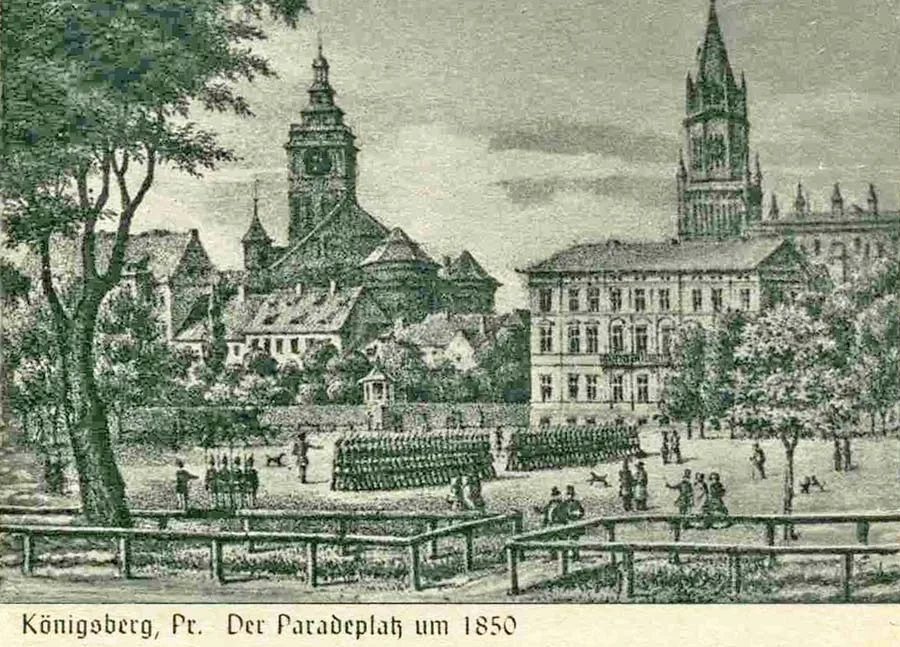 The square was by no means called Parade Square by chance.
The stream flowing from the direction of Tragheimer Kirchenstrasse (Tragheimer Kirchenstraße) ran along the western edge of the Königsgarten, which is why later, after it had been filled in, the houses built there had to be erected on piles.
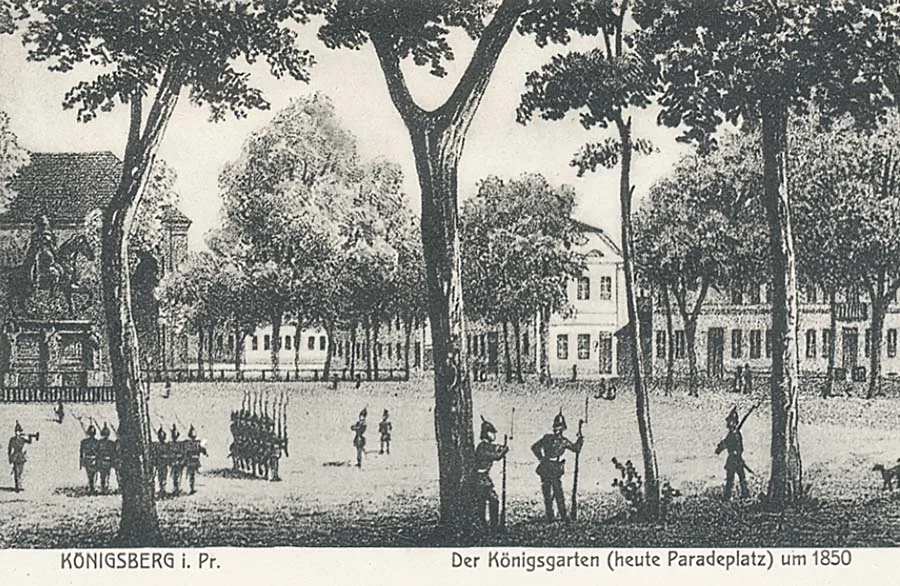 The meme "Prussian drill" did not arise out of nowhere, but on the parade ground of the Königsgarten.
No fewer than 325 piles were driven into my father's plot (Paradeplatz 19). Another stream skirted the city theatre. A photograph from 1850 has survived in which both the stream and the bridge over it are clearly visible. This stream flowed, at Theaterstrasse (Theaterstraße), into the moat that then surrounded the castle.
At the northern end of Theaterstrasse, turning it into a dead end, stood the Horse Mill (Roßmühle4), demolished in 1808, and so Theaterstrasse was then poetically called Come-Back-Again Lane (Kehrwiedergasse). On it, between 1780 and 1800, the elegant Königshalle was built in the neoclassical style, originally single-storeyed. In 1848 Lieutenant General Plehwe5 founded the "Königshalle" society, as a royalist stronghold of the Prussian anti-liberal union, which held its meetings in this building. From 1935 the building housed an officers' casino.
That fine trees grew in the Königsgarten is attested not only by Bering's plan of 1613 but also by the story of how Chancellor von Kreytzen (Georg Friedrich von Kreytzen; 1639–1710) in 1697 received Elector Frederick III, a native of Königsberg who probably very much liked to visit his home town, on a legendary giant linden tree. This venerable tree, which no doubt remembered the ancient Prussians, had a circumference of 30 feet and supported five tiers of balconies one above another. On the highest of them distinguished guests of the city in lavish wigs were often entertained. A truly Baroque idea! Nowadays hardly anyone could imagine honouring celebrities on a multi-tiered linden in Hirschau6.
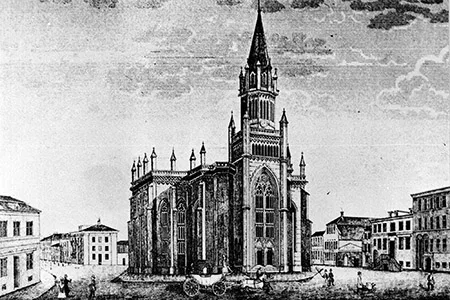
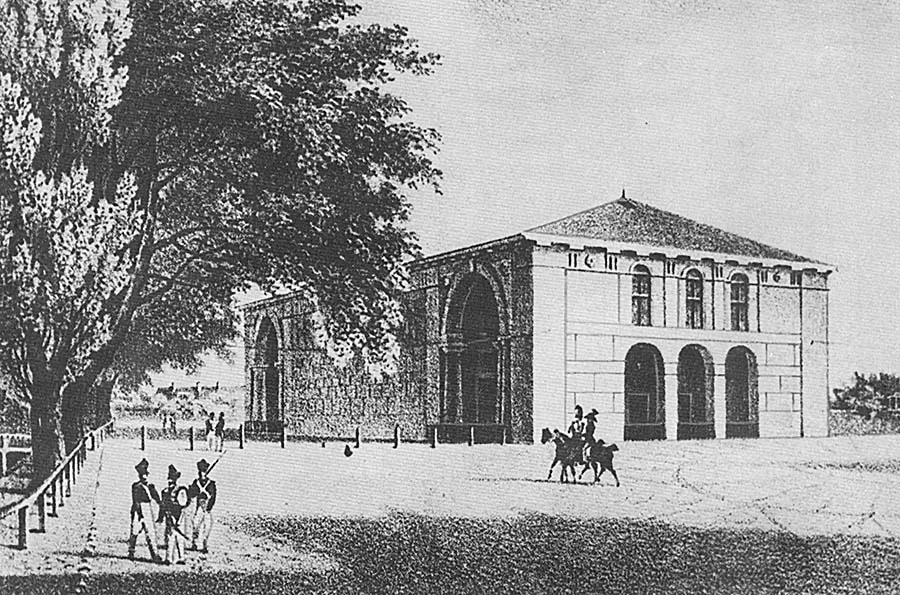 The old theatre, which stood where construction of the Garrison Church later began.
Then came the incredibly harsh winter of 1708, when one could travel by sledge over the ice of the Baltic Sea all the way to Lübeck. None of the rare trees in the Königsgarten of that time were prepared for such cold: they froze to death, and even the giant old linden perished, after which it had to be felled. The garden fell into neglect.
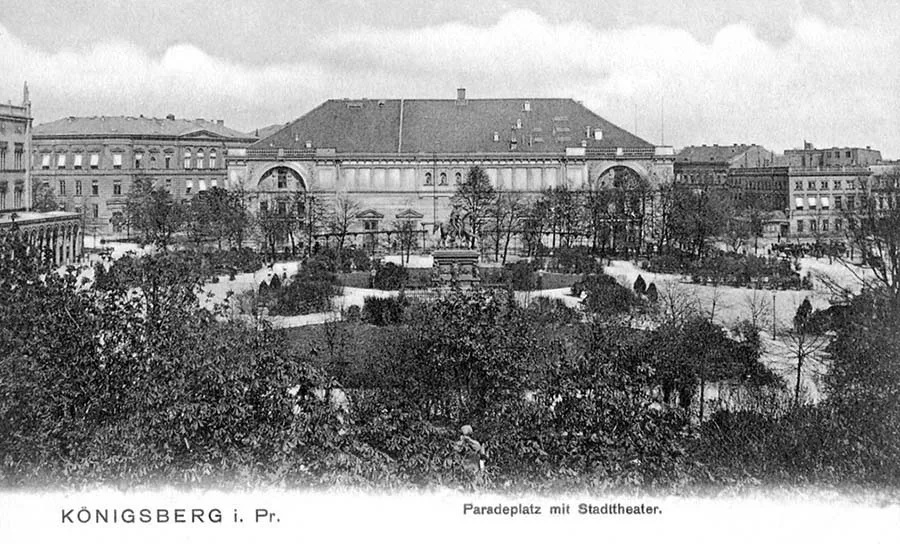 The new City Theatre on Parade Square was an almost exact copy of the old one.
When the thrifty and pious Frederick William I, called the Soldier King (Soldatenkönig) by his contemporaries, ascended the throne in 1713, he did not undertake the renovation of the King's Garden but instead began to use it as a drill ground. In the eastern part a riding hall was built, which was later moved to Mondscheingasse, then to Gartenstrasse and later still to Giesebrechtstrasse, right onto the site of the future university. In the central part of the Königsgarten he planned to build a garrison church. The project was entrusted to Schultheiss von Unfriedt7.
"Had it been completed," wrote Ludwig von Baczko8, "it would have been the most beautiful church in Königsberg." Given the skill of the builders, this sounds quite plausible. However, it was built only up to the level of the windows; then funding for the project stopped... This unfinished building stood for many years, and only in 1791, when the Königsberg theatre on Kreytzenscher Platz needed more spacious premises, was it remembered. The ruins of the unfinished building were demolished, but there was not enough money for a new theatre building then either. And the old theatre went on operating in Königsberg for another fifteen years.
Only in 1806–1808 did Privy Councillor Valerian Müller9, director of building, construct the new City Theatre (Stadttheater) in the neoclassical style to the west of the foundations of the unfinished garrison church. Barely completed, it burned down in 1808, but was rebuilt almost immediately — mainly with insurance money — and opened on 9 December 1809 in the presence of Their Majesties.
On its long sides the new theatre was adorned along its full height with two semicircular niches. The second storey (the third in the Russian tradition — ed.) was, according to the design, to be decorated with a tall frieze of figures, intended to embellish the otherwise modest exterior. However, this frieze, which would undoubtedly have greatly improved the exterior of the new city theatre, resembling a large box, had to be abandoned for lack of funds. And only eight figures, four in the centre and two in each niche, between which a fire escape could be prosaically seen, illustrated what the frieze was meant to look like according to the design.
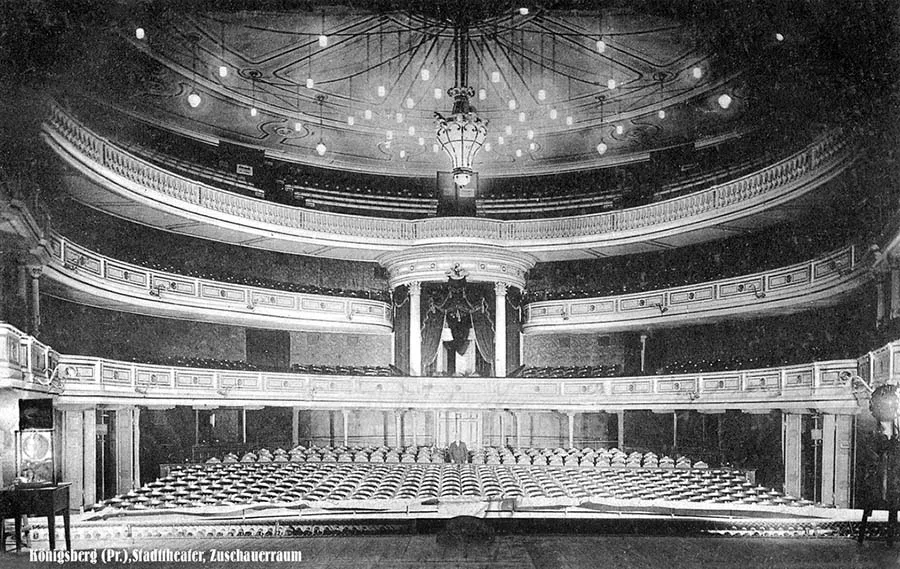
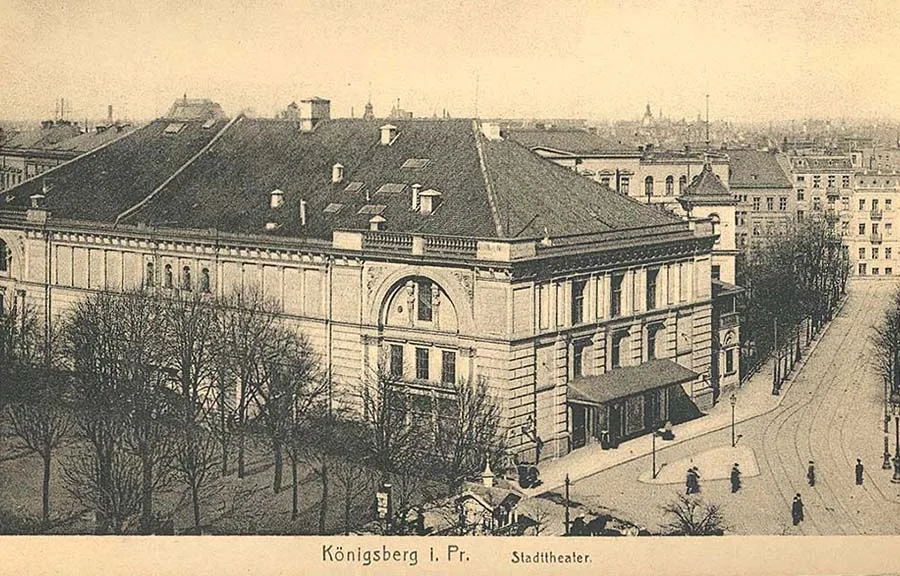 The new City Theatre inside and out.
The large-scale rebuilding of 1910/1911, as a result of which the niche in the north-western part became a thing of the past, put an end to whatever original elegance remained in what afterwards became the "Opera House".
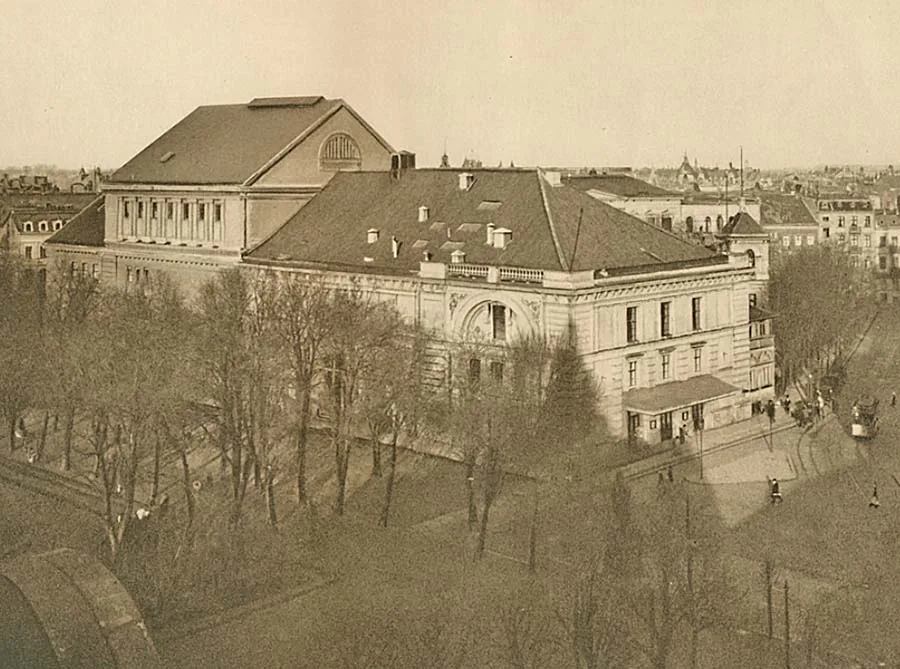
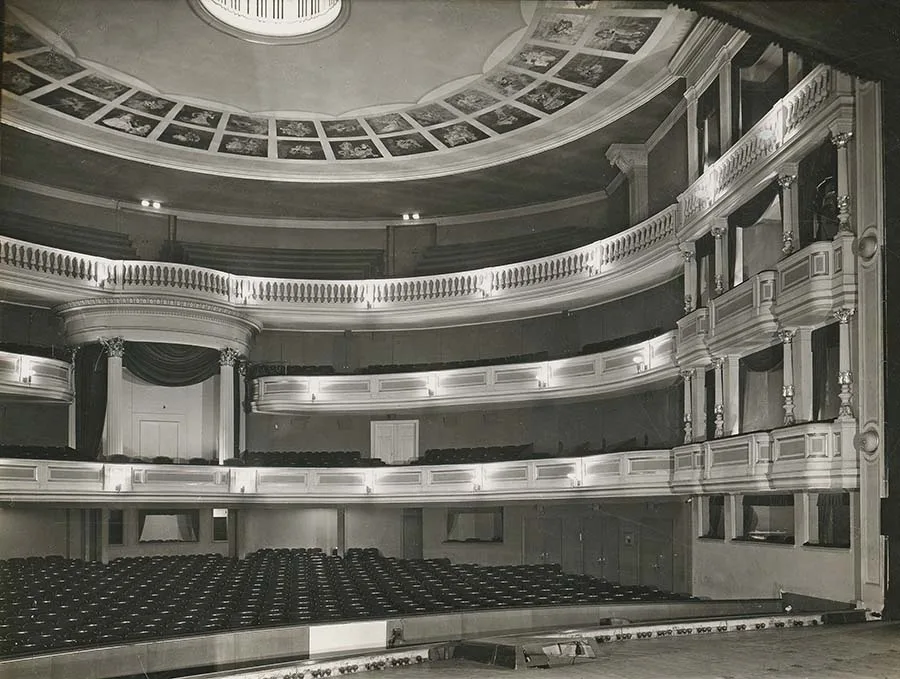 Exterior and interior of the City Theatre after the reconstruction of 1910–1911.
I was always puzzled as to why the roof over the new part of the building was covered with slate of all things. Did this black-and-red roofing really rescue the unfortunate building, disfigured by the reconstruction?
Inside, however, the theatre always delighted with its graceful originality. Here classicism displayed its truly royal dignity, achieved through the severity of its forms, softened by noble colours — white, red and gold. Apart from the ugly, garish and too small-scale ceiling paintings, which were also continued in the 1911 extension, the colour scheme of the interior may well correspond to the one our beloved Queen saw when, sitting with her husband Frederick William III in the royal box, she perhaps listened to an opera by Friedrich Himmel10 (Friedrich Heinrich Himmel; 1765—1814).
In later times the chandelier of the City Theatre with its 200 gas jets became famous; it had at least the advantage that kerosene from its predecessor no longer dripped into the auditorium.
And outside, on the parade ground, horse fairs and fairs with merry-go-rounds, shooting galleries, "wonders of the world" and street musicians were now also held.
The situation changed when in 1841 a monument to Frederick William III was erected on Paradeplatz. But first the old streams and the former trout ponds were filled in; they had become so swampy that they troubled the residents with their stench, and one of them had even acquired the unpleasant name "Black Sea".
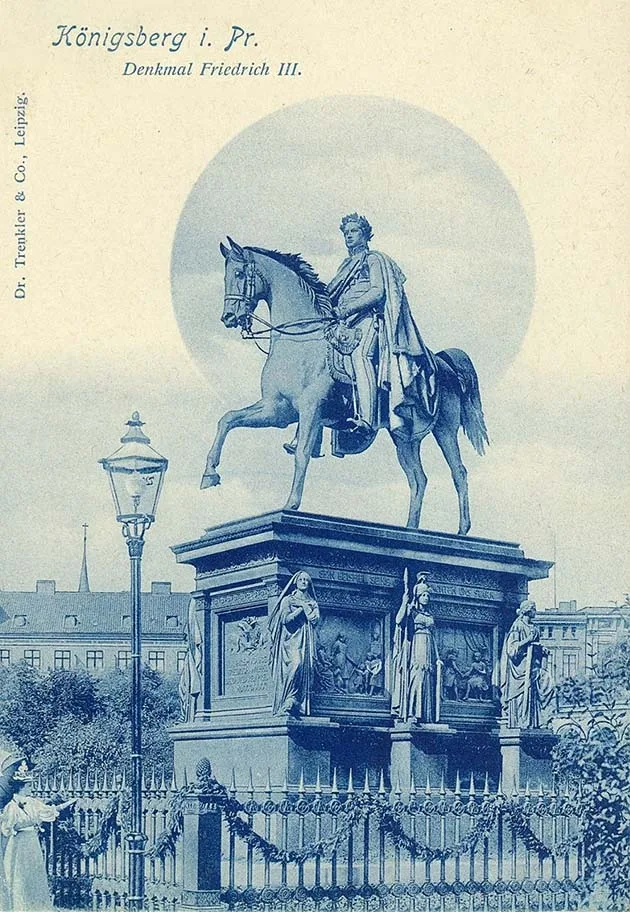
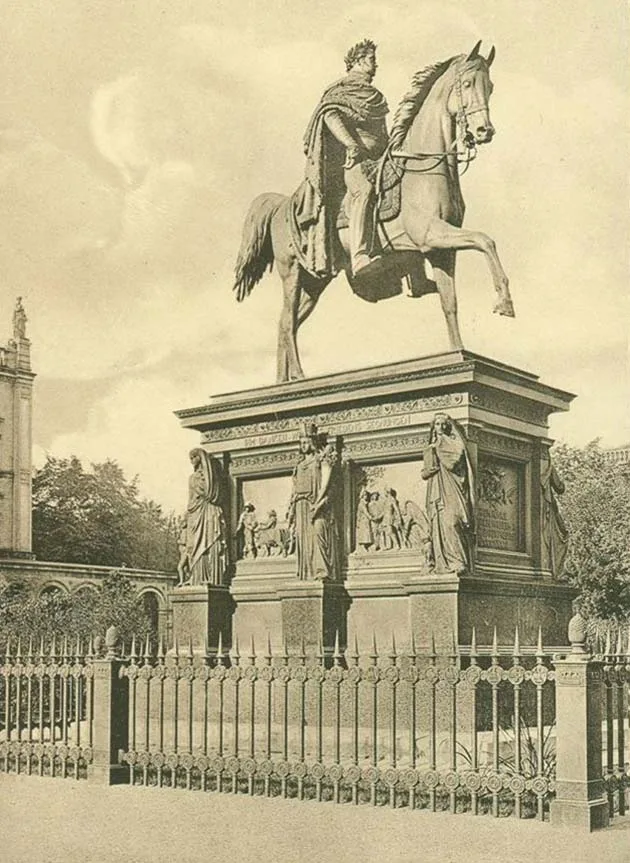
The statue of Frederick William III was the only equestrian monument in Königsberg. Given the logistics of the time, transporting the massive bronze colossus, created by Rauch's11 pupil August Kiss12, to East Prussia was no easy matter.
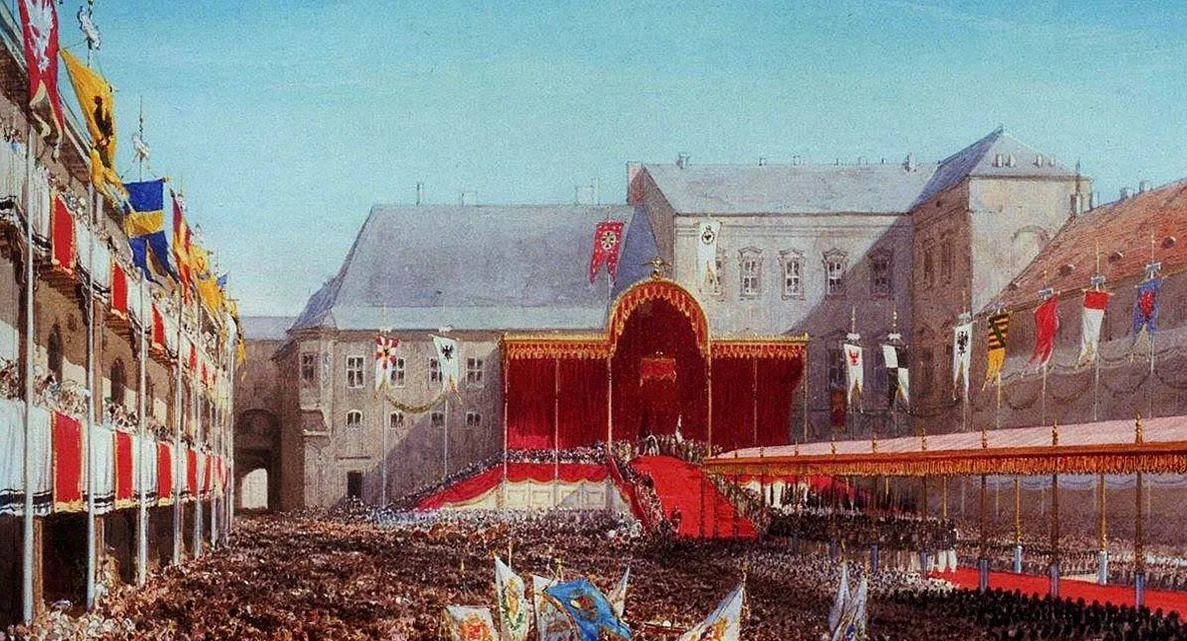
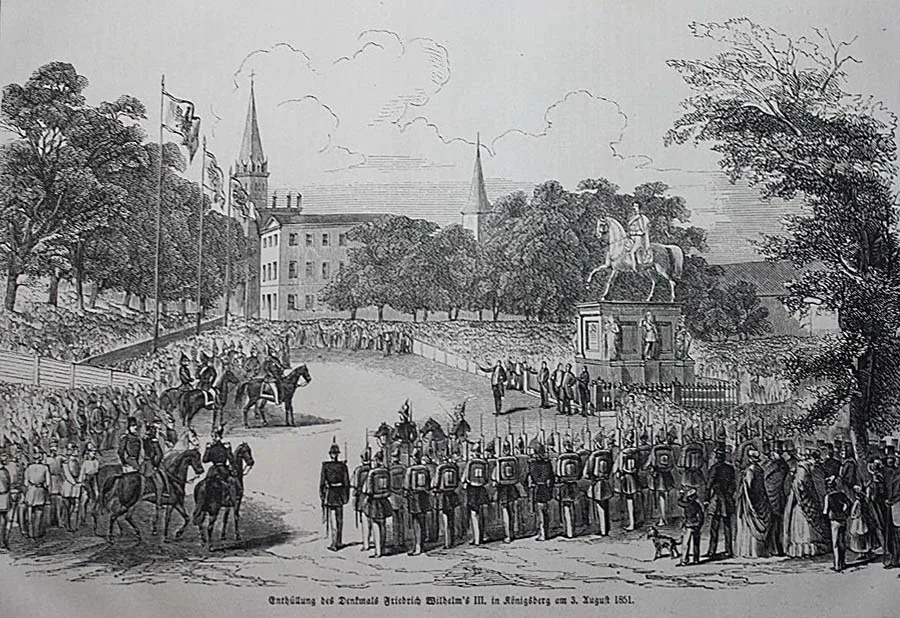 The ceremonial unveiling of the monument to Frederick William III in the Königsgarten.
We should not forget that there was no railway yet, and transport by water from the Lauchhammer iron foundry near Elsterwerda was also impossible. So the only available option was horse traction.
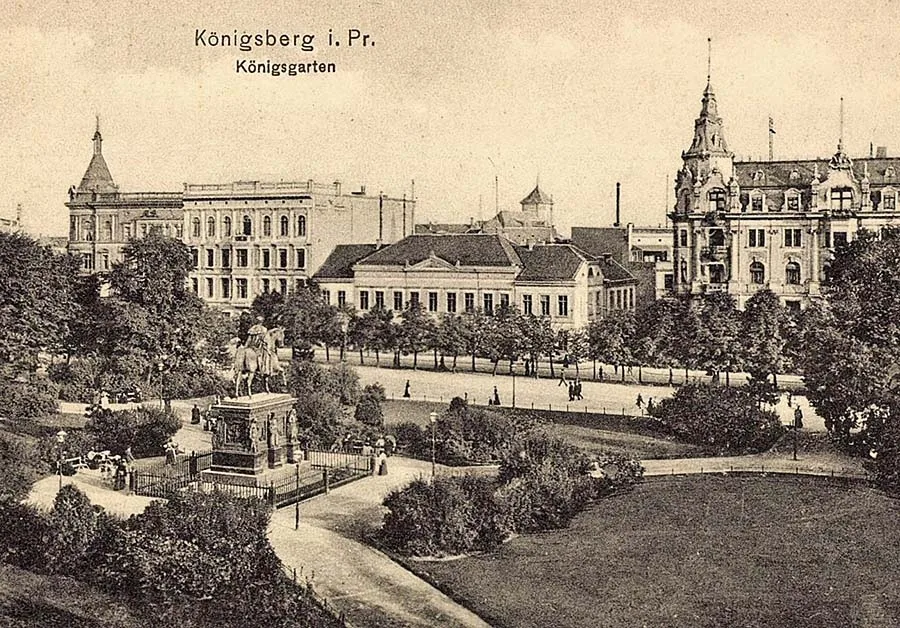 The monument faced the Königshalle (centre) and the Gräfe und Unzer publishing house (right).
But the roads at that time were in such a deplorable state that the procession got stuck for long periods several times. In Jüterbog a problem arose: the monument turned out to be too tall to pass through the town gate. The top of the gate had to be removed and, in addition, a hollow dug in the roadway. When the colossus was finally brought to the relatively new Brandenburg Gate of Königsberg, it became clear that it was too tall for this gate as well — the top had to be removed here too. The problem was repeated at the Green Gate! Here, however, it was enough to dig out two feet of earth beneath it. When the king at last stood on his high pedestal in the Königsgarten, the whole city was in raptures and began to extol the sculptor.
As proof, let us quote a passage from the book "Idylls of the Baltic Shore" by the German writer Ferdinand Gregorovius13, which he published in 1851. The scene described took place at the then popular summer resort of Neukuhren (Neukuhren, now the town of Pionersky):
"That summer Kiss visited the beach in Samland. The resort community of Neukuhren decided to receive the master... in the most solemn manner and even to 'crown' him. One of the teachers of the provincial gymnasium, in view of his classical education, was persuaded to write some verses of welcome. This amiable man sat for two days in his room, locked behind closed doors, reciting from memory, for inspiration, Homer, Pindar and other great Greek tragedians.
At last, on the day of the reception, he appeared, like Muhammad emerging from the cave14, with a finished poem — classical distichs skilfully composed for the occasion.
Half the population of Neukuhren gathered in the main square of the resort to witness this act of homage to the art of sculpture.
In front of the vestibule of the main building all the ladies of the resort had gathered, as if for a 'Court of Love'15.
High up on the Capitoline steps the orator stood waiting. Opposite, on another flight of steps, stood the band with bassoons, trumpets and violins raised, barely restraining themselves from falling upon their instruments. Thus, under the blue heavens, poetry and music stood silently facing each other for a whole hour, awaiting their confidante, sculpture. Even the birds sat silent in the trees, listening curiously; the air was motionless, the sea froze in mute expectation, and two young girls, holding on cushions a laurel wreath and the verse dedication, languished like secret passion and longing of which no one knows. But suddenly! — the sound of a post horn beyond the garden — riders galloping with flags, followed by an escort, at last a carriage — and there he is, Kiss!
The band fell upon their instruments like starving lions upon their prey; the poet began his recitation; Kiss, a friendly elderly gentleman with a meek, gentle expression, stepped out and humbly bowed his head at the Capitoline steps. The poet went on reading his verses; the girl presenting the laurel wreath, which according to the scenario of the solemn reception she was to place on the master, became flustered; the symbol of glory slipped several times from Kiss's venerable head; but in a desperate effort she pulled herself together, using the sculptor's ear as if it were a nail in a wall, thanks to which the wreath did not fall to the ground. Tasso-Kiss16 smiled, adjusted the wreath and uttered a majestic phrase: 'Not to me, but to the Creator belongs this wreath!' He embraced the orator and handed out roses to the ladies; the musicians blew their trumpets; a procession formed, and the amiable master was led in triumph around the square…"
But the monument was also criticised. It was claimed that any horse walking the way Kiss had depicted it would inevitably topple over sideways. Rumours spread that the artist, in despair over this fatal mistake, later shot himself. However, neither was meant seriously — and the horse goes on standing, merely raising its right foreleg.
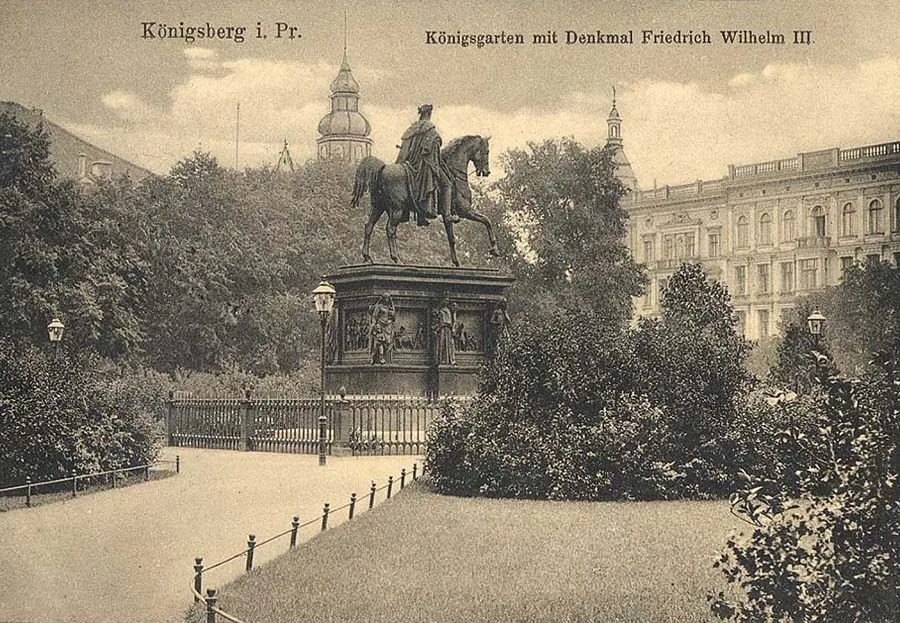
On the base of the monument there is a series of reliefs depicting the happy royal family, peasants ploughing, a mounted volunteer of the War of Liberation, and — one of the most important pages in the history of Königsberg — General Yorck's appeal to the militia in the building of the East Prussian Agricultural Directorate on 5 February 1813.
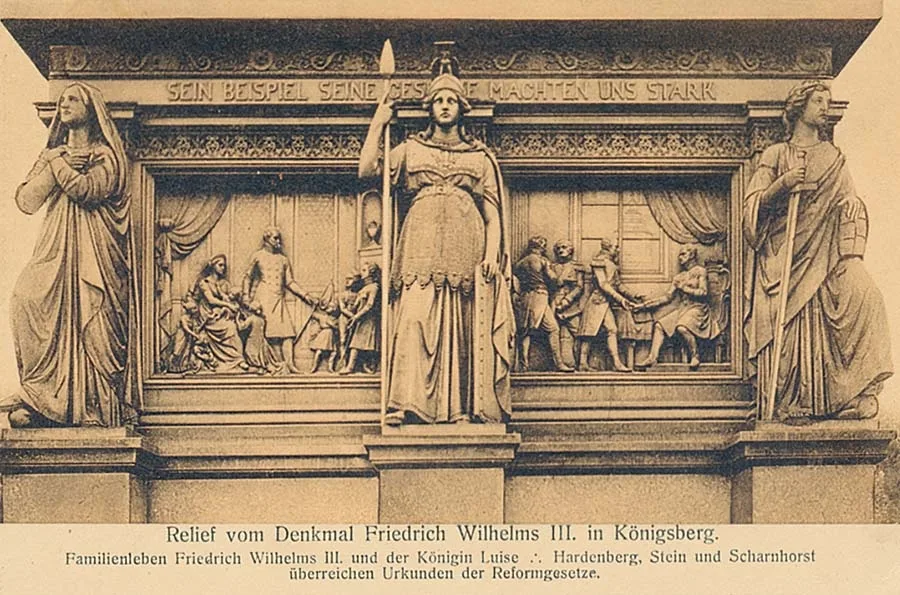 The reliefs on the pedestal of the monument to Frederick William III are rather high reliefs.
Above these images runs the inscription: "His example and his laws gave us strength to liberate the Fatherland. To him we give thanks for the blessing of a peaceful life."
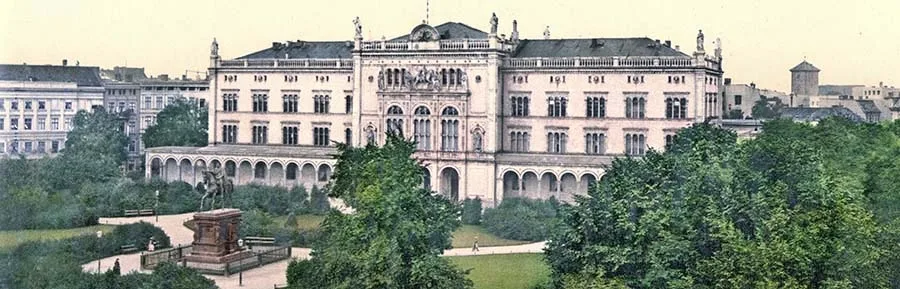
The three-hundredth anniversary of the Albertina was approaching. Since the old building in the courtyard of the Cathedral was no longer sufficient, a new one was planned for the Königsberg university on the site of the riding hall in the Königsgarten. Its design was entrusted to the future Senior Privy Building Councillor17 Friedrich August Stüler18, whose portrait, thanks to the masterly hand of Adolph Menzel19, has been preserved in the painting depicting the coronation of William I.
Frederick William IV loved the city on the Pregel, probably in memory of walks in Luisenwahl with his mother, who died young. At his coronation in Königsberg in 1840 he was received with genuine jubilation. On 31 August 1844 the king, attending the solemn ceremony of laying the foundation stone, said: "The founder of the Albertina wished that it should never follow the winding path of comets. Its course should be like the sun, which, shining evenly, truly dispels darkness, penetrates deep caves, tears away the veils of night, lets fruits ripen and flowers open — such an influence is truly beneficial to people."
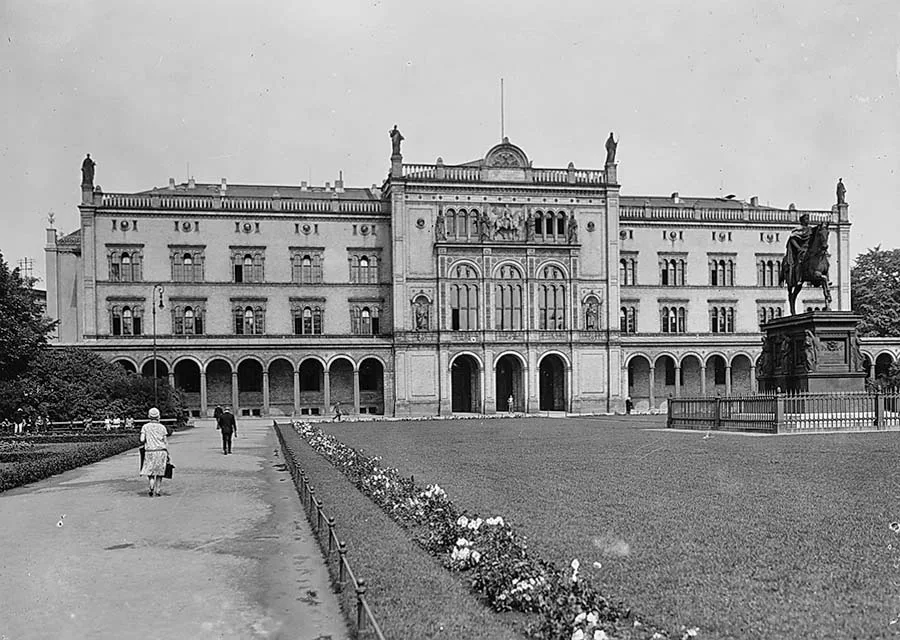 The façade of the new building of the Königsberg Albertina University, facing the Königsgarten.
Stüler created a somewhat pompous building of yellow clinker brick in the style of the Italian Renaissance with a wide projecting colonnade, which the king liked very much.
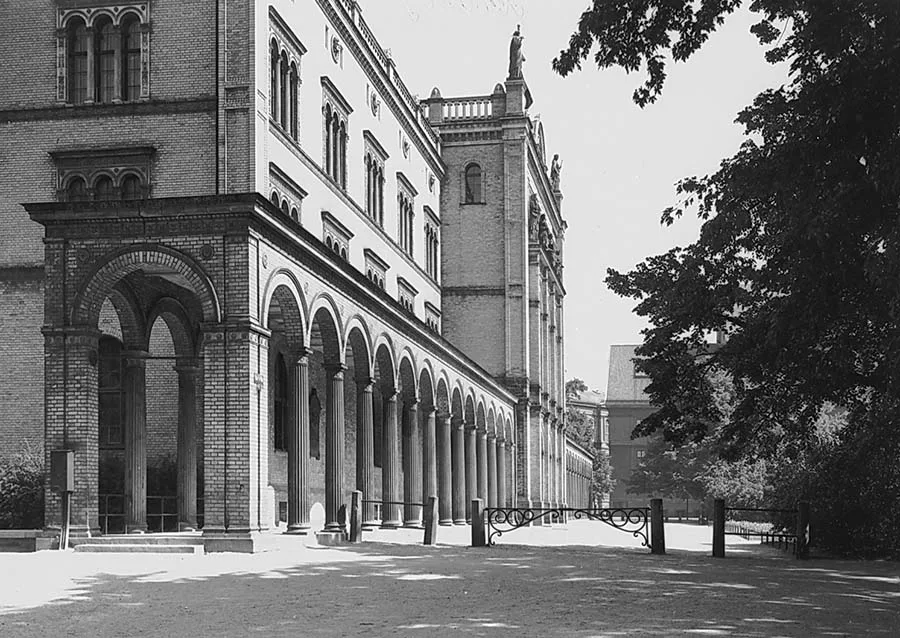 The colonnade which, as we now know, was meant to encircle the entire Königsgarten.
In its decoration, attention is deserved by the equestrian relief of Duke Albrecht and the statues of Luther and Melanchthon in the central part, as well as by the busts of numerous scholars: the first rector Georg Sabinus, Simon Dach, Jacobi, Hamann, Herder, Kant, Bessel, Hippel, Herbart, Kraus, Hagen, Burdach, Lachmann and Lobeck.
An engraving of 1850 has survived showing Stüler's original design. The building is not so rich in sculpture, but the colonnade, which now adorns only the façade, encircles the whole square — a design which, had it been carried out, would have made a magnificent impression. The king was undoubtedly personally interested in it, since he loved walks during which one could indulge in witty conversation — suffice it to recall the Orangery at Sanssouci (Schloss Sanssouci) in Potsdam, where he lived, and the Belvedere palace on the Pfingstberg hill (Pfingstberg).
It is also interesting that on the engraving mentioned above the monument to Frederick William III is placed parallel to the building, facing west.
The monument was surrounded by gardens: at the four diagonal entrances at the corners magnificent lilac bushes were planted, which in spring filled the whole surroundings with a delightful fragrance. Only after the First World War were they cut down, and a broad lawn framed with flowers was laid out around the monument.
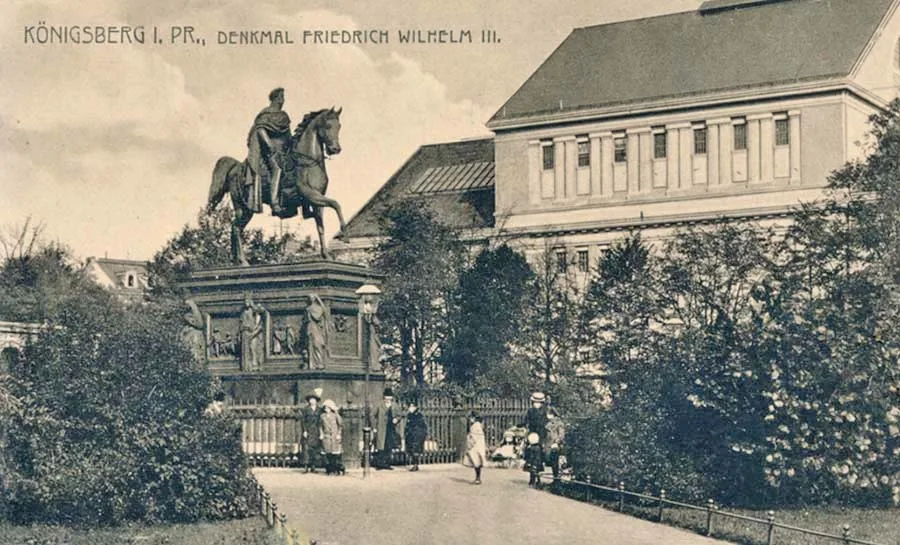 The Opera House (right) was clearly not a great success for its architect.
A second monument was also erected in the Königsgarten: the statue of Kant, created by the virtuoso hand of Rauch19 to mark the 60th anniversary of his death. In my view this splendid work is out of place here.
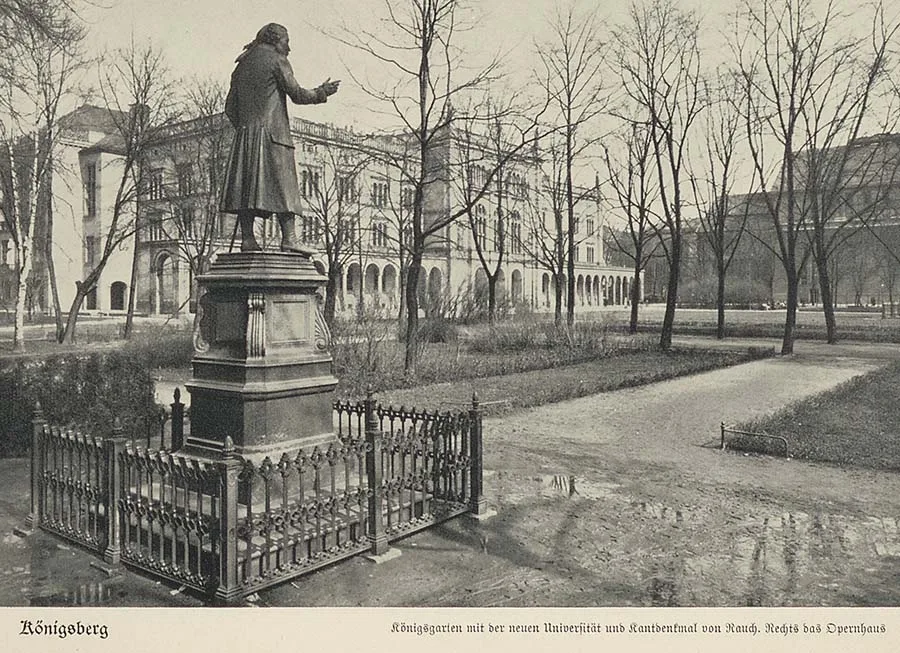 The monument to Immanuel Kant on Parade Square.
Construction of the university was completed, and it was consecrated only on 20 July 1861. But in the new, 20th century its building became too cramped, and between 1924 and 1927 an extension was added, whose only charm was that it was barely visible from the front. Why its roof was "planted", or more precisely "disfigured", with gilded prickly pears or aloes has always remained a mystery to me.
Then, shortly before the Second World War, came the "solemn day of homage" to Gauleiter Koch, which is said to have cost the city four million Reichsmarks. The brick façade of the university, which had previously been carefully refreshed by sandblasting, was spectacularly lit by cascades of electric light, and in front of it, black and ghostly, towered the equestrian statue of the king — a magnificent and unforgettable sight!
No less impressive was another night. But it was not so festive and solemn; on the contrary, it was terrible and full of horror — the dreadful night of 29 to 30 August 1944.
But the bronze king passed fearlessly and steadfastly through them and through the fire pouring down from the heavens, survived and remained unharmed — may this become a prophetic symbol of the future for all of us in Königsberg!
Translator's notes
1. Pleasure gardens (Lustgarten) were called "Neskuchny" ("Never-Dull") gardens in Russia. This is a type of park created for the leisure of the general public. The name was used before the revolution.
2. The Hetzgarten was an arena built on ancient models. Frederick III was very fond of this arena, where courtiers and royal guests could watch animals such as bears, wolves, foxes, wild boars and buffaloes kill one another for the spectators' pleasure. Ordinary people were allowed to watch only on very rare occasions.
3. A House of Pleasure (Lusthaus) is a building with two main meanings: first, a large urban hall for parties and receptions in Renaissance parks, which often contained ballrooms and theatres. On the other hand, it could be a small pavilion-like structure in parks or woods that served as a place of seclusion and rest.
4. A horse mill (Roßmühle) is a mill driven by horse power, i.e. by a horse. It worked like a horse gin: the horses walked in a circle and turned a shaft, driving the mill mechanism.
5. Von Plehwe is a German and Russian noble family; one of its best-known representatives in Russia was Vyacheslav Konstantinovich Plehve, a Russian statesman. He was killed by a bomb thrown into his carriage by the Socialist Revolutionary Yegor Sozonov in St Petersburg (1904).
6. Hirschau is now the settlement of Kolomenskoye in the Zelenogradsk District of the Kaliningrad Region. The Warnicken Forest once consisted exclusively of deciduous trees — birch, alder, linden, beech and aspen. The pride of the forest were mighty oaks and poplars. At the beginning of the 19th century it was decided to change the character of the forest and to plant mainly conifers. But from 1883 oaks, maples, ashes and elms began to be planted again. Seventy oaks growing near the forestry office in Hirschau formed an unusual grove in the shape of the famous Prussian Iron Cross, known as the "Bismarck Oaks".
7. Joachim Ludwig Schultheiss von Unfriedt (1678–1753) was director of building in Prussia in the first half of the 18th century.
8. Ludwig Adolph Franz Josef von Baczko (1756–1823) was a German writer.
9. Johann Valerian Müller (1771–1839) was a German architect and Prussian building official in Königsberg. An advocate of the simplicity of classicism.
10. This refers to the opera (Singspiel) "Fanchon the Hurdy-Gurdy Girl" by Friedrich Heinrich Himmel ("Fanchon das Leyermädchen", Friedrich Heinrich Himmel; 1765–1814), a German composer; it premiered in Königsberg in November 1805 in honour of Queen Louise, consort of Frederick William III.
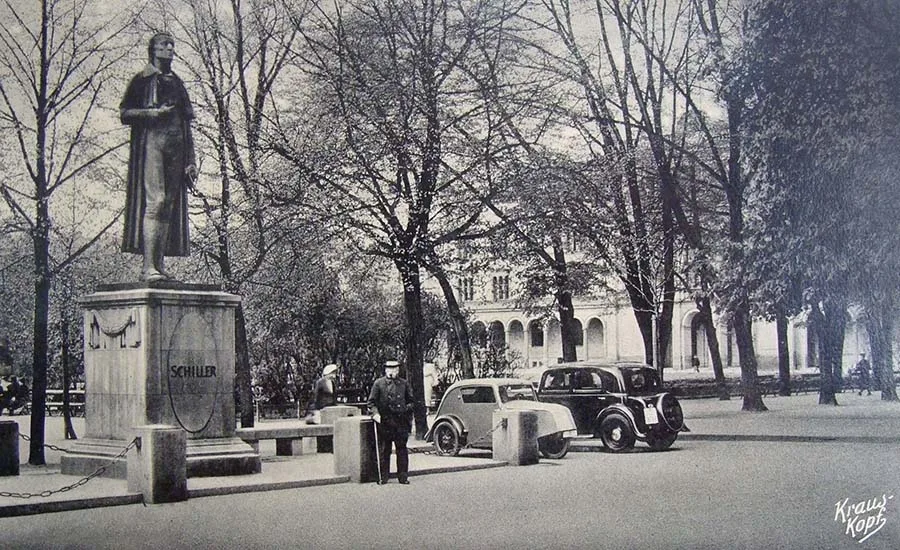 The Schiller monument also stood near the theatre on Paradeplatz, but for some reason the author said nothing about it.
11. Christian Daniel Rauch (1777–1857) was a German sculptor, a representative of academic classicism.
12. August Kiss (August Kiß; 1802–1865) was a German sculptor.
13. Ferdinand Gregorovius (1821–1891), "Idyllen vom baltischen Ufer". Königsberg, 1851.
14. In 610 the Prophet Muhammad was in the cave of Hira when the angel Jibril appeared to him and commanded: "Read!" The cave of Hira is a sacred place in Islam where Muhammad meditated and received revelations from Allah.
15. Courts of Love (Cour d'amour ) were medieval courtly disputations in which questions of law and love were debated in a body modelled on a court of justice.
16. An allusion to Torquato Tasso (1544–1595), who was proclaimed the greatest poet of Italy and awarded a laurel wreath that had previously been bestowed only once, on the great Petrarch.
17. Oberbaurat is a German rank meaning "senior building councillor" or "chief building councillor". The term refers to a high-ranking state or military official in the field of construction who held a senior post in the civil service.
18. Friedrich August Stüler (1800–1865) was an outstanding German architect, a follower of Karl Friedrich Schinkel and one of the key masters of the historicist period in Berlin. His best-known works are the Neues Museum in Berlin and the dome and triumphal arch of the Royal Palace, destroyed in 1950.
19. Adolph von Menzel (Adolph Friedrich Erdmann von Menzel; 1815–1905) was a German painter and graphic artist, one of the leaders of Romantic historicism. During his lifetime he enjoyed wide popularity as well as the respect and patronage of the German imperial court.
Source
Photos
Bildarchiv Ostpreußen bildarchiv-ostpreussen.de.
● Editor's note: Read on VisitPrussia.com an interview with the translator of German and, in particular, Prussian fairy tales, our regular contributor Tatyana Kolivay, who runs her own blog, where countless other parables, legends and fairy tales in her translations have been published.
Translated from Russian with the help of AI (Claude, Anthropic), October 2026.