"Being itself is comparison…"
(Osip Mandelstam).
A great contribution to the formation of Königsberg's green lacework was made by the leafy suburbs that became city districts. Between 1905 and 1910 Kalthof, Tragheimsdorf, Vorder- and Mittelhufen, Lawsken, Ponarth, Schönfließ, Amalienau, Gross Ratshof, Karolinenhof, Mühlenhof, Neue Bleiche and Rosenau were incorporated into the old city. By 1 December 1910 these territories amounted to 24.11 km2, with 30,868 inhabitants. By 10 June 1927 they were joined by Juditten, Devau, Kummerau, Neuhufen, Friedrichswalde, Maraunenhof, Ratshof and Speichersdorf, so that another 40.2 km2 passed to Königsberg. By 15 November 1928 Ballieth, Metgethen and Jerusalem (418 ha, 253 inhabitants) had come within the city limits, and by 1 January 1929 Gross Holstein and Spandienen (820 ha, 391 inhabitants). In 1933 followed Altenberg (278 inhabitants), Beydritten, Charlottenburg, Lauth, Moditten, Quednau, Palmburg, Seligenfeld and Neuendorf (7,138 ha). In total the suburbs added 7,416 ha with 13,190 inhabitants to the "inner city".
Let us look at the variants of green space that had taken shape over time, by the beginning of the 20th century, in some of the city districts laid out as "garden cities".
Ratshof (Rathshof)
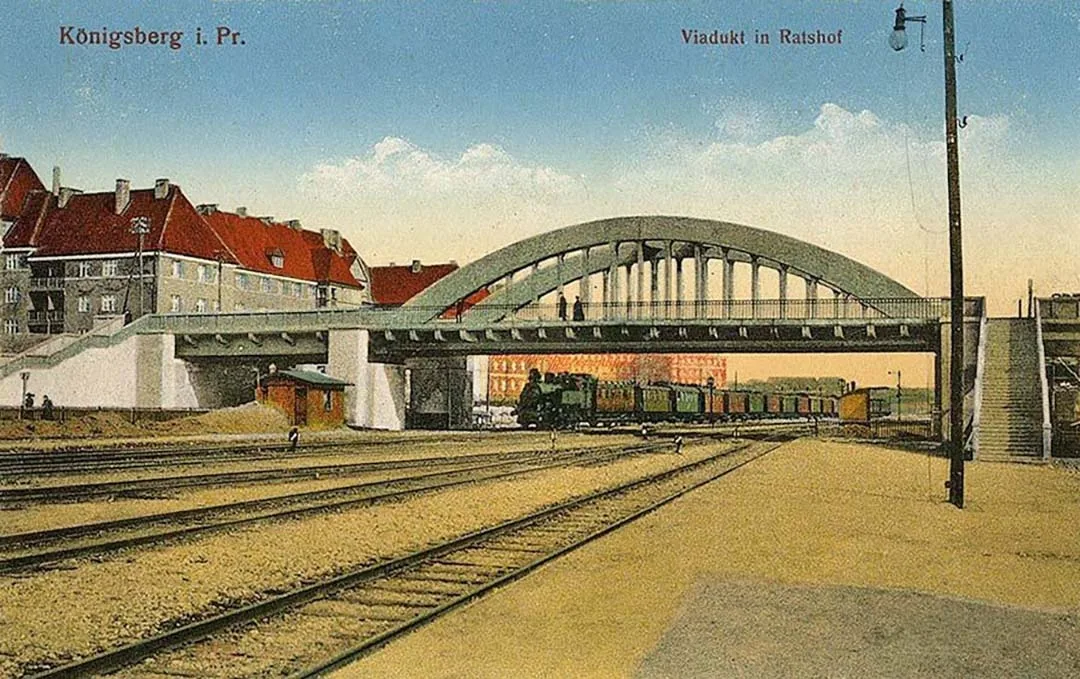
A western suburb of Königsberg, first mentioned as far back as the distant times when the first houses of Altstadt were being built, i.e. the 13th century. Because of its ancient origins, the history of Ratshof is complicated and cannot be traced in full: the farmstead of the senior clergyman of the town of Altstadt was founded here, and from then on this place west of Laak (a district of the city close to the Castle) was home first, for more than 200 years, to the farm of the Altstadt parish, then to a smithy, and then to an estate. In 1533 the church farm was sold to councillor Bettner, and in 1586 it was resold to Urban Rodeman, who began laying out a park on the banks of the Ratshof Freigraben stream. It is known that in 1806 the estate was bought by the city authorities with the aim of creating a public city park, but after Prussia was conquered by Napoleon the Königsberg magistrate needed money to pay a huge contribution to the victors, and the park grounds were therefore sold again, to a certain Wentland, who continued the work of laying out the park. Later, in 1843, circumstances forced him to sell this land once more, to the von Batocki family, one of whose members (Adolf Tortilowicz von Batocki-Friebe) was Oberpräsident of East Prussia in the time of the Weimar Republic. At the expense of the new owners, the construction of the park with cascades on the stream, little bridges and avenues on terraced slopes was completed at the end of the 19th century. The park grounds took in the banks of the stream below the Hammerteich / Hammer Teich pond (now Pionersky Pond) and extended as far as Ratshof Lindens Street / Rathslinden (now Basseynaya Street). In German "Hammer" means "hammer", and the name of the pond is undoubtedly connected with the smithy that worked here in days of old.
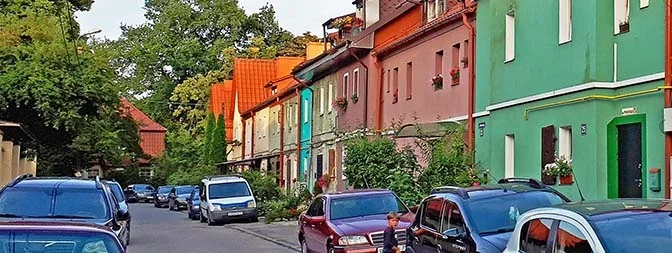
The new city district, built up from 1907 onwards as a "garden city", lay between the railway branch line to Pillau (now the town of Baltiysk) and Lawsker Allee (now Pobedy Avenue), and was intended for the workers of the new railway carriage works built in 1903.
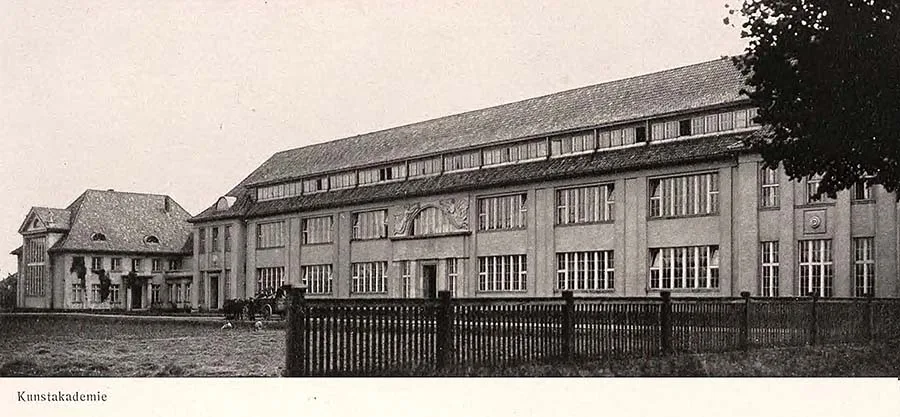 The new Königsberg Academy of Arts in Ratshof.
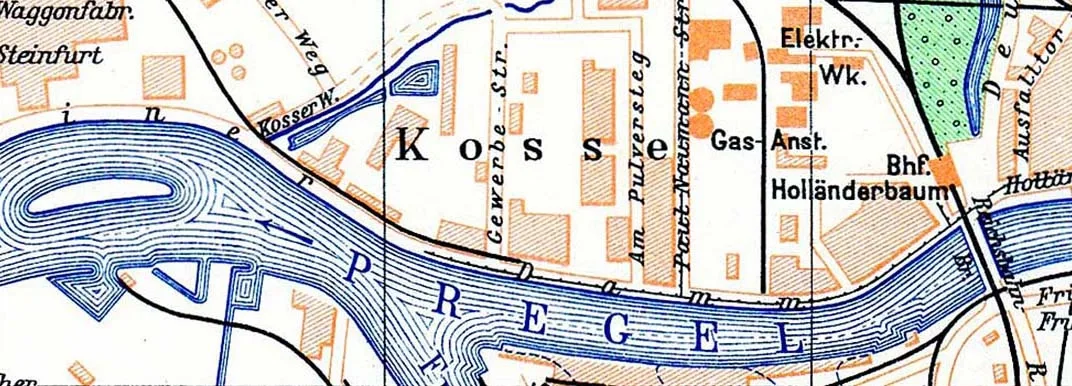
Today the former Königsberg Ratshof is a district of Kaliningrad stretching from north to south — from Leytenanta Katina Street to the Right Embankment of the Pregolya. Its eastern boundary is Engelsa Street, and its western boundary is Vozdushnaya Street.
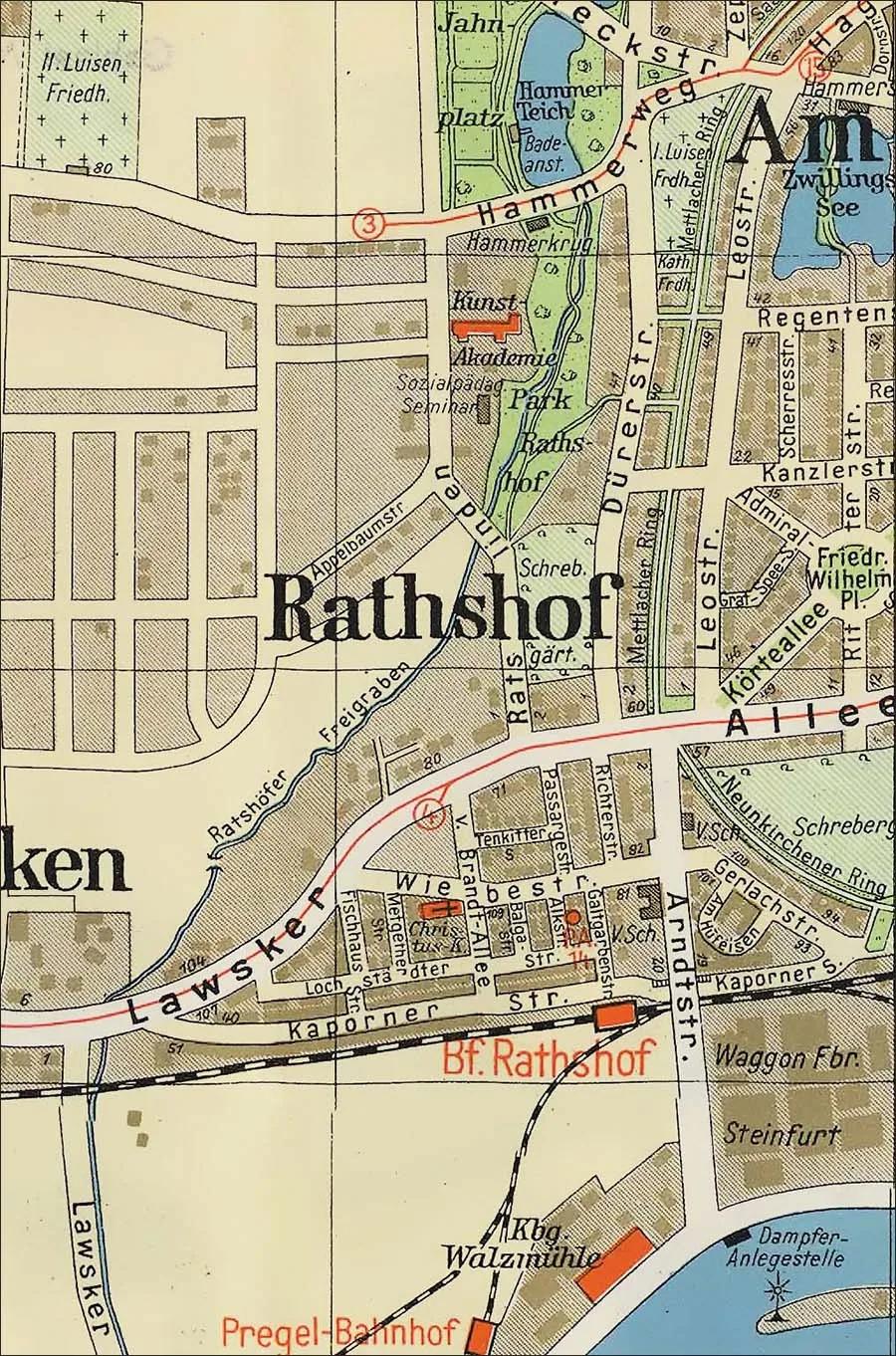 Ratshof on a map of Königsberg from the first half of the 20th century.
Already the design of the "garden city", built by the company "General Union for the Construction of Housing" (architect D.F. Bleyer), provided for green spaces — avenues along the streets, private gardens, a planted square by the school, and a public garden named Vierbrüderplatz (Four Brothers Square), which lay where Stanochnaya Street and Radishcheva Street now intersect. In the north of the new district, built up with small detached houses, there were allotment gardens along Rathslinden Street (Basseynaya), which crossed the Ratshofs Freigraben stream (Vozdushny).
This was where the green grounds of the above-mentioned Ratshof estate park (5.5 ha) began — today these are the overgrown banks of the Vozdushny Stream between Basseynaya Street and Lesoparkovaya Street.
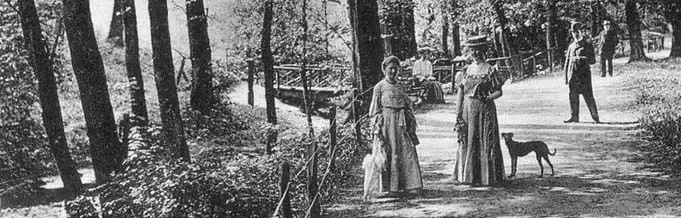
At the end of the 19th century the estate became the Großrathshof establishment, which, with its historic park above a deep ravine with a picturesque stream flowing out of the Hammerteich pond, was extremely attractive to visitors — townspeople at leisure (even in Kaliningrad times this green zone kept the structure of a park for quite a long while). In 1907 the restaurant building in the southern part of the park was leased as a care home for children in need of constant attention. A little later the Ratshof estate park became a public city park. In 1912–13 the relief "Hercules Holding Back the Waters" (sculptor S. Cauer) appeared on the sluice of the Hammerteich pond.
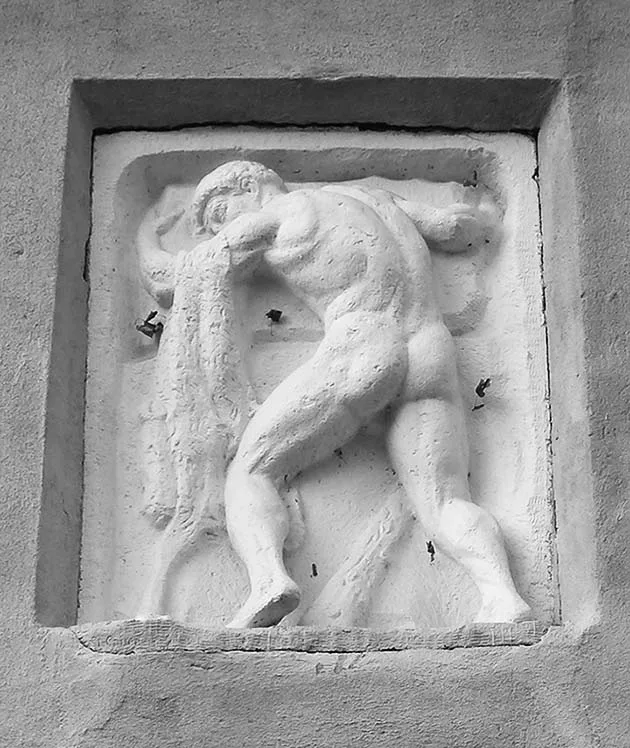
"Hercules Holding Back the Waters" — a bas-relief by Stanislaus Cauer.
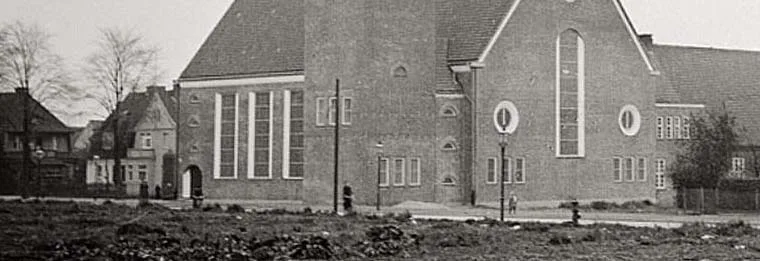
In 1916 a complex of buildings was erected in the centre of the park area to house the Königsberg Academy of Arts, founded back in 1805 (it is now home to Secondary School No. 21).
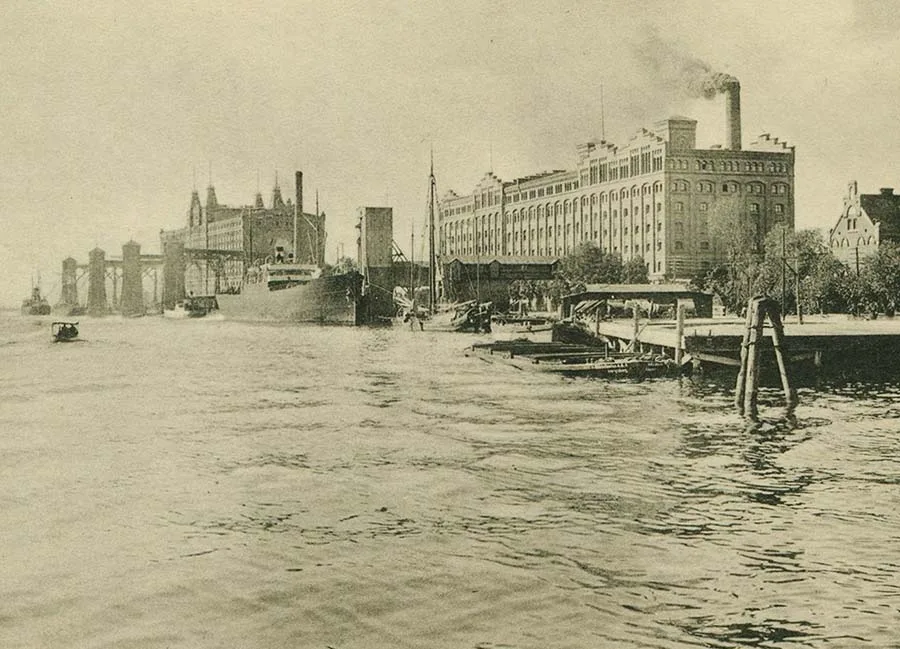 The roller mill and grain elevator on the bank of the Pregel — this too is all Ratshof.
North of the park, on the terraced slopes around the Hammerteich pond, there was at the beginning of the 20th century a very extensive green area with a bathing place, fitted out in 1909, and the popular Hammerkrug inn, located not far from where today's Mira Avenue and Basseynaya Street intersect. West of the pond a large, 8.3-hectare sports ground, Jahn Platz, was laid out, occupying the area between today's Leytenanta Katina Street and Mira Avenue (Jahn Platz — Jahn Square — was named in honour of "Jahn, the father of sport", the man who created the first sports complex in Berlin.) Today it is the Pioner stadium.
Further up the stream, in the Fürstenschlucht ravine, meaning "Princes' Gorge", a terraced green zone convenient for walking was also laid out; from the 1920s it was adjoined by the New Jewish Cemetery, extensive and leafy, with several cemetery buildings (today the site of the cemetery, ravaged in the post-war years, is occupied by numerous dacha plots, and the veterinary clinic on Katina Street occupies a small house that served either as the caretaker's lodge or as a place for taking leave of the dead).
The Fürstenschlucht promenade and the Fürstenteich pond further north (Princes' Pond, now Neskuchny Pond) together made up a walking area of 20 ha.
The green spaces around the pond continued west and east along the Landgraben canal (translated from German as "the Country" or "Out-of-Town" canal, now the Drinking Water Canal). The canal's name goes back to the fact that as early as the days of the Knights, in 1384, this 17.3-km watercourse was dug from ponds lying far to the north-west of the city in order to supply it with drinking water. The Fürstenteich pond was a drinking-water reservoir fed by the Landgraben. The highly attractive natural, picturesque landscapes characteristic of the Landgraben were complemented within the city limits by footpaths running along the slopes and along the high ridge beside the pond. The green canal, with sports grounds laid out on its banks, ran towards General-Litzmann-Straße (now Sovetsky Avenue) and formed a northern green link between distant Ratshof and the central districts of the city.
Fritz Gause, in his comprehensive book "Königsberg in Prussia. The History of a European City", sums up all of the above in a single phrase: "Ratshof with its many gardens…"
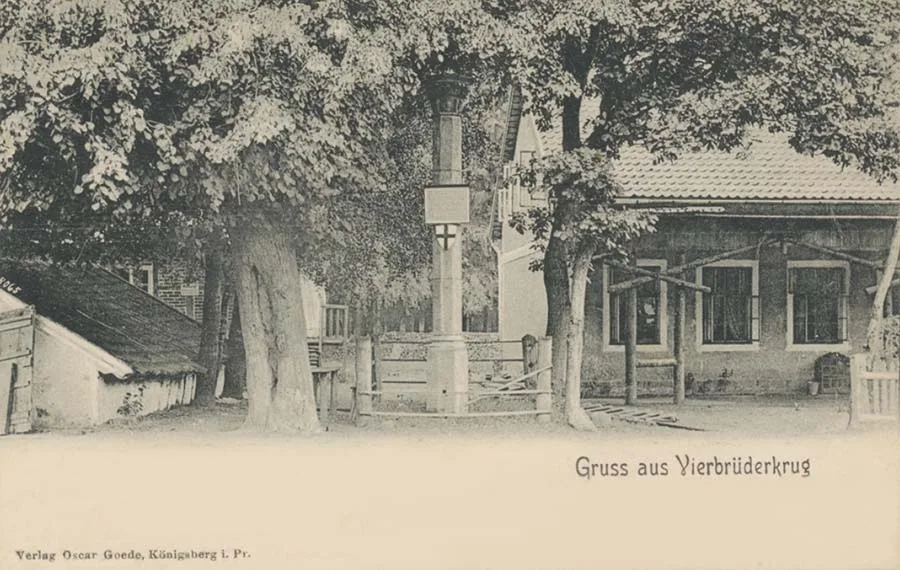 The Four Brothers Column on the road out of Königsberg towards Pillau.
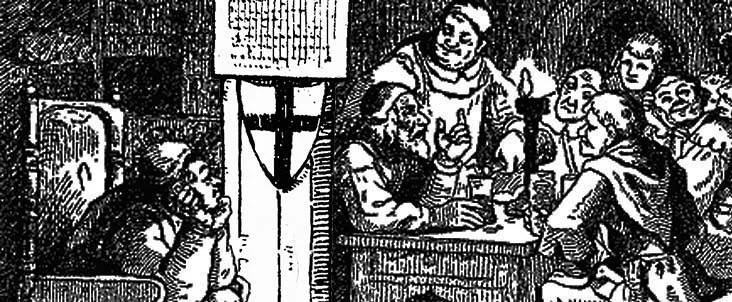
Among the gardens of Ratshof, one of interest for its unusual name, inspired by an ancient saga of the Order, is the public garden in the residential district by the Railway Carriage Works — Four Brothers Square / Vierbruderplatz.
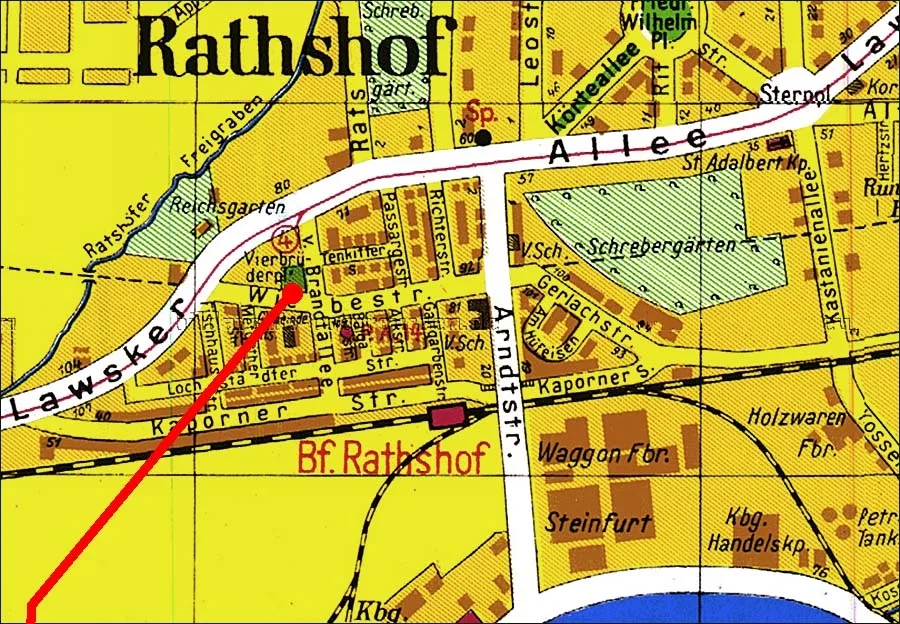 The Four Brothers public garden in Ratshof on a 1931 map of Königsberg.
The same name was borne by a modest inn that still stood at the end of the 19th century not far from the hamlet of Moditten (the end of Pobedy Avenue, on the road out to Baltiysk), in the middle of a large forest that reached all the way to the town of Fischhausen (now Primorsk). The inscription on a wooden board that adorned the inn read: "… thirteen hundred less five… Here amid the woods sat four valiant men… here were bold Diewel, daring Kobenzell, fearless Reden and fierce Stobemell. Their loyalty was proven many times in battle…" and so on. The story recorded on the board was as follows: in 1295 (thirteen hundred less five!) four brothers, knights of the Order from the fortress of Wargen (the village of Kotelnikovo, Zelenogradsk District) set out to put down yet another uprising raised by Prussians of the Sudovian tribe, who refused to submit to the Order's conquerors. The four brothers were killed, and their monument became a column in the form of a tree, on which, in memory of the heathens' treachery, the crusaders hung four "severed heads"; much later an inn-cum-tavern was built on the same spot. All these blood-chilling events took place very close to the monument to Aleksandr Kosmodemyansky on the Baltic Highway. In place of the first column, which had rotted away with time, a new one was erected in the 19th century, and at the beginning of the 20th century a small square in the new district of the city was named after the four brothers.
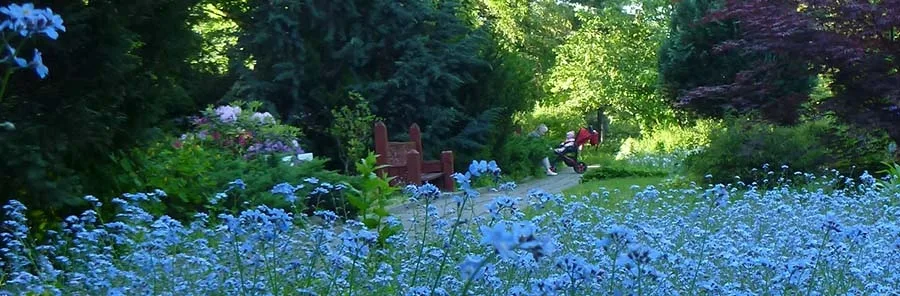
Today the Ratshof park, laid out in the mid-16th century and given its final form only by 1916, is an unkempt thicket along the lower course of the Vozdushny Stream between Mira Avenue and Pobedy Avenue.
Translated from Russian with the help of AI (Claude, Anthropic), October 2026.