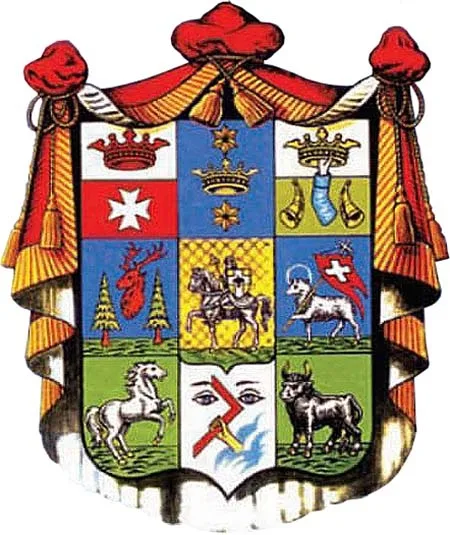
 The Sackheim coat of arms
on the arms of Königsberg, second row, far right.
The village of Sackheim had a predominantly Prussian-Lithuanian population. It lay on the old road from Königsberg to Tapiau (Gvardeysk), Insterburg (Chernyakhovsk) and on into Lithuania. It was therefore a frequent stopping place for peasants and merchants bringing goods to the city, and for farmhands hoping to find some temporary work in Königsberg. It is assumed that at the turn of the 15th and 16th centuries Sackheim began to take on the features of a suburb.
In the 16th century Sackheim was beset by the misfortunes typical of the densely built towns of that time. Fires came first. In 1513, 1539 and 1575, each time spreading rapidly from house to house, they destroyed a considerable part of the settlement.
In the first quarter of the 16th century the Reformation (1523–25) came to Sackheim, as it did to the whole of Prussia. The Lithuanian population of Sackheim received it with the same goodwill as most of the inhabitants of Königsberg. All the more so because a separate church in Steindamm was set aside for the Polish and Lithuanian population of the towns and suburbs, where sermons were preached in their native language. But this bilingualism in the Steindamm Church did not last long. The Lithuanian and Polish parts of the congregation came into conflict, and to resolve it the Lithuanian Lutherans of Sackheim were given a church of their own in 1550. This was the former chapel of the Hospital of St Elizabeth.
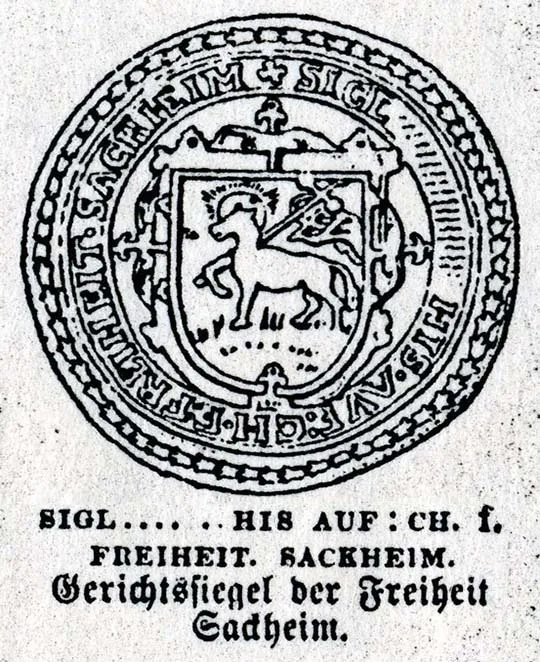
The seal of Sackheim.
In 1578 Sackheim became a Freiheit belonging to Königsberg Castle. The concept of a "Freiheit" has a counterpart in Russian, the sloboda: a suburb where people live an urban life, but somewhat more freely. "Frei" in German means free, and the Russian word sloboda is likewise derived from the word for freedom, svoboda.
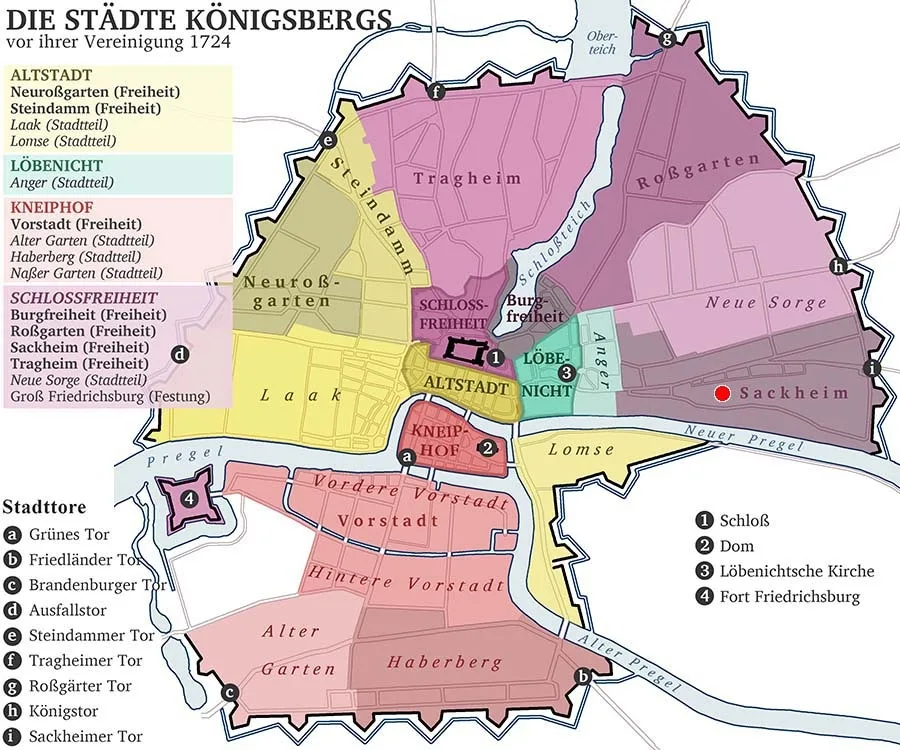
Sackheim on a reconstructed map of the towns, Freiheiten and districts of Königsberg before their unification in 1724.
The emergence of the Freiheiten is connected with medieval town law, under which towns were limited in territory and had a number of houses strictly stipulated in their charter. This in turn limited the growth of the town's population. Yes, one could add storeys, live more closely packed or even secretly build a few more houses, but none of this could radically affect the size of the town or the number of its inhabitants. Meanwhile, in those distant times, as today, people were driven by the understandable desire to live better and raise their standard of living. The ducal councillors in the castle, the town craftsmen and the farmers and stockbreeders living outside the walls all wished to have more money. And although the system of commodity-money relations in feudal society more closely resembled a socialist planned economy, the basic economic laws were and remained the same. The heads of the craft associations [guilds] understood that the path to prosperity lay in increasing the number of buyers of their products; then production could be increased as well. The ducal treasurers realised no less clearly that revenue for the treasury depended directly on the number of taxable households and on the incomes of the craftsmen living in them. Rural farmhands saw how much better people lived in the towns and so were not averse to becoming townspeople themselves. Literally everyone therefore gained from the appearance of suburban settlements.
It was in order to distinguish such suburbs from villages that simply lay in the vicinity, without breaching the terms of the agreements between the towns and the state, that the Freiheiten were devised. The Freiheiten fell into two groups: the first comprised those belonging to the town councils, while the second were administered directly by the castle.
The town Freiheiten had little or no self-government and no urban attributes. People living in them were subject to municipal law but were not townspeople in the full sense. In this they differed from the inhabitants of the so-called town districts, the Stadtteile / Stadtteil. By these criteria the castle Freiheiten (that is, state or ducal ones) fell only just short of being towns: many of them had seals and coats of arms, and justice on their territory was administered by local courts. Sackheim, too, received such a coat of arms, with a white lamb bearing a red flag with a white cross in the centre. Yet the ducal Freiheiten held no charter of town rights and could not form their own church congregations; they were assigned to town parishes, in the case of Königsberg mostly to that of Löbenicht. Even if a church was built on the territory of a Freiheit, it became a "daughter" of the parish church in the town.
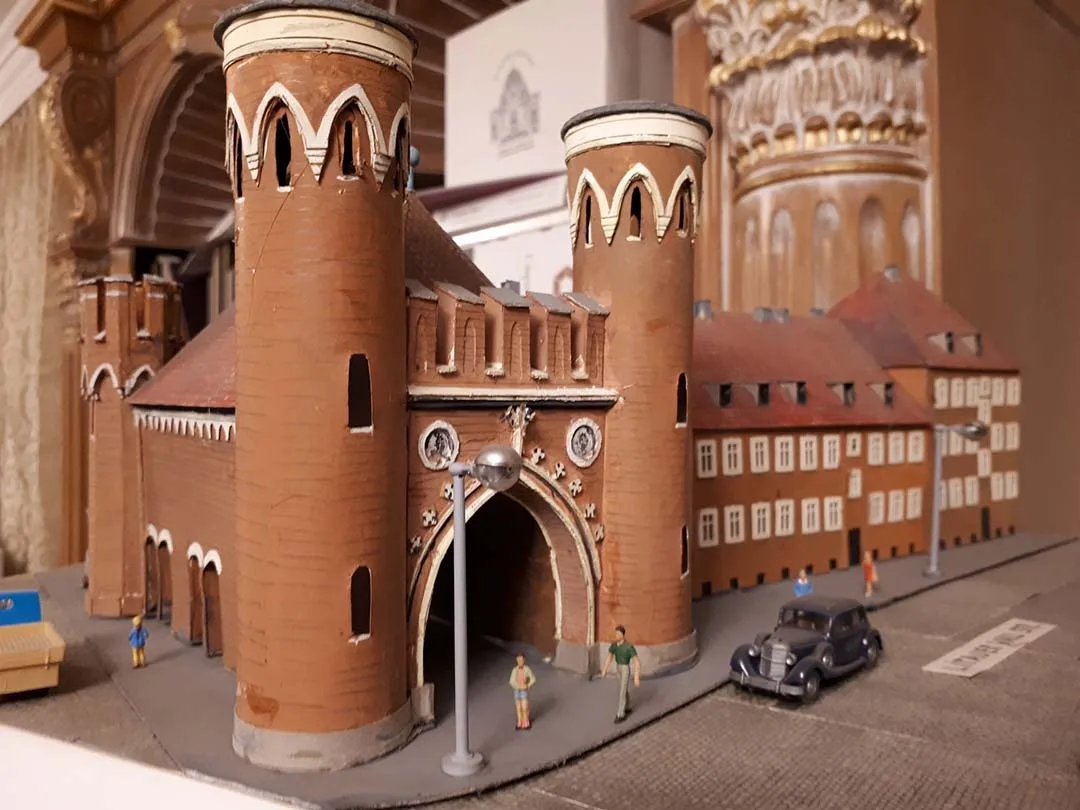
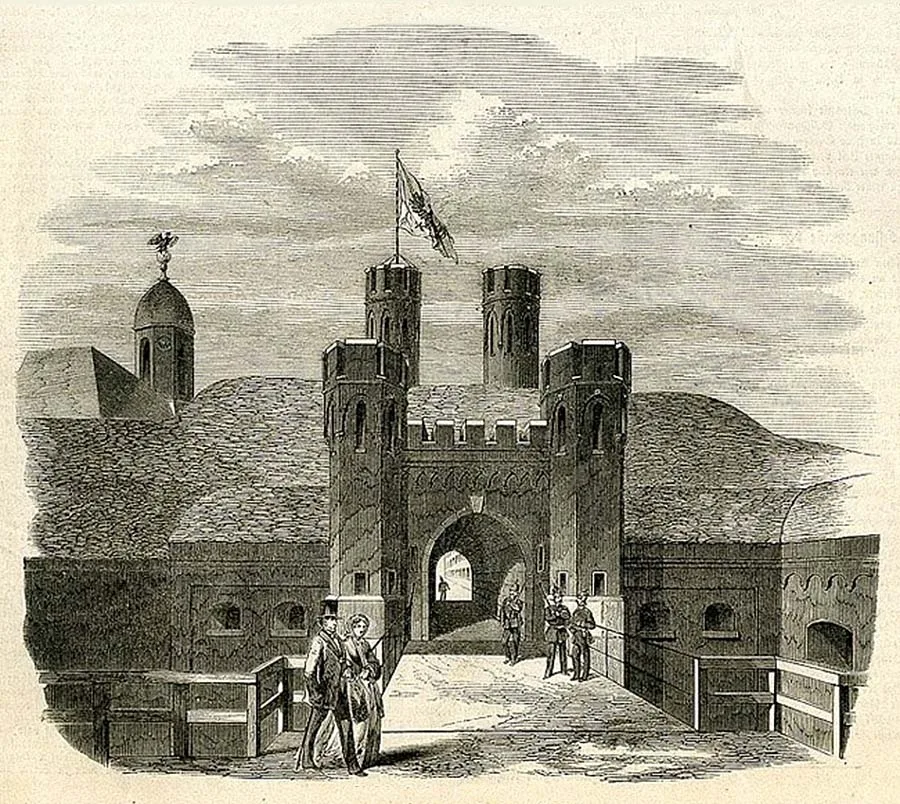 View of the Sackheim Gate from outside the fortress wall.
Sackheim became just such a castle Freiheit. What is more, if we are to believe a pithy saying from the town folklore of the period, it was ranked alongside the full-fledged towns that would later form Königsberg.
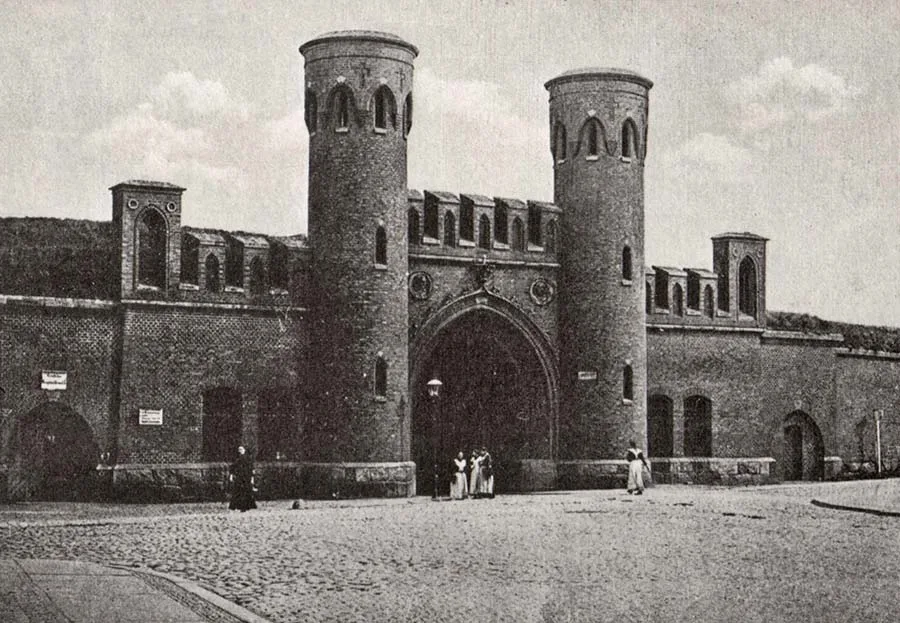 The Sackheim Gate from the town side.
Not everyone knows that the well-known Königsberg saying
In der Altstadt die Macht,
Im Kneiphof die Pracht,
Im Löbenicht der Acker,
Auf dem Sackheim der Racker.
"In Altstadt power, in Kneiphof splendour, in Löbenicht the plough…" has a fourth line as well: "…in Sackheim the riff-raff." Need one explain after this that, to put it in modern terms, the crime situation in Sackheim left much to be desired? Then again, nothing else was to be expected: on the whole the people of Sackheim were poorer than the inhabitants of the three towns on the Pregel, and those who settled here were not the most cultured or educated...
It is no wonder, then, that some Sackheimers felt an irresistible urge to "pluck" wealthy burghers or to rob merchants arriving in Königsberg.
Löbenicht moved its slaughterhouse out to Sackheim, onto the bank of the Pregel. In those days the trades of knacker and executioner were considered the "lowest". The town executioners, incidentally, also lived in Sackheim. The members of these indispensable but unrespected professions formed a kind of "caste of untouchables". For a burgher to marry the daughter of an executioner or a slaughterhouse worker was thought outrageous, and to give one's own daughter into "that dreadful family" was a decision hard even to imagine.
It would be wrong, however, to claim that Sackheim was known only as a Freiheit inhabited exclusively by marginal elements. For example, it was home to the shooting range of the Löbenicht marksmen's guild. As early as 1554 Duke Albrecht established a great shooting festival in Königsberg. At this festival members of the marksmen's guilds and anyone else who wished could try their hand at a rather peculiar kind of shooting: with a crossbow at birds. No birds were killed at the festival; the shooting was at wooden targets representing birds. To make it all look like a real hunt, special towers, known as Stange, were used for the "flight of the birds".
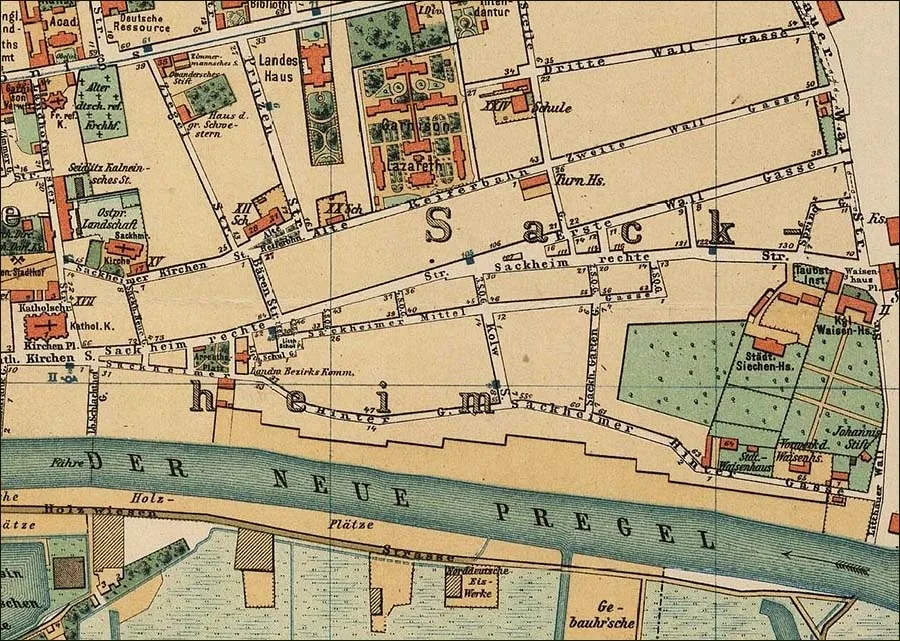 Sackheim on an 1885 map of Königsberg.
The Stange of the Löbenicht marksmen's guild was built in Sackheim. At first it stood closer to Löbenicht itself, not far from the Lithuanian Church. Later it was moved to the outskirts, where the Sackheim Gate would afterwards be built.
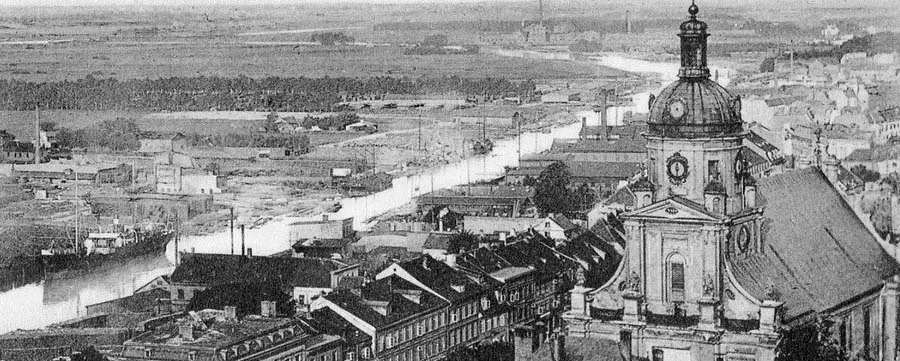
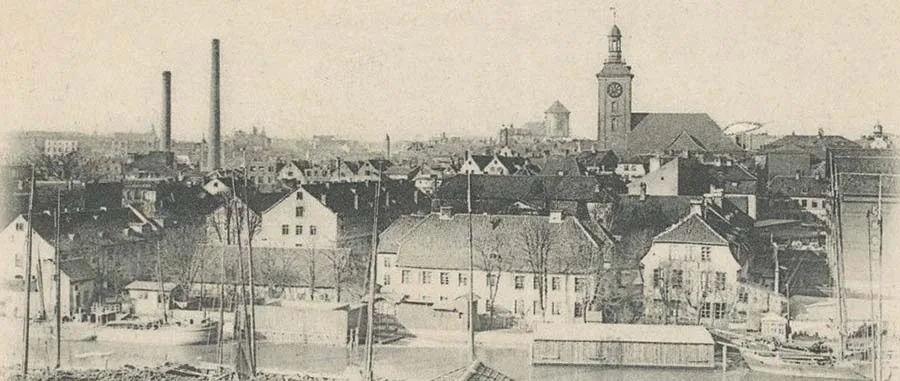
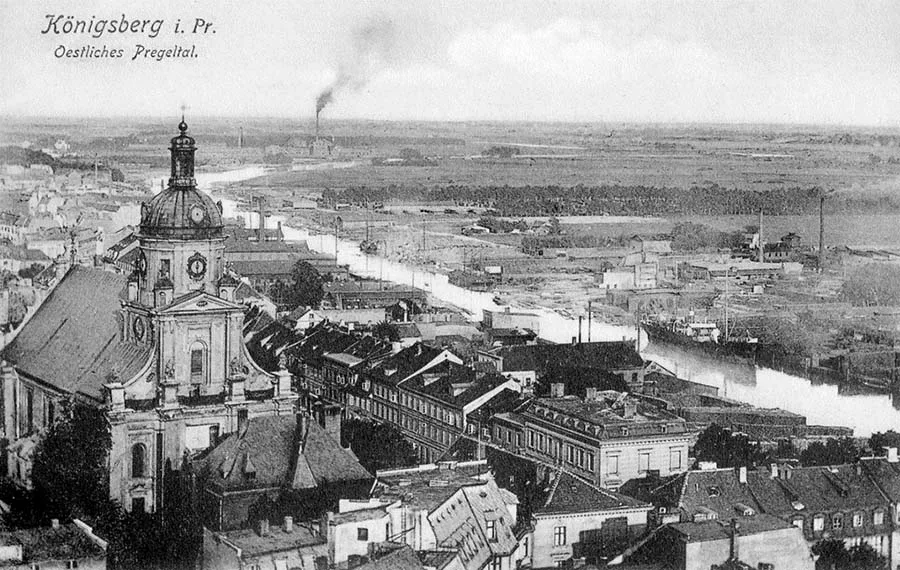 View of the Catholic Church and Sackheim from the tower of St Barbara's Church in Löbenicht.
In 1611 the Elector of Brandenburg, Johann Sigismund (1572–1619), travelled to Warsaw to obtain from the King of Poland the post of regent for the incapacitated Duke Albrecht Friedrich. He based his claim to the regency on the fact that since 1594 he had been the ailing duke's son-in-law. In return, the King of Poland, Sigismund III (1566–1632), demanded concessions easing the religious laws in Prussia with regard to Christians professing Catholicism. As a result, in 1614–16 the Catholic Church was built on the boundary between Sackheim and Löbenicht, and on 2 September 1612 the Gregorian calendar, at that time regarded as purely Catholic, was introduced in the duchy.
When in 1626 the question of building common earthwork fortifications became pressing in Königsberg, Sackheim, under the design of the mathematician and fortification engineer Strauss, found itself inside the fortress wall as one of the border districts.
The section of the rampart in Sackheim comprised two full bastions, one demi-bastion and a town gate, which was named the Sackheim Gate / Sackheimer Tor. This was, of course, not the gate that we can still see today on Moskovsky Prospekt. But the present gate has kept the site and the name of the gate of the first ring of ramparts.
When the gate was built, the tower of the Löbenicht marksmen's guild was demolished. But since the place had already become customary for shooting practice, the House of the Löbenicht Marksmen's Guild was built just outside the gate, where the "House with the Deer" stands today. The figure of a deer at the entrance to the building did not appear by chance either: it commemorates the Marksmen's House that once stood here.
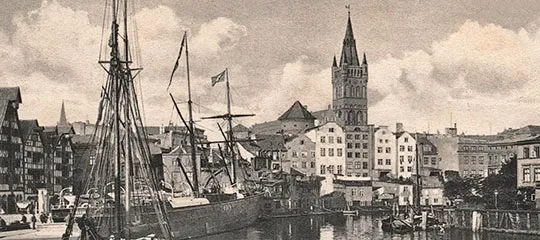
Towards the middle of the 17th century, despite its less than brilliant reputation, Sackheim began to play an ever more important role in Königsberg life. Firstly, in 1636 a boom barrier, the "Lithuanian Beam" / Litthauische Baum, was placed across the Pregel at Sackheim. Here ships and barges bound for the city were stopped for inspection and customs clearance. For the same purpose warehouses were built on the bank of the Pregel in Sackheim, where goods were unloaded to be counted and stored temporarily pending customs clearance. In 1640 the German-speaking Lutherans of Sackheim succeeded in having a church of their own built for them. It was founded not far from the Catholic one, which displeased the Catholics. Because of their objections, construction dragged on for 8 years.
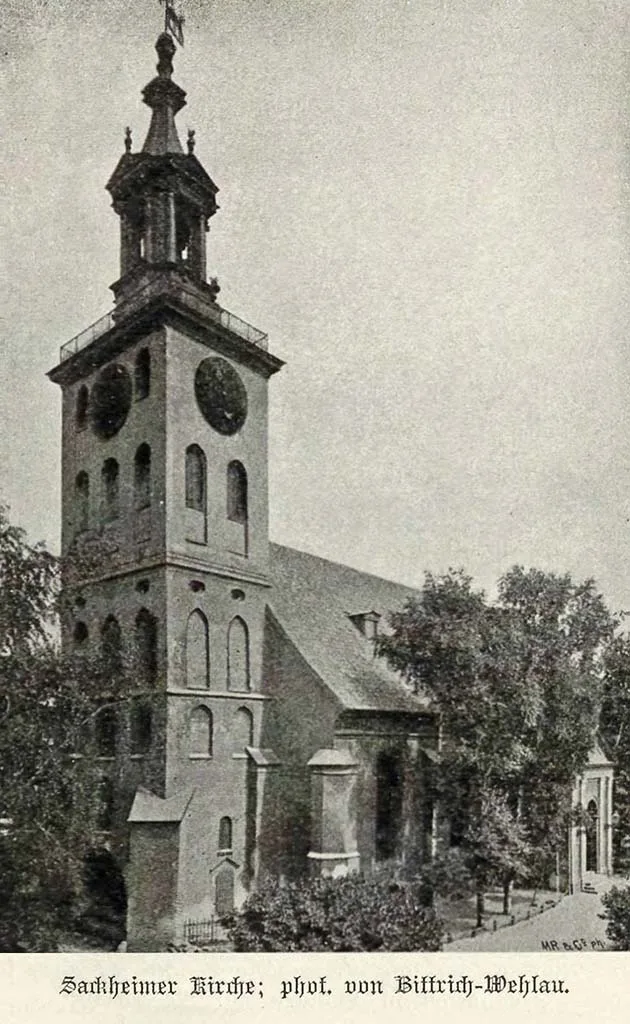
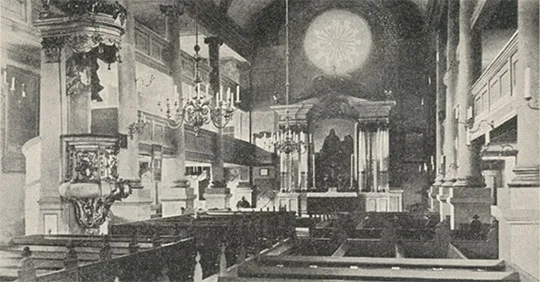
The Sackheim Church was more interesting than many in the city.
The first service in the new church, which was named the Sackheim Church / Sackheimer Kirche, took place in 1648. In 1707 an organ by the master builder Johann Mosengel / Johann Josua Mosengel (1663–1731) was installed in it.
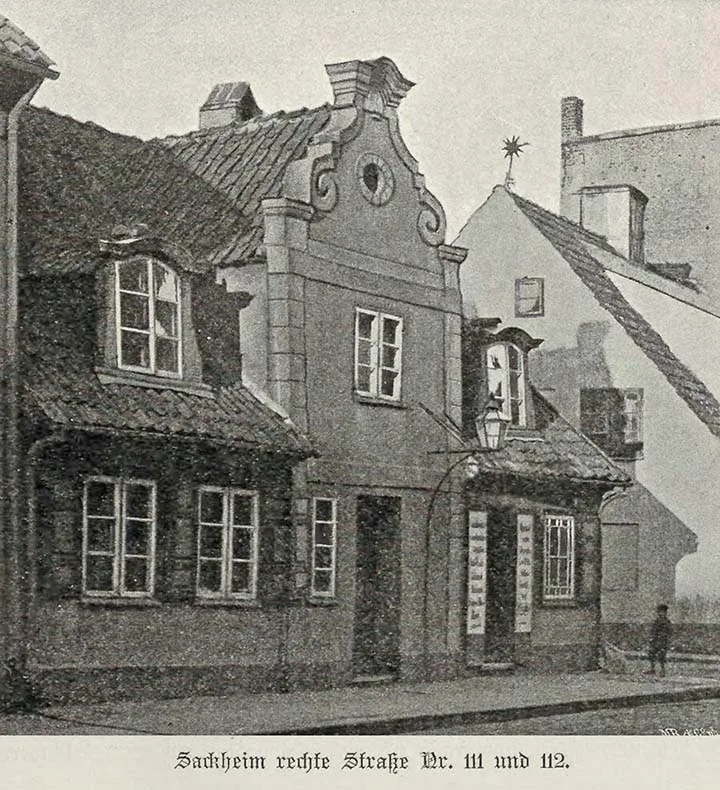
A Baroque house at Sackheimer rechte Straße 111.
In 1654 the first school in Sackheim was opened.
On 17 January 1701 the Elector of Brandenburg, Friedrich III (on the day before his coronation as the first King in Prussia under the name of Friedrich I), founded the highest order of knighthood in Prussia, the Order of the Black Eagle (Hoher Orden von Schwarzen Adler). Under the order's statutes its head was always the reigning King of Prussia. In the same year, 1701, now as head of this new Order, King Friedrich I founded the charitable Royal Orphanage in Sackheim, whose patron was that very Order of the Black Eagle. The orphanage building was designed by Joachim Ludwig Schultheiß von Unfriedt (1678–1753), one of the best-known architects of East Prussia, who for a time directed all state building work in the province.
To his designs the settlements of Tapiau (Gvardeysk), Ragnit (Neman), Gumbinnen (Gusev), Darkehmen (Ozyorsk), Stallupönen and Schirwindt (Kutuzovo, Nesterov District) were replanned at the time they were granted town status.
And, Schirwindt apart, which was destroyed in the Second World War, all the other towns mentioned owe the present layout of their streets and squares precisely to the architect Unfriedt. Unfriedt was also entrusted with rebuilding the south-eastern wing of the Order castle in Königsberg, which became known as the "Unfriedt Building" / Unfriedtbau. Jumping 300 years ahead, one can say that the Royal Orphanage building is the only one of von Unfriedt's works to survive in Kaliningrad. However, the architect's work can be judged only from old photographs: after the war the Baroque orphanage building was restored in a hideously simplified form. But in the 18th century the orphanage building was undoubtedly an adornment of Sackheim. From 1705 to 1809 the orphanage had its own church, the Orphanage Church / Waisenhauskirche, which was Reformed (Calvinist), since the Brandenburg branch of the Hohenzollerns traditionally professed this Protestant denomination. Looking at the orphanage building today, one might suppose that several dozen pupils lived there, but in fact there were only 12 of them; on the other hand, each had his own two-room apartment. Clearly, an institution with such lavish provision was not for ordinary mortals: it took in children from noble families who for one reason or another had lost their parents.
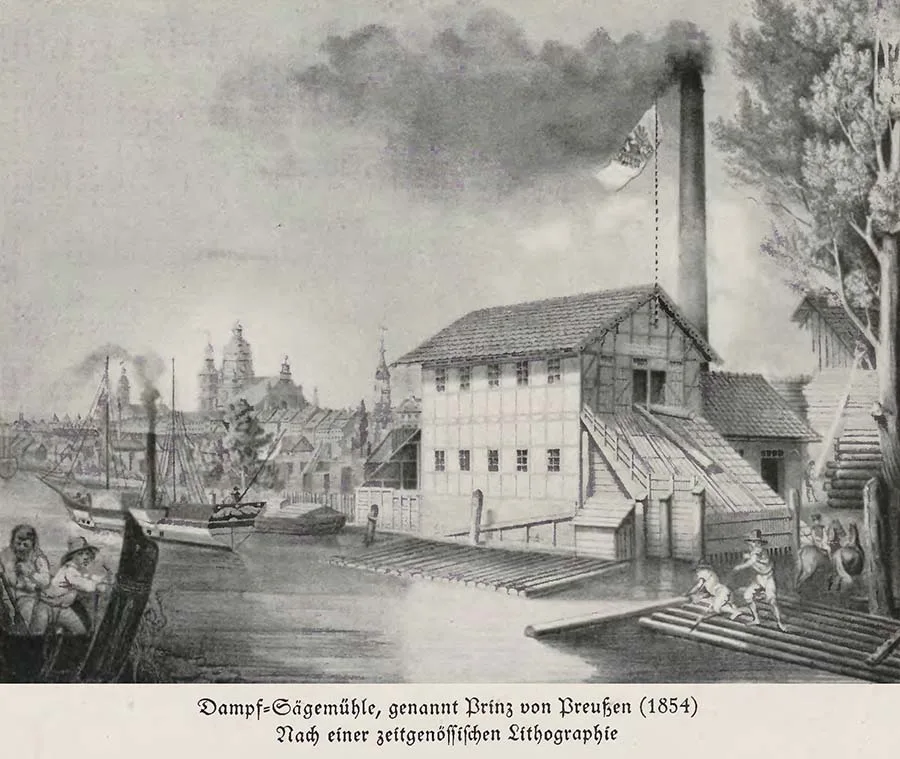 The Prinz von Preußen sawmill (unknown artist, lithograph, 19th century).
The orphanage school gave a better education than could be had in the burgher schools, and many pupils went on from the orphanage to university without any further preparation.
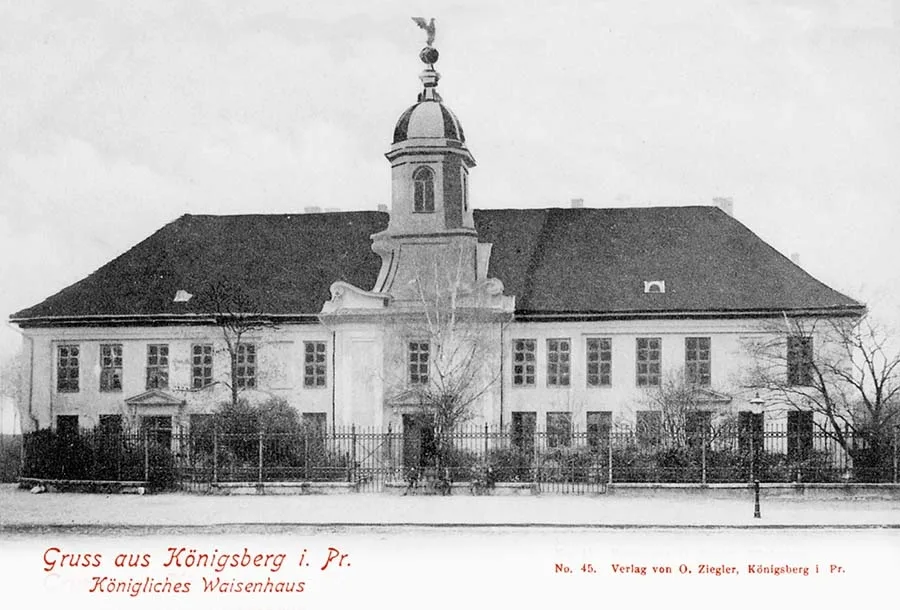 The façade of the Royal Orphanage.
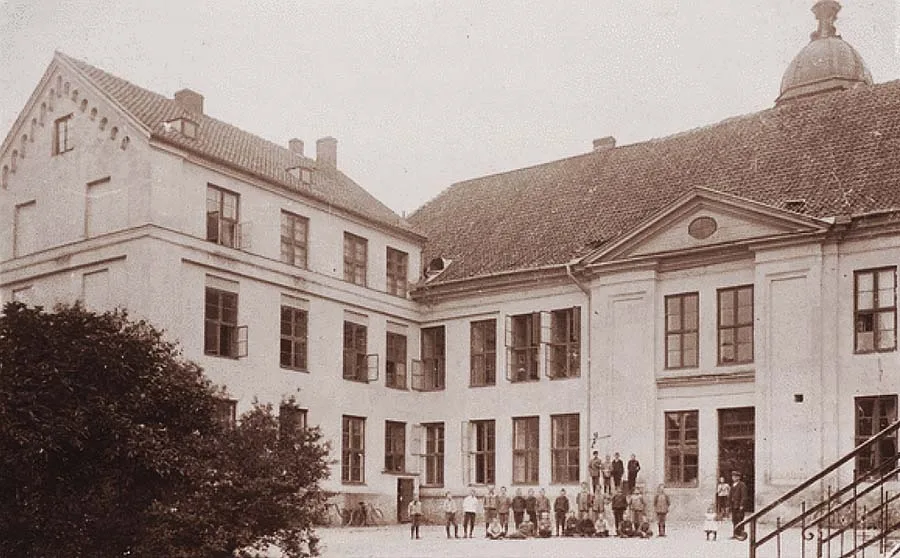 Group photograph of the pupils. View of the orphanage from the courtyard.
On 13 June 1724 the three towns on the Pregel, Altstadt, Kneiphof and Löbenicht, were united into the single city of Königsberg. Their Freiheiten became part of it too. As for the state Freiheiten, Sackheim among them, they became part of Königsberg territorially, but came under the administration of the Königsberg municipality only after the municipal reform of 19 November 1808.
The Great Königsberg Fire of 11 November 1764 swept through Sackheim as well. 369 houses and 49 granaries burned down there. The streets and blocks adjoining the Anger, that is, in the western part of Sackheim, suffered most. The Sackheim and Catholic churches burned down. It was decided to rebuild them on their former sites, using the old foundations and walls. The rebuilding of the Sackheim Church was directed by Carl Ludwig Bergius (1716–67), the chief director of building. The Sackheim Church was reconsecrated in 1768.
In 1771 a gilded weathervane in the form of the "Lamb of God", the symbol of Sackheim, was placed on its spire. The rebuilding of the Catholic church was directed by Johann Samuel Lilienthal (1724–99). The main work took place in 1765–76, and in 1777 it was consecrated.
The fire of 1764 became an occasion to "correct" Sackheim's rather chaotic street pattern, which in the old western part had survived from the days when the Freiheit was a Prussian village.
From then on Sackheim's street network consisted of long streets fanning out narrowly, starting in the west and stretching east towards the ramparts. They were crossed by short streets running from north to south, which appeared as new blocks were built.
In 1806 the building of the East Prussian General Landschaft Directorate / Ostpreußische Generallandschaftsdirektion, which granted loans for the development of agriculture, was erected on the boundary between the Anger and Sackheim. On 5 February 1813 this building hosted an assembly of the estates, addressed by the Prussian politician and reformer Count zu Dohna-Schlobitten / Friedrich Ferdinand Alexander zu Dohna-Schlobitten (1771–1831) and General Yorck / Johann David Ludwig Graf Yorck von Wartenburg (1759–1830, see below). The assembly decided to create a new volunteer East Prussian army: a reserve corps of 10,000 men, a Landwehr of 20,000 men, a Landsturm for local defence and a cavalry regiment.
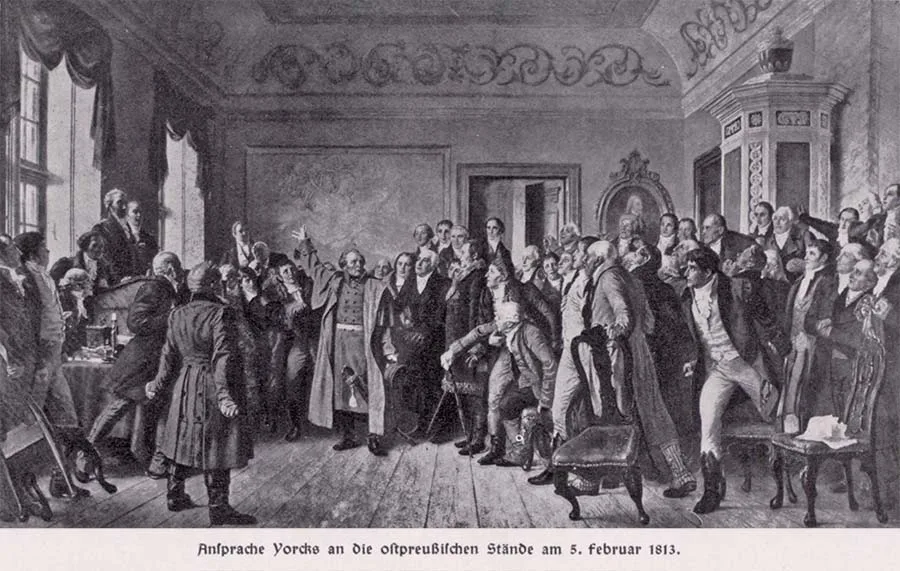
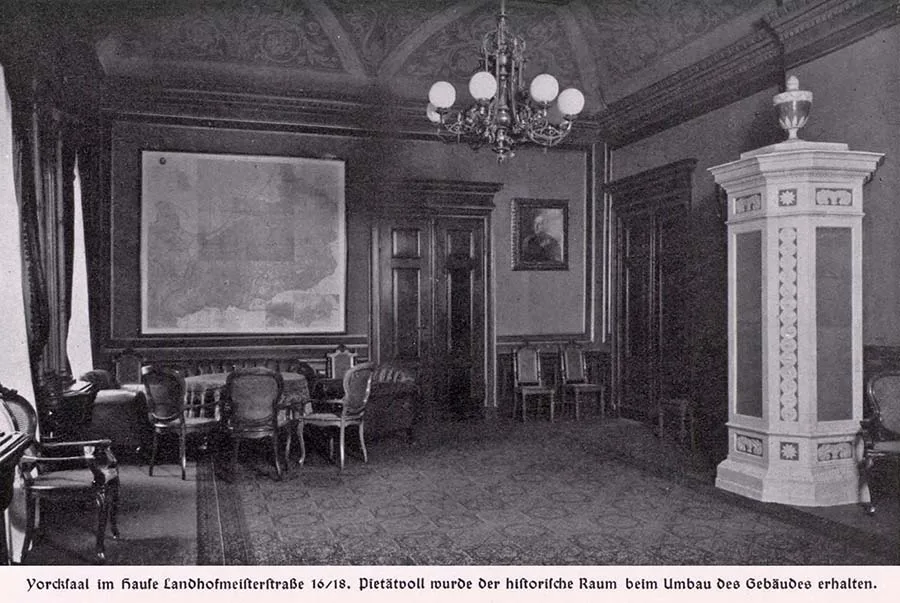 The historic hall in which General Yorck spoke.
Later, in memory of this event, Sackheim became a corner of the city whose street names immortalised the heroes of the war against Napoleon, Ludwig Yorck and Friedrich Wilhelm Freiherr von Bülow (1755–1816).
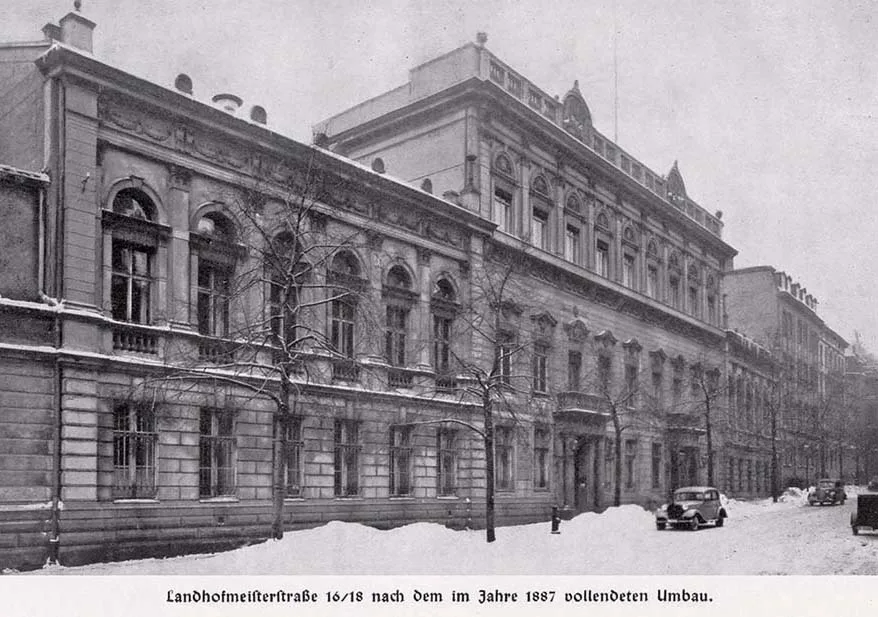 The East Prussian General Landschaft Directorate on Landhofmeisterstraße.
In the same year, 1806, the Lithuanian Church, which stood at the junction of Sackheim and Sackheimer Hinterstraße, ceased to exist. The reason was the decline in the number of parishioners. The policy of turning the population of Prussia into a single people with one language had done its work over several centuries. Ethnic Lithuanians now regarded German as their native language and no longer needed a separate church with services in Lithuanian. A rather unusual use was found for the church building: it was turned into what would now be called an administrative detention prison, then known in German as the Arresthaus. The square where the former Lithuanian church stood came to be called Arresthaus-Platz.
When Königsberg's 2nd bastion ring was built in 1843–62, its Sackheim section consisted of the Litauen bastion / Litauen ("Lithuania"), the Sackheim ravelin and the newly built Sackheim town gate. The Lithuania bastion, as we now call it, in keeping with the general rule that no two elements of the bastion ring should be alike, differed from all the other bastions in having a casemated battery facing the Pregel. As the fortification engineers intended, the guns of this battery were to control the river from the east and protect the city against possible attacks by an enemy river flotilla.
The Sackheim Gate took the form of a small medieval fort with four towers, which, admittedly, could at best have served as lookouts and were in essence decorative elements.
Medallions on the gate held high reliefs of the heroes of the Coalition Wars already mentioned above, Bülow and Yorck. The Sackheim Gate and the reduit-caponier with the battery of the Lithuania bastion have survived to this day and are registered cultural heritage sites. The Sackheim ravelin, however, did not survive the demolition of the 2nd bastion ring in 1910–11. All that remains of it is the characteristic bend of the moat.
After the First Vatican Council (1870), which issued the bull on papal infallibility, some Catholics who disagreed with the council's decisions organised a movement known as the "Old Catholics", which broke away from papal authority. In 1876 the Königsberg "Old Catholics" took over the Catholic church in Sackheim, and only in 1889 did it once again belong to the Roman Catholic Church.
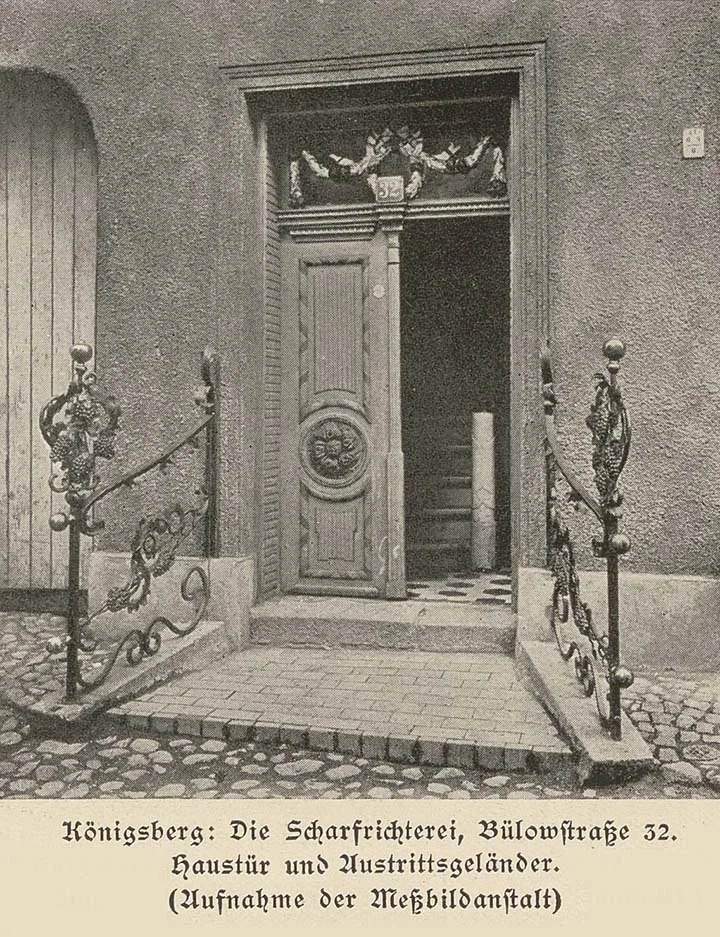
The entrance of a house at Bülowstraße 32.
Summing up the 19th century for Sackheim, one can state that the once "gangland" district had turned into a perfectly liveable one. Facilities important to the city were located on its territory.
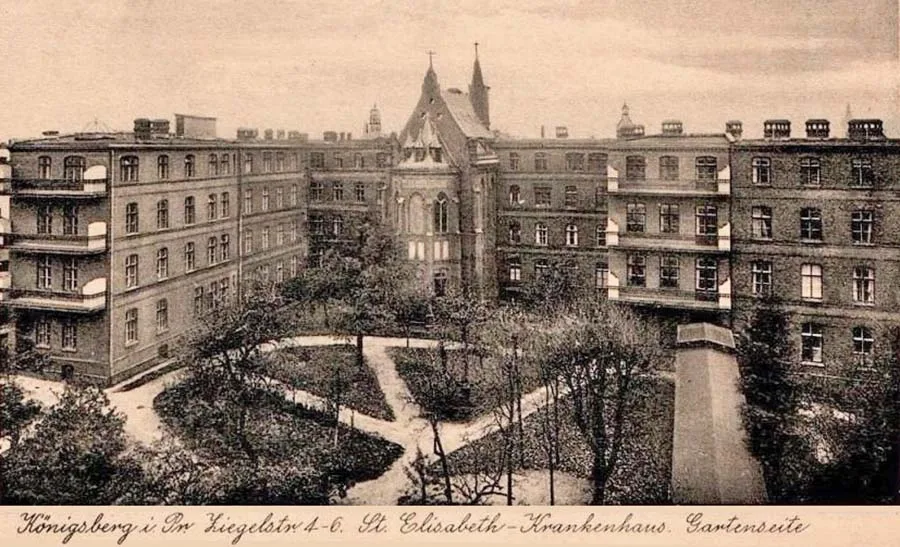 View from the courtyard of a house on Kirpichnaya Street.
There were two churches here and two chapels attached to hospitals and almshouses; four schools: the Sackheim town school (with separate classes for boys and girls), the Lithuanian auxiliary school, the 9th elementary school for girls and the 9th elementary school for boys; medical and social institutions: St Elizabeth's Hospital, the town infirmary, the Royal Orphanage, the town orphanage and the Johannes almshouse; the credit institution "East Prussian Landschaft", a gymnasium hall, a public bathhouse and an administrative detention prison. The last, it is true, was closed at the very end of the century (1896), and the building was taken over by the district command of the Landwehr.
By 1903 the buildings of the Löbenicht Hospital had become completely dilapidated. It was decided to move the institution itself out of the city centre. Sackheim became the new home for its patients. In memory of the old building, the 18th-century entrance portal was transferred to the new complex. The hospital kept its old name, although it was now located in Sackheim, on Heidemannstraße (Cherepichnaya Street).
In 1906 (the foundation stone bears the date 18.09.1906) a combined school building was erected, housing a school for girls and a school for boys. The first was named after Johann Friedrich List (1787–1868), the 4th Oberbürgermeister of Königsberg, who held this office in 1825–38; the second after Professor August Wilhelm Heidemann (1773–1813), the 2nd Oberbürgermeister (in 1810–13).
The last pre-war embellishment of Sackheim was the construction in the 1920s and 1930s of terraced blocks of flats along the line of the former ramparts.
These buildings looked so imposing that in Soviet Kaliningrad a tale went round by word of mouth that they were medieval and had at the same time served as the city's defensive wall. Of course, these houses had nothing to do with the city's defence, except for one, the so-called "Firemen's House". The municipality built it for those who defended the city against fire: the men of the city fire brigade and their families. In the 1930s a number of streets in Sackheim were also renamed, but here the renamings were not connected with Nazi ideology. The unattractive name Arresthaus-Platz was replaced by Sankt-Elisabeth-Platz, in memory of the Convent of St Elizabeth with its hospital that had once stood here. The old street Sackheimer Hinterstraße was renamed in 1932 Gebauhr-Straße in honour of a family of entrepreneurs and patrons of the arts.
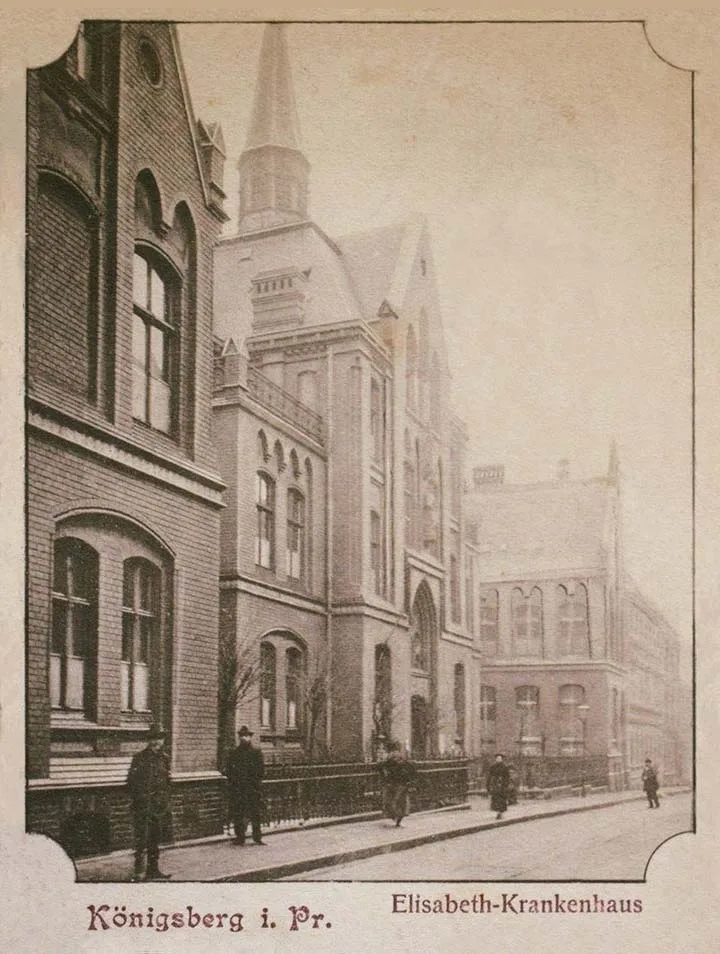
St Elizabeth's Hospital on the same Kirpichnaya Street.
The consequences of the British bombing of Königsberg on the night of 30 August 1944 can be compared for Sackheim only with the fire of 1764. The comparison is all the more apt because once again the western and oldest part of the district, adjoining Löbenicht and the Anger, suffered most.
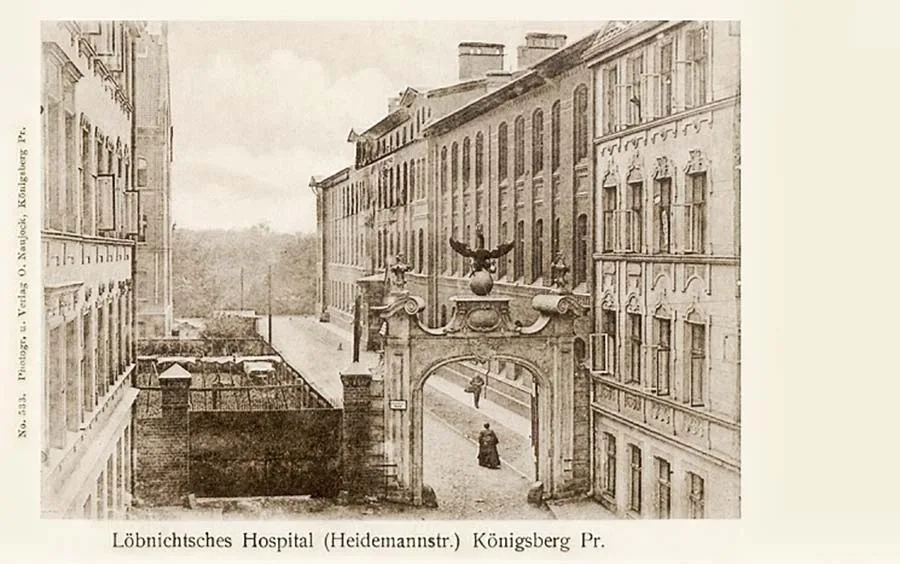 The Löbenicht Hospital after its move to Sackheim.
Most of the houses here burned out completely, losing their roofs, floors, windows and doors. The storming of the city added to the destruction. Although Sackheim did not lie in the path of the Red Army's main thrust, it was attacked by ground-attack and bomber aircraft, and on the last day of the assault the district was taken by the 83rd Guards Rifle Division (Major General A.G. Maslov, 1903–71) of the 11th Guards Army.
After the fighting ended, Sackheim was included in the 1st district of Königsberg (Military Commandant's Office No. 1). Sackheim was not honoured with a separate Soviet name. Sackheim's main streets were renamed as early as November 1945, and many of them have kept those names. The minor streets were not renamed and were not taken into account at all, because they had ceased to exist.
On the whole, there were few houses in Sackheim fit to be restored as dwellings. They were concentrated mainly on 1812 Goda Street, Stekolnaya Street and Kaunasskaya Street (now Litovsky Val).
On the other hand, some administrative buildings were restored; they had been better built in their time and so had withstood the fires and shelling with less damage. This applied above all to the medical institutions. As early as 1945 St Elizabeth's Hospital on Kirpichnaya Street was converted into an infectious diseases hospital. In post-war Königsberg intestinal diseases caused by insanitary conditions and the destroyed water supply raged for the first couple of years. So in those years the institution was overflowing with patients. In 1951 the infectious diseases hospital moved, and a tuberculosis clinic was opened in its former building, since the tuberculosis situation also left much to be desired. The buildings of the Löbenicht Hospital, on the other hand, though originally designed for medical purposes, were not used as such: two of them were restored as residential buildings, the hospital chapel as a warehouse, and the main treatment block was demolished.
In 1949 the Barrikady cinema opened in the former gymnasium hall of the secondary school. At about the same time, the buildings of a now Soviet sawmill were erected on the foundations of the former Prinz von Preußen sawmill. So Lesopilnaya (Sawmill) Street once fully lived up to its name.
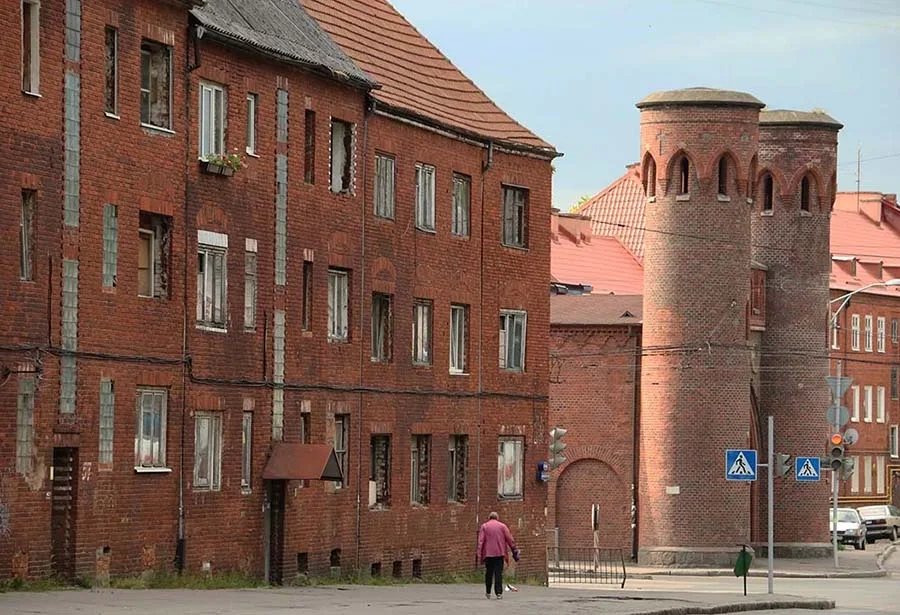 The Firemen's House and the Sackheim Gate in the early 2010s.
Nevertheless, even at the end of the 1960s much in Sackheim was still a reminder of the war that had ended more than 20 years before: most of its territory was waste ground, cleared of ruins but strewn with broken brick.
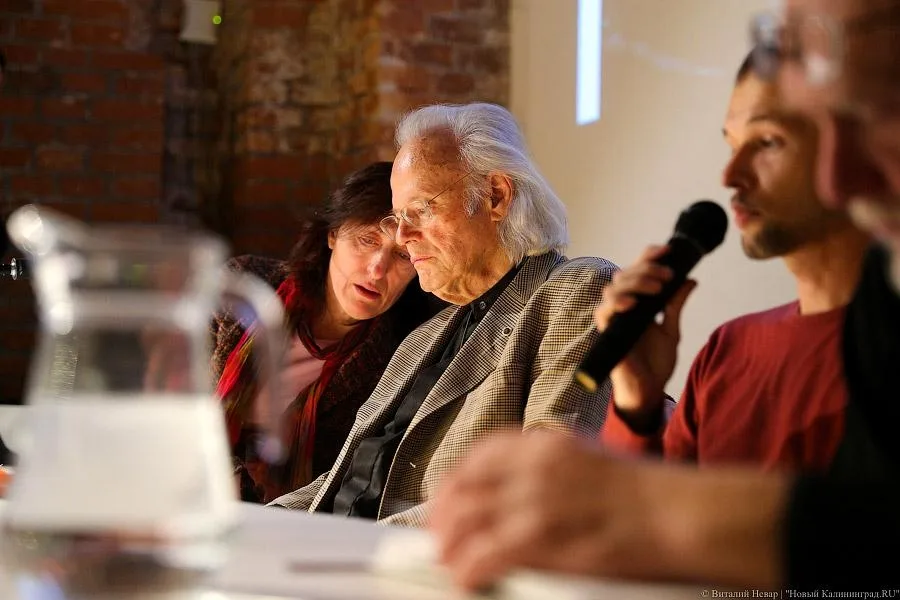 Michael Wieck (centre) presents his book "The Decline of Königsberg" at the Sackheim Gate (25.11.15).
Holding the microphone is the publisher Maksim Popov. Photo by Vitaly Nevar.
Only about 60 buildings remained here. In the city directories of the 1960s the facilities in the former Sackheim that mattered to residents can literally be counted on the fingers of one hand: besides the Barrikady cinema on Lazaretnaya Street mentioned above, there were the children's polyclinic of the Leningradsky District (Litovsky Val 55; by 1968 it had moved to the shore of the Upper Pond on Proletarskaya Street), an enterprise called "Oblaptekoupravleniye" (the regional pharmacy administration) in the former St Elizabeth's Hospital at Kirpichnaya Street 7/9, "Rosgalantereya" at Stekolnaya Street 39/41, Vocational School No. 11 in the so-called "Firemen's House" (Moskovskaya Street 167/169 – Litovsky Val 59), Secondary School No. 36 in the building of the former elementary school (Dneprovskaya Street 22) and Primary School No. 24 (Moskovskaya Street 162). By 1968 a medical equipment shop had moved into the building at Moskovskaya Street 155. At the turn of the 1960s and 70s the former Sackheim still had not a single kindergarten, crèche, post office or large shop.
The ruins of the Sackheim and Catholic churches were examined by a historical and architectural commission, which found them to be of no historical value in view of the heavy destruction and the loss of their artistic elements. The commission concluded that their restoration was inadvisable. The building of the former Lithuanian Church of Sackheim, which later became a prison and a commandant's office, stood in the 1960s with a restored roof and could have been used further, but was nonetheless soon demolished.
Mass construction came to Sackheim at the very end of the 1960s. Over the following 10 years more than 40 blocks of flats (9–12 storeys) and public buildings were erected, about 10 times more than in the previous 25 years.
Moskovskaya Street was turned into Moskovsky Prospekt, which also swallowed up Dneprovskaya Street, the former Sackheimer Mittelgasse. School No. 36 moved into a new standard building, and its old premises in the elementary school building were taken over by the School for Working Youth and the Pioneers' House of the Leningradsky District. Two combined nursery-kindergartens, No. 117 and No. 121, were built. The primary school was closed and a School for Accountants opened in its premises. The renovated Royal Orphanage building housed Pharmacy No. 13 and the Regional Production Association for Photo and Film Work with its art photography studio. Curiously, two more institutions in the former Sackheim were connected with photography and cinema: the "Obyektiv" art studio of the Kaliningrad branch of the USSR Union of Journalists (Moskovsky Prospekt 120) and the newsreel correspondents' office of the Leningrad Documentary Film Studio (Moskovsky Prospekt 111). The number of shops increased considerably: besides three grocery shops, Nos. 35, 74 and 102, several specialised non-food shops were opened: "Okhotnik" (Hunter), "Tsvety" (Flowers), "Promtovary" (Manufactured Goods), "Knigi" (Books) and the "1000 Melochei" (1000 Little Things) shop, very popular with Kaliningraders in those years. In the 1970s the first post-war cafés also appeared in Sackheim: "Ogni Moskvy" (Lights of Moscow, Moskovsky Prospekt 119/1) and "Kholodok" (Moskovsky Prospekt 151).
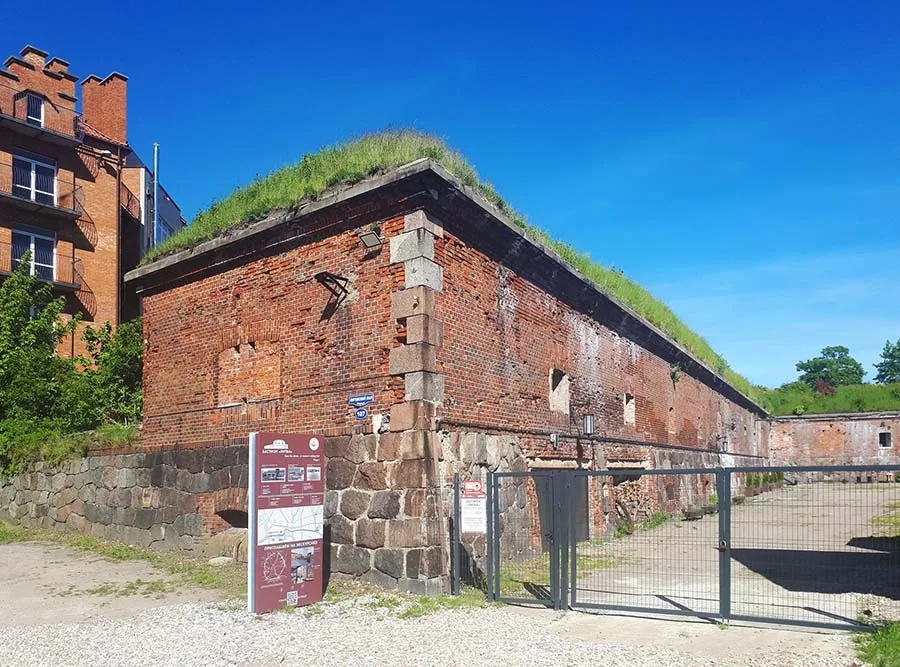 The Lithuania bastion on the bank of the Pregolya in the 2020s.
In the 1970s Sackheim acquired the appearance that we can see today.
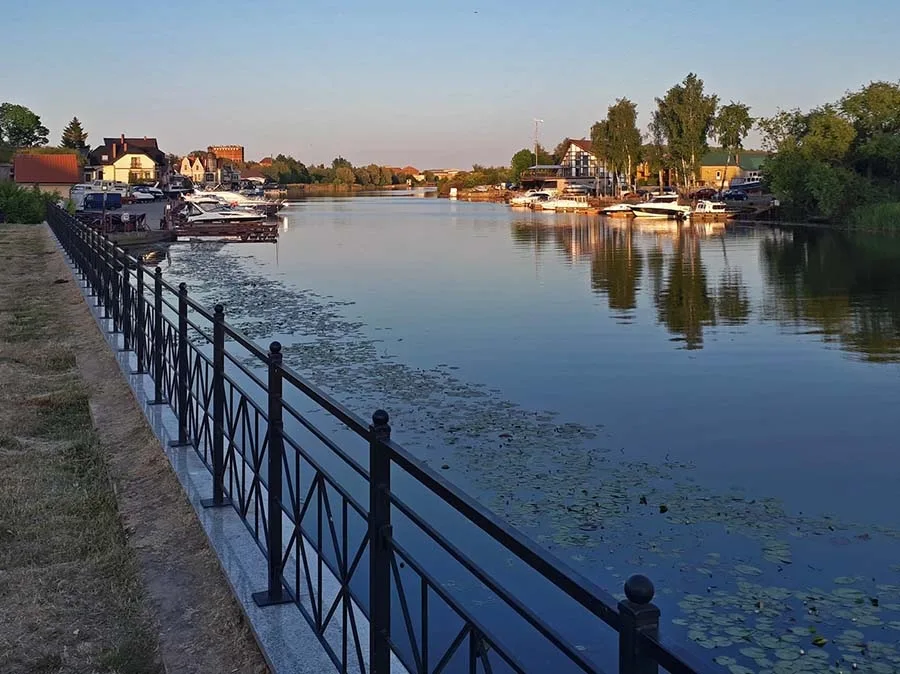 The Pregolya embankment in Sackheim.
Later changes were no longer so significant, and for the urban environment they were mostly negative. In 2008, during the construction of the 2nd overpass, Stroitelnaya Street disappeared from the city maps together with its pre-war houses. Already in the 1970s the Barrikady cinema no longer met the standard of a modern cinema and was classed as a "second-category cinema". From 2007 the building stood abandoned, then it was handed over to the Russian Orthodox Church. No new use was found for it, and in 2013 the former gymnasium hall of the elementary school was demolished. In 2011 one of the tallest buildings in Kaliningrad was built between 1812 Goda Street and Stekolnaya Street; yet this gigantic 20-storey candle of glass and concrete still looks like a foreign body here. A pleasant exception was the conversion of the Sackheim Gate into the "Vorota" (Gate) art space. Many Kaliningraders had the chance to go inside this historic building for the first time. In 2022 the badly dilapidated portal of the Löbenicht Hospital was restored. Concerned members of the public managed to save the "Firemen's House" on the corner of Litovsky Val and Moskovsky Prospekt: instead of the planned demolition, it is now being reconstructed, including restoration of its historic façades.
A brief list of the streets of Sackheim
(for the period 1928–32)
Blumenstraße appears on maps in 1901; as late as the end of the 19th century there was a meadow here. The street was not damaged by the bombing, but its buildings were damaged during the storming of the city. The damaged buildings were demolished by the 1960s. The construction of new Khrushchev-era blocks in 1969–71 virtually wiped out the street. One could say that part of the former Blumenstraße is today's Cherepichny Lane. There are no pre-war buildings on it, but to the north, among the courtyards, a school building of 1906 has survived.
Bärenstraße first appears on the 1885 map. Bärenstraße connected the streets Sackheim and Yorkstraße. The buildings on Bärenstraße were not damaged in the bombing of 30.08.1944, but were destroyed during the storming of the city. After the war the street was not renamed but was regarded as a continuation of Kirpichnaya Street. In the 1960s all the ruins of the pre-war buildings on it were demolished. In 1974 the nine-storey block at Moskovsky Prospekt 99–109 was built across the street. That was the end of the street's history.
Bülowstraße is one of the oldest streets in Sackheim; it is already marked on the 1763 map. At that time it was called Wallstraße (Rampart Street), and in the 19th century it became First Rampart Street, Erste Wallstraße. The street received the name of the hero of the Napoleonic Wars Friedrich Wilhelm von Bülow in 1892. The buildings on Bülowstraße were practically undamaged by the bombing and partly survived the storming of the city. On 23.11.1945, by order of the commander of the troops of the Special Military District, Bülowstraße was renamed Stekolnaya Street, and it has kept this name to the present day. The pre-war houses on it were demolished in the 1970s. In their place a Khrushchev-era block (1971) and a couple of more modern houses (1989 and 1996) were built. The last German building on this street was demolished in 2022, despite protests by residents. A multi-storey residential building is now under construction on its site.
Sackheim; at the beginning of the 19th century it was called Sackheimische Straße, and in the middle of the same century Sackheimer rechte Straße (Sackheim Straight Street). The main and oldest street of Sackheim, leading from the Anger to the Sackheim Gate. Along this street ran the old road towards Tapiau (Gvardeysk) and Insterburg (Chernyakhovsk). In the 20th century the street Sackheim widened near the Sackheim Gate to form a square, Weisenhausplatz. Here, on Weisenhausplatz, was the turning loop of tram routes 9 and 10, which ran along Sackheim. During the bombing of 30.08.1944 the western part of the street was badly destroyed, while the eastern part suffered only during the storming of the city in April 1945. By order of General Galitsky, commander of the troops of the Special Military District, of 23.11.1945 the street Sackheim was renamed Smolenskaya Street. But as early as 01.08.1946 the Civil Affairs Administration renamed it Moskovskaya Street. Moskovsky Prospekt was later laid out along the line of Moskovskaya Street; it was widened and built up mainly in the late 1970s and early 80s. Everyone is free to decide for themselves whether Moskovsky Prospekt at this point is that very street Sackheim or whether it inherits the site of a vanished street. Six pre-war buildings have survived on the former street Sackheim, two of which (the Sackheim Gate and the Royal Orphanage) are registered cultural heritage sites.
Sackheimer Gartenstraße, a small cross street of Sackheim that connected Sackheimer Mittelstraße and Sackheimer Hinterstraße. It came into being in the middle of the 18th century, but was fully built up with houses only by the middle of the 19th century. During the bombing of 30.08.1944 the houses on it burned out but were not destroyed. On 23.11.1945, by order of the commander of the troops of the Special Military District, it was renamed Sadovy Lane, and it kept this name until 1960. Today the site of the street is occupied by the courtyard of houses Nos. 3–13 on Grieg Street. No pre-war buildings have survived on it.
Sackheimer Kirchenstraße; the street came into being in the 17th century with the building of the Sackheim Church, but took its final shape after the fire of 1764, when it came to connect the Anger and Sackheim districts. Further on it ran into the street Alte Reiterbahn. During the British bombing the buildings on it were badly damaged by fire. After the war it was not renamed separately and became the western part of 1812 Goda Street. However, during the construction of prefabricated panel housing (1972–74), 1812 Goda Street was shortened somewhat, losing among other things the part that had once been Sackheimer Kirchenstraße. Its site is now taken by a path through the courtyard along the building at Moskovsky Prospekt 99–109 and by the Moskovsky Prospekt – 9 Aprelya Street interchange.
Sackheimer Mittelgasse came into being in the middle of the 18th century. Most of the buildings on the street burned out during the British bombing of Königsberg. On 23.11.1945, by order of Galitsky, commander of the troops of the Special Military District, it was renamed Promezhutochnaya Street, but as early as 01.08.1946 it was renamed Dneprovskaya Street, which existed at least until 1977. By the 1960s it had been cleared of ruins; only three pre-war houses remained on it, one of which was demolished in the 1970s. In 1968–77 several nine-storey panel blocks were built along and across the street, and in 1974 School No. 36 opened on it. Today the site of the street is occupied by the courtyards of houses Nos. 100–110 and Nos. 130–136 on Moskovsky Prospekt, the grounds of School No. 36 and so on. Two pre-war buildings have survived on the former Sackheimer Mittelgasse: the elementary school (1875–76) and the combined building of the girls' and boys' schools (1906).
Sackheimer Neue Gasse first appears on a map in 1763. It was rebuilt after the fire of 1764. It connected Sackheimer Kirchenstraße and the street Sackheim. It was badly damaged in the British bombing (30.08.1944). After the war it was not renamed. By the 1960s it had been cleared of the ruins of pre-war buildings. It disappeared when Moskovsky Prospekt was widened in the late 1970s. Its site is now taken by the interchange of Moskovsky Prospekt and 9 Aprelya Street.
Sackheimer Hinterstraße took shape in the middle of the 18th century under the name Sackheimer Hinter Gasse. Before that the area of the street was rather densely and chaotically built up. After the fire of 1764 it was decided to regularise the buildings in the southern part of Sackheim, and this led to the appearance of one of the longest streets in the district. At the beginning of the 20th century the Löbenicht Hospital was moved to Sackheimer Hinterstraße. Next to it was the Prinz von Preußen sawmill. In 1932 the street was renamed Gebauhr-Straße in honour of a father and son, Carl Julius Gebauhr the Elder (1809–81) and Carl Julius Gebauhr the Younger (1852–1913). The former is known for founding in Sackheim the Prinz von Preußen sawmill, the first steam sawmill in Königsberg, and was also a renowned piano maker. His son was a patron of the arts and the founder of the Königsberg Conservatory. The street suffered during the bombing and the storming of the city. On 23.11.1945, by order of the commander of the troops of the Special Military District, it was renamed Lesopilnaya Street, a name it has kept to the present day. In its western part the street can be considered to have vanished completely: panel blocks have been built on part of it, and part is occupied by their courtyards. The eastern part became Lesopilnaya Street. One pre-war building has survived on it: the 2nd block of the Löbenicht Hospital (1903). The old sawmill buildings were rebuilt, and in the 1950s a Soviet sawmill operated there. Today [first quarter of the 21st century] they house commercial businesses.
Sedanstraße first appears on the 1860 map. It was named after the victory of the Prussian army at Sedan during the Franco-Prussian War (1870–71). By the beginning of the 20th century it had been built up with houses. During the bombing of the city on 30.08.1944 the houses on the street burned out but were not destroyed. After the war it was not renamed, but in effect became part of Grieg Street. By the 1960s the ruins of the pre-war buildings on it had been demolished, and in 1973 and 1975 9- and 12-storey residential buildings were built on the street. Today it is part of Grieg Street between Moskovsky Prospekt and Admiral Tributs Embankment.
Yorkstraße was formed in 1892 from the streets Alte Reiterbahn and Zweite Wall Gasse, which in turn had appeared at the end of the 18th century and formed the northern boundary of Sackheim. The street was named after the hero of the wars against Napoleon, Johann David Ludwig Graf Yorck von Wartenburg. During the British bombing (30.08.1944) the houses on Yorkstraße were fatally destroyed in its western part, but were practically undamaged in the eastern part. On 23.11.1945, by order of General K.N. Galitsky, commander of the troops of the Special Military District, it was renamed 1812 Goda Street (the Street of the Year 1812), and it has kept this name to the present day. On the street (within its pre-war extent) 13 pre-war houses have survived, among them one registered cultural heritage site: the building of the Ost fire station (1900, architect Paul Mühlbach, 1849–1908).
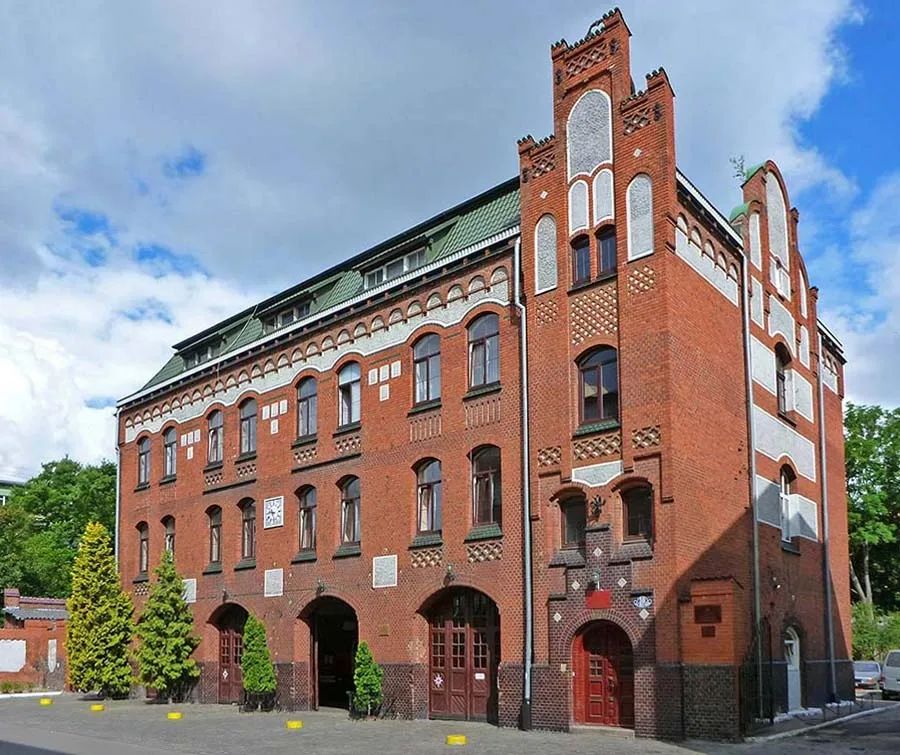 The fire station on 1812 Goda Street.
Katholische Kirchenstraße appeared in the 17th century together with the building of the Catholic Church, but took its final shape only after the fire of 1764. This short street connected the Anger and Sackheim districts, and further on it forked into the streets Sackheim and Sackheimer Hinterstraße. It was badly damaged during the bombing of the city (30.08.1944). On 23.11.1945, by order of the commander of the troops of the Special Military District, it was renamed Dorogobuzhskaya Street. A street of that name existed for several years, but then (no later than 1956) became part of Moskovskaya Street. Its site is now Moskovsky Prospekt opposite houses Nos. 60–62. No pre-war buildings have survived on Katholische Kirchenstraße.
Kolwstraße came into being around 1870 and connected the streets Sackheimer Mittel Gasse and Sackheimer Hinter Gasse. By 1885 it had been built up with houses. It was damaged in the British bombing (30.08.1944), although the damage was not fatal. After the war it was not renamed. By the 1960s it had been cleared of the ruins of pre-war buildings. In 1974 the building of School No. 36 was built right in the middle of the former Kolwstraße.
Lithauer Wallstraße belonged only partly to Sackheim. It came into being as a rampart road when Königsberg's 1st ring of ramparts was built (1626–40). At the beginning of the 20th century the earth rampart along this street in the Sackheim area was demolished. In the 1920s residential buildings were built on the site of the rampart between the streets Sackheim and Yorkstraße, among them the "Firemen's House". In 1939 similar houses forming a continuous wall were built along Lithauer Wallstraße on the stretch from the Sackheim Gate to the Lithuania bastion. The buildings on Lithauer Wallstraße suffered relatively little in the bombing and the storming of the city during the war. After the war, on 23.11.1945, by order of the commander of the troops of the Special Military District, Lithauer Wallstraße was renamed Kaunasskaya Street. However, in 1946 the Civil Affairs Administration did not endorse this name; the street was first called Litovskaya Street and a little later Litovsky Val. Today 16 pre-war buildings have survived on the part of Litovsky Val that belonged to Sackheim, four of which are registered architectural monuments.
Lithauische Schulstraße was named after the school that first operated at the Lithuanian Church and later became simply the Lithuanian auxiliary school of Sackheim. Surprisingly, the buildings on Lithauische Schulstraße, including that of the former Lithuanian Church, were not badly damaged in the bombing and storming of Königsberg. The church building, with its roof, stood at least until 1966 and was demolished only when the district was built up with panel housing. The street itself was not renamed after the war. Its site is now the passage between houses No. 78 and No. 80 on Moskovsky Prospekt and the courtyard of the building at Moskovsky Prospekt 80–90.
Prinzenstraße; the street belonged partly to Sackheim. It appeared on city maps in 1885 and led from Sackheim to Neue Sorge, to Königstraße. The western side of the street faced St Elizabeth's Hospital and the Sackheim town school with separate classes for boys and girls. On the eastern side stood the 4th elementary school for girls, a lyceum and a social welfare institution, as well as the boundary of the grounds of the garrison infirmary. But the right-hand side of Prinzenstraße already belonged to Neue Sorge. The street was not damaged by fires during the British bombing (30.08.1944); some buildings were seriously damaged during the storming of the city. On 23.11.1945, by order of the commander of the troops of the Special Military District, Prinzenstraße was renamed Bolnichnaya (Hospital) Street, after the infirmary located here. In the end, however, a different street in Neu Rossgarten became Bolnichnaya Street, and on 01.08.1946 the former Prinzenstraße was renamed Lazaretnaya Street. By the 1960s three pre-war buildings remained on the street, but in 2013 one of them, the gymnasium hall of the Sackheim town school, was demolished. Today there are two pre-war buildings on the street, but both are assigned to Kirpichnaya Street.
Prinzhauseneck, a small corner street adjoining Sackheimer Mittelstraße. It appeared on maps at the very beginning of the 20th century. At that time it was home to the 9th elementary school for boys and the 9th elementary school for girls, as well as a gymnasium hall shared by these schools. The buildings on the street burned out during the British bombing (30.08.1944), but the walls of the girls' elementary school and the gymnasium hall stood until the 1960s. After the war it was not renamed. Today the site of the street is occupied by the grounds and sports ground of School No. 36. The building of the girls' elementary school (1875–76) has survived and is now recognised as a cultural heritage site. It is assigned to Moskovsky Prospekt and now houses a young technicians' centre.
Voigdtstraße appeared on city maps at the very beginning of the 20th century. This corner street ran past the Sackheim Church and connected Sackheimer Kirchenstraße with Ziegelstraße. On 23.11.1945, by order of General Galitsky, commander of the troops of the Special Military District, it was renamed Stroitelnaya Street, and it kept its name until the 2000s. Three pre-war residential houses survived on the street. However, when the 2nd overpass was built, it ran up against one of them. When construction of the 2nd overpass bridge resumed in 2008, these houses were demolished. The street disappeared with them. Its site is now the Moskovsky Prospekt – 9 Aprelya Street interchange.
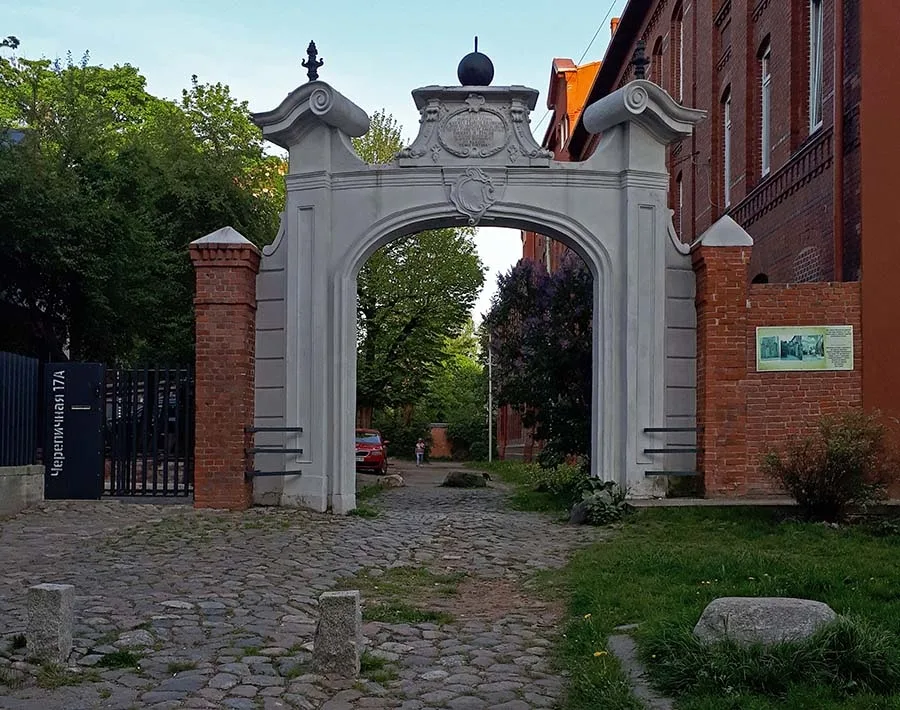 The portal of the Löbenicht Hospital on Cherepichnaya Street.
Heidemannstraße came into being at the turn of the 19th and 20th centuries on a vacant lot where the people of Sackheim had once had their vegetable gardens. The street was named after the 2nd Oberbürgermeister of Königsberg, August Wilhelm Heidemann (1773–1813). The street ran past the town infirmary, which had been built in this area earlier. And in 1903 the new blocks of the Löbenicht Hospital were built on Heidemannstraße. Thus almost the whole eastern side of the street faced medical institutions. In the 20th century two elementary schools also faced the street. After the war, on 23.11.1945, by order of the commander of the troops of the Special Military District, Heidemannstraße was renamed as two streets at once: Novaya Street and Rechnoy Lane. On 01.08.1946, by order of the Civil Affairs Administration, Novaya Street was renamed Pekhotnaya Street, and Rechnoy Lane Cherepichnaya Street. Only in the 1950s did Heidemannstraße finally become Cherepichnaya Street, though it no longer reaches the street Sackheim (Moskovsky Prospekt). Seven pre-war buildings have survived on the street (two of them are listed under Litovsky Lane), as well as the old portal of the Löbenicht Hospital (18th century, in the photo above). The former main block of the Löbenicht Hospital, its chapel and the portal are cultural heritage sites.
Ziegelstraße is one of the oldest streets in Sackheim. It probably appeared when the Sackheim Church was built, but acquired its present layout after the fire of 1764. By 1790 at the latest it was fully built up with houses. In 1894 the complex of St Elizabeth's Hospital was built on Ziegelstraße, comprising, besides the wards for patients, a chapel, living quarters for the nursing nuns and a kindergarten. On 23.11.1945, by order of General Galitsky, commander of the troops of the Special Military District, it was renamed Kirpichnaya Street, which was simply a translation of its name into Russian. It has kept this name to the present day. In 1976 the western side of Kirpichnaya Street was built up with five nine-storey buildings (listed under 9 Aprelya Street). On the eastern side of the street stand two pre-war buildings, one of which (St Elizabeth's Hospital, see above) is a registered cultural heritage site.
Sprindgasse, a crooked little corner street, came into being in the middle of the 18th century. It owed its angled shape to the fact that it originally ran along a stream which flowed into the Pregel further down and was later filled in. After the war it was not renamed, although it existed as a nameless lane. It disappeared in 1974 with the construction of the residential buildings at Moskovsky Prospekt 161–163 and the "1000 Melochei" shop.
1st, 2nd, 3rd, 4th, 5th, 6th and 7th Sackheimer Obergasse: seven lanes connecting Sackheimer Mittelstraße and the street Sackheim. They were numbered starting from the Sackheim Gate towards the city centre. But this was not always so: the 1809 map shows the reverse numbering, from the centre towards the gate. After the war these lanes were not renamed. Today the site of the 1st Obergasse is the passage between houses No. 136 and No. 138 on Moskovsky Prospekt; of the 2nd, the passage between houses No. 120 and No. 130 on Moskovsky Prospekt; of the 3rd, the green area in front of the building at Moskovsky Prospekt 106; of the 4th, the passage between houses No. 98 and No. 100 on Moskovsky Prospekt; and of the 5th, 6th and 7th Obergasse, the green area in front of the buildings at Moskovsky Prospekt 88, 84 and 82 respectively.
Photos: Bildarchiv Ostpreußen / bildarchiv-ostpreussen.de, Vitaly Nevar, Mikhail Ogorodnikov.
– – – – – – – – –
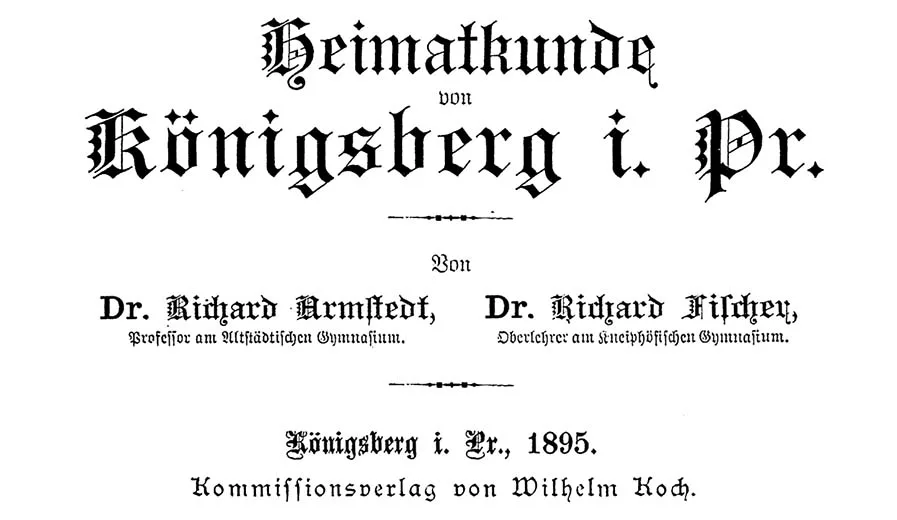
The chapter "Sackheim"
from the book by local authors "Königsberg Local Studies",
published at the end of the 19th century
In 2012–2014, "Pregolya", the literary and art supplement to the "Baltic Almanac",
published a translation of "Königsberg Local Studies" ("Heimatkunde von Königsberg i. Pr.", 1895, Kommissionsverlag von Wilhelm Koch, Königsberg), a book by the Königsberg authors Dr Richard Armstedt, a professor at the Altstadt Gymnasium, and Dr Richard Fischer, a senior teacher at the Kneiphof Gymnasium; the translation was made by an unknown translator. The idea of publishing it came from Igor Vladimirovich Afonin. The text was adapted and annotated by Aleksey Borisovich Gubin and Igor Fyodorovich Avtukhov. That book had a separate chapter on Sackheim. We have substantially edited it and offer it to you as a supplement to the text by Aleksey Yevgenyevich Petrushin.
– – – – – – – – –
Sackheim
The former village of Sackheim is the oldest Freiheit, which arose soon after the founding of Königsberg. The surviving court records date from 1326. The coat of arms of Sackheim: on a blue field, the Lamb of God with a red banner bearing a white cross. The court seal bore an inscription on the granting of privileges, in which the Latin letters "F. H." stand for "Freiheit" ("Sigil des Erbor Gericht Firstlicher F. H. Sackheim"). Beside the flag are the Latin letters "K" and "B" and the figures "7.8.". The letters stand for "Königsberg", and the figures presumably for the year the seal was confirmed: 1578.
(The name "Sackheim" probably comes from the Prussian language, in which it could have meant a settlement that arose on a forest plot, on cleared woodland — editor's note.)
At the dawn of its existence Sackheim was not a single territory. Its eastern part, where the princely Wood Garden (Holzgärten) with the wood treasury (Holzkämmerei) and the wood office (Holzschreiberei) was located, and where since the beginning of the 18th century the Royal Orphanage (Königliche Waisenhaus) has stood, came under the jurisdiction of the castle administration. The western part, with the hospital (Löbenichtschen Hospital), belonged to Löbenicht. The latter (because of its proximity to the port and warehouses — ed.) often suffered from fires. The most devastating occurred in 1539, 1575 and 1764. The architecture here even now (the 1890s — ed.) is for the most part modest and provincial.
(This refers to the oldest part of Sackheim, bounded by today's Moskovsky Prospekt, Litovsky Val, the Pregolya and Cherepichnaya Street, along which a stream then flowed from the pond at the Sackheim Gate — Editor's note.)
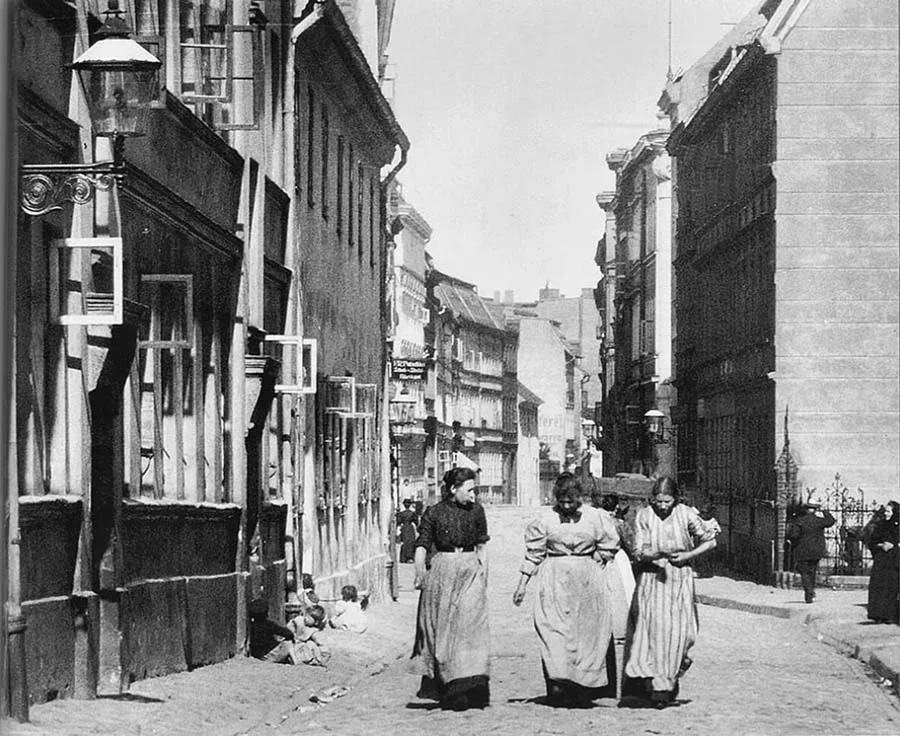
Girls walking along Sackheimer Mittelgasse (1910).
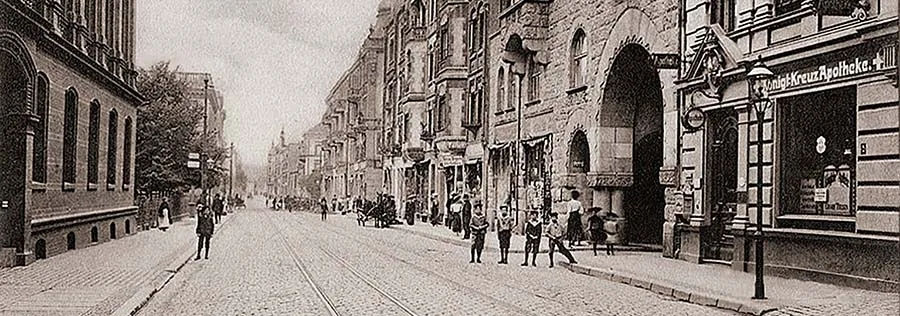
The main street is Sackheimer rechte Straße (Sackheimer rechte Straße; besides "straight", rechte also means "right" in both senses, correct and right-hand. On the modern city map it is the part of Moskovsky Prospekt from Sergey Tyulenin Street to the Sackheim Gate — ed.)
It used to be called Broad Lane (Breite Gasse) and simply Sackheim Street (Sackheimer Straße). It runs from the Sackheim Gate (Sackheimer Thor) to the Stegen in Löbenicht, is the main traffic artery here and links Sackheim with other parts of the city.
At the Catholic Church (Katholischen Kirche / Propsteikirche) Sackheimer rechte Straße becomes Catholic Church Street (Katholische Kirchestraße). Here, too, the Lower Sackheim Street (Sackheimer hinter Straße, now Admiral Tributs Embankment) branches off towards the Pregel (now the Pregolya river), ending at the Lithuanian Barrier (Litthauer Baum); this is the name of the boom on the Pregel where the Königsberg customs officers inspect vessels arriving from the upper reaches of the river and from the direction of Labiau (Labiau, now the town of Polessk) and the Curonian Lagoon.
Near Prison Square (Arresthausplatz) Sackheimer Mittel Gasse branches off to the right of Sackheimer rechte Straße and later rejoins it. Further east, Bülowstraße (Bülow Straße, now Stekolnaya Street), which until 1892 was called 1st Rampart Lane (1. Wallgasse), leads off to the left.
To the north of Sackheimer rechte Straße runs another, parallel street which at its beginning, from the southern end of Landhofmeisterstraße (now Sergey Tyulenin Street) to the crossing with Ziegelstraße (Ziegel Straße), is called Sackheim Church Street (Sackheimer Kirchen Straße), and further on, as far as the rampart, bears the name of General Yorck (York Straße). Until 1892 these were the Old Ropewalk (Alte Reiferbahn) and 2nd Rampart Lane (2. Wallgasse).
The main streets of Sackheim, which run parallel to the river, are connected by several mostly narrow and short streets and lanes, the most interesting of which is Kolwstraße (Kolw Straße), built in the 1860s and named after its builder.
(The network of Sackheim streets and lanes, rather confusing from the modern reader's point of view, is now hard to picture, given the very considerable replanning of the district and its development with new modern buildings. For a more detailed study, therefore, one should consult the city maps of the 19th and 20th centuries — Editor's note.)
After the Reformation of 1525 all the churches in Königsberg became Protestant. But on the boundary between the Anger (Anger) and Sackheim stands the Catholic Church, dedicated to St John the Baptist.
Where, one might ask, could a Catholic church outwardly resembling St Peter's Basilica in Rome have come from here? Since the Duchy of Prussia remained a fief of Catholic Poland, the Catholics of Prussia turned to Poland for help in building a church in Königsberg.
And when in 1611 the Elector Johann Sigismund of Brandenburg (Johann Sigismund, 1572–1619), regent for the last Prussian duke Albrecht Friedrich (Albrecht Friedrich von Preußen, 1553–1618) and his son-in-law besides, petitioned the King of Poland after the death of his father-in-law to be recognised as the rightful ruler of Prussia, the Warsaw Sejm, among other conditions, obliged him to build a Catholic church in one of the suburbs of Königsberg and to pay the priest an annual salary of 1,000 Polish guilders.
(The question of succession in Prussia very nearly reached deadlock, since the ailing Duke Albrecht Friedrich had no male children. Under agreements signed earlier, Prussia would in that case have lost its independence as a state and become a Polish province. However, in 1605 the Elector Johann Friedrich managed to obtain a charter to govern Prussia and the title of duke, but without the right to pass it on to an heir. After his death his son Johann Sigismund likewise managed to obtain the guardianship, and after the duke's death, as a result of complex diplomatic negotiations, the right to hereditary rule over Prussia within the Polish kingdom. — Editor's note.)
The Prussian burghers, who had not taken part in the negotiations, at first fiercely resisted these conditions, but in the end swore the oath of fealty to the Elector in the presence of a Polish commission sent specially to Königsberg, thereby also approving the building of the Catholic Church. As early as 22 May 1614 the foundation stone of the future church was ceremonially laid on the appointed site, and construction was completed in 1616. Originally the church had no tower, which reassured the Protestants. The church acquired its present appearance, with a beautiful dome above the tower, and was reconsecrated on 27 April 1777, following restoration after the fire of 1764, which had completely destroyed it.
When, after Pope Pius IX proclaimed the bull on papal infallibility (1870), a schism occurred in the Catholic community, the opponents of this dogma (Altkatholiken, Old Catholics) separated from the Roman Catholics. In 1876 the Prussian government handed the church over to the former as the more numerous congregation. Later, however, the number of Old Catholics declined considerably, and so in 1889 the Roman Catholics took the church back. Since then Old Catholic services have been held in the Hospital Church of Löbenicht (Löbenichtschen Hospitalkirche).
In 1890–1894 the church was renovated, and it is now a magnificent work of architecture. The vaults are Baroque; the nave is considerably higher than the two side aisles, which are separated from it by two rows of columns.
The chief adornment of the church is the altarpiece painted by Ittenbach (Franz Ittenbach, 1813–1879) in 1846, depicting Christ crucified. Fourteen paintings of the Passion of Christ adorn the walls and ceiling of the church. The windows are decorated with images of the 12 apostles. The church also has other paintings of saints and apostles, and on the outer west side above the entrance stand figures of the four evangelists carved in sandstone. The church is 45.5 metres long, 27 wide and 29 high.
(In terms of today's layout, the church stood on the site of the office building on Moskovsky Prospekt that houses the Statistics Department — editor's note.)
The north side of the quadrangular Catholic Church Square (Katholischen Kirchen Platz, formerly the old churchyard) is formed by houses belonging to the church. Among them is the 6-class elementary school (Katholische Kirchschule), evidently built at the same time as the church. Two plots of land in Haberberg (Haberberg) were acquired for a second school building, and in 1813 the Catholic congregation bought land for a cemetery outside the King's Gate (Königstor).
The oldest Protestant church in Sackheim stood on what is now Prison Square; it was called the Lithuanian or St Elizabeth's Church (Litthauische oder Elisabethkirche). The number of Lithuanians living in Königsberg is small, but one must bear in mind the rafts, all kinds of boats and river vessels from Lithuania that come to the capital of East Prussia every year; counting them, the number of Lithuanians is more considerable. In 1526 Duke Albrecht (Albrecht von Brandenburg-Ansbach, 1490–1568) allowed a Lithuanian preacher in Königsberg. Sermons for the Lithuanians were preached in the Steindamm Church (Steindammer Kirche), alternating with sermons for the Poles. In 1603 the small Lithuanian congregation was given a church dedicated to St Elizabeth, built back in the time of the Order (Deutscher Orden). In 1807 its building was converted into a prison for prisoners of war. The few Lithuanians remaining in Königsberg then began attending services in the Hospital Church. The former detention house now serves as offices of the district command. Next to St Elizabeth's Church there was once the Convent of St Elizabeth, dissolved after the Reformation of 1525. The convent building was given to the Löbenicht Hospital. For a long time the cemeteries of the Lithuanian Church and of the Löbenicht Hospital were located nearby.
(The prison stood east of the second overpass bridge on Moskovsky Prospekt, in the courtyard of house No. 78 — editor's note.)
At first services in the Lithuanian Church were held only in Lithuanian. But as building grew denser and the German population of Sackheim increased, sermons in German became necessary as well.
Georg Neuschilling (1606–1658) from Danzig (Danzig) was called as preacher.
Soon friction arose between the German and Lithuanian parishioners. The German congregation then appealed to the Elector Georg Wilhelm (1595–1640) to be allowed to build a church of their own, and on 25 May 1640 they received permission to build it on the site where the Sackheim Church (Sackheimer Kirche) still stands today.
But now it was the Catholics who began to raise obstacles, as the distance between their church and the new Protestant one turned out to be very small, and the singing allegedly prevented them from attaining reverence. Such a reason could hardly be taken seriously; nevertheless, construction was halted and resumed only eight years later. It was completed on 31 August 1648. The first sermon in the new church was preached by Pastor Neuschilling on the church feast of the 12th Sunday after Trinity. The poet Simon Dach (1605–1659) composed a solemn hymn of thanksgiving with chants for this feast. In 1764 the church burned down and, after repairs, was consecrated again on 22 January 1769.
The walls of today's Sackheim Church have partly preserved fragments of the old masonry. On the tower is a weathervane flag with the arms of Sackheim: the Lamb with the cross banner. The interior has a nave and two aisles. The wooden vault of the nave is 12.5 metres high. It rests on two rows of Ionic columns separating it from the side aisles, which are 9 metres high.
The church is adorned by an altarpiece painted by Professor Heydeck (Johannes Heydeck, 1835–1910) in 1878. It depicts Jesus Christ inviting. In 1813 a new parish cemetery was laid out beyond the King's Gate.
(In terms of today's layout, the Sackheim Church stood on Moskovsky Prospekt, east of the Statistics Department building, beneath the tram ramp from the overpass — editor's note.)
Not far from the Sackheim Church, at Yorkstraße 65, stood the large new building of the Garrison Infirmary (Garnisonlazarett, now the infectious diseases hospital on Frunze Street).
If we walk east to the end of Bülowstraße, we come to Lithauer Wallstraße (Litthauer Wallstraße). This rampart begins at the Rossgarten Gate (Rossgärter Thor) and reaches as far as the bank of the Pregel.
Where the Pregel crosses the city boundary is the Lithuanian Barrier. And where Sackheimer rechte Straße meets Lithauer Wallstraße stands the Sackheim Gate (Sackheimer Thor), where the old country road to the east used to begin. The inner side of the gate is adorned with busts of Generals Yorck and Bülow, made of limestone by the sculptor Stürmer (Wilhelm Stürmer, 1812–1885).
Hans David Ludwig von Yorck (Johann David Ludwig Graf Yorck von Wartenburg) was born on 26 September 1759. In 1812 he commanded the Prussian Royal Army Corps that Prussia provided for the war with Russia. But after Napoleon's retreat from burning Moscow, General Yorck on 30 December 1812 concluded a neutrality agreement with the Russian general Diebitsch (Ivan Ivanovich Dibich-Zabalkansky (before entering Russian service Hans Karl Friedrich Anton von Diebitsch und Narten, 1785–1831) at the mill in Tauroggen. We regard this agreement as the beginning of Prussia's decisive struggle against the French. To the cheers of the people of Königsberg, General Yorck led his troops through the Sackheim Gate in January 1813. Soon afterwards began his fruitful work as Governor-General of Prussia in creating a people's militia. As a corps commander under Blücher (Gebhard Leberecht von Blücher, 1742–1819), General Yorck distinguished himself several times in battle, especially at Bautzen on 20–21 May 1813, at Wartenburg on the Elbe on 3 October 1813, at Möckern on 16 October 1813, at Laon on 9 March 1814 and at Paris on 30 March 1814. On 3 June 1814 General Yorck was given the honorary title of Count Yorck von Wartenburg. The general died in 1821.
Friedrich Wilhelm von Bülow (Wilhelm Freiherr von Bülow, Graf von Dennewitz) was born on 16 February 1755 in Falkenberg near the Altmark. In 1811 he held the post of governor of East and West Prussia. He took part in the successful battle against the French at Möckern on 5 April 1813, and won victories at Grossbeeren on 23 August 1813 and at Dennewitz on 6 September 1813. In the Battle of Leipzig, Bülow's East Prussian Landwehr stormed the Grimma Gate. He took part in the victorious battles at Laon on 9 March 1814 and at Paris on 30 March 1814. He was given the honorary title of Count Bülow von Dennewitz. In recognition of his services he was granted estates in Neuhausen (now the town of Guryevsk) and in Grünhoff (now the village of Roshchino, Zelenogradsk District). General Bülow took part in the campaign of 1815. After peace was concluded with France he held a command post in Königsberg. It was here that he died on 25 February 1816. He was buried on the estate of Grünhoff.
In the immediate vicinity of the Sackheim Gate stands the Royal Orphanage (Königliche Waisenhaus), adorned with a handsome little tower. It was founded on 18 January 1701 by King Friedrich I (1657–1713) on the day of his coronation (18.01.1701).
Construction was completed in 1703. On 18 January 1705 the first sermon was preached in the house church, which existed until 1809. According to the orphanage's chronicles, it took in 24 orphans or half-orphans, among them 12 children of the Reformed faith and 12 Lutherans. All the boys had to be at least eight years old. For the material support of the orphanage the King established the following arrangement: the knights of the newly founded Order of the Black Eagle each donated 50 ducats before their admission to the order. From his own funds the King donated 100 every year. His thrifty successor Friedrich Wilhelm I (1688–1740) found the orphanage's budget too large and abolished the knights' ritual of donation, at the same time adding six places in the orphanage for children from noble families.
King Friedrich Wilhelm IV (1795–1861) restored the practice of contributions to the upkeep of the orphanage by the knights of the Order of the Black Eagle, setting the donation at 450 ducats a year. The King himself contributed 50 ducats a year to the orphanage's budget. On 17 January 1855 a new budget for the upkeep of the orphanage was approved, in which the sum was considerably increased. The house now maintained two preachers, one Reformed and one Lutheran, who held services in the orphanage's house church, looked after the pupils and taught them. This was the first attempt in Prussia to reconcile the two branches of Protestantism, which until then had been bitterly hostile to each other.
Until 1809 the school attached to the orphanage prepared children for university entrance. Then it was turned into an elementary (primary) school. The school had a seminary that trained teachers for elementary schools. This was the first institution of its kind in our province. It trained teachers from among gifted pupils. In 1870 the seminary was moved to Waldau (Waldau, now the village of Nizovye), and in 1877 the school was raised to the rank of a progymnasium. From Easter 1894 the school became an elementary school once more.
Adjoining the orphanage is the Provincial Institution for the Education of the Deaf and Dumb (Provinzial-Taubstummenerziehungsanstalt), founded in 1825 and located on Orphanage Square (Waisenhausplatz 3).
(In terms of today's layout, the Royal Orphanage stood on the corner of Litovsky Val and Moskovsky Prospekt. The building has survived in a considerably altered form and houses various organisations. Adjoining it on the west side is the building of the former school. — Editor's note.)
A few houses further on, a little off the street, is the Town Infirmary for the Chronically Ill (Städtische Siechenhaus, Waisenhausplatz 7b). This institution was founded in 1884 with donations. It cares for old, sick, helpless and lonely people.
According to the figures for 1893–1894, there were 112 such people.
In its southern part Lithauer Wallstraße meets Lower Sackheim Street (now Lesopilnaya Street). Here Lithauer Wallstraße and the street have a rural, almost village-like look. A few houses along from Lithauer Wallstraße we see the Town Orphanage (Städtische Waisenhaus), in which 32 Protestant boys are at present being brought up and educated. This orphanage developed out of the poorhouse (Pauperhaus) that existed here earlier. Such institutions existed in all three towns on the Pregel. The most gifted orphans from them had the chance to continue their studies at the university. The town orphanages also had close ties with the town schools. The oldest Königsberg orphanage was founded in Kneiphof in 1580, followed by the orphanage in Löbenicht in 1615 and the Altstadt one in 1631. Each of these houses brought up 16–30 boys, who received education, lodging, clothing and care there. However, the funds for their upkeep were extremely meagre: the Kneiphof orphanage received 9,145 thalers a year, the Löbenicht one 19,467 thalers, the Altstadt one 9,246. The boys had to work as far as possible. They sang in church choirs, went round the town on feast days singing psalms, and received alms and gifts. They could do housework for pay and accompany the dead to the cemeteries (especially during the plague). Gradually such practices became a thing of the past, but at the same time incomes fell, and so the number of pupils decreased.
By 1803 the orphanages of Altstadt and Kneiphof were on the verge of closure owing to funding problems. To prevent this, they were merged with the better-endowed orphanage of Löbenicht. The institution was named the Choir School (Chorschülerininstitut). In 1833 a new building was erected for the orphanage and an adjoining plot of land was bought.
(Presumably the town orphanage stood on the site where the blocks of the new hospital were built in 1928. Today this place is on the corner of Lesopilnaya and Cherepichnaya Streets — editor's note.)
At the western end of Lower Sackheim Street, opposite Prison Square, is the Fahrenheid Almshouse (Fahrenheidsche Armenhaus), which houses only elderly women, who have found a roof over their heads here and a small allowance. The almshouse was founded in 1771 by Commercial Councillor Fahrenheid, a well-known merchant and patron, in Hinter Rossgarten (Hinter Rossgarten), in premises now belonging to the town hospital. In 1830 the almshouse moved to the building where it is still located. In 1893–1894 it housed 119 old women.
(Friedrich Reinhold Fahrenheid (1703–1781) and his son Johann Friedrich Fahrenheid (1747–1834) donated considerable sums to charity. The building of the Fahrenheid almshouse still stands on 9 Aprelya Street; it now houses a bank. In modern Kaliningrad the territory of Sackheim occupies the area bounded by Sergey Tyulenin Street, Frunze Street, Litovsky Val and the Pregolya. — Editor's note.)
Translated from Russian with the help of AI (Claude, Anthropic), October 2026.