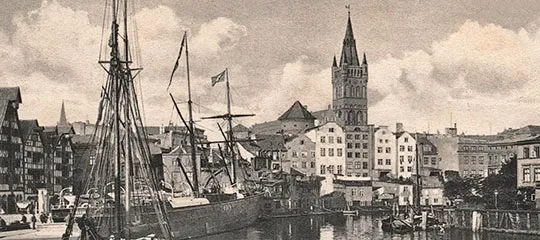
The lack of space between the castle and the river, where the town was reviving after the devastating uprising of the Prussians, made it necessary to create a suburb or, as such settlements were then called, a "liberty" (Freiheit), named Steindamm (Steindamm, which translates from German as "stone causeway"). It was dependent on the town council of the Altstadt (Rate der Altstadt) in the same way as the other liberties were dependent on the government.
The Steindamm liberty had its own court, elected from the guild of petty burghers, which, however, differed from the courts of the other liberties in that it also had criminal jurisdiction.
The highest authority over the court was the Vogt, who held the title of burgrave — the third most important of the senior officials. Whether Steindamm had its own coat of arms and court seal, as the other liberties did, is not known for certain. The area covered by the jurisdiction of the Steindamm court later included, besides Steindamm proper, Neuroßgarten, Laak, Lastadie, Alter and Neuer Graben and Holländerbaum. The court building (Gerichts- oder Dinghaus) was built in 1491 at the Steindamm Bridge (Steindammer Brücke). Sessions were held on Mondays. After the courts in the liberties were abolished, an anatomical theatre was set up in the former court building.
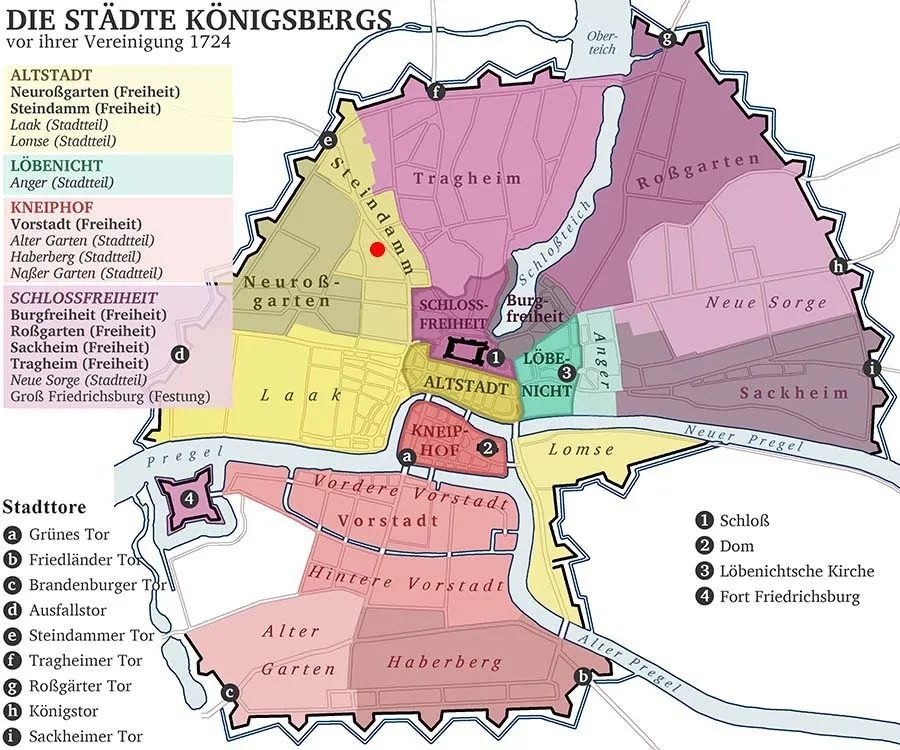
Steindamm on a reconstructed map of the towns, liberties and districts of Königsberg before their unification in 1724.
Until the 17th century Steindamm was comparatively short. For a long time the local church of the same name marked its northern end.
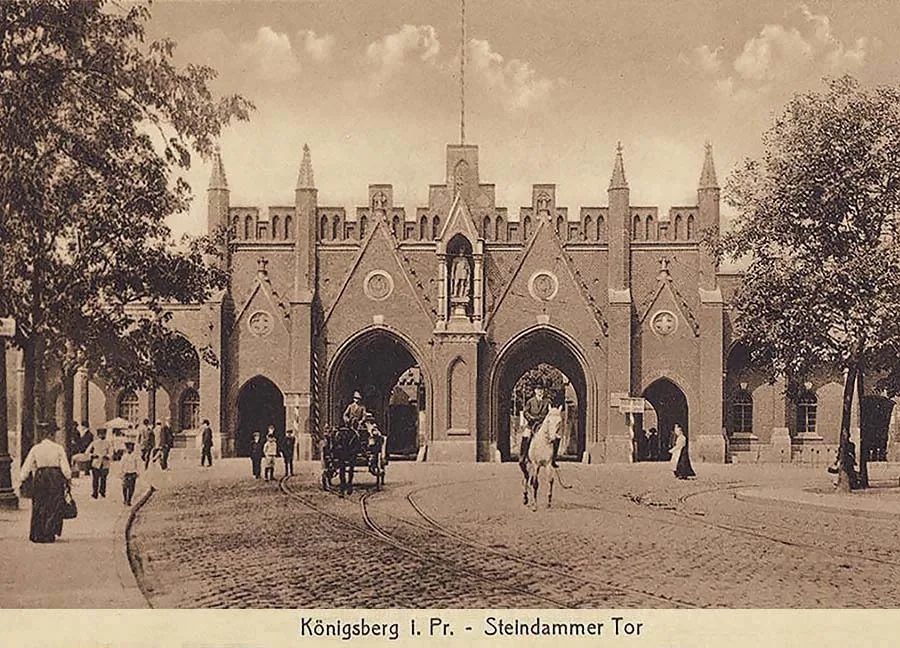
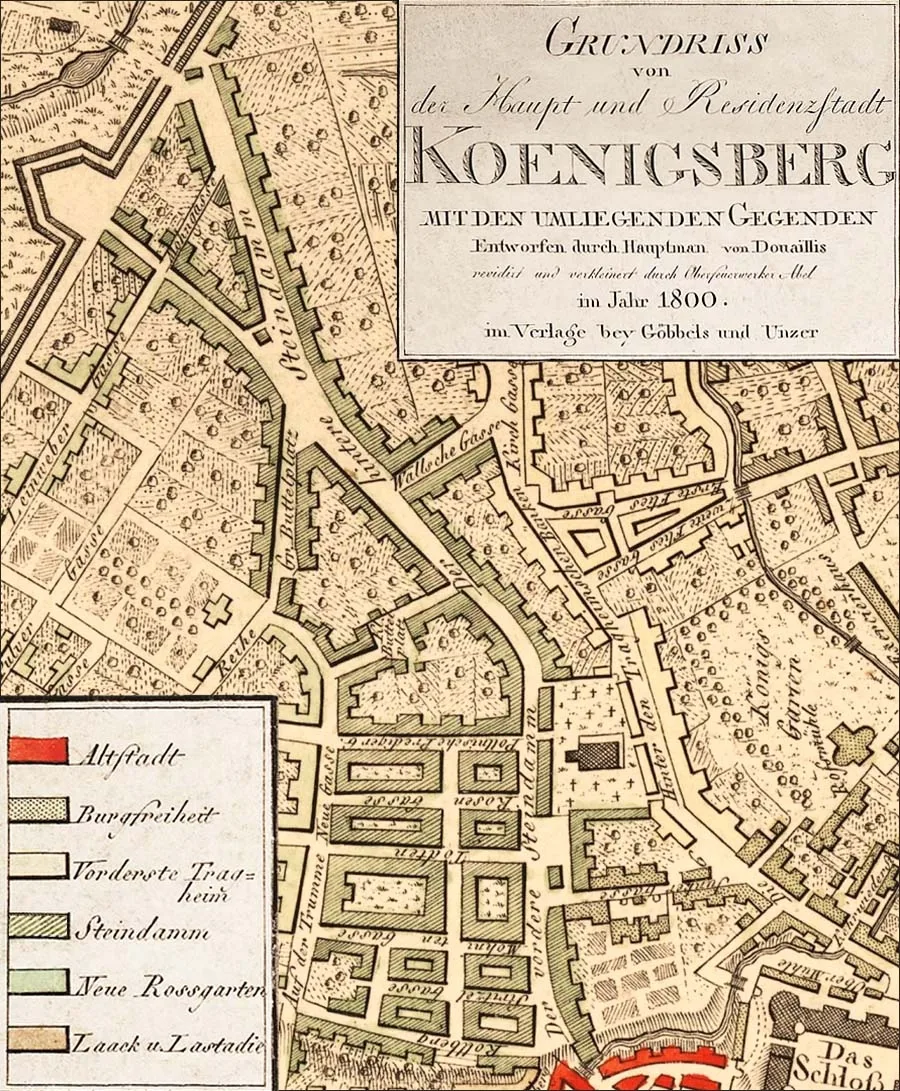 Steindamm on a map of 1800. The Steindamm Gate (see above) was dismantled in 1912.
The area opposite the church, between Wagnerstrasse (Wagnerstraße, now Vagnera Street), Drum Street (Drumstraße, now Bolnichnaya Street) and St Nicholas Street, formerly called Polish Preacher's Lane (Nikolaistraße / Polnischer Prediger Gasse, no longer exists; it ran north of and parallel to Wagnerstrasse), was largely built up by 1572. The Straw Market (Strohmarkt) and the Hay Market (Heumarkt) were not yet separated then and formed one large Buttelplatz (Buttelplatz), named after the executioner who worked on it at weekends. Later the square was divided by buildings into the Great and the Little Buttelplatz.
In 1811 the markets officially received their present names. Beyond the Hay Market, in the northern part of Steindamm, the Old Lane (Alte Gasse) branched off to the left.
The point of Steindamm farthest from the castle was the Rampart Gate (Wallenthor), later the old Steindamm Gate (alte Steindammerthor). It stood west of the present Steindamm Gate, beyond the fortification rampart built in 1626. Further on the roads parted — the Pillau road ran west, and the Samland road led north-west. (The area described above is that of the present-day beginning of Barnaulskaya Street and further on to the fork of today's Teatralnaya Street and Leninsky Prospekt. The old Steindamm Gate stood at the intersection of Teatralnaya Street with General Galitsky Street — ed. note.)
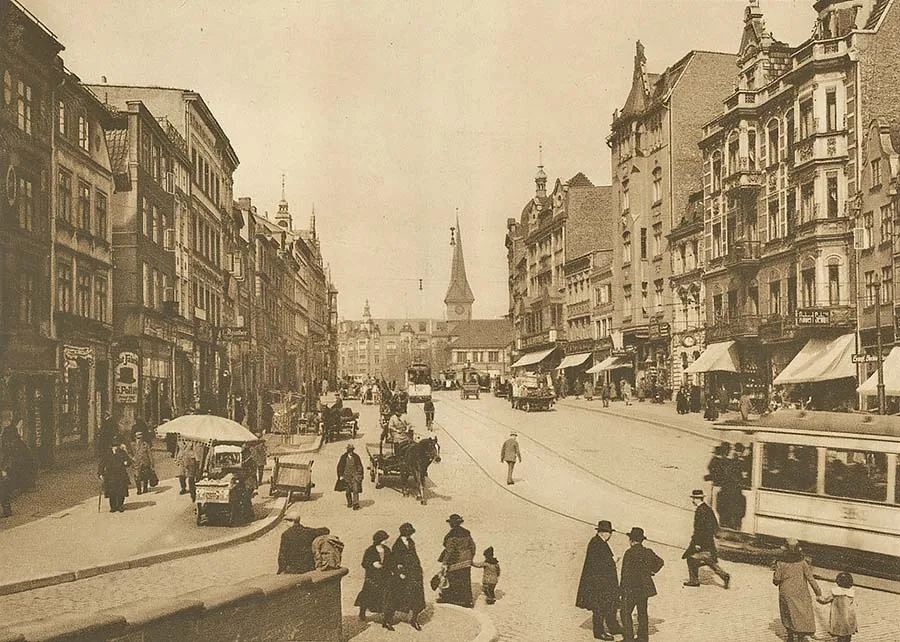
Closer to the castle Steindamm is considerably wider than in its northern part.
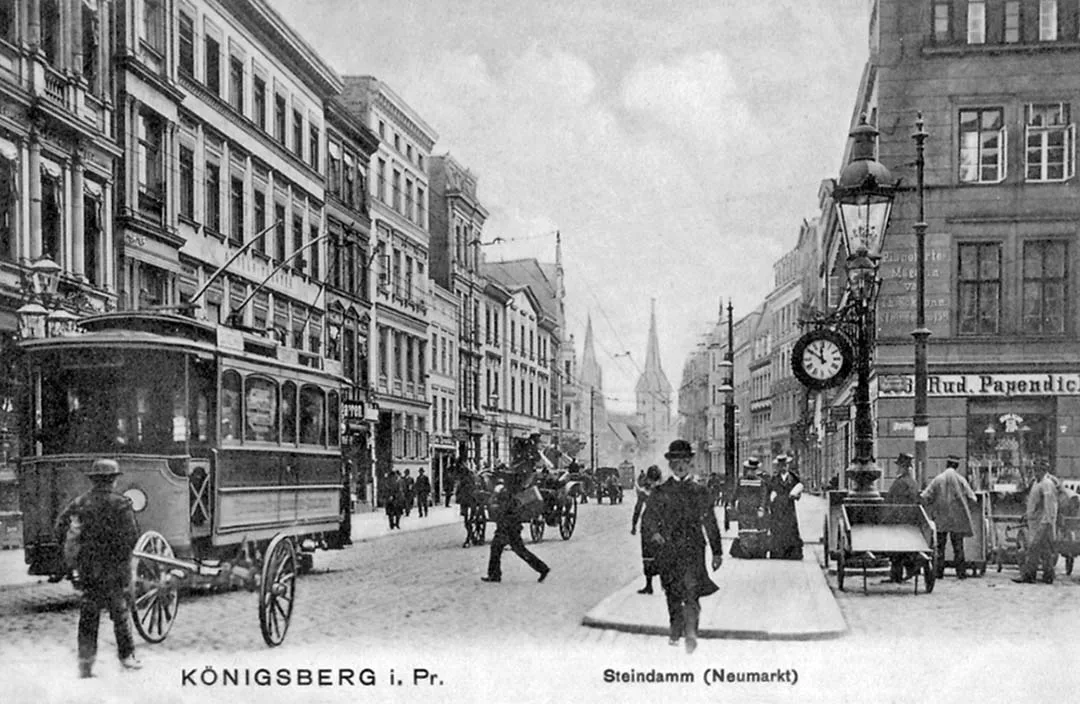
The present-day Steindamm is a very busy shopping street and traffic artery. The southern part of the street is fairly wide. Markets are held here on Wednesdays and Saturdays.
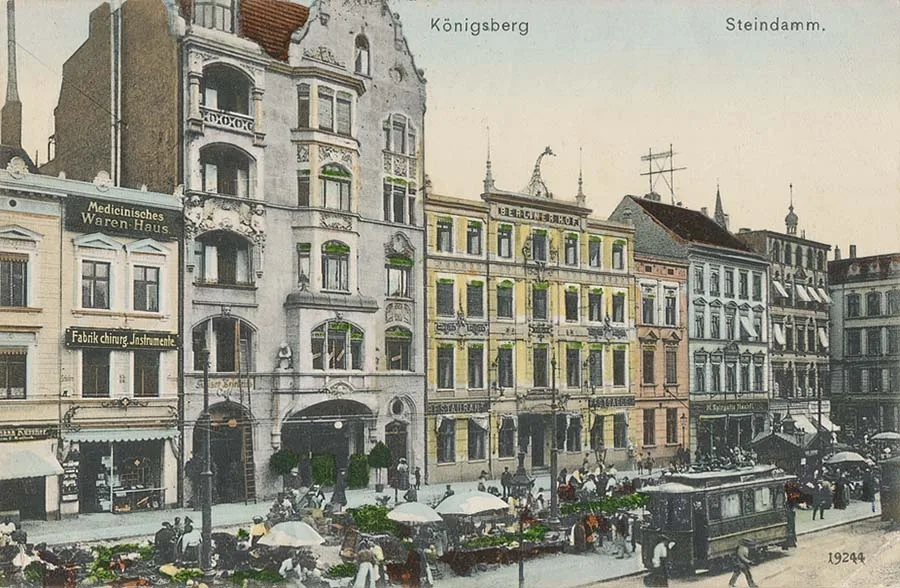 The Steindamm market was very picturesque, but in the 20th century it was turned into a car park.
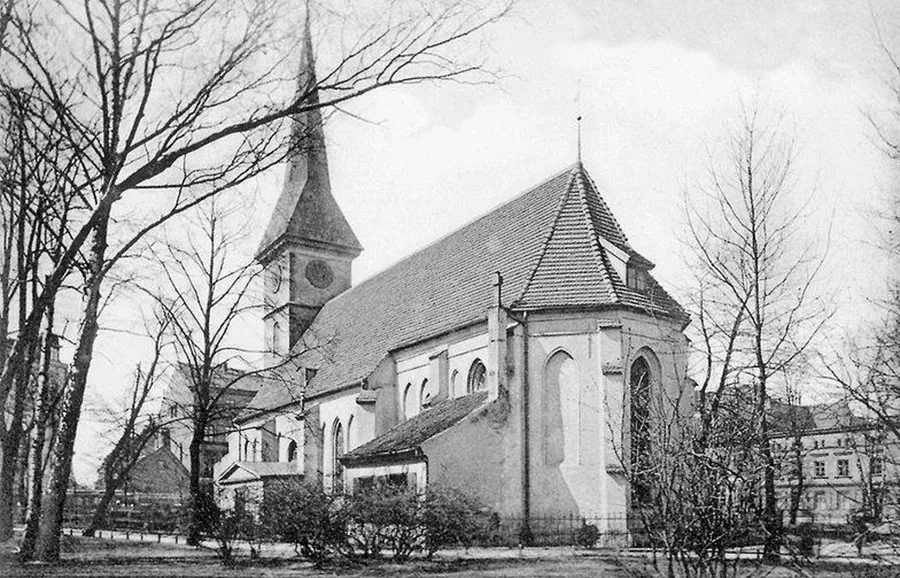
The Steindamm Church (Steindammer Kirche) attracts attention not so much as an architectural monument as a historical one. It is the oldest church in Samland. Construction of the first wooden chapel on this site began in 1256, literally the year after the conquest of Sambia. Like the old Altstadt church (Altstädtischen Pfarrkirche), of which it was at first a filial church, the Steindamm Church was dedicated to St Nicholas. To distinguish them formally, the Steindamm church was called "St Nicholas Church outside the walls of Königsberg" (St. Nikolaikirche außerhald der Mauern Königsbergs).
The single-nave Steindamm Church, with its old pointed vaults, was rebuilt several times. The pulpit is chalice-shaped.
The altarpiece depicts the Last Judgement, painted by the artist Anton Möller (Anton Möller, 1563–1611). Above the entrance to the baptistery a stag's head is mounted.
According to legend, a stag once ran into the church during a service. According to another version, the stag's head relates to the words of the Psalter: "As the hart longs for fresh water, so my soul longs for Thee, O Lord." (In the Russian translation of the Bible a similar text is given in Psalm 41:2: "As the hind longs for streams of water, so my soul longs for Thee, O God!" — ed. note.) To the right of the altar is an image of St Nicholas. In 1559, while the bells were ringing, the church tower collapsed; it was rebuilt in 1587 and then covered with copper in 1650. In 1888 the Steindamm Church was substantially rebuilt.
Before the church Reformation of 1525 the Polish and Lithuanian congregations had nothing to do with the Steindamm church. But when the Reformation came, the previously discriminated Poles and Lithuanians formed their own congregation and began to use the church periodically for services.
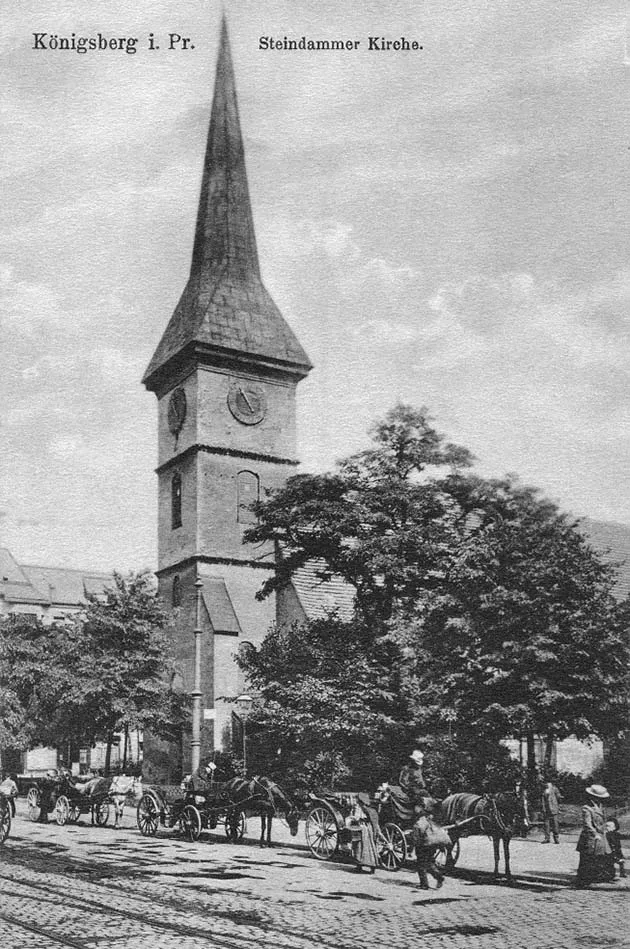
The Steindamm Church was the oldest in the city.
As the number of Poles in Königsberg grew, in 1603 the church in Steindamm was placed entirely at their disposal, and it came to be called the Polish Church (Polnische Kirche).
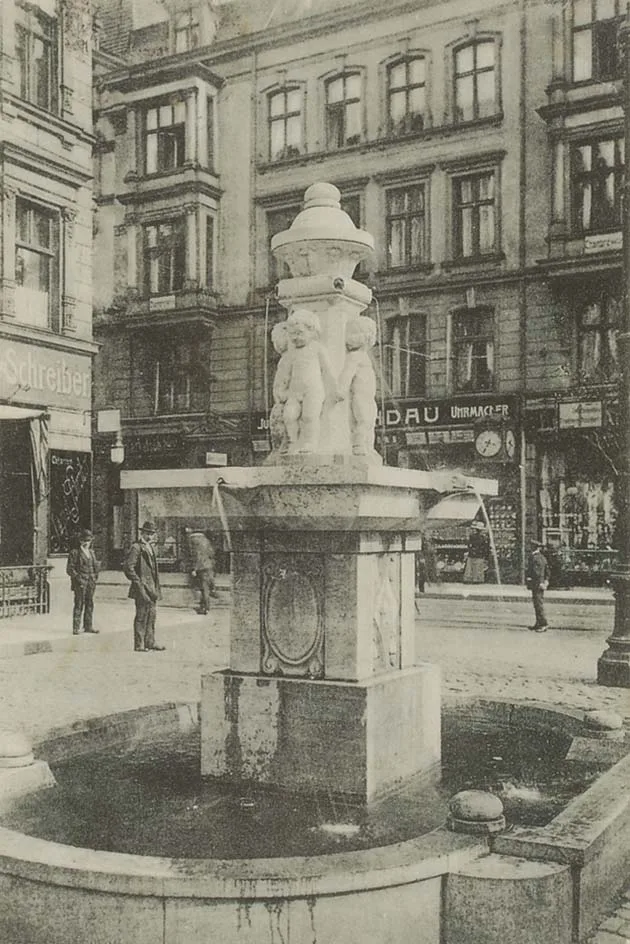
The "Putti" fountain from the Steindamm market has survived and adorns the grounds of the Museum of the World Ocean.
At the same time the Lithuanians received the Church of St Elizabeth (St. Elisabeth Kirche) in Sackheim.
The first Protestant pastor at the Steindamm Church was Johannes Seclutianus (Johannes Seclutianus / Jan Seklucjan, 1510/15–1578). Polish services were interrupted during the Seven Years' War, when Königsberg was occupied by the Russians, and later, at the beginning of the 19th century, with the arrival of the French. The Russians held their Greek Catholic services (Orthodox services) here. Three brass chandeliers with double-headed eagles still serve as a reminder of this. In 1807–1814 the French set up a field hospital in the Steindamm (Polish) Church. All these events, as well as the gradual Germanisation of the Poles who had come to Königsberg, weakened the Polish congregation, which eventually broke up. As a result, the church came to be attended mainly by servants, apprentices and soldiers. Like the castle church, the Steindamm Church had no parish of its own.
By 1874 there were so few parishioners that the last service for civilians was held in that very year. From then on the church was attended only by soldiers, and even then once a month, when sermons in Polish were preached for them.
In 1881 a parish of its own was formed from some of the faithful of the Altstadt, Tragheim and Neuroßgarten, after which the Steindamm Church became an independent parish church. The old cemetery around it had already been filled in in the 16th century, and the ground by the church became higher than its floor. In 1802 this cemetery was finally closed, and land near the astronomical observatory was allocated for it. Another Steindamm cemetery lay near Violet Hill (Veilchenberg).
(The old Steindamm cemetery was moved to present-day Gvardeysky Prospekt, and the new cemetery was located on present-day Dmitriya Donskogo Street. The wooden Steindamm church was first mentioned in 1256; in 1263 it was rebuilt in stone. During the Second World War the church was seriously damaged and then dismantled. In terms of today's landmarks, it stood at the intersection of Zhitomirskaya Street and Leninsky Prospekt. — Ed. note.)
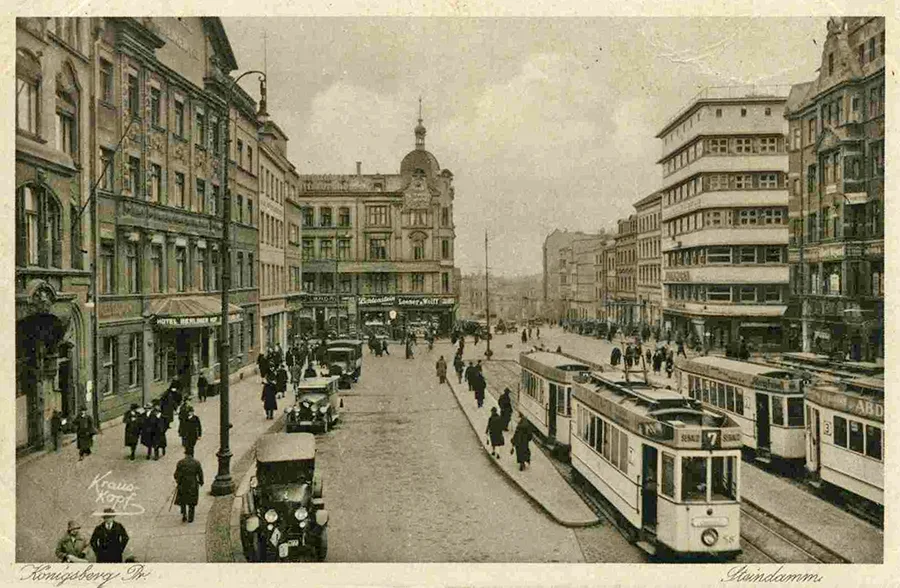
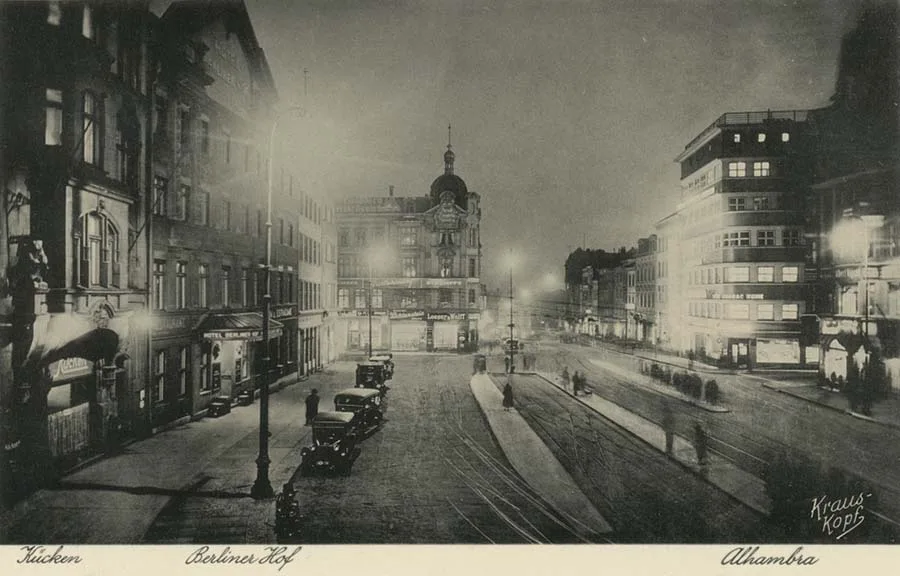 The Steindamm market by day and in the evening — from the photo studio of Krauskopf (Fritz Krauskopf, 1882–1945).
In the north Steindamm ends at the Gothic-style Steindamm Gate (Steindammer Thor).
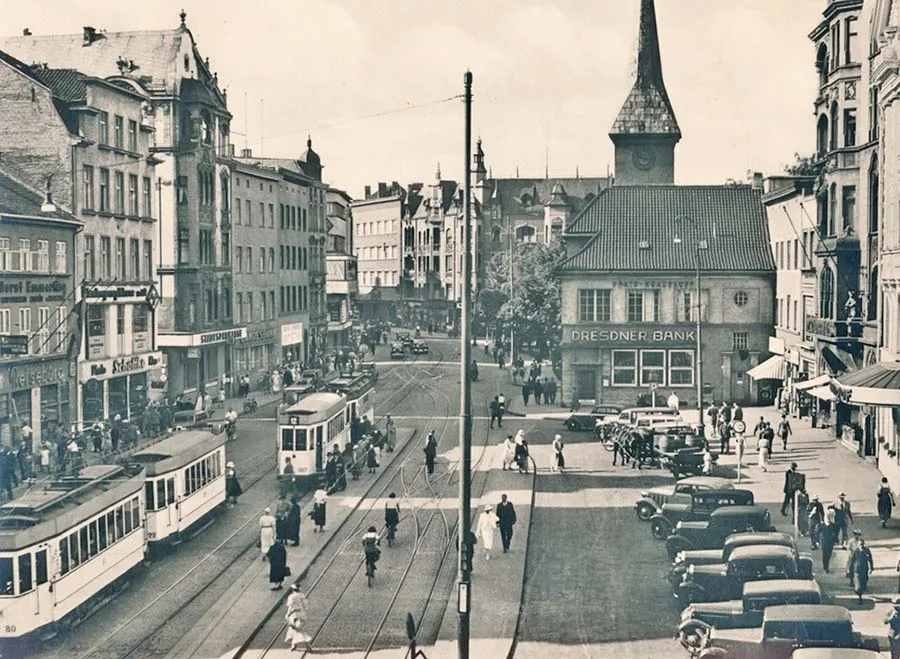 Krauskopf's photo studio was on the second floor of house No. 64, above a bank office (on the right, in front of the church).
It has four passages: two high ones in the middle for carriages, and two low ones on either side of them for pedestrians. On the city side the gate is adorned with a life-size statue of King Frederick William IV (Friedrich Wilhelm IV, 1795–1861). The gate was built under this Prussian monarch. The statue is the work of Professor Wolff (Carl Conrad Albert Wolff, 1814–1892). It stands in the centre between the two main passages. Apart from this sculpture, the gate is decorated on its western side with the coats of arms of Königsberg. On the eastern side years are added to the coats of arms: 1226, 1525, 1657. They symbolise the most important milestones in the history of East Prussia: the arrival of the Teutonic Order, the transformation of the Order's state into a Polish duchy, and the attainment of sovereignty. Above the main portals of the gate is the Prussian eagle.
(The Steindamm Gate was dismantled in 1912. It stood on Gvardeysky Prospekt next to the building of the Kaliningrad city administration, formerly the Königsberg Stadthaus. — Ed. note.)
The square at the Steindamm Gate is bounded on the west by the imposing infantry barracks (Infanterie-Kaserne) and serves as a parade ground for military exercises (Exerzierplatz). Before the barracks and the adjoining military buildings were built, there was a huge square here, which was also used for exhibitions. Thus in 1875 the 2nd Provincial Crafts Exhibition was held on the square.
Opposite the barracks is the military training smithy, and further along the street, in house No. 6, are the university's physico-mathematical laboratory, the physics cabinet and the mineralogical-geological institute. On the same street, to the south, in house No. 152, is the university ear, nose and throat outpatient clinic. In 1894/95, 1,474 patients were treated there.
(Several buildings housing institutes of Königsberg University were concentrated in this area. The following have survived to this day: the Institute of Hygiene at Leninsky Prospekt 13a, the Institute of Experimental and Theoretical Physics at Chernyakhovskogo Street 6, and the Mineralogical Institute at Leninsky Prospekt 13a. Several other institutes located on present-day Ivannikova Street were built later than this book saw the light of day. — Ed. note.)
From Wrangelstrasse (Wrangelstraße) to Italian Lane (Walsche Gasse), the eastern side of Steindamm, until Hohenzollernstrasse (Hohenzollernstraße) was laid out in 1895, had no connecting link with Tragheimer Kirchenstrasse (Tragheimer Kirchenstraße), which runs almost parallel to it.
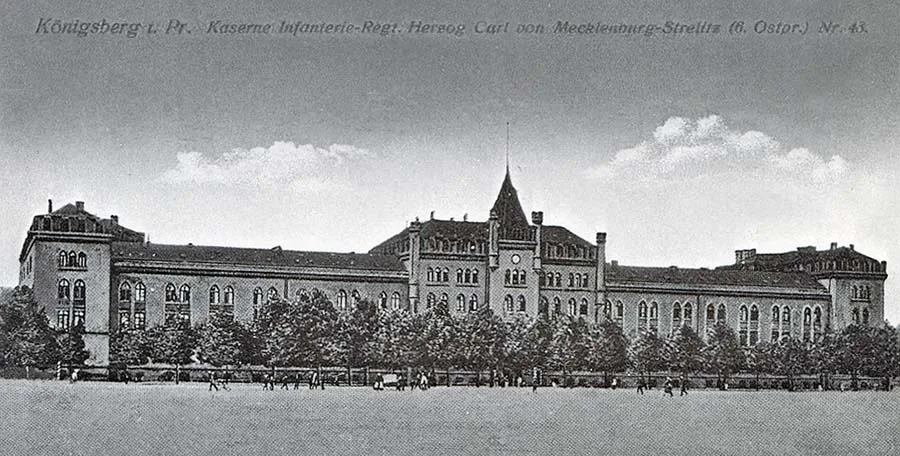
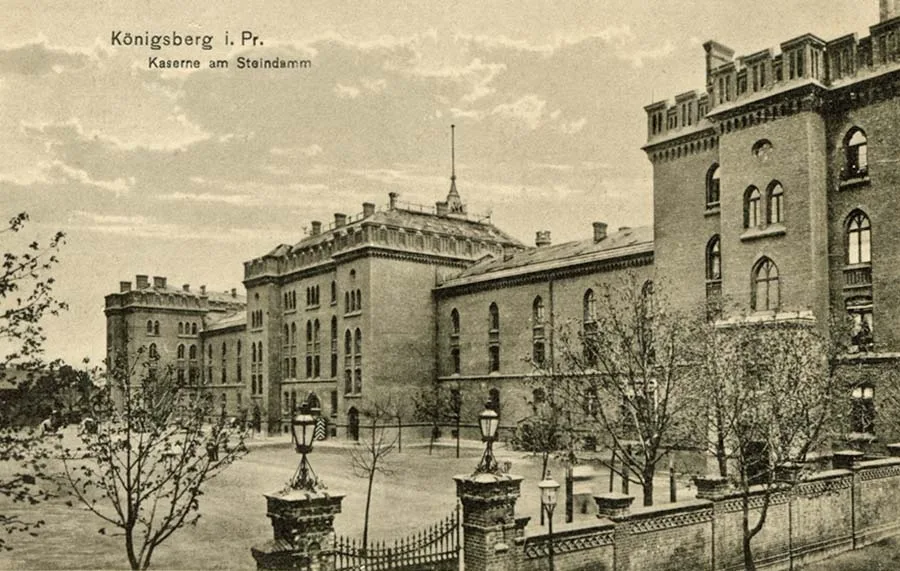 The infantry barracks on the square at the Steindamm Gate.
The name of Italian Lane comes from the word Wälsch (Italian), since the estates of Count Skalich extended as far as it.
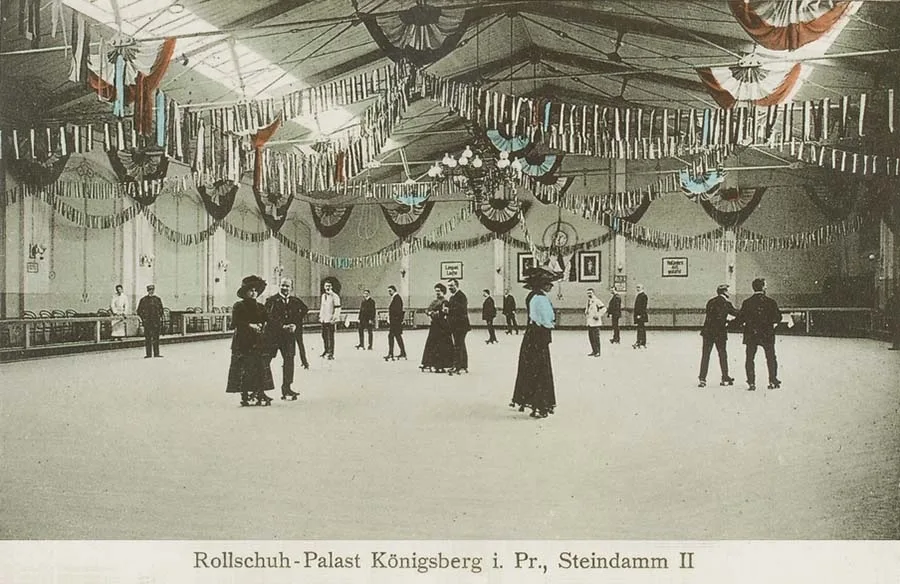 Steindamm was a trendsetter — the photo shows the local roller-skating rink in the 1910s.
Among the streets connecting Steindamm with the Neuroßgarten district lying to the west, besides those already mentioned, the following should be named: Upper Rollberg (Ober-Rollberg, now Kopernika Street) and Wagnerstrasse (Wagnerstraße, which has survived and kept its name!), and the lanes Monks' Lane (Monken Gasse), Rose Lane (Rosen Gasse, has not survived) and Schtritzelgasse (Schtritzelgasse).
Upper Rollberg, which flows into the southern part of Steindamm, runs west along the edge of a rise along the boundary with Laak, once a stretch of floodplain meadows.
This rise with its steep slope was formerly called the Glappenberg (Glappenberg) after the Prussian Glappe, leader of the native inhabitants who rose in revolt in 1269–1273. Glappe was captured and executed here.
One can descend from Steindamm into the Pregel valley, where on the river banks in this part of the city lies Lastadie with its numerous port warehouses, by Lower Rollberg (Unter Rollberg, now the descent from Zhitomirskaya Street to Moskovsky Prospekt — ed.), by Smoky Passage (Bosengang, a no longer existing alley from Upper to Lower Rollberg) and by Farmers' Lane (Bauernhofsgasse, now the descent to Moskovsky Prospekt from Bolnichnaya Street); the last two are so narrow that a carriage cannot pass through them.
Wagnerstrasse runs towards the Neuroßgarten Church and on to the Botanical Garden. Wagnerstrasse was named after the well-known surgeon Professor Karl Ernst Albrecht Wagner, who came to Königsberg in 1858 and initiated the construction of the surgical clinic. Formerly this street was the Lane of the Dead (Todten Gasse), since it was along it that the dead were carried to the cemetery by the Neuroßgarten Church.
Drum Street is the boundary between Steindamm and Neuroßgarten and runs from south to north from Upper Rollberg to the Hay Market (Heumarkt). On it stands the prayer house of the Brethren (Brüdergemeinde).
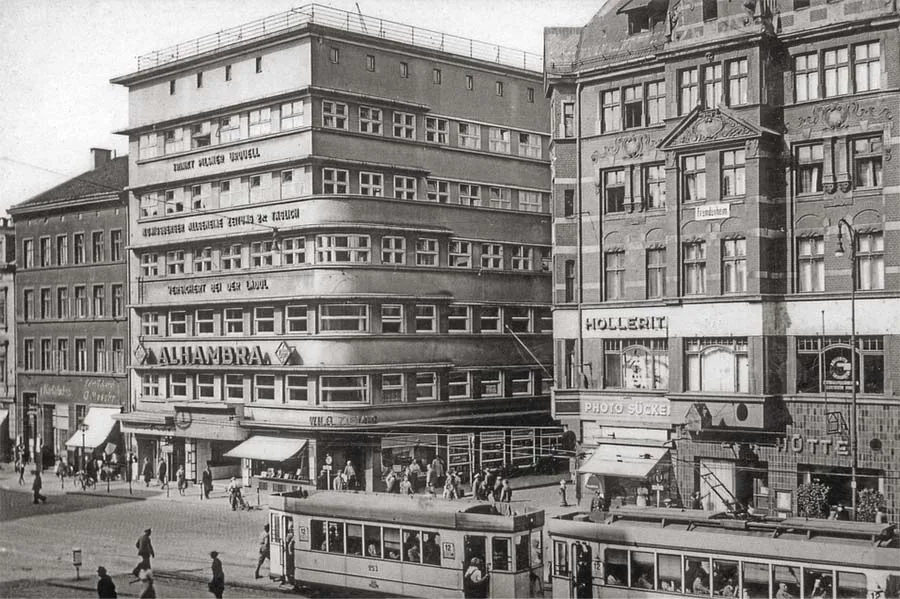 The chic cinema with the "Alhambra" café appeared on Steindamm towards the middle of the 20th century.
This religious community traces its origins to the Bohemian or Moravian Brethren (Böhmischen oder Mährischen Brüdern), the remnants of the orthodox Hussites, also known as Taborites.
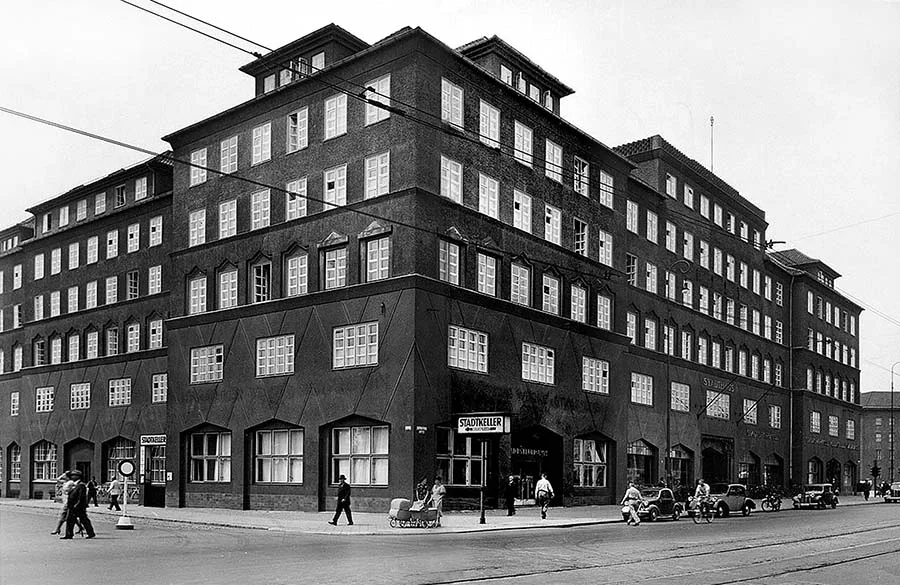 The Königsberg town hall would later become the Kaliningrad city hall.
Expelled from Bohemia during the Thirty Years' War, they settled in Upper Lusatia (Oberlausitz) under the protection of Count Zinzendorf (Nikolaus Ludwig Graf von Zinzendorf und Pottendorf, 1700–1760). Members of the Brethren are called Herrnhuters (Herrnhuter) after the name of their colony, Herrnhut (Herrnhut). They regard themselves as adherents of the Augsburg Confession (Augsburgischen Konfessionsverwandten) and lead a simple and strict way of life. Their missionary activity in other parts of the world is very considerable. Since 1893 the local congregation has occupied a newly built prayer house on Drum Street; the previous one was at Altstädtische Langgasse 34. The congregation in Königsberg dates back to 1729. In 1765 it acquired its first preacher.
(From the description of the Steindamm district it follows that this suburb was the area adjoining present-day Leninsky Prospekt from the west, from Kopernika Street to the Kaliningrad Administration building, including the southern part of Teatralnaya Street, the Mother Russia square, and Zhitomirskaya, Vagnera, Saltykova-Shchedrina, Bolnichnaya, Kosmicheskaya, Zvyozdnaya and Sibirskaya streets. Moreover, it is extremely strange that the authors left out of view the street that gave the district its name. In the chapters on other districts no such glaring omissions are found. — Ed. note.)
Photos on this page: Bildarchiv Ostpreußen.
Translated from Russian with the help of AI (Claude, Anthropic), October 2026.