LEGENDS OF PRUSSIA in the blog of Tatyana Kolivay.
[ 1814 ]
Trade. — Factories. — Arts.
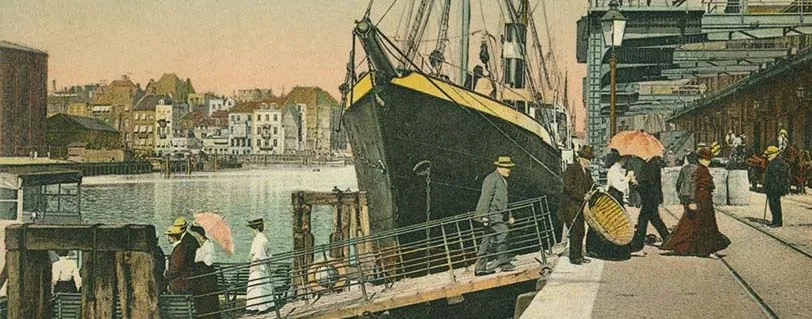
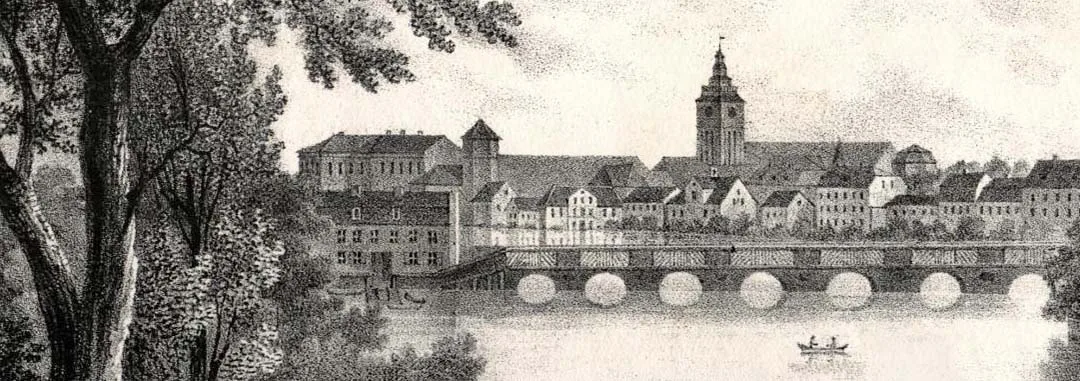
Trade, which is the source of Königsberg's prosperity and has been the chief occupation of its inhabitants, cannot fail to attract a traveler's attention here. I have therefore not neglected to gather as much information about it as possible, and I share with you both my own observations and what I have learned from the local merchants.
The fortunate location of Königsberg at the mouth of a navigable river with access to the sea has allowed the city to become the granary of Prussia, a maritime country which, with its rich natural resources, is the breadbasket of northern Europe. Besides Königsberg, grain is also loaded onto ships at Elbing and Danzig [today the Polish cities of Elbląg and Gdańsk respectively — ed.].
Incidentally, in former times the government did not always take the right measures to promote trade. On the contrary, some of the regulations introduced by the Ministry of Finance created a great many difficulties. The following facts show that throughout the 18th century the Prussian government, so wise and experienced in everything else, failed to understand the principles of trade.
When the great Kingdom of Poland still existed, the inhabitants of the Samogitian and Podlasie voivodeships and of Lithuania brought their goods (chiefly grain, flax, hemp, linseed and hempseed, and potash) on large vessels to Königsberg, where they sold them to the merchants, and as a rule took back salt, which has always been an indispensable commodity.
The trade was conducted as follows:
A Polish landowner would send his produce, at various times and in whatever way best suited his estate's circumstances, to the Königsberg merchant he traded with, receiving from him a return cargo of salt, herring, iron and luxury goods, though salt always remained the priority. The Pole, however, received no money for his produce straight away, nor did he send any of his own; instead, the Königsberg merchant kept an account of the goods received and shipped in his ledger and settled with the Polish landowner at the end of the year.
Nor did the Königsberg merchant pay cash to the Portuguese and the Spaniard from whom he bought salt, to the Dutchman and the Norwegian from whom he bought herring, or to the Swede, whose main export was iron; instead, he sent them Polish goods.
When the time came at the end of the year to settle with the Pole, the Königsberg merchant had long since paid the sellers from Spain, Holland, Norway and Sweden with Polish goods, and had made a profit besides, without ever touching any cash.
How advantageous this kind of trade was for the Prussian merchant is obvious. All the Polish produce that reached Königsberg was capital for the local merchant, which he traded with year after year without paying taxes and which he used, first, to give credit to foreigners and, second, to obtain goods from them on trust, since this method of payment was very convenient for the Dutch, the Spanish and others. In this way the Königsberg merchant drew them into his substantial trading operations.
Frederick the Great had the unhappy idea of introducing a monopoly on the salt trade, and in doing so he practically destroyed the commerce of Königsberg for many years. The king placed his agents in Spanish and Portuguese ports, where they were to buy salt for cash. Naturally they paid far more for it, since, unlike the Königsberg merchants, they had no trading ties with the sellers and had no goods to offer as a means of payment. The salt bought in this way also incurred considerable freight costs, whereas the former salt sellers, to oblige their trading partners in Königsberg, had tried to arrange for the salt to be taken on board simply as ballast.
In Königsberg it was now unloaded into warehouses, which was laborious and inconvenient, since otherwise it would have had to be loaded straight from the ships onto Polish carts or left lying on the loading platform until the Poles collected it. Salt depots were set up in Poland as well as in Königsberg, an army of officials was hired... and the whole business was made so expensive that the price of salt rose by 50%.
Now a Pole who came for salt could buy it only for cash. If he had not brought enough money with him, he was forced to sell his goods in a hurry, losing the capital he had previously put to good use in trade.
The Poles, unhappy with the high price of the royal salt and with having to pay for their purchases in money, began to look for other trade routes. They turned to the Courland and Russian ports, chiefly Riga, which experienced a trade boom solely thanks to this unfortunate Prussian reform.
The salt monopoly is just one of many examples of how Frederick II [also known as Frederick the Great, also known as Old Fritz — ed.], who showed wisdom in all other affairs of state, made mistakes in the sphere of trade.
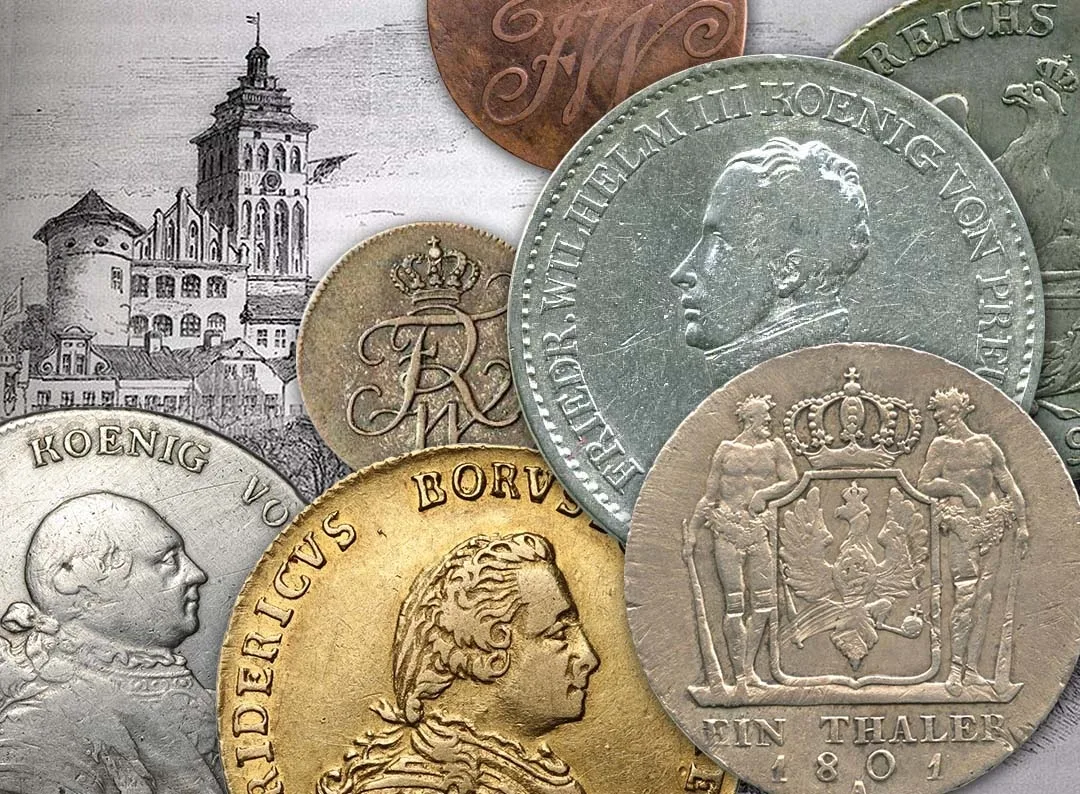
Introducing a state salt monopoly was a mistake. Yet it was also under him that grain magazines were established in several conveniently located towns throughout the country, where peasants could deliver rye, the staple food of the common people, at a price of 1 thaler per scheffel1, with the money paid out immediately; this guaranteed a stable market, and grain did not lose its value when the market was glutted.
If, however, the price of rye rose above 1 1/3 thalers per scheffel, the royal grain magazines were opened, and anyone who needed grain for his own consumption could buy it at a fixed price of 1 1/3 thalers.
With this set of measures Old Fritz saved thousands of his subjects from starvation. This happened, for example, in Saxony, where there was an acute shortage of grain and the crisis affected several thousand subjects.
Under Frederick William II these magazines were abolished on the pretext that grain growing needed to be encouraged, which immediately led to a sharp rise in grain prices. Another poor harvest raised fears of famine, and this forced the government to ban grain exports.
The ban deprived the merchants of opportunities for profitable speculation, and as a result they became wary of making purchases. Foreign orders could therefore no longer be filled on time, and the trade moved to other cities.
To support the development of domestic factories, the government banned the import of a number of goods that Königsberg had previously exported to Poland and Russia, or imposed high duties on them.
However, the domestic goods that were supposed to replace the banned imports could not meet the existing demand, so foreign buyers began to seek the goods they needed either directly or through other trading centers.
As a result, Königsberg lost its lucrative intermediary business.
The government made another serious mistake last year, in 1813. After the Continental Blockade2 was lifted, all English colonial and manufactured goods were subjected in Prussia to a high war duty. As a result, more than 60 English ships left the port of Pillau and headed for Riga to avoid these losses.
The lessons learned from this situation, however, forced the Ministry of Finance to abandon such measures, which threatened to ruin the trade of Königsberg.
I was given many more examples of ill-advised orders which in former times came from Berlin, often without regard to the real conditions of trade, but I fear I would try your patience by listing them. Allow me to mention just one more case, which vividly demonstrates the incompetence of the former finance minister (now, fortunately, more sensible decisions are being made in matters of trade).
A company for insuring ships and cargoes was set up in Berlin, and the Königsberg merchants were ordered to insure their goods and ships with that company in particular. The scheme, however, proved unworkable, and after the first unsuccessful attempts it had to be abandoned.
Despite all this, local trade is of great importance and will become even more successful if the government removes the obstacles to its prosperity and is more prudent in commercial matters.
The latest decrees of the Ministry of Finance give grounds to believe that its view of these matters is becoming more sensible, and the merchants hope for a favorable future.
Königsberg's main trading goods are: grain of all kinds, linseed and hempseed, flax, linen cloth, yarn, leather, ship timber, feathers, bristles, potash, wood ash and vodka.
I will describe a few of these goods in a little more detail, to give a general idea of the scale of local trade.
I will begin with grain.
Wheat is the most exported of the grain crops and is shipped mainly to Holland and England. Red wheat from Königsberg is in great demand on the London exchange, as it is considered one of the finest grains in Europe. Not only does it make excellent white flour, but because red Königsberg wheat has a thin husk, it yields more flour than other varieties.
Only a small part of the wheat comes from the Russian-Lithuanian provinces; most of it is grown in the country itself. Moreover, it is not as overdried as Riga wheat, which is not in demand on the London market because dry wheat makes poor flour. A great deal of wheat used to be exported to France, but exports there have now ceased completely. It is hoped that in future wheat will be supplied to Spain, as it was before the trade barrier was introduced.
The development of improved methods of tilling the fields in England and France has dealt a serious blow to Prussian grain exports, and this market will most likely never recover. Moreover, North American wheat in English ports is now serious competition for Prussian exports. A very small amount of wheat is supplied to Sweden and Norway.
Rye, meanwhile, is loaded onto ships bound chiefly for those very countries, Norway and Sweden. Neither country can do without supplies of Prussian rye, since the loss of Finland deprived Sweden of its former sources of grain. Amsterdam also buys a great deal of rye in Königsberg.
Barley is in demand mainly in Spain and Portugal, where it is used as feed grain for mules. On the whole, barley exports are not as significant as rye exports, even in the very best years. Almost all the barley is grown in the country itself, while most of the rye is supplied from Russian Lithuania.
Oats are not usually exported; they are shipped only in exceptional cases, for example when there is an acute shortage in other countries.
Peas are exported to Sweden, Norway, England and Holland. In Sweden and Norway they are bought as provisions for sailors. Grey peas, which are grown almost exclusively in Prussia, are subject to strong price fluctuations: often they do not sell at all, and sometimes demand for them is very high and the price can rise to twice that of wheat.
Since this kind of grain can be consumed only within a single year, it is a very capricious commodity.
What makes the Königsberg grain trade distinctive and practical for foreigners is that there are always large stocks of grain here, whereas elsewhere grain dealers buy goods only after receiving an order.
Before the fire of 1811, which destroyed almost half of the granaries, the city held grain worth 2,116,000 thalers, that is, a colossal two million one hundred and sixteen thousand Berlin scheffels of grain (about 275,000 tonnes), the largest stocks of any trading city, not excepting Danzig, Hamburg and Amsterdam, although the grain trade in Danzig is even larger than in Königsberg. That is why grain can accumulate in the warehouses in Königsberg, and every order can be shipped immediately.
Linseed and hempseed are exported exclusively to Holland, where they are used in oil pressing. It is remarkable that Prussia actively supports its own factories but does nothing at all to develop oil pressing.
Holland buys seed for its oil mills from Prussia and then sells the finished oil back to Prussia.
It would be far more profitable to set up oil pressing in Königsberg itself, since the money for workers' wages and transport would then remain in the country, and no duty would have to be paid on re-export, not to mention the benefit livestock farming would gain from the resulting oilcake.
Vodka is partly exported to Sweden, but this export item is not very important, since the Swedish government often bans its import.
Flax and hemp are exported to England, but mainly to Holland.
Flax is grown mainly in Prussia, while hemp is imported from Lithuania and Poland. Both goods are in great demand, since they are preferred to their Russian counterparts. Königsberg exports more than twice as much flax and hemp as all the other Prussian ports put together.
Prussian ship timber (as well as barrel wood) is highly valued for its strength, flexibility and durability. The main buyers of ship timber are Holland and England. Barrel wood is shipped mainly to the ports of wine-making countries: Bordeaux, Porto and Cádiz. Exports of beams and boards from Königsberg are insignificant compared with other Prussian ports.
Ships are sometimes built in Königsberg to the order of foreign companies.
Linen cloth is exported to Holland, America, Spain and England.
Exports to England are hampered by high duties, and a considerable part is therefore smuggled there. If fabrics were bleached better in Prussia, demand for the local linen would be even higher.
Yarn is exported in large quantities to England, where it is used by local manufactories in the production of cotton fabrics. The province of Warmia supplies particularly large quantities of yarn.
Potash and wood ash are very important commodities, because Königsberg ash is preferred to all other kinds. The ash is sorted very carefully here and graded by quality by washing, and this ensures high demand.
I will not mention the other export goods shipped from Königsberg, such as feathers, bristles, wax, honey, tar, furs, sacking, canvas, lime bast and so on, especially since individually they are of little importance.
To the Russian-Polish provinces are exported: salt, herring, dried fish, iron, copper, dressed leather, colonial and manufactured goods, and all kinds of art objects and luxury goods.
In manufactured goods Königsberg holds first place in all of northern Europe, since no Russian city with access to the sea can compare with it in this respect.
Even the strict Russian import bans cannot stop this trade, since it is a gold mine for the local market.
One of the Königsberg merchants, who owns a large warehouse of manufactured goods, gave me an example of how little strict measures affect the smuggling of goods.
Under Russian customs regulations, responsibility for smuggled goods lies not only with the customs officers and the Cossacks guarding the border but also with the inhabitants of the border villages. A smuggler therefore cannot consider himself safe until he has hidden the goods at his place of residence.
One day a Jew came to this merchant, bought goods from him worth 12,000 thalers, paid for them at once in cash and told him the following: he had divorced his wife and given her half of his fortune. The other half he had invested in this purchase of goods. If he were caught smuggling, he would be sent to the Siberian mines and his property would be confiscated. That was why he had decided to divorce his wife, prudently dividing his property. But if he escaped capture, the division of property with his wife would mean nothing to him, and he might be able to make a profit of fifty or sixty percent on his goods.
The reasons why the trade in manufactured goods in Königsberg is so important are as follows:
Geographical location: Königsberg is the key market for the provinces of Samogitia, Masovia and the Podlasie Voivodeship, and for Lithuania.
The accommodating nature of the local merchants: they are willing to sell at a small markup, follow their customers' tastes and spare no means to attract them, whereas the Russian merchants, faced with the ban on bringing goods in across the Prussian border, treat their customers with great arbitrariness and injustice.
Danzig cannot compete with Königsberg in this field because it lies too far from the border. The inhabitants of Kuyavia and central Poland therefore prefer to turn to the merchants of Breslau (Wrocław) or Leipzig rather than Danzig.
The years from 1808 to 1813 inclusive were particularly good for Königsberg's trade. Reliable sources assure me that it was only thanks to Königsberg's trade that the economic stability of the state could be preserved.
I was told the following story about this:
Consul General Clérembault, who lived in Königsberg, had all of Prussia within his jurisdiction and was an extremely greedy man, determined to grow rich in his post at all costs. Had he given orders to confiscate without further ado the ships arriving in Pillau with colonial and manufactured goods, he would have gained little from it and would by no means have enriched himself. Besides, the King of Prussia firmly insisted that the proceeds from the sale of confiscated merchant ships go to his account.
So Clérembault did the following:
For every ship that arrived he himself prepared certificates, which the owner of the cargo had to buy from him for a large sum if he wished to remain the owner of his goods. In this way Clérembault took two or three thousand louis d'or from each ship, and sometimes more, which made the goods much more expensive, but not to the detriment of the Königsberg merchants, who knew how to make up their losses when selling.
Since Clérembault was the only consul who carried on such schemes so publicly and shamelessly, Königsberg soon came to control the trade of a vast territory from the Neman to the Rhine, and Warsaw, Breslau, Leipzig, Hamburg, Frankfurt and Vienna received their goods exclusively through Königsberg.
Since the local merchants set the prices themselves, the profits were enormous and partly made people forget the suffering the country had endured as a result of the ill-fated war.
Small traders who had previously been almost unknown on the exchange now became wholesalers who counted their wealth in hundreds of thousands. Forwarding offices began to appear in small towns and even villages, making considerable profits. The peasants began to earn large sums from this, and so fate gave the impoverished country a means of healing its wounds at least in part.
Traffic into Germany grew so much that sometimes several hundred Russian carters arrived in the city in a single day to carry the goods onward.
The following fact will help give an idea of the local merchants' profits: the Jewish trading house F** earned 120,000 thalers on a single consignment of cotton yarn needed by Saxon manufacturers for the production of cotton goods.
Two young merchants started their joint venture with a capital of 13,000 thalers, and when they closed their firm after five years of trading, each received five hundred thousand in the division. These two gentlemen, however, apparently cheated many English trading houses with the help of the consul general, claiming that huge consignments of goods they had sold from arriving ships had been confiscated.
Their names were published on the London Stock Exchange as those of outright swindlers. The Königsberg merchants, who enjoy a reputation as very honest people, treat these dishonest men with the great contempt they deserve.
One circumstance that favored Prussian trade was that the consul general did not reside in Pillau. Had he done so, nothing could have escaped him. But in that port he had only one subordinate official, who could very easily be persuaded to keep quiet. And so a great many cargoes arrived in the port of Pillau that went unnoticed by Monsieur Clérembault.
Emboldened by numerous displays of such kindheartedness on the part of the French consul general, the English finally allowed an entire merchant fleet to enter the port of Pillau at once.
But this proved too great a test of the Consul General's leniency. Moreover, the consul in Danzig, who was his enemy, had been informed of the arrival of the English fleet. And so, however much Monsieur Clérembault resisted, he had to resort to confiscating the cargoes of the English ships after all. The King of Prussia immediately declared all the confiscated cargoes his own, and Napoleon, who also wanted to make something out of them, bought them from the Prussian king for twenty million francs. It is said that the inhabitants of the Prussian coast, on hearing of this, carried off a considerable part of these cargoes, for they could not allow such an enormous quantity of sought-after goods to end up in the hands of the hated French.
The trade in government securities and currency speculation here are mainly in the hands of Jews, who are particularly well cared for and protected in the Prussian state. They prosper here more than in all the other German lands. Jews enjoy all the rights of Christians and engage only in what brings them a reliable profit without any risk. The trading houses of Oppenheim, Schwarz, Caspar, Friedländer, Friedmann, Auerbach and others do very profitable business here, while the Christian merchants complain bitterly about the ruinous stock-exchange speculation that is so damaging to their trade. One very experienced merchant said to me: "The misguided tolerance of our government shields these usurers, whose harmful influence will become obvious when we are all ruined."
In conclusion, I will tell you about the recent calamities that befell the Königsberg merchants, so that you can imagine what devastating events a trading city can live through and still remain viable.
In 1802 a strong, persistent wind blew straight into the mouth of the Pregel, causing the water to rise so high that an entire district of the city on both sides of the river was completely flooded within just a few hours.
The flood came so quickly that nothing could be saved. Cellars, houses and granaries were inundated. People moved through the streets in boats. Several ships sank, stocks of timber were scattered and washed away, loading bridges collapsed, and the goods in the warehouses ended up under water and were completely destroyed.
The greatest damage was done to the Lizent warehouse (Lizentpakhof), where stocks of goods worth an enormous sum were kept, and since the Lizent warehouse has only one story, all the goods were flooded. No one here could remember a flood on such a scale, and since the goods were not insured against flooding, the losses fell entirely on the shoulders of the local merchants.
In the summer of 1811, at midday, a fire broke out at the flax scales next to the granaries; it spread quickly, and once it had engulfed the granaries it could no longer be put out, because these half-timbered buildings, eight and nine stories high, were all filled with grain. Pulling down several of them did not stop the fire. All the granaries on one side of the Pregel and more than a hundred houses in one of the suburbs burned down together with everything in them, including 36,000 Berlin lasts of grain3. Huge stocks of flax, hemp, tallow, butter, train oil, rum, wine and other goods were consumed by the flames, so that the damage was estimated at 6–7 million thalers.
Almost all of these burned warehouses still lie in ruins. Four times in sixty years Königsberg has suffered fires on this scale.
I can say little about the factories and manufactories, because there are very few of them here, and those few are of so familiar a type that one would hardly find anything special in them.
The sugar refineries here rightly come first, since they are of great importance.
There are two of them; one has existed for more than thirty years, and the other was founded in 1808 on the initiative of the French consul general Clérembault, who also had his share in the fund. Both are joint-stock companies, and the dividends on their shares are always above ten percent; and in spite of this, the capital of the old refinery has already been doubled and credited to each shareholder.
The conditions for holding shares in the old sugar refinery are very strange: scholars and Jews are not allowed to own shares. The sugar far surpasses that of Hamburg in the care of its processing and its whiteness, and the two refineries produce as much of it as the province of East Prussia needs. At present a private individual is building a third, smaller refinery at his own expense. The shareholders of the two large refineries are very displeased about this, since they are worried that confectionery production will be carried on here as widely and at retail as it is in Hamburg, which greatly lowers the price. Previously they were protected from such competitors by their privilege, but now freedom of trade has been introduced in the Prussian states generally, so that it is forbidden to put obstacles in the way of individuals who wish to go into the confectionery business.
The famous Schimmelpfennig tobacco factory has now been merged with two others and is run by a group of shareholders. This factory's sales are very large.
A tannery producing shoe leather belongs to the local Schumacher firm and does business on a fairly considerable scale. The local method of manufacture is praised, but little dressed leather is produced.
The local faience factory has already ruined several of its owners, which is probably due to the very low prices of the English Wedgwood factory, whose products are imported in large quantities.
There are also a number of vegetable tanneries, weaving mills, ship's rope works, canvas works, wax bleaching works4 and the like, producing goods for the country's needs. But since they have no sales abroad, or only small ones, neither their size nor their equipment deserves particular mention.
As I was told, large factories have never prospered here, partly because merchants can make better use of their capital in trade, and partly because there is almost no unemployment here and consequently not enough cheap labor.
I am inclined to regard this as good fortune rather than misfortune: for trade always brings a surer profit than factories, which in monarchical states are as a rule financed by governments. In general, factories in Prussia will be of no use as long as agriculture is short of hands; and this will continue until the present population doubles.
There is no mention of artists whose names are known beyond the borders of their homeland, which I believe is due not so much to a lack of talent as to a lack of opportunity to develop it. There is no painting here, no art collections, no art schools and in general no means of nurturing natural talent and inspiring emulation, so a budding local genius can develop to perfection only abroad, where he also finds recognition. Moreover, it is said of the Prussians that they always prefer foreigners to their own people, and so the saying "A prophet is not without honor, save in his own country!" is fully borne out here.
An art that cannot be found anywhere except in Königsberg and Danzig, and which is in danger of dying out, is the working of amber. In Königsberg there seem to be only four specialists in this craft left, and in the whole of Danzig only two. Of all of them, only two truly deserve the title of master. I have seen very beautifully made pieces that are of great value to a connoisseur. But it is almost impossible to sell them, since few people understand their true value, and buyers are therefore rare.
LEGENDS OF PRUSSIA in the blog of Tatyana Kolivay.
TRANSLATOR'S NOTES
1. Scheffel (German: Scheffel): until 1872, a dry measure used in various German states. In Prussia one scheffel = 54.9615 liters.
2. The Continental Blockade (French: blocus continental): economic sanctions imposed by Napoleon I Bonaparte against Great Britain in order to cut off trade between it and the European states.
It was established by the decree on the "blockade of the British Isles," issued by Napoleon on 21 November 1806. Under this decree, all trade and any dealings with Great Britain were prohibited throughout Napoleon's empire, as well as for its allies and in the territories occupied by its troops. To monitor compliance with the blockade and to combat smuggling, a special customs organization was created in all the lands under Napoleon's rule, headed locally by French consuls.
The blockade could not be enforced effectively without the participation of all the states of continental Europe, because any exception created a breach through which English goods penetrated and spread across the entire continent. Napoleon's foreign policy in the following years was therefore largely determined by his desire to close such loopholes. Under the terms of the Peace of Tilsit of 1807, Russia and Prussia were forced to join the blockade.
After Napoleon I's defeat in the war with Russia in 1812–13, the French authorities lost the ability to monitor other countries' compliance with the blockade. The Continental Blockade was formally lifted in 1814.
3. The Berlin last of grain (German: Berliner Last Getreide, where Last literally means "load") was a unit of measurement in the early Hanseatic period and originally meant the amount of grain that could be carried on a cart drawn by four horses. 1 Last = approximately 2 tonnes.
Later, units of load measurement came to be differentiated according to the specific product, for example Salzlast ("salt last"), and also according to place, for example Bremer Last ("Bremen last"), Ostseelast ("Baltic last"), Berliner Last ("Berlin last") and Preußische Last ("Prussian last").
4. Wax bleaching is a process used since ancient times to give naturally yellowish beeswax a white or ivory color before the bleached wax could be used to make, for example, candles.
Translated from Russian with the help of AI (Claude, Anthropic), October 2026.