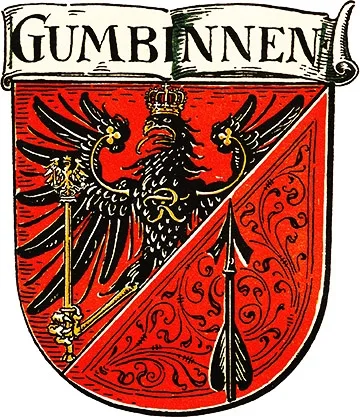
 Coat of arms
of Gumbinnen
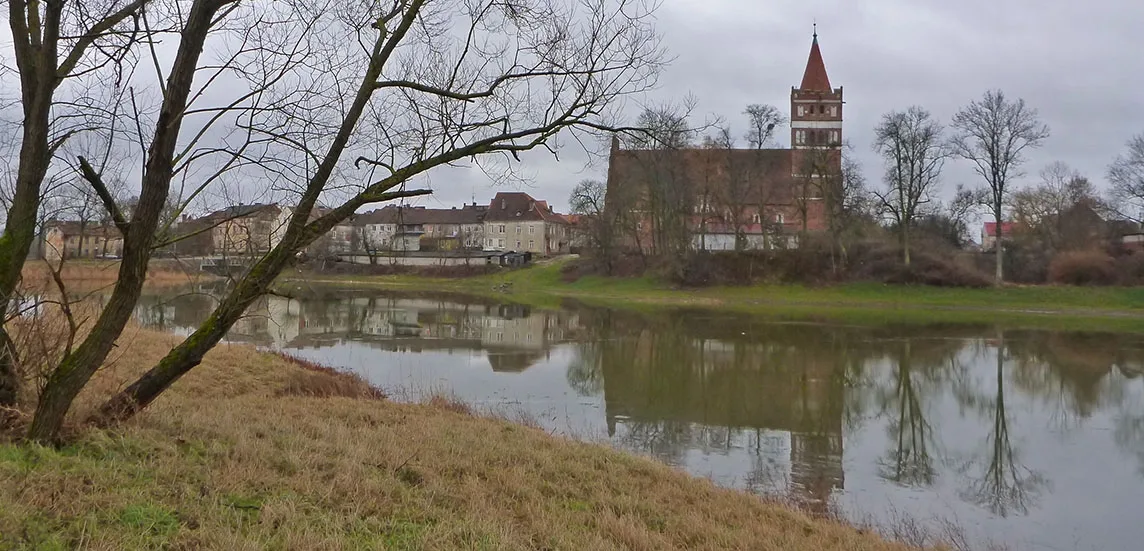
The first settlements on the site of present-day Gusev appeared as early as 9000 BC. Finds at the Gusev-1 settlement site indicate that in pre-Teutonic times the area was inhabited by one of the Yotvingian tribes. By 1283 the territory had become part of the state of the Teutonic Order, but there is no reliable information about any settlements on this spot.
Only in 1539, by then in the days of the Duchy of Prussia, is a settlement called Kulligkehmen mentioned at the confluence of the Pissa and the Rominte (Krasnaya).
The name is thought to derive from a Lithuanian phrase meaning “gnarled branches”. In 1545, by order of Duke Albrecht, the first church was built in Kulligkehmen. In 1558 the settlement of Pisserkeim, or Bisserkem, came into being: it split off from Kulligkehmen and absorbed part of the village together with the church. In 1580 (according to other sources as early as 1550) Kulligkehmen is mentioned for the first time as Gumbinnen.
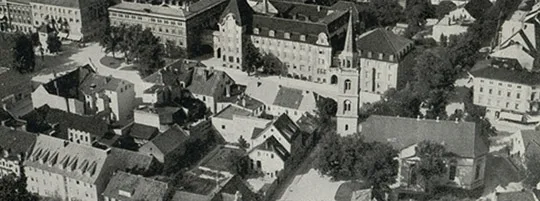
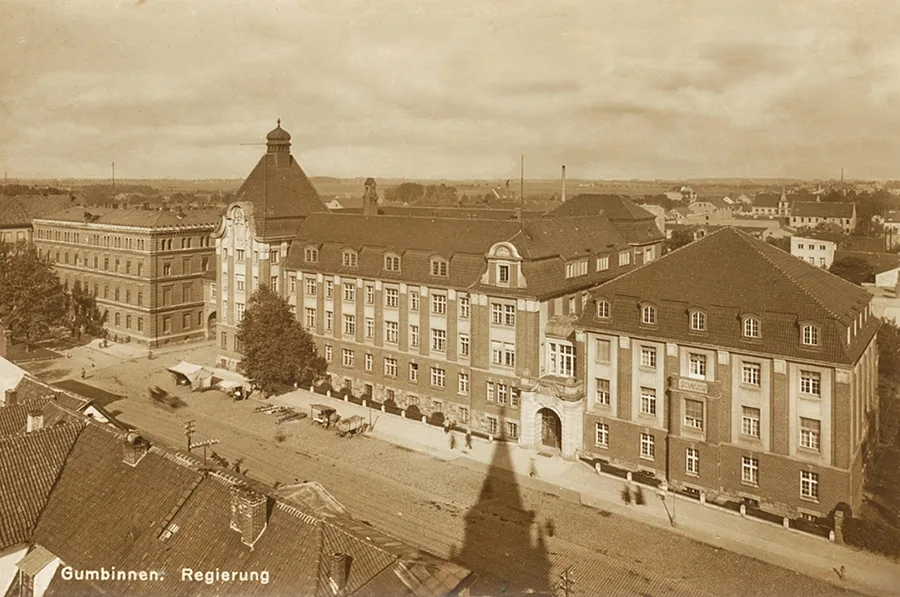 The old and new (centre) buildings of the Gumbinnen district government (Lenin Avenue).
The town suffered badly in 1656 during the Northern War (1655–60) between Sweden and Poland and its allies. Gumbinnen and the surrounding area were then laid waste by an army of Crimean Tatars, who fought in the war on Poland’s side.
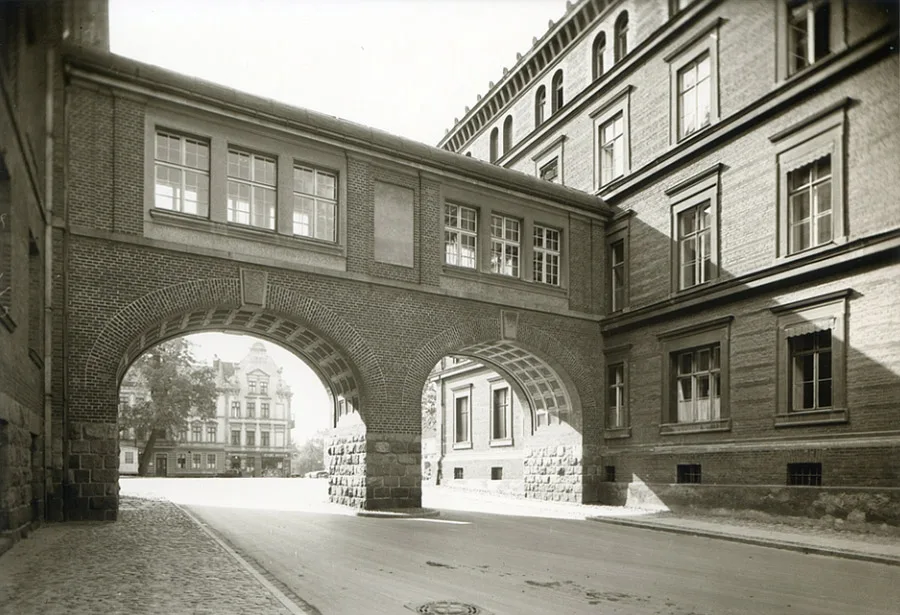 The overhead gallery passage that connected the government buildings in Gumbinnen.
In 1709–10 the area was devastated by a plague epidemic. The population fell sharply and the fields were left untilled. The situation was saved thanks to the decision of King Frederick I to invite religious refugees from across Europe to settle in Prussia (including its sparsely populated districts). This campaign was continued and expanded by his son, Frederick William I. Families from Switzerland, the Palatinate, Magdeburg and Nassau began arriving in the Gumbinnen area. In 1720 a Protestant church was opened in Gumbinnen.
The main influx of settlers from Nassau, the Palatinate and Switzerland came in 1721–25.
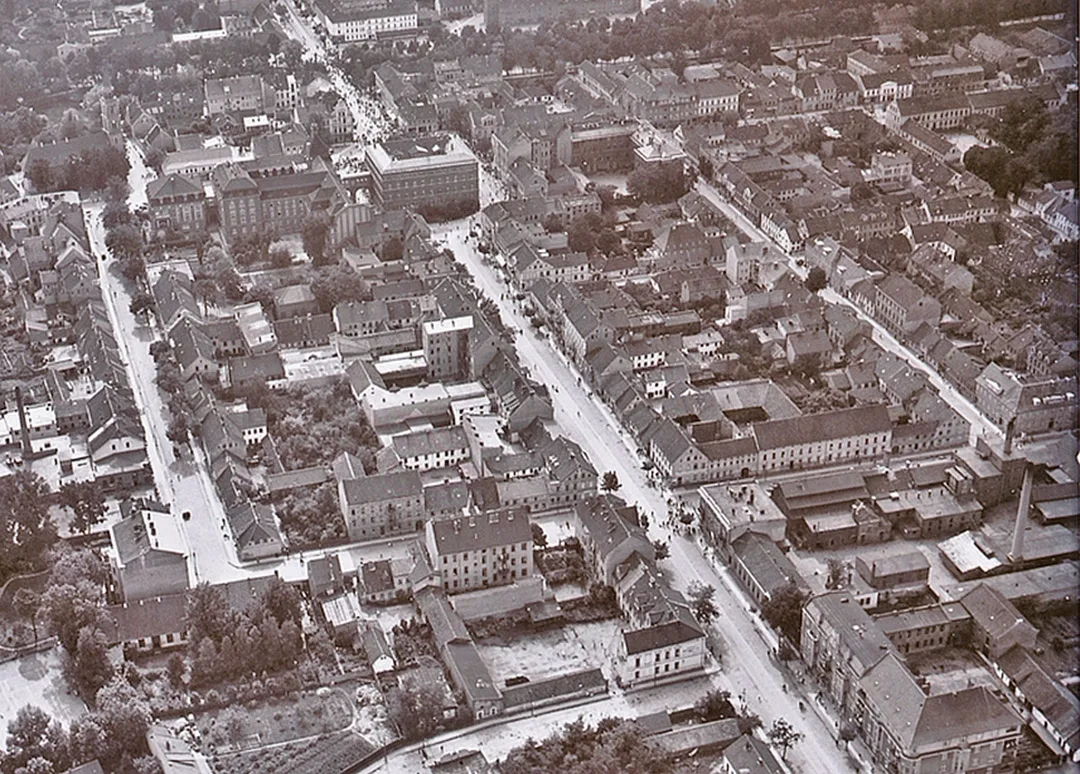
To give the newly settled territories their own administrative, craft and cultural centre, King Frederick William I granted Gumbinnen town status on 6 April 1721. The date of the town’s foundation, however, is not quite so clear-cut: in addition to town status, municipalities also had to receive town rights. At the time the town consisted of two areas, Altstadt and Neustadt. Altstadt received town rights in 1722 or (according to other documents) in 1724.
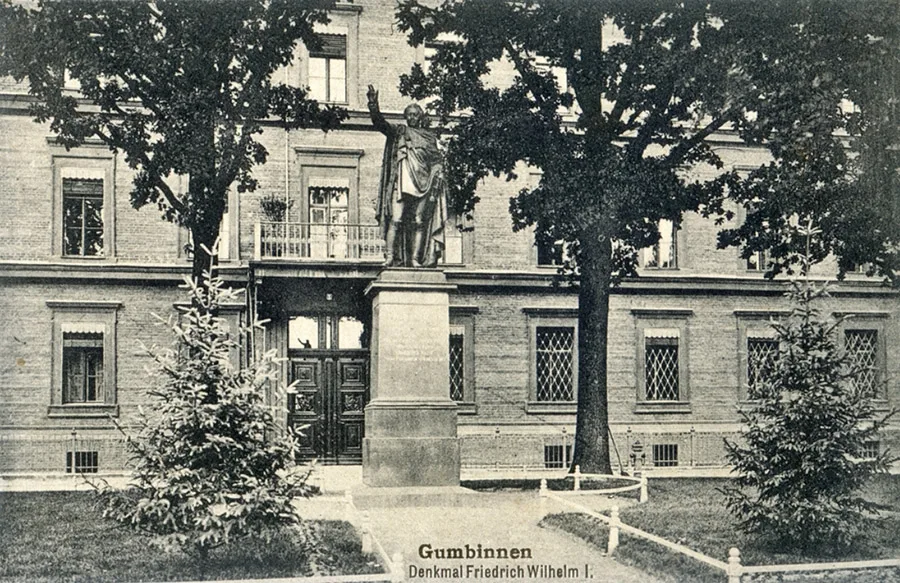 Monument to Frederick William I in front of the old government building.
The official date on which Gumbinnen received town rights is considered to be 24 May 1724, when the first meeting of the town magistrate took place. In 1727 Neustadt was merged with Altstadt. Thus the town of Gumbinnen finally took shape only in 1727.
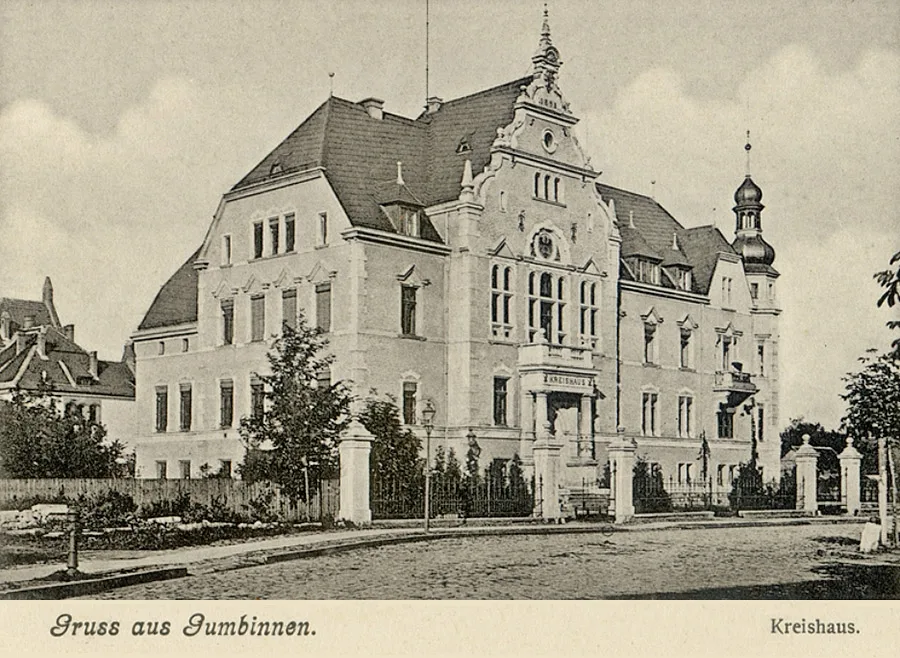 The Gumbinnen Kreishaus on Hindenburgstraße (Zoya Kosmodemyanskaya Street).
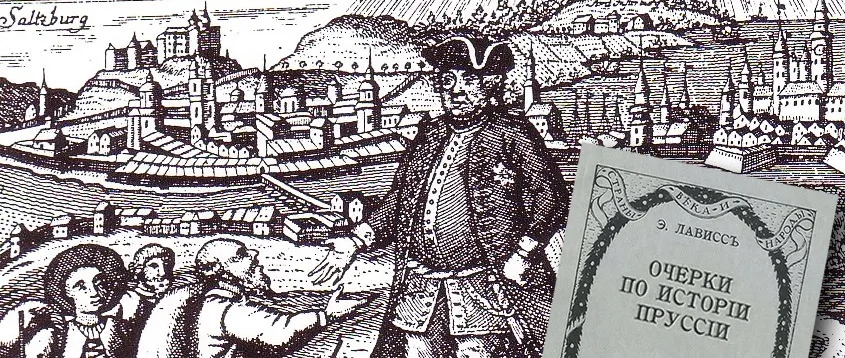
At the same time the town’s quarters were rebuilt to a design by the royal master builder Johann Ludwig Schultheiß von Unfriedt (1678–1753). In 1732 families from Salzburg began to settle in Gumbinnen and its surroundings. From 1736 the War and Domains Chamber operated in Gumbinnen. In 1736–39 the first Reformed Church was built in Neustadt. In 1739–40 the Salzburgers opened a charitable hospital, which remained in existence right up to the Second World War. In 1741 the first town hall was opened on Königstraße. In 1752–54 Salzburg settlers built a temporary Reformed church in the town.
During the Seven Years’ War Gumbinnen was occupied by the Russian army under Field Marshal S.F. Apraksin. On 7 August 1857 the townspeople were made to swear allegiance to the Russian Empress Elizabeth I, after which, on 10 August 1857, Apraksin’s army set off towards Insterburg (Chernyakhovsk).
After Apraksin’s retreat and the start of the second campaign in East Prussia, Gumbinnen was occupied by the Russian army again on 13 January 1758. The town’s burgomaster, J.F. von Domhard, was inclined to cooperate with the new authorities, and so the period under the Russian Empire, which lasted until 5 May 1862, had no negative consequences for the town.
The next time a foreign army entered Gumbinnen was on 18 July 1807, when Napoleon’s troops were pursuing the retreating Russian army. The French units remained in the town for a month, until 17 July 1807. They then passed through Gumbinnen again in 1812, before the invasion of Russia. From 18 to 21 June 1812 Napoleon himself stayed in Gumbinnen. The house where Napoleon spent the night was later acquired by the local Masonic lodge.
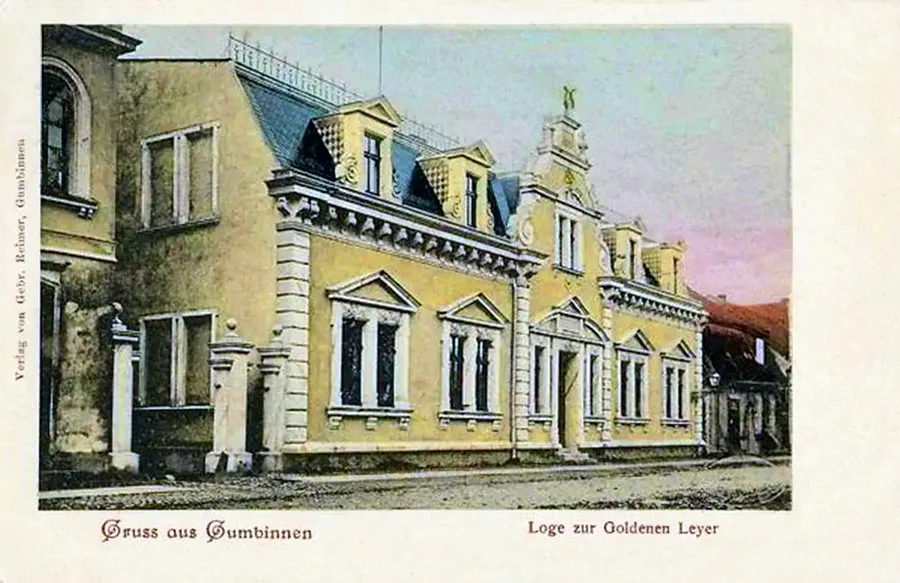 The Gumbinnen Masonic lodge “To the Golden Lyre” (Zoya Kosmodemyanskaya Street; the building has not survived).
Between the two French military campaigns, important events took place in the town: in 1808 Gumbinnen became the official seat of the Prussian government. This determined its role in the administrative structure of East Prussia.
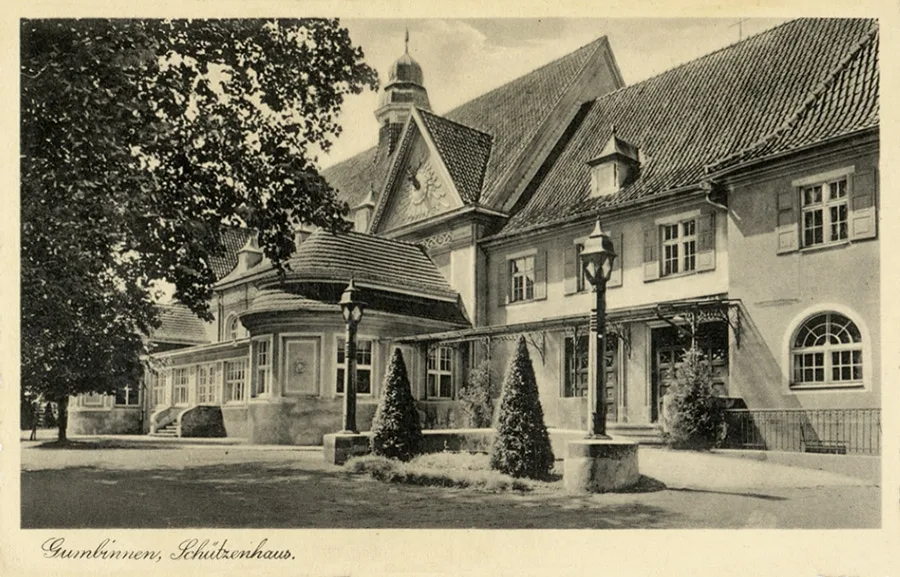 The Gumbinnen Hunters’ House, which now houses the Gusev Officers’ House (Matrosova Street).
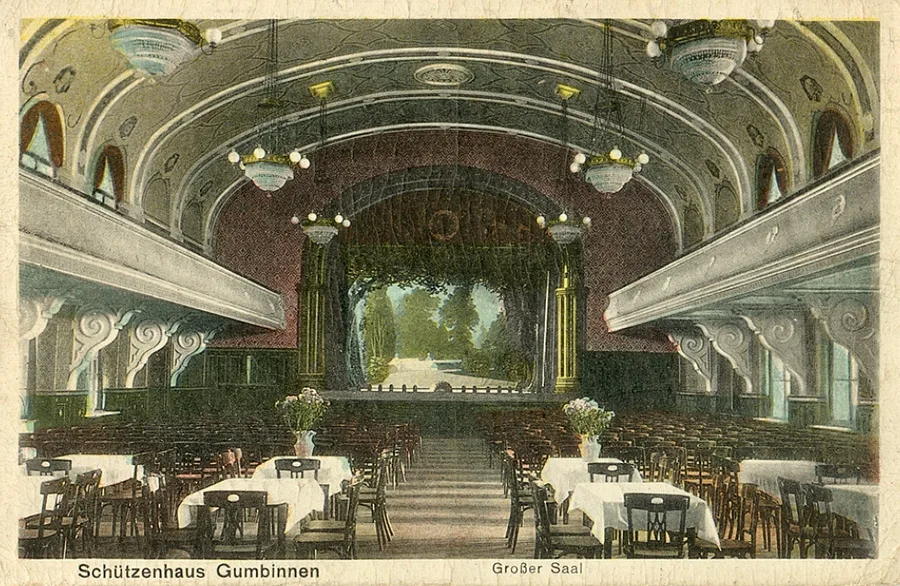 Interior of the main hall of the Gumbinnen Hunters’ House.
During the period of the Napoleonic Wars and the reforms, the president of this government in Gumbinnen was Theodor von Schön (1773–1856). Under his leadership school education was developed, cultural life was revitalised and centralised district institutions were established in the town, one of which was the Central Agricultural Society.
As a result of the administrative reform, Gumbinnen became the centre of a government district (Kreis).
In 1818 this district comprised two urban districts — Insterburg (Chernyakhovsk) and Tilsit (Sovetsk) — plus 12 rural districts: Angerburg (Węgorzewo, Poland), Darkehmen (Ozyorsk), Goldap (Gołdap, Poland), Gumbinnen (Gusev), Heydekrug (Šilutė, Lithuania), Insterburg (Chernyakhovsk), Niederung, Oletzko (Olecko, Poland), Pillkallen (Dobrovolsk), Ragnit (Neman), Stallupönen (Nesterov) and Tilsit (Sovetsk).
In 1838 the first Salzburger Kirche was demolished because it had fallen into disrepair, and on 15.10.1840 a new one was consecrated, which survives to this day (pictured below).
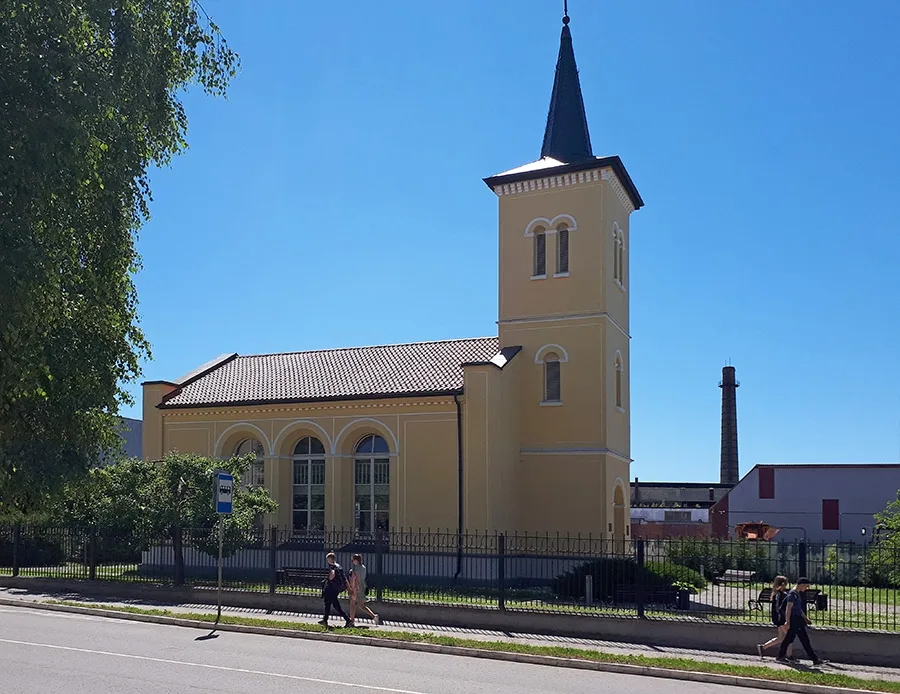 The Salzburger Kirche in Gumbinnen (Mendeleyeva Street).
In 1860 the Prussian Eastern Railway (Preußische Ostbahn) reached Gumbinnen, having been extended from Königsberg to Eydtkuhnen (Chernyshevskoye).
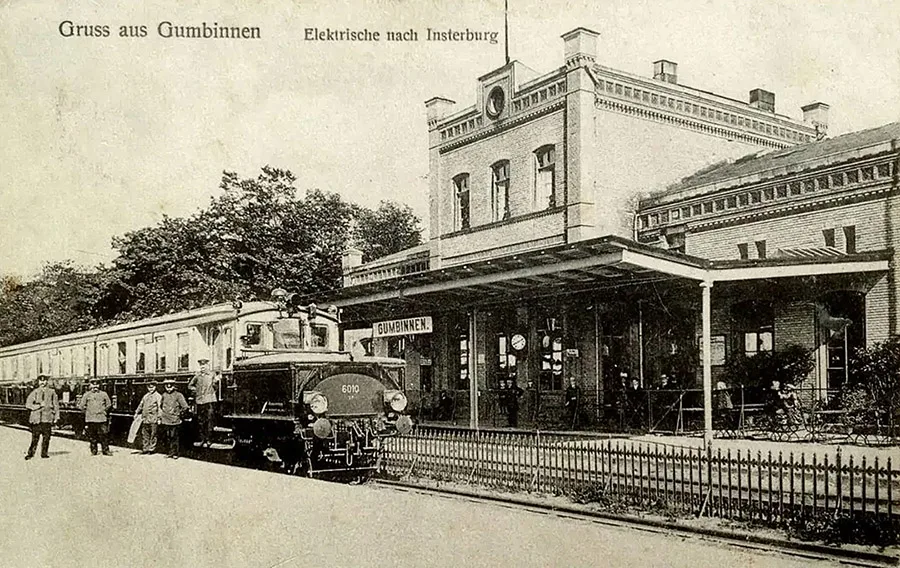 The Insterburg “local train” at Gumbinnen station.
In the same year, 1860, an engineering works opened in Gumbinnen. In 1871 the municipality of Gumbinnen comprised five localities: the town of Gumbinnen (Gusev), the Annahof estate (Gusev, 54 Pobedy Street), Bitter’s Etablissement, a knacker’s yard and a brickworks (now part of Gusev). In all, the municipality had 389 residential houses, home to 1,592 families and 197 single people. In 1885 a municipal slaughterhouse was built. In 1887–90 the building of the Chief Postal Directorate and the main post office was erected. In 1890 infantry and artillery barracks were built.
In 1872 the first agricultural school in East Prussia opened in Gumbinnen. In 1898 a new town hall building was opened. In 1900 the municipal park of Fichtenwalde was founded.
In 1907 services began on the Gumbinnen–Tollmingkehmen railway branch line (Gusev – Chistye Prudy).
On 18.04.1907 the first provincial football club, “Prussia”, was founded. In 1908–10 a municipal sewerage system was laid in Gumbinnen. In 1911 a new government building was opened on Gumbinnen’s central square. In 1912 a bronze sculpture of an elk was put up.
In 1913–14 the Gumbinnen–Angerburg railway line (Gusev–Węgorzewo) was built.
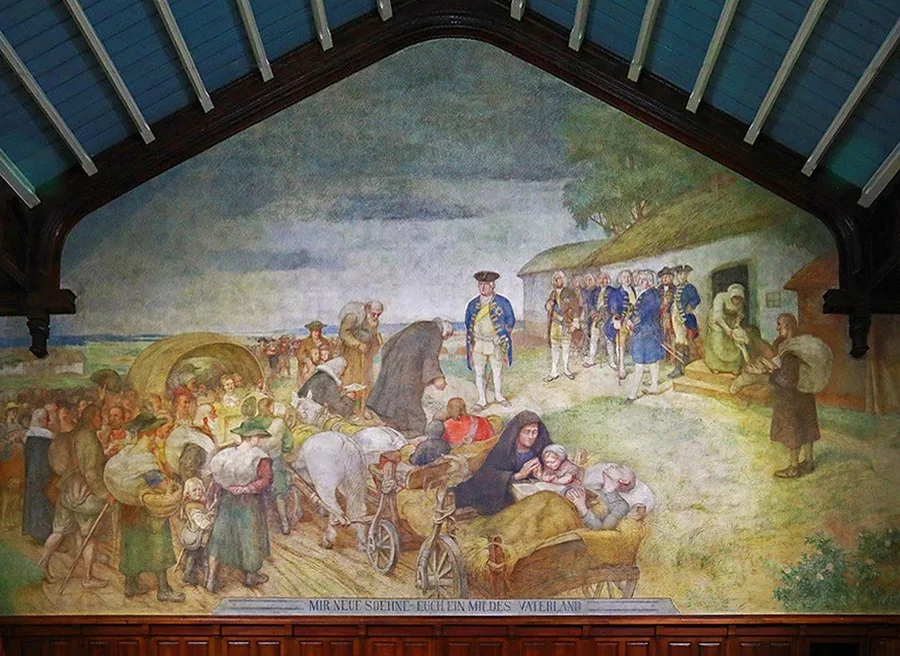 The assembly hall of the Gusev College of Agrotechnologies and Environmental Management is adorned with a fresco by Otto Heichert (1868–1946) depicting the Prussian King Frederick William I receiving the Salzburg emigrants. The work was created in 1912–1913.
In 1914 the largest battle of the First World War fought on the territory of the region took place near Gumbinnen; it ended in victory for the Russian army.
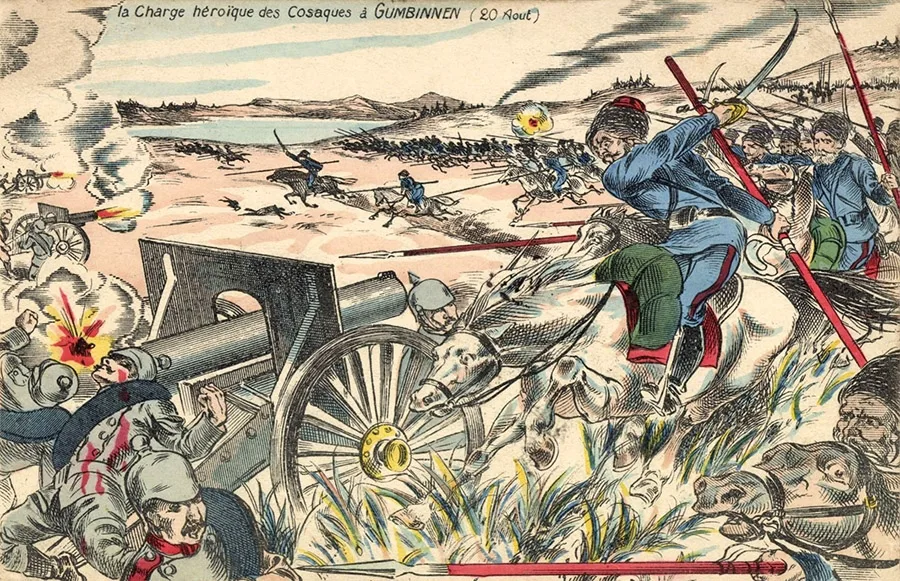 A Cossack charge on German positions near Gumbinnen (French postcard).
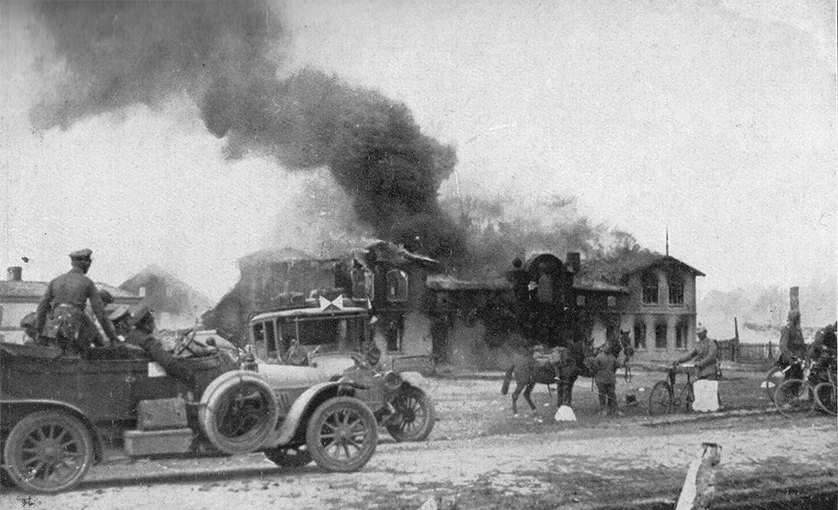
Rennenkampf’s Russian 1st Army reached the approaches to Gumbinnen by 19.08.1914. On 20 August it clashed with units of the German XVII Army Corps. In the Battle of Gumbinnen, the fighting right by the town was conducted by General N.A. Yepanchin’s 3rd Corps. Since the German army withdrew, with losses on the whole equal on both sides, the Russian army is regarded as the victor of the battle. On 23.08.1914 the Russian 25th Infantry Division (General P.I. Bulgakov) entered Gumbinnen. The town suffered almost no damage in the fighting. The occupying troops in Gumbinnen behaved, on the whole, with discipline; there was no mass or systematic looting or violence.
The Russian command appointed a local teacher, Professor R.E.A. Müller, as head of the town. Yet only two weeks later the 1st Army began its retreat, Russian troops passed through the town once more, and on 12.09.1914 it was taken by the German army.
On 04.08.1917 the rural community of Norutschatschen (Klein Norutschatschen, Blumenau and the mill) became part of the municipality of Gumbinnen. In 1917 an agricultural machinery plant was launched in Gumbinnen. In 1931 the municipality of Gumbinnen comprised 13 localities covering 1,281.2 hectares of land. The town had 1,041 residential houses and 4,996 outbuildings. Before the war Gumbinnen had a power station, an engineering works, a brickworks, a brewery, a flour mill and a packaging plant. Crafts and small private workshops were also widespread. Educational institutions included a secondary school, a vocational school, a commercial school and an agricultural school, as well as a technical college of mechanical engineering. The town had a district hospital and a private clinic. For worshippers there were three Protestant churches and a Catholic church, a Baptist chapel and a synagogue. A municipal stadium served for sport and sporting events. Two newspapers were published in Gumbinnen in the interwar period. In 1937 the first bus routes appeared in the town.
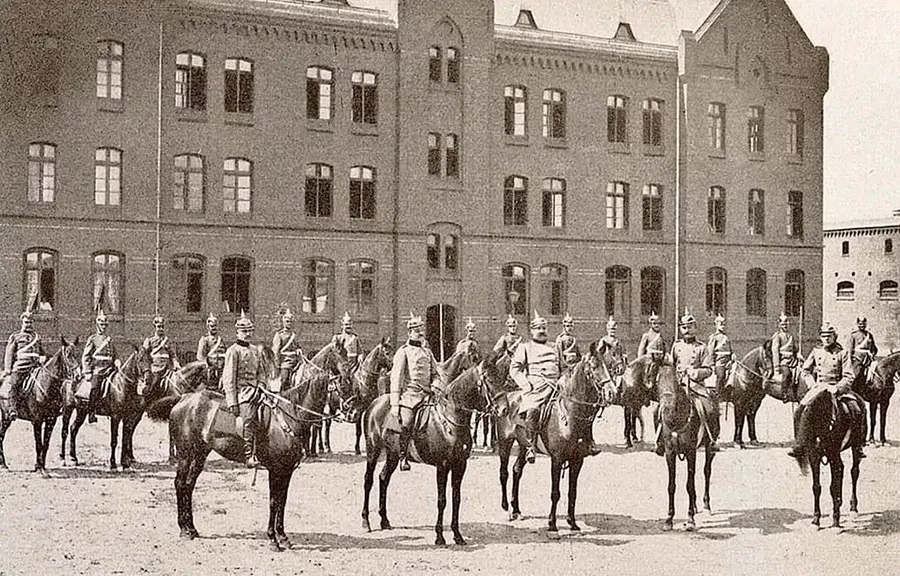 Prussian dragoons in front of their Gumbinnen barracks.
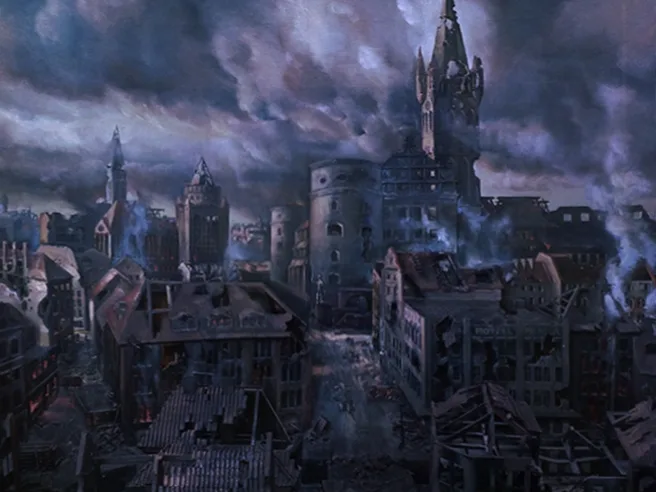
The Second World War reached Gumbinnen itself in the autumn of 1944.
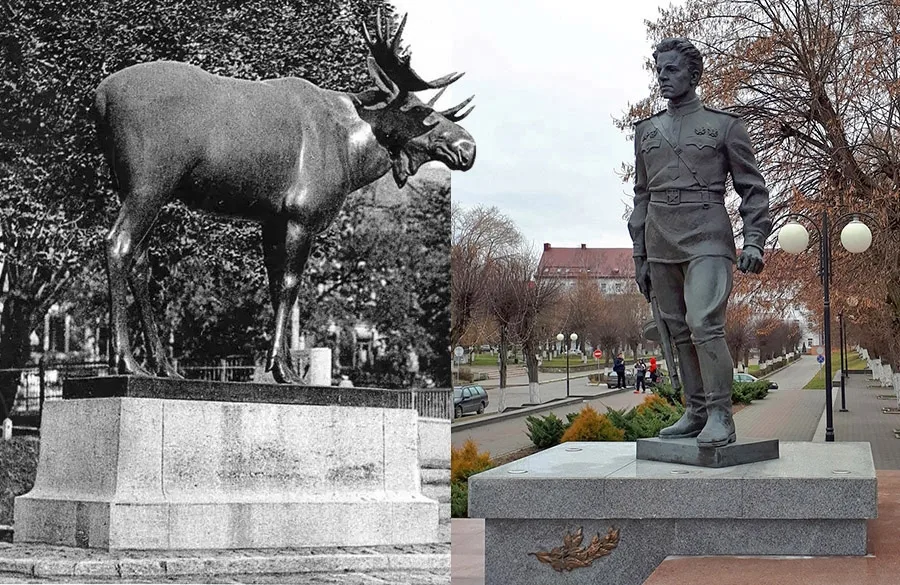 The “Elk” sculpture on the bank of the Pissa. Today a monument to S.I. Gusev (right) stands on this spot, and the “Elk” has been moved to the small park at the corner of Pobedy and Krasnoarmeyskaya Streets.
On 16–30.10.1944 the 3rd Belorussian Front (five combined-arms armies and one air army) carried out the Gumbinnen–Goldap Operation, which, as the command intended, was to end with the rout of the Wehrmacht forces in East Prussia and the capture of Königsberg. The enemy’s strength and resilience, and the depth and quality of its defensive lines, were clearly underestimated. Gumbinnen lay in the sector of the Front’s main thrust (the 11th Guards and 5th Armies). The Soviet advance was slow and costly. This allowed the enemy to bring up reserves, including Volkssturm units. On 16.10.1944 an air strike was carried out on Gumbinnen, leaving the town centre damaged.
On 19.10.1944 Soviet troops reached the Pissa, and on 20 October the Front’s main striking force, the 2nd Tatsinskaya Tank Corps, was committed to battle. It became possible to begin the fight for Gumbinnen. However, after breaking through, the tank corps suffered heavy losses, narrowly escaped encirclement and was forced to withdraw.
The rifle divisions had already reached the outskirts of Gumbinnen, but the overall situation (their offensive capacity was exhausted) forced the front command to temporarily abandon the fighting for the town and fall back to field positions captured earlier.
The second phase of the battle for the town unfolded during the strategic East Prussian Offensive (13 January – 25 April 1945), carried out by three fronts. Gumbinnen once again lay in the sector of the 3rd Belorussian Front. The town was finally taken on 21 January 1945 by soldiers of the 130th Taganrog Rifle Division (Maj. Gen. K.V. Sychyov) of the 28th Army. The fighting was again fierce and bloody. The 28th Army failed to encircle the defending force and cut off its supplies. Moreover, the enemy blew up all the bridges over the Pissa, and the sappers managed to lay only an ice crossing, which could not bear the weight of heavy equipment. As a result, the town had to be taken in street fighting, block by block, gradually driving the enemy out.
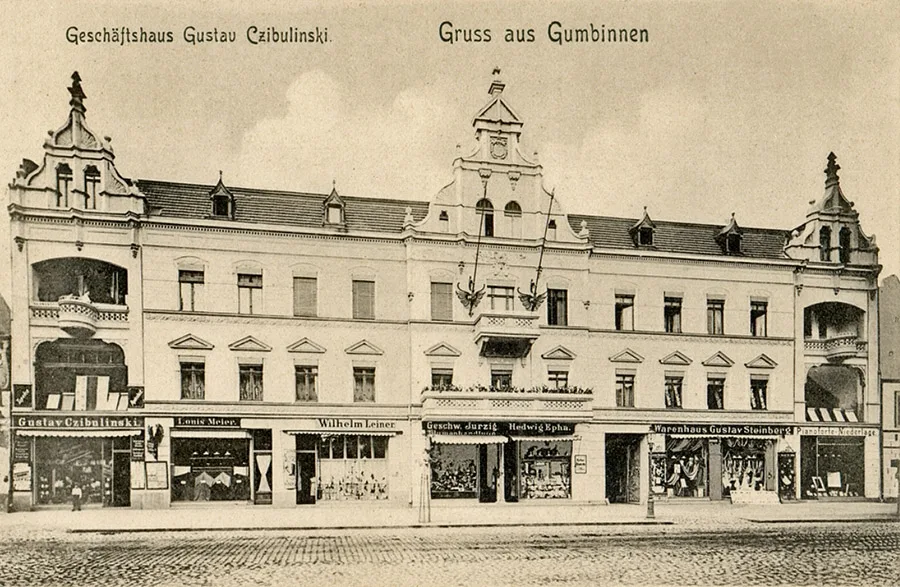 The office of Gustav Cybulinski.
By the end of the fighting, roughly 63% of the town's residential buildings had been destroyed, and the rest were in need of major repairs. The woodworking plant, the gasworks, the tannery and the printing house were destroyed beyond recovery, and the water supply and sewerage systems were put out of action.
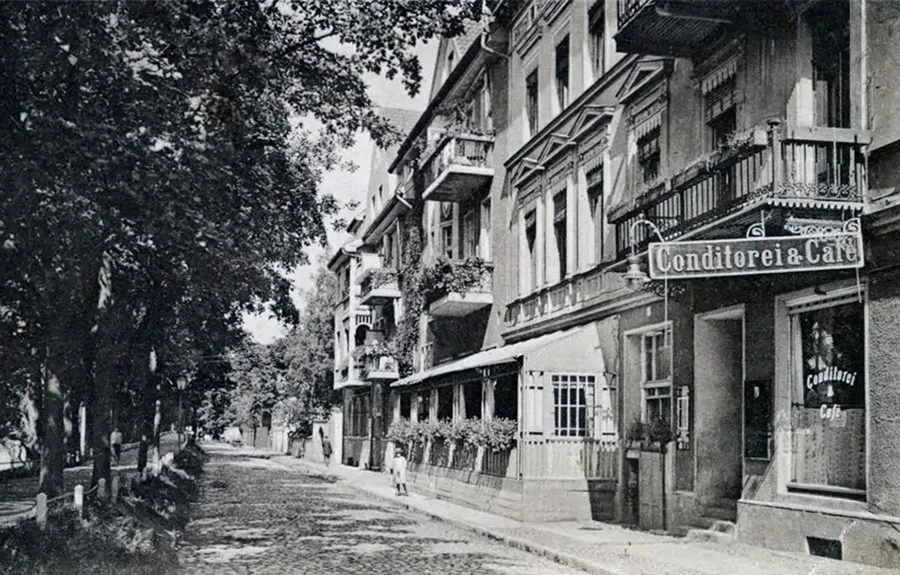 A café and confectioner's on Dammstraße (now Pravoberezhnaya St.).
On 7 September 1946 Gumbinnen was renamed in honour of Hero of the Soviet Union Captain S.I. Gusev, political officer of the 664th Rifle Regiment, who was killed in the fighting near the town (at the village of Groß Baitschen / Groß Baitschen, now Podgorovka). On 25 July 1947 Gusev became a town of regional subordination. Even before the town was renamed, on 14 March 1946, Flour Mill No. 14 began operating on the site of the pre-war flour-milling plant. By the end of 1947 the power station, the mill with its water turbines and the municipal industrial works had been restored in the town. The district executive committee was up and running by June 1947 and the town executive committee by October, and in December elections to the local Soviets were held.
In that same year, 1947, the town prosecutor's office was set up, a communications office and a civil registry office were established, a 50-bed hospital, two schools and a school for working youth were opened, and the district newspaper «Za doblestny trud» ("For Valiant Labour") began to appear. For leisure, the Sparta cinema (350 seats), the House of the Red Army and a library were opened.
Also in 1947, a municipal trading organisation was established, and the industrial cooperative artels «Metallist» and «Luch» began work; they existed until 1953 and 1954 respectively. In 1948 a cheese factory, a bakery, a municipal food-processing plant and a timber enterprise started operating.
In 1947–50 the water supply system was partially restored, and a pumping station and a water tower were put into operation. The power grid was also being restored. To house the population, 499 residential buildings (a third of the pre-war housing stock) were repaired. As of 1 January 1950, Gusev had a crèche, a kindergarten, two children's homes, two primary schools, a secondary school, a vocational school and an agricultural college. Healthcare was provided by an 80-bed hospital, an outpatient clinic and a pharmacy. Cultural and leisure facilities included the Spartak cinema, the House of Officers, a house of culture and a library.
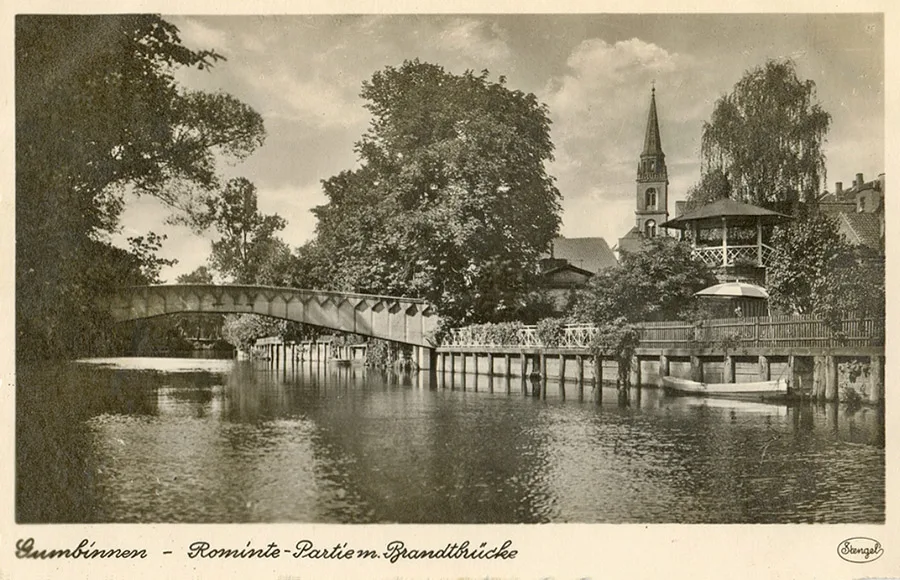 The Karl Brandt Footbridge, which shared the fate of all Gumbinnen's bridges, blown up in 1945.
In the 1950s Gusev continued to develop as an industrial centre.
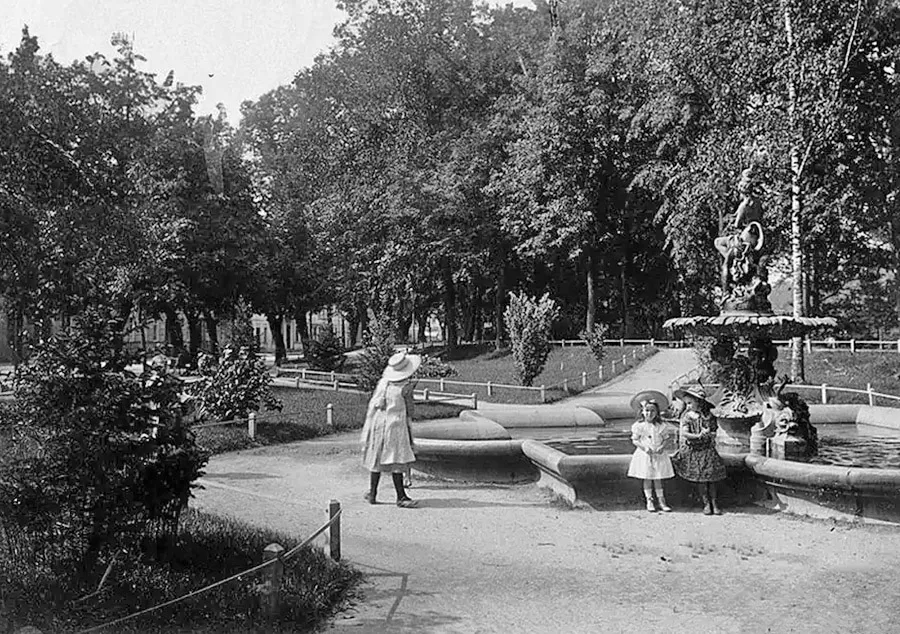 Girls by the fountain in a Gumbinnen park.
On 7 January 1952 the flour mill was converted into a compound feed plant; the GRES-5 power station was commissioned (1953), and the Gusev Lighting Fixtures Plant was built (1954). In 1957 the railway station was opened. Mass construction of apartment blocks began in 1958–59. In 1961 the last unsafe residential building in the town was cleared.
On 12 June 1961 the Mikrodvigatel enterprise was established on the basis of a repair and engineering plant. It produced low-power electric motors for household and industrial use and became one of the largest enterprises in the country in this sector.
In 1964 the Chaika knitwear factory opened, with an output of up to 8,000 items a day. In the first half of the 1960s a new bridge over the Pissa, the Mir cinema (650 seats), a new school for 450 pupils, two kindergartens and two workers' clubs were built. The retail network grew to 40 shops, and catering to 13 canteens. The healthcare system also developed considerably, with the addition of a 150-bed hospital, a 49-bed maternity hospital, an ambulance station, six first-aid posts, a sanitary and epidemiological station and two pharmacies. An evening school began operating in 1961. A House of Pioneers and a music school (1959) were opened. In 1963 a monument to Lenin was erected on Victory Square.
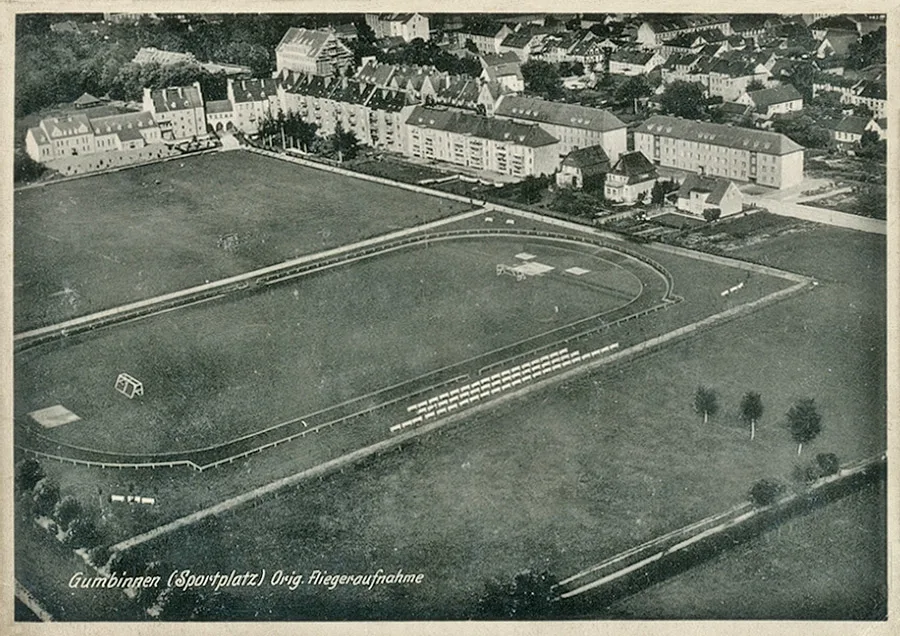 The municipal stadium of Gumbinnen (Krasnoarmeyskaya St.).
In the 1970s and 80s the town's main enterprises remained the lighting fixtures plant and the Mikrodvigatel plant, whose products were shipped to every region of the country. In 1979 a brickworks began operating in Gusev.
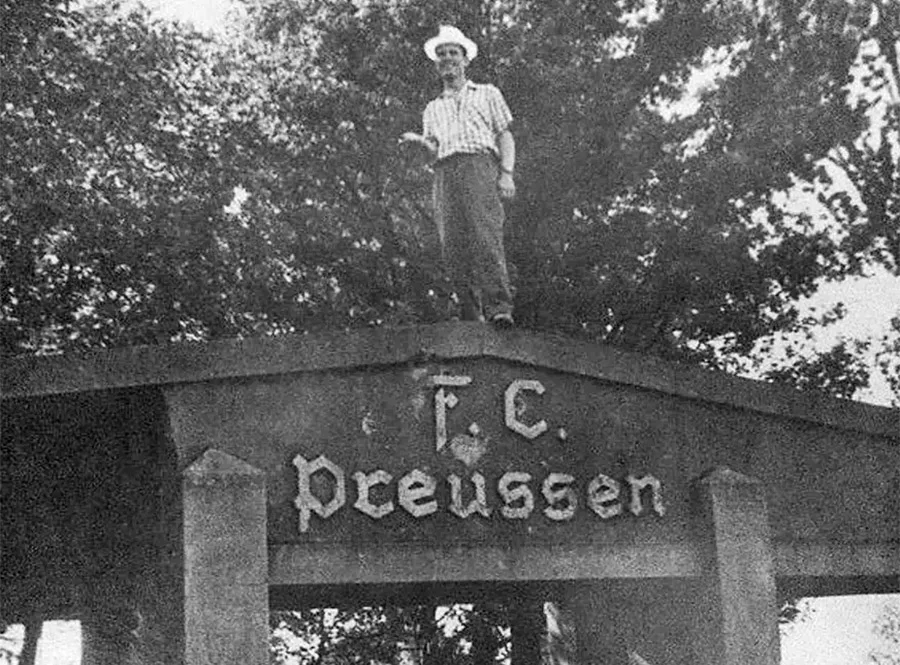 A Soviet settler on the gates of the FC "Prussia" stadium.
In the 1980s the Gusev compound feed plant expanded production and began supplying its products beyond the region. In 1984 the Kosmos catering complex opened for the townspeople. By the end of the 1980s, 98.3% of the town's housing stock was connected to the water supply, 92.7% to the municipal sewerage system and 97.2% to the gas supply. Only the provision of central heating (31.1%) and hot water (29.8%) remained low. The town had public transport (5 bus routes).
For Gusev, the 1990s passed much as they did for many other small towns. Industry suffered most, while trade, services and food production grew. In 1993 the Museum of History and Local Lore opened, and in the same year School No. 5, the largest in the town, welcomed its first pupils.
School No. 6 opened later. In 1994 the brickworks was closed. In 1997 the Mikrodvigatel plant shut down, but it later resumed work, mainly servicing and repairing electric motors. The crisis in industrial production continued into the 2000s. In 2003 the lighting fixtures plant was closed. In 2004 the Chaika knitwear factory went bankrupt.
After 2005 some positive changes emerged: Mikron LLC began operating in the buildings of the Mikrodvigatel plant and resumed its core production (albeit not at former volumes). In 2008 the Technopolis GS project was launched, aimed at creating a high-tech industrial cluster in Gusev. In 2009 a plant of the research and production association Digital Television Systems opened there, manufacturing a range of digital television set-top boxes. A cardboard packaging factory and a house-building plant also opened as part of the technopolis.
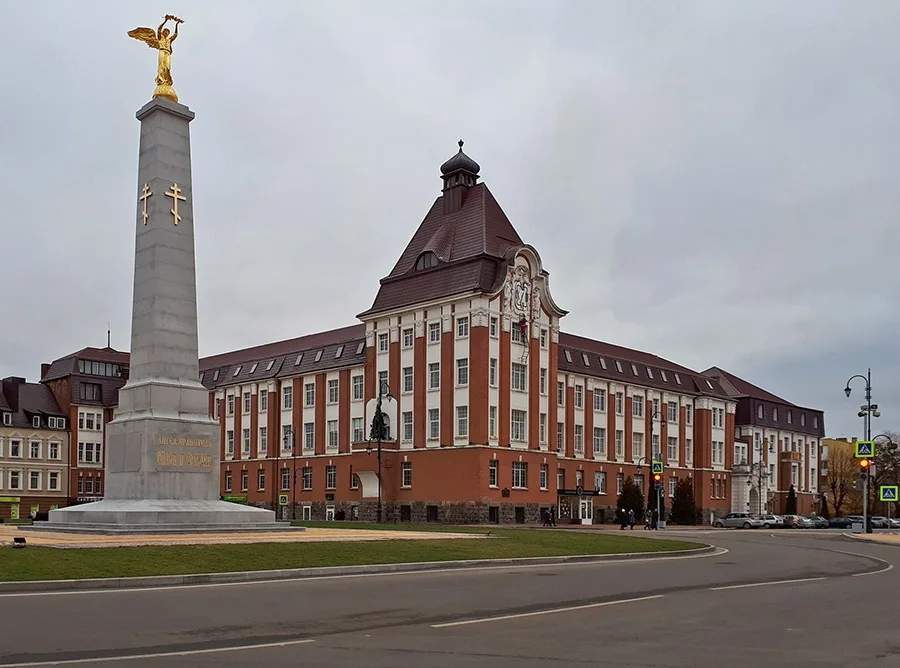 The building of the district administration in Gusev (Pobedy Square) today.
In 1990, the Ministry of Culture of the RSFSR recognized Gusev as a historic town of Russia. In the 2010s, Gusev stepped up its efforts to make the town more attractive to tourists. The main emphasis was placed on the town's role in the events of the First and Second World Wars.
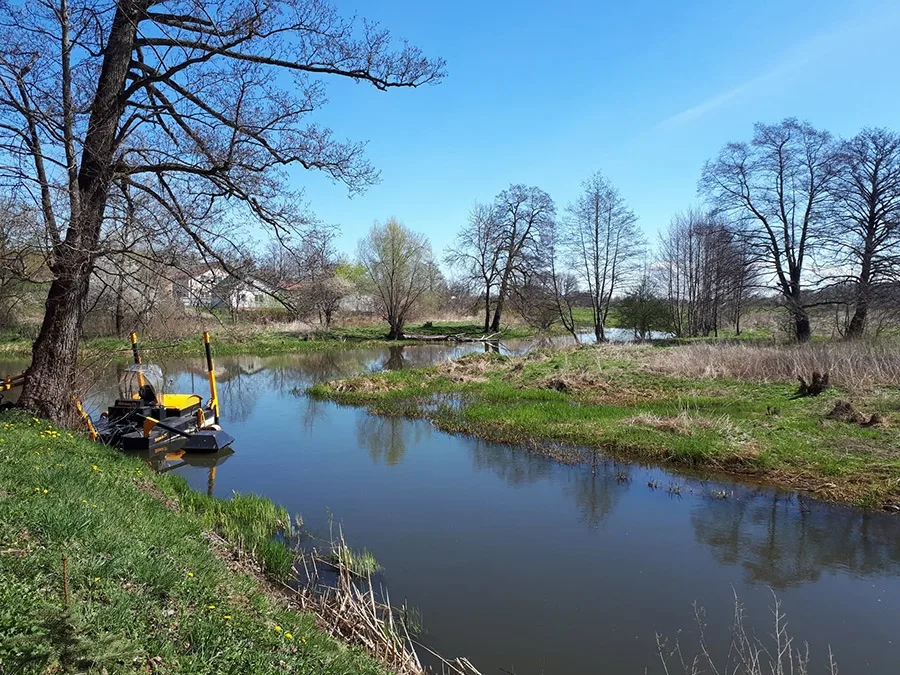 A dredger near the confluence of the Krasnaya and the Pissa (City Park).
On 28.05.2011, the Coin Garden was opened, featuring models of coins minted in Russia and the Soviet Union. In 2015, an IS-2 tank was mounted on a pedestal.
Sights
The Salzburg Church (1840), the Lutheran church (1926), the Baptist chapel (1906), the Catholic church (early 20th century, on the grounds of a military unit, now a club), the Altstadt chapel (late 19th century), the Catholic chapel (1920), the former hunting club (now the Officers' House), the complex of a steam and water mill and granary (late 19th – early 20th century), the agricultural school building (1872), the district administration building (1898), the Frederick William I School building (1903), the People's Bank building (early 20th century), numerous other residential and administrative buildings from the late 19th – early 20th centuries, garrison barracks and military depot complexes, staff and other military buildings (late 19th century), the elk sculpture (1911), the fresco by Otto Heichert (agricultural college), the ruins of a memorial to the soldiers of an uhlan regiment, the burial site of 17 Russian and 44 German soldiers (1914), the mass grave of Soviet soldiers (960 people, memorial 1955), the King's Bridge (1957), the Coin Garden (2011).
Notable people
Arthur Degner / Degner (1888–1872), German painter. Born in Gumbinnen, he studied at the Königsberg Art Academy in 1906–08. Under the Nazi regime he was persecuted for "degenerate art".
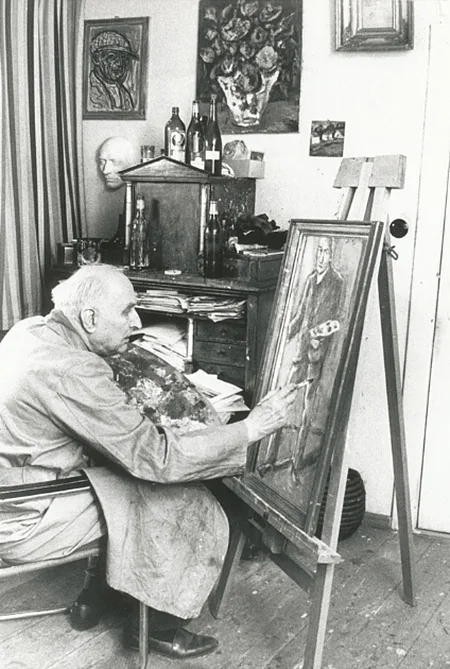 Painter Arthur Degner.
Richard Friese / Friese (1854–1818), German animal painter. Born in Gumbinnen, he lived there until 1871. He created numerous art postcards with views of the Rominte Heath. As a sculptor, he is known for the deer sculptures on the Deer Bridge over the Rominte (Krasnaya).
Gregorovius / Gregorovius (1821–91), German historian and writer, author of a fundamental work on the medieval history of Rome and Italy. From 1832 to 1838 he attended the Friedrich School / Friedrichschule in Gumbinnen. He then studied at the University of Königsberg, where he later earned his doctorate.
For reference
Sodeiken was founded before 1550. In 1550 it is mentioned as Sadnicken, and around 1557 as Sudekeit. In the 19th century Sodeiken was a village that from 1818 formed a rural municipality in the Kreis of Gumbinnen (Gusev). The village belonged to the Gumbinnen-Altstadt parish (the Altstädtische Kirche of Gumbinnen). In 1871 the municipality of Sodeiken consisted of four settlements: the village of Sodeiken (36 farmsteads) and the estates of Bernen (4 farmsteads), Radlauken (2 farmsteads) and Krug Fichtenwalde, the Fichtenwalde inn (2 farmsteads). In total, 105 families and 14 single men lived in the municipality. On 18.03.1874 the rural municipality of Sodeiken was incorporated into the newly established Amtsbezirk of Stanneitschen (from 1938 Zweilinden, now Furmanovo). Friedrich Lenkeit, a retired senior postman from Sodeiken, served as head of the Amtsbezirk from 1933 until the evacuation of its population in 1944.
Norutschatschen was in the 19th century a village that from 1818 formed a rural municipality in the Kreis of Gumbinnen (Gusev). The village belonged to the Gumbinnen-Altstadt parish (the Altstädtische Kirche of Gumbinnen). In 1871 Norutschatschen had 45 households, home to 192 families and 11 single men. On 18.03.1874 the rural municipality of Norutschatschen was incorporated into the newly established Amtsbezirk of Prußischken (from 1938 Preußendorf, now Bryanskoye).
Groß Norutschatschen was founded in 1539. It is first mentioned as Klein Killigkehmen, Klein Kulligkehmen or Klein Colligkeim. In 1555 it is recorded as Klein Colligkehmen, and in 1590 as Klein Collikenen. Later it became Norutschatschen. In the 20th century, before the war, Groß Norutschatschen had a school, a brickworks, a mill, a hotel and two bathing places on the Rominte (Krasnaya).
Klein Norutschatschen is mentioned in 1898 as the outlying farmsteads of Norutschatschen (zu Norutschatschen). In 1898 it had 13 residential houses. The village belonged to the Gumbinnen-Altstadt parish (the Altstädtische Kirche of Gumbinnen). In the first half of the 20th century Klein Norutschatschen had a brickworks.
Friedrichsfelde is first mentioned in 1785. In the 19th century Friedrichsfelde was a village in the Kreis of Gumbinnen (Gusev). The village belonged to the Gumbinnen-Altstadt parish (the Altstädtische Kirche of Gumbinnen). Until 1865 the village of Friedrichsfelde belonged to the rural municipality of Norutschatschen (now part of Gusev). On 11.02.1865 the independent rural municipality of Friedrichsfelde was formed; it also included the Borksruh estate (54°36'34'' N 22°13'14'' E), which had previously formed a Gutsbezirk. In 1871 the municipality of Friedrichsfelde comprised seven farmsteads (five in Friedrichsfelde and two in Borksruh), home to 13 families and one single man. On 18.03.1874 the rural municipality of Friedrichsfelde was incorporated into the newly established Amtsbezirk of Prußischken (from 1938 Preußendorf, now Bryanskoye). In the pre-war years Friedrichsfelde had a brickworks.
Annahof was founded in 1821 as an estate (Kammergut) with a windmill belonging to the municipality of Gumbinnen. The estate belonged to the parish in Gumbinnen. In 1871 Annahof had one household. In the 1930s Annahof comprised several small farms.
Luschen was founded no later than 1564 as Luschichkeim. Until 1785 it was then called Luschkeinen. In the 19th century Luschen was a village that from 1818 formed a rural municipality in the Kreis of Gumbinnen (Gusev). The village belonged to the Gumbinnen-Altstadt parish (the Altstädtische Kirche of Gumbinnen). In 1871 Luschen comprised 16 farmsteads, home to 50 families and 1 single man. On 18.03.1874 the rural municipality of Sodeiken was incorporated into the newly established Amtsbezirk of Stanneitschen (from 1938 Zweilinden, now Furmanovo). Before the war Luschen had a school.
Schönort was founded around 1899 as a village within the rural municipality of Luschen. The village belonged to the Gumbinnen-Altstadt parish (the Altstädtische Kirche of Gumbinnen).
Drückklershöfchen was founded before 1833 as a village within the rural municipality of Kulligkehmen (from 1938 Ohldorf, now Lipovo) in the Landkreis of Gumbinnen (Gusev). The village, whose population was predominantly Reformed, belonged to the parish of the Neustädtische Kirche of Gumbinnen. On 18.03.1874, as part of the rural municipality of Kulligkehmen, the village of Drückklershöfchen became part of the newly established Amtsbezirk of Kulligkehmen.
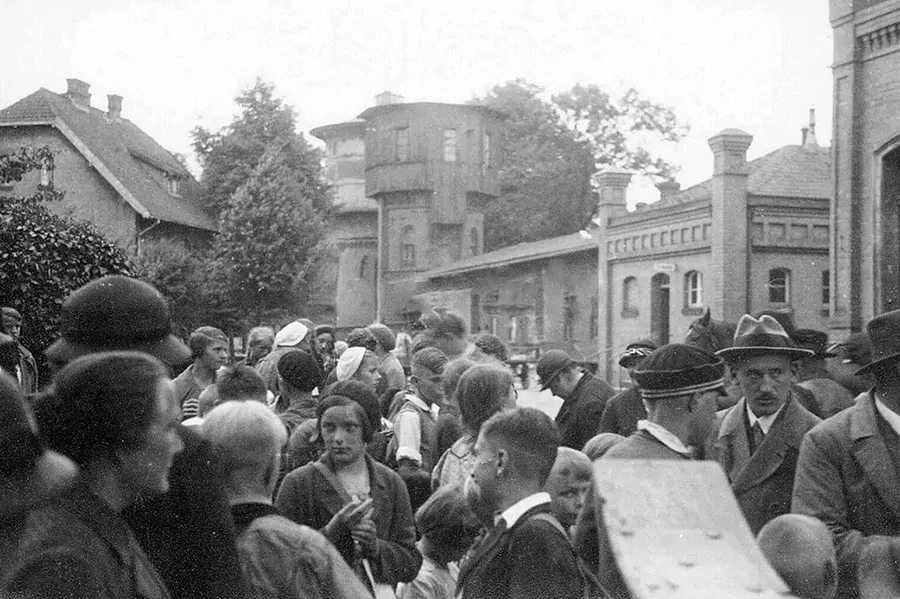 Residents of Gumbinnen on the station square.
Composition of the population of Gumbinnen in 1871: Protestant Christians – 8880, Catholics – 36, other Christians – 3, Jews – 137, children under 10 – 1289, literate – 7093 (94%), blind – 4, deaf-mute – 8, insane – 8.
Population of the Sodeiken commune in 1871: Evangelical Christians – 469, Catholics – 1, children under 10 – 130, literate – 247 (75%), blind – 1, deaf-mute – 1, insane – 1.
Population of Norutschatschen in 1871: all 783 Evangelical Christians, children under 10 – 234, literate – 392 (72%), insane – 2.
Population of Luschen in 1871: Evangelical Christians – 188, Jews – 13, children under 10 – 56, literate – 78 (57%).
Population of the Friedrichsfelde commune in 1871: all 70 Evangelical Christians, children under 10 – 11, literate – 51 (93%), insane – 1.
Population of Gumbinnen–Gusev over time: 1738 – 2,082, 1782 – 4,798, 1816 – 5,072, 1831 – 6,023, 1867 – 8,779, 1871 – 9,056, 1875 – 9,144, 1880 – 9,530, 1885 – 10,453, 1890 – 12,207, 1905 – 14,196, 1910 – 14,540, 1925 – 19,002, 1933 – 19,987, 1939 – 22,181, 1946 (Oct.) – 1,7001, 1947 – 6,5012, 1959 – 14,174, 1970 – 22,053, 1979 – 24,574, 1989 – 27,031, 2002 – 28,467, 2009 – 28,063, 2010 – 28,260, 2012 – 28,542, 2013 – 28,534, 2014 – 28,508, 2015 – 28,511, 2016 – 28,204, 2017 – 28,257, 2019 – 28,307, 2020 – 28,484, 2021 – 29,234 inhabitants.
Population of the Sodeiken commune over time: 1867 – 782, 1871 – 4703, 1885 – 604, 1905 – 527, 1925 – 480, 1933 – 405, 1939 – 553 inhabitants.
Population of the Norutschatschen commune over time: 1867 – 803, 1871 – 783, 1885 – 1,229, 1905 – 3,603, 1910 – 3,713 inhabitants.
Population of Annahof over time: 1871 – 18, 1905 – 18 inhabitants.
Population of the Luschen commune over time: 1867 – 197, 1871 – 201, 1885 – 224, 1905 – 247, 1910 – 265, 1919 – 204, 1925 – 161, 1933 – 218, 1939 – 231 inhabitants.
Population of Drücklershöfchen over time: 1905 – 38 inhabitants.
Population of the Friedrichsfelde commune over time: 1867 – 64, 1871 – 704, 1885 – 53, 1905 – 36, 1925 – 25, 1933 – 25, 1939 – 29 inhabitants.
Population of Blumenau over time: 1905 – 10 inhabitants.
Population of the Norutschatschen mill over time: 1905 – 15 inhabitants.
Population of Klein Norutschatschen over time: 1898 – 201 inhabitants.
Population of Schönort over time: 1905 – 20 inhabitants.
——————
1 – including 180 Germans.
2 – including 309 Germans
3 – of whom 394 lived in the village of Sodeiken itself.
4 – of whom 58 lived in the village of Friedrichsfelde itself.
Photos: bildarchiv-ostpreussen.de, pastvu.com, Mikhail Ogorodnikov.
Translated from Russian with the help of AI (Claude, Anthropic), October 2026.