LEGENDS OF PRUSSIA on the blog of Tatyana Kolivay.
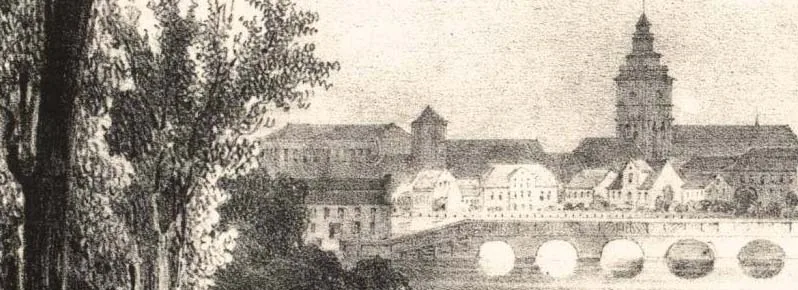
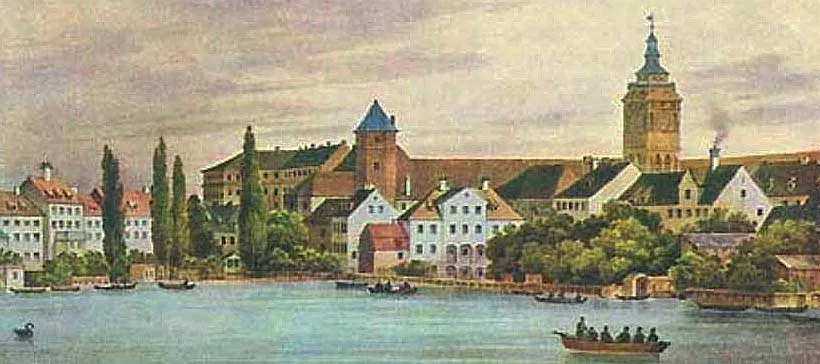
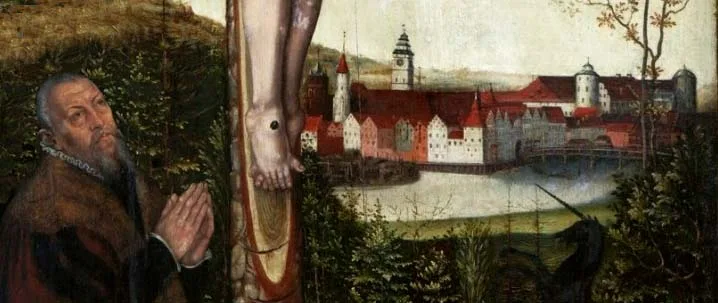
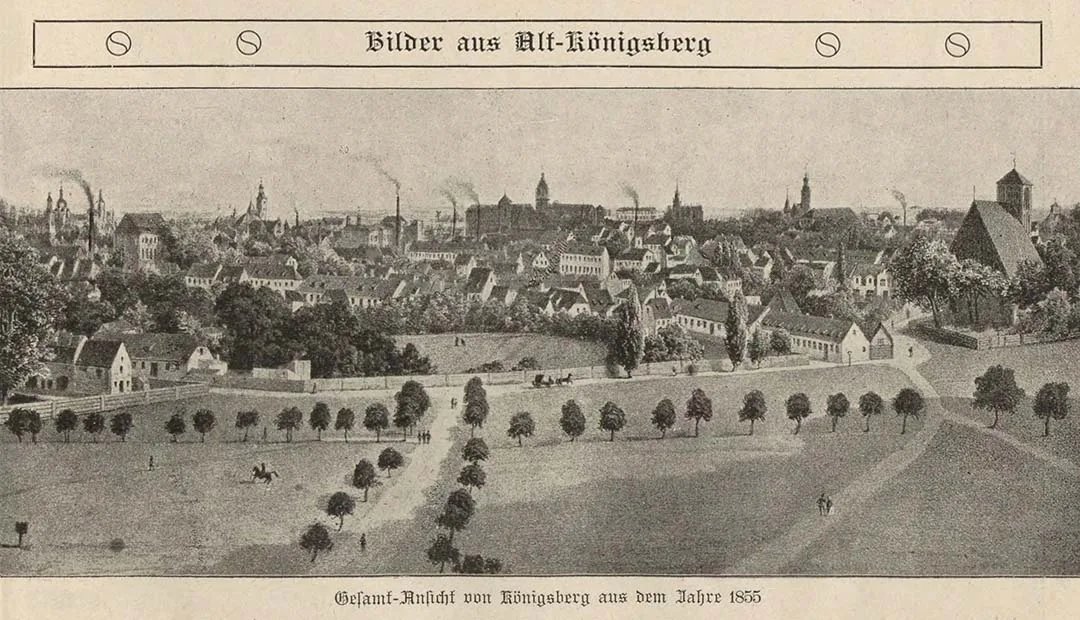
The distant city on the Pregel promises everyone who visits it for the first time a great variety of impressions. This royal city on seven hills, with seven gates and seven bridges, spreading wide on both banks of the river, looks most impressive. All seventeen of its towers, no two alike, and the Royal Palace on Castle Hill, built in the days of the Order, are the striking landmarks of the cityscape.
Königsberg stretches in a broad half-arc from the lush meadows along the Pregel to the wooded hills with the observatory upon them — a monument in his own lifetime which the great astronomer Bessel1 erected to himself.
If you come to this northern metropolis from the neat modern towns of Germany, you will at once sense in it a certain Nordic heaviness and even a certain austerity.
But if you stay here for a long time, you will learn to value the inner composure, the business sense and the industriousness of the locals, as well as their far greater warmth than one might suppose on first acquaintance. This is exactly what happens to most travellers, especially when they come here from the south.
It is difficult to form a complete picture of Königsberg. This mass of houses scattered over the hills hints at the former imperial glory of the city on the Pregel. In many other Prussian towns that glory has long since faded, dissolving in the bustle of the modern world. But not in Königsberg.
Kneiphof, the island in the city centre encircled by the arms of the Pregel, the market of the Altstadt, the Old Castle, Löbenicht, the venerable Cathedral... All of them still bear the centuries-old stamp of former greatness and still astonish with their unique medieval architecture. Most of the streets here are still lined with houses whose pointed roofs resemble nightcaps. One house leans towards another and peers curiously into its windows.
It must be said that in many of its features Königsberg has a decidedly old-fashioned bourgeois character, which it will probably lose very soon. The railway recently laid here is drawing the city on the Pregel into the great bustle of the Empire, and then of the whole world. The Brandenburg Gate has become an imposing western entrance to the city. On the famous Philosophers' Dam, a large meadow adorned with greenery, rise the stately buildings of the railway station. Königsberg has only one railway station, but precisely for that reason it has no equal either in size or in beauty.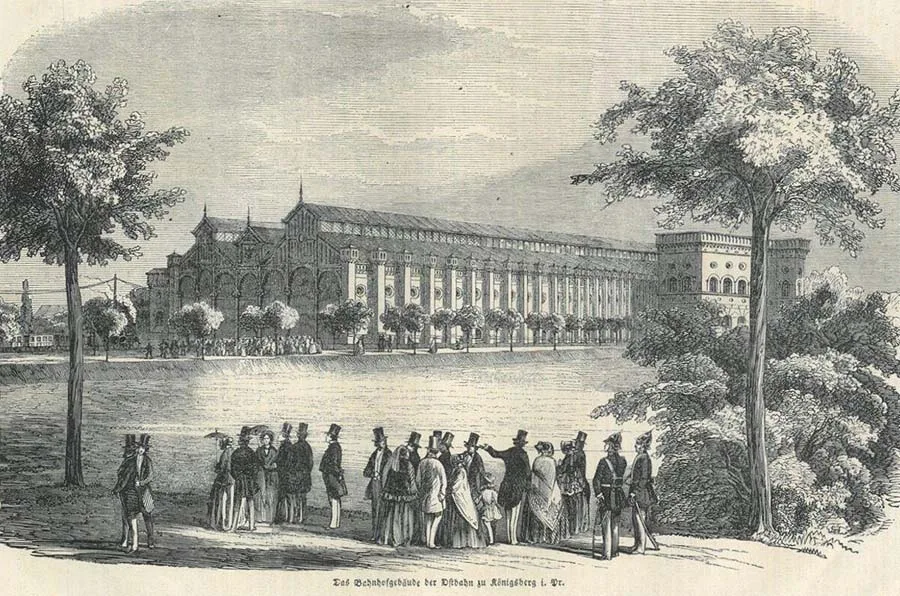
The station district, once one of the most deserted parts of Königsberg, now teems with traffic.
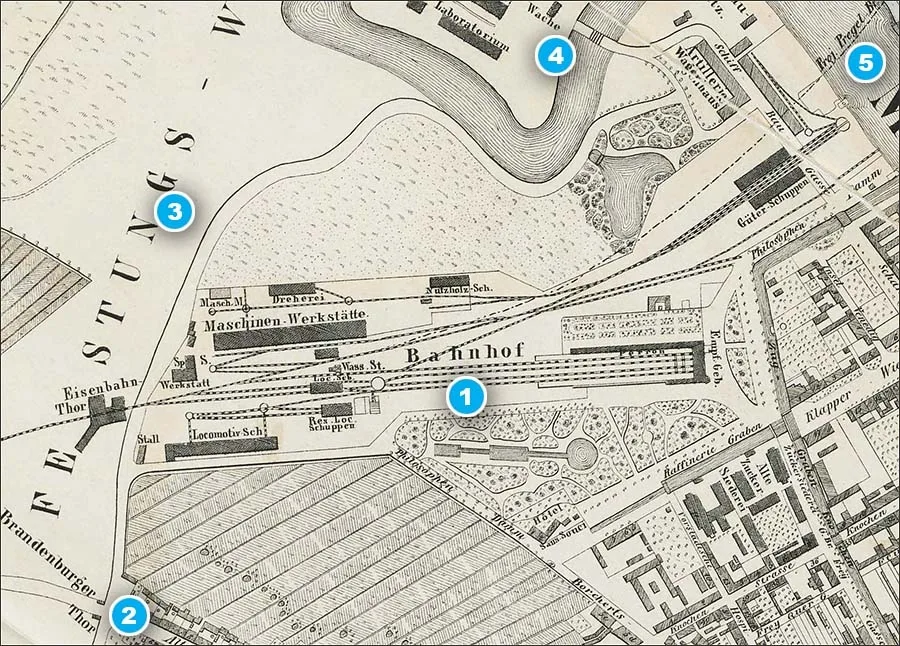 1. Railway station; 2. Brandenburg Gate; 3. City rampart; 4. Friedrichsburg Gate; 5. Pregel.
Out of the marshland, with magical speed, splendid rows of houses, gardens and new streets have arisen. The first street the newcomer reaches is called Haberberg. At its beginning we see the statue of a man in a plumed hat, with a sword in one hand and a banner in the other. This brightly painted wooden figure is Königsberg's William Tell, the journeyman shoemaker Hans von Sagan, who, according to legend, in 1270 led the army of the Order, which had begun to retreat, to victory in the battle against the Lithuanians at Rudau. Perpendicular to Haberberg runs the aristocratic Vorstädtische Langgasse. It will lead us to the centre of Königsberg. Its magnificent perspective is overwhelming in its architectural splendour. And further on, beyond the local stock exchange, through the arch of the Green Gate, the next fine street comes into view — the Kneiphöfische Langgasse (Kneiphof Long Street). Today it is the haunt of Polish and Russian Jews, who can be seen here, so to speak, in the original.
Nearby stands the new synagogue, built in a most imposing style. From here the visitor comes out to the main artery of Königsberg life — the river Pregel. From the Green Bridge, which leads to the island of Kneiphof, there is a magnificent view. To the right of the bridge is the exchange, standing entirely on wooden piles above the river. Its façade is carried by a portico resting on Ionic columns. It would look good if its classical forms were not spoiled by a pediment resembling a grenadier's cap.
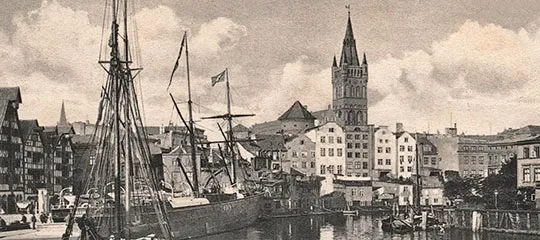
From this point one can admire the panorama of the city. From here there is a view of the port, cheerful and truly maritime: with ships whose masts fly flags, with barges and imposing warehouses on both sides of the quays, whose former plank decking has turned into stately granite paving. Here one can see all sorts of modern vessels and the clumsy flat-bottomed wittinen that come here from Russian Lithuania. They are worked by poor dzimken, those harmless, half-naked children of nature, whose appearance makes a strange contrast with our culture and way of life. Here moor the ships that bring cheeses from Elbing, and small light boats with vegetables and fruit. They are fitted with a kind of side fin, like a fish's, so as not to lose their balance on the high waves of the local lagoons in stormy weather. What craft you do not see here! Brigs and barges with one to three masts, elegant steamers which, like birds in flight, cut through the Pregel, skilfully making their way through a swarm of other, clumsier little boats, until at last, puffing heavily through their smoking funnels, they come alongside and release a crowd of happy passengers onto the shore.
How one longs, some day, to join these lucky people on a river trip to Pillau and across the lagoon!
The journey to Pillau — the only one the great Kant ever undertook in his life — was once tiring and dull. People travelled there by post coach overland or by paddle steamer across the lagoon. But now it is one of the most tempting destinations for those who would like to get out of Königsberg for a little while.
But we stay in the city and pass through the Green Gate, crowned with a tower, onto the most refined of all the local streets, the Kneiphöfische Langgasse, where we see buildings that recall Venetian palaces. To discover on the distant shore of the Baltic Sea such fanciful forms and lines, characteristic of buildings on the shores of the Adriatic, is in itself a marvel.
Here we see tall old-fashioned houses in the old Franconian Zopfstil2. They are finished in snow-white plaster. We see noble ladies looking out of the windows of these houses and observing passers-by through their lorgnettes. Very distinctive are the high stoops with stone steps, called "Wolme" here. They run along the street fronts from house to house. This is the good old Hanseatic style. The residents, especially the ladies, in fine weather gladly make use of these extra square feet in the Italian manner, with an ease not usual in our north. Even in winter one can see the young ladies of Kneiphof, dressed in thick quilted jackets, strolling for hours on the Wolme, which never fails to delight passers-by. How many deals and how many marriages have been concluded thanks to these charming little balconies!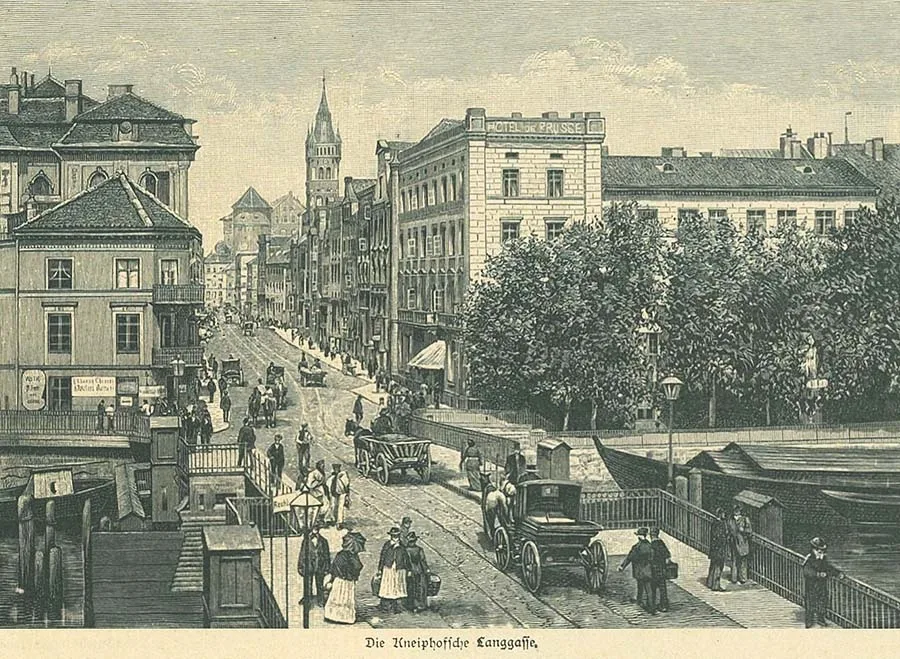
Kneiphof is an island encircled by two arms of the Pregel. Its marshy ground was first won from the river by driving piles, and then fortified with walls, towers and gates, of which not a trace remains today.
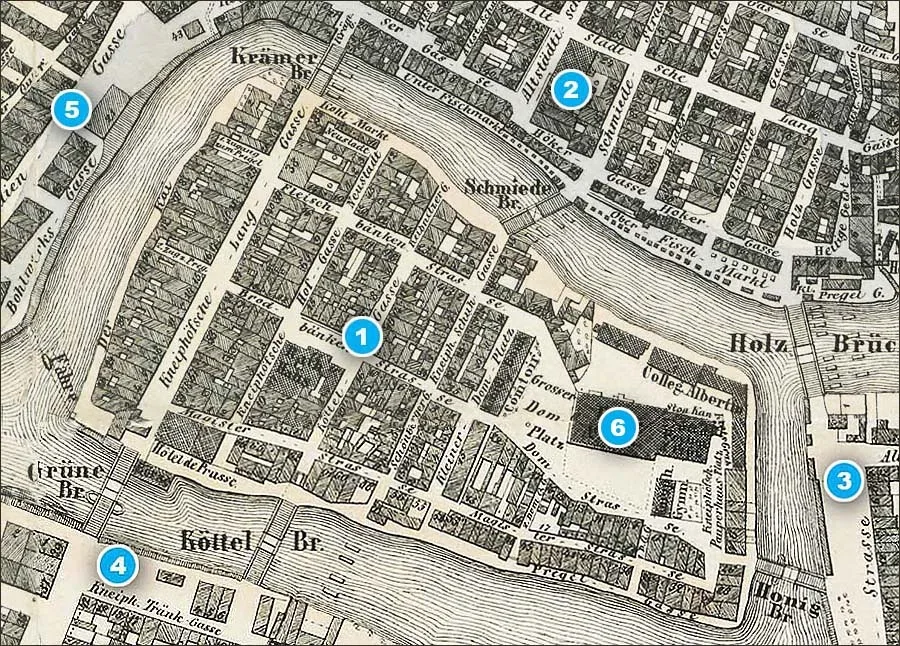 1. Kneiphof; 2. Altstadt; 3. Lomse; 4. Vorstadt; 5. Lastadie; 6. Cathedral.
Besides the grand Langgasse, the other streets here also have many old buildings, and there is the town hall with the adjoining Junkerhof — a copy of the Artushof in Danzig4, in whose spacious hall student balls are regularly held.
Not far from here is Cathedral Square, above which the city's principal church proudly rises with its tall tower. It astonishes with its interiors, the height of its vaults, its beautiful columns and its majestic great organ with five thousand pipes. In the burial chapel, separated from the choir by an iron grille, the tombs of the grand masters lie beneath three vaults, and above them rises the stone effigy of Duke Albrecht. He is shown lying life-size together with his wife. On the outer north side is the former professors' vault, called the Stoa Kantiana5, since Kant was buried here in 1804. A bust of Kant by Schadow6 adorns the great hall of the neighbouring university building.
Inside the nave of the Cathedral one can see a rare wealth of excellent wood carving. The carving of the oak confessionals and the canons' stalls is particularly magnificent.
Adjoining this venerable cathedral are the university buildings — the lecture halls of the Albertina, which, leaving aside the institutions of higher learning in England, is one of the best universities in the world. Then again, for the cumbersomeness and dilapidation of its buildings, the University of Königsberg would also be hard to match. Take, for example, the two decrepit stone portals leading into the university courtyard, on which pious Latin inscriptions can barely be read. These portals have the ascetic character of gloomy monastic colleges and in no way suggest the generosity of the university's founder and his successors. However, the foundations of a new university building have already been laid and consecrated by the hand of the King. Perhaps the hour is not far off when the Muses of Königsberg will cast off their beggars' rags and appear before the world in new garments.
Across the Shop Bridge and the Smiths' Bridge one can cross from Kneiphof into the Altstadt, whose narrow winding main street leads to a cosy park laid out beside the local church.
It is known among the locals as the "Muckergarten". In the background a row of houses can be seen, above which the south wing of the castle rises picturesquely. The inner courtyard of the castle can be reached by climbing a steep hill. The eventful history of Königsberg Castle is reflected in the variety of its architectural styles. Five past centuries have left their mark on it.
Thus half of the north wing has survived in its original form from the time of the Teutonic Order and dates from the middle of the 14th century.
The east wing is believed to have been built under Duke Albrecht in the 1530s. The new wing in the south-east corner was built in the time of the luxury-loving King Frederick I, and the west wing under Margrave George Frederick at the end of the 16th century. It houses the castle church, whose premises are strikingly democratic: in the vaults beneath it there is a huge wine cellar, and above the vaulted ceiling of the nave is the spacious Hall of the Muscovites, intended for balls and celebrations. It is larger than the famous Gürzenich in Cologne7.
The north wing houses the premises of the tribunal and the high court (hence the bundles of fasces depicted on both sides of the entrance). There are also the secret archive, the coin collection, the school of crafts, the "Prussia" hall and the hall of the German Society.
Above the main gate on the east side is the hall of the Physical-Economic Society (Physikalisch-Ökonomische Gesellschaft), with a large standard clock by the window. The members of the royal government, the consistory and the Lord Lieutenant (Oberpräsident) occupy the east wing and part of the south wing.
On the third floor of the east wing are the rooms for accommodating members of the royal family. 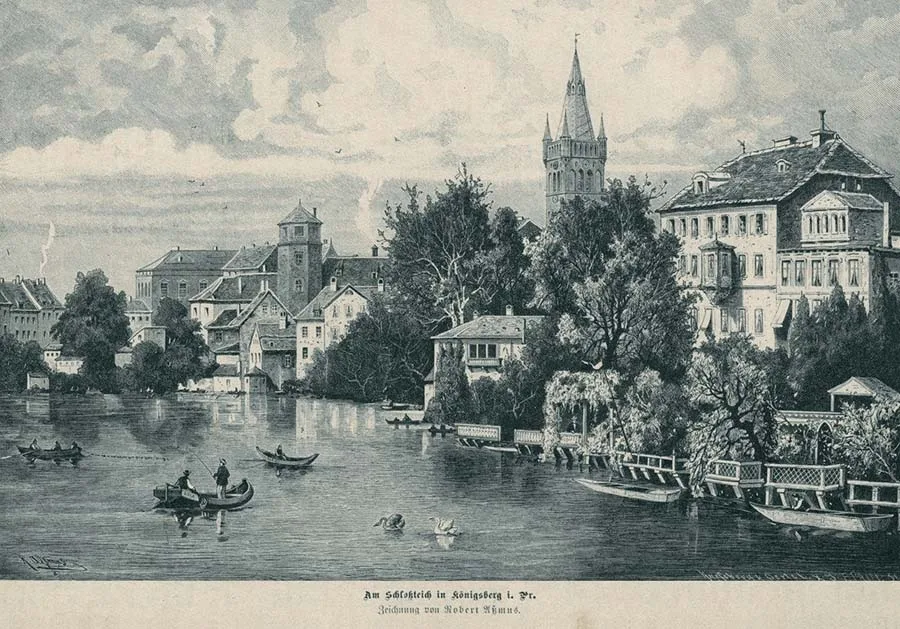
These moss-covered stone walls have many times looked down upon the most important events of world history.
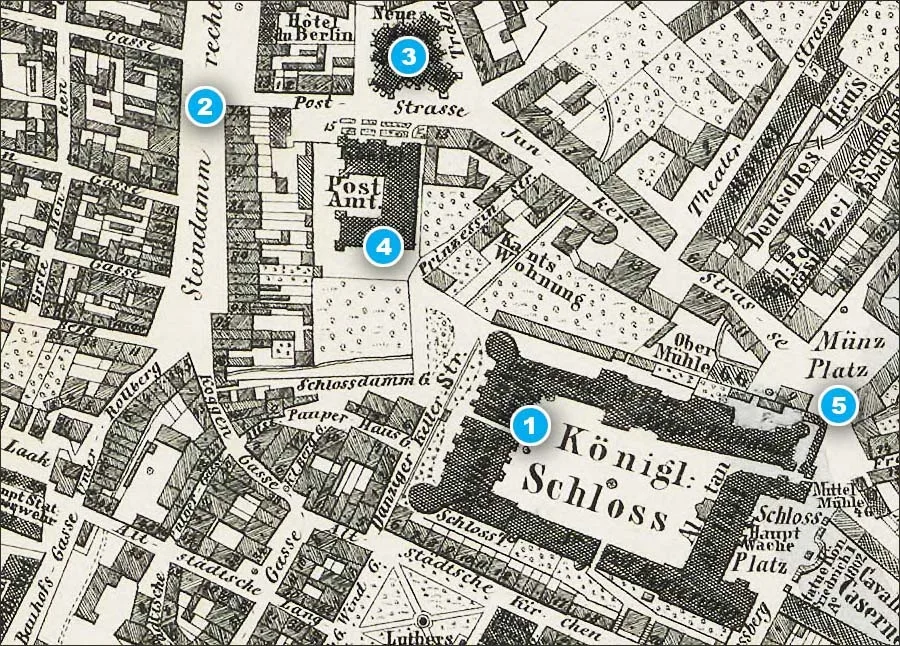 1. Castle; 2. Steindamm; 3. New Altstadt Church; 4. Post Office; 5. Münzplatz (Mint Square).
Here an unfortunate, dim-witted duke, having asked the haughty nobles for money to buy a new doublet, received from them the insolent reply that a sovereign, too, could wear patched clothes.
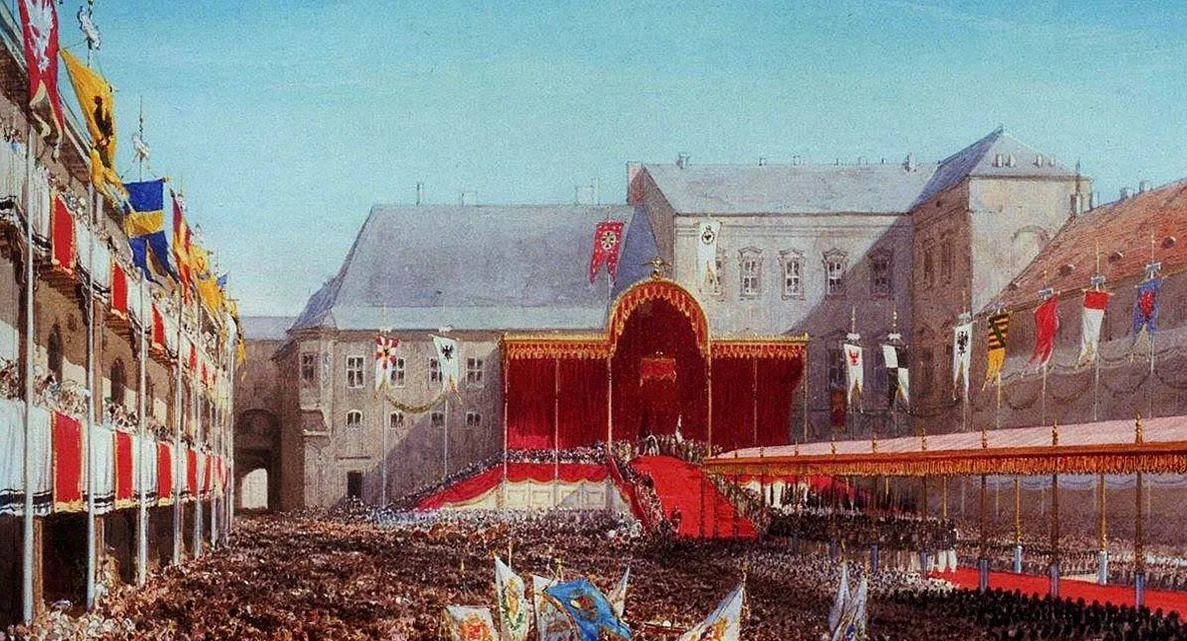
Here the first King of Prussia was crowned and the first knight of the Order of the Black Eagle was invested.
Here, in the Hall of the Muscovites, named so in his honour, Peter the Great gave feasts. During the Seven Years' War the Russian generals Panin, Korff, Saltykov and Suvorov looked out of the windows of this castle as governors of the conquered province8.
In these rooms the unforgettable Queen Louise shed tears in the fateful year 1807, and the simple clavier at which she sought consolation in hours of suffering and anguish can still be seen here today.
In this building in 1808 the great work of political reform was accomplished — the municipal ordinance of the three towns of Königsberg — the achievement of our glorious statesmen Stein, Schön and Altenstein (Stein, Schön und Altenstein).
From a window of these lofty chambers, on 13 June 1811, Napoleon reviewed the proud regiments of the Grande Armée hurrying towards the Niemen. Behind the French commander one could see the head of his Mameluke Roustam. A thousandfold Vive L'Empereur! thundered in the air, and the sun cast glittering golden rays on the victorious eagles of the legion of the French Guard.
But half a year passed, and King Murat, in his fantastic colourful costume that looked like fancy dress, a hunted fugitive, watched the remnants of the magnificent army, wrapped in rags, marching hastily past — for haste was a matter of life and death! Meanwhile, in the next room, Stein, Schön and Auerswald (Stein, Schön und Auerswald) were discussing the details of the popular uprising.
From the spacious gallery of the 200-foot corner tower one can see more land than belongs to many German princes who have a vote in the Bundestag.
At eleven in the morning and at nine in the evening a pious chorale rings out over the city from the gallery of the tower, which to many devout hearts may seem more pleasing than famous classical melodies.
The local wine cellar has won enormous fame. Anyone who wishes to become acquainted with its wines should apply to the manager of the so-called "Blutgericht" (Blood Court), the wine restaurant in the cellar beneath the north wing of the castle. He will be offered, with the greatest willingness, a choice of all the treasures of the famous wine collection, listed in a splendid catalogue.
Should the guest of this wine establishment wish to pursue his researches beneath the vaults of the deep cellar among huge casks casting Rembrandtesque shadows, he should go there, to the "Torture Chambers", from which this "Blood Court" took its name.
Königsberg Castle is impressive in its size. All the more so because it stands high, on a hill which is practically the centre of the city. In winter, when Königsberg switches to a regime of snow and ice, climbing up to the castle can be difficult, and many a bold conqueror of summits now and then slides back down the steep slope.
Undoubtedly, the surroundings are very impressive too. On one side rises the east wing of the castle with its old-fashioned decorated gateway portal and the guardhouse in the middle. Opposite it, among tall buildings, are the royal stables, now used by the cuirassier staff. Their courtyard is enclosed by a wall with lattice insets and trophies. In front of this wall, on a marble pedestal, rises a metal statue of Frederick I by Schlüter9. It is crowned by the Prussian eagle and the motto of the rulers of Prussia — Suum Cuique10.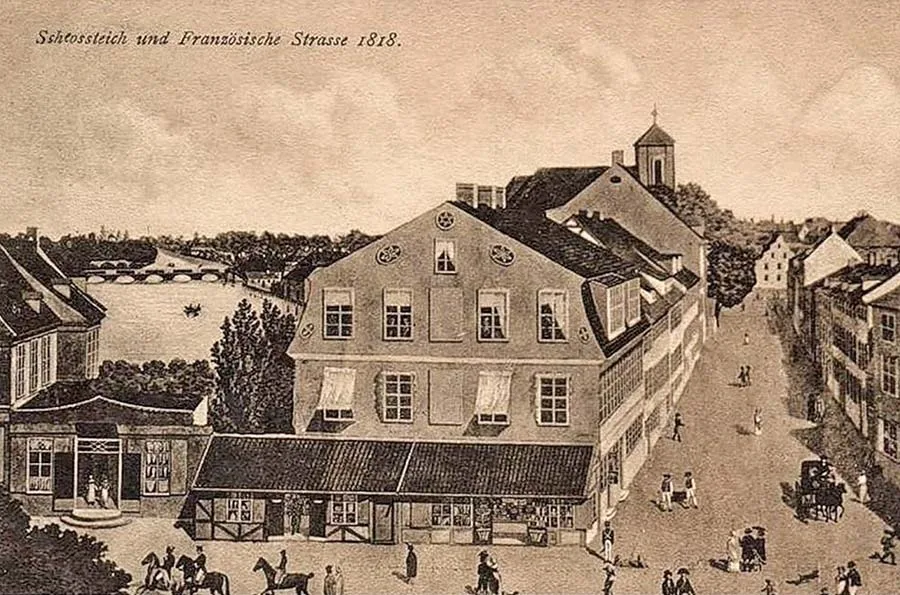
From here there is a magnificent view of the elegant Französische Straße (French Street) with its smart shops.
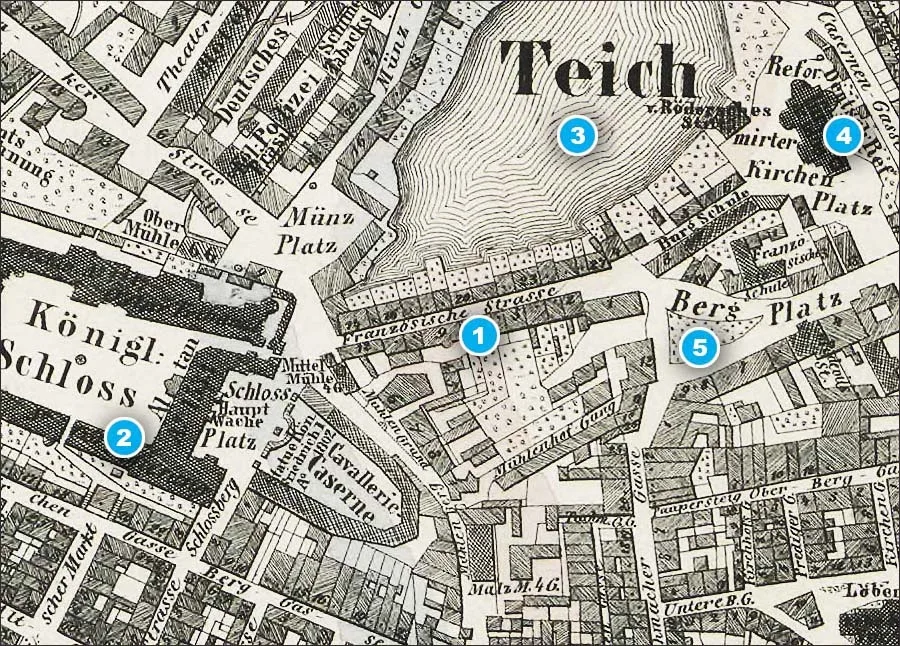 1. Französische Straße; 2. Castle; 3. Castle Pond; 4. Burgkirche; 5. Bergplatz.
Next to the castle the Altstadt market spreads out picturesquely, enclosed on three sides by tall pointed houses with balcony-like stoops and old projecting bays. Among them stands out the town hall (now the court building) with a stone-carved head beneath the tower clock, called the Japper, which mockingly sticks out its tongue at every stroke of the bell. An excellent backdrop to this city sight is provided by Pomatti's court confectionery, with a statue of Frederick William I in a niche, and by Castle Hill towering above the city.
At the eastern foot of Castle Hill lies another old district of the city — Löbenicht, whose main streets still breathe a sombre Hanseatic solidity. Seven-storey gabled houses look at one another like neighbours and seem, like respectable gossips, to discuss their joys and sorrows among themselves. Between them run many narrow lanes, called here "cat paths".
Along the Löbenichtsche Langgasse (Löbenicht Long Street) heavy beer wagons rumble past every now and then, for this is where the famous and wealthy Königsberg brewers live, called in the local dialect "Mälzenbräuer" — "malt brewers". Löbenicht beer has as first-class a reputation in Prussia as Bavarian beer. This district is home to the famous beer cellars of Königsberg: Schumacher's "Tunnel" on Castle Hill, the very popular "Gambrinus Hall", and, up on the Löbenicht hill, the modern "Phoenix Hall".
This whole neighbourhood pleasantly tickles our nostrils with the fresh smell of beer.
From Löbenicht it is easy to get to Sackheim. However, this extensive district of the city on the whole offers nothing of interest. Worth mentioning is the Catholic church, which, with its dome and richly decorated façade, looks most majestic. Next to the Sackheim Gate are three charitable institutions for the afflicted: the Bülow Institute for the Blind, the Home for the Deaf and Dumb, and the Orphanage. On the long Königstraße (King Street), a gilded inscription on a large, recently built building informs the traveller not unacquainted with Latin that this is the home of the museum and the Academy of Arts.
The museum's halls display the collection of paintings of the Königsberg Art Association, as well as a collection of plaster casts provided by Rauch11 and Tieck12. They were made mainly from antique sculptures in the collection of the Dresden Augusteum. In front of the museum rises an obelisk which the Province of East and West Prussia erected in 1842 to its former president, Minister of State von Schön13, when he left the state service. Nearby is the Royal Library, numbering about 100,000 volumes, including many manuscripts and incunabula. If not for its content (most of the books in it are old theological works), then at least for the precious metal of its bindings this collection is unique — it is known here as the Silver Library. These pious books were clad in silver by order of Duke Albrecht.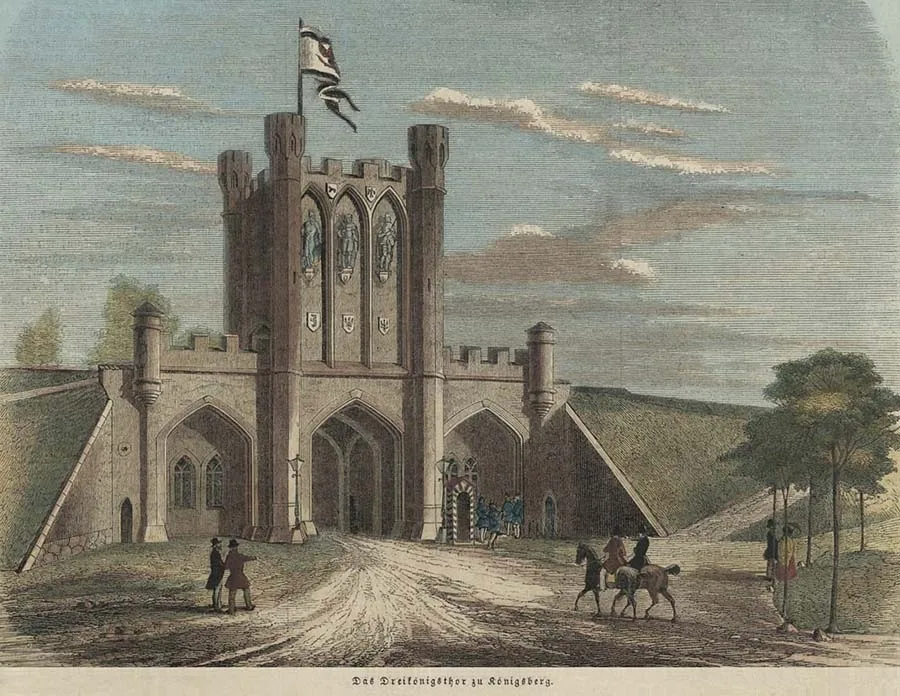
Rossgarten is just as broad and cosy a street as Königstraße. It is inhabited mainly by the Königsberg aristocracy.
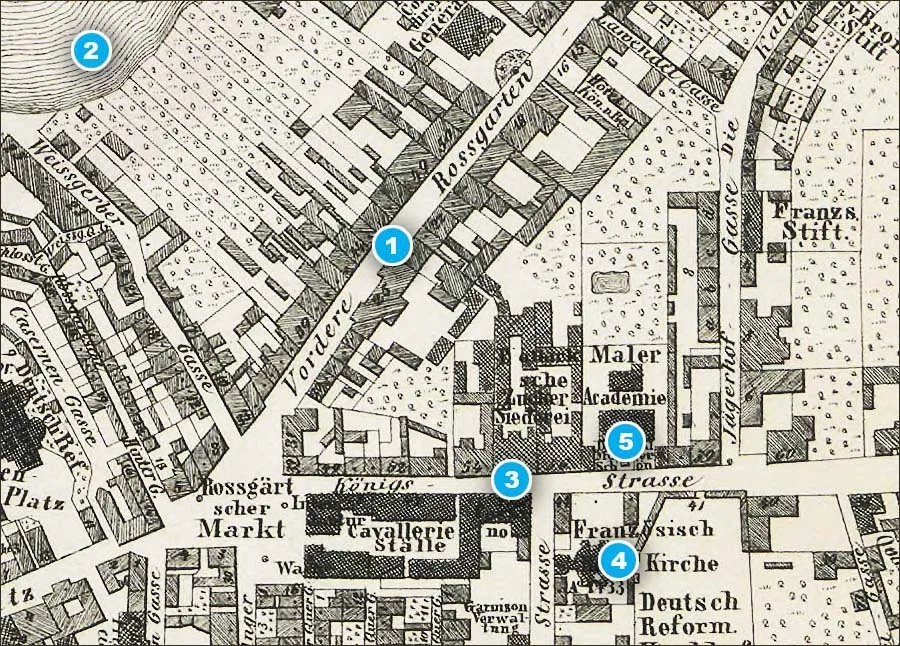 1. Rossgarten; 2. Castle Pond; 3. Königstraße; 4. French Church; 5. Academy of Arts.
However, before you see the end points of these streets — the King's Gate and the Rossgarten Gate — both of them lose their lustre in a succession of nondescript and sometimes poor houses. Thus one can walk along these streets observing life, so to speak, along ascending and descending trajectories.
Among the longest and most spacious streets of the city is also the Steindamm, which has a truly bourgeois character. At the beginning of the Steindamm, Poststraße (Post Street) leads us to two modern buildings. The new post office is undoubtedly one of the most beautiful in the whole city. It was designed in the Neo-Romanesque style16 and looks particularly impressive when seen from the inner courtyard, where the building forms a large open square with two wings. A clock with a transparent dial shows passers-by the exact time at any hour of the day or night. But the New Altstadt Church, standing further along at an angle, is certainly no masterpiece of Schinkel17. This Neo-Gothic building seems to be a fragment of some architectural jungle. The exterior of the church raises many questions, but the interior even more. Apart from the portal façade with its tall pointed-arch window, the whole architecture of the building consists of restless, tangled forms and unfortunate combinations in which the shape of the cross is hard to make out. The mighty buttresses are a mystery to us: they seem to have been built for their own sake. And inside, behind the multitude of columns, one cannot see what actually matters most…
Beyond the Steindamm Gate lie the so-called Hufen, where the wealthiest city patricians rest from the burden of their cares in their luxurious summer residences. There is no shortage here of places of entertainment or ornamental parks. The local cemetery holds the grave of Hippel14 and also the resting place of the great astronomer Bessel. Here in the Hufen is the former Busolt garden15, in which the Prussian royal family found refuge in the ill-fated years 1807–1809.
A brilliant future awaits the Parade Square (or King's Garden), whose centre is adorned by the equestrian statue of Frederick William III. Here, on the site of the present riding hall, the modern buildings of the university are to be erected. The bronze equestrian statue by Kiss18, unveiled on 3 August 1851, is another monumental ornament of Königsberg. The pedestal and base of polished granite are 43 feet high. The horse on which the monarch sits is shown at rest, only its right front hoof raised impatiently in the air. The King is portrayed with a striking likeness; the rider's hands grip the reins firmly. A cloak falls in a broad wave from his right shoulder. In its picturesque folds it conceals the aesthetic awkwardness of the general's uniform. His head is adorned with a laurel wreath. The pedestal is divided into six parts by allegorical figures. The four at the corners are Faith, Justice, Love and Truth, and in the middle of the two long sides are Borussia19 and Abundantia20. On the front side is a tablet on which, beneath an eagle in a laurel wreath, one can read the inscription: "To King Frederick William III. The grateful inhabitants of Prussia. 1841"21. The reliefs depict scenes from the King's life and allegorical figures. The historical accuracy with which the King's attire and likeness are rendered deserves every admiration22.
But just as unprepossessing as the exterior of the present university — the temple of science in Königsberg — is the wretched appearance of its temple of art, the drama theatre.
Seen from three sides, the theatre looks very intriguing: all one can see are long walls covered by a roof, without any windows, as with the Chinese. The stone steps of the main entrance lead into a vestibule with columns, from which three doors open into the interior. But the interior can boldly compete with the most beautiful theatre halls and exceeds the drama theatre in Berlin in size. The highlight of the interior decoration is a chandelier with two hundred gas burners, which once hung in the hall of the Berlin Treubund23. The chandelier lights a huge auditorium for 1,800 spectators. Incidentally, the history of the Königsberg theatre is extremely interesting. For a long time it was run by directors known throughout Germany. First and foremost one must mention the famous August von Kotzebue24, who did a great deal for the development of German drama and opera and who ended his days so dramatically.
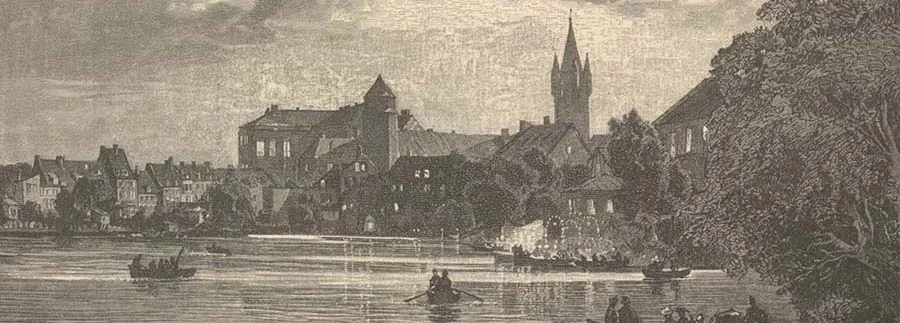
The area of the Castle Pond is enchanting. It is a true Lago Maggiore for Königsberg with its genuinely northern climate. On all sides the water is surrounded by terraced gardens. By the bridge stands Hartung's new palace25, and a little to the right the stately buildings on Münzstraße and Französische Straße. Above them the castle's Haberturm (Oat Tower) rises picturesquely. The banks of the wide pond, densely overgrown with shrubs and trees, the pavilions, summerhouses and arbours surrounding the water and reflected in it — all this makes an unforgettable impression.
On warm summer evenings the Castle Pond teems with gondolas and boats until late at night, and though our gondoliers do not sing songs from Torquato Tasso26 like their Venetian colleagues, merry student songs, full-voiced male choirs and the strumming of guitar strings ring out here over the water. The pond is a truly fairy-tale sight when the bridge and the surrounding gardens are brightly lit, holidaymakers stroll along them, and the melodies carrying over the neighbourhood awaken the echo that has slumbered until then.
Beyond the remote Friedland Gate the road runs past junk dealers' shops and warehouses to the Ochsenmarkt (Ox Market) and the Lindenstraße (Linden Street), where Simon Dach lived, the poet and author of the famous "Ännchen von Tharau"27. These streets are shady avenues; the houses here are rich and solid, like large polished money chests: for here, in a quiet part of the city, several of the best-known merchants and bankers live in comfortable seclusion. The extensive cattle market on the edge of this area looks like a small East Prussian provincial town, which often consists of nothing but a square market place.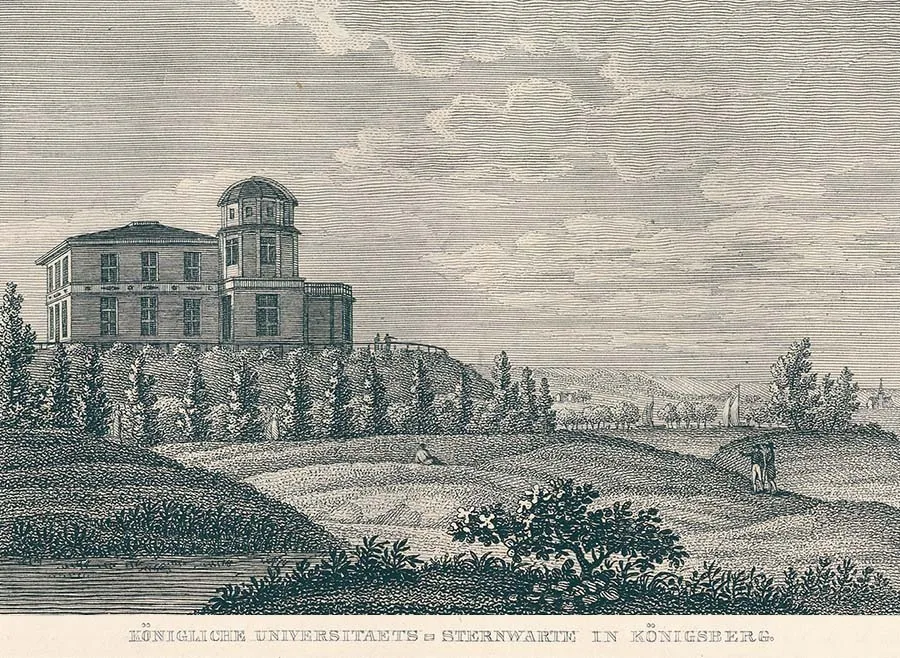
In the opposite part of the city, in very pleasant surroundings, are the Botanical Garden, the Zoological Museum, the Anatomical Theatre and the Observatory.
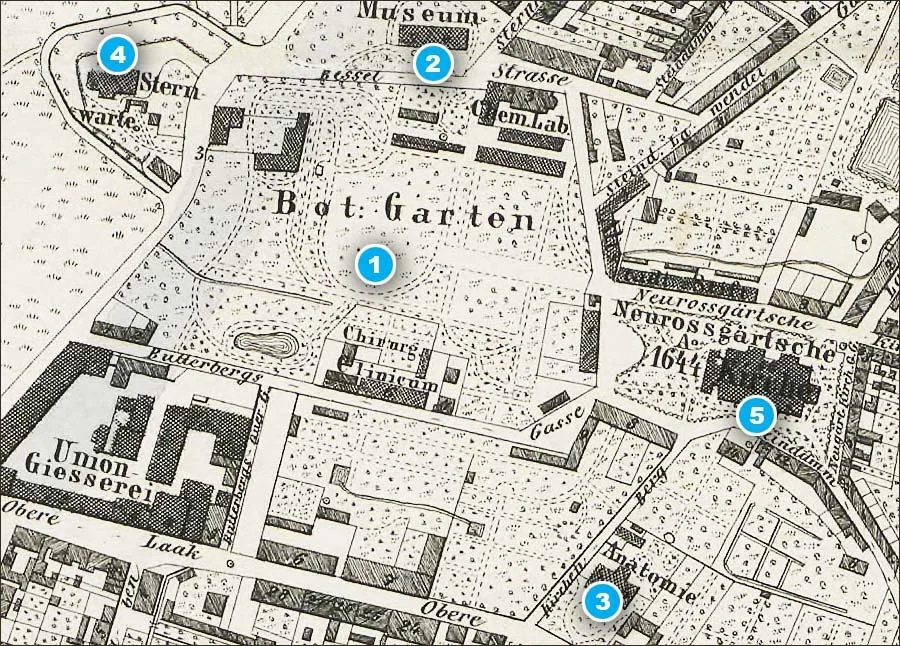 1. Botanical Garden; 2. Zoological Museum; 3. Anatomical Theatre; 4. Observatory; 5. New Rossgarten Church.
Let us look into the Botanical Garden. Other botanical gardens may surpass Königsberg's in the richness of their collections, yet it hardly yields to them in the systematic arrangement of its holdings and the gentle charm of its grounds.
The vista opening between two lovely hills is very picturesque and gives us a view of the city harbour, the Pregel and the green plain stretching to the very horizon. The house of the garden's director, entwined with vines, looks idyllic and graceful, like the dwelling of some dryad.
Leaving the botanical garden by its side gate, we see the stately façade of a building in the modern style, surrounded by a dense group of trees and shrubs. This is the Zoological Museum. Everything God created on the fifth day of Creation is represented here almost completely, in peaceful proximity to one another.
Not far from here, on a garden terrace, stands the famous Königsberg Observatory, whose observations, when it was still headed by Bessel, were a kind of astronomical Gospel for all the observatories of the world. It is distinguished not only by the solid exterior construction of the building but also by its well-considered location at the highest point of the city, from which one can see the Pregel in all its bends right down to the lagoon, on whose shores pastoral landscapes spread out with lush meadows, woods, dairy farms and villages.
Otherwise Königsberg is poor in monumental and architectural ornaments. But ever since the recently built railway connected this remote city in the east with the rest of the country, a real building boom has set in here: the number of new houses is growing, and the city quarters are changing their character. Yet beauty and style have very little to do with these newly erected buildings, although what applies to the arts and sciences in general applies no less to architecture. But in this field, purely ideal in its innermost nature, contemptible materialism has won dominance in our industrial age.
The building firms in Königsberg are no exception to the general rule. They want to build cheaply, using the available capital to the utmost.
Elegance and beauty are not taken into account at all: the main emphasis is on what is practical and profitable. The new buildings here are, as a rule, as alike as twins. In these monotonous boxes, piling storey upon storey like Noah's Ark in the Old Testament, one very rarely finds traces of an original style: these are buildings with an invisible but unmistakable inscription, "Money wanted!"
But soon Königsberg will receive, as an ornament to the city, a monument to the great Königsberg philosopher Kant. Since a statue of Duke Albrecht will stand in front of the new university building, his native city will erect the bronze statue of one of its greatest fellow citizens on the square near the Altstadt church in the centre of Königsberg. We owe this idea to the man who at present holds Kant's chair at the Albertina — Professor Rosenkranz28. Although the funds collected for erecting this monument, including His Majesty the King's donation of 800 thalers, already amount to 9,000 thalers, another 4,000 thalers must still be raised for the pedestal. However, not all donations have come in yet. Let us hope for the best. The 9-foot statue has already been made in plaster by Rauch11 and is to be cast in metal in Silesia.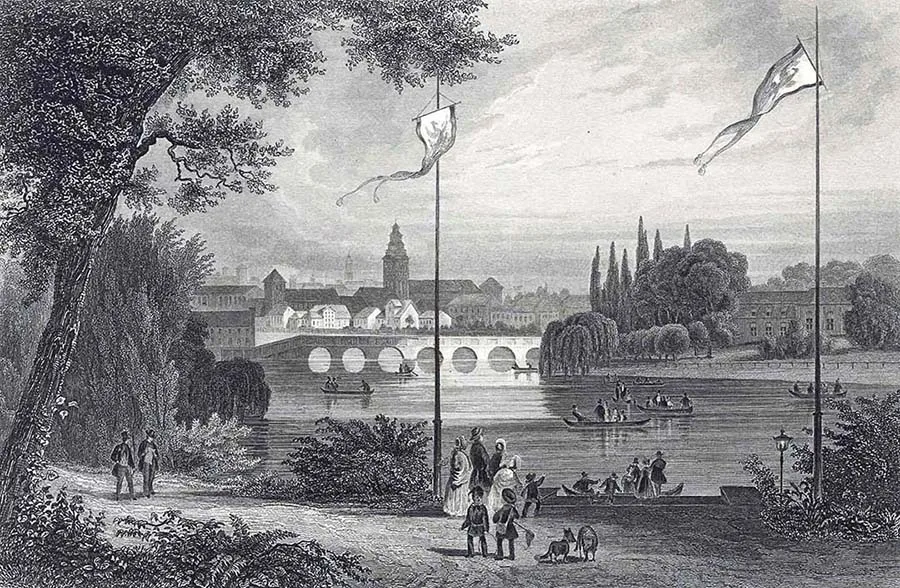
Worthy in every respect are the new fortifications around the city, and one should not miss the opportunity to stroll along the earthen embankment of the rampart.
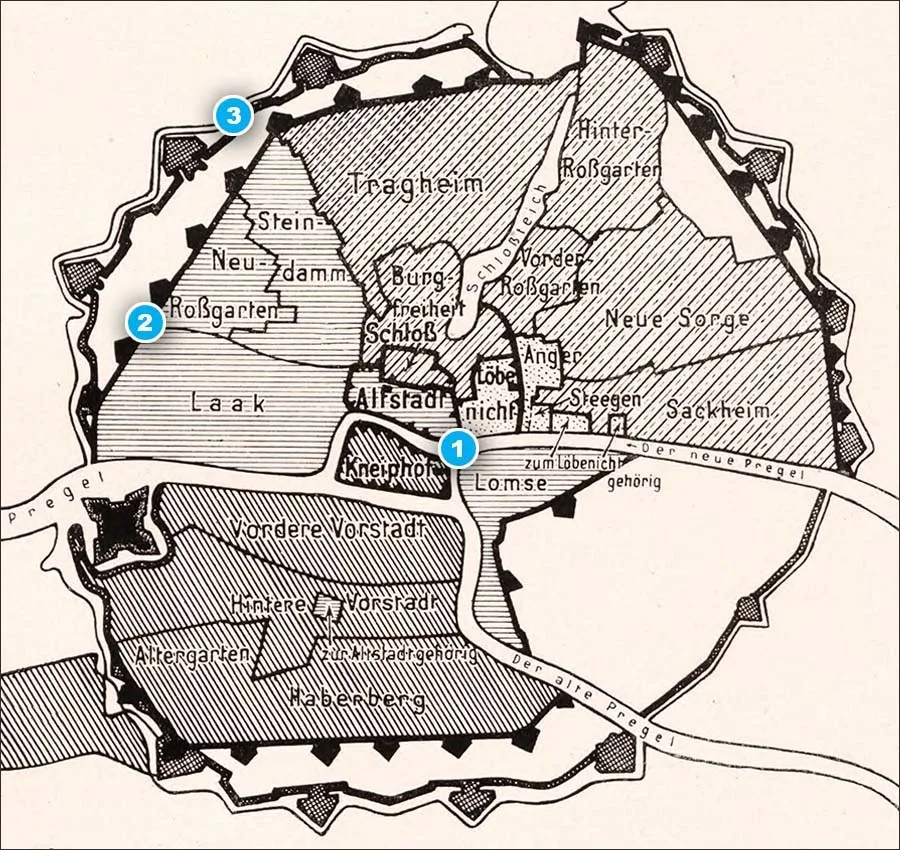 Three lines of Königsberg's fortifications from different eras: 1. Medieval, when each of the three towns on the Pregel had its own city walls; 2. The first common rampart ring of the 17th century; 3. The second rampart ring, built in the middle of the 19th century.
Even a single cursory glance at the scale of construction of this bastioned defensive system should give the stranger an idea of the millions that have already been spent on it and that will still be needed. This stone belt of defence girds the city ever more tightly. Admirable are the four sluice dams which regulate the water conduits laid for fortification purposes.
The Grolman Bastion and the defensive barracks on the parade ground, named Herzogsacker — "the Duke's Field" — after the place where it was built [today the Kronprinz barracks], are the main fortifications between the King's Gate and the Rossgarten Gate29.
The central reduit30 of the Grolman Bastion, with its open layout, its beautifully executed stone base, its stately arched windows and the airy gallery running from wing to wing above the flat bombproof roof, looks like a real palace.
Opposite stands the Herzogsacker (Duke's Field) defensive barracks [today the Kronprinz barracks], with its truly Cyclopean masonry and countless gun embrasures. It lies at the threshold of the city like a fearsome sphinx with a hundred keen eyes glaring menacingly in every direction.
The King's Gate, built in the pseudo-Gothic style and rising above the fortress wall, recalls Stolzenfels Castle31 with its projecting oriels and other ornaments of the outer wall.
In the niches of the second tier stand three statues: King Ottokar of Bohemia32, King Frederick I of Prussia and Duke Albrecht33. They were carved in sandstone by the sculptor Stürmer34.
The Sackheim Gate is impressive in its might. It serves as a monument to the brave Ludwig Yorck35, who arrived here with his army corps in 1813, and to the noble Baron Bülow von Dennewitz36. Both portraits are executed as medallions at the sides of the gate's arch.
The Rossgarten Gate is built so elegantly that its status as a fortification is not obvious. The pediment of the gate is adorned with sandstone medallions bearing portraits of two very famous heroes of the Napoleonic Wars, namely Scharnhorst39 and Gneisenau40. About 50 paces from the gate stands the Dohna Tower, a massive structure adorning the shore of the Upper Pond41. On the opposite shore its twin tower, bearing the name of Wrangel42, rises martially.
Thanks to these fortifications Königsberg can, like legendary Troy in its time, withstand a siege lasting many years.
LEGENDS OF PRUSSIA on the blog of Tatyana Kolivay.
TRANSLATOR'S NOTE
1. Friedrich Wilhelm Bessel (1784–1846) — German mathematician and astronomer, a pupil of Carl Friedrich Gauss. Foreign Member of the Royal Society of London (1825), of the Paris Academy of Sciences (1840; corresponding member from 1816), honorary member of the St Petersburg Academy of Sciences (1814). Wikipedia
2. Zopfstil (German, from Zopf — pigtail) — a historical and regional artistic style that spread in Germany and Austria in the second half of the 18th century. The somewhat ironic name arose from the fashion of the time for men's wigs with short pigtails at the Austrian court of Emperor Joseph II (1765–1790). In Austria-Hungary the Zopf style replaced the Austrian, or Viennese, Rococo of the reign of Empress Maria Theresa (1741–1780). Wikipedia.
3. In Russian this term usually denotes low-lying strips of the seashore exposed to high tides or wind-driven surges of seawater. Gosen-Neu Zittau is a municipality in the Oder-Spree district in the state of Brandenburg. It lies in the Spree valley, not far from the Oder-Spree Canal.
4. Artus Court (Polish Dwór Artusa; German Artushof; formerly also Junkerhof) — a building in the centre of Gdańsk which used to be the meeting place of the merchants. The name was taken from the very popular medieval legend of King Arthur, the symbol of chivalry and gallantry. First in Great Britain and France, and then in other European countries, houses where knights and aristocrats gathered were named after him. The most famous was the Artushof in Danzig. Wikipedia
5. Literally "Kant's Portico". Stoa (Greek Στοά — "portico") — in ancient architecture, a long portico gallery, usually with one or two rows of columns and a wall along one of the long sides; a covered colonnade.
6. Johann Gottfried Schadow (1764–1850) — German sculptor, teacher and art theorist. A representative of academic Classicism. He was the founder and one of the leading representatives of the Berlin Classicist school of sculpture of the early 19th century, so-called Prussian Hellenism. Wikipedia
7. The Gürzenich was built between 1441 and 1447 on land belonging to the Gürzenich family as a civic hall for festivities. The exterior of the building is in the classic Late Gothic style. In the ballroom on the upper floor honoured guests of Cologne were received, emperors, princes and burghers held their celebrations, and coronation ceremonies, court sessions and sittings of the Reichstag took place. In the 17th century it functioned solely as a trading house. Around 1820 the tradition of the medieval hall for festive occasions was revived.
8. V. I. Suvorov, the father of the great military commander, was governor of East Prussia in 1760–61. Neither S. F. Apraksin nor von Sass was ever governor of East Prussia.
9. Andreas Schlüter (1634–1714) — German sculptor and architect, a leading representative of the North German Baroque. In 1697 Schlüter created a bronze statue of Elector Frederick III for Königsberg. In this monument Schlüter appears as an apologist of the military might and absolutism of the Prussian monarchy. In the statue of the Great Elector he sought to create the image of a formidable and wise ruler. Clad in antique garments, in a luxuriant wig, the ruler of Prussia sits solemnly on a slowly pacing horse. The pedestal of the monument is decorated with large ornamental volutes and four figures of chained captives symbolising the different temperaments and the peoples subdued by the Elector. Wikipedia
10. Suum Cuique — "To each his own" /Latin/
11. Christian Daniel Rauch (1777–1857) — German sculptor of academic Classicism. Together with his teacher Johann Gottfried Schadow he was the founder and one of the leading representatives of the Berlin Classicist school of sculpture of the early 19th century, so-called Prussian Hellenism. Wikipedia
12. Christian Friedrich Tieck (1776–1851) — German sculptor of academic Classicism. Together with his teacher Johann Gottfried Schadow he was one of the leading representatives of the Berlin Classicist school of sculpture of the early 19th century, so-called Prussian Hellenism. He specialised in sculpted portraits and made a large contribution to the decoration of many buildings by the architect Karl Friedrich Schinkel. Younger brother of the well-known Romantic writer Ludwig Johann Tieck. Wikipedia
13. Heinrich Theodor von Schön (1773–1856) — Prussian statesman. Wikipedia
14. Theodor Gottlieb von Hippel (1741–1796) — German statesman, writer and critic. Burgomaster of Königsberg. Wikipedia
15. The Busolt garden was laid out by Hippel. It is named after its next owner, Busolt.
16. Round-arch style (Rundbogenstil) — see Neo-Romanesque style. Wikipedia.
17. Karl Friedrich Schinkel (1781–1841) — German architect, painter, draughtsman and stage designer. He is regarded as the leader of "Romantic historicism" in German architecture: he worked in the Neo-Gothic and Neo-Renaissance styles and was the principal representative of the architectural style of Prussian Hellenism. Schinkel's work had a profound influence on the official architecture and all the arts of his time, as a result of which a restrained classical style prevailed in the art of the Kingdom of Prussia until the middle of the 19th century. Wikipedia
18. August Kiss (German August Kiß; 1802–1865) — German sculptor.
19. Borussia — the Latin name of Prussia.
20. Abundantia — the Roman goddess of abundance and prosperity.
21. ”Ihrem König Friedrich Wilhelm III. die dankbaren Preußen. 1841”
22. More about this monument can be read in the article at this link
23. Treubund — an association founded at the end of 1848 in Berlin by people of anti-democratic leanings, supporters of a pronounced Prussianism. Originally it was called the Royalist Association, but soon after its founding, in February 1849, it came to be called the "Union for King and Fatherland". The aim of the Union was to strengthen loyalty to the King and to ensure the moral education of the people and the welfare of all citizens. Any Prussian over the age of 20 could become a member.
24. August Friedrich Ferdinand von Kotzebue (1761–1819) — German dramatist and novelist who wrote several popular plays. In his day he was even more popular than Goethe or Schiller. He held the rank of court councillor in the Russian Empire. Father of the Russian navigator O. E. Kotzebue.
25. Johann Heinrich Hartung (1699–1756) — German publisher and printing-house owner in Königsberg.
26. Torquato Tasso (1544–1595) — Italian poet of the 16th century, writer, dramatist and philosopher.
27. "Ännchen von Tharau" — a song to words by the East Prussian poet Simon Dach. It had a notable influence on the development of ideas about the German folk song in the 19th–20th centuries.
28. Johann Karl Friedrich Rosenkranz (1805–1879) — German philosopher. He was professor of philosophy, holding Kant's chair at the Albertina, the University of Königsberg. Wikipedia
29. On 5 April 1843 the project for building Königsberg's new rampart ring was approved. Construction officially began on 15 October 1843 with the ceremonial laying of the foundation stone of the defensive barracks, then named "Duke's Field" (Herzogsacker) after the site where it was built. It was later renamed Kronprinz. This defensive barracks, as its name suggests, served to house troops, and in the event of an assault on the city became a second-line fortification supporting with its fire the fronts of the Grolman Bastion lying in front of it. Almost simultaneously, the foundation stone of a second fortification was laid — the King's Gate (Königstor). Link
30. Reduit (French réduit — refuge) — an inner fortification built within closed works for fighting inside them and for strengthening their internal defence. The original purpose of a reduit was to serve as a refuge for a garrison attacked and pressed from all sides. The term also denotes any fortified point located behind the main fortifications and forming the last bastion of defence. Link
31. Stolzenfels Castle (German Schloss Stolzenfels) stands above the Koblenz district of the same name on the left bank of the Rhine, opposite the mouth of the river Lahn. The castle was built in 1242–1259 by Archbishop Arnold II of Trier as a summer residence. English Neo-Gothic had a strong influence on the Romantic style of the building. The rooms of the summer residence were decorated with valuable furniture and paintings. The most impressive room was the Knights' Hall with old armour on display. Wikipedia
32. King of Bohemia Přemysl Ottokar II (1233–1278). Duke of Austria from 6 December 1250 to 21 November 1276, King of Bohemia from 22 September 1253, Duke of Styria in 1260–1276, Duke of Carinthia and Carniola in 1269–1276, of the Přemyslid dynasty.
33. Albrecht of Brandenburg-Ansbach (German Albrecht von Brandenburg-Ansbach; 1490–1568) — the last Grand Master of the Teutonic Order and the first Duke of Prussia.
34. Wilhelm Ludwig Stürmer /Wilhelm Ludwig Stuermer/ (1812–1864). A famous German sculptor. Court sculptor to King Frederick William IV.
35. Count Johann David Ludwig Yorck von Wartenburg (German Johann David Ludwig Graf Yorck von Wartenburg; 1759–1830) — Prussian field marshal of the Napoleonic era.
36. Friedrich Wilhelm von Bülow, Count von Dennewitz (German Friedrich Wilhelm Freiherr von Bülow, Graf von Dennewitz; 1755–1816) — baron, later Count von Dennewitz (7 August 1814), Prussian General of Infantry (4 April 1814). A monument to Bülow was erected in Brandenburg in honour of the Battle of Dennewitz. A street in Sackheim bore Bülow's name (now Stekolnaya Street). In the Kaliningrad region, in the village of Roshchino, the von Bülow family estate, Grünhoff, has partly survived and is being restored. Wikipedia
37. Caponier (French caponnière) — a vaulted stone structure in the dry ditch of a fortress for enfilading fire along the ditch when repelling an assault.
38. In the Sackheim district, on the bank of the Pregel, a customs post was set up, which was named the "Lithuanian Barrier" (German Littauer Baum).
39. Gerhard Johann David von Scharnhorst (1755–1813) — a general in Prussian service from 1801. As the first chief of the Prussian General Staff, he was known for his military theories and his reforms of the Prussian army, as well as for its leadership during the Napoleonic Wars.
40. Count August Wilhelm Antonius Neidhardt von Gneisenau (German August Neidhardt von Gneisenau; 1760–1831) — Prussian military commander (field marshal) of the Napoleonic era.
41. Dohna Tower (German Dohnaturm). Named after the Prussian field marshal Friedrich Karl zu Dohna. Built in 1853. It stands on the shore of the Upper Pond. Wikipedia.
42. Wrangel Tower — historical name: Wrangelturm. Built: 1853–1859.
Translated from Russian with the help of AI (Claude, Anthropic), October 2026.