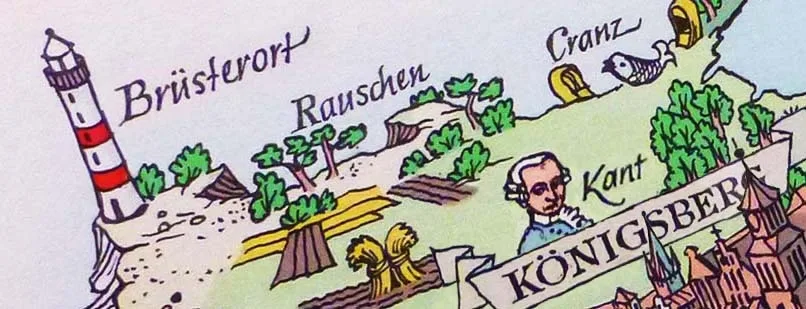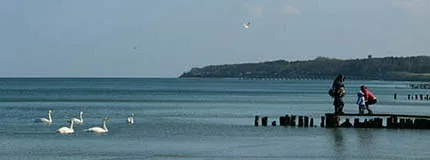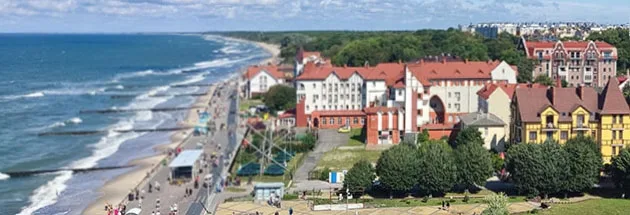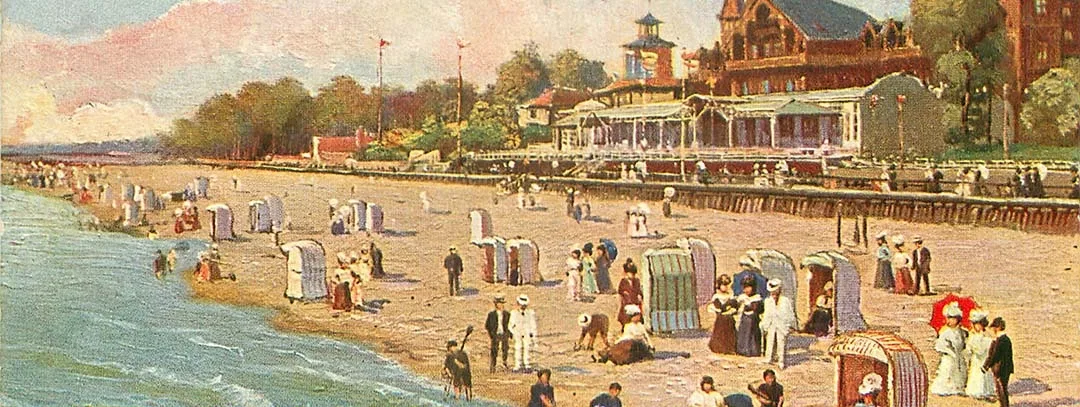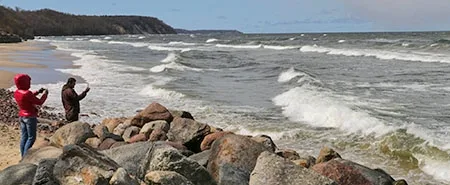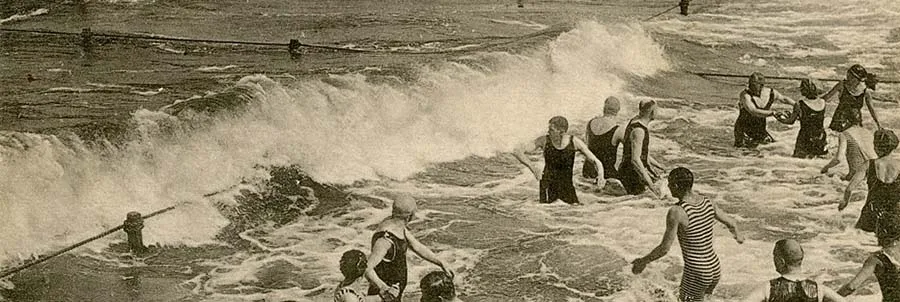
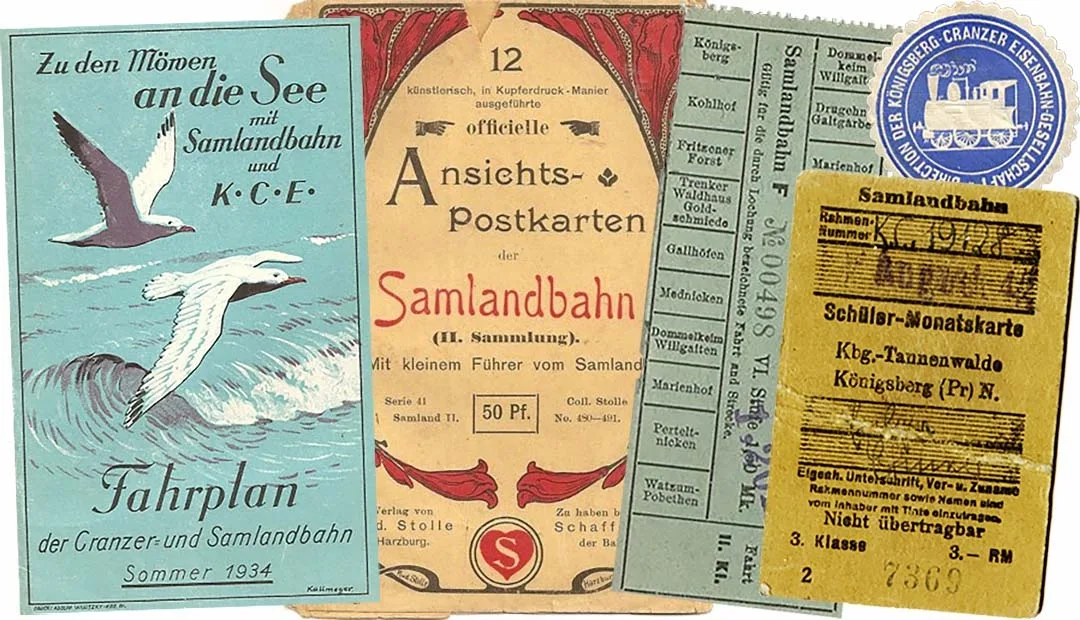
The first seaside resort of Königsberg (Königsberg / Kaliningrad) was Cranz (Cranz / Zelenogradsk), which gained this status as early as 1816 thanks to the efforts of the Königsberg medical councillor Dr Kessel1 (Dr. Kessel). Amber extraction, however, leased out to private entrepreneurs, still considerably restricted the freedom of beach life.
But when, at the end of the 1830s, the municipalities of the coastal towns began to lease the amber-extraction rights themselves, lively seaside resorts sprang up here, and the beautiful Neukuhren (Neukuhren / Pionersky), hardly had it appeared, surpassed Cranz in the opinion of some. On the west coast of Samland a new seaside resort, Neuhäuser (Neuhäuser), came into being, helped by the construction of the Lizent Railway (Lizentbahn) to Pillau (Pillau / Baltiysk) in 1865. It was a settlement of wealthy Königsberg merchants, who lived there in their villas.
Although the ailing Heinrich von Kleist2 (Bernd Heinrich Wilhelm von Kleist, 1777–1811) sought rest by the sea in the harbour of Pillau as early as 1810, this little town became a seaside resort only in the 20th century.
On 8 July 1885 the Cranz Railway (Cranzer Bahn) was opened. The State Railway (Staatsbahn), however, could carry only a relatively small number of holidaymakers to the coast, and only to Cranz at that.
That is why, in those days, anyone who wanted to visit Neukuhren and its surroundings in summer had to jolt patiently to the seashore in "Journalieren" (Journalieren), modelled on similar covered wagons of the "Kremser"2 (Kremser) type, with a roof on four corner poles between which a tarpaulin was stretched in bad weather and strong wind.
Railway shares in those days paid high dividends, and this was not the least of the inspirations for building a new railway line. It ran not only through Neukuhren, then dearly loved by many (it later lost its popularity when a military airfield appeared there), but also opened up the interior of Samland (Samland) to the general public and revealed the wild beauty of the magnificent, steep north-western coast.
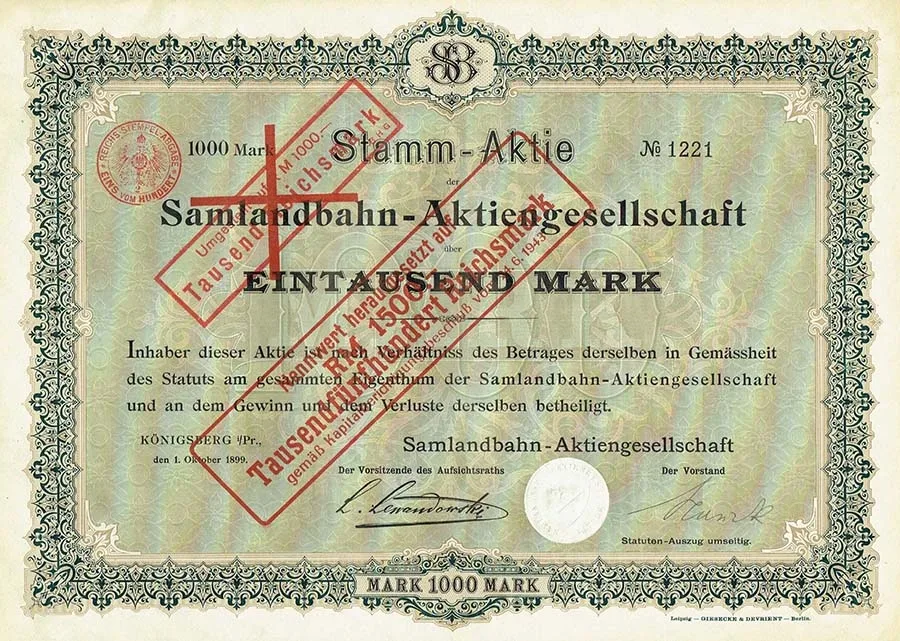 A share certificate of the Samland Railway.
The founding capital of the new joint-stock company amounted to 1.5 million marks. The state and the province declined to take part. Unforeseen difficulties that arose during construction increased the cost of the project by more than 2 million marks. This sum, however, was provided in good time by the shareholders, whose number had to be increased, and by the district of Fischhausen (Kreis Fischhausen / Primorsk). Finally, in order to meet the deadline, two more railway companies had to be called in to help. As a result, the construction of the 45.2 km line from Königsberg to Warnicken (Warnicken / Lesnoye) was nonetheless completed on time.
Saturday, 14 July 1900, was the opening day of the Samland Railway (Samlandbahn). The station building in Königsberg was a small, rather flimsy structure that looked less convincing even than the station in Cranz, but the locomotive, festively decorated with green branches, was already standing under steam, with carriages decorated in the same way visible behind it. On board were the province's highest officials, the construction management, guests of honour and representatives of the press invited for the occasion. The first journey with passengers took place the following day, Sunday.
We were not on that first train on 15 July. My parents planned our first trip for one of the following Sundays, 22 or 29 July, and took my brother and me with them. How could I not tell you about that unforgettable journey?!
It was a beautiful sunny summer day. Walking a little past the Cranz Station (Cranzer Bahnhof), already familiar to us children, we went along the right-hand side of Fuchsberger Allee (Fuchsberger Allee / Sovetsky Prospekt), under the big "Samland Railway" (Samlandbahn) sign mounted on two posts, and across the wooden bridge over the Hufen Brook (Hufenbach) to the modest station building.
The ticket offices were literally besieged by people wanting to buy tickets, since everyone who had already made the first trip was delighted. Equally universal was the praise for the rocky sea coast, which until then had been known only to the summer visitors of Neukuhren.
At the platform stood a six-wheeled locomotive, smoking, puffing and hissing, with a long line of carriages coupled to it to hold all the holidaymakers hurrying towards them.
These carriages caused a real sensation: their huge windows could be called panoramic, something that even the press of the glorious city of Königsberg did not fail to praise.
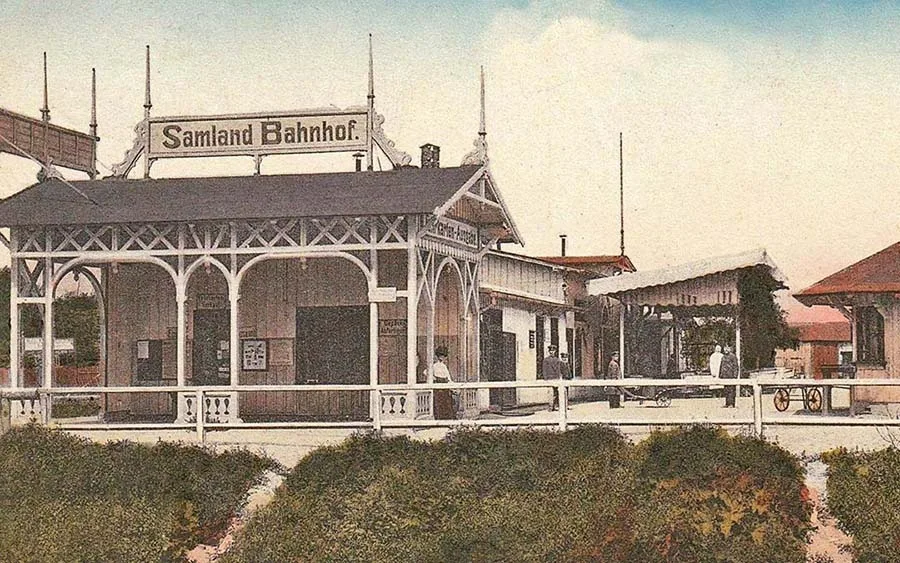 Samland Station in Königsberg.
Here the conductors, passing from one carriage to the next, do not have to jump from footboard to footboard as they do on the Cranz Railway (Cranzer Bahn); they calmly step from platform to platform over wrought-iron footbridges with railings. All the more did the new carriages of the Samland Railway compare favourably with the converted cattle wagons of the Lizent line (Lizentbahn), which, having acquired tiny windows after reconstruction, had been put into service on the line to Metgethen (Metgethen).
Colourful crowds of excursionists in their Sunday best took their seats in joyful anticipation. The driver and the guards scurried anxiously back and forth.
At last came the moment so impatiently awaited by all the passengers, armed with beach umbrellas and everything else needed to set up a comfortable spot on the beach — the train moved off!
For a while the route ran along the track of the Cranz Railway, but then it turned west. The first station was Kohlhof (Kohlhof). Insignificant as it was, serving only the Kohlhof estate, a small light-brown house with a waiting room had nevertheless been built on the platform.
The house's only decoration was a pair of carved dragon heads above the station name board, which sent us children into indescribable raptures. Tickets were not sold at these little stations: they were bought on the train.
Gradually the towers of Königsberg sank below the horizon; the nearest of them was the observation tower of white and red sandstone in the Tiergarten (Tiergarten). Work on the Ottokar Church (Ottokar-Kirche) had not even begun at that time, and the Luisenkirche (Luisenkirche) was far from complete. The train rolled through open fields.
Passing the "Trenker Waldhaus" (Trenker Waldhaus), a popular spot for Königsbergers' country outings, which only in 1919 would become part of Tannenwalde (Tannenwalde / Chkalovsk), the train reached Goldschmiede. Even then few people knew that this village was named after Duke Albrecht's personal physician, Dr Aurifaber (Leibarzt Dr. Aurifaber), who had Latinised his surname and become Goldschmidt. The prince gave him this estate for his faithful service. Yes, in those days the art of medicine still enjoyed royal honour!4
Next, beside the nearby "highway", the dazzling white manor house of the Fuchsberg (Fuchsberg) estate floated slowly past the windows.
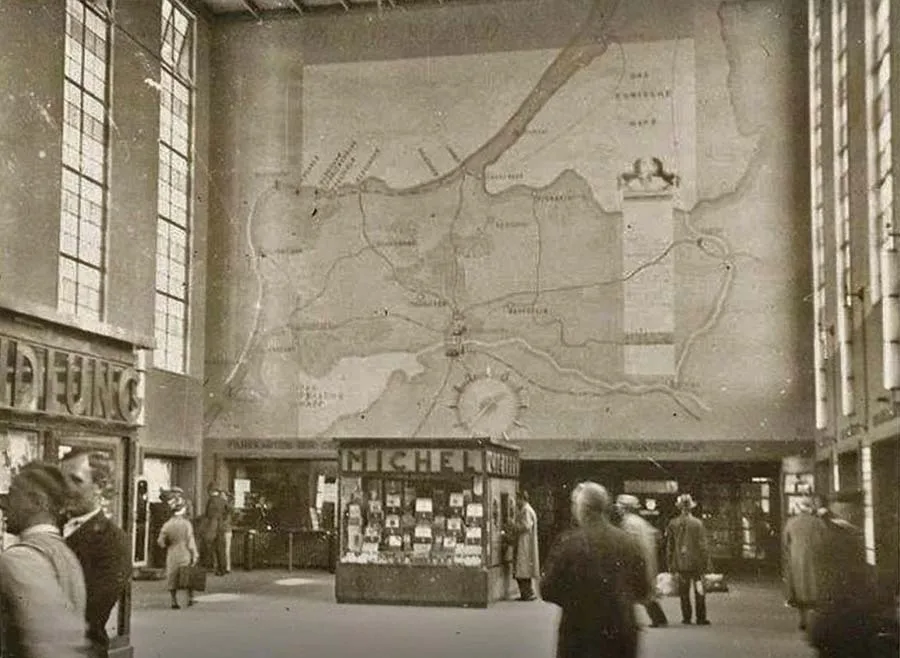 Map of the Samland railways at the North Station.
The fourth stop was Gallhöfen (Gallhöfen) station, where the platform had no shelter at all, only a bench, which showed how insignificant it was. And very soon most trains began to pass through here without stopping.
"Mednicken!" Given the importance of this station, where two trains travelling in opposite directions often passed each other, a large station building decorated with dragons was built here, since holidaymakers, as the project's planners envisaged, were to set off from here on hikes in every direction.
To the west of Mednicken (Mednicken) lay the old Order mill of Mühlfeld (Mühlfeld) and the Landgraben (Landgraben) canal, and quite close to the south of the station — the beautiful Wargen Pond (Wargener Teich) with two Prussian hillforts on its banks, the charming old Order church and its modest inn by the pond, on which one would soon be able to go boating. From here, along the Landgraben, to Metgethen and Juditten (Juditten), ran in spring what was perhaps the most beautiful route — everything around was blue with violets! To the east of Mednicken lay the heavily silted Mushroom Pond (Pilzenteich), 2.5 km long, and Tannenkrug (Tannenkrug), a popular place in the late 19th century for people and horses to rest and have a bite during their long journey in the "Journalieren" through Pobethen (Pobethen / Romanovo) and Rantau (Rantau / Zaostrovye) to Neukuhren.
Further on we were met by a green-clad hill whose foot was very hard to reach, since there was not a single signpost to it: it was the private property of the owners of the Grünhoff (Grünhoff) estate.
This was the 80-metre Schulmeisterberg (Schulmeisterberg), the highest point of the glacial moraine. It was entirely covered with forest, and this beautiful mixed forest was full of lilies of the valley. If you walked north from it, deep in the forest you could come out on the shore of the charming Engerteich (Engerteich) pond.
After Mednicken, where much later, at the end of the 1920s, a pair of storks settled on a telegraph pole, the wooded hills of the Alk (Alkgebirge) appeared outside the windows. Mount Galtgarben could not then be clearly made out, as there was not yet a tower on its summit.
For us impatient children this ride to the "dear sea" did not seem fast enough — so many stops! So tiresome! On the Cranz Railway there were only seven stations: Rothenstein, Nesselbeck, Gross Raum, Mollehnen, Laptau and Bledau (Rothenstein, Nesselbeck, Gr. Raum, Mollehnen, Laptau und Bledau)!
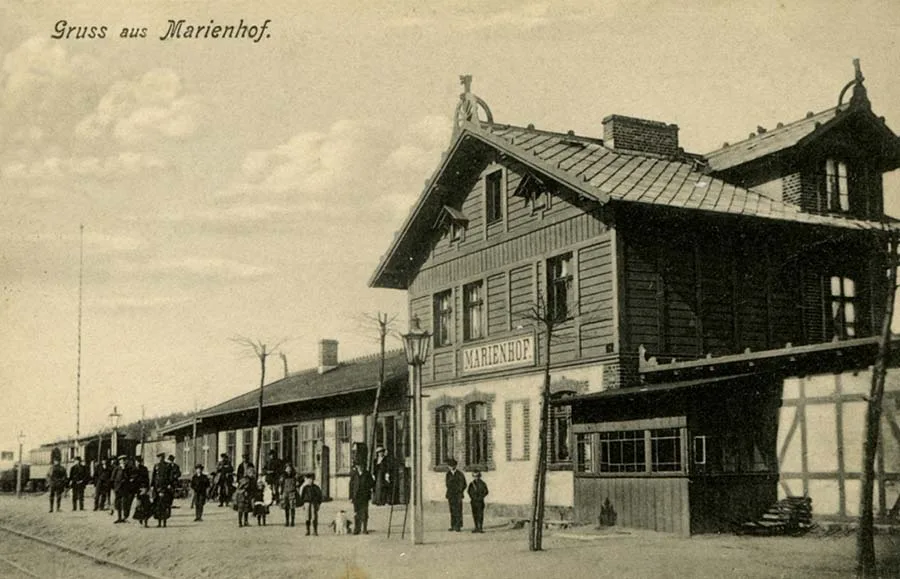 The station building at Marienhof.
But the real test of our patience was still to come! Having passed the Alkgebirge, the train arrived at Marienhof (Marienhof) station.
"Fifteen minutes' stop!" announced the conductor. Everyone already knew that a junction would soon be built here on the way to Fischhausen via Thierenberg (Thierenberg) and Gaffken (Gaffken). The rails had already been laid, and traffic on the Fischhausen District Railway (Fischhausener Kreisbahn) was to open on 1 October of that same year, 1900.
The stop, however, was fully justified. Our small and weak locomotive needed to top up the water in its boiler from the big tank at the station (although the word "tank" had not yet been coined in its military sense), since Marienhof lay exactly halfway to Warnicken.
To the north of the station, from a rise called the Steetberge (Steetberge), there was a view of the Kurhaus Dellgienen (Kurhaus Dellgienen) — a handsome wooden building built for the tourists who, it was planned, would come here by rail.
The calculations, however, did not pay off: tourists preferred the beaches, and the few who got off at Marienhof walked towards Galtgarben, so only two years later the big Kurhaus building was sold for demolition.
At last, with a snort and a hiss, our train continued on its way.
Suddenly the carriage door flew open and in came, with a friendly smile, a moustachioed railwayman, easy to recognise by his brand-new red leather belt. He was offering twelve postcards with views of the most beautiful places. The set cost exactly one mark and, of course, all the landscapes of Samland quickly sold out.
The next stop was Perteltnicken (Perteltnicken) station with its modest "dragon" house, where hardly anyone got on. As early as Duke Albrecht's time there were fish ponds here; in time their number reached 44, large and small, in which carp, trout, char, tench, crucian carp and golden ide were bred.
Next came Pobethen-Wartnicken (Pobethen-Wartnicken) station. Of Pobethen, in the valley to the east, only the slender spire of the Order church could be seen.
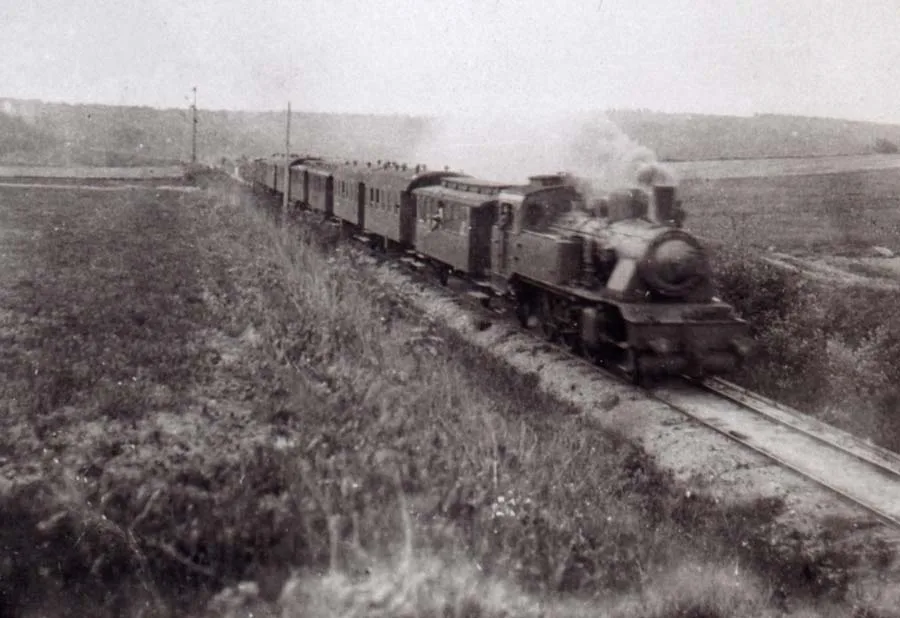 On the section Neukuhren – Rauschen.
To the west a hill blocked the whole view, and one could only guess at the nearby Wartnicken estate with its farm buildings.
In the first year of the railway's operation there was often confusion here — passengers with tickets to Warnicken (Warnicken) got off at this station. So in 1901 the owner of the Wartnicken estate, Baron von König, decided to drop the old Prussian name Wartnicken and renamed his East Prussian estate Watzum (Watzum) after a village in his family's home district of Wolfenbüttel (Wolfenbüttel, in Lower Saxony, not far from Braunschweig). A few years later the station was renamed Watzum-Pobethen.
The train puffed on. Soon the air grew noticeably fresher, a view of the sea opened up on the right, and my childish imagination was already painting a picture of foaming wave crests crashing noisily against the Rantau cape (Rantau / Gvardeysky), towards which the train was heading. On the left, meanwhile, we left behind the hills of the Kleines Gebirge (Kleines Gebirge), headed by the 86.5-metre Kalthof Hill (Kalthöfer Berg), which offered a beautiful panoramic view of the Samland sea coast.
The hill could be reached from Kalthof (Kalthof) railway station, and from there one could walk down to Rauschen (Rauschen) through the beautiful forests of the Lachsbach valley, past Alexwangen and Tykrehnen (Lachsbachtales Alexwangen und Tykrehnen).
We sat out the stop at Lixeiden (Lixeiden) with great impatience, and then the train pulled into the station of the already fairly well-known resort of Neukuhren.
In 1900 it was far more elegant and cosy than the then still modest Rauschen. Around the famous pear tree in front of the Neukuhren Kurhaus (Kurhaus), "parted and met again" dances5 were still held, just as in the days of Ferdinand Gregorovius (Ferdinand Gregorovius), who described them so beautifully in his "Idylls of the Baltic Shore" („Idyllen vom Baltischen Ufer”).
After a rather long stop in Neukuhren we continued towards Rauschen. Here the railway had been laid through the forest, but the sea could be seen on the right. Suddenly, on the left, the famous Lachsbach valley (Lachsbachthal) opened up, where, according to the maps, the Borstenstein (Borstenstein / Stone of Lies) was supposed to be. The beautiful church and the thermal baths in Rauschen did not yet exist; the trains were met only by a few modest houses of the picturesque village of Sassau (Sassau) in the valley of the Mill Brook (Rauschener Mühlfließ).
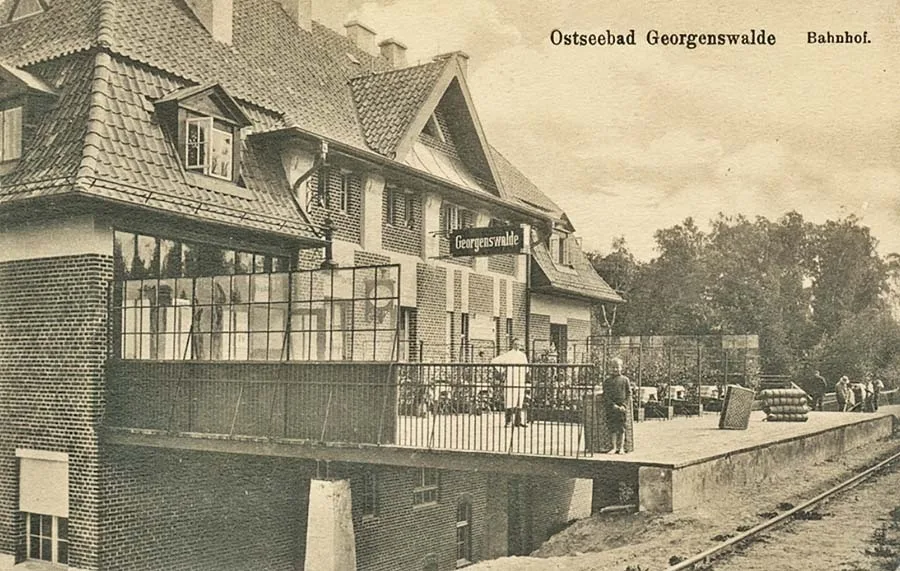 Georgenswalde station, where a hotel will soon open.
When the track beyond Rauschen station was being built, it became necessary to cut a long passage through the sand hills of the Teichwald (Teichwaldes). In one place the railway section was almost buried by masses of sliding sand. Further on we found ourselves on an embankment in the marshy valley of the little river Katze (Katze), named after the Sudovian chieftain Katze (Catcze). This river rises in the Warnicken Forest near Alt-Katzkeim (Alt-Katzkeim) and forms beautiful valleys "rich" in adders. Where the Katze flows into the idyllic Rauschen Mill Pond (Rauschener Mühlenteich), a huge dam was built (the very one whose construction required so much extra expense). Later blue lupins grew on it in their thousands. A magnificent sight in bloom!
Incidentally, the tunnel cut through the dam for the road to the village of Schönwalde/Schönwalde was special. It was called the "whispering tunnel": words whispered quietly at one end could be heard quite distinctly at the other.
In the Gausup Gorge (Gausupschlucht), where the road to Hirschau (Hirschau) crossed the railway line, stood another dragon-decorated house — Gausupschlucht station. With the construction of Rauschen-Düne (Rauschen-Düne) station it was no longer needed.
There was still a stop at Georgenswalde (Georgenswalde) station, and then the train ran straight to the terminus at Warnicken.
The construction of this railway, which at first caused so much worry and concern, later brought its investors high dividends: whereas 157,831 passengers were carried in the first year of operation in 1900, by 1920 the figure had risen to 1,217,720.
The line from Warnicken through Gross Dirschkeim (Groß-Dirschkeim) to Palmnicken (Palmnicken) was built only during the Second World War, which probably helped many refugees reach Pillau faster in those fateful days.
Yes, in 1900 the trip to Warnicken was no quick affair and took about three hours. But with the construction of the Samland Railway, the development of our beautiful seaside resorts on the north coast proceeded at unprecedented speed, and one could talk about it endlessly.
NOTES
1. Friedrich Christian Kessel (1765–1844) — doctor of medicine, chief medical councillor in the Königsberg district. Kessel was a firm advocate of a healthy lifestyle, believing that the universal means of preventing and treating disease were sun, air and water treatments combined with remedial gymnastics and long walks along specially designed health trails. In 1816 Cranz received the status of a Royal Resort. And the credit for this goes to Dr Kessel, who opened the first warm sea baths here.
2. Heinrich Wilhelm von Kleist — German dramatist, poet and prose writer.
3. "Kremser" — a covered horse-drawn wagon for pleasure trips out of town or excursions.
4. As is well known, the author of the article, Herbert Meinhard Mühlpfordt (Herbert Meinhard Mühlpfordt, 1893–1982), was a physician.
5. "Resort life pulsed around the old pear tree in front of Richter's hotel. An 'engagement nail' had been driven into the tree, promising happiness to future married couples." (Bäder-Almanach, 1889)
"...at the centre of everything that happened in Neukuhren was the magnificent pear tree in the park at Richter's, under which generation after generation of Germans met and parted." (Ostpreussenblatt, 28.03.1970)
PHOTOS
Bildarchiv Ostpreußen bildarchiv-ostpreussen.de.
SOURCE
● Editor's note: read on VisitPrussia.com an interview with the translator of German and, in particular, Prussian fairy tales, our regular contributor Tatyana Kolivay, who runs her own blog, where countless other parables, legends and fairy tales in her translations have been published.
Translated from Russian with the help of AI (Claude, Anthropic), October 2026.