Within Königsberg's old medieval city walls there were neither green squares nor parks. In those days towns were small and enclosed by stone walls, and within the bounds of such a town, ready for defence, everything was densely built up. Even Gothic Lübeck and Nuremberg had no greenery inside their city walls, apart from the occasional beautiful private garden hidden behind high fences. In the Middle Ages, parks inside the city walls would have seemed a needless waste of space, because beyond the gates stretched fields, meadows and forests, where everyone went out of town on holidays, as is so beautifully depicted in Goethe's “Faust”.
The Swedish king Gustavus Adolphus (Gustav II Adolf, 1594–1632), who landed at Pillau in 1626, forced the three towns on the Pregel to build a new, modern, common system of fortifications, which now also took in some of the suburban settlements. (Königsberg spent eight years building it!) It was then that the Ducal (later Royal) Garden, the large private gardens by the Castle Pond, the garden of the Old Shooting Guild and the cemeteries of the old churches came to lie within the city's fortress walls.
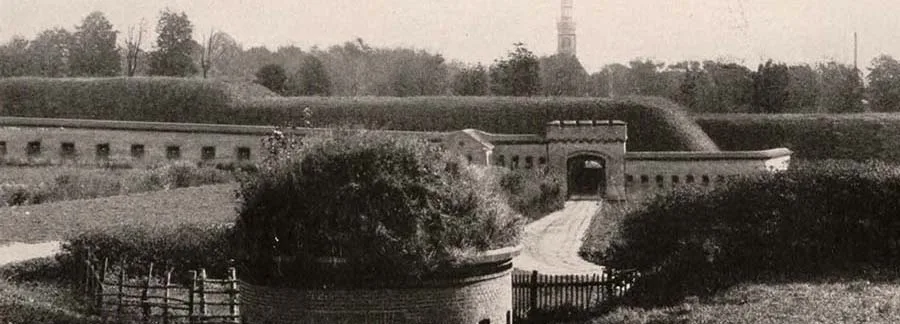
When construction of the third ring of fortifications around Königsberg began in 1843, the People's Garden in Neurossgarten also ended up inside the fortress walls, while the greenery on the modernised ramparts (the so-called glacis) formed a green belt around the city.
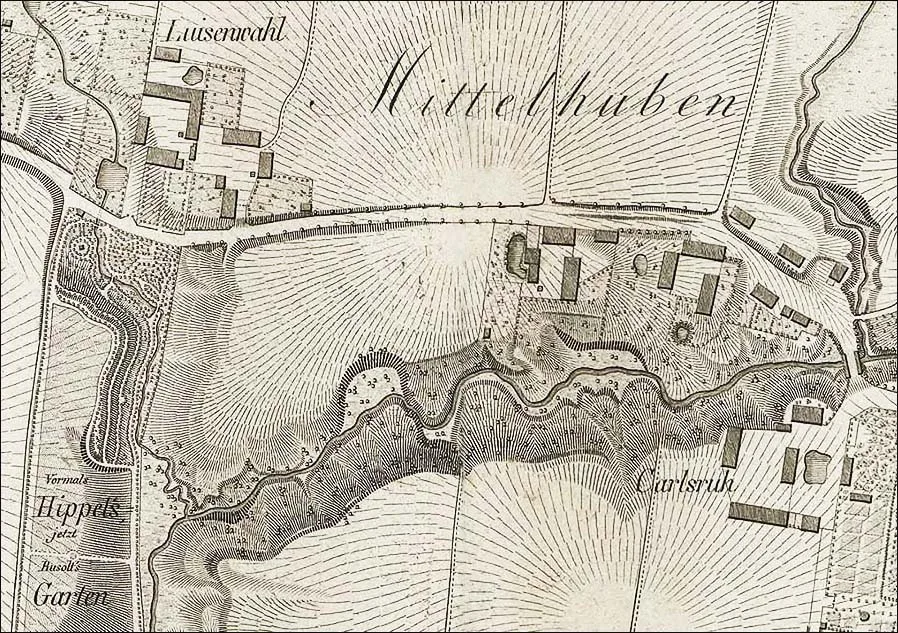 Luisenwahl, Hippel's Garden and Mittelhuben on the 1815 city map.
It was still a long way to the 1930s, when Königsberg would become a beautiful garden city, one of the loveliest in Germany.
But when, on the initiative of the energetic Lord Mayor Körte (Siegfried Körte, 1861–1919), a passage was cut through the fortifications at the Wrangel Tower in 1910, the preconditions arose for gradual progress in this direction. The plan for dismantling the fortifications, drawn up by the director of city planning Beuster (Fritz Beuster), provided for the preservation of most of the 70-year-old trees on the old ramparts.
And so, over many years, under the direction of the director of municipal gardens Ernst Schneider (Ernst Schneider, 1874–1968), Königsberg gradually turned into a green city. From the Royal Garden (Königsgarten, the former Ducal Garden, later Parade Square), through the gardens and promenades on the banks of the Castle and Upper Ponds, as far as Max Aschmann Park, there stretched a single green space. From the Sackheim Gate to the Holländerbaum Gate it was one continuous park. Beautiful squares appeared on the ground between the Friedland Gate and the Brandenburg Gate. In addition, to the east lay Kleist Park, a beautiful manor park which, like the Kalthof estate, together with Contienen and Spittelhof, had been responsible for supplying the court with food.
The memory of its former owner, the retired captain Kleist (Berthold Kleist, 1848–1925), is preserved by a boulder on which he himself carved the first words of Horace's ode: “Non omnis moriar” (“Not all of me shall die”). Kleist believed that handing the park over for public use would secure him the grateful memory of posterity. Like the War Councillor Scheffner (Johann Georg Scheffner, 1736–1820), he bequeathed this property of his to the city in exchange for a life annuity.
In the west of the city, Juditten Park invited people to stroll and relax. Closer to the centre lay Ratshof Park. Green copses, full of nightingales, led from it past the Hammer Pond (Hammerteich) to the Prince's Pond (Fürstenteich). In the southern part of the city there were the Schönbusch and Aweiden parks, as well as the Friedrichsruh park in Ponarth.
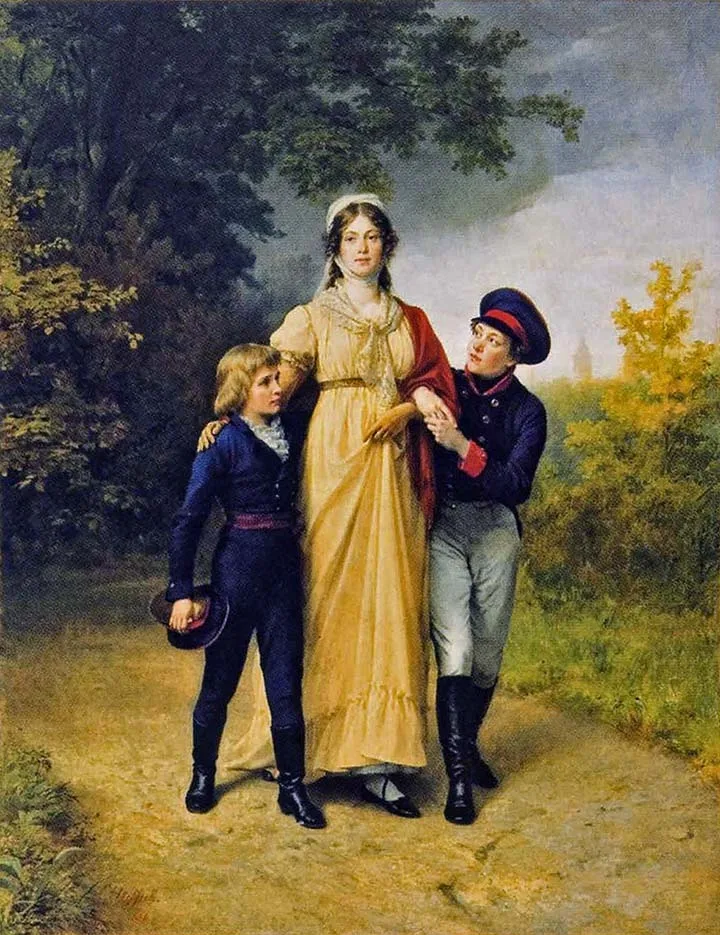
“Queen Louise with Her Sons in Luisenwahl Park”. Painting by Carl Steffeck.
Yet the true gem among them, a wonderful and peaceful refuge, was and remained to the very end Luisenwahl Park.
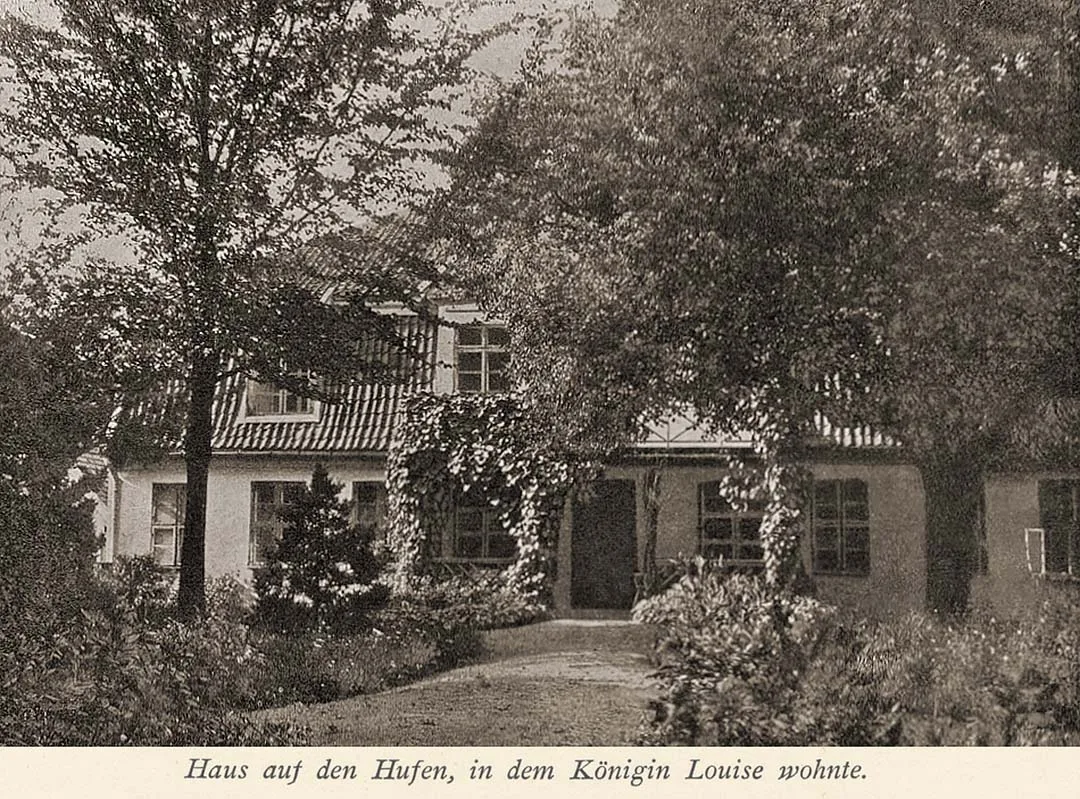
Most people in Königsberg associated the name of this magnificent garden with the noble Prussian queen who, as is well known, repeatedly lived in Königsberg for long periods between 1806 and 1809 and in the summer months preferred to the castle a house on Busolt's estate, which later entered local history as “Queen Louise's Cottage” (Luisenhäuschen).
But that is not quite right. Once, here on these “Huben”1, lay the Pojenters Hof estate (Pojenters Hof), recalled until the First World War by the Dairy House (Milchhäuschen) standing in the south-western corner of the park, a farm building of the old estate.
In 1786 this land was acquired by the burgomaster Theodor Gottlieb von Hippel the Elder (Theodor Gottlieb von Hippel, 1741–1796), whose beneficial work in Königsberg became part of the city's history. He turned the estate garden into a magnificent English park. Old lime trees were already growing there, and beside one of them, on the western edge near Louis-Ferdinand Street (Louis-Ferdinand-Straße), hung a bell said to have survived from the days of the Pojenters Hof estate, which had been used to call people to evening and Sunday services. Unfortunately, after 1933 some of these magnificent old lime trees were cut down, just as they were in the beautiful gardens of the Masonic lodges on the bank of the Castle Pond and in many other places.
Hippel could hardly have found a more beautiful park than this stretch along the Hufen ravine. His friends Scheffner, Kant and Kraus probably came here often.
But the way here was long; the roads beyond Königsberg's fortifications were in poor condition: there were no rolled “chaussées” yet, let alone asphalt. And so that the people of Königsberg could visit the “Huben” more easily, and so that his friends could reach his beautiful park without getting their feet wet, Hippel authorised money from the city treasury for a plank walkway from the old Steindamm Gate, which stood where the inn “At the Corner by the Gate” (Zum Winkel am Tore) later was, all the way to his park.
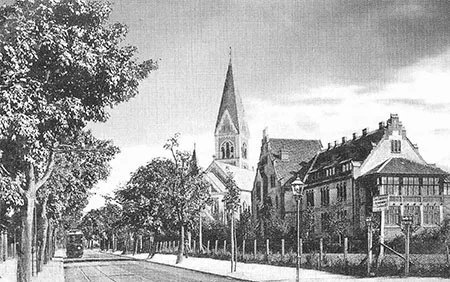
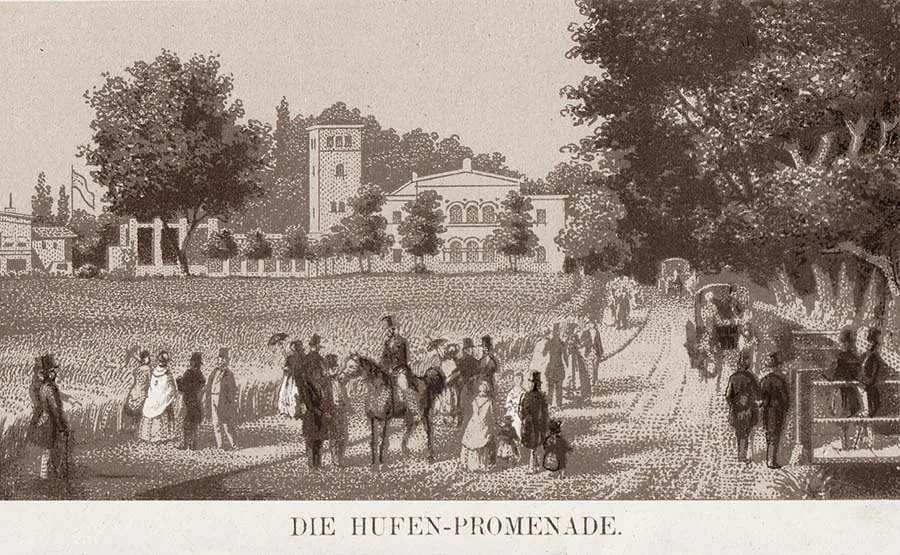 Hufen Avenue in the first half of the 19th century.
This plank walkway was one of the most famous sights of Königsberg in its day.
A “Plank Walk Society” (Bohlengesellschaft) was even founded to keep it in good repair; it later gave rise to “Dr. Kesse's Beautification Society” (Dr. Kesseische Verschönerungsverein).
After Hippel's death in 1796, the government and school councillor Busolt (Gotthilf Christoph Wilhelm Busolt, 1771–1831) bought the park grounds from his heirs. In honour of his wife Luise, he named the acquisition Luisenwahl (Luisenwahl).
So arose this name, which later acquired a royal lustre thanks to Queen Louise, who in the summer months preferred the cottage on Busolt's estate to the castle. It was a typical small Baroque residence. Inside there were only seven rooms, furnished by the people of Königsberg. The house was furnished in a bourgeois but modest manner. The queen used to say: “I have fine books, a clear conscience and a good piano, which lets one live more calmly amid the storms of this world.” Napoleon's steward, his personal Mameluke Roustan, thought otherwise, writing his disparaging verdict on the wooden wall of Queen Louise's Cottage in 1812: “A wretched castle for a king!”(Miserable château pour un roi!) Napoleon, as is well known, preferred to stay in Königsberg Castle.
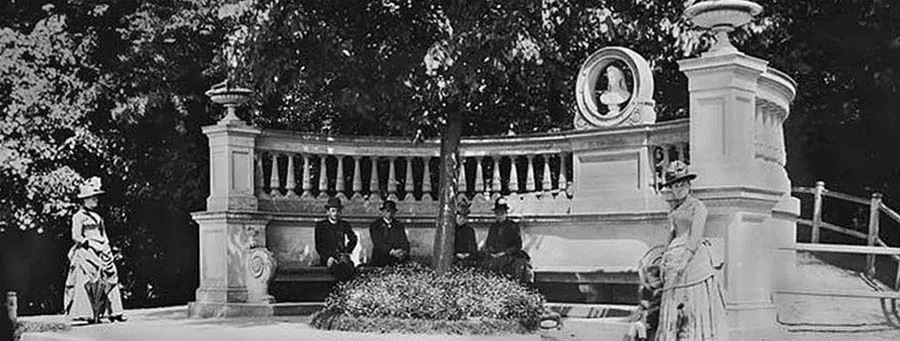
The queen was especially fond of a quiet spot in the park where, in 1874, her beautiful marble bust by Rauch (Christian Daniel Rauch, 1777–1857) was installed. From this small hill there was a wide view over fields, meadows and the river all the way to the Frisches Haff. There, not far from her cottage, the queen wrote her letters, in which she always called the park by its old name, “Hippel's Garden” (Hippels Garten).
The old War Councillor Johann Georg Scheffner (see above), a volunteer in the Seven Years' War, relates in his book “My Life” that he often walked here with the queen, who valued him for his wit and worldly wisdom: “Never have I seen or noticed on any woman's face a freer, purer gaze, a more cheerful, almost childlike innocence. She understood everything, and everything true, good and beautiful made an enormous impression on her.”
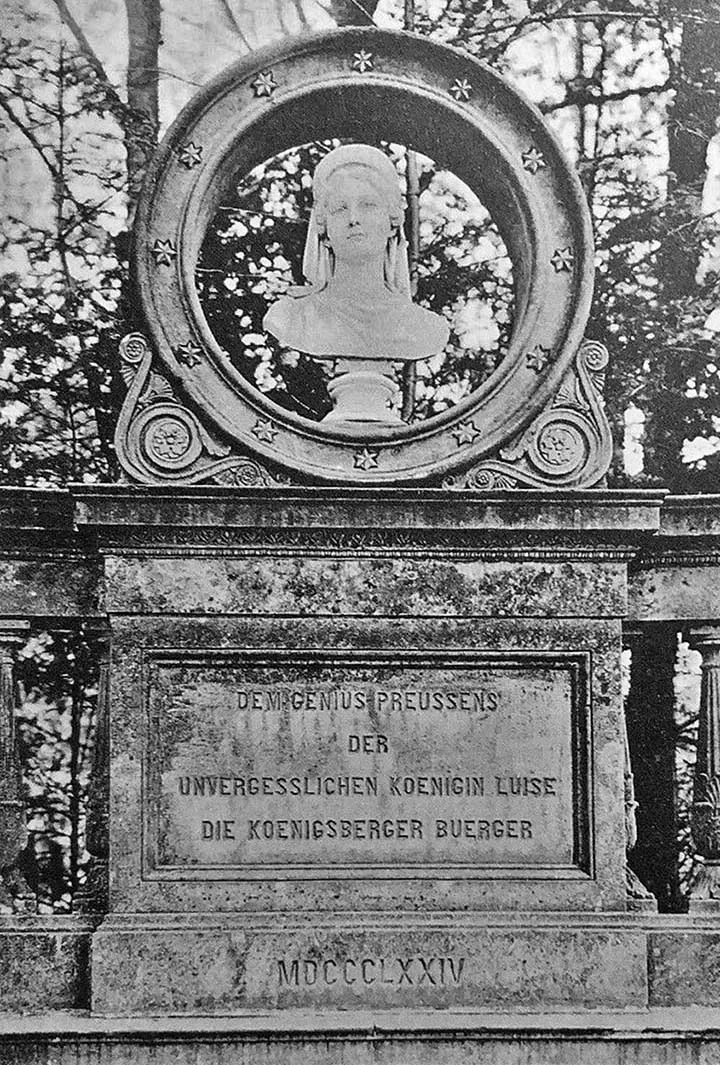
Bust of Queen Louise in her favourite Königsberg park.
Years and decades passed. William I ascended the Prussian throne and, in memory of his beloved mother, who had died young, and of his own youth, partly spent in Königsberg, bought the park from Busolt's heirs.
Even then we should picture Luisenwahl as a single complex extending from the Old Pillau Road to Busolt Street. At the road keeper's house (it stood where the rock garden by the Schiller monument was later laid out), a side street lined with country houses surrounded by gardens branched off the Old Pillau Road: our Hufen Avenue.
On the 1720 map, however, this side street beyond the Freigraben ravine is marked only by a very thin line. Apparently, as a road it then ended before reaching the park, or skirted it to the north.
Later William I bequeathed Luisenwahl to the city, and only then, one may suppose, after a cutting had been driven through the beautiful park, separating Queen Louise's Cottage and the rare hornbeams in front of it from the main part, did Hufen Avenue become the main road to Ratshof and Juditten.
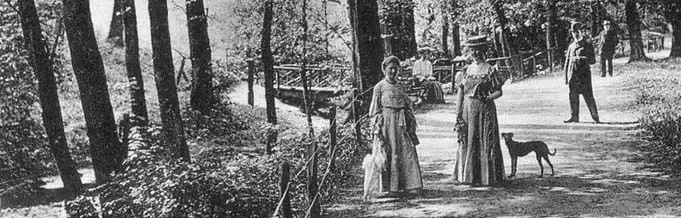
But was this not a truly royal gift to the people of Königsberg? Can one imagine a more idyllic place than this park? Can one imagine anything more picturesque than the path with its ancient lime trees along the brook to the spring, whose ever-murmuring, iron-rich water stained the stones ochre yellow? And further downstream, where the brook's banks were reinforced with stones, all the way to the Dairy House gleaming with whitewash amid the greenery? Next to it in the park stood wooden tables and benches where, in the shade of the trees, one could enjoy delicious sour cream, curd cheese and fragrant rye bread, or even drink white wine. Could one imagine anything more idyllic?
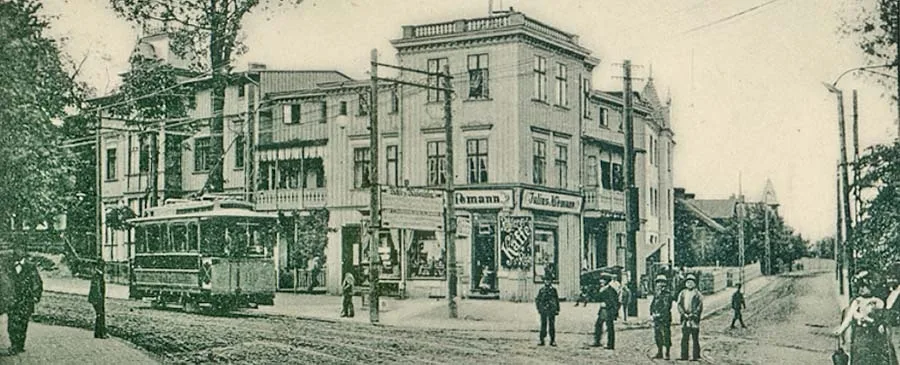
But when Königsberg's fortress belt began to burst at the seams, and the new century, with its catastrophes as yet unknown to us, mercilessly asserted its rights, all the “establishments” that had sprung up among or in place of the country villas of wealthy Königsbergers, the “Hufenterrasse”, “Flora”, “Friedericia”, “Park-Villa Nova”, and later also “Julchenthal” and “Luisenhöhe”, fell into decline.
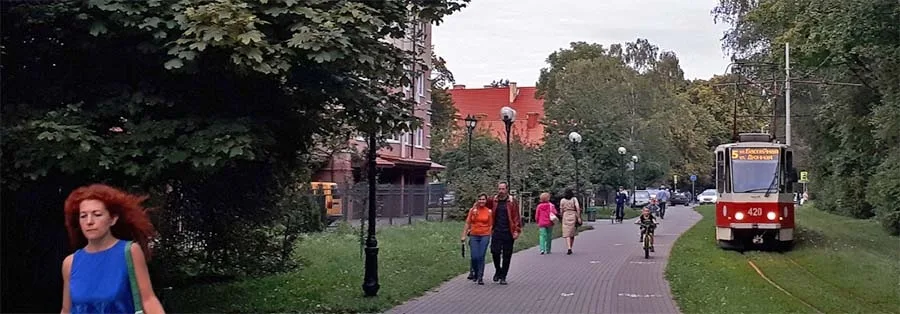
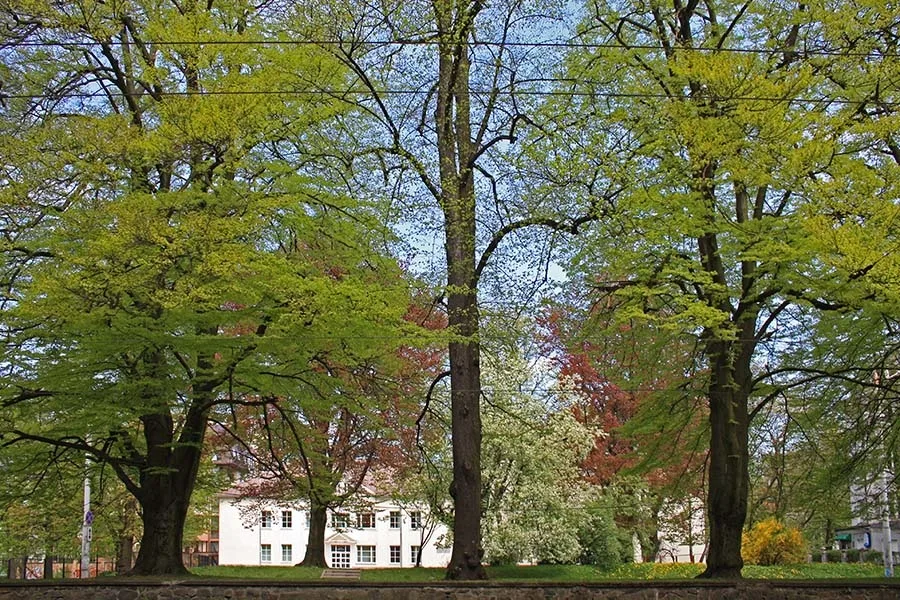 82 Prospekt Mira. Two hundred years ago Queen Louise's Cottage stood on this spot.
New streets and rows of houses were built, the bridge was widened, and finally, in 1913, the banks of the ravine were landscaped, becoming a magnificent addition to the park. How wonderful it was here by the brook when the rhododendrons glowed in the shade of the trees!
Then, in 1928, a lawn with an open-air stage appeared, and for the centenary of Franz Schubert's death a modest monument to this charming composer of so many beautiful songs was erected in Luisenwahl.
In the harsh winter of 1929–30, which turned the Baltic Sea into a silent icy desert, many of the fruit trees on the slope of the meadow in Luisenwahl, which every spring had been covered in beautiful blossoming “snow”, froze. Since Königsberg's young people had taken over this slope for skiing and sledging, it was decided not to replant the orchard, and from then on, on fine winter days, one could enjoy the pleasures of winter sports in Luisenwahl for hours.
Later Hufen Avenue was widened alongside Luisenwahl Park too. The magnificent hornbeams were thus cut off from Queen Louise's Cottage, which by then had become a Home for Mothers and Children (Mütterheim). Its residents had to make do with a small green island surrounded on all sides by the roar of cars.
Fortunately, Luisenwahl, which later lived through so many sad events, still faithfully serves the local residents today as an amusement park with swings, carousels and dance floors.
TRANSLATOR'S NOTE:
1. Hube (Middle German, the same as Hufe) is a hide, i.e. a plot of land, and also a land measure whose area varied by locality, from 7 to 15 ha.
SOURCE
Ostpreussen-Warte Folge 01 vom Januar 1955
LEGENDS OF PRUSSIA on the blog of Tatyana Kolivay.
Translated from Russian with the help of AI (Claude, Anthropic), October 2026.