LEGENDS OF PRUSSIA in the blog of Tatyana Kolivay.
Prussia is rarely visited by travellers eager to broaden their knowledge of it. For this reason it is still, to a certain extent, terra incognita. The few pilgrims who have written about Prussia give, in most cases, an entirely false picture of it. Almost all of them portray it as a deserted, dreary wilderness whose inhabitants stand at the same level of culture as their neighbours, the Poles and the Russians. The French generally believe that everything here is dreadful. Thanks to my favourite occupation, the study of history, I have had occasion to read the Prussian chronicles, some of which have long since become bibliographical rarities: those of Simon Grunau, Caspar Hennenberger, Paul Weissel and Christoph Hartknoch. In each of these old books I found a paradise called Prussia, on which nature generously pours out her blessings. And so in 1814 I undertook a journey through Prussia, which gave me an excellent opportunity to sort out the contradictory assertions of my predecessors.
[ 1814 ]
The castle. — Anecdotes. — Roustam. — Murat. — A sermon retracted. — The view from the castle tower. — The "Blood Court" in the wine cellar. — A secret vault full of skulls. — The collapse of the castle. — The Cathedral. — Tombs. — The princely crypt. — The university building. — The sanctuary — Other churches. — The image of Christ. — The Great Theatre. – The Old Theatre. — Inscriptions. — The stock exchange. — The Kneiphof town hall. — Other public buildings.
My letters of credit secured me an excellent reception in Königsberg, which made my life here [in 1814 – ed.] very pleasant. To be honest, I had nothing left to wish for, except perhaps a little more peace and quiet, for there is more than enough good for me in this city. I could write a great deal about the local inhabitants, their character, way of life and habits, since I am among people here from morning till night. I have also made several interesting acquaintances, so I have no lack of opportunity to make observations. Nevertheless, I shall keep my judgements to myself, for I know how difficult it is truly to get to know people's character, since as a rule they show themselves to strangers in their Sunday best, beneath which they hide their true nature. I had better acquaint you with the sights of Königsberg.
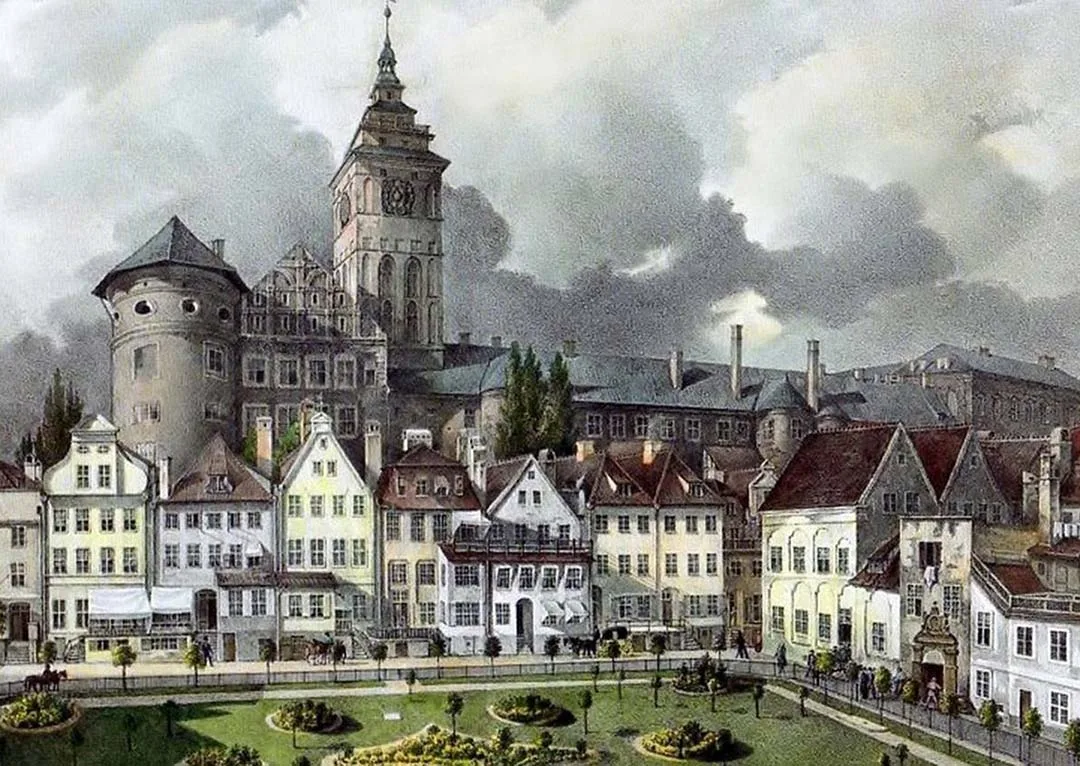
Thanks to the kindness of Mr R., a friend of the castellan of Königsberg Castle, I was able to inspect, as far as possible, all its numerous halls and chambers; I went up and down endless staircases and spent almost a whole day forming an idea of this unusual building, although I knew in advance that I would find little remarkable in it.
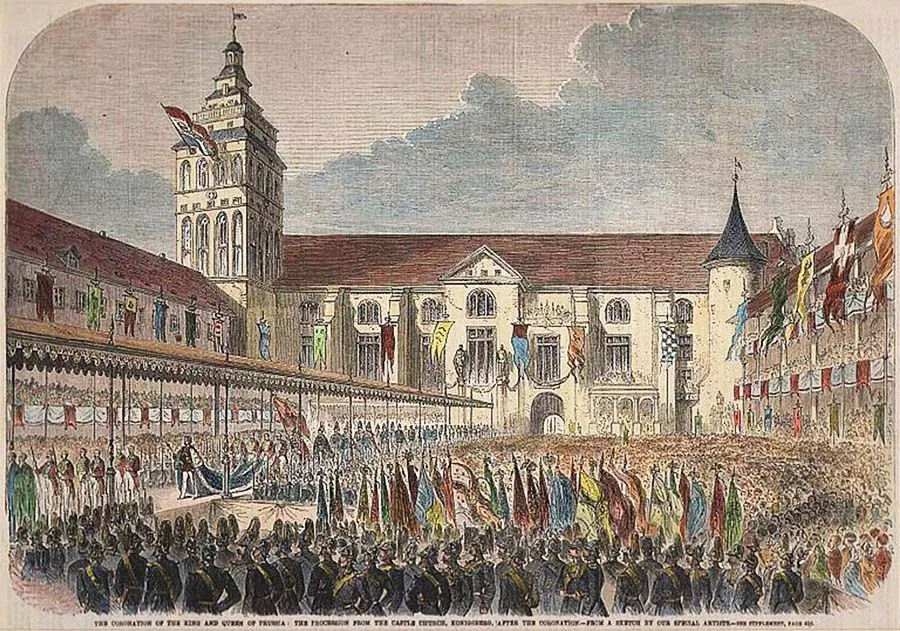 The coronation of the first Prussian king, Frederick I, in Königsberg Castle (1701).
This stone colossus is a sampler of the building styles of the last five centuries, which have been added to one another, little by little, in the most whimsical way.
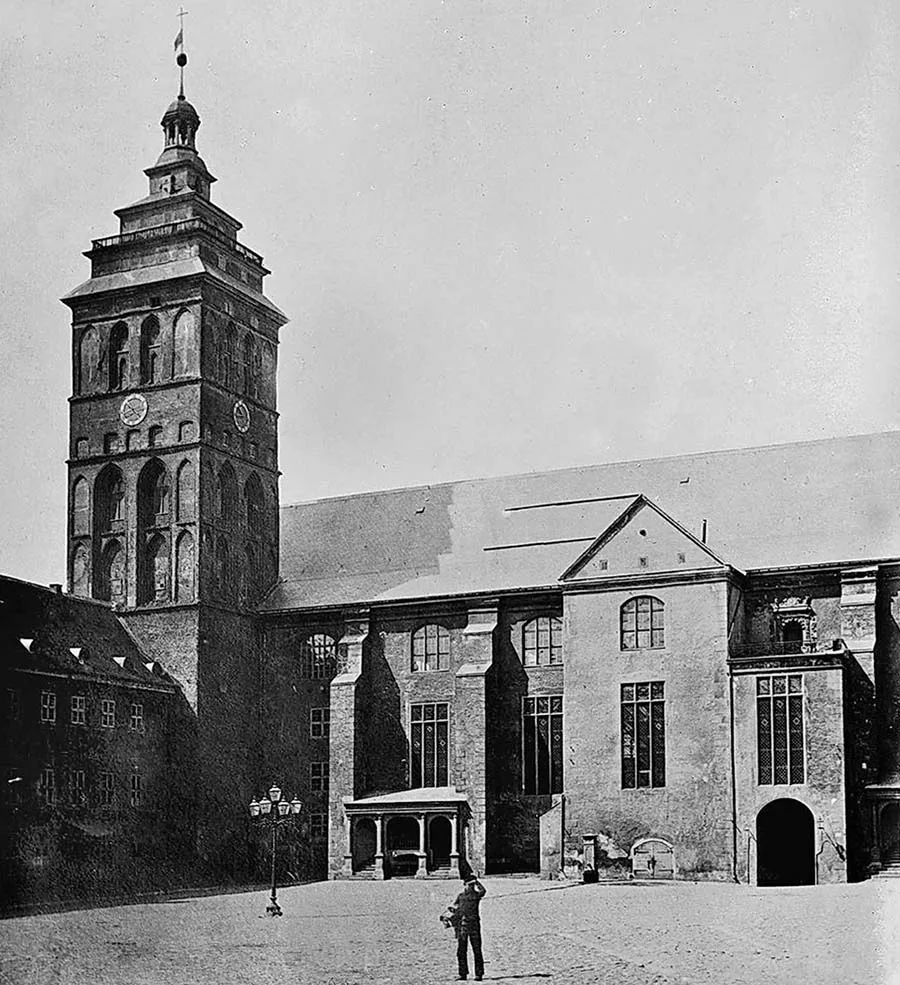 The courtyard of Königsberg Castle in the mid-19th century.
Thus one wing, with the castle's fine towers and dungeons built in the 13th century, has remained untouched to this day. Opposite it is the part of the castle built by Margrave Albrecht in the 16th century.
The church, which occupies a considerable part of the west wing, was built in the 17th century, whereas the side opposite it was erected partly in the 14th and partly in the 18th century. To all this belongs the building of the Oberlandesgericht, built about four years ago, which is without doubt the worst part of the castle and so tasteless that I would not wish to be in the shoes of its builder, who has sinned so grievously against good style.
The part of the palace built under Frederick I, a king who loved splendour and pomp1, is executed with taste and in a good French style.
However, the plan by which this building was to become one of the most magnificent parts of the castle has been carried out very modestly. It has not yet been plastered and looks somewhat motley, since it is built of red stone, with its projections, parapets and cornices of grey sandstone.
In this wing, which forms a triangle adjoining the large closed square of the castle, the two lower floors house the seat of the royal government of East Prussia; all the main state treasuries are also located here. On the third floor are the royal apartments, furnished very simply; some of them do not even have wallpaper, and nothing betrays the fact that a large royal family lived here for a long time. On the other hand, the view from these rooms over the city and the port is extraordinarily beautiful.
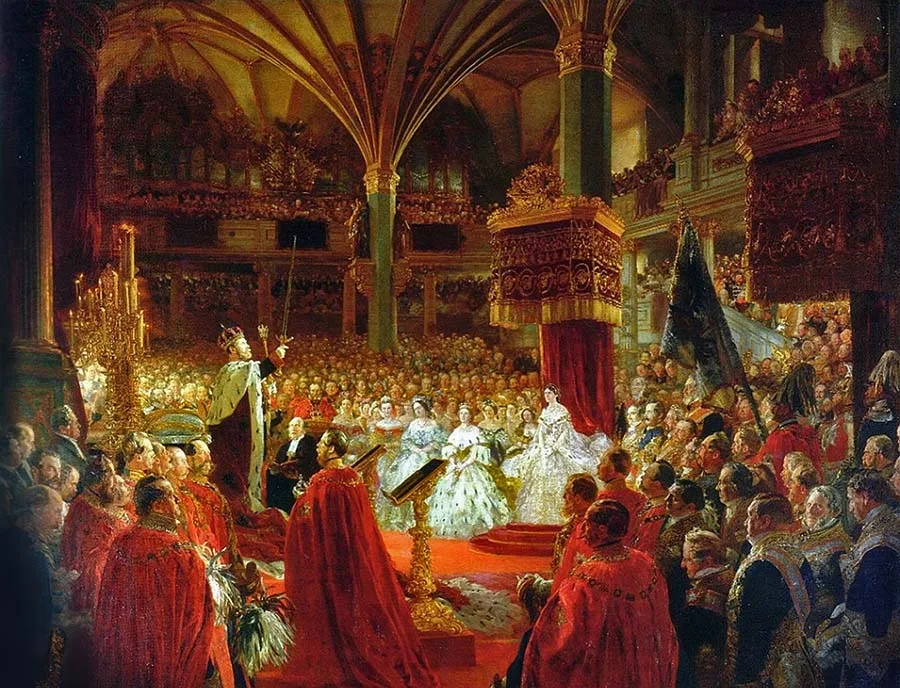 Painting by Adolph Menzel "The Coronation of William I in Königsberg, 1861".
I should like to share with you some anecdotes that the castellan told me when I visited the royal apartments, since these stories help us to know a number of famous people better.
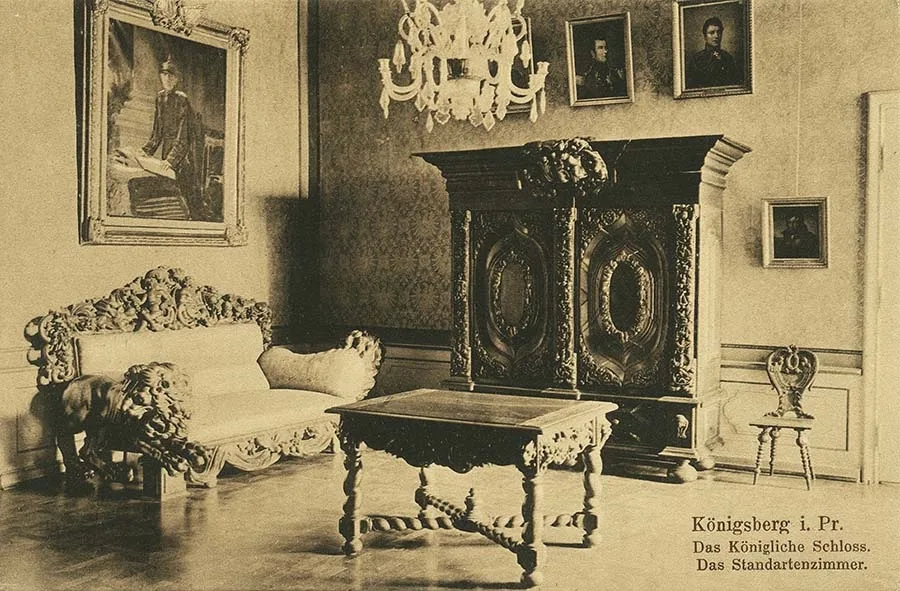 Royal furniture in the Hall of Banners and Standards.
* * *
The kings of Prussia must be crowned in Königsberg and, after the coronation ceremony, reside in the castle for several days. As is well known, thrift is one of the principles of the local ruling dynasty, and so for the brief stay of the Prussian royal family in the castle no furniture is bought for their apartments; instead it is provided by the richest inhabitants of the city. When Frederick William II2 was crowned here, the Jews, whom this king greatly disliked, thought they would win royal favour if they took it upon themselves to furnish the royal apartments. The local government knew nothing of the king's antipathy towards the children of Israel and gladly allowed them to furnish the rooms.
Only two days before the king's arrival the court marshal arrived, found the furnishings of the apartments magnificent and was lavish in his praise. He was then informed that this was entirely the merit of the local Jews, and some of the Jewish elders had already approached him to hear the coveted praise in person. But how astonished everyone was when the court marshal ordered all the furniture to be carried out without delay and the royal apartments to be furnished anew! And although very little time remained, the order had to be obeyed, at which, it is said, the Christian merchants were as pleased as the Jews were saddened – although the conclusions drawn by both sides turned out, as time showed, to be mistaken.
* * *
In 1807, in the presence of the present king and queen, the richest people of the city considered it an honour to supply the castle with the most expensive furniture. Among others, Mr D**, a merchant, provided for the queen an exquisitely beautiful ebony bed with legs in the form of four bronze lions. When the French entered the city and the castle was being prepared for Napoleon's arrival, this bed, together with other pieces of furniture, was still there. Suddenly Mr D** appeared in the castle accompanied by several porters and demanded it back. He was refused, being told that Napoleon himself would sleep in that bed. The merchant, however, declared that he would sooner break it than allow the tyrant to sleep in the same bed in which his queen had slept. He looked determined, and everything suggested that he would carry out his threat. And so, to avoid an unnecessary scandal, the demand of the patriotic owner of the royal bed was granted.
* * *
During his stay Napoleon ordered guards to be posted at all the castle gates, and no one was allowed into the inner courtyard, although a very popular footpath ran through it, which was thus blocked.
* * *
Roustam, Napoleon's personal Mameluke3, was rather partial to beer and an inveterate tobacco smoker, so the castellan, who supplied him with tobacco, often kept him company when the Mameluke sat about idle. Roustam wanted to show his gratitude and warned the castellan about Napoleon's servants, who, wherever they happened to be, usually helped themselves to the table silver.
The castellan, who had been entrusted with the care of all the silver tableware the city had provided for Napoleon's table, hurried to the dining hall, where dinner had just ended, and saw to his horror that a considerable amount of silver was missing. He complained to Roustam, who advised him to lock all the adjoining rooms at once and search them thoroughly: perhaps he might get something back, since the thieves could hardly have carried their loot far. The castellan followed this advice and, sure enough, found most of the silver hidden in chimneys and stoves, although a few small items that could easily be carried off in pockets were never found. And why be surprised? Like master, like man!
* * *
Murat4 also stayed in the castle when he fled from Russia, and apparently intended to remain in Königsberg for some time.
One of the inhabitants of Königsberg voiced his hatred of the French and was arrested on the orders of His Fugitive Majesty, who was immediately informed of the incident. The Königsberger was sentenced to be shot. Hearing this, crowds of townspeople gathered round the castle, intending to free the condemned man from the soldiers by force. And this "theatre king" was forced to order the prisoner's release, and soon he himself hastily left the city. It is said that in Elbing (now the Polish city of Elbląg) he declared that he regretted not having ordered Königsberg to be burned.
______________
The wing of the castle built by Margrave Albrecht is occupied by the Landhofmeister and Oberpräsident von Auerswald5, so I was unable to see its interior. It is said to contain many halls and beautifully furnished rooms and to be the cosiest part of the castle.
Beneath the west wing of the castle lies an extensive wine cellar, where a huge number of casks and bottles brought from all over the world are stored.
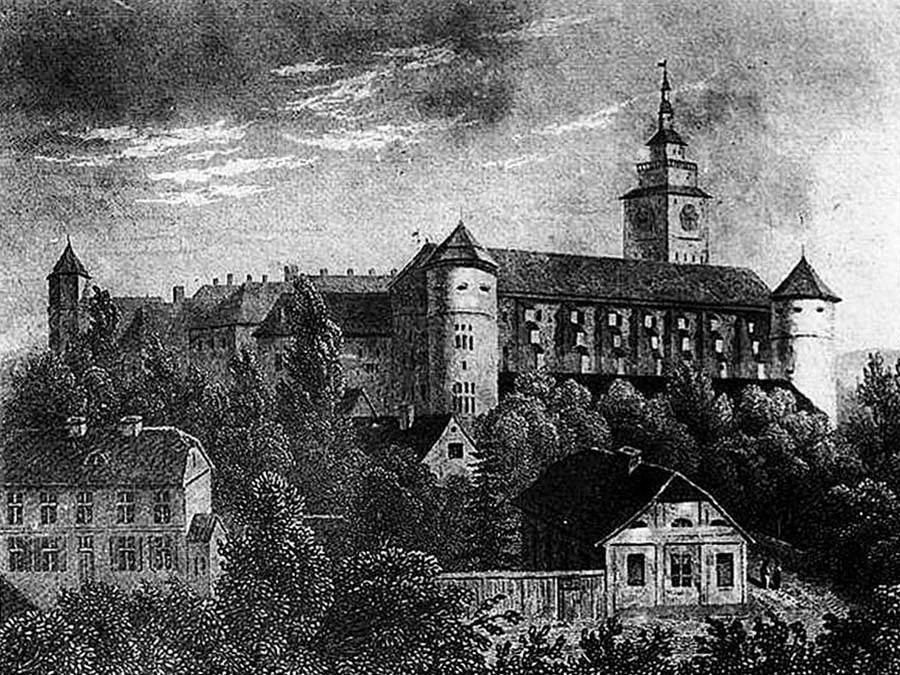 View of the west wing of Königsberg Castle and Immanuel Kant's house (left).
The two unusually large corner towers adjoining the same west wing contain prisons, but they are empty, because the local government, out of humanity, has decided not to use them to hold criminals.
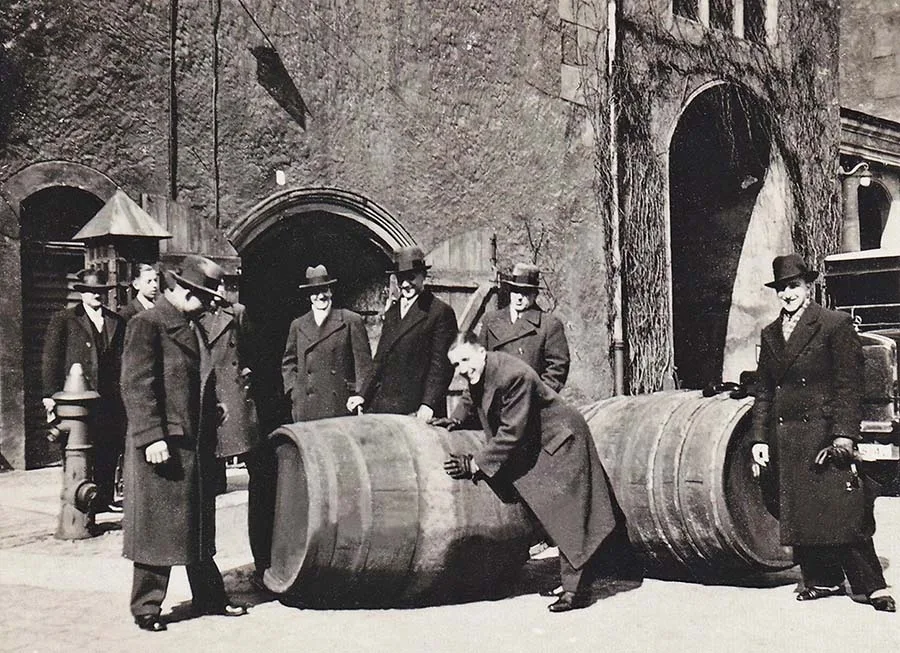 In the cellars beneath the west wing of the castle wine was stored.
The room on the ground floor is used as a Zeughaus6; it is separated by a passage leading into the inner courtyard of the castle. Above it, on the second floor, is the church. It is decorated simply but tastefully, while the royal prayer box is very richly adorned. On the gallery of the church hang the coats of arms of the Knights of the Order of the Black Eagle, which Frederick I had made for the day of his coronation. In this church he was anointed and placed the crown upon his head with his own hands.
It was here, during the Seven Years' War, that the chief court preacher Arnold delivered a sermon of consolation in which he spoke ill of the Russians and claimed that they had committed many atrocities in Prussia at that time. The Russian governor took this as a grave insult and wanted, without further ceremony, to seize the eminent clergyman and send him to St Petersburg, from where he would probably have been permitted to make a journey to Siberia.
But thanks to the intercession of the magistrate a conditional pardon was obtained for him, on condition that the following Sunday he publicly retract his seditious sermon.
The preacher disliked this intensely, but he had little choice: his well-being was at stake, and he had to agree. Sunday came, the church was packed to overflowing, the governor himself sat in the royal box, and everyone awaited the appearance of the preacher. He mounted the pulpit, pale and sorrowful. With restrained sadness he spoke the opening words and was just about to begin the shameful retraction when the church filled with smoke and people on all sides cried out: "Fire, fire!" Everyone rushed outside in terror, the governor hurried away along the gallery leading to his apartments, the service was interrupted, and so the preacher did not have to retract publicly. Several people, however, died in the crush. The smoke had been produced with gunpowder and rosin by a few students who wanted to spare their fellow countryman the disgrace. The fact that the affair was hushed up shows how forgiving the Russian official was.
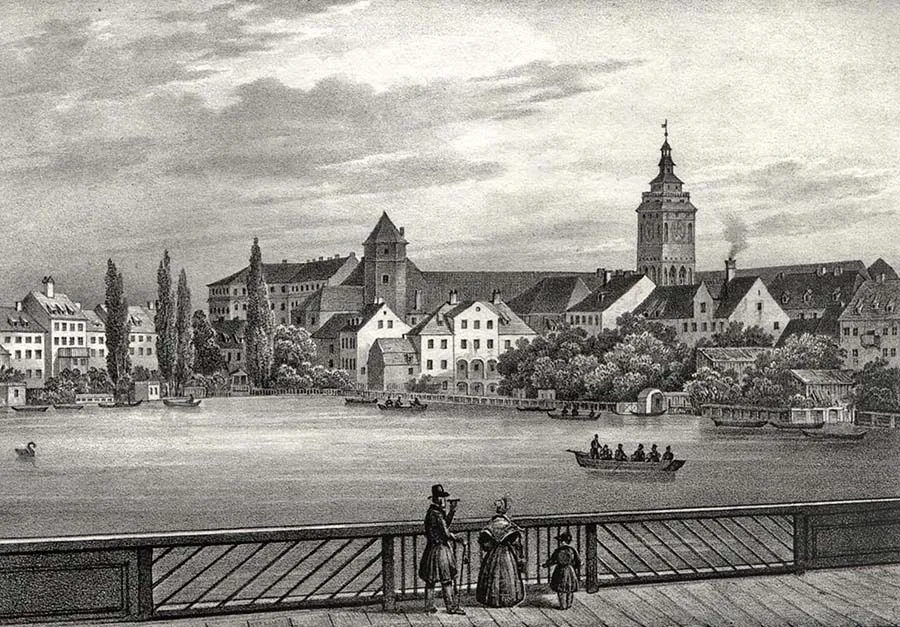 View of the castle from the bridge across the Castle Pond.
On the third floor of the west wing of the castle is the enormous Muscovite Hall, which is twice the size of the castle church. It is one of the largest halls in Europe, as may be judged from the fact that it was here that the ball in honour of Frederick William III7 was held. Three thousand guests gathered for the ball, and yet the hall seemed almost empty.
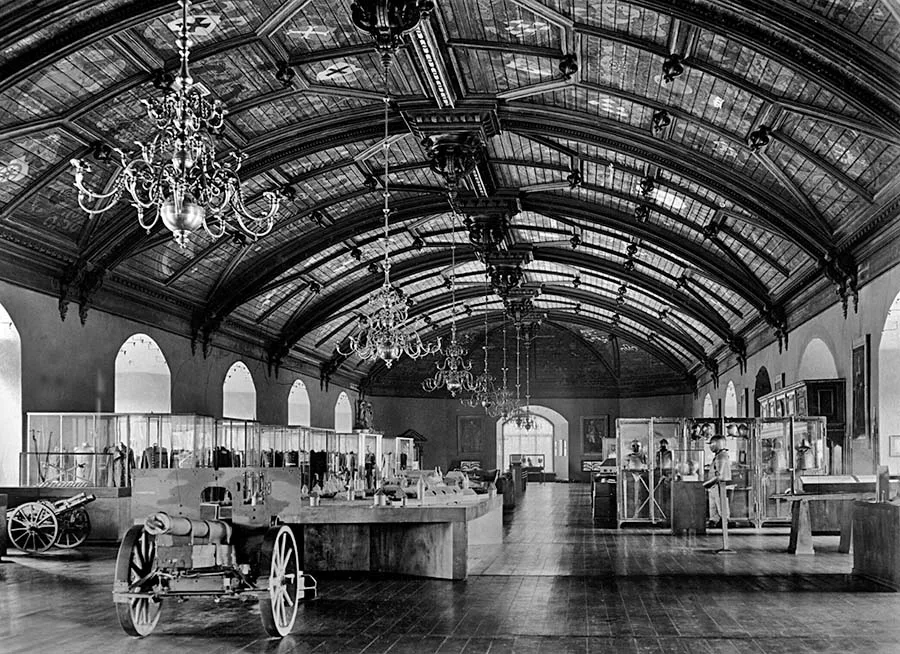 In the Muscovite Hall a collection of old weapons was on display.
It is decorated very simply and is too low for its size. Why it received this name I was unable to find out. Building a hall above a church is a strange idea, all the more so since, to reach it, one has to climb more than a hundred steps up a staircase inside the castle's main tower.
From the gallery of the keep there is a panoramic view of the large city with its harbour and of the picturesque surroundings through which the Pregel flows. One never tires of looking at this enchanting countryside, like a garden in bloom, and it is very hard to tear oneself away from the attractive sight. The horizon is so clear that with binoculars one can even see Pillau, although that town lies seven miles from Königsberg.
The part of the castle built in the 13th century bears the marks of its era: wide vaulted halls, dark passages, secret staircases – everything has been preserved in its unique character, harking back to the early Middle Ages. Today it houses the offices of the Criminal Collegium, which I think is right, since a court that decides matters of life and death ought to be in serious and solemn surroundings. Less fitting is the fact that directly beneath the rooms of the Criminal Court there is a wine cellar which, thanks to its extensive stocks of excellent wine, is very popular with the townspeople.
Strangely enough, this wine cellar is called the "Blood Court"8.
To rest and refresh ourselves after the tiring climbs up the castle stairs, my friend R*** took me there. This cellar is by no means the best place in the city for lovers of drink, but it is known for its very rich wine list. I wanted to know why the wine cellar had been given such a strange name, and did not hide that I thought it unsuitable. A man who had joined our company a little earlier replied: "Nothing could be more suitable than this name, for here the people of Königsberg sit in stern judgement on their fellow citizens."
The waiter, hearing this reply, grinned and immediately gave his own explanation: in the middle of the cellar there is a tower-like brick column that runs through the whole height of the building and is sealed on all sides, with no visible openings.
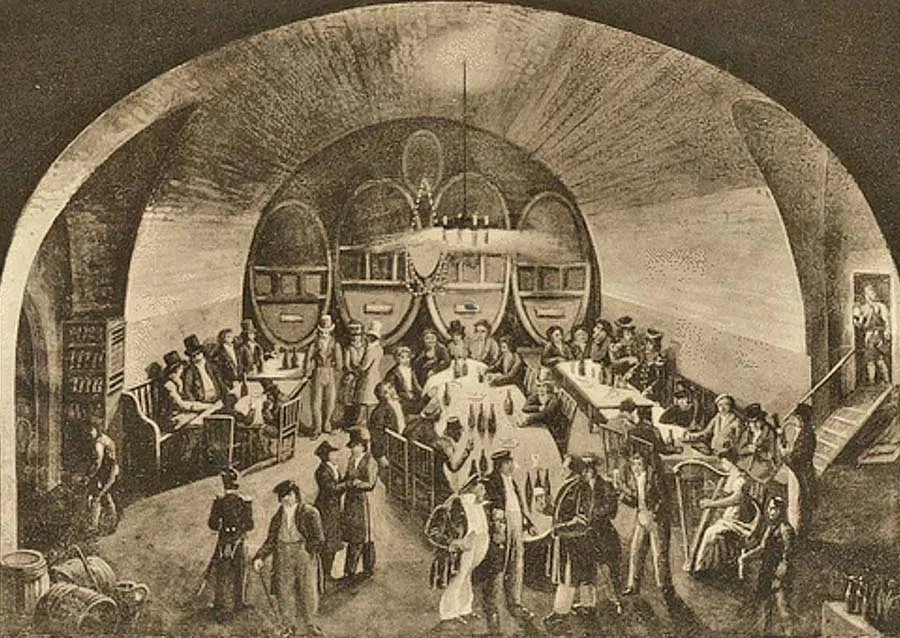 Interior of the main hall of the "Blood Court" restaurant.
For a long time people tormented themselves with guesses about the purpose of this strange shaft, until, driven by curiosity, they broke through the wall and found behind it a multitude of human bones, which confirmed the supposition that in ancient times this wing housed a court and that the remains of the executed were thrown into the stone well. Hence the name – the "Blood Court".
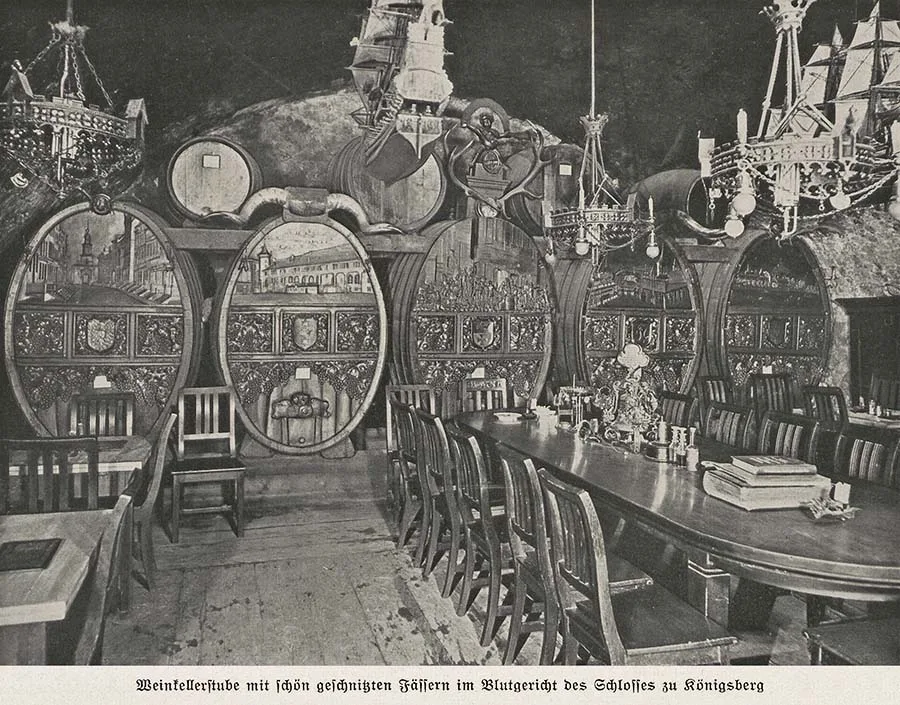 Details of the famous interior of the "Blutgericht" in the early 20th century.
Be that as it may, the fact that the Teutonic Order turned its own residence into a dumping place for rotting human remains is a sign of barbarism.
The Oberlandesgericht, which stands in line with the Criminal Collegium, was built, so we are assured, at great expense, but so badly and tastelessly, inside and out, that whoever designed it may be said to have "immortalised" himself with such shoddy work for centuries to come. How the head of the local department of architecture and building, who showed himself a man of good taste in erecting the New Theatre, could have allowed this is a mystery to me. All the more so since this pitiful creation was built before his very eyes, for he lives right here in the castle.
It is said that the old building, dating from the time of the knights, which had stood here before, collapsed in the presence of the king just as he received news of the battle of Pułtusk9 (December 1806).
It is said that the collapse of what was then the seat of government deeply shook the monarch, and he took it for a bad omen.
In front of the castle, opposite the guardhouse, stands a handsome bronze statue of Frederick I on a pedestal of white and grey marble. The inscription states that Frederick William III dedicates the statue of his ancestor to the Prussian people.
Königsberg Castle is the headquarters of all the collegia of the Prussian province and of all its treasuries. The Royal German Society and the Physical-Economic Society also held their meetings here. In the hall of the latter several paintings by Philipp Hackert10 are now on display, which can be seen for an admission fee. Since I shall often be seeing these wonderful paintings, I reserve the right to tell you about them in more detail in future, for to judge paintings one needs more than a fleeting glance, especially when they are by a master about whom one knows little.
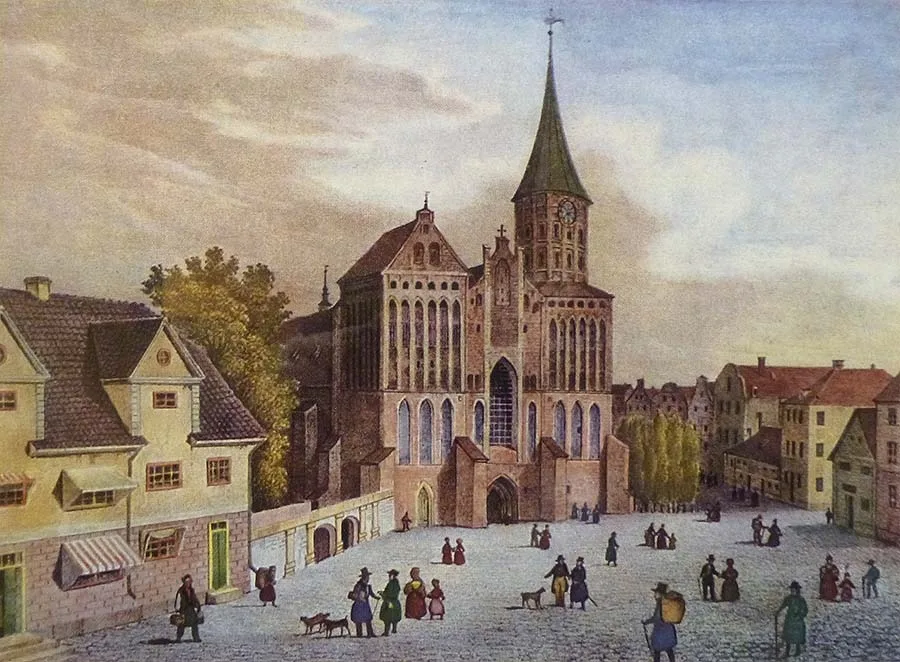 The Cathedral and the Great Cathedral Square.
The Cathedral, built in the 14th century, is a building of very imposing size, devoid of any external architectural decoration. It is surrounded by many barracks and burial vaults that weaken the impression this structure might otherwise make.
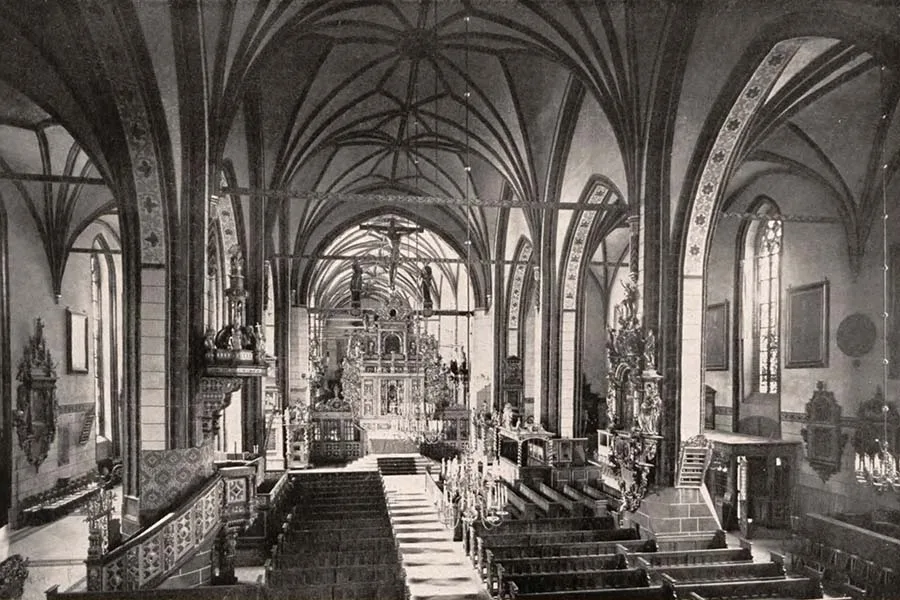 The central nave of the Cathedral. Once people sat here facing the altar...
When you enter, you do not immediately notice the extraordinary size of this church, but if you linger a while, your gaze loses itself in the wide, bold vaults. The galleries, quite useless in such a vast space, the colourfully carved confessionals and prayer boxes and the multitude of tombstones cannot alter the overwhelming impression made by these daring halls.
Behind the altar begins the cathedral proper, adjoined by the old princely burial vault, which also takes up a good deal of space. The vault of the choir is higher than that of the nave, but slightly narrower. The organ matches the size of the cathedral. It is said to have 5,000 pipes, the largest of them as thick as a man. I do not know whether size is an advantage, but when the organ began to play, its thunderous sounds rolled through the wide vaults, shook the whole space and made an extraordinary impression on me that lived on in me long after I had left the church.
The bishop's throne and the canons' stalls still stand in the choir of the cathedral. There are also a number of tombs, some of them valuable and very skilfully made. Above all, the monument to von Wallenrodt11 and his wife draws particular attention. It is made of black marble, with Corinthian columns of fine proportions and several very well-executed statues of white marble. The chubby-cheeked angels grouped around the tomb spoil the overall impression this precious monument could have made had they not been there, or had they been carved with greater skill.
The master was probably prevented from working on the tomb, which was then finished by some bungler.
No less remarkable is the grave of Chancellor Cocceji12. On an antique sarcophagus of black marble lies a statue of the deceased. He rests his head on his right hand. The statue is made of alabaster and very exquisitely executed. Grief is expressed with great truthfulness in the features of the recumbent figure, and the proportions of the whole body are very precisely observed. What a pity that this magnificent monument is placed too low and hidden behind the choir stalls! It has suffered considerably from the ravages of time and needs restoration. Legend has it that this chancellor rashly sentenced to death a girl who, in his opinion, had stolen a valuable ring.
After the unfortunate woman's execution the ring was found in a jackdaw's nest, which proved the innocence of the executed girl. The negligent judge grieved over his bloody order until his death, and that is why the sculptor expressed genuine sorrow in the features of the statue.
Here, too, we see the monument to the Bishop of Samland Georg von Polentz13, an outstanding statesman and active promoter of the Reformation in Prussia.
In addition, the choir contains a multitude of monuments, epitaphs and tombstones of bishops, knights, monks and councillors, which are of greater interest to the antiquarian than to the lover of art, for they were made in the Middle Ages and preserve the spirit of that era.
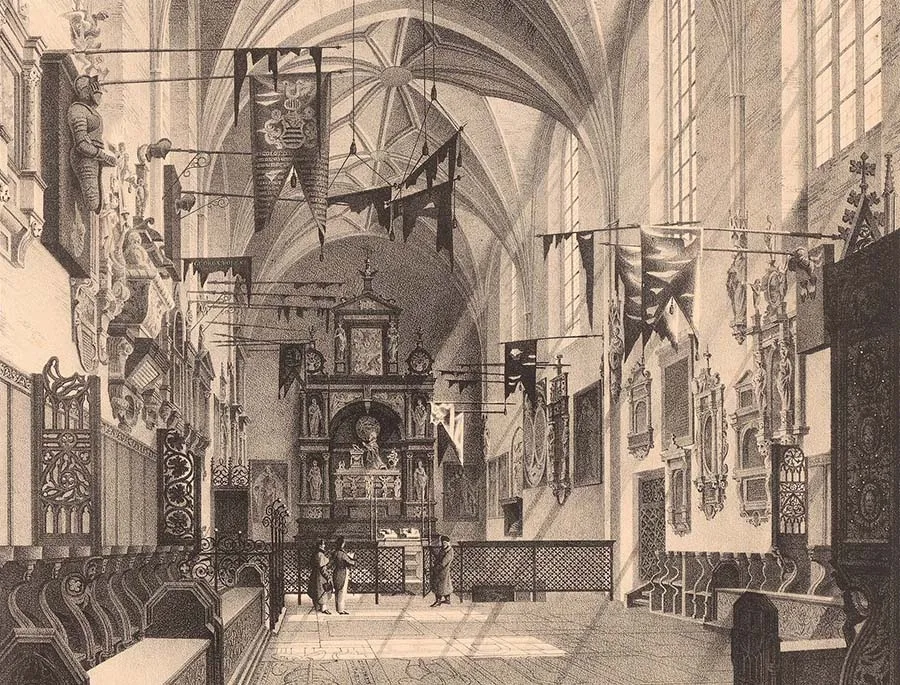 The space behind the altar of the Cathedral with its numerous tombstones and epitaphs.
The princely crypt is separated from the choir by an iron grille (see above). In it lie the remains of the last six grand masters of Prussia who lived in Königsberg, as well as Margrave Albrecht, his son Albrecht Frederick, their families and members of a number of other noble Prussian families.
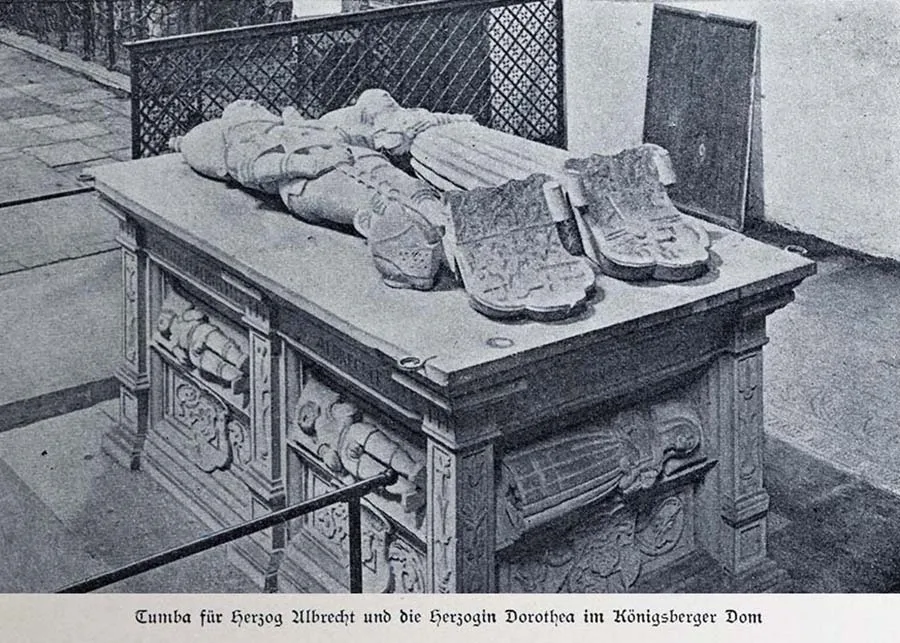 Tomb of Duke Albrecht and his first wife, Duchess Dorothea.
They all lie in various underground vaults, some in copper and some in tin coffins. Their monuments stand above ground. The sarcophagi of the grand masters are of extraordinary size: they are ten to twelve feet long and quite wide. The portraits of the deceased on wooden panels hanging in the burial hall have been almost completely worn away by time.
Margrave Albrecht has two monuments here; why this is so is not entirely clear. One of them stands above his resting place and is a cube-shaped altar of rough sandstone on which lie the effigies of the margrave and his first wife in a sleeping pose. The other monument stands against the gable wall of the crypt vault; it is at least fifty feet high and built of many kinds of marble. Of course, one should not expect anything perfect from an era when the plastic arts of the North were in their infancy. Yet the statue cannot be called unsuccessful: the figure of the elector, set in a niche, has a noble air, and the monument is very valuable thanks to its many rare kinds of marble.
Less graceful, though memorable and quite costly, are the tombs of Albrecht Frederick and his wife, whose kneeling sandstone statues stand in the middle of a mausoleum built of marble of many colours.
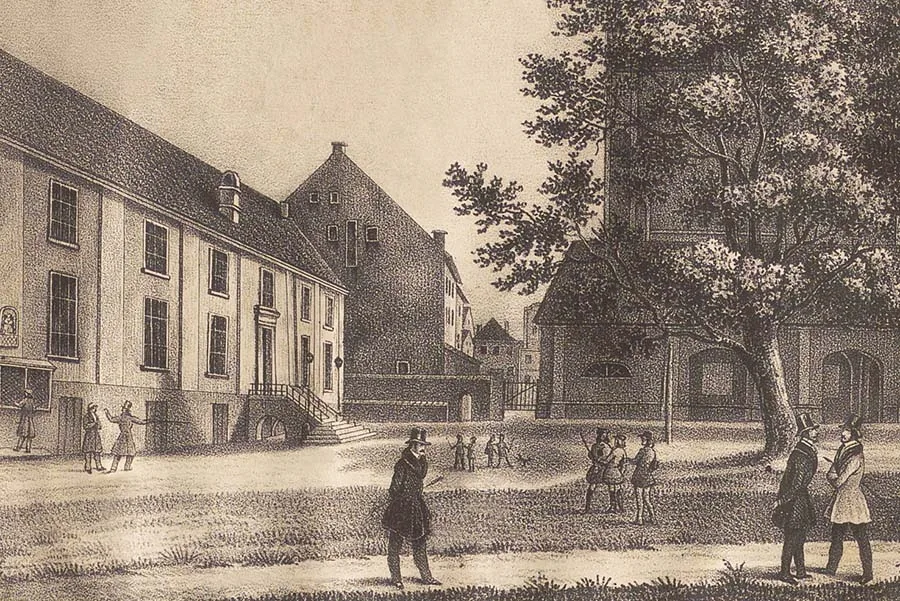 The Old Albertina and the Stoa Kantiana (right).
In a wooden chest set into the wall lie the remains of Grand Master Duke Luther (Lothar) of Brunswick14, the founder of this cathedral; at the time of his death the wall of the church had reached the height at which his coffin can now be seen. Judging by his bones, he must have been a giant.
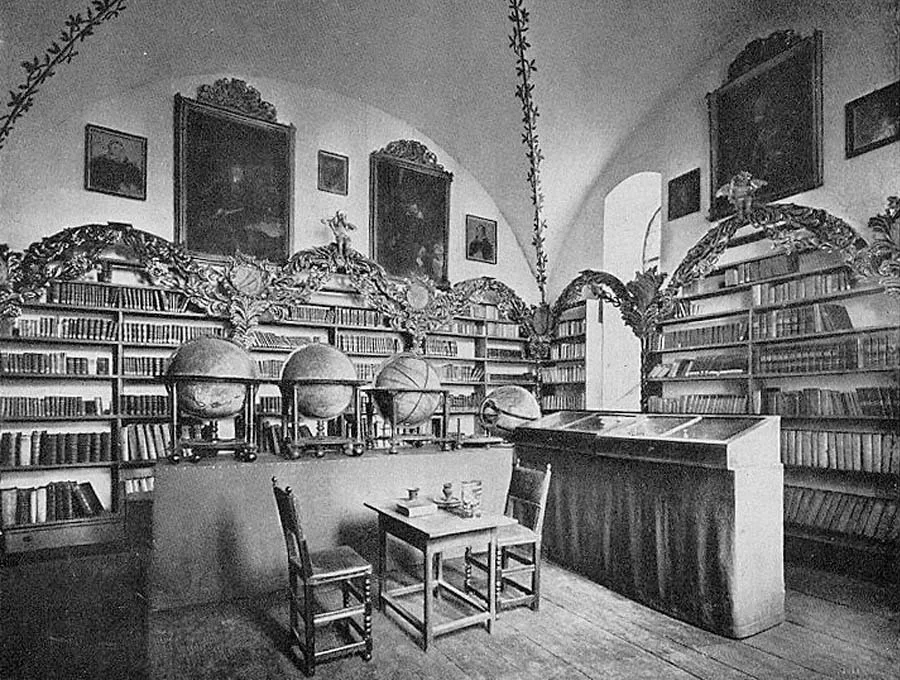 The Wallenrodt Library in the Cathedral.
In the Chamber of Consolation (Trostkammer) many rich vestments and altar cloths are kept; there is also a manuscript in which a man signed away his soul to the Devil, the knife that Satan gave this man to kill himself with, and many other curiosities of the kind.
In the tower of this church is the famous library of von Wallenrodt, which I shall tell you about later. Some of the lower rooms house the church library, rich in manuscripts of the Church Fathers, works on church history and theological literature.
Next to the cathedral stand the old, spacious but unsightly university buildings, adjoined by the Collegium Albertinum, a boarding college for poor students.
On the square surrounded by these buildings stands the gravestone of a student killed in a duel, which one of the former sovereigns declared a so-called "sanctuary". This privilege granted to the grave stele was so respected that as late as the reign of Frederick the Great it once saved a man who had killed unintentionally.
Today it is hard to believe that anyone could be saved simply by running up to this stone.
The university hall (auditorium maximum) is adorned with very mediocre portraits of sovereigns and a skilfully executed marble bust of Kant. This is the only, and a very modest, monument to the great man erected by Königsberg. Of course, the famous philosopher does not need one, for as long as humanity lives Kant will not be forgotten; but the honour of the people of Königsberg demands that his memory be honoured "in bronze and marble", to spare the city any suspicion of ingratitude.
The Altstadt Church, built earlier than the Cathedral, is a large, plain, venerable building that makes an indelible impression with the considerable height of its cross vaults and its bold columns soaring heavenward.
The architect managed to combine simplicity with fitting elegance so well that in the half-light of these magnificent halls you are seized by a feeling of religious rapture and always leave with a certain emotion.
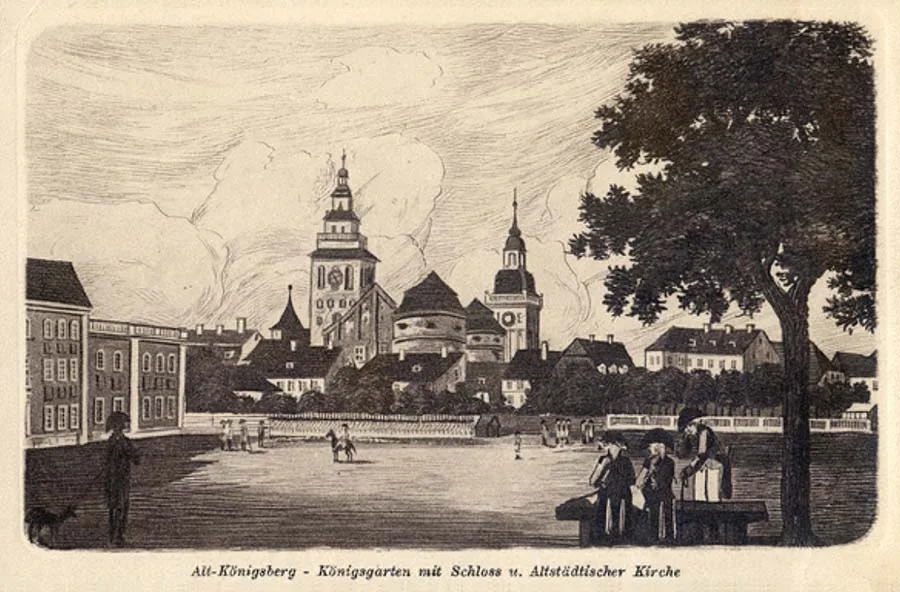 View of the castle and the Altstadt Church from Parade Square.
I have seldom come across an old German church that captivated my feelings as much as this one, and I wish I had enough knowledge of medieval architecture to understand the reason for so vivid an impression.
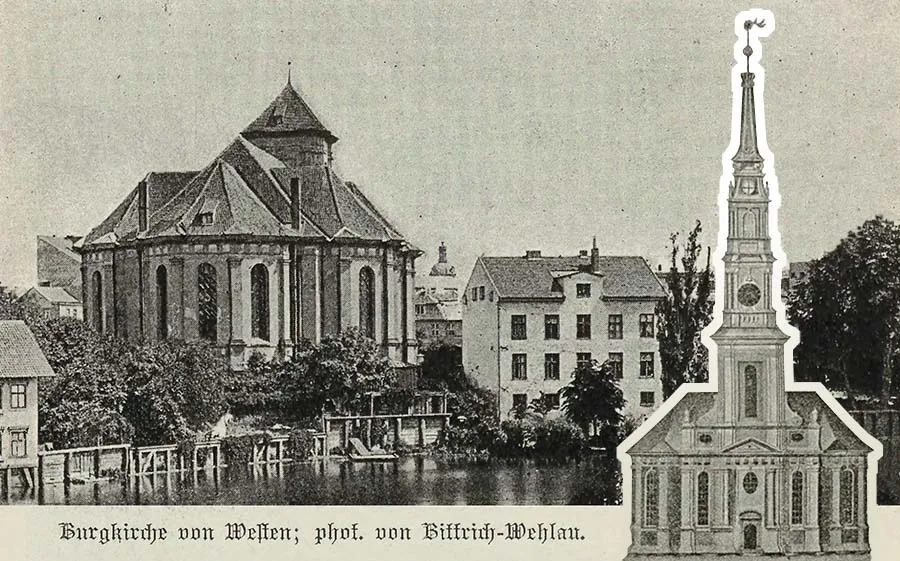
The Reformed Church, now better known as the Burgkirche. / This is how it was meant to look according to the design.
Of the countless tombs that cover the floor and walls of this church, I shall mention only two that seemed to me particularly memorable. Among them is the burial place of the blind Magister Greisinger, who, despite losing his sight in his fourteenth year, was one of the greatest scholars of his time. His likeness on the monument is executed with great skill. Greisinger lived in the first half of the 17th century.
The other monument is a simple and rather inconspicuous gravestone lying right in front of the altar and dedicated to Osiander15, a former pastor of this church.
This clergyman came to Königsberg from Nuremberg. He played an important role in converting the brethren of the Teutonic Order to Lutheranism. Fanatically devoted to the Lutheran doctrine, he persecuted many clergymen for their opinions, had them imprisoned, sent those he disliked into exile, sowed discord in the life of the court and of the whole country, poisoned the peace of his sovereign's last days and contributed in no small measure to his sinking into a kind of madness.
With his intolerance, which bordered on cruelty, he so exasperated his opponents that he did not dare go out into the street unarmed.
After Osiander's death his body had to be buried in secret so that his enemies would not desecrate it.
The very large altar, excessively adorned with carving and gilding, cost some 30,000 guilders to make in the 17th century. For that sum one could have bought a painting by Correggio16 at the time and thus adorned the church more worthily.
The organ is extraordinarily beautiful and was recognised by Abbé Vogler17 as an outstanding masterpiece.
The Reformed Church is a handsome building in which the architect applied the rules of perspective very successfully. It consists of five rotundas adjoining one another. All of them are surrounded by Doric pilasters. If you look at the church from some distance, you seem to see open halls with columns.
The tower is only half built (see above). According to the design it was to have four tiers of columns, one above the other, but there are only two. The Prussian sovereigns always regarded Königsberg as their stepchild, so that most of the projects intended to adorn the city remained unfinished.
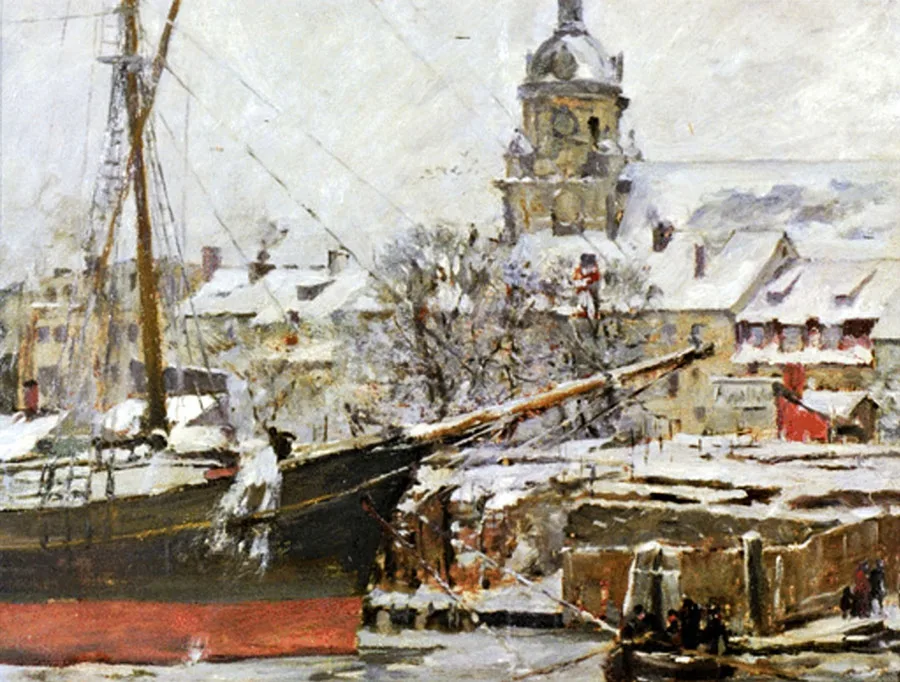 The Catholic church in Carl Storch's painting "The Landing Stage on the New Pregel".
The Catholic church is built in the new style and with great taste. It is distinguished by a magnificent dome, built on a reduced scale after the model of the dome of St Peter's in Rome.
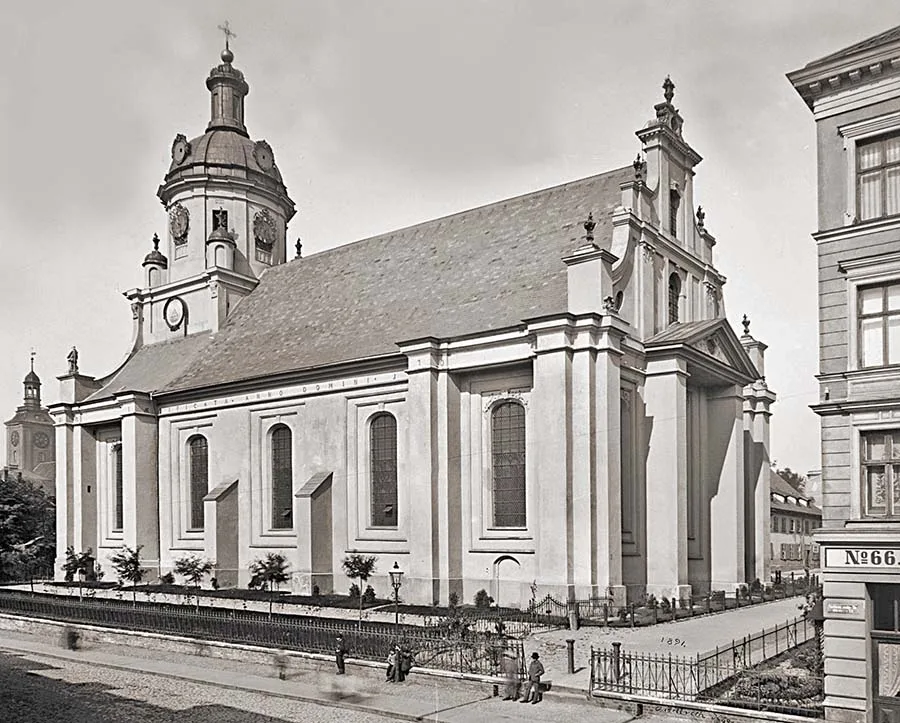 The Löbenicht (left) and Catholic churches of Königsberg.
Inside, this magnificent building is decorated with tasteless altars, paisley-like paintings on the walls and worthless pictures. One can only regret that this beautiful church, one of the chief ornaments of the city by its outward appearance, has not been given decent decoration inside.
The Tragheim Church has the form of an equilateral cross, but the shortcomings this type of construction inevitably brings with it have been reduced to a minimum: for each of the four arms of the cross on which the building is based is so well proportioned that the whole church can be seen from almost any point. The barrel vaults that create its breadth are joined in the middle by a cross dome resting on four huge arches with openings at the ends of the cross.
These bold vaults, which have no supports, create an indescribably beautiful effect and give the church, lit by eleven large semicircular windows, a character that is not only joyful but also sublime, so well suited to peaceful, blissful prayer. The furnishing of the church is simple and on the whole very harmonious.
No excesses, no empty ornaments spoil the impression this cheerful church makes on the soul of the worshipper.
On the pulpit there is an old image of Christ in a medallion which, according to the church archive, is a copy of a picture painted from life by the Roman Lentulus and sent to the Roman Senate. Christ is depicted in profile. In its draughtsmanship the image is of unsurpassed beauty. The profile bears a striking resemblance to the statue of Jupiter in the third hall of the Gallery of Antiquities in Dresden. Divine majesty is combined with inexpressible gentleness, truly and eloquently conveyed, but the drapery is stiff and imperfect and looks like the work of a clumsy restorer.
In the other churches I found nothing remarkable, except that some of them have exquisitely beautiful towers which, seen from afar, give the city a majestic appearance. Most of the churches burned down in the great fires that swept the city in the 18th century, so their exteriors still look new. Nor have all of them recovered from the devastation they suffered in 1807, when they had to serve as hospitals.
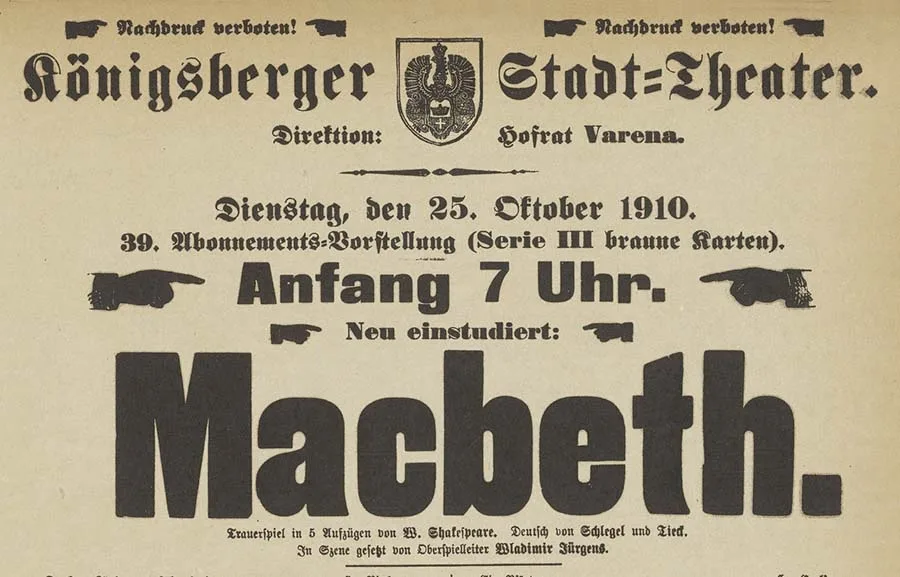 Fragment of a Königsberg theatre playbill.
The local New Theatre is undoubtedly the most remarkable work of architecture in Königsberg; the theatres of Vienna and Berlin cannot compare with it in beauty. It is of quite unusual size and stands on a handsome square.
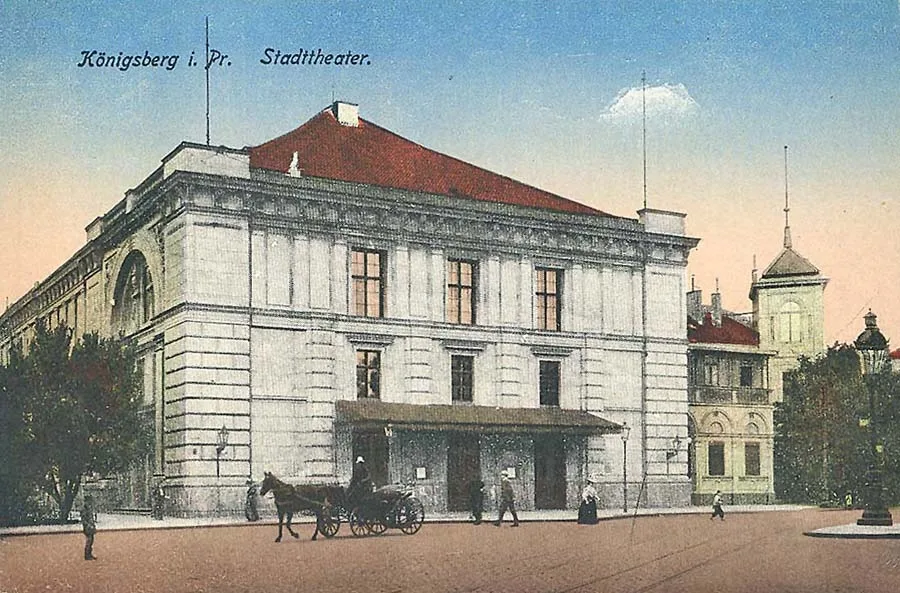 The theatre on Parade Square. On its site now stands the apartment building at Universitetskaya Street 4–10.
It can be viewed from all sides, and one marvels at the effect produced by this noble work of art. The long façade of the building is not interrupted by any window openings and has porticoes of the Egyptian order at both ends. Given the great size of the structure, any other architectural order would have been petty and out of place, since only columns of large diameter harmonise with the overall architectural concept. However, the façade looks somewhat monotonous and heavy, for the bas-reliefs that are meant to be mounted on the walls are missing.
They were commissioned from Director Schadow in Berlin, but for lack of money they have not yet reached Königsberg.
From each portico three entrances lead inside: those on the left to the stage and the dressing rooms, those on the right to the boxes of the second and third tiers and to the gallery. On the gable side facing the Castle Pond, three large arcades lead into an open, spacious vestibule giving access to the aisles of the stalls, to the boxes of the first tier, to the concert hall and to the buffet.
The corridors, like the vestibule and the staircase, are wide and comfortable, so that even with the largest audience there is never a crush, and a completely full house empties in five minutes, as I saw with my own eyes. In this respect the theatre deserves to be held up as a model. The buffet adjoins the vestibule and is as spacious as it is magnificent. The concert hall is located above the vestibule and easily holds 600 to 700 people. It is arranged in such a way that the music from it does not carry into the auditorium of the theatre, so concerts and performances can be given at the same time.
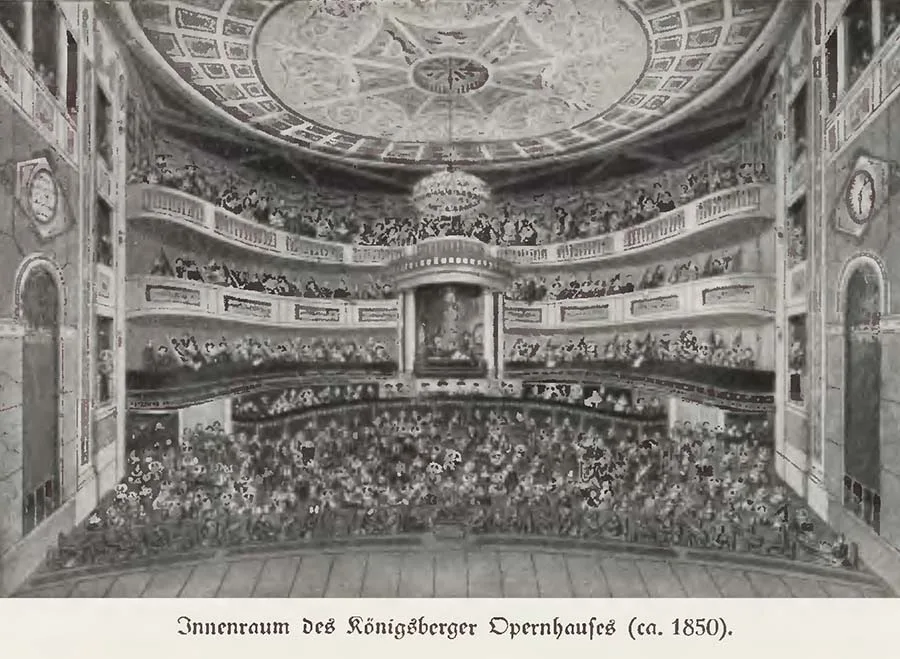 View of the auditorium from the stage. The splendid royal box catches the eye.
The interiors of the theatre are richly and tastefully decorated, surpassing in this respect everything I have ever seen. All the boxes are open, not divided by any partitions, and in the centre is the splendid royal box (see above).
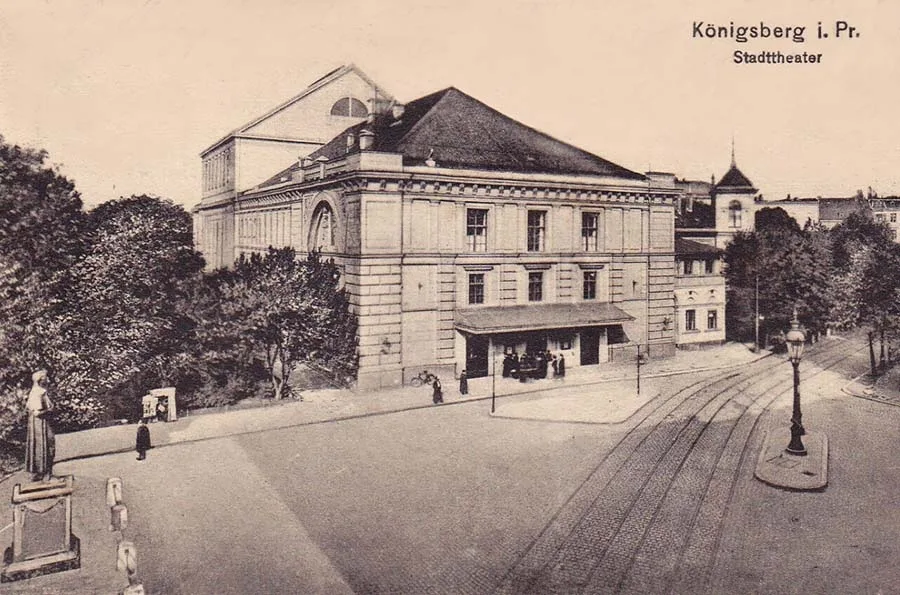 Déjà vu: the Schiller monument (left) on the square in front of the theatre.
It has beautifully painted side walls decorated with wall lamps, and is separated from the other boxes by two richly gilded fluted Corinthian columns supporting elegant ceiling beams.
The boxes do not reach the stage but are separated from it on each side by walls 50 to 60 feet long. In these walls there are two niches holding antique flower baskets. Behind the orchestra there is a so-called "closed area" with seats. Art critics usually sit there, so tickets for it are rarely sold. The size of the stalls has made it possible to arrange the seats in three groups, with standing room between them. All the seats have backs, which is probably necessary so as not to tire during four hours in the theatre. Behind the stalls is a raised platform from which everything can be heard and seen perfectly. There the spectator is somewhat isolated from the rest of the house18. You pay more for these seats than for the stalls.
To the left of the stage there is a clock, and to the right, in a semicircle, the title of the play to be performed the next day is written.
The stage is very large and, unlike those of all German theatres, has the following peculiarity: there are no wings, but instead two sloping side panels, which make scene changes easier, look better in perspective and harmonise with what is happening on stage.
This luxurious theatre burned in 1808, soon after it had been built. The famous scene painter Breysig lost in the fire his collection of drawings of the most exquisite buildings and landscapes, which he had made during twenty years of travel around Europe. This collection of drawings, destroyed in the fire, was so rich that another equal to it may perhaps not exist; the loss was therefore irreparable. The cause of the fire was never discovered, although a reward of a thousand thalers was offered for any reliable information. Most probably it was arson, since many cases of deliberate damage to the decorations and moving parts of the building, as well as to windows, doors, seats and the like, had been noted earlier, which points to malicious intent.
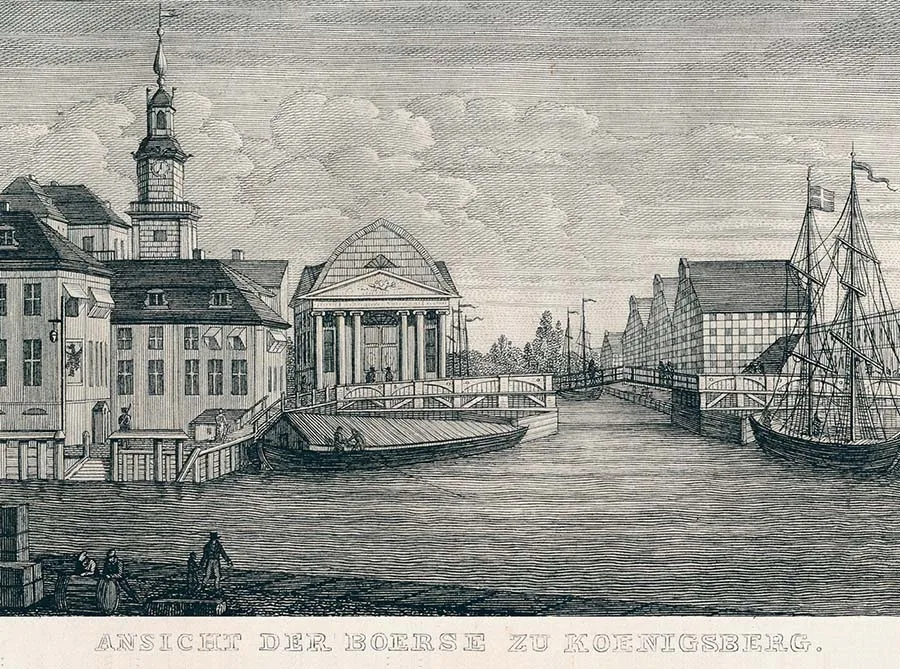 The old Königsberg Stock Exchange and the tower of the Green Gate (left) on the Kneiphof.
The second Königsberg theatre is called the Old Theatre only to distinguish it from the newer one. It was rebuilt only about fifteen years ago, after it had burned to the ground.
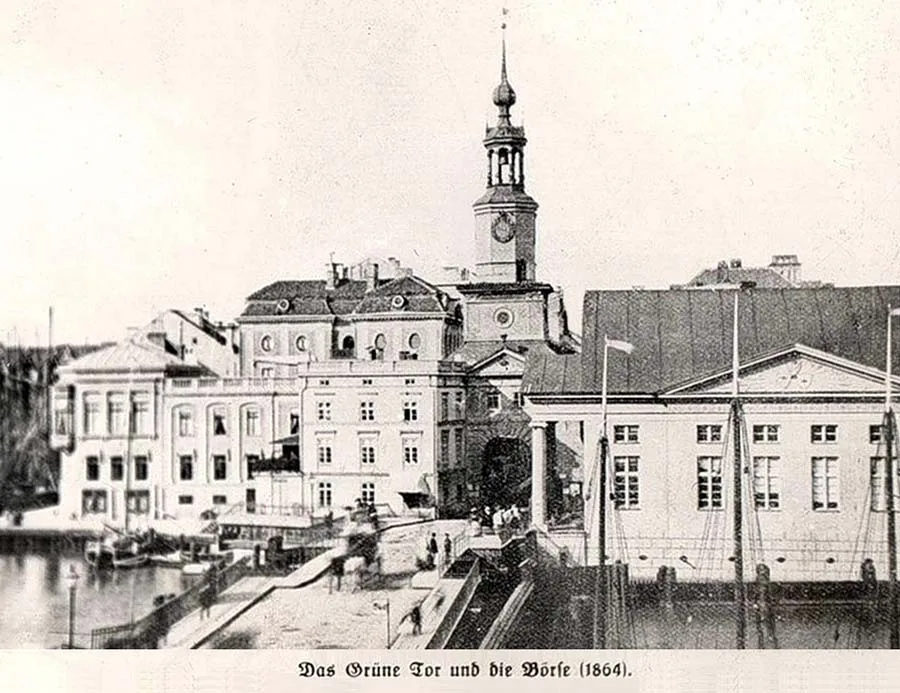
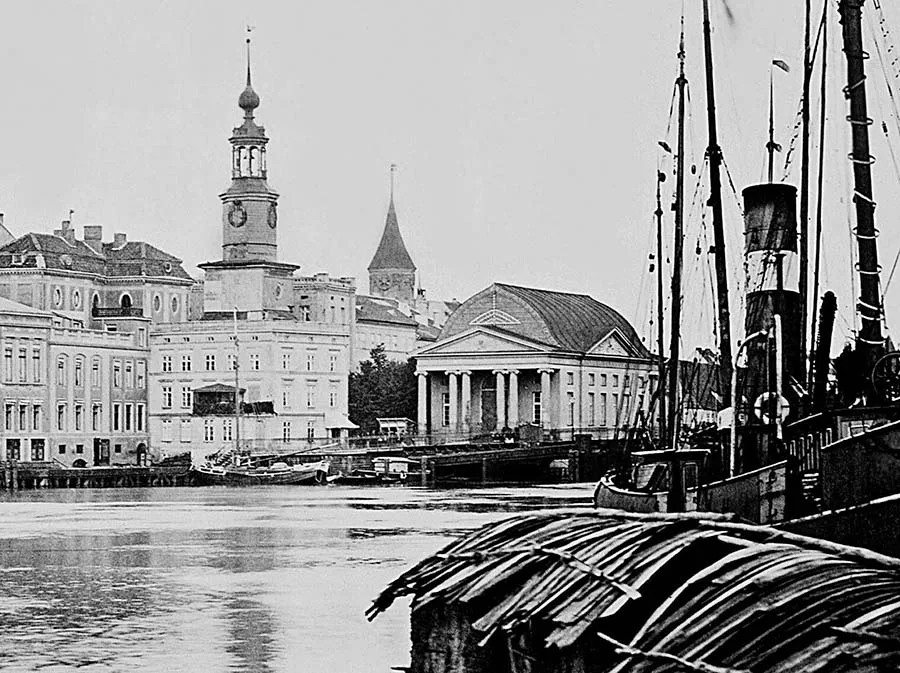 The Green Gate and the Old Stock Exchange (right) on the Kneiphof. The flyover bridge has eclipsed this view.
It is the private property of a merchant who, although he profited greatly from letting the building, rebuilt it after the fire with obvious parsimony and disregard for all the rules of architecture. It is said that the people of Königsberg were so upset by the builder's stinginess that this gave rise to the construction of the new large theatre.
It is said that the owner of the Old Theatre asked a professor who had long been irritated by the tasteless design of the building to compose a suitable inscription for it. The professor agreed and, when reminded of his promise, sent the following: "This is a house of Comedy, not a barracks."
Mr B. (that was the owner's name) naturally did not like it, and he turned to Kant, who by then was already very old, asking him to compose a more suitable dedication.
Kant found this request inappropriate and annoying. Professor Rink, who was visiting him at the time, saw a volume of Virgil on the table, opened it at random and read out the first phrase he came across: Amant alterna Camēnae19. And this was the phrase placed on the façade of the building, although in this case, torn out of Virgil's text, it was utter nonsense.
During the mobilisation of the army the theatre building was used as a clothing depot, and at present it stands empty.
The Stock Exchange, located on the Kneiphof by the Green Bridge, is an elegant pavilion built in a noble antique style which, they say, cost a great deal of money because, at the strange insistence of the city's merchants, it was built on the water, that is, on piles. The exchange building has handsome peristyles with Ionic columns on two sides and a round copper-covered dome, and it looks very fine.
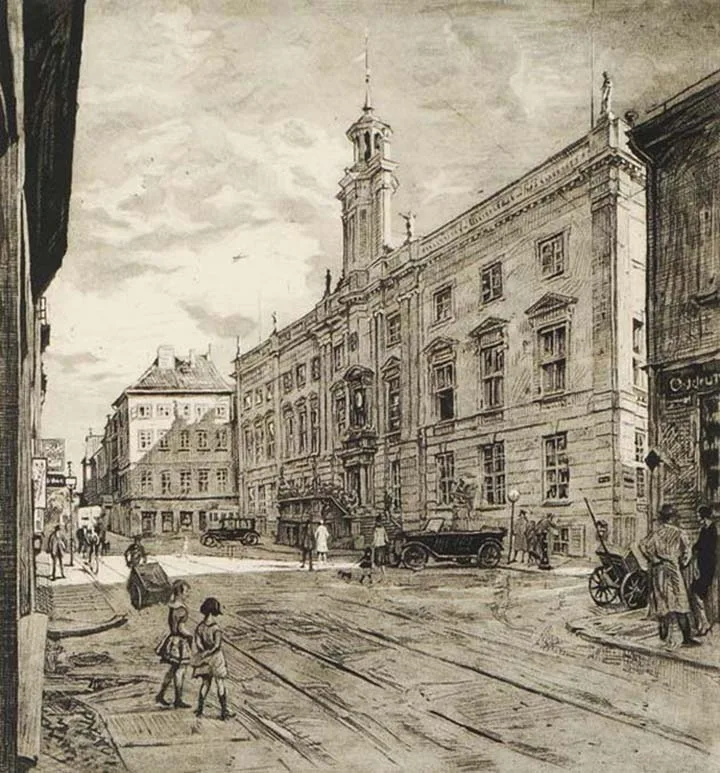
The Kneiphof Town Hall. From the second quarter of the 18th century it
housed the town hall of united Königsberg.
The Kneiphof Town Hall (see above) is a solid, richly and elegantly decorated building with a magnificent staircase and an elegant columned portal. The great hall of the magistrate, faced with marble and adorned with statues, is also worthy of an ancient city.
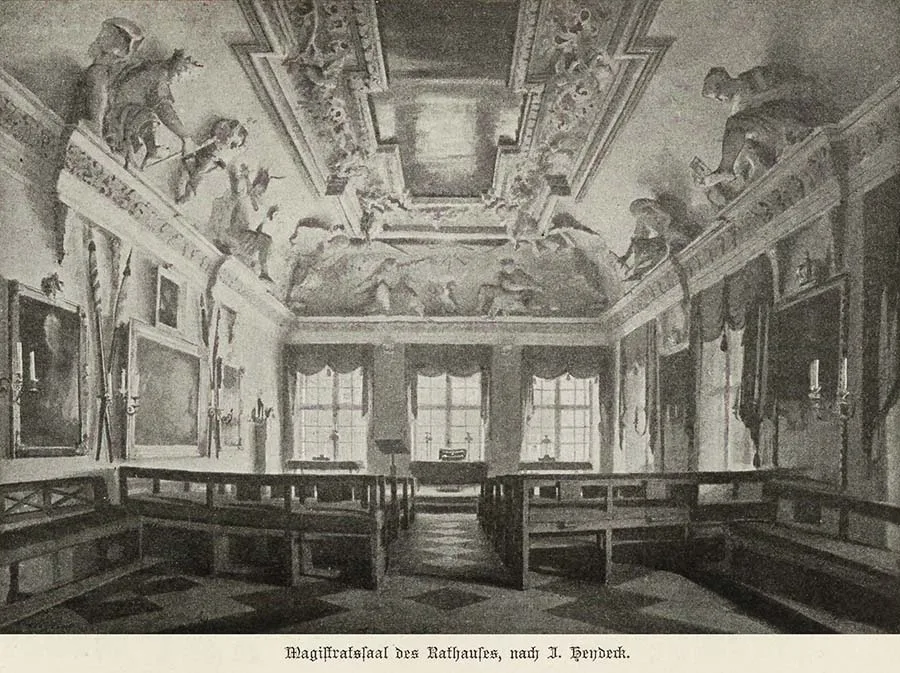 Interior of the Kneiphof Town Hall.
The town hall of the Altstadt, the Royal Orphanage (now Zeller's educational institution) and the Royal Library were built at the beginning of the 18th century in the French style then prevailing, clearly nobler than the style of later times. The last two buildings look particularly fine and have the appearance of palaces. The façade of the first is spoiled by a disproportionately high flight of steps and a few shapeless columns.
The other public buildings, like the private ones, are in no way distinguished, for the former were built with the utmost economy, while in the construction of the latter only the convenience and comfort of their occupants were taken into account, so expressive decorative solutions are found only in their interiors. This is usually the case in commercial cities. In Riga, Danzig, Hamburg, Amsterdam and London, for example, tastefully built houses are as rare as they are here, although many rich people live in both places.
LEGENDS OF PRUSSIA in the blog of Tatyana Kolivay.
TRANSLATOR'S NOTES
1. Frederick I (German: Friedrich I.; 1657–1713) – Elector of Brandenburg as Frederick III from 1688, first King of Prussia from 1701, a member of the Hohenzollern dynasty.
2. Frederick William II of Prussia (German: Friedrich Wilhelm II. von Preußen; 1744–1797) – King of Prussia from 1786. Son of Augustus William and Louise Amalie of Brunswick-Wolfenbüttel, nephew of Frederick II the Great.
3. Roustam Raza (French: Roustam Raza, 1782–1845) – a Mameluke, bodyguard and squire of Emperor Napoleon.
4. Joachim Murat (French: Joachim Murat; 1767 –1815) – Napoleonic marshal, Grand Duke of Berg in 1806–1808, King of Naples in 1808–1815. Because of his love of theatrical effects and lavish exotic costumes he was nicknamed the "theatre king" (see below).
The French historian and diplomat Count Louis Philippe de Ségur, French ambassador at the court of the Russian Empress Catherine II, described this man as follows: "Murat, this theatre king by the refinement of his dress and a true monarch by his indomitable spirit and boundless energy, was as bold as a dashing charge and always had an air of superiority and menacing daring, which was the most dangerous weapon in an attack."
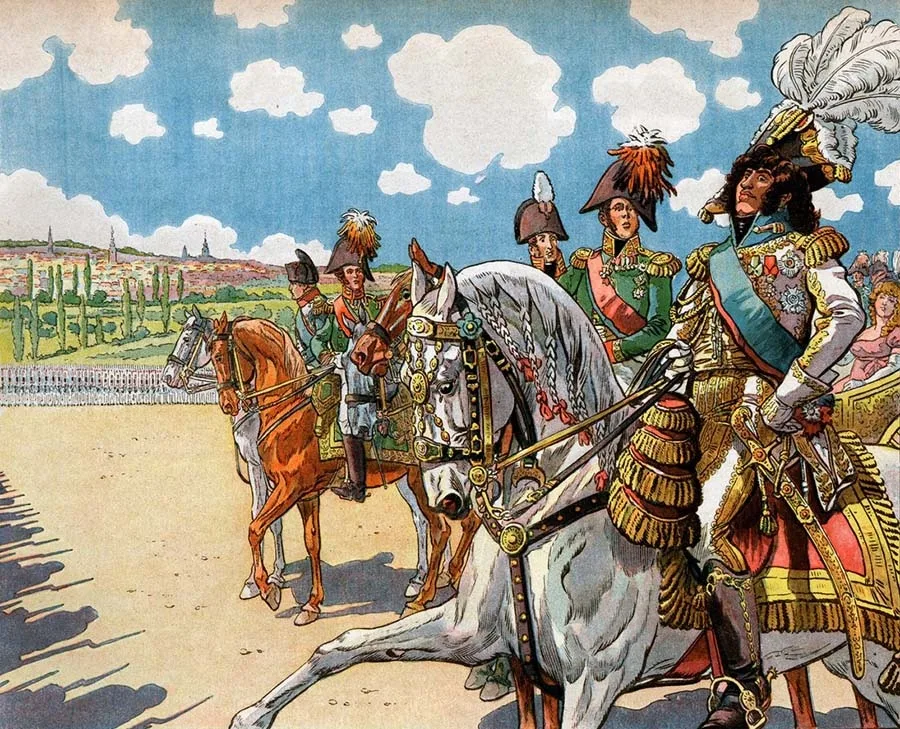 Murat reviewing a parade. Drawing by Jacques Onfroy de Bréville (Jacques Onfroy de Bréville), known in his day under the pseudonym Job (Job).
5. Hans Jakob von Auerswald (German: Hans Jakob von Auerswald; 1757–1833) – Prussian general and politician. Enjoying the king's trust, von Auerswald was repeatedly appointed to responsible posts: in 1788 he was charged with organising agricultural credit, in 1797 he was president of the chamber in West Prussia, in 1802 he held the same post in East Prussia, and in 1808 he was appointed Oberpräsident of East and West Prussia. When the post of Oberpräsident was abolished, Hans Jakob von Auerswald was appointed president of the main administration of East Prussia, and in 1811 he was raised to Landhofmeister of the Kingdom of Prussia. As curator of the University of Königsberg he also rendered great services to his native land.
6. Zeughaus (German: Zeughaus) – an arsenal, armoury.
7. Frederick William III (German: Friedrich Wilhelm III.; 1770–1840) – King of Prussia from 1797. Son of Frederick William II and Frederica Louisa of Hesse-Darmstadt, grandnephew of Frederick II the Great, father of the Russian Empress Alexandra Feodorovna (Charlotte of Prussia), grandfather of the Russian Emperor Alexander II. He took part in the wars against Napoleon and the Congress of Vienna and was one of the leaders and organisers of the Holy Alliance.
8. In today's Kaliningrad the "Blood Court" restaurant is more often called the "Blutgericht" (German: Blutgericht). The fame of the Blutgericht gives Kaliningrad restaurateurs no rest, and they periodically attempt to revive it.
9. The Battle of Pułtusk (Bataille de Pultusk) – a battle fought on 14 (26) December 1806 between the Russian and French armies near the Polish town of Pułtusk during the War of the Fourth Coalition.
10. Jacob Philipp Hackert (Jakob Philipp Hackert; 1737 –1807) – German landscape painter and engraver, a representative of Neoclassicism and Romanticism in Western European art of the second half of the 18th century.
11. Martin von Wallenrodt (1570–1632) was a lawyer and book collector. In 1619 the ducal government in Königsberg admitted the 49-year-old Wallenrodt, then district administrator and governor of Tapiau, to its ranks and gave him the important post of Chancellor of Prussia. Wallenrodt collected books all his life and left 2,000 valuable volumes. They formed the core of the Wallenrodt Library, which he bequeathed to the city and the university.
12. When describing (from memory?) the epitaphs in the Cathedral, the author gave the Prussian chancellor's name wrongly as Cocceji (Samuel Freiherr von Coccej, 1679–1755, who died and was buried in Berlin). In Königsberg Cathedral there was an epitaph-sarcophagus of Johann von Kospoth (Johann von Kospoth, 1601-1665), Chancellor of Prussia in 1663–1665.
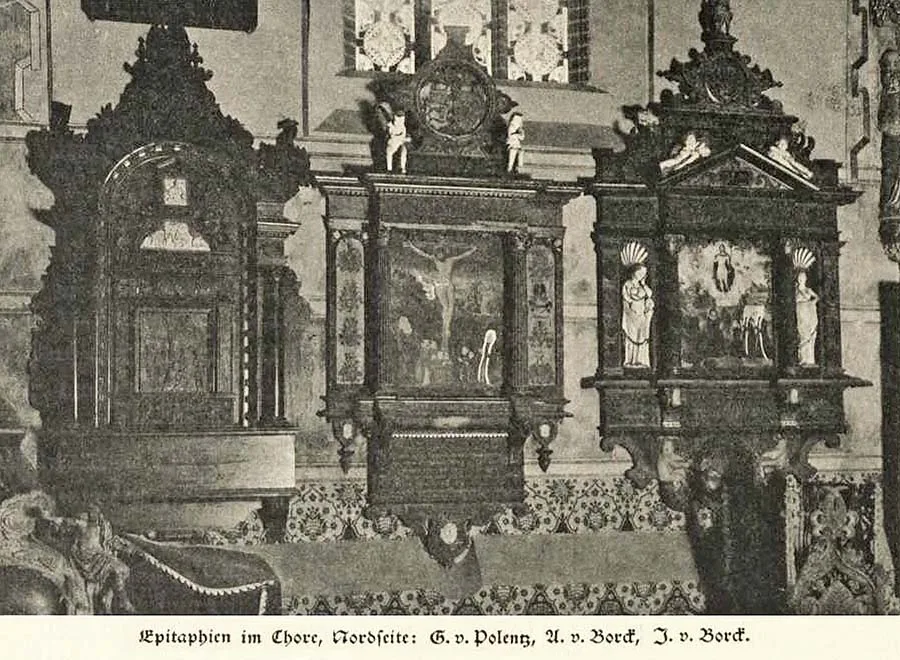
The epitaph of Bishop von Polentz (left) stood on the wall of the Cathedral next to similar artefacts dedicated to members of the von Borck family.
13. Georg von Polentz (George von Polentz; c. 1478–1550) – Bishop of Samland and Pomesania. The last Bishop of Samland in 1518–1525, the first Catholic bishop to adopt the Protestant faith.
14. Luther (Lothar) of Brunswick (German: Luther von Braunschweig; c. 1275–1335) – the 18th Grand Master of the Teutonic Order from 1331. He promoted the building of Königsberg Cathedral not as a fortress cathedral but as a purely religious building in the Gothic style: on 13 September 1333 he gave permission to continue the construction of the Cathedral in Königsberg, begun in 1330.
15. Andreas Osiander (Andreas Osiander; 1498–1552) – German Lutheran theologian and Protestant reformer. In 1549 he settled in Königsberg and took the chair of theology at the local university. He played a decisive role in converting the Teutonic Knights to Lutheranism. Osiander lived and worked in Königsberg until his death in 1552.
16. Antonio Allegri da Correggio (Correggio; Antonio Allegri; c. 1489–1534) – Italian painter, one of the greatest masters of the High Renaissance.
17. Abbé Georg Joseph Vogler (Georg Joseph Vogler, 1749–1814) – German composer, organist, music theorist, music teacher and musicologist.
18. Evidently the amphitheatre is meant.
19. Amant alterna Camenae – "The Camenae (Muses) love alternation". (Virgil, "Eclogues", III, 59).
Translated from Russian with the help of AI (Claude, Anthropic), October 2026.