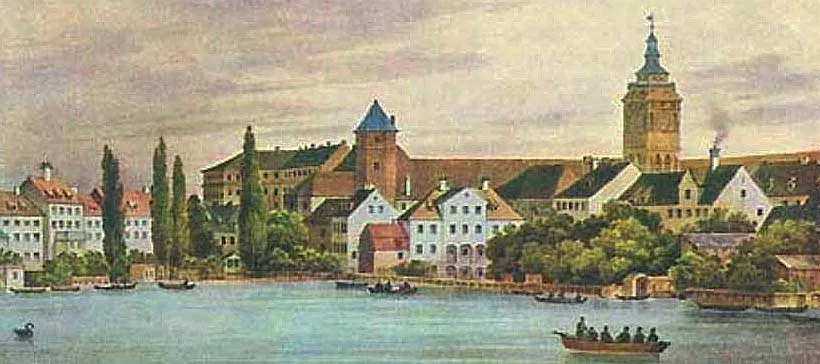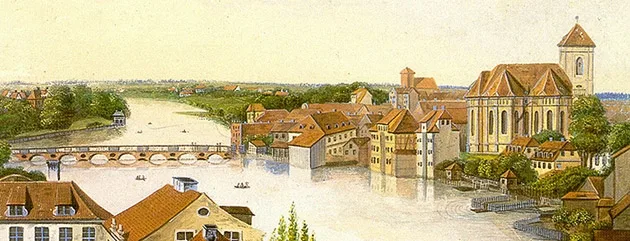
Burgfreiheit is the name given in Königsberg to the part of the city lying north of the castle. Since the 16th century the term "Freiheit" has been used for suburbs that were granted town rights and their own jurisdiction by the issue of so-called "charters of liberty".
(Translated literally from German, the words Burg and Freiheit, which together form the name of the city district of Burgfreiheit, mean "castle" and "freedom" respectively. But the word Freiheit has a second meaning, "sloboda" – a privileged settlement. Unlike towns, such settlements did not possess town rights (Stadtrecht), but they often enjoyed privileges and autonomy. — Editor's note.)
In Königsberg six such settlements were directly subordinate to the sovereign: Burgfreiheit, Sackheim, Neue Sorge, Tragheim, Vorder Rossgarten and Hinter Rossgarten. Their head was the Oberburggraf, who was also the highest authority in civil jurisdiction. His deputy was the chancellor. Their decisions were carried out by the so-called castle guards.
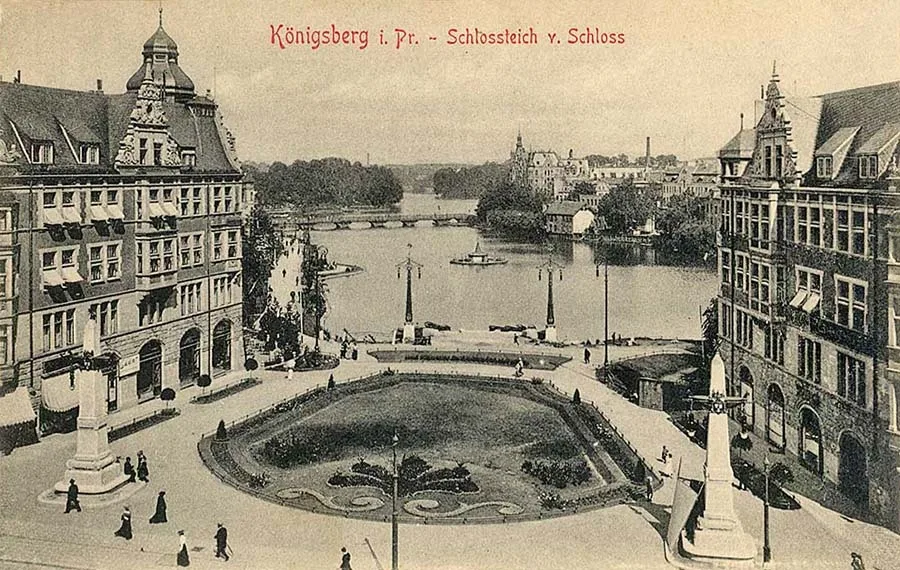 Mint Square and the Castle Pond.
Numerous private jurisdictions were also subordinate to the Oberburggraf. Besides the university, which only quite recently (1879) lost its special status in matters of justice, parishes and individual noble families also had civil jurisdiction over the territories belonging to them. Thus, the German Reformed congregation had its own civil jurisdiction on the basis of a privilege of 4 July 1698, and the French one on the basis of a privilege of 5 March 1707. Among the noble families that had their own jurisdiction in our city, the following should be mentioned: Barfuß, Kreyzen, Dohna, Dönhoff, Klinger, Kupner and Holstein (Barfuß, Kreyzen, Dohna, Dönhoff, Klinger, Kupner, Holstein). Criminal jurisdiction in the free suburbs belonged to the High Court established in 1659, and after its abolition (in 1721) to the Court Tribunal.
To the west, Burgfreiheit bordered on Steindamm along the street of the same name (Steindamm). To the north, on Tragheim (Tragheim).
The boundary with it ran along a line from Italian Lane (Wallsche Gasse) to 2nd and 1st Brook Streets (2. und 1. Fließstraße) as far as Tavern Street (Krugstraße), from there across the Peat Market (Torfmarkt) and further along Modesten Lane (Modestengasse) to the Castle Pond (Schloßteich). The Peat Market was originally the name of a small square on which the summer restaurant "Börsenhalle" (Börsenhalle) stood, while Modesten Lane is the old name of the part of Hinter Rossgarten (Hinter Roßgarten) from the Peat Market to the Masonic lodge "Three Crowns" (Dreikronenloge). On the eastern shore of the Castle Pond (Schloßteich), the following belonged to Burgfreiheit: French Street (Französische Straße), Burgkirchen Square (Burgkirchenplatz), Hill Square (Bergplatz) and Mill Passage (Mühlengrund).
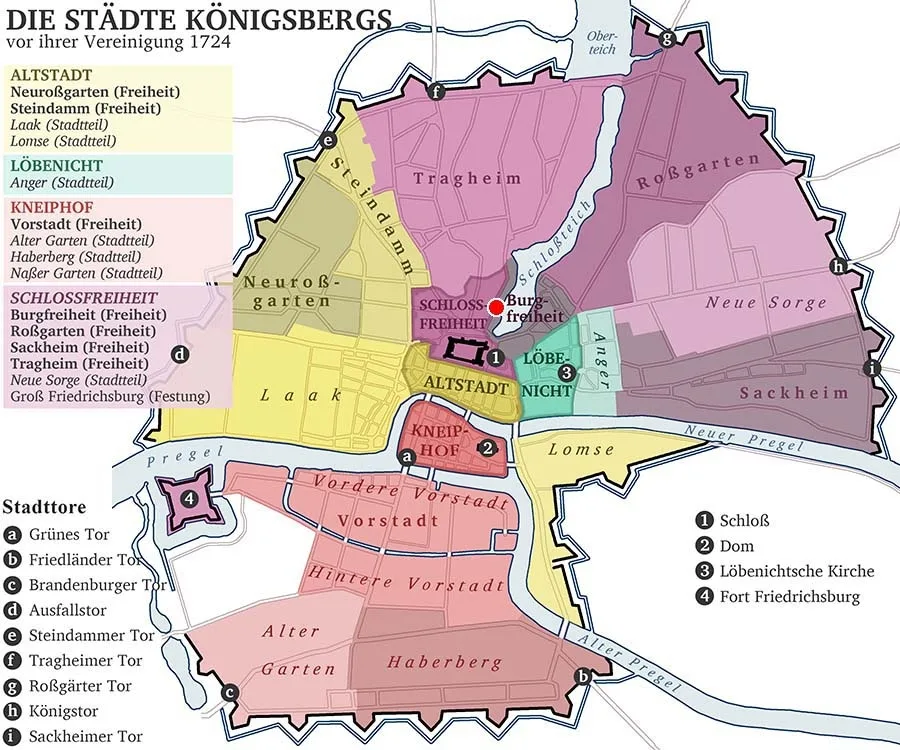
Schloss- and Burgfreiheit on a reconstructed map of the towns, settlements and districts before their unification in 1724.
In the times of the Teutonic Order, and also in the ducal period, there was practically no building in Burgfreiheit, which is now known for its many busy shopping streets and the most beautiful square in Königsberg.
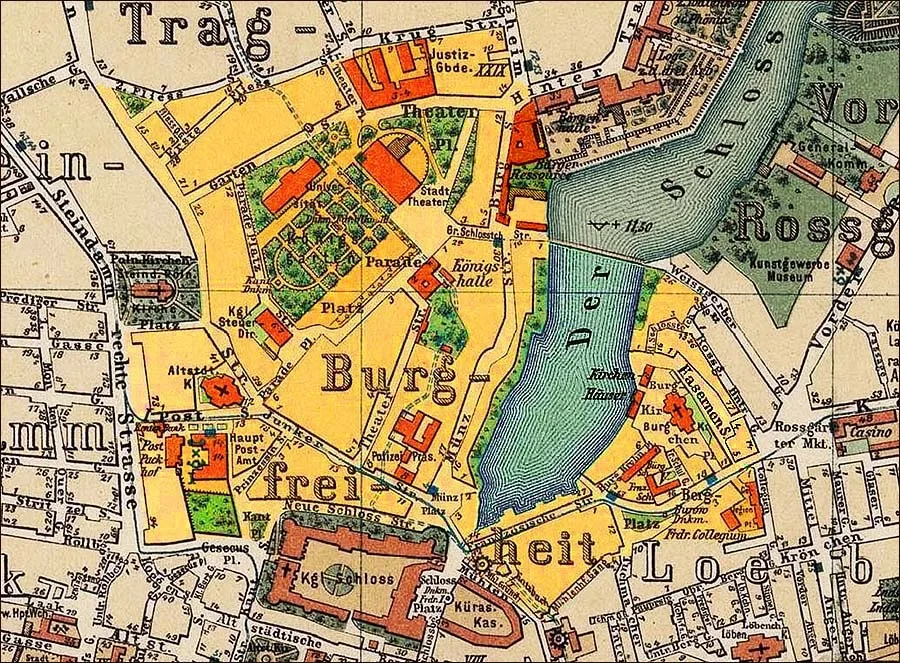 Burgfreiheit on a map of 1885; the book "Königsberg Local Studies" came out in 1895.
Originally only court officials were allowed to settle here, and Junker Street (Junkerstraße) is named after them. The fact that all three towns whose unification created Königsberg (Altstadt, Kneiphof and Löbenicht) allowed only local merchants to trade on their territory until the time of the first Prussian kings greatly hampered the development of trade. But it was precisely here, in Burgfreiheit, that those protected by Calvinist doctrine began to settle, and it was here too that the Great Elector began to settle refugees from France, that is, the Reformed Huguenots.
In addition, these towns periodically feuded both among themselves and with the neighbouring settlements.
Matters went so far that in 1701, shortly after the coronation of Frederick I, an association of discontented settlers, among whom there were many foreigners, petitioned the king to create a fourth town, proposing to call it "Königsstadt" or "Friedrichsstadt".
This would have dealt a heavy blow to the trade and industry of the three towns that had given cause for it. Only with great difficulty did the common city council of Königsberg manage to prevent the creation of a fourth town.
If we come out of the gate of Königsberg Castle, we find ourselves on Castle Square (Schloßplatz); turning left and passing the monument to Duke Albrecht (Herzog Albrecht) on our left, we see on our right a little square, now used as a cab stand and called Mint Square (Münzplatz). The name recalls the times when the Mint (Königsberger Münzstätte) stood here. Its building stood here until 1802, when it was demolished. The iron money struck there was marked with the letter "E".
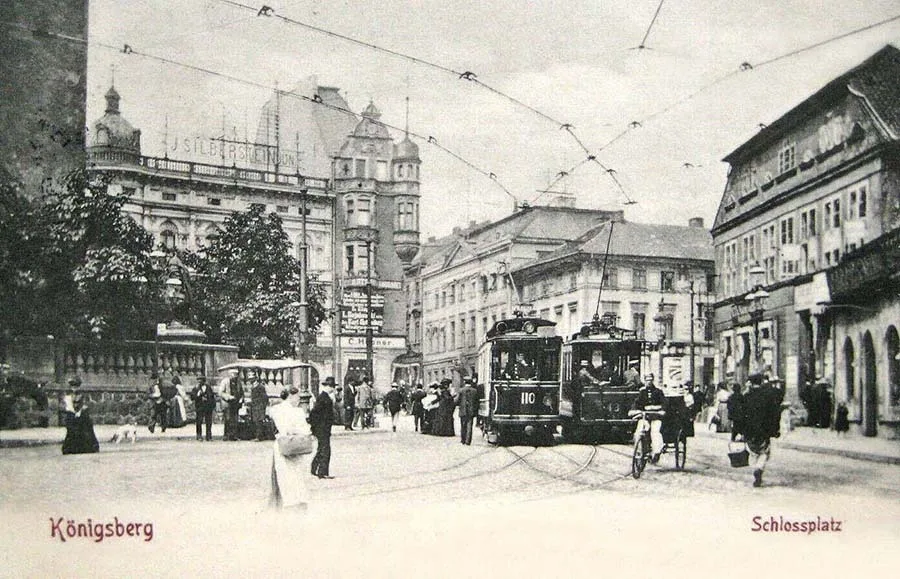 Castle Square flowed into Mint Square without the pedestrian noticing.
During the Seven Years' War the Königsberg Mint struck Russian coins, with the Russian Empress Elizabeth on the obverse and the Prussian eagle on the reverse.
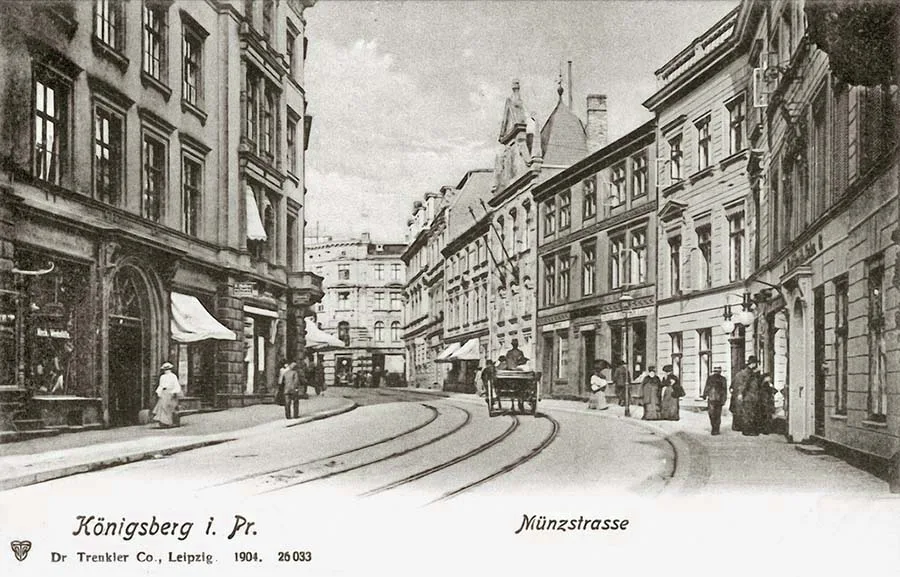 Mint Street, which ran parallel to the western shore of the Castle Pond.
Königsberg received the right to mint coins in 1454 from Casimir IV Jagiellon (Kazimierz Jagiellończyk, 1427–1492), King of Poland, on condition that they bore the image of the Polish monarch. The town of Altstadt also had the right to mint coins after the end of the war in 1466, but five years later this right was taken away from it because their quality was very poor.
(The authors of the book gave a somewhat one-sided account of the history of minting in Königsberg. The first coins in Königsberg were struck in 1260 in the suburb of Steindamm. Minting ceased in 1309. It resumed in the middle of the 15th century and continued until 1803. During the Seven Years' War the Königsberg Mint struck Russian coins without any special marking, which makes them difficult to tell apart from those minted in Moscow. — Editor's note.)
In the times of the Teutonic Order there was a convent dedicated to St Magdalene on the site of Mint Square. Later a hall for balls and theatrical performances (Ballhaus) was built here; it was also used for ball games.
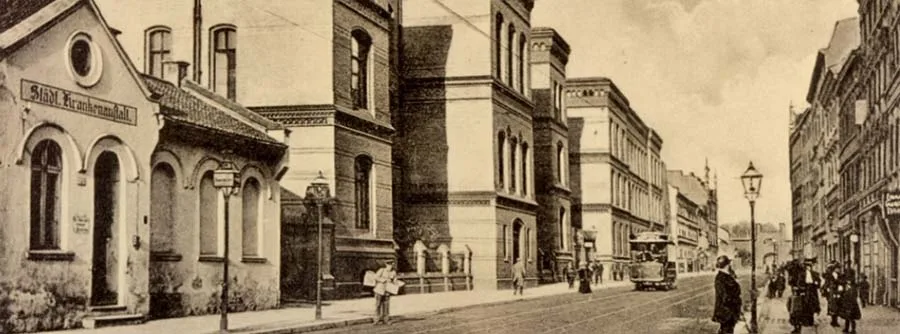
On Mint Street (Münzstraße), which runs from the square of the same name along the western shore of the Castle Pond, stood the Firmarie (Firmarie), that is, the infirmary where elderly brethren of the Order lived out their days. At the beginning of the 17th century this street was partly built up. A characteristic feature of today's Mint Street is the large number of photographic studios on it. Here too are the printing works and dispatch office of the "Königsberg General Newspaper" (Königsberger Allgemeine Zeitung. A "General Newspaper" was also published in St Petersburg in 1866–67. — Editor's note.)
Junker Street stretches westwards from Mint Square. Its width is clearly insufficient. Probably until 1544 it was not even paved, or was paved very badly. It was in 1544 that Duke Albrecht ordered the Vogt (steward) of the castles of Schaaken (Schaaken) and Fischhausen (Fischhausen) to improve the road and pave it.
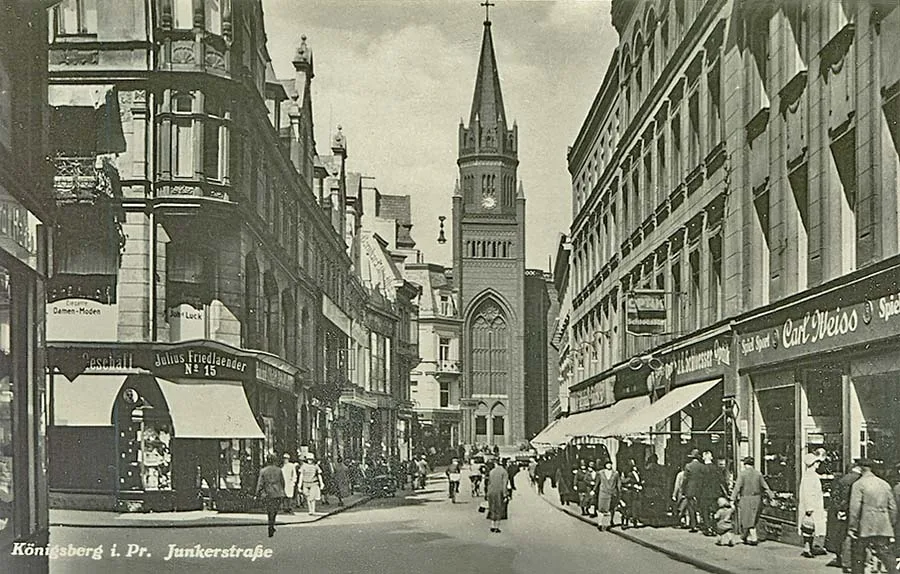 Junker Street and the Altstadt Church.
Until 1572 this whole area was for the most part a blossoming garden. The southern side of Junker Street ran along the old castle moat, on whose bank a few scattered houses stood.
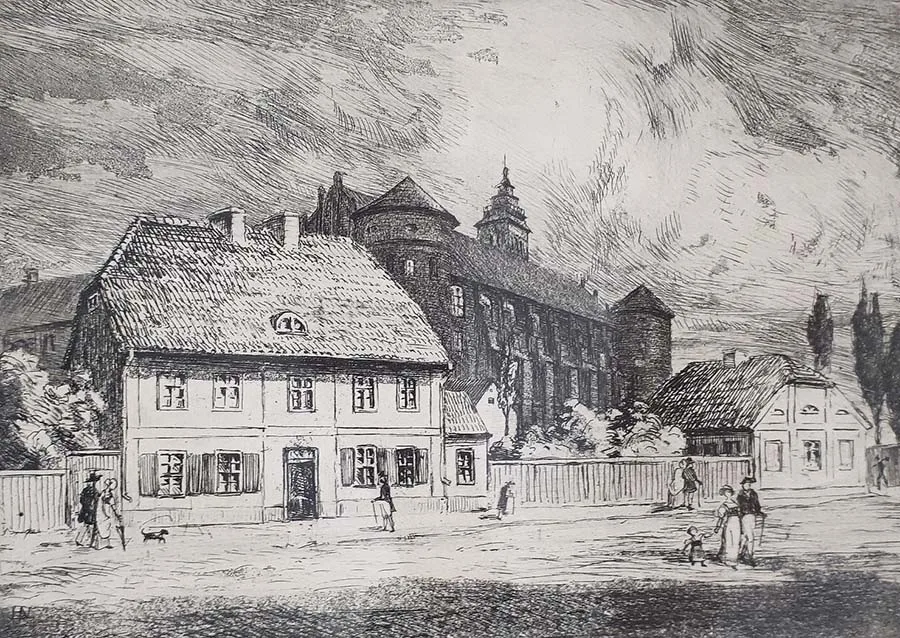 Kant's house near the castle. Etching by Helene Neumann (Helene Neumann, 1874–1942).
Here too are the oldest stone buildings in this part of the city, in particular the one that housed the chancellery and later Voigt's art shop (Junkerstraße 13–14). The oldest building on this street belongs to Hagen's Pharmacy (Hagensche Apotheke). Today's Police Headquarters (Polizeipräsidium, No. 8) was built on the site of Schimmelpfennig's old tobacco factory (Schimmelpfenningsche Tabakfabrik), which was under royal supervision.
Almost at the very western end of Junker Street there is a turning to the left – the beginning of Princesses' Street (Prinzessinstraße). Its name is explained by the fact that as far back as ducal times there was a square of the same name here (Prinzessinenplatz). Here stood the simple two-storey house of the great local philosopher Immanuel Kant.
It was demolished in 1893 because its southern part stood in the way of the construction of Liedtke's new commercial building (Liedtkesches Geschäftshaus), on which a memorial plaque appeared with the inscription:
"On this spot stood the house in which Immanuel Kant lived and taught in 1783–1804" (In dieser Stelle stand das Haus, in welchem Immanuel Kant wohnte und lehrte von 1783–1804).
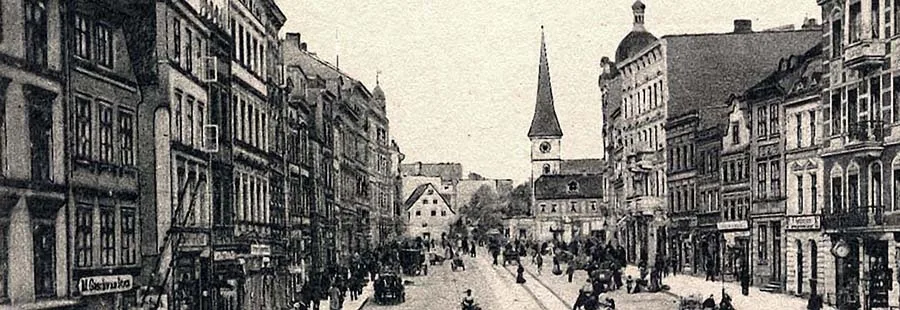
Continuing west along Junker Street, we come to where Post Street (Poststraße) begins and the Altstadt Church (Altstädtische Kirche) stands. Formerly this street was a continuation of Junker Street, which thus extended as far as Steindamm and ended at the gate of the same name (Junkergassenthor). The gate was demolished in 1701. The church was built in the Gothic style to a design by the architect Karl Schinkel (Karl Friedrich Schinkel, 1781–1841) with the active royal participation of Frederick William III (Friedrich Wilhelm III, 1770–1840). Since the design made the church very expensive, the king ordered its volume to be reduced, while the number of columns inside remained the same. This explains the stirring impression its interior makes.
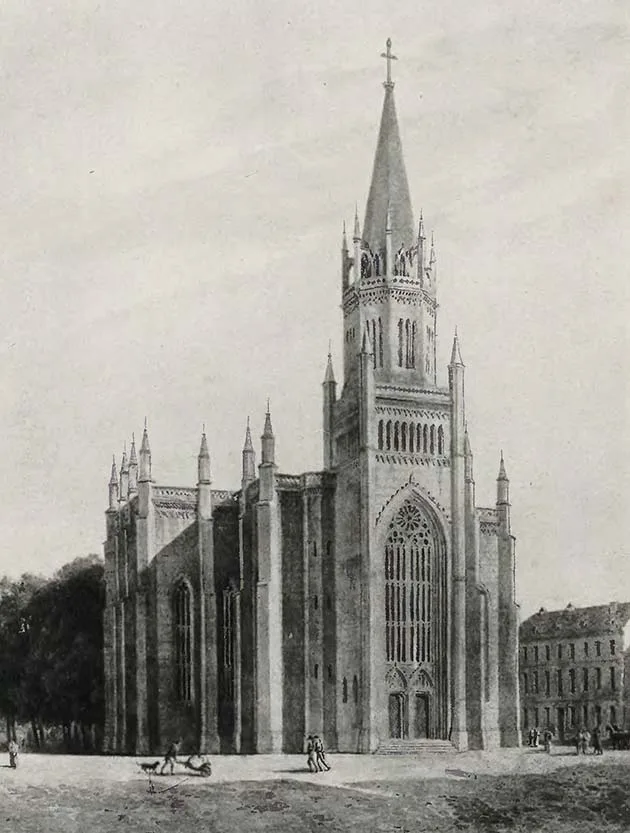
The Altstadt Church. Watercolour by an unknown 19th-century artist.
The foundation stone was laid on 22 June 1838; Crown Prince Frederick William (Friedrich Wilhelm, 1795–1861) attended the ceremony. The church was consecrated on 15 October 1845. Its altar, richly carved and gilded, was inherited from the old Altstadt Church, which formerly stood on the square south of the castle.
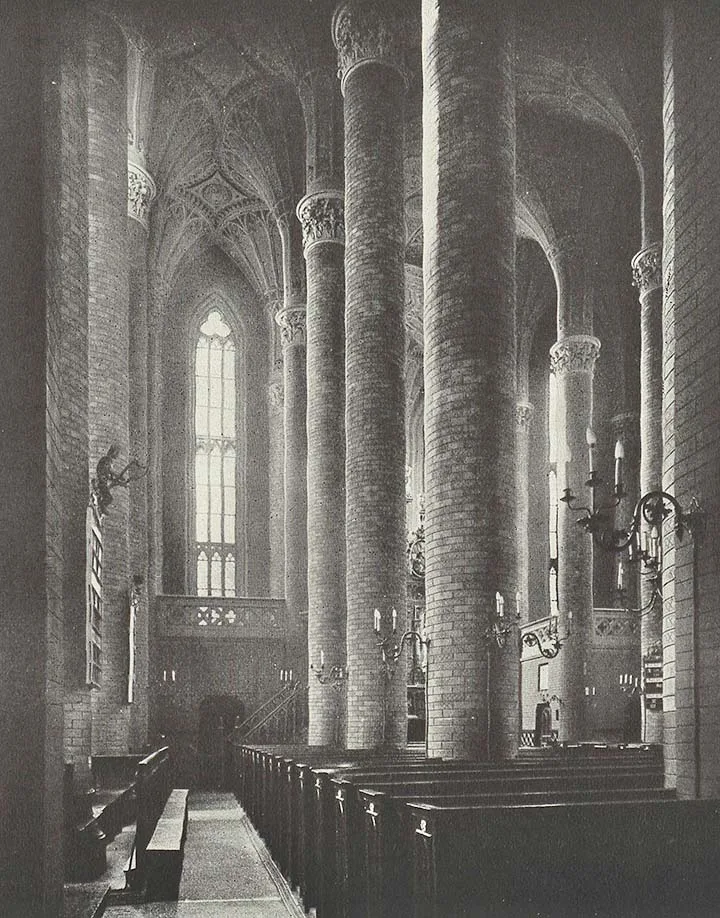
The shortage of money benefited the church's interior.
The organ was made to a design by the master Casparini (Kasparini). The pulpit is new and very simple. The inscription on the marble plaque in the centre of the altar reads: "To the glory of God and the salvation of mankind this house of God was built by the pious kings Frederick William the Third and Frederick William the Fourth. The spiritual communities of Altstadt render them thanks. 15 October 1845."
The church tower is square at the base, hexagonal in the middle section and octagonal above that. The cross crowning the tower is cast iron. The main portal is magnificent. On the church's 50th anniversary, celebrated in 1895, a new organ by Terletzki (Terletzki) was presented, and considerable repairs were carried out on the tower and exterior of the church. Before the church, an old theatre (altes Schauspielhaus) stood on its site. It was built in 1755, burned down in 1797 and was rebuilt in 1800. But since it was no longer needed, it was demolished.
(The young Hoffmann, the writer Stendhal, the composer Wagner, the Russian officer Bolotov and other famous figures frequently visited this theatre. — Editor's note.)
The chief ornament of Post Street is the post office building.
The oldest post office building in Königsberg, which stood on its site, is mentioned by the historian Ludwig von Baczko (Ludwig von Baczko, 1756–1823) in his book "An Attempt at a History and Description of the City of Königsberg", 3rd issue, 1788 (Versuch einer Geschichte und Beschreibung der Stadt Königsberg, 1788): "Near Grumbkow's, not far from the house that formerly belonged to Pudewil, on Kehrwieder Street (Theatre Street) is the old post office." How long it remained here is unknown. But already in the 18th century we find it on today's Altstadt Hill Street (Altstädtische Bergstraße), the stretch of which from Castle Hill (Schlossberg) to the Altstadt Market (Altstädtischer Markt) used to be called Post Street. Next to it, in 1730, a new post warehouse (Postpackhaus) appeared – now Franz Sterkau's confectionery (Konditorei von Strekau). The façade of the post office facing the town was adorned with a monument to Frederick William I (Friedrich Wilhelm I, 1688–1740). The post office was located here until 1797, after which the house was acquired by the city president von Hippel (Theodor Gottlieb von Hippel, 1741–1796). Fifty years later the Lesgewang Foundation (v. Lesgewansche Stift) was housed here, and on the spot where the foundation had previously been, the new post office building was built in 1848–1849. The old post office was demolished, and in 1850 a building was erected on its site, nicknamed, apparently because of its small size, the "Pocket House" (Taschenhaus), which housed the "East Prussian Rent Bank" (Rentenbank für Ostpreßen, Poststraße 15a). The need to widen this street where it merged with Steindamm forced the bank to sell the building in 1891, and part of it was then demolished.
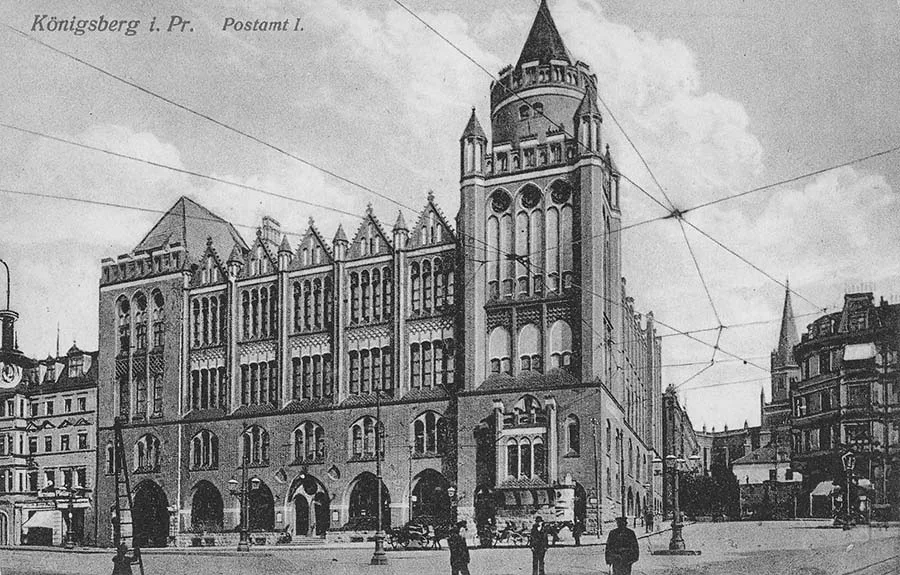 The Königsberg post office and the Altstadt Church (right).
The present main post office building with Gothic elements, magnificent in execution, was put into service in the autumn of 1887. The construction cost 568,280 marks.
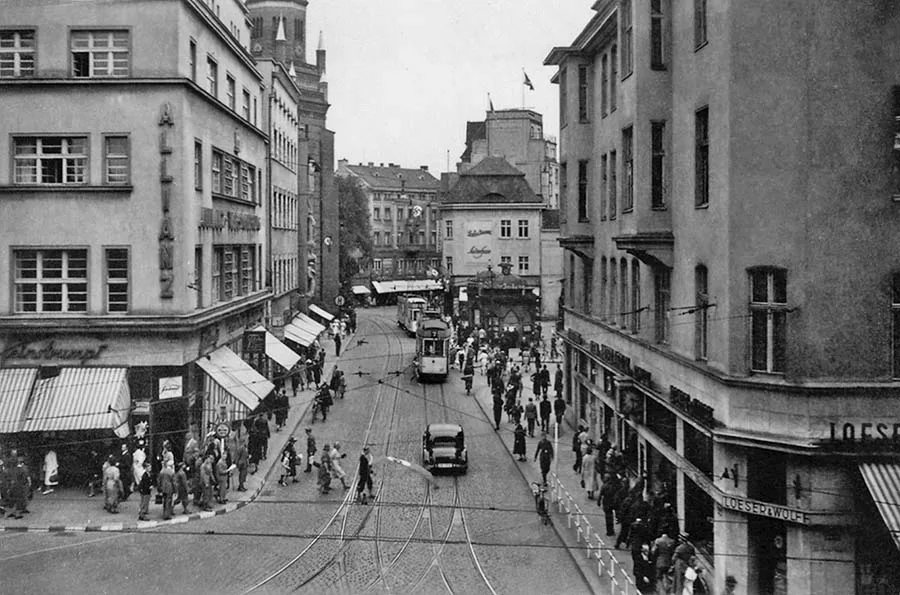 Post Street. There are still so few cars that they do not even have a lane of their own.
Besides the main building, the complex includes the telegraph office and additional annexes for storing luggage and for service needs. Each has steam heating and electric light. The house of Theodor von Hippel mentioned above stood where the telegraph office is now.
(The Königsberg post office building stood where the Plaza shopping and entertainment centre on Leninsky Prospekt is now. — Editor's note.)
Theodor Gottlieb von Hippel was born on 31 January 1741 in Gerdauen (now the settlement of Zheleznodorozhny). In 1756 he entered the University of Königsberg to study theology, then transferred to the faculty of law. Exceptional talent, diligence and perseverance enabled him to rise quickly to high judicial posts. In 1780 he became Oberbürgermeister of Königsberg and received the title of war councillor, corresponding to today's title of town hall councillor. King Frederick William II (Friedrich Wilhelm II, 1744–1797) promoted Hippel further, making him privy war councillor and city president. In 1790, on the eve of his fiftieth birthday, Hippel was ennobled. Taking an active part in the intellectual life of Königsberg in the second half of the 18th century, he was bound by close ties of friendship with Kant, Jacobi (Johann Conrad Jacobi, 1717–1774), the von Schrötters (Freiherrn von Schrötter) and other outstanding people of his time. He had literary talent and a good sense of humour, and is therefore still regarded as an outstanding German satirist. During his administration of Königsberg, an art school was opened in the city (1790), the Philosophers' Dam (the area of today's Portovaya Street) was reconstructed, the bog between the western part of the castle and the embankment was finally filled in, the road in Mittelhufen (Mittelhufen, now Prospekt Mira near the Central Park and the Zoo) was renewed, and much else was done. Theodor von Hippel died on 23 April 1796.
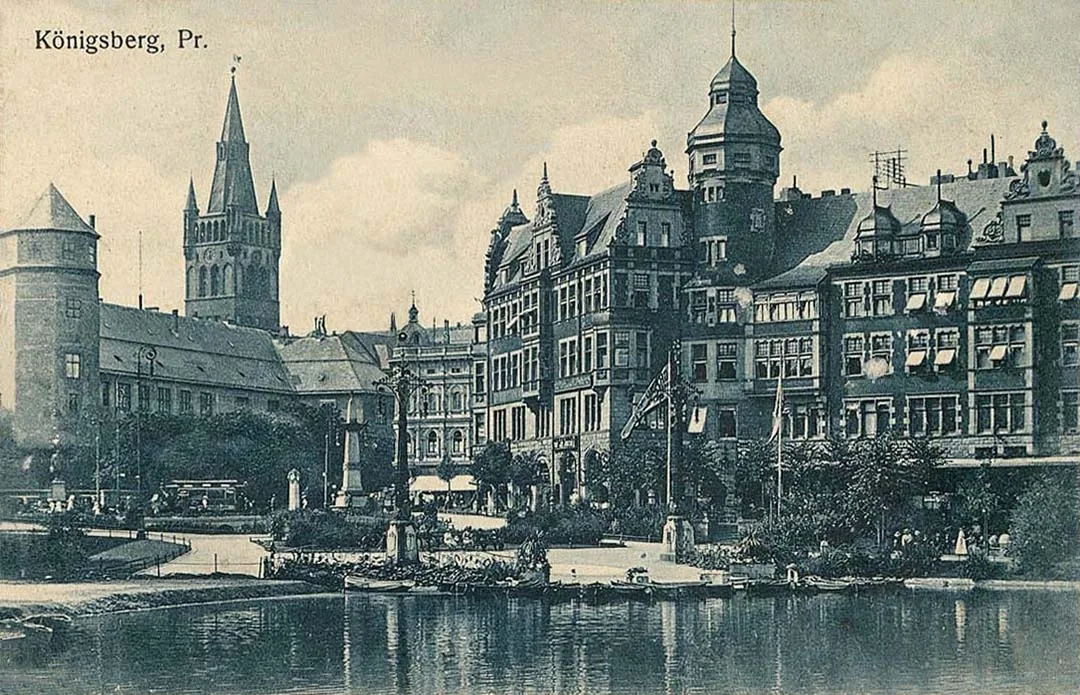
From the north-east, a street adjoins the Altstadt Church and leads us to Parade Square (Paradeplatz), one of the most beautiful in the city. Today's Parade Square is only part of the square of the same name that was once here.
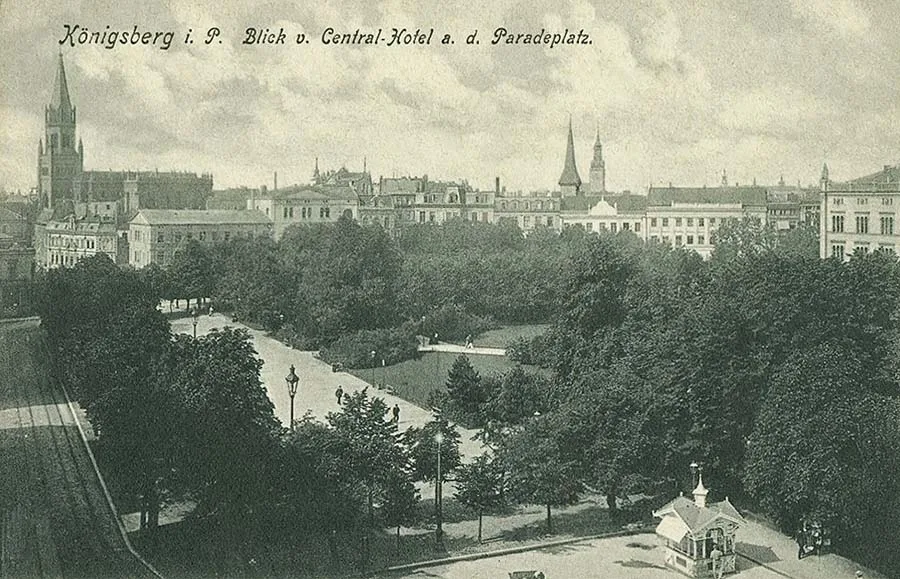 Parade Square has always been and remains a green oasis in the city centre.
Local people, out of old habit, often call it the King's Garden (Königsgarten), which takes us back to the history of this place. If we try to picture it in the times of the Teutonic Order, we must remove all the buildings and also the streets leading to Steindamm. At that time there was an open space here stretching roughly from Italian Lane to the Castle Pond, occupied by the Pleasure Garden (Lustgarten) and the Hunting Garden (Hetzgarten).
(In a number of publications on our website the Hunting Garden appears as the Hetzgarten. The German word Hetzgarten is sometimes translated into Russian as "zoo" or "zoological garden". But it was in fact an enclosure next to the castle for the baiting and fighting of wild animals, and at the same time a bestiary where exotic and dangerous representatives of the fauna were kept. — Editor's note.)
The Pleasure Garden contained all sorts of ornate structures, towers and pavilions. But its chief merit was its many fruit trees. In 1724 there were 80 of them, and they were leased to a gardener. A special charm was lent to this garden by a gigantic ancient lime tree thirty feet in girth, in whose crown five wonderful galleries had been built, one above the other. The lowest gallery was supported by twelve wooden columns. As early as 1697 Chancellor von Kreytzen (Kanzler Georg Friedrich von Kreytzen, 1639–1710) gave a banquet here for Elector Frederick III (Kurfürst Friedrich III / König Friedrich I, 1657–1703) and his retinue.
The Hunting Garden adjoined the Pleasure Garden where the street leading to the Castle Pond (Schloßteichstraße) began. Later several houses belonging to the Czerwonka family were built on the site of the Hunting Garden (Czerwonkasche Häuser; they were demolished in 1880). Gardens like the Königsberg Hunting Garden were not unusual in the times of the Teutonic Order. The best Hunting Garden in Prussia was near Marienburg, where, besides bears, monkeys, guinea fowl and capercaillie, even a lion was kept, presented to the Grand Master in 1408. During festivities the animals were used for mock hunts, baiting and fights.
The Königsberg Hunting Garden was abolished by Frederick the Great soon after his accession to the throne. He ordered the money raised to be distributed to the poor. This happened in 1744.
The Pleasure Garden had ceased to exist even earlier, after the harsh winter of 1708, which destroyed many trees, tall hedges and flowers. A drill ground (Exerzierplatz) was laid out on its site. Besides the gardens, in the north-eastern corner of today's Parade Square there was a rather unsightly horse mill (Roßmahlmühle). It stood where Theatre Street (Theaterstraße) now begins.
Frederick William I (Friedrich Wilhelm I, 1688–1740) planned to build a magnificent Garrison Church (Garnisonkirche) opposite the theatre, but the marshy ground prevented the plan from being carried out. The foundations alone required so much money that there could be no thought of completing the construction. Near the unfinished building, a garrison drill house (Exerzierhaus) was built in 1774. In 1806 it was demolished so that a theatre could be built on the site, but it was then rebuilt not far away, where the university building later appeared. The garrison drill house subsequently hosted all kinds of festivities and events: celebrations of every sort, exhibitions, meetings of the patriots of the "Prussian Union" (Preußenverein, 1850); people even managed to trade horses in it.
When in 1800 the War and Domains Chamber of the East Prussian government decided to build residential houses on the area behind the garrison drill house, a new street appeared. It was called Garden Street (Gartenstraße). The marshy ditch that ran here was filled in. In 1808 the horse mill mentioned above was demolished, and Theatre Street, which had previously been a dead end and by local tradition was called Turn-Back Street (Kehrwiederstraße), was extended to Parade Square.
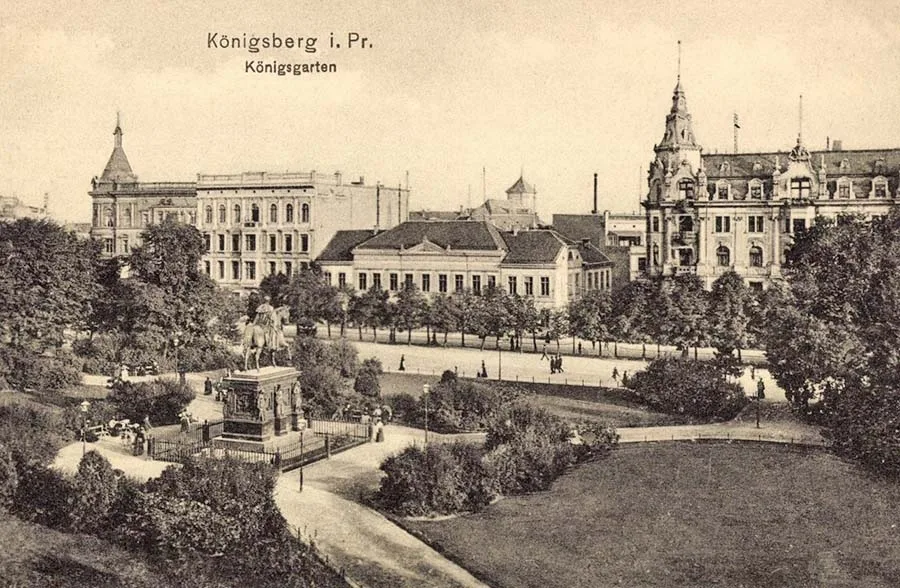 In the centre of Parade Square stood a monument to the king who had given it to the city.
An especially important date for Parade Square was 4 November 1809. On that day King Frederick William III renounced his rights to Burgfreiheit on condition that Parade Square would remain the property of the city in perpetuity and would always have to remain free of buildings.
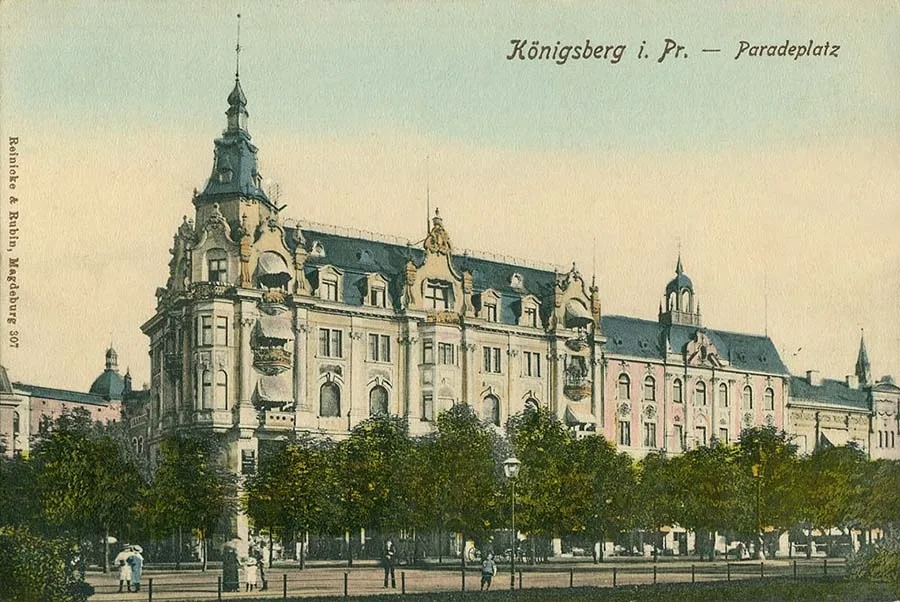 The building of the Gräfe und Unzer publishing house on Parade Square, with its bookshop and the Café Bauer.
Thus the square changed owners, but in essence nothing changed. Previous generations of townspeople had cared little about the improvement of public spaces. Only after the completion of the new university building, for which the city, after long negotiations, provided the necessary space free of charge, did the need to put the area in front of it in order become obvious to everyone. However, to do so it was necessary to fill in the unsightly brook with little footbridges that flowed across it and to fell the tall poplars that grew along its course. Today's English-style gardens, with their lush lawns, pretty groves and well-kept paths, belong to the very recent past (1885). They have become an organic part of its architectural ensemble, lending the square, with its monuments and stately buildings, elegance and romance. Parade Square has become one of the favourite places of the people of Königsberg and on fine days presents an exceptionally lively and colourful picture, especially thanks to the activity of the city's Beautification Society (Verschönerungsverein), which made its own substantial contribution: a children's playground and numerous benches. (The former Parade Square was on the site of today's small square in front of the university building on Universitetskaya Street. — Editor's note.)
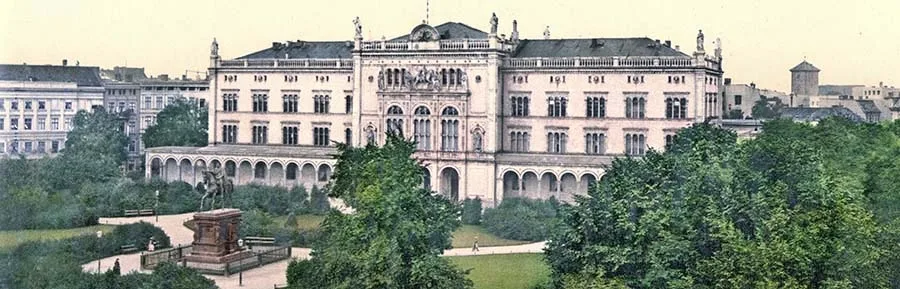
Among the buildings framing Parade Square, the most beautiful is indisputably the university. The old university building near the Cathedral on the island of Kneiphof (Kneiphof) had long ceased to meet even the most modest requirements, and the construction of a new one was among the most pressing problems of the city. However, although everyone agreed on this, the financial situation of the state, especially after the devastating Wars of Liberation (meaning the war with France at the time of the Napoleonic invasion — editor's note), was so dismal that almost thirty years passed before the first stone was laid in the foundation of the new Albertina (1844). So the fulfilment of this cherished wish proved no easy matter. The question of a plot of land was especially acute, for almost all the land in the city is privately owned.
There was long deliberation: at first they wanted to build on the site of Kalckreuth's house at Bergplatz 11–12, then on the site of the old theatre on Post Street, and only in 1838 was the decision taken to build the university building on Parade Square.
Things got moving after the accession of Frederick William IV to the throne in 1840: at the end of June 1844 the magistrate passed the corresponding resolution. Full of love for the arts and sciences, the king nurtured grandiose plans. He decided to build three monumental buildings on Parade Square: a new university in the north-west, a court building in the south-west and a new theatre in the north-east. A colonnade encircling the square was to unite them into a magnificent architectural ensemble. Unfortunately, the splendid idea was never realised, but the new university was built.
The foundation stone of the new university was laid on 31 August 1844. The king, who had been rector since 1808, attended the ceremony and accompanied the first three hammer blows with the following words: "The university must be a hearth of light. Its motto: Forward!" The following years brought new political upheavals to the country, and construction came to a standstill. (Apparently the revolutionary events in Germany of 1848–49 are meant. — editor's note) Finally, on 6 April 1856, construction resumed, and (after another short break in 1859 because of the threat of war) the building was completed in 1862. On 20 July of that year the university was solemnly consecrated in the presence of Crown Prince Frederick, who had inherited the honorary post of rector of the university from the king, who had died by then.
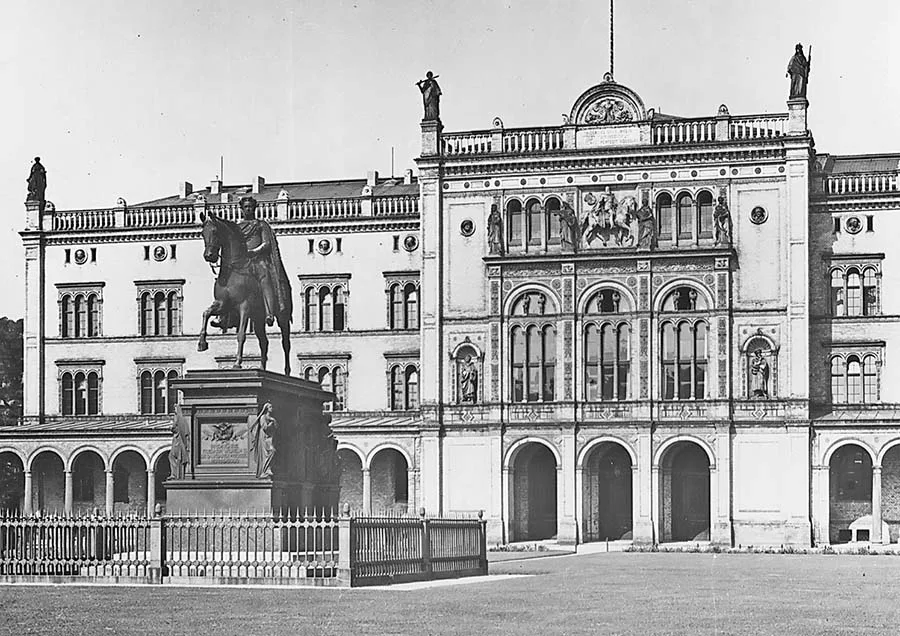 The new Albertina on Parade Square with the monument to Frederick William III in front of the façade.
The design of this majestic building belongs to Privy Councillor von Stüler (Friedrich August Stüler, 1800–1865), one of whose best-known works is the reconstruction of the Hohenzollern castle (Hohenzollern) near Bisingen (Bisingen).
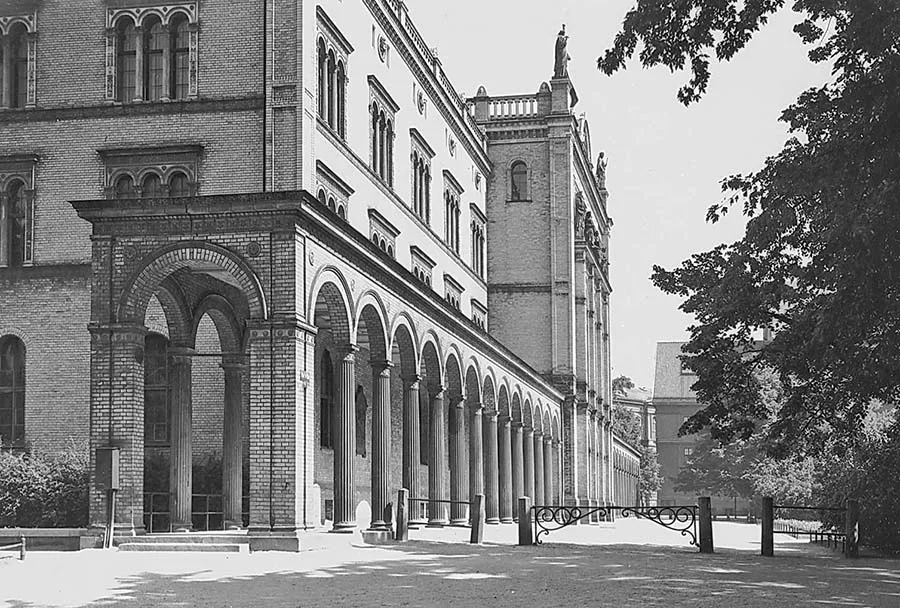 The original version of the design proposed surrounding the whole square with a colonnade.
(He was commissioned to work on the castle of the dynasty ruling Prussia at roughly the same time as the Königsberg university was being built, whereas his design for the reconstruction of the Winter Palace in St Petersburg after the devastating fire of 1837 dated from several years earlier. Stüler was also responsible for the design of the Friedenskirche in Potsdam, which became the prototype for the church in Mehlauken (now the settlement of Zalesye). — Editor's note.)
The building was erected in the Italian Renaissance style, modelled in particular on the masterpieces of brick architecture in the cities of Lombardy and Northern Italy, as far as Bologna. The outer walls are of skilfully worked yellow brick supplied by the Royal Brickworks near Dirschau (Dirschau, now the Polish town of Tczew / Tczew). The university building is 75 metres long and 20 metres wide. In the central part of the façade is an imposing risalit. To the left and right of it a covered gallery runs along the wall, its columns made of Hungarian sandstone. Three large round-arched windows adorning the risalit link the second and third floors, and each is divided into three parts by two small columns. Each of the columns ends in a caryatid supporting the vault of the window's common arch. The windows are framed by four pilasters, each of which, at about half its height, is adorned with an inscription in gold letters in Latin: Virtus (virtue), Pietas (piety), Candor (purity), Sapientia (wisdom). To the left and right of the windows, at second-floor level, niches hold sculptures of two spiritual fathers of the university and great reformers, Luther (Martin Luther, 1483–1546) and Melanchthon (Philipp Melanchthon 1496–1560), made by Professor Friedrich Schievelbein (Friedrich Anton Hermann Schievelbein, 1817–1867). Above the middle window is a high relief of the founder of the university, Duke Albrecht (Albrecht von Brandenburg-Ansbach, 1490–1568), on horseback. On either side of the high relief there are also two windows, each divided into three parts by two columns; at the edges of the windows are four allegories of the principal faculties: philosophy, theology, law and medicine. On the left their row is closed by a medallion with a portrait of the first rector of the Albertina, Georg Sabinus (Georg Sabinus, 1508–1560), and on the right by a similar medallion with a portrait of Simon Dach (Simon Dach, 1605–1659), the famous East Prussian poet and songwriter, professor of poetry from 1639 and rector in 1656–59.
The risalit is crowned by a semicircular gloriette with the Prussian eagle and a Latin inscription: "Fridericus Guilelmus IV. Instituit 1844, Guilelmus perfecit 1862". ("Frederick William the Fourth began the building in 1844, and William completed it in 1862.")
The right and left parts of the façade each have five windows on the second and third floors. Each of these windows is also divided into three parts by two columns. Above the windows of the upper row, famous Königsberg scholars are immortalised in portrait medallions:
Philosopher Johann von Hamann (Johann Georg Hamann, 1730–1788);
Philosopher Johann von Herder (Johann Gottfried von Herder, 1744–1803);
Philosopher and political scientist Christian Kraus (Christian Jakob Kraus, 1753–1807);
Botanist and chemist Karl Hagen (Karl Gottfried Hagen, 1749–1829);
Anatomist and physiologist Karl Burdach (Karl Friedrich Burdach, 1776–1847);
Philosopher Immanuel Kant (Immanuel Kant, 1724–1804);
City president Theodor von Hippel (Theodor Gottlieb von Hippel, 1741–1796);
Philosopher Johann Herbart (Johann Friedrich Herbart, 1776–1841);
Astronomer Friedrich Bessel (Friedrich Wilhelm Bessel, 1784–1846);
Mathematician Carl Jacobi (Carl Gustav Jacob Jacobi, 1804–1851).
On the eastern side of the building, facing the theatre, there are two more medallions:
Philologist Karl Lachmann (Karl Konrad Friedrich Wilhelm Lachmann, 1793–1851);
Philologist Christian Lobeck (Christian August Lobeck, 1781–1860).
The niches for medallions on the rear façade and the western end are empty. (Apparently they were meant for portraits of scholars who would earn such an honour in the future. — Editor's note.)
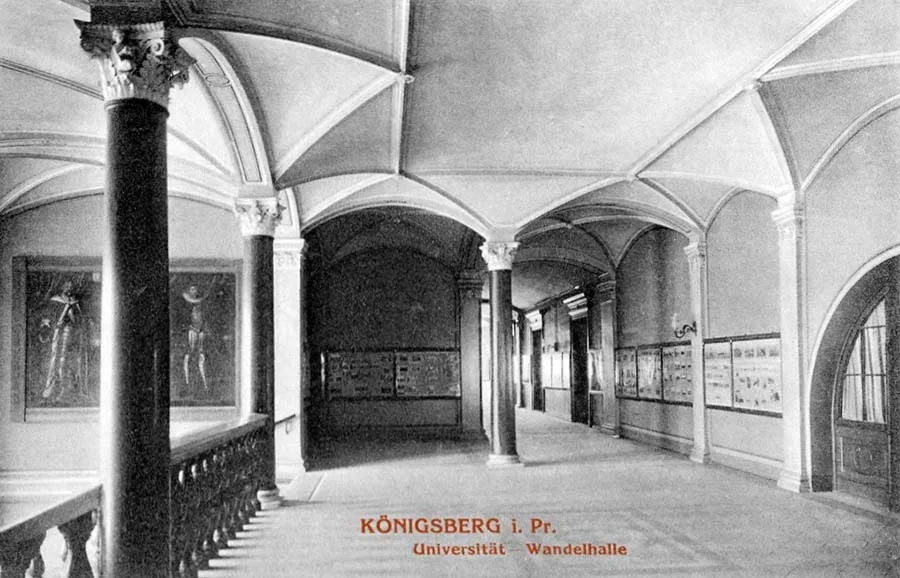 The Albertina hall on the ground floor.
Eight statues rise above the roof of the university building. Above the central part of the main façade they symbolise legislation and public administration. The corners of the main block of the main façade are adorned with sculptural allegories of history and archaeology. Above the risalit of the rear façade rise statues symbolising mathematics and physics. At the corners of the rear façade are sculptural figures of geography and astronomy.
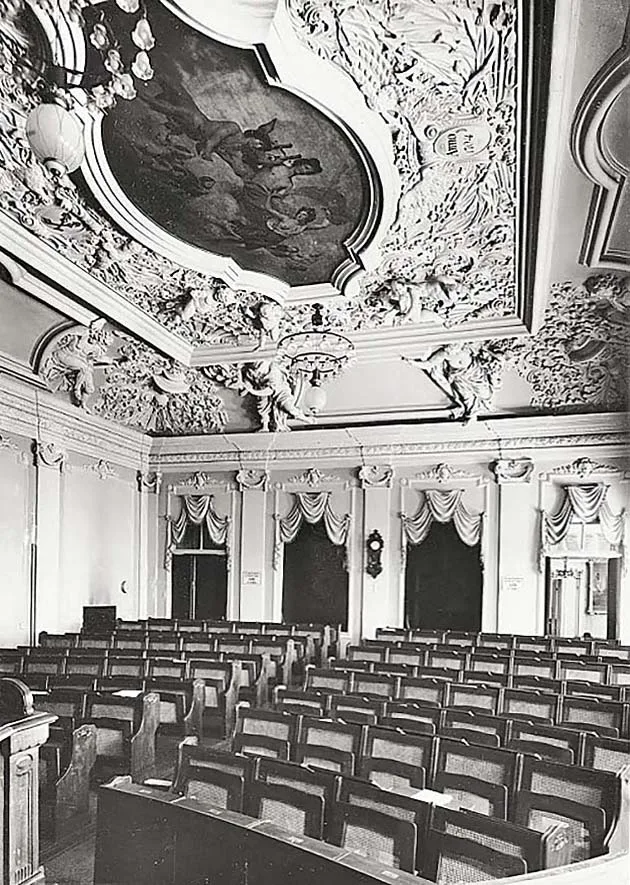
One of the twenty university lecture halls.
Above the main cornice of the building is an attic storey decorated with a balustrade. Three large carved doors with glass windows protected by wrought-iron grilles lead into the spacious foyer of the university, where the so-called "black boards" are found, on which lists of admitted students and announcements are posted. The room is adorned with columns of grey Silesian marble. Six marble steps lead to the far part of the foyer. Balustrades of red Belgian marble decorate the arched openings on both sides of the staircase. To the left and right stretch corridors, and straight ahead is the main staircase to the upper floors. Its steps are made of hard Silesian (Kunzendorf) marble, and its columns of reddish-brown Westphalian marble quarried near Olpe. The Corinthian capitals of marble chips were made at the Royal Porcelain Manufactory in Berlin. They depict student life and study, fencing and music. To the left and right are memorial marble plaques with the names of students who took part in the wars of 1813–15, 1866 and 1870–71 and gave their lives for the Fatherland.
The most beautiful room in the university is the lavishly decorated Aula (assembly hall), designed for 600 people, of whom only eighty have seats.
The chairs intended for the rector, the deans and the professors are separated by a barrier in a separate part of the hall, where there is also a lectern for doctoral candidates during the ceremonial defence of their dissertations. The ceiling of the hall is vaulted; the ribs of the vaults are gilded and rest on pilasters. Above the main entrance is a balcony for musicians, supported by two consoles.
The chief ornament of the Aula is its precious murals representing the four faculties: philosophy, theology, law and medicine. To the left of the entrance is a fresco illustrating a truly philosophical attitude to life and death: Socrates drinking poison from a cup. Further to the left is a portrait of Herodotus, the "father of history", as Cicero called him. On the right is the symbol of mathematics: Archimedes during the siege of Syracuse. These three frescoes were created by the university professor Piotrowski (Maximilian Antoni Piotrowski, 1813–1875).
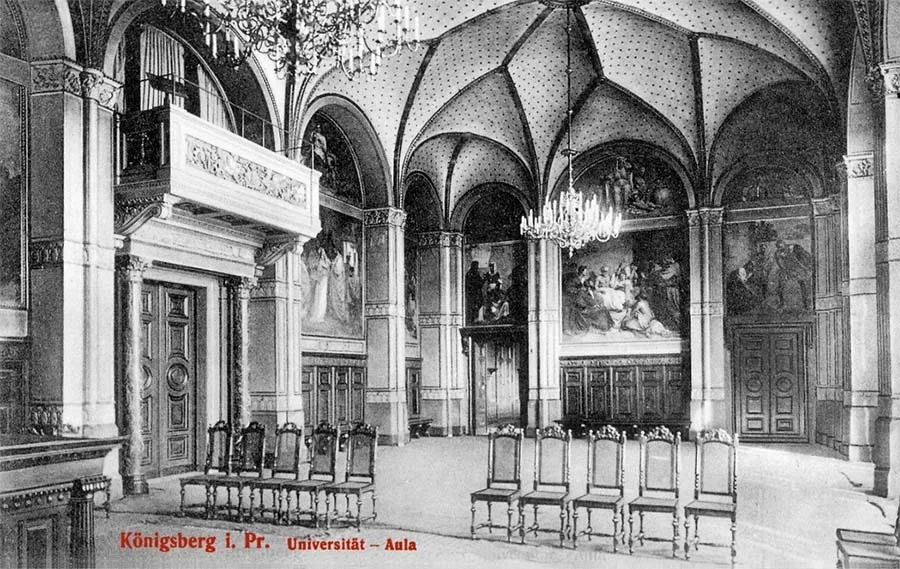 The Aula (assembly hall) with frescoes and the musicians' balcony.
Above the lectern is a fresco by Professor Rosenfelder (Karl Ludwig Rosenfelder, 1813–1881): the Apostle Paul proclaiming in Athens the coming of the unknown God.
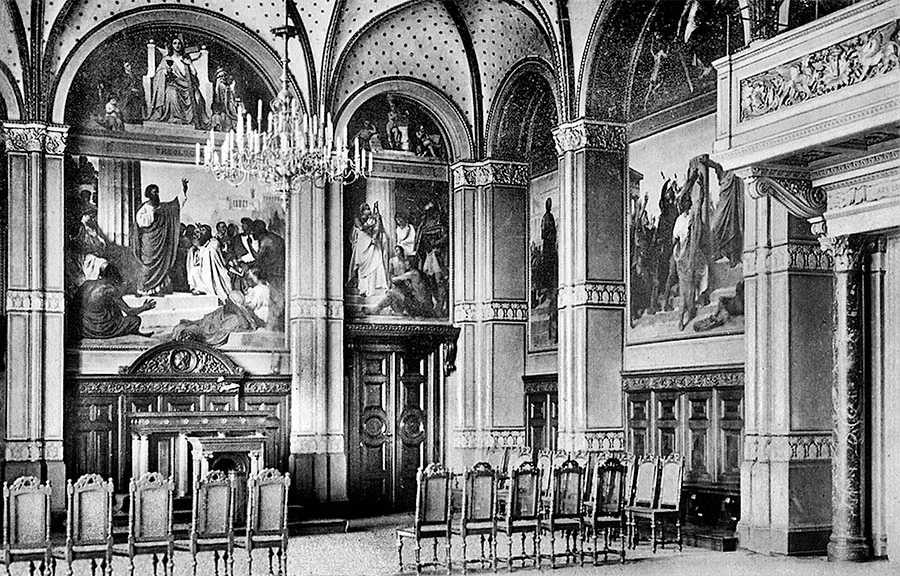 Seating in the assembly hall in front of the lectern.
The neighbouring ones represent music and poetry. One shows David playing the harp before King Saul, the other Homer reciting his poems to the Greeks. Both were painted by Professor Heydeck (Johannes Heydeck, 1835–1910). Next comes another fresco by the Königsberg-born Professor Gräf (Gustav Gräf, 1821–1895): the rulers of Athens swearing to serve the laws of Solon for ever, symbolising the triumph of justice. To the left is again a work by Professor Rosenfelder, illustrating the importance of the art of rhetoric: the great Athenian orator Demosthenes receiving a laurel wreath from a grateful people. The next one, probably also by Rosenfelder: the famous physician Hippocrates at a patient's bedside. Then come works by Professor Neide glorifying science: the philosopher Aristotle receiving strange animals from the general Alexander the Great; Ptolemy in the observatory of the city of Alexandria, the symbol of astronomy.
Art history is represented by a painting by Gräf: Phidias showing Pericles and Aspasia the shield of Pallas Athena.
Other allegorical paintings also adorn the hall. Below all the frescoes run high panels of polished oak with a carved frieze. The floor is laid with parquet.
Several fine paintings are in the senate room adjoining the Aula. For example, a portrait of the young Crown Prince Frederick William of 1808 by Knorr (Georg David Salomon Knorr, 1844–1916), and a portrait of Emperor Frederick III in the rector's gown at the opening ceremony of the university building in 1862, painted by Lauchert (Richard Lauchert, 1823–1868). There are also marble busts of Kant (from the Stoa Kantiana), Hagen and Wagner by various masters. Particular attention is deserved by the very valuable collection of copper engravings displayed on the upper floor of the university.
Besides the Aula, the university has twenty small and large lecture halls, rooms for all kinds of collections and manuscripts, a reading room, a library and official apartments for teachers. There had never been a building like it in Königsberg. The construction costs matched such luxury: 892,820 marks, not counting the cost of the paintings. Altogether – over a million!
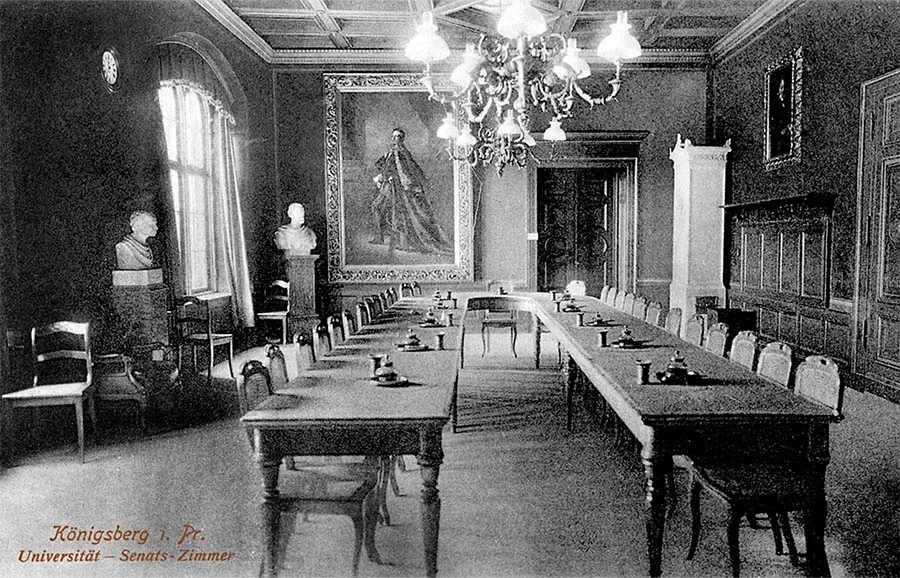 The meeting hall of the university senate.
Nevertheless, one building could not satisfy all the needs of the university. Numerous institutes are housed separately.
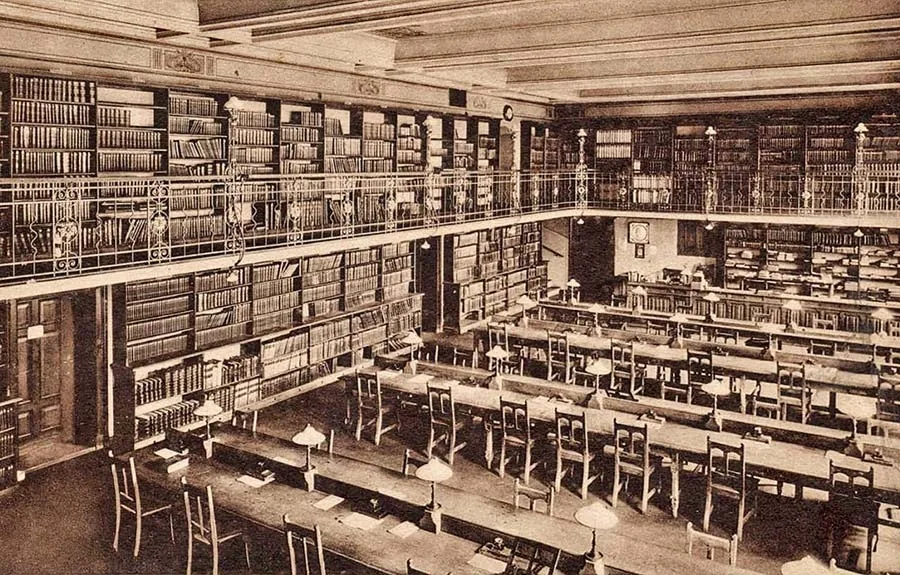 The reading room of the academic library.
The faculty of philosophy alone has 21 institutes, and the faculty of medicine 14. Most of them, especially the laboratories and clinics, were created after 1862.
The number of teaching staff grew rapidly from 1862 onwards. At the move to the new building there were 57: 33 professors, 9 associate professors and 15 lecturers. Now there are 98: 49 professors, 21 associate professors and 28 lecturers. In addition, there is a university judge, technical instructors, junior officials and lower-grade civil servants. The number of students in the summer of 1862 was 412; in the summer semester of 1894 (at the time of the celebration of the university's 350th anniversary) it was 697; in the winter semester of 1894/95, 706; and in the summer semester of 1895 another fifty were added, making 756. (The new university building was badly damaged during the war, then restored as a school. Later Kaliningrad University settled in it. The historic building was restored in simplified form, without decoration. — Editor's note.)
Of great importance for the student life of our university is the Palaestra Albertina, which, unlike the numerous scientific institutes, is intended for the physical training of students.
In this way a healthy counterweight to one-sided intellectual education is provided. The initiator of this project was a former student of the Albertina, Dr Lange (Friedrich Lange, 1849–1927) of New York. Thanks to his substantial contribution and numerous donations from other sources, on 27 July 1894, in the presence of Prince Friedrich Leopold (Prinz Friedrich Leopold von Preußen, 1865–1931), having celebrated the university's 350th anniversary, those concerned laid the foundation stone of the future sports palace on 3rd Brook Street. According to the design, it is to contain a riding school, fencing halls, baths, games and sports halls, a dining hall, rest rooms and so on. (The Palaestra Albertina, opened in 1896, was named after the gymnasia of antiquity. The building was restored after the war and now stands on Marshal Rokossovsky Street. — Editor's note.)
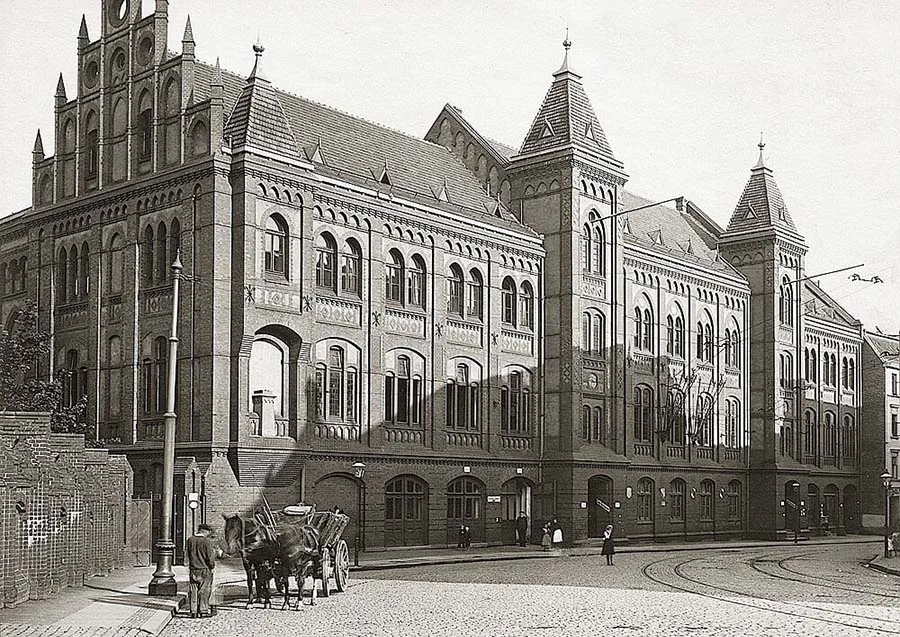 The Palaestra Albertina was built on the territory of the neighbouring district of Tragheim.
In front of the university stands an equestrian statue of Frederick William III (Friedrich Wilhelm III, 1770–1840), erected by the province as a token of deep gratitude to its late ruler, with whom it had once loyally shared joys and sorrows.
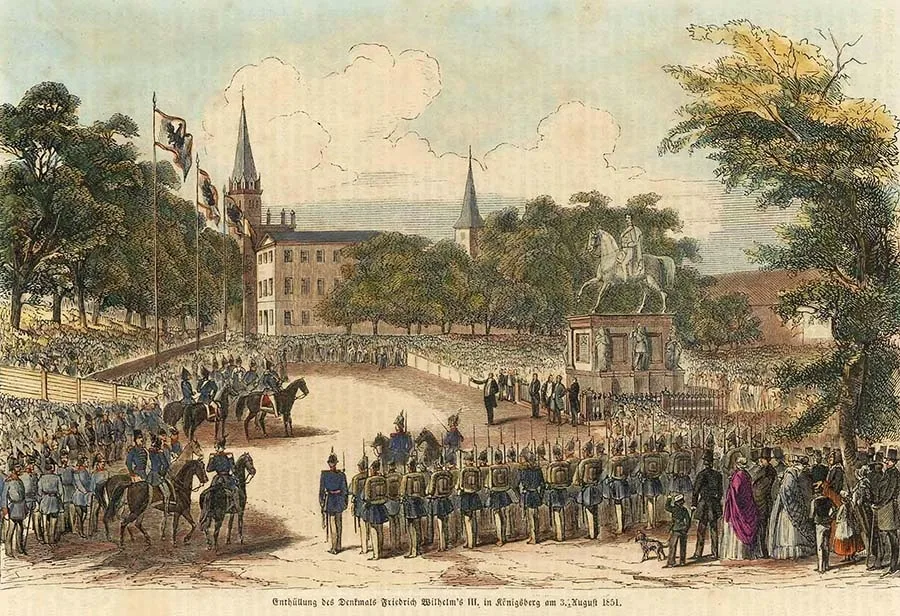 Unveiling of the monument to Frederick William III on Parade Square.
The monument was created by Professor August Kiss (August Kiß, 1802–1865) in Berlin and cast in bronze at the foundry of Count Einsiedel (Georg Alexander von Einsiedel, 1813–1867) in Lusatia (Lausitz). The ceremonial unveiling took place on the birthday of the monarch so dear to all Prussians, 3 August 1851, in the presence of his successor Frederick William IV (Friedrich Wilhelm IV, 1795–1861).
The king, crowned with a laurel wreath, sits on horseback – the embodiment of manly strength – wrapped in the folds of a cloak, beneath which gleams a general's uniform with the chains of the Orders of the Black Eagle and the Iron Cross. His left hand grips the reins firmly, restraining the fiery horse as it paws the ground. The noble animal is adorned with costly harness; the saddlecloth and pistol holster are covered with skilful embroidery, modelled on that which the women of Berlin presented to the king on his return from the victorious campaign of 1813–14. The statue rises on a monumental bronze pedestal, which stands on a polished granite base raised on three steps. On the pedestal we see relief scenes of the revival of Prussia after the unfortunate war of 1806–07: the king's family happiness and legislative activity, war and victory, and also the blessings of peace. Let us look at them in more detail.
On the front of the pedestal we see the Prussian eagle, crowned with laurels and holding a victorious palm branch in its talons. Here too is the dedication: "To their King Frederick William III – the grateful Prussian people, 1841".
The content of the front corresponds to the composition on the back, illustrating the creation of the militia. In its centre stands General Yorck (Johann David Ludwig Graf Yorck von Wartenburg, 1759–1830), his right hand solemnly raised to receive the oath, while a student takes a weapon from his left hand. On either side of the general stand Counts Alexander and Ludwig von Dohna (Friedrich Alexander zu Dohna-Schlobitten, 1741–1810; Ludwig Alexander zu Dohna-Schlodien, 1750–1804). The former holds the decree on the formation of the militia, the latter raises the banner. The officer treading weapons underfoot and holding out a sword is General von Bardeleben (Karl Alexander von Bardeleben, 1770–1813), who fell on the battlefield. In one corner is the respected patriot, the Oberbürgermeister of Königsberg Heidemann (August Wilhelm Heidemann, 1773–1813), in militia uniform; in the other corner, a militia cavalryman. The scene can be identified by the castle portal in the background.
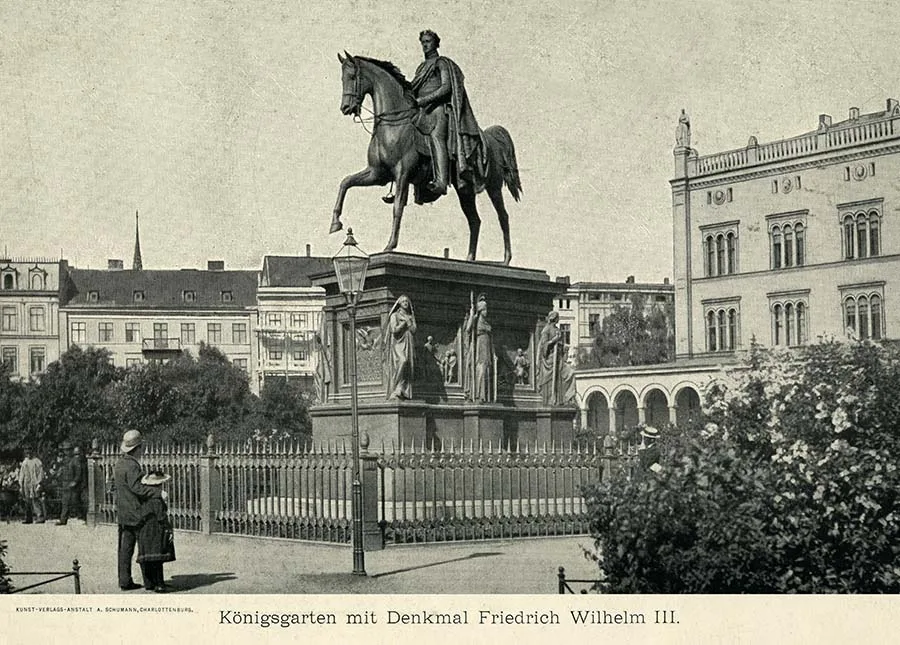 The appearance of the monument to the king on the square revived its old name, the King's Garden.
On the eastern side of the wall the happy family life of the royal couple is depicted. Next to it we see the king in one of the halls of Königsberg Castle handing Minister von Hardenberg (Karl August von Hardenberg, 1750–1822) a charter proclaiming the liberation of the people from all oppression and initiating the reorganisation of the state.
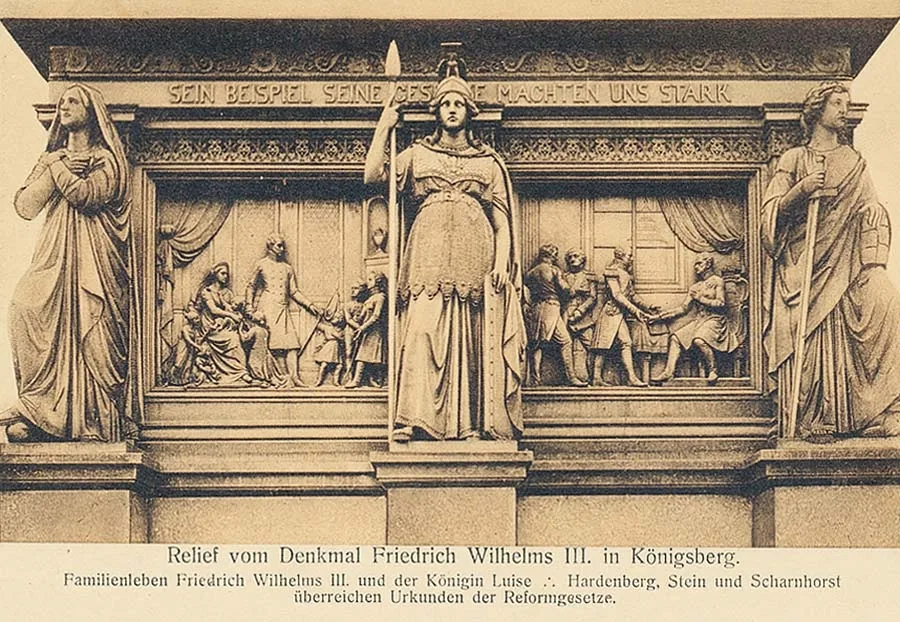 Reliefs on the eastern side of the pedestal of the monument to Frederick William III.
The other two figures are the Prussian reformers Stein and Scharnhorst (Heinrich Friedrich Karl Reichsfreiherr vom und zum Stein 1757–1831; Gerhard Johann David von Scharnhorst, 1755–1813). Two scenes on the long western side of the pedestal illustrate the blessings of peace. In one, peasants diligently till their newly acquired land. (Serfdom was abolished in Prussia in 1807. Moreover, in Prussia it differed from the Russian form. In brief, in Russia the peasants were bound to the landowner, while in Prussia they were bound to the land. Editor's note.)
In the other we see representatives of the agricultural, teaching and military estates. The observatory indicates that the scholar is the famous astronomer Bessel (Friedrich Wilhelm Bessel, 1784–1846); the Landwehr cavalryman bears the features of General von Auerswald (Hans Adolf Erdmann von Auerswald, 1792–1848), who in 1813 was among the first to take up arms in the struggle for freedom, and who was shamefully murdered by a mob in Frankfurt am Main in 1848.
The reliefs on the pedestal are separated from one another by allegorical female figures. On the eastern side: Faith, Borussia (the Latinised name of Prussia – editor's note) and Justice. On the western side: Love, Blessing and Wisdom. The figures are connected with the scenes depicted beside them. The dedications above the relief compositions read:
"His example, his laws made us strong" (east), "For the liberation of the Fatherland" (north), "To him we give thanks for the blessed peace" (west). The monument is 11 metres high. It is surrounded by railings with an image of an eagle and a laurel wreath.
Frederick William III reigned from 1797 to 1840. In 1793 he married Princess Louise of Mecklenburg-Strelitz (Luise Auguste Wilhelmine Amalie zu Mecklenburg, 1776–1810, Queen Louise – editor's note). He ascended the throne with the best of intentions – to make his people happy. But he carried out his reforms too slowly. The rout that Napoleon inflicted on the Prussian troops on 14 October 1806 at Jena and Auerstedt made him forget his plans for a long time. Even Russian help could not remedy the situation; on the contrary, it made it worse. After two bloody battles, at Preußisch Eylau (Bagrationovsk, Kaliningrad Region) on 6 February 1807 and at Friedland (Pravdinsk, Kaliningrad Region) on 14 June 1807, the king was forced to sign a peace agreement humiliating for Prussia (9 July 1807, known in Russian historiography as the Peace of Tilsit – editor's note). This cost the king half of his subjects and almost half of his lands. Yet it was precisely after this that the true revival of Prussia began. The vigorous activity of Frederick William III led to long-awaited results. The king's loyal helpers were von Stein, von Hardenberg and von Schrötter (see above, see above, Friedrich Leopold von Schrötter, 1743–1815). Easing the lot of the peasants moved forward sharply; the handling of all municipal matters was transferred to new authorities – magistrates and town halls elected by the citizens. (The municipal reform of 19 November 1808.) The class barriers between the nobility, townspeople and peasants collapsed. The old restrictions of the guilds were abolished. General von Scharnhorst solved the difficult task of reorganising military service. All degrading punishments in the army were abolished. Only merit entitled one to command posts. Most of these reforms were adopted in Königsberg, where the royal court resided for almost two years, from 15 January 1808 to 15 December 1809. The hard years brought about a new upsurge of strength and, above all, of spirit during the War of Liberation of 1813–15. Our people then acted against the French in alliance with Russia and Austria. The king's main task became the incorporation of the lands of peoples with age-old Prussian traditions: the part of Pomerania north of Peenemünde with the island of Rügen, the southern part of Saxony and Brandenburg, most of Westphalia and the Rhine Province. The task of merging them became the king's main concern after 1815. All of Prussia was divided into provinces, government districts and urban territories. The law on compulsory military service was adopted in 1814. In 1819 the law on compulsory school education was adopted. The Lutheran and Reformed church congregations were united into a single Evangelical Church (the church union of 1817). A new customs regulation was introduced, and trade and transport links with other states (except Austria) were put in order. Many technical innovations are associated with the name of King Frederick William III: railways, steamships, all sorts of machines, the telegraph. All these innovations had a beneficial effect on the life of the people. Frederick William III died on 7 June 1840.
Besides the statue of Frederick William III, Parade Square has a monument to the celebrated philosopher Immanuel Kant. It is simpler, but no less significant than the king's. The great thinker is shown in the dress of his time. His head is uncovered; he holds his three-cornered hat and his cane in his left hand, while his right is raised as if he were giving instruction. In accordance with the artistic concept of the sculptor (who did not live to see the unveiling of the monument – see below), the "pioneer of thought" was to be symbolically placed on an "ancient rock". The statue therefore rises on an elegant granite pedestal with the simple inscription "Kant".
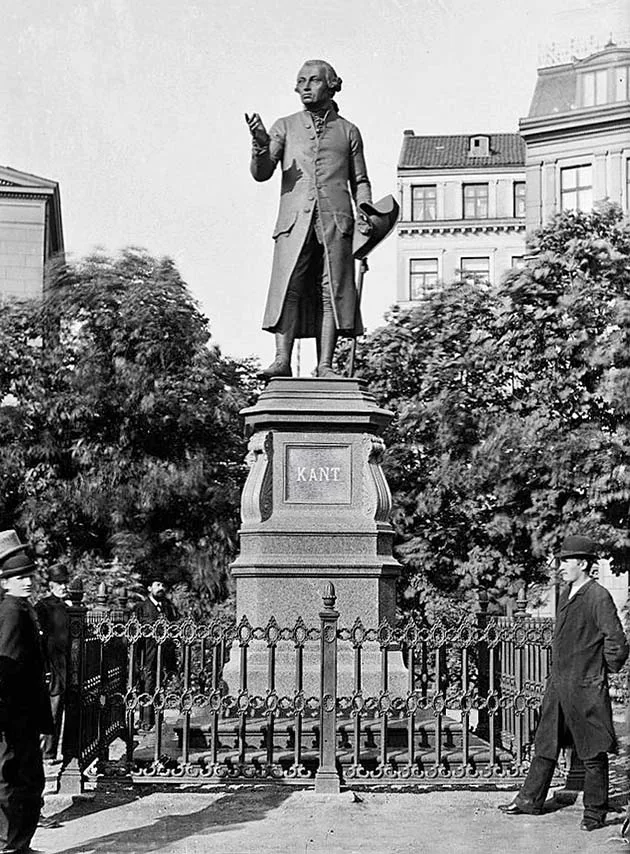
Monument to Immanuel Kant by Christian Rauch.
The monument to Kant is the work of the famous sculptor Rauch (Christian Daniel Rauch, 1777–1857), creator of the magnificent monument to Frederick the Great on Unter den Linden in Berlin, where Kant is depicted on the pedestal among other great figures.
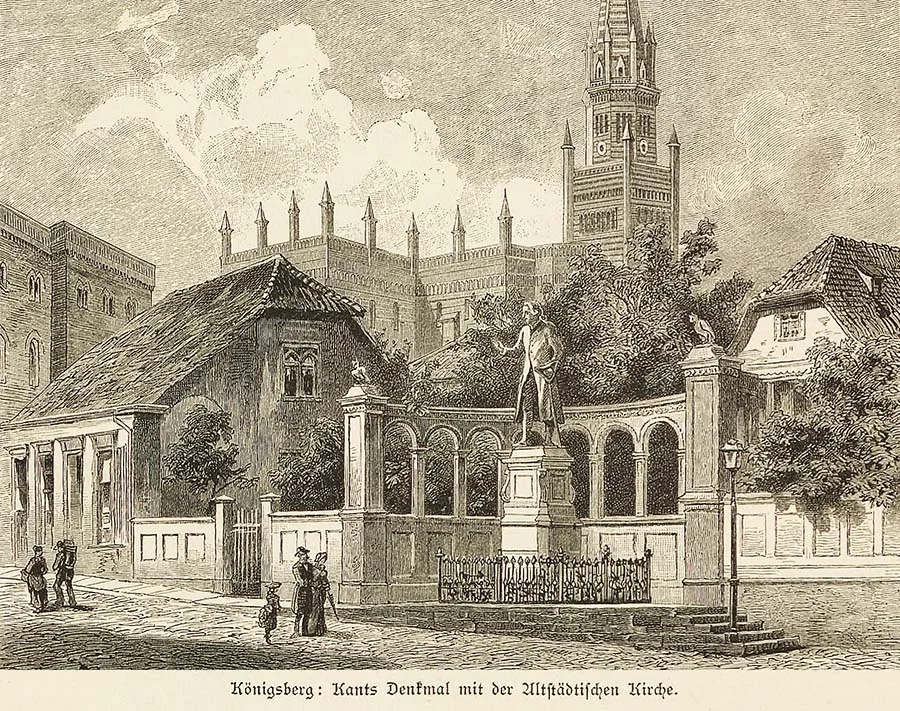 The monument to Kant began its journey around Königsberg not far from where the great philosopher had lived.
That "Berlin" Kant bears an extraordinary resemblance to the monument in Königsberg, which was cast by Gladenbeck (Carl Gustav Hermann Gladenbeck, 1827–1918) in the Royal Foundry workshops soon after Rauch's death (in 1857). The granite base was made by the court stonemason R. Müller.
The installation of the monument was long delayed until the question of where it should stand was settled. Finally, on 18 October 1864, it was ceremonially unveiled not far from the spot where the house in which the great thinker had lived once stood (Prinzessinstraße 3). The site for the monument was created by the demolition of old houses and the filling in of castle moats that had lost their purpose.
Originally the monument was surrounded by a semi-rotunda and stood at the northern end of Kantstraße, named after the philosopher, where Princesses' Street branched off from it.
When the laying out of Castle Street began in 1885, the monument was moved to its present place on Parade Square.
(Today the monument to Kant – a copy replacing the original lost during the Second World War – stands on the other side of the former Parade Square. — Editor's note.)
Immanuel Kant was born in Königsberg on 22 April 1724. His father was a harness maker (a craftsman making harness and leather goods). He lived on the corner of Vordere Vorstadt and Saddlers' Street, now Vokzalnaya Street. The philosopher's mother, née Reuten, was an intelligent and pious woman who had a great influence on her son. (In terms of today's orientation, the house of Kant's parents stood roughly at the beginning of Portovaya Street, on its left side – editor's note)
At first Kant attended the Hospital School in the Vorstadt, but then, at the age of eight, he moved to the Collegium Fridericianum. In 1740 Kant entered the University of Königsberg, where he studied mainly mathematics and physics.
After completing his studies, he worked for some time as a private tutor with a fairly well-to-do family in the environs of Königsberg. In 1755 he was already at the University as a Privatdozent in philosophy, mathematics and geography. In 1770, at the age of 46, Kant became a professor, which he remained until 1797. Poor health prevented him from fully realising his academic plans. He died on 12 February 1804, in the eightieth year of his life.
Immanuel Kant lived very modestly and preferred the company of a small circle of close friends who constantly visited him. The local artist Dörstling (Emil Dörstling, 1859–1940), commissioned by the patron Dr Walter Simon (Walter Simon, 1857–1920), painted a picture in which the philosopher and his friends are immortalised in lively conversation.
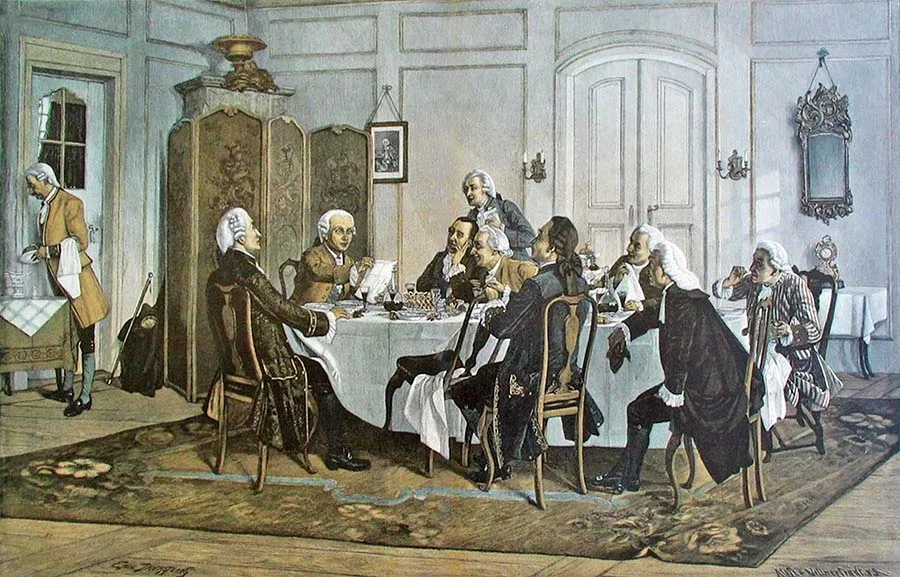 Woodcut after the painting "Kant among His Friends" (1892).
In this painting we see Kant reading a letter to his friends. The painting shows: Professor Kraus, the philosopher Hamann, War Councillor Scheffner (Johann George Scheffner, 1736–1820), Professor Hagen, the clergyman Borowski (Ludwig Ernst Borowski, 1740–1831), City President von Hippel, and the merchants Motherby (Robert Motherby, 1736–1801) and Jacobi (Johann Conrad Jacobi, 1717–1774). All those immortalised in the painting enjoyed high moral and scholarly authority, and their names were known far beyond East Prussia even then. In the background of the painting is Lampe (Martin Lampe, 1734–1806), Kant's longest-serving servant. The painting was presented to Königsberg by Dr Walter Simon and is now temporarily in the Junkerhof (Junkerhof).
Immanuel Kant was respected in all strata of city society and enjoyed the warm love of his fellow citizens. Everyone looked with pride at the unassuming scholar who had brought glory not only to our university but to all Prussia. All Europe knew him. From all over Germany, all who were noble in spirit and thirsted for true knowledge flocked to Königsberg to see this sage and hear his lectures. But Kant's heart belonged to Königsberg alone; he would not agree to move to any other university. He was invited, for example, to Halle. But he never left the bounds of East Prussia.
Kant's world-famous works are the "Critique of Pure Reason" (1781), the "Critique of Practical Reason" (1788) and the "Critique of the Power of Judgment" (1790). He regarded as independent categories the so-called categories independent of human reason: God, freedom, immortality. His teaching is called the Categorical Imperative. It had many followers, especially in East Prussia, since it is connected with an awareness of civic duty, which showed itself especially in the war of 1813 against France.
Not far from the Kant monument stands the austere building, devoid of any decoration, of the Royal Tax Directorate (Königl. Provinzial-Steuerdirektion). This office is directly subordinate to the Ministry of Finance and is in charge of all the affairs of the tax service.
To the north-east, Parade Square ends with the building of the City Theatre, not very interesting architecturally but very imposing in size. Its foundations were laid on 16 July 1806.
The construction was carried out by a joint-stock company. But even before the building was completed, on 1 July 1808, it burned to the ground. Its restoration and the continuation of the construction began almost immediately. The opening took place on 9 December 1809 in the presence of King Frederick William III and Queen Louise. The theatre holds 1,500–1,600 people.
The most significant reconstruction of the theatre took place in 1892–93. By reducing the excessively large vestibule, room was made for a foyer. The two new wings with turrets added to the main block each have their own purpose: one was built to provide the theatre with various service rooms, while in the second, whose windows look out onto the street leading to the Castle Pond (Schloßteich), the Theatre Restaurant (Theaterrestaurant) opened. On the walls of its lower hall Professor Knorr created beautiful frescoes with allegorical depictions of various drinks.
Our theatre, having become a true temple of culture, remembers many celebrated performers. Its fame has spread far beyond Königsberg. It has 18 opera soloists, 22 actors, 40 chorus members, a ballet company of 11, 45 orchestra members and 74 technical staff – 210 in all.
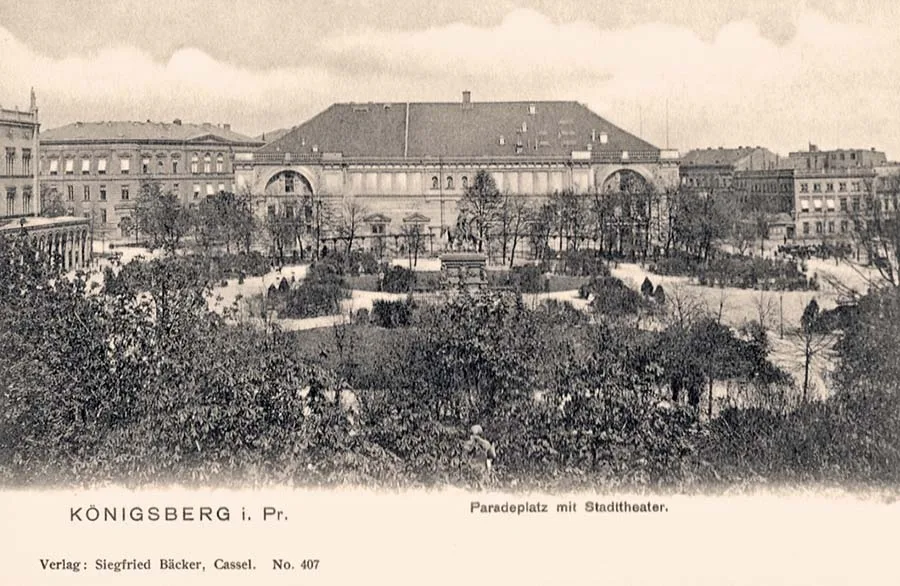
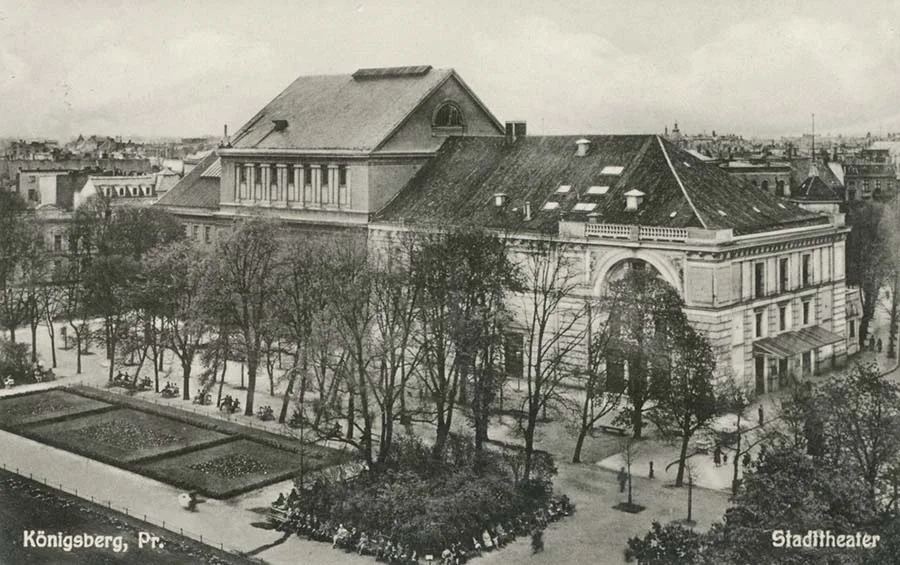 The theatre on Parade Square before and after its reconstruction in the early 1890s.
The beginnings of theatrical life on the banks of the Pregel date back to 1605, when Duchess Marie Eleonore (Marie Eleonore von Jülich-Kleve-Berg, 1550–1608) invited English comedians to perform in Königsberg.
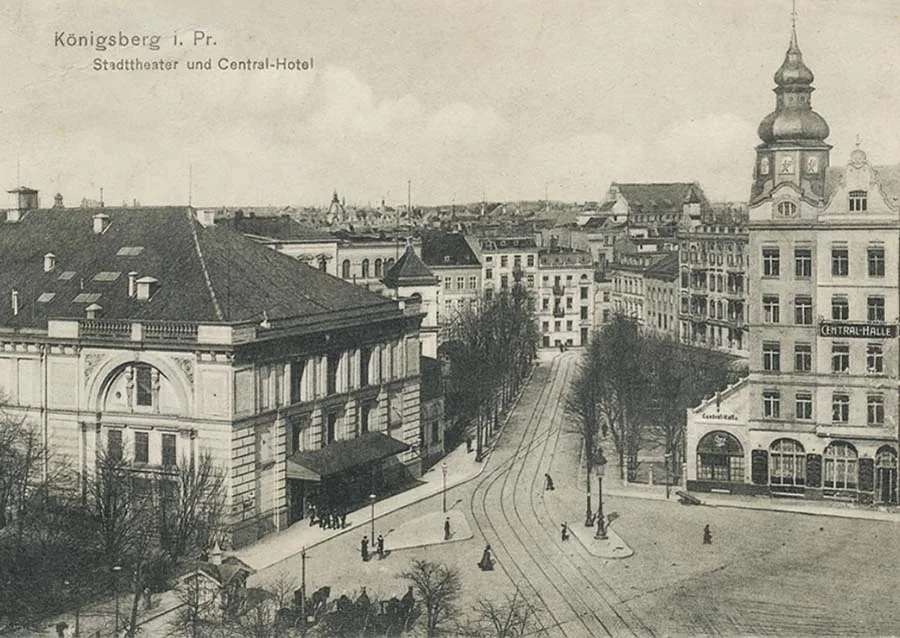 Across the road from the theatre (left) stood a hotel (Central Hotel) with a handsome tower.
In 1611 Johann Sigismund (Johann Sigismund, 1572–1619) likewise invited to Königsberg 19 actors from England and the Netherlands, accompanied by 17 musicians. Their costumes consisted of cloaks of white material with red lining and black silk cords. A few years later Johann Sigismund let the actors go home, as the expense proved too great. But George William (Georg Wilhelm, 1595–1640) again brought a theatre company from England to Königsberg. Under Frederick the Great (Friedrich II. der Große, 1712–1786) the first (old) local theatre was founded. For its construction the king in 1755 presented the city with the whole of Kreytzen Square (Kreytzenscher Platz, now roughly the intersection of Leninsky Prospekt and Shevchenko Street – editor's note). Until then, performances had been given in the gardens of Altstadt (Altstadt) and in the Junker Garden. At the beginning of the century (1802) a permanent theatre company was founded in Königsberg, which for a long time performed only in winter, alternately in Königsberg and Danzig. In 1892 a new company was formed, receiving an annual subsidy of 12,000 marks from the city. In return, once the bonds have been redeemed, the theatre will pass into the ownership of the city. (One wonders why the authors leave out of the city's theatrical history the reign of Frederick I (Friedrich I, 1657–1713), a great aesthete, spendthrift and Francophile, who was born in Königsberg and was the first to be crowned there. It cannot be that nothing happened on the local stage in his time. — Editor's note.)
Before we leave Parade Square, let us take one more look at the surrounding buildings. Most of them are new and built with great taste.
It is remarkable that here, near the castle, there are no fewer than five large bookshops selling not only books but also works of art. This reflects the influence and proximity of the university, which dominates the cultural life of Königsberg.
Now let us turn into Great Castle Pond Street (Große Schloßteichstraße). Walking east along it, we come to the bridge across the pond, intended for pedestrians only, and enjoy the beautiful view that captivates every visitor to the city. The northern part of the Castle Pond presents an especially majestic picture: the expanse of water stretching into the distance looks wonderful framed by lovely gardens and tall treetops. Besides the green private grounds and the lawns of the restaurants, on the left we see the Börsengarten (Börsengarten), behind which the park of the Masonic lodge "Three Crowns" (Dreikronenloge) can be made out, and further on the lodges "To the Death's Head and Phoenix" (Loge zum Todtenkopf und Phönix) and "Immanuel" (Immanuelloge). On the right, on the eastern shore of the pond, the General's Garden and the Commandant's Garden can be seen.
(The General's Garden began on a rather narrow plot where the new bridge across the pond now starts and the monument to Marinesko stands, and the garden continued as far as today's Klinicheskaya Street. The Commandant's Garden was immediately behind the Commandant's building and south of it, where a multi-storey block now stands. But both these gardens are in another district of Königsberg, namely Rossgarten. Likewise, the Masonic lodges are on the territory not of Burgfreiheit but of Tragheim. — Editor's note.)
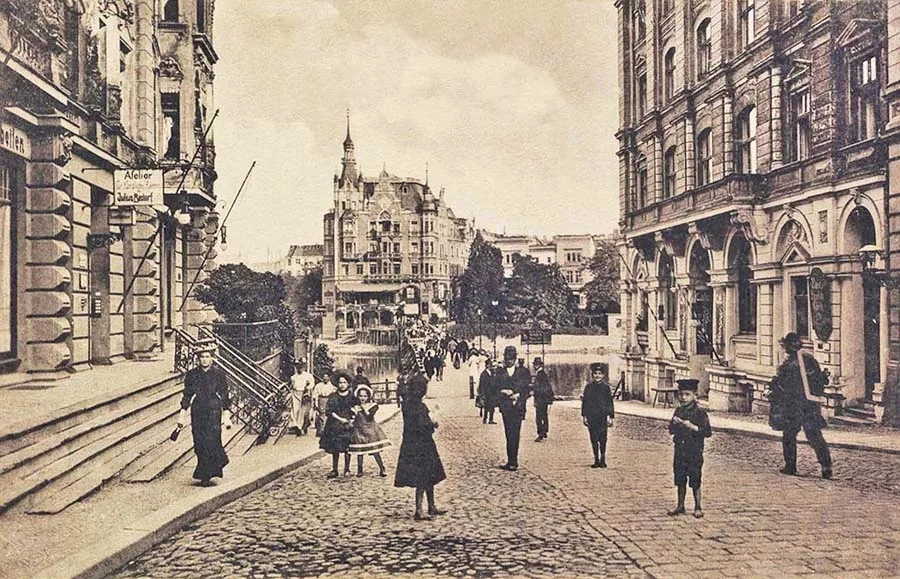 View from Great Castle Pond Street eastwards towards the bridge.
Numerous boats wait along the shores for those who like to go rowing and, at the same time, by the light of splendid illuminations, enjoy an evening concert in the Börsengarten. These were given on Thursdays.
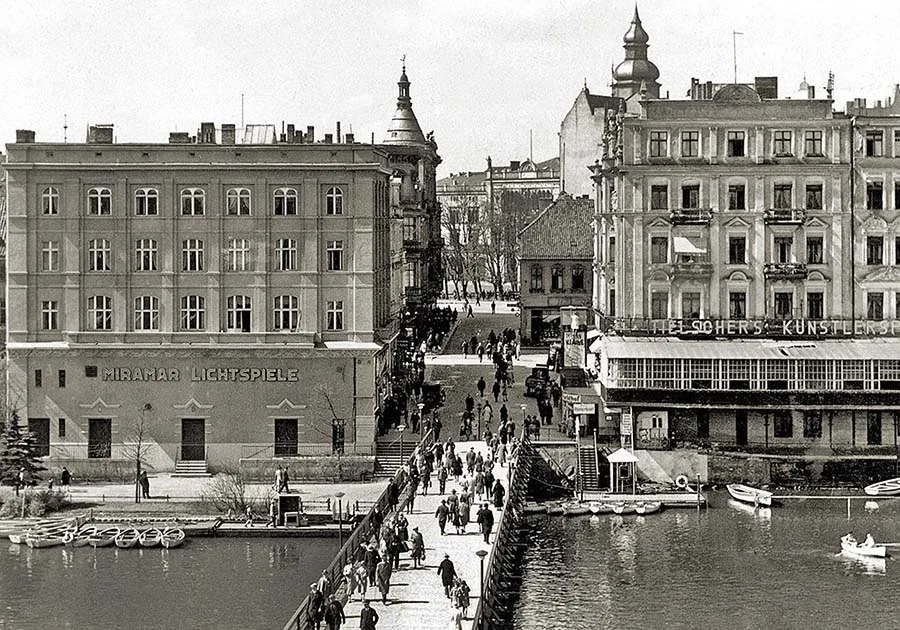 View west towards Parade Square from the bridge across the Castle Pond.
At such times the boats too are decorated with lanterns, and the refreshing cheerfulness that reigns everywhere quickly makes one forget everyday cares.
The southern part of the Castle Pond is much wider than the northern. But the houses that crowd right up to it from Mint Street (Münzstraße) in the west and French Street (Französische Straße) along the southern shore make this part of the waterfront less idyllically beautiful than the northern one. They also partly block the view of the castle, which lies at the southern end of the pond. (Later this part of the pond would be enhanced with a promenade; the old houses would be demolished and the new buildings set further back from the water. — Editor's note.)
Many different festivities are held on the shores of the pond. The arrival of royal personages in Königsberg is celebrated especially spectacularly. One such festivity on the pond had tragic consequences.
It happened on 13 September 1869. On that day a brilliant festival with fireworks and illuminations was held in honour of King William's arrival in Königsberg. Everything shone with joy; thousands of people hurried here to enjoy the rare spectacle.
Suddenly the rotten railing of the overloaded bridge broke, and a great many spectators fell into the water. The bodies of forty people were later found. (According to other sources, 32 people drowned. — Editor's note.)
In summer the Castle Pond charms us with its smooth water and the greenery around it; in winter it beckons with the chance of active recreation. The southern part of the pond is home to the "Skaters' Club" (Klub der Schlittschuhläufer) with its ice rink, marked out and decorated with green fir trees and colourful flags. Someone very enterprising has set up a similar rink in the northern part of the pond too.
Until the middle of the 18th century the lack of a bridge across the Castle Pond did not particularly trouble anyone. The first footbridge across it was built only in 1753. There has long been talk that this old wooden bridge should be made more solid and rebuilt in stone so that traffic could cross it. In 1853, at a meeting of the magistrate, a proposal was discussed to use for this purpose part of the fortune of the justice commissioner Gesekus (Johann Heinrich Gesekus, 1745–1810), which he had bequeathed to the city.
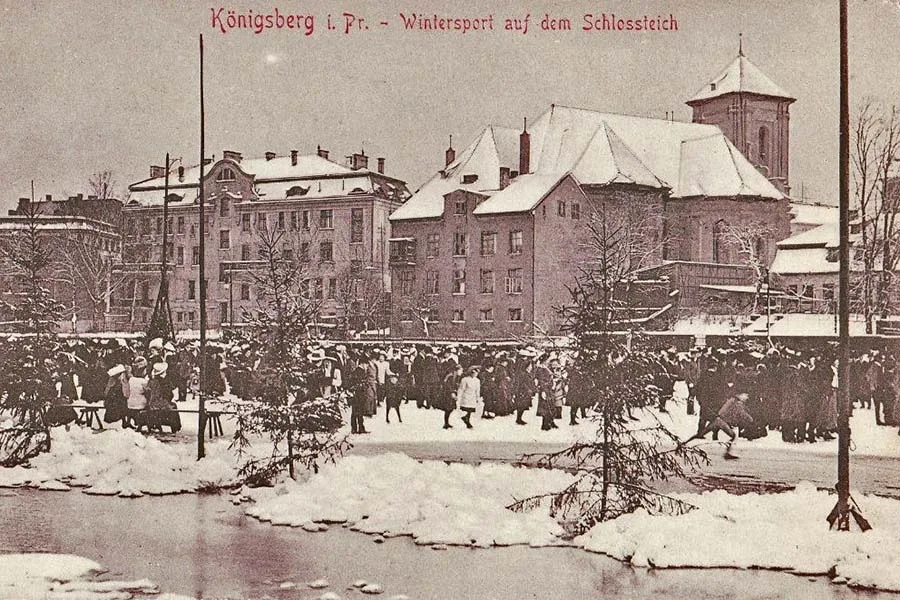 Crowds of people on the ice rink in the southern part of the Castle Pond.
It was he who at the time had proposed making the bridge across the Castle Pond fit for traffic. But the plan has still not been carried out – perhaps not to the detriment of the pond, the quiet of whose shores is still broken only by music from the surrounding gardens.
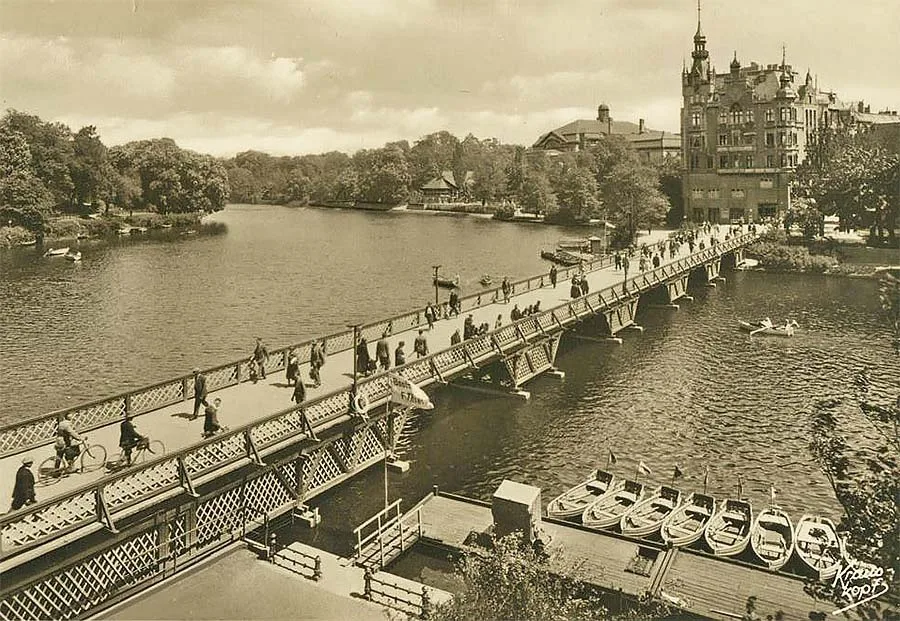 The footbridge across the Castle Pond.
However, the rapidly growing traffic east and west of this body of water, almost 1,200 metres long, will sooner or later require the construction of a stone bridge.
(Here and above the same bridge across the pond is meant; it remained wooden throughout the first half of the 20th century and burned down in the bombing of August 1944. Thirty years after the end of the Second World War it was rebuilt in reinforced concrete. Another one was later built to the north of it. It should be noted that the plans for the reconstruction of Königsberg approved in the mid-1930s included the construction of a bridge for traffic across the Castle Pond. — Editor's note.)
At one time there was a plan that threatened the very existence of the pond. It was proposed to drain it and lay out gardens on the land thus gained.
Such a solution seemed appropriate in former times, because foul-smelling sewage from the whole neighbourhood ended up in it and made life on its shores unbearable. However, after all the polluted inflows had been diverted and conditions had returned to normal, the idea of draining the pond was abandoned. The peculiar colour that the waters of the Castle Pond take on from the end of July to the end of September is the result of the bloom of algae that appear in it at about this time.
Also worth mentioning is the small, tastefully designed floating swan house that the Animal Breeders' Association erected in the southern part of the pond in 1894 as winter quarters for the swans. Many people of Königsberg remember that there was a similar one in the northern part. It was connected to the shore by a footbridge, from which there was a wonderful view of the whole pond.
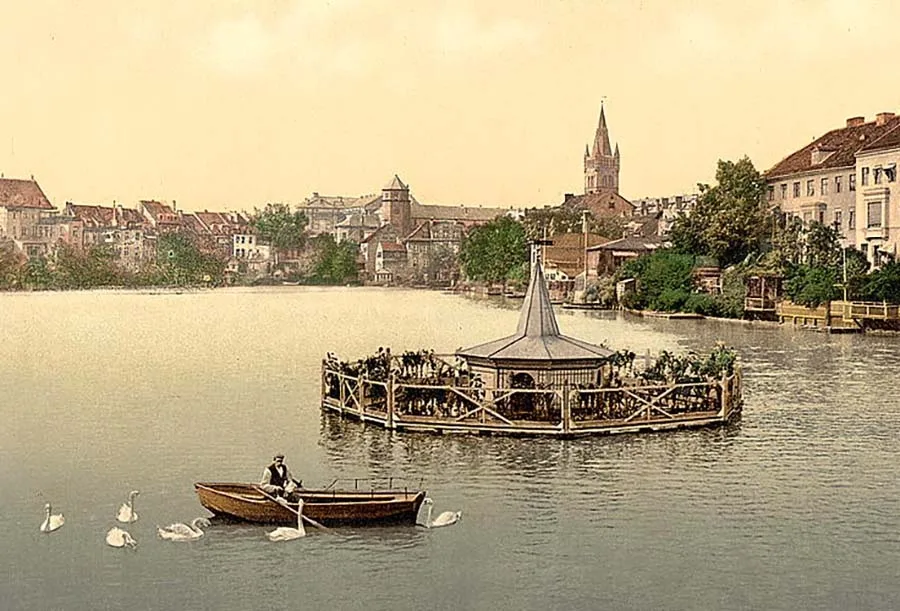 The swan house in the southern part of the Castle Pond.
We leave the bridge across the Castle Pond and turn east into Tanners' Street (Weißgerberstraße) towards the Rossgarten Market (Roßgärtermarkt).
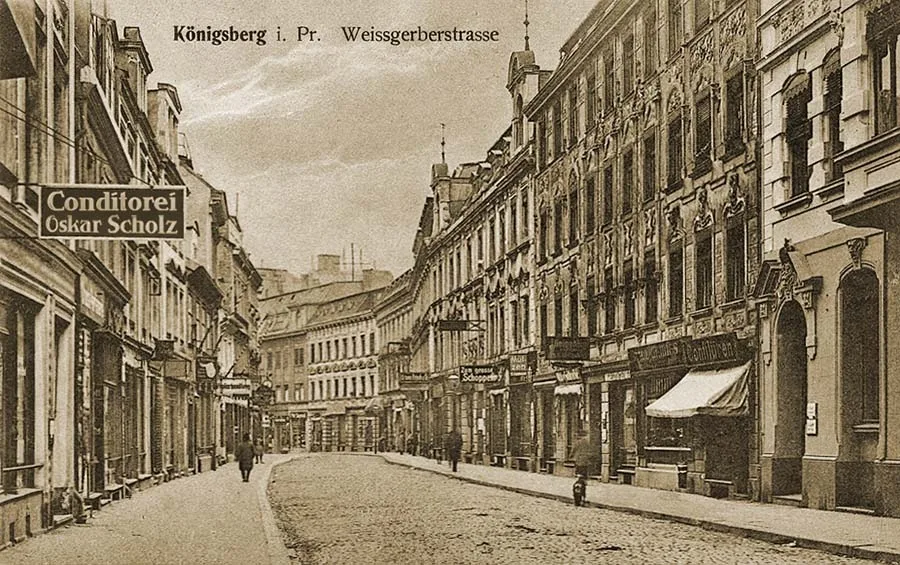 Tanners' Street in Rossgarten.
Here we find ourselves outside Burgfreiheit, in another district of the city called Rossgarten. (Today this is the pedestrian passage from the southern bridge across the pond to Zarayskaya and Frunze Streets. — Editor's note.)
At one time the settlement of Burgfreiheit was separated from the Rossgarten Market by a fortress wall that ran from the wall of Löbenicht by the local Community Garden (Gemeindegarten) along College Lane (Collegiengasse), across Hill Square (Bergplatz), along Barracks Street (Kasernenstraße) and on to the Castle Pond. Considerable remains of this wall have survived to this day, in particular in house number one on Kasernenstraße. The fortress wall ended at the Castle Pond, not far from today's Burgkirche (Burgkirche), with a tower that was used to store gunpowder (Pulverturm). In 1636 this tower was struck by lightning, and two hundred hundredweight of gunpowder blew up. (One can imagine the din over Königsberg – the thunder after the lightning strike and the explosion of twenty tonnes of gunpowder that followed!!! — Editor's note.)
Where College Lane comes out onto Hill Square stood the Cross Gate (Kreuzthor), facing Rossgarten. The gate was named after the church of the Monastery of the Holy Cross (Kloster zum hl. Kreuz).
It was demolished in 1705. According to legend, on the square in front of this gate, where the Rossgarten Market is now, a completely reckless criminal was once executed. After that his evil spirit moved into the gate, and it began to swing open by itself. So its leaves were soon removed. As early as 1688 the Church of the Holy Cross was turned into a foundry where the production of cannon was set up.
Going a little further down Hill Square, on the left we see a simple monument: a column crowned with a bust of the well-known and popular professor of surgery Burow (Karl Heinrich August Burow, 1809–1874).
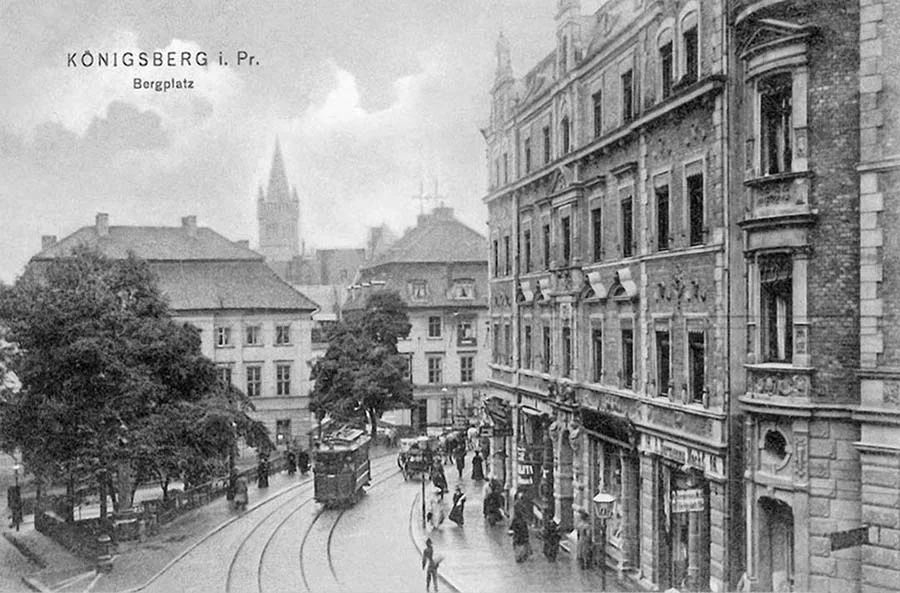 Hill Square had a special charm of its own.
The space between the fortress wall of the town of Löbenicht and the castle (south of the Castle Pond) was almost unbuilt in ducal times. Along the wall towards the Castle Pond there were several stables belonging to noblemen, which is why today's Barracks Street was then called Stable Lane (Stallgasse).
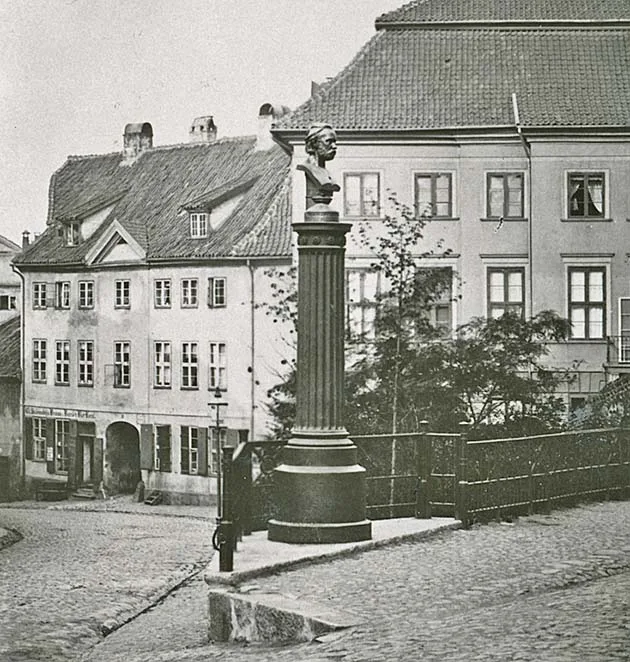
The bust of Burow against the background of Count Dohna's palace on Hill Square.
On the site of the former French School (L’école française), where elegant houses belonging to the French Reformed congregation now stand at Bergplatz 17–18, we see the residence of the Supreme Marshal (Obermarschallei, the residence of the Obermarschall, one of the highest officials of Königsberg – editor's note). And in the southern part of Burgkirchen Square (Burgkirchenplatz), towards French Street, there was the ducal slaughterhouse. All the rest of the space was either gardens or simply wasteland.
Great changes in Burgfreiheit began after the settlement of the Huguenots mentioned above in 1686. Three hundred and fifty French refugees found shelter here and in the course of the late 17th and early 18th centuries built a new street, which they called French Street.
Before that there was only a footpath along the dam on the southern shore of the Castle Pond. After its modernisation, changes in the quality of building became noticeable and the number of inhabitants began to grow. From 1 December 1686 the newly arrived French settlers held their services in the premises of today's Castle School (Burgschule). Then they bought land and built their house of God on it (where the French Reformed School at Bergplatz 16 would later be). In 1733, on a site adjoining the land of the German Reformed congregation, on King Street (Königstraße) in Neue Sorge (Neue Sorge), construction began on today's French Reformed Church (L'église réformée française de Königsberg. It stood on what is now the eastern corner of Frunze and Sergey Tyulenin Streets, next to the Dom Byta services building – editor's note). In 1787 a French school for boys and girls was founded at this church, so that the settlers would not forget their native language. In its original form it existed only until 1825. Until 1832 it continued to function as an elementary (primary) school for boys. The girls' school on this site continued to function as a private higher school for girls until 1886.
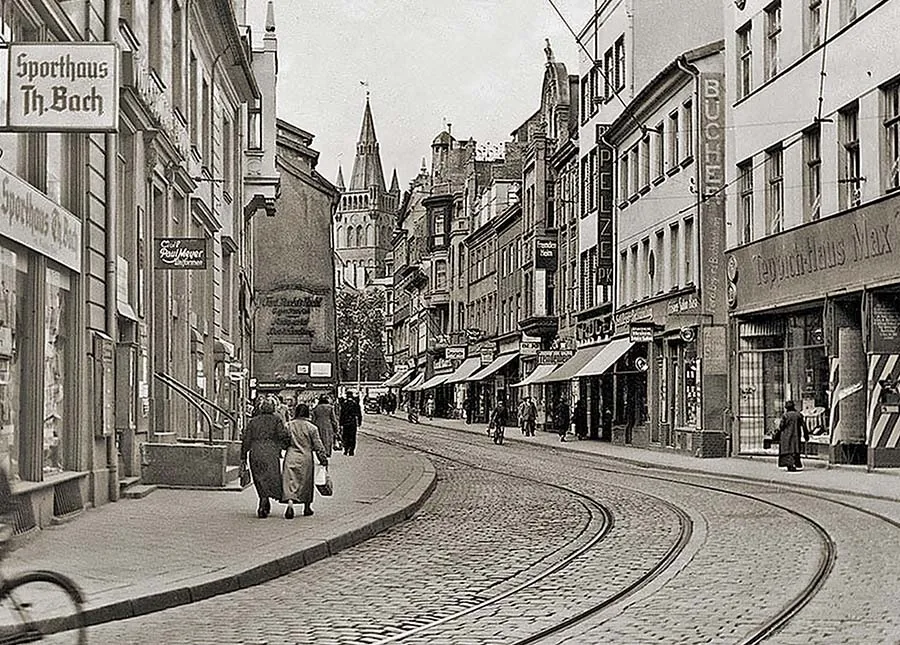 French Street. View from Hill Square towards the castle.
The Great Elector (Große Kurfürst Friedrich Wilhelm, 1620–1688) took a firm stand against the hostility and persecution of German Reformed Christians by Lutherans and Catholics.
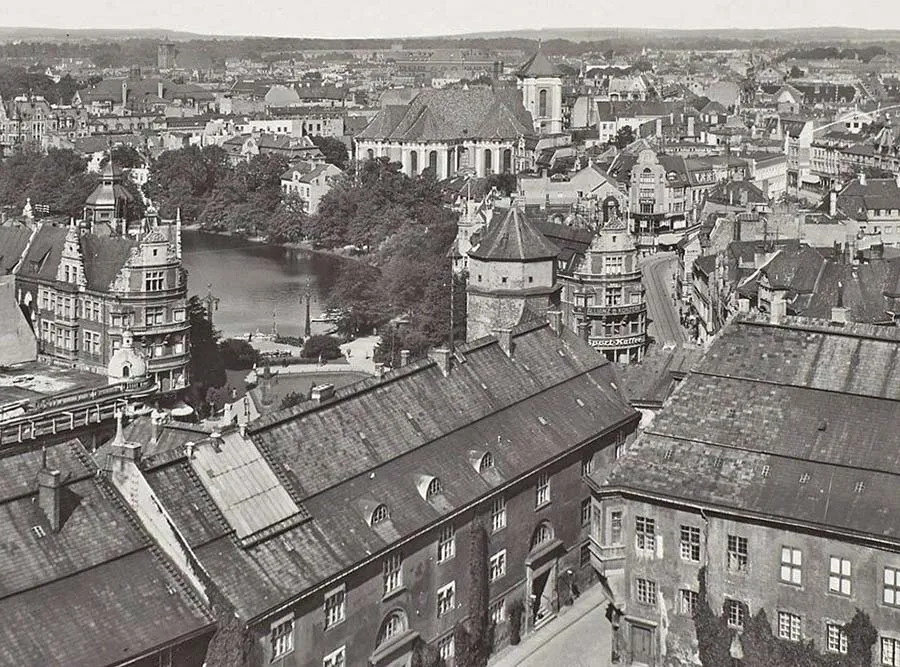
View from the castle tower towards the pond, the Burgkirche, French Street and Neue Sorge beyond it.
Reformed Christians had been present in Königsberg since 1531, but they were not allowed to hold public services. They gathered secretly in Jungferndorf near Arnau (Jungferndorf, now the settlement of Rodniki), not far from the city. When Johann Sigismund converted to the Reformed faith on 25 December 1613, their situation changed. They were allowed to hold services in the east wing of the castle when the Elector or the court was in Königsberg. It was there, on 20 October 1616, that the first Reformed sermon was preached by Johann Crocius (Johann Crocius, 1590–1659). Only in 1649 did the King of Poland, John Casimir (Jan II Kazimierz Waza, 1609–1672), at the insistence of the Great Elector, grant Reformed Christians freedom of worship, and from then on services were always conducted by a Reformed pastor sent from Poland. It was intended to build a German Reformed Church, but the death of the Great Elector in 1688 upset the plans. Even earlier, in 1668, a site had been providently found for a Reformed church and a Reformed school near Slaughterhouse Square (Schlachthofplatz). But construction began only on 25 May 1690. The consecration of the German Reformed Church took place on 23 January 1701, shortly after the coronation of Frederick I.
According to Schlüter, the architect of the Burgkirche, his design was not fully carried out, especially as regards the tower, which now has a pyramidal roof instead of a spire.
The portal of the church was adorned with Corinthian columns, its interior originally had Doric columns, and on the tower we see Ionic columns. The church has five massive vaulted galleries. In 1819, by royal command, the church came to be called the Burgkirche, and accordingly the square on which it stands received its present name. (In terms of today's orientation, the Reformed Burgkirche stood a little south of the present building of the State Television and Radio Company on Klinicheskaya Street, next to it. — Editor's note.)
The Collegium Fridericianum gave its name to narrow College Lane. Until 1812 Hill Square was officially called the Slope (Schiefer Berg), and this name is still widely used. Walking from College Lane to Hill Square, we see on the right a gateway leading to the square in front of the Burgkirche. Above the gateway are three sculptures: in the middle "Justice", and on either side of her "Compassion" and "Love".
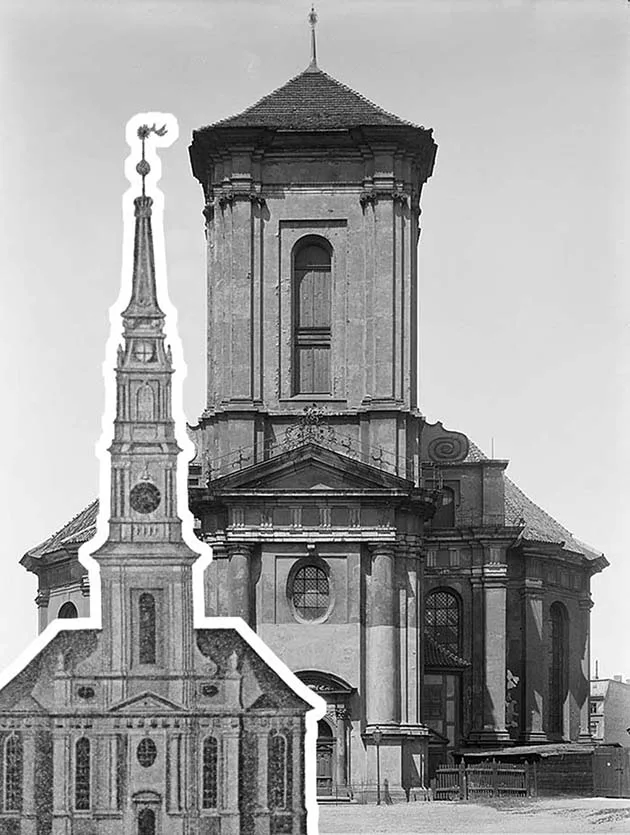
The design of the Burgkirche and what came of it...
Remarkably, "Justice" holds the scales in her right hand and the sword in her left. The gateway was built in 1727 with funds bequeathed by the Royal Prussian commercial councillor Karl Cabrit (Charles Cabrit, 1675–1727).
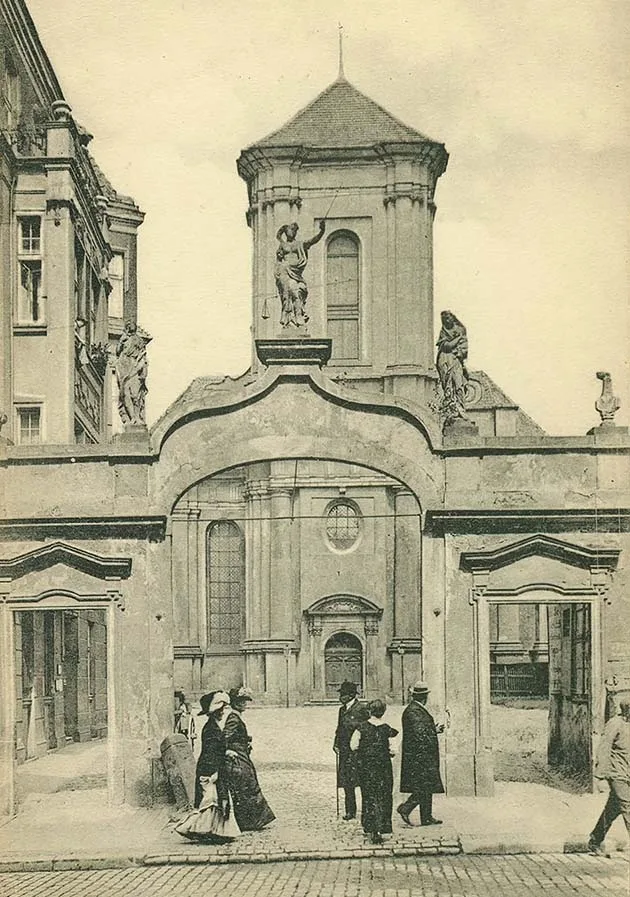
Ladies in feathered hats walk past the portal of the Burgkirche.
The Castle School gives 1664 as the year of its foundation. Funds donated by members of the German Reformed congregation and a generous gift from the Great Elector, who assigned it 100 Hufen of land near the town of Labiau, ensured it a comfortable existence. King Frederick I also supported the school financially. On 6 May 1813 this Reformed school, instead of a Latin school, came to be called the Higher Castle School (Höhere Burgschule). Remarkably, besides English and French, until 1821 its curriculum included Polish. On 15 October 1859 the school received the status of a first-class Realschule.
From 19 April 1882 it was called the Realgymnasium at the Castle (Realgymnasium auf der Burg). The school's close ties with the German Reformed congregation were broken after it came under state administration on 1 April 1889.
Since Easter 1893 it has been in the process of being transformed into a secondary school, that is, a general secondary school without Latin. The present school building, already outdated and quite inadequate for the large number of pupils, will be replaced at Michaelmas 1895 by the renovated premises of the old Collegium Fridericianum (Friedrichs-Kollegium), which has been converted for this purpose. (The text of the book does not mention that the future writer E. T. A. Hoffmann studied at the Burgschule. In 1927 the Burgschule moved to a new building on Lendorf Street in Hufen, now Gymnasium No. 1 on Kropotkin Street. — Editor's note.)
(Finally, we can walk once more along the fortress wall that separated Burgfreiheit from the other districts. In the north it began at the eastern shore of the Castle Pond, where the Powder Tower had stood since 1500. This spot was a few dozen metres south of the bridge across the pond. Then the wall ran eastwards, but soon turned south-east, reached the Cross Gate and continued a few dozen metres further. A few metres short of the Crown Gate, the wall turned west and ran past the Fools' Gate (Narrenthor). Having passed it, after a dozen metres it turned south and then west, crossing the Katzbach (or Löbe) brook and reaching the Castle Mill (Burgmühle) and the Mill Gate (Mühlthor). Here it joined the wall of the castle's outer bailey and turned north-west, skirting the outer bailey and gradually losing its purpose... The western part of Burgfreiheit (on the corresponding shore of the Castle Pond) was probably only partly protected by fortifications. The fortress wall was probably no more than two metres thick and nine metres high. Its lower part was built of boulders, the rest of brick, and a gallery ran along the top. — Editor's note.)
Photos on this page: Bildarchiv Ostpreußen / bildarchiv-ostpreussen.de.
Translated from Russian with the help of AI (Claude, Anthropic), October 2026.