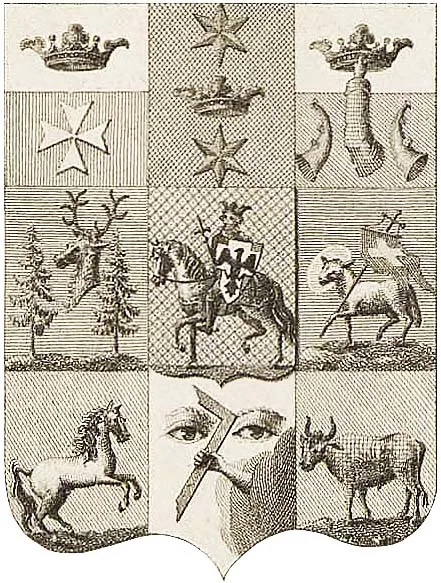
 Coat of arms of Neue Sorge
on the coat of arms of Königsberg, bottom row, centre.
What is known for certain, though, is that in the 16th century the site of the future Neue Sorge district was occupied by ducal (state) farmland — in plain words, ploughland. At the time it was called Kalthöfischer Acker (the Kalthof fields). Three hundred years later, in memory of the ducal estate, the part of the land that was never built up in the newly formed Neue Sorge would be called Herzogs-Acker. The transformation of the ducal pastures into a Freiheit (a suburban settlement) is closely linked to the activities of the Brandenburg electors in East Prussia and, above all, to the marriage schemes of a father and son, Joachim Frederick (1546–1608) and John Sigismund (1572–1619). Even in Brandenburg it was clear that the Prussian ducal crown might very soon be left without an owner, owing to the illness of Duke Albert Frederick (1553–1618) and his lack of heirs. So, well in advance, in 1594 Joachim Frederick married his son to Albert Frederick's eldest daughter, Anna of Prussia (1576–1625). But then, on 25 April 1603, George Frederick (1539–1603), who had been regent for the ailing duke, died. Several noble European houses at once claimed the right to install their own representative as regent of the Prussian throne. At that point Joachim Frederick, Elector of Brandenburg, who had been widowed in 1602, himself expressed the wish to marry Albert Frederick's fourth daughter, Eleanor of Prussia (1583–1607). Neither he nor anyone else in those years was troubled by the fact that the groom was 37 years older than the bride and seven years older than her father, or that in this way he became his own son's brother-in-law.
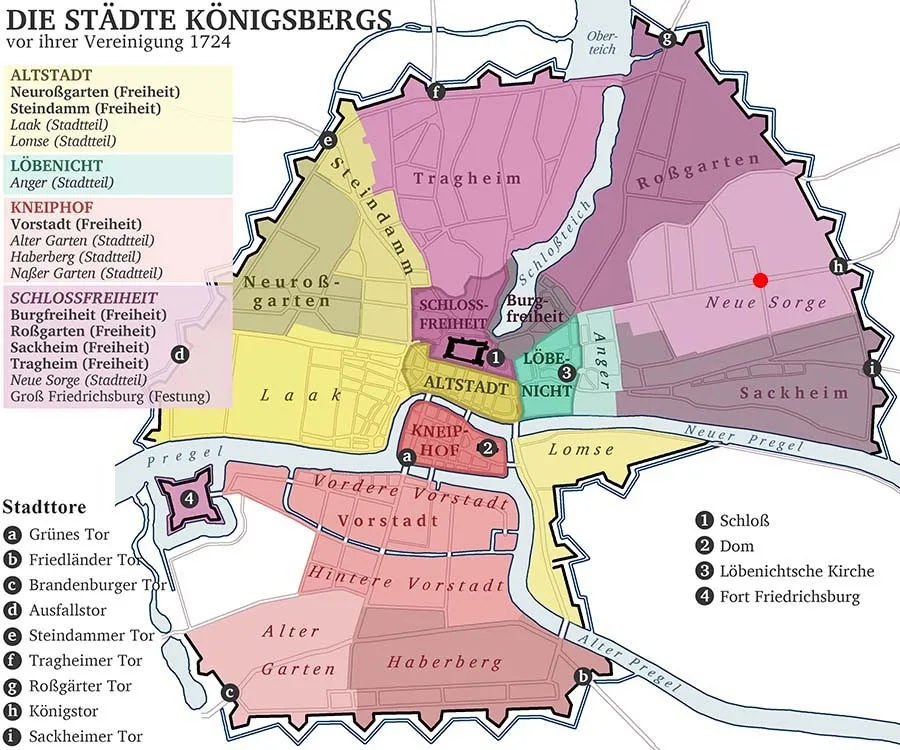 Neue Sorge on a reconstructed map of the towns, suburbs and districts of Königsberg before their unification in 1724.
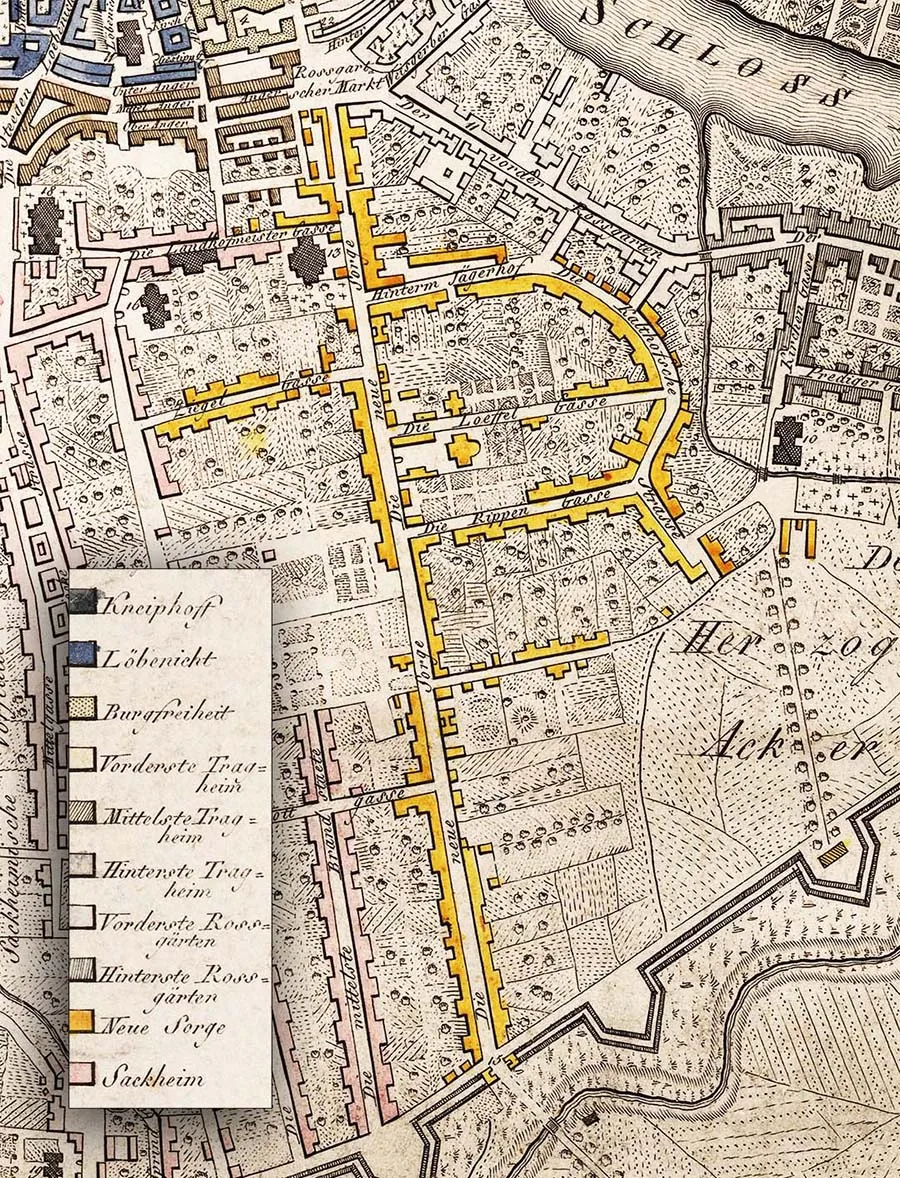
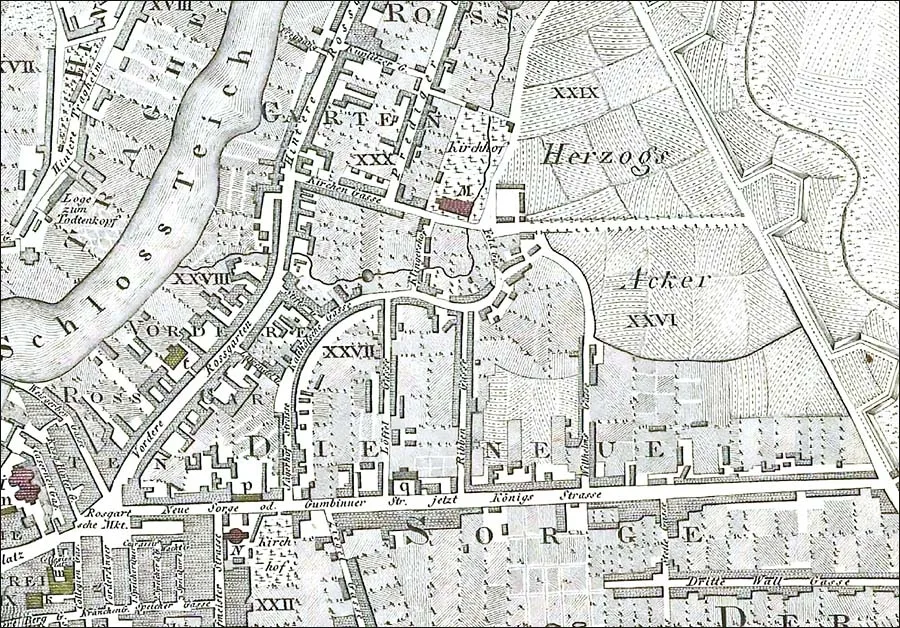 Herzogs-Acker on the 1809 map of Königsberg, still without the Kronprinz barracks.
On the other hand, his close kinship with the duke's family allowed Joachim Frederick to ask the King of Poland for the right of regency over the incapacitated Albert Frederick. He obtained this right in 1605, after long negotiations with the Polish side.
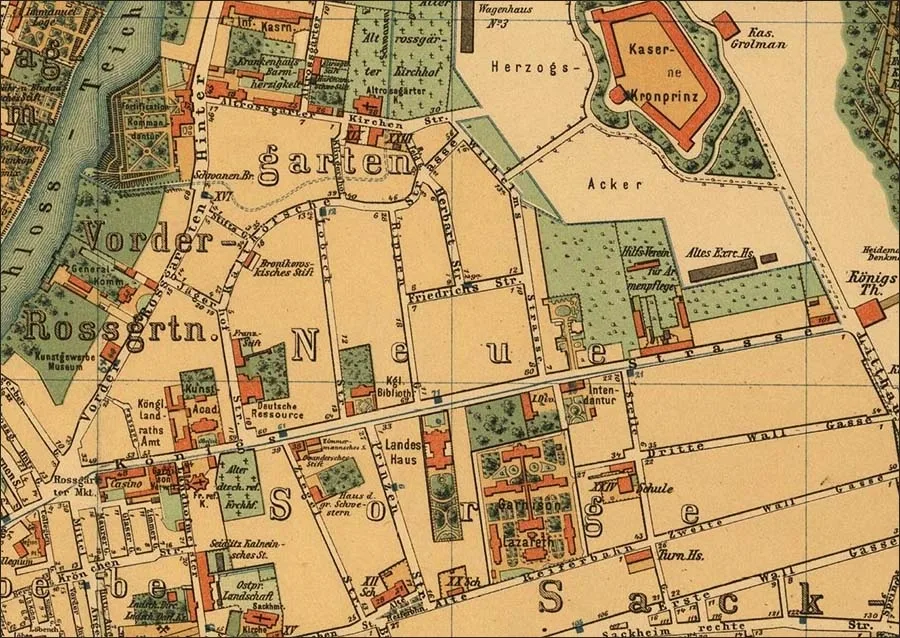 Neue Sorge and Herzogs-Acker on the 1885 map of Königsberg.
Only he did not outlive the rightful duke and held his new office for a mere three years. His son John Sigismund, however, being at once the heir of the previous regent and the son-in-law of the duke under guardianship, obtained the regency without long delays. True, there were two circumstances that might prevent him from taking the duke's own place after his death: first, he was a Calvinist, which to the Lutherans of the time was worse than if he had been a Catholic; second, the local nobility did not want to see any regent or duke from Brandenburg in Prussia at all and aspired to follow the path of a "noble republic" with an elected monarch whose power would be limited. And it was precisely to win the support of the noblest and richest families of Königsberg that John Sigismund began handing out very valuable lands from the "ducal fund". This distribution of land undoubtedly brought closer the day (16 October 1612) when the Königsberg estates, after a year of wrangling, finally swore allegiance to the new regent. Incidentally, on Bering's town plan (1613) this district is already called Neusorg. After the death of Duke Albert Frederick in 1618, John Sigismund secured the passing of the title of Duke of Prussia to the Brandenburg branch of the Hohenzollerns.
There is every reason to assume that the value and prestige of property in Neue Sorge rose with the construction in 1626–36 of the 1st rampart ring (in other words, the 1st bastion belt) around Königsberg and its suburbs. Once it was built, Neue Sorge found itself inside the Königsberg ramparts, becoming the city's north-eastern border district. Admittedly, at that time the buildings of Neue Sorge did not even come close to the city rampart, but credit must be given to the mathematician and fortification engineer Johann Strauss (1590–1630), who looked many years ahead and designed the trace of the ramparts and bastions in such a way that it was only slightly adjusted 200 years later and on the whole defined the city's boundaries for almost three centuries. In the north-east, the boundaries of Neue Sorge did not reach the fortifications themselves; between the two lay ducal farmland — that very Herzogs-Acker. On the stretch in front of Neue Sorge and Herzogs-Acker, the rampart ring consisted of four bastions and the Neu Sorge Thor (as it was spelled in the 17th–18th centuries). This city gate deserves a closer look. Like the other gates of the old bastion ring, it was made of wood and banked with earth. But it was the only gate of the first fortifications to be moved to another place over time — and moreover before the earthen bastions were replaced by the second bastion belt.
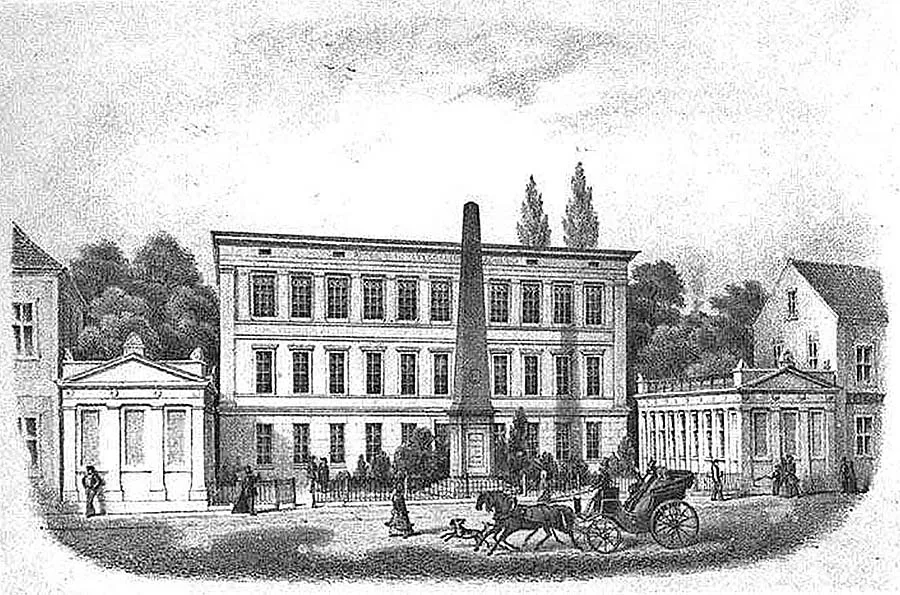 The old building of the Königsberg Academy of Arts on Königstraße.
The Neue Sorge Gate stood where the right flank of the Kronprinz barracks now faces Litovsky Val Street.
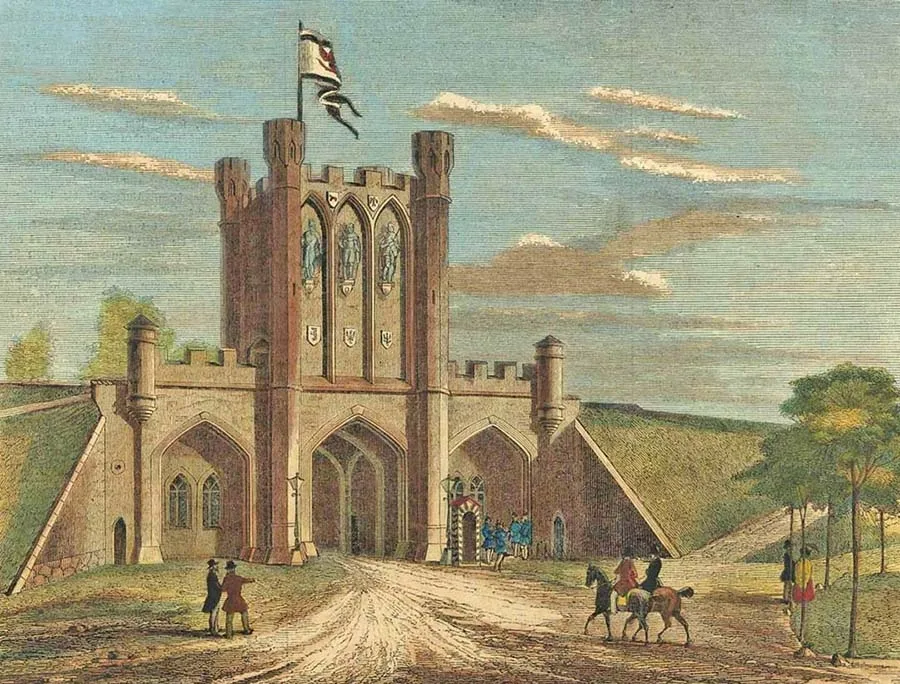 King's Gate in the mid-19th century.
On today's city map its position looks illogical, since to drive through it towards Guryevsk (Neuhausen) one would have to make a detour to the left inside the city and then, outside the city, back to the right, adding considerably to the distance. But in those days the main street of Neue Sorge led straight to this gate. No images of the Neue Sorge Gate have come down to us; however, judging by the city plans of the first half of the 18th century, it was more modest in size than the neighbouring Rossgarten and Sackheim gates.
The status of the new district was considerably raised under the Great Elector Frederick William. It was he who in 1662 made Neue Sorge a ducal Freiheit — a settlement without town rights but with certain urban attributes, which in the case of Neue Sorge were a court seal and the district's own coat of arms upon it. The coat of arms (in the version that has come down to us) showed, on a white field, a hand reaching out of a cloud and holding a set square, and two eyes. At about the same time Kalthöfischer Acker also came to be called Neue Sorge for good. In Königsberg the name was associated with Bogusław Radziwiłł (1620–69), the Lithuanian magnate whom Elector Frederick William, constantly occupied with wars, appointed his governor in Prussia in 1657. According to legend, when Radziwiłł was told that a new Freiheit would now be under his charge, he exclaimed: "Wieder eine neue Sorge!" (Yet another worry!). However, in a certain context the German word Sorge can also mean "household" or "enterprise", so let us agree that in this version of the name's origin Neue Sorge means "New Holding". But this pretty Königsberg legend is shattered to pieces by Bering's city plan mentioned above, published 49 years before this event — Neusorg already appears on it.
And again a coincidence: Neue Sorge received the status of a Freiheit precisely at the time when the Great Elector Frederick William was struggling with the Königsberg nobility and burghers, who refused to swear allegiance to him as the rightful Duke of Prussia.
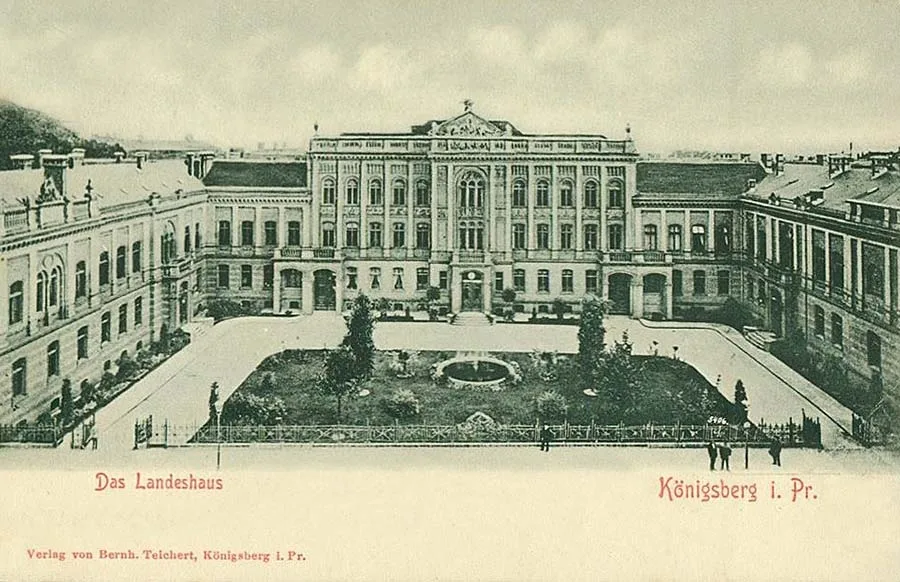 Königstraße 28. The building of the provincial (regional) parliament.
In response, Frederick William began handing out ducal land in Neue Sorge to those willing to recognise him as their sovereign, focusing first and foremost, of course, on the noblest and richest families.
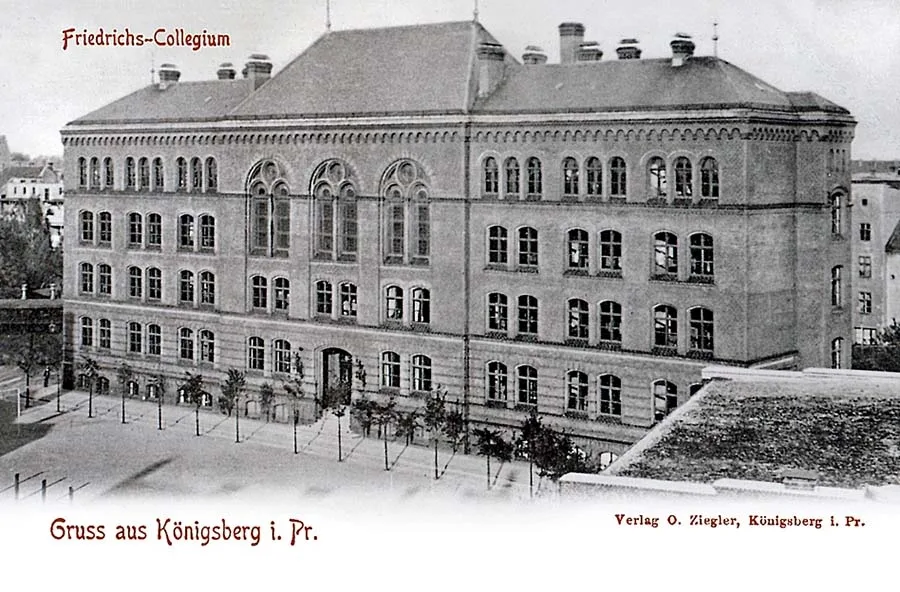 The Friedrichskollegium gymnasium on Jägerhofstraße.
If we simply list some of the nobles who then received plots in Neue Sorge for palaces and manor houses, we immediately recognise names familiar since the days of the Order, as well as those that would be mentioned again and again in the history of Prussia: Polenz, Wallenrodt, Kanitz, Schlieben, Röder, Goltz, Lesgewang, Flanß and many others. In time, in the number of rich houses and Baroque palaces, this district could rival what had until then been the most prestigious suburb — the Castle Freiheit, Burgfreiheit.
And yet at first Neue Sorge, like a number of other Freiheiten, was built up slowly, and much of its territory continued to serve typical rural needs: grazing livestock, haymaking, growing grain and gardening. Many of the nobles and burghers granted land here by the elector already had houses closer to the castle and therefore sold or leased out their new plots. There was nothing offensive in this for the granting party, as the land was handed out precisely so that the nobles thus rewarded could increase their wealth. As in the other suburbs, the first part of Neue Sorge to be built up was the Freiheit's central street, which bore the same name, Neue Sorge. At the time it was straight as an arrow and led to the city gate of the same name (Neue Sorge). Houses were also actively built in the western part of the Freiheit, closer to Königsberg Castle. Neue Sorge had no church of its own; the residents of the Freiheit belonged to the Rossgarten parish. But given the small population of Neue Sorge and the nearness of the Rossgarten church, this was no particular inconvenience.
On 13 June 1724 the three towns on the Pregel and their Freiheiten were united into a single city of Königsberg. The state Freiheiten, Neue Sorge among them, found themselves within the city, but until the municipal reform of 1808 they were subject to the king, whose representatives administered royal property from the castle. This situation persisted because the municipalities responded with great reluctance to the king's initiatives to build any facilities of state importance on town territory.
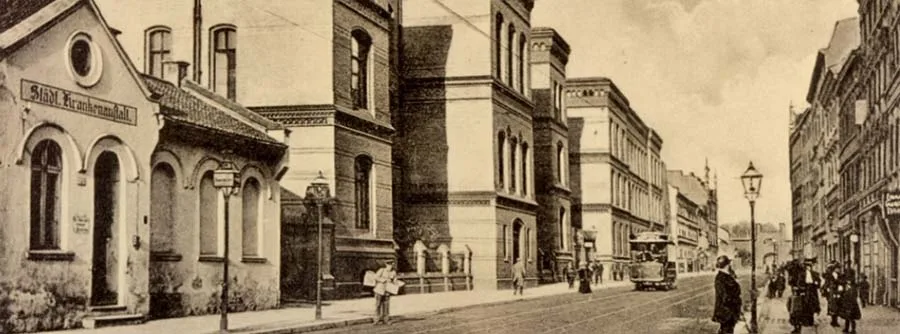
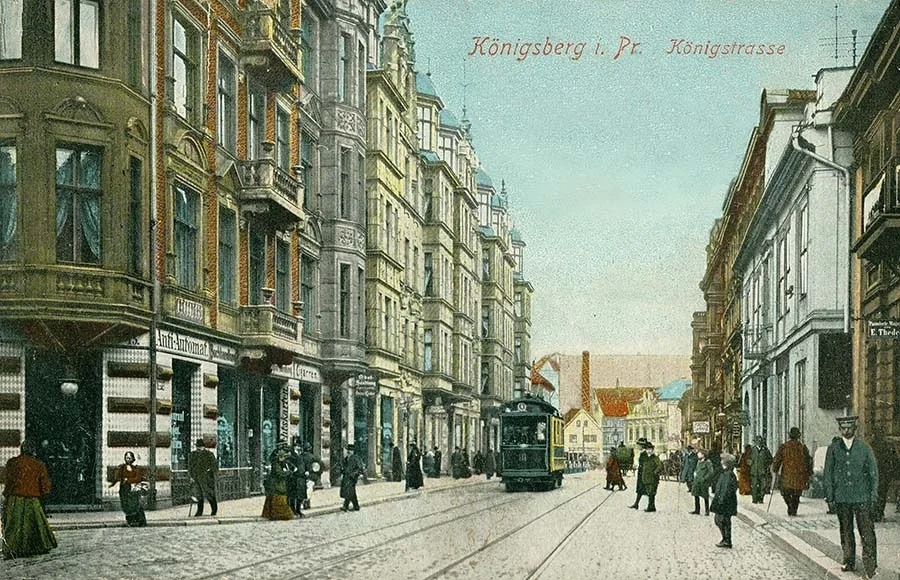 A little tram on Königstraße. Line No. 6 ran here to King's Gate, and No. 2 to Devau airport.
Although the medieval Kulm town law formally ceased to exist in 1620, all the new municipal codes were in one way or another based on it and implied broad autonomy for the municipalities.
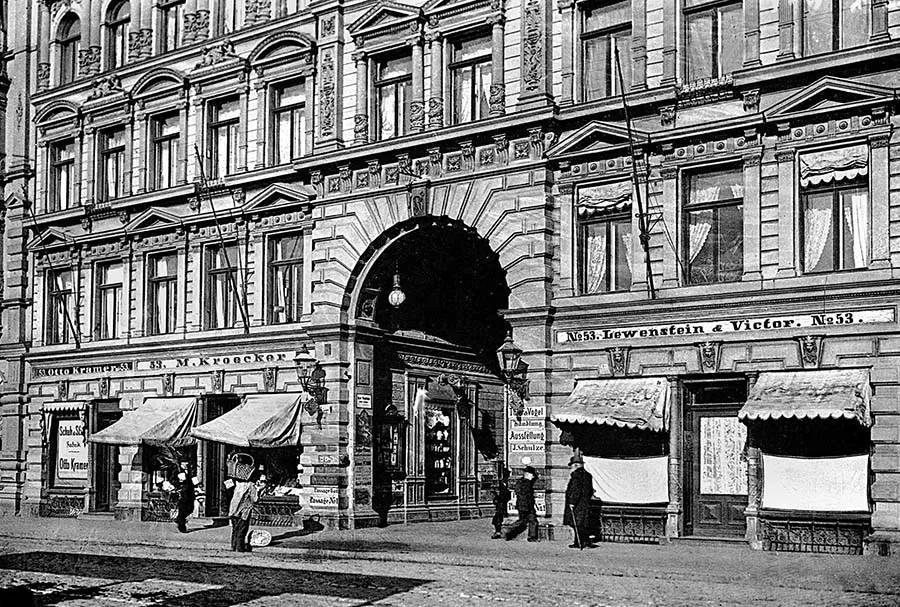 Königstraße 53. The southern entrance to the Königsberg Passage.
And as soon as the king so much as mentioned the need to place some state institution in the city, months of haggling would begin. The burghers would pull ancient charters and more recent edicts on rights and privileges out of the city archives and, citing their clauses, demand concessions from the king in return. On the territory of the state Freiheiten, however, the monarch faced no restrictions whatsoever.
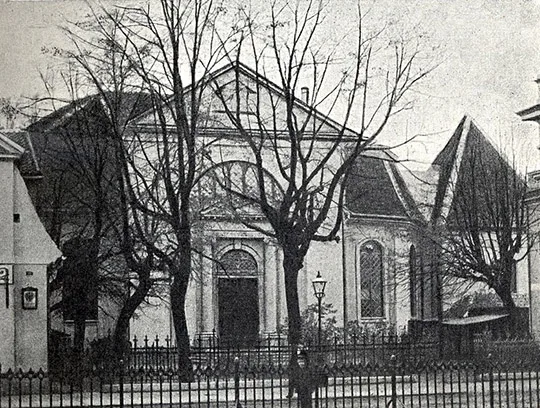
In 1733 King Frederick William I, himself a Calvinist, allocated 12,000 thalers for the construction of a Reformed church for the French community of Königsberg. This was a little under two-thirds of the total cost of building it. The construction was entrusted to the royal architect Joachim Ludwig Schultheiß von Unfriedt (1678–1753). The Rococo building was erected in 1733–36 at the very beginning of Neue Sorge street. At the same time land next to the church was set aside for a Reformed cemetery. The consecration of the French Reformed Church took place on 29 July 1736 in the presence of the king himself. Until 1817 sermons were preached in it exclusively in French. Seventy years would pass, and the royal investment (those 12,000) would pay off handsomely: it was La Canal, the pastor of the Königsberg French Church, who would persuade Napoleon to reduce Prussia's indemnity under the Peace of Tilsit (1807) by 8 million francs.
On 11 November 1764, at about seven in the evening, unextinguished coals on one of the ships moored at the quay in Lastadie started a fire. A gale blowing towards Löbenicht that evening carried the flames from the burning vessel to the nearest buildings. Leaping from house to house, the fire moved east, and Neue Sorge went up in flames together with the neighbouring Freiheiten. The fire was so destructive that even the street layout of the district changed afterwards. In the course of rebuilding the blocks, the main street, still named Neue Sorge, shifted to the south and now ran from the city centre due east.
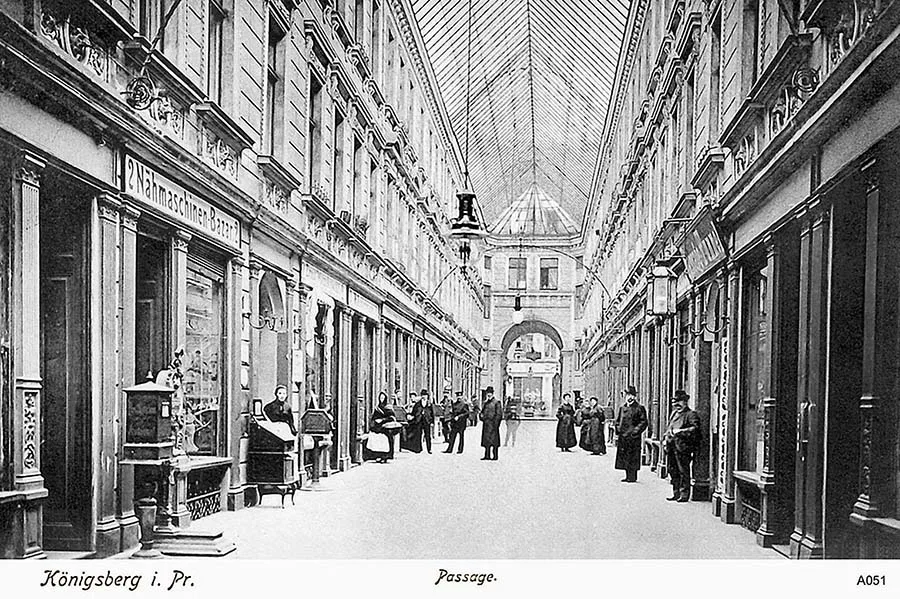
Through the passage one could walk from Königstraße to Vorder Rossgarten and back (see below).
Like the former Neue Sorge, it was straight and wide, but at its end it ran up against the city rampart. The streets Jägershof and Kalthöfsche Gasse branched off it. The latter curved round to the Neue Sorge city gate.
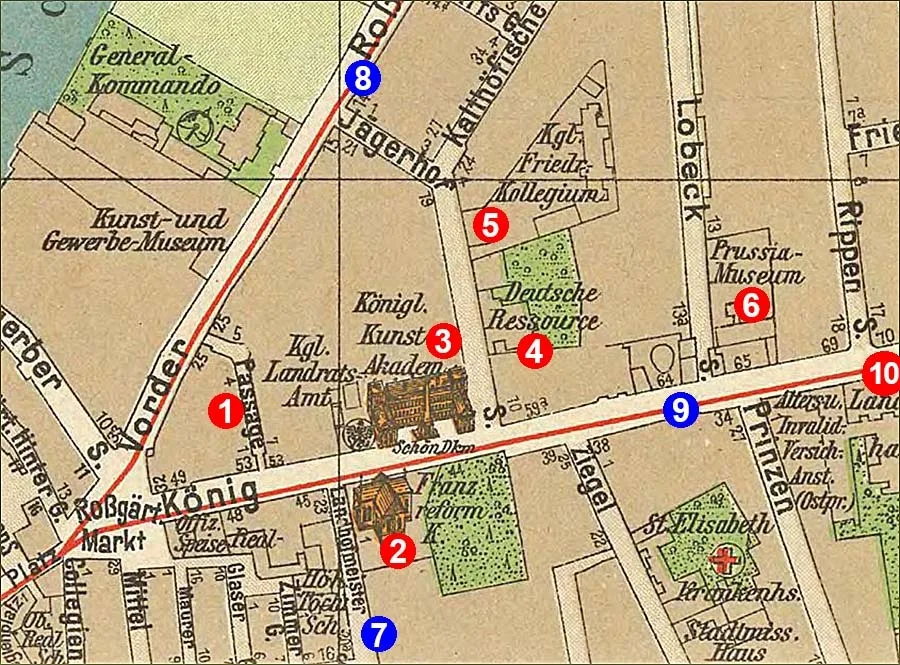
1901. 1 – Passage; 2 – French Reformed Church (at the corner of Tyulenina and Frunze streets); 3 – Academy of Arts (at the corner of Frunze and 9 Aprelya streets); 4 – Deutsche Ressource restaurant; 5 – Friedrichskollegium gymnasium; 6 – Prussia Museum; 7 – Landhofmeisterstraße (Tyulenina Street); 8 – Vorder Rossgarten (Klinicheskaya Street); 9 – Königstraße (Frunze Street); 10 – Provincial (regional) parliament.
True, this inconvenience did not last long: as early as 1765 a passage was dug through the city rampart where Neue Sorge street met it, and on its site the Gumbinnen Gate (Gumbinner Tor) was built. The old Neue Sorge Gate was then filled in.
After Prussia and Russia lost the War of the Fourth Coalition (1806–07) at the battle of Friedland (Pravdinsk) on 14 July 1807, the Peace of Tilsit was concluded. As far as Prussia was concerned, the terms of this peace treaty recorded its complete capitulation, and without the Prussian side even taking part. Napoleon allowed Prussian statehood to survive on the mandatory condition of a military alliance between Prussia and France. The terms of the peace split Prussian high society. Some members of military and political circles found it impossible to serve the king (and Napoleon as his ally) and left the service; some of them entered the service of the Russian Emperor Alexander I. But the bulk of the military men and politicians decided that the right moment had come to carry out reforms and renew the Prussian state system — all the more so as Napoleon himself favoured a thorough reform of the conservative European states. Under pressure from two sides, King Frederick William III, who in other circumstances would have had no need of any reforms, agreed to set up a special state commission, which took up the reform of the Prussian military and administrative systems. There was also a third party that supported the course of reform and put pressure on the king — his wife, Queen Louise. The reforms in Prussia were moderately bourgeois and even more moderately democratic. They in no way affected the power and position of the monarch, but they were meant to consolidate the people of Prussia and unite them around the figure of the king through the interests of the state. For Neue Sorge the result of these reforms was a change of status from royal Freiheit to city district (19 November 1808), the renaming of the Gumbinnen Gate as King's Gate (1811), and yet another change in the name of the main street, which also became "the King's" — Königstraße. In addition, institutions of the newly created Landwehr — the second-line military reserve — and of the reformed Prussian regular army began to appear in Neue Sorge.
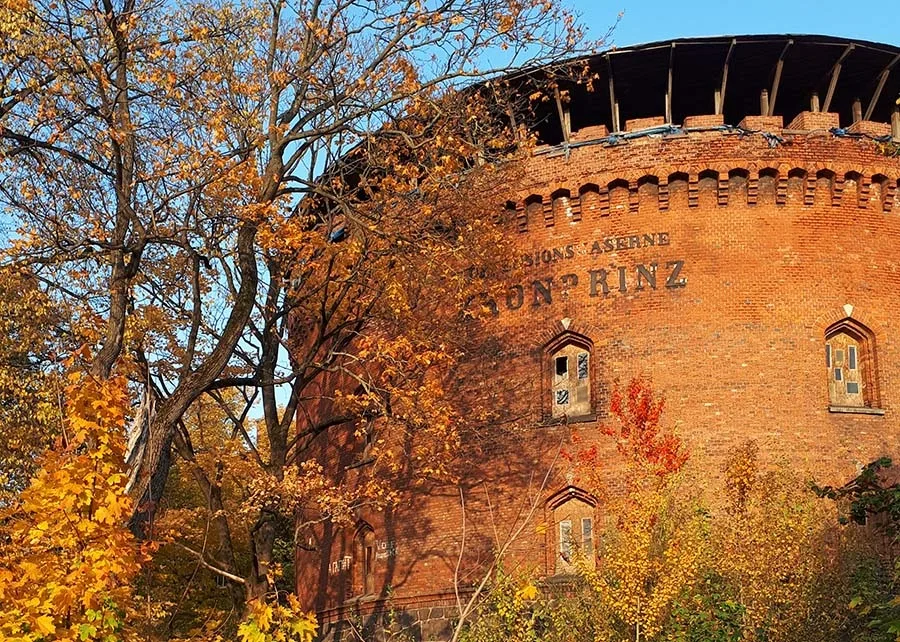 The Kronprinz barracks in autumn 2024 — not quite abandoned, but a sad sight.
On 30 August 1843 a ceremony was held in front of King's Gate to mark the start of construction of Königsberg's second rampart ring. Although in fact it had all begun nine years earlier.
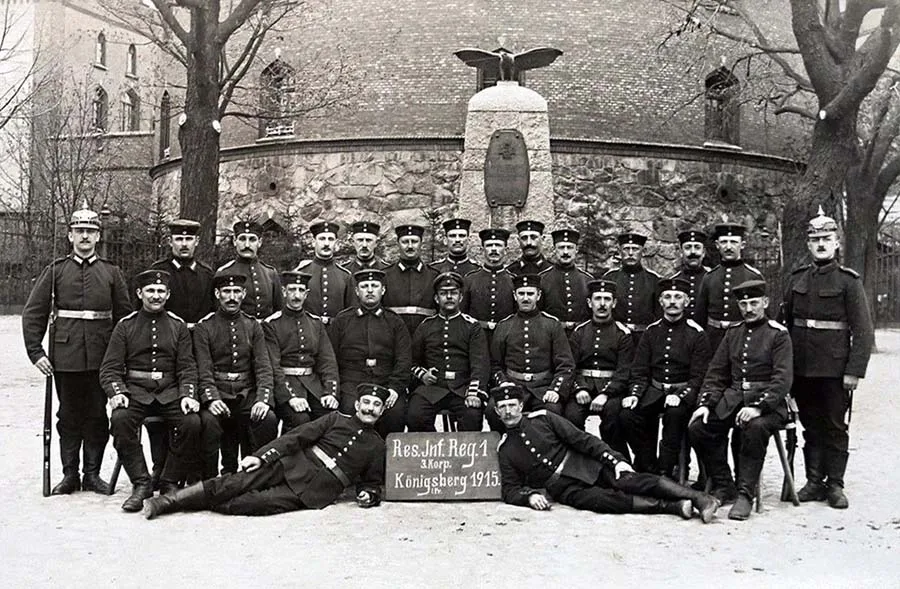 A group portrait of soldiers in front of the Kronprinz barracks (1915).
In 1834 the Königsberg estates drew up a petition to King Frederick William III asking for the fortifications of Königsberg to be strengthened. But they handed it over only to the next king, Frederick William IV, when he came to Königsberg in 1840 to receive the oath of allegiance from his subjects. On 19 December 1841 a commission was approved, consisting of the generals of infantry Karl Wilhelm Georg von Grolman (1777–1843) and Johann Wilhelm von Krauseneck (1774–1850), together with the head of the engineering corps, Lieutenant General Ernst Ludwig von Aster (1778–1855). The latter became the author of the general design of Königsberg's new fortifications. On 17 March 1842 a one-year period was set for amending, refining and adopting Aster's design, and on 5 April 1843 the design was approved. Besides the ceremony in front of King's Gate, there was another one on Herzogs-Acker. Here, on 15 November 1843, the foundation stone of the future Kronprinz defensive barracks was laid. In fact, it was this event that launched the large-scale construction of the bastion ring, which officially ended only in 1862, while on Lomse Island (Oktyabrsky) it continued until 1889.
Today, on the Kronprinz barracks, one can see a strange, albeit official, plaque reading "FORTRESS OF FREDERICK THE GREAT 1759" (see below). Not a single word of it is true. After its completion, the fortress was the entire city of Königsberg. A defensive barracks is a separate type of fortification, like, for example, a bastion or a ravelin. In 1759 there were exactly 84 years still to go before it was built. Nor does it have anything to do with King Frederick II the Great: it was named after Crown Prince William, the future King of Prussia and first German Emperor, William I (1797–1888).
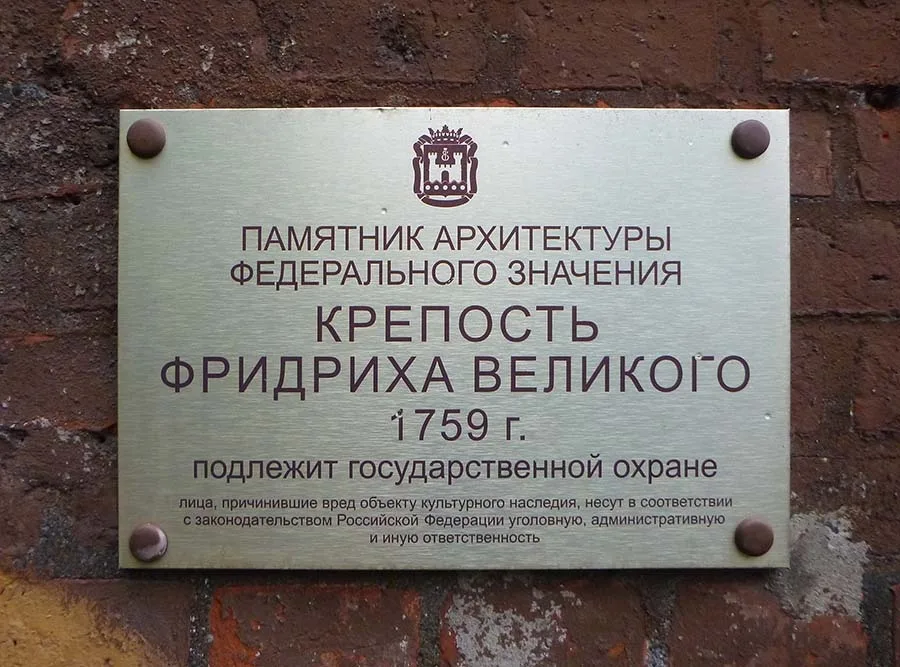 The "strange" plaque on the Kronprinz barracks.
The barracks had two main purposes: in peacetime it housed personnel and was used for drill, while in the event of a siege of the fortress city its embrasures and upper platform allowed tiered artillery and rifle fire over the ramparts of the Grolman bastion in front of it.
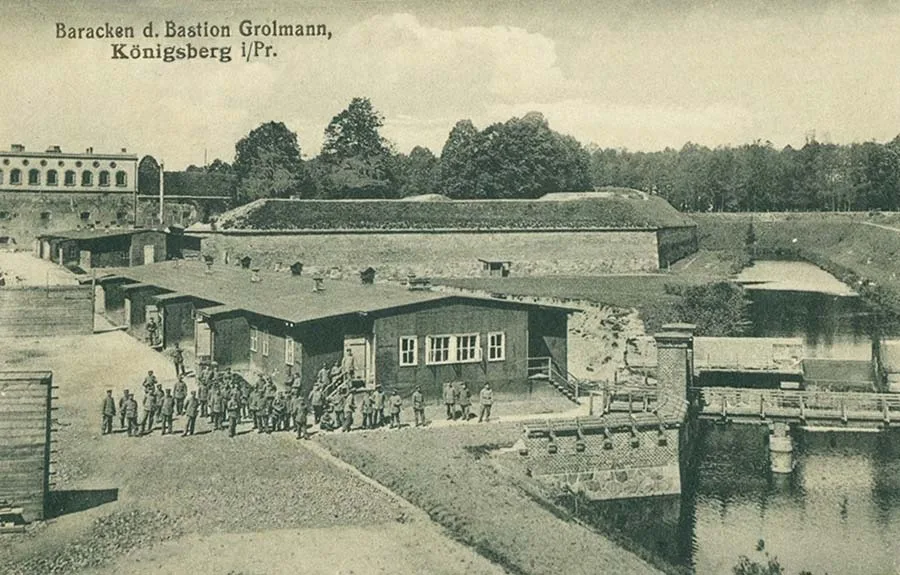 Huts by the Grolman bastion.
The ability to deliver such fire was one of the important differences between the new bastion front and the old bastion belt that had existed here since the 17th century. The point is that as early as the 18th century the simple bastion system had completely lost its defensive capabilities.
The development of field and siege artillery and the growing number of guns in armies meant that an enemy besieging a bastion fortress could concentrate, at the points of the main and diversionary attacks, a number of artillery batteries many times greater than the number of guns on the fortress ramparts. Moreover, it had now become possible to deliver plunging fire with explosive bombs and shells directly onto the city's blocks, since no ramparts or walls were an obstacle to high-trajectory fire. In this way the fortress lost its chief advantage over an enemy army in the field in front of it, which had previously consisted in the fortress artillery being positioned considerably higher than the surrounding ground and therefore outranging the enemy in flat-trajectory fire. Now, according to the fortification engineers' plan, the necessary density of the fortress artillery's return fire was to be ensured by placing it in tiers in three casemated multi-storey buildings. The Kronprinz defensive barracks was also given a third function: if the enemy broke through behind the line of the main rampart (which, in fact, was a catastrophe for a bastion fortress), it was to turn into a local citadel, pin down the enemy forces that had broken through with its fire and hold out until reinforcements arrived. That is why the barracks was designed for all-round defence and had its own ditch, two square three-quarter towers on the flanks, a ditch caponier and a large gorge tower. All these elements were intended to make it harder for the enemy to settle beneath the walls of the barracks in order to breach or mine the masonry.
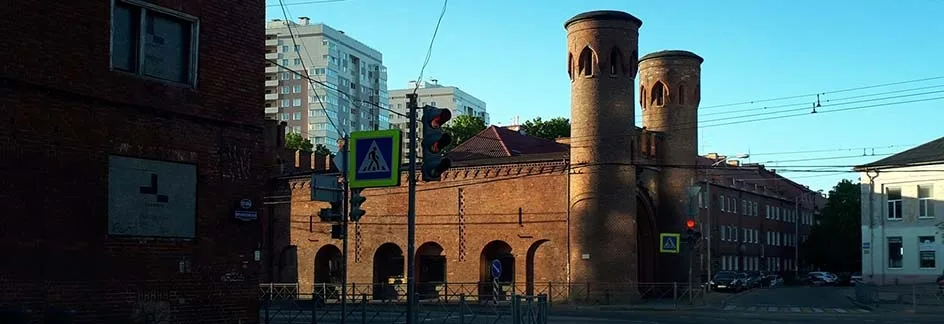
King's Gate deserves a separate mention. The builders of the bastion ring intended this gate to be the most impressive of all such structures. It was designed by the architect Friedrich August Stüler (1800–65). The main decoration of the gate was three sculptures on the façade facing the city.
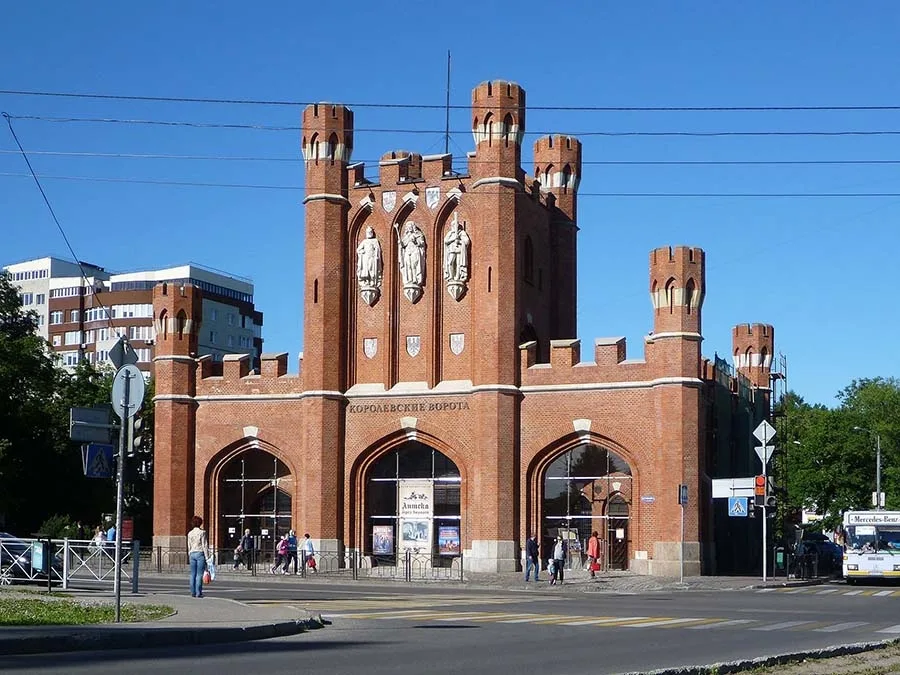 King's Gate in the 21st century.
The sculptures (see below) were made by the court sculptor Friedrich Ludwig Stürmer (1812–64) and depicted the founder of Königsberg, the Bohemian (Czech) King Ottokar II Přemysl (left), the first King of Prussia, Frederick I (centre), and the first Duke of Prussia, Albert of Brandenburg-Ansbach.
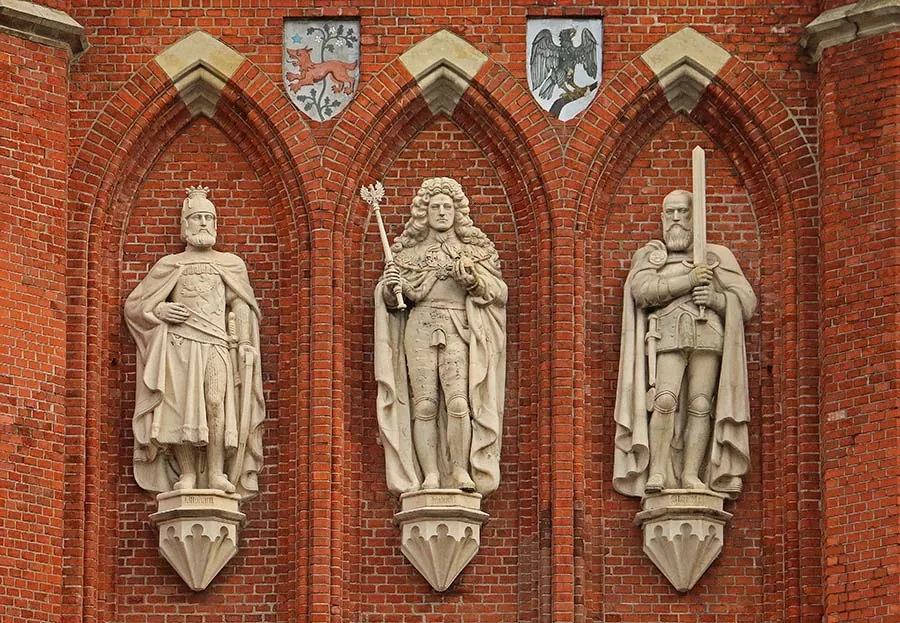 On the city side the gate is adorned with sculpted portraits of the principal local political figures of all time: the founder of the city, the Bohemian King Přemysl Ottokar II; the first Prussian king, Frederick I; and the Grand Master of the Order and first Duke in Prussia, Albert of Brandenburg, a Hohenzollern.
It can safely be said that both in appearance and in location the new gate lived up to the name "King's".
The section of fortifications covering Herzogs-Acker and Neue Sorge (the Kronprinz defensive barracks, the Grolman and Kupferteich bastions, King's Gate) was built in the very first years of construction of the 2nd bastion ring. That is why its elements turned out to be the most powerful and massive here, exactly in accordance with Aster's design. Later, military and state officials realised that the construction was proving very expensive and that already at this stage the new system of fortifications was beginning to become obsolete. Therefore on other bastion fronts the design was often adjusted to make it cheaper. All the more remarkable, then, that it is the Grolman bastion front that is today the best-preserved fragment of the 19th-century rampart ring.
The appearance of a huge complex of defensive structures with a sizeable garrison led to the construction of various military establishments in the surrounding area. In 1876–79 the buildings of the garrison hospital were erected between Königstraße and Alte Reiferbahn (later part of Yorckstraße). In its day it was an impressive architectural ensemble of seven main buildings, four of which were connected by galleries. Königstraße was also home to the military commissariat, and at the beginning of the 20th century an officers' casino opened on Friedrichstraße (Tomskaya Street).
However, one should not think that Neue Sorge was some sort of Königsberg military base: purely civilian institutions coexisted perfectly well here with military facilities. Thus, at the end of the 19th century Neue Sorge had two elementary schools (Nos. 20 and 24), the Royal Library (which moved to Tragheim in 1904), four almshouses for the poor and disabled, and the Deutsche Ressource restaurant. In 1890 the state acquired the Gross Jägerhof property on Jägerhof street, where by 1893 a new building was erected for the Friedrichskollegium, one of the best-known Königsberg grammar schools. In 1901 the Friedrichskollegium had 845 pupils and 32 teachers. At the end of the 19th century the Goethe High School for Girls opened on Friedrichstraße (Tomskaya Street).
In 1904, after the Royal (University) Library had moved out of the building at Königstraße 65/67, the Prussia Museum moved in. It remained in Neue Sorge until 1923, after which it was given halls in Königsberg Castle. In addition, administrative bodies were located on Königstraße in Neue Sorge: the tax office and the building of the provincial parliament.
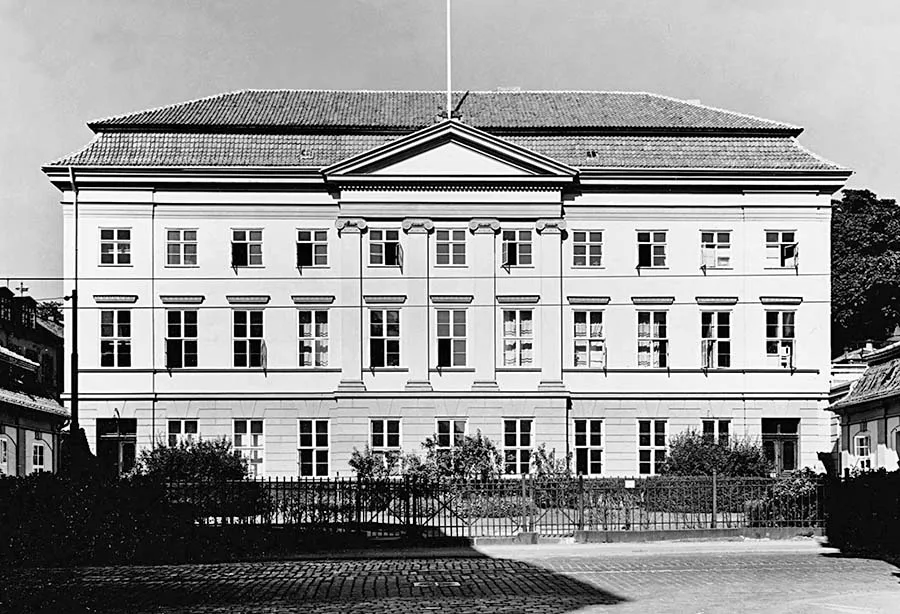 Königstraße 65. The university library building, which passed to the Prussia Museum in 1904.
It should also be noted that Neue Sorge was home to the city fire service. In 1890–95 the building of the East Prussian Fire Society opened on Königstraße.
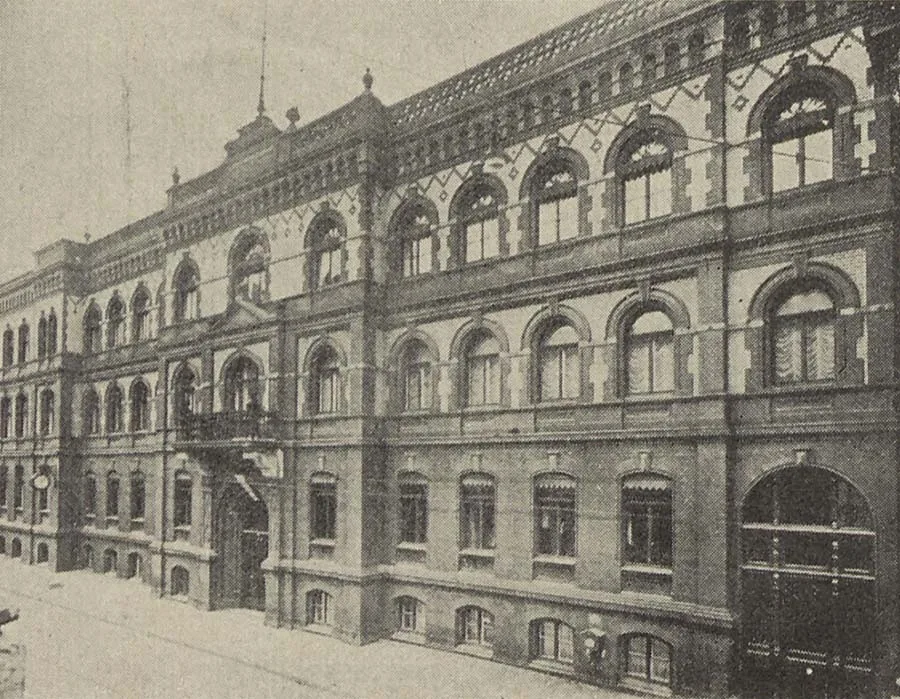 The building of the East Prussian Fire Society.
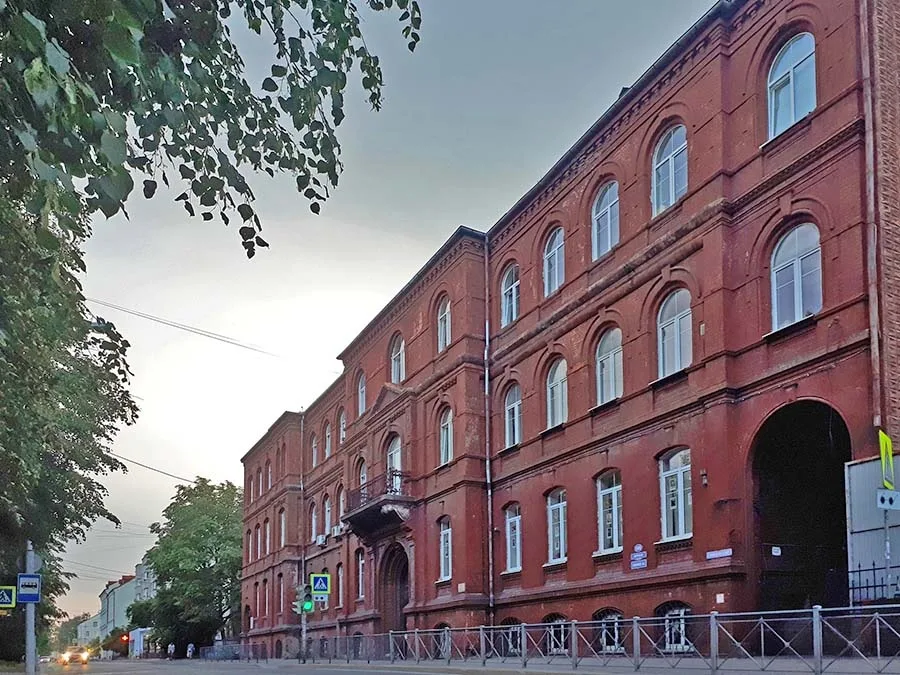 Frunze Street 105. The building of the East Prussian Fire Society today (2024).
And in 1900, on Yorckstraße, on the side belonging to Neue Sorge, the Ost fire station was built (architect Paul Mühlbach, 1849–1908).
In 1900 a branch of the Königsberg narrow-gauge railway (Königsberger Kleinbahn) was opened. On it, a station was opened by King's Gate and named simply "King's Gate" (Kleinbahnhof Königstor). The branch itself started at the Butterberg bastion (now the site of the memorial to the 1,200 Guards heroes), then ran along the fortress rampart (present-day Gvardeysky Prospekt and Professora Baranova Street), passed onto Litauer Wallstraße (Litovsky Val Street) and, after stopping at the station by King's Gate, turned towards Neuhausen (Guryevsk). Originally it ended in the village of Prawten (the settlement of Lomonosovo, now struck off the register), but by November 1901 it had been extended via Kirche Schaaken (Zhemchuzhnoye) to Schaakvitte (Kashirskoye). The network of Königsberg narrow-gauge railways played an important role in organising regular passenger and freight services between Königsberg and the villages of Samland. Looking at today's Litovsky Val Street, it is hard to imagine that a narrow-gauge line once ran along it.
For Neue Sorge, the Nazis' rise to power in 1933 was marked by yet another renaming of the main street. Königstraße was renamed Straße der S.A., in honour of the Nazi storm troopers, the Sturmabteilung (S.A. for short), who at that time were the strong-arm vanguard of Hitler's party, its muscle. The storm troopers eagerly engaged in street fights with communists, confronted the police, guarded Nazi events and took part in Jewish pogroms. Tellingly, as soon as Hitler had gained full power in the country, the over-zealous, often poorly educated S.A. storm troopers, who laid claim to an exceptional position, began to seriously irritate the Nazi government, the Wehrmacht generals and the Führer himself. And Hitler made his choice against the S.A. During the so-called "Night of the Long Knives", which officially took place on 30 June 1934 but in fact stretched over a week, the most radical S.A. leaders and up to 200 militant activists were killed (shot or "killed while resisting arrest"). The S.A. as an organisation lost its former importance in the Nazi system, but the street name was not changed, since many of Hitler's fellow party members had begun their careers in the S.A.
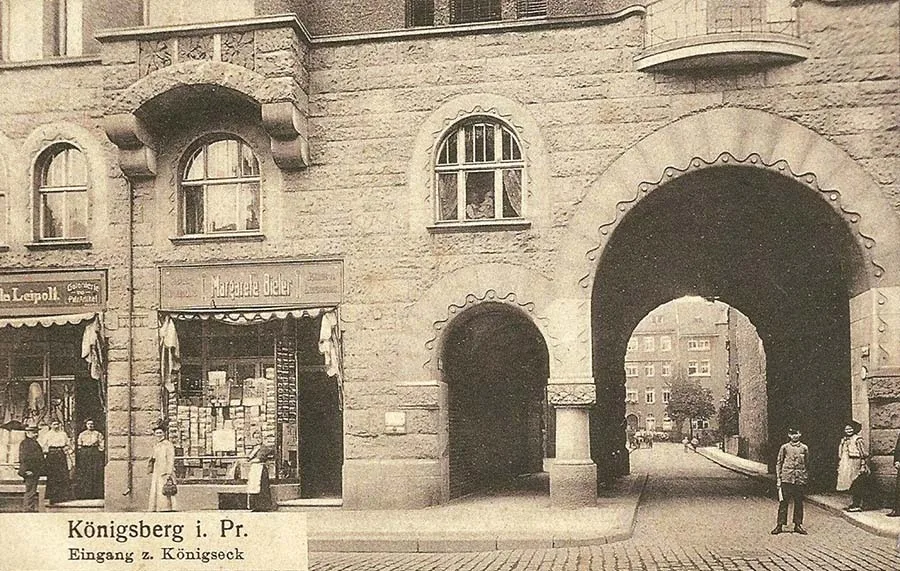 Königstraße in the early 20th century. The archway leading to Königseck street.
On the night of 30 August 1944, bombers of the British Royal Air Force dropped 480 tonnes of incendiary and high-explosive bombs on Königsberg. Some of them also fell on the western edge of Neue Sorge.
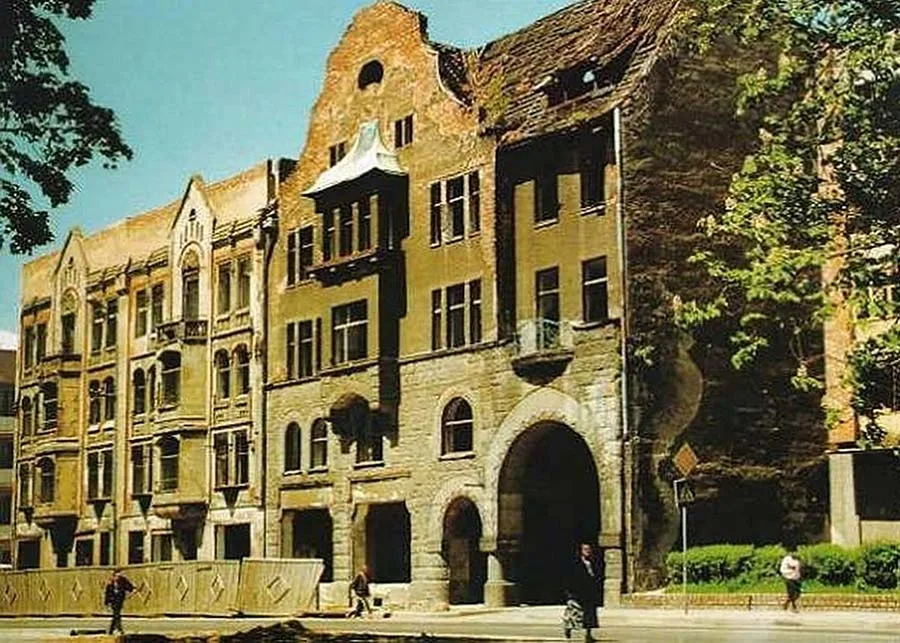 Frunze Street 51. The "Kreuz-Apotheke", when the eatery in the building had already closed but the roof had not yet collapsed.
The British follow-up aerial reconnaissance photographs recorded continuous damage to the roofs of buildings on Jägershof and Kalthöfsche Straße (present-day 9 Aprelya Street) and partial damage on Königstraße. In particular, the Friedrichskollegium buildings burned out completely, and a valuable collection of works of art and books perished in them. During the storming of the city, Red Army armour entered this area only in its last hours, on 9 April 1945. But before that Neue Sorge had come under fire from artillery and ground-attack aircraft.
After the fighting for Königsberg ended, Neue Sorge was included in the 1st district of Königsberg (Military Commandant's Office No. 1). Neue Sorge was not given a Soviet name of its own. All the buildings in the district had been damaged, but at least a third of them were in a condition that allowed them to be repaired fairly quickly and used as housing. The western part of the district, which had burned down during the British bombing, suffered the worst destruction. In the rest of the district there were whole blocks that had withstood the bombs and shells, interspersed with wasteland where others had been demolished. Administrative buildings with good-quality brickwork came through the hard times of war better than the rest.
The renaming of streets was begun by the city's military authorities, and in Neue Sorge, as there were no really tiny lanes, almost all the pre-war streets received new names. On 15 September 1947 tram services were restored along Energeticheskaya Street (now Frunze Street) as far as King's Gate. Later the tracks were restored as far as the Aeroport loop at the end of 10 Aprelya Street (now Yuriya Gagarina Street). From 1947 until services along Frunze and Yuriya Gagarina streets ended, it was always line No. 4 trams that ran here.
For more than 15 years after the end of the war the city authorities had no time to build up the part of the Leningradsky district of Kaliningrad that the former Neue Sorge had become. It may seem surprising, but the Soviet Union sent the first cosmonaut into orbit while one of Kaliningrad's central districts (and one with a Lenin Street, as Frunze Street was then called) consisted, exactly by half, of bald patches where ruins had been cleared.
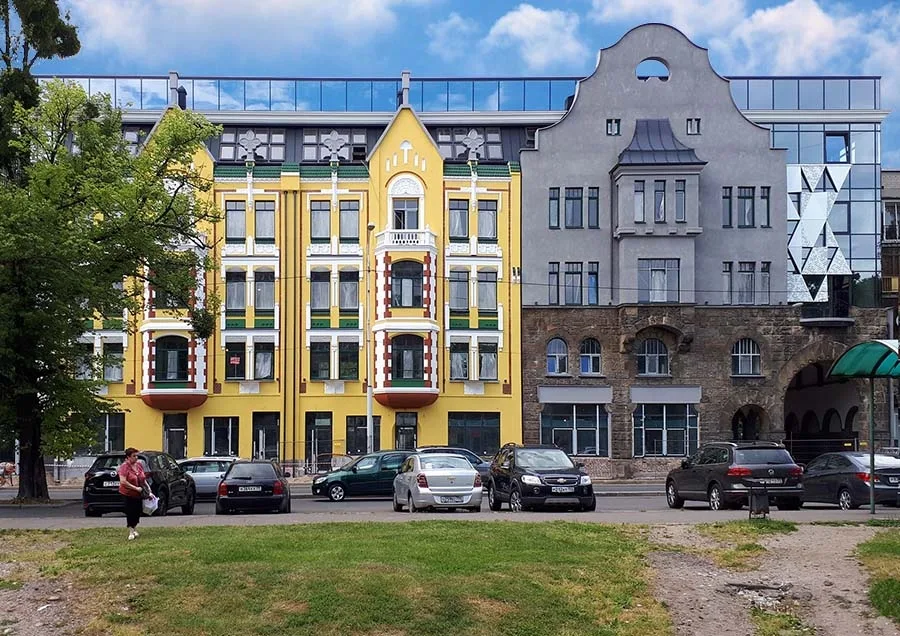 Frunze Street 51. The deliberately eclectic "Kreuz-Apotheke" after renovation.
In 1961 only two small houses were built there. Large-scale construction began only at the end of the 1960s and got into full swing in the 1970s.
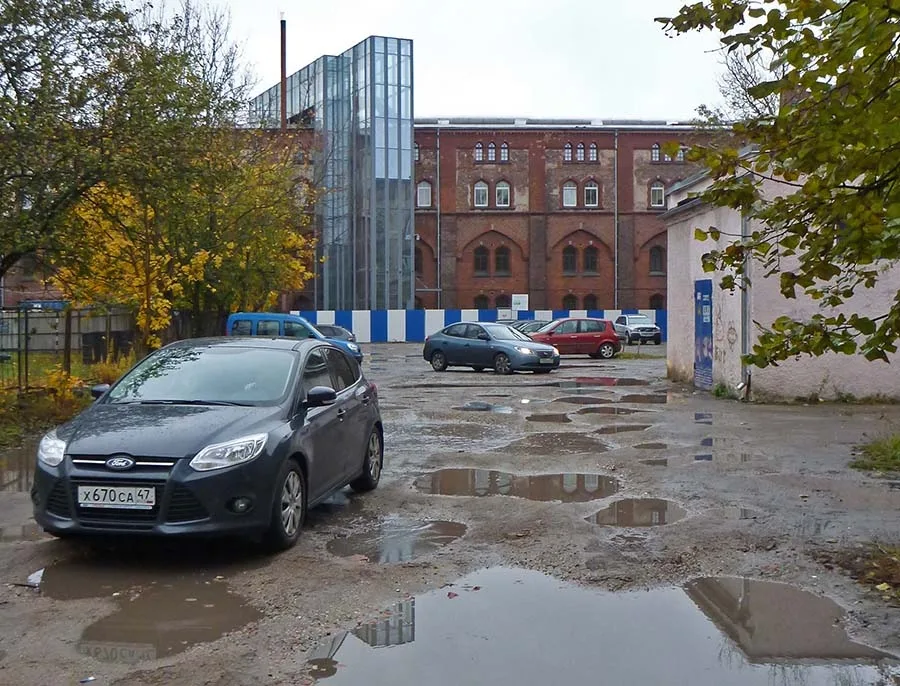 At one time a whole wing of the Kronprinz barracks was occupied by the Baltic branch of the Pushkin State Museum of Fine Arts — the NCCA.
In all, 52 buildings were erected in the district in Soviet times, which now make up 45% of all buildings in the former Neue Sorge. Among them were two schools: School No. 24 in 1970 and School No. 25 in 1979. On 16 August 1974 a new tram line along 9 Aprelya Street was put into service, as it had been decided to close the old line along Klinicheskaya Street. At the intersection of Frunze and 9 Aprelya streets, the modernisation of the tram network produced the so-called "junction 100", or Grand Union — a tram crossing at which a tramcar approaching from any of the four directions could turn left, turn right or go straight on. There were only three such junctions in the USSR; none remains today. In 1975 the tram line along Frunze Street was moved onto a green strip. In 1976 the city's Dom Byta (House of Services) opened at the corner of Frunze and 9 Aprelya streets. This continued the policy of erecting monumental buildings in the city and setting up in them all kinds of combines bringing related services together. As far as the Dom Byta was concerned, the success was partial: although the building was recognisable and was meant to symbolise the might of the Soviet consumer services system, it turned out rather clumsy, and the tin letters "Dom Byta" on it were soon covered in rust, which quite accurately reflected what went on inside. Criticism of the quality of services regularly broke through into the pages of the local newspapers, and Kaliningraders themselves often preferred to use the laundries, hairdressers, tailors' shops and rental points closer to their homes.
There were losses too: several houses restored after the war fell into a dangerous state, because the restoration had been hasty and proper maintenance had then been lacking, and were demolished. In this respect the tenement house with the pre-war address Königstraße 31/32, built in 1900–05 and popularly known as the "Kreuz-Apotheke" after a partly surviving inscription, was relatively lucky. Before the war this building was widely reproduced on postcards for its picturesque double archway, where Königseck (Uglovaya) street began. After the war it housed a family hostel, then flats, and on the ground floor a Pelmennaya dumpling café (Canteen No. 24). The archway remained popular and appeared in shots of a couple of Soviet war films of the 1950s. But the house fell into disrepair, and by 1987 it was in such an appalling state that its residents were moved out. The city authorities did not dare to demolish it, but neither did they find money for repairs.
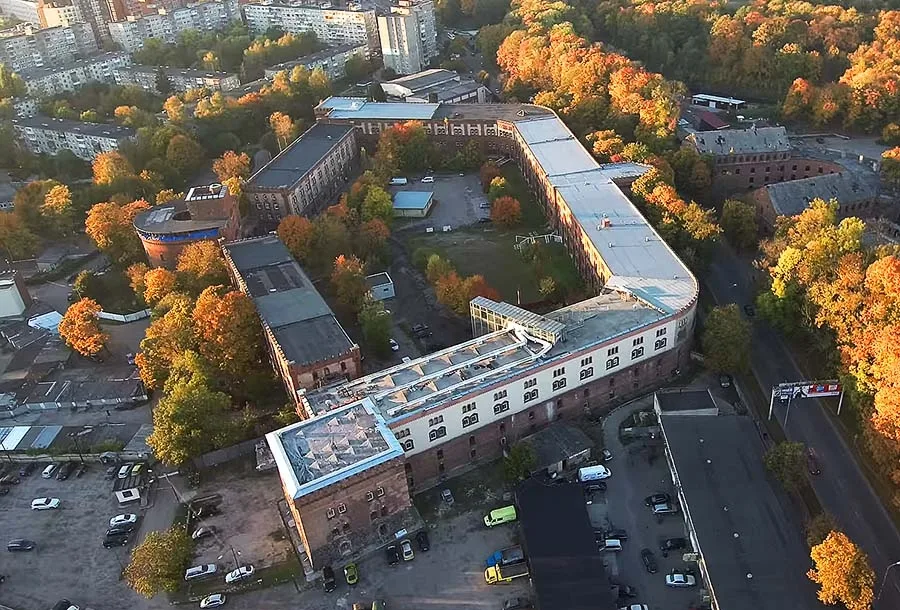 Separated by Litovsky Val Street, the Kronprinz barracks and the Grolman bastion from a bird's-eye view. (Screenshot from a video on the website rcn39.ru.)
Partly ruined, behind a plank fence, the "Kreuz-Apotheke" stood until the 2010s. Only in the 2020s was an owner found for it. Today the renovated "Kreuz-Apotheke" building houses a business centre.
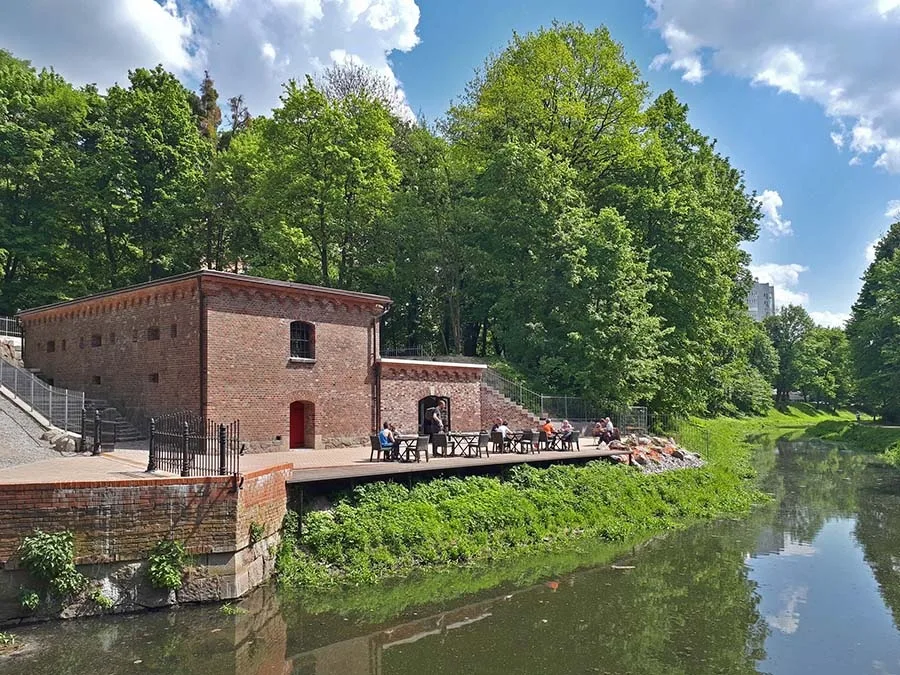 The private Blockhaus Museum of Decorative and Applied Arts on the Lithuanian (Krepostnoy) Stream.
The post-Soviet era, remembered by townspeople for the unjustified destruction of German architecture to please construction-business tycoons, treated Neue Sorge rather gently. In 2006 a residential building on Yaroslavskaya Street, restored in simplified form, was pulled down. But on the whole new construction in the district was modest and piecemeal: houses were "squeezed" into free spaces at the expense of wasteland and green areas. In total 15 buildings have been put up since 1991. The latest act of vandalism happened in 2018, when the building of the Goethe High School for Girls, perfectly fit for repair, was demolished to please a developer. Papers had already been prepared to register the building as a site with the features of a historical and architectural monument. As always, it was demolished in a thievish and brazen manner, with work starting on a day off. Governor Anton Alikhanov and presidential candidate Kseniya Sobchak managed to get some publicity at the demolition site, but the demolition went ahead regardless of their speeches and statements. Still, positive and negative changes in the former Neue Sorge alternated. For the 750th anniversary of Königsberg (2005), King's Gate was restored, and a branch of the Museum of the World Ocean opened in it. An owner was also found for the reduit of the Kupferteich bastion — it now houses the Reduit beer restaurant. In 2008 Frunze Street lost its tram service. In 2020, after 33 years spent as a ruin, the "Kreuz-Apotheke" building was reconstructed (see above). The project caused a lot of controversy, but given the prospect of losing the building entirely, it too can be counted as an asset. Finally, the latest welcome event is the start of repairs to the Grolman bastion.
Sights: In all, 48 pre-war buildings have survived in Neue Sorge, about 40% of all buildings in the district. Identified and registered cultural heritage sites (historical and architectural monuments) are the Kronprinz defensive barracks (1843–49), the King's Gate city gate (1843–47), the Grolman bastion (1851), the reduit of the Kupferteich bastion (1853–56), the Ost fire station building (1812 Goda Street 59, 1900), the building of the East Prussian Fire Society (Frunze Street 105, 1890–95), the tax office building (Frunze Street 50, 1880–90), a residential building with a pharmacy and an archway (Frunze Street 51, 1900–05), a residential building (Frunze Street 71, 1870–80), a residential building (Frunze Street 87/89, late 19th century) and the officers' casino building (Tomskaya Street 19, c. 1910). In addition, the main rampart, defensive passages, cavaliers, casemated traverses and the bridgehead fortification on the stretch of the Litovsky Val adjoining the Grolman bastion are separately entered in the register of historical monuments. For history lovers, King's Gate houses a branch of the Museum of the World Ocean, and there is the private Blockhaus Museum of Decorative and Applied Arts, devoted to the cafés, restaurants and breweries of former East Prussia (see photo above). The latter occupies the bridgehead fortification of the Grolman bastion on the bank of the Lithuanian (Krepostnoy) Stream. Museum displays are expected to open soon in the bastion itself and in the Kronprinz barracks.
A short list of the streets of Neue Sorge
(for the period 1928–32)
Augustastraße took shape in the mid-18th century and is one of the old streets of Neue Sorge. In the second half of the 19th century several military institutions were located on it, since a large parade ground for drill lay right next to the Kronprinz barracks. But after the First World War the street was "demilitarised", and civilian premises came to predominate on it. The street was not damaged in the British bombing raids, but its houses were badly damaged during the storming of the city on 6–9 April 1945. In the first post-war years Augustastraße was not renamed; it first appeared under a new name (together with Steilestraße, see below), as a continuation of Griga Street, on the city plan of 1956. Four pre-war houses survive on the former Augustastraße, one of which is a registered site of cultural significance.
Wilhelmstraße led from Königstraße to Altroßgärter Kirchenstraße (now Nerchinskaya Street). The street first appears on the plan of 1763. At the end of the 18th century it was called Nach Herzogs Acker. In 1809 the name Wilhelms Gasse appears for the first time, and by 1875 the street had stretched as far as Rossgarten. It was not damaged in the British bombing raids, but its houses were partly destroyed during the storming of Königsberg (6–9 April 1945). On 23 November 1945, by order of the commander of the troops of the Special Military District, Wilhelmstraße was renamed Kaznacheyskaya (Treasury) Street, evidently after the nearby tax office building. But as early as 1 August 1946 the city civil affairs administration renamed it Pionerskaya Street, at the same time joining to it the former Altroßgärter Kirchenstraße (now Nerchinskaya Street). Later Pionerskaya Street came to consist of Wilhelmstraße in Neue Sorge and Fahrenheit Straße in Rossgarten. In 1970 part of Pionerskaya Street (Wilhelmstraße) ended up within the grounds of School No. 24. One pre-war building, an architectural monument, survives on the former Wilhelmstraße.
Dinterstraße appeared in 1894 on the site of a vacant lot and the building of the Association for Poor Relief (Hilfs-Verein für Armenpflege). In the same year it was named after Friedrich Gustav Dinter (1760–1831), a Königsberg school councillor and organiser of public education in Königsberg. The little street connected Königstraße and Friedrichstraße. It was not damaged in the British Royal Air Force bombing raids, but during the storming of the city almost all its houses were fatally damaged and were later demolished. In the post-war years it was not renamed and ceased to exist as a street. However, in 1968 Yanovskaya Street appeared for the first time in the city directory, located on the site of the former Dinterstraße. On 17 June 2020 Yanovskaya Street was renamed Major General Yanovsky Street, in honour of the commander of the group of Soviet truce envoys (in 1945 a lieutenant colonel), P. G. Yanovsky (1917–2005), who on 9 April 1945 accepted the surrender of the Königsberg garrison from General Otto Lasch. No pre-war buildings survive on the former Dinterstraße.
Jägershof. In the 18th century the Great Hunting Lodge (Groß Jägershof) stood at the beginning of Neue Sorge street; as a result, the street branching off Neue Sorge came to be called Hinter Jägershof, and later simply Jägershof. The street ran along the boundary between Neue Sorge and Rossgarten. In the 19th century the street had a Franciscan almshouse and the fashionable Deutsche Ressource restaurant. In 1893 a new building for the Friedrichskollegium Realgymnasium was erected at the beginning of Jägershof. The street was badly damaged during the British Royal Air Force bombing raid (29–30 August 1944). The storming of Königsberg (6–9 April 1945) added further destruction. As a result, after Soviet settlers had cleared away the ruins on Jägershof, the street turned into a path across wasteland. The street was given no name in the post-war years; only after 10 Aprelya Street was renamed Yuriya Gagarina Street in 1961 did that former name pass, slightly altered, to the former Jägershof. It was now called 9 Aprelya Street. In 1974 the street got a tram service: lines No. 4 (until 2008) and No. 5 ran along it regularly, and lines No. 8 and No. 10 from time to time. In Soviet times two landmark facilities for Kaliningrad opened on the street: the Dom Byta (1976) and the largest second-hand consignment shop in the city (1988), which among other things sold imported electronics brought in by sailors. In post-Soviet times the street gained two supermarkets and a mini-market. Today both surviving tram lines, No. 3 and No. 5, run along the former Jägershof. No pre-war buildings of the former Jägershof street have survived to this day (2024).
Kalthöfsche Straße. On 23 November 1945, by order of the commander of the troops of the Special Military District, Kalthöfsche Straße was renamed Rizhskaya (Riga) Street. This name was confirmed in 1946 by the civil affairs administration. But in fact (on city plans and on the ground) it was Kuplitzer Straße and Arnoldtstraße in Rossgarten that were renamed Rizhskaya Street, and that is where it still is today. Kalthöfsche Straße, meanwhile, became a nameless road after the war, running at first among ruined buildings and, after their demolition, across a large stretch of wasteland. But in 1974 the question arose of moving the tram line of routes 4 and 5 off Klinicheskaya Street. On the section in Neue Sorge the tram tracks were relaid along, among other routes, part of Kalthöfsche Straße. As a result, Kalthöfsche Straße came to be regarded as part of the newly formed 9 Aprelya Street. Two pre-war buildings facing the former Kalthöfsche Straße survive — the buildings of the Rossgarten secondary school (1896–97).
Königseck, a corner street adjoining Königstraße, took shape at the very beginning of the 20th century. On the one hand its name meant "King's Corner" and harmonised with the nearby Königstraße; on the other, it went back to the family of the Barons von Königseck, who had once owned the Neue Sorge palace. The street was known for beginning at a double archway in a tenement house, which was captured on many postcards and photographs. Königseck was partly destroyed during the bombing and storming of Königsberg. On 23 November 1945, by order of the commander of the troops of the Special Military District, Königseck was renamed Uglovaya (Corner) Street. This name proved a good fit and has come down to the present day unchanged. After the war the buildings on it were restored and occupied. Today there are five houses on the street (including one cultural heritage site).
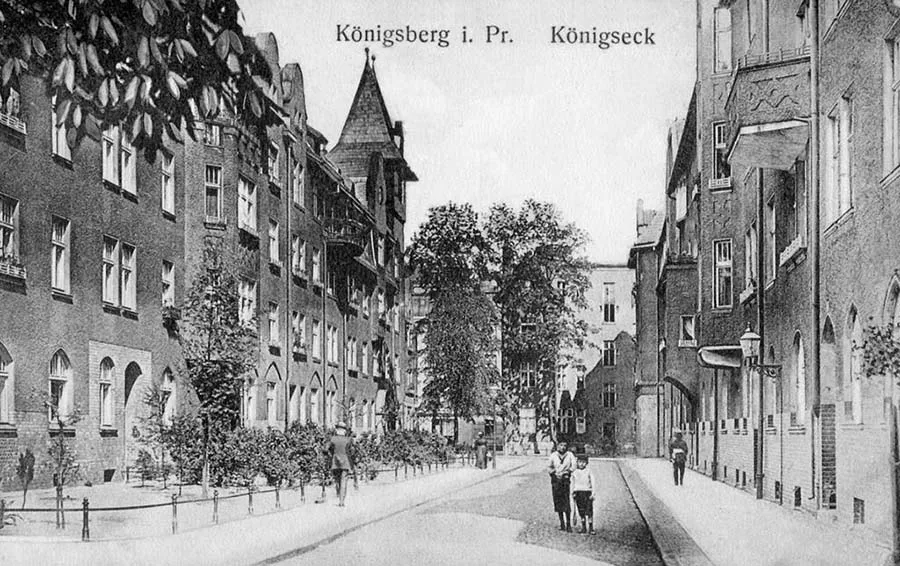 The cosy little street of Königseck, which translates as King's Corner.
Königstraße, the oldest street of Neue Sorge, which changed its name several times. It took shape in the 16th century and, like the district itself, bore the name Neusorg, changing it a little later to Neue Sorge. At that time the beginning of the street lay in the Rossgarten (Roßgarten) district. By the mid-18th century the street had acquired the geographical position it has kept to this day. From 1726 it was called Breite-Straße ("Broad Street"). In 1744, when the Gumbinnen Gate (Gumbinnen-Tor) was built, Breite-Straße became the way out of the city towards Neuhausen (Guryevsk). The street's name changed accordingly: it came to be called Gumbinnenstraße. In 1811 it received the name Königstraße (King's Street), and in 1843 one of the most beautiful gates of Königsberg — King's Gate — was built at its end. When the Nazis came to power, the street was renamed yet again in 1933, as Straße der S.A. During the British Royal Air Force raid on the night of 29–30 August 1944, the buildings in the western part of the street were badly damaged. On the last day of the storming of the city, Red Army units fought their way along the street towards the centre of Königsberg, which led to the destruction of buildings in the eastern part of the street as well. On 23 November 1945, by order of the commander of the troops of the Special Military District, it was renamed Energeticheskaya Street and kept that name until 1950, when by decision of the city executive committee it was renamed Lenin Street. In 1963, after Leninsky Prospekt had been created in Kaliningrad, Lenin Street was renamed for the last time and received the name Frunze Street. By then a little over a dozen buildings remained on it, including one post-war house built in 1962. In 1968–77 six residential buildings were erected on Frunze Street, five-storey ones on the left side and nine-storey ones on the right. In the process, the right side of the street was shifted considerably to widen it, so that the building of the infectious diseases hospital now faced Frunze Street. Taking this widening into account, 12 pre-war buildings survive on the former Königstraße (including nine in Neue Sorge), of which seven are registered cultural heritage sites (including four in Neue Sorge).
Litauer Wallstraße. The north-eastern part of this street belonged to Neue Sorge. Litauer Wallstraße arose as a lateral road when the 1st rampart ring of Königsberg was built (1626–40). In 1843–53 new bastions, King's Gate and the Kronprinz barracks were erected on it. At the beginning of the 20th century the fortifications from King's Gate onwards to the Pregel were demolished and houses were built in their place. After the Second World War, on 23 November 1945, by order of the commander of the troops of the Special Military District, Litauer Wallstraße was renamed Kaunasskaya (Kaunas) Street. However, in 1946 the civil affairs administration did not endorse this name; the street was at first called Litovskaya (Lithuanian) Street and a little later Litovsky Val (Lithuanian Rampart). Today seven pre-war structures survive on the part of Litovsky Val that belongs to Neue Sorge, some of them heavily rebuilt after the war. Four structures are registered architectural monuments; in addition, the rampart of the Grolman bastion and the adjoining cavaliers have been recognised as a monument.
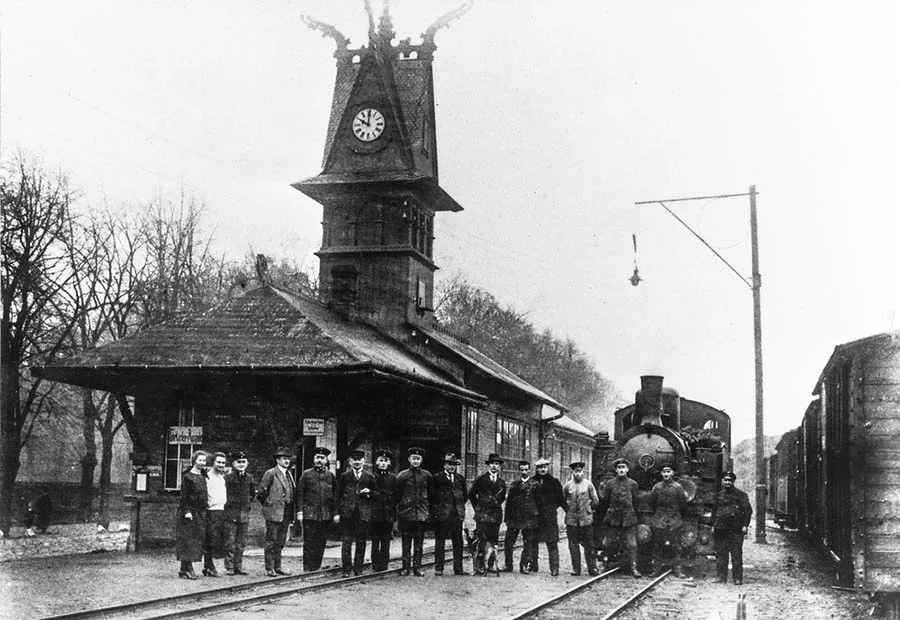 The narrow-gauge railway station on Litauer Wallstraße.
Lobeckstraße has been known since 1720 under the name Löffelgasse. In 1863 it was renamed in honour of Christian August Lobeck (1781–1860), chief librarian of the Royal Library and professor of rhetoric and ancient arts. On 23 November 1945, by order of the commander of the troops of the Special Military District, Lobeckstraße was renamed Novgorodskaya Street. It is hard to say why the city civil affairs administration disliked this name, but on 1 August 1946 it renamed the street Yaroslavskaya by its own order. This name is still in use today. Six pre-war buildings survive on the street.
Rippenstraße (Rib Street) got its name from a huge whale rib that adorned the house of the weaver Wilhelm Gessler, who lived on this street. In 1728 the street's popular name became official. A whale rib was such a curiosity in Königsberg that it is mentioned in Lilienthal's work. During the Second World War the street was moderately damaged in the bombing raids and the storming of Königsberg. On 23 November 1945, by order of the commander of the troops of the Special Military District, Rippenstraße was renamed Grazhdanskaya (Civil) Street. The street has kept this name to this day. Five pre-war buildings survive on the street (including two buildings inside a courtyard).
Friedmannstraße arose at the end of the 18th century as Mittelste Brandstätte. Then, from about the 1830s until 1893, it was called 3. Sackheimer Wallstraße (Third Sackheim Rampart Street), although territorially it already lay in Neue Sorge. In 1893 it was renamed in honour of Rosalie Friedmann (1805–58), née Fraenkel, wife of the councillor and financial magnate Isidor Friedmann. Rosalie Friedmann became known for her charitable work and her part in organising a home for poor women. In the pre-war years Friedmannstraße was home to the Friedenskirche and the city orphanage. On 23 November 1945, by order of the commander of the troops of the Special Military District, Friedmannstraße was renamed Internatsionalnaya Street. But on 1 August 1946 the city civil affairs administration decided to give it a new name — Belokamennaya Street, which the street bears to this day. In 1971 two five-storey blocks were built across the former Friedmannstraße, as a result of which Belokamennaya Street shifted some 50 metres to the north and ceased to coincide with Friedmannstraße. But of Friedmannstraße, one pre-war building survives on it as of 2024.
Friedrichstraße arose around 1870, but at first it was half as long as it is today. By the beginning of the 20th century the street had been extended east as far as Herzogs Acker. In the pre-war years the street was home to the officers' casino and the Goethe School for Girls (Goetheschule). On 23 November 1945, by order of the commander of the troops of the Special Military District, Friedrichstraße was renamed Poperechnaya (Transverse) Street, although geographically the name "Longitudinal" would have suited it better. No better was the version approved by the civil affairs administration: from 1 August 1946 Friedrichstraße was called Tupikovy Pereulok (Dead-End Lane). However, this name did not last long, and on the city plan of 1956 the street already bears its present name, Tomskaya Street. Today three pre-war buildings survive on the street, one of which has the status of a historical and architectural monument.
Herbartstraße appeared after 1860 and until 1878 was called Roßgärter Feldstraße. The street led from Kalthöfische Straße to Wilhelmstraße. In 1878 it was renamed in honour of Johann Friedrich Herbart (1776–1841), professor of pedagogy and philology and founder of the pedagogical seminar. His widow bequeathed the family library to the university. The buildings on Herbartstraße burned out during the British bombing raid on the night of 30 August 1944, but the shells of the buildings, without roofs, doors or window frames, stood until the 1950s, when they were completely demolished. The resulting path across the wasteland was not deemed worthy of a new name. In 1970 School No. 24 was built to the east of the street. Today the former Herbartstraße is a path within the grounds of this school.
Steilestraße first appears on the plan of 1790 as Brandstätte ("Fire Site"). The street led from Königstraße to Sackheim street (which became part of Moskovsky Prospekt), and thus its southern part lay in the Sackheim district. By 1800 it had changed its name to Mottstraße, and then by 1811 it came to be called Steile Gasse. In 1834 it is marked on the city plan as Freite Gasse, but after that the name Steilestraße became firmly established on all subsequent maps. The street was not damaged in the British bombing raids, but its houses were badly damaged during the storming of the city on 6–9 April 1945. In the first post-war years Steilestraße was not renamed; it first appeared under a new name (together with Augustastraße), as a continuation of Griga Street between Lenin Street (now Frunze) and Moskovskaya Street (now Moskovsky Prospekt), on the city plan of 1956. In 1966 the first five-storey building was erected on the street. Then, in 1971–80, it was built up with five- and nine-storey prefabricated panel blocks. No pre-war buildings survive on the former Steilestraße.
– – – – – – – – –
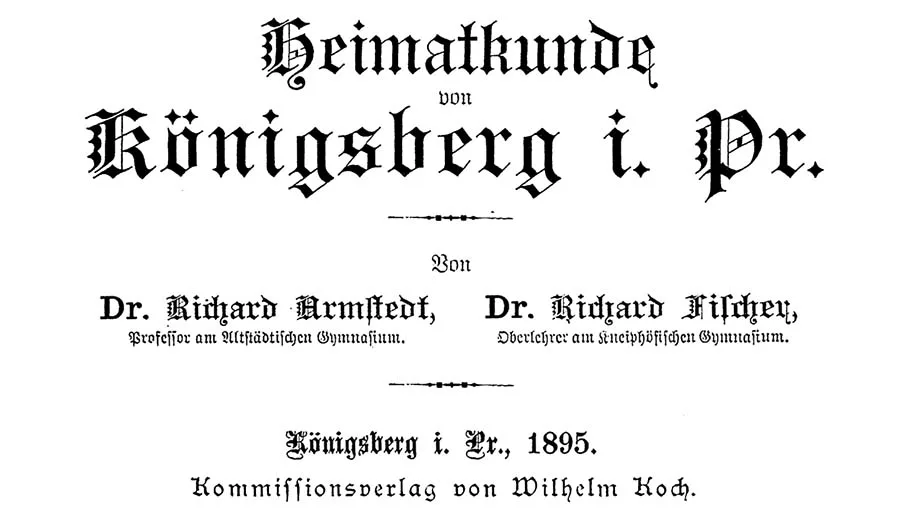
The chapter “Neue Sorge”
from the book by local authors “Königsberg Local History”,
published at the end of the 19th century
In 2012–2014, “Pregola”, the literary and art supplement to the “Baltic Almanac”,
published a translation of the book by the Königsberg authors Dr. Richard Armstedt, professor at the Altstadt Gymnasium, and Dr. Richard Fischer, senior teacher at the Kneiphof Gymnasium, “Königsberg Local History” (“Heimatkunde von Königsberg i. Pr.”, 1895, Kommissionsverlag von Wilhelm Koch, Königsberg), made by an unknown translator. The idea of publishing it belonged to Igor Vladimirovich Afonin. The text was adapted and annotated by Aleksey Borisovich Gubin and Igor Fyodorovich Avtukhov. That book also had a separate chapter on Neue Sorge. Lightly edited, it is offered here for your attention as a supplement to the text by
Aleksey Yevgenyevich Petrushin.
– – – – – – – – –
Neue Sorge
Moving on, we approach King Street (Königsstraße). In the 19th century its name came to stand for the whole suburb, which until 1811 was known as Neue Sorge. It lies between Rossgarten to the north and Sackheim to the south. Besides King Street, which runs from west to east, the suburb includes several more streets and lanes connecting it with the neighbouring districts. Apart from the ducal stables (Schirrhof), the large Hunting Lodge (Jägerhof) and two taverns, one on the Rossgarten Market (Roßgärter Markt) and one on the corner of what is now Brick Street (Ziegelstraße), there were no other buildings in Neue Sorge at the beginning of the 17th century. But from the 1610s, when the Elector of Brandenburg Johann Sigismund (1572–1619) came to power in Prussia, and later under his son Georg Wilhelm (1595–1640), both of whom readily granted the land here to their courtiers, vigorous building began in this part of the “inner city” (Innenstadt).
The court of Neue Sorge was founded on 4 March 1662 by the Great Elector (Friedrich Wilhelm, 1620–1688). To choose six or more capable men, as required, to serve as judges, the Oberburggraf held what was then called a “Kur” (election). The court seal bore two eyes with a hand between them, reaching out of a cloud on the right and holding a set square, the year and a Latin inscription: “Sigill. Immunit. Neuesorge. Rectum inter et aequum” (Seal of the Freiheit of Neue Sorge. Law and justice). The Hausvogt was given lodgings by the stables at the Rossgarten Market, where he was to look after the estate and at the same time perform the duties of judge.
There is no single convincing explanation of the name Neue Sorge. There is a story that the governor, Prince Radziwiłł (Bogusław Radziwiłł, 1620–1669), when asked about the name of this newly emerged district, grumbled: “Eine weitere neue Sorge!” (Yet another new worry). However, the name already existed by then.
It had come into use before the prince took office. The version according to which the name of the new suburb, Sorge, supposedly derived from the Middle High German “Zarge” (enclosed area), appeared when the district found itself inside the new city walls in 1626, is not entirely convincing either.
Today King Street, together with the Steindamm, is one of the longest, most beautiful and most prestigious streets of Königsberg. It is lined with the buildings of military and civil authorities and of cultural, scientific and educational institutions, which give it a solemn and calm appearance, in contrast to the Kneiphof Long Lane, the Steindamm, Junker Street (Kneiphöfsche Langgasse. Steindamm, Junkerstraße) and other busy city thoroughfares, where the ground floors of the buildings are mostly occupied by shops.
On the left side of the street, after the Rossgarten Market, the first building to catch the eye is the Academy of Arts (Kunstakademie). The desire to cultivate the fine arts arose in Königsberg relatively late. Neither the city's location nor the sober, practical and highly critical turn of mind of most of its inhabitants favoured the development of painting and sculpture here.
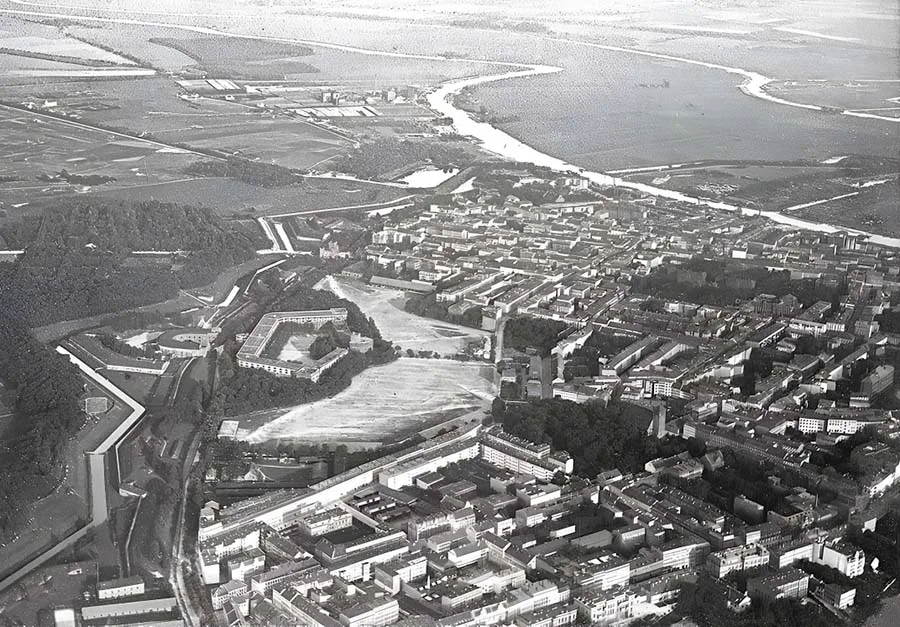 A bird's-eye view of Neue Sorge.
Music, on the other hand, is another matter: in Königsberg it is welcomed in all its forms. The philosopher Rosenkranz (Johann Karl Friedrich Rosenkranz, 1805–1879) rightly remarks: “In Danzig, it seems to me, visual perception prevails and the art of sculpture dominates. In Königsberg people rely more on the ear.”
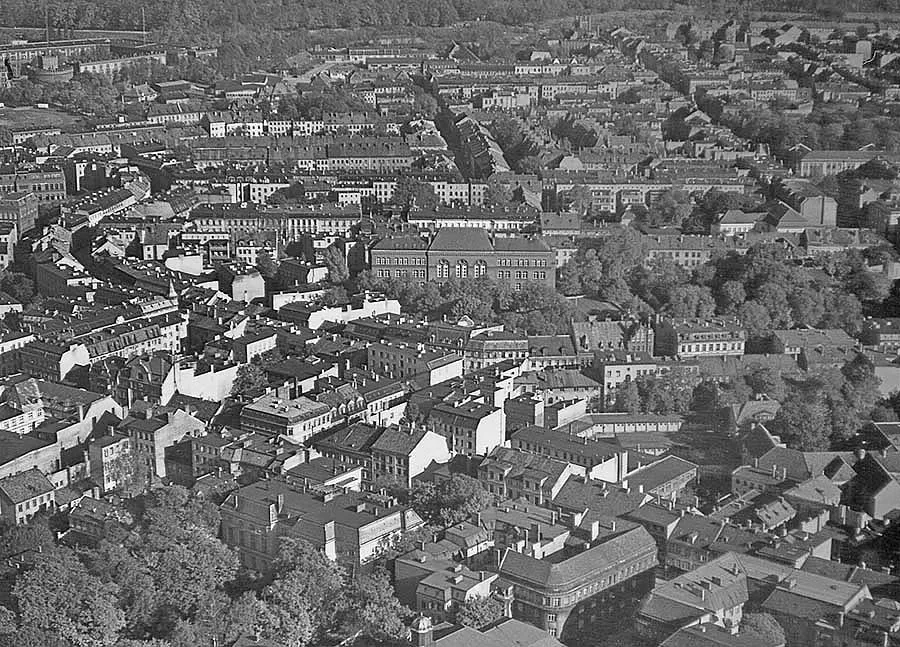 Neue Sorge. In the centre, the royal school Friedrichs-Kollegium. Top left, the Kronprinz barracks.
Our Academy of Arts, opened in 1845, was founded by the Oberpräsident of East Prussia von Schön (Heinrich Theodor von Schön, 1773–1856) and the famous history painter Karl Rosenfelder (Karl Ludwig Rosenfelder, 1813–1881), who became its first director. Under Rosenfelder's leadership outstanding masters worked and taught here, such as Piotrowski (Maximilian Anton Piotrowski, 1813–1875), Trossin (Robert Trossin, 1820–1896), Behrendsen (August Behrendsen, 1819–1886), Gemmel (Hermann Gemmel, 1813–1868) and, somewhat later, Steffeck (Karl Steffeck, 1818–1890), the present landscape painter Max Schmidt (Max Schmidt, 1818–1901), and the already mentioned painters Heydeck (Johannes Heydeck, 1835–1910), Neide (Emil Adolph Neide, 1843–1908), Knorr (Georg David Salomon Knorr, 1844–1916) and the sculptor Reusch (Johann Friedrich Reusch, 1843–1906).
The building, fairly simple in itself, was erected on the site of an unprepossessing hunting lodge that stood hidden in the shade of clipped lime trees and was demolished in 1838. Outwardly the Academy closely resembles the Royal University Library (Königliche Universitätsbibliothek), which stands a little further along the street. It houses the university's collection of plaster casts of statues of Greek gods. The Academy building is adorned with a Latin inscription:
ARTIUM OPERIBUS CONDENDIS. ARTIFICIBUS INSTITUENDIS.
In translation: “Works of art that are to be created. Artists who are to be trained.”
Originally the ground floor of the Academy's main building was used by the Trade School (Gewerbeschule) and the first floor by the Provincial Art School (Provinzial-Kunstschule), now the Royal Provincial School of Art and Crafts (Königliche Provinzial-Kunst- und Gewerkschule). It was founded in 1790 by the city's Oberpräsident von Hippel (Theodor Gottlieb von Hippel, 1741–1796); engravers, chasers and craftsmen were taught drawing and modelling here. The Trade School (Gewerbeschule), officially called the Royal Building Trades School (Königliche Baugewerkschule), was founded in 1821 to improve students' knowledge of mathematics, chemistry and physics. At first it was housed in the castle. Both institutions moved into the new building on King Street in 1843, but in 1845 they had to make way for the Royal Academy of Arts.
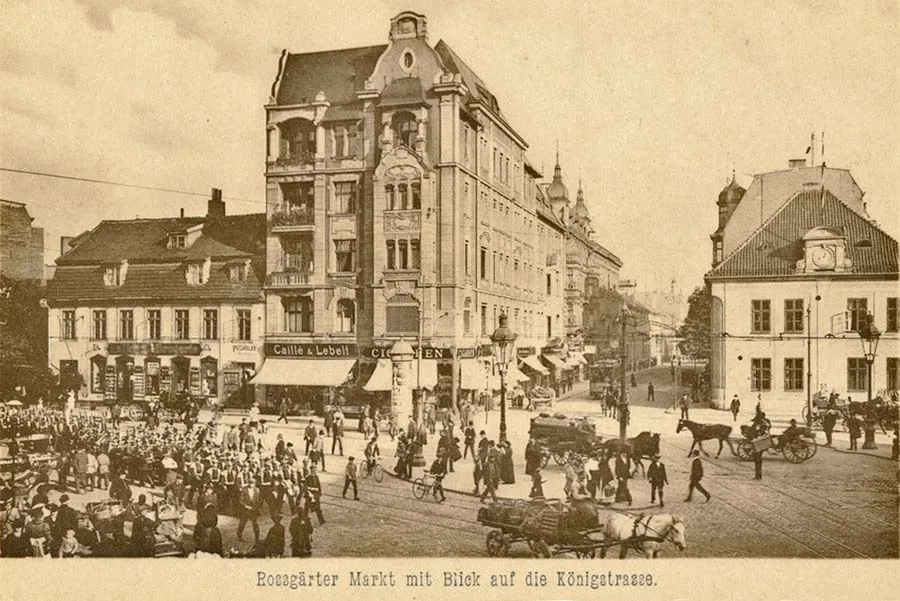 The beginning of King Street. View from the Rossgarten Market.
On 15 October 1895 the Royal Academy celebrated its 50th anniversary. It had opened on 1 September 1845 with only three classes. Since then the Academy has had 700 graduates, among them many gifted and active men of art. At present an average of 40 students graduate each year.
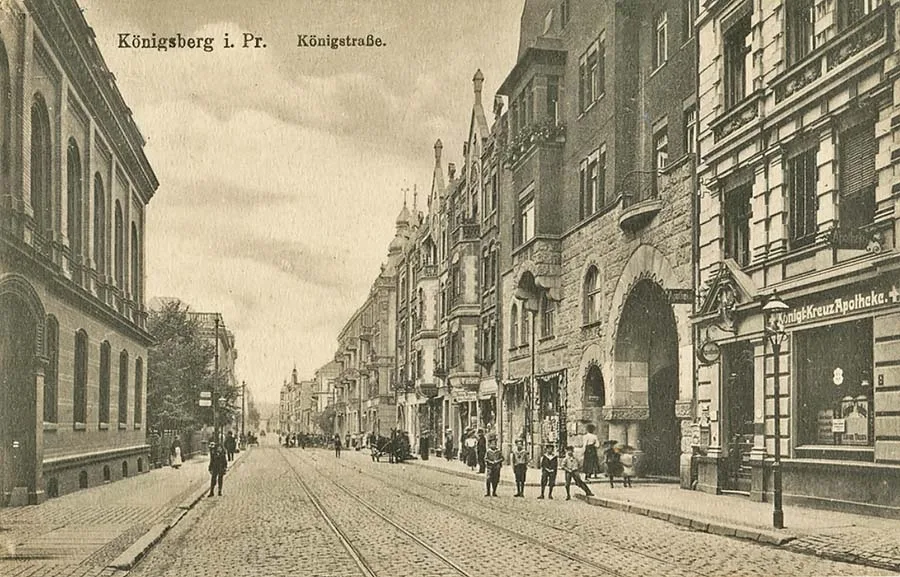
King Street. View towards the Academy of Arts and the Rossgarten Market.
The Academy admits students without preliminary training or any special knowledge. In the first year they learn drawing in the copying class from original models, and in the plaster class they draw from life copies of ancient and modern sculptures. The next course is painting from life, followed by easel painting. In addition, there are etching and engraving workshops, as well as a sculpture workshop. Lectures are given on perspective and the construction of shadows, anatomy and art history. Six artists and three scholars teach at the Academy. It has a very rich library and collections of copperplate engravings and drawings. All this ensures a high standard of teaching.
The second floor of the Academy building temporarily houses the City Picture Gallery (Städtische Gemäldegalerie). Its collection had been formed by 1833, partly from works donated by well-known artists and partly from works purchased specially for it. A special role was played here by the Art Society (Kunstverein), founded together with the Trades Society (Gewerbeverein) in 1832. But in 1845 the Art Society became independent and began to collect paintings exclusively. It handed over 110 works to the city for perpetual use in exhibitions, retaining the function of keeping them.
The collection was enlarged by gifts from the royal museums (57 paintings), the Hippel collection (51 paintings), the collection of Privy Councillor Minuth of Berlin (46 paintings) and others. At the end of 1894 the gallery had 297 paintings.
Among them are magnificent works of art, especially of the most recent period. However, many have not yet been put on display for lack of space. The idea has now arisen of constructing a new museum building to bring together all the fine painting in Königsberg under one roof and at last give the local public the chance to enjoy the fine arts.
For this purpose the city has already acquired a very suitable plot of land at King Street 40–42, and generous donations from Privy Commercial Councillor Moritz Simon, Commercial Councillor Robert Simon (Dr. Robert Simon), the wife of Dr. Möller (Möllerschen) and First Lieutenant Grape have formed a good fund for building the museum.
(Judged by today's street layout, the Academy of Arts building stood on the corner of Frunze Street and 9 Aprelya Street, opposite the Dom Byta. It has not survived. In 1919 the Academy of Arts moved to a new building on what is now Basseynaya Street, today the building of School No. 21, after which the building on King Street was occupied by the School of Arts and Crafts. — Editor's note.)
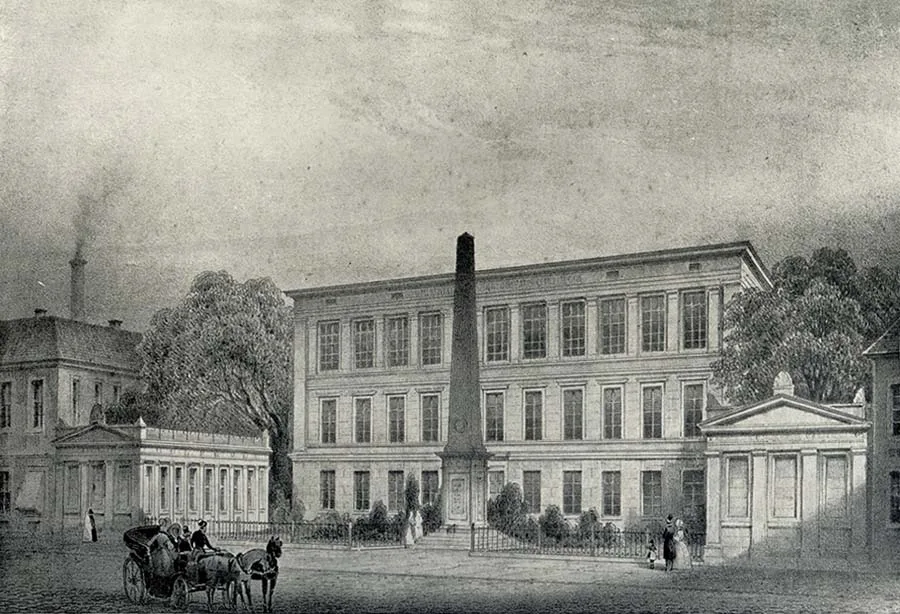
The Academy of Arts on King Street.
In the small front garden of the Royal Academy of Arts stands a tall iron obelisk. It is a monument erected by the people of Königsberg in 1843 as a mark of respect and gratitude to Theodor von Schön, the departing Oberpräsident of Prussia. One of the most important periods in Prussian history is closely linked with this man's name.
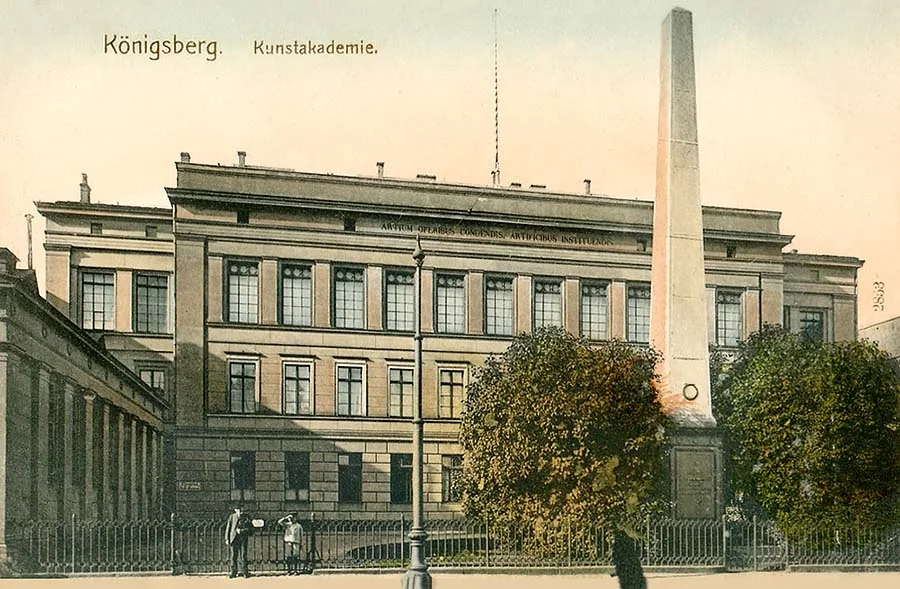
The Academy of Arts and, in front of it, the monument to Theodor von Schön, demolished by the Nazis in the 1930s.
(The obelisk was demolished during Nazi rule. — Editor's note.)
Theodor von Schön was born on 20 January 1773 in the hamlet of Schreitlaugken (now the Lithuanian village of Šereitlaukis on Mount Rambynas opposite the town of Neman) in the Prussian part of Lithuania. In 1789 he began his studies in Königsberg and soon became the most diligent pupil of Kant (Immanuel Kant, 1724–1804) and of the prominent political economist and constitutional lawyer Christian Jacob Kraus (1753–1807). After graduating from the university, von Schön travelled widely in Germany, visited England and entered the civil service under a law which stated that the best student was given complete freedom in choosing his place of service. In 1809 he became President of Lithuania, distinguished himself by his excellent administration of his province in that harsh period and became one of the most prominent leaders of the glorious uprising of East Prussia in 1813. In 1816 he became Oberpräsident of West Prussia, and in 1824 of East Prussia as well. The two provinces remained united until 1878.
After Friedrich Wilhelm IV ascended the throne in 1840, Schön was appointed Minister of State. In this capacity he showed himself to be an ardent republican, and in 1842 he published the political pamphlet “Whence and Whither?” (Woher und Wohin?), which cost him his career in the civil service. In the same year the king granted him the title of Burggraf of Marienburg in recognition of his initiatives to restore Marienburg Castle. Surrounded by honours, Theodor von Schön died on 22 July 1856 and was buried on his estate of Arnau near Königsberg (now the settlement of Maryino; the grave was restored around 2000).
Opposite the Academy of Arts stands the French Reformed Church (Französisch-reformierte Kirche). It was built on part of the cemetery of the German Reformed congregation, specially cleared for the purpose. King Friedrich Wilhelm I (1688–1740) gave 12,000 thalers towards its construction. The foundation stone was laid on 16 June 1733, and on 29 July 1736 the church was consecrated in the presence of the king.
This building makes no claim to be called an architectural monument. But after its restoration in the summer of 1894 it acquired a quite attractive appearance. Above the main portal is a Latin inscription in gold letters on black marble:
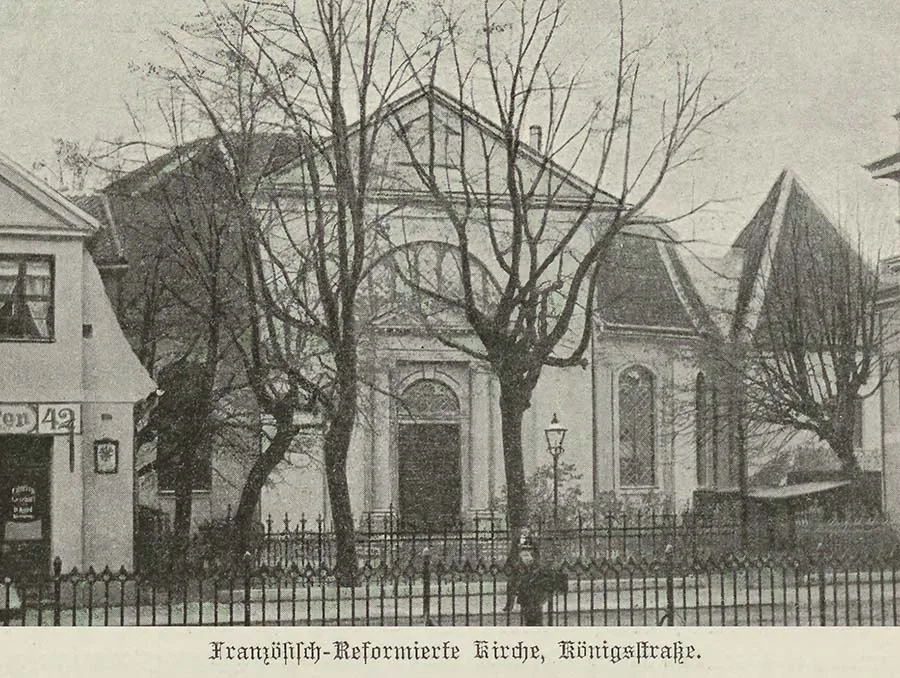 The French Reformed Church.
D. O. M.
Anno MDCCXXXIII
Imperante
Potentissimo Pruss. Rege
Friderico Wilhelmo
Elektore Brandenburgico
Templum Gallis
Ob reformata sacra exulibus
Aedificatum.
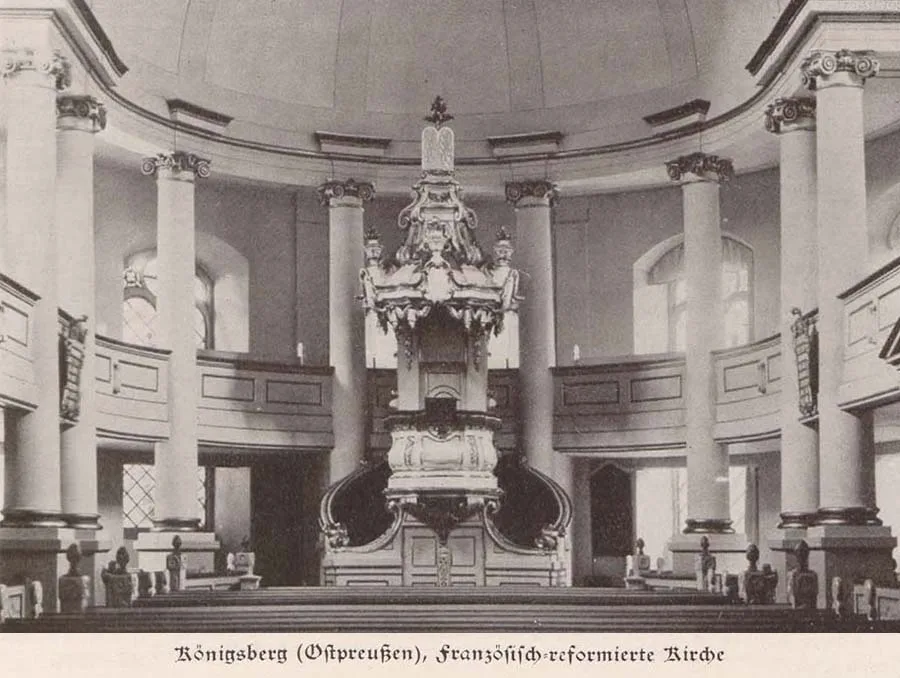 The interior of the French Reformed Church.
In translation: “This temple was built thanks to the grace of King Friedrich Wilhelm of Brandenburg, who graciously received the French driven from their homeland for their faith.”
A clumsy bell tower stands next to the church. It can hardly be called a tower: it is no taller than the building. The first sermon for the French in this church was preached in 1686 by Abraham Boullay du Plessis from the Norman town of Alençon.
Next to the church lies the German Reformed Cemetery (Deutsch-reformierte Friedhof), whose grounds were donated in 1629 by Georg Wilhelm to the congregation of the Burgkirche. The cemetery was closed in December 1891 and then bought by the city in order to build a museum here. This transfer of the cemetery, together with the vacant land, was formalised by a contract valid until 1 April 1896. By that date the unsightly cemetery walls were to be pulled down. Today only the inscription above the gateway arch survives, which is of historical interest:
V. G. G. Louise Charlotte und Hedwig Sophia Geschwister, Markgräfinnen und Churfürstliche Prinzessinnen zu Brandenburg I. P. G. C. B. Herzoginnen.
In translation: “By the grace of God, Luise Charlotte and Hedwig Sophie, sisters, margravines and electoral princesses of Brandenburg, duchesses of Prussia, Jülich, Cleves and Berg.”
Thus the sisters of the Great Elector left their mark: in 1640 they ordered a wall to be built around the land that their father had donated to the Reformed congregation. Of that wall only one column, crowned with cross vaults, has survived. In the cemetery there is a remarkable marble tombstone of the merchant Daniel Zimmermann (Daniel Zimmerman, 1742–1814), adorned with figures of Faith, Hope and Charity by Schadow (Johann Gottfried Schadow, 1764–1850).
(This Reformed cemetery has not survived. It lay on the corner of what are now Frunze, Sergeya Tyulenina and 9 Aprelya streets, on and next to the site of the former Dom Byta. — Editor's note.)
On the corner of Lobeck Street (Lobeckstraße, now Yaroslavskaya Street) stands the Royal Library (Königliche Bibliothek), separated from the street by a small front garden. The building was originally called the “King's House” (Königliche Haus) and was built in 1731 for Friedrich Wilhelm I. Later Frederick the Great (Friedrich der Große, 1712–1786) founded a Military School (École militaire) here, and in 1810 the building was handed over to the Royal Library, which had previously been housed in the castle and was called the Castle Library (Schloßbibliothek). In the early 1820s it was merged with the university library (Universitetsbibliothek).
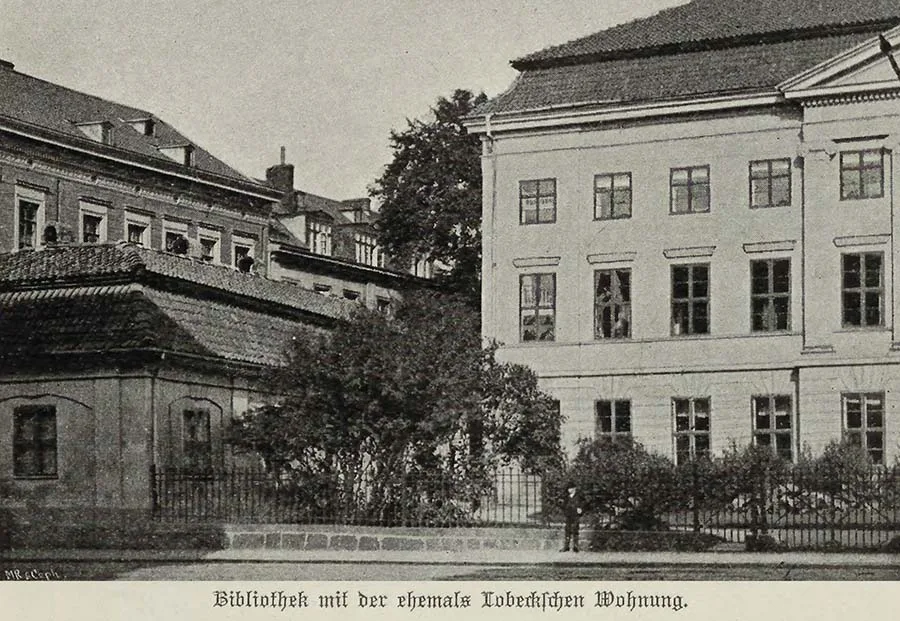 The library and the house where the great philologist Christian Lobeck once lived.
The library, which now holds 300,000 volumes, was founded by Duke Albrecht (Albrecht von Brandenburg-Ansbach, 1490–1568). In 1525 he began to collect a “German” library for his own use; 68 printed books in Latin and Greek acquired in 1529 laid the foundation of the “Latin” library.
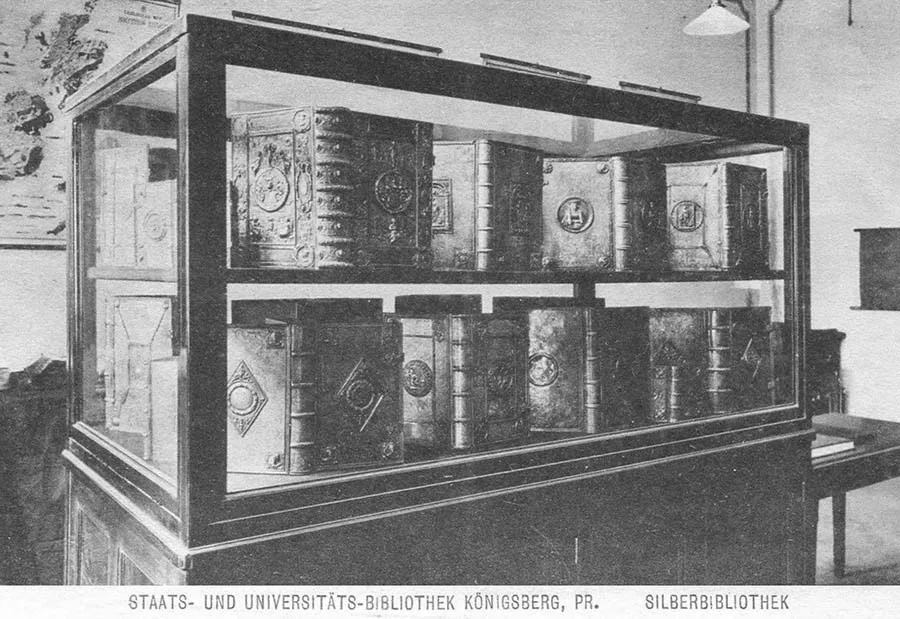 The Silver Library against a map of Great Britain.
The first librarian was Felix König, a Protestant reformer and refugee from Holland, nicknamed Polyphemus. In 1540 the library was opened to the public. It was replenished with books from the collections of monasteries and of the convent of the Teutonic Order, and from the private libraries of such scholars as Speratus, Aurifaber and others. Every year three to four thousand books are added to the library.
A special place is held by the Silver Library (Silberbibliothek). It comprises 20 volumes, of which 14 are in folio, 4 in quarto and 2 in octavo (in Folio, in Quart, in Oktav — the names of book sizes)*. The books are ecclesiastical and devotional in content. Some have skilful silver mounts on their covers; others, such as the Gospels translated by Osiander, are entirely clad in silver.
Most of the Silver Library belonged not to the duke but to his second wife Anna Maria (Anna Maria von Braunschweig, 1532–1568), who loved luxury and splendour. On 20 August 1611 the Silver Library became part of the collection of treasures gathered in the castle.
In 1757 it was taken to Küstrin (now the Polish border town of Kostrzyn nad Odrą) to save it from the Russians, and during the Napoleonic Wars to Memel (now the Lithuanian port city of Klaipėda) so that it would not fall to the French. Seventeen volumes of this library are the work of Königsberg goldsmiths, three the work of famous masters from Nuremberg. These works of art allow us to speak with confidence of the high level of the goldsmith's craft in Königsberg at that time.
The ever-growing demands placed on libraries have made the building on King Street clearly unsuitable for this purpose. The city now has to build a new one, probably in Tragheim.
(The library building has not survived, and its collection was indeed moved to the University Library in 1901. As for the Silver Library, after the war of 1941–1945 it turned up in the castle museum of the Polish city of Olsztyn. — Editor's note.)
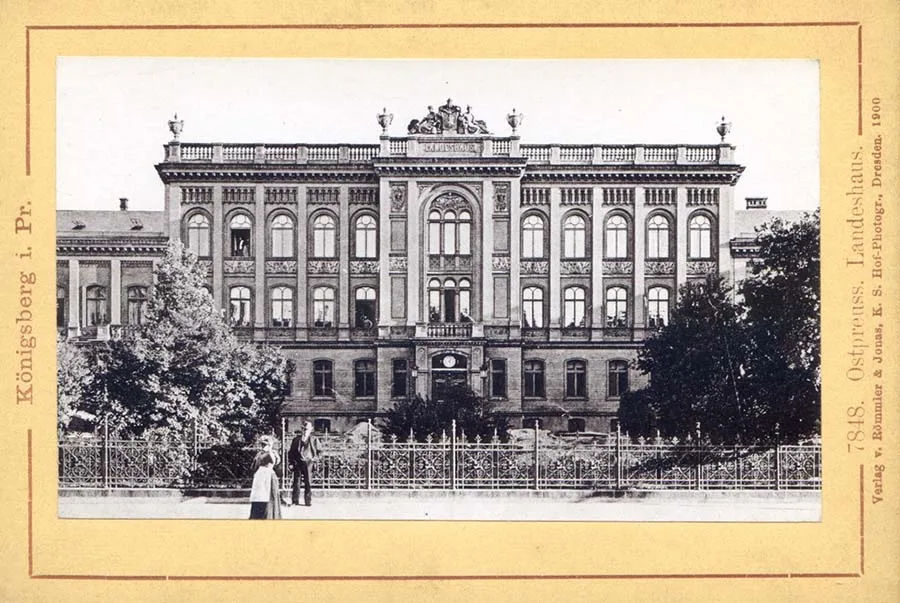
The Parliament of East Prussia at the end of the 19th century.
The parliament building of the Province of East Prussia (Landeshaus) is far more imposing than the other public buildings on King Street mentioned above. It was built for the provincial administration (Provinzialverwaltung) and originally consisted only of the central section, being considerably smaller than it is now.
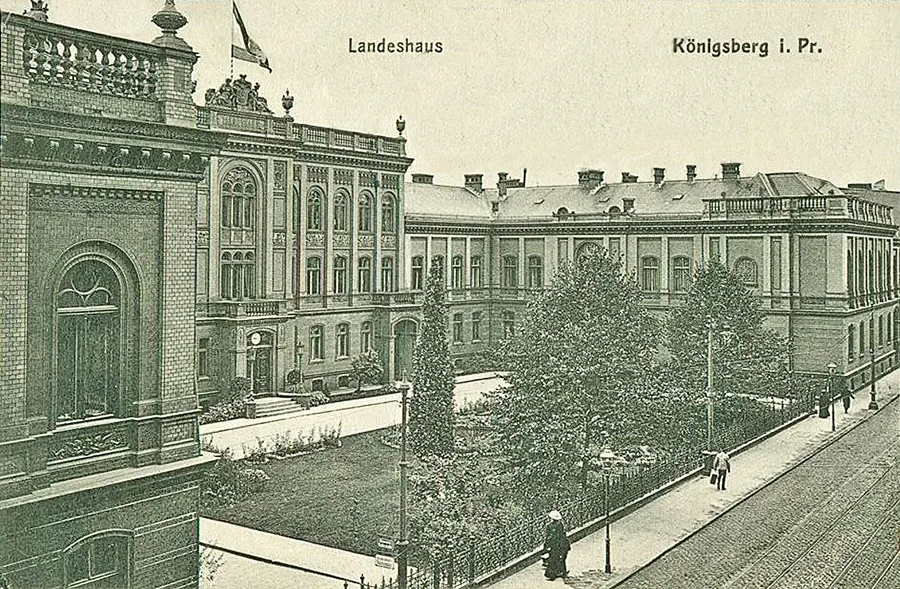 The Parliament of East Prussia at the beginning of the 20th century.
Later it was decided to add two wings to it. The western wing, completed in 1893, is for the official residence of the head of the parliament (Landeshauptmann). The eastern one is still under construction.
In the elegantly and sparingly decorated assembly hall of the parliament, attention is drawn to Brausewetter's painting “York's Address to the Prussian Estates on 5 February 1813” (“Yorks Anrede an die preußischen Stände am 5. Februar 1813”, Otto Brausewetter, 1835–1904). This historic moment marks the beginning of Prussia's struggle against French domination. The momentous assembly took place in the former Estates House (Ständehaus) on Landhofmeister Street (now Sergeya Tyulenina Street), which now houses the Credit Bank.
(The building in which General York delivered his fiery appeal has not survived; it stood almost opposite the “Strazh Baltiki” printing house. — Editor's note.)
On the same side of the street, next to the parliament and nearer to the King's Gate, there used to be the town residence of the Counts of Dohna (Dohna). This residence, together with its large garden, is now military property.
Opposite stood another aristocratic residence, belonging to the von Kunheim family, of particular interest because of its kinship with Martin Luther.
(The fact is that one of the members of the Kunheim family, Georg von Kunheim (1550–1611), married Margarethe Luther (1534–1570), daughter of the church reformer Martin Luther, in 1555. — Editor's note.)
Next to the former Dohna property is the Intendantur building. This is a military administrative supply office responsible for providing the troops with pay, provisions, hospital care, quarters and clothing. Each army corps has a provincial Intendantur.
The section of King Street from Steep Lane (Steile Gasse, now Grieg Street) to the King's Gate was once called the Upper Fire Site (Oberste Brandstätte). The first gate in the rampart was built here after 1765, and until 1811 it was called the Gumbinnen Gate (Gumbinner Thor). In those days King Street, too, was called Gumbinnen Street (Gumbinnerstraße).
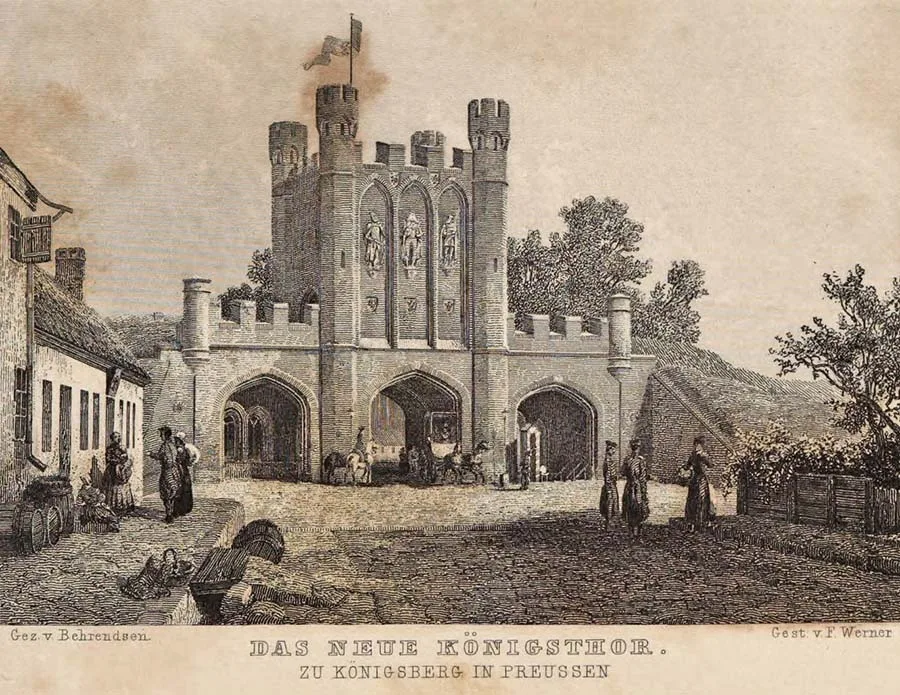 The new King's Gate.
The present King's Gate (Königsthor), built in 1850, makes an effective end to King Street, but since in time its capacity became insufficient for the growing flow of traffic, a few years ago the adjoining ramparts were pulled down and a road was built around it on the right and on the left.
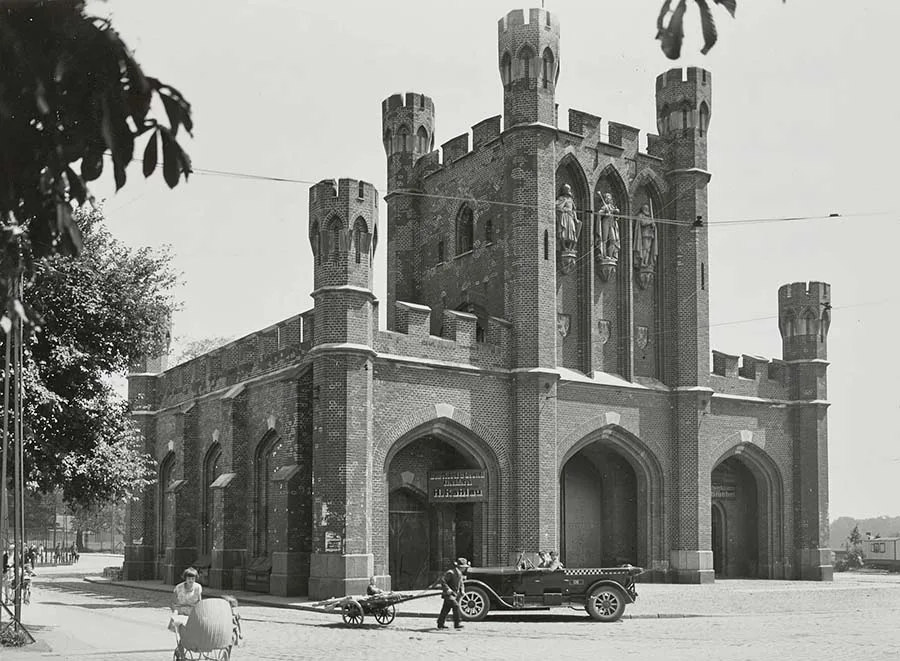 The King's Gate in the 20th century: wheelbarrow VS taxi.
The statues adorning the gate on the inner side depict the founder of Königsberg, the Bohemian King Ottokar (Přemysl Otakar II), the first Duke Albrecht and the first Prussian King Friedrich I (Friedrich I, 1657–1713). They were made by the Berlin sculptor Stürmer (Ludwig Wilhelm Stürmer, 1812–1885). Next to the full-length statues of the local rulers are the coats of arms of Samland and Natangen (Samland, Natangen — the ancient lands on which Königsberg stands).
During the construction of the new King's Gate and the adjoining fortifications, part of the old Löbenicht cemetery had to be demolished.
Of the streets running north from King Street, that is, towards Rear Rossgarten (Hinter Roßgarten), one should first mention Augusta Street (Augustastraße), which leads from the King's Gate. It was laid out only in the early 1790s and named after the wife of Emperor Wilhelm I (Wilhelm I / Wilhelm Friedrich Ludwig von Preußen, 1797–1888).
The next street, Wilhelm Street (Wilhelmstraße), also leads to the Duke's Field (Herzogsacker). Rippen Street (Rippenstraße) and Lobeck Street (Lobeckstraße) run parallel to each other to Kalthof Street.
The name of Rippen Street (Rippen — rib) is explained by the fact that a whale rib eight ells long was supposedly attached to the house of the weaver Valerius Gessler, who lived on it. Lobeck Street (formerly Spoon Lane — Löffelgasse) is named after one of the most important philologists of our university, Christian August Lobeck (1781–1860). He was born on 5 June 1781 in Naumburg. In 1814 he came to Königsberg as a professor. Enjoying well-deserved respect, he worked here, among other things as chief librarian, until his death on 25 August 1860.
Hunting Lodge Street (Jägerhofstraße) connects King Street with Front Rossgarten (Vorder Roßgarten). It takes its name from the Great Hunting Lodge (Großen Jägerhofe) that once stood here. Today it is a modern street with attractive new buildings.
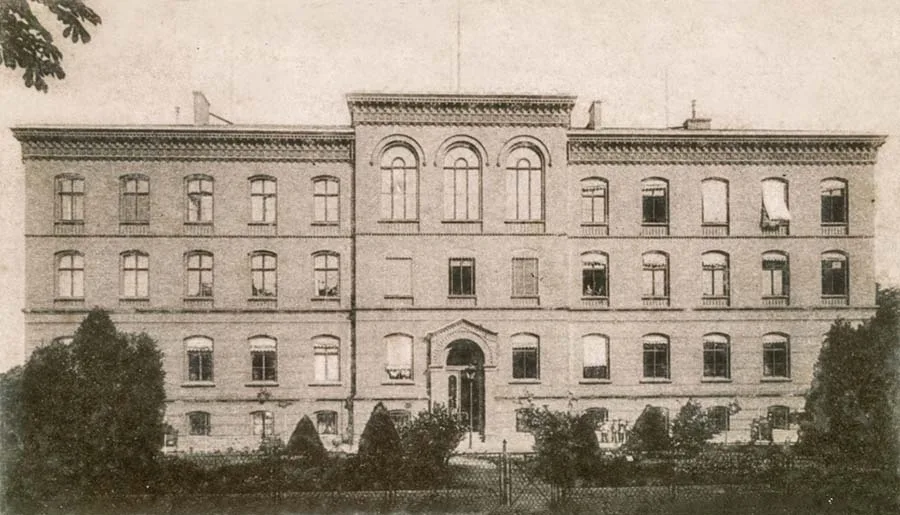 The dreary façade of the Friedrichs-Kollegium.
On Hunting Lodge Street stands the Friedrichs-Kollegium gymnasium. Its building was constructed in 1890–1892. Its exterior is extremely plain. The interior, however, fully meets the most modern requirements. The assembly hall (Aula), with a magnificent organ, is adorned with busts of Kant and Herder (see below).
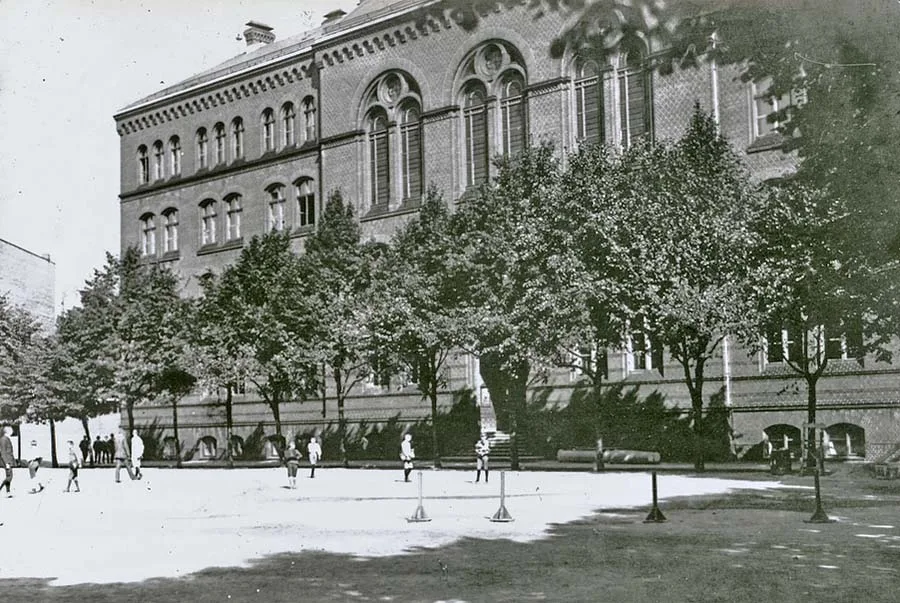
The courtyard of the Friedrichs-Kollegium.
The large inner courtyard facing the street is surrounded by new buildings, erected in 1895, which contain the official apartments of the school's management.
This gymnasium was founded on 11 August 1698 as a small private school by the royal councillor for forestry affairs Theodor Gehr (1663–1707). By a royal rescript of 4 March 1701 it was proclaimed a Royal School (Königlichen Schule). In 1703 the school was moved from Sackheim to a house near the Cross Gate (Kreuzthor) in the Burgfreiheit, bought from Obermarschall von Creytzen (Georg Friedrich von Creytzen, 1639–1710). The school came to be called the Landhofmeister's Hall (Landhofmeisters Saal), but as early as 10 May 1703 it received the name Collegium Fridericianum (Kollegium Fridericianum, that is, Friedrichs-Kollegium).
In the following years the building was rebuilt several times; a wooden tower was erected on its roof, serving as an observatory, the first in Königsberg. A small chapel was added in 1703 and was used until 1853.
The Friedrichs-Kollegium consisted of a Latin school, a German school and a boarding house. The Latin school trained teachers of Latin. The German school, which until 1810 was also attended by girls, trained merchants and craftsmen.
In 1790 a teachers' seminary was founded here, which trained teachers for the higher schools and was connected with those schools. Eight schools for the poor were built in all parts of the city between 1732 and 1738. Today [1895] there are 25 such schools in Königsberg.
In 1749 Frederick the Great placed the Kollegium, together with the schools for the poor, under the administration of the State Ministry. From 4 September 1810 this educational institution was called a gymnasium. The old building was demolished in 1853 and a new one erected in its place, which was consecrated on 17 October 1855. A gymnasium hall for the school was opened in 1876 at York Street 30. (Now 1812 Goda Street; the gym hall stood on the south-western corner of today's Grieg and 1812 Goda streets, and nothing remains of it. — Editor's note.)
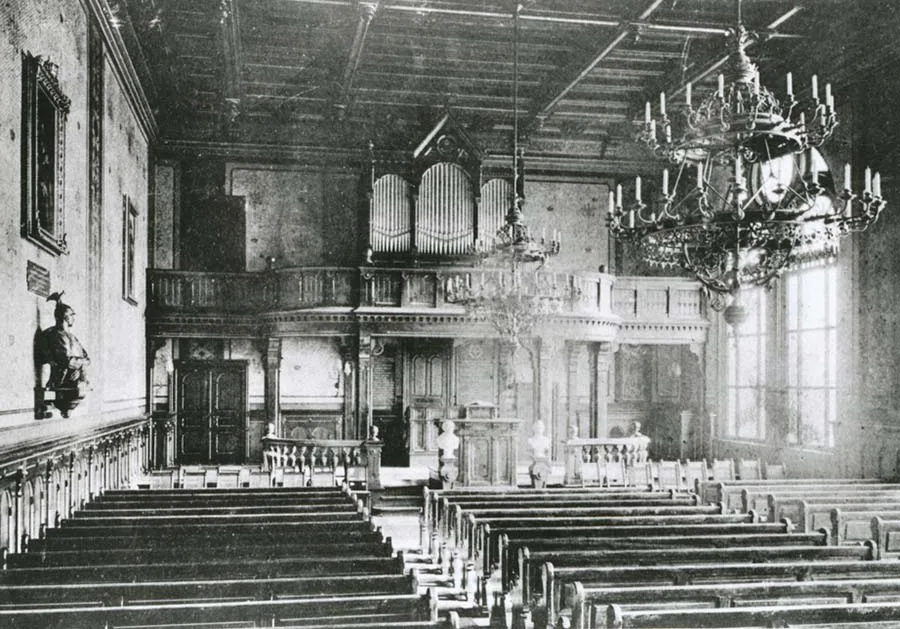 The Aula of the Friedrichs-Kollegium.
On 1 October 1892 the gymnasium, with its Easter and Michaelmas courses, was transferred to the new building at Hunting Lodge Street 9. The most famous teacher of the Friedrichs-Kollegium was Gottfried Herder, and its most brilliant pupil was Immanuel Kant.
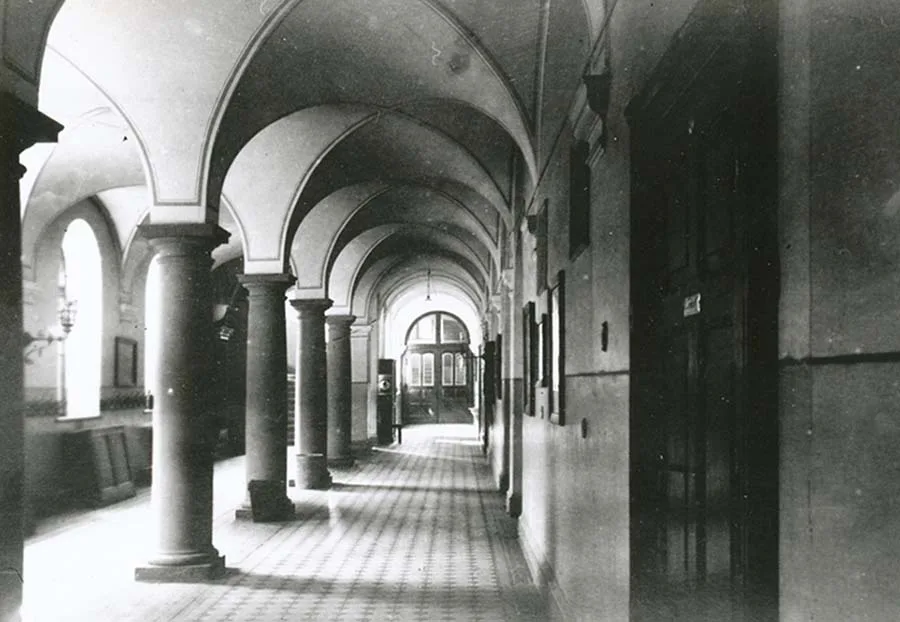 A corridor inside the Friedrichs-Kollegium.
Johann Gottfried Herder (1744–1803) was born on 25 August 1744 in Mohrungen (near Allenstein). He was the son of an elementary school teacher. In 1762 he came to Königsberg to study medicine, but soon changed his plans and began to study theology.
Immanuel Kant had a great influence on the students, and Kant himself was greatly influenced by the philosopher Hamann (Johann Georg Hamann, 1730–1788). Johann Gottfried Herder became the heir to Hamann's ideas and taught at the Friedrichs-Kollegium for only one school year (1763–64), after which he left Königsberg and never returned.
In 1776 Herder became court preacher in Bückeburg, then general superintendent in Weimar. Together with Wieland, Schiller and Goethe, Herder became one of the great devotees who laid down their lives on the altar of German literature. His services in popularising the folk song deserve special emphasis. (He compiled the collection “Songs of the Peoples of the World”.) Herder died on 18 December 1803.
(The authors of the book attached no particular importance to the fact that Herder's move from Mohrungen to Königsberg came about with the kindly help of a Russian army doctor, J. C. Schwarz-Erla, who helped Herder settle in Königsberg and enter the university. — Editor's note.)
The next street worth noting runs to the north of King Street and parallel to it. It bears the name of Friedrich (Friedrichstraße) and connects Rippen, Wilhelm and Augusta streets, as well as the perpendicular Herbart Street.
(Modern names: Friedrich Street is Tomskaya Street, Rippen Street is Grazhdanskaya Street, Wilhelm Street is part of Pionerskaya Street, and Herbart Street is a passage west of the School No. 24 building. — Editor's note.)
Herbart Street is named after the celebrated philosopher Johann Friedrich Herbart, who held Kant's chair in 1809–1833.
His successor from 1833 to 1879 was the well-known professor Rosenkranz, who became known to the general public through his Königsberg sketches.
To the south of King Street run Landhofmeister Street (now Sergeya Tyulenina Street), Brick Street (Ziegelstraße, which has essentially kept its name), Princes' Street (Prinzenstraße, part of Lazaretnaya Street) and Steep Lane (Steile Gasse, now part of Grieg Street). Here the ground slopes down fairly steeply towards Sackheim. Most of the streets mentioned above appeared relatively recently.
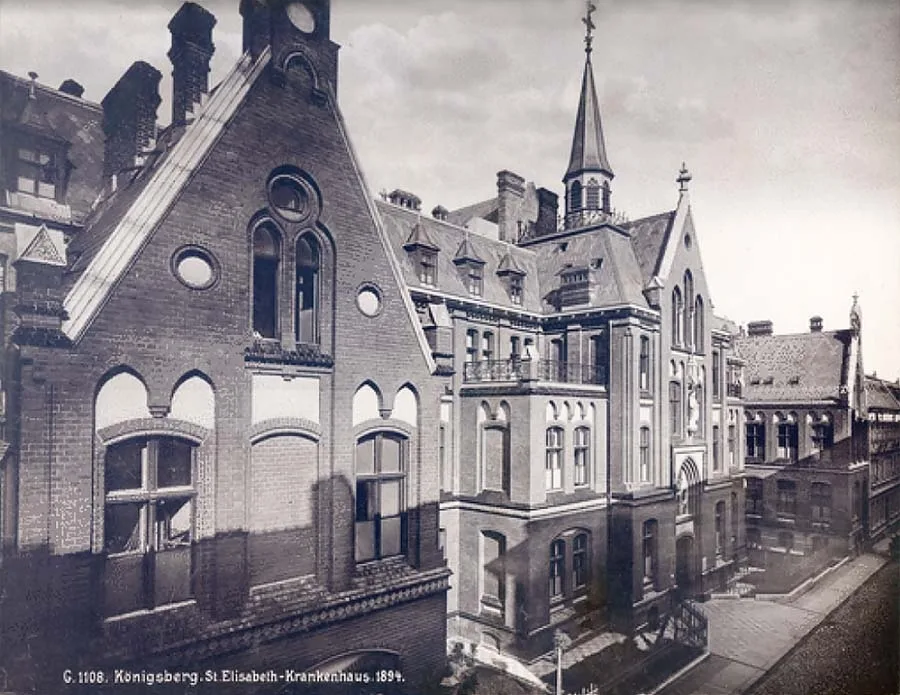 The façade of St. Elisabeth Hospital.
On Brick Street stands the Catholic St. Elisabeth Hospital (Elisabeth-Krankenhaus). In 1864 the “Grey Sisters” (Graue Schwestern) began their charitable work in Königsberg. At first the Grey Sisters only saw outpatients, but in 1890 they converted an old residential house into a hospital.
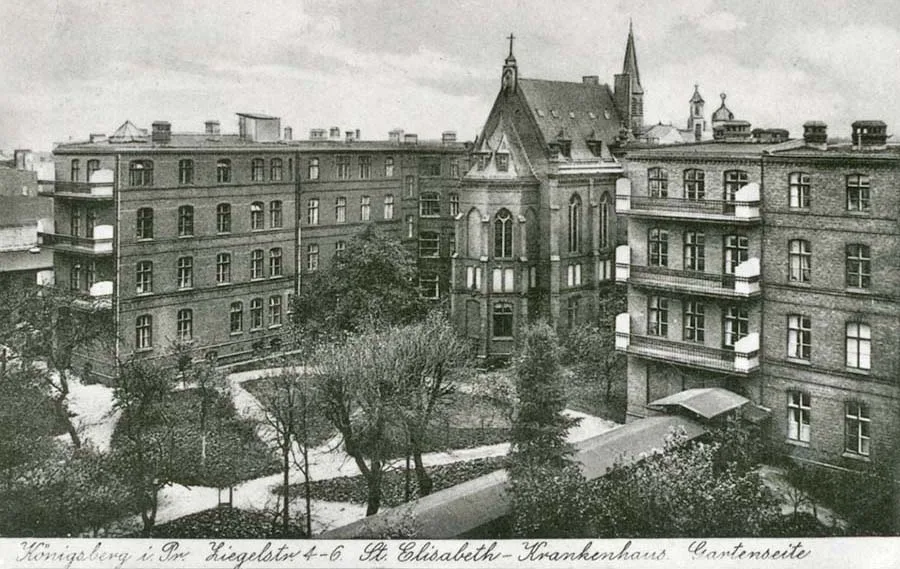 View from the courtyard of St. Elisabeth Hospital.
Construction of the handsome new hospital building began in April 1893, and on 3 January 1894 it already admitted its first patients. The hospital has 140 beds for patients treated in four departments in three different classes. Treatment is paid for, with prices varying according to the patients' means. Whereas at first there were only three sisters, there are now 32. Six doctors work at the hospital. In all, by 15 December 1894, 853 patients (477 men and 376 women) of all denominations and nationalities had been admitted. Associated with the hospital is an outpatient clinic (polyclinic), which received 1,384 patients in 1894. Medical care, dressings and medicines are free of charge here. Since 1 January 1895 a subscription for paid home care has been available.
Only one house separates the Protestant City Mission House (Evangelische Stadtmissionshaus) from St. Elisabeth Hospital. It too is a new building, but a more modest one. The missionaries here regard countering pagan beliefs as one of their tasks. They strive to correct the spiritual sins of modern society, to purify church rites and to bring stray Christians back into the fold of the church. In addition, the mission maintains homes and hospitals for the poor and a rescue service for orphaned children; it founds youth associations and temperance associations (Enthaltsamkeitsverein — Society of Strict Morals) and supports people who have fallen into various difficult situations in life.
Friedmann Street (Friedmannstraße), which until the end of 1892 was called Third Rampart Lane (dritte Wallgasse), crossed Steep Lane and ran eastwards, parallel to King Street, from the Garrison Hospital (Garnison Lazarett) to the Lithuanian Rampart (Litthauer Wallstraße).
On it stands the House of the Friedmann Society (Friedmannsche Vereinshaus), in whose honour it was renamed. The house is home to the Women's Society (weiblicher Verein) of ladies wishing to help the sick and the poor. Help is given in people's homes. The society is headed by Frau Friedmann, the wife of a city councillor.
(This street, like the House of the Friedmann Society, no longer exists. It ran through the courtyards of today's nine-storey buildings, which stand at some distance along Frunze Street from the fence of the Infectious Diseases Hospital to Litovsky Val. In 1913 the Friedenskirche (Church of Peace) was built on Friedmann Street. It has not survived either. As can be seen from the above, the territory of the Neue Sorge community covered the area along today's Frunze Street from Klinicheskaya Street to Litovsky Val, extending 100–200 metres to the north and south of the former King Street. — Editor's note.)
Archive photos: Bildarchiv Ostpreußen. Modern photos: Mikhail Ogorodnikov.
_______________________
- “Folio”, “quarto” and “octavo” are traditional book sizes that depend on how the printed sheet is folded. Folio, the largest format, is a sheet folded once, producing two leaves and four pages. This format is also known as “in-folio”. Quarto, the medium format, is a sheet folded twice: four leaves and eight pages. The term “quarto” comes from the Latin for “fourth”. Octavo is a sheet folded three times: eight leaves and sixteen pages. The term “octavo” comes from the Latin for “eighth”.
Translated from Russian with the help of AI (Claude, Anthropic), October 2026.