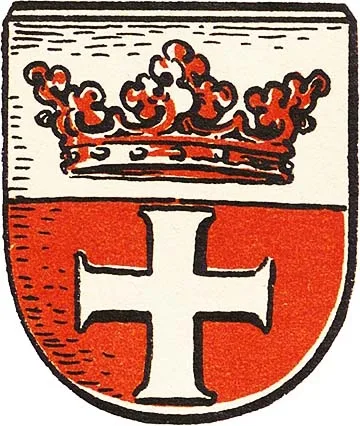
Coat of arms
of Altstadt
Help for the Sambian rebels arrived from Natangia. In 1262 the insurgents burned the early settlement on the Steindamm, north-west of the castle. Königsberg Castle itself, although at that time a simple fortress of timber and earth, proved too tough a nut for the Prussians, who lacked the skills to storm fortifications of this kind. The Prussians blockaded the castle and tried to starve it out. But after three years of siege they had achieved nothing, and in 1265 they were forced to end hostilities at Königsberg. Two years earlier the bishop, who apparently had little faith in Königsberg's staying power or in the value of the land beneath its walls, had exchanged his estates near the castle for safer territories near Kulm Castle / Kulm (Chełmno, Poland). It was on these former episcopal lands that the new settlement was founded.
After the uprising was crushed, it was decided to rebuild Königsberg Castle itself in stone, somewhat to the west of its former site. Along the southern wall of the new Königsberg Castle lay the "lischke" – a settlement that had yet to become a town.
Some of the settlers were former inhabitants of the Steindamm, those who had managed to survive the siege and the hardships that came with it. But evidently few such people were left, so the Order instructed the locator Gerko von Dobrin to attract settlers from Germany to Königsberg. People willing to move to distant Prussia were found in Lübeck, Lower Saxony and Westphalia. In addition, the first settlers included families from Pomerania, the lands along the Elbe and the west of Prussia.
From a 13th-century point of view, the future Altstadt was founded on a very favourable site: its long northern side was shielded from enemy attack by the walls of Königsberg Castle. Under the agreement with the Order, there were to be no town fortifications here, so that the townspeople would not be tempted to quarrel with the Teutonic Knights, trusting in the strength of their town walls. The second long side, the southern one, had a natural barrier in the form of the river and needed no particularly strong walls. All that remained was to build walls and towers on the western and eastern sides, and the town fortifications were complete. At the same time the river was a waterway and a sledge road by which one could reach the Baltic and, beyond it, Europe, as well as Nadrovia and, beyond it, Lithuania.
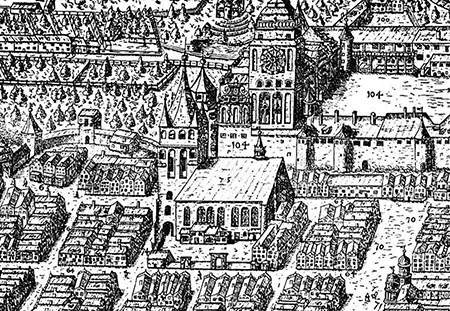
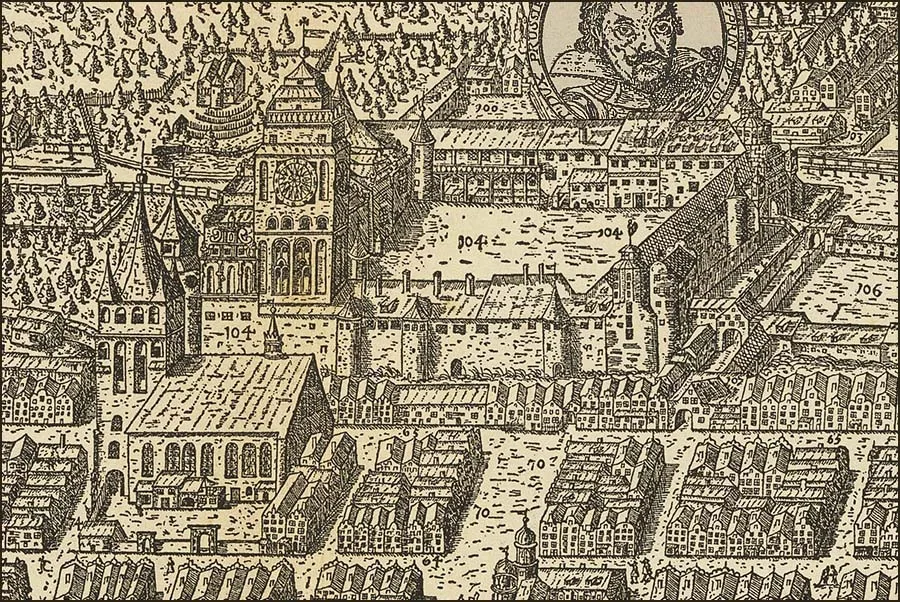 The old Altstadt Church and the castle on Bering's plan (1613).
Unlike the burned, haphazard settlement on the Steindamm, the new town was planned according to all the town-planning rules of the time. First of all, the area was drained and protected by a dyke against storm-surge water.
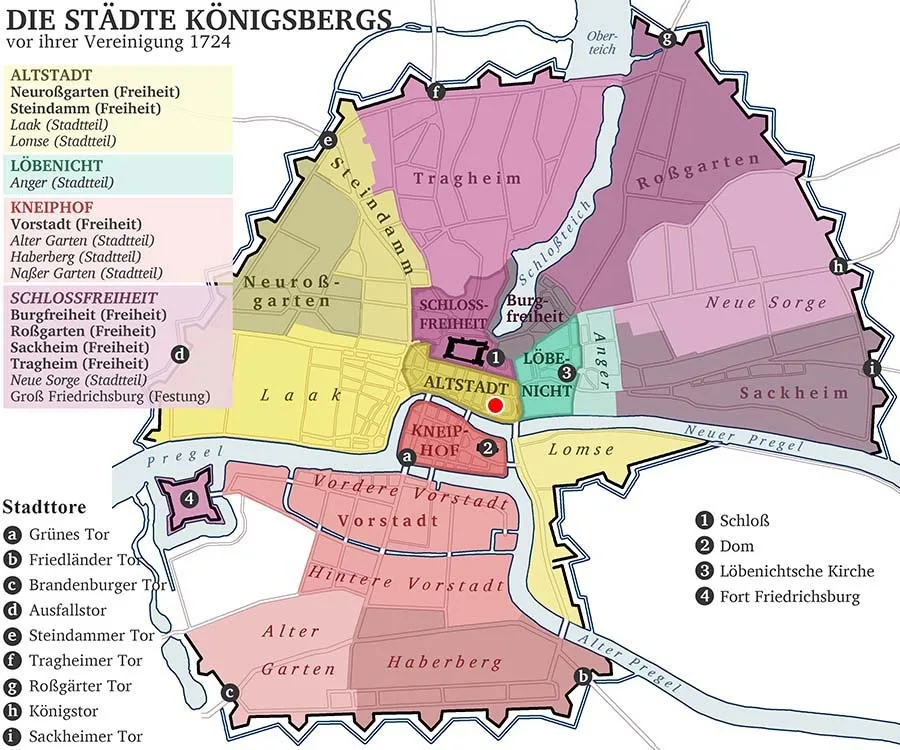
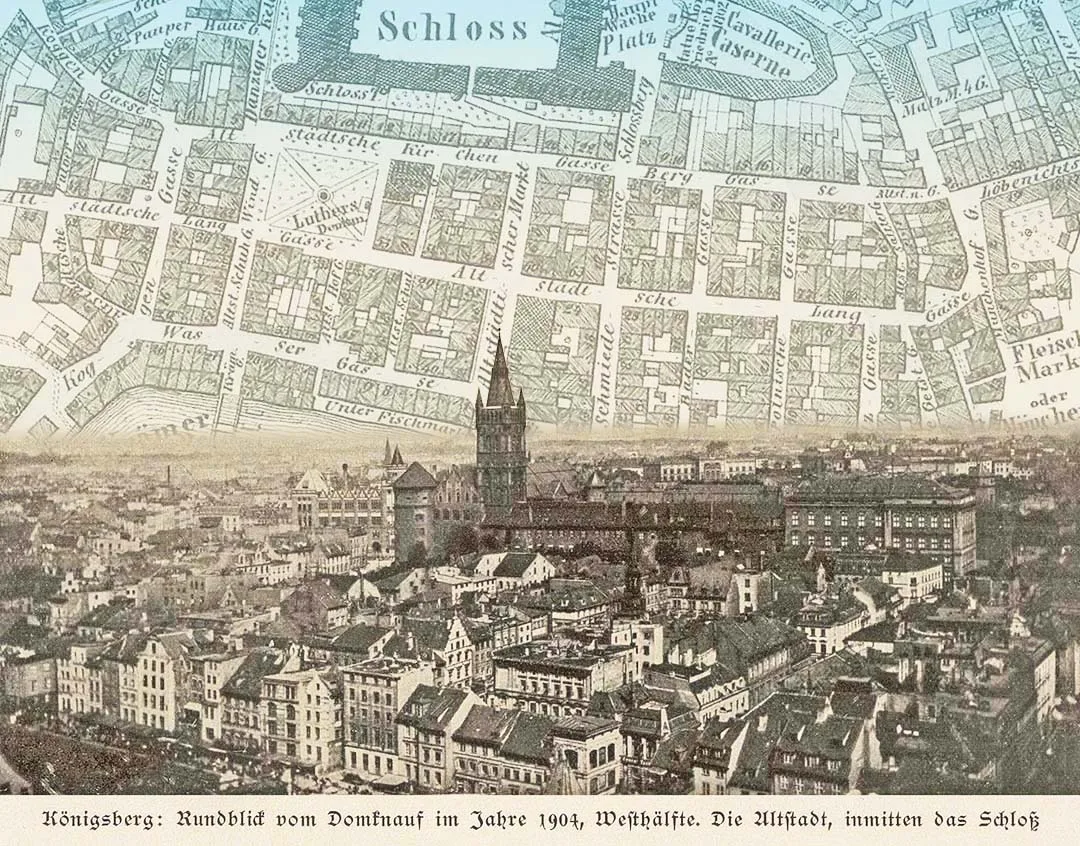
Altstadt on a reconstructed map of the towns, liberties and districts of Königsberg before their unification in 1724.
The main longitudinal street was laid out – the Altstadt Long Street (Altstädtische Langgasse). The street parallel to it along the river was named Water Lane (Wassergasse), and another parallel street on the slope of the Königsberg hill came to be called Mountain Street (Bergstraße). The remaining streets ran perpendicular to these three, so that the town was cut into rectangular blocks. In addition, two squares were formed: the Market Square (Marktplatz) and the Church Square (Kirchenplatz). The town hall was soon built on the Market Square, and on the Church Square the foundation stone of the new Church of St Nicholas was laid in 1264. The town wall had three gates. In the west the Stone Gate (Stein-Tor) opened onto the Steindamm causeway; the gate facing the road towards Neuhausen (Guryevsk) would a little later be called the Löbenicht Gate (Löbenichtsches-Tor); the third gate, the Shop Gate (Krämer-Tor), led south to the Pregel. A little later the Shop Bridge (Krämer-Brücke) would be built beyond the gate, named after the market stalls built near it and on it. The bridge belonged to Altstadt itself, but the stalls and the right to trade in them belonged directly to the Order.
Speaking of names, one should remember that Altstadt did not become Altstadt straight away. We can speak with more or less confidence about the names of the early 14th century. The oldest surviving seal of Altstadt (1360) bears the inscription S SIVITAS DE CONINXBERGHE, which simply cannot be read as anything other than "the town of Königsberg".
And the central figure of the seal is none other than the King of Bohemia, Ottokar II Přemysl (1233–78), in whose honour (according to the main theory) Königsberg was named. And no Altstadts at all. Firstly, in the Order, as a clerical organisation, the language of official state documents was Latin. Secondly, to be called Altstadt, that is, the "old town", a settlement has to exist for a certain time. It was the same with the town gates – the Löbenicht Gate acquired that name once the name of the neighbouring town to the east had become established as Löbenicht, rather than the original Nova civitas – the New Town (Neustadt). The Stone Gate (Stein-Tor) likewise got its name when it was rebuilt in stone, and by all appearances it was the first of Altstadt's gates to become a stone one. The Shop Gate is also mentioned as the Koggen-Tor or the Gate of St George / St. Georg-Tor. As for Altstadt as a place name, the most likely scenario seems to be that after Löbenicht appeared as a town (1300), people constantly had to specify which of the towns they meant, and so, when speaking of the first of the Pregel towns, they called it the "old town" (Altstadt). This is why here too, in using the word "Altstadt", we indicate that in the early period we are speaking precisely of the town of Königsberg, which over time came to be officially called Altstadt.
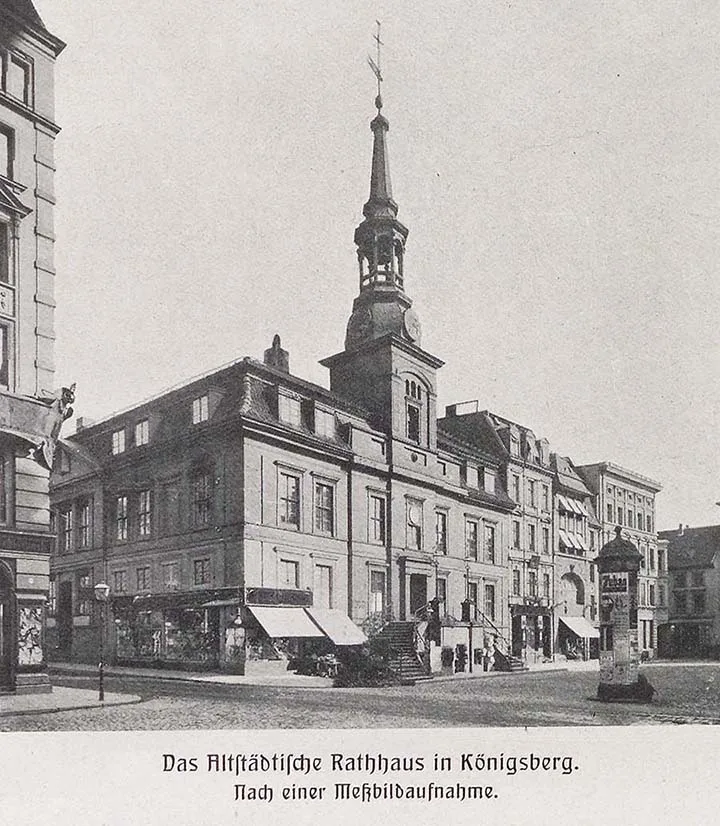
Altstadt Town Hall was the architectural focal point of the Market Square...
In 1286 Altstadt received its town charter. The importance of the event is underlined by the fact that on 26 February, in Königsberg Castle, the charter granting town rights on the model of the town of Kulm was handed over by the Landmeister Conrad von Tirberg (1230–88), the highest official of the Order in Prussia (until 1309 the residence of the Grand Master of the Order himself was in Venice).
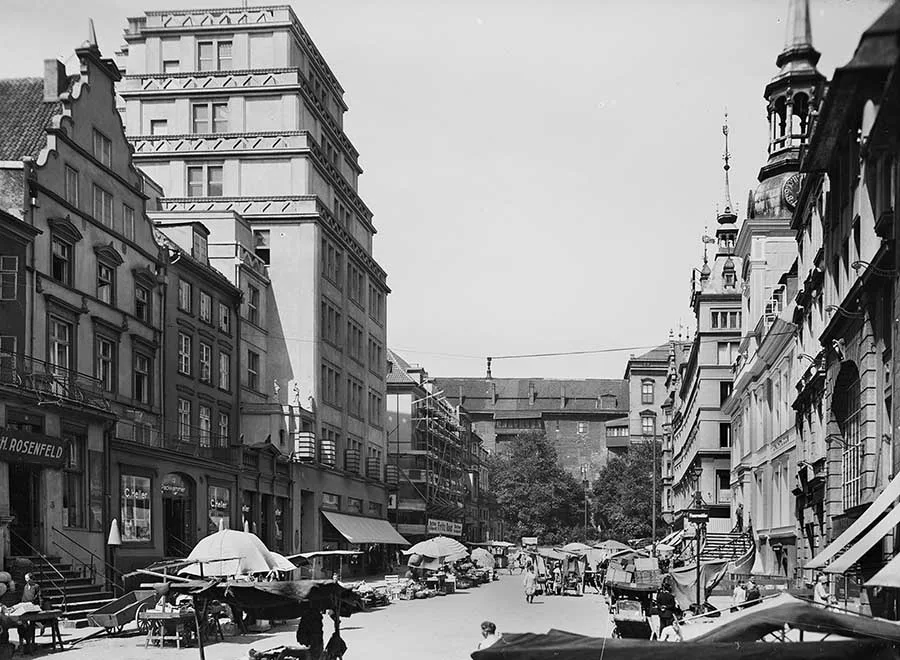 ...until the Kiewe department store (Kaufhaus Kiewe & Co, left) was built opposite it.
In accordance with this charter and the town law, a burgomaster and a town council were elected in Altstadt and a court was formed. It must be said that, in all likelihood, by the time it received its town rights Altstadt had already been built up – that is, all the plots intended for residential housing were occupied and further construction was simply impossible. This, however, was a perfectly normal situation for medieval towns.
The whole of town life was built on licences, limits, privileges and strict regulation. Besides the number of houses and yards, limits were set on the number of shops, breweries, workshops and so on. Any competition on the market, lowering or raising of prices, increase in labour productivity, in the length of the working day or in the number of workers, or streamlining of production through cheaper labour, technology or materials was considered an unconditional evil, and those who violated this orderly system were regarded as criminals. Under these conditions, craft products were extremely expensive in relation to foodstuffs.
Orders from the authorities of the Order were especially valued: they made it possible to produce goods beyond the quotas for local consumption. Proximity to the Komtur's castle and to the residence of the Order's Marshal (from 1309) created additional opportunities for such orders.
Moreover, in feudal society personal connections were always valued, since they made it possible to obtain new privileges and patents from the authorities, which in turn led to further growth of wealth and authority. This is why a saying eventually arose that "in Altstadt there is power, in Kneiphof – money, and in Löbenicht – fields"; this saying very aptly ranked the three towns in hierarchical order.
In the first period the town fortifications were a simple wooden palisade with equally wooden gates and watchtowers. Only in 1333–70 was the wooden wall gradually replaced with a solid stone one. Its construction resembled the defensive walls of the Teutonic castles: fieldstone was used for the base, and the upper part was of brick. The wall had loopholes, and a wooden defensive gallery was built on top of it. This allowed the soldiers to move safely along the wall, and the part of the gallery that overhung the wall, with loopholes in its floor, made it possible to strike the enemy right beneath the walls. The wall was up to two metres thick and nine metres high.
In 1286 the Krämer-Brücke (Shop Bridge) was built, leading from Altstadt to the island of Kneiphof. When construction of the Cathedral began on the island in 1330, another bridge was built – the Cathedral Bridge (Dom-Brücke). It was destroyed in 1379, but in the same year the Smiths' Bridge (Schmiede-Brücke) was built in its place.
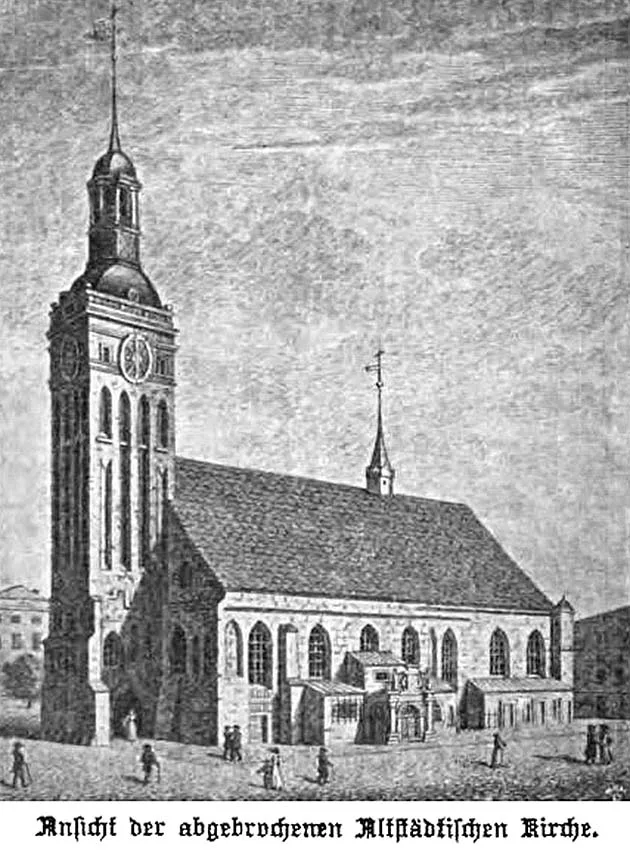
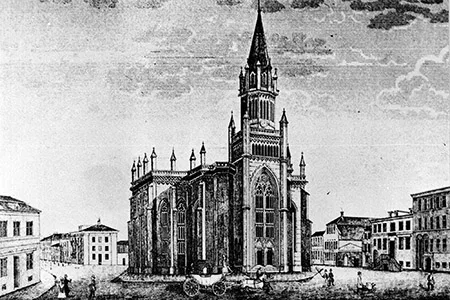
The old Altstadt Church.
After Altstadt built yet another bridge in 1404 – the Wood Bridge (Holz-Brücke) to the island of Lomse (Oktyabrsky Island) – the town acquired a monopoly on the passage of people and goods into Kneiphof (and on to Natangia) and onto Lomse.
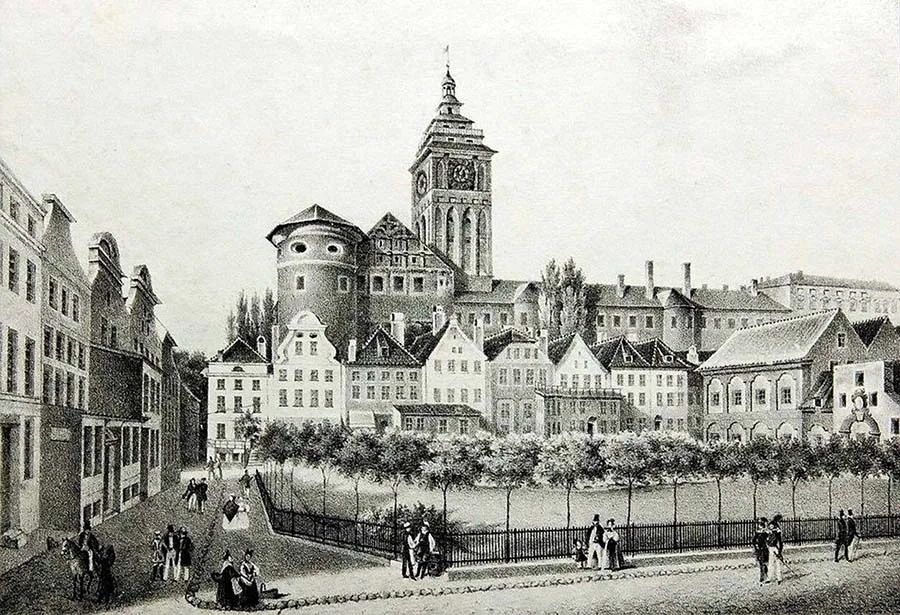 The square on the site of the demolished old Altstadt Church was popularly called the "Square of the Apostates".
And traffic by land in the other direction, from Kneiphof to Samland and Nadrovia, likewise passed exclusively over the Altstadt bridges. The tolls collected for passage substantially filled Altstadt's treasury, and the ability to restrict passage was an excellent trump card in negotiations with Kneiphof.
Even while Altstadt was receiving its town rights, it was set the condition that the townspeople should leave undeveloped a plot of land that would be handed over to the cathedral chapter for the construction of a cathedral. One should not confuse the square for the town church (Kirchenplatz), which lay in the north-west, where much later the Kaiser-Wilhelm-Platz / Keiser-Wilhelm-Platz would be laid out, with the south-eastern area set aside for the cathedral. This cathedral was built of wood in about 1297–1302 under Bishop Siegfried von Reinstein (d. 1318).
On the cathedral grounds a school was opened, which also received the name Cathedral School (Domschule), as well as a hospital with a name quite common in Germany, Zum Heiligen Geist, which translates as "To the Holy Spirit". The cathedral in Altstadt did not exist for long.
As we know, in 1327 it was decided to rebuild it in stone and in another place – on the island of Kneiphof. Construction began about three years later (it was certainly under way in 1333). By 1351 the cathedral was so far advanced that the chapter gave up its territories and buildings in Altstadt, except for the Hospital of the Holy Spirit. The cathedral school was also moved to the new cathedral. The people of Altstadt then decided to set up their own church school in the town, but met with the expected resistance from the church leadership in the persons of the Bishop of Samland and the cathedral chapter. The clergy of that era considered town schools potential sources of heresy, and the Bishop of Samland did not want to lose his monopoly on education either. In 1337 Bishop Johannes Clare even issued a decree forbidding the opening of schools at town churches. But the inhabitants of Altstadt got their way, and the Altstadt parish school is mentioned as early as 1376. The compromise was a complicated procedure for appointing the teacher, the Schulmeister. He was appointed by the cathedral chapter, examined by a commission of the Altstadt magistracy, and confirmed in office by the Order's authorities in the castle.
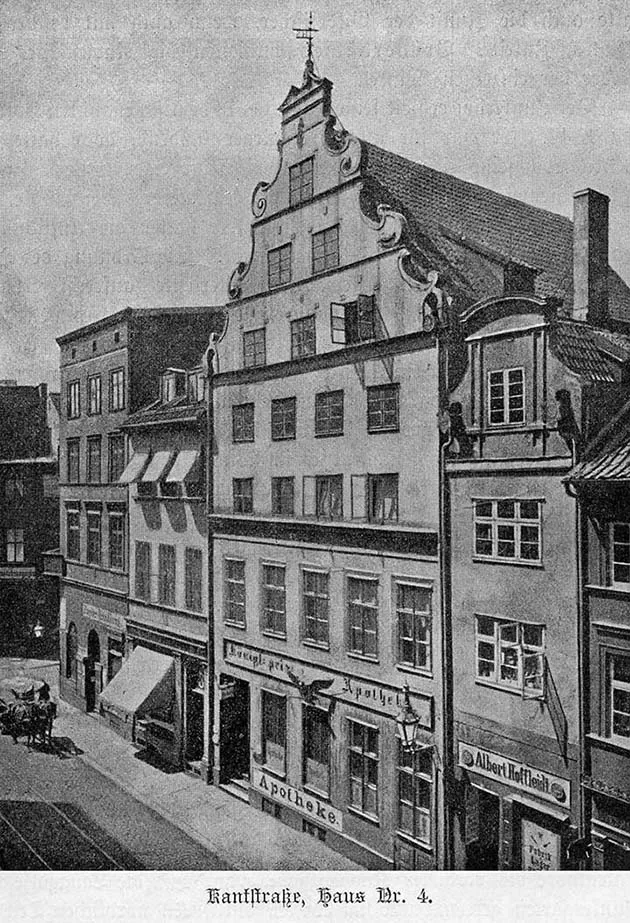
Pharmacy on Kantstraße.
In 1339 Altstadt joined the Hanseatic League (a political and economic union of the towns of Northern and Western Europe). Within this league, in 1367 Altstadt also joined the Confederation of Cologne, whose aim was to counter Denmark's attempts to control traffic between the Baltic and the North Sea.
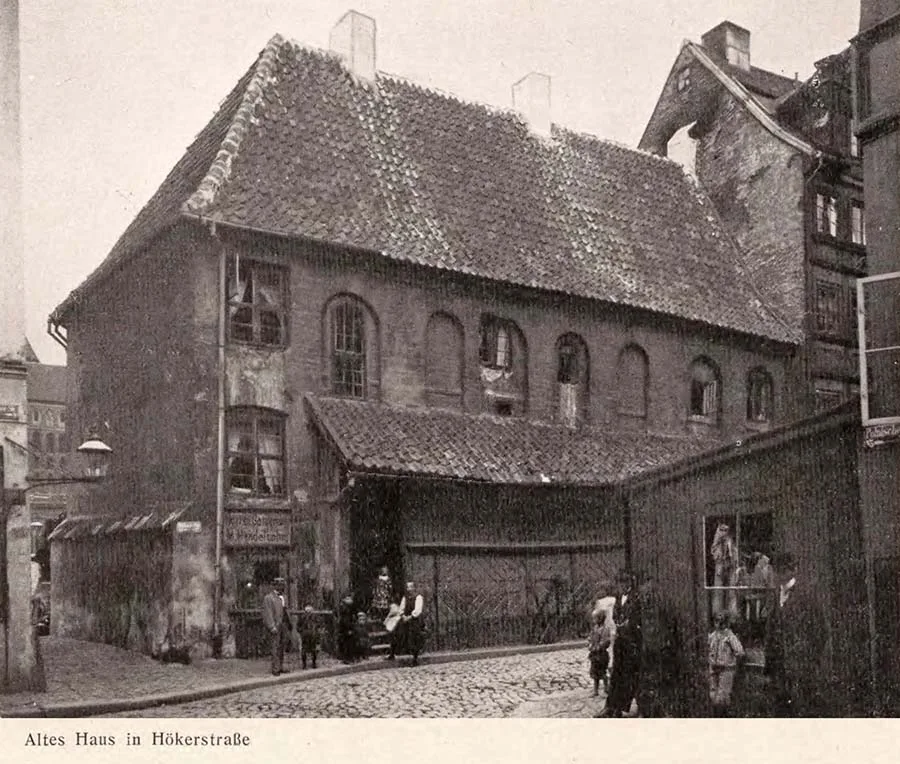 The last medieval house (c. 15th century) at Hökerstraße 10 was demolished as early as 1911.
Having gathered the ships of its member towns into a powerful fleet, the Confederation stepped up hostilities in the Hanseatic–Danish war that had begun back in 1361, and sacked Copenhagen. On 24 May 1370 the Treaty of Stralsund was concluded, after which the Hanseatic League not only became the leading power in the region but also gained a right of veto in the contest between candidates for the Danish throne.
After 1370 Altstadt was allowed to extend its boundaries in the western part of the town. Its territory now extended beyond the southern wall of Königsberg Castle. The old wall with the Stein-Tor had to be demolished, and in its place a new, even stronger one was built, with three gates and five towers. Now the Steindamm Gate (Steindammer-Tor) led from Altstadt into the Steindamm, the Laak Gate (Laaken-Tor) led into the Laak, and the Piper Gate (Pfeifen-Tor) led out to the Altstadt warehouses – the Lastadie.
At the turn of the 14th and 15th centuries, at the height of the State of the Teutonic Order, the life of the average Altstadt citizen differed fundamentally from that of the rural population. Even so, almost all townspeople kept livestock, which was held in the common town herd by hired herdsmen on the town pasture, located in the area called Neuroßgarten. In addition, many townspeople cultivated fields and processed what they grew, using it for their own consumption and for sale.
Many inhabitants held a licence to brew beer, which was brewed once a fortnight; they drank it themselves and sold it to those who had no such licence. Other common trades were the procurement and sale of timber, clay and salt, and the production of charcoal.
But still, most burghers were engaged in crafts as we are used to understanding them – the hand manufacture of non-food consumer goods. Most craftsmen were united in guilds. Only masters of rare and unique professions, such as bell-founders, remained outside these professional communities. The guilds not only protected the interests of their members in general but also made sure that no competition or overproduction arose among craftsmen. The guilds fought particularly zealously against illegal artisans – the so-called "attic hares" – who took away their share of the market. The guild members themselves were forbidden to work on days off and holidays, or after a certain hour on weekdays. Under these conditions the townspeople had free time that had to be filled somehow. And since the religious spirit of the time did little to encourage an entertainment industry, the townspeople's leisure consisted mainly of spending time together in conversation and gambling, mostly at dice. For the town elite – the rich and noble citizens, among whom merchants, guild masters and owners of large breweries predominated – the towns had establishments such as the Junker Courts (Junkerhof) or Junker Gardens (Junkergarten). For simpler townspeople there were the Community Gardens (Gemaindengarten).
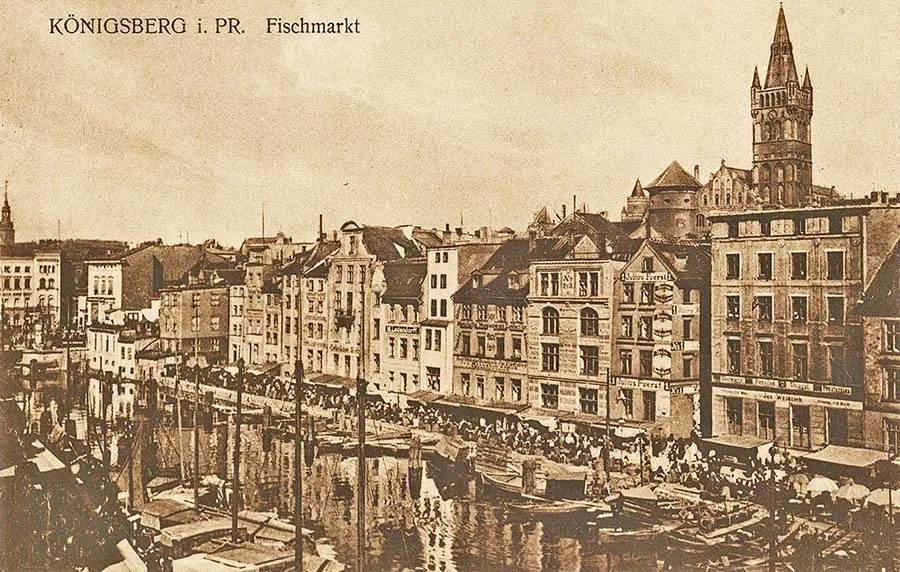 The Altstadt Fish Market outshines the Pregel and the castle.
In the Altstadt Junkerhof on Wassergasse everything was strictly regulated, like all the rest of town life. Each category of visitors was allotted its own permanent area with a large table, separated from the others.
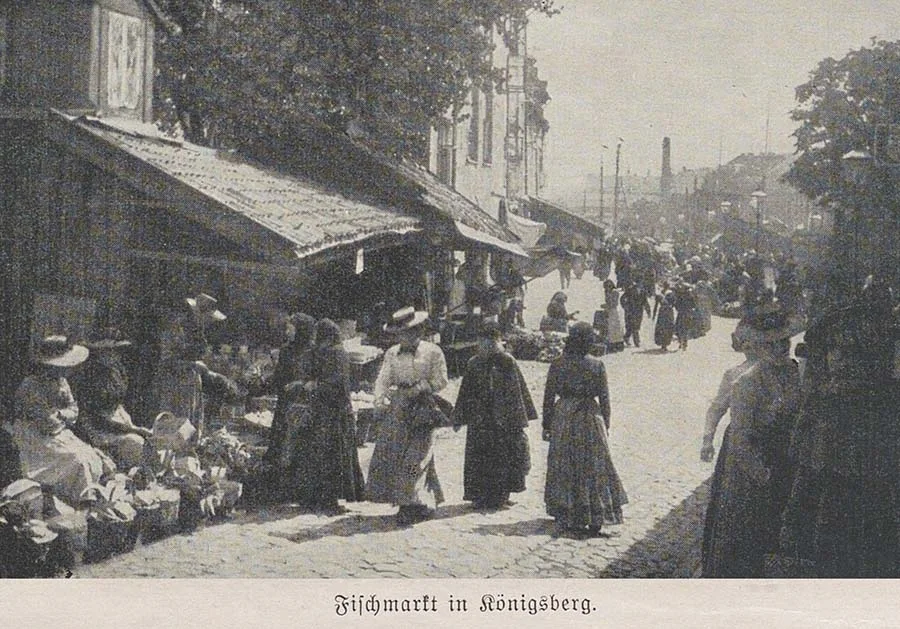 The Fish Market on the bank of the Pregel.
In one corner the representatives of the municipality gathered, in another the members of the court. The merchants and brewers had a corner of their own, and yet another was reserved exclusively for the brothers of the Order. The pastimes of these respected members of society were brightened by the playing of the town musicians. In the Gemeindegarten everything was similar, but simpler, more democratic, noisier and probably merrier. The Altstadt Gemeindegarten also had a shooting range with targets for archery. The townspeople had to maintain a militia, and under a decree of 1394 every adult burgher was obliged to own a weapon and keep up his skill in handling it. Most often that weapon was the bow. All archers were divided into free and unfree. Of the free archers only a periodic voluntary "passing of the shooting standard" was required – participation in various events that were more like festivals, where shooting at targets for accuracy and speed took place. The unfree archers were paid by the guilds and the municipality. They were obliged to train for a certain period each year and to demonstrate their skill at shooting contests, where prizes awaited the winners. In time the free and unfree archers united in a guild of marksmen. To become a member of the guild as a free archer, a recruit had to serve three years among the unfree archers.
Another form of entertainment for the people of Altstadt was festivals. As a rule, they took the form of popular festivities and were tied to religious holidays.
Thus at Whitsun all the men of Altstadt could try their hand at shooting at wooden birds. Respect and rewards awaited the winners, and the whole event was accompanied by noise and beer. There are known cases when theatrical performances – again on religious themes – were given on the Market Square during festivals, or carnivals were held. Professional festivals organised by the guilds (an example of which is the most famous of them, the Day of the Long Sausage) were extremely irregular. Sometimes they took place several years in a row, followed by a break of years or even decades. But on the whole, town life at the height of the Order was attractive precisely because it was accompanied by vivid events and the periodic coming together of the entire town community, in which every citizen could find his place if he wished. At the same time, to make that place in society more honourable and comfortable, some of the inhabitants hastened not only to develop their professional skills but also to obtain a good education, which almost always raised its holder to a new level in the social hierarchy. And since Königsberg had no university of its own, young people from Altstadt did not hesitate to go and study in Poland (Kraków), Germany (Cologne, Würzburg, Heidelberg) and even Italy (Bologna).
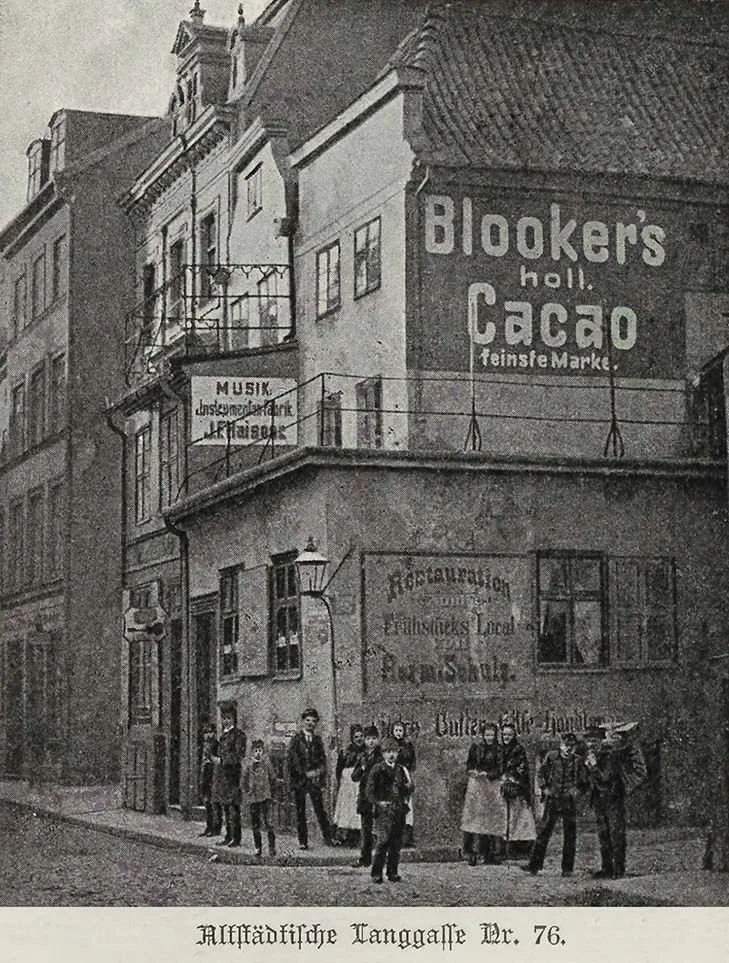
The Altstadt Long Street, house no. 76.
After the Order lost the Great War of 1409–11 to the Polish-Lithuanian coalition, the Order's state was struck by a protracted crisis. It was linked to the enormous reparations imposed by the First Peace of Thorn. The burden of these payments fell first and foremost on the population of Prussia, including the townspeople.
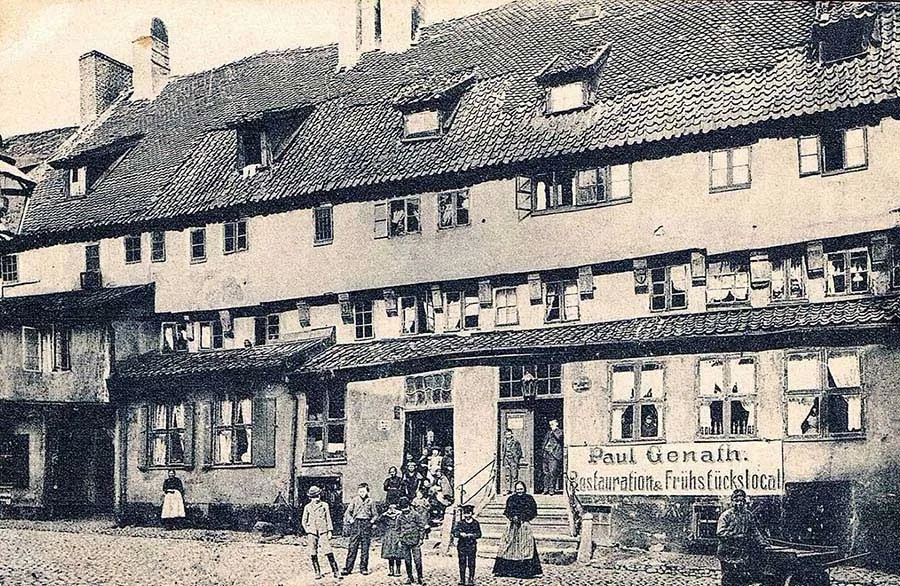 Paul Gehnat's signature restaurant on Holy Spirit Lane (Heiligegeistgasse, 6).
Production and domestic trade fell into decline. Meanwhile, the example of other Hanseatic towns showed that municipalities could have considerably more rights and take part in the work of government. The Estates General had existed in France for more than a century, the free cities of Germany sent their representatives to the Imperial Diet of the Holy Roman Empire, and even in neighbouring Poland-Lithuania there was a Sejm whose lower chamber included representatives of the largest towns. Yet in the State of the Teutonic Order all power continued to belong undividedly to the Order itself. Therefore Altstadt, and together with it Kneiphof, supported the demands of Danzig / Danzig (Gdańsk, Poland) to extend the towns' rights from Kulm status to the status of free cities and to involve the urban patriciate in governing the state. The chief activist from the Königsberg towns was the burgomaster of Altstadt, Andreas Brunau (c. 1400–57). Together with the burgomaster of Kneiphof he took part in the founding of the Prussian Confederation in 1440. Altstadt thus became one of its founding towns. Brunau represented above all the interests of the town's wealthy merchant elite. The other burghers broadly agreed with him as long as the talk was only of new liberties and rights. It must be said that the Order understood the full danger of the opposition league and therefore entered into long negotiations with the municipalities.
The leadership of the Order was prepared to concede a great deal, except for one thing: depriving the Teutonic Order of its exclusive right to political power and turning Prussia into a state with broad participation of the nobility and burghers in public life, on the model of Poland-Lithuania.
And then the members of the Prussian Confederation took a step which by today's standards amounts to outright collaborationism: they offered the Order's main adversary, the King of Poland, to accept them as his subjects. Changing allegiance was not considered anything shameful for townspeople at that time, but in this case it would have meant a considerable territory being torn away from one state in favour of another. The actions of the Prussian Confederation were "condemned by the international community", represented in the region by two powers: the Pope of Rome and the German Emperor. The latter, in particular, declared the very existence of the Prussian Confederation unlawful. The Polish King Casimir IV, on the other hand, warmly welcomed the ideas of the Prussian towns. He issued an edict of incorporation and began to receive oaths of allegiance from representatives of the municipalities. In Königsberg the role of the Polish representative was given to Chancellor Johann von Konecpole (Jan Taszka Koniecpolski, d. 1455), who on 19 June 1454 received the signed oath of the burgomasters of Altstadt, Löbenicht and Kneiphof. After this the armed townspeople attacked the castle, attempting to destroy its southern wall.
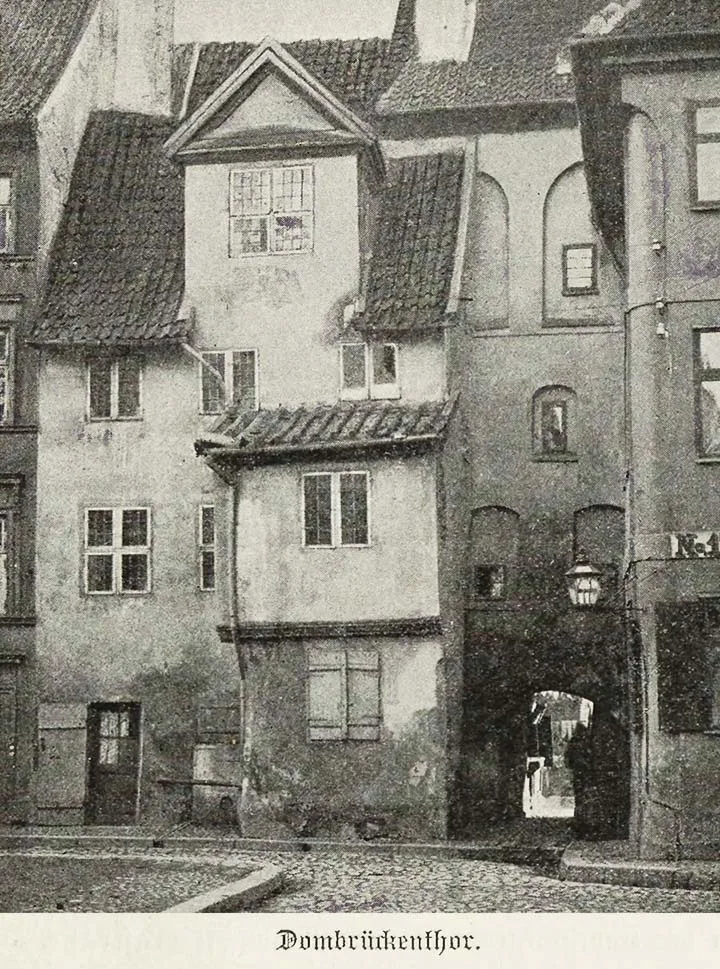
Dombrücken-Tor (Dombrückenthor / Cathedral Gate).
But then, on 24 March 1455, a real coup took place in Altstadt: the guilds, made up of craftsmen, reaffirmed their loyalty to the Order and came out on its side. Burgomaster Brunau was forced to flee. The supporters of the Prussian Confederation from Altstadt had to take refuge in Kneiphof.
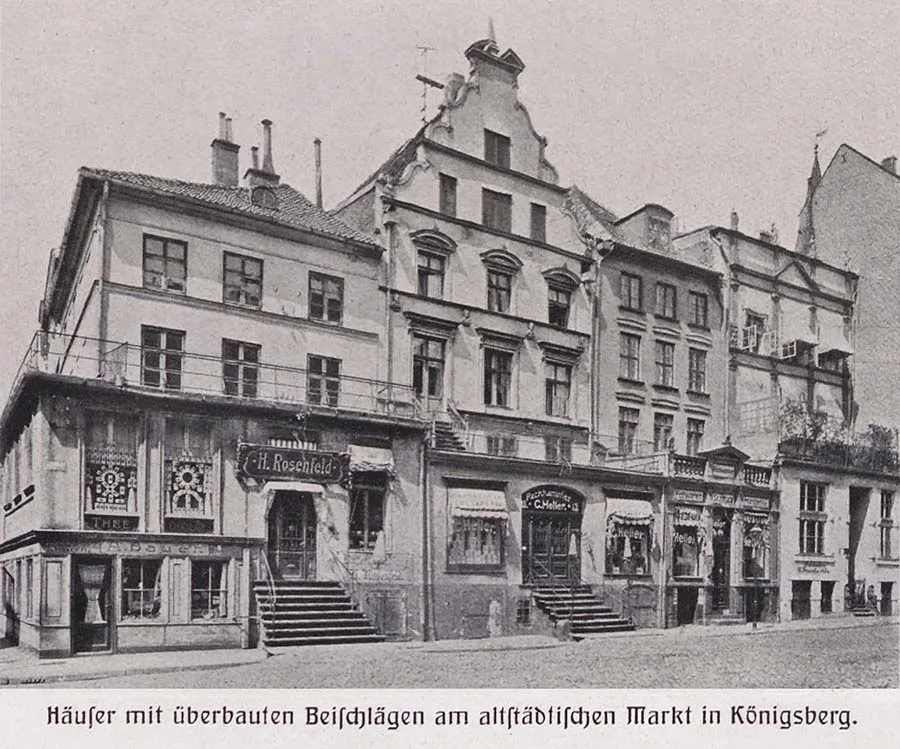 Houses on the Altstadt Market.
Meanwhile an army was already marching to the aid of the Königsberg Castle garrison under the command of Heinrich Reuß von Plauen (c. 1400–1470), Komtur of Elbing (Elbląg, Poland) and future Grand Master of the Order (from 1469). Von Plauen let the people of Altstadt know that the Order's authorities appreciated their loyalty to the treaty with the Order and that no sanctions would be applied against the town (towns whose burgomasters had sworn allegiance to the Polish king were usually stripped of their town rights). Encouraged, the inhabitants of Altstadt fielded their militia to help the Komtur. As a result, besieged Kneiphof surrendered at the mercy of the victors on 14 July 1455. By that time Burgomaster Andreas Brunau had already fled to Danzig and so escaped punishment.
After the defeat of the Teutonic Order in the Thirteen Years' War (1454–66) and the signing, at its end, of the Second Peace of Thorn, catastrophic for the Order, life in Altstadt declined once again.
The only consolation for the inhabitants was that they could now consider themselves a capital city, since the residence of the Grand Master had been moved to Königsberg Castle as early as 1457, and Altstadt was the town closest to the castle.
For a time the Altstadt court even became the supreme court of the Order's state. However, the Order was paying reparations and debts to mercenary troops and trying to gather strength for revenge. All this was inevitably accompanied by a heavier tax burden and debasement of the coinage, when the precious-metal content of money was reduced while its face value stayed the same. Life in such economic conditions became greyer and drearier than with a stable currency, flourishing trade and growing production. Things went so far that Altstadt even adopted a "beggars' law" (1500), which limited the number of beggars in the town to no more than 70 and fixed the places where they were allowed to ask for alms. In addition, a "poor law" was passed, setting out the municipality's measures to help townspeople who had fallen on hard times. The nature of these laws says more than anything else about the situation in the town in those difficult times. It is hard to look into the thoughts of people long dead, but one gets the impression that everyone had grown tired of living within the Order's state, as a body grows tired of tight clothing. And that is precisely why the town estates, the monk-knights and even the Catholic parish priests accepted the Reformation and the abolition of the Order in Prussia so easily. Later the people of Altstadt even argued over whether the Reformation in Königsberg began with the sermon of Johann Briesmann / Brismann (1488–1549) in the Kneiphof Cathedral on 27 September 1523, or whether it came here with Pastor Johann Amandus, who in the same year 1523 began calling from the pulpit of the Altstadt Church for icons to be removed. Amandus gave his speeches earlier, but there is a catch: he failed to convey the essence of Luther's teaching to the parishioners, and so he was asked to leave both the church and the town. Soon, however, another preacher sent by Martin Luther arrived in Altstadt – Johann Graumann (1487–1541), who, in the spirit of the age, took the pen name Poliander.
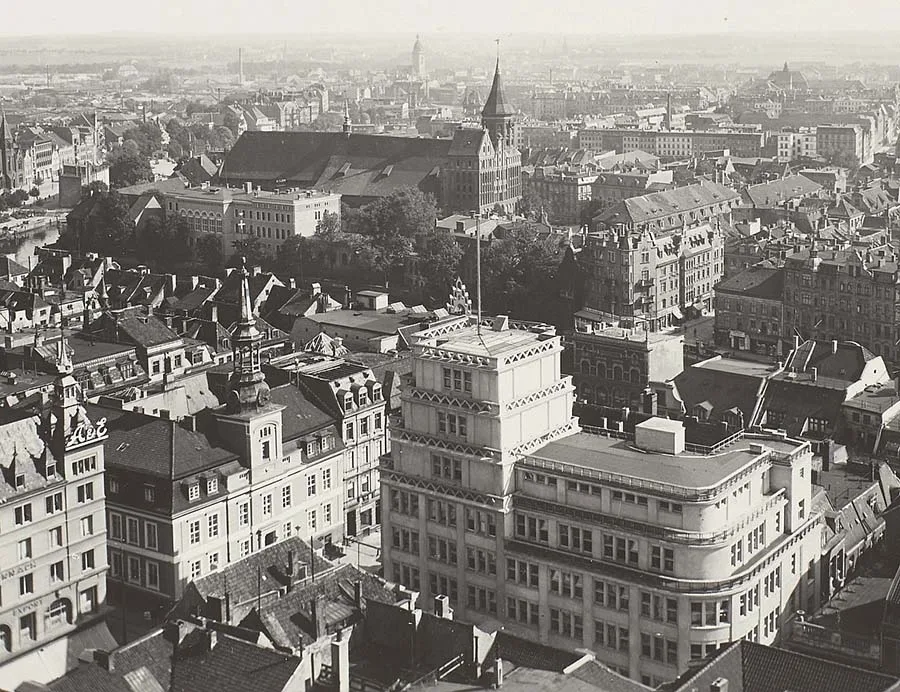 View from the castle tower. In the foreground, the Altstadt Town Hall (left) and the Kiewe department store (centre). In the background, the Cathedral on Kneiphof and the spire of the Lutheran church in Haberberg.
Besides being a gifted preacher, Poliander wrote poetry, including Lutheran hymns, one of which – "Praise the Lord, O my soul" – became so popular that Johann Sebastian Bach himself used it in one of his works.
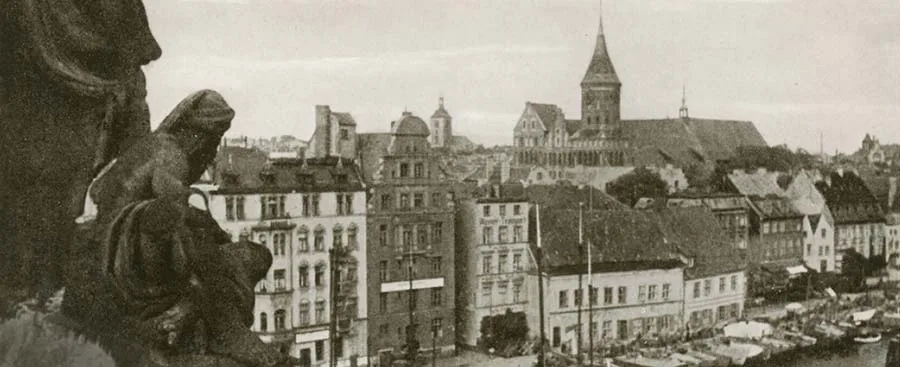
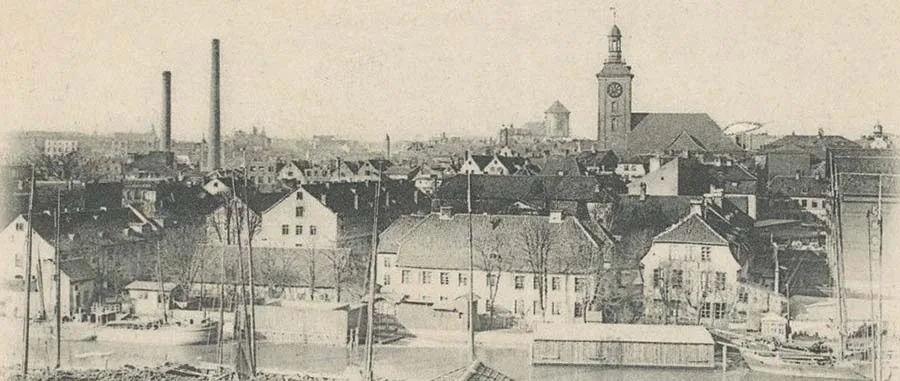
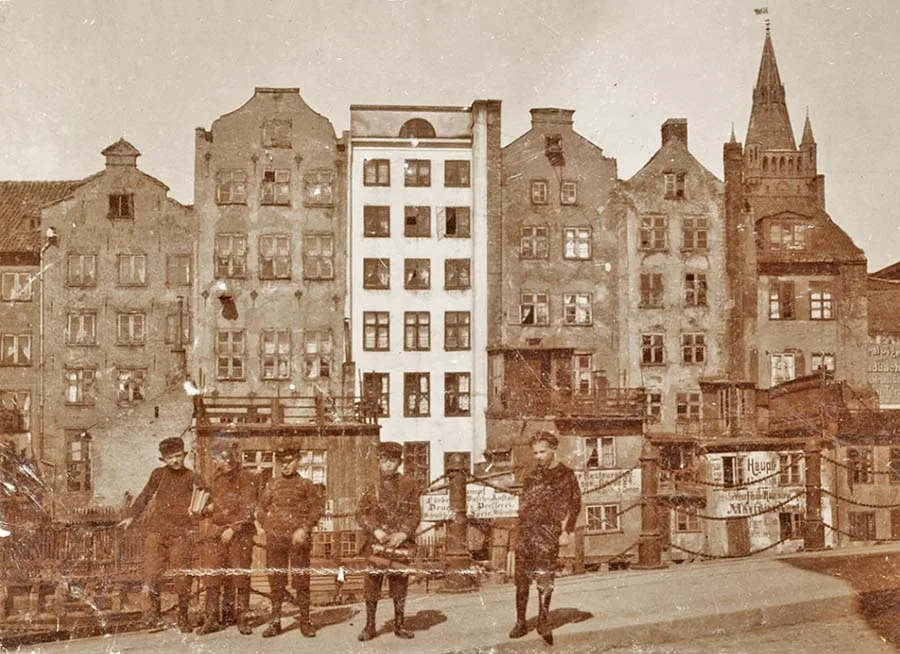 View of the Altstadt embankment from Kneiphof.
He also described the Prussians and the gathering of amber, bequeathed his library of 1,000 books to Altstadt, and was one of Duke Albrecht's associates in founding the University of Königsberg.
Another member of the Altstadt Church congregation was another well-known associate of Luther, the Evangelical theologian Andreas Osiander (1498–1552). He was the man who introduced Martin Luther to Albrecht of Brandenburg-Ansbach, then still head of the Teutonic Order and later Duke of Prussia. From about the age of ten Osiander studied and re-edited the fundamental Christian books; he may have been the real author of Luther's Small Catechism. In Königsberg, however, he was remembered in a different capacity. Osiander lived in the era when the main Lutheran tenets and dogmas were taking shape; he loved delving into ancient Christian texts, seizing on every word and every turn of phrase in them in his striving to grasp their essence. To this end Osiander constantly took part in theological debates and in drafting and adopting Protestant documents.
It was Osiander who in 1543 published Nicolaus Copernicus's famous book "On the Revolutions of the Heavenly Spheres", with a personal note that things might not be so, but that as a mathematical theory it was worthy of study.
When the university opened in Königsberg, its main task being the theological study of Christianity in the light of Luther's teaching, Osiander hurried there and in 1549 became a professor of the Albertina. From 1550 he developed a doctrine here which most of us would find insignificant, but which almost led to a schism in Prussian society and even to armed confrontation. In very brief terms, its essence is that God's justification (forgiveness) of the soul of a true Christian is a consequence of Christ's divinity and occurs because Jesus comes to dwell in the soul of every truly believing Christian. This assertion found opponents, who declared that God's grace dwells in the sinful soul from the outset and enables God to justify it. What could be the fundamental contradiction here, one might ask? But not for Lutherans in the early days of this confession. Lutheranism was then extremely radical, and its adherents were intolerant of any kind of heresy. Therefore whoever turned out to be wrong would immediately be counted among the heretics, who, in the opinion of 16th-century Lutherans, were worse than Catholics. As a result, two parties formed in the town's theological and university circles, denouncing each other at every opportunity, demanding that their opponents be dismissed from their professorships and banished from the town, appealing to the flock and accusing their adversaries of being in league with the devil. Duke Albrecht, who himself apparently did not understand the substance of the dispute, supported Osiander's party – probably because he fully trusted the man who had led him to Protestantism. Osiander was also supported by Johann Funck / Funk (1518–66), pastor of the Altstadt Church (in 1547–49) and later the Duke's court preacher. This is why Altstadt was considered a stronghold of the "Osiandrian heresy".
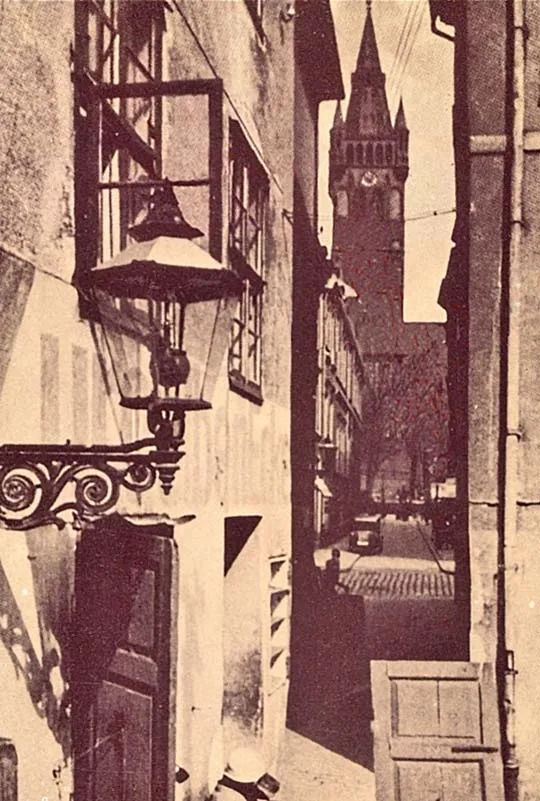
Junkerhof Lane (Hofgasse) with a view of the castle tower.
The confrontation between the "Osiandrian" and "anti-Osiandrian" parties continued even after Osiander's own death in 1552. Osiander, buried by the Altstadt Church, even had to be dug up again to show everyone that his death had been caused by illness and not that "the devil had taken him, wringing his neck".
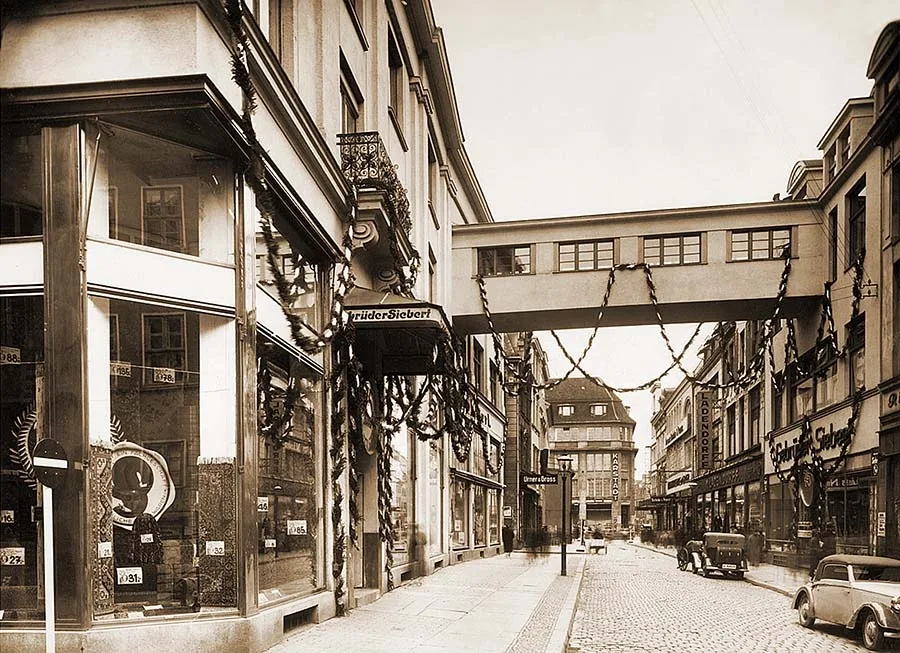 The crossing of Water Lane (Wassergasse) and Junkerhof Lane (Hofgasse).
It all ended with Osiander's and Funck's opponents turning to the Polish King Sigismund II (a Catholic!) with a demand for a fair investigation and trial. Under feudal law it was the King of Poland who was obliged to settle disputes between the estates and the Duke, who in this case sided with the "Osiandrists". In 1566 a plenipotentiary commission arrived in Königsberg from Poland. Although the Altstadt court building was intended for such cases, it was decided not to stir up the townspeople, and the sessions were held in the Kneiphof court. The court sentenced Funck and his closest associates to death for "opposing state and church administration" in the duchy. On the market square of Kneiphof, Johann Funck, Matthias Horst and Hans Schnell / Schnel were beheaded. Another of the accused, the librarian Christian Johann Steinbach, was pardoned on account of his advanced age and state of health, but he was required to leave Königsberg. By law the sentence had to be confirmed by Duke Albrecht himself, and this need to condemn his closest people to death finally undermined his physical and mental health.
After the death of Duke Albrecht and his wife Anna Maria in 1568, what were perhaps the most turbulent times in its entire history began for Altstadt. The nominal ruler of Prussia until 1618 was Albrecht's son, Albrecht Frederick (1553–1618), but because of the latter's limited legal capacity real power lay in the hands of regents:
in 1578–1603 this was George Frederick of Brandenburg-Kulmbach (1539–1603), in 1605–08 the Elector of Brandenburg Joachim Frederick (1546–1608), and in 1611–18 his son John Sigismund (1572–1619), who in 1618 became the first Duke of Prussia from the Brandenburg branch of the Hohenzollern dynasty. After John Sigismund, power in Prussia passed in 1619 to the Elector George William (1595–1640). All these rulers had to "live in two houses": the Duchy of Prussia was their second domain, both in order and in importance. They were often absent from Königsberg for long periods, handing over the reins of government in Prussia to councillors from among the local inhabitants. For a small reward these councillors easily found common ground with representatives of the municipalities and the merchants, deciding many matters in their favour. A kind of oligarchic ruling elite emerged, which held real power in Königsberg and in Prussia as a whole. It was in this period that the towns became surrounded by liberties – Freiheiten / Freiheit – and suburban areas – Stadtteile / Stadtteil. The difference between a liberty and a suburban area was that a liberty was intended for the development of a settlement on its territory whose inhabitants were not townspeople with the rights that went with that status, but paid taxes into the town treasury. They lived permanently in the liberties, where they ran their households (mainly agricultural).
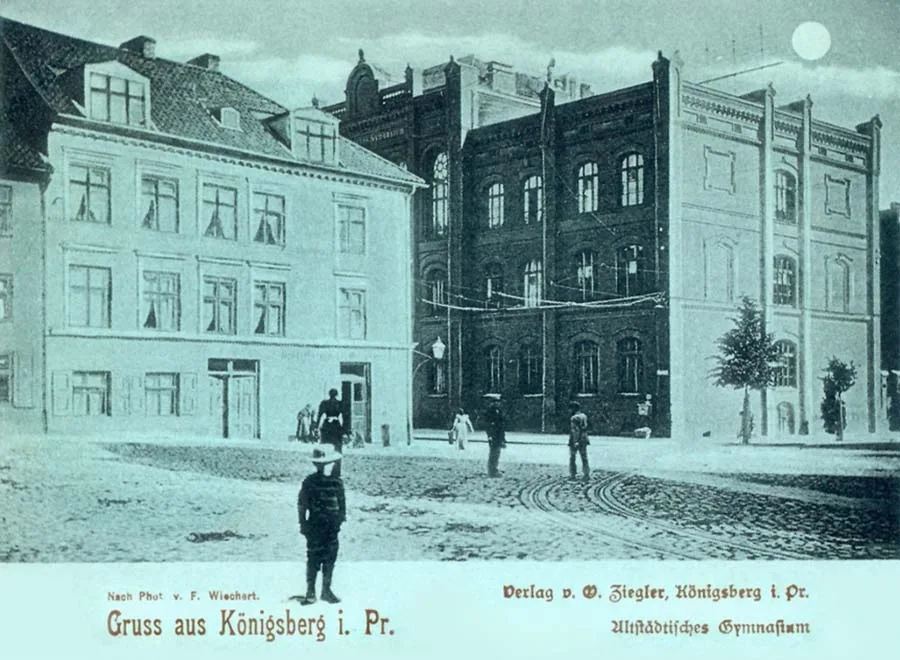
The Altstadt Gymnasium on a postcard by a local publisher.
The liberties had clear boundaries and their own coats of arms. Their population did not form an independent Christian congregation but belonged to the town parish. Even if a church was built in a liberty, it did not become a parish church but was a "branch", or daughter church, of the town parish.
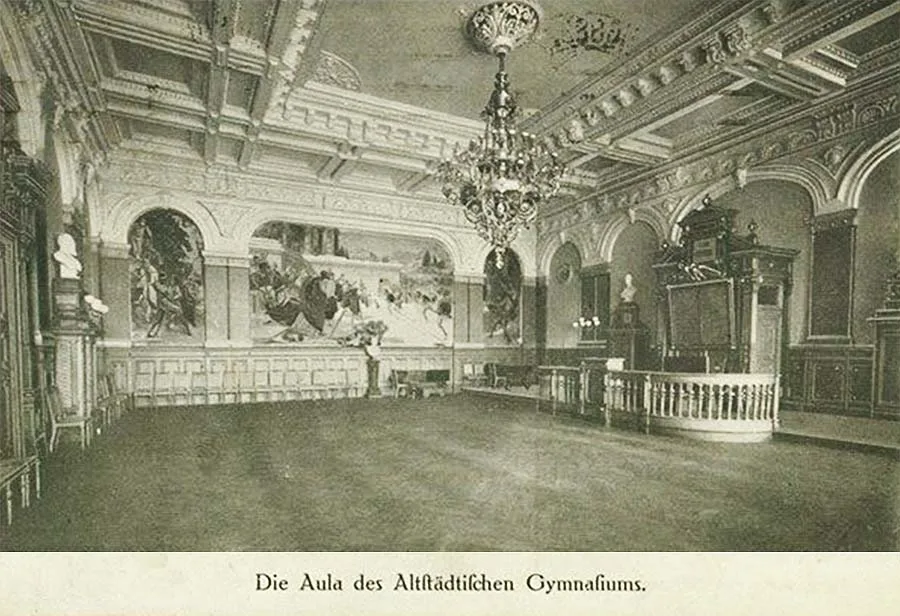 The assembly hall (German: Aula) of the Altstadt Gymnasium.
The Stadtteile, on the other hand, were not intended for residential building but served exclusively for the townspeople's economic activities; if houses did appear there, they were in effect illegal structures. The Stadtteile had no coats of arms or churches of their own, and their boundaries could be extended as needs grew. Back in the times of the Order, Altstadt acquired suburban areas: the Laak, for trading warehouses and shipyards, and Lomse, for storing and processing timber. By the 17th century Neuroßgarten had turned from a Stadtteil for grazing cattle into a liberty that was being actively built up. Another such liberty was the Steindamm. Considering that the brutal Thirty Years' War (1618–48) was raging in Europe, during which not only towns but entire regions were mercilessly plundered, burned and ravaged, things were going very well indeed for Altstadt. In 1626 a momentous event occurred that forced the three Königsberg towns to build common town fortifications. The fact was that troops of one of the active participants in the European war, the Swedish King Gustavus II Adolphus, had landed in Prussia.
Duke George William, who was then ruling Prussia, made the only right decision: to remain neutral and to side neither with his Catholic overlord, the King of Poland, nor with his brothers in the Protestant faith, the Swedes.
The latter, however, pointed out to the Prussians that Prussia, having no defensive works in its capital (apart from long-outdated medieval ones), could easily be forced into hostilities on one side or the other. It was to remedy this situation that a project for common rampart fortifications for the three Pregel towns was hastily drawn up. Apparently, the four interested parties – the three municipalities and the Duke – sought to protect their possessions in the surrounding area with maximum coverage. As a result, the bastioned fortress turned out to be very large, so large that neither the Duke's soldiers nor the town militia would have sufficed to defend it. But it was a reserve for many years to come. Once its construction was complete, Altstadt no longer had to keep its old walls in good repair and could gradually begin dismantling them, building houses and craftsmen's workshops in their place. (As a result, by the 20th century the only part of the old town fortifications to survive undestroyed was the Yellow Tower / Gelbe-Turm, which was preserved solely as an old curiosity.) The Steindamm liberty then effectively merged with the town of Altstadt, which predetermined its rapid development later on. Also, in 1635 Altstadt began to build up the former pasture of Neuroßgarten, turning it into a liberty. In 1644–47 a church of its own was built in Neuroßgarten, although its population still belonged to the Altstadt congregation.
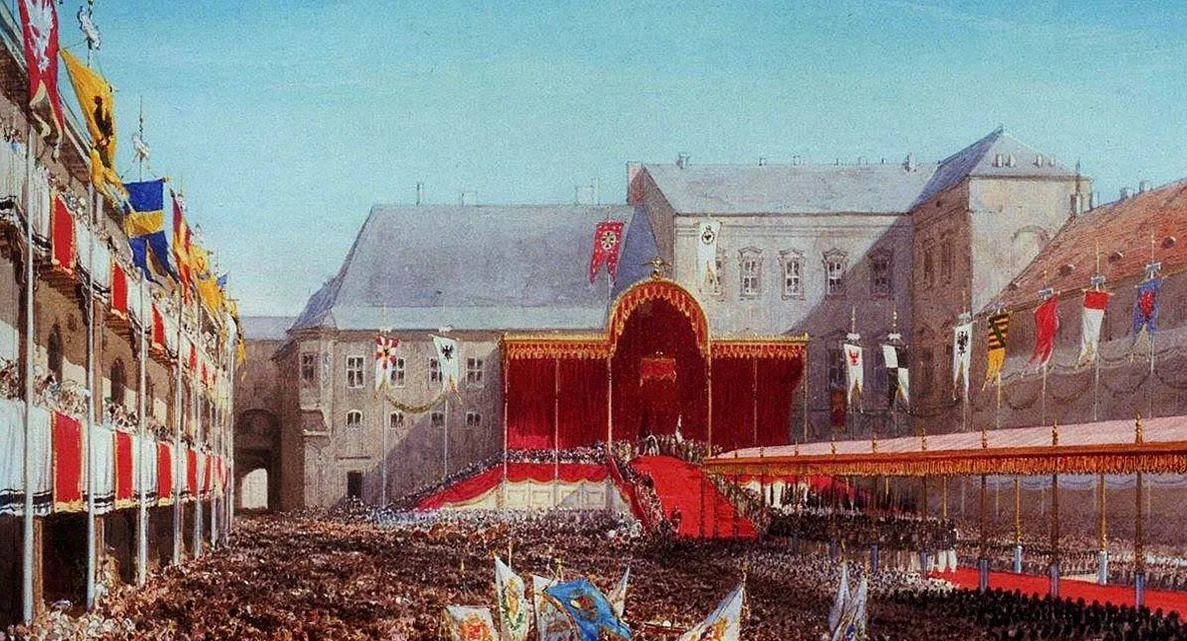
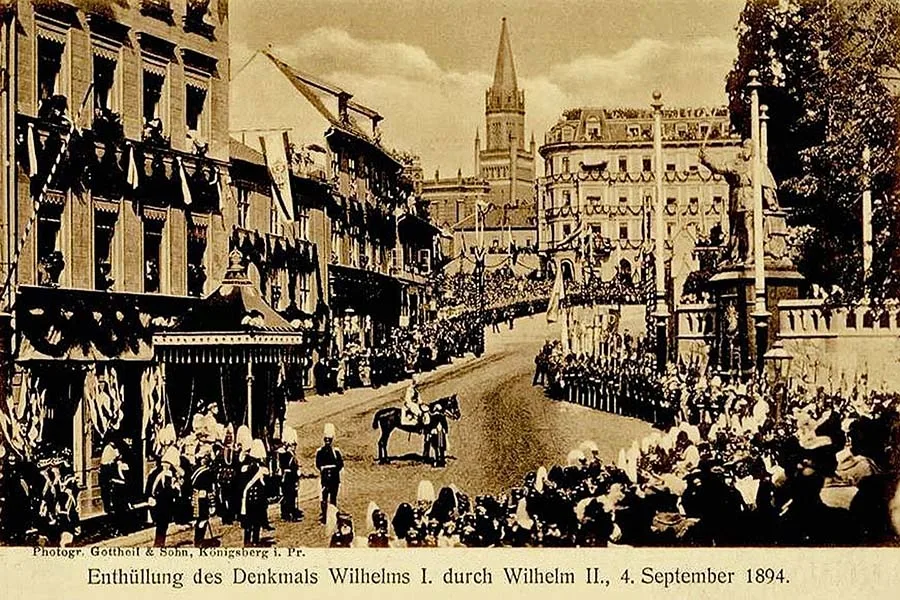 Wilhelm II takes part in the unveiling of the monument to his grandfather Wilhelm I on the square named after him.
However, just as work on the bastion ring was being completed, the free-for-all of municipal officials in Königsberg began to come to an end. The new Duke in Prussia, the "Great Elector" Frederick William, set a course from the very beginning towards building an absolute monarchy in the state.
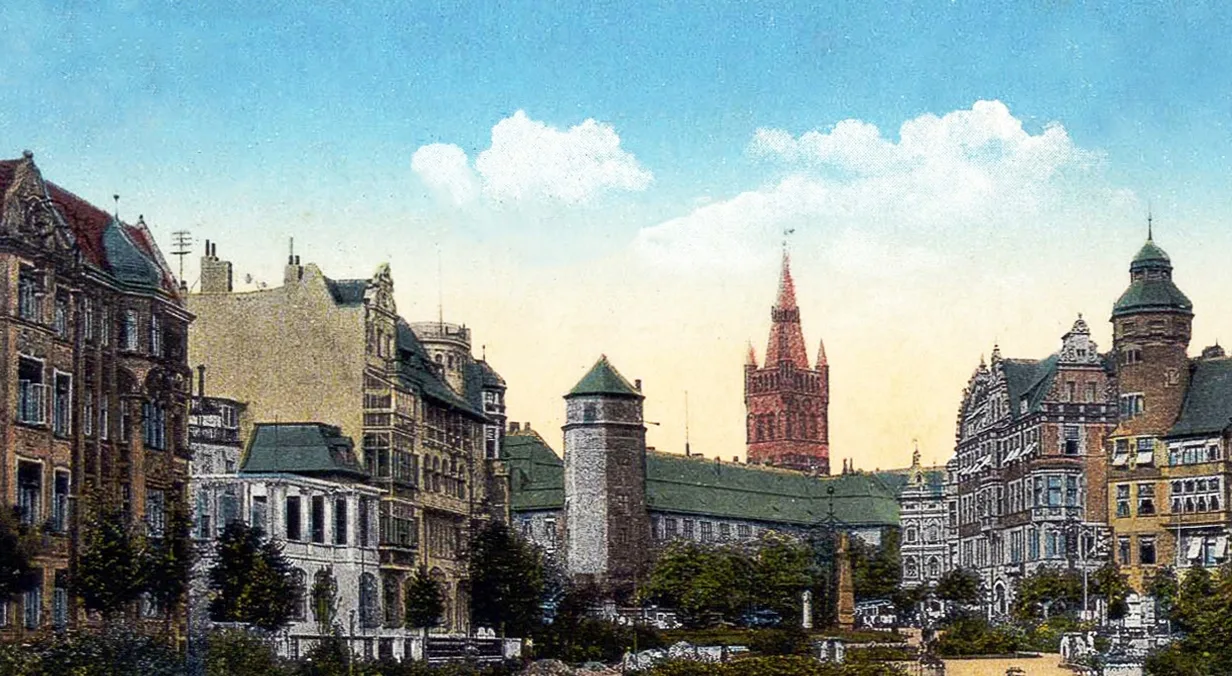
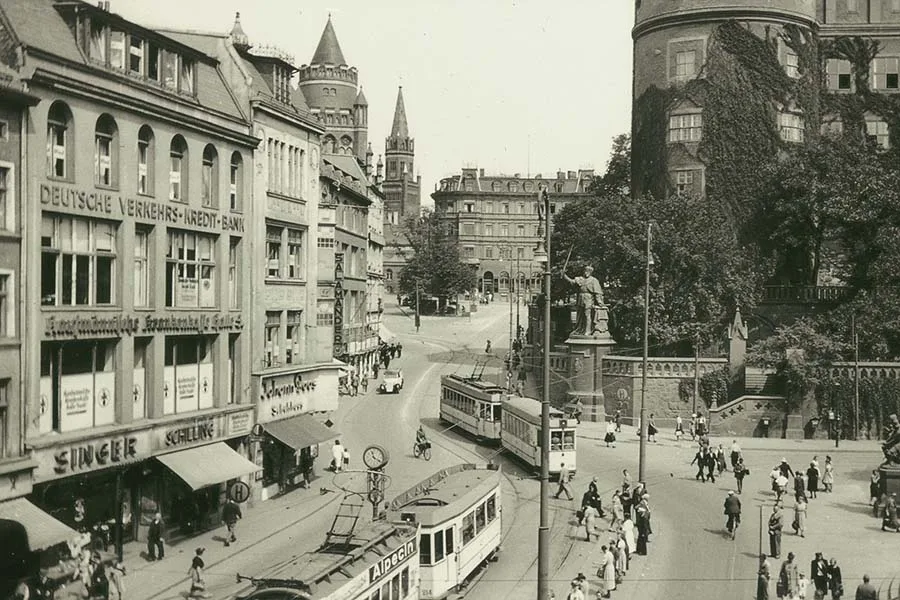 Kaiser Wilhelm Square (Kaiser-Wilhelm-Platz). In the background, the spire of the tower of the New Altstadt Church is visible. To the left, the building of the Main Post Office. To the right, the monument to Wilhelm I and the castle.
In a unified state, that is, since before him Prussia and Brandenburg were united only by the person of the Elector-Duke, who under the treaty with Poland could style himself Duke only when he set foot on Prussian territory. In Altstadt, accustomed to self-government, these initiatives of Frederick William met with the utmost resistance, which almost led to armed confrontation. The culmination of the struggle with the municipalities was the Elector's founding of the Friedrichsburg fortress opposite the Altstadt Laak. The guns of this fortress could stop any vessel sailing to or from the town, and could also burn down all the Altstadt warehouses in the Laak. One should not think, however, that Frederick William tried to act solely from a position of strength. On the contrary, in exchange for civil peace and the estates' recognition of the absolute supremacy of the Elector-Duke's political power in Prussia, he offered to extend the rights of the municipalities in everything concerning the town economy.
Moreover, the local elites were compelled to accept the new order of relations without bloodshed or repression, which was a rare exception to the traditions of the time.
Unless one counts the imprisonment of the Elector's implacable opponent, Hieronymus Roth from Kneiphof. On 17 October 1663 the heads of the municipalities and the town councillors were sworn in at the castle, and on 18 October the inhabitants of the three towns took a collective oath, followed by festivities with gifts and fireworks. And here again Altstadt was placed somewhat above the other towns, because it was in its town hall that the ceremonial dinner marking the citizens' oath to the Great Elector took place. In addition, in 1663 the Court and Main Post Office – in effect the postal administration of Prussia – was established on the Bergstraße in Altstadt, and the Licent, the state customs office, was located in the Altstadt Laak.
Nevertheless, from that time until the unification of the Pregel towns into a single Königsberg on 13 June 1724, Altstadt no longer interfered in high politics, concentrating on its own municipal and economic problems. And in this striving to live richly and dominate among the Pregel municipalities, the Altstadt magistracy and the guilds stopped at nothing: they wrote complaints that their neighbours were violating their privileges, petitioned for new concessions and rights, and tried to curtail the rights of foreigners and members of other religious denominations.
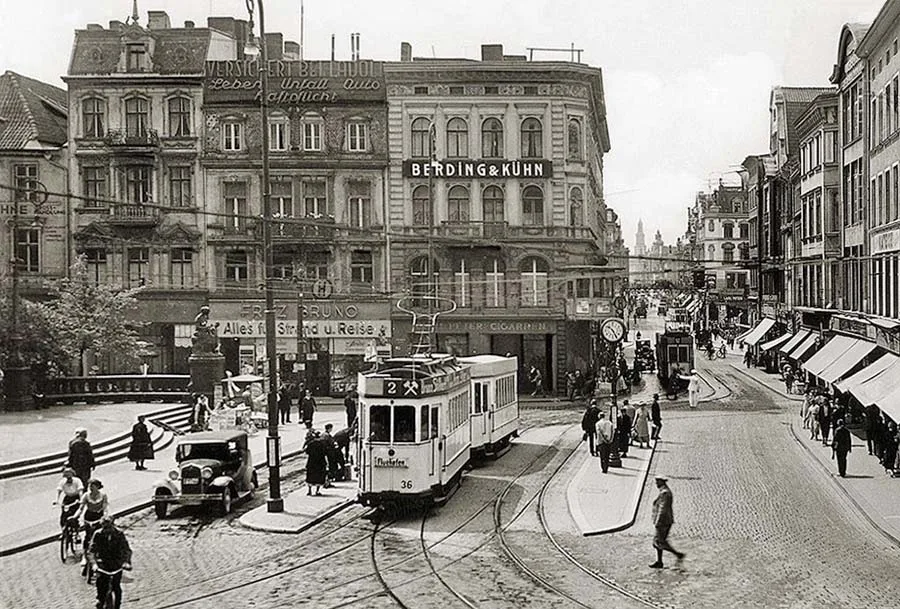 Kaiser Wilhelm Square; on the right, the opening of Kantstraße, and through the perspective of the Kneiphof and Vorstadt Long Streets the spire of the Haberberg Church can be seen in the distance – four districts in one photo!
German historians have remarked very aptly that in the 17th and 18th centuries the supreme authority in Prussia was more tolerant towards its subjects than the subjects were towards one another.
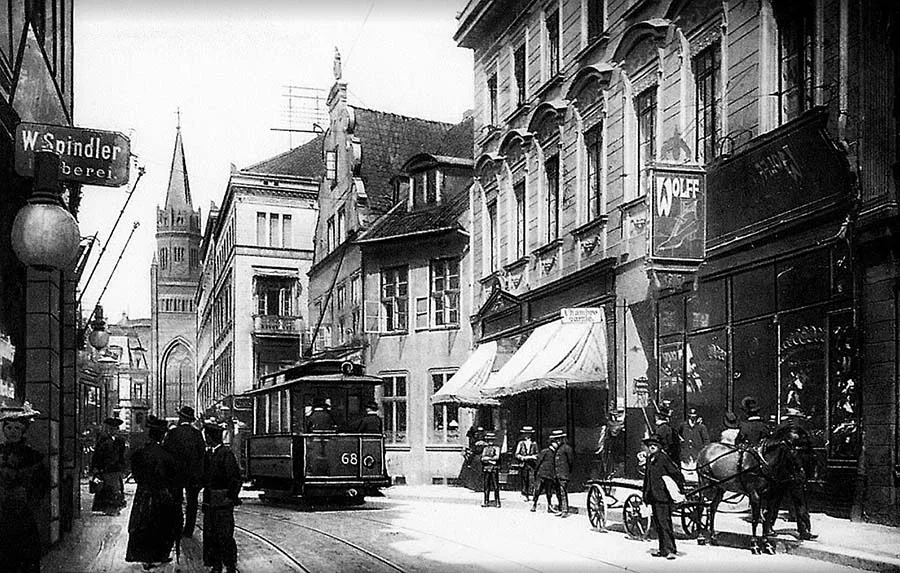
The spire of the New Altstadt Church closed the vista of Junkerstraße in Burgfreiheit.
And while Russian historiography usually notes that the reason for uniting the three municipalities into a single Königsberg was King Frederick William I's wish to consolidate neighbouring and historically close towns, German historiography emphasises that the monarch had simply grown tired of every innovation he devised for the good of the state meeting with resistance from the townspeople because it clashed with someone's personal or corporate interest.
The first burgomaster of the united Königsberg was the former burgomaster of Altstadt, Zacharias Hesse (1670–1730). But one should not see in this any privilege of Altstadt (now a city district) over the other towns – originally it was intended that this post would be taken by the burgomaster of Kneiphof and personal friend of the Russian Emperor Peter I, Christoph Negelein (1668–1746). But he unexpectedly declined the post.
Nevertheless, after the towns were united, Altstadt began to lose its role as hegemon among the towns (now city districts). One may suppose that the main reason was that everything new appearing in town life required a certain amount of space and new infrastructure, and in densely built-up Altstadt these resources were harder to find than in the younger districts.
Business and social life gradually shifted to the Steindamm and the former castle liberty of Burgfreiheit. On the other hand, this meant that many examples of architecture from the ducal and royal periods survived longer in Altstadt than in other districts. But houses from the times of the Order, as in the whole of Königsberg, no longer survived by the 20th century.
Meanwhile, in the 18th century Altstadt had many notable sites that were important for town life. Among them was the Fish Market / Fischmarkt, the main place for wholesale and retail trade in fish. The Altstadt town market played an important role in the local grain trade. Since the city magistracy of the united Königsberg, by agreement with the other former towns, came to sit in the Kneiphof Town Hall, the city court moved into the vacated Altstadt Town Hall. The Königsberg city archive was also housed there. In the Altstadt parish school, built back in 1592–95, the Königsberg Public Library was located in 1737–73, after which it too moved into the building of the former Altstadt Town Hall.
A curious story spanning centuries is connected with the Altstadt Town Hall, its finale falling in the 18th century. In 1455, after the combined forces of the Teutonic Order, Altstadt and Löbenicht had forced the rebels – supporters of the Prussian Confederation – who had taken refuge in Kneiphof to capitulate, the façade of the Altstadt Town Hall was adorned with a mocking sculpted mask sticking its tongue out at Kneiphof. In 1528 this mask was supplemented by a second one with a clockwork mechanism, which every hour pushed its tongue out towards Kneiphof and pulled it back in. But in 1774 a sparrow flew into the mask's mouth and damaged the mechanism beyond repair. Now it was the turn of the people of Kneiphof, who after this incident began calling the inhabitants of Altstadt "sparrow-swallowers" (Sperlingschlucker).
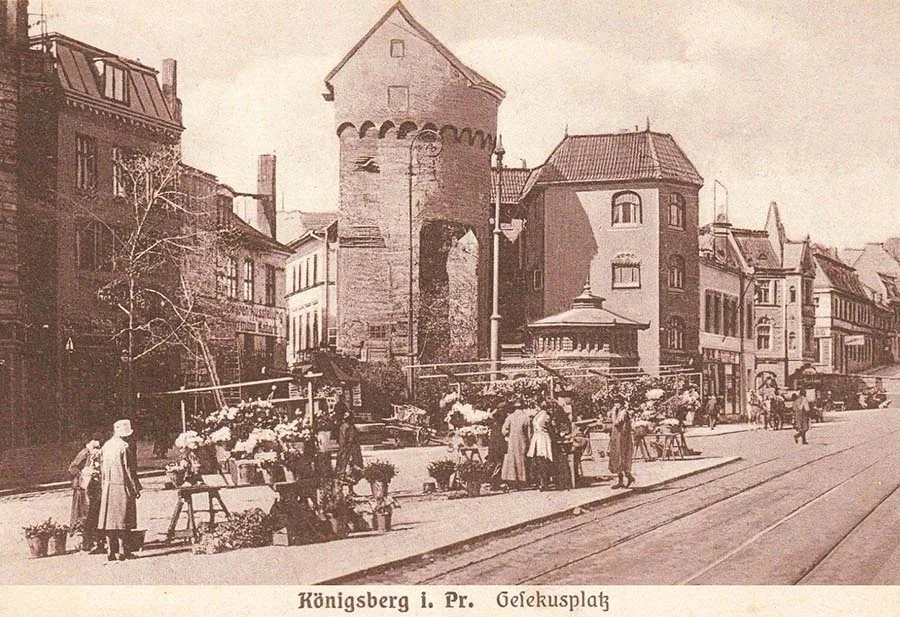 The Yellow Tower on Gesekusplatz.
And from 1783 Immanuel Kant lived in Altstadt, on Prinzessinstraße*. He lived here until the end of his days in 1804.
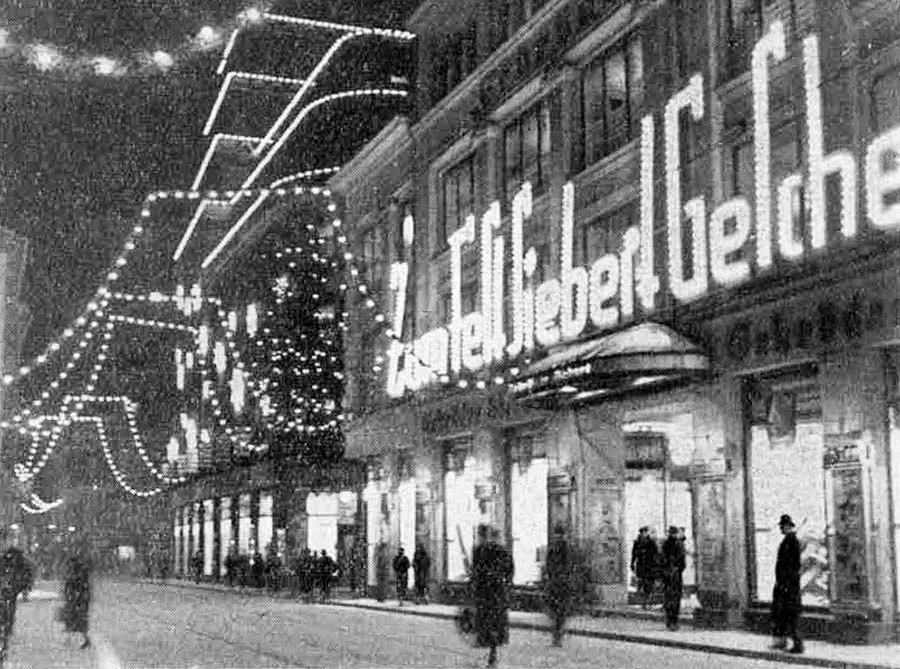 Shop windows of the Siebert company on the Altstadt Long Street, opposite the Liedtke confectionery.
Surprisingly, the inhabitants of Altstadt, who always strove to prove that their town (district) was something special that stood out among the other parts of Königsberg, on this occasion paid little attention to the fact that the great philosopher lived on Altstadt's territory. After Kant's death his house was first resold several times and then, in 1893, simply demolished because it was no longer of commercial interest. And not a single patron could be found who wished to invest money in preserving it. Unfortunately, this was not the only hasty and ill-considered decision regarding memorable buildings in Königsberg.
Another famous building that for many years was Altstadt's calling card, and which likewise did not survive the 19th century with its reforms and revolutions, was the Altstadt Church. By the 1820s it had become structurally unsafe because of centuries of ground subsidence beneath its foundations. When there were too many cracks in the masonry, the church was dismantled. This happened in 1826–28. Nothing was built in its place; only a memorial marker was set up to show that one of the oldest places of worship in Königsberg had once stood here.
The resulting square was at first named Altstadt Church Square (Altstädter Kirchplatz), but for some reason people called it Muckerplatz, which has a wide range of meanings, from "square of the apostates" to "dung square".
In 1897 the place was renamed Kaiser-Wilhelm-Platz, and today it is the most frequently reproduced view of Königsberg in pre-war photos.
The New Altstadt Church was built in another place (not even in Altstadt, but in the Steindamm) and consecrated in 1845. This period coincided with the boom of historicism and the reassessment of the city's architectural heritage in Königsberg. Therefore the new church was built in the Neo-Gothic style, and the pulpit, the altar and the choir stalls were transferred to it from the old one. The interest in history that representatives of the local intelligentsia (above all members of the Prussia Society) instilled in the townspeople helped to ensure that many old façades and their elements were preserved in Altstadt, although the buildings themselves were periodically rebuilt. By the end of the first quarter of the 20th century it was an astonishing conglomerate of residential, administrative and commercial buildings; at the same time it was a living Königsberg museum, a place where one could go shopping or sit in a café with a view of the stern walls of the castle. What, one might think, did events in Czechoslovakia or distant France have to do with this unshakeable grandeur? The lines in the newspapers about the Wehrmacht's latest brilliant victories did not at all sound like a death sentence for all this Prussian prosperity.
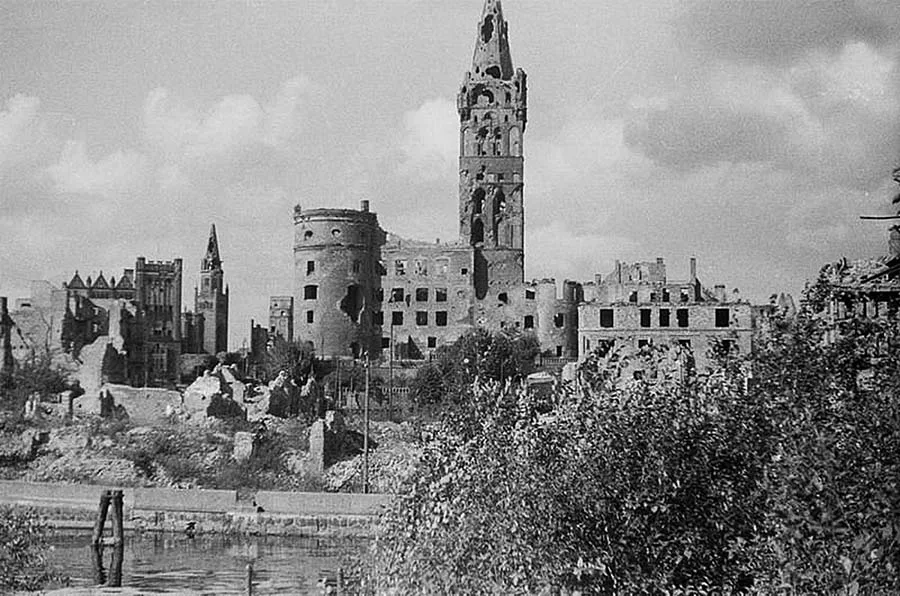 View from Kneiphof towards Altstadt in the 1950s.
On 30 August 1944 Altstadt was almost completely destroyed during the second bombing raid on the city by the British Royal Air Force.
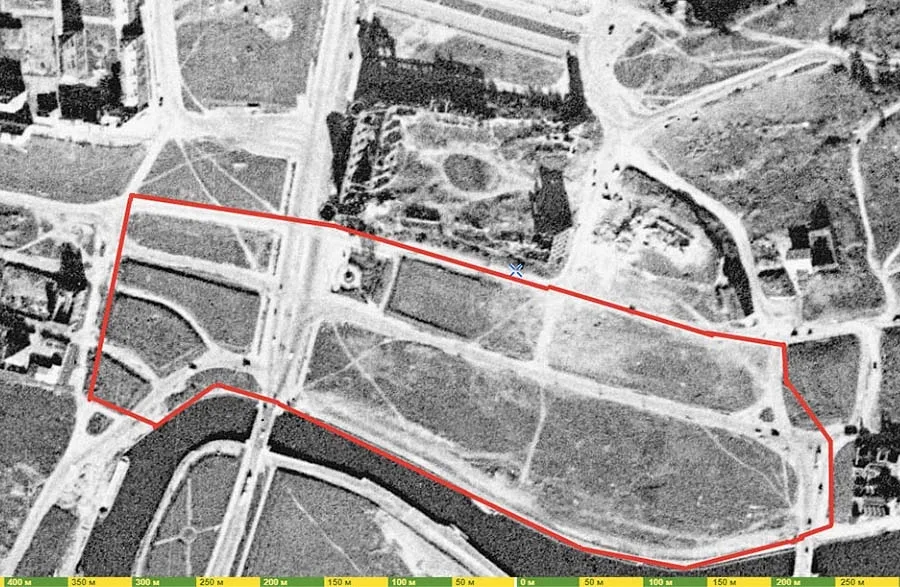 Aerial photograph of Altstadt in the 1970s.
Here its fate differs little from that of its neighbouring towns: tons of incendiary bombs with a small number of high-explosive ones (to cause panic and collapses that would hinder fire brigades from getting through) burned everything in Altstadt that could burn. At best, a house was left as a brick shell without roof, rafters, floors (which were almost always wooden), window frames and doors. At worst, the effect of the flames also caused the brickwork to collapse. Eyewitnesses recall that the fire in the historic part of the city burned out not only the insides of the buildings but also people's souls – the inhabitants of Altstadt wandered aimlessly among the smoking ruins, their faces utterly detached. What had been built over centuries burned down in a single night. Many townspeople felt that life had lost all meaning. These bombing raids had no particular military purpose; they had another aim – to break the spirit of the population and its will to continue the war. And that aim was undoubtedly achieved…
Of course, the subsequent storming of the city on 6–9 April 1945 added to the destruction, not so much through the actions of the assault units themselves as through the accompanying artillery and air strikes.
After the war some of the ruined streets were given new names. Thus the main street of Altstadt, the Altstädtische Langgasse, was renamed Pravoberezhnaya Street. The streets Hökerstraße and Wasserstraße, which ran parallel to it and merged into one another, became Rechnaya Street. Of the streets leading from the hill on which the castle stood down to the river (perpendicular to the Altstädtische Langgasse), the following were renamed: Schmiedestraße became Slobodskaya, Baderstraße became Kupalnaya, and Polnische Straße became Noginskaya. Koggenstraße was given the name Yakutskaya.
However, by 1965 the entire territory of Altstadt had been cleared of ruins by bulldozers. The only artefact of the pre-war past that remained was Kaiser-Wilhelm-Platz, with its little cast-iron fence, inside which stood a monument to A.V. Suvorov that had replaced the monument to the "Iron Chancellor" Otto von Bismarck on this spot. In Kaliningrad this square was named Staraya (Old) Square. But in 1973, before construction of the Estakadny Bridge began, it too was demolished. Apart from the interchange of the Estakadny Bridge, the territory of Altstadt is now occupied by the carriageways and pavements of Moskovsky Prospekt and the extensive green area adjoining it. That is, even compared with Löbenicht and Kneiphof, where at least something of the city districts has survived, Altstadt is staggering in that NOTH-ING of it is left.
And yet it is precisely the fact that there was no standard Soviet housing on the site of Altstadt, and that the green area is no priceless work of landscape design, that made possible an ambitious project to recreate the historic centre of Königsberg, with the carriageway of Moskovsky Prospekt moved into a tunnel. Nothing like this has ever been built in Kaliningrad, and the project does not look cheap. But everything happens for the first time at some point, and truly valuable architectural creations are never cheap.
* — according to the latest "intelligence", Prinzessinstraße was located in the district neighbouring Altstadt, Burgfreiheit, aka the Castle Liberty.
The illustrations include photos from the East Prussia Photo Archive and by Mikhail Ogorodnikov.
– – – – – – – – –
The chapter "Altstadt"
from the book by local authors "Königsberg Local Studies",
published at the end of the 19th century
In 2012–2014, "Pregola", the literary supplement to the "Baltic Almanac", published
a translation of the book by the Königsberg authors Dr Richard Armstedt, professor at the Altstadt Gymnasium, and Dr Richard Fischer, senior teacher at the Kneiphof Gymnasium, "Königsberg Local Studies" ("Heimatkunde von Königsberg i. Pr.", 1895, Kommissionsverlag von Wilhelm Koch, Königsberg), made by an unknown translator. The idea of publishing it belonged to Igor Vladimirovich Afonin. The text was adapted and annotated by Aleksey Borisovich Gubin and Igor Fyodorovich Avtukhov. That book had a separate chapter on Altstadt. Having edited it substantially, we present it to you as a supplement to the text by
Aleksey Yevgenyevich Petrushin.
– – – – – – – – –
Die Altstadt
The name of the town of Altstadt literally means "Old Town" in German, and it appears on the tablets of history almost simultaneously with the building of the Order's first fortress on the site of the Prussian hillfort of Twangste. The year of its foundation is usually taken to be 1256. The town's original location is not entirely clear. Most indications point to the area of today's Steindamm Church (Steindammer Kirche), which stood north-west of the castle. This church was dedicated to St Nicholas, the protector of seafarers; it is the oldest church not only in Königsberg but in the whole of Samland.
The church was built at the same time as the new town "on St Nicholas's hill near the castle" and stood, in all probability, in the north-western part of the settlement. The church, as was usual at the time, formed part of the town's fortifications. To the west, north and east the little town was naturally protected by marshes and lakes, and to the south-east it was covered by the castle.
The old road from Natangia (Natangen) to the heart of Samland ran right through here. This small and poorly fortified settlement did not enjoy its existence for long. The church could not provide it with reliable protection...
The great uprising of the Samland Prussians in 1260–64 destroyed the town. In 1263 the settlement was destroyed by the rebels led by the Prussian chieftain Nalube (Nalube). Altstadt was captured, while Königsberg Castle (Schloß Königsberg), despite all the privations and hardships, managed to hold out. When the danger had passed, the inhabitants who had escaped death and captivity no longer settled on the same spot but built a new settlement between the castle and the Pregel (Pregel), where the town was protected to the north by the castle garrison and to the south by the river, which provided steady and safe communication with other parts of Prussia.
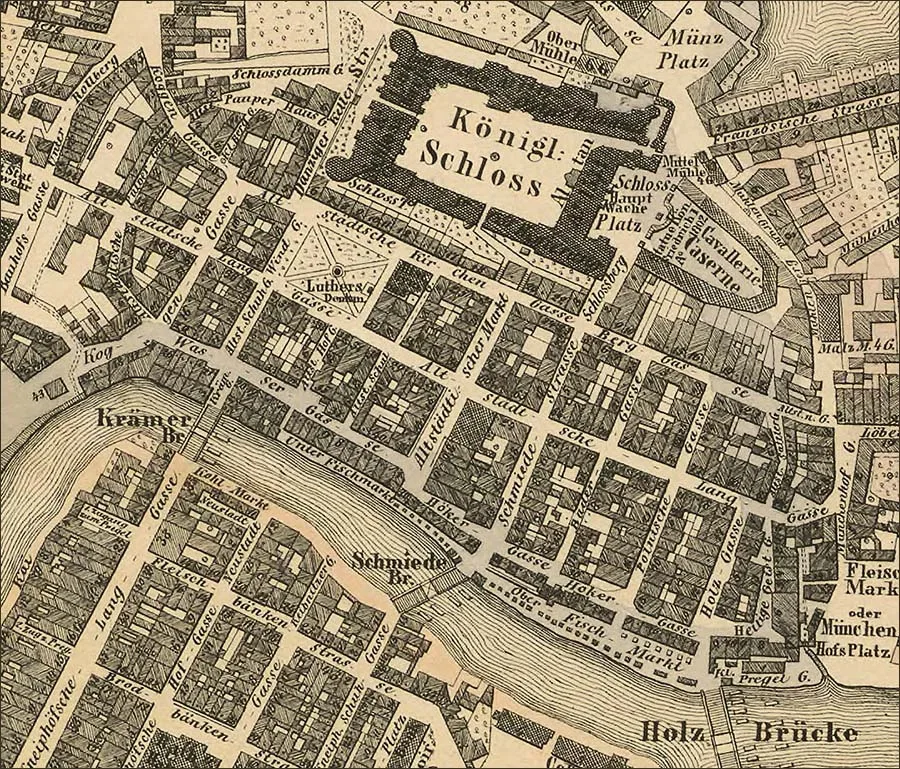 Altstadt on an 1860 map.
On 28 February 1286 the newly built town received from the Landmeister Konrad von Tierenberg (Konrad von Tierenberg) its basic and founding privileges, as a reward for the bravery and courageous self-sacrifice shown in the struggle against the rebellious Prussians, and as an exhortation to remain loyal to the Order in future.
By this important document, which, like the founding charters of the two other towns founded later – Löbenicht (Löbenicht) and Kneiphof (Kneiphof) – is still kept in the city archive, the inhabitants were granted the Kulm right to elect judges. In addition, they were assigned all the meadows, pastures, fields, forests and ponds from the Pregel to the field of Lauchsen (Lauchsen, the old name of Lawsken) and half a mile deep into Samland, with the exception of the church lands of Altstadt, as well as the northern part of the Upper, or Great, Island and of the Small Island below Kneiphof, where the Friedrichsburg fortress (Friedrichsburg) now stands.
They were permitted to make hay and gather firewood on the Vogtswerder (Vogtswerder – the name of today's Kant Island before the town of Kneiphof was founded) and to build warehouses there. They were allowed to fish in the lagoon from the mouth of the Pregel to Peyse (Peyse), and also in the Pregel from the Shop Bridge (Krämerbrücke) upstream as far as the village of Heiligenwalde (Heiligenwalde, now Ushakovo).
Finally, they were granted the right to cut firewood for their own needs in the forest on the southern bank of the Pregel called Labun (Labun), as well as in all the other forests belonging to the Order, from the territory of the Town Liberty (Stadtfreiheit) to Lauth (Laut). Thanks to later grants, including villages, the town's property grew considerably.
The coat of arms of Altstadt at the dawn of its existence showed a formidable crowned knight on horseback. In his right hand the knight held a sceptre in the shape of a lily, and in his left a shield bearing an eagle and a cross. This knight is the Bohemian King Ottokar (Přemysl Ottokar II, founder of Königsberg). From the middle of the 15th century the town had a new coat of arms, which took root and remains in use to this day. The coat of arms shows a shield divided into two parts.
The upper part is a red crown with gilded points on a white field. The lower part is a white cross on a red field. The crown and the cross signify that the town and the fortress were founded jointly by King Ottokar and the Teutonic Order.
Somewhat later, following a custom that had arisen, figures of shield-bearers began to be placed beside the coat of arms, considerably enriching it visually. On the Altstadt coat of arms the shield-bearers were at first two lions; later, instead of the lions, two natives – Prussians – were depicted.
The main colours: those of Altstadt were white and red, of Löbenicht light blue, of Kneiphof green. The Altstadt dragoon company in red uniforms greeted Elector Frederick III (Kurfürst Friedrich III, who became King Frederick I of Prussia) during his journey on 22 March 1690. The soldiers of the Altstadt rifle companies decorated their headgear with red and white ribbons.
However, the space available for the town was not very large. The castle and the hill on which it stands bounded Altstadt to the north, the river Pregel to the south, and the Löbebach stream (Löbebach) to the east. In the west the town was apparently bounded at that time by today's Kantstraße (Kantstraße, now Leninsky Prospekt, which leads onto the Estakadny Bridge), and only much later extended as far as the old Steindamm Bridge (Steindammer Brücke), later still taking in the Lastadie and the Laak (Lastadie und Laak).
The old street grid has largely survived to this day. The main street, the Altstadt Long Street (Altstädtische Langgasse), runs westwards from the eastern end of the town. Several lanes branch off it to the north and south. In the south they flow into Water Lane (Wasser Gasse) and Humpback Street (Höcker Straße), which run along the river parallel to the Altstadt Long Street. In the north the parallel street is the Altstadt Mountain Street (Altstädtische Bergstraße), but it appeared much later.
Previously there was simply a road here along the southern walls of the castle. In 1375 the Grand Master Winrich von Kniprode (Winrich von Kniprode, c. 1310–1382) strictly forbade the people of Altstadt to build their houses right up against the southern walls of the castle. But this ban was not observed for long, and the Street Below the Hill (Straße unter dem Berge) appeared. In 1811, together with the Altstadt Church Street and Post Street (Altstädtische Kirchenstraße und Poststraße), it came to be called the Altstadt Mountain Street (Altstädtische Bergstraße).
Königsberg's first fortifications were palisades of sharpened logs, but when Henning Schindekopf (Henning Schindekopf, c. 1330–1370) became Marshal of the Teutonic Order in 1360, all three Pregel towns (Altstadt, Löbenicht and Kneiphof) acquired stone walls, gates and towers.
The lower part of the walls was made of fieldstone boulders, the upper part of brick. Including the covered defensive walkway on top, the walls were no more than 10 metres high. Of the many towers only one has survived, the so-called Yellow Tower (Gelber Turm) on Gesekusplatz (Gesekusplatz). It has been rebuilt many times, and little remains of its former beauty.
In 1812 the tower passed into private ownership. Besides this tower, particularly many fortifications were built for protection from the north-west. It was there that the town wall came right up to the castle. Not far from the dansker already mentioned rose a huge square tower, demolished in 1800. Where the courtyard of the Altstadt Gymnasium (Altstädtische Gymnasium) now borders on Powder Lane (Pulver Gasse), there stood a round tower. It was called the New Tower (Neuer Turm); at first it served as an arsenal, then as a powder magazine, and later it was used as a prison. The New Tower was demolished in 1888. Three strongly fortified gates with gate towers and barbican towers (Thorturm und Vorthorturm) faced west and north-west: the Lastadie Gate (Lastadienthor) at the end of Ship Street (Koggenstraße – a cog was a Hanseatic sailing ship) was demolished in 1734, almost at the same time as the Swan Gate (Schwanenthor / Lackenthor) at the end of the Altstadt Long Street. The Nicholas or Steindamm Gate (Nikolaithor oder Steindammerthor) connected Ship Lane (Koggen Gasse) with the Steindamm (Steindamm) and was demolished in 1752. Here, in the northern part of Ship Street, the road crossed the moat by the Steindamm Bridge (Steindammer Brücke). In front of the tower of the Lastadie Gate stood the Watchtower (Pfeifenturm), pushed far forward and commanding the Pregel. It was demolished in 1737. Besides the gates and towers, the town was protected by double walls framing the Swan Ditch, or Swan Pond (Schwanengraben oder Schwanenteich). In the north this body of water was connected with the castle moats, and to the south it stretched all the way to the Pregel. The Swan Pond delighted the eye with its many swans. In keeping with the customs of the time, cosy arbours stood on its bank. The Swan Bridge (Schwanenbrücke) divided the pond into two parts, of which the upper belonged to the Community Garden (Gemeindegarten) and the lower to the Junker Garden (Junkergarten). Today the pond has been filled in and built over.
(The Watchtower was originally, in the 16th century, called the Tower by the Lastadie Gate (Turm beim Lastadien Thor). Later it was known as the Ribbed Tower (Rippenturm). At the end of the 17th century it came to be called the Watchtower. — Editor's note)
The fortress walls running along the Pregel have not a single fortress tower, except for the Polish Lane Tower (Polnischer Gassenturm). There are no towers east of the Löbebach stream (Löbebach) either, but there the newly formed town of Löbenicht (Löbenicht) had fairly strong defences of its own.
Along the Pregel the following gates with towers stood here: the Gate of St George, or Ship Gate, and later the Shop, Smiths', Wood and Cathedral Bridge Gates (St. Georgs- oder Koggenthor, Krämerthor, Schmiedethor, Holzthor, Dombrückenthor). Besides the gates there were four small passages here, as there is today, for example, at the end of Bath Lane (Badergasse). From Altstadt into Löbenicht, on the other hand, there was only the Löbenicht Gate (Löbenichtscher Thor), also called the Gate of the Crooked Ditches (Krummegruben-Thor), at the end of the Altstadt Long Street.
The main entrance to the castle was through the Castle Gate (Schloßthor), whose second name was the Ditch of the Dead (Mordgrubenthor). Smiths' Street (Schmiedestraße) led to it; this gate appeared somewhat later and was originally for pedestrians only. It was demolished in 1706. Another passage into the castle led from the Altstadt Church Square, also through a very narrow gate.
The oldest bridge of Altstadt and of all Königsberg (across the Pregel) is considered to be the Shop Bridge (Krämerbrücke). It is mentioned in sources from 1286. Its former name, Ship Bridge (Koggenbrücke), like the name of the Ship Street of the same name (Koggenstraße), comes from an old word for a ship (Kogge, Koggen (Middle Low German) – a medieval single-masted decked sailing ship with high sides and a sturdy hull). Later numerous little shops sprang up on both sides of the bridge (in German a small shopkeeper is a Krämer). When a new bridge was built in 1787, these shops were demolished. The Shop Bridge is the oldest bridge to Kneiphof, and beyond it to the Vorstadt (Vorstadt), where the Hospital of St George, belonging to Altstadt, is located, and further still to Natangia, and from there to West Prussia, beyond which lies the whole of Europe. The road in this direction was of the greatest importance. (The Shop Bridge was rebuilt in 1900.)
The second oldest was the Cathedral Bridge (Thum- oder Dombrücke). This bridge led to the Cathedral (Königsberger Dom) built in 1333 on Kneiphof. It was not intended for large carriages. This bridge may have formed a single whole with the tower (Dombrückenthor) above its gate, which stood at the end of Bath Lane (Badergasse). Opposite (on the island of Kneiphof) stood the ancient Cathedral Tower (Domthor).
When the inhabitants of Altstadt and Kneiphof found themselves forced to bypass the bishop's domain, they built another bridge, at the demand of Grand Master Winrich von Kniprode – the Smiths' Bridge (Schmiede Brücke). At the same time the Cathedral Bridge was demolished. This happened in 1379. (The point was that in those years part of the island of Kneiphof was the property of the Bishop of Samland and could not be used by the burghers for free passage.) Shops also stood on both sides of the Smiths' Bridge. In 1787 the shops were demolished and the bridge renovated. In 1896 the bridge was rebuilt as a bascule bridge. Its construction cost 483,000 marks.
The Wood Bridge (Holzbrücke), built in front of the gate of the same name, is first mentioned in 1404. This bridge connected Altstadt and the castle with part of the Great or Upper Island (later Lomse). Before the bridge was built, the Wood Gate (Holzthor), built between 1379 and 1400, already stood here. The bridge acquired particular importance after the High Bridge (Hohe Brücke) was built across the other arm of the Pregel. The Wood Bridge was rebuilt on a new site in 1901–04.
Having proved their loyalty to the Teutonic Order during the Thirteen Years' War (Dreizehnjähriger Krieg oder Preußischer Städtekrieg, 1454–66), also known as the War of the Cities, Altstadt and Löbenicht received from the Grand Master the right to build a bridge across the Natangian Old Pregel (Natangischer Alter Pregel).
In this way a direct connection was established between Altstadt, the castle and Natangia, whereas previously such traffic had passed only through Kneiphof, which during the events of 1455 had supported the Prussian Confederation, opposed to the Teutonic Order, and did not let goods and cargo through its territory. Despite Kneiphof's vigorous protest – a bypass road across the Natangian arm of the Pregel was not in its interests – the bridge was built around 1500. Kneiphof's protest was above all prompted by the potential loss of income from the tolls previously levied on goods carried across its territory. All the lawsuits brought by Kneiphof proved futile. In the end the parties were reconciled. During the Polish war, better known as the Horsemen's War (Reiterkrieg, 1520–21), the High Bridge was demolished to protect Altstadt from enemy invasion, and after the end of the campaign it was restored almost immediately. The present High Bridge was built in 1882. (In 1938 a new one was built a little to the south, and only the piers and the bridge-keeper's house remain of the old one.)
The streets of Altstadt are cramped; the narrow houses soar steeply upwards. Almost all the houses face the street with their gables. The narrowness of the streets is aggravated by numerous Wolme (Wolme) or Podeste (Podeste) – projecting extensions, as on the Kneiphof Long Street (Kneiphöfische Langgasse).
All this made it necessary to draw up precise plans (Fluchtlinieplan) marking "red lines" that could not be overstepped when new houses were built. From 1700 it was forbidden to build extensions projecting more than two feet from a house.
Walking from the castle to Altstadt along the ancient Mill Road (Weg Mühlenberg), which nearer the river becomes Monks' Court Lane (Münchenhofgasse), let us turn into the Altstadt Long Street. The very first narrow street on the left, Holy Spirit Street (Heiligengeiststraße, formerly a lane / Gasse), will remind us by its name of a long-forgotten building from the times of the Order – the Hospital of the Holy Spirit. It stood right on the boundary with Löbenicht. The hospital was founded in the 13th century, soon after Altstadt, and was subordinate to the bishop and his chapter; in 1395 it passed under the authority of the Order. In 1528 Duke Albrecht (Albrecht von Brandenburg-Ansbach, 1490–1568) handed the hospital with all its buildings over to Altstadt. (Over time the hospital fell into disrepair and was dismantled.) The place where it had stood was built up with burghers' houses. The house at Holy Spirit Street 7 is one of the oldest houses in Altstadt.
Right next to the hospital, in 1302, Bishop Siegfried (Bischof Siegfried) built the old Cathedral (älterer Dom Königsbergs – meaning the first cathedral, built on the territory of Altstadt). Next to the cathedral, in 1304, a residence for the clergy and the Cathedral School (Kathedral- oder Domschule) were built. The cathedral was dedicated to St Adalbert (heiliger Adalbert). But the site where the cathedral stood proved insufficient, and so in 1333 construction of a new Cathedral began on the island of Kneiphof, to which the old cathedral moved with all its property. In 1351 the old cathedral building, like the hospital premises later, passed into the possession of Altstadt. The school building was demolished somewhat earlier.
We continue westwards along the Altstadt Long Street and immediately notice, at the crossing with Wood Lane, a large "golden" axe on the corner house. This is an old sign that used to serve as a house number. Such signs (Hausmarken / house marks) are quite common even today: doves, a goose, a golden ball, a beehive and so on. Later, legends connected with the house marks began to appear. In the case of the axe, for example, it is said that the owner of this house commissioned work from a carpenter but did not want to pay him in full, and then the carpenter, in vexation, hurled his axe at the offender's house; it stuck in the corner beam and remained there for ever as a threat to the owner, which eventually brought the latter to the idea that he had better pay up. Later this corner house was the shop of Johann Heinrich Hartung (Johann Heinrich Hartung, 1699–1756), the well-known book publisher and founder of the newspaper business in Königsberg.
We cross Bath Lane (Badergasse). Its name needs explaining: "Bader" was what barbers were formerly called in Prussia; they were jacks of all trades: they shaved beards, cut hair, provided what medical help they could and gave their clients massages while they took a bath. Hot baths in bathhouses were very popular for a long time.
Altstadt owned two bathhouses, used mainly by Russian merchants, who were accustomed to caring for their bodies. Over time, however, the number of visits to these establishments declined, so the town's poor Bader (barbers) could no longer afford to prepare hot baths often, and eventually this business died out.
The next cross street is Smiths' Street (Schmiedestraße). Jewellers lived and worked on it. (In German a jeweller is a Goldschmied, which literally translates as "gold smith". In the case of the name of this Altstadt street, the first part of the word somehow gradually disappeared and only the second remained.) The street was so named because goldsmiths used to live here.
Further on, beyond Smiths' Street, comes the Altstadt Market (Altstädtischer Markt), which is in essence merely a wide street. Here one can see many old little houses with characteristic extensions reaching up to the first floor. The main building here is the Altstadt Town Hall (Altstädtisches Rathaus). It stands with its gable facing the market. Its northern wing and rear façade face the Altstadt Long Street and Smiths' Street respectively. The town hall has stood on this spot since the town was founded. It was rebuilt only twice: in 1528 and 1757. In 1832 the building was remodelled and considerably enlarged with various extensions towards Smiths' Street. The town hall tower was built in 1764. Before the renovation of 1757 the town hall had two towers. This building cannot be called monumental. From 1528 its symbol was the Japper (Japper) – a satirical mask, a head topped with a crown. As the clock struck, a long tongue shot out of the mask's mouth with each stroke. But one day a sparrow flew into its mouth and the mechanism broke. Today the satyr's place is taken by a static lion's head. Similar distinguishing signs of houses (house marks) can be seen in other German towns as well. Until 1724 the Altstadt Town Hall was the seat of the town council and the court.
The constitution of the three towns of Königsberg (Altstadt, Löbenicht, Kneiphof) was exactly the same. The entire population of the towns (the burghers) was divided into the Großbürger (Großbürgern), who paid high taxes and included rich merchants, brewers and wealthy owners of various enterprises, and the Kleinbürger (Kleinbürgern), who included the owners of small shops and craftsmen. They formed a single guild (Zunft), but each craft had its own statutes. Becoming a member of the guild was very difficult. Usually only sons and sons-in-law were admitted. German origin and the Lutheran faith were indispensable requirements for admission. The Great Elector (Großer Kurfürst) was the first to try to change the procedure for joining the guilds.
Foreign merchants, the so-called "Lieger" (Lieger), could stay in the town with their goods only from 1 May to 1 December and could trade only with the Großbürger. In earlier times only Großbürger could be members of the town councils and courts. King Frederick I (Friedrich I, 1657–1713) carried out a partial reform of town government in 1711. However, the Kleinbürger obtained the same rights as the Großbürger only after the reform of 1808.
The town council was replenished by free election, mainly from among the members of the court. The elections of the Oberburggraf always took place under the aegis of the central authorities and in public: in Altstadt before the altar of the local church, in Löbenicht and Kneiphof in the town halls. The council consisted of thirteen members. At the head of the council stands the Bürgermeister (Bürgermeister / burgomaster). Every year he laid down his powers and new elections were held. The burgomaster supervised all services and institutions.
Next in rank was the Vice-Bürgermeister (Vice-Bürgermeister / deputy burgomaster), or "companion" (the burgomaster's associate). He was head of the church and the schools within the town walls.
The Vogt (Vogt / governor) had his own civil judicial authority in the Freiheiten (Freiheiten / suburbs, liberties).
The fourth official of the council was called the Wetthern (Wetthern / parity chief). Subordinate to him were the Marktpolizei (Marktpolizei / market police) and the chairman of the Wettgericht (Wettgericht / parity, arbitration court), which usually examined and regulated food prices. The town treasurer looked after the state of the town's finances. He supervised the town buildings, street structures, town yards and carriages.
The quartermaster or war commissioner (Einquartierungsherr oder Kriegskommissar) dealt with everything connected with the quartering of troops. He also directed the watch and the fire service.
The seventh official of the council was the judge. He was at the same time chairman of the council in two corporations, presided over the court and took part in the execution of sentences.
The remaining officials of the council dealt with other matters of the town economy: they supervised the carts, the ash collectors, the herring warehouses, the office buildings and prisons, and so on.
From 1701 the town councillors (Stadträte) came to be called masters of the town hall (Ratsherren). The only lifelong post among the town councillors was the important office of town clerk (Stadtschreiber), who, although legally part of the council, was formally not a member of it.
The court consisted of one chief presiding judge (Schöppenmeister), a deputy (Viceschöppenmeister) and ten members (Schöppen). The court had full civil and criminal jurisdiction over all inhabitants of the town, unless they were subject to some other court (for example, a military tribunal). Civil cases could be appealed to the Supreme Court, a court of higher instance (Hofgericht). If a case concerned honour, bodily injury or life, confirmation had to be obtained from the sovereign (Landesherr). The court in Altstadt sat once a week, on Fridays.
After 1455, by order of the Grand Master, yet another court was created – a special court at the Altstadt Town Hall. All inhabitants of the small towns of Prussia who had previously applied to the town of Kulm (Kulm, now the Polish town of Chełmno), where under Kulm law the supreme court of appeal of Prussia sat, were now to apply to this court. In 1517 the special court came to be called the court of appeal (Appelationsgericht) and was moved to Königsberg Castle. Until 1657 Poles could also apply to it.
The officials of the town hall, like the members of the court, had no fixed salary. Their incomes were extremely modest. The burgomaster of Altstadt, for example, received a salary of only 300 thalers a year at the beginning of the 18th century. To decide particularly important questions, such as setting the tax rate, not only the members of the court but also representatives of the Großbürger and Kleinbürger assembled. The guilds were headed by elders. Each had its own elder, elected for life.
These men, when necessary, had to apply to the town council and settle questions jointly. Their votes were decisive for the presiding judge and were considered the "voice of the people" (Mund der Bürgerschaft, literally: "the mouth of the citizenry").
Thus decisions on the most important questions of town life were taken only by the joint decision of the town hall and the court of all the burghers. These bodies met together in the Altstadt Town Hall and arrived at a common opinion. The burgomaster of Altstadt took precedence over the burgomasters of Löbenicht and Kneiphof in deciding important questions and had the casting vote.
When on 13 June 1724 King Frederick William I (Friedrich Wilhelm I, 1688–1740) united all three towns of Königsberg, the Altstadt Town Hall remained the place where the united court sat. The united council of the former towns began to sit in the Kneiphof Town Hall. The united court became the Royal City Court (Königliches Stadtgericht), and now, instead of a chief presiding judge, it was headed by a senior judge (Oberrichter). The city court remained in the Altstadt Town Hall building until the great judicial reform of 1879. From then on it was called the District and Regional Court (Amts- und Landgericht), whose sessions were held in the new Palace of Justice (Justizgebäude) on Theatre Square.
Today the Altstadt Town Hall is the property of the city and serves various purposes. It houses the registry office (Standesamt), the Siemering Museum (Siemering-Museum) and even a music conservatory (Konservatorium der Musik).
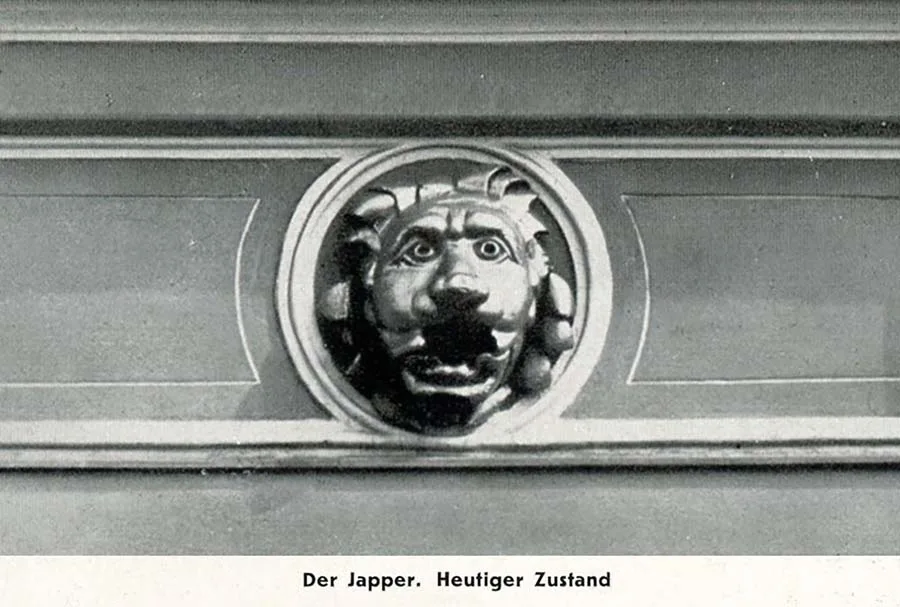 The Japper house mark (a mechanical mascaron) was the symbol of the Altstadt Town Hall from 1455 to 1832.
The Siemering Museum is a small collection of seven pieces of sculpture, mostly castings, made by Professor Siemering (Rudolf Leopold Siemering, 1835–1905) and donated by him to his native city. They include a marble bust of Dr Johann Jacoby (Dr. Johann Jacoby, 1805–1877). The old town and town-hall scales, which used to be beneath the town hall, are no longer there. The cellar has been let in order to raise funds for the restoration of the building. The buildings on Smiths' Street belong to the state treasury and house the tax offices.
At the corner of the Altstadt Market and Humpback Street stood the burgomaster's house. Later the official residence of the police director was located here. In the northern part of the Altstadt Market, beneath the castle walls, there is a confectionery whose façade is adorned with a monument to King Frederick William I. It is the oldest monument in Königsberg and one of the few monuments ever erected to this king.
The king is depicted life-size, standing on a globe. In his right hand he holds a commander's baton. He is surrounded by weapons. The whole composition is set in a niche framed by four Ionic pilasters supporting a triumphal arch, on the corners of which sit two statues of slaves in chains. Between them is the royal coat of arms topped with a crown. Beneath it is an inscription stating that the council and people of the city of Königsberg resolved to erect this monument in 1730, that the monument is in its qualities wholly unworthy of this great king, and calling on posterity to honour his memory for ever.
Under the pilasters to the right and left of the pedestal are two lion masks pouring water from their jaws into a stone basin. This monument is the work of the sculptor Johann Heinrich Meissner (Johann Heinrich Meissner, 1701–1770). It was made in Danzig of sandstone and bought by the city for a paltry sum – 342 thalers 60 groschen. As a work of art the monument is of no value whatsoever.
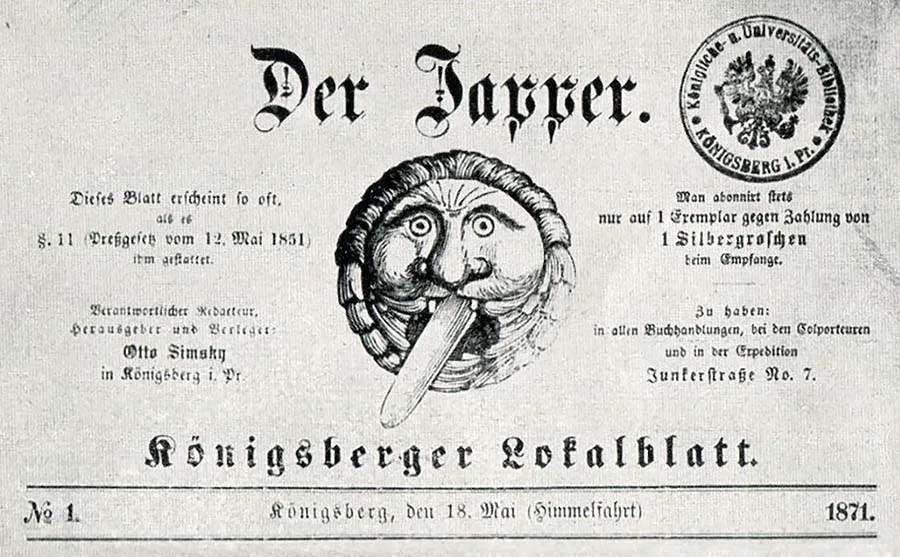 The logo of the satirical newspaper Der Japper, published in Königsberg in the early 1870s.
The house by which the monument stands used to be a postal warehouse. Such a decoration was not provided for in the building's design, and the funds allocated for construction were insufficient. The city decided to ask for the missing money, hoping for the king's favour towards Königsberg.
Frederick William I reigned in 1713–1740. Unlike his father, he was an enemy of all luxury and splendour. Burgher prudence and thrift bordering on stinginess prevailed at the royal court at that time. He gave all his love to his soldiers. With the help of Leopold von Dessau the king created the best army in Europe. He constantly cared for the tillers of the soil, strove to raise agriculture and improve the condition of the peasants. So in this sense he can also be called the "peasant" king. (The mention of the "peasant" monarch is given in the book as a contrast to his other nickname: the "soldier" king.) At the same time he strove, as far as possible, to create a mighty domestic industry, as he showed by personal example on his own lands. He valued the arts and sciences little, but paid much attention to elementary schools, thereby earning due respect. Almost all the schools were founded with his support.
East Prussia was his favourite province because it helped him most in all his undertakings. The Lithuanian lands (meaning the eastern territory of the country, populated largely by Lithuanians), devastated by the plague, he resettled with migrants from all parts of Germany, above all with inhabitants of Salzburg, who had been expelled from their country for their religious convictions. As many as 11,155 such settlers from Salzburg came here, of whom only a few remained in Königsberg. Thus in 1754, 377 Salzburgers lived in Königsberg. (Most of the settlers from Salzburg settled in the Gumbinnen district.)
In 1724 he united the three parts of the city, creating the city of Königsberg. Here he established his administration and judiciary.
Part of Western Pomerania (Vorpommern) became the most significant military acquisition of this, on the whole, peace-loving king.
The street running past the monument to Frederick William I leads west to the Altstadt Church Square. The square took its name from the church that stood here and was demolished in 1826–28. It was dedicated to St Nicholas, like the Steindamm Church. Above the entrance was the inscription: "O Saint Nicholas, be merciful to us!" (O heiliger Herr sancte Nicolae bitte got vor uns!) In the church tower there was a passage for pedestrians, through which they reached Windy Lane (Windgasse), which has now become part of Kantstraße (Kantstraße). The church in Altstadt (Altstädtische Kirche) is first mentioned in 1286; it acquired its later appearance after rebuilding in 1504–37. Construction of the tower was completed in 1542–56.
The three vaults of the church rested on sixteen stone columns. The famous organ, built in 1763, was the work of the local master Casparini (Adam Gottlob Casparini, 1715–1788); part of it has survived in the New Altstadt Church on Post Street. The altar and pulpit, made in 1606 and richly decorated with carving, were widely known for their beauty and value.
In 1523 the first Lutheran pastor, Dr Johann Amandus (Dr. Johann Amandus), preached here; he had been sent to Altstadt by Albrecht, Grand Master of the Teutonic Order, and was replaced in 1525 by Johann Poliander (Johann Poliander).
Johann Poliander was born in 1487 in Neustadt (Neustadt) in Bavaria. His real surname was Graumann (Graumann), which literally means "grey man" in German. Following the custom of the time, many educated people adopted Latinised surnames, sometimes artificially constructed. Thus "Poliander" is a combination of the Latin words Poli – "many" and Andr – "man", plus the German suffix "-er", indicating a profession. In 1519 Poliander attended the religious disputation in Leipzig as a supporter of Eck, and then went over to the teaching of Martin Luther. In 1525, on Luther's advice, he took over the post of Pastor Johann Amandus, who was known for his utterly unbearable, hot-tempered character. Poliander died (in Königsberg) in 1541, leaving a library of more than a thousand volumes, in which documents and manuscripts on the history of the churches, mainly of Altstadt, were collected. It became the foundation of the Königsberg city library.
In the first quarter of the 19th century the tower of the old Altstadt Church began to lean, and its vaults and columns threatened to collapse. The church was closed in 1824 and then dismantled over two years. A beautiful square arose in its place. (In a medieval town squeezed inside its fortress walls, every inch of land was worth its weight in gold. We read above how house owners built overhanging extensions above the street. Moreover, some house owners made underground storerooms beneath the carriageways, creating a risk of collapse or subsidence. The authorities fought against such practices.) On the spot where the church's altar stood, the Luther Stone (Lutherstein), a block of polished granite, has now been placed. Here lies buried Hans Luther (Hans Luther, 1526–1575), the eldest son of the great church reformer Martin Luther (Martin Luther, 1483–1546).
Hans Luther was born in 1526 and studied law at the University of Wittenberg; in 1549 he visited the recently founded University of Königsberg. As councillor to Duke Johann Wilhelm of Saxony (Herzog Johann Wilhelm von Sachsen, 1530–1573), he also received the title of court councillor from Duke Albrecht. But this title was not official. Hans Luther came to Königsberg on business in 1575 and died there on 28 October of the same year. The stone was set up in 1859. (It survived for some time after the capture of Königsberg by the Red Army, but by 1950 there is no information about it. — Editor's note)
However, the great reformer's family ties with East Prussia were not severed by the death of his son here. His younger daughter Margarete, born in 1534, was betrothed in 1555 to Georg von Kunheim (Georg von Kunheim, 1532–1611), hereditary owner of Mühlhausen (Mühlhausen, now the settlement of Gvardeyskoye in the Bagrationovsk district). Margarete Luther-Kunheim (Margarete Luther-Kunheim, 1534–1570) died in 1579 and was buried by the altar of the church in Mühlhausen.
Margarete continued Luther's line in East Prussia, and this lineage runs through the Kunheim and Saucken (Saucken) families still living today.
(The church in former Mühlhausen has survived; after the war it was used as a warehouse, then it was left ownerless and fell into decay. Its restoration began in 1994, and in 2007 the church was granted the status of a cultural heritage site. In 2010–12 the roof was overhauled. — Editor's note)
The Altstadt Church (Altstädtische Kirche) was surrounded by a churchyard (Kirchhof) called St Nicholas's (Nikolai-Kirchhof). It was cleared at the beginning of the 19th century.
In 1803 the Altstadt congregation received a cemetery near the Brandenburg Gate (Brandenburger Thor). Another cemetery of the congregation is located near Violet Hill (Veilchenberg), and yet another by the Steindamm Gate (Steindammer Thor).
Now on the site of the old Altstadt Church a magnificent public garden has been laid out with a fountain, lawns and flower beds. Popularly the square was given the name Sectarians' Square (Muckerplatz). Once two priests of this church, Ebel and Diestel (Johannes Wilhelm Ebel, 1784–1861 / Ludwig Diestel, 1825–1879), together with a numerous flock from noble families, led a church heresy, that is, they distorted the interpretation of church rites. As a result of the investigation carried out, both preachers were removed from office. Their followers fenced off the place where the church had stood and planted flowers.
On this square is the zero kilometre point (Nullpunkt) for all the highways leading out of Königsberg. (The zero kilometre is used for measuring distances on roads. This spot, the intersection of Moskovsky Prospekt with the Estakadny Bridge, is still the "zero point" of Kaliningrad today. — Editor's note)
At the south-western corner of the castle, the province of East Prussia erected a monument to Kaiser (Emperor) Wilhelm I (Kaiser Wilhelm I, 1797–1888). It is now a true adornment of the square and the newest monument in Königsberg. A site had to be found for it. For this purpose four old houses on the south side of the castle were demolished, and part of the Cyclopean retaining wall (Cyklopenmauer) running along the western wing of the castle was not rebuilt, which made Kantstraße considerably wider. Kaiser Wilhelm is depicted in his coronation robes with his sword raised aloft. His gaze is turned towards heaven. His left hand rests on the orb, which together with the sceptre lies on an altar standing beside him. He seems to be living through the greatest event of his life – the coronation, which took place on 18 October 1861. He seems to be hoping for help from the Almighty: for becoming emperor is the heaviest of duties for the chosen. The height of the statue to the tip of the sword is 6 metres 80 centimetres.
The polished granite plinth is made of erratic blocks found not far from Schaaken. The plinth weighs 1,900 hundredweight. On the front of the plinth is the inscription: "To their glorious King and Kaiser Wilhelm I – the grateful Province of East Prussia, 1894" (Ihrem ruhmgekrönten König, Kaiser Wilhelm I., die dankbare Provinz Ostpreußen 1894). Wide stone steps of East Prussian granite lead up to the terrace that surrounds the monument and continues along the south side of the castle.
The terrace is decorated with greenery and separated from the street by a balustrade of red brick. Near the monument the brick gives way to red sandstone. Right by the castle a wall has been built, designed with great taste. Here there is a fountain with a lion's head, from whose jaws water flows into a semicircular basin. This wall forms a fine conclusion to the South Terrace, which is rather narrow and pressed against the castle.
The statue was made to the design of the architect and sculptor Reusch (Johann Friedrich Reusch, 1843–1906) and cast by the firm of Schäffer und Walker (Schäffer und Walker) in Berlin. The building engineer Hinkeldeyn (Hinkeldeyn) designed all the architectural surroundings of the monument. The Pelz brothers (Gebrüder Pelz) directed all the stonework.
The funds for building the monument were collected by the inhabitants of East Prussia (150,000 marks) and allocated by the Prussian Landtag (220,000 marks). The ceremonial unveiling of the monument took place on 4 September 1894 in the presence of the Kaiser and his consort.
Wilhelm I reigned from 1861 to 1888. He was born on 22 March 1797, the second son of King Frederick William III (Friedrich Wilhelm III, 1770–1840) and his consort Louise of Mecklenburg-Strelitz (Luise Mecklenburg-Sterlitz, 1776–1810). The future Kaiser's youth coincided with Prussia's unfortunate war with France, which was followed by a victorious upsurge. As a nine-year-old boy he was forced to flee from Napoleon with his parents to Prussia. Here in Königsberg, on 1 January 1807, he received his officer's commission. After a three-year stay in Memel and Königsberg, he returned to Berlin with his parents. Because of his poor health he could not take part in the campaign of 1813, but in 1814 he fought in France and received his first decorations. These were the Russian Cross of St George and the Prussian Iron Cross. Being the second son, he hardly thought of the possibility of becoming heir to the throne, and so decided to devote himself to a military career. In 1849 he became commander-in-chief of the Prussian troops in suppressing the uprising in Baden, and it was here that he showed his military abilities.
Since his elder brother turned out to be childless and seriously ill, Wilhelm received the title of Prince Regent and held it until the death of his brother Frederick William IV (Friedrich Wilhelm IV, 1795–1861). On 2 January 1861 he became King of Prussia, and on 18 October he was crowned in the church of Königsberg Castle.
His first significant achievement was the reorganisation of military service, since he himself, being a soldier, knew all its problems and difficulties. The army he created made a brilliant and victorious march through Denmark (1864), Austria (1866) and France (1870–1871). The reward for all these victories was the acquisition for the empire of Schleswig-Holstein with Lauenburg, Hanover, Hesse-Kassel, Nassau, Frankfurt am Main and Alsace-Lorraine.
On 18 January 1871, to the thunder of cannon, the aged king was proclaimed Kaiser (Emperor) in the Palace of Versailles near Paris. The German state was restored, mightier and more glorious than ever before. The Kaiser's peaceful activity greatly strengthened the new authority and the well-being of the people. Laws were passed on provision for sick workers, on care in case of industrial injuries, and on disability and old-age pensions. All this was done or planned under his leadership. Germany received a unified judicial system, a single currency for the whole country, a single system of weights and measures and the other attributes of a unified state. During his reign Germany acquired new colonies in Africa (Cameroon, Togo, Namibia, Burundi, Rwanda, Tanzania) and in the Pacific Ocean (New Guinea, the Bismarck Archipelago, part of the Solomon Islands, the Marshall Islands) – the colonial power of the empire grew. Kaiser Wilhelm I died on 9 March 1888, mourned by the whole nation. His consort Augusta of Saxe-Weimar (Augusta von Sachsen-Weimar-Eisenach, 1811–1890) did not long survive her husband and died on 7 January 1890.
Parallel to Kantstraße – which between the Altstadt Long Street and Mountain Street was once called Windy Lane, and further south was Shoemakers' Lane – the very narrow Junkerhof Lane (Hofgasse) runs south from the Altstadt Church Square.
It got its name from the Altstadt Junker Court (Altstädtischen Junkerhof), which had stood here since the 14th century. This compound (a group of buildings) was rebuilt many times and had grown considerably by the beginning of the 18th century.
In 1876 the buildings of the compound became the trading house of the Siebert brothers. Then for a long time it was used as a warehouse for the goods of the Pinnauer Mühlen (Pinnauer Mühlen) factory, located in Wehlau (Wehlau, now the settlement of Znamensk).
Junker Courts, or Artus Courts (Artushöfe), existed in all three Pregel towns. Junkers was then the name for rich landowners and noblemen, and the name Artus Court comes from the semi-legendary English King Arthur, whose round table, at which he liked to sit with his faithful twelve companions, served as the prototype for associations of noble knights throughout Europe. According to legend, Arthur founded such courts in many seaside towns.
And so the Junker landowners, entrepreneurs and officials began to build Artus Courts and to hold meetings of their professional guilds and other associations in them. Each community had its own "corner" in the courts. For example, the Altstadt Junker Court had: the Tankard Corner (Kannenwinkel) for brewers; the Councillors' Corner, or Court Corner (Rats- oder Gerichtswinkel), for privy councillors and lawyers; and the Ship Corner (Hölkenwinkel), where traders and merchants gathered. (The name Hölkenwinkel also alluded to the slang word "Hölk", derived from the word "hulk", meaning an abandoned ship lying at anchor that had become the last refuge for members of its crew who had found no other employment – something like a "refuge for those driven into a corner". — Editor's note)
The emblem of the Brewers' Corner was a tankard with crossed keys; that of the merchants a ship with crossed boathooks. The fishermen's guild was attached to them, but its rights were somewhat limited. Each Corner kept a Brothers' Book (Brüderbuch), in which the names of the members were entered. The Junker Court had its own statute, set out in the so-called Court Letter of 1544 (Hofbrief von 1544). The statute was binding on all Großbürger. But each Corner had its own statutes, as well as its own board.
Order in the Corners was kept by annually elected elders. Disputes that arose were settled at the Morning Talks (Morgensprachen – the morning is wiser than the evening!). The sign of the Altstadt Junker Court was the image of a man with an owl sitting on his head. The great hall of the Junker Court, called the Remter, was decorated with paintings and statues of King Arthur, Orlando Furioso, Hercules and other mythical characters.
While in winter the Junker Court served as the meeting place of the Junkers, in summer the Junker Garden (Junkergarten) became that place. It too had a Great Remter and various Corners. Until 1766 the Festival of the Fair Ox was held here. During the fair the butchers decorated an ox and led it through the town; such animals were called the Fair Ox (Jarmarktsochse). The Altstadt Junker Garden lay between the Lastadie Gate and the Swan (or Laak) Gate; to the west it was bounded by the Swan Pond mentioned above. Today the Junker Garden has been built over, the Swan Pond filled in, and the Altstadt Gymnasium built in its place.
As for the lesser burghers, they too had a place for their gatherings. There they drank beer, played games and celebrated festivals. This place was called the Community Garden (Gemeindegarten). It too was located in Altstadt. Despite many transformations, this Garden has survived to this day and is known as the Jubilee Hall (Jubiläumshalle).
Formerly it stretched from the Laak Gate to the Ship Gate and was separated from the Junker Garden by the Altstadt Long Street. Its western boundary lay along the northern part of the Swan Ditch. The Garden is considered to have been founded on 15 August 1469. The burghers gathered in it not only for convivial feasts but also to practise crossbow shooting. Grand Master Winrich von Kniprode added bird shooting to this. Surviving records from that time allow us to study their way of life and understand what contribution they made to the social life of the town estates. The right to visit the garden and express one's opinion there belonged to those who not only had a sufficient sum of money but were also local burghers. The Garden was managed by two elected elders (Älterleute), joined by two elected craftsmen. They kept the Garden Book and had to keep order. As a reward for their work and trouble, the elders had the right to eat and drink in the Garden free of charge whatever their hearts desired.
There were also a "garden writer" (Gartenschreiber, apparently a chronicler) and two innkeepers, who changed every 14 days. On St Martin's Day (Martini), 11 November, an account of the management was presented, which often exceeded the sum set by the administration. Twice a year, on the fourth Sunday after Trinity (Trinitatis) and on St Martin's Day, the elders reported to all members of the garden, that is, they held a Morning Talk (Morgensprachen). Together with the members of the council, disputes were settled and fines and punishments imposed. To this day the Jubilee Hall preserves an old symbol of punishment in the form of a severed hand, as a reminder of the severity of the penalty for misdeeds. The same severed hand also hung in the Junker Garden above the place where the elders sat.
On weekdays the Garden usually opened at three in the afternoon. On Sundays and Mondays, at noon. On holidays, on tournament days, or if the Shooting King (Schützenkönig) was giving the Royal Feast (Königskost), the opening time could be different. From surviving records for 1618 we learn that the garden clerks were allowed to sell beer to take away from nine in the morning until three in the afternoon (while the garden was still closed!) "to increase the garden's income".
Among the various games, "Pilkentafel" (Pilkentafel) was especially popular. Two people on each side took part in the game. They threw disc-shaped bone counters, marked with the numbers "5" and "6", onto a narrow flat board. The skill lay in making your counter land on top of your opponent's or knock it off the board. The oldest board, from 1469, has survived, found by the colonnade of the old Community Garden: its length was 47 Fuß and 7 Zoll, its width one Fuß 11 Zoll ("Fuß" – a foot – about 30 centimetres, Zoll – an inch – about 20 millimetres; that is, the board was about 1.6 m long and about 0.6 m wide). It is known that the boards in Kneiphof and Löbenicht were longer.
Crossbow practice in the Garden was usually arranged for a group of more than five burghers. Grand Master Winrich von Kniprode divided shooting into practice shooting (that is, shooting at a target) and shooting at the "bird". The marksmen could keep their bows and crossbows, as well as their shooting gear (wrapping, bowstrings, bolts (arrows for crossbows) and arrows for bows), in the Remter, but the Garden also had its own shooting equipment, on the choice and use of which the Shooting King could give advice.
Target shooting usually took place in the Community Garden, while the "bird" was shot at outside the town. The name of Bird Lane (Vogelgasse), connecting the New Ditch (Neuer Graben) with Lastadie Lane (Lastadiengasse), is a reminder of those times. The figure of a bird was carved from wood and fixed on a tall pole. Whoever hit the "bird" at the royal shoot became the Shooting King.
He was entitled to various privileges and honours. For example, he received gifts, was exempt from certain duties, did not do regular service and had free access to the Community Garden. But he also had obligations: for instance, he had to give the "Royal Feast". On that day there was dancing in the Garden, which almost never happened there, except at weddings and other festive occasions. Every burgher had the right to shoot, and soon shooting guilds (Schützengilden) were organised in all three Pregel towns, as well as brotherhoods of marksmen called "Companies" (Kompagnien). All these organisations had their own statutes.
When firearms appeared in the 16th century, special Shooting Houses (Schützhäuser) began to be built. The Altstadt Shooting House stood where the Neuroßgarten Church Square (Neu-Roßgärter Kirchenplatz) is now. The old plan of 1613 shows two shooting ranges: one on the Butterberg (Butterberg), the other near the Laak. West of the shooting range, where the official residence of the director of the Botanical Garden now stands, a pole with a "bird" was preserved. Further west was the hill with the Altstadt gallows (later the Astronomical Observatory of Friedrich Bessel was built on the Butterberg hill). This proximity – of the bird pole and the gallows – reminds us of the unhappy year 1807, when the Königsberg marksmen, along with their silver plate, donated the precious Altstadt Royal Shield of 1564 to the patriotic cause. The Löbenicht Shooting House stood by the Copper Pond, and the people of Kneiphof built theirs by the Brandenburg Gate.
In 1613 the first official shooting with firearms took place in Königsberg.
Crossbow shooting ceased in 1634, and in Löbenicht even earlier, in 1623. After all the towns were united in 1724, the differences in the rules were abolished. By order of Frederick the Great (Friedrich der Große, 1712–1786) in 1748, the Kneiphof Shooting House became the common one for all Königsberg marksmen. The Altstadt Shooting House was turned over to the infirmary of the von Dohna regiment; the Löbenicht Shooting House building was sold and was used first as a prison and then as a guardhouse for the Sackheim Gate. In 1854 the shooting guild bought a plot on Mittel-Tragheim street in Tragheim (Mittel Tragheim). Thus the shooting brotherhood became completely separated from the Community Garden. With the general decline of the burgher spirit in the 18th century, the Community Garden's losses grew even greater. In 1721 the Garden was let and used for weddings, balls and exhibitions. In 1855 the 600th anniversary of Königsberg was lavishly celebrated here. After that the Community Garden came to be called the Jubilee Hall. In 1880 everything here was thoroughly rebuilt.
The ownership of this property – the historic buildings at Ship Street 42 and the Altstadt Long Street 54 – belonged to the Altstadt Community Garden Corporation (Altstädtische Gemeindegarten-Korporation). It is managed under the general supervision of the magistracy. All voting members of the corporation live in Altstadt or its suburbs. The members of the corporation are independent entrepreneurs, house owners and other inhabitants of the city; they belong to the class of Kleinbürger.
The corporation's income is used to support elderly, needy artisans unable to work, mainly former members of the corporation who were house owners in Altstadt. They number about 30.
Opposite the Jubilee Hall, at the end of the Altstadt Long Street, stands the building of the new Altstadt Gymnasium (Altstädtisches Gymnasium). The gymnasium grew out of the old parish school.
At first the boys of Altstadt had to attend the cathedral school on Holy Spirit Street, founded in 1304. This rule remained in force when the school and the cathedral moved to Kneiphof. For a number of reasons the Altstadt council had to build its own church school between 1333 and 1339. The clergy of the Cathedral, which had moved away from Altstadt, protested vigorously against this. Grand Master Dietrich von Altenburg (Dietrich von Altenburg, d. 1341) settled the dispute as follows: those who lived north of the Altstadt Long Street were to attend the Altstadt church school, and those who lived south of it the Cathedral School in Kneiphof. Every two years the pupils of these two schools changed places. The teacher at the Church School was called the Kapitel (Kapitel). Further disputes were happily resolved by 1381: parents obtained the right to choose a school for their children.
The Altstadt church school (Altstädtisches Pfarrschule) most probably stood where St Nicholas's churchyard (Nikolai-Kirchhof) was until 1889, on today's Altstadt Church Square. In 1487, for no obvious reason, the church school moved to Danzig Cellars Street (Danziger Keller Straße), next to the castle tower, opposite the place where the almshouse for the poor (Altstädtisches Pauperhaus) stood in 1631 and later a girls' school (Töchterschule). The great movement of the church Reformation (Bewegung der Reformation) changed society substantially and also influenced the education system. The Altstadt Gymnasium came to be called the Latin School (lateinische Schule).
When, under Elector George Frederick (Georg Friedrich, 1539–1603), a new church was built in the castle with a round tower added to it in the south-west, the school could not remain where it had been since 1487, as the new tower blocked its light. Therefore in 1587 the Altstadt town hall asked the government to build a new school out of cheap timber growing on lands that had once belonged to the Elector. The new school was built at the corner of Mountain Street and the Altstadt Church Square, that is, on its old site. It was consecrated on 14 August 1595. By royal decree of 18 September 1810 the Altstadt church school was renamed a gymnasium and placed under the authority of the city. The ceremonial consecration of the new gymnasium took place on 9 September 1811. The school remained in the repeatedly rebuilt premises and the enlarged building with short partitions until Easter 1889. During the major rebuilding of 1846–1847, for example, the school found shelter at Ober-Laak 17. Construction of the new gymnasium building at the corner of the Altstadt Long Street and Building Yard Lane (Bauhofsgasse) began on 9 April 1889. The old gymnasium building was handed over to the Bürgerschule (Bürgerschule).
The new gymnasium has electricity and is equipped with everything required by present-day secondary schools, including steam heating. The splendid assembly hall is decorated with red marble pilasters. Here there is a marble plaque listing the names of former pupils who fell fighting for their Fatherland in the wars of 1866 and 1870–1871. Opposite the three large stained-glass windows, it is planned to place paintings depicting the crowning of a victor of the Olympic Games with a wreath.
If we walk across the Altstadt Church Square (later Kaiser Wilhelm Square) and further up northwards, past the monument to Kaiser Wilhelm along Kantstraße, we reach a large square, Gesekusplatz (Gesekusplatz). It was named after the commissioner of justice Gesekus, who by his will of 3 August 1802 left the city a large capital to promote useful undertakings.
No part of old Altstadt has undergone such significant changes over time as this one. The castle walls and moats stretched westwards here towards the future square. In the same direction, as is well known, the dansker tower projected. Near the dansker the town walls came right up to the castle. Between them and the present south side of Gesekusplatz lay Charity Lane (Pauperhausgasse). Roughly in the middle, Little Mountain Lane (Kleinberggasse) joined it from the south, coming out on the other side onto Ship Lane.
It is hard to imagine the former appearance of this area: narrow lanes, numerous extensions built onto the town walls, for example, the Town Treasury in the Danzig Cellar (Kämmerei auf dem Danziger Keller) – here it became unbearably cramped.
The almshouse for beggars (Pauperhaus) on the site of the dansker was built in 1631. On the same site, in 1813, the Superintendent of Altstadt, Dr Weiss (Dr. Weiß), founded a high school for girls, which later moved to the Cathedral in Kneiphof.
North of the almshouse stretched the old stables (alter Marstall). In the corner formed by these two buildings was the Danzig Cellar (Danziger Keller) – a two-storey building half built into the slope of the hill on which the castle stood. Above its entrance was the coat of arms of Danzig with the inscription "At the Danzig Arms" (Im Danziger Wappen). West of the former dansker, right by the town wall, which had collapsed from age, was the Altstadt Hospital (Altstädtisches Hospital). The space between it and the Post Garden to the south, bounded by the town moats, is called Castle Dyke Lane (Schlossdammgasse), formerly the Square by the Old Hospital (Platz am alten Hospital) or the Deserted Square (Der Wüsteplatz). In the northern part of the square, where Castle Street begins, there stood until 1885 a stone building intended to house the castle guard. Today the moats have been filled in and the walls and towers demolished, except for the Yellow Tower. The houses that stood here were demolished at the same time.
Finally, let us return to the part of Altstadt that faces the Pregel. There, east of the Shop Bridge (Krämer Brücke), we see the Upper and Lower Fish Markets (Ober- und Unterfischmärkte), stretching along the banks of the Pregel. At the Smiths' Bridge they flow into one another. The Lower Fish Market was once called the Bridge of the Wreath-Makers (Kränzmacherbrücke), and the Upper Fish Market, formerly called the Fish Bridge (Fischbrücke), extended as far as Bath Lane and the Rotten Bridge (Faule Brücke). Life bustles in the markets; under the awnings specially built here there is a brisk trade, above all in live fish. The small stretch of embankment adjoining the market to the east, named after Johann Georg Hamann, who lived here, leads us to Monks' Court Square (Münchenhof).
Johann Georg Hamann (Johann Georg Hamann) was born on 27 August 1730 into the family of a Bader (owner of bathing tubs, a bath attendant). He was six years younger than Immanuel Kant. In 1746 he entered the university, first to study theology and then law. Later his passion became philosophy and other humanities. But he had no clear goal, and this was reflected in his life. Then we find him in Riga, later in London, then he returned home. Here Hamann was by turns a private tutor, a merchant, a clerk in the office of the Kneiphof Town Hall, a copyist in the War Chamber and in the Chamber of State Lands, and editor of the newspaper published by Johann Kanter. Finally, in 1777–87 he served as manager of the packing yard. In 1787 Hamann left for the town of Münster in Westphalia, where he was graciously received by Princess Gallitzin. There he died on 21 June 1788. In his works Hamann examined philosophical questions with a striking depth of thought and insight into the essence of things. He had a powerful influence on many leading people of his time, including Herder and Goethe, and was in close contact with Kant, Hippel and others who formed the bulwark of Königsberg's intellectual life. The confused and hard-to-understand ideas in his works were interpreted in different ways, which is why he was nicknamed the "Magus of the North". House No. 1 on Hamannstraße (Hamannstraße) is marked with a memorial plaque. Hamann's only son was the universally respected director of the Altstadt Gymnasium and died in 1813.
Translated from Russian with the help of AI (Claude, Anthropic), October 2026.