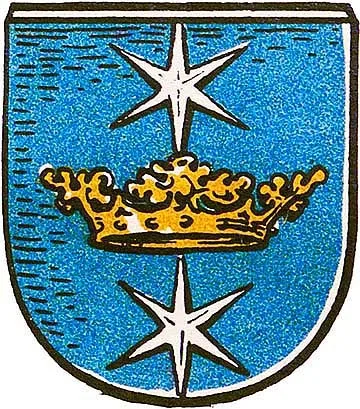
Coat of arms
of Löbenicht.
The residents of the Altstadt can hardly have been pleased to see buildings springing up next to their town, but the German Order (also known as the Teutonic Order) welcomed the birth of new settlements in every way. What is more, their organisers, the locators, were given money and building materials for the purpose, and if a settlement did not grow into a town, the locator became its headman (Schulze) with the right to pass that status on to his heirs. There was still a great deal of "free" land in Prussia, and every village and every town meant extra marks and shillings for the Order's treasury. The Order's territory ran on a simple feudal principle: a commandery, as an administrative unit of the Order, lived largely on its own revenues, most of which came from levies and taxes on the local population, merchants' tolls and fees for patents and privileges. That is why within the bounds of today's Kaliningrad Region there were only four permanent commanderies: Balga (German Balga), Brandenburg (Ushakovo, German Brandenburg), Königsberg (Kaliningrad, German Königsberg) and Ragnit (Neman, German Ragnit). Meanwhile, on a comparable area in the southern part of the Order's state, which is now Polish territory, there could be several times as many commanderies, because the dues from numerous wealthy towns and villages with larger areas of cultivated land made it possible.
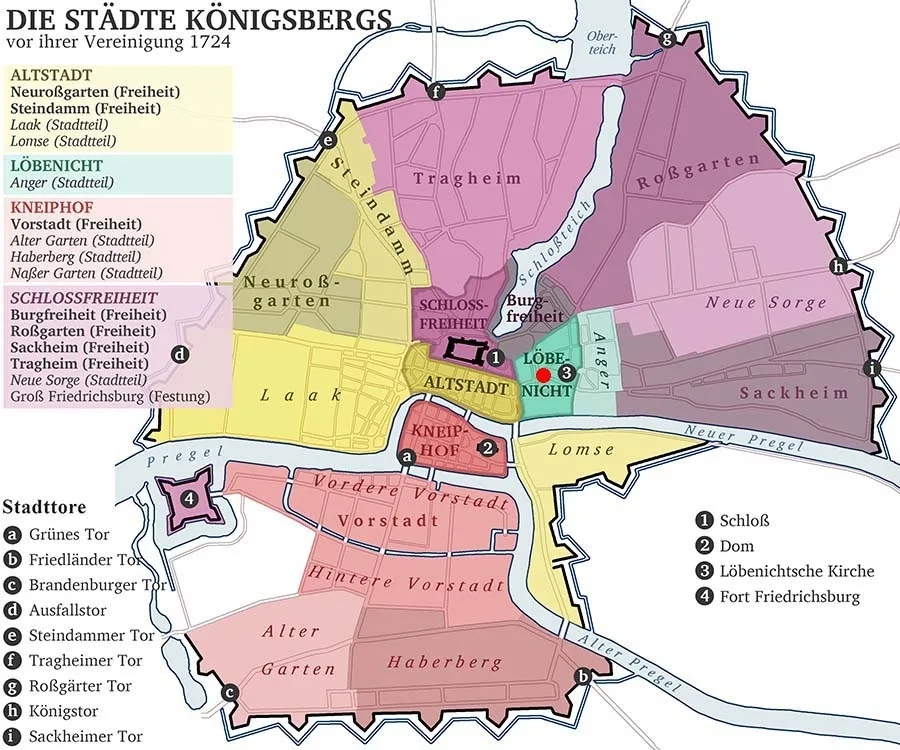
Löbenicht on a reconstructed map of the towns, suburbs and districts of Königsberg before their unification in 1724.
By 1300 the settlement on the eastern bank of the Katzbach had grown so much that its inhabitants petitioned the Order's authorities for town rights. On 27 May 1300 the Komtur of Königsberg, Berthold von Brühaven, granted Löbenicht a charter conferring Kulm town law on it.
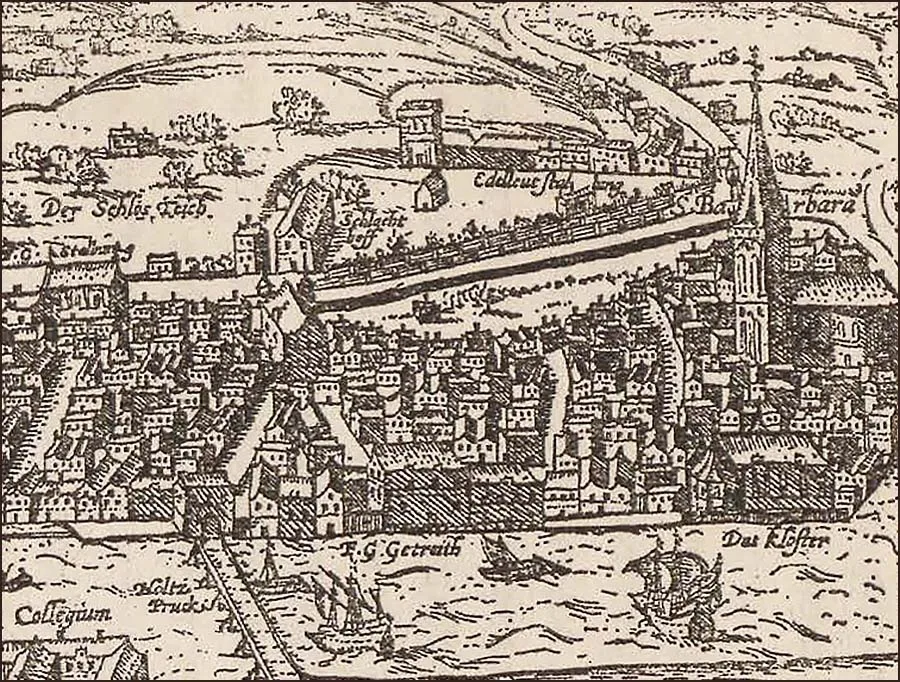 Löbenicht in an engraving by Georg Braun (1580).
And again, as with the Altstadt earlier and the Kneiphof later, there was as yet no talk of any "Löbenicht". A year earlier the new town had been given the plain name Nova civitas, "New Town", or in German Neustadt. It is really from this moment that the first town by the southern wall of Königsberg Castle began to be called the "Old Town" (Altstadt), as opposed to the "New Town". The name Neustadt did not stick, however, and as early as 1338 the town is recorded as Löbenicht, after the old Prussian name of the Katzbach stream, the Löbe. In general, the fact that place names in Prussia often favoured Prussian roots over German or Latin ones shows that the Order's state did not go too far in "Germanising" the native population.
Löbenicht, as befitted a town of that time, had all the necessary attributes and elements: a charter, a coat of arms, a magistracy (town council), a market and a church. Almost at once the town began to acquire defensive walls with gates and towers.
Löbenicht was a vassal of the Order and enjoyed its protection, but in the feudal system self-defence was a necessity and even a duty: the vassal treaty, a role played by the town charter, laid down the town's obligation to maintain fortifications and a town militia. The fortifications seem at first to have been a simple palisade, later gradually replaced by masonry. Matching Löbenicht's old fortifications to today's terrain is no easy task. Only the northern and southern boundaries can be traced clearly: allowing for a small margin of error, they now correspond to Shevchenko Street and the northern edge of the carriageway of Moskovsky Prospekt. The boundary between Löbenicht and the Altstadt ran 50 metres west of the Rosneft filling station on Moskovsky Prospekt and then up the King's Hill exactly along the edge of the paved square in front of the House of Soviets, which is now passing into history. Löbenicht's eastern (outer) town wall would lie in the courtyard behind the Wedding Palace, across the grounds of today's Kindergarten No. 31.
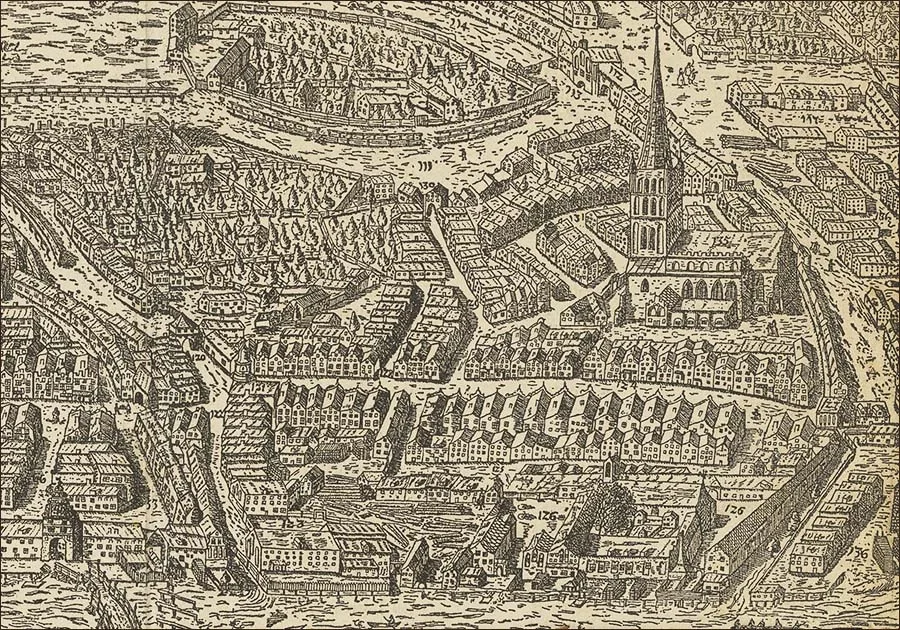 Löbenicht on Bering's plan (1613).
Because Löbenicht lay on a hillside, its streets were curved and did not form a regular rectangular grid as in the Altstadt and the Kneiphof.
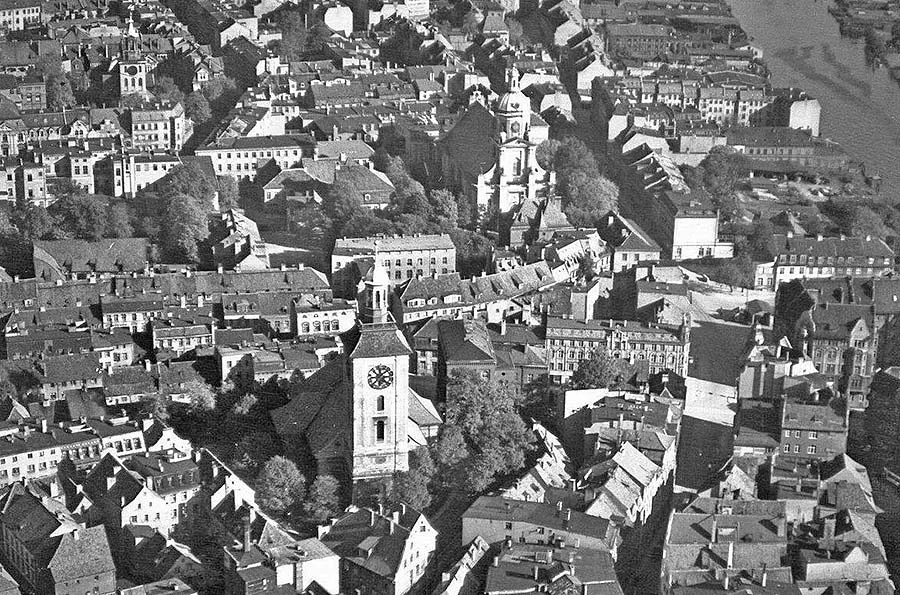 View of Löbenicht from a bird's-eye perspective.
Not a trace remains today of the main street, Löbenichtsche Langgasse (German Löbenichter Langgasse). Today, curving slightly, it would cut the filling station site in half, pass through a tyre shop and come out onto the pavement of Moskovsky Prospekt near the pedestrian crossing. Curiously, in the west it ended opposite the Altstadt street Bergstraße (German Bergstraße), but it ran up against the town wall: there was no gate into the Altstadt at this point. So it continued as the short, crooked street Krumme Grube (German Krumme Grube, literally "Crooked Pit"), through which Löbenichtsche Langgasse joined the main street of the Altstadt, Altstädtische Langgasse (German Altstädtsche Langgasse). Löbenicht's town hall and market square stood at this sharp bend. At its other end Löbenichtsche Langgasse finished at the Kohl-Tor (German Kohl-Tor, "Cabbage Gate"), through which one could reach the suburb of Sackheim (German Sackheim) and further on Tapiau (Gvardeysk, German Tapiau). That is why it was also called the Sackheim Gate. It must not be confused with the Sackheim Gate that stands today in a different place and is no successor to its Löbenicht namesake.
The northern part of Löbenicht, which stood on high ground (the area of today's Wedding Palace), was called the Oberstadt (German Oberstadt, i.e. the Upper Town).
Here the main street was Obergasse (German Obergasse), which led to the Krönchen-Tor (Crown Gate, German Krönchen-Tor). Through this gate one could leave in the direction of Neuhausen (Guryevsk, German Neuhausen). A third gate led north into the Burgfreiheit (German Burgfreiheit), the suburb of the castle, which belonged to the Order and had no town rights. For reasons unknown this gate was named the "Fools' Gate" (Narren-Tor, German Narren-Tor).
To the south Löbenicht was separated from the Pregel by the fishing village of Liep (German Liep) or Lipnick (German Lipnick). This village was also on the Order's land and became part of Löbenicht much later. For the time being, one of the conditions for receiving town rights was, among other things, having no access to the river. Evidently the Altstadt lobby had done its work, persuading the Teutonic administration not to create a rival to them in trade.
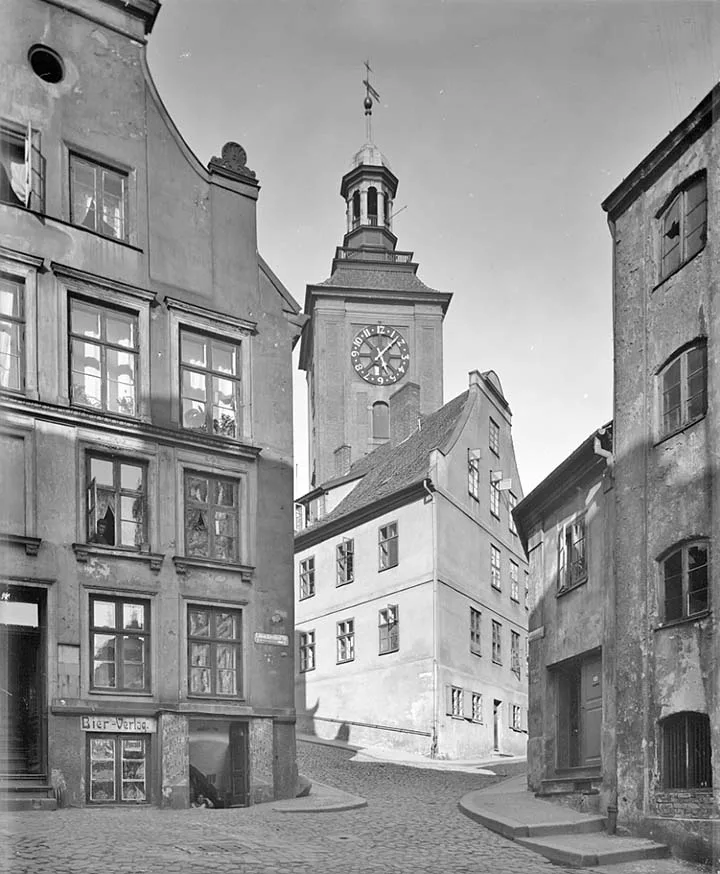
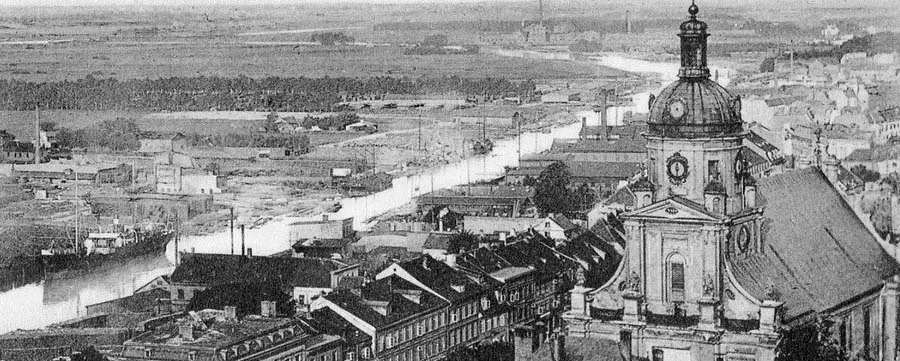
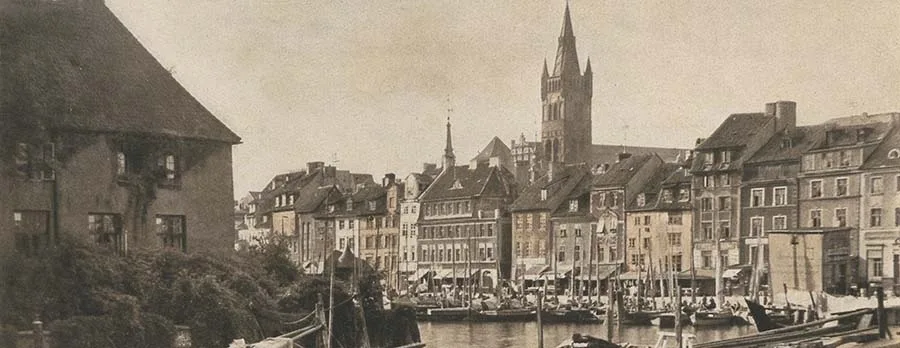
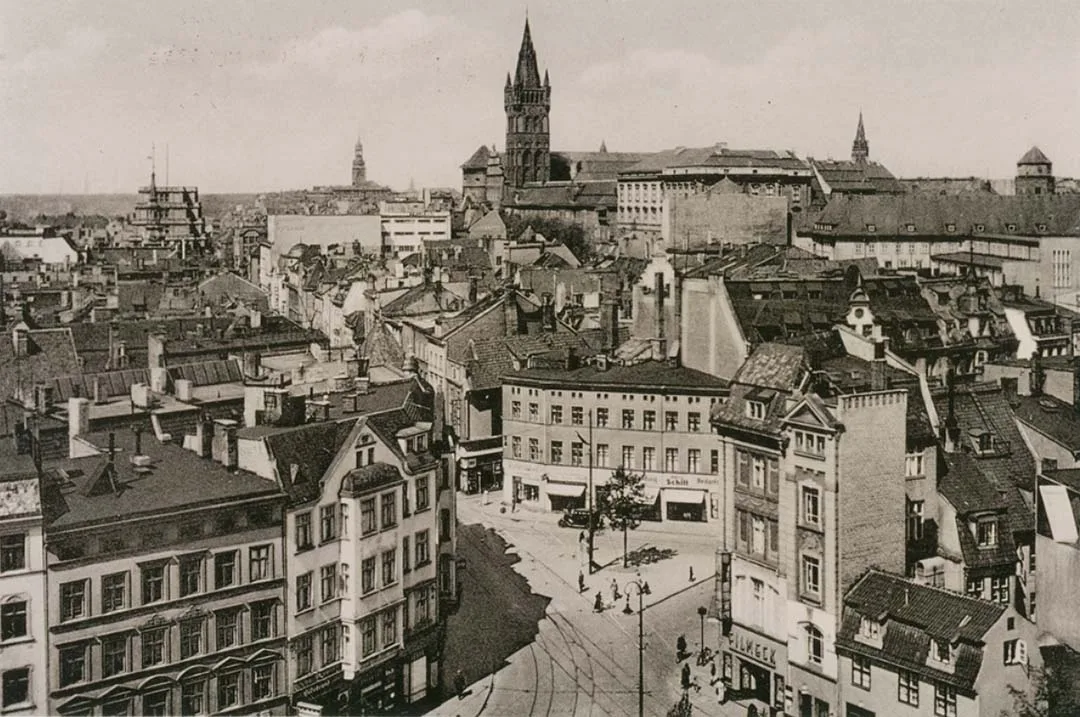
Löbenicht landscape with the spire of St Barbara's.
It should be noted separately that Löbenicht had no fortifications of its own on the side facing the Altstadt. The Altstadt's town wall was at the same time the boundary between the two towns.
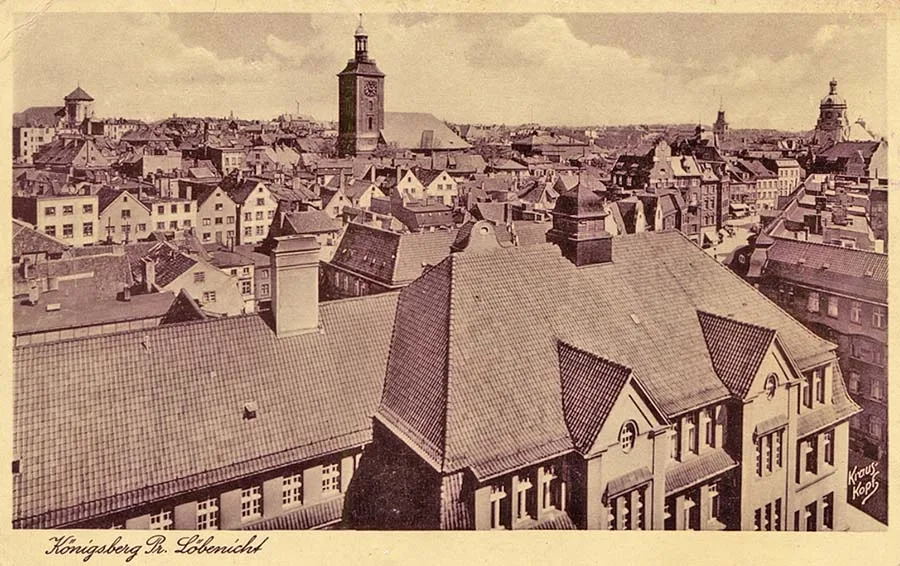 A postcard with a view of the roofs and spires of Löbenicht.
The only gate through which one could pass from the Altstadt into Löbenicht belonged to the Altstadt and was, logically enough, called the Löbenicht Gate. In 1414 the people of Löbenicht began building their houses right up against the Altstadt's town wall. But the Altstadt residents decided that this threatened their security and made a sortie into Löbenicht. The forces were clearly unequal, which is why the history of the Middle Ages has no chapter entitled "The Battle of Löbenicht": the buildings under construction were demolished, but the Order, called in as arbiter, took Löbenicht's side and fined the Altstadt. Disputes between the Altstadt and Löbenicht continued to flare up from time to time, but without armed clashes. Because of its modest manpower, limited economic resources and lesser standing in the Order's circles, these disputes were seldom settled in Löbenicht's favour.
The town church of Löbenicht was built in 1334–52 in the Gothic style, which made it the same age as the cathedral on the Kneiphof island. The church was dedicated to St John the Baptist and St Barbara. St Barbara was especially venerated by the then Grand Master of the Teutonic Order, Luther von Braunschweig (c. 1275–1335).
This Grand Master was known for favouring the building of churches by parishioners in honour of St Barbara, so many of the churches built in Prussia during his rule bore the name Barbarakirche (German Barbarakirche). The Löbenicht church was no exception. Its full name was "Church of St Barbara on the Hill" (German Kirche St. Barbara auf dem Berge).
Perhaps the Grand Master's preferences were taken into account because the patron of the Löbenicht church was the Teutonic Order itself, whereas the Bishop of Samland was patron of the cathedral in the Kneiphof and the cathedral chapter of the church in the Altstadt. We can only guess what the Löbenicht church looked like in the 14th and 15th centuries, but it is known that the tower was built at the same time as the nave, or almost. This was quite rare in local building practice of the time: church towers were then usually built one or two centuries after the main body of the building (the nave). The engraving published in 1581 in Georg Braun's book, however, shows the exterior of the Löbenicht church quite clearly. It can be seen even better on Bering's plan, published in 1613. But it should be borne in mind here that at the end of the 15th century the townspeople enlarged the nave and raised the tower, so the engravings already show it in its rebuilt form. The location of the Löbenicht church in today's Kaliningrad is easy to determine: it stood exactly on the site of the Moskovsky supermarket. So one can state that nothing of it remains, not even the foundations.
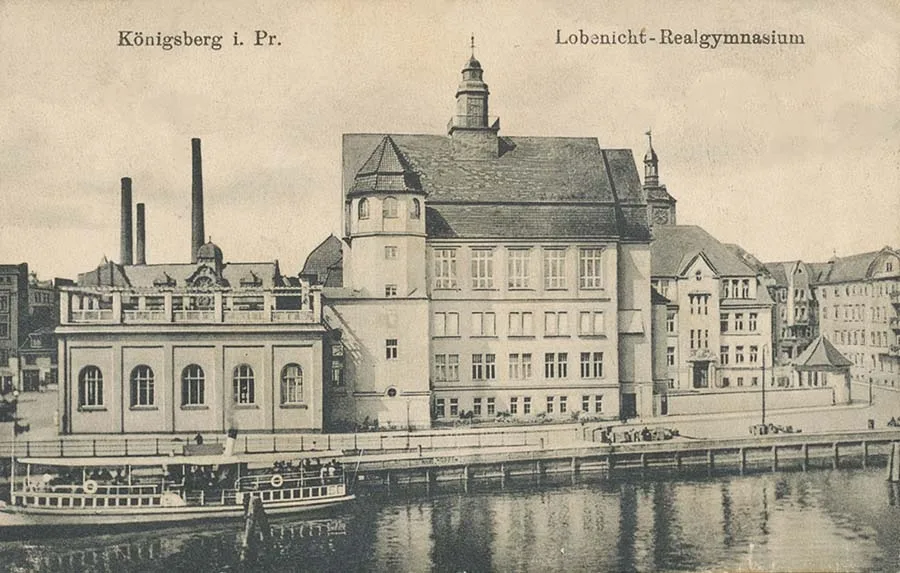 The Löbenicht Realgymnasium was founded in 1441.
In its original form Löbenicht was a very small town even by medieval standards. It measured roughly 270 m from west to east and 240 m from north to south. Nor did the main occupations of its inhabitants make it powerful: they worked in the fields and processed agricultural produce.
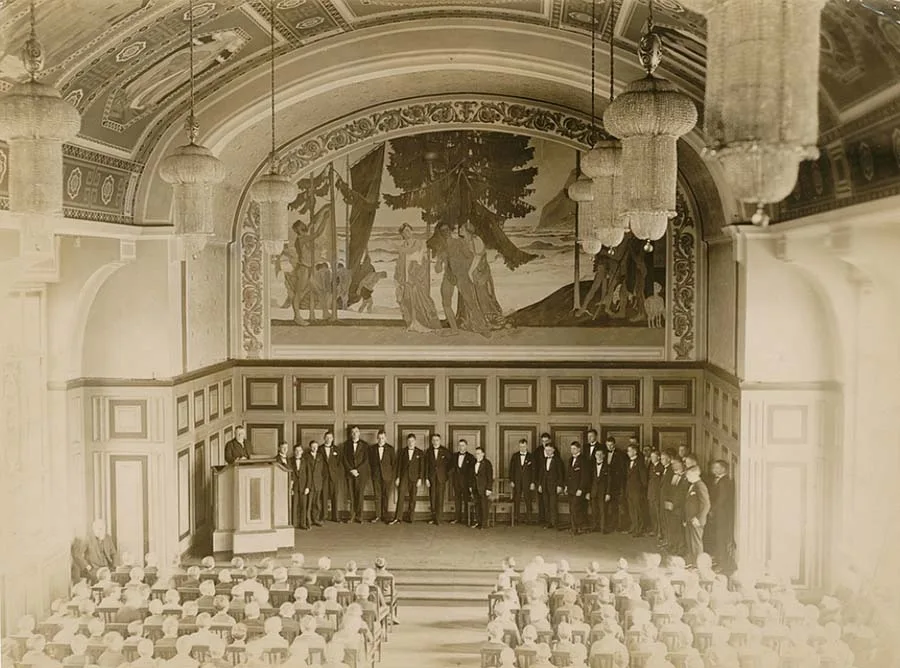 The assembly hall (German Aula) of the Löbenicht Realgymnasium.
There were crafts too, but mainly for the local market. In the 14th–15th centuries the price ratios between goods were quite different from today's: food was very cheap compared with non-food goods, and it was practically impossible to get rich by producing it. Under strict limits on guild production and fixed prices, Löbenicht survived by producing malt for the breweries of the Kneiphof and the Altstadt, and it also had the largest number of breweries of its own of all three towns on the Pregel. It is hard to imagine now, but by the 18th century 86 breweries were operating on this small patch of land!
In 1339 Löbenicht, together with the Altstadt and the Kneiphof, joined the Hanseatic League, of which it remained a member until 1579. Löbenicht undoubtedly derived some benefit from belonging to the league, but on the whole the little town's membership of this trading alliance had no influence either on the fate of the Hansa or on that of Löbenicht itself. In general, Löbenicht always followed the lead of the Altstadt, on which it depended very heavily.
In 1349, at the southern edge of Löbenicht near the fishing village of Liep, Grand Master Heinrich Dusemer von Arfberg (c. 1280–1353) founded a convent, to which an abbess and 12 nuns moved from Kulm (Chełmno, Poland, German Kulm) and Thorn (Toruń, Poland, German Thorn). This place would come to be called Münchenhof (German Münchenhof), meaning "monastery yard".
Next to the convent stood a house (it would not be quite correct to call it a convent) of sisters of the Tertiary Order. These sisters lived by a monastic rule but were laywomen, so they wore grey, which hinted at their "semi-monastic" status. Besides this, in Löbenicht itself there was a pious lay society of women (Beguinae), in which the novices, the "Beguines", led a godly life and lived under the supervision of a mistress in a common sisters' house, but could leave it at any time and marry.
In 1441 a grammar school was opened at the church in Löbenicht. As one might guess, the Löbenicht school too was the smallest compared with similar institutions in the Kneiphof and the Altstadt. It should be said that opening and maintaining a school was entirely the responsibility of the municipal authorities and the parishioners. The Order did not interfere in school affairs, while the clergy around the bishop, on the contrary, did not encourage such initiatives, believing that only schooling under the bishopric's supervision could guarantee that pupils would not be infected with some heresy.
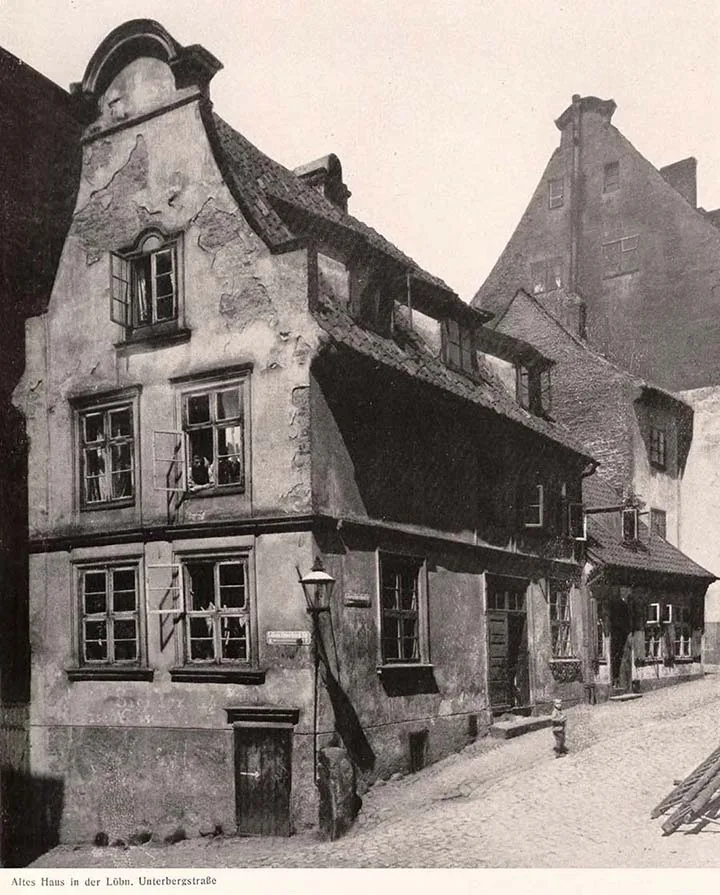
An old Löbenicht house on Unterbergstraße.
When hard times came for the Order after the lost Great War (1409–11), the municipality of Löbenicht, unlike those of the Altstadt and the Kneiphof, did not join the opposition Prussian Confederation and sent no delegates to the Polish king in Kraków to negotiate placing the town under the jurisdiction of the Polish crown.
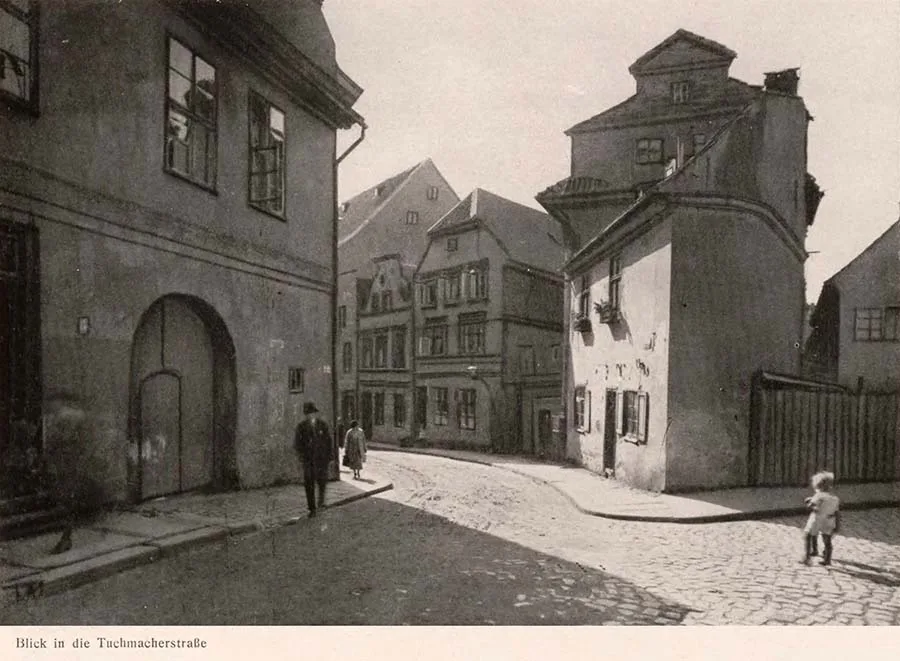 Clothmakers' Street (Tuchmacherstraße).
However, the burgomaster of Löbenicht demanded payment for loyalty from the Order quite firmly:
"The burgomaster and council of Löbenicht-Königsberg petition His Majesty Ludwig von Erlichshausen and the Order for recognition of their [the people of Löbenicht's] rights to fish in the Frisches Haff and the Pregel as far as the 'Holy Forest', and for the grant of woods on the way from Königsberg to Schaaken at the sluice into the 'Priest's Forest' on the hill and by the pond, and also on the Deime near Dodo on this side of Sareppe, as well as the possibility of floating this timber down the Deime, etc. Witnesses: Hermann Stulmecher, burgomaster, Gregorius Bruchman, town treasurer, Andre Tideke, Hans Bluzike, Niklus Balav and councillor Hans Stulmecher. Tapiau, 1450."
And when the plenipotentiary of the Polish king, Chancellor Johann von Konecpole (Jan Taszka Koniecpolski, Polish Jan Taszka Koniecpolski, d. 1455), arrived in Königsberg, the burgomaster of Löbenicht, Hermann Stulmecher, signed an oath to King Casimir IV of Poland along with other town heads. But the Löbenicht guilds remained faithful to the treaty with the Order, and in 1455, together with the Altstadt, Löbenicht fielded its small militia to help the Order's Komtur Heinrich Reuß von Plauen (c. 1400–1470) besiege the rebellious Kneiphof.
In 1506, with the permission of the penultimate Grand Master in Königsberg, Friedrich von Sachsen, Löbenicht at last acquired its first territories outside the town. In Russian the words best suited to describe them are "sloboda" or "predmestye" (suburb), while in German they are called Freiheit, which translates literally as "freedom".
Incidentally, the Russian word "sloboda" also derives from the word "svoboda", "freedom". Such suburbs were originally used for economic activity; later, houses were built in them as well. Löbenicht's first two such suburbs were the Anger (German Anger) to the east of the town and the Stegen (German Stegen) to its south-east. The Anger was used mainly for processing and storing agricultural produce, and the Stegen for procuring and working timber. As both suburbs directly adjoined Löbenicht, they de facto extended the boundaries of the town itself. Löbenicht's eastern boundary now ran along Landhofmeisterstraße (Sergeya Tyulenina Street, German Landhofmeister Straße), and in the south-east the town reached the Pregel near today's Regional Youth Culture Centre (Moskovsky Prospekt 60–74).
In 1521 Münchenhof received a third monastery on its grounds, this time of Franciscan friars, who moved here from near Wehlau (Znamensk, German Wehlau). The friars had left Wehlau as early as 1517, but found a permanent home near the convent only four years later.
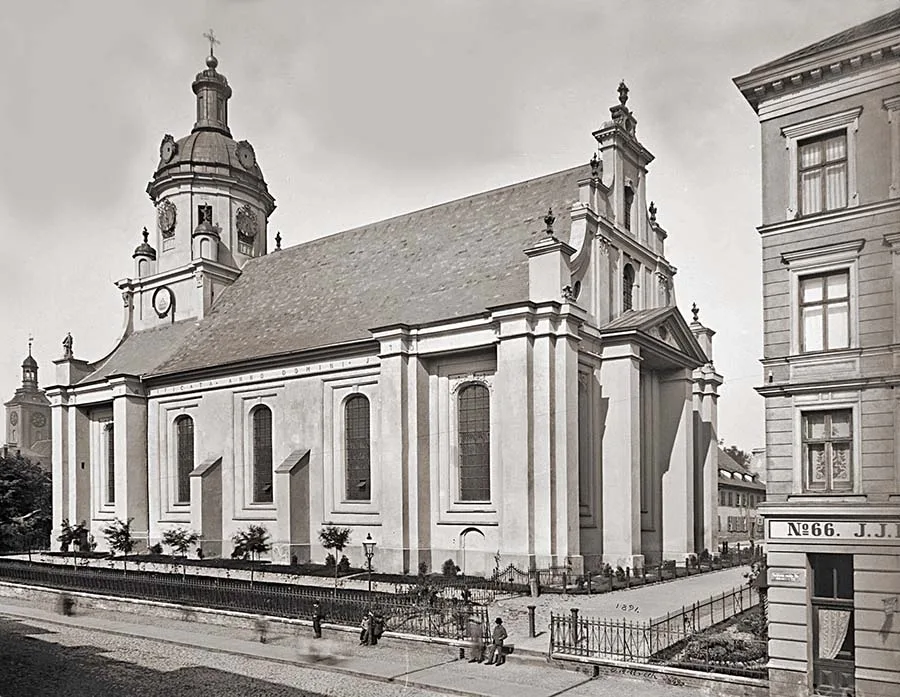 Königsberg's Catholic church stood on the border between Löbenicht and Sackheim.
As later events showed, however, they had settled here in vain, for the Reformation was already knocking at Königsberg's gates.
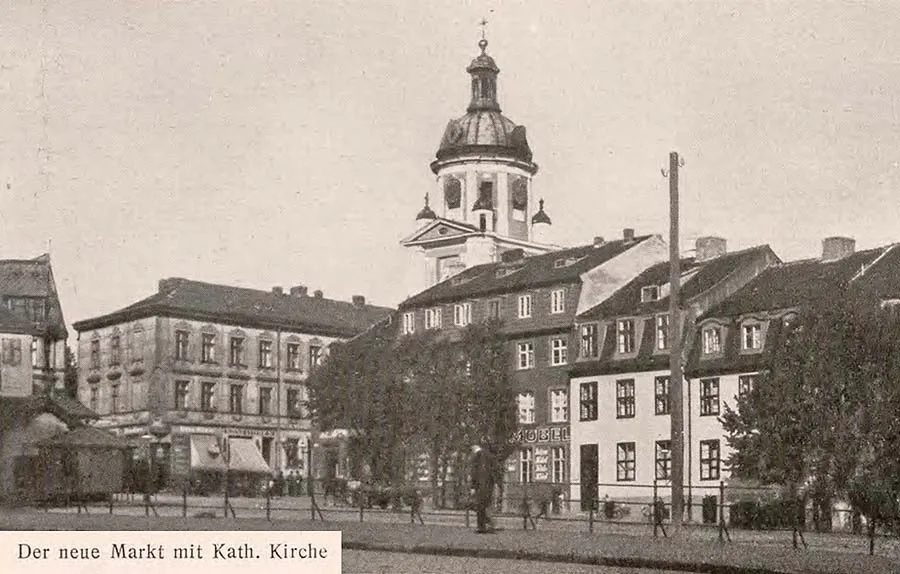 The New Market on the bank of the Pregel and the Catholic church.
The Löbenicht parish went over to Lutheranism a little later than the other two towns on the Pregel. This happened in 1524 during an Easter sermon by the evangelical preacher Johann Amandus (d. 1530), in which he set out the fundamentals of Luther's teaching and proposed getting rid of the icons in the church at once. As everywhere in Königsberg, the people of Löbenicht adopted Protestantism with surprising ease. Almost immediately afterwards the monks and nuns had to leave the local monasteries, since monasticism was contrary to the spirit of Lutheranism. The pious union of "Beguines" mentioned above supported the move to Lutheranism and was itself recognised as fully in keeping with the theses of Martin Luther's teaching. The expulsion of the friars was very noisy and even came to physical violence. But this was probably the only incident of its kind in the transition from the Pope to Luther.
In 1531 the monastery buildings were converted into a hospital which, because of its considerable size, came to be called the Great Löbenicht or Great Royal Hospital (German Das Große Königlich Hospital). Löbenicht's church school was then turned into a Latin school, and its teachers were now evangelical theologians. In 1580 a new building was opened for the school, but even among the town's local Latin schools the Löbenicht one remained the smallest.
It should be noted here that in the first century of Lutheranism its adherents were more intolerant of any kind of heresy or doubt than the Catholics. To a Lutheran, a Calvinist or an Anabaptist was no brother in Protestant outlook but a heretic worse than a Catholic. In 1543 the pastor of the Löbenicht church received an unusual assignment from Duke Albrecht: he was to examine all the Dutch who had settled in the town on their true understanding of the Gospels. Local residents were strictly forbidden to let any accommodation within the town limits to those who had not passed this "test". Those who passed, on the other hand, were enrolled in the Löbenicht parish, which, given the prosperity and enterprise of the Dutch settlers, undoubtedly benefited the town. In addition, many suburbs that did not belong to Löbenicht were assigned to the Löbenicht church, for example Tragheim (German Tragheim), Rossgarten (German Roßgarten) and Sackheim (German Sackheim). They separated from the Löbenicht congregation only when they acquired parishes of their own: Rossgarten in 1623, Tragheim in 1633 and Sackheim in 1648.
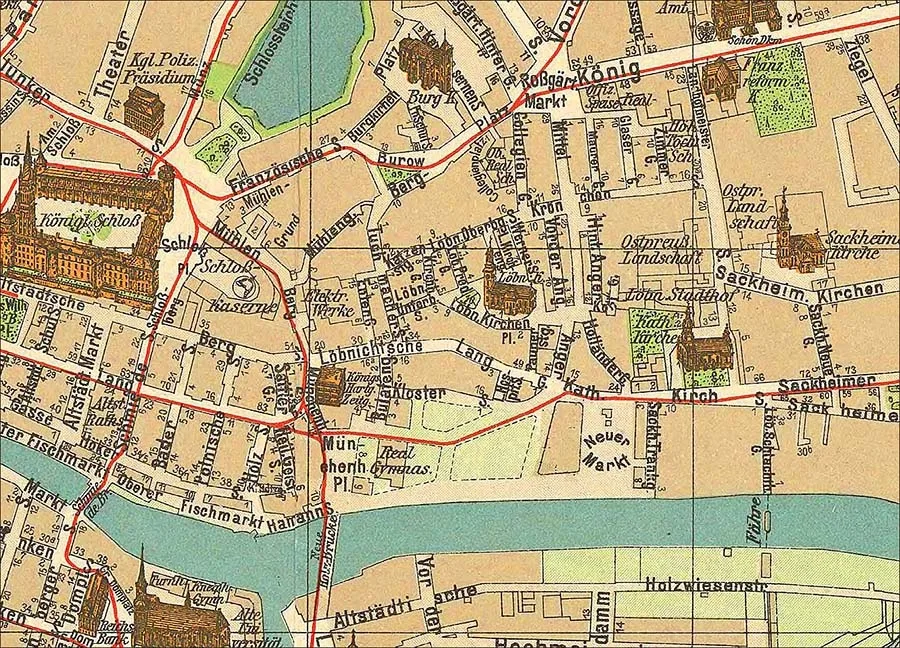 Löbenicht on a map of Königsberg from the early 20th century.
In 1609 Johann Sigismund, Elector of Brandenburg, who governed Prussia as regent, granted Ponarth (the Dimitrovo district of Kaliningrad, German Ponarth) to Löbenicht. Unlike the Anger and the Stegen, this was no longer a suburb but a so-called Kammerdorf (German Kammerdorf), that is, a village belonging to the treasury, in this case Löbenicht's.
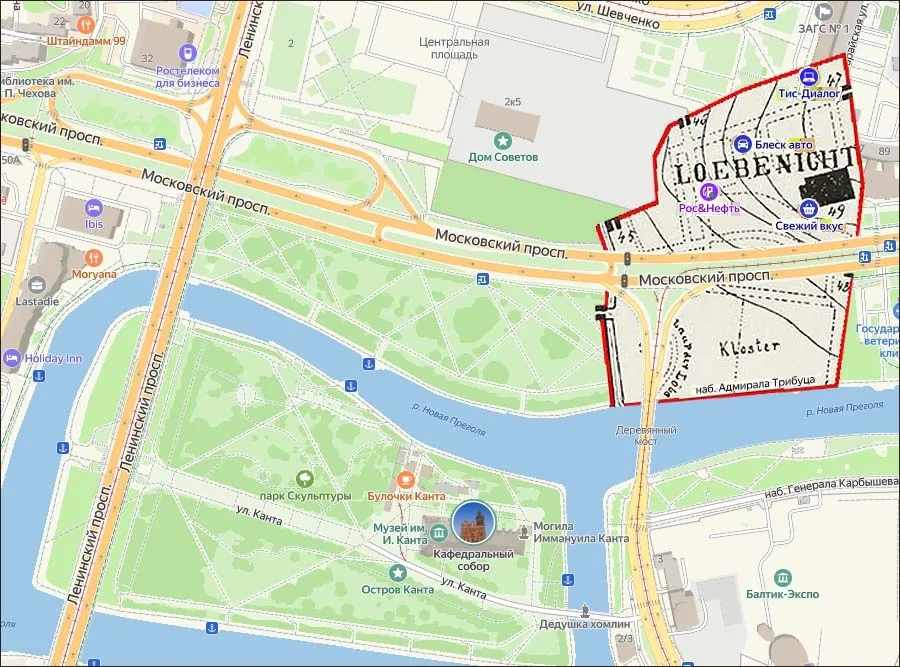 16th-century Löbenicht on a modern Yandex map of Kaliningrad.
Here the town acted as a subject of feudal law and could levy rent for the use of land or dues in kind on the peasants. Small treasury holdings (estates) were most often simply leased out, bringing income to the town treasury. In the 17th century Löbenicht also leased land in the ducal Freiheit of Neue Sorge (the area of today's Frunze Street, German Neue Sorge).
For practically the whole of the 17th century town life went on under wartime conditions. Troops did not enter Königsberg, Löbenicht included, but the Thirty Years' War (1618–48), the Northern War (1655–60) and the Scanian War (Danish-Swedish, 1675–79) took their economic toll on the three towns on the Pregel. During these wars an important event took place: in 1626–30 the three towns, their suburbs, the castle and the ducal lands acquired common earthen rampart fortifications. The old town fortifications lost any purpose, and the area enclosed by the rampart and bastions determined the limits of Königsberg's development for almost 300 years to come. All these changes were, of course, ultimately paid for out of the townspeople's pockets. A whole century of wars was followed in 1709–11 by a terrible plague epidemic that swept through Löbenicht, as through the rest of Prussia.
One in four inhabitants of the town died, and funeral services were no longer held even at the cemetery: plague pastors merely said short prayers over the common pits.
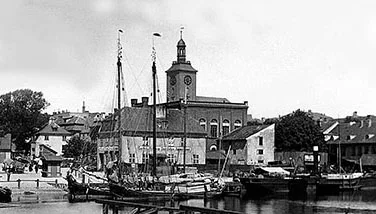
The state gave the towns ruined by these disasters funds to pay off their debts and restore their economies. The chronicles of the time note that of all the towns of Königsberg only Löbenicht spent the money wisely, settled its debts and put town life back in order. The municipalities of the Kneiphof and the Altstadt, meanwhile, got bogged down in disputes and squabbles among themselves and with representatives of the state, contesting former privileges and demanding new ones. All this was one of the reasons (though not the only one) that prompted King Frederick William I to unite the three towns on the Pregel in 1724 into a single "Royal Prussian Capital and Residence City of Königsberg". The Löbenicht magistracy, greatly reduced in size, moved into the Altstadt town hall, which now became the town hall for the whole city. Löbenicht's own town hall, now vacant, was let in 1731 to the printing house of the publisher Hartung, which later became the famous publishing company Gräfe und Unzer. Löbenicht had to hand over its fortress artillery. Weapons were left only to the marksmen's guild, which embodied the former town militia, but by now mostly for ceremonial parades.
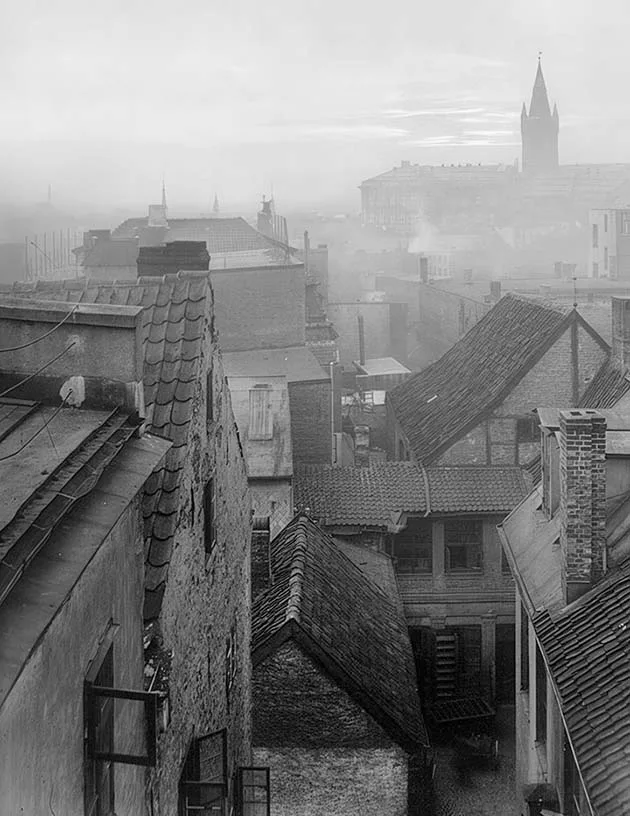
Morning view from Löbenicht towards the castle.
At about seven o'clock in the evening of 11 November 1764, as the investigation later established, embers were left burning in a boiler on one of the merchant ships under repair in the Lastadie. The ship caught fire, and several warehouses (Speicher) went up in flames from it.
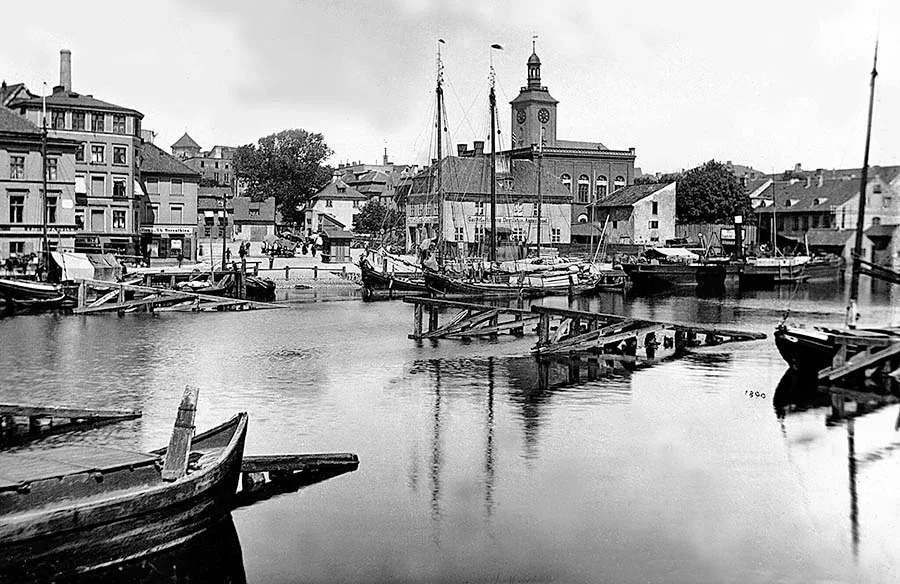 View of Löbenicht from the Pregel.
That day a hurricane-force wind was blowing from the sea. It drove the fire towards the city centre, where it burned down several houses in the Kneiphof and the Altstadt, and the worst blaze broke out in Löbenicht. Almost the entire town burned down, including the town hall with the printing house and the church. The church tower collapsed and destroyed the school next to it. The Löbenicht Hospital burned down. The fire in Löbenicht raged for a day and a half and was put out only by seven o'clock in the morning of 13 November. Many of the houses were beyond repair. The Löbenicht Hospital and its church were rebuilt only by 1770. The Löbenicht church had to be dismantled. It was completely rebuilt in 1776 in the Baroque style to a design by Johann Ernst Löckel. A new building was also put up for the school. The Great Fire of 1764 brought two innovations to Königsberg: in 1770 fire brigades were set up in the town districts and suburbs (which were joined to Königsberg only in 1809), and in 1782 an ordinance was issued banning the construction of half-timbered buildings in the city.
In 1811 the Löbenicht school passed from church to municipal administration. In 1855–59 a new building was put up for it on Münchenhofplatz (German Münchenhofplatz). The memorial to the Baltic sailors on Moskovsky Prospekt now stands where it used to be. In 1865 the school received the status of an Oberrealschule (German Oberrealschule), and in 1882 that of a Realgymnasium (German Realgymnasium).
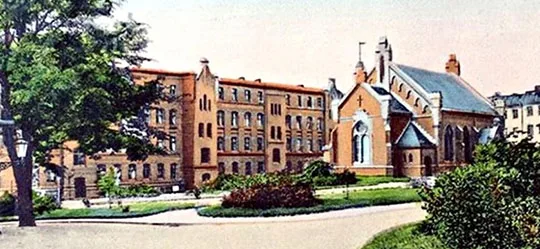
In 1901 a new building was erected on Landhofmeisterstraße (Sergeya Tyulenina Street, German Landhofmeisterstraße) for the Queen Louise Girls' School (German Konigin-Luise-Schule). In 1903 a municipal school was built next to it on Glasserstraße (German Glasserstraße); in 1921 it was named after Bessel.
In 1903 the dilapidated buildings of the Löbenicht Hospital were demolished. A new complex of buildings was built in Sackheim on Heidemann-Straße (Cherepichnaya Street, German Heidemann-Straße), but it kept the name "Löbenicht". The entrance portal of the old hospital (late 18th century) was preserved and moved to the new site in Sackheim, where it can be seen to this day (see below).
Löbenicht was one of the first districts to get proper public transport. First a horse tram ran along Löbenicht's northern boundary; its routes No. 3 and No. 6 ran along Schiferberg (part of Shevchenko Street, German Schiferberg) and Königstraße (Frunze Street, German Königstraße). Then, on 31.05.1895, Königsberg's first tram route was opened. Its terminus was on the New Löbenicht Market (now Moskovsky Prospekt 60–68).
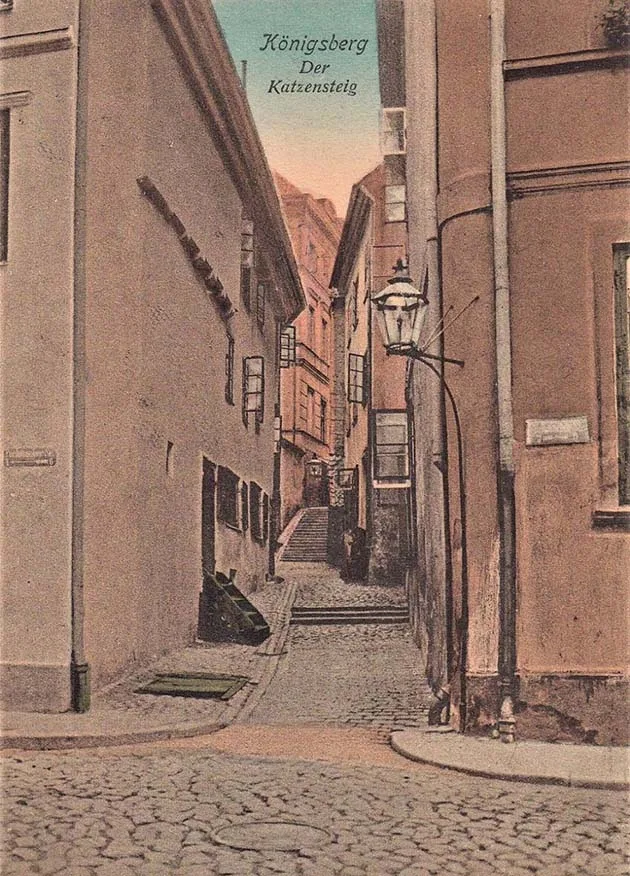
Katzensteig, the narrowest street in Königsberg.
On 12 December 1890 the first municipal power station went into operation on the Katzbach stream at the western edge of Löbenicht; its electricity was used for the tram network. In 1895 Königsberg's first tram depot also began operating there.
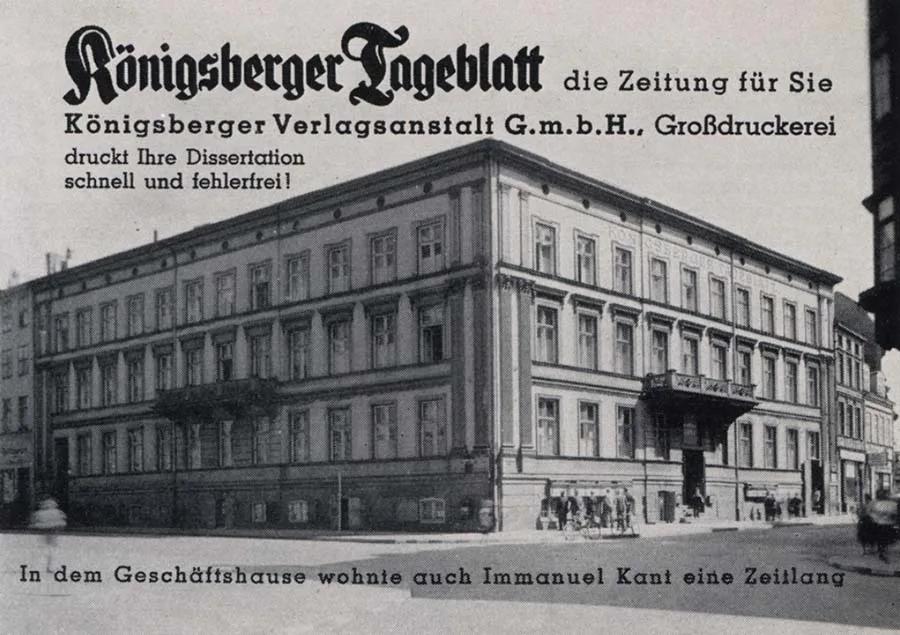 "Have your dissertation printed freely and quickly! — so the newspaper Königsberger Tageblatt advertises its services. — Immanuel Kant lived in the printing house building for some time."
By 1926 the tram was running along the eastern boundary of the former town of Löbenicht, Mittelanger Street (the courtyard behind the Moskovsky supermarket, German Mittelanger). As of 1939, routes No. 1 and No. 11 ran here.
Pre-war Löbenicht was captured in a great many photographs. Yet looking at them, one still feels that something has been missed. The narrow, crooked lanes and dense buildings made it impossible to take in the whole setting of the old town at a glance. And although in Löbenicht, as in the centre of Königsberg in general, no houses from the Order period remained, it was Löbenicht that most closely matched the established image of a medieval town. The Löbenicht lane Katzensteig (German Katzensteig, see above) was considered the narrowest street in Königsberg. Its name can be translated as "Cat's Climb", although Russian street naming for some reason uses the word "spusk" ("descent") for sloping streets. No one could have imagined that all this would soon turn to dust…
30 August 1944 was the last day of Löbenicht as such. The night raid by the Royal Air Force, which dropped 480 tonnes of incendiary and high-explosive bombs on the historic centre of Königsberg, caused a fire that was catastrophic for the city, and Löbenicht burned in it.
It lay at the epicentre of the bombing and, judging by aerial photographs from autumn 1944, burned out completely. Only a few houses collapsed from the fire, but all the others were turned into sooty shells without roofs, floors, windows, doors or furnishings. Together with other buildings, the Löbenicht church burned with all its furnishings. The post-war memoirs of Löbenicht residents say that it was here that the aftermath of the fire made the most depressing impression: the crooked lanes with their dead houses crushed people's spirits. Residents wandered aimlessly, as if mad, through the ashes, where nothing that could burn was left. The ruins smouldered, and the wind strewed ash over the cobbles.
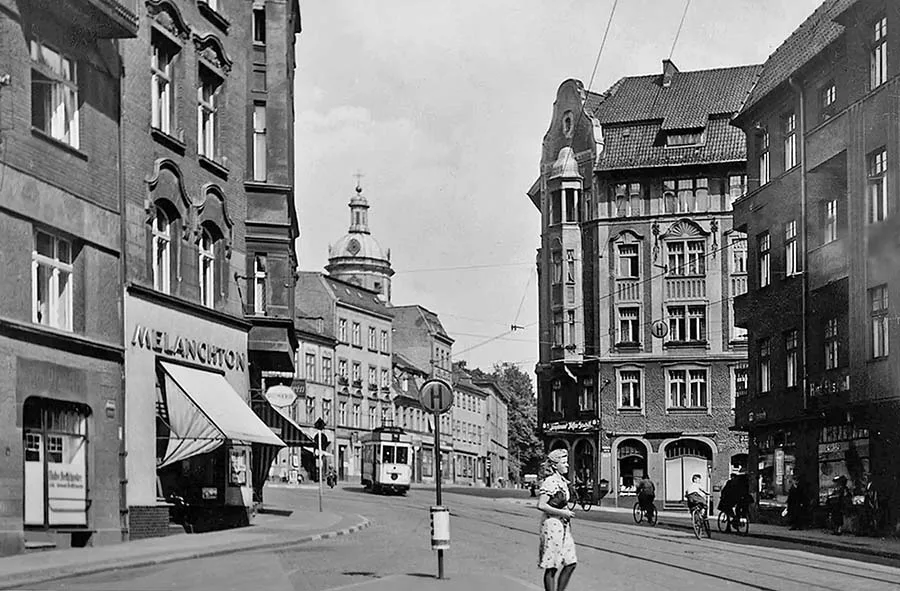 Pre-war Löbenicht in the 1940s.
The storming of the city added to the destruction of Löbenicht. During the day on 9 April 1945 units of the Red Army advanced from the Sackheim and King's Gates towards the castle.
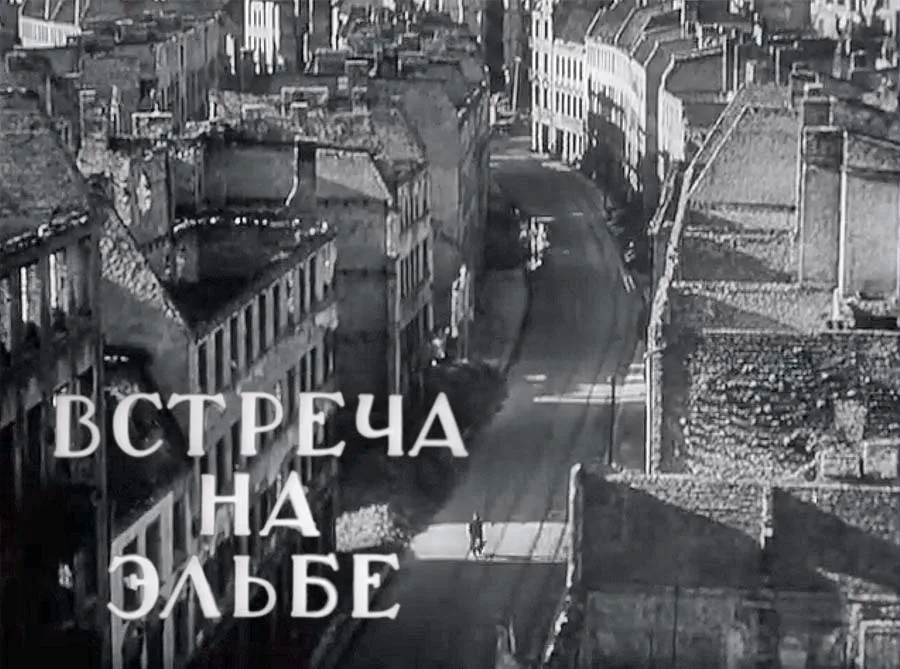 Löbenicht's Long Street in the film "Meeting on the Elbe" (dir. Sergei Eisenstein, 1949).
Löbenicht lay geographically in their path, and although by then the resistance of the Wehrmacht soldiers and Volkssturm men was scattered, with no unified command of the defence, local fighting for houses and blocks undoubtedly contributed to the destruction of the town's buildings.
After the fighting ended, Löbenicht fell within the area under the 1st Commandant's Office of Königsberg (the 1st district). Documents of the time describe this district, which covered the central and oldest part of Königsberg, as the least suitable for housing the quartered soldiers and officers, civilian specialists and local population. Nevertheless, by order of the commander of the Special Military District, Colonel General K. P. Galitsky (1897–1973), several streets of Löbenicht received Soviet names, though all of them lay either in the historic Anger or along the boundary of Löbenicht.
The list of renamed streets is short: Schiferberg (German Schiferberg) became part of Smolenskaya Street, Krönchenstraße (German Krönchenstraße) was renamed Onezhskaya Street, Mauerstraße (German Mauerstraße) became 1st Volskaya Street, Glasserstraße (German Glasserstraße) became 2nd Volskaya Street, and Zimmerstraße (German Zimmerstraße) became 3rd Volskaya Street.
In addition, Mittelanger (German Mittelanger) became Zaraiskaya Street, and Landhofmeisterstraße (German Landhofmeisterstrße) became Sergeya Tyulenina Street. Today only Tyulenina Street is still in its original place. Before the war it was the boundary of the Anger. The strange Zaraiskaya Street, which today does not even look like a street, actually lay in the courtyard behind the Wedding Palace, built later. After a block of nine-storey buildings (the Wedding Palace and the Moskovsky supermarket) was built in the 1970s, the street was moved to a new location. Smolenskaya Street, in altered form, was renamed Shevchenko Street, and its part in the north of former Löbenicht became the beginning of Frunze Street. 1st, 2nd and 3rd Volskaya Streets and Onezhskaya Street are now nameless driveways near the Music College (Frunze Street 4). They can still be made out on the ground, but it is very hard now to imagine that they were once real streets.
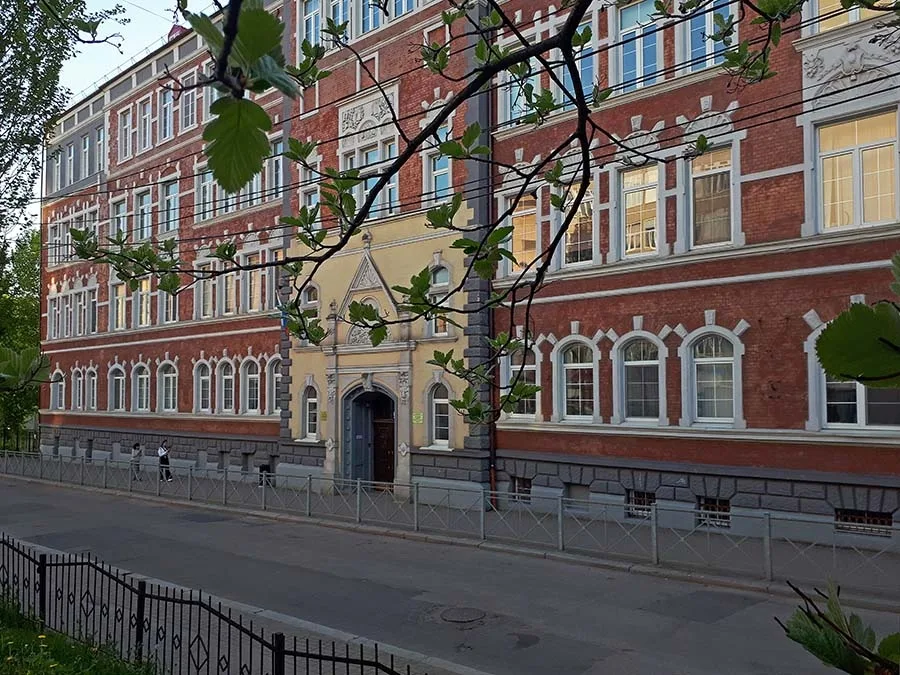 School No. 41 on Sergeya Tyulenina Street was once the Queen Louise Girls' Grammar School.
In 1949 Sergei Eisenstein's film "Meeting on the Elbe" was shot in Königsberg. The film includes footage of ruined Löbenicht.
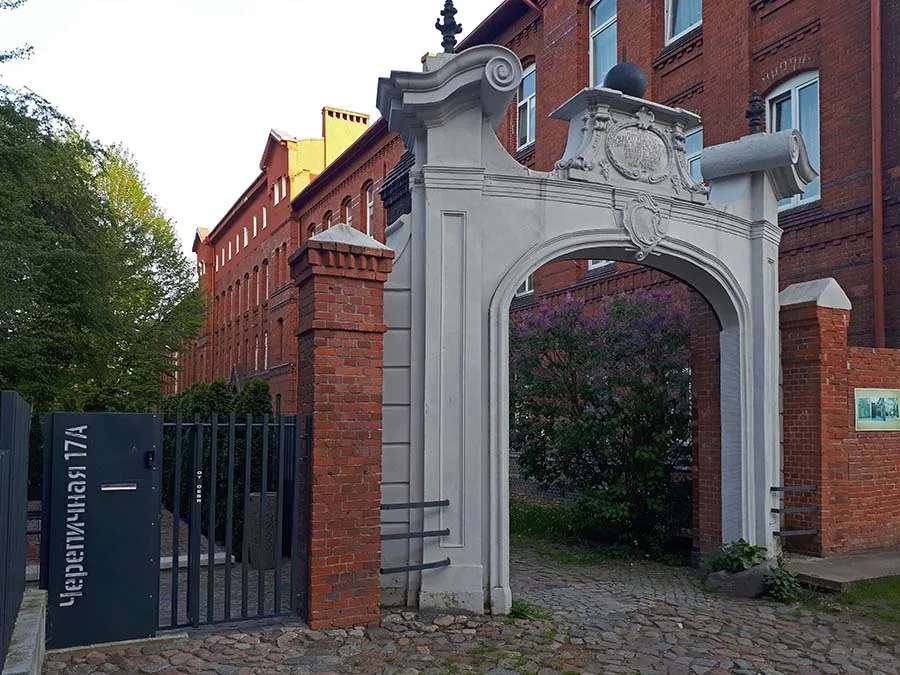 The portal of the Löbenicht Hospital on Cherepichnaya Street.
Contrary to the many mentions of the ruined building of the Löbenicht church being demolished in the 1970s, aerial photographs from 1966 clearly show that by then there were no remains of it rising noticeably above ground level. On the territory of historic Löbenicht (without the Anger, Münchenhof and the Stegen) there were no buildings at all, apart from the ruins of the power station on the western boundary of the former town. In the other part of the Löbenicht district stood the damaged buildings of the Bessel School (now the Music College) and the Queen Louise Girls' School (School No. 41 opened here in 1961), a couple of small houses in the Anger (demolished in the 1970s), and, standing apart, the huge ruins of the Löbenicht Realgymnasium (demolished in the 1970s). One can therefore state that historic Löbenicht was completely destroyed by the war and by the work of clearing the rubble.
When imagining the possibility of rebuilding it after the war, one must take into account not only the state of the ruins but also the technical level of the construction industry of the time and, most importantly, the social and political situation.
And then it becomes clear that Löbenicht had no chance at all. Until the earthen slope from the House of Soviets down to Moskovsky Prospekt was paved over with asphalt in 2018, artefacts still surfaced from the ground there after rain and runoff: fragments of stamped bricks, square nails, ceramic beer-bottle stoppers. In the courtyard behind the Moskovsky supermarket lie several dozen granite boulders, possibly remains of the foundations of the Löbenicht church. In the Anger one can see the restored buildings of the Bessel and Queen Louise schools. If you walk on into Sackheim, at the crossroads of Lesopilnaya and Cherepichnaya Streets you can see the recently restored entrance portal of the old Löbenicht Hospital. And that is all. All we have left are photographs of the narrow, crooked, but oh so charming Löbenicht lanes. Then again, roughly half of the historic centre of Königsberg is an empty, nominally green area. And perhaps the history of Löbenicht has merely been put on a long pause.
Illustrated with photos from the East Prussia Photo Archive and by Mikhail Ogorodnikov.
– – – – – – – – –
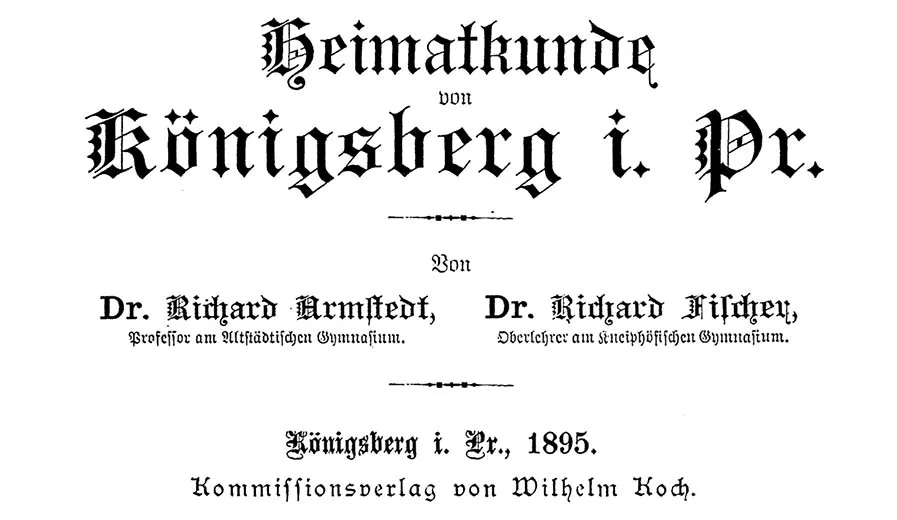
The chapter "Löbenicht"
from the book by local authors "Königsberg Local History",
published at the end of the 19th century
In 2012–2014 "Pregolya", the literary and art supplement to the "Baltic Almanac", published
a translation, by an unknown translator, of the book by the Königsberg authors Dr Richard Armstedt, professor at the Altstadt Gymnasium, and Dr Richard Fischer, senior teacher at the Kneiphof Gymnasium, "Königsberg Local History" ("Heimatkunde von Königsberg i. Pr.", 1895, Kommissionsverlag von Wilhelm Koch, Königsberg). The idea for the publication belonged to Igor Vladimirovich Afonin. The text was adapted and annotated by Aleksey Borisovich Gubin and Igor Fyodorovich Avtukhov. That book had a separate chapter on Löbenicht. Having edited it substantially, we present it to you as a supplement to the text by
Aleksey Yevgenyevich Petrushin.
– – – – – – – – –
Der Löbenicht
Löbenicht, the second oldest of the three towns of Königsberg, received town rights from the Order's Komtur Berthold Brühaven (Berthold von Brühaven) on 27 May 1300.
The coat of arms of Löbenicht: a gilded crown with two golden stars above and below on a blue field; two angels serve as supporters; the crown is the symbol of King Ottokar, and the stars may recall the knight-brother von Dobrin (Ritterbrüder von Dobrin), who came to Prussia with the Teutonic Order (Deutscher Orden) and bore on his coat of arms a red sword with a star.
The town's first name was Neustadt (Neustadt), which in Russian means New Town (in short, Novgorod), as opposed to the Altstadt (Altstadt), whose name translates as Old Town. Löbenicht, the present name, very probably derives from the name of a tiny rivulet, the Lebo (Lebo), later called the Cat Stream (Katzbach). The Upper German word "Löbenicht" (Löbenicht) or "Löbenick" (Löbenick) may mean "Place on the Löbe" (Ort an der Löbe).
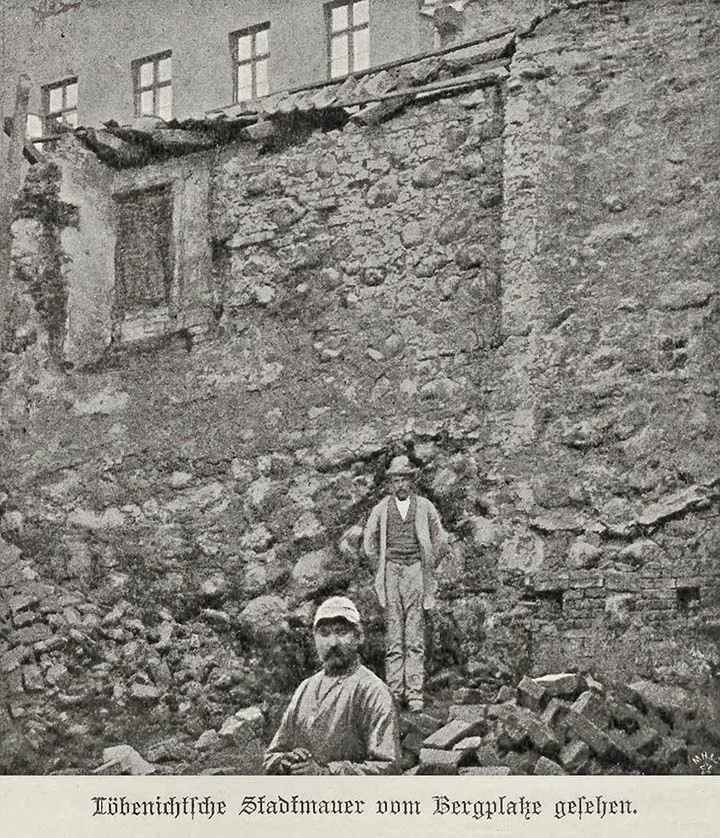
View of the Löbenicht town wall from the Hill Square (Bergplatz, 19th century)
The name Königsberg, which originally covered only the castle together with the Altstadt, came to include Löbenicht and the Kneiphof (Kneiphof) only in 1506, by decree of Grand Master Friedrich von Sachsen (Friedrich von Sachsen, 1474–1510).
Löbenicht had its own fortress walls protecting the town on the north and east. In the west the defensive function was performed by the Altstadt fortress wall that separated the towns. On the south the Pregel was a natural defence against hostile invasion. The walls had no towers, but there were four gates: the Mill or Castle Gate (Mühl- oder Schloßthor), the "Crown" Gate (Krönchenthor), the Sackheim Gate (Sackheimer Thor), and the Clothmakers' Gate, also known as the Fools' Gate (Tuchmacher- oder Narrenthor).
The Mill, or Castle, Gate stood in the north-west at the foot of the Mill Hill between Löbenicht and the castle. The town musicians lived in this gate.
The Clothmakers' Gate closed off Clothmakers' Street (Tuchmacher Straße) at its northern end; the road through it led into the Burgfreiheit (Burgfreiheit, the Castle Liberty). Its popular name was the Gate of Fools (Narrenthor, which translates literally from German as "Fools' Gate"; however, the name of this gate most likely came from another word beginning with the same letter, Nahrung, meaning "food"). This gate, which protected the town on the north, disappeared in 1753.
The Sackheim Gate stood at the eastern end of Löbenicht Long Street. Passing through it, one reached the suburb of Sackheim. The Sackheim Gate stood until 1755.
In 1809 the fortress walls around Löbenicht were demolished.
The "Crown" Gate (Krönchen, "little crown", a diminutive) outlived them and held out longest of all (until 1814). This gate stood where the lane of the same name (Krönchengasse) meets Upper Hill Lane (Oberberggasse). Through it a road ran along the hill to the suburb of the Anger (Anger).
Since time immemorial Löbenicht has been divided into two parts: the Hill Town (Bergstadt) and the Lower Town (Unterstadt). The town's main street, Löbenicht Long Street (Löbenichtsche Langgasse), runs from the former Crooked Ditches (Krumme Gruben) to the old Sackheim Gate (alter Sackheimer Thor). Parallel to it, to the south, runs Monastery Lane (Klostergasse), and to the north Upper Hill Lane (Oberberggasse), formerly called Broad Hill Lane (Breite Berggasse).
The town's narrow lanes connect its main streets; the most important of them are Bullatengasse (Bullatengasse), which leads from Löbenicht Long Street to Monastery Yard Square (Münchenhofplatz), and Clothmakers' Street (Tuchmacherstraße), which climbs steeply from the Langgasse. Along it one can go up the hill that rises in the northern part of the town, where Löbenicht borders on Rossgarten (Rossgarten).
A terrible fire broke out in Löbenicht in 1764. It started on the Altstadt Timber Meadows (Altstädtische Holzwiesen), on the opposite bank of the Pregel. The flames quickly leapt to the north bank of the river, reducing Löbenicht and Sackheim entirely to ashes.
369 houses and 49 warehouses burned down, and 27 people died in the fire. The damage caused by the fire was estimated at between 4 and 5 million thalers (Thaler).
Despite the substantial financial aid given by Frederick the Great* (Friedrich der Große, 1712–1786) to the people of Löbenicht who had suffered, the town was rebuilt slowly, and houses were built as economically as possible. The old foundations were reused. This explains why the old network of crooked, narrow lanes survived, as did the style of the houses, most of which had their own breweries, which meant a room for selling the finished product and a cellar for storing it. Because of their narrow façades, the buildings extended far back into the yard, and people lived in poorly finished rooms without the most basic amenities. It is worth remembering this when strolling along the narrow Langgasse and trying to picture life there in former times.
Brewing was of special importance to the people of Königsberg. As early as the 17th century a little rhyme was even composed about it:
Das Brauwerk dieser Stadt
Ist weit und breit berühmt,
Da man in Menge hat
Vom guten schwarzen Bier.
The master brewers of the town
are famous far and wide.
To drink on every occasion
their dark beer is a wonder!
In Löbenicht the brewers took precedence over other merchants, forming the most privileged stratum of society. Another old Latin verse, listing the professions that were prestigious for young men and matched their ideals, runs: "Aut miles aut monachus aut Maelzenbraener im Loebinicht" ("Either a knight, or a monk, or a brewer in Löbenicht").
The right to make malt and brew beer had been strictly regulated since ancient times. A General Privilege of 15 March 1721 fixed the number of breweries in the three towns on the Pregel at 251.
The same document banned the import of beer brewed elsewhere. The activities of local brewers were regulated by the Brewing Ordinance of 9 March 1709, which laid down how much beer each brewery had to brew every year (the beer obligation) and at what price it could be sold (the price obligation). In addition, each brewery was obliged to sell its beer only through its own innkeepers (the tavern obligation). A special supervisory body of the Brewers' Guild, made up of state officials and brewers, ensured compliance with all these regulations.
The ordinance of 1709 assured the brewers of Königsberg a decent income, averaging 1,000 thalers. Besides meeting the demand for beer in the city and its surroundings, they also supplied their product to Pillau (Pillau). Foreign sailors drank a great deal, and the local Pillau brewery could not keep up. There was a special vessel, the so-called Beer Boat (Bierboot), which in summer made several trips a week to Pillau to make up the shortage of beer there.
In 1803 there were 213 breweries in Königsberg: 97 in the Altstadt, 26 in the Kneiphof, 86 in Löbenicht and 4 in the surrounding suburbs, which by then had become city districts.
Brewing suffered a severe blow in 1811 as a result of the law on freedom of crafts and trade, which affected the local market in such a way that its leaders began to sell less beer because of the growing number of small breweries in the towns and villages of East Prussia, whose owners sought to enter the Königsberg market, squeezing out the local grandees. As a result, by 1829 only 85 local breweries were still afloat in Königsberg, 65 of them in Löbenicht. By 1840 there were even fewer, 45, of which 44 were in Löbenicht. Buyers increasingly preferred Bavarian-style lager to dark Löbenicht beer. It is brewed at one city brewery (Rettig) and three large breweries (Ponarth, Schönbusch and Wickbold) located beyond the gates of the "inner city" (Innerstadt).
In the second half of the 19th century fierce competition broke out among the brewers. Large companies sought to buy up, at any price, the brewing privileges of those who were willing to sell them. As a result the number of breweries kept falling: in 1855 there were 30 left, in 1895 only seven.
If you enter Löbenicht from the Altstadt along the bank of the Pregel and turn left, passing through Monastery Yard Square (Münchenhofsplatz), you will come to the lane of the same name (Münchenhofgasse), formerly called the Crooked Ditch (Krumme Grube).
Here we find ourselves in front of the Hartung printing house building (Hartungsche Druckerei), built in 1592. It once served as Löbenicht's town hall. At that time the building faced Löbenicht Long Street with both its wings. It also housed the Junkerhof (Junkerhof) and the public scales. The town hall building lost its purpose after all parts of the city were united into a single Königsberg in 1724. After that the former town hall served mostly various public purposes. It also burned in the fire of 1764, was restored and passed into private ownership. Its present appearance is the result of repairs after another fire on 23 December 1876.
The first printing house in Königsberg was founded in 1523 by Hans Weinreich (Hans Weynreich, c. 1485–1566), invited from Danzig by Duke Albrecht (Albrecht von Brandenburg-Ansbach, 1490–1568). The first book printed there (and indeed the first in Königsberg! — editor's note) was the prayer book "Our Father" in the version of the Danzig pastor Mathias Binwalth (Mathias Bynwalth, c. 1500–1573). At the end it carried this poem:
Czu Königsberg hatt gedruckt mich
Hans Weynreich gar fleyssiglich
Bei der Schloßtreppen der Aldestadt.
Da such’ mich, wer Lust czu kauffe hat.
Printed in Königsberg
by diligent Hans Weinreich
Near the castle of noble forebears.
Buy it — and I'll be known to you.
The founding of the university in 1544 gave printing a powerful impetus. Duke Albrecht summoned to his Lutheran banner from Nuremberg the famous typographer and printer Hans Lust (Hans Lust). On 29 May 1549 the duke graciously granted him the opportunity to found his own printing house here. In 1639 another printing house appeared in Königsberg, that of Johann Reusner (Johann Reußner). For a long time it held the exclusive right (privilege) to print university publications in large runs.
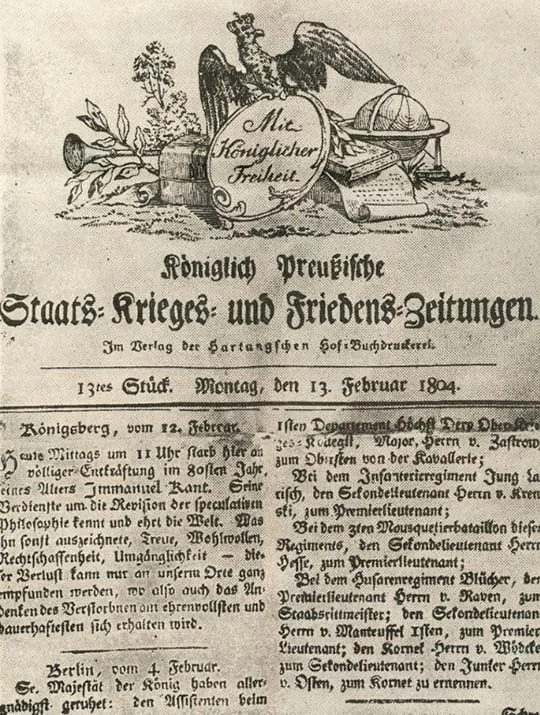
"Royal Prussian State, Peace and War Newspaper".
In 1751 Reusner's printing house was sold to Heinrich Hartung (Johann Heinrich Hartung, 1699–1756) of Erfurt. Thanks to his energy and diligence, Hartung soon became famous not only in Königsberg and Prussia but far beyond its borders.
His son, Gottlieb Hartung (Gotlib Lebrecht Hartung, 1747–1797), moved the printing house from Wood Lane in the Altstadt (see "The Golden Axe" in the section "Altstadt") to Löbenicht, where it is now.
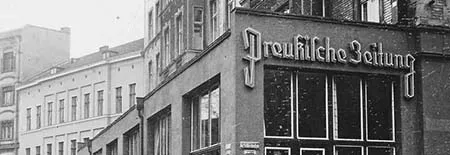
This printing house is now the property of a joint-stock company. It prints the "Königsberg Hartung Newspaper" (Königsberger Hartungsche Zeitung). This is the oldest regular newspaper in Königsberg. Its history begins in 1640, when Johann Reusner received privileges from Elector George William (Georg Wilhelm, 1595–1640). It may be mentioned here that the oldest German newspapers, the "Frankfurt Journal" (Frankfurter Journal) and the "Post Notices" (Post-Avisen), were first printed in Frankfurt am Main not much earlier, in 1615 and 1617 respectively, while the oldest Berlin newspaper, the "Voss Newspaper"1 (Vossische Zeitung), has existed only since 1722. The name of the oldest Königsberg newspaper changed several times: in the 1640s it started out as the "European Mercury" (Europäischer Mercurius), in the 1680s it became simpler and was called the "Ordinary Newspaper" (Ordinari-Post-Zeitung), in 1709–1740 it was the "Royal Prussian Fama" (Königl. Preußische Fama), which came out twice a week. From 1752 it was called the "Royal Privileged Prussian State, War and Peace Newspaper" (Königl. privilegierte Preußische Staats-, Kriegs-, und Friedenzeitung). The paper's masthead was always crowned by the Prussian eagle. Only during the Russian occupation, from 6 February 1758 to 1 July 1762, and later from 19 July to 6 August 1763, was the Prussian eagle replaced by the Russian double-headed eagle. During the unhappy years of the French invasion, 1806–1813, and the years that followed, the newspaper did much to raise patriotic feeling. Among its contributors was the famous philosopher Johann Gottlieb Fichte (Johann Gottlieb Fichte, 1762–1814), who taught at the University of Königsberg from December 1806 to June 1807. In 1813–1816 the newspaper was edited by August von Kotzebue (August Friedrich Ferdinand von Kotzebue, 1761–1819), who was Russian Consul General in Königsberg and was murdered in Mannheim in 1819 by the student Karl Sand (Karl Ludwig Sand, 1795–1820) because of rumours that he was a Russian spy.
From Monastery Yard Square the lane of the same name leads towards the castle. The name of the lane and the square is explained by the fact that from 1521 there was a Franciscan monastery here (Mönchskloster der Franziskaner), whose friars were called "grey monks" (Graumönche) or "brothers of the bull" (Bullatenbrüder). But as early as 1524, when the Reformation began in Königsberg, the monastery was closed.
The preacher of the Altstadt church, Johann Amandus (Johann Amandus), a passionate supporter of Luther (Martin Luther, 1483–1546), called out to his congregation on Easter Tuesday: "The grey monks have eaten and drunk with us long enough. Now let them eat and drink with others."
The people, inflamed by the sermon, rushed to the monastery and wrecked it, driving the friars out into the street. Only the intervention of Albrecht himself (who at that time had not yet become duke and was in his last months as Grand Master — editor's note) saved them from brutal reprisals. The monastery building, however, was promptly adapted as a warehouse for storing grain. In 1827 it burned down and has not been rebuilt to this day. Monastery Yard Lane, which leads to the square of the same name, as well as Bull Lane (Bullatengasse) and Monastery Lane (Klostergasse), have kept names that recall the history of this place: the Catholic Franciscan monastery that stood here in the Middle Ages.
Near Monastery Yard Square the boundary with the Altstadt was formed by the Cat Stream (Katzbach). There were no bridges across it, so it was impossible to get from here to the Wood Bridge (Holzbrücke) over the Pregel, which was entered from Altstadt territory. On the Altstadt side of the Cat Stream, right on the bank of the Pregel, stood the Hospital of the Holy Spirit (Hospital zum Heiligen Geist).
The most important building on Monastery Yard Square is the Municipal Realgymnasium (Städtisches Realgymnasium). This school was founded at the dawn of the Reformation in 1525 and for a long time, under the name of the Latin School (Lateinschule), was run by the Löbenicht church (Löbenichtsche Kirche), standing almost right next to it. In 1810 the school became the Burgher School (Bürgerschule), and in 1859 a first-class Realschule (Realschule 1). In 1859 the school moved from the old building to a new one, whose foundation stone had been laid on 2 September 1855 to mark the 600th anniversary of Königsberg. In 1894 a wing was added to the new building, and in 1895 a gymnasium hall. Since 1882 the school has been called the Realgymnasium.
Behind the Realgymnasium lies a large complex of buildings known collectively as the Löbenicht Hospital (Löbenichtsches Hospital).
The ancient portal of the hospital gate is decorated with a sculpture of an eagle and stands at the corner of Löbenicht Hospital Lane (Löbenichtsche Hospitalgasse) and Monastery Lane. Above the entrance, on a wooden panel, is an inscription in Latin:
Refugium hoc paupertatis
et indigentiae monumentum pietatis
Alberti March. Brandenb.
Flammis ao MDCCLXIV penitus dirutum
e cineribus climentia et liberalitate
Friderici II Magni
in integrum restitutum est.
Sacrum sit posteritati !
Sit illaesum
Vicibus Fortunae.
This refuge of poverty
and want, a monument to the piety
of Albert of Brandenburg,
was entirely destroyed by fire in 1764
and raised from the ashes by the mercy and generosity
of Frederick II the Great.
May it be sacred to posterity!
May it not suffer
from the vicissitudes of fate.
The hospital building originally belonged to a convent founded by Grand Master Winrich von Kniprode (Winrich von Kniprode, c. 1310–1382) after the Battle of Rudau in 1370, in fulfilment of a vow made by his predecessor Dusemer von Arfberg (Heinrich Dusemer von Arfberg, c. 1280–1353) in 1349 before a battle with the pagan Lithuanian tribes. The convent was dedicated to the Virgin Mary and St Benedict. At first it had only 12 Cistercian nuns (a monastic order close to the Benedictines). After the church Reformation, in 1531 Duke Albrecht turned the convent into a hospital for the sick and the poor. It was given the property and revenues of three churches, as well as its own jurisdiction. Instead of the 12 former nuns, the hospital's staff now included six women of noble rank and as many townswomen. All of them had to adhere to the Lutheran faith. Those maintained by the hospital were provided, depending on the means available, with accommodation, food, firewood and money.
Thanks to further donations the hospital expanded considerably. Individual guilds pooled their donations with related guilds, and different departments of the hospital merged with similar ones. Thus the hospital's department for the mentally ill moved to Allenberg after a new building was built there.
The hospital now has 360 places, 60 of them so-called conditional places. Those occupying them receive, besides accommodation, a pension to pay for food, heating and lighting. The 120 full places receive accommodation, fuel, lighting and money. The 180 free places have only accommodation with lighting and heating.
(The hospital buildings stood in the area of the memorial to the Baltic sailors on Moskovsky Prospekt, better known as "the Launch" — editor's note)
In the northern part of the hospital's large quadrangular courtyard stands the modest Hospital Church (Hospitalkirche). In front of its altar is the grave of the famous Prussian historian, writer, cartographer and former preacher of this church, Caspar Hennenberger (died 29 February 1600). All this perished in the fire of 1764.
Frederick the Great donated almost 30,000 thalers to rebuild the hospital, and on 2 June 1771 the new hospital church was already consecrated. Since 1807 services for Lithuanians have been held in it. In 1836 the church was renovated.
Since 1889 services for Old Catholics have been held in it. The cemetery of the Hospital Church lies outside the Sackheim Gate on the Copper Hill (Kupferberg).
(Hennenberger drew up one of the first maps of East Prussia. As for the hospital cemetery, first the House of Culture of the pulp and paper mill was "planted" on it, and later the unfinished building was turned into the City shopping centre on Moskovsky Prospekt — editor's note)
Hospital Street (Hospitalstraße) comes out onto Löbenicht Long Street almost opposite the spot where the Paupers' Steps (Paupersteig) lead off towards the Löbenicht church. Its name recalls the poorhouse (Löbenichtsches Pauperhaus) that stood here from 1615. Boys from poor families were brought up in it. This poorhouse burned down in 1764, but after the fire it was rebuilt at Löbenicht Long Street 50. After the Municipal Orphanage (Städtisches Waisenhaus) opened, the old poorhouse was closed and its building passed into private hands.
Climbing the Paupers' Steps, we find ourselves on Löbenicht Church Square (Löbenichtscher Kirchenplatz), where the Löbenicht church (Löbenichtsche Kirche) stands. It was founded around 1334 and was originally dedicated to St John the Baptist and St Barbara.
Of all three towns of Königsberg, Löbenicht was the last to embrace the evangelical teaching. The first Lutheran sermon, accompanied by the removal of all icons and images of saints from the building, was preached here in 1524 by Pastor Amandus. The local church was rebuilt many times. In 1695, for example, it was struck by lightning, which destroyed the tower with the belfry and the choir. Hardly had it been restored when, in 1707, part of the ceiling collapsed during a service, injuring many, and the wife of the then Obermarschall Friedrich Wilhelm von Kanitz (Friedrich Wilhelm von Kanitz (1656–1719) was killed. In 1764 the church burned down and was consecrated again only in 1776. The king donated 12,220 thalers for the rebuilding and an additional 3,450 thalers for building the pastor's house. During the war with the French in 1807 the Löbenicht church served as a military hospital. On 23 September 1809, in the presence of Queen Louise, the church was consecrated once more. It is built in the shape of a cross, its longitudinal and transverse naves being exactly the same, 36 metres each. The windows are round-arched.
(On a modern map of the city the Löbenicht church would be found on Zaraiskaya Street, south-west of the Wedding Palace — editor's note)
The parish cemetery by the King's Gate (Königsthor) was laid out in 1795. In 1844 it was partly taken over by new fortifications. The new Löbenicht cemetery was laid out in the Sprind area (Sprind).
(On the map of Kaliningrad: beyond the King's Gate on Yuriya Gagarina Street in Tikhy Park — editor's note)
From Löbenicht Church Square several narrow lanes lead to Upper Hill Street (Oberbergstraße), which ended a little further east at the Crown Gate. Here there used to be the Löbenicht Junker and Community Gardens (Junker- und Gemeindegarten); above the entrance to the latter was an inscription:
"Here in the people's garden, they say,
the dark beer is a real treasure!
Whoever doubts me, let him come here
and drink his fill of dark beer!"
Ins diesem Garten insgemein
Sagt man, soll das best Schwarzbier sein.
Wer nicht will glauben, wag daran
Ein Zech, und zey nur friedsam.
Nothing remains of these gardens today (remember that the book was written in the early 1890s — editor's note).
(The Crown Gate led from Löbenicht through the Anger to Sackheim. It is first mentioned in 1506 and was demolished in 1814. The name of the gate is historical; it is linked with the words "Kranker", sick person (remember the local hospital!), and "Krone", the crown in Löbenicht's coat of arms. On a modern map the gate would be found near the Wedding Palace on Zaraiskaya Street — editor's note)
Returning to the western end of Löbenicht Long Street and walking a few steps up the Mill Hill (Mühlenberg), we come upon an ultra-modern example of industrial architecture, the Municipal Power Station (Städtisches Elektrizitätwerk). It was built in 1891 on the grounds of the Municipal Mill Yard (Hof der städtischen Malzmühle) and stands in the very centre of Königsberg, which makes even distribution of electricity possible from here. Electric cables run from it all over the city.
Building this complex cost 980,000 marks. The electric current is distributed by the city administration in the interests of citizens and communities. Electricity consumption in individual houses is recorded by electricity meters.
(This building may have survived the war. At any rate, there was a traction substation for the trams here. It was demolished in connection with the construction of the cascade near the House of Soviets — editor's note)
Löbenicht includes the Anger district (Anger) with the so-called "Footbridges" (Stegen), and several villages and estates outside the town are also assigned to it, including the village of Ponarth (Ponarth).
THE ANGER
The first mention of the Anger in Löbenicht dates from 1506. As its name suggests, the area was meadowland at that time.
(Anger means village green, common pasture, meadow — editor's note)
Time passed, and warehouses and barns began to be built here. The main street, Meadow Street (Mittelanger, now a courtyard area east of Zaraiskaya Street), connects the Rossgarten Market (Roßgärter Markt) and Löbenicht Long Street. From Meadow Street, Dutch Lane (Holländergasse) runs south-east to the New Market (Neuer Markt) on the bank of the Pregel. Dutch Lane used to be called Piglet Lane (Ferkelgasse). The name Dutch Lane may be explained by the fact that in the eastern part of the town, on the banks of the Pregel, there were meadows also called Dutch (Holländerreien) and a tavern, the "Dutch Inn" (Holländer Krug). The tavern's name was later changed to the more aristocratic "Hotel de Holland" (Hotel de Holland). The New Market is a large quadrangular square stretching from Löbenicht Long Street to the Pregel. It was laid out on the site of those very "sheds" (Stegen). That was the name of a residential quarter of ramshackle little houses, demolished in 1811.
(The market was roughly on the site of the building in whose basement floor the Kaliningrad Regional Museum of Fine Arts was housed before it moved to the Stock Exchange building — editor's note)
Of the official buildings in the Anger, one can mention only the Municipal Realschule (Städtische Realschule) on Meadow Street, founded in 1865 as a secondary school. From 1880 it became a higher school, and since 1892 it has borne its present name.
Its building was erected in 1876. (The school stood roughly on the site of the Moskovsky supermarket — editor's note)
Since olden times the eastern boundary of the Anger with Neue Sorge (Neue Sorge) was a long strip used for making ropes, the so-called Ropewalk (Reiferbahn). In the middle of the 18th century Landhofmeister Street (Landhofmeisterstraße, Sergeya Tyulenina Street) arose on its site. Its name comes from the title of Landhofmeister, that is, the title of one of the four Prussian military councillors, and the street is so called because in 1632 Landhofmeister Andreas von Kreytzen (Andreas von Kreytzen, 1579–1641) was given separate jurisdiction over the site next to the Catholic church (Katholische Kirche), where the old chaplain's residence (Kaplanei) had previously stood.
At the southern end of Landhofmeister Street the Löbenicht Stadthof (Löbenichtscher Stadthof) has stood since olden times; the fire brigade (Feuerwehrkommando) is based there. To the north the yard borders on the building of the East Prussian General Agricultural Administration (Ostpreußische Generallandschaft). The General Landschaft should be understood as an agricultural institute (in the sense of an institution — ed.) whose aim is to provide its members with loans at moderate interest. The loans are repaid by amortisation (redemption) at a low interest rate, gradually, over a long period. (Put simply, credit for agricultural enterprises on favourable terms — ed.) Frederick the Great had become convinced of the effectiveness of associations of this kind after carrying out similar projects in Silesia, Brandenburg and Pomerania, where local landowning nobles willingly took part in his experiments.
(Those very Junkers! The most prominent representative of this class was Otto von Bismarck — editor's note)
In 1780 the nobility of East Prussia asked the king to establish a similar credit society but received no answer. The following year the nobles appealed to the king again, but were refused. Frederick the Great could never forgive the people of East Prussia for having sworn allegiance to the Russian empress during the Seven Years' War, thereby breaking their oath to their king.
Frederick the Great's successor, King Frederick William II (Friedrich Wilhelm II, 1744–1797), was more favourably disposed and on 16 February 1788 signed a decree establishing the institution, granting 200,000 thalers from the state treasury for its initial setting-up.
Later, with the aim of covering part of the debts Prussia had incurred as a result of the unsuccessful war (1806–07) by means of bills (mortgage bonds) issued by the East Prussian Landschaft, the membership of this organisation was extended to include royal estates and forests, non-noble properties and, finally, peasant farms with a minimum value of 1,500 marks.
The offices of the General Landschaft were at first on the plot of land bought from von Diereck (von Diereck) at Landhofmeister Street 8–9. Then, in 1806, the plot of the town estate of von Wallenrodt (von Wallenrodt) on the same street was acquired. The administration was run by a board headed by a General-Landschaftsdirektor.
The administration's activities were supervised by the Royal State Government. The supervising official was called the General-Landschaftspräsident. The administration was in charge of the East Prussian Mutual Aid Fund, housed in the same building. A branch of the administration was at Kneiphof Long Street 17. On the administration's main building at Landhofmeister Street 16–18 the inscription "February 1813" was placed together with an Iron Cross, in memory of the famous meeting of the Prussian estates held here (all strata of Prussian society — editor's note), which paved the way for freeing the country from the French yoke.
(This building has not survived. It stood opposite the surviving building of the former Agricultural Bank at Sergeya Tyulenina Street 17–19, which houses services of the Baltic Fleet. The bank building was built around 1899, after the publication of the book whose chapter you have just read, on the site of the dismantled old administration building at Landhofmeister Street 8–9.
When working out house numbers, one should know that in Königsberg, within the fortifications, medieval numbering was retained: the numbers ran in order from the beginning of the street to its end and then continued in order on the other side back to the beginning of the street.
Outside the ring of fortifications, modern numbering was adopted, with even numbers on one side and odd numbers on the other.
As follows from the description, the Anger was a fairly narrow strip stretching from King's Street (Königstraße) to the Pregel. In the west the Anger was bounded by Meadow Street, in the east by Landhofmeister Street — editor's note)
* — Frederick II the Great reigned in 1740–1786. He was born on 24 January 1712 into the royal family of Frederick William I (Friedrich Wilhelm I, 1688–1740). As a child he did not get on with his father, who disliked the boy's artistic nature and his interest in the fine arts. The ever-growing tension between father and son drove the latter to flee. But the attempt failed.
The enraged father decided to punish him as a traitor and imprisoned him in the fortress of Küstrin (Küstrin), and had his accomplice in the escape, a close friend, executed. This broke the son's resistance, and at his father's demand he began to work in the government. After that their relations became untroubled.
In the conquest of Silesia, to which the Brandenburg dynasty had long laid claim, and in other wars (1740–1742, 1744–1745, 1756–1763), especially in the Seven Years' War, Frederick II showed his outstanding abilities, defeating the armies of Austria, France, Russia and Sweden. After the battle of Gross-Jägersdorf on 30 August 1757, when the army of Field Marshal von Lehwaldt, left behind to defend Prussia, was routed by superior Russian forces, the province was occupied for four whole years (1758–1762). Frederick II took it extremely hard that East Prussia, and especially Königsberg, accepted Russian rule without any resistance. He resolved never again to set foot on East Prussian soil.
Of great importance for the development of the Prussian state were the incorporation of part of West Prussia (except Danzig and Thorn) and Ermland, and the signing of the convention on the First Partition of the Polish-Lithuanian Commonwealth in 1772. The newly acquired territories made it possible to establish all kinds of communication between East Prussia and the other provinces of the state and gave a powerful boost to the development of trade.
Thanks to his victories, Frederick the Great became the most prominent figure on the European political stage of his time. The prosperity of the inhabitants of the Prussian state rose markedly during his reign, for which the people deeply respected their king. He also became famous for creating, in 1785, a league of German princes against the claims of Austria. The great monarch died on 17 August 1786.
TRANSLATOR'S NOTE
1. The newspaper, published from 1721, bore the name "Vossische Zeitung" after the publisher and bookseller Christian Friedrich Voss (Christian Friedrich Voß), who bought it in 1751 and made it very popular.
Translated from Russian with the help of AI (Claude, Anthropic), October 2026.